Costs of Child Poverty: A rapid evidence review of the effect of income on child outcomes
Published 5 December 2025

© Crown copyright 2025
This publication is licensed under the terms of the Open Government Licence v3.0 except where otherwise stated. To view this licence, visit nationalarchives.gov.uk/doc/open-government-licence/version/3 or write to the Information Policy Team, The National Archives, Kew, London TW9 4DU, or email: psi@nationalarchives.gov.uk.
Where we have identified any third party copyright information you will need to obtain permission from the copyright holders concerned.
This publication is available at https://www.gov.uk/government/publications/costs-of-child-poverty-a-rapid-evidence-review-of-the-effect-of-income-on-child-outcomes/costs-of-child-poverty-a-rapid-evidence-review-of-the-effect-of-income-on-child-outcomes
DWP research report no. 1113
A report of research carried out by Verian on behalf of the Department for Work and Pensions.
Crown copyright 2025.
You may re-use this information (not including logos) free of charge in any format or medium, under the terms of the Open Government Licence. View the National Archives Open Government Licence or write to the Information Policy Team, The National Archives, Kew, London TW9 4DU, or email psi@nationalarchives.gov.uk
This publication is also available in DWP Research and analysis publications
If you would like to know more about DWP research, email socialresearch@dwp.gov.uk
First published November 2025.
ISBN 978-1-78659-895-0
Views expressed in this report are not necessarily those of the Department for Work and Pensions or any other government department.
Executive summary
Research aims
This rapid evidence review aimed to answer three research questions:
- What is the effect of income on children’s school readiness?
- What is the effect of income on children’s health outcomes?
- What is the effect of income on economic outcomes?
For all three research questions, income had to be received during pregnancy or childhood. To be included in the review, studies needed to use a methodology that could show causality, so it was restricted to Randomised Control Trials (RCTs) and Quasi-Experimental designs (QEDs).
Method
The review was conducted in three stages, with separate searches for each research question. For each question, the reviewers searched academic databases for studies conducted in OECD and/or European countries, which fitted a range of inclusion and exclusion criteria and addressed outcomes of interest. Studies had to employ a robust methodology that could demonstrate the causal effect of income on the key outcomes of interest. Literature needed to be published in English, either in an academic journal or as a working paper.
Results
1. The effect of income on school readiness
The review included 13 studies, covering 15 different programmes (including earnings supplements through increased earnings and retained benefits, welfare benefit payments, one-off lump sums paid on the birth of a baby, unconditional cash transfers, and cash transfers conditional on obtaining preventative medical care) and one study that investigated the effect of loss of family income due to job loss. Of these, seven of the studies described RCTs (five individual studies and two that pooled the results of multiple trials), and six described QEDs.
The studies found that income in childhood has the following causal impacts on Early Years Learning Goals:
-
5 of 12 studies found evidence that income improved cognitive development (communication and language, literacy, maths)
-
2 of 8 studies found that income improved personal, social and emotional outcomes
-
1 of 4 studies found that income improved physical development
-
2 of 2 studies that conducted a combined analysis of multiple RCTs found that income improved school readiness, using an aggregate of outcomes
2. The effect of income on health outcomes
The review included nine studies, covering nine programmes (including both conditional and unconditional cash transfers, changes to welfare payments, tax credits and changes in income due to a localised economic boom). Of these, eight of the studies were QEDs, and one was an RCT.
The studies found that income had the following causal impacts on health outcomes:
-
2 of 4 studies found that income improved physical and/or mental health outcomes
-
0 of 2 studies found that income reduced childhood obesity
-
1 of 1 study found that income reduced the likelihood of future hospitalizations, medical costs and days spent in hospital
-
2 of 3 studies found that income increased birthweight
-
2 of 3 studies found that income improved health outcomes in children under five years old
3. The effect of income on economic outcomes
The review included 12 papers covering 13 studies (one paper included two separate QEDs) and 10 different programmes or sources of income change including annual lump-sum payments, monthly (conditional) cash transfers, monthly scholarship payments, tax credits (leading primarily to increases in earnings), or paternal job loss. Of these, 12 studies were QEDs, and one was an RCT.
The studies found that income had the following causal impacts on economic outcomes:
-
3 of 5 studies found that income in childhood increased employment or earnings from ages 18 to 40
-
1 of 2 studies found that income in childhood reduced income-related welfare receipt in adulthood
-
6 of 6 of studies found that that income improved educational outcomes in children aged from 6 to 15 years, including enrolment, attainment and school completion
-
8 of 11 studies found that income improved educational outcomes in children aged 15 to 18
-
3 of 7 studies found that income improved educational outcomes when the children were aged 18 or older
Conclusion
21 of the 35 studies found at least some evidence of a causal relationship between income change and one of the key outcomes included in this review. Specifically:
-
5 of 13 studies found evidence that income had an effect on school readiness
-
5 of 9 studies found evidence that income had an effect on health outcomes
-
11 of 13 studies found evidence that income had an effect on economic outcomes
The main limitation of this review is the distance of some of the studies from the UK policy context. Although we limited the review to studies in the OECD or Europe, 14 of them were conducted in the US and nine of the studies for Research Question 3 aimed to improve school attendance in Latin America. Only five studies assessed the impact of income changes in the UK. These studies were less likely to identify a causal impact on school readiness or economic outcomes, and found mixed evidence in favour of a causal impact on health outcomes. As a result, additional research is needed to address key evidence gaps on the causal impact of income change on school readiness, health and economic outcomes in the UK context.
Glossary of terms
Confounder
A variable that is associated with both the exposure (e.g. intervention) and the outcome, potentially distorting the true relationship between them.
Earnings supplements
Additional income based on earnings, which may be paid through a combination of increased earnings and retained benefits (for instance, increasing the amount that welfare recipients could keep when they went to work).
Mediation analysis
Statistical analysis used to understand and quantify how an independent variable affects a dependent variable through an intermediary variable (the mediator).
Meta-analysis
A statistical method used to combine and synthesise findings from multiple independent studies to estimate the average effect size.
Quasi-Experimental Design (QED)
A research design that adheres to the structure of an experiment but lacks random assignment to treatment and control groups. It is used when randomisation is either impractical or unethical.
Randomised Controlled Trial (RCT)
Randomised Controlled Trials (RCTs) prospectively and randomly allocate participants to either intervention or control groups. RCTs can robustly evaluate the impact of interventions because they account for both known and unknown factors because allocation to the treatment is random. Measured differences between groups can, therefore, be considered to be the result of the intervention alone. However, the need to ensure rigid implementation of an intervention (high fidelity with the protocol) can reduce its external valid.
Sensitivity analysis
Statistical analysis used to assess how sensitive the results of a model are to change when key assumptions [parameters and inputs] are manipulated.
Statistical significance
A statistically significant result is one that is unlikely to arise solely because of random (or chance) variation. The conventional threshold for a result to be judged as statistically significant is 5% (i.e., p < 0.05). In a trial, this means that there is less than a 1 in 20 chance of the observed results arising if there were no real systematic differences between the groups.
Introduction
On 17 July 2024, the Prime Minister announced the creation of a new Ministerial Child Poverty Taskforce. The role of the Taskforce was to oversee the development and delivery of a cross-government Child Poverty Strategy to reduce and alleviate child poverty. The Child Poverty Taskforce publicly committed to publishing a full Child Poverty Strategy in 2025.
To feed into this, DWP commissioned a Rapid Evidence Review (RER) to understand the evidence base on the relationship between income and child outcomes. DWP wanted to understand the impacts of income for children in low-income families on outcomes including school readiness, economic growth and health.
Specifically, DWP had three research questions:
- What is the effect of income on children’s school readiness?
- What is the effect of income on children’s health outcomes?
- What is the effect of income on economic outcomes?
Research shows that school readiness is a critical indicator of a child’s cognitive, social, and emotional preparedness for school. Children who do not achieve a ‘Good Level of Development’ (GLD) by age five are more likely to struggle with fundamental skills such as communication, language, literacy, and mathematics (UK Health Security Agency, 2015). As part of the Plan for Change: Breaking Down Barriers to Opportunity and Improving the Life Changes of Every Child, the Government has set a milestone to close the opportunity gap by ensuring a record proportion of children start school ready to learn. The goal is to have 75% of five year olds in England achieve a good level of development in the Early Years Foundation Stage assessment by 2028, up from the current 67.7% (UK Government, 2024).
The Department for Education (DfE) statistics show a strong association between area deprivation and school readiness (see Figure 1).[footnote 1] Further, in the 2023 to 2024 academic year, just 52% of pupils eligible for Free School Meals achieved a Good Level of Development, compared to 72% of pupils ineligible for Free School Meals (Explore Education Statistics, 2024). This raises the question of whether the association between income and school readiness is casual.
Figure 1 Percentage of Children with a good level of development by IDACI decile, 2021/22 to 2023 to 2024

Figure 1 uses DfE statistics to show the percentage of children achieving a good level of development across four headline measures by deprivation in England from 2021 to 2022 to 2023 to 2024. Deprivation is measured using IDACI deciles, which rank neighbourhoods by the proportion of children living in income-deprived households. Decile 1 represents the 10% of neighbourhoods with the highest levels of child poverty, while Decile 10 represents the 10% with the lowest levels. Figures are based on the child’s home address.
On 7 July 2024, the UK Government launched its Opportunity Mission: Giving Every Child the Best Start in Life. At the heart of this mission is improving education and health outcomes, recognising that healthier children learn more effectively, and academic success contributes to lifelong health.
The opportunity mission aims to break the link between a child’s background and their prospects by strengthening early childhood health services. Key measures include the expansion of 30 hours of government-funded childcare, broader eligibility for free school meals, and restoring the value of the Healthy Start Scheme.[footnote 2]
Additionally, the government’s 10 Year Health Plan for England aspires to ’raise the healthiest generation of children ever.’ This vision involves shifting the focus from treatment to prevention, tackling the obesity crisis and narrowing the gap in healthy life expectancy between the UK’s richest and poorest regions.[footnote 3]
Another of the UK government’s milestones is to raise living standards in every part of the country, through higher Real Household Disposable Income per person and GDP per capita. There is also evidence that income, economic outcomes, and health outcomes are related: individuals who experience poverty in their childhood earn less as adults, are less likely to be in employment, are more likely to engage in criminal or anti-social activities, and are more likely to experience poor health, which results in a loss in GDP to the nation (Blanden et al., 2010; Villadsen et al., 2023). Obesity in particular has been highlighted by the UK government as a key risk factor for conditions driving health-related economic inactivity.[footnote 4]
Previous research conducted by Cooper and Stewart (2021) supports the hypothesis that household income has a positive causal effect on children’s outcomes, including their cognitive development, social and behavioural development, and their health, particularly in households with persistent low income. However, their review covers a wide range of outcomes, which are assessed across a wide range of age groups, and it does not include the full range of economic outcomes (only high school and university attendance and graduation).
DWP sought to establish whether there is a causal connection between income and school readiness, health, and economic outcomes. This research also explored the effect size, assessing the extent to which increased income contributes to improved outcomes and whether the source of the income has a differential impact on these outcomes.
Methods
Inclusion and exclusion criteria
DWP and Verian set inclusion and exclusion criteria to maximise the relevance of the findings related to DWP’s three research questions: school readiness, health outcomes and economic outcomes. For this reason, the inclusion and exclusion criteria differed for each research question.
Across all three research questions, the reviewers searched for studies conducted in the Organisation for Economic Co-operation and Development (OECD) and/or European countries. Included studies had to have a stated aim of testing the effect of financial resources (or lack thereof), with financial resources measured at the individual or household level. Literature needed to be published in English in an academic journal or in a working paper. Additionally, during the paper selection, DWP and Verian prioritised studies with robust methodologies like RCTs and QEDs above research that analysed longitudinal data with fixed effects.
The specific inclusion and exclusion criteria for each research question are set out below.
Research Question 1 – School readiness
For Research Question 1, school readiness outcomes had to align with the early learning goals in the UK Early Years Foundation Stage framework: Communication and Language, Literacy, Mathematics, Personal, social and emotional development (PSE) and Physical development. Studies had to include outcome measures taken from children aged approximately five years old and under (studies including first or second year of schooling were included when the effect of income on school readiness was demonstrated, to compensate for the lack of studies focussing on this age group in some areas). See details of inclusion and exclusion criteria in Table 1.1.
Table 1.1: Inclusion and exclusion criteria for research question 1
| Category | Inclusion | Exclusion |
|---|---|---|
| Population of interest[footnote 5] |
OECD and/or European countries Outcome measures taken from children aged approximately five and under |
Non-OECD / non- European countries Outcome measures taken from children over 10 |
| Methodology | Randomised controlled trials, Quasi-experimental designs, meta-analyses[footnote 6] Stated aim of testing the effect of financial resources (or lack thereof) Financial resources measured at individual or household level |
Literature reviews which do not include a meta-analysis, qualitative research and studies that do not allow the inference of causality (e.g. correlational or pre-post studies) |
| Outcomes | Outcomes related to ‘school readiness’, which include (but are not limited to): the early learning goals in the Early Years Foundation Stage framework | Outcomes unrelated to ‘school readiness’ |
| Reporting | Written in English Research published in an academic journal from 1997 onwards[footnote 7] Working papers published within the last 8 years (since 2017) |
Not written in English Research published pre 1997 Working papers published over 8 years ago |
Research Question 2 – Health outcomes
For Research Question 2, health outcomes could include (but were not limited to): obesity, oral health, physical health, mental health, early years health, hospital admissions, birthweight, and infant mortality rates. Studies had to include health outcomes for children aged up to approximately 19 years old, or adult health outcomes in studies that specifically explored the long-term effects of differential income during childhood. See details of inclusion and exclusion criteria in Table 1.2.
During the literature extraction process, DWP and Verian prioritised studies from countries with single-payer healthcare systems to provide data that were more relevant to the UK.
Table 1.2: Inclusion and exclusion criteria for Research Question 2
| Category | Inclusion | Exclusion |
|---|---|---|
| Population of interest |
OECD and/or European countries Countries with Single-Payer Healthcare systems will be prioritised during evidence selection |
Non-OECD/non- European countries |
| Methodology | Randomised controlled trials, Quasi-experimental designs, meta-analyses Stated aim of testing the effect of financial resources (or lack thereof) Financial resources measured at individual or household level |
Literature reviews which do not include a meta-analysis; qualitative research; and studies that do not allow the inference of causality (e.g. correlational or pre-post studies) |
| Outcomes | Outcomes related to ‘health’ in children aged up to approximately 19, which include (but are not limited to): Obesity, Oral health, Physical health, Mental health, Early Years health, Hospital admissions, Birthweight and Infant mortality rates Outcomes which are measured in adults to explore the long-term effects of differential income during childhood |
Outcomes unrelated to health Outcomes in adults over the age of 19, unless they specifically explore the long-term effects of differential income during childhood |
| Reporting | Abstract written in English Focus of research within the last 50 years Research published in an academic journal from 2017 onwards Working papers published within the last 8 years (since 2017) |
Not written in English Focus of the research over 50 years ago Research published in a academic journal pre-2017 Working papers published over 8 years ago |
Research Question 3 – Economic outcomes
For Research Question 3, economic outcomes could include (but were not limited to): earnings, employment or unemployment, job retention, welfare dependency, debt, labour market supply, and in-work progression. DWP and Verian also included educational outcomes that are known to be related to economic outcomes, such as high-school and university graduation rates. See details of inclusion and exclusion criteria in Table 1.3.
Table 1.3: Inclusion and exclusion criteria for Research Question 3
| Category | Inclusion | Exclusion |
|---|---|---|
| Population of interest |
OECD and/or European countries Countries with Single-Payer Healthcare systems will be prioritised during evidence selection |
Non-OECD/non- European countries |
| Methodology | Randomised controlled trials, Quasi-experimental designs, meta-analyses Stated aim of testing the effect of financial resources (or lack thereof) Financial resources measured at individual or household level |
Literature reviews which do not include a meta-analysis; qualitative research; and studies that do not allow the inference of causality (e.g. correlational or pre-post studies) |
| Outcomes | Outcomes related to ‘health’ in children aged up to approximately 19, which include (but are not limited to): Obesity, Oral health, Physical health, Mental health, Early Years health, Hospital admissions, Birthweight and Infant mortality rates Outcomes which are measured in adults to explore the long-term effects of differential income during childhood |
Outcomes unrelated to health Outcomes in adults over the age of 19, unless they specifically explore the long-term effects of differential income during childhood |
| Reporting | Abstract written in English Focus of research within the last 50 years Research published in an academic journal from 2017 onwards Working papers published within the last 8 years (since 2017) |
Not written in English Focus of the research over 50 years ago Research published in a academic journal pre-2017 Working papers published over 8 years ago |
Literature searches
DWP’s Research Library Team conducted the literature searches using the EBSCO and Web of Science databases. To facilitate this process, for each research question Verian produced a search protocol, which contained detailed inclusion and exclusion criteria a suggested search string (see Annex A – Search Strings for details).
For each research question, DWP’s Research Library Team piloted and then revised the proposed search string, and Verian screened the first 50 records (ranked in order of relevance) to ensure the search was generating relevant results. DWP’s research library team then revised the search string and shared additional results with Verian. For Research Questions 2 and 3, there was an upper limit of 500 records for screening.
Research Question 1 – School readiness
For Research Question 1, the initial search string generated 639 records. Following a discussion between DWP and Verian, the search string was revised and re-run, which identified 480 records for screening.
DWP’s Research Library Team also conducted follow up searches using a set of amended search strings, which generated an additional 369 records for screening. Full details of the initial, revised, and additional search strings can be found in Annex A – Search Strings.
DWP and Verian identified an additional 61 records via citation tracking and the 54 papers that were included in Cooper and Stewart’s (2021) systematic review were also screened.
The Institute for Fiscal Studies (IFS) shared information on one additional record which explored the impact of the two-child limit on school readiness (Cattan et al., 2025).
Research Question 2 – Health outcomes
For Research Question 2, the initial search string generated 945 records. Following a discussion between DWP and Verian, the search string was revised and re-run, which identified 941 records. Full details of the initial and revised search strings can be found in Annex A – Search Strings.
DWP and Verian identified an additional 13 records via citation tracking.
DWP ordered these records by relevance and Verian screened the first 500.
Research Question 3 – Economic outcomes
Finally, for Research Question 3, the initial search string generated 631 records. Following a discussion between DWP and Verian, the search string was revised and re-run, which identified 897 records for screening. Full details of the initial and revised search strings can be found in Annex A – Search Strings.
DWP and Verian identified an additional seven records and one relevant record was shared by stakeholders during the review process.
DWP ordered these records by relevance and Verian screened the first 500.
Paper selection
During the paper selection, DWP and Verian prioritised studies with robust methodologies like RCTs, QEDs or meta-analyses over research that analysed longitudinal data with fixed effects
Research Question 1 – School readiness
In total, Verian researchers screened 965 records for Research Question 1. From these, Verian researchers identified 23 records as likely to be relevant following the screening process (see Annex B – PRISMA Flow Charts for details on the screening process).
In total, Verian researchers and DWP selected 13 papers for data extraction and quality appraisal.
Research Question 2 – Health outcomes
In total, Verian screened 500 records for Research Question 2. Verian researchers identified 50 records as likely to be relevant following the screening process (see Annex B – PRISMA Flow Charts for details on the screening process).
Following discussion between Verian and DWP, the researchers selected 10 papers in total for data extraction and quality appraisal.[footnote 8]
Research Question 3 – Economic outcomes
In total, Verian screened 500 records for Research Question 3. Verian researchers identified 32 records as likely to be relevant following the screening process (see Annex B – PRISMA Flow Charts for details on the screening process).
Following discussion between Verian and DWP, the researchers selected 12 papers for data extraction and quality appraisal.
Data extraction
Verian extracted data into a template structured around the PICO (Population, Intervention, Comparison, and Outcomes) framework that was modified for each research question. Verian conducted quality appraisal for individual RCTs using the Risk of Bias 2 (RoB2) framework, which rates the risk of bias in five domains as ‘Low’, ‘Some concerns’, or ‘High’ (Higgins et al., 2019). For QEDs, Verian conducted quality appraisal using the Risk Of Bias In Non-randomised Studies - of Interventions (ROBINS-I) framework, which rates the risk of bias in seven domains as ‘Low’, ‘Moderate’, ‘Serious’, or ‘Critical’ (Sterne et al., 2019).
Studies which are assessed with RoB2 as having a ‘High’ risk of bias have substantial methodological concerns in at least one domain, or some concerns in multiple domains in a way that substantially lowers confidence in the study’s result. Studies which are assessed with ROBINS-I as having ‘Serious’ risk of bias have serious methodological concerns that are likely to affect the ability to draw valid conclusions from the study in at least one domain, but not a critical risk of bias in any domain. Evidence from studies that Verian identified as having a critical risk of bias were excluded.
The effect of income on school readiness
Results
Overview of evidence found
The review covers 13 papers: 12 published in academic journals and one from the grey literature. Seven describe RCTs (five individual studies and two papers that conducted a joint analysis of several RCTs), and six describe QEDs. Papers cover the countries, methodologies and types of income change set out in Table 1.4 Table.
Table 1.4. Summary of the countries covered, intervention types and methodologies used by the 13 papers included in the review
| Country | Number RCT of papers | Number of QED papers | Type of income change | Country |
|---|---|---|---|---|
| USA and Canada | 2 (both analysing multiple RCTs) | 0 | Earnings supplements | USA and Canada |
| USA | 4 | 1 | Earnings supplements (RCT) |
|
| Unconditional cash transfer[footnote 9] (3 RCTs) Welfare benefit payment (QED) |
USA | |||
| Canada | 0 | 1 | Welfare benefit payments | Canada |
| Australia | 0 | 1 | Lump-sum payment | Australia |
| Ireland | 0 | 1 | Employment income | Ireland |
| Mexico | 1 | 0 | Conditional cash transfer | Mexico |
| Spain | 0 | 1 | One-off payment | Spain |
| UK | 0 | 1 | Welfare benefit payments | UK |
| Total | 7 | 6 | - | Total |
The papers draw data from 15 programmes. The two papers (Clark-Kauffman et al., 2003; Duncan et al., 2011) which conducted a combined analysis of multiple RCTs focused on the following programmes:
-
the New Hope Project (the subject of both combined studies) – a programme in Wisconsin, USA, including a cash supplement to bring full-time parents’ income to the poverty line, childcare and health insurance subsidies, and community service jobs
-
Canadian Self-Sufficiency Project (SSP: two programmes – SSP and SSP Plus; the subject of both combined studies) – two programmes providing monthly cash transfers to single-parent, long-term Income Assistance recipients in full-time work; SSP Plus also included voluntary employment services
-
Connecticut Jobs-First (the subject of both combined studies) – a conditional cash assistance programme in Connecticut, USA, providing financial work incentives (through earned income disregard) conditional on participation in employment services
-
Minnesota Family Investment Program (MFIP: two programmes – full MFIP and MFIP incentives only) – two programmes in Minnesota, USA, including an earning supplement, childcare subsidies, and relaxed eligibility thresholds for cash assistance; full MFIP also included employment services
The remaining studies focus on the following programmes:
-
the Australian Baby Bonus (Australia) (QED) (Gaitz & Schurer, 2017) – a one-off conditional cash transfer to parents following the birth or the adoption of a child after July 1, 2004; it was initially paid regardless of income, but after January 1, 2009, only low-income families were eligible
-
Baby’s First Years (US) (the subject of three RCTs: Hart et al., 2024; Noble et al., 2024; Troller-Renfree et al., 2024) – an unconditional cash transfer programme, paying mothers a small or large monthly amount for the first 6 years of their children’s lives
-
Canada child benefit (Canada) (QED) (Milligan & Stabile, 2011) – a system comprising two main benefits: the Canada Child Tax Benefit, paid monthly for one year dependent on parent’s net income, and the National Child Benefit Supplement, providing child benefits and services that varied by province
-
Parental job loss (Ireland) (QED) (Mari & Keizer, 2021) – effects of a decrease in income from earnings, in Ireland
-
Minnesota Family Investment Program (MFIP: two programmes) (US) (Gennetian & Miller, 2002) – two programmes in Minnesota, USA, including an earning supplement, childcare subsidies, and relaxed eligibility thresholds for cash assistance; full MFIP also included employment services
-
Oportunidades (Mexico) (RCT) (Fernald et al., 2008) – a conditional cash transfer programme in Mexico, paid to families in poverty conditional on family attendance at health check-up and children’s attendance at school
-
the Spanish Baby Bonus (Spain) (QED) (Borra et al., 2021) – a one-off unconditional cash transfer to Spanish mothers with a child born after July 1st, 2007, and additional subsidies for lower-income families and mothers or children with disabilities
-
Supplemental Security Income (SSI) (US) (QED) (Guldi et al., 2024) – a monthly cash transfer, making up around 45% of a family’s income, for families with children with a low birthweight (under 1,200g)
-
the introduction of a two-child limit to Universal Credit (UC) and Child Tax Credit (CTC) (UK) (QED) (Cattan et al., 2025) – from 6 April, 2017, households no longer received additional benefit amounts for third or subsequent children
Income change was delivered through one-off payments, monthly cash transfers, earnings supplement programmes, parental job loss or withdrawal of a welfare benefit.[footnote 10]
Studies included in this REA assessed cognitive development (including early years goals around language and communication, literacy, and maths), personal, social and emotional development (PSE development), or physical development. Across studies, these outcomes were collected through a mix of parental reports and teacher reports of development, standardised tests (academic and psychometric), and brain activity. Children were aged between 9 months and 12 years old when the outcomes were measured; they were most commonly 4 to five years old (ten were in this range, eight looked at children who were older than 5 years and four at children who were younger than 4 years.[footnote 11]
Table 2.4 in the ‘Costs of Child Poverty Research - Report tables’ spreadsheet contains a summary of study characteristics for each study. The spreadsheet includes Tables 2.5 and 2.6, which summarise the individual studies and tables showing the individual programmes (and their evaluations) included in Duncan et al. (2011) and Clark-Kauffman et al. (2003). Note that Clark-Kauffman et al. (2003) contains all the programmes that are included in Duncan et al. (2011), with the addition of the two Minnesota Family Investment Programmes.
Quality of evidence
Randomised controlled trials
Of the five individual RCT studies:
-
one was judged to have a High risk of bias (Fernald et al., 2008)
-
two had Some Concerns of bias (Gennetian & Miller, 2002; Troller-Renfree et al., 2024)
-
two had Low risk of bias (Hart et al., 2024; Noble et al., 2024); see Table 2.1 in the ‘Costs of Child Poverty Research - Report tables’ spreadsheet for a summary of results
The High risk of bias in the study of the Mexican conditional cash transfer programme ‘Oportunidades’ was attributed to missing outcome data (Fernald et al., 2008). For this study, the sample ranges from 2913 to 3793 for different outcomes, but there is no information about which groups are missing outcome data or any detailed discussion of why.
Quasi-experimental designs
Of the five QEDs reviewed for risk of bias:[footnote 12]
-
three of the published QEDs had overall judgements of Serious risk of bias (Gaitz & Schurer, 2017; Guldi et al., 2024; Milligan & Stabile, 2011)
-
two have Moderate risk of bias (Borra et al., 2021; Mari & Keizer, 2021); see Table 2.2 in the ‘Costs of Child Poverty Research - Report tables’ spreadsheet for a summary of results
These judgements reflect standard problems that are known to lead to bias in QEDs: QEDs are, in general, more likely to be biased than RCTs, and the quality assessments of the studies reflects that. However, despite an inherent risk of bias, QEDs offer a valuable alternative to RCTs by allowing researchers to study real-world interventions, policy changes, and naturally occurring groups when randomization is impractical or unethical.
Two studies are at Serious risk of bias from confounders (Gaitz & Schurer, 2017; Milligan & Stabile, 2011). Confounders are unmeasured variables that have a causal influence on both the outcome and the probability of receiving the intervention, which is often a problem for QEDs (but are not a problem for RCTs, where assignment to treatment is random). The study of the Australian baby bonus does not account for confounders that are likely to cause upwards bias in the estimates (Gaitz & Schurer, 2017); in the study exploring the effect of variation in Canadian Child Benefit, the reviewers cannot confidently state in which direction the confounders would bias the result (Milligan & Stabile, 2011).
The study of the impact of eligibility for US Supplemental Security Income is at Serious risk of bias due to selection of results (Guldi et al., 2024). Some risk of bias in selection of results is usual for QEDs because the existence of a pre-registered analysis plan is an important criterion, but such analysis plans are rarely publicly available for non-randomised studies. This study was rated as Serious risk of bias because, as well as there being no preregistration, the study reports multiple analytical methods (parametric/non-parametric and models with different specifications of variables) with no indication of how these were selected nor whether they were chosen from multiple analyses/models beyond those shown in the paper.
Is there a causal relationship between income and school readiness?
Five studies covering eight programmes (and one study looking at the effect of lost income due to job loss) found a causal relationship between income and outcomes related to the early years learning goals, such as cognitive, personal, social and emotional or physical development. Eight studies covering six programmes found no evidence of a causal relationship. Four studies were rated as having a High or Serious risk of Bias. Among the 9 studies that were rated as a low or moderate risk of bias (or not assessed), three found evidence of a causal impact of income change on school readiness. See Table 2.3 in the ‘Costs of Child Poverty Research - Report tables’ spreadsheet for details of all 13 studies (for additional detail, please refer to Table 2.4).
Results are presented by early learning goals, although cognitive outcomes (communication and language, literacy, and maths) are combined, since it can be difficult to separate the three, given the outcome measures used in the studies. However, it is worth noting that generally studies reviewed here either found a statistically significant effect of income on school readiness for all domains that they measured or no statistically significant effect for any of the domains measured, with some nuances. Studies were most likely to measure cognitive outcomes and least likely to measure physical development.
Cognitive outcomes (communication and language, literacy, maths)
Twelve studies assessed the impact of changes in income on cognitive outcomes. Five of the studies found evidence of a causal relationship between income and development, whilst the remaining seven did not.
The two studies that conducted a combined analysis of multiple RCTs on earnings supplements in the USA and Canada found that additional income increased cognitive achievement, which was a combination of cognitive performance and school attainment measures.[footnote 13] Earnings supplements had a positive effect on cognitive achievement for children who were two to five and five to eight years old at time of measurement (nought to two and three to five years old at baseline) in Clark-Kauffman (2003). There was a positive effect of additional income on cognitive achievement across all the studies in Duncan (2011), although only two of the four individual earnings supplement programmes showed an impact when considered individually.[footnote 14] One of the programmes that did not find an impact was also assessed as a single study in this review, an RCT that found no effect of welfare benefits on maternal responses to questions about how well their child was doing in school overall, four questions about child’s level of engagement at school, and a question about grade repetition/ suspension/ expulsion (Gennetian & Miller, 2002).
Three RCTs, all evaluations of the Baby’s First Years programme in the USA, found predominantly no statistically significant impacts of a high monthly cash transfer of USD 333 on cognitive outcomes, relative to low monthly cash transfer of USD 20. There was no effect on language development at one year old, nor child development status at two and three years (Hart et al., 2024). There was no effect at four years old on any of language development, executive function or pre-literacy skills (Noble et al., 2024). There was no evidence for the pre-registered composite outcomes around brainwaves, measured at age 4; although there was some exploratory analysis showing increased alpha activity, which is related to attention and executive function (Troller-Renfree et al., 2024).
The fifth RCT, a conditional cash transfer in Mexico, showed an effect of the transfer on cognitive development and language development for those who received payments for an extra 18 months (Fernald, 2008).
Two QEDs found an impact of income on cognitive development, including elements of communication and language, literacy, and maths.
Additional income from Canadian welfare benefits led to an increase in cognitive development scores for boys with mothers who only had high-school education or less (Milligan & Stabile, 2011). Specifically, there was an increase in vocabulary scores for boys aged four to six (but not girls) with mothers whose education was high-school or less (but not for the full general population sample). There was also an effect on maths scores for boys aged 6 to 10[footnote 15] (but not girls) for those with mothers who only had high-school education or less (but not for full sample with all levels of education).
Children in Ireland who experienced paternal job loss between the ages of one and three years may have had lower scores on tests of vocabulary at age 3 via the channel of parental income alone (Mari & Keizer, 2021). This result is from a ‘mediation analysis’, which tests the causal chain that underpins an effect. We should be somewhat cautious in interpreting it, given that there were no overall differences in vocabulary between those children whose fathers lost their jobs and those whose fathers remained in employment. Further, the authors ran multiple models and there were no mediation effects of loss of income from maternal job loss, even though there were decreases in vocabulary scores at age 5 for those children who had experienced maternal job loss (compared to those who had not). The authors note that children who experienced parental job loss are less likely to be in childcare schemes and offer that as an explanation for their mixed results.
Four other QEDs found no effects of income on cognitive development.
A study of the effect of the two-child limit on Universal Credit and Child Tax Credit in the UK found that it had no effect on the Good Level of Development (GLD) indicator in Foundation Stage Profile measured in Reception at four to five years old (Cattan et al., 2025). This consists of a pass/fail score on each of the 12 early learning goals, so it is a composite of all domains on pass/fail criterion. There was no effect on a general population sample of children from families with any incomes; and there was also no effect when restricting the sample to children who are eligible for Free School Meals.
There was no effect of eligibility for Supplemental Security Income on child development, as measured by the Bayley’s Mental T-score (which includes object permanence, memory, problem solving, and language-related abilities) or the NCATS Child score (which measures responsiveness to parental cues), in a regression discontinuity design (RDD) in the USA (Guldi et al., 2024). Outcomes were measured at 9 months; families who received the supplement would have been eligible from the birth of the child.
There was no effect of either of the Baby Bonus schemes on cognitive development: or skills (language, literacy, and numeracy) (Gaitz & Schurer, 2017). There was no effect of the Spanish Baby Bonus payment on Spanish and mathematics student performance in second grade, i.e., at ages 7 or 8 (Borra et al, 2021).
Personal, social and emotional outcomes
Out of the eight studies that specifically measured personal, social, and emotional (PSE) outcomes, two found a causal effect of income on these outcomes and six (including the three RCTs of different outcomes from Baby’s First Years, so only four separate programmes) found no statistically significant effect of income on PSE outcomes. (Noting that the two papers that combined multiple RCTs and found positive effects also have included some PSE results, but they used combined measures in the analysis and are not included in eight studies in this section; Clark-Kauffman, 2003, and Duncan, 2011.)
Amongst those who received welfare benefits in Canada, there were effects of variation in child benefits on PSE outcomes in the full sample, with similar patterns (but larger standard errors) in the sample whose mothers had lower levels of education (high school or less) (Milligan & Stabile, 2011). Higher income causes decreases in aggression, including both physical violence (measured by conduct disorder-physical aggression) and social conflict (indirect aggression). There is an impact in the full sample and in the sample where the mothers have lower-education; and in the lower-education sample the result is driven by the girls. Effects on emotional outcomes were more mixed, with increased income leading to decreases in hyperactivity-inattention and emotional disorder-anxiety in the full sample (but not the sub-samples) and no statistically significant effect on pro-social behaviour.
Experiencing income loss due to parental job loss had a negative effect on PSE outcomes at three years old, one to two years after the job loss (Mari & Keizer, 2021). A mediation analysis suggests that the income differences triggered by job loss increased internalising (emotional and peer) problems by .03 SDs (p = .058) and externalising (conduct and hyperactivity) problems by .04 SDs (p = .008).
Some of the studies that found no statistically significant effects on cognitive development also found no statistically significant effects on PSE outcomes.
The three studies of the unconditional monthly cash transfer programme, Baby’s First Years, all found no statistically significant effect of the cash transfer on PSE outcomes: Child Behaviour Checklist (maternal report) (Noble et al., 2024); Brief Infant–Toddler Social–Emotional Assessment (Age 1 and 2) and the Child Behaviour Checklist (Age 3) (Hart, 2024); and beta and gamma brainwaves (Troller-Renfree, 2024).
There was no statistically significant effect of welfare benefits in the USA on the Behavioural Problems Index nor the Positive Behaviour Scale (both based on maternal responses) or an indicator of whether the mother had been contacted by school regarding behavioural problems since assignment; in an RCT that found no statistically significant effects across the board (Gennetian & Miller, 2002). There was also no statistically significant effect of the Australian Baby Bonus scheme on PSE (Strengths and Difficulties Questionnaire) (Gaitz & Shurer, 2017).
PSE outcomes were also assessed as part of the GLD indicator in a study of the effect of the two-child limit on Universal Credit and Child Tax Credit in the UK (Cattan et al., 2025). As highlighted in the previous section, there was no effect on a general population sample of children from families with any incomes; and there was also no effect when restricting the sample to children who are eligible for Free School Meals.
Physical development outcomes
Four studies investigated outcomes related to gross motor skills; one study found an effect while three did not. Conditional cash transfers led to an increase in endurance but not motor skill in a study that had positive results relating to other early learning goals (Fernald, 2008).
Two studies that found no statistically significant effects in other domains also found no statistically significant effect of income on physical development outcomes. Eligibility for supplementary welfare benefits was not associated with an increase in gross motor skills, in a study that also found no statistically significant effect on cognitive outcomes (Guldi, 2024). Similarly, the Australian Baby Bonus did not improve physical outcomes including motor skills, in a study that also found no statistically significant effects on cognitive outcomes and PSE (Gaitz & Schurer, 2017).
Physical outcomes were also assessed as part of the GLD indicator in a study of the effect of the two-child limit on Universal Credit and Child Tax Credit in the UK (Cattan et al., 2025). As highlighted in the previous section, there was no effect on a general population sample of children from families with any incomes; and there was also no effect when restricting the sample to children who are eligible for Free School Meals.
Source of extra income
Neither of the two studies that evaluated the effect of lump-sum payments established a causal effect (Borra et al., 2021; Gaitz & Schurer, 2017). The Australian Baby Bonus programme (Gaitz & Schurer, 2017) and the Spanish Baby Bonus programme (Borra et al., 2021) both gave one-off payments after the birth of a child (AUD 3,000/ EUR 2,500, or AUD 5,150/ EUR 3,540 adjusted for 2025 inflation). Any family in the population with a baby born at the right time would have qualified for the programmes, there were no income restrictions. Neither evaluation demonstrated a statistically significant effect of the payment on school readiness.
The remaining studies all delivered extra income via a regular payment over a sustained period. Four positive studies covered seven programmes with transfers made for a period of 18 months to five years, targeted at low-income families, and found a clear positive effect of income on school readiness from earning supplements (Clark-Kauffman, 2003; Duncan, 2011), benefits payments (Milligan & Stabile, 2011), conditional cash transfers (Fernald, 2008). A fifth found a negative effect of a change in income due to parental job loss one to three years before the outcome measures were taken (Mari & Keizer, 2021). Six studies (covering three programmes) that analysed the effect of regular payments to low-income families over a sustained period did not find an impact on outcomes related to school readiness. These studies explored the Baby’s First Years programme (a monthly cash transfer) (Hart et al., 2024; Noble et al., 2024, Troller-Renfree et al., 2024); the UK two-child limit on benefits (welfare payment), including when restricting the sample to children eligible for Free School Meals (Cattan et al., 2025); earnings supplements (Gennetian & Miller, 2002), and Supplemental Security Income Programme (welfare payment) – though this last was only paid for 9 months before outcome measurements (Guldi et al., 2024).
Both papers that combined multiple RCTs found that income is more important than other elements of welfare-to-work schemes (Clark-Kauffman et al., 2003; Duncan et al., 2011). Clark-Kauffman (2003) found only earnings-supplement programmes increased school readiness, but not mandatory employment services, such as education, training, or immediate job search in which parents were required to participate to be eligible to receive cash welfare benefits. However, the impact of the programmes on family income ranged from USD 1,500 to USD 2,000 per year for the families enrolled in the earnings-supplement programmes, but never exceeded USD 250 per year for families enrolled in the other programmes. Similarly, Duncan (2011) found that the impacts of the programmes on family income were positive and statistically significant only for the earnings supplement programmes. Programmes that focussed on maternal education or childcare use increased neither income nor school readiness.
Scale of impact
Three papers provide estimates of effect sizes that give an idea of how the effect varies with the size of the change in annual income – though note that income is nominal and has not been adjusted for inflation since the time of publication of the papers.
Duncan et al (2011) assessed the relationship between variation in income and cognitive achievement across all of the different programmes in their paper. They found that a USD 1,000 increase in annual income sustained for between 2 and 5 years boosts cognitive achievement by 6% of a standard deviation (Adjusting for 2025 inflation, this income would be about USD 1,410 in 2025 or GBP 1,090[footnote 16]).They explain this in terms of one of the achievement tests they used, the Bracken Basic Concept Scale, where the effect size translates into about one additional correct answer to a 61 question test. (For comparison, half a standard deviation would be six additional correct answers.) They also say that an effect size of 6% of a standard deviation would translate into around an increase of 1 point on an IQ scale. (For comparison, half a standard deviation would be 8 IQ points.)
Milligan and Stabile (2011) found that an increase of CAD 1,000 from the Canadian Child Benefits programme (which would be about CAD 1,580 in 2025, or GBP 850),[footnote 17] received for between 2 and 5 years, led to a change of 6 to 10% of a standard deviation on PSE scores of 4 to 10 year olds across their full sample. For each CAD 1,000 (in 2011 nominal amounts) of income there were reductions of: 6.8% of a standard deviation for hyper-activity inattention, 9.6% of a standard deviation for emotional-disorder-anxiety and 10% of a standard deviation for conduct-physical aggression scores. Looking at the sub-groups that have stronger effects on PSE – the girls with lower-education mothers – there were reductions of 16.4% of a standard deviation in conduct-physical aggression and 21.7% of a standard deviation in indirect aggression scores, again per CAD 1,000 of income in 2011 prices. For cognitive achievement, there are no effects over the full sample, but again, focussing on the subgroup of those whose mothers were lower-educated found larger effects: there 6.9% of a standard deviation in maths scores of 4 to 10 year olds whose mothers had high-school education or less per CAD 1,000 of income in 2011 prices. Narrowing the focus further, to include gender of the child of the lower-education mother, increased the effect size in the relevant subgroup: 23.1% of a standard deviation for boys’ maths scores, and 36.5% of a SD for boys’ vocabulary scores.
The earnings supplement programmes evaluated by Clark-Kauffman (2003) had a positive effect of 8% of a standard deviation across all programmes on cognitive achievement (for those aged nought to two and three to five years old at baseline). Unlike the two studies above, the percentage increase is the effect of being in the programme, not an effect per USD 1000 income. The impact of the earnings supplement programmes ranged from USD 1,500 to USD 2,000 per year (about USD 2,700 to USD 3,600, or GBP 2,080 to 2,780 in 2025 prices[footnote 18]).
The mediation analysis of Mari and Keizer (2021) found effect sizes in a similar range, of 3 to 4% of a standard deviation.
If the effect of providing a USD 1,400 (equivalent to GBP 1,090, both in 2025 prices) increase in annual income (identified by Duncan et al. (2011) is applied to the Good Level of Development (GLD) at the end of the Early Years Foundation Stage (EYFS), a 6% standard deviation improvement would translate to a 3-percentage point increase in the GLD pass rate for children eligible for free school meals (FSM).[footnote 19] For example, based on 2023 to 2024 data, this would raise the pass rate from 51.5% to 54.5%.
Looking across the range of effects found in the review, the impact on GLD pass rates for FSM-eligible children could vary between 1.5 and 5 percentage points, depending on the strength of the intervention.
These estimates are based on translating effect sizes from studies using different outcome measures, to illustrate what they might mean for GLD achievement. However, the actual impact could vary depending on the measure used.
These translations into impact on the GLD all have the caveat that the scale of impact might vary considerably between different measures, especially when expressed purely in terms of variance: the calculations show what the impact would be if an increase in income had an impact of the same scale on the GLD. However, one cannot infer that an increase in income for these children would lead to improvements in GLD of this magnitude.
Conclusion – The effect of income on school readiness
Three papers reporting RCTs demonstrated a causal relationship between increases in income and school readiness. Two papers that analysed multiple RCTs across the USA and Canada identified an effect of earning supplement programmes on cognitive development and school attainment (Clark-Kauffman et al., 2003; Duncan et al., 2011). Similarly, Fernald et al. (2008) identified a causal impact of a conditional cash transfer on cognitive development and language development. However, the remaining 4 RCTs (which cover two different programmes) did not find a causal relationship. It is plausible that this difference is due to the comparatively small sample size of these four studies. The papers that combined multiple studies had sample sizes of tens of thousands of participants and Fernald et al. (2008) had a sample of 2,449, but the four RCTs that did not find a relationship all had sample sizes of 1,000 or fewer. For example, Baby’s First Years was designed to have the power to detect an impact of 0.207 standard deviations (20.7% of a standard deviation) on cognitive functioning and family processes (Noble et al., 2024). The sizes of the (non-statistically significant effects) were less than 0.1 (10% of a standard deviation) for both cognitive functioning (Noble et al., 2024) and family processes (Hart et al., 2024). Whilst they are similar in size to the effect sizes in the larger studies, the sample sizes for the evaluation of Baby’s First Years are too small to detect them. Larger sample sizes allow the detection of smaller effects.
RCTs are the gold standard for demonstrating causal relationships; QEDs are a less robust methodology than RCTs, but they have the advantage of much larger samples and are therefore capable of detecting smaller effects. Reflecting this, the QEDs in this review were all judged to have either Moderate or Serious risk of bias, but there are some positive results.
Two out of the four QEDs that tested the impact of regular payments found positive causal effects on school readiness. There were positive impacts on early learning goals, specifically communications and language, PSE, and physical development.
However, on the whole, studies that had positive results generally had them for all outcomes tested; most (12) studies tested some form of cognitive development outcomes (communication and language, literacy, and maths), some (nine) tested PSE development, and only a few (three) tested physical development. One study found that results were gendered, with positive impact on cognitive achievement for boys and PSE for girls (Duncan et al, 2011). Many of the studies did not conduct sub-sample analysis, so it is possible that there were undetected effects in particular sub-samples.
In terms of the source of income and its recipients, neither of the two lump-sum Baby Bonus payments were effective at improving school readiness. These were one-off payments made to anyone in the general population on the birth of a baby. In contrast, the studies that found statistically significant effects tended to assess programmes that had regular payments over a sustained period of time, targeted at low-income families or being most effective on mothers with lower education. Earnings supplements (a combination of increases in wages and greater retention of benefits as income from wages increased) were notably well-represented in the successful programmes, but they were also the subject of both of the papers that combined analyses of multiple RCTs. There are too few studies of any one type to make strong generalisations. It may be that size of increase is more important than income source. For instance, Clark-Kauffman (2003) found an effect of earnings supplements but not of maternal education or childcare, whose impact on income never exceeded USD 250 per year (USD 450 in 2025, adjusted for inflation, which is GBP 350[footnote 20]), which is consistent with evidence that increases in school readiness are dependent on the amount paid (Duncan et al., 2011; Milligan & Stabile, 2011).
Limitations of this review include the small number of studies found. This is partly due to the inclusion criteria on age, which was needed to make inferences about school readiness. Further, interventions that change income are expensive, which makes RCTs costly and infrequent; QEDs require policy variations or exogenous shocks, which are relatively few in number. These restrictions meant this review found fewer papers than Cooper and Stewart (2021), who had a wider set of outcomes (also including health), and who reviewed 19 RCTs or QEDs, and 54 studies in total.
The preponderance of programmes evaluated were implemented in the USA and Canada, which have very different systems, in particular payments for accessing healthcare. (The effects of income on health outcomes will be the subject of the second part of this rapid evidence review.) This raises the question of how generalisable results are to the English context. The mechanisms through which money appears to affect children’s outcomes, including maternal mental health, parenting, and the home environment, are equally relevant in the UK (Cooper and Stewart, 2021). However, the one UK study did not find a causal relationship between income and school readiness (Cattan et al., 2025).
This review focussed on outcomes measured at around five years old, which leaves questions about whether there would be effects in later childhood or adult life. From this evidence base, the review cannot rule out there being cumulative effects of income that show up as (larger) effects in older children or be confident that the effects found at younger ages will persist into later life. Cooper and Stewart (2021) did not have this review’s restrictions on age and they included observational studies with fixed effects. In their larger number of papers, they found 14 of 17 ‘cases’ (a distinction introduced to present double counting of programmes) showed improvements in cognitive outcomes, and 10 of 12 showed improvement in PSE; and specifically that ‘effects on educational and social-behavioural outcomes are also found for older children and teenagers’ (p.1,000). The difference in inclusion criteria led to a difference in categorisation of one study: Gennetian & Miller (2002) found no statistically significant effect for children aged under 6 at time of assignment (so under 9 at the time of outcome measures) but a positive result for those who were over 6 at time of assignment (over 9 at the time of outcome measures). Therefore, it did not show a causal effect of income on school readiness in this review, but it did show an improvement on children’s outcomes for Cooper and Stewart.
In conclusion, this review found evidence of a causal relationship between income and school readiness in RCTs with large sample sizes, which would translate into a 2.8 percentage point increase in children achieving a GLD (and a 3.0 percentage increase among pupils who are eligible for FSM) per GBP 1,090 annual payment. However, that effect size is not large enough to be detected in some single RCTs with smaller sample sizes. The QEDs show a more mixed picture, including the UK study which did not find a causal connection between the introduction of the two-child benefit limit and school readiness. Common elements of successful programmes were regular payments over a sustained period of time.
The effect of income on health outcomes
Results
Overview of evidence found
The review covered nine[footnote 21] papers in total: eight published in academic journals and one working paper. One study was a three-armed RCT (comparing a control to two different types of cash transfer) and the remaining eight studies were all QEDs. Studies cover the countries, methodologies and types of income change set out in Table 1.5.
Table 1.5. Summary of the countries covered, intervention types and methodologies used by the 9 studies included in the review
| Country | Number RCT of papers | Number of QED papers | Type of income change |
|---|---|---|---|
| USA | 1 | 3 |
RCT: Unconditional cash transfer and Conditional cash transfer QED: Change of financial landscape; Unconditional cash transfer; Tax credits and deductions |
| UK | 0 | 3 | Change in welfare payment; Conditional cash transfer (2) |
| Canada | 0 | 1 | Change in welfare payment |
| Spain | 0 | 1 | Change in welfare payment |
| Total | 1 | 8 | - |
The studies draw data from eight programmes:
-
the Canadian Universal Child Care Benefit (Canada) (QED) (Lebihan & Mao Takongmo, 2018) – a universal monthly cash transfer for families with a child under six years old
-
Health in Pregnancy (HiP) grant (UK) (QED) (Leyland et al., 2017a; Reader, 2023) – a one-time conditional cash transfer for mothers who attended an antenatal check-up before the 25th week of pregnancy
-
Lone Parent Obligation Reform (LPO) (UK) (QED) (Li & Avendano, 2023) – prior to the reform, single parents could claim unconditional Income Support until their youngest child turned 16; the LPO reform brought that age down to five, but when their eligibility for unconditional Income Support expired, then lone parents could apply for Jobseeker’s Allowance (JSA), which offers a similar level of income support, but requires claimants to prove that they are looking for work
-
the Marcellus Shale development (QED) (USA) (Martin, 2021) – an economic boom created by development of the Marcellus Shale geological formation for natural gas extraction, leading to growth in income in the area
-
the Spanish Baby Bonus (Spain) (QED) (González & Trommlerová, 2022) – a one-off unconditional cash transfer to Spanish mothers with a child born after July 1st, 2007, and additional subsidies for lower-income families and mothers or children with disabilities
-
Supplemental Security Income (USA) (SSI) (QED) (Ko et al., 2020) – a monthly cash transfer, making up around 45% of a family’s income, for families with children with a low birthweight (under 1,200g)
-
tax credits and deductions following the birth of a child (USA) (QED) (Engel & Marcotte, 2024) – families in the USA with children born at the end of the tax year can make substantial tax savings; the exact tax credits, tax deductions and exemptions depend on income and marital status
-
Yes! Study-specific transfer programme (USA) (RCT) (Stacy et al., 2024) – a conditional cash transfer programme providing weekly transfers to students; for one group, transfers were conditional on attendance at an after-school programme
Income change occurred through one-off payments, weekly or monthly cash transfers, tax credit deductions, withdrawal of welfare payment or a localised economic boom.
Studies included in this RER assessed mental and physical health outcomes (often reported as a composite measure), obesity, healthcare utilisation, birthweight and early years health outcomes (nought to five years). Across studies, these outcomes were collected through a mix of survey measures, physical measurements and medical data. Children were aged between 0 (i.e., at birth) and 18 years old when the outcomes were measured. Three studies looked only at outcomes at birth; one additional study took outcome measures at birth and from older children. Three studies had a pre-adolescent sample (one to two years, one to five years, nought to eight years), and three included adolescents in their sample (two 14 to 17 years, and one 5 to 18 years).
Table 2.10 in the ‘Costs of Child Poverty Research - Report tables’ spreadsheet contains a summary of study characteristics for each paper.
Quality of evidence
Randomised controlled trial
The one RCT included in the review was rated as having High risk of bias (Stacy et al., 2024); see Table 2.7 in the ‘Costs of Child Poverty Research - Report tables’ for a summary of results. This is because of missing outcome data, which was more likely to be missing in the control than the treatment; and we judged that the missingness is likely to be associated with the outcome. It is plausible that participants with worse health would be less likely to complete the survey that measured the outcomes. If participants who are less healthy were less likely to complete the outcome survey and there were less surveys returned in the control group, then that creates a risk that the study fails to find an effect, even if one exists.
Quasi-experimental designs
Of the nine QEDs reviewed:
-
one QED had an overall judgement of Critical risk of bias (Watson et al., 2019)
-
two were rated to have a Serious risk of bias (Leyland et al., 2017; Li & Avendano, 2023)
-
four had a Moderate risk of bias (Engel & Marcotte, 2024; González & Trommlerová, 2022; Lebihan & Mao Takongmo, 2018; Reader, 2023)
-
two had a Low risk of bias (Ko et al., 2020; Martin, 2021); see Table 2.8 in the ‘Costs of Child Poverty Research - Report tables’
The study with a critical risk of bias was excluded from the review (Watson et al., 2019). This rating was due to uncontrolled confounding that could have biased the results. The effect of a universal income payment, which was the focus of the study, may have been confounded by the effect of a tax return rebate. Additionally, the authors were unable to control for season of birth due to the use of a birth cutoff date (1 January) as their identification strategy, and this may have also confounded the effect.
The Serious risk of bias ratings were attributable to specific methodological limitations:
-
Leyland et al (2017): Risk of bias due to confounding – the study did not control for substantial potential confounders that were likely to cause upwards bias in the estimates (over-estimating any effects)
-
Li & Avendano (2023): Risk of bias due to the classification of interventions – in this study, mothers could switch between treatment and control groups during follow-up, depending on partnership status changes, which would cause bias but not in any predictable direction
Is there a causal relationship between incomes and health outcomes?
Five studies found a causal relationship between income and health outcomes. Four studies found no evidence of a causal relationship. Three of the studies had a Serious or High risk of bias; among the six studies that were rated as low or moderate risk of bias, four found a causal relationship between income and health outcomes and two did not find a causal effect of income on health. See Table 2.9 in the ‘Costs of Child Poverty Research - Report tables’ spreadsheet for details of all nine studies (for additional detail, please refer to Table 2.10).
Results are presented by category of health outcome, then again by the source of the income change; followed by a summary of effect sizes that were found, where studies reported a statistic that is comparable (generally change in standard deviation of the measure). Some studies of under-5s, which could fit in two places, are reported both under the relevant health outcome as well as under Early years health.
Mental and physical health outcomes
Four studies included in the review examined the effect of income on physical and/or mental health outcomes; one found a significant positive effect and a second found mixed evidence of positive effects. The other two did not find a causal connection between income and health.
A study in the UK found an effect of the Lone Parent Obligation (LPO) reform on adolescent mental health (Li & Avendano, 2023). Reform of the LPO meant that some lone parents lost unconditional Income Support worth approximately GBP 200 per week; they would have been able to claim Job Seeker’s Allowance worth a similar amount if they could prove they were looking for work, or they might have increased their employment income (which was the intended effect of the policy). There is evidence that the LPO reform had an adverse impact on children’s mental health. Mental health was measured with the Strengths and Difficulties Questionnaire (SDQ), where a score of 17 or more indicates problematic or abnormal behaviour. The study found that the LPO reform increased the probability that adolescents scored 17 or above by 2.5 percentage points (95% CI: 1.3 to 3.7). The LPO reform was also associated with a small increase in the emotional symptoms sub-component of SDQ (increase of 0.163 standard deviations, 95% CI: 0.120 to 0.206).
One study in the USA found mixed evidence for the effects of income on the incidence of medical conditions in childhood; the effects that were found were in early childhood (Ko et al., 2020). Being eligible for Supplemental Security Income (as a result of very low birthweight) did not significantly impact any pre-specified physical or mental health outcomes in the full sample analysis, aged nought to eight. However, subsample analysis, which explored the impact of SSI eligibility across age groups nought to three, three to six and six to eight revealed that SSI eligibility reduced the incidence of specific medical conditions among children aged nought to three and three to six. The study reported that crossing the birthweight cutoff (thereby losing SSI eligibility) increased malnutrition between ages nought to three; digestive diseases between ages nought to three; urinary tract infection between ages nought to three; and developmental delay for children aged three to six. However, subsample analysis did not identify any significant impact of SSI eligibility on rates of respiratory tract infection, digestive diseases, injuries or burns, or the need for early intervention/ special education for any age group.
Two studies investigated the effect of income on composite measures of physical or mental health; both found no significant effect. One QED found no effect of the Canadian universal child care benefit on parent-reported physical health or mental health (Lebihan & Mao Takongmo, 2018). The benefit was a monthly payment of CAD 100 for each child from ages nought to five. The study found no significant effects on health in longitudinal and cross-sectional surveys of children aged old to five years old. An RCT conducted in the USA similarly found no significant impact of a weekly cash transfer of USD 150 on a self-reported physical and mental health composite among 14 to 17 year olds (Stacy et al., 2024).
Obesity
Two QEDs conducted in the USA found no evidence that additional income reduced child obesity (Ko et al., 2020; Martin, 2021). A QED that explored the impact of SSI eligibility as a result of low birthweight (<1,200g) found that SSI eligibility had no significant impact on obesity across all of the age-groups tested in the research (nought to three, three to six, six to eight, nought to eight) (Ko et al., 2020). Similarly, a QED that explored the impact of increased household income resulting from Marcellus Shale gas payments reported no effect on youth obesity rates across elementary, middle, and high school populations.
Healthcare utilisation
One study found evidence that changes in income impacted hospitalisations and healthcare utilisation. A QED in the USA found that being eligible for Supplemental Security Income (as a result of very low birthweight) reduced the total days spent in hospital for children aged nought to eight by 15.0 days and reduced logged Medicaid costs for children aged nought to eight by 30%.
Subsample analysis revealed that these impacts were driven by effects in the younger age groups. SSI eligibility reduced the probability of any hospitalisation in children aged nought to three by 10.6% and total days spent in hospital for children aged nought to three by 12.5 days. Subsample analysis also revealed that SSI eligibility reduced hospitalisations for specific conditions in some younger age groups, such as genitourinary tract diseases in children aged nought to three by 2.5%, hospitalizations due to injury or burn in children aged nought to three by 5.2%, and hospitalizations for sensory organ diseases in children aged three to six by 4.0%. However, subsample analysis did not identify any significant impact of SSI eligibility on the total number of hospitalisations, nor hospitalisations for specific conditions such as infection, nutritional or metabolic disorders, respiratory diseases or digestive diseases for any age group.
Birthweight
Two out of three studies found that increases in income had an effect on birthweight.
The Spanish Baby Bonus study found that a 2,500 EUR welfare payment paid to families for the birth of a child reduced the likelihood of their next child being born at very low birthweight (<1500g) (González & Trommlerová, 2022). Specifically, women entitled to receive the baby bonus were 0.36 percentage points less likely to give birth to a baby with very low birthweight in the next five years, which was a 62% decrease compared to women who just missed out on the baby bonus. However, there was no effect on birthweight in general or the likelihood of the next child being born at low birth weight (<2500g).
Two studies evaluate the impact of the Health in Pregnancy (HiP) grant on birthweight, which provided mothers with a one-time payment of GBP 190 if they attended an antenatal check-up before the 25th week of pregnancy. One study found that the HiP grant led to an increase of 11.8 grams in birthweights in England and Wales (Reader, 2023) and the other found no statistically significant effect of the HiP on birthweight or prematurity in Scotland (Leyland et al., 2017a). The HiP grant was conditional on visiting the midwife or GP for an antenatal check by the 25th week of pregnancy. The Scottish study found that the grant led mothers to book appointments earlier during their pregnancy: it decreased mean gestational age at the booking appointment (i.e., the first antenatal appointment with a health care professional) by 0.35 weeks, and increased the odds that mothers booked a health visit before 25 weeks gestation by 10%.
Early years health outcomes
Two out of three studies found that changes in income impacted health outcomes in children under five years old.
Two studies from the USA found a causal relationship (Engel & Marcotte, 2024; Ko et al., 2020). One found that that children born at the end of the calendar year (whose families could claim an additional tax credit in the first year of the child’s life, yielding an income boost of USD 5,597.85) gained more weight during the child’s first year of life than children born at the beginning of the calendar year (Engel & Marcotte, 2024). There are multiple tax credits a family can earn when a child is born, including the Child Tax Credit (CTC) and, for families on low-income, the Earned Income Tax Credit (EITC).The other found that eligibility for Supplemental Security Income (SSI) payments (approximately USD 600 paid over on average 10.4 months) reduced the incidence of several medical health conditions in children aged nought to three (including malnutrition, digestive diseases, and urinary tract infections) and three to six (developmental delay), but had no impact on obesity in this age group (Ko et al., 2020). However, this research did not identify any significant impact of SSI eligibility on rates of respiratory tract infection, digestive diseases, injuries or burns, or the need for early intervention special education for any age-group. The research also found that being eligible for extra SSI payments reduced the probability of any hospitalization in children aged nought to three, total days spent in hospital for children aged nought to three by 12.5 days, and children aged nought to eight by 15.0 days and reduced hospitalisations for specific conditions, such as genitourinary tract diseases in children aged nought to three, injuries or burns in children aged nought to three and for sensory organ diseases in children aged three to six. As stated above, subsample analysis did not identify any significant impact of SSI eligibility on the total number of hospitalisations, nor hospitalisations for specific conditions such as infection, nutritional or metabolic disorders, respiratory diseases or digestive diseases for any age group.
On the other hand, a study from Canada found no evidence that a universal monthly childcare benefit of CAD 100 had any impact on physical and mental health outcomes in children aged one to five years old (Lebihan & Mao Takongmo, 2018).
Source of income change
Four studies included in the review examined the impact of a lump-sum payment on children’s health outcomes; three found a significant effect (Engel & Marcotte, 2024; González & Trommlerová, 2022; Leyland et al., 2017a; Reader, 2023). The lump-sum payments analysed via studies in this review ranged from GBP 190 to USD 5,597.85 (average payment).
Three of the four studies examined the impact of a lump-sum payment on birthweight, of which two found a causal effect. The Spanish Baby Bonus (2,500 EUR) (González & Trommlerová, 2022) and the HiP grant (GBP 190) in England and Wales (Reader, 2023) both improved birthweight outcomes. Conversely, the same HiP grant in Scotland had no statistically significant effect on birthweight or prematurity.
Finally, one study found that children born at the end of the calendar year (whose families could claim an additional tax credit in the first year of the child’s life worth USD 5,597.85 on average) gained more weight during infancy than children born at the beginning of the calendar year (Engel & Marcotte, 2024).
The remaining five studies all examined a change in income over a sustained period, via a change in welfare payments (Ko et al., 2020; Lebihan & Mao Takongmo, 2018; Li & Avendano, 2023), a regular cash transfer (Stacy et al., 2024) or a localised economic boom (Martin, 2021).
Two of the three studies that examined the impact of a change in regular income via a change in welfare payments found a significant impact on children’s mental and physical health. LPO reform led to worse children’s mental health (Li & Avendano, 2023), while SSI payments paid to families of children with a very low birthweight (<1,200 grams), worth approximately USD 600 per month, led to a reduction in the likelihood of a child experiencing a range of health conditions and healthcare utilisation (Ko et al., 2020). Conversely, the third study found no impact of a monthly child care benefit of CAD 100 on physical and mental health outcomes in children aged one to five years old (Lebihan & Mao Takongmo, 2018).
Neither the cash transfer nor the localised economic boom had an impact on health. An RCT found no evidence that a regular cash transfer of USD 150 impacted on a self-reported physical and mental health composite among 14 to 17 year olds (Stacy et al., 2024). Similarly, a QED that explored the impact of increased household income resulting from Marcellus Shale gas payments found no effect on youth obesity rates across elementary, middle, and high school populations (Martin, 2021).
Scale of impact
Three studies report effect sizes using a metric that allows us to compare the scale of impact of income on child health outcomes. They report their results in terms of the change in standard deviation and they should be compared with some caution because the outcome measures were different. Both the distribution of the outcome (and the actual standard deviation) and the pathway by which income impacts the outcome (and hence the size of any change) may be different.
The changes were between 2% and 16.3% of a standard deviation, depending on the outcome being measured. The Health in Pregnancy (HiP) grant in England and Wales was a lump sum payment of GBP 190 that increased birthweight by 2% of a standard deviation (Reader, 2023). Tax credits awarded following an end-of-year birth (worth USD 5,597.85 on average) led to an increase in weight gain of 15% of a standard deviation or 8% of a standard deviation (depending on the sample used). Finally, the LPO reform led to worse emotional outcomes: an increase in teenagers’ scores on the ‘Emotional Symptoms’ subscale of the SDQ of 16.3%.
Conclusion – The effect of income on health outcomes
Five QEDs included in this review identified a causal impact of income on a range of child health outcomes, including mental and physical health (Ko et al., 2020; Li & Avendano, 2023), hospitalisation and healthcare utilisation (Ko et al., 2020), birthweight (González & Trommlerová, 2022; Reader, 2023) and early years outcomes (Engel & Marcotte, 2024; Ko et al., 2020). However, the remaining four studies (three QEDs, one RCT) found no evidence of a causal impact of income on child health outcomes including mental and physical health (Lebihan & Mao Takongmo, 2018; Stacy et al., 2024), obesity (Martin, 2021) and birthweight (Leyland et al., 2017a). Additionally, one QED that assessed the impact of SSI eligibility on obesity found no impact in children aged nought to eight or in sub-groups consisting of smaller age ranges.
This mixed picture does not substantially change if we exclude the three studies that were judged to be at High or Serious risk of bias. (This is not an unusual rating for QEDs, since they are a less robust methodology than RCTs and by their nature do not control for all potential confounding factors). Among the six studies that were rated as Low or Moderate risk of bias, four found a causal relationship between income and health outcomes and three found no evidence of a causal effect of income on health.
Effect sizes ranged from changes of 2% to 16.3% of a standard deviation, in the three studies that presented their results in this manner. This gives an idea of the range of effect sizes, but of course the actual standard deviation will depend on the outcome being measured; and the impact of the intervention could also depend on the outcome being measured.
Limitations of this review include the small number of studies found. It focussed on study designs that are capable of showing a causal connection, i.e. RCTs and QEDS. However, interventions that change income are expensive, which makes RCTs costly and infrequent; QEDs require policy variations or exogenous shocks, which are relatively few in number. These restrictions meant this review found fewer studies than Cooper and Stewart (2021), who included longitudinal studies and identified 16 studies relating to physical health outcomes. Studies were also excluded if their context was deemed too dissimilar from the UK, the same approach as in Cooper and Stewart (2021).
Nevertheless, there is still a question of how generalisable the results are the UK. Only three of the studies included in this review explore the impact of income in the UK (Leyland et al., 2017a; Li & Avendano, 2023; Reader, 2023). Two other studies took place in Spain (González & Trommlerová, 2022) and Canada (Lebihan & Mao Takongmo, 2018) – nations that both have universal healthcare coverage. The remaining four studies were conducted in the USA, which does not have universal healthcare coverage and is therefore arguably a significantly different healthcare system (Engel & Marcotte, 2024; Ko et al., 2020; Martin, 2021; Stacy et al., 2024).
Three of the five studies conducted outside the USA identified a significant effect of income on health outcomes, including on mental health in the UK (Li & Avendano, 2023) and birthweight in Spain, and England and Wales (González & Trommlerová, 2022; Reader, 2023). The remaining two non-USA studies found no evidence of an impact of income on birthweight in the Scotland (Leyland et al., 2017a), or early years health in Canada (Lebihan & Mao Takongmo, 2018). None of the studies identified in the RER found any evidence on physical health outcomes, hospitalisations or early years health outcomes in non-USA contexts. As a result, it is unclear whether the effects identified in the USA on physical health outcomes, hospitalisations and early years health outcomes would translate to the UK context.
To conclude, this review found mixed evidence about whether or not there is a causal impact of income on a range of child health outcomes, including mental and physical health, hospitalisation and healthcare utilisation, birthweight and early years outcomes. However, the review found no evidence of an effect on obesity.
The effect of income on economic outcomes
Results
Overview of evidence found
The review covers 12 papers: eight from academic journals and four working papers. One paper included two distinct QEDs, bringing the total to 13 studies: one RCT and 12 QEDs. One study was conducted in the UK. All remaining studies were conducted in North or Latin America and span several countries, a range of methodologies, and types of income change, as summarised in Table 1.6.
Table 1.6. Summary of the countries covered, intervention types and methodologies used by the 13 studies included in the review.
| Country | Number of RCT studies | Number of QED studies | Type of income change |
|---|---|---|---|
| Mexico | 1 | 4 |
RCT: Conditional cash transfer QED: Conditional cash transfer (4) |
| USA | 0 | 3 | Unconditional lump-sum; Paternal job loss; Tax credits |
| Colombia | 0 | 2 | Conditional cash transfer |
| Brazil | 0 | 1 | Conditional cash transfer |
| Costa Rica | 0 | 1 | Conditional cash transfer |
| United Kingdom | 0 | 1 | Conditional cash transfer |
| Total | 1 | 12 | - |
This review examined Income change through a range of sources: annual lump-sum payments, monthly conditional cash transfers, monthly scholarship payments, tax credits (primarily leading to increases in earnings from employment), and paternal job loss. Of the 13 studies, one focused on lump-sum payments, one on tax credits, one on job loss, and the remaining 10 on conditional cash transfers, nine of which targeted low-income families.
The studies drew data from nine sources of income change:
-
Avancemos (Costa Rica) (Meza-Cordero & Gulemetova, 2023) – a conditional cash transfer programme, paid to families in poverty conditional on their adolescents (12 to 25 years) attending secondary school
-
Bolsa Familia (BF) (Brazil) (Laguinge et al., 2025) – a conditional cash transfer programme, paid to low-income families with children up to 15 years conditional on school attendance of teenagers, and immunization of children
-
Casino profits (North Carolina, USA) (Bruckner et al., 2024) – annual lump sum paid to members of the Cherokee Nation
-
Earned Income Tax Credit (EITC) (USA) (Bastian & Michelmore, 2018) – tax credit for low- and middle-income families, which encourage people into work; the authors estimate that for every USD 1,000 increase in the maximum possible claim (due to changes in policy), there was a USD 2,220 increase in family income, with USD 160 from tax credits, implying the most of the income increase was from increased employment and earnings
-
Education Maintenance Allowance (EMA) (UK) (Britton et al., 2025) – a conditional cash transfer programme paid to 16 year olds from households where parental income was lower than GBP 30,000. Students received a weekly transfer of GBP 30 provided that they were enrolled in full-time academic or vocational training
-
Familias en Acción (Colombia) (Baez & Camacho, 2011) – a conditional cash transfer programme, paid to poor households with children on the condition that children aged less than seven attend regular medical check-ups, and that children aged between seven and 18 attend school
-
Oportunidades / PROGRESA (Mexico) (Araujo et al., 2021; Behrman et al., 2012; Zhang & Imai, 2021) – a conditional cash transfer programme, paid to families in poverty conditional on family attendance at health check-up and children’s attendance at school
-
Prepa Sí (Mexico) (Dustan, 2020) – a conditional cash transfer programme, paid directly to pupils in the area (i.e. a universal benefit) during the academic year, conditional on being enrolled in school, with the amount dependent on their grade point average (GPA)
-
PROBEMS (Mexico) (Hoyos et al., 2024) – a conditional cash transfer programme for poor upper secondary school students, which gave a ‘scholarship’ conditional on enrolment, with a slightly higher value for students with better grades
-
Paternal job loss (USA) (Hilger, 2016) – effects of a decrease in income from earnings
Studies assessed outcomes across employment, welfare receipt, and educational achievement in primary, secondary and tertiary education. Data included self-report and administrative measures taken from databases. Outcome measures were taken across a wide age range (7 to 40 years):
-
5 out of 13 studies focused on childhood (ages 8 to 18)
-
5 out of 13 studies focused on adulthood (ages 18 to 40)
-
3 out of 13 studies took measures in both childhood and adulthood (ages 7 to 22, 12 to 21 and 16 to 28)
Table 2.14 in the ‘Costs of Child Poverty Research - Report tables’ spreadsheet contains a summary of study characteristics for each study.
Quality of evidence
Randomised controlled trial
The review included one RCT (Hoyos et al., 2024), which was rated as having some concerns regarding risk of bias; see Table 2.11 in the ‘Costs of Child Poverty Research - Report tables’ spreadsheet for a summary of results.
Quasi-experimental designs
Of the 12 QEDs reviewed:
-
two QEDs were rated as having a Serious risk of bias (Baez & Camacho, 2011; Behrman et al., 2012)
-
six had a Moderate risk of bias (Araujo et al., 2021; Baez & Camacho, 2011; Bastian & Michelmore, 2018; Britton et al., 2025; Dustan, 2020; Laguinge et al., 2025)
-
four had a Low risk of bias (Bruckner et al., 2024; Hilger, 2016; Meza-Cordero & Gulemetova, 2023; Zhang & Imai, 2021); see Table 2.12 in the ‘Costs of Child Poverty Research - Report tables’ spreadsheet for a summary of results
The Serious risk ratings were attributed to specific methodological limitations:
-
Behrman et al. (2012): Risk of bias due to missing data – this study had high levels of missing data and attrition, especially among older children; therefore, outcome estimates of years of schooling may not be representative of the population
-
Baez & Camacho (2011): Risk of bias due to selection of participants into the study – this study used propensity score matching, which is not able to control for all potential confounders arising from the programme’s design
Is there a causal relationship between incomes and economic outcomes?
Of the 13 studies reviewed, 11 found a causal relationship between income and economic outcomes. Two studies were assessed as having a Serious or High risk of bias. Among the remaining 11 studies, those that were rated as Low or Moderate risk of bias, nine found a causal relationship between income and economic outcomes. See Table 2.13 in the ‘Costs of Child Poverty Research - Report tables’ spreadsheet for details of all 13 studies (for additional detail, please see Table 2.14).
Results are organised by outcome category: employment, welfare receipt, and educational achievement, and then by the source of income change. A summary of the scale of the impact is also provided, based on the two studies that reported the size of the effect per USD 1,000 of income change.
Child employment and earnings are also discussed within the Education section, as increases in these indicators are typically associated with decreased time spent in school.
Employment and Earnings
Five studies examined the impact of income changes on employment and earnings among individuals aged 18 to 40. Three found positive effects on at least one employment-related outcome and two found no significant effects. Overall, the evidence suggests a consistent causal relationship between income and employment, though findings on adult earnings were more mixed.
Two studies found that increasing income in childhood leads to increases in employment in adulthood.
A Mexico-based QED found that individuals whose families had received an extra 18 months of payments from the Oportunidades conditional cash transfer were 1.5% more likely to be report being in work at age 28 to 29 (Zhang & Imai, 2021).
A USA-based QED found that increases in family income from ages 13 to 18 resulting from increases in the available Earned Income Tax Credit (EITC) increased self-reported employment from age 22 to 27 (Bastian & Michelmore, 2018). Every USD 1,000 increase in income due to EITC from ages 13 to 18 led to a 0.1 percentage point increase in the likelihood of being employed from age 22 to 27. (This is the effect per USD 1,000 increase in income received: the authors’ estimates suggest that a policy that increased the maximum EITC by USD 1,000 would lead to an increase in family income of approximately USD 12,500 in the six years from ages 13 to 18 – just over USD 2,000 per year. So, the total effect could be substantial.) There were no significant effects of income from EITC on employment at ages nought to five or 6 to 12.
Evidence on the impact of income on adult earnings was mixed.
Two studies from Latin America found that increases in childhood income led to increased earnings in adulthood.
Receiving cash transfers in childhood (conditional on school enrolment, school attendance and health clinic attendance) from the Mexican Oportunidades programme resulted in higher weekly (4.5%) and monthly (5.4%) salaries at age 28 to 29, compared to those who started to receive transfers 18 months later (Zhang & Imai, 2021).
Conditional cash transfers given to Brazilian families with children up to 15 years old (conditional on school attendance, immunisation and health check-ups) led to an increase of approximately USD 250 in reported monthly earnings at 25 to 40 years old (Laguinge et al., 2025).
However, the three remaining studies found no evidence of an impact of income on earnings in adulthood.
A QED which investigated the effect of the EMA in the UK, a weekly conditional cash transfer worth GBP 30 paid to students provided they were enrolled in full-time academic or vocational training, found no consistent evidence that it improved long term annual earnings for scheme participants between ages 17 and 28 (Britton et al., 2025).
A QED which analysed the effect of income due to changes in EITC found no statistically significant impact on earnings between ages 22 and 27 (Bastian & Michelmore, 2018).
A QED that explored the impact of paternal job loss in the USA, which led to a decrease in income of USD 8,200 (14 per cent) in the first year after job loss and a cumulative decrease in family wealth over time of USD 100,000, found no evidence that the changes had an impact on the child’s future earnings (Hilger, 2016).
Welfare
Two studies investigated the impact of conditional cash transfer programmes on future welfare usage.
One QED found evidence that increased income during childhood decreased the likelihood of receiving income-related welfare payments in adulthood. In Brazil, children whose families received monthly conditional cash transfers of USD 30 to 70 (equivalent to 20% of the minimum wage) via the Bolsa Familia (BF) programme were 3.7 percentage points less likely to receive welfare payments via the BF programme in adulthood (Laguinge et al., 2025). This effect was gender-specific, driven by a 5.8 percentage point reduction in welfare receipt in adult men, while no statistically significant impact was observed for women.
Conversely, a QED which investigated the effect of the EMA in the UK, a weekly conditional cash transfer worth GBP 30 paid to students in low-income households provided they were enrolled in full-time academic or vocational training, found no evidence that the allowance changed recipients’ likelihood of receiving out-of-work benefits between 17 and 28 (Britton et al., 2025).
Education – Primary and Secondary school (up to age 15)
Six QEDs assessed the impact of increases in income on educational outcomes in children aged from 6 to 15 years, including enrolment, attainment and completion. Five of these studies were conditional cash transfers, whose payment was conditional on school attendance. All six of the studies found at least one positive effect, including one study exploring the intergenerational impact of income supplements: mothers received a transfer for each child and the study investigated outcomes for their grandchildren.
Three QEDs investigated the impact of the Oportunidades conditional cash transfer programme in Mexico – or its predecessor PROGRESA – on school enrolment and completion. All three found positive effects for children from ages 6 to 15. Cash transfers were around MXN 732.5 to 827.5 on average (about USD 35 to 40) and were capped at a monthly maximum of MXN 2,945.
One QED found the grant led to increases in enrolment in school at ages 6 to 7 (by 5 to 8%) and 8 to 11 (by 2 to 3%); however there was no impact for ages 12 to 14 (Behrman et al., 2012). There was also a significant impact on years of school completion at 12 to 14 years old: schooling completion increased by 4% (approximately 0.2 years).
Another QED found recipients who started to receive the payments 18 months earlier – because of different roll out dates in different areas – were significantly more likely to complete primary school and secondary school (Zhang & Imai, 2021).
The third QED assessed the impact of the Urban Model of Oportunidades, which increased the value of grants by 27 to 30%, to MXN 951.67 to 1051.67 relative to the traditional grant (Araujo et al., 2021). Drop-out rates among middle school pupils (ages 12 to 15) were 75 to 83% lower in localities receiving the larger, urban grant relative to those receiving the traditional grant.
Two other QEDs also assessed the impact of conditional cash transfer programmes, where receiving money was dependent on school attendance.
The Bolsa Familia conditional cash transfer in Brazil, which gave families a monthly income of USD 30 to 70, increased the likelihood of completing ‘primary education’ delivered to children from six to 14 by 8.8 percentage points (Laguinge et al., 2025).
The Avancemos programme in Costa Rica, which paid monthly grants of USD 42 to 65 (on average 8 to 12% of annual household income) to families with children aged 11 to 17 years old, led to an increase in school attendance in all age groups, an increase in school and an increase in completed years of schooling among those aged 12 to 14, but no change in adolescent employment (where adolescent implies that the child is not in school) (Meza-Cordero & Gulemetova, 2023).
One USA-based QED examined the impact of unconditional payments made to members of the Eastern Band of Cherokee, following the development of a casino on their land (Bruckner et al., 2024). Families received annual lump-sum payments averaging approximately USD 5,000 per family per year, for up to 18 years. The study investigated the intergenerational effect of the transfer, examining the outcomes of the children of the children who received it. It found that the payments increased the third-grade math scores for the next generation of children by 0.025 per year of maternal exposure to the payments; and their third-grade reading scores by 0.028 standard deviations (Bruckner et al., 2024).
Education – Secondary school (15 to 18)
11 studies assessed the impact of income increases on educational outcomes in children aged 15 to 18. Eight of the studies found evidence of at least one positive effect.
Nine QEDs and one RCT examined the impact of conditional cash transfer programmes on educational outcomes for children aged 15 to 18 (Araujo et al., 2021; Baez & Camacho, 2011; Behrman et al., 2012; Britton et al., 2025; Dustan, 2020; Hoyos et al., 2024; Laguinge et al., 2025; Meza-Cordero & Gulemetova, 2023; Zhang & Imai, 2021). Five of those studies assessed the impact of conditional cash transfers in Mexico, three of which investigated the impact of the Oportunidades programme, where payments were conditional on attendance; four investigated other conditional cash transfer programmes, where payments were conditional on attendance or enrolment. The eleventh study examined the effect of increased in income due to changes in tax credits.
All three QEDs that investigated the Oportunidades programme, which provided monthly cash transfers worth between MXN 320 and MXN 1050, found that it improved educational outcomes for children aged 15 to 18.
Early beneficiaries, who received an extra 18 months of the conditional cash transfer (estimated to be worth MXN 8,640 extra income in total), and who were aged 6 to 12 in 1997 (one year prior to the start of the transfer), were 25% more likely to complete secondary school than late beneficiaries; however there was no equivalent effect for early beneficiaries aged nought to five in 1997 (Zhang & Imai, 2021).
Increasing the monthly payments by 27 to 30% for urban residents increased the likelihood of pupils collecting a graduation grant by 15.6 percentage points for females and 11.5 percentage points for males (equivalent to a 60% increase), and increased the likelihood of taking the ENLACE exam (a mandatory national examination at the end of high school, taken at ages 17 to 18) by 12.9 percentage points for females and 10.4 percentage points for males (equivalent to a 38.7 and 41.3% uplift, respectively) (Araujo et al., 2021).
Finally, a QED found boys aged 15 to 18 who participated in the conditional cash transfer had completed 0.13 more years of schooling one year after the start of the programme and 0.28 more years of schooling two years after the start of the programme (Behrman et al., 2012). However, there was no effect for girls, or evidence of an increase in school enrolment for boys or girls aged 15 to 18, or of a change in the employment or earnings (where being employed suggests not being in school) for either gender aged 15 to 18.
Four other QEDs that examined the impact of conditional cash transfers on educational outcomes for children aged 15 to 18 found consistent, positive effects in Brazil, Colombia and Costa Rica:
Recipients of the monthly Bolsa Familia conditional cash transfer in Brazil, worth 20-30% of monthly minimum wage, were 5.9 percentage points more likely to complete secondary school than ineligible children with comparable characteristics (Laguinge et al., 2025).
Recipients of the monthly Familias en Accion transfer in Colombia, worth COP 12,000 (USD 7) per child in grades one to five and COP 14,000 (USD 14) for those in grades 6 to 11, were 4 to 8.4 percentage points more likely to take the national mandatory ICFES exam (a proxy for high-school completion), depending in the propensity score matching QED (Baez & Camacho, 2011).
Similarly, the analysis using a regression discontinuity design found that recipients were 3.9 percentage points more likely to take the national mandatory ICFES exam (a proxy for high-school completion) (Baez & Camacho, 2011).
The Avancemos programme in Costa Rica, which provided USD 42-65 depending on the grade of the pupil (conditional on school attendance), increased high-school attendance by 26.7%, increased school year completion by 0.86 years, and lowered the likelihood of employment by 4% for children aged 15 to 17 (Meza-Cordero & Gulemetova, 2023).
However, there was no evidence of an impact of the two other conditional cash transfer programmes in Mexico – where the payment was conditional on enrolment – on educational outcomes for children aged 15 to 18.
The ‘PROBEMS’ scholarship, a monthly payment of MXN 716 which was targeted at 10th grade pupils in households below the poverty line and determined by pupils’ GPA, did not affect pupils’’ likelihood of taking the ENLACE exam (a national mandatory exam that is taken at the end of high school, used as a proxy for graduation), or their performance on the ENLACE exam (Hoyos et al., 2024).
The Prepa Si programme, which provided monthly cash transfers of MXN 500 to 700 based on GPA for each month of the school year (10 months a year, no payments over the summer) to pupils in public schools on the condition that they were enrolled in high school, did not find any impact on eligible pupils’ likelihood of taking the ENLACE exam, or on performance on the exam (Dustan, 2020).
The final QED investigated the impact of a conditional cash transfer programme found that the EMA, a weekly stipend worth GBP 30 provided that they were enrolled in full-time academic or vocational training (Britton et al., 2025). This QED found that the EMA stipend significantly increased the number of students in full-time education in year 12, by around 2.5 percentage points. The stipend also reduced the annual income of recipients aged 17 by GBP 150, equivalent to a 7% reduction in earnings for 17 year olds in the sample. However, the QED found no evidence that recipients were more likely to receive level 1-3 qualifications, nor complete at least two A-levels.
Finally, a USA-based QED found that increases in family income in childhood due to the income from EITC from ages 13 to 18 (which was mainly from increased earnings) led to increases in the number of years of schooling that children completed (Bastian & Michelmore, 2018). The authors estimate that a USD 1,000 increase in family income from ages 13 to 18 years increased in the number of years of schooling by 0.01 years. The authors also estimate that a USD 1,000 increase in the maximum EITC available increased family income by approximately USD 12,500 over the six year period between a child’s 13th and 18th birthday (roughly USD 2,000 per year), implying there this would lead to a 0.125 year increase in number of years of schooling. However, the study found no evidence that increases in family income due to the EITC from ages 13 to 18 increased the likelihood of high-school graduation; and no evidence that increases in income from ages nought to five or ages 6 to 12 increased the number of years of school completed or the likelihood of high-school graduation.
Education – Tertiary Education (College and University)
Seven QEDs examined the impact of a change in income in childhood on educational outcomes for children aged 18 or older, including college enrolment, attendance and completion. Three of the QEDs found some evidence that changes in income led to changes in outcomes (Hilger, 2016; Meza-Cordero & Gulemetova, 2023; Zhang & Imai, 2021).
Five of the QEDs looked at the impact of conditional cash transfers in childhood on tertiary education outcomes in the UK (Britton et al., 2025), Mexico (Behrman et al., 2012; Zhang & Imai, 2021), Brazil (Laguinge et al., 2025) and Costa Rica (Meza-Cordero & Gulemetova, 2023). Only one found a causal effect. A QED assessing the long-term impact of the Oportunidades programme found that that early beneficiaries, who started to receive the conditional cash transfer 18 months earlier, and who were aged 6 to 12 and 13 to 18 years in 1997 were 5% more likely to complete tertiary education than late beneficiaries (Zhang & Imai, 2021).
The other four did not find a consistent, causal impact of conditional cash transfer programmes on tertiary education outcomes.
The receipt of the EMA did not increase the likelihood of pupils attending university (Britton et al., 2025).
Another QED investigating the Oportunidades programme found no evidence that having received the payments from ages 16 to 18 affected the number of completed years of tertiary education, likelihood of enrolment in tertiary education, or likelihood of employment or change in earnings from ages 19 to 20 (Behrman et al., 2012).
A QED found that the additional income from the Bolsa Familia programme in Brazil did not increase the likelihood of recipients completing tertiary education (Laguinge et al., 2025).
The QED which evaluated the Avancemos programme in Costa Rica found no evidence that programme beneficiaries aged 18 to 21 were more likely to complete additional years of schooling than a propensity matched comparison group who received no cash transfers (Meza-Cordero & Gulemetova, 2023). However, the programme did increase school attendance by 54.7% and reduce employment by 24.1% for programme beneficiaries aged 18 to 21, which the authors interpret as older children responding to the incentive in the conditional cash transfer and returning to school.
Two USA-based QEDs investigated the impact of income changes on college enrolment and attainment; one found a causal impact and one did not.
A QED that examined the impact of parental job losses – and the subsequent loss of income through unemployment – found that one year after their father was made unemployed, children experienced a 0.43 percentage point decrease in the likelihood of attending college (relative to a baseline of 40.6% in the sample) (Hilger, 2016). Additionally, the authors estimated there was a 0.07 percentage point decrease in the likelihood of attending college per USD 1,000 decrease in family income one year after their father was made unemployed. This effect was strongest for middle income families (income USD 50,000 to 100,000).
The QED that assessed the effects of income from the EITC found no impact on the likelihood of attending or completing college, regardless of age of exposure (Bastian & Michelmore, 2018).
Education – Total years of Schooling
Five QEDs assessed the impact of increased income on years of schooling; all five found that increases in income led to children completing more years of school.
One USA-based QED found that receipt of income due to the EITC from ages 13 to 18 increased the highest grade children completed by age 26 (Bastian & Michelmore, 2018).
The other four studies assessed the impact of conditional cash transfers, where the transfer was conditional on school attendance.
The Avancemos programme in Costa Rica led to an increase of 0.72 years of across the whole sample, which was driven by the effect for those aged 12 to 17 (Meza-Cordero & Gulemetova, 2023).
Similarly, the study of Bolsa Familia in Brazil found an increase of 0.8 years of school attended on average (Laguinge et al., 2025).
The remaining two QEDs analysed the impact of the Oportunidades programme.
The QED that investigated the impact of the programme in the first two years that it was available found that it increased in the number of years of schooling that were completed (Behrman et al., 2012). When income was given to boys of ages 8 to 18, and girls of ages 6 to 14, the programme increased total years of school completed, with a larger impact of two years of income than one year.
Another QED found that early entry into the Oportunidades programme led to an increase of 0.29 years of school completed for girls, but no significant effect for boys (Zhang & Imai, 2021).
Source of income change
Ten studies included in the review examined the impact of conditional cash transfer programmes; one in the UK and nine in Latin America.
The QED which evaluated the EMA in the UK, a weekly conditional cash transfer worth GBP 30 paid to students provided they were enrolled in full-time academic or vocational training, found evidence that the programme increased school enrolment and decreased earnings at age 17 (Britton et al., 2025). However, there was no evidence that the programme increased adult earnings by age 28, future welfare dependency, or the likelihood of recipients achieving higher qualifications or attending university.
Seven of 9 studies conducted in Latin America identified at least some evidence that the regular provision of income – conditional on attending school – improved children’s economic and educational outcomes (Araujo et al., 2021; Baez & Camacho, 2011; Behrman et al., 2012; Laguinge et al., 2025; Meza-Cordero & Gulemetova, 2023; Zhang & Imai, 2021); whilst two studies of cash transfers that were only conditional on enrolment did not find a causal impact (Dustan, 2020; Hoyos et al., 2024). The value of the transfers varied, but generally accounted for approximately 20 to 40% of households’ monthly income.
Seven QEDs assessed the impact of conditional cash transfer programmes where receipt of payments was conditional on school attendance, three of which were studies of the Oportunidades/PROGRESA programme. Across the three studies that analysed the impact of Oportunidades/ PROGRESA, there was evidence of a significant positive outcome of the programme for employment (Zhang & Imai, 2021), educational outcomes in primary and middle school (Araujo et al., 2021; Behrman et al., 2012; Zhang & Imai, 2021) and in high school (Araujo et al., 2021; Behrman et al., 2012; Zhang & Imai, 2021). There was mixed evidence regarding programme’s impact on tertiary schooling outcomes and total years of schooling completed (Behrman et al., 2012; Zhang & Imai, 2021).
The four remaining studies that explored cash transfers that were conditional on school attendance found a range of positive outcomes.
The QED in Brazil identified a significant increase in earnings and reduction in the likelihood of receiving welfare payments in adulthood, a significant increase in the likelihood of completing primary and secondary education (though not tertiary education), and an increase in .8 years of school completed as a result of the Bolsa Familia transfer (Laguinge et al., 2025).
The Familias en Acción programme in Colombia increased the likelihood of high school completion, according to the proxy measure of increased taking of the mandatory ICFES exam; however there was no impact on the results of ICFES exam in either the propensity matching study or the regression discontinuity study (Baez & Camacho, 2011).
Finally, the Avancemos programme in Costa Rica was shown to improve beneficiaries’ school attendance across a wide range of age groups, and increase the number of years of school completed whilst reducing the likelihood of childhood employment (Meza-Cordero & Gulemetova, 2023).
The two cash transfer programmes whose benefits were conditional on enrolment did not show any evidence of a causal impact on outcomes. Neither the ‘Prepa Si’ programme, which provided monthly cash transfers of MXN 500 to 700 for ten months to pupils in public schools, nor the ‘PROBEMS’ scholarship programme, a monthly payment of MXN 716 on average, had a significant impact on high-school graduation rates or attainment (Dustan, 2020; Hoyos et al., 2024).
The remaining three studies included in this review analysed income variation from a variety of sources in the USA, identifying a range of significant impacts; one was a lump-sum payment and two were changes in income from employment earnings (Bastian & Michelmore, 2018; Bruckner et al., 2024; Hilger, 2016).
An unconditional cash transfer provided as an annual, lump sum payment of USD 5000 to families of the Eastern Band of Cherokee significantly improved the next generation’s maths and English scores in standardised tests administered at ages 8 to 9 (Bruckner et al., 2024).
Paternal job loss reduced household income and, as a result, significantly reduced the likelihood of children enrolling in college one year after the job loss (Hilger, 2016). However, there was no long-term impact on future earnings.
Finally, receipt of additional of income due to the EITC in adolescence (ages 13 to 18), which came mainly via increased earnings from employment, increased the highest grade completed at school, the likelihood of completing school, and the likelihood of future employment (Bastian & Michelmore, 2018).
Scale of impact
Two studies provide an idea of how the effect of income on economic outcomes varies with the size of the change in income, by estimating the effect per USD 1,000 of income change. In this section, we inflation adjust the USD 1,000 to show the scale of impact of the income change in 2025 prices.
The QED assessing the effect of income increase due to tax credits (mainly achieved through higher income from earnings) found that an increase in income of USD 1,387/ GBP 1,030 (in 2025 prices) for children aged 13 to 18 years led to an increase of 0.01 years of schooling completed,[footnote 22] a 0.2 percentage point increase in high school completion, and a 1 percentage point increase in the likelihood of being employed at ages 22 to 27 (Bastian & Michelmore, 2018). The increase was higher among families with lower income: an additional USD 1,387/ GBP 1,030 (in 2025 prices) of family income led to 0.16-percentage point increase in high school graduation rates for families earning below USD 30,000 (in 2013 prices), but only a 0.07-percentage point increase when averaged over families earning below USD 90,000 (in 2013 prices).
The QED assessing the impact of paternal job loss found that for every USD 1527/ GBP 1,140 of income lost (in 2025 prices), there was a 0.07 percentage-point decrease in college enrolment (Hilger, 2016).
Conclusion – the effect of income on economic outcomes
Eleven of the 13 studies included in this review identified at least some evidence of a causal impact of income on economic outcomes, including employment and earnings (Bastian & Michelmore, 2018; Laguinge et al., 2025; Zhang & Imai, 2021), receipt of welfare benefits in adulthood (Laguinge et al., 2025), primary and secondary school achievement (Araujo et al., 2021; Behrman et al., 2012; Bruckner et al., 2024; Laguinge et al., 2025; Meza-Cordero & Gulemetova, 2023; Zhang & Imai, 2021), high school achievement and enrolment (Araujo et al., 2021; Baez & Camacho, 2011; Bastian & Michelmore, 2018; Behrman et al., 2012; Britton et al., 2025; Laguinge et al., 2025; Meza-Cordero & Gulemetova, 2023; Zhang & Imai, 2021), college attendance and achievement (Hilger, 2016; Meza-Cordero & Gulemetova, 2023; Zhang & Imai, 2021) and years of school completed (Bastian & Michelmore, 2018; Behrman et al., 2012; Laguinge et al., 2025; Meza-Cordero & Gulemetova, 2023; Zhang & Imai, 2021). If we exclude the two studies that were judged to be at High or Serious risk of bias (Baez & Camacho, 2011; Behrman et al., 2012), we find that, nine of the remaining 11 studies found a causal relationship between income and economic outcomes.
Eight of the 11 studies that identified a causal impact of income on economic outcomes also failed to identify other effects, on: employment and earnings (Bastian & Michelmore, 2018; Britton et al., 2025; Hilger, 2016), high school achievement (Baez & Camacho, 2011; Behrman et al., 2012; Britton et al., 2025; Zhang & Imai, 2021) and college achievement (Bastian & Michelmore, 2018; Behrman et al., 2012; Britton et al., 2025; Laguinge et al., 2025; Meza-Cordero & Gulemetova, 2023).
The remaining two studies found no evidence of an impact of income on high-school completion or high-school achievement (Dustan, 2020; Hoyos et al., 2024). These studies examined cash transfer programmes where payment was conditional on enrolment in education (not attendance), PROBEMS and Prepa Si (both in Mexico). This was a very minimal conditionality and the authors of the study that assessed Prepa Si also state that the conditionality was not always enforced (Dustan, 2020).
In contrast, the other eight studies that examined the impact of conditional cash transfer programmes all found at least some evidence of a casual impact on economic and educational outcomes. These studies assessed five programmes: EMA in the UK Avancemos in Costa Rica, Bolsa Familia in Brazil, Familias en Acción, in Colombia, and Oportunidades / PROGRESA in Mexico.
The QED which evaluated the EMA in the UK, a weekly conditional cash transfer worth GBP 30 paid to students provided they were enrolled in full-time academic or vocational training, found evidence that the programme increased school enrolment and decreased earnings at age 17 (Britton et al., 2025). However, there was no evidence that the programme increased adult earnings by age 28, future welfare dependency, or the likelihood of recipients achieving higher qualifications or attending university.
All four programmes in Latin America gave payments conditional on attending school. They improved attendance in primary and secondary education (levels at which the conditionality operated), and economic outcomes in adulthood, including employment and earnings. However, they had mixed success at improving tertiary education outcomes, which occurred after the end of the programme and had no conditional benefits attached. This suggests that the conditionality improved school attendance at primary and secondary levels – which in many cases was one of the stated aims of the programme – and via that mechanism improved economic outcomes in adulthood.
Two studies included in the review examined the impact of variation in earnings, via job-loss or tax credits (Bastian & Michelmore, 2018; Hilger, 2016). The receipt of additional of income due to the EITC in adolescence (ages 13 to 18), which was mainly due to increased earnings from employment, improved educational outcomes in secondary school and the likelihood of future employment. The loss of income due to paternal job loss resulted in a lower likelihood of children enrolling in college. These studies both used data from the USA, where there is a substantial cost of college. The authors of the job loss study suggest that lower parental income impacted on the affordability of college.
Finally, one study showed that annual, lump sum payments to families significantly improved the next generation’s maths and English scores in standardised tests administered at ages 8 to 9 (Bruckner et al., 2024).
Relatively few studies in this review reported effect sizes in terms in a standardised format. Two studies reported results in terms of the impact of a USD 1,000 change in household income. A USD 1,387/ GBP 1,030 (in 2025 prices) increase of income due to EITC from ages 13 to 18 led to an increase of 0.01 years of schooling and an increase of 1% in the likelihood of employment between 22 and 27 and a 0,2 percentage point increase in the likelihood of high school completion whilst a USD 1527/ GBP 1,140 (in 2025 prices) decrease via parental job loss was shown to decrease college enrolment by 0.07 percentage-points.
The main limitation of this review is the potentially limited relevance of many of the studies to the UK policy context. Only one QED was conducted in the UK. Nine of the thirteen studies investigated the effect of cash transfer programmes in Latin America. As such, it is unclear how the evidence from Latin America may relate to the UK context. The remaining three studies explored the impact of variation in income in the USA, which is a more comparable context.
The effective programmes gave income conditional on the child’s school attendance, aiming to improve school attendance and completion in a substantially different context. It is likely that school attendance increased in order to obtain the cash transfers, and that the increased school attendance is the mechanism for improvements in economic outcomes in adulthood. Studies that incentivised enrolment, but not attendance (including the EMA grant in the UK, which provided a weekly GBP 30 stipend to students in Year 12 provided that they remain enrolled in full time academic or vocational training) did not lead to improved economic outcomes in adulthood.
To conclude, this review found generally positive evidence in favour of a causal impact of income on each of the economic outcomes assessed: Employment and Earnings, Welfare and Education outcomes, including Primary and secondary (up to 15), Secondary (15-18), Tertiary education (College and University) and Years of schooling. However, the majority of this evidence was identified in a vastly different context to the UK.
Conclusion
This RER aimed to establish whether the observed associations between family income and school readiness, health outcomes and economic outcomes are causal. To do so, 34 papers, which covered 35 studies, were identified via a literature search and assessed.
Twenty-one of the 35 studies found at least some evidence of a causal relationship between income change and one of the key outcomes included in this review. Specifically:
-
5 of 13 studies found evidence of a causal impact of income change on school readiness
-
5 of 9 studies found evidence of a causal impact of income change on health outcomes
-
11 of 13 studies found evidence of a causal impact of income change on economic outcomes
Nine of the studies included in the review were rated as having a High or Serious risk of Bias. Excluding studies that were rated as having a High or Serious Risk of Bias rating, we find that:
-
3 of 9 studies found evidence of a causal impact of income change on school readiness
-
4 of 6 studies found a causal relationship between income and health outcomes
-
9 of 11 studies found a causal relationship between income and economic outcomes
The main limitation of this review is the potentially limited relevance of many of the studies to the UK policy context. Indeed, only five studies included in this review assessed the impact of income changes in the UK. These studies were less likely to identify a causal impact on school readiness or economic outcomes and found mixed evidence in favour of a causal impact on health outcomes. Whilst studies conducted in Europe, the USA and Canada are expected to provide relatively transferable findings, it is unclear how the findings from studies conducted in Latin America would translate into a UK policy context. As a result, additional research is needed to address key evidence gaps on the causal impact of income change on school readiness, health and economic outcomes in the UK context. Additional research in the UK context would support future policymaking.
References
Araujo, M. C., Martinez, M. A., Martinez, S., Perez, M., & Sanchez, M. (2021). Do larger school grants improve educational attainment? Evidence from urban Mexico. Journal of Development Effectiveness, 13(4), 405–423.
Baez, J. E., & Camacho, A. (2011). Assessing the Long-term Effects of Conditional Cash Transfers on Human Capital: Evidence from Colombia. 5751.
Bastian, J., & Michelmore, K. (2018). The Long-Term Impact of the Earned Income Tax Credit on Children’s Education and Employment Outcomes. Journal of Labor Economics, 36(4), 1127–1163.
Behrman, J. R., Gallardo-García, J., Parker, S. W., Todd, P. E., & Vélez-Grajales, V. (2012). Are Conditional Cash Transfers Effective in Urban Areas? Evidence from Mexico. Education Economics, 20(3), 233–259.
Blanden, J., Hansen, K., & Machin, S. (2010). The Economic Cost of Growing Up Poor: Estimating the GDP Loss Associated with Child Poverty. Fiscal Studies, 31(3), 289–311.
Borra, C., Costa-Ramon, A., González, L., & Sevilla-Sanz, A. (2021). The causal effect of an income shock on children’s human capital. Barcelona GSE Working Paper Series, 1272, Article 1272.
Britton, J., Ridpath, N., Villa, C., & Waltmann, B. (2025). The short- and long-run effects of the Education Maintenance Allowance. The IFS.
Bruckner, T. A., Bustos, B., Dodge, K. A., Lansford, J. E., Odgers, C. L., & Copeland, W. E. (2024). Intergenerational effects of a casino-funded family transfer program on educational outcomes in an American Indian community. Nature Communications, 15(1), 8168.
Cattan, S., Waters, T., & Wernham, T. (2025). Assessing the impact of transfers on child development.
Clark-Kauffman, E., Duncan, G. J., & Morris, P. (2003). How Welfare Policies Affect Child and Adolescent Achievement. The American Economic Review, 93(2), 299–303.
Cooper, K., & Stewart, K. (2021). Does Household Income Affect children’s Outcomes? A Systematic Review of the Evidence. Child Indicators Research, 14(3), 981–1005.
Department for Education. (2024). Early years foundation stage profile handbook.
Duncan, G. J., Morris, P. A., & Rodrigues, C. (2011). Does Money Really Matter? Estimating Impacts of Family Income on Young Children’s Achievement With Data From Random-Assignment Experiments. Developmental Psychology, 47(5), 1263–1279.
Dustan, A. (2020). Can large, untargeted conditional cash transfers increase urban high school graduation rates? Evidence from Mexico City’s Prepa Sí. Journal of Development Economics, 143, 102392.
Engel, K., & Marcotte, D. E. (2024). Baby bump? Birth month, family income, and early childhood development. Economics & Human Biology, 54, 101409.
Explore Education Statistics. (2024). Early years foundation stage profile results, Academic year 2023 to 2024.
Fernald, L. C. H., Gertler, P. J., & Neufeld, L. M. (2008). Role of cash in conditional cash transfer programmes for child health, growth, and development: An analysis of Mexico’s Oportunidades. Lancet (London, England), 371(9615), 828–837.
Gaitz, J., & Schurer, S. (2017). Bonus Skills: Examining the Effect of an Unconditional Cash Transfer on Child Human Capital Formation (SSRN Scholarly Paper 2911463). Social Science Research Network.
Gennetian, L. A., & Miller, C. (2002). Children and Welfare Reform: A View from an Experimental Welfare Program in Minnesota. Child Development, 73(2), 601–620.
González, L., & Trommlerová, S. (2022). Cash transfers before pregnancy and infant health. Journal of Health Economics, 83, 102622.
Guldi, M., Hawkins, A., Hemmeter, J., & Schmidt, L. (2024). Supplemental Security Income for Children, Maternal Labor Supply, and Family Well‐Being: Evidence from Birth Weight Eligibility Cutoffs. Journal of Human Resources, 59(4), 975–1010.
Hart, E. R., Gennetian, L. A., Sperber, J. F., Penalva, R., Magnuson, K., Duncan, G. J., Halpern-Meekin, S., Yoshikawa, H., Fox, N. A., & Noble, K. G. (2024). The effect of unconditional cash transfers on maternal assessments of children’s early language and socioemotional development: Experimental evidence from U.S. families residing in poverty. Developmental Psychology, 60(12), 2290–2305.
Higgins, J. P., Savović, J., Page, M. J., Elbers, R. G., & Sterne, J. A. (2019). Assessing risk of bias in a randomized trial. In J. P. T. Higgins, J. Thomas, J. Chandler, M. Cumpston, T. Li, M. J. Page, & V. A. Welch (Eds.), Cochrane Handbook for Systematic Reviews of Interventions (1st ed., pp. 205–228). Wiley.
Hilger, N. G. (2016). Parental Job Loss and Children’s Long-Term Outcomes: Evidence from 7 Million Fathers’ Layoffs. American Economic Journal: Applied Economics, 8(3), 247–283.
HMT. (2011). The Magenta Book. GOV.UK.
Hoyos, R. de, Attanasio, O., & Meghir, C. (2024). Targeting High School Scholarships to the Poor: The Impact of a Program in Mexico. Economic Development and Cultural Change, 72(4), 1747–1768.
Ko, H., Howland, R., & Glied, S. (2020). The Effects of Income on Children’s Health: Evidence from Supplemental Security Income Eligibility under New York State Medicaid. National Bureau of Economic Research.
Laguinge, L., Gasparini, L., & Neidhöfer, G. (2025). The Long-Run Effects of Conditional Cash Transfers: The Case of Bolsa Familia in Brazil (SSRN Scholarly Paper 5251109). Social Science Research Network.
Lebihan, L., & Mao Takongmo, C.-O. (2018). The impact of universal child benefits on family health and behaviours. Research in Economics, 72(4), 415–427.
Leyland, A. H., Ouédraogo, S., Nam, J., Bond, L., Briggs, A. H., Gray, R., Wood, R., & Dundas, R. (2017a). Evaluation of Health in Pregnancy grants in Scotland: A natural experiment using routine data. Public Health Research, 5(6), 1–278.
Leyland, A. H., Ouédraogo, S., Nam, J., Bond, L., Briggs, A. H., Gray, R., Wood, R., & Dundas, R. (2017b). Evaluation of Health in Pregnancy grants in Scotland: A natural experiment using routine data. NIHR Journals Library.
Li, L., & Avendano, M. (2023). Lone parents’ employment policy and adolescents’ socioemotional development: Quasi-experimental evidence from a UK reform. Social Science & Medicine, 320, 115754.
Mari, G., & Keizer, R. (2021). Parental Job Loss and Early Child Development in the Great Recession. Child Development, 92(5), 1698–1716.
Martin, M. A. (2021). What is the causal effect of income gains on youth obesity? Leveraging the economic boom created by the Marcellus Shale development. Social Science & Medicine (1982), 272, 113732.
Meza-Cordero, J. A., & Gulemetova, M. (2023). Re-evaluating the behavioral change from conditional cash transfers: Evidence from the Avancemos National Program in Costa Rica. Poverty & Public Policy, 15(1), 29–47.
Milligan, K., & Stabile, M. (2011). Do Child Tax Benefits Affect the Well-being of Children? Evidence from Canadian Child Benefit Expansions. American Economic Journal: Economic Policy, 3(3), 175–205.
Noble, K., Magnuson, K., Duncan, G., Gennetian, L. A., Yoshikawa, H., Fox, N., Halpern-Meekin, S., Troller-Renfree, S., Han, S., Egan-Dailey, S., Nelson, T., Nelson, J. M., Black, S., Georgieff, M. D., & Karhson, D. (2024). The Effect of a Monthly Unconditional Cash Transfer on Children’s Development at Four Years of Age: A Randomized Controlled Trial in the U.S. OSF.
Reader, M. (2023). The infant health effects of starting universal child benefits in pregnancy: Evidence from England and Wales. Journal of Health Economics, 89, 102751.
Stacy, C., Teles, D., & Walker, J. G.-H. F. (2024). A Randomized Controlled Trial of Cash Transfers for Violence Exposure Prevention.
Sterne, J. A., Savovic, J., Page, M. J., Elbers, R. G., Blencow, N., Boutron, I., Cates, C. J., Cheng, H.-Y., Crobett, M. S., Eldridge, S., Emberson, J. R., Hernan, M. A., Hopewell, S., Hrobjartsson, A., Junqueira, D. R., Juni, P., Kirkham, J. J., Lasserson, T., Li, T., … Higgins, J. P. T. (2019). RoB 2: A revised tool for assessing risk of bias in randomised trials. 336.
Troller-Renfree, S., Costanzo, M. A., Duncan, G., Magnuson, K., Gennetian, L. A., Yoshikawa, H., Black, S., Karhson, D. S., Georgieff, M. D., Nelson, J. M., Nelson, T., Fox, N., & Noble, K. (2024). The impact of a monthly unconditional cash transfer on child brain activity: A 4-year follow-up. OSF.
UK Government. (2024). Break Down Barriers to Opportunity.
Villadsen, A., Asaria, M., Skarda, I., Ploubidis, G. B., Williams, M. M., Brunner, E. J., & Cookson, R. (2023). Clustering of adverse health and educational outcomes in adolescence following early childhood disadvantage: Population-based retrospective UK cohort study. The Lancet. Public Health, 8(4), e286–e293.
Watson, B., Guettabi, M., & Reimer, M. (2019). Universal Cash Transfers Reduce Childhood Obesity Rates (SSRN Scholarly Paper Social Science Research Network.
Zhang, A., & Imai, K. S. (2021). Do Conditional Cash Transfers Improve Education and Labour Market Outcomes in the Future Generation? SSRN Electronic Journal.
Annex A – Search Strings
Research Question 1 – Proposed Search String
Search terms related to income
AB(wealth* OR assets OR salary OR salaries OR earning* OR wage* OR pension* OR income* OR “socio-economic status” OR “socioeconomic status” OR SES OR poverty OR poor OR depriv* OR disadvantag* OR hardship OR money OR cash* OR expenditure OR spending OR “standard* of living” OR “living standard” OR “cost of living” OR CCT OR “Conditional Transfer” OR Unconditional OR Benefit OR welfare OR “Social Security” OR voucher)
Search terms related to causal relationships
AND AB(caus* OR effect* OR determin* OR impact* OR influenc* OR associat* OR correlat* OR “Trial” OR “RCT” OR “Random* control* trial” OR QED OR Quasi OR “longitudinal” OR “Fixed effect” OR “Step* Wedge” OR “Cluster Random*”)
Search terms related to the age group of interest i.e. children
AND AB(child* OR Kindergar* OR infan* OR Reception OR Nursery OR preschool)
Search terms for communication and language, mathematics, literacy or physical development
AB(Cognitive OR Development* OR ʺschool readinessʺ OR Reading OR Math* OR Writing OR vocabulary OR Test score* OR IQ OR Attain* OR Performance OR ʺSchool outcomeʺ OR Qualification* OR “learning goal” OR “Early year” OR Proficiency OR Achiev OR Abilit* OR ʺKey stage 1ʺ OR “child development” OR learning OR enrichment OR education OR outcomes OR “memory” OR “working memory” OR “motor skill” OR “listen” OR “comprehension” OR “pattern recognition” OR “cooperat” OR “attention”)
Search terms for personal, social and emotional development outcomes
AB(behav* OR ʺsocial outcomeʺ OR ʺsocial assessmentʺ OR ʺsocial skillsʺ OR ʺsocial withdrawalʺ OR ʺsocial developmentʺ OR ʺsocial* competenʺ OR socioemotional OR emotional OR social-emotional OR ʺpositive social behavʺ OR ʺnegative social behavʺ OR “self-regulation” OR “self regulation” OR “executive function” OR attention OR aggress OR destructive OR ʺmental healthʺ OR depression OR anxi* OR stress OR ʺsleep* problemsʺ OR antisocial OR “conduct disorder” OR externali* OR internali* OR ʺbehav* problem indexʺ OR “adaptive social behaviour inventory” OR “child behavior checklist” OR “motor OR social development scale” OR “social rating scale” OR “social skills rating scale” OR fight*)
Research Question 1 – Initial Search String
Population
Child* OR infan* OR “pre-K” OR kindergar* OR nursery OR preschool* OR “pre school” OR ((School OR nursery) n3 (transit)) OR ((4 OR 5 OR 6) n2 (age* OR “year* old”)) OR ((primary OR elementary OR “early year”) n2 (educat OR school*))
Intervention
Income OR poverty OR poor OR (social* n2 (status OR exclu* OR class)) OR disadvant* OR depriv* OR unemploy* OR employ* OR ((working or middle OR social OR lower) n1 (class)) OR impover* OR SES OR socioecon* OR “socio econ*”
Outcome
Title: (School* OR pupil OR education) AND (ready* OR readin* OR prepar* OR (toilet* n1 train) OR Literac OR numerac* OR ((emotion* OR behav* OR cognit* OR self) n2 (regula* OR devel* OR abili)) OR (“execut funct”) OR Math OR ((basic* OR fundament) n1 skill) OR develop* OR vocab* OR IQ OR (motor n2 skill) OR attention OR “working memor*”)
Study Type
Abstract: Trial OR experiment* OR longitud* OR quantat* OR (data n1 study) OR cohort OR “quasi experiment” OR quasiexper OR QED OR analys* OR “fixed effect*” OR impact OR effect OR outcome
Location
Abstract: Australia* OR Austria* OR Belgi* OR Canad* OR Chile* OR Colombia* OR “Costa Rica” OR Czech OR Denmark OR Danish OR Estonia* OR Finland OR Finnish OR France OR French OR German* OR Greece OR greek OR Hungar* OR Iceland* OR Ireland OR Irish OR Israel* OR Italy OR italian OR Japan* OR Korea* OR Latvia* OR Lithuania* OR Luxemb* OR Mexic* OR Netherland* OR New Zealand OR Norway OR norwegian OR Poland OR polish OR Portug* OR Slovak* OR Slovenia* OR Spain OR Spanish OR Swed* OR Switzerland OR swiss OR Türkiye OR Turkish Or turkey OR “United Kingdom” OR United States OR Scotland OR scottish OR wales OR welsh OR England OR Alabama OR Alaska OR Arizona OR Arkansas OR California OR Colorado OR Connecticut OR Delaware OR Florida OR Georgia OR Hawaii OR Idaho OR Illinois OR Indiana OR Iowa OR Kansas OR Kentucky OR Louisiana OR Maine OR Maryland OR Massachusetts OR Michigan OR Minnesota OR Mississippi OR Missouri OR Montana OR Nebraska OR Nevada OR “New Hampshire” OR “New Jersey” OR “New Mexico” OR “New York” OR “North Carolina” OR “North Dakota” OR Ohio OR Oklahoma OR Oregon OR Pennsylvania OR “Rhode Island” OR “South Carolina” OR “South Dakota” OR Tennessee OR Texas OR Utah OR Vermont OR Virginia OR Washington OR “West Virginia” OR Wisconsin OR Wyoming Alberta OR “British Columbia” OR Manitoba OR “New Brunswick” OR Newfoundland OR Labrador OR “Nova Scotia” OR Ontario OR “Prince Edward Island” OR Quebec OR Saskatchewan OR “Northwest Territories” OR Yukon OR Nunavut
Research Question 1 – Revised Search String
Population
Child* OR infan* OR “pre-K” OR kindergar* OR nursery OR preschool* OR “pre school” OR ((School OR nursery) n3 (transit)) OR ((4 OR 5 OR 6) n2 (age* OR “year* old”)) OR ((primary OR elementary OR “early year”) n2 (educat OR school*))
Intervention
Income OR poverty OR poor OR (social* n2 (status OR exclu* OR class)) OR disadvant* OR depriv* OR unemploy* OR employ* OR ((working or middle OR social OR lower) n1 (class)) OR impover* OR SES OR socioecon* OR “socio econ*”
Outcome
School AND (ready* OR readin* OR prepar* OR (toilet* n1 train) OR Literac OR numerac* OR ((emotion* OR behav* OR cognit* OR self) n2 (regula* OR devel* OR abili)) OR (“execut funct”) OR Math OR ((basic* OR fundament) n1 skill) OR develop* OR vocab* OR IQ OR (motor n2 skill) OR attention OR “working memor*”)
Study Type
Trial OR experiment* OR longitud* OR quantat* OR (data n1 study) OR cohort OR “quasi experiment” OR quasiexper OR QED OR analys* OR “fixed effect*” OR impact OR effect OR outcome
Location
Australia* OR Austria* OR Belgi* OR Canad* OR Chile* OR Colombia* OR “Costa Rica” OR Czech OR Denmark OR Danish OR Estonia* OR Finland OR Finnish OR France OR French OR German* OR Greece OR greek OR Hungar* OR Iceland* OR Ireland OR Irish OR Israel* OR Italy OR italian OR Japan* OR Korea* OR Latvia* OR Lithuania* OR Luxemb* OR Mexic* OR Netherland* OR New Zealand OR Norway OR norwegian OR Poland OR polish OR Portug* OR Slovak* OR Slovenia* OR Spain OR Spanish OR Swed* OR Switzerland OR swiss OR Türkiye OR Turkish Or turkey OR “United Kingdom” OR United States OR Scotland OR scottish OR wales OR welsh OR England OR Alabama OR Alaska OR Arizona OR Arkansas OR California OR Colorado OR Connecticut OR Delaware OR Florida OR Georgia OR Hawaii OR Idaho OR Illinois OR Indiana OR Iowa OR Kansas OR Kentucky OR Louisiana OR Maine OR Maryland OR Massachusetts OR Michigan OR Minnesota OR Mississippi OR Missouri OR Montana OR Nebraska OR Nevada OR “New Hampshire” OR “New Jersey” OR “New Mexico” OR “New York” OR “North Carolina” OR “North Dakota” OR Ohio OR Oklahoma OR Oregon OR Pennsylvania OR “Rhode Island” OR “South Carolina” OR “South Dakota” OR Tennessee OR Texas OR Utah OR Vermont OR Virginia OR Washington OR “West Virginia” OR Wisconsin OR Wyoming Alberta OR “British Columbia” OR Manitoba OR “New Brunswick” OR Newfoundland OR Labrador OR “Nova Scotia” OR Ontario OR “Prince Edward Island” OR Quebec OR Saskatchewan OR “Northwest Territories” OR Yukon OR Nunavut
Research Question 1 – Additional Search String
(((Child* OR infan* OR “pre-K” OR kindergar* OR nursery OR preschool* OR “pre school” OR ((School OR nursery) n3 (transit)) OR ((4 OR 5 OR 6) n2 (age* OR “year* old”)) OR ((primary OR elementary OR “early year”) n2 (educat OR school*))
AND
Income OR poverty OR poor OR (social* n2 (status OR exclu* OR class)) OR disadvant* OR depriv* OR unemploy* OR employ* OR ((working or middle OR social OR lower) n1 (class)) OR impover* OR SES OR socioecon* OR “socio econ*”
AND
Title ((School* OR pupil OR education OR child* OR kindergarten) AND (ready* OR readin* OR prepar* OR (toilet* n1 train) OR Literac OR numerac* OR ((emotion* OR behav* OR cognit* OR self) n2 (regula* OR devel* OR abili)) OR (“execut funct”) OR Math OR ((basic* OR fundament) n1 skill) OR develop* OR vocab* OR IQ OR (motor n2 skill) OR attention OR “working memor*”) OR “human capital”)
AND
Abstract: Trial OR experiment* OR longitud* OR quantat* OR (data n1 study) OR cohort OR “quasi experiment” OR quasiexper OR QED OR analys* OR “fixed effect*” OR impact OR effect OR outcome
AND
Abstract: Australia* OR Austria* OR Belgi* OR Canad* OR Chile* OR Colombia* OR “Costa Rica” OR Czech OR Denmark OR Danish OR Estonia* OR Finland OR Finnish OR France OR French OR German* OR Greece OR greek OR Hungar* OR Iceland* OR Ireland OR Irish OR Israel* OR Italy OR italian OR Japan* OR Korea* OR Latvia* OR Lithuania* OR Luxemb* OR Mexic* OR Netherland* OR New Zealand OR Norway OR norwegian OR Poland OR polish OR Portug* OR Slovak* OR Slovenia* OR Spain OR Spanish OR Swed* OR Switzerland OR swiss OR Türkiye OR Turkish Or turkey OR “United Kingdom” OR United States OR Scotland OR scottish OR wales OR welsh OR England OR Alabama OR Alaska OR Arizona OR Arkansas OR California OR Colorado OR Connecticut OR Delaware OR Florida OR Georgia OR Hawaii OR Idaho OR Illinois OR Indiana OR Iowa OR Kansas OR Kentucky OR Louisiana OR Maine OR Maryland OR Massachusetts OR Michigan OR Minnesota OR Mississippi OR Missouri OR Montana OR Nebraska OR Nevada OR “New Hampshire” OR “New Jersey” OR “New Mexico” OR “New York” OR “North Carolina” OR “North Dakota” OR Ohio OR Oklahoma OR Oregon OR Pennsylvania OR “Rhode Island” OR “South Carolina” OR “South Dakota” OR Tennessee OR Texas OR Utah OR Vermont OR Virginia OR Washington OR “West Virginia” OR Wisconsin OR Wyoming Alberta OR “British Columbia” OR Manitoba OR “New Brunswick” OR Newfoundland OR Labrador OR “Nova Scotia” OR Ontario OR “Prince Edward Island” OR Quebec OR Saskatchewan OR “Northwest Territories” OR Yukon OR Nunavut)))
NOT
((Child* OR infan* OR “pre-K” OR kindergar* OR nursery OR preschool* OR “pre school” OR ((School OR nursery) n3 (transit)) OR ((4 OR 5 OR 6) n2 (age* OR “year* old”)) OR ((primary OR elementary OR “early year”) n2 (educat OR school*))
AND
Income OR poverty OR poor OR (social* n2 (status OR exclu* OR class)) OR disadvant* OR depriv* OR unemploy* OR employ* OR ((working or middle OR social OR lower) n1 (class)) OR impover* OR SES OR socioecon* OR “socio econ*”
AND
Title: (School* OR pupil OR education) AND (ready* OR readin* OR prepar* OR (toilet* n1 train) OR Literac OR numerac* OR ((emotion* OR behav* OR cognit* OR self) n2 (regula* OR devel* OR abili)) OR (“execut funct”) OR Math OR ((basic* OR fundament) n1 skill) OR develop* OR vocab* OR IQ OR (motor n2 skill) OR attention OR “working memor*”)
AND
Abstract: Trial OR experiment* OR longitud* OR quantat* OR (data n1 study) OR cohort OR “quasi experiment” OR quasiexper OR QED OR analys* OR “fixed effect*” OR impact OR effect OR outcome
AND
Abstract: Australia* OR Austria* OR Belgi* OR Canad* OR Chile* OR Colombia* OR “Costa Rica” OR Czech OR Denmark OR Danish OR Estonia* OR Finland OR Finnish OR France OR French OR German* OR Greece OR greek OR Hungar* OR Iceland* OR Ireland OR Irish OR Israel* OR Italy OR italian OR Japan* OR Korea* OR Latvia* OR Lithuania* OR Luxemb* OR Mexic* OR Netherland* OR New Zealand OR Norway OR norwegian OR Poland OR polish OR Portug* OR Slovak* OR Slovenia* OR Spain OR Spanish OR Swed* OR Switzerland OR swiss OR Türkiye OR Turkish Or turkey OR “United Kingdom” OR United States OR Scotland OR scottish OR wales OR welsh OR England OR Alabama OR Alaska OR Arizona OR Arkansas OR California OR Colorado OR Connecticut OR Delaware OR Florida OR Georgia OR Hawaii OR Idaho OR Illinois OR Indiana OR Iowa OR Kansas OR Kentucky OR Louisiana OR Maine OR Maryland OR Massachusetts OR Michigan OR Minnesota OR Mississippi OR Missouri OR Montana OR Nebraska OR Nevada OR “New Hampshire” OR “New Jersey” OR “New Mexico” OR “New York” OR “North Carolina” OR “North Dakota” OR Ohio OR Oklahoma OR Oregon OR Pennsylvania OR “Rhode Island” OR “South Carolina” OR “South Dakota” OR Tennessee OR Texas OR Utah OR Vermont OR Virginia OR Washington OR “West Virginia” OR Wisconsin OR Wyoming Alberta OR “British Columbia” OR Manitoba OR “New Brunswick” OR Newfoundland OR Labrador OR “Nova Scotia” OR Ontario OR “Prince Edward Island” OR Quebec OR Saskatchewan OR “Northwest Territories” OR Yukon OR Nunavut)
Research Question 1 – Cash Transfer Specific Search String
Population
(Child* OR infan* OR “pre-K” OR kindergar* OR nursery OR preschool* OR “pre school” OR ((School OR nursery) n3 (transit)) OR ((4 OR 5 OR 6) n2 (age* OR “year* old”)) OR ((primary OR elementary OR “early year”) n2 (educat OR school*)))
AND
(Income OR poverty OR poor OR (social* n2 (status OR exclu* OR class)) OR disadvant* OR depriv* OR unemploy* OR employ* OR ((working or middle OR social OR lower) n1 (class)) OR impover* OR SES OR socioecon* OR “socio econ*”)
Intervention
Title: Cash and Transfer
Study Type
Abstract: Trial OR experiment* OR longitud* OR quantat* OR (data n1 study) OR cohort OR “quasi experiment” OR quasiexper OR QED OR analys* OR “fixed effect*” OR impact OR effect OR outcome
Location
Abstract: Australia* OR Austria* OR Belgi* OR Canad* OR Chile* OR Colombia* OR “Costa Rica” OR Czech OR Denmark OR Danish OR Estonia* OR Finland OR Finnish OR France OR French OR German* OR Greece OR greek OR Hungar* OR Iceland* OR Ireland OR Irish OR Israel* OR Italy OR italian OR Japan* OR Korea* OR Latvia* OR Lithuania* OR Luxemb* OR Mexic* OR Netherland* OR New Zealand OR Norway OR norwegian OR Poland OR polish OR Portug* OR Slovak* OR Slovenia* OR Spain OR Spanish OR Swed* OR Switzerland OR swiss OR Türkiye OR Turkish Or turkey OR “United Kingdom” OR United States OR Scotland OR scottish OR wales OR welsh OR England OR Alabama OR Alaska OR Arizona OR Arkansas OR California OR Colorado OR Connecticut OR Delaware OR Florida OR Georgia OR Hawaii OR Idaho OR Illinois OR Indiana OR Iowa OR Kansas OR Kentucky OR Louisiana OR Maine OR Maryland OR Massachusetts OR Michigan OR Minnesota OR Mississippi OR Missouri OR Montana OR Nebraska OR Nevada OR “New Hampshire” OR “New Jersey” OR “New Mexico” OR “New York” OR “North Carolina” OR “North Dakota” OR Ohio OR Oklahoma OR Oregon OR Pennsylvania OR “Rhode Island” OR “South Carolina” OR “South Dakota” OR Tennessee OR Texas OR Utah OR Vermont OR Virginia OR Washington OR “West Virginia” OR Wisconsin OR Wyoming Alberta OR “British Columbia” OR Manitoba OR “New Brunswick” OR Newfoundland OR Labrador OR “Nova Scotia” OR Ontario OR “Prince Edward Island” OR Quebec OR Saskatchewan OR “Northwest Territories” OR Yukon OR Nunavut
Research Question 1 – Extra School Readiness Specific Search String
Population
Child* OR infan* OR “pre-K” OR kindergar* OR nursery OR preschool* OR “pre school” OR ((School OR nursery) n3 (transit)) OR ((4 OR 5 OR 6) n2 (age* OR “year* old”)) OR ((primary OR elementary OR “early year”) n2 (educat OR school*))
Intervention
Income OR poverty OR poor OR (social* n2 (status OR exclu* OR class)) OR disadvant* OR depriv* OR unemploy* OR employ* OR ((working or middle OR social OR lower) n1 (class)) OR impover* OR SES OR socioecon* OR “socio econ*”
Outcome
TI ((School* OR pupil OR education) AND (ready* OR readin* OR prepar* OR (toilet* n1 train) OR Literac OR numerac* OR ((emotion* OR behav* OR cognit* OR self) n2 (regula* OR devel* OR abili)) OR (“execut funct”) OR Math OR ((basic* OR fundament) n1 skill) OR develop* OR vocab* OR IQ OR (motor n2 skill) OR attention OR “working memor*”))
Study Type
Trial OR experiment* OR longitud* OR quantat* OR (data n1 study) OR cohort OR “quasi experiment” OR quasiexper OR QED OR analys* OR “fixed effect*” OR impact OR effect OR outcome
Location
Australia* OR Austria* OR Belgi* OR Canad* OR Chile* OR Colombia* OR “Costa Rica” OR Czech OR Denmark OR Danish OR Estonia* OR Finland OR Finnish OR France OR French OR German* OR Greece OR greek OR Hungar* OR Iceland* OR Ireland OR Irish OR Israel* OR Italy OR italian OR Japan* OR Korea* OR Latvia* OR Lithuania* OR Luxemb* OR Mexic* OR Netherland* OR New Zealand OR Norway OR norwegian OR Poland OR polish OR Portug* OR Slovak* OR Slovenia* OR Spain OR Spanish OR Swed* OR Switzerland OR swiss OR Türkiye OR Turkish Or turkey OR “United Kingdom” OR United States OR Scotland OR scottish OR wales OR welsh OR England OR Alabama OR Alaska OR Arizona OR Arkansas OR California OR Colorado OR Connecticut OR Delaware OR Florida OR Georgia OR Hawaii OR Idaho OR Illinois OR Indiana OR Iowa OR Kansas OR Kentucky OR Louisiana OR Maine OR Maryland OR Massachusetts OR Michigan OR Minnesota OR Mississippi OR Missouri OR Montana OR Nebraska OR Nevada OR “New Hampshire” OR “New Jersey” OR “New Mexico” OR “New York” OR “North Carolina” OR “North Dakota” OR Ohio OR Oklahoma OR Oregon OR Pennsylvania OR “Rhode Island” OR “South Carolina” OR “South Dakota” OR Tennessee OR Texas OR Utah OR Vermont OR Virginia OR Washington OR “West Virginia” OR Wisconsin OR Wyoming Alberta OR “British Columbia” OR Manitoba OR “New Brunswick” OR Newfoundland OR Labrador OR “Nova Scotia” OR Ontario OR “Prince Edward Island” OR Quebec OR Saskatchewan OR “Northwest Territories” OR Yukon OR Nunavut
Research Question 2
Search Terms related to outcome
morbidity OR mortality OR obes* OR diabet* OR asthma OR an#emi* OR cancer* OR disease* OR (birth n1 weight) OR ((prematur* OR preterm OR pre-term) n1 (birth or baby)) OR nutrition* OR maln* OR ((tooth OR teeth OR dental OR oral) n2 (decay OR carie* OR health)) OR (Physical n1 (health OR activ) OR ((econ* OR food* OR finan) n2 insecur)) OR (life n2 expect) OR musculo OR MSK OR cardio* OR COPD OR myocard* OR Health* OR unhealth* OR sick* OR Ill* OR ((attention* OR hyperact) n3 (disorder)) OR ADHD OR ADD OR ((mental OR psych* OR sleep OR eating OR internali* OR externali) n1 (disorder OR problem)) OR depress OR anxi* OR stress* OR PTSD OR Traum* OR ((emotion* OR self OR psycholog) n1 (regulat OR distress)) OR anorex OR bulim* OR leukem* OR (bowel OR liver OR renal OR kidney OR heart) n2 (disease) OR neuro OR development* OR chronic* OR autis* OR asperg*
Search terms related to the age group of interest
(child* OR Kindergar* OR infan* OR Nursery OR preschool OR teenage* OR adolescen* OR pubert* OR youth* OR “life course” OR Baby OR birth OR Pupil OR parent* OR “gr#w* up” OR “early life” OR TI(household OR family) OR AB(school) OR TI (school)
Search terms related to income
( ( CCT OR ((Condition* OR uncondition* OR cash OR universal* OR income) n2 (transfer OR support OR payment)) OR “child benefit” OR ((income OR economic* OR financ) n1 (support OR assist OR payment)) ) OR TI ( ((salary OR earning* OR wage* OR income* OR “socioeconomic” OR socioeconomic OR SES OR poverty OR poor OR depriv* OR disadvantag* OR hardship OR ((social OR working OR under OR middle OR upper OR low) n2 (class)) OR “Social Security” OR “universal credit” OR “JSA” OR jobseeker* OR unemploy*)) ) )
Search terms related to study type
( RCT OR QED OR (cluster* n1 random) OR “step wedge” OR “quasi- experiment” OR “quasiexperiment” OR “difference in difference” OR “interrupt time series” OR “regress* discon” OR (natur n2 experiment) OR “instrument varia” OR “propensity score” OR “match* design” OR (QE n1 (study OR design)) OR (control* n1 (trial* OR group)) OR “mendel random*”)
Geographic Limitations
AB ( (Australia* OR Austria* OR Belgi* OR Canad* OR Chile* OR Colombia* OR “Costa Rica” OR Croat OR Serb* OR Cypr* OR Malta OR maltese OR bulgar* OR Romania* OR Czech* OR Denmark OR Danish OR Estonia* OR Finland OR Finnish OR France OR French OR German* OR Greece OR greek OR Hungar* OR Iceland* OR Ireland OR Irish OR Israel* OR Italy OR italian OR Japan* OR Korea* OR Latvia* OR Lithuania* OR Luxemb* OR Mexic* OR Netherland* OR New Zealand OR Norway OR norwegian OR Poland OR polish OR Portug* OR Slovak* OR Slovenia* OR Spain OR Spanish OR Swed* OR Switzerland OR swiss OR Türkiye OR Turkish Or turkey OR “United Kingdom” OR United States OR USA OR “united states” OR America* OR Scotland OR scottish OR wales OR welsh OR England OR Alabama OR Alaska OR Arizona OR Arkansas OR California OR Colorado OR Connecticut OR Delaware OR Florida OR Georgia OR Hawaii OR Idaho OR Illinois OR Indiana OR Iowa OR Kansas OR Kentucky OR Louisiana OR Maine OR Maryland OR Massachusetts OR Michigan OR Minnesota OR Mississippi OR Missouri OR Montana OR Nebraska OR Nevada OR “New Hampshire” OR “New Jersey” OR “New Mexico” OR “New York” OR “North Carolina” OR “North Dakota” OR Ohio OR Oklahoma OR Oregon OR Pennsylvania OR “Rhode Island” OR “South Carolina” OR “South Dakota” OR Tennessee OR Texas OR Utah OR Vermont OR Virginia OR Washington OR “West Virginia” OR Wisconsin OR Wyoming OR Alberta OR “British Columbia” OR Manitoba OR “New Brunswick” OR Newfoundland OR Labrador OR “Nova Scotia” OR Ontario OR “Prince Edward Island” OR Quebec OR Saskatchewan OR “Northwest Territories” OR Yukon OR Nunavut OR UK OR “united kingdom” OR britain OR scotland OR scottish OR british OR (north* n2 (ireland OR irish)) OR Manchester OR Yorkshire OR Glasgow OR Edinburgh OR Leeds OR London OR NHS OR “national health service” OR NHS OR Bristol OR sheffield OR cardiff OR England OR birmingham OR cornwall OR newcastle OR aberdeen OR lancashire OR nottingham ) OR TI ( (Australia* OR Austria* OR Belgi* OR Canad* OR Chile* OR Colombia* OR “Costa Rica” OR Croat OR Serb* OR Cypr* OR Malta OR maltese OR bulgar* OR Romania* OR Czech* OR Denmark OR Danish OR Estonia* OR Finland OR Finnish OR France OR French OR German* OR Greece OR greek OR Hungar* OR Iceland* OR Ireland OR Irish OR Israel* OR Italy OR italian OR Japan* OR Korea* OR Latvia* OR Lithuania* OR Luxemb* OR Mexic* OR Netherland* OR New Zealand OR Norway OR norwegian OR Poland OR polish OR Portug* OR Slovak* OR Slovenia* OR Spain OR Spanish OR Swed* OR Switzerland OR swiss OR Türkiye OR Turkish Or turkey OR “United Kingdom” OR United States OR USA OR “united states” OR America* OR Scotland OR scottish OR wales OR welsh OR England OR Alabama OR Alaska OR Arizona OR Arkansas OR California OR Colorado OR Connecticut OR Delaware OR Florida OR Georgia OR Hawaii OR Idaho OR Illinois OR Indiana OR Iowa OR Kansas OR Kentucky OR Louisiana OR Maine OR Maryland OR Massachusetts OR Michigan OR Minnesota OR Mississippi OR Missouri OR Montana OR Nebraska OR Nevada OR “New Hampshire” OR “New Jersey” OR “New Mexico” OR “New York” OR “North Carolina” OR “North Dakota” OR Ohio OR Oklahoma OR Oregon OR Pennsylvania OR “Rhode Island” OR “South Carolina” OR “South Dakota” OR Tennessee OR Texas OR Utah OR Vermont OR Virginia OR Washington OR “West Virginia” OR Wisconsin OR Wyoming OR Alberta OR “British Columbia” OR Manitoba OR “New Brunswick” OR Newfoundland OR Labrador OR “Nova Scotia” OR Ontario OR “Prince Edward Island” OR Quebec OR Saskatchewan OR “Northwest Territories” OR Yukon OR Nunavut OR UK OR “united kingdom” OR britain OR scotland OR scottish OR british OR (north* n2 (ireland OR irish)) OR Manchester OR Yorkshire OR Glasgow OR Edinburgh OR Leeds OR London OR NHS OR “national health service” OR NHS OR Bristol OR sheffield OR cardiff OR England OR birmingham OR cornwall OR newcastle OR aberdeen OR lancashire
Research Question 3
Search terms for Economic and Educational Outcomes
((life* OR future OR term OR outcome* OR longterm OR long* OR traject* OR equal* OR inequal* OR prospect* OR subsequ* OR adult* OR mobility) n7 (earn* OR wage* OR salar* OR career OR employ* OR unemploy* OR labour OR income OR generation* OR work* OR “jobseeker* allow” OR “universal credit” OR debt OR indebt * OR “social security” OR econom)) OR (later n2 (life OR lives)) OR intergenerat OR multigeneration) OR “human capital” OR ((EXAM OR examination) n4 (result OR school* OR outcome)) OR ((School OR education OR universit* OR college OR student) n9 (outcome OR graduat* OR diplom* OR qualif* OR degree* OR certificat* OR attain* OR success* OR dropout OR “drop out” OR leav*)
Search terms related to the age group of interest
( ((parent * OR household OR father OR mother OR neighbo* OR guardian* OR maternal* OR paternal* OR generation* OR intergeneration* OR multigeneration) n3 (earn OR wage* OR salar* OR career OR employ* OR unemploy* OR labo?r OR social OR socio* OR SES OR income OR disadvant* OR wealth* OR class OR debt* OR indebt)) OR child OR Kindergar* OR infan* OR Nursery OR preschool OR teenage* OR adolescen* OR pubert* OR youth* OR “life course” OR Baby OR birth OR Pupil OR parent* OR “gr#w* up” OR (early n1 (life OR year)) ) OR TI (school) OR AB school*
Search terms related to income
( ( CCT OR ((Condition* OR uncondition* OR cash OR universal* OR income) n2 (transfer OR support OR payment)) OR “child benefit” OR ((income OR economic* OR financ) n1 (support OR assist OR payment)) ) OR TI ( ( ((salary OR earning* OR wage* OR income* OR “socio-economic” OR socioeconomic OR SES OR poverty OR poor OR depriv* OR disadvantag* OR hardship OR ((social OR working OR under OR middle OR upper OR low ) n2 (class)) OR “Social Security” OR “universal credit” OR “JSA” OR jobseeker OR unemploy*)) ) )
Search terms related to study type
( RCT OR QED OR (cluster* n1 random) OR “step wedge” OR “quasi- experiment” OR “quasiexperiment” OR “difference in difference” OR “interrupt time series” OR “regress* discon” OR (natur n2 experiment) OR “instrument varia” OR “propensity score” OR “match* design” OR (QE n1 (study OR design)) OR (control* n1 (trial* OR group*))
Geographic Limiters
AB ( (Australia* OR Austria* OR Belgi* OR Canad* OR Chile* OR Colombia* OR “Costa Rica” OR Croat OR Serb* OR Cypr* OR Malta OR maltese OR bulgar* OR Romania* OR Czech* OR Denmark OR Danish OR Estonia* OR Finland OR Finnish OR France OR French OR German* OR Greece OR greek OR Hungar* OR Iceland* OR Ireland OR Irish OR Israel* OR Italy OR italian OR Japan* OR Korea* OR Latvia* OR Lithuania* OR Luxemb* OR Mexic* OR Netherland* OR New Zealand OR Norway OR norwegian OR Poland OR polish OR Portug* OR Slovak* OR Slovenia* OR Spain OR Spanish OR Swed* OR Switzerland OR swiss OR Türkiye OR Turkish Or turkey OR “United Kingdom” OR “United States” OR USA OR America* OR Scotland OR scottish OR wales OR welsh OR England OR Alabama OR Alaska OR Arizona OR Arkansas OR California OR Colorado OR Connecticut OR Delaware OR Florida OR Georgia OR Hawaii OR Idaho OR Illinois OR Indiana OR Iowa OR Kansas OR Kentucky OR Louisiana OR Maine OR Maryland OR Massachusetts OR Michigan OR Minnesota OR Mississippi OR Missouri OR Montana OR Nebraska OR Nevada OR “New Hampshire” OR “New Jersey” OR “New Mexico” OR “New York” OR “North Carolina” OR “North Dakota” OR Ohio OR Oklahoma OR Oregon OR Pennsylvania OR “Rhode Island” OR “South Carolina” OR “South Dakota” OR Tennessee OR Texas OR Utah OR Vermont OR Virginia OR Washington OR “West Virginia” OR Wisconsin OR Wyoming OR Alberta OR “British Columbia” OR Manitoba OR “New Brunswick” OR Newfoundland OR Labrador OR “Nova Scotia” OR Ontario OR “Prince Edward Island” OR Quebec OR Saskatchewan OR “Northwest Territories” OR Yukon OR Nunavut) OR Manchester OR Glasgow OR Edinburgh OR Leeds OR London OR Bristol OR sheffield OR cardiff OR England OR birmingham OR cornwall OR newcastle OR aberdeen OR lancashire OR nottingham OR Belfast OR sheffield* OR York* ) ) OR TI ( (Australia* OR Austria* OR Belgi* OR Canad* OR Chile* OR Colombia* OR “Costa Rica” OR Croat OR Serb* OR Cypr* OR Malta OR maltese OR bulgar* OR Romania* OR Czech* OR Denmark OR Danish OR Estonia* OR Finland OR Finnish OR France OR French OR German* OR Greece OR greek OR Hungar* OR Iceland* OR Ireland OR Irish OR Israel* OR Italy OR italian OR Japan* OR Korea* OR Latvia* OR Lithuania* OR Luxemb* OR Mexic* OR Netherland* OR New Zealand OR Norway OR norwegian OR Poland OR polish OR Portug* OR Slovak* OR Slovenia* OR Spain OR Spanish OR Swed* OR Switzerland OR swiss OR Türkiye OR Turkish Or turkey OR “United Kingdom” OR “United States” OR USA OR America* OR Scotland OR scottish OR wales OR welsh OR England OR Alabama OR Alaska OR Arizona OR Arkansas OR California OR Colorado OR Connecticut OR Delaware OR Florida OR Georgia OR Hawaii OR Idaho OR Illinois OR Indiana OR Iowa OR Kansas OR Kentucky OR Louisiana OR Maine OR Maryland OR Massachusetts OR Michigan OR Minnesota OR Mississippi OR Missouri OR Montana OR Nebraska OR Nevada OR “New Hampshire” OR “New Jersey” OR “New Mexico” OR “New York” OR “North Carolina” OR “North Dakota” OR Ohio OR Oklahoma OR Oregon OR Pennsylvania OR “Rhode Island” OR “South Carolina” OR “South Dakota” OR Tennessee OR Texas OR Utah OR Vermont OR Virginia OR Washington OR “West Virginia” OR Wisconsin OR Wyoming OR Alberta OR “British Columbia” OR Manitoba OR “New Brunswick” OR Newfoundland OR Labrador OR “Nova Scotia” OR Ontario OR “Prince Edward Island” OR Quebec OR Saskatchewan OR “Northwest Territories” OR Yukon OR Nunavut) OR Manchester OR Glasgow OR Edinburgh OR Leeds OR London OR Bristol OR sheffield OR cardiff OR England OR birmingham OR cornwall OR newcastle OR aberdeen OR lancashire OR nottingham OR Belfast OR sheffield* OR York* ) )
Annex B – PRISMA Flow Charts
Research Question 1
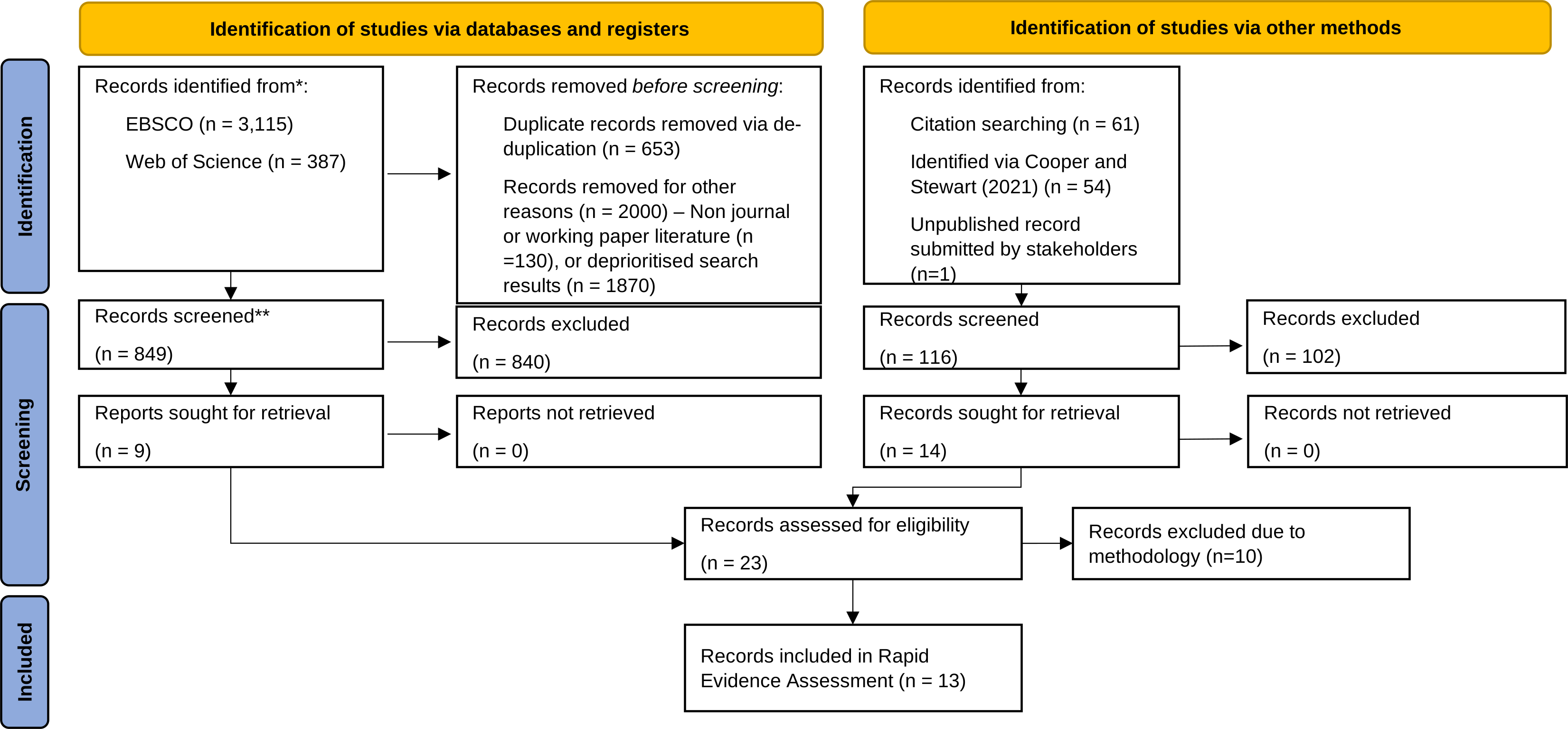
Research Question 1 – PRISMA Flow Description
PRISMA flow diagram for Research Question 1 shows the identification, screening, and inclusion process. Records identified: 3,115 from EBSCO and 387 from Web of Science. Additional sources: 61 from citation searching, 54 from Cooper and Stewart (2021), and 1 stakeholder submission. Before screening, 653 duplicates and 2,000 records were removed for other reasons (130 non-journal or working paper literature, 1,870 deprioritised results). Screening included 849 records (840 excluded) and 116 additional records (102 excluded). 23 records assessed for eligibility; 9 reports sought for retrieval (none missing) and 14 records via other methods (none missing). 10 records excluded due to methodology. Final inclusion: 13 studies.
* Note – Several searches were re-run by DWP over the course of the literature search process, leading to slightly different numbers of results. We have reported results based on the first instance a set of results were shared with Verian, as these documents were used to conduct screening.
** Note – Records were identified across multiple, sequential searches. As a result, some records were excluded as duplicates during the screening process.
Research Question 2
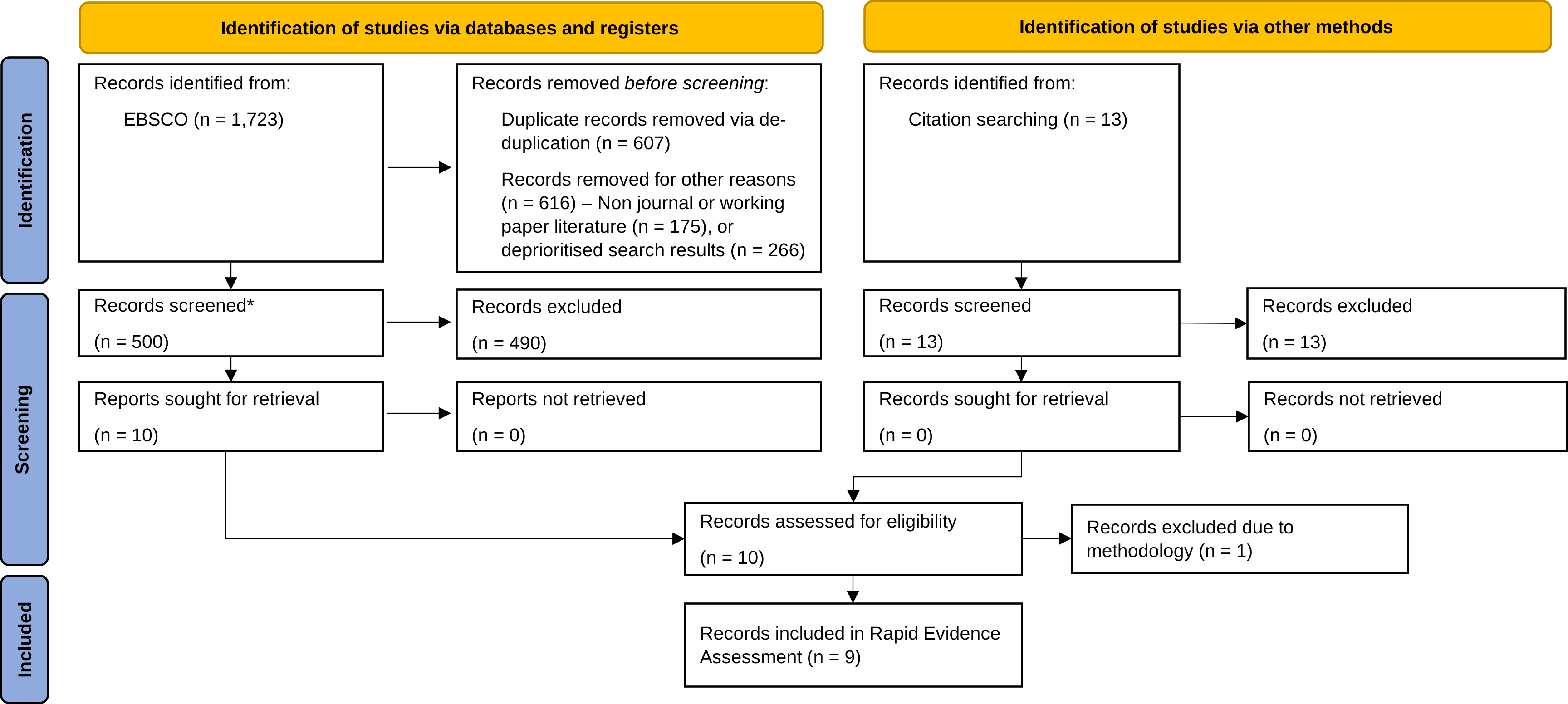
Research Question 2 – PRISMA Flow Description
PRISMA flow diagram for Research Question 2 shows the identification, screening, and inclusion process. Records identified: 1,723 from EBSCO and 13 from citation searching. Before screening, 607 duplicates and 616 records were removed for other reasons (175 non-journal or working paper literature, 266 deprioritised results). Screening included 500 records (490 excluded) and 13 additional records (13 excluded). 10 records assessed for eligibility; 10 reports sought for retrieval (none missing). 1 record excluded due to methodology. Final inclusion: 9 studies.
* Note – Records were identified across multiple, sequential searches. As a result, some records were excluded as duplicates during the screening process.
Research Question 3
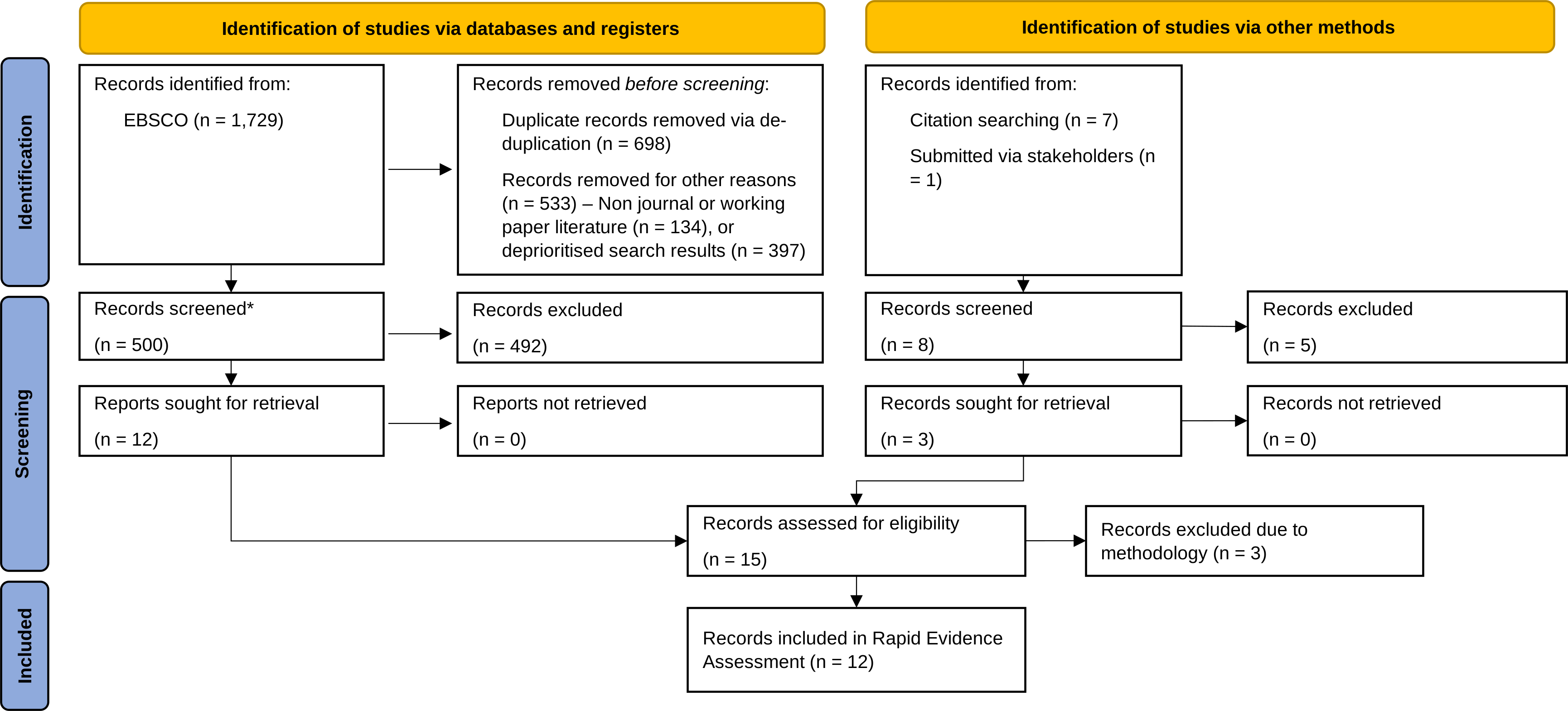
Research Question 3 – PRISMA Flow Description
PRISMA flow diagram for Research Question 3 shows the identification, screening, and inclusion process. Records identified: 1,729 from EBSCO, 7 from citation searching, and 1 stakeholder submission. Before screening, 698 duplicates and 533 records were removed for other reasons (134 non-journal or working paper literature, 397 deprioritised results). Screening included 500 records (492 excluded) and 8 additional records (5 excluded). 15 records assessed for eligibility; 12 reports sought for retrieval (none missing) and 3 via other methods (none missing). 3 records excluded due to methodology. Final inclusion: 12 studies.
* Note – Records were identified across multiple, sequential searches. As a result, some records were excluded as duplicates during the screening process
-
Early years foundation stage profile results, Academic year 2023 to 2024 - Explore education statistics - GOV.UK ↩
-
Fit for the future: 10 Year Health Plan for England - executive summary (accessible version) - GOV.UK ↩
-
The original exclusion criteria restricted research to outcome measures taken from children aged 5 and under. However, during the screening process, Verian and DWP agreed that several papers which included older children were relevant to this research as the outcomes were closely related to school readiness. ↩
-
The original searches also included papers using fixed effects analysis of longitudinal data that tracks specific households but given the number of RCTs and QEDs found and the questionable relevance and/ or methods of longitudinal studies found, the decision was made to focus on the more robust RCT and QED studies. ↩
-
In the original specification of the inclusion and exclusion criteria, only research published from 2017 onwards was considered within-scope. This cut-off date was revised following consultation with DWP to include additional relevant literature. ↩
-
Note one paper was excluded during this process due to it being rated as having a critical risk of bias. See Quality of Evidence for details. ↩
-
These three RCTs were separate studies, evaluating different outcomes of the same programme, Baby’s First Years. ↩
-
This review selected results that were relevant to changes in income. Some papers also reported results for interventions that did not fit the inclusion criteria and the review did not extract these. ↩
-
The review tried as far as possible to focus on results for the target age range, which means that, for papers that included analysis that included children who were outside of the age range, the review tried to extract only results that matched this review’s inclusion criteria. That means that, for some papers, e.g., Clark-Kaufmann et al., (2003) and Duncan et al., (2011) there is analysis for older age groups that is not considered in this report. ↩
-
Note the QED conducted by the IFS was not assessed for bias (Cattan et al., 2025). ↩
-
Note that both Clark-Kauffman (2003) and Duncan et al. (2011) pool outcomes which span across a range of domains, which, in some programmes, also includes Personal, Social and Emotional outcomes. As these sub-outcomes are not reported on a programme specific basis, the results presented are categorised here as cognitive outcomes (as reported in both papers), and not reported under Personal, social and emotional outcomes. ↩
-
These two studies are reported slightly differently because of the different statistical methods they used: Clark-Kauffman (2003) compared the effect of receiving the earnings supplement to not receiving it, whereas Duncan (2011) used the assignment to treatment as an instrumental variable to assess the effect of income on cognitive achievement. ↩
-
These are the spread of ages at which the scores were measured, but each test was only administered once. ↩
-
Inflation conversion was calculated using the U.S. Bureau of Labour Statistics inflation calculator. Conversion to GBP was calculated using the mid-market rates at midday on 24 March 2025, using XE Currency Converter. ↩
-
Inflation conversion was calculated using the U.S. Bank of Canada inflation calculator. Conversion to GBP was calculated using the mid-market rates at midday on 24 March 2025, using XE Currency Converter. ↩
-
Inflation conversion was calculated using the U.S. Bank of Canada inflation calculator. Conversion to GBP was calculated using the mid-market rates at midday on 24 March 2025, using XE Currency Converter. ↩
-
In order to translate the effect sizes into the equivalent increase in GLD achievement, we took the standard deviation of GLD passes in 2023 to 2024 and calculated increases in pass rates as percentages of that figure, using a range of effect sizes reported in the literature (3%, 6%, and 10% of the SD). The formula for SD is the square root of the variance, which for a binomial distribution is p*(1-p), where p = the probability of an individual passing. ↩
-
Inflation conversion was calculated using the U.S. Bureau of Labour Statistics inflation calculator. Conversion to GBP was calculated using the mid-market rates at midday on 24 March 2025, using XE Currency Converter. ↩
-
Note that one paper was excluded due to having a Critical risk of bias. See Quality of Evidence for details. ↩
-
Inflation conversion was calculated using the U.S. Bureau of Labour Statistics inflation calculator. Conversion to GBP was calculated using the mid-market rates at midday on 7 August 2025, using XE Currency Converter. ↩