
Colne abstraction licensing strategy
Updated 12 February 2026

© Crown copyright 2026
This publication is licensed under the terms of the Open Government Licence v3.0 except where otherwise stated. To view this licence, visit nationalarchives.gov.uk/doc/open-government-licence/version/3 or write to the Information Policy Team, The National Archives, Kew, London TW9 4DU, or email: psi@nationalarchives.gov.uk.
Where we have identified any third party copyright information you will need to obtain permission from the copyright holders concerned.
This publication is available at https://www.gov.uk/government/publications/colne-catchment-abstraction-licensing-strategy/colne-abstraction-licensing-strategy
1. About the licensing strategy
This strategy sets out our approach to managing new and existing abstractions and impoundments within the Colne catchment in the Thames river basin district.
Our approach ensures that we:
- meet river basin management plan objectives for water resources activities
- avoid deterioration within this catchment
These requirements are set out by the Water Environment (Water Framework Directive) (England and Wales) Regulations 2017 (referred to as the Water Framework Directive 2017). We apply this approach to the water body in which the abstraction or impoundment is located.
It also applies to:
- all downstream surface water bodies that may be affected by any reduction in abstraction related flow
- adjacent groundwater bodies affected by any reduction in groundwater level
The strategy also sets out local approaches to the sustainable management of water resources in collaboration with partners.
Our guidance on managing water abstraction gives the technical explanation, legal and policy requirements behind the abstraction licensing strategies (ALS).
Please see our guidance if you need to:
- check if you need a licence to abstract water
- check if you need a licence to impound water
- apply for an abstraction or impounding licence
Note: We continuously update our assessment tools, because of this some details in this document, for example hands off flow (HoF) values, may be out of date. You can contact the Environment Agency for the latest data.
1.1 Collaborative and sustainable water management
Our long-term goal is to develop a stronger catchment focus for water resources. We are working with abstractors and catchment groups to:
- develop local solutions to existing pressures
- prepare for the future
Catchment groups may include a variety of different partnership groups such as:
- abstractor groups
- local catchment partnerships
- priority catchment groups
- environmental groups
Regional water resources groups are taking forward strategic multi-sector regional plans which consider environmental needs for long term planning. We are working with these groups to improve the connection between regional planning and catchment scale planning and delivery. There is more information on regional planning in the National Framework.
This strategy is a tool to make informed decisions on the choices abstractors make about their use of water. We want this strategy to help abstractors plan their water use and become more resilient in the face of climate change.
2. Catchment overview
2.1 Landscape and land use
The catchment covers an area of approximately 1026 km2. The Colne catchment includes areas of Hertfordshire to the north, and Buckinghamshire and Middlesex in the south and west.
The Colne ALS area contains half of the Chiltern National Landscape. The Chilterns are designated as a National Landscape, formerly referred to as an Area of Outstanding Natural Beauty (AONB), in recognition of its exceptional landscape qualities. Unconfined chalk dominates the geology, providing groundwater to support the rare and valuable chalk stream habitats. The chalk dips beneath the London Clay in the southeast boundary of the catchment. The watercourses in this area are more reliant on rainfall to maintain river flow.
The catchment is characterised by more agricultural land use in the north and more urbanised area to the south. To view the extent of the catchment area see maps 1 to 6.
2.2 Water Resources
The Colne catchment contains ten main rivers and their tributaries: the Colne, Ver, Tykeswater, Gade, Bulbourne, Chess, Misbourne, Alderbourne, Colne Brook and Pinn. The catchment lies predominantly on an unconfined chalk aquifer which provides much of the flow to support these watercourses. Flow rates can be influenced at different times by abstraction pressures along with seasonal and annual climatic variations. The chalk dips beneath the London Clay to the southeast margin of the catchment making it confined in some areas.
These rivers drain in a south-easterly and southerly direction. Southerly sections culminate in a complex network of rivers before the Colne flows into the River Thames upstream of Teddington Lock. The recreationally important Grand Union Canal (GUC) interlinks throughout the catchment with the Rivers Colne, Gade and Bulbourne.
Thames Water and Affinity Water are the water companies active in this catchment. Public water supply is the major abstraction type with more than 90% of licenced volumes attributed to this purpose. There are over total of 170 abstraction licences in the catchment, 14% of which are surface water abstractions and 86% are groundwater abstractions.
2.3 Climate change
Climate change is likely to affect the quantity and seasonal availability of water resources within the catchment. The Environment Agency Climate impacts tool provides a simple description of current and potential future challenges.
The projected climate change impacts on rainfall and river flow for the East England region by the 2050s are for:
- rainfall to decrease by up to about -12.7% in the summer but increase by up to about 5.3% in the winter (Southeast England)
- low flows to be up to about -41.7% lower (East England) but peak river flows to be up to about -5.8% higher (London)
2.4 Partnership working
The River Colne Catchment Action Network is the partnership active in this catchment bringing together stakeholders from a range of backgrounds. It aims to develop collaborative approaches to water resources management and planning as well as address wider issues in the catchment.
3. Water resource availability in the Colne catchment
3.1 Surface water availability
The method for calculating the water resource availability is explained in managing water abstraction. Water availability is calculated at selected assessment points (AP). The maps show the water availability calculated at the AP; local water availability may differ.
There are 12 assessment points (APs) in the Colne ALS:
- AP1 Upper Ver covers the upper reaches of the Ver with its downstream extent south of Redbourn – the reaches of this AP are within the unconfined chalk area and the catchment area upstream of AP1 is 63.4 km2
- AP2 Lower Ver covers most of the lower reaches of the Ver with its downstream extent south of the M25 motorway – the reaches of this AP are within the unconfined chalk area and the catchment area upstream of AP2 is 134.5 km2
- AP3 Upper Colne covers the upper reaches of the Colne (from Confluence with Ver to Gade) as well as the Upper Colne and Ellen Brook, the Colne (upper east arm including Mimmshall Brook) and Tykeswater – some reaches of this AP are within the unconfined chalk area and some fall within the confined Chalk area to the east – the catchment area upstream of AP3 is 353 km2
- AP4 Upper Gade covers most of the Gade (Upper stretch Great Gaddesden to confluence with Bulbourne and GUC extending down to Hemel Hempstead – the reaches of this AP are within the unconfined chalk area and the catchment area upstream of AP4 is 47.8 km2
- AP5 Upper Bulbourne covers the upper reaches of the Bulbourne (heavily modified) extending down to Berkhamsted – the reaches of this AP are within the unconfined chalk area and the catchment area upstream of AP5 is 38.2 km2
- AP6 Lower Bulbourne covers most of the lower reaches of the Bulbourne (heavily modified) extending down to Hemel Hempstead prior to its confluence with the Gade – the reaches of this AP are within the unconfined chalk area and the catchment area upstream of AP6 is 66.4 km2
- AP7 Lower Gade covers the majority of the Gade (from confluence with Bulbourne to Chess) (heavily modified) with its downstream extent prior to its confluence with the Colne – the reaches of this AP are within the unconfined chalk area and the catchment area upstream of AP7 is 188.5 km2
- AP8 Chess covers the majority of the Chess with its downstream extent prior to its confluence with the Colne – the reaches of this AP are within the unconfined chalk area and the catchment area upstream of AP8 is 94.5 km2
- AP9 Upper Misbourne covers the upper reaches of the Misbourne with its downstream extent to the west of Amersham – the reaches of this AP are within the unconfined chalk area and the catchment area upstream of AP9 is 47.8 km2
- AP10 Lower Misbourne covers most of the lower reaches of the Misbourne extending down to Gerrards Cross prior to its confluence with the Colne – the reaches of this AP are within the unconfined chalk area and the catchment area upstream of AP10 is 85.7 km2
- AP11 Middle Colne covers the upper reaches of the Colne (Confluence with Chess to River Thames) (heavily modified) with its downstream extent east of Denham prior to its confluence with the Misbourne – some reaches of this AP are within the unconfined chalk area and some fall within the confined Chalk area to the east – the catchment area upstream of AP11 is 746 km2
- AP12 Lower Colne covers the lower reaches of the Colne (Confluence with Chess to River Thames) (heavily modified) with its downstream extent prior to its confluence with the Thames – this AP also contains the reaches of the Pinn (heavily modified), the Alderbourne, the Colne Brook (heavily modified) and the Horton Brook – most reaches of this AP are within the confined Chalk area and the catchment area upstream of AP12 is 1026 km2
3.2 Water resource availability colours and implications for licensing
The water resource availability is calculated and the colour assigned at four different flows:
- Q30 – the flow of a river which is exceeded on average for 30% of the time, therefore you would expect the river flow to be lower than Q30 on 256 days in an average year, that is, a higher flow
- Q50 – the flow of a river which is exceeded on average 50% of the time, therefore you would expect the river flow to be lower than Q50 on 183 days in an average year
- Q70 – the flow of a river which is exceeded on average for 70% of the time, therefore you would expect the river flow to be lower than Q70 on 110 days in an average year
- Q95 – the flow of a river which is exceeded on average for 95% of the time, therefore you would expect the river flow to be lower than Q95 on 18 days in an average year, that is, a low flow
We use the colours below to represent different surface water availability at these flows:
Water available for licensing
Green

There is more water than required to meet the needs of the environment.
New licences can be considered depending on local and downstream impacts.
Restricted water available for licensing
Yellow

Full licensed flows fall below the environmental flow indicators (EFI).
If all licensed water is abstracted there will not be enough water left for the needs of the environment. No new consumptive licences would be granted. It is likely we will be taking action to reduce full licensed risks. Water may be available if you can ‘buy’ (known as licence trading) the entitlement to abstract water from an existing licence holder.
Water not available for licensing
Red

Recent actual flows are below the EFI (or have been overridden by a downstream AP where flows are below the EFI).
This scenario highlights water bodies where flows are below the indicative flow requirement to help support a healthy ecology in our rivers. We will not grant further licences in these water bodies.
We are currently taking action in these water bodies. Water may be available if you can buy (known as licence trading) the amount equivalent to recently abstracted from an existing licence holder.
3.3 Water availability maps
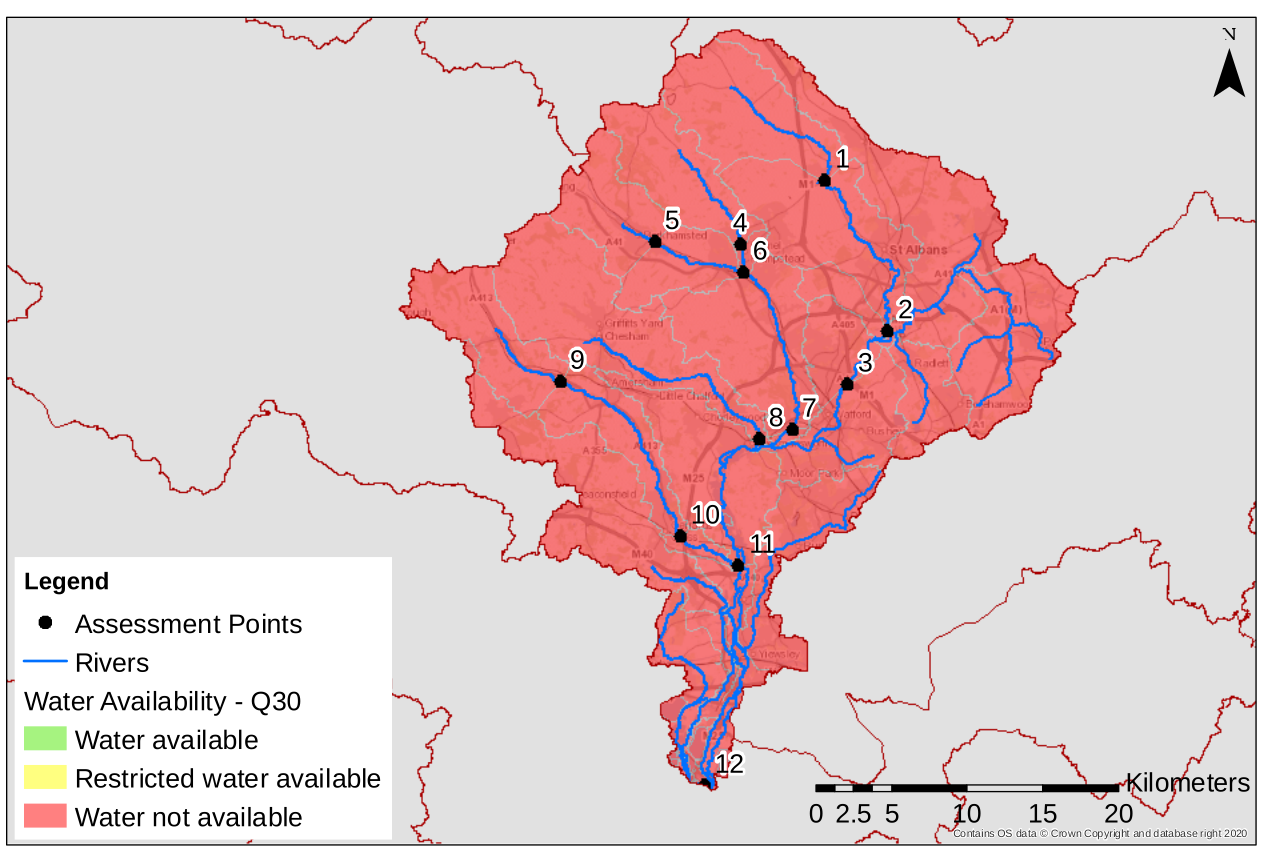
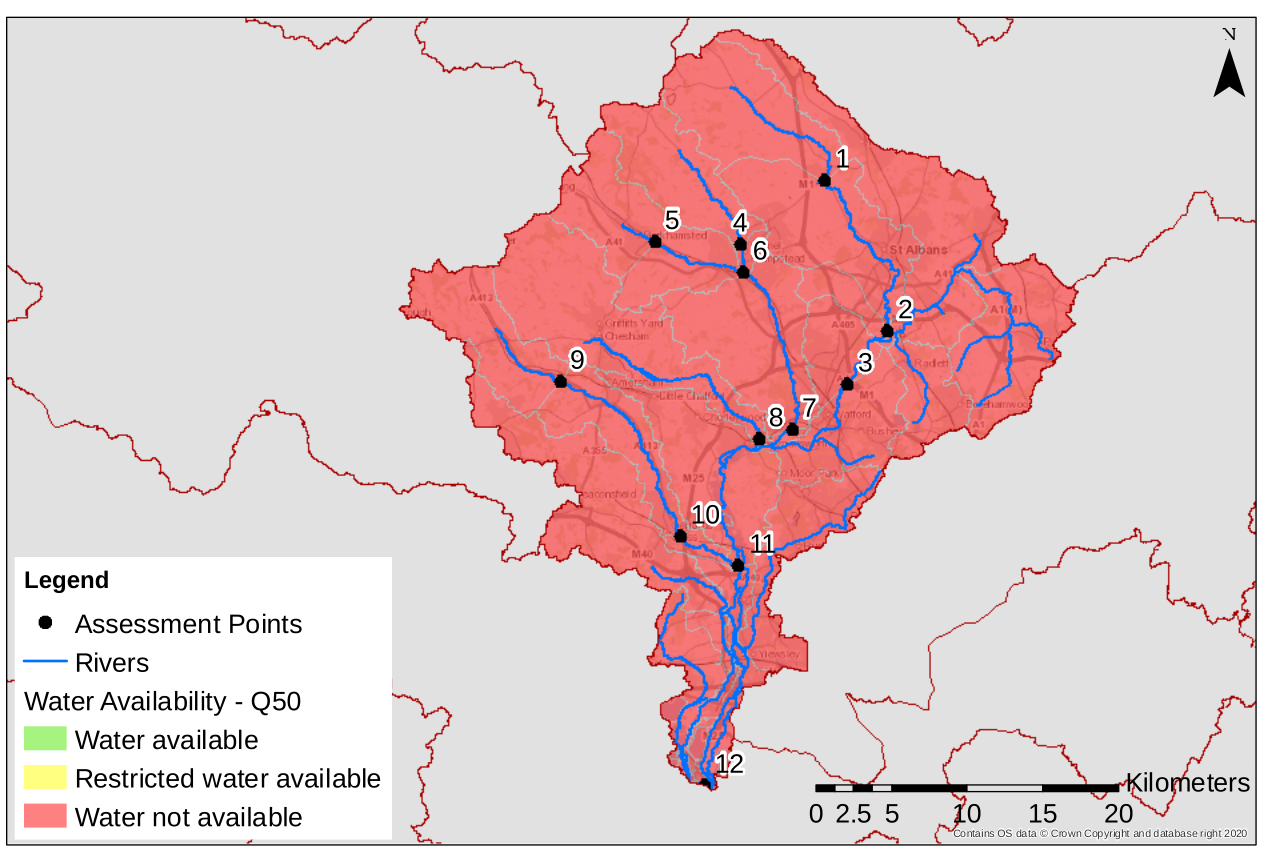
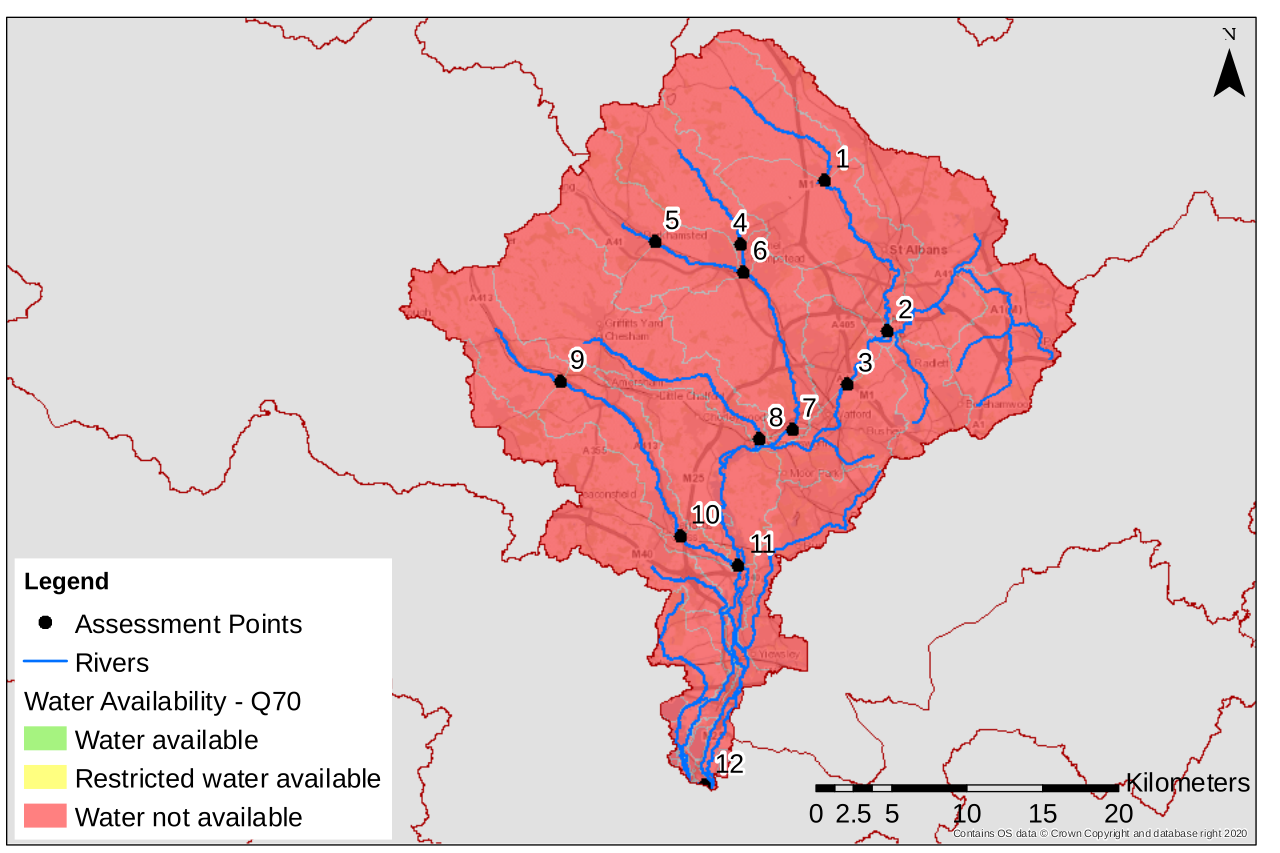
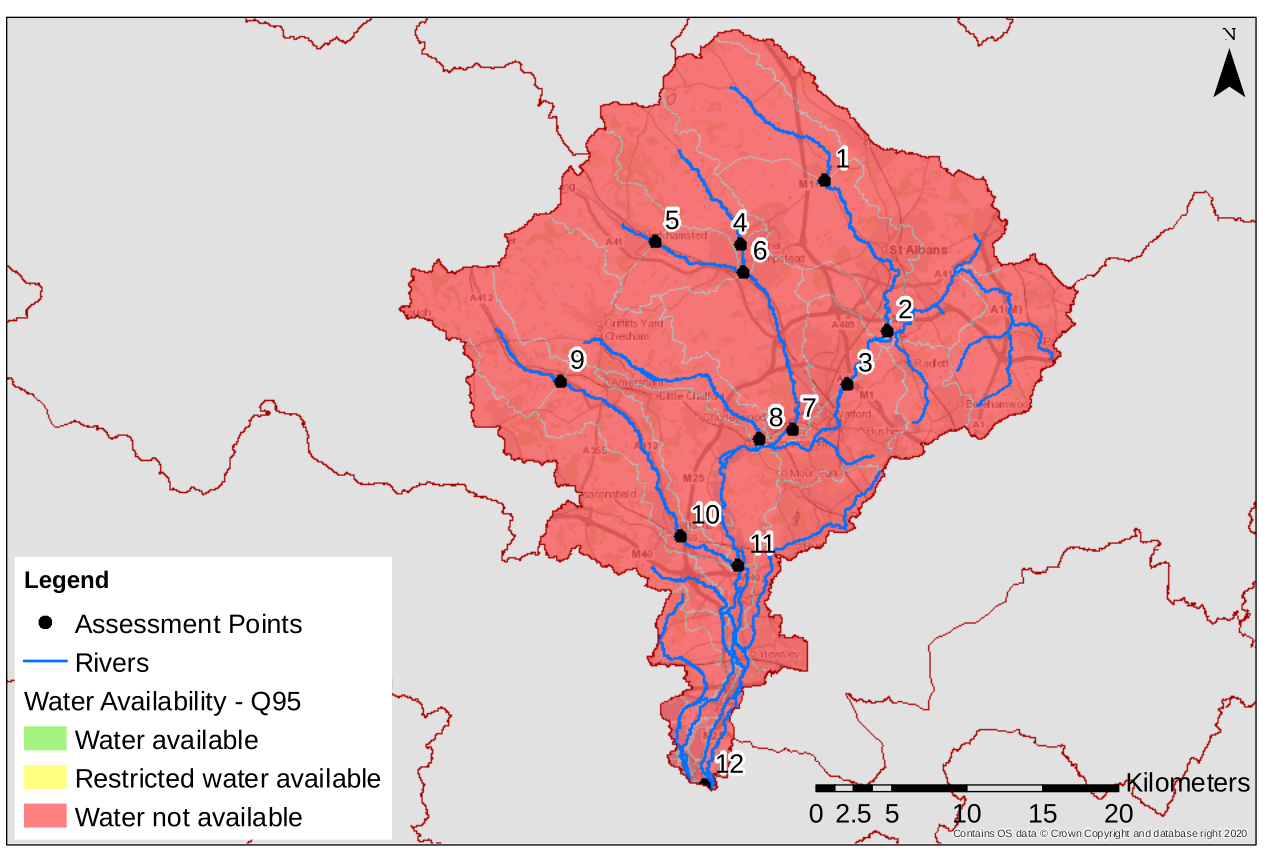
The water availability colours for the Colne catchment are presented in maps 1 to 4.
Table 1. Summary of maps 1 to 4 water availability at each AP by flow category
| AP and name | Q30 | Q50 | Q70 | Q95 |
|---|---|---|---|---|
| 1 Upper Ver | Water not available | Water not available | Water not available | Water not available |
| 2 Lower Ver | Water not available | Water not available | Water not available | Water not available |
| 3 Upper Colne | Water not available | Water not available | Water not available | Water not available |
| 4 Upper Gade | Water not available | Water not available | Water not available | Water not available |
| 5 Upper Bulbourne | Water not available | Water not available | Water not available | Water not available |
| 6 Lower Bulbourne | Water not available | Water not available | Water not available | Water not available |
| 7 Lower Gade | Water not available | Water not available | Water not available | Water not available |
| 8 Chess | Water not available | Water not available | Water not available | Water not available |
| 9 Upper Misbourne | Water not available | Water not available | Water not available | Water not available |
| 10 Lower Misbourne | Water not available | Water not available | Water not available | Water not available |
| 11 Middle Colne | Water not available | Water not available | Water not available | Water not available |
| 12 Lower Colne | Water not available | Water not available | Water not available | Water not available |
Map 1. Water resource availability colours at Q30 for Colne ALS
This map demonstrates that water is not available at any AP in the Colne ALS.
Map 2. Water resource availability colours at Q50 for Colne ALS
This map demonstrates that water is not available at any AP in the Colne catchment.
Map 3. Water resource availability colours at Q70 for Colne ALS
This map demonstrates that water is not available at any AP in the Colne catchment.
Map 4. Water resource availability colours at Q95 for Colne ALS
This map demonstrates that water is not available at any AP in the Colne catchment.
3.4 Groundwater resource availability
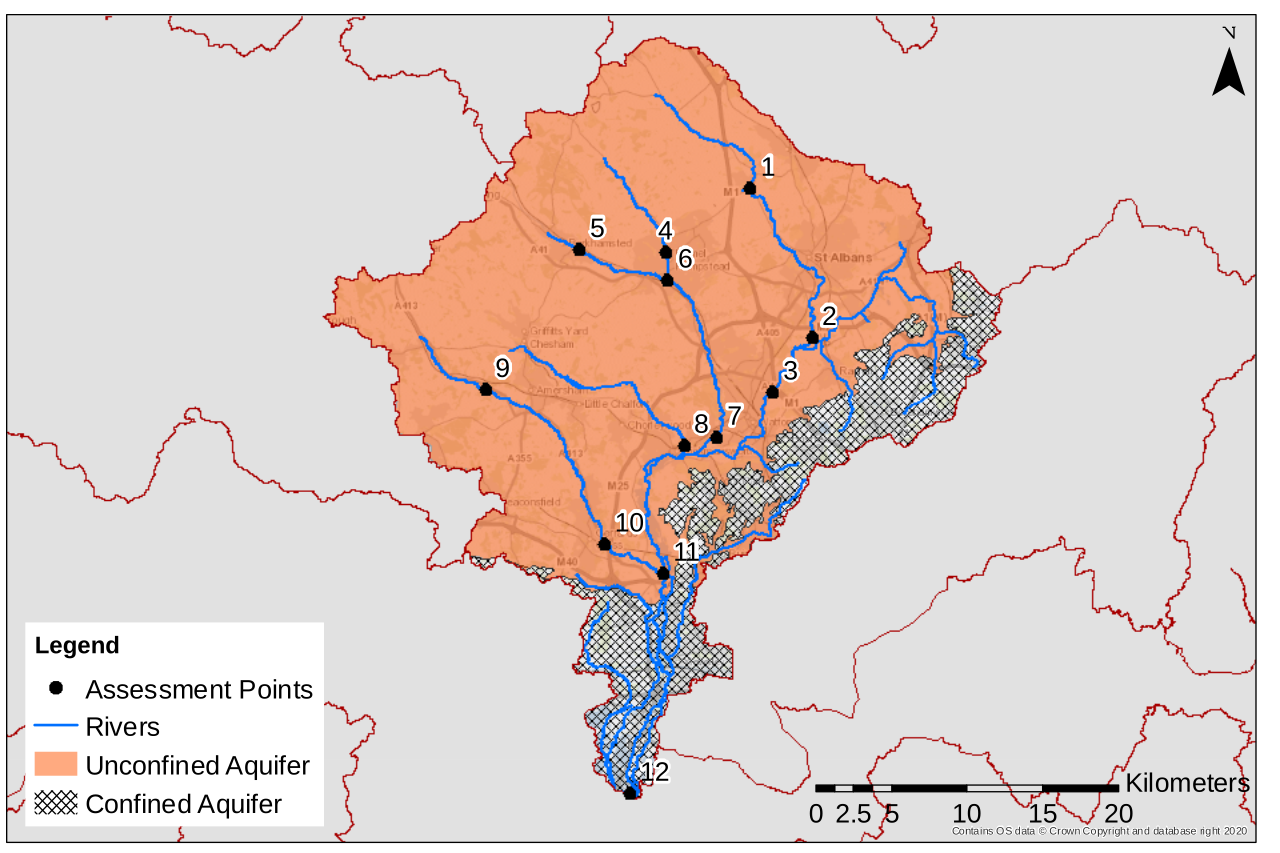
Water availability is the same for surface water and groundwater in the Colne ALS except for the confined chalk aquifer in the Greater London area, which is overlain by clay. This confined part of the chalk aquifer uses the same licensing approach as the London ALS. Map 5 shows the boundary of unconfined and confined aquifers within the Colne area.
We must also account for:
- the available resource in the aquifer
- the impact of abstraction on protected sites
Map 5. Confined and unconfined aquifers in the Colne catchment
This map demonstrates that the unconfined chalk aquifer dominates most of the Colne ALS catchment. The area of confined chalk that dips beneath the London Clay is highlighted to the southeast margins of the catchment.
3.5 Resource reliability
If you want to apply for a licence, it is worth considering the reliability of your surface water abstraction.
By assessing the quantity of water available at different flows it is possible to see:
- when there is a surplus or deficit of water
- the associated reliability of an abstraction
This is an indication only. Actual reliability of a licence will be discussed when you apply. This report indicates that there is limited water reliability for consumptive abstraction.
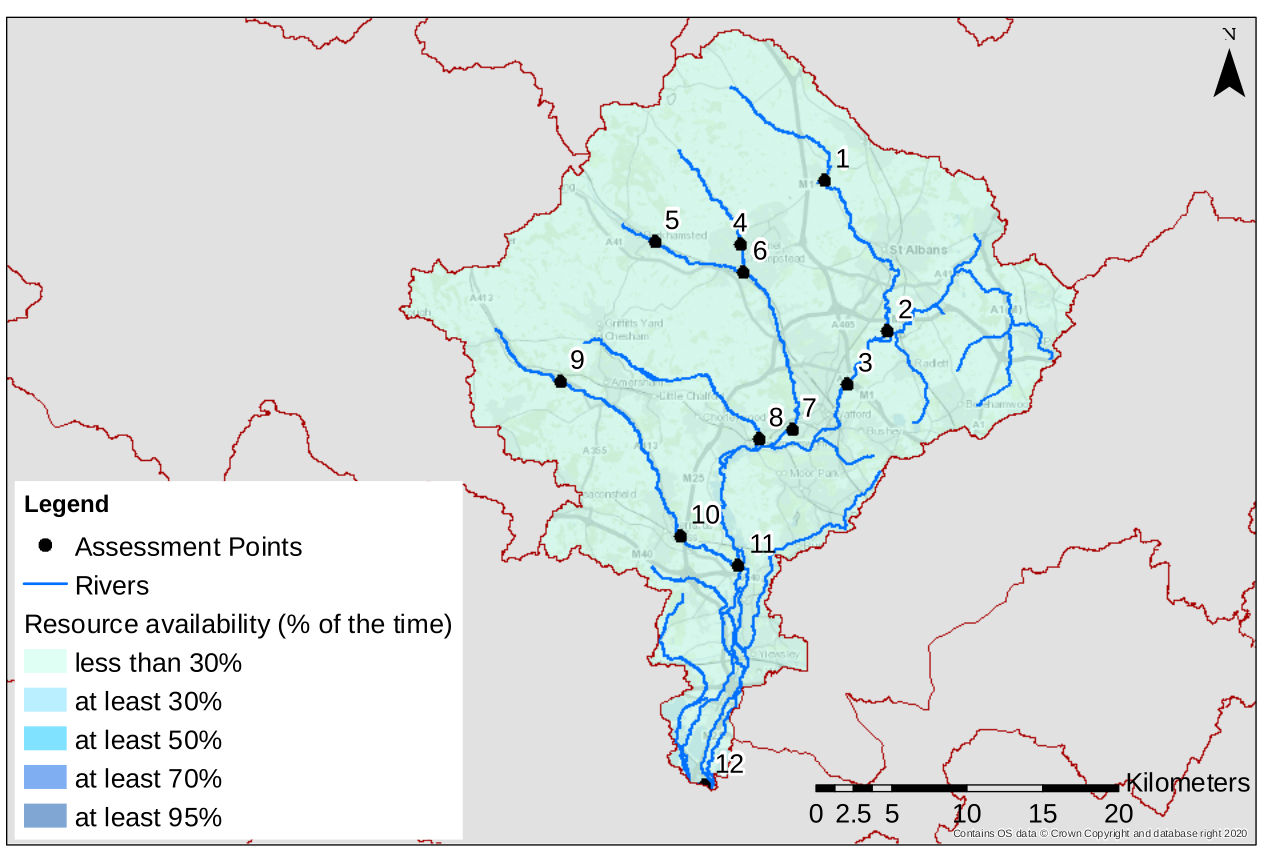
Map 6 gives an indication of the resource availability for consumptive abstraction in Colne area expressed as a percentage of time. In this catchment consumptive abstraction is available less than 30% of the time at all APs.
Map 6. Water resource reliability of the Colne ALS expressed as a percentage of time available
This map displays that at all APs in the Colne catchment area, consumptive abstraction is available less than 30% of the time.
Water availability in the Colne Catchment is extremely constrained. Even at Q10 flows, there is no water available to abstract at any AP (see Table 2). Any applicant seeking to abstract water should be fully aware of these limitations before proceeding.
3.6 Other considerations for resource availability and reliability
When we grant a licence, it does not mean that we guarantee a supply of water.
We may have to add constraints to licences such as ‘hands off flow’ (HoF) or ‘hands off level’ (HoL) conditions to protect the environment and the rights of other abstractors. These conditions specify that if the flow or level in the river drops below what is needed to protect the environment, abstraction must reduce or stop. In dry years, restrictions are likely to apply more often, which will affect the reliability of supply.
This document outlines limited availability of water, but even if water is available this does not guarantee that applications will be successful. This is because we must determine each application on its own merits, and local factors may mean we are either unable to grant a licence as applied for, or even at all.
The level of water availability is mentioned in Section 3. The resource assessment indicates there is no meaningful water availability for consumptive-based abstraction proposals. This is because existing abstraction licences have all but taken the available resource.
New licences within an ALS are usually given a ‘common end date’ (CED), which allows them to be reviewed at the same time.
The next CED for this ALS is 31 March 2038. Where a licencing period is over 12 years, a minimum value condition (MVC) will be applied to the licence as per the legislation. A MVC will state a value to which abstraction may be reduced when we notify a licence holder. We will not be liable to pay compensation to the licence holder for implementing the reduction.
Where we are uncertain about the long-term impacts of an abstraction, we will grant a short-term licence that can require the abstractor to monitor potential impacts. This collected data will inform if the abstraction can continue after the monitoring period has ended.
3.7 Impoundments
An impoundment is a dam, weir or other construction in an inland water that obstructs or impedes flow. Our assessment of an impounding licence application takes into consideration its potential impacts on the environment (such as fish migration), flood risk, downstream water users and flow modification. In line with current legislation, we do not time limit impounding licences.
Applications for impounding licences will be dealt with on a case-by-case basis and our obligations under the Conservation of Habitats and Species Regulations 2017 and Water Framework Directive 2017 will be considered. Proposals must also comply with The Eels (England and Wales) Regulations 2009 and the Salmon and Freshwater Fisheries Act 1975 and be consistent with the Environment Agency’s in channel structure policy.
You must have an impounding licence before you start to construct, alter, repair or remove an impounding structure, even in an emergency. However, certain exemptions may apply and if we deem there is little or no impact on the environment and other water users, you may not need a licence. Please contact the Environment Agency if you intend to construct, alter, repair or remove an impounding structure so that we may advise you whether a licence is required.
There is more information in our guidance on how to check if you need a licence to impound water.
4. How we manage water availability in the Colne ALS
4.1 Surface water
We assess surface water flows at each AP, which are significant points on a river, often where two major rivers join or at a gauging station. An AP can cover multiple surface water bodies.
Where groundwater abstractions directly impact on surface water flows, the impact is measured at the surface water AP.
The tables give an indication of:
- how much water is available for further abstraction
- the associated restrictions we may have to apply to new and varied abstraction licences from the main river
Each HoF is linked to an AP, but will be monitored via flow gauging stations and assessed on the resource availability at the most appropriate AP. In some cases, additional restrictions may apply to licences where there is a more critical resource availability downstream to protect the ecological requirements of the river and other water users. This has been considered in the figures given in Table 2.
All abstraction licence applications are subject to an assessment. This takes account of any local and downstream issues and may be subject to further restrictions.
Reading from top to bottom in Table 2 are the APs in the Colne ALS area. Reading across the columns shows the potential reliability of a new licence expressed as the number of days water may be available under this restriction during an average year. In cases where there is water available at all flows, we may apply a minimum residual flow (MRF) equal to 75% of Qn99 flows in the water body to protect very low flows. We will decide this on a case-by-case basis.
Table 2 Summary of licensing approach for the assessment points of Colne ALS
Volumes are given in mega litres per day (Ml/d).
| AP and name | AP National Grid Reference | Water resource availability | HoF restriction (Ml/d) | Number of days per annum abstraction may be available | Approximate volume available at restriction (Ml/d) | Is there a gauging station at this AP? | Additional restrictions |
|---|---|---|---|---|---|---|---|
| AP1, Upper Ver | TL 10940 11864 | No water available for licensing | 52.5 | 4 | 0 | Yes | The HoF at AP1 has been overridden by a more restrictive flow constraint to protect the Lower Colne. |
| AP2, Lower Ver | TL 15064 01934 | No water available for licensing | 136.9 | 4 | 0 | Yes | The HoF at AP2 has been overridden by a more restrictive flow constraint to protect the Lower Colne. |
| AP3, Upper Colne | TQ 12429 98392 | No water available for licensing | 443.4 | 4 | 0 | Yes | The HoF at AP3 has been overridden by a more restrictive flow constraint to protect the Lower Colne. |
| AP4, Upper Gade | TL 05335 07637 | No water available for licensing | 50 | 4 | 0 | Yes | The HoF at AP4 has been overridden by a more restrictive flow constraint to protect the Lower Colne. |
| AP5, Upper Bulbourne | SP 99657 07791 | No water available for licensing | 12.7 | 4 | 0 | No | The HoF at AP5 has been overridden by a more restrictive flow constraint to protect the Lower Colne. |
| AP6, Lower Bulbourne | TL 05503 05806 | No water available for licensing | 100 | 4 | 0 | Yes | The HoF at AP6 has been overridden by a more restrictive flow constraint to protect the Lower Colne. |
| AP7, Lower Gade | TQ 08765 95351 | No water available for licensing | 216.7 | 4 | 0 | Yes | The HoF at AP7 has been overridden by a more restrictive flow constraint to protect the Lower Colne. |
| AP8, Chess | TQ 06569 94789 | No water available for licensing | 129.6 | 4 | 0 | Yes | The HoF at AP8 has been overridden by a more restrictive flow constraint to protect the Lower Colne. |
| AP9, Upper Misbourne | SU 93421 98548 | No water available for licensing | 55.1 | 4 | 0 | No | The HoF at AP9 has been overridden by a more restrictive flow constraint to protect the Lower Colne. |
| AP10, Lower Misbourne | TQ 01330 88311 | No water available for licensing | 80.8 | 4 | 0 | No | The HoF at AP10 has been overridden by a more restrictive flow constraint to protect the Lower Colne. |
| AP11, Middle Colne | TQ 05200 86358 | No water available for licensing | 953.5 | 4 | 0 | Yes | The HoF at AP11 has been overridden by a more restrictive flow constraint to protect the Lower Colne. |
| AP12, Lower Colne | TW 02951 71829 | No water available for licensing | 1053.7 | 4 | 0 | No | N/A |
In the Colne catchment the river flow is well below the EFI at all APs. The critical AP is AP12, Lower Colne. To protect the ecology of the river at this point, the HoF is set at the level equal to 1% of the time or 4 days in an average year. These flows will occur infrequently and cannot be relied upon to occur every year or even in alternate years. An abstractor will need to fully understand the implications of these limitations before pursuing a proposal.
Non-consumptive or small-scale applications
A non-consumptive abstraction is where all the abstracted water is returned after use to the same source close to the point of abstraction from where it came. This ensures no net loss of water from that abstraction source.
Small-scale consumptive abstractions that result in an overall net benefit to the water environment and meet our environmental objectives and policies for the catchment may be considered subject to an appropriate impact assessment and any mitigation measures that may be required.
Support of distributaries
River systems are complex and can split into multiple channels, some of which return flow back into the main channel while others carry water away from the river to another catchment. These are known as distributaries.
An applicant may need to assess the impact of their abstraction proposal on any nearby distributaries considered to be at risk from their proposal. We can advise applicants of this requirement once an initial assessment of their proposal has been completed. This assessment will need to be undertaken before an application is made.
Heat pumps
Proposals to install heat pump schemes which need to abstract water must demonstrate the scheme is non-consumptive. All water abstracted from either a surface water or groundwater source must be able to return all water back to that same source from which it came. The option to return water to a different source will not be supported. This returning water needs to be discharged close to the abstraction point.
Surface water heat pump schemes will need to demonstrate no risk of deterioration to the ecology or habitats of the waterbody from which the water is abstracted or returned (or both). No chemical activities can be used or returned (or both) to the surface water. There will be limits placed on the returning water temperature values to safeguard the aquatic environment.
Robust assessment of thermal impacts including mixing behaviour, seasonal patterns, and the potential to influence fish movement or sensitive habitats will be expected. Intake designs must minimise entrainment risks, while returning water must avoid local scour or morphological change, particularly in narrower chalk-fed tributaries.
Groundwater heat pump schemes will need to demonstrate the water abstracted can be returned to the same source. No chemical activities can be used or returned (or both) to that groundwater source.
All schemes will need to provide appropriate thermal modelling to ensure no adverse implications for the receiving water source or the Colne’s ecological objectives and Water Framework commitments.
Abstractions from the Grand Union Canal (GUC)
The Colne river system includes the GUC. This navigation is managed by the Canal and Rivers Trust (CRT). Any proposal to abstract water from the GUC or other navigable waterways managed by them will require CRT permission. CRT, under legislation, is required to make the application to abstract water and to hold any the licence granted on behalf of an abstractor. The abstraction policies outlined in the Colne ALS will equally apply to the GUC and any other navigable waterways managed by CRT within the Colne ALS area.
4.2 Groundwater
Unconfined chalk
The unconfined groundwater chalk aquifer is assessed under the same policy position as the surface water in the Colne and is closed to new consumptive licences.
Confined chalk
New consumptive groundwater licences may be available from within the confined chalk aquifer. Applications for abstractions from this source will be assessed as per the principles in the London ALS.
Lower Greensand
The Lower Greensand (LGS) is reliant on groundwater flows from neighbouring management areas, where rainfall on associated geological outcrops recharges this aquifer. There is a position against allowing abstraction from the LGS where it poses a risk to surface water features or the water resource status (or both) of those outcrops.
Enquiries to abstract water from the LGS will all be subject to detailed local assessment and consultation with neighbouring Environment Agency management areas. There will be a need to demonstrate no such impacts for a licensing enquiry to proceed from the LGS.
4.3 Protected sites
The Conservation of Habitats and Species Regulations 2017 provide a very high level of protection to:
- Special Areas of Conservation (SAC), which contribute to biodiversity by maintaining and restoring habitats and species
- Special Protection Area (SPA), which provides protection to birds and their nests, eggs and habitats
Government policy treats Ramsar sites (internationally important wetland sites) in the same way as SACs and SPAs. Ramsar sites, SACs and SPAs are referred to collectively as European sites. Sites of Special Scientific Interest (SSSI) also carry a high level of environmental importance.
Conservation objectives are the overarching objectives for European and SSSI protected sites to maintain at, or to reach, favourable condition. These are set by Natural England. The process for setting targets that underpin these objectives is described through the Joint Nature Conservation Committee approved ‘Common Standards Monitoring Guidance’ (CSMG). Natural England use CSMG targets to assess the condition of European and SSSI protected sites. Natural England consider these quantitative targets a pre-requisite for achieving the conservation objectives for European or SSSI designated sites. We have a duty to have regard to Natural England’s advice when determining licence applications that may impact on a designated site.
We may need more detailed supporting information when a licence application could impact on a designated conservation site. This will allow us to complete the required statutory assessment.
There is one internationally designated site in the Colne catchment. This is the Southwest London Water bodies SPA and Ramsar. Southwest London Water bodies is located at the bottom of the catchment and comprises a series of gravel pits and reservoirs, which are internationally important for supporting wintering wildfowl. The predominant species of interest are Gadwall and Shoveller. These sites are dependent on the water resources of the area and will be affected by a change to water levels and water utilisation.
In addition to this there are also 13 water dependent SSSIs in the Colne catchment abstraction management strategy (CAMS) area. These provide a variety of important habitats and support species, many of which are nationally important. These are:
- Staines Moor
- Mid Colne Valley
- Old Park Wood
- Wraysbury and Hythe End Gravel Pits
- Wraysbury No.1 Gravel Pit
- Croxley Common Moor
- Frays Farm Meadows
- Frogmore Meadows
- Kingcup Meadows and Oldhouse Wood
- Old Rectory Meadows
- Sarratt Bottom
- Water End Swallow Holes
- Denham Lock Wood
Further information on protected sites and species can be found on Natural England’s website.
5. Managing the catchment together
5.1 Action on unsustainable abstraction
Our guidance on managing water abstraction gives details on:
- what an unsustainable abstraction is
- the measures available to resolve environmental issues caused by abstraction
Across the Colne catchment we are engaged in activities to tackle unsustainable abstraction and to improve flows. These activities include:
- actions under the Water Industry National Environment Programme (WINEP)
- revocations of licences for non-use
- reductions of under-used and unused licenced or permitted abstraction volumes
- changes to time-limited licences where abstraction quantities are no longer justified – renewal of a licence could pose a risk of deterioration in ecological status and not all sustainability issues in the catchment are resolved
- time limited licences will be subject to more restrictive renewal with additional monitoring requirements added to improve data collection, analysis and effective use
- catchment-based work
Actions are necessary to improve rivers where flows are not sufficient to support a healthy ecology. Under the Water Framework Directive (WFD) regulations, the aim is to ensure rivers and coastal waters achieve ‘good ecological status or potential’, and that there is no deterioration from their current status. We have sought to reduce or cease certain groundwater abstractions demonstrated to impact the environment. This is aimed to improve groundwater aquifers and the surface water bodies which are fed by these aquifers.
We have undertaken a range of catchment focused initiatives. This section also outlines options initiated in this catchment for future approaches to water management, including collaboration and sharing which may be of interest to both new and existing abstractors.
We are working across the catchment with our partners to reduce abstraction and improve the health of the water bodies within it. This includes river restoration projects to improve flows through morphology works to enhance habitat, ecology and biodiversity.
All rates for sustainability reductions are expressed as Ml/d in licenced average daily rates. Daily average rate is calculated by dividing the total annual licensed volume by the number of days in a year.
AP1: Upper Ver and AP2: Lower Ver
AP1 and AP2 fall within the Ver Water Body. The overall WFD classification (2022) is ‘Moderate’.
The water resource availability colour is red at all flow categories for AP1 and AP2. Therefore, flows do not support good ecology and the environment is damaged as a result, with unsustainable abstraction a cause of the flow problem.
Action that has been taken on unsustainable abstraction
The following action has been taken in this catchment:
- there has been a total abstraction reduction of 12.1 Ml/d within AP1 by Affinity Water
- there has been an abstraction reduction of 15.8 Ml/d within AP2 by Affinity Water
- Revitalising the River Ver project spanning Verulamium Park causeway to Cottonmill allotments in St Albans
The Revitalising the River Ver project will reduce the shading of the channel by removing non-native tree species. This will increase habitat to support macrophyte growth and biodiversity. Morphological changes to the channel have already been made to improve flow and create a wetland.
Action that we will take on unsustainable abstraction
The action planned in this catchment is reductions in abstraction by 8 Ml/d by 2030 in AP1 by Affinity Water.
AP3: Upper Colne
AP3 falls within the Colne (from Confluence with Ver to Gade) Water Body. The overall WFD classification (2022) is ‘Moderate’. The Upper Colne and Ellen Brook Water Body overall WFD classification (2022) is ‘Poor’.
The water resource availability colour is red at all flow categories for AP3. Therefore, flows do not support good ecology and the environment is damaged as a result, with unsustainable abstraction a cause of the flow problem.
Action that has been taken on unsustainable abstraction
The action that has been taken in this catchment is an ongoing project around the River Colne called ‘Rediscovering the River Colne’. For more information about the projects, see the catchment partnership website.
Action that we will take on unsustainable abstraction
The action planned in this catchment is reductions to abstraction of 2.4 Ml/d by 2030 in AP3 by Affinity Water.
AP4: Upper Gade
AP4 falls within the Gade (Upper stretch Great Gaddesden to confluence with Bulbourne and GUC) Water Body. The overall WFD classification (2022) is ‘Poor’.
The water resource availability colour is red at all flow categories for AP4. Therefore, flows do not support good ecology and the environment is damaged as a result, with unsustainable abstraction a cause of the flow problem.
Action that has been taken on unsustainable abstraction
The following action has been taken in this catchment:
- abstraction near Hemel Hempstead was reduced by 6.4 Ml/d by Affinity Water
- Upper Gadebridge Park River Restoration – morphological works have been carried out to improve river habitat in the River Gade between Link Road and Gadebridge Lane (this was an Affinity Water funded scheme in partnership with the Environment Agency and Dacorum Borough Council)
- restoration has also taken place at Lower Gadebridge Park moving the river from a perched channel to reconnect with groundwater at the valley bottom – morphological works have been carried out to improve river habitat (this was funded by the Environment Agency working in partnership with Affinity Water and Dacorum Borough Council)
Action that we will take on unsustainable abstraction
The action planned in this catchment is reductions to abstraction of 2.7 Ml/d by 2030 by Affinity Water.
AP5: Upper Bulbourne
AP5 falls within the Bulbourne Water Body. The overall WFD classification (2022) is ‘Poor’.
The water resource availability colour is red at all flow categories for AP5. Therefore, flows do not support good ecology and the environment is damaged as a result, with unsustainable abstraction a cause of the flow problem.
Action that has been taken on unsustainable abstraction
The following action has been taken in this catchment:
- there has been an abstraction reduction of 8 Ml/d within this AP by Thames Water
- channel restoration, Box Moor near Hemel Hempstead – morphological works restored 1km length of the river between GUC and the Two Waters Road, Hemel Hempstead (Box Moor Trust in partnership with the Environment Agency, and Chilterns Chalk Streams Project)
AP8: Chess
AP8 falls within the Chess Water Body. The overall WFD classification (2022) is ‘Moderate’.
The water resource availability colour is red at all flow categories for AP8. Therefore, flows do not support good ecology and the environment is damaged as a result, with unsustainable abstraction a cause of the flow problem.
Action that has been taken on unsustainable abstraction
The action taken in this catchment is an abstraction reduction of 6.8 Ml/d within AP8 by Affinity Water.
Further reductions are planned by Thames Water in this catchment.
AP9: Upper Misbourne and AP10: Lower Misbourne
AP9 and AP10 fall within the Misbourne Water Body. The overall WFD classification (2022) is ‘Poor’.
The water resource availability colour is red at all flow categories for AP9 and AP10. Therefore, flows do not support good ecology and the environment is damaged as a result, with unsustainable abstraction a cause of the flow problem.
Action that has been taken on unsustainable abstraction
The following action has been taken in this catchment:
- there has been an abstraction reduction of 9 Ml/d within AP9 by Affinity Water and Thames Water
- there has been an abstraction reduction of 11 Ml/d within AP10 by Affinity Water
Action that we will take on unsustainable abstraction
We will take the following action in this catchment:
- there are planned reductions to abstraction of 0.5 Ml/d by 2030 in AP9 by Affinity Water
- there are planned reductions to abstraction of 6.2 Ml/d by 2030 in AP10 by Affinity Water
- Thames Water is undertaking further investigation to understand impact of their remaining groundwater abstractions in AP9
5.2 Approaches to sustainable water management
We have undertaken a range of catchment focused initiatives. This section outlines options initiated in this catchment for future approaches to water management. This includes collaboration and sharing which may be of interest to both new and existing abstractors.
Five regional groups have been created in England to develop long-term water resources plans up to 2050 and beyond. The Colne catchment falls in the Water Resources South East Group. The area covered by this group includes Hertfordshire, London, Kent, Sussex, Buckinghamshire, Berkshire, Oxfordshire, Hampshire and Surrey.
It is a multi-sector group that includes representatives from:
- water companies
- National Farmers’ Union
- Drinking Water Inspectorate
- Consumer Council for Water
- Natural England
- Ofwat
- CRT
The regional groups have been tasked with considering the challenges and producing multi-sector regional plans. These will set out how water supply and demand will be managed over the long-term for people, businesses and agriculture, whilst protecting the environment. They will need to understand environmental needs and develop the long-term environmental destination for water resources by:
- ensuring no deterioration
- addressing unsustainable abstraction
- improving environmental resilience in the face of climate change
The regional plans will set out the actions that water companies and other abstractors will need to take to reach the long-term environmental destination. Draft plans are published on the Water Resources South East.
We have provided information to this group to help them identify catchments with existing or potential problems.
5.3 Water rights trading
We want to make it easier to trade water rights. A water rights trade is where a person sells all or part of their water right, as defined by their abstraction licences, to another person on a permanent or temporary basis. In many cases a trade will involve a change in abstraction location or use which we will need to approve through the issue or variation of abstraction licences.
In licensing trades, as with new abstraction licences, we need to make sure that we do not cause any deterioration in water body status within the water bodies where the trade will take place and to downstream water bodies.
This section provides a guide to the potential for trading in water bodies of a particular ALS water resource availability colour, as shown on maps 1 to 4.
Water available for licensing
Green
There may be opportunities to allow trades of recent actual abstraction and licensed abstraction. But little demand for trading is expected as water is available for new abstractions.
Restricted water available for licensing
Yellow
There may be opportunities for licence holders to trade up to their full licensed quantities. But the quantities of water available to trade may be restricted once levels of actual abstraction reach sustainable limits. We will not permit licence trades in water bodies where we are taking action to prevent deterioration. The exception to this is if the trade is consistent with achieving water body objectives.
Water not available for licensing
Red
We will only trade recent actual abstraction but no increase in recent actual abstraction is permitted in the water body. Licensed abstraction will be recovered for the environment.
6. Glossary
Abstraction: Removal of water from a source of supply (surface or groundwater).
Abstraction licence: The authorisation granted by the Environment Agency to allow the removal of water.
Assessment point: A significant point on a river, often where two major rivers join or at a gauging station.
Catchment: The area from which precipitation and groundwater will collect and contribute to the flow of a specific river.
Catchment based approach: Partnership working at the river catchment scale to deliver a range of environmental, social, and economic benefits while protecting our precious water environments for the benefit of all.
Consumptive abstraction: Abstraction where a proportion of the water is not returned directly or indirectly to the same source of supply after use. For example, for the use of spray irrigation, general agriculture, domestic use, public water supply and water bottling.
Discharge: The release of substances (for example, water, treated sewage effluent) into surface waters.
Environmental flow indicator: Flow indicator to prevent environmental deterioration of rivers, set in line with new UK standards set by UK Technical Advisory Group.
Groundwater: Water that is contained in underground rocks.
Groundwater management unit: A defined sub-division of a groundwater body used in assessing water availability and relevant licence conditions.
Hands off flow: A condition attached to an abstraction licence which states that if flow (in the river) falls below the rate specified on the licence, the abstractor will be required to reduce or stop the abstraction.
Hands off level: A condition attached to an abstraction which states that if level (in the river or groundwater aquifer) falls below the level specified on the licence, the abstractor will be required to reduce or stop abstraction.
Impoundment: A structure that obstructs or impedes the flow of inland water, such as a dam, weir, or other constructed works.
Non consumptive abstraction: Abstraction where a significant proportion of the water is returned directly to the same source of supply and close to the point of abstraction after use. For example, for hydropower.
Surface water: This is a general term used to describe all water features such as rivers, streams, springs, ponds, and lakes.
Water body: Units of either surface water or groundwater which we use to assess water availability.
Water Environment (Water Framework Directive) (England and Wales) Regulations 2017 (referred to as the WFD Regulations 2017): Regulations that provide a framework for managing the water environment in England and Wales.