Balance Sheet Framework
Updated 23 April 2026

© Crown copyright 2026
This publication is licensed under the terms of the Open Government Licence v3.0 except where otherwise stated. To view this licence, visit nationalarchives.gov.uk/doc/open-government-licence/version/3 or write to the Information Policy Team, The National Archives, Kew, London TW9 4DU, or email: psi@nationalarchives.gov.uk.
Where we have identified any third party copyright information you will need to obtain permission from the copyright holders concerned.
This publication is available at https://www.gov.uk/government/publications/balance-sheet-framework/balance-sheet-framework
1. Introduction
Role of the balance sheet in fiscal policy
The Treasury’s objective for fiscal policy is to support sustainable growth, achieve value for money, and provide high-quality public services and investment, through effective management of the public finances and sustainable taxes and borrowing. This includes supporting fiscal sustainability through a strong balance sheet.[footnote 1]
The public sector balance sheet shows what the public sector owns (assets) and what it owes (liabilities). Assets include physical assets like buildings and land, financial assets like equity investments and loans, and intangible assets like data. Liabilities include government debt and public sector pension obligations.
Assessing the health of the public finances through measures of the balance sheet (assets and liabilities) alongside traditional flow measures (revenues and expenditure) can strengthen management of the public finances. It allows government to make more informed decisions, improves identification and management of risks such as growing liabilities or underperforming assets, and ensures assets maximise value. The balance sheet is the broadest measure of fiscal sustainability, and a strong balance sheet is key to fiscal health.
The Treasury is placing strong focus on the balance sheet as part of a series of innovative reforms to how the government manages the public finances. At Autumn Budget 2024, the government moved to target public sector net financial liabilities in the fiscal rules, alongside introducing the Financial Transaction Control Framework to manage the stock of financial assets.[footnote 2] At Budget 2025, the government has introduced this framework to ensure that all assets and liabilities are managed in a robust and tailored way, alongside guidance to manage implicit liabilities not captured in measures of the balance sheet.[footnote 3] This is a significant step forward in the extent of fiscal policy and puts the UK at the forefront of balance sheet management globally.
The framework brings together in one place new and existing guidance on balance sheet management. It is a permanent and live document which will be updated in the future as policy is developed.
What is on the public sector balance sheet?
There are several different measures of the balance sheet. The Office for National Statistics (ONS) publish public sector finances data, which are produced in line with the European System of Accounts (ESA) 2010, containing several statistical balance sheet metrics.
-
Public sector net debt (PSND) captures the debt liabilities of the public sector, net of liquid financial assets (e.g. cash deposits).
-
Public sector net financial liabilities (PSNFL) includes wider financial liabilities, like public sector funded pension liabilities, and nets off illiquid financial assets like loans and equity.
-
Public sector net worth (PSNW) is the broadest statistical measure, also capturing non-financial assets such as schools and hospitals.
The ONS also publish public sector net worth on a Government Finance Statistics Manual (GFSM) 2014 basis. This includes the liabilities of unfunded public sector pension schemes and a wider coverage of Public Private Partnership contracts.
The Whole of Government Accounts (WGA) consolidates the assets and liabilities of organisations across the entire public sector. It is compiled in line with International Financial Reporting Standards (IFRS) and provides the most comprehensive view of government’s financial position, also capturing the liabilities associated with provisions.
Figure 1.A Different measures of the public sector balance sheet
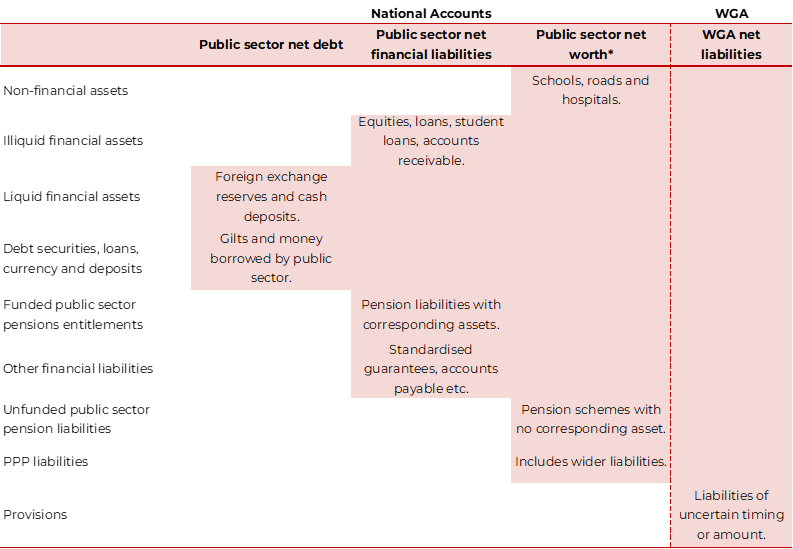
*Consistent with the IMF Government Finance Statistics Manual (GFSM) 2014.
In the most recently published Whole of Government Accounts, as of 31 March 2024 the public sector balance sheet was comprised of £2,651 billion of assets and £5,024 billion of liabilities. The largest assets are physical assets in property, plant and equipment (£1,539 billion) and the largest liability is government borrowings (£2,020 billion).[footnote 4]
Chart 1.A Composition of the public sector balance sheet (£bn), 2023-24
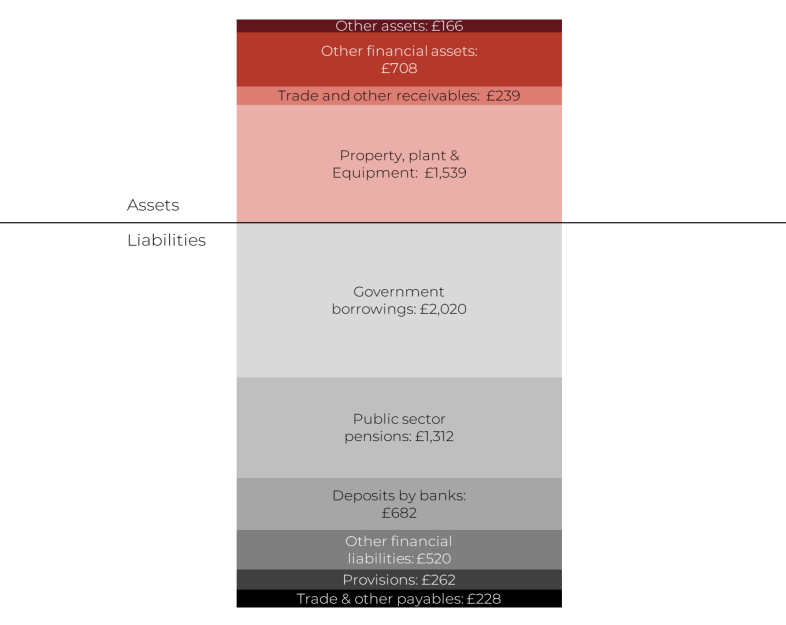
Source: HM Treasury Whole of Government Accounts
UK Government Investments (UKGI) also produces annual reports on the government’s stock of contingent liabilities that provide transparency about potential costs that may fall to government. The total expected cost of these liabilities was £250 billion as of 31 March 2024.[footnote 5]
Our approach to balance sheet management
The government’s approach to balance sheet management is comprised of the following core principles.
What gets measured gets managed – Having comprehensive balance sheet data is needed to reveal the size and types of public sector assets and liabilities. Valuing and transparently publicly reporting on assets and liabilities held on the balance sheet provides incentives to ensure their effective management. The UK produces comprehensive data in the WGA and various official statistics, and reports on individual items like financial assets and contingent liabilities.
Accounting for assets and liabilities not captured in statistical metrics or accounting – Measures of the balance sheet capture assets and liabilities according to international financial reporting or statistical standards, but in each measure of the balance sheet there are also “off-balance sheet” liabilities like contingent and implicit liabilities. These are often not recognised due to uncertainty about whether they will crystallise and require government funding. To the extent that these liabilities present a risk of future calls on taxpayers, they should be priced, reported on, and proactively managed as with other liabilities.
A three-portfolio model – The balance sheet is comprised of assets, liabilities and entities with different objectives, funding and structures, so they require different management principles. Chapter 2 introduces the three-portfolio model, grouping assets and liabilities into the social portfolio, the commercial portfolio, or the funds and liabilities portfolio to guide management decisions. A version of this model was originally set out in the 2020 Balance Sheet Review Report.[footnote 6]
Responsibility for management at an appropriate level – The management of assets and liabilities should be delegated to specialist finance, asset management, and investment teams, while strategic decisions are made by departments and the Treasury about what assets and liabilities government should hold. Accounting Officers have overall responsibility for meeting asset and liability management requirements set out in Managing Public Money (MPM).
Whole life-cycle management – The management of assets and liabilities should focus on their whole life cycle and be based on long-term planning, often over horizons beyond a spending review (SR) settlement or the Office for Budget Responsibility’s (OBR) forecast. This includes assessing and forecasting which assets are required to deliver government’s objectives, determining the optimal funding mechanism, ensuring assets are effectively managed, and having an exit strategy.
Who this framework applies to
This framework covers management of the whole public sector balance sheet, including all the assets and liabilities held by central government, local government and public corporations. It takes the broadest view of assets and liabilities, capturing contingent and implicit liabilities, knowledge assets, and private finance. It does not relate to how organisations report their Statement of Financial Position or change the Government Financial Reporting Manual (FReM).[footnote 7]
The organisations expected to comply with this framework are all those entities subject to MPM, that is all entities classified to central government such as departments and their public bodies, and certain other public sector organisations. The following should be noted:
-
Local government entities are not required to comply with the framework but are encouraged to follow its best practice principles. Departments that provide funding to local government entities to deliver services must agree with the Treasury reasonable steps to ensure that the standards in the framework are applied to the assets required to deliver those services, taking account of any resourcing impacts on local government. This may include collecting data on assets that funding is allocated to and their condition, designing allocation processes to incentivise effective management, and including local government assets in departmental asset planning.
-
NHS trusts and parts of the education sector are entities classified to central government with greater operational autonomy from their parent department than other central government entities. While they remain subject to the framework in line with the management principles for the portfolio in which they sit (in this case, the social portfolio) and the general provisions in Chapters 2 and 6-9, the mode of application reflects their bespoke governance. Parent departments are responsible for ensuring these entities apply the standards in the framework in an appropriate manner. The way that parent departments apply the standards across these entities must be agreed with the Treasury and the Office of Government Property (OGP) and codified by the end of 2026.
-
Public corporations are not required to comply with the framework in its entirety, save those required to follow MPM in their bespoke governance arrangements. The provisions in Chapter 4 apply to public corporations owned or controlled by central government and must be reflected in key documents like their financial framework or shareholder arrangements. Departments should include shareholdings in public corporations in their asset registers, asset management plans, and disposals in line with Chapters 2 and 6.
-
The devolved governments are not required to comply with this framework, but they will be engaged on its best practice principles.
Each chapter sets out its specific scope and includes both guiding principles and requirements. Chapter 10 provides detail on how the Treasury expects the framework to be applied in practice.
2. Three-portfolio model and asset management
Rationale for a portfolio approach
The framework is based on a three-portfolio model, which defines management approaches and exit strategy that are tailored to assets, liabilities and entities with similar characteristics.
Across the public and private sector, assets and liabilities are often managed as portfolios rather than individually. A portfolio approach facilitates better decision-making, such as considering the right mix of assets to achieve objectives, driving economies of scale by grouping assets and liabilities with similar characteristics, and revealing the extent of government’s exposure to risks.
Implementation of a portfolio approach can be real or notional:
-
In some cases, it may make sense to consolidate assets to be managed as one portfolio by a central specialised body, such as the National Wealth Fund for various financial investments or the Government Property Agency for central government offices.
-
In other cases, grouping into a portfolio could be notional, applied at a departmental or public body level by aligning with the principles of a given portfolio to optimise balance sheet management.
Either way, this framework is intended to ensure that the public sector manages its assets and liabilities in an optimal way to maximise social, economic and financial returns for the taxpayer.
Overview of the three-portfolio model
The model sets out three overarching portfolios. They are broadly defined as below, but there may be cases where it is not immediately obvious which portfolio an asset or entity aligns with or where it has elements of multiple portfolios. The guide to portfolio allocation below sets out how to consider the different criteria to make a judgement, and the Treasury is happy to discuss any hard or fringe cases.
-
The social portfolio includes assets involved in delivery of social objectives and public goods. These assets are generally funded by taxation and paid for by direct government spending, but in some cases may be funded by user charges or other income to cover costs. Examples include schools, hospitals, government buildings, prisons, defence infrastructure and local roads.
-
The commercial portfolio includes entities wholly or partially government owned and/or controlled that seek to generate revenue and are operating commercially, as well as assets created by financial transactions. In steady state, commercial entities are generally funded from sales of goods and services or investments. Examples are public financial institutions like the British Business Bank and public enterprises selling goods like Ordnance Survey.
-
The funds and liabilities portfolio includes funds managed to meet future risks or liabilities like funded public sector pensions, government’s main unfunded financial liabilities such as borrowings, and institutions that ensure the UK’s financial resilience such as the Bank of England.
Figure 2.A Overview of the three-portfolio model
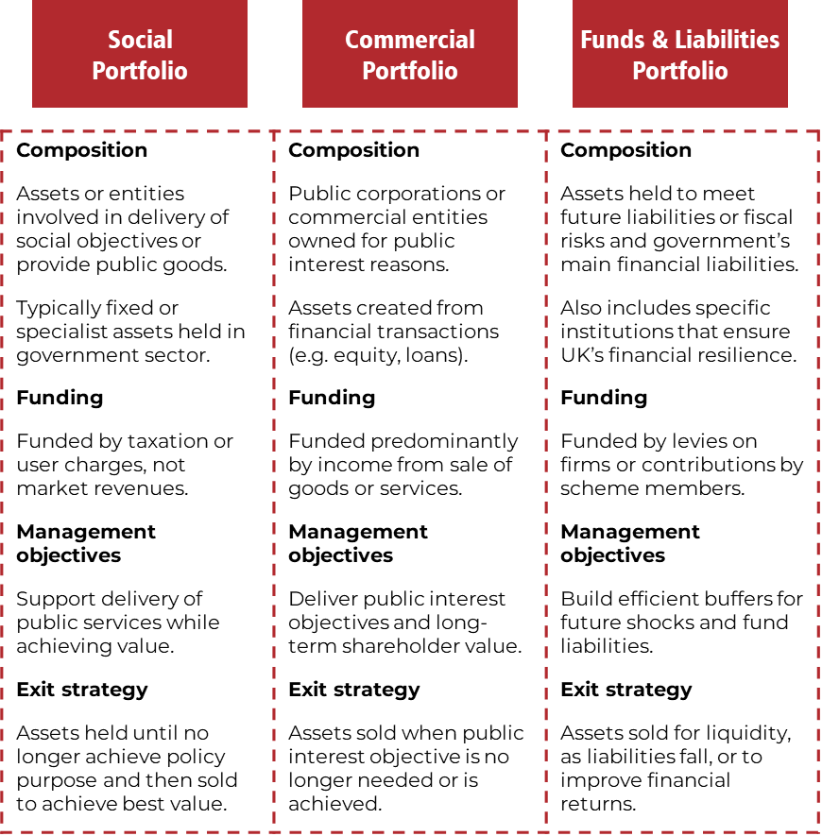
Categorisation of assets and entities into one of these portfolios enables tailoring of management arrangements to the nature of the asset or entity, improving decision making and outcomes., For example:
-
Managing assets in the social portfolio well can lead to improved service delivery and assets delivering better value for money, including opportunities to improve utilisation of assets.
-
Ensuring commercial entities are set up for success can improve cost-effectiveness of delivery and increase shareholder returns, which can be reinvested.
-
Robust management of liabilities improves risk management and ensures liabilities are funded in the most cost-efficient way.
Allocating assets and liabilities by portfolio
Allocation to each portfolio is determined based on the asset, liability or entity’s objectives, funding and governance arrangements, rather than the asset type or statistical classification.
This is a criteria-based assessment. It is not the case that an asset, liability or entity must meet all the criteria to be allocated to a portfolio; instead, this is a judgement based on which criteria it most aligns to, with a focus on how it should best be managed to meet its objectives.
There may be cases where assets or entities could move between portfolios over time or where there is a choice over how they could be managed to align with either the social or commercial portfolio. How the asset or entity should be managed is thus a primary consideration.
Criteria
The objective of the asset, liability or entity is a key criterion when considering its portfolio. While ultimately everything on the public sector balance sheet should have a policy-related objective, its wider objectives will help judge which portfolio it sits in.
Table 2.A Criteria – objectives
| Portfolio | Objectives |
|---|---|
| Social | • To deliver social objectives or provide public goods • Support the delivery of public services while achieving value for money |
| Commercial | • To conduct commercial-based activity in the public interest, such as selling goods or services or engaging in financial intermediation • To achieve public interest objectives, while maximising government’s long-term shareholder value within the context of those objectives |
| Funds and liabilities | • Pre-fund or fund government obligations at the point of need • Build buffers for future shocks and hold funds against future liabilities when financially efficient • Be an institution acting to ensure the UK’s financial resilience - its financial stability and ability to withstand shocks and other risks |
How an asset or entity is funded and its governance arrangements can also help determine its portfolio. When assessing existing assets and entities, there should be consideration of whether current arrangements are the most efficient. There may be instances where an asset is funded or set up in a certain way, signalling one portfolio, but it may be better managed in line with a different portfolio.
Table 2.B Criteria – funding and governance
| Portfolio | Source of funding | Governance |
|---|---|---|
| Social | • Funded predominantly by taxation (or gilt financing) and/or user charges less than cost • May be supplemented by other income streams to cover costs |
• Assets (and liabilities associated with assets) managed by the public sector organisation responsible, with oversight from the relevant department |
| Commercial | • Entities may require initial capitalisation, which may be public or private funding • In steady state, funded predominantly by income from sale of goods or services or returns on investment |
• Entity set up with corporate structure and typically whole or partial public ownership • Entities may also be classified to the public sector without public ownership due to level of control exercised |
| Funds and liabilities | • Funds to meet specific liabilities may be funded by levies on firms or contributions from scheme members • Unfunded liabilities met out of general taxation |
• Funds managed by Trustees or Board with fiduciary duty to act on behalf of beneficiaries • Institutions governed by memorandum of understanding |
Relationship with statistical classification
The ONS classifies entities to the public or private sector for the purpose of the National Accounts, in accordance with international guidance. The public sector splits into sub-sectors: general government, comprised of central government and local government, and public corporations, comprised of financial and non-financial corporations.
These classifications can guide which portfolio the asset or entity sits in. For example, assets in the social portfolio will predominantly be classified as part of the general government sector and assets in the commercial portfolio will often be classified as public corporations.
However, there will be exceptions. For example, there may be entities which would be most efficiently managed in the commercial portfolio but are classified as central government. These cases require a more nuanced approach, given the need to balance allowing entities to act commercially against the controls required for central government entities under MPM. This is discussed in detail in Chapter 4.
Application of the three-portfolio model
The three-portfolio model can be used to determine the most efficient way of acquiring, managing and disposing of assets and entities with different objectives.
Departments and public bodies should assign assets, liabilities and entities to a portfolio to guide their management. This is for organisations’ own purposes, rather than for reporting externally or to the Treasury, but the Treasury expects the portfolio management principles to underpin asset planning. Assigning central government entities to the commercial portfolio requires Treasury approval, given the flexibilities available to commercial entities.
The three-portfolio model can be applied both when reviewing the existing balance sheet (stocks) as well as new transactions (flows).
- Stocks – Public sector organisations must look to manage existing assets and liabilities in line with the framework. There may be instances where current arrangements do not align with select provisions in a portfolio. The asset or entity should move towards alignment over time unless it can be shown that the existing arrangements achieve the same outcomes or that there would be significant costs which outweigh the benefits of change.
- Flows – All new transactions where approval has not already been granted must follow this framework. This includes on acquiring new assets, setting up new entities, taking on new liabilities, when material changes are made to assets or entities, and when considering whether to retain or dispose of assets or entities.
Chapter 10 sets out detail on the application of this framework.
Asset management across all portfolios
The remaining chapters of the framework set out guidance and requirements that differ depending on the portfolio the asset, liability or entity sits in. There are two key requirements which apply across all portfolios: the production of asset registers and asset management plans. These requirements do not typically apply to public corporations but may be included in their framework documents if appropriate.
Asset registers
All assets owned, leased, managed, or used by organisations in scope must be recorded in asset registers. This includes tangible assets like property, plant and equipment, financial assets like loans and shareholdings (including in public corporations), and knowledge assets.
Asset registers enable timely and accurate production of accounts, allow for holistic planning for maintenance across a portfolio of assets, and support efficient usage of assets, as an asset register helps surplus assets or spare capacity be identified for alternative use or disposal.
Departments are responsible for ensuring that they and entities within their departmental group maintain records of the assets they own, lease, manage, or use. These asset registers should be updated on a regular basis and be comprehensive.
Where departments fund entities outside of central government for the purpose of managing assets (for example, providing grant funding to local authorities to maintain schools or roads, or making payments under legacy PFI contracts), they should ensure they can access information about assets those funds are used to manage.
Asset registers should contain the following:
- The name, description and location of the asset.
- The owners and managers of the asset – to identify who is responsible for management of the asset.
- A summary of the purpose the asset is held for – to support planning and prioritisation of resources across the asset base.
- The cost of acquisition and creation of the asset, and when it was acquired and created – to assist with valuation.
- A recent valuation, the basis of valuation (e.g. existing use value, market value, etc.), and the date this was made – to support choices about maintenance, renewal, and disposal.
- An assessment of the asset’s condition (for fixed assets), and the date this was made. This should be via a regular condition survey and include the method used to prepare the assessment.
- Whether the asset is in the social, commercial or funds portfolio.
- An assessment of the importance of the asset for delivery and the asset’s current utilisation, summarised by the following categories: - Core – Assets which are expected to be required for delivery for the long-term (more than 10 years). - Flex – Assets expected no longer to be required for delivery in the medium term (e.g. the next 10 years), or which are operating at less than maximum capacity or utilisation. - Surplus – Assets that currently or soon will play no role in delivery.
Public sector organisations are not required to record all assets in a single document – they may use multiple registers, including across organisations in the departmental group. For example, organisations may wish to maintain separate registers for property and non-property assets like equipment. However, these registers should be structured in line with a defined standard which enables organisations to integrate data into a consolidated register at organisation or department level.
Departments must make asset register summaries available to the Treasury on request, including in advance of SRs.
Departments should actively explore whether making summaries of their asset registers publicly available could facilitate asset utilisation by advertising spare capacity to the private sector. This would be inappropriate in specific cases where asset holdings are sensitive.
Chapters 3 and 9 cover further guidance on property asset registers and knowledge asset registers respectively.
Asset management plans
All organisations must have the assets they own, lease, manage, or use reflected in an asset management plan that guides decision-making across their asset base.
Departments must ensure that asset management plans covering their whole group’s asset base are in place (i.e. all the assets managed by departments or entities in the departmental group). This does not need to be a single asset management plan. In some cases, public bodies who manage assets directly may be better placed to produce plans, however departments should plan for strategic decisions across their group (e.g. the size of maintenance budgets).
Where departments fund other entities for the purpose of investing in or managing assets, they should ensure appropriate asset management plans are in place as a condition of funding. This includes when providing grant funding to local authorities to maintain schools and roads or payments under legacy PFI contracts.
The Treasury expects departments to have complete asset management plans underpinned by quality evidence as a condition for allocating funding for capital investment and asset maintenance. Department bids for capital DEL at regular SRs should be underpinned by these asset management plans.
A good asset management plan should cover the following.
- The policy goals of the organisation – A comprehensive statement of outcomes the department or organisation intends to deliver over the long-term and the role of its asset base in supporting that.
- The current composition and condition of the asset base – Prepared using the asset register and (where relevant) condition surveys. Annex B provides further guidance on assessing condition.
- An assessment of future asset needs – The minimum viable portfolio of assets required to deliver organisational policy goals. This needs assessment should take a long-term view, covering the changing policy and economic context in at least the next decade.
- Specific plans for asset acquisition – Plans should consider how asset needs can be most efficiently delivered, trading off modifying, replacing or maintaining existing assets against acquiring new assets. This should consider how assets will be financed, for example via direct government financing or use of private finance models.
- Specific plans for asset maintenance – An outline of the ongoing maintenance requirements of the existing asset base and any new assets that are expected to be acquired.
- Specific plans for commercialisation or disposal – Identification of assets with irreducible spare capacity that can be commercialised and identification of assets that are surplus or no longer serving a public interest objective, together with a plan for disposal.
Chapters 3 and 9 set out specific guidance on asset management plans for property assets and knowledge assets respectively.
3. Social portfolio
Scope of application
This chapter applies to all assets in the social portfolio, as defined below, that government directly or indirectly funds. This may include:
- assets managed and funded directly by a department (for example, the prisons and probation estate managed by the Ministry of Justice);
- assets managed by entities in the wider departmental group (for example, the strategic road network managed by National Highways within the Department for Transport group); and
- assets managed by other entities where these assets are funded by the department, including assets managed by other government bodies (such as local government) or privately-owned assets used for the delivery of government services under contracts (for example, the legacy PFI portfolio or GP-owned estate).
The organisations responsible for ensuring the principles of this chapter are implemented are all those subject to MPM, including all entities classified to central government such as departments, their public bodies, NHS trusts and parts of the education sector.
The Treasury expects that organisations should take a proportionate approach to implementing the principles of this chapter, expending effort commensurate with the size of their asset base.
What to own
Definition of portfolio
The social portfolio is comprised of assets and liabilities involved in the delivery of public policy objectives which aim to achieve social returns for society. It comprises assets which:
- are owned or leased by government;
- are essential to the delivery of social services, including those for health, education, justice, transport, publicly owned housing, defence, public safety, community, culture and leisure, and services that meet other local needs that contribute to quality of life;
- may be considered public goods, which members of society should be able to consume freely;
- are predominantly funded by taxation (or borrowing, which is ultimately funded out of taxation); user fees or charges at or less than cost, or other supplementary income streams; and
- do not seek to generate a commercial return.
Many assets in the social portfolio are material for welfare but may not be profitable to deliver or the private sector may not internalise externalities. This may result in market failure and under-investment, missing markets, or the asset not being used in a way that maximises welfare. An example is public parks that offer free entry, letting society benefit in a way that would not be replicated by private sector delivery.
Table 3.A Composition of the social portfolio
| Example assets by public policy or social objective |
|---|
| Education: schools, academies, colleges and related assets (e.g. equipment) |
| Health: primary and secondary care estate and related assets |
| Public safety: buildings for emergency services and related assets |
| Justice: buildings for justice (e.g. prisons, courts) |
| Community services: buildings delivering community services |
| Government administration: other government buildings (e.g. embassies, offices, jobcentres) |
| Housing: some publicly owned housing (e.g. military housing) |
| Defence: military infrastructure and equipment |
| Transport: roads and transport infrastructure with no user charging |
| Culture and leisure: public parks, libraries etc. |
| Flood defence: flood and coastal defence infrastructure |
Benefits of direct ownership
If the requirement for an asset will not change for a substantial period (e.g. an asset’s lifespan), it is normally better value for money for the public sector to own it directly. Direct ownership refers to the public sector owning rather than leasing assets from the private sector. For property assets, it can mean owning freehold or leasehold.
Direct ownership enables government to use assets flexibly over time to optimise service delivery as priorities and operating models evolve and is likely more financially efficient over the whole life of a policy than other delivery mechanisms.
It is also generally more efficient to directly own assets where government is substantially exposed to the costs and risks. Direct ownership enables government to make judgements over the balance of investment today and lower costs or resilience in the future. For example, government must determine whether to invest in flood infrastructure today given future flooding risk, to minimise the impacts of future extreme weather events.
The benefits of directly owning an asset relative to leasing from the private sector or using private finance models should be weighed in the business case when acquiring assets or renewing leases. The whole life cost of each option should be assessed in the appraisal.
Managing assets in the social portfolio
Institutional responsibilities for asset management
Responsibility for asset management. Departments and public bodies are responsible for the management of their assets and liabilities and are accountable to Parliament for use of resources. They are also liable for risks associated with ownership of the asset. This includes asset condition and maintenance, asset failure, and any legal risks. It is important that organisations explicitly plan for these. Judgements around financing and ownership of assets must consider efficiency for the public sector, not just for the organisation, as what may reduce budgetary impacts may be more expensive for the Exchequer overall.
Models for asset ownership and management. It is generally good practice to pool assets for management by a single function. This provides opportunities for economies of scale and building a centre of expertise. Across the public sector, there are various models to manage assets. For example, the prisons and probation estates are managed centrally within the Ministry of Justice, while the Government Property Agency manages most of the central government office estate as one portfolio. The Treasury intends to review different asset ownership and management models to consider whether pooled management of certain asset types may lead to improved allocative efficiency.
Asset management lifecycle
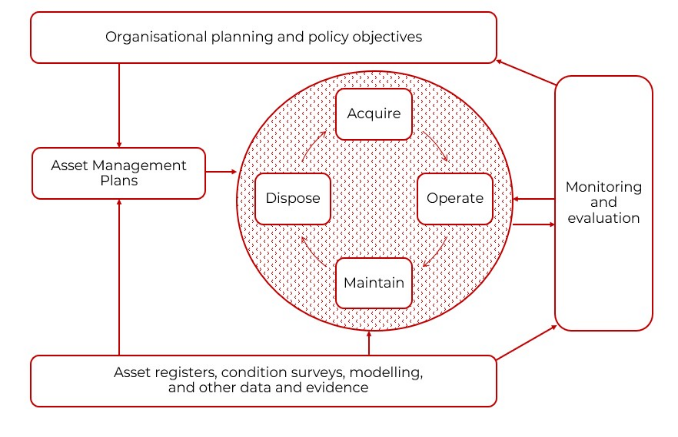
Public sector organisations should ensure that assets are effectively managed throughout the four main stages in an asset’s lifecycle: acquisition, operation, maintenance, and disposal.
The full lifecycle of an asset should be considered at every stage of decision-making. For example, before acquisition organisations should consider how the asset will be used, how much it may cost to maintain and by when it will be disposed of.
Strong asset planning enables good lifecycle management. Organisations should prepare quality asset management plans which consider their policy objectives and resources; are built on data from asset registers, condition surveys and robust modelling; and which are updated as evaluation highlights more efficient ways to operate.
Figure 3.A Asset management lifecycle and planning
Strategic asset planning
Chapter 2 sets out the requirements for production of asset registers. Asset registers are an integral part of the planning process. They allow for holistic planning for maintenance and renewal across a portfolio of assets and support efficient usage of assets.
There are some specific arrangements relating to asset registers for property assets within the social portfolio:
- All central government property assets, including assets owned by departments, public bodies, NHS trusts and parts of the education sector classified to central government, must be recorded in InSite in line with the government property data standard (GPDS).[footnote 8],[footnote 9]
- Organisations may prepare and use multiple asset registers with differing detail, like one register at site level and separate registers recording assets in each site. These should use a common data structure to enable aggregation. For facilities management and property asset registers, they should follow the GPDS.
Chapter 2 sets out that public sector organisations must produce asset management plans that cover their whole asset base and sets out the essential components of an asset management plan.
There are some specific arrangements for asset management plans for property assets within the social portfolio:
- Central government organisations owning, leasing, managing, or using property assets must produce a Strategic Asset Management Plan (SAMP). The OGP publishes guidance on the production of an effective SAMP.[footnote 10] SAMPs aim to show that assets are being managed and valued properly, in line with the Government Property Strategy.[footnote 11]
- Departments are not required to produce an asset management plan for property assets as required by Chapter 2 in addition to a separate SAMP. They should ensure their SAMP meets the standard of a good asset management plan outlined in paragraph 2.33.
Acquisition of assets
After identifying the need for a new asset, organisations should first determine whether there are existing assets available which are suitable or could be adapted. Proposals for acquiring new assets should be justified in a business case, considering alternatives like adapting or extending existing assets. The business case for acquiring new assets should account for the whole life cost of the asset, including management over its lifetime (for example, maintenance costs).
Role of government vs private financing
It is generally more financially efficient for assets in the social portfolio to be funded by general taxation or government borrowing if tax revenue is insufficient and it is fiscally sustainable. This is because the government has a lower cost of capital, equivalent to gilt yields, and so can finance the assets and risk at a lower cost than the private sector, which would include a risk premium and profit margin.
In some cases, there may be opportunities for the asset or entity to source some funding over time from user charges or income from other sources, for example, from donations, from commercialising spare capacity, or from income generated by a commercial arm of an entity.
Entities managing assets in the social portfolio must not undertake commercial borrowing, given that they will face a higher cost of capital than the government.
Value for money in using private finance models is more likely to be demonstrable when one or more of certain conditions are present, such as a revenue stream and ability to transfer revenue risk to the private sector. There are fewer examples of this in the social portfolio, where most assets are taxpayer-funded rather than user or consumer funded. Chapter 7 sets out guidance on the use of private finance models, assessing value for money and the Treasury approval process.
Operating and maintaining assets
Asset condition and degradation
Assets should be maintained to an acceptable standard, with maintenance plans developed via the broader asset management plan.
Physical assets have a useful life over which they can be expected to function. Their value depreciates over time and the cost of their acquisition is spread across their useful life for accounting purposes.
Assets’ useful lives vary depending on asset type and usage and tend to be a range, based on how the asset is maintained across its life.
Table 3.B sets out the results of an ONS review of the lives of different types of assets in the public and private sector in the UK. This is included here to highlight indicative examples of the lives of different assets. The ONS uses these estimates of asset lives to model the UK capital stock in the national accounts and so they may be different to asset life estimates used for the purposes of departmental accounting.
Table 3.B Illustrative examples of asset lives by asset class
| Asset class | Weighted average asset life, years (ONS, 2019)[footnote 12] |
|---|---|
| Dwellings | 50 |
| Other buildings | 37 |
| Transportation equipment | 15 |
| Computer software and databases | 5 |
| Machinery and equipment | 21 |
In preparing accounts, organisations are expected to make their own assessments of their assets’ useful lives, in line with the FReM.[footnote 13]
The maintenance of assets is critical for ensuring they facilitate service delivery in the most cost-effective way, ensuring that value can be extracted throughout their useful lives and in some cases enabling those useful lives to be extended through renewal investments.
Works carried out on capital assets can be classified as RDEL or CDEL, depending on the IFRS accounting and nature of works undertaken. Day-to-day costs for servicing assets (sometimes called ‘repairs and maintenance’) are recognised in income and expenditure and are classified as RDEL. Other types of expenditure on capitalised assets may score as CDEL if it is probable future economic benefits associated with the expenditure will flow to the entity.
While depreciation describes how the value of an asset reduces over time, condition is an assessment of the asset’s real physical state.
Regularly surveying asset condition is critical because assets in worse condition may not be as productive, the cost of maintenance of assets in worse condition tends to be higher, and poor condition can increase the likelihood and severity of asset failure. If asset condition is not well-maintained, it results in a backlog of maintenance investment. Forecasts for maintenance required to return asset condition to an acceptable level can be thought of as a liability, not captured in usual measures of the balance sheet, which grows over time without action.
Principles for effective maintenance
Organisations should ensure they have robust plans for maintaining their assets, applying the following principles.
Employ preventative or predictive maintenance. Organisations should, at a minimum, adopt planned preventative maintenance (PPM) by scheduling regular inspections, services and minor repairs on assets to prevent unexpected failures and extend lifespans.[footnote 14] This prioritises addressing issues before they escalate into more costly breakdowns. It does not prevent organisations from conducting reactive maintenance to address unexpected failures. Where this is necessary, organisations should track their share of spend on PPM versus reactive maintenance and take action to reduce the latter over time. Organisations should in the long-term develop analytics that enables a predictive maintenance regime.[footnote 15] This approach is designed to maximise asset longevity by planning maintenance works based on forecasts of asset degradation.
Use consistent definitions. Definitions of backlog maintenance differ depending on asset type. For some assets, such as property, all departments should use a consistent set of standards in measuring their backlog. The OGP will publish guidance on this definition in early 2026. Where a cross-government standard is not available, departments should adopt a consistent definition of acceptable condition levels in their departmental group for monitoring over time.
Box 3.A Public sector estate maintenance backlog
The public sector estate – which includes schools, hospitals, courts and prisons, the defence estate, and job centres – plays a critical role in the delivery of public services.
Managing the condition of the public sector estate has historically been a significant challenge for government. There are a complex range of incentives within government which tend to lead to the deferral of estates maintenance. Without concerted action to address maintenance backlogs, they tend to increase over time.
Because of the added difficulty and importance of maintaining public sector estates, there are some specific initiatives and structures:
- The OGP set guidance for the property function, including a common condition rating system which government should use to assess the condition of property.
- The 10 Year Infrastructure Strategy’s Social Infrastructure Roadmap aims to improve asset data, conduct an asset needs assessment to better understand how asset performance supports public services, and to drive more effective procurement.
As announced at Budget 2025, the Chief Secretary to the Treasury will lead a review of value for money across government spending, including reviewing the maintenance of public sector assets.
Collect high-quality-evidence. Organisations should collect evidence to prepare their asset management plans and should follow Annex B to do so. The main types of evidence are:
- Asset registers and recent, high-quality asset condition surveys.
- Modelling to link investment in maintenance to policy outcomes.
- Maintenance backlog forecasts, with associated assessments of how these relate to policy outcome delivery.
- Records of spending against previous maintenance plans and monitoring the impact of spending on delivering policy objectives.
Prioritise according to policy delivery and urgency. Some assets will stop being useful or necessary for delivery of their original purpose. Organisations should distinguish between assets which do not serve a policy purpose and those essential to delivery of public services and prioritise maintenance works on the assets which contribute most to policy. Organisations may use the “core, flex, surplus” classification in paragraph 2.24 to aid this prioritisation. Organisations should also be able to identify those maintenance works which are most time-sensitive for asset integrity. If maintenance works are required now, and delay would lead to significant further deterioration of asset condition or an increase in the cost of works, these works should be prioritised.
Undertake comprehensive option appraisal. When developing plans for maintenance works, organisations should consider whether ordinary works, major renovation, or disposal and acquisition of replacement assets provides greatest value for money. Organisations should assess the expected lifetime or long-term cost of maintenance works, to support a value for money choice between different options.
Optimising value of the social asset base
Efficient asset usage ensures assets deliver maximum value and enables policy goals to be achieved with the minimum assets required. Assets with spare capacity are not being fully utilised. Where spare capacity cannot be eliminated via asset disposals or transfers to another public sector organisation, it is good practice to consider whether assets can be commercialised to generate a financial return.
Commercialisation of assets can generate income, increasing value generated by the asset beyond the social value generated from its primary use. This should only be undertaken if it does not impact the asset’s primary policy objectives and assets must not be owned speculatively for the sole purpose of commercial activity.
There are several different models for commercialising assets:
- Leasing out property or infrastructure assets. Leasing means the private sector pays for the right to use the asset, but the public sector retains ultimate ownership.
- Provision of commercial services, either directly or indirectly through third parties. For example, hospitals can earn revenue from food outlets and vending machines operated by third parties.
- Licensing or spinning out knowledge assets. These assets are suited to commercialisation, given their intangible nature means that they have irreducible spare capacity and can be scaled without degradation of the asset. Chapter 9 contains further detail.
Departments are responsible for assessing and developing the commercial potential of their assets but must seek Treasury approval where the proposed activity is novel, contentious, or repercussive.
Key elements to consider are commercial viability of a proposal, the appropriate market rate to charge, and what is the most suitable delivery model. It is important that commercial services are priced appropriately. As set out in MPM, typically, charges for services should be set at a commercial rate, based on comparative services provided in the private sector.[footnote 16]
Exit strategy
Disposals must be factored into asset planning. Holding assets poses an opportunity cost (from cash that could be released) and a real cost from activities like maintenance. If an asset is deemed to be surplus to its original objective, there should first be consideration as to whether assets could be redeployed for alternative use. If there is no alternative use, the asset should be disposed of. Departments should always look to identify and dispose of surplus assets before seeking funding for new assets, to ensure the balance sheet is used efficiently.
For property assets, an asset may be surplus to one public sector organisation’s needs but could be utilised by another. All entities classified to central government, including departments, public bodies, NHS trusts and parts of the education sector, are required to record surplus property assets on InSite, managed by the OGP, and must offer assets to other public sector organisations before the open market.[footnote 17]
Departments should ensure an asset is surplus to all needs in the departmental group, as selling an asset where there is an ongoing need for service delivery could result in government paying a higher cost to deliver the same policy, with reduced flexibility due to not owning the asset and losing out on appreciating asset values (to note, this does not mean government should own assets for speculation).
Chapter 6 provides further guidance on asset disposals.
4. Commercial portfolio
Scope of application
The assets and liabilities in the commercial portfolio are used to generate revenue alongside delivering public interest objectives.
Often, these assets are managed in commercial entities such as government-owned companies. Much of this chapter is focused on the management of those entities rather than the direct management of assets, because typically the best approach to managing commercial assets will be delegation to specialist commercial entities.
Departments are responsible for applying the provisions of this chapter across the entities in their commercial portfolio. Commercial entities themselves, including both public corporations and central government entities, are responsible for operating in line with the management principles, as applied by departments through framework documents or other governance arrangements.
For the purposes of this framework, the commercial entities in a department’s commercial portfolio refer to those which:
- are on the department’s “core” balance sheet,
- are in the wider departmental group, or
- the department is the majority shareholder or exercises control over an entity such that the entity is classified as part of the public sector.
What to own
Overview of portfolio
The commercial portfolio is primarily comprised of assets used to generate commercial returns.
- Equity investments or loans to the private sector, delivered mostly by public financial institutions.
- Assets and liabilities of public corporations or commercial entities within central government, e.g. buildings, land, machinery or knowledge assets, used to deliver commercial goods or services.
In some cases, these assets may be the same types of assets held in the social portfolio (e.g. land or buildings), but they are being used in an overall commercial process.
The commercial portfolio can include assets held by departments or commercial entities. Typically, commercial assets should be managed in dedicated commercial entities, which are the primary subject of this chapter. Commercial entities are:
- categorised as government-owned and/or controlled;
- seeking to generate revenue as part of their day-to-day activity to cover a significant portion of their costs and potentially (but not always) generate a financial return;
- typically, but not always, held in corporate form; and
- operating commercially – providing financial intermediation or selling goods and services.
Commercial entities are diverse in terms of purpose and extent of government control. The commercial portfolio includes entities:
- where government holds a shareholding (as minority, majority or sole shareholder), either having purposely set up a commercial entity or acquired a shareholding in an existing one;
- that are closely governed by a regulatory regime or provided support by government such that the public sector is deemed to exercise control and have thus been classified to the public sector; or
- that are temporarily on the public sector balance sheet, for example under a Special Administration Regime.
Objectives and funding of commercial entities
Commercial entities seek to achieve public interest objectives, while maximising government’s long-term shareholder value within the context of those objectives. This should be done in an efficient and sustainable manner, without exposing taxpayers to unnecessary risk.
Commercial entities should aim, in steady state, to be primarily funded by income from sale of goods or services or returns on investments, such that the institution is largely financially self-sufficient. Where government has mandated that the entity should undertake non-commercial activity, such that an entity cannot be self-sufficient, the government can provide a subsidy, which should be reported to the Treasury and the sponsor department.
When a public interest reason for ownership exists
There should be a clear, disclosed statement of rationale for public ownership and this statement should be periodically reviewed to ensure there remains a continued case for public ownership.
Determination of whether an entity should be publicly owned is often judgement-based. The key question is whether a public interest rationale for ownership exists and whether this is best delivered via state ownership, considering whether it could be achieved more efficiently through private ownership or other measures like regulation. Rationale for owning commercial entities includes as follows.
There is a market failure – Markets may be unable to allocate resources efficiently and are not maximising societal outcomes, so public ownership is more efficient or reliable. Examples include where:
- The market cannot or will not supply goods or services deemed essential for society or does not deliver them optimally. A private sector company with a sole focus on maximising profit may not have consideration for wider public interest objectives.
- The market does not recognise the positive or negative externalities associated with a good or service. These could be internalised under public ownership, though there are also other means of internalising externalities such as via regulation.
- The sector has a natural monopoly, with high barriers to entry for competitors. A lack of competition can reduce choice and result in higher prices for consumers.
Public ownership is in the national interest – Ministers may determine that there is a need for the public sector to have control over the remit and outputs of a firm with assets of strategic interests like critical national infrastructure or defence. For example, Sheffield Forgemasters, a key supplier of the UK’s civil and defence sector.
Temporary ownership or control – Government may temporarily own or control a company in distress because a firm is of systemic importance, or because the product or service has strategic value. Usually, this is done with an aim for the company to be returned to the private sector. For example, Bulb Energy entered a Special Administration Regime in 2021 to protect its customers and ensure continued energy supply, subsequently being sold to Octopus Energy.
Categorisation of commercial entities
Public corporations vs central government entities
There is a distinction between entities classified by ONS to the public corporation sub-sector and the central government sub-sector.
Public corporations are deemed to be “market producers” in line with national accounts guidance. This includes public non-financial corporations, which produce market goods or non-financial services and cover most of their production costs via the sales of those goods and services, or public financial corporations, which typically engage in financial intermediation (i.e. transacting in financial assets or liabilities). Public corporations operate in a more flexible spending control regime.
Central government commercial entities are majority funded by government, via grants or ability to raise fees or levies. They are set up in commercial form and intend to raise funding from commercially generated revenue streams in the future. They must comply with MPM, including having an Accounting Officer and meeting Parliamentary expectations on spending. This chapter outlines potential flexibilities that can be afforded to central government commercial entities by the Treasury, to support their ability to function in a commercial way.
Public financial institutions vs public enterprises
Within the commercial portfolio, entities can also be sub-divided into public financial institutions and public enterprises.
Public financial institutions are public financial corporations or central government entities whose principal activity is making financial investments (e.g. equity) intended to generate a return. More detail is set out in Chapter 3 of the Financial Transaction Control Framework.[footnote 18]
Public enterprises are public non-financial corporations or central government entities whose primary activity is producing goods or services, with the intention to generate revenues from sales.
Table 4.A Example entities in the commercial portfolio
| Public corporation | Central government commercial entity | |
|---|---|---|
| Public financial institution | British International Investments, NatWest (formerly) | National Wealth Fund, British Business Bank, Student Loans Co |
| Public enterprise | Ordnance Survey, Sheffield Forgemasters | HS2 Ltd, GB Energy – Nuclear |
How to own – overview
To achieve their objectives, public corporations and central government commercial entities should be managed differently from other entities, balancing robust controls with freedom to operate commercially. Central government commercial entities and public corporations have different set ups that have driven their classification, but it is the Treasury’s intention that both are managed in a similar way.
To do this, departments and commercial entities they own and/or sponsor must observe three management principles.
- Managing entities on a commercial basis.
- Operate independently, with robust corporate governance.
- Distinctly manage non-commercial activity.
Managing entities on a commercial basis
In general, commercial entities should seek to maintain competitive neutrality, i.e. ensuring there is a level playing field with private enterprises, so that the presence of publicly owned entities does not undercut the market and undermine economic efficiency. This does not preclude supply of funding to commercial entitles to allow them to meet public service obligations and address market failures.
Financial return targets
In line with MPM, commercial entities providing goods or services should aim to charge them at a commercial rate. Therefore, institutional financial return targets should typically be set for commercial entities to align with a risk-weighted return on capital relevant to the sector in which a commercial entity operates. Where a commercial entity operates in a market without any competitors, prices and the return target should typically aim to recover at least full costs.
To ensure public interest objectives are delivered, some commercial entities may charge prices for provision of goods or services and target a rate of return below sector expectations or their full costs, with a subsidy provided by government. This must be agreed with the Treasury given the impacts on fiscal costs and competitive neutrality.
This aims to ensure that entities maximise government’s long-term shareholder value in the context of their public interest objectives. Departments should also consider the Subsidy Control Act 2022, which prevents public authorities giving financial advantages to companies that create excessive distortions within a market.
Return targets should be set over a period to facilitate stable planning, and as a default departments should enable entities to recycle income generated sufficient to maintain their existing scale of activity. Additional profits should either be recycled by the institution, enabling them to grow, or returned to the department as a dividend.
Application of regulatory frameworks
Commercial entities should be subject to the same regulatory and legal regimes as private sector enterprises in the same sector. Framework agreements should codify where commercial entities are subject to regulation via the relevant sector regulator, and in these cases, they should seek regulatory approval or licenses.
Any departure from this mirroring approach should consider distortionary impacts and only be considered where it is inappropriate for a government entity or contrary to its public interest objectives.
In all cases where commercial entities are subject to regulation via a sector regulator, the regulator must be wholly independent from the commercial entity.
Risk management and performance measurement
Commercial entities should have the freedom to take on commercial risk. They should manage risk in line with an appetite agreed with shareholders, while owning that risk to ensure that they pay regard to efficiency and do not undertake disproportionate risk.
Government shareholders must set a risk appetite via an economic capital approach for public financial institutions, details of which can be found in the Financial Transaction Control Framework.[footnote 19] For public enterprises, industry standard approaches should be followed, like publishing qualitative risk appetite statements in annual accounts, which are appraised in their audit and risk committee report.
Some commercial entities may be designed to operate in a ‘closed box’, where they manage their own risk with no recourse to the Exchequer – as set out in paragraph 8.8. Ways to facilitate commercial entities owning their risk may include clarifying remedial steps for underperformance, being subject to the same bankruptcy legislation as private enterprises, and setting a framework for restructuring, administration or divestments for entities in distress.
Independence and robust governance
Ensuring commercial entities have robust corporate governance enables them to provide goods, services, or financial intermediation efficiently. Departments should set their strategic direction and exercise control through conventional corporate governance structures akin to if the entity were being managed within the private sector.
Clear mandates
Departments must set a clear mandate for the commercial entities they are shareholders and sponsors of. Mandates are set across a multitude of documents, and some key considerations are:
- Policy sponsorship – Clarifying the public interest outcomes a commercial entity is intended to achieve and how the department will support it via a senior departmental sponsor and sponsor team.
- Clear governance – Clarifying how a department is represented on the board, including how it will exercise voting rights, what voting rights it has, and matters reserved to the government shareholder.
- Performance targets – Outlining expected performance across public interest and financial objectives, clarifying the level and period over which targets are set.
- Non-commercial activity – Explicitly clarifying what this activity is, and the expectations for the level of grant-in-aid subsidy or cross-subsidisation required for this activity.
- Removing unnecessary barriers to cost recovery – Assessing if there are unnecessary barriers, like price restrictions or burdensome regulation, which expose taxpayers to losses. There may be good policy reasons for these to support consumer or other outcomes.
- Information Sharing – Codifying open dialogue between a commercial entity and shareholders and expectation that all shareholders have access to performance management data.
Table 4.B outlines how these considerations can be reflected.
Table 4.B Key governance documents and considerations
| Duration | Documents | Considerations |
|---|---|---|
| Long-term or perpetual | Framework document Financial framework Company foundational documents Shareholder agreements |
Policy sponsorship Shareholder arrangements Performance targets Non-commercial activity Barriers to cost recovery Information sharing |
| Short-term (<5 years) | Multi-year corporate strategy | Performance targets Non-commercial activity Monitoring processes |
| Immediate term (annual) | Annual business plan Chair’s letter |
Non-commercial activity Performance targets |
Governance and operational independence
A commercial entity, via its board of directors, should be responsible for maintaining good corporate governance. The Board is responsible for an entities’ performance and answerable to its shareholders, with management delegated to the executive team.
The commercial entity should make day-to-day decisions independently. This is integral to ensuring institutions operate as effectively as possible. They should exercise this independence within a framework of public interest objectives agreed with departmental ministers, financial controls agreed with their sponsor department and the Treasury, and delegated authority. Departments should influence management of an entity through their role as a shareholder.
Where ministers wish commercial entities to undertake activity outside their mandate, this should be instigated transparently though an agreed power of direction, with the Accounting Officer of the commercial entity responsible for maintaining transparency.
Acting as a shareholder
Departments should be an active shareholder, and typically represented on entities’ boards, using their board position to ensure that government’s priorities are reflected in business decisions.
Government board members will in most cases vote on management decisions reserved for the board and agree delegations to the management team. They will also be accountable alongside other board members for performance to the entity’s shareholders. There may also be reserved matters for government shareholders.
Shareholding is distinct from policy sponsorship. The Arm’s Length Body Sponsorship Code of Good Practice sets out the need for clarity between these two functions.[footnote 20] In some cases sponsorship and shareholder functions may be delivered by separate units.
UKGI is the government’s centre of excellence in corporate governance and departments should consider whether UKGI is best placed to deliver the shareholder function for commercial entities.
Private shareholders
Introducing private shareholders into ownership of commercial entities can increase capability and leverage private sector capital.
Where private shareholders are introduced, government should ensure the profile and intentions for private ownership aligns with the mandate that government sets for an entity. Private shareholders as a rule should be additive, meaning their expertise should enhance the chances of achieving government objectives for commercial entities.
Ownership rights of private shareholders and government should be calibrated so voting rights are commensurate with equity stakes. Ownership rights should be codified in shareholder agreements and departments should seek Treasury consent on these agreements.
Key considerations in such agreements are thresholds for votes required for corporate actions, rules for related party transactions, delegations and reserved matters for the board or government, exit provisions for shareholders, and board composition and structure.
Distinctly managing non-commercial activity
Spending control should be applied to the non-commercial activity that commercial entities may undertake, the costs of which should be traded off with other government spending priorities.
There are two types of non-commercial activity:
- Sub-commercial activity – This is activity where a commercial entity provides a good or service priced below the level it would charge absent a wider government public interest mandate.
- Social activity – This is where a commercial entity fully funds a service and does not seek income from consumers or businesses.
Non-commercial activity should be in an entity’s mandate, with forecast costs set out in annual business plans. Outturn compared to this should be reported to the Treasury at the end of the financial year.
Box 4.B Reporting costs
Sub-commercial activity
For activity that would exist absent a government mandate to reduce prices, costs of sub-commercial activities are measured by the difference between industry market prices and the prices set. Work to calculate this should be proportionate, using estimation if required.
For sub-commercial activity that may not exist absent a government mandate, costs are measured by the difference between the cost that is incurred from delivering the activity and the income generated.
Social activity
This is measured by the total cost of conducting this activity, not just any grant-in-aid requirements used to subsidise it, to avoid cross-subsidy not being transparently reported.
Arrangements for central government entities
Commercial entities should have controls suitable to their commercial activity. These will vary but in general should be controls on risk and return rather than transaction-level controls, such as:
- Financial return targets – To set an expectation for the financial performance of the entity over a suitable period.
- An articulated risk appetite – To set an expectation for the risk appetite e.g. an economic capital limit for public financial institutions or risk appetite statements for other entities.
- Key performance indicators or policy impact measures – To set expectations for delivery of the entity’s public interest objectives.
Flexibilities for commercial entities
In certain cases, flexibilities may be appropriate for some central government entities. These are at the discretion of the Chief Secretary to the Treasury and will require demonstration that robust controls are in place and that these flexibilities represent good value for money.
The core list of flexibilities, which may be granted gradually as the commercial entity matures, include the following:
- Setting annual budgets in AME. It may be better to manage spending in AME if investments and returns are unpredictable and smooth spending is not in the entity’s control. This creates risk and must be consistent with the principles in Consolidated Budgeting Guidance (CBG) on when budgeting in AME is suitable.[footnote 21] Predictable spending like administration spending will remain in DEL.
- Granting higher delegated limits for Treasury consent. Higher delegations may offer the agility necessary to meet an entity’s objectives. This needs to be considered against the reduced ability of government to oversee riskier investment or business decisions.
- A bespoke pay framework for senior and specialist roles, to allow institutions to recruit expertise needed to manage complex transactions or compete for private sector talent. This can include approvals for senior pay and special severance packages.
- Income recycling to aid an entity’s market credibility and planning. The ability to recycle returns is necessary to scale activities over time but involves a trade-off with how much is returned to government.
There are wider flexibilities which may be considered for entities partially owned by private shareholders, to facilitate their involvement, or, by exception, entities that operate in a ‘closed box’ to self-contain risk. These may (with Treasury consent) include the following:
- Hedging strategies to support an institution to use its expertise to manage certain market risks in line with commercial practices.
- Private insurance procurement, transferring the risk to insurers at a premium enables commercial entities to shoulder their own risk.
- Contextual guidance on novel, contentious and repercussive spending to clarify expected areas of spending and reduce delays to activity that an entity should reasonably undertake.
- Commercial banking which in some cases may be more flexible, than government banking or needed to secure private investment.
- Borrowing independently of government which may be granted where there is a compelling case for the entity borrowing versus relying on government’s credit rating. This is subject to Treasury-set borrowing limits. The Treasury will produce further guidance on where limited commercial entity borrowing may be justified.
Firms temporarily under government control
In general, direct government intervention in private companies is a last resort, as allowing firms to fail is integral to the functioning of a market-based economy. Where risks of market inefficiency or potential harm to consumers are identified, a regulatory approach is preferred.
In extremely limited circumstances where firm failure exposes taxpayers, consumers, or government itself to disproportionate risk, the government may consider temporary intervention.
When the government takes temporary control of a firm, it must manage it according to principles that protect the public interest while maintaining market integrity. Government must ensure its intervention does not distort competition or confer unfair advantage on the entity. Firms under temporary control have similar but nuanced objectives compared to other commercial entities – they should balance a public interest rationale for intervention with maximising re-sale value.
Management of these entities should follow the same principles set out earlier in this chapter, but with three adjustments:
- The entity is not required to shoulder all its own risk, as its inability to do so is a key reason for intervention. Instead, a restructuring plan should be developed to build capacity to manage risk prior to sale.
- The entity should not undertake non-commercial activities, as diverting resources to activities that a private shareholder would not expect it to do would likely reduce its future resale value.
- If the entity is classified to central government, it is likely appropriate to grant most of the list of flexibilities above, so it can operate like a private sector company in preparation for resale.
Throughout, government should seek operational efficiencies, maintain high standards of control, and plan for a timely exit. An exit strategy should be established in advance, setting out clear triggers, timelines, and actions so that government control is temporary.
Exit strategy
Ownership of commercial entities or assets has an opportunity cost, as it employs capital that could be reinvested elsewhere. The disposal of a commercial entity or asset should be considered if there is no longer a public interest in retaining ownership.
Departments should produce brief statements explaining the rationale for ownership of each commercial entity. Periodically, to the frequency deemed appropriate by departments or when requested by the Treasury, departments should review the rationale for public ownership. This will initially comprise a light-touch assessment.
If this rationale is in doubt, an in-depth review to assess the case for disposal should be undertaken. This should comprise a detailed assessment of whether a rationale for ownership still exists, using the principles in paragraphs 4.11-4.15, and assessment of performance, risk and viability. If the entity requires a large subsidy, departments should consider whether ownership is desirable from a financial standpoint.
Before undertaking disposal of a commercial entity, government should consider, alongside the asset disposal principles in Chapter 6:
- If only part of an entity is being considered for disposal, whether a disposal would undermine the financial viability of the parts of the business that remain in the public sector.
- Whether a sale would leave government with explicit or implicit liabilities, but without the financial return that compensates taxpayers for covering the liabilities or direct levers to manage them.
- Whether government will have a continued interest in the activity of the entity and so should consider conditions such as special shares or requirements to continue production in the UK.
- Competitive dynamics that will exist if the entity is sold, which will determine the extent to which gains accrue to consumers versus new private sector owners.
- Ensuring the sale achieves value for money (see Annex C for how to consider this in the business case), and that any desire to achieve a sale does not impact the ability to achieve best value.
5. Funds and liabilities portfolio
What to own
Definition of portfolio
The objective of the funds and liabilities portfolio is to preserve government’s ability to finance itself and meet its future obligations, build up efficient financial buffers to mitigate the long-term impact of shocks, and internalise costs to protect taxpayers from some liabilities.
The funds and liabilities portfolio is comprised of:
- funds to meet future liabilities or risks, such as funded public sector pension schemes, together with the corresponding liabilities;
- government’s main unfunded financial liabilities; and
- institutions that support the UK’s financial resilience, such as the Bank of England.
Funds refer to holdings of financial assets invested with the sole purpose of meeting specific future liabilities or risks, where the goal is to transfer costs away from the general taxpayer. Liabilities that may be funded include pension obligations where the risk does not directly sit with the Exchequer, such as the Transport for London Pension Fund, and provisions such as nuclear decommissioning liabilities, where establishing a fund ensures adherence to the ‘polluter pays’ principle.
The balance sheet includes over £5 trillion liabilities.[footnote 22] Some are the direct responsibility of departments and public bodies. These may be considered as part of activity in the social and commercial portfolios, for example guarantees delivered by public financial institutions shall be managed in the commercial portfolio. The funds and liabilities portfolio includes the most significant unfunded public sector liabilities, including the stock of debt and public sector pension obligations.
The government also has an important role in ensuring the UK’s financial resilience, and this portfolio includes institutions essential to delivering this alongside their other policy and operational objectives. For example, the Bank of England is responsible for ensuring the UK has a stable financial system while also maintaining monetary stability.
Holding of funds
When liabilities should be pre-funded
In general, government does not pre-fund future liabilities. This is because there is an opportunity cost to holding assets in a fund for the purpose of meeting future liabilities and it creates allocative inefficiency at the whole public sector level. The funds could instead be put to alternative use with greater societal returns, and the liability or risk could be more efficiently managed in the round with other unfunded liabilities and met out of general taxation when they fall due.
In some cases, holding funds can transfer financial risk with funding a liability away from the Consolidated Fund (and so general taxpayers). But, if financial risk is not sufficiently transferred away, creating or maintaining a fund increases fiscal risk and is unlikely to be the most financially efficient way of meeting future liabilities.
MPM sets out the principles which govern the approach to meeting specific future liabilities.[footnote 23] In summary:
- government can hold funds for specific liabilities if any financial risk sits outside of the Consolidated Fund (e.g. if the scheme or its sponsor are funded by a levy on industry or contributions from beneficiaries), but generally government should not hold or set up a fund when all risk sits with the Consolidated Fund;
- any decisions relating to funding or defunding should consider these guidelines, plus any broader issues (e.g. objectives, barriers including legal, fiscal impacts); and
- fiscal sustainability should be considered in both funding and defunding decisions.
MPM also sets out the approach to assessing the case for creating a fund. The design of the fund should ensure risk is transferred away from taxpayers and any shortfall in the fund meeting liabilities should not be permanently met by the Consolidated Fund.
Funds to meet specific risks
Funds to meet specific risks, which could include implicit liabilities to government, should follow the same principles as above.
Such a fund should only be set up if it aligns with these principles and the risk cannot be reasonably managed in the private sector, for example via insurance markets. As set out in Guidance for Managing government’s Implicit Liabilities, government should develop a proactive strategy for meeting the costs of a risk crystallising and pre-funding is one option.[footnote 24]
For example, Pool Re is a reinsurer that provides cover for terrorism-related damage and is backed by a government guarantee. It is funded via income from reinsurance premiums and investment returns. If reserves are insufficient to cover losses, the Treasury will extend a loan to Pool Re to be repaid via future premium income.
How funds should be managed
Funds should be accumulated via contributions from beneficiaries (and employers for pension schemes) or the individuals whose activity is creating the liability. This could be through introducing levy or a mandatory contribution.
Governance and board independence. It is important to establish strong governance around the fund. This should protect both contributors, for example from the fund being directed to make inappropriate investment decisions, and government, against any risk of having to shore up the fund in the event of inadequate returns. The fund should have an independent board making investment decisions to achieve the objectives of the fund, and it should be managed by expert asset managers. The fund’s board will have a legal duty to ensure the fund is sufficient to meet liabilities when they fall due. They should therefore have complete control over investment decisions.
Supporting government priorities. In some instances, the fund may be able to support wider government priorities while meeting their duties, for example investing in UK companies to support growth. The fund’s board should identify where such opportunities exist, but investment decisions are ultimately at the discretion of the board and government should not direct such decisions, so as not to undermine the potential returns generated and the fund’s purpose of transferring risk for specific liabilities or risks away from the taxpayer.
Funding models. Where the fund is linked to the activity of a company, the fund should be established as a separate entity to ensure the funding is protected in the event of the company becoming insolvent. There should be mechanisms in place such that the risk of any shortfall in the fund is met by contributors, such as via increases to the levy or changing contribution rates. If the fund is insufficient when a liability or risk crystallises, government may extend a loan to cover the shortfall, to be repaid by contributors over time, and this mechanism should be established upon creation of the fund. Any risk that the general taxpayer will have to cover any shortfall should be remote.
Aggregation of funds. Where appropriate, there should be consideration of whether pooling of funds to achieve benefits of scale is feasible. Benefits of scale can include lower management fees and other administrative costs, and more sophisticated investment in diverse and large-scale projects that smaller funds may not be able to access. For example, the LGPS asset pooling framework, in which the 86 Administering Authorities in England and Wales transfer management to one of six asset pools, enables the scheme to harness benefits of scale. These include negotiating lower fees for fund managers, greater access to high-performing funds, or to internalise expertise.
Exit strategy for funds
The asset sale principles for the funds and liabilities portfolio apply to the segment of the portfolio covering funds held to meet specific liabilities. They do not apply to the wider portfolio, for example other liabilities held or financial institutions.
Assets in the portfolio should be sold when required for liquidity purposes or to pay for liabilities as they fall due. The fund’s asset managers should decide how to best manage the financial asset holdings they are responsible for, in the light of their legal and fiduciary duties, and that includes decisions around the sale of assets.
If all financial risk associated with a liability sits with the Consolidated Fund, then that liability should not be funded in advance by holding assets. Where funds exist but financial risk sits with the Consolidated Fund, the Treasury will request that departments produce a business case for defunding. Indicators of all financial risk sitting with the Consolidated Fund include, but are not limited to, the controlling entity being financially captive, meaning it has no ability to increase revenue or reduce the liabilities, or where the government has provided an explicit guarantee to cover any shortfall in the fund.
Chapter 6 contains further guidance on asset sales, including considerations for defunding an existing fund.
How unfunded liabilities are managed
Debt management
The government funds its cash requirement through issuance of gilts and Treasury bills by the UK Debt Management Office (DMO) – i.e. through wholesale debt markets – and through the retail market, via savings products issued by National Savings and Investments (NS&I).
Treasury ministers set annual financing remits for the DMO and NS&I, which set out how much they should raise over the financial year and, in the case of the DMO, how this should be split between gilts of different types and maturities and Treasury bills. Financing plans are set in line with the debt management objective, which is “to minimise, over the long term, the costs of meeting the government’s financing needs, taking into account risk, while ensuring that debt management policy is consistent with the aims of monetary policy”.[footnote 25]
More information on the government’s debt and cash management is set out in the annual Debt Management Report.[footnote 26]
Unfunded pension liabilities
Liabilities for unfunded Public Service Pension Schemes (PSPSs), like the Civil Service Pension Scheme, are one of government’s largest liabilities. The major unfunded PSPSs are defined benefit (DB) pension schemes promising members a guaranteed, inflation-linked income in retirement. Their unfunded nature means that while employers and members make contributions, these are in effect used to pay pensions and lump-sums of retired members, with any in-year surpluses or deficits made good by payments to or from the Exchequer.
Approach to management – The Treasury uses a forecast of future gross pension spending as a share of nominal GDP as its central measure of PSPS affordability. Levers to manage the size of accrued unfunded PSPS liabilities are limited. The Treasury does have several levers and principles to manage accrual of further PSPS liabilities.
Responsibilities for pensions policy – The Public Service Pensions Act 2013 requires Treasury consent for any changes to regulations containing rules of major PSPSs.[footnote 27] Departments responsible for management of individual PSPSs cannot alter pension entitlement prospectively or retrospectively without seeking prior Treasury approval. Treasury centrally coordinates policy across departments to manage precedent-risk on cross-cutting issues. A central principle is that previously accrued pension benefits should only be improved retrospectively in exceptional circumstances or where legally required.
Setting contribution rates – Employer contribution rates to unfunded PSPSs are set through actuarial valuations every four years. The methodology is based on expected member costs, such as changes in longevity, but also uses a discount rate based on the OBR’s long-term economy forecast. Employer contribution rates will rise if PSPSs are estimated to be less affordable to the future UK economy and vice versa. Although contribution payments are fiscally circular in-year, they still help to internalise future pension costs for recruitment decisions.
Cost control mechanism – The Public Service Pensions Act 2013 introduced a Cost Control Mechanism (CCM) as part of the valuation process. The CCM sets out that scheme parameters need to be corrected if member costs breach the floor or ceiling of a set corridor.
Institutions to achieve financial resilience
The Bank of England
The Bank of England (Bank) promotes stability through regulating and monitoring the financial sector, ensuring that banks are holding an appropriate level of capital relative to their balance sheet.
The Bank also promotes financial stability through liquidity facilities, which lend reserves to firms, ensuring banks and eligible institutions have the resources they need to manage their liquidity. These facilities sit on the Bank’s balance sheet and are backed by its capital. The Financial Relationship Memorandum of Understanding sets out the dynamic between the Treasury and the Bank for operations backed by the Bank’s capital.[footnote 28]
Exchange Equalisation Account
The Exchange Equalisation Account (EEA) holds the UK government’s gross official reserves, comprised of foreign currency assets, gold assets and net positions of International Monetary Fund (IMF) Special Drawing Rights (SDR). The Treasury appoints the Bank of England as its agent to carry out the EEA’s day-to-day management.
In the EEA Act 1979, the policy objectives of the reserves are: checking undue fluctuations in the exchange value of sterling; enabling government payments abroad; and carrying out the UK’s obligations to the IMF. The EEA’s investment strategy is set to meet these objectives, limit risk and volatility, and to optimise returns. Further information on the EEA is set out in Management of the Official Reserves.[footnote 29]
6. Asset disposals
Overview
Reviewing the asset base for disposals
An efficiently managed balance sheet ensures there is a clear policy or public interest reason for all assets held. While assets represent value on the balance sheet, depending on the type of asset they also bring costs, like maintenance, legal or administrative costs.
It is therefore important to regularly review assets to ensure that public resources are being used efficiently. This ensures that assets which no longer serve a policy purpose, and that cannot be repurposed for alternative use in the public sector, are disposed.
For SRs, the Treasury expects departments to have reviewed their asset base (as per Chapter 2) ahead of time via asset management plans to identify where assets continue to be necessary and where they are surplus and should be disposed of. This assessment should underpin department capital spending bids at SRs.
New disposal opportunities may also be identified in-between SR cycles, and they should be assessed as and when the opportunity arises.
Scope of this chapter
This chapter applies to all central government organisations. For public corporations, it applies to departments when considering the sale of public corporations (and other entities), but it does not apply to public corporations’ own disposals. The overarching principles should however be considered a guide for all public sector organisations.
Existing guidance on asset disposals sits alongside this chapter:
- Managing Public Money – Sets out key principles and requirements for dealing with public resources, including that it is good practice to dispose of surplus property.[footnote 30]
- Asset sale disclosure guidance – Outlines the process for disclosing asset sales to Parliament and specifies what information must be disclosed. This includes the rationale for any sale and the quantified impact on the public finances, considering a range of metrics.[footnote 31]
- Managing Surplus Government Property – Provides guidance on identifying when assets are surplus and how to dispose of assets, including considerations prior to selling or transferring an asset.[footnote 32]
Treasury consent and disclosure requirements
Treasury consent, and disclosure of the impacts of a sale to Parliament, is required for those assets where the value of the asset is either greater than the department’s delegated limit or where the disposal is considered novel, contentious or repercussive. The latter includes any disposal that meets any of the following criteria:
- the sale of a type of asset that the government has not sold before,
- a sale conducted under a novel kind of contract,
- a sale that is expected to generate significant public interest, or
- a sale that is expected to generate a significant loss/profit.
Accounting Officers are responsible for ensuring any novel, contentious or repercussive sales are identified and put to the Treasury for consent. Where departments are unclear whether a sale is novel, contentious or repercussive, they should contact their Treasury spending team.
Social portfolio – when to dispose
Identifying surplus assets
Assets in the social portfolio should be disposed when they are surplus. This describes assets no longer required for the organisation that holds the asset. This is most apparent when owning the asset contributes no change to the output of public or other services of the organisation. Identifying surplus assets is an integral part of asset management. See Chapter 2 for further detail on asset management planning, including an assessment of core, flex and surplus assets.
The public sector entity which owns the asset should assess whether it is surplus. This should be discussed with the parent department, with reference to the department’s asset management plans. Organisations should consider whether an asset is:
- currently being utilised to deliver core operational functions,
- needed for future operational functions,
- integral to continuity or resilience of service delivery,
- held for commercial purposes related to their remit, or
- available for disposal, in line with government policy.
When an asset has been identified as surplus, organisations should put forth a business case to either repurpose or dispose the asset. This should be prepared in line with the guidance in Annex C.
Property transfer within central government
While an asset may be surplus to one organisation, it may be of value to another part of the public sector. For example, land may be surplus to one department but could be used by another to deliver policy goals. It is preferable to transfer assets within the public sector where there is an alternative use, rather than selling on the market.
Central government organisations, including departments, their public bodies, and more independent organisations like NHS trusts and parts of the education sector, must offer surplus property assets to other public bodies before placing it on the open market, designate the asset as surplus on InSite, and work with other organisations to consider the public value of the asset.[footnote 32]
Transfer within the public sector should normally be done at market value.[footnote 33] The public sector should minimise the costs of obtaining a market valuation, and where the parties can agree to do so they should jointly commission a single independent valuation. If a central government organisation expresses interest and they are willing to pay market value, by default this should be the preferred buyer.
Further guidance on transfer of property within the public sector can be found in Managing Surplus Government Property and MPM.
Commercial portfolio – when to dispose
The commercial portfolio includes both entities and assets, for which there are slightly different considerations for disposals. For both, government should judge whether there is no longer a public interest objective making ownership or holding an asset desirable, or if they could be better served in the private sector.
Assessing if public interest ownership objectives exist
Chapter 4 sets out when a public interest reason for ownership of commercial entities exists. This rationale must be articulated in a brief statement, and this should be reviewed periodically to ensure there remains a case for public ownership.
Key questions to consider when assessing whether public interest objectives still exist include:
- Is there a market failure necessitating ownership of the entity? Is public ownership still the optimal approach to address this?
- Is public ownership, or continued provision of the given goods or services, still in the national interest?
Where an in-depth review is deemed appropriate, further investigation should also consider wider factors:
- Is the entity making a financial return for shareholders? If not, there should be an assessment as to why, whether this can be improved while remaining in the public sector, and whether public ownership is desirable from a financial standpoint.
- Could the objectives be achieved more efficiently by private ownership? For example, could private ownership generate efficiencies in management or balance sheet utilisation due to increased competitive and/or regulatory incentives?
- Is there still explicit or implicit risk which is more efficiently managed through public sector ownership?
Sale of commercial assets held by departments
For commercial assets held by departments, such as an equity investment in a company or a loan book, the key consideration is also whether a public interest objective for holding the asset still exists.
Questions to consider for equity investments are:
- What was the original rationale for investment, and is government involvement still needed to achieve that? For example, if investment was to support first of a kind technology, has a market now been established, no longer requiring government to retain its holding?
- Can further policy objectives be achieved by retaining the investment, or is the only remaining benefit any financial benefit? If the latter, the asset should be assessed for sale.
For loans, it may be better value for money to hold the loan until maturity rather than look to dispose of the asset, especially in cases where selling the loan or loan book requires doing so at a discount. While such a disposal will provide cash proceeds in exchange for the asset, it is forgoing a stream of income over the lifetime of the loan.
Funds – when to dispose
Overview
This section covers funds held to meet specific liabilities. If all financial risk associated with a liability sits with the Consolidated Fund, then that liability should not be funded in advance by holding assets. This is because there is an opportunity cost to holding assets in a fund for the sole purpose of meeting future liabilities, and holding funds can create allocative inefficiencies at the whole public sector level.
Defunding is where assets are separated from the liabilities, so that the liabilities become unfunded. The assets can then be sold, the proceeds used to meet other priorities and liabilities will be paid for out of general taxation when they fall due.
The Treasury will generally request an assessment of defunding on a reactive basis, when issues arise that require alternative action (for example, if a fund has a shortfall that requires government to act). The final decision on whether to defund requires Treasury consent.[footnote 35]
Considerations in defunding an existing fund
The business case for defunding should follow the Green Book. MPM sets out how to approach the five-case model for defunding.
The strategic case should set out the extent to which financial risk sits with the Consolidated Fund and so the fund meets conditions for defunding. Indicators of financial risk sitting with the Consolidated Fund include the controlling entity being financially captive, so it has no ability to increase revenue or reduce liabilities, or where government has provided an explicit guarantee to cover any shortfall in the fund.
The economic case considers when liabilities should be funded, where the benefit is an assumption that selling financial assets to the private sector increases allocative efficiency in the economy and/or reallocation of resources within the public sector will improve social returns. For assets held to meet risks, this should consider whether risk can be managed by the private sector without government support.
The financial case should include quantitative analysis of future assets, liabilities and cash flows, including any fiscal impacts.
The remainder of the business case should cover commercial and management cases, such as legislative impacts, plans for future management of liabilities and assessment of different defunding strategies, for example the strategy for disposal of different types of assets (e.g. cash, equity, any non-financial assets) held in the fund.
Looking at defunding a scheme in isolation might show that the cost to the Exchequer is greater if paid for via taxation as liabilities fall due, compared to holding assets and benefiting from financial returns. However, this does not account for increased allocative efficiency from freeing up funds for alternative uses, which can lead to greater social returns. As assets will generally be returned to the Treasury departments do not need to consider alternative use of funds in the business case, but this should be reflected in Treasury’s advice.
Implementation of defunding
Once a decision to defund has been made, the disposal strategy should aim to defund the scheme as soon as possible while ensuring the sales are value for money. The disposal strategy depends on the types of assets in the fund.
- Liquid assets, like listed equities or bonds, that are regularly traded in markets, can be sold relatively quickly.
- For illiquid assets (e.g. non-listed equity or real estate), there is likely to be a trade-off between selling versus waiting until the investment has matured (where possible), where the latter may be better value for money and so have implications for the timeline of defunding.
Departments must also ensure they comply with the Asset Sales Disclosure Guidance. It is in the public interest to disclose the sale to Parliament given the assets sold are not surplus in the conventional way, and the liability will continue to exist after the sale.
All three portfolios – when to dispose
There should be consideration as to whether an asset or entity is operationally essential to the government or strategically important to the UK. If this is the case, then the government will retain significant interest in what happens to the asset or entity post-sale. For example, if it stops providing the desired services, is broken up, is affected by an economic downturn, or if a sale is to potentially hostile foreign owners.
Careful consideration and due diligence should be carried out when assessing a sale if this is the case. The regulatory environment in which the entity would sit in the private sector should be sufficient to minimise government’s implicit liabilities and wider economic risks.
Departments should comprehensively assess the costs and risks associated with the entity being privately owned, including commercial price setting which will impact government costs and reduced flexibility. For example, in 1996 the Ministry of Defence (MOD) sold and leased back military housing to Annington Property Ltd. MOD remained responsible for spending on property maintenance and the deal prevented the MOD from being able to demolish properties or build additional houses for service families. MOD repurchased the houses in January 2025, bringing them back into public ownership.[footnote 36]
If it is determined that the asset or entity should be sold and is not strategically or operationally important, the government may still want to include provisions to protect consumers to some degree.
Externalities that are material to social welfare but not accounted for by markets may require regulatory intervention alongside a sale. These may be large enough to negate the efficiency gains of private ownership and make public ownership preferable. This should be factored into appraisal within the business case, as set out in Annex C.
Best practice when conducting asset disposals
Once government decides to dispose of an asset, it is important to consider a range of factors to maximise value for money. This includes the asset valuation, whether any restructuring of the asset is required, market conditions at the time of disposal, the design and management of any disposal process, and bidder dynamics.
Achieving good balance sheet outcomes
Fiscal sustainability coincides with a strong balance sheet. Any disposal of public sector assets should consider the following:
Proceeds from disposals should be reinvested in capital assets to avoid weakening the balance sheet. CBG sets out that by default the net book value scores as capital income so use of proceeds is restricted to capital. Profit or loss on disposal scores in the resource budget.[footnote 37]
Avoid excessive focus on specific benefits to one fiscal metric from selling an asset. Different fiscal metrics capture different assets and liabilities, so disposals impact them in different ways. Decisions to sell an asset should not be made based on impacting one metric.
Disposals should aim to achieve best value for the public sector. If there is no alternative use for the asset within the public sector, achieving best value generally means disposing to the private sector at market value. However, there may be cases where best value does not equate to targeting market value, as there are wider social benefits which could be achieved, for example disposing at a lower price to facilitate policy outcomes. There should be a strong rationale for disposing below market value as this means forgoing proceeds relative to what could have been achieved. This should be considered in the economic case and is discussed further in Annex C. Disposals at below market value should be scored against budgets in line with CBG.
Organisations should ensure that any ‘hidden’ or ‘uncaptured’ value is captured. For example, knowledge assets, such as intellectual property (IP) or data, can sometimes go unidentified. It is generally advised to license rather than sell or ‘assign’ knowledge assets. This enables inclusions of terms like a requirement to commercialise to prevent a company purchasing IP solely to prevent competitors accessing it. Chapter 9 covers knowledge assets in detail.
Sale price and contracts should consider the asset’s value to the bidder and options for capturing increases in value. For example, there should be consideration of whether a property disposal includes overage provisions – contractual agreements allowing sellers to receive payments if conditions are met – where assets have redevelopment potential. Managing Surplus Government Property includes guidance on overage clauses and MPM sets out where overage provisions are acceptable on transfers between public bodies.[footnote 38]
Asset disposal policy should balance freeing up funds and avoiding creating perverse incentives. Policy should avoid setting overly restrictive time constraints on completing a sale, unless there is an overriding reason for selling an asset quickly or the costs of retention makes selling quickly preferable. Such constraints risk creating perverse incentives to sell assets that are not surplus or to conduct fire sales, which are likely to result in selling assets at a lower price.
The sale of an entity should avoid risks or liabilities remaining with government unless there is a policy reason. This means liabilities should generally not be detached from associated assets in a sale. While this might result in a lower sale price, it ensures risks associated with the liability are removed, rather than government being left liable but without benefit of holding assets to meet a liability. Where liabilities remain with government, these should be identified and factored in decision making. Implicit liabilities should also be carefully considered and be reallocated to the private sector via specific policy measures.
Key steps in conducting asset disposal
When an asset has been identified as surplus or meeting other requirements for disposal, the responsible organisation should put forward a business case to repurpose or dispose of the asset.
This should be prepared in line with Annex C, which sets out how to appraise whether to dispose of an asset. Business cases should consider the strategic objectives of disposal, the social costs and benefits of disposal and retention, and an assessment of the market and an asset’s market value. Organisations should assess whether:
- a well-functioning and healthy market exists for the asset,
- the market is of sufficient size to absorb the asset without distortion,
- optimal sale execution can be determined to obtain the best price,
- the transaction costs are proportionate, and
- the required legislative power exists to carry out the sale.
For financial assets, the following should also be in place:
- Supportive market conditions – where there is healthy demand for assets and the market is pricing efficiently at normal volatility.
- Fair value price – the market price for the asset must be within a pre-determined range of fair value to engage in a sale.
- Free of inside information – sales can only take place when government is free of inside information relating to assets.
More broadly, when conducting disposals organisations should:
- For property assets, adhere to Managing Surplus Government Property guidance around options appraisals, stakeholder engagement, and alignment to government priorities.[footnote 39]
- Seek expert advice on disposals. UKGI can analyse and advise departments on the appraisal and execution of asset sales.
- Ensure compliance with Asset Sales Disclosure Guidance. The fiscal implications of an asset sale should be disclosed to Parliament via a Written Ministerial Statement, where an asset’s value is greater than delegated limits or a sale is novel, contentious or repercussive.
- Review lessons learned. When conducting major or complex disposals, it is important to evaluate outcomes, including whether the outcome achieved strategic objectives and value for money. Lessons learned should inform any future disposals conducted.
7. Private finance
Introduction
In this framework, private finance models refer to delivery models that use or enable use of private sector capital to meet the full or partial costs of construction (and may also include operation or maintenance) of infrastructure assets, where the public sector is involved.
This chapter applies to all entities in scope of MPM. It does not cover the devolved administrations, local government or public corporations (save those required to follow relevant parts of MPM in their bespoke governance arrangements). It does not supersede arrangements set out under the system of independent economic regulation (for example price controls), although it covers development of any new models where government is involved.
The government works closely with the private sector to deliver core aspects of the UK’s infrastructure, as set out in the government’s 10 Year Infrastructure Strategy.[footnote 40] Driving infrastructure investment and opportunities that can be unlocked through partnerships with the private sector is a central pillar of the government’s growth mission.
When designed well, private finance models can bring expertise and efficiency to delivery of projects and enable key risks to be shared among the private sector, taxpayers and users. Whether and how to deploy private finance models will depend on the specifics of a project and be case-by-case, but this chapter outlines core principles that should always be considered. Lessons should be learnt from past use of private finance models, with some models having been criticised for contract inflexibility and complexity. Robust design and careful implementation are critical to ensuring value for money.
Departments should engage with the Treasury and National Infrastructure and Service Transformation Authority (NISTA) at the outset of developing private finance model options for a project, programme or market mechanism. NISTA can provide commercial and financial expertise in designing private finance model options.
Types of private finance models
Government uses various private finance models to deliver infrastructure projects. The optimal choice of model will depend on the nature of the asset class, specific project characteristics, existing market structure, and the role that government plays in relation to the asset (e.g. sponsor, user, policymaker). Existing models include, but are not limited to, different types of Public Private Partnerships (PPPs), concessions, joint ventures, economic licence-based models (e.g. Regulated Asset Base, cap and floor mechanisms) and Contracts for Difference. This chapter will also be relevant to variations of these models and to new situations in which they might be applied. Private finance models may utilise different sources of financing and funding.
- Financing – Capital raised or provided by government or the private sector (by many different financial institutions and investors) to meet upfront costs of developing and constructing capital assets.
- Funding – Various streams of project-related payments, income or cashflow used to amortise financing and meet project costs. Payments may be from taxpayers, consumers or users, or a mix.
The government or relevant regulator may award private sector entities contracts or licences to require or enable delivery of assets using private finance. Ultimate asset ownership may sit with either the private or public sector, but asset-related risks are likely to be shared.
It is important that risk-sharing is well-designed from the outset. Some models may include a government support package for private sector delivery and financing of the relevant asset. Direct grants may also be used, and these are not covered in this guidance unless a grant is an integral part of a proposed private finance model.
Where infrastructure is delivered in the private sector using private sector financing and wholly commercial funding streams, and the government is not involved, this guidance does not apply.
Value for money considerations
The suitability of private finance will depend on the nature of the asset (public sector or market-led), the size and complexity of a project, and risks involved. Use of private finance must be driven by a clear rationale for how it benefits project design, delivery or outcomes and consideration must be given to any obligations falling on the taxpayer.
The cost of private finance is usually higher than government’s cost of borrowing. The overall project cost will depend on whether delivery and risk management efficiencies can be created by use of private capital through a well-structured private finance model.
Taxpayer obligation. There is a fiscal trade-off when a private finance model creates an obligation for taxpayers or their close proxy. Where a private finance model creates a significant taxpayer obligation, the benefits brought from risk transfer and efficiencies should be traded off against the higher costs of private financing. Departments should follow the Green Book in carrying out appraisals, which will be updated in 2026. The Treasury can provide guidance on which private finance models create taxpayer obligations, but this is likely to include:
- Taxpayer funding – Private finance models that are taxpayer funded must be traded off with a government financing option unless taxpayer funding is a small minority of funding and this taxpayer funding creates no meaningful resource budget trade-off.
- Contingent liabilities – Private finance models where provision of government guarantees or indemnities transfer key project risks to the taxpayer should compare the probability-weighted net expected cost of this against an alternative direct government spending option, such as use of loans or equity. This is in line with the Contingent Liability Approval Framework,[footnote 41] which also articulates that Government should be suitably recompensed for its risk.
- Mandating a revenue stream – Private finance models where government mandates consumers or firms to make compulsory and unrequited payments to fund an asset, proxying general taxation (e.g. levies on general billpayers not necessarily in receipt of benefits) should be treated as a taxpayer funded model. This is different from voluntary user charging for services received or granting regulatory licences that permit the private sector to charge users.
Where there is no public interest rationale for government control of a commercial entity delivering a capital asset (as defined in paragraphs 4.7-4.8), it would not be appropriate to trade-off public sector delivery and financing with private finance models. In this case, assessing a range of delivery models is still required to determine the best value for money option and any contingent liabilities may still be subject to the comparison outlined in paragraph 7.12.
Policy not driven by classification. Decisions on the use of private finance models with a significant taxpayer obligation must never be driven by balance sheet classification or perceived affordability in the current capital budget. Doing so risks adopting models where the true financial impacts of projects are disguised due to fiscal treatment. Funding models that create a liability that taxpayers must meet via a stream of annual payments are equivalent to government borrowing to finance capital projects and spreading debt repayment costs over time. However, in developing policy options, it is appropriate for government to consider whether the risk, reward and funding requirement should sit with the public or private sector and whether there is a public interest rationale for government controlling delivery of an asset.
Value for money. Where use of a private finance model creates a significant taxpayer obligation, decisions on its use must always be driven by value for money. This should be underpinned by a key principle: private financing might deliver higher value for money than a public sector option (or public sector comparator in PPP models) if benefits of risk transfer and efficiencies in delivery outweigh the higher cost of private capital. This should consider costs and benefits over the whole life of a project. Government should select the best value for money risk transfer setting from a range of options, regardless of balance sheet classification. Please seek advice from the Treasury on whether use of a public sector comparator is appropriate.
A privately financed infrastructure project is more likely to be able to demonstrate value for money against the principle above where one or more of the following are present:
- The private sector is willing, is best suited to and is incentivised to bear the appropriate project related risks to drive better cost outcomes and better project delivery.
- It is a large project or has a degree of complexity such that private sector expertise is more likely to deliver benefits, and those benefits are more likely to be obtained by use of private finance rather than an alternative mechanism for obtaining such expertise.
- There is a revenue stream from users and revenue risk can be transferred and be better managed by the private sector.
Considerations in policy design
Departments should consider the specific requirements and objectives of each project or programme, what kind of benefits private finance could offer, and develop an approach that best meets those needs. This approach encourages innovation and flexibility and ensures that the most suitable financing model is chosen for the project.
Departments should make evidencing the benefits and justifying the costs of a private finance model a central part of their proposals.
Potential benefits of private finance
The specific benefits and value that private finance can add will vary by project depending on their characteristics and can include:
Risk transfer and risk management – Private finance models might allow key project risks to be better allocated to the private sector, who can accurately price and manage risks. Private sector partners may bring specialised skills and track records in delivering complex projects. It is important that risk is not only genuinely transferred, but that financing and contractual arrangements incentivise risk management.
Due diligence and ‘front-end loading’ – Private investors and lenders typically require rigorous upfront analysis before committing capital, which can lead to better project design and management. Different private finance models result in different incentives to investors and should be carefully considered.
Governance and commercial incentives – Well-structured private finance arrangements may include robust governance and clear commercial incentives that drive performance and accountability through the project. Private finance can incentivise on-time and cost-effective delivery by linking payment to achievement of milestones.
Well-defined and implemented incentives for performance and maintenance of assets – Private finance models can link revenue to asset availability and quality, incentivising the private sector to maintain and operate assets to a specified standard over the contract life and ensure the right capacity and expertise to deliver to high quality. It is important that incentives for maintenance remain at the end of contracts if assets are to be returned to the public sector.
Investor controls and decision making – The involvement of investors can introduce additional scrutiny and discipline to decision-making processes, particularly where financial interests are aligned to project success and long-term asset performance.
Factors to consider in policy design
When designing private finance model options, departments should consider the following as part of their proposal:
Revenue streams – Consideration should be given to potential sources of revenue that could cover payments for delivering the asset and any related services, including how much of the overall project cost these revenue streams will cover, their stability and who has control over revenues. With some private finance models, the presence of revenue streams improves current budget affordability for government.
Risk – Understanding different risks present and which party bears risk is critical. Each risk should be well defined and borne by the party best able to manage it. There may be risks that the private sector is not willing to bear and this needs to be factored into model design. Where government will bear major project risks, consideration should be given as to whether benefits of the private finance model still outweigh its costs. Reputational risks and risks of non-delivered outcomes will remain regardless of any risk-sharing arrangement.
Box 7.A Risk in privately financed projects
When considering use of private finance, departments should identify and set out the risks associated with the project and consider which risks should be borne by which party during the life of the project. There are a variety of project risks and the party best able to manage that risk depends on the nature of the risk and project in question.
| Risk | Explanation |
|---|---|
| Construction risk | Risks present in construction of an asset. Includes responsibility for design, obtaining consents, management of sub-contractors, delays, completion risks and costs of construction. |
| Defect liabilities | Refers to the period post-construction when the contractor is responsible for rectifying defects or faults. Risk transfer here is fundamental as it allocates responsibility for quality of the asset. |
| Revenue risk | Revenue risk relates to a risk that revenues associated with the project are lower than expected and includes demand risk and risks associated with collection of revenue. |
| Operational risk | Infrastructure assets typically have significant operational risks, including maintenance of the asset (e.g. health and safety risks) and the overall performance of the asset during its lifetime. |
| Financial risk | Financial risks include refinancing risks and market risks (e.g. interest rates, inflation). |
| Insurance risk | This refers to the allocation of risks associated with insurable events – property damage, third-party liability, business interruption or other losses. |
| Counterparty risk | The risk that one party fails to meet its contractual obligations, which may lead to challenges in protecting continuity of service delivery. |
Complexity – Consideration should be given to complexity of the asset, how use could change during its lifetime, whether significant changes in project specification are likely and the flexibility needed in operation of the asset. The level of complexity and need for flexibility will influence which risks arise and the party best suited to bear them.
Type of finance – Different types of private finance offer different benefits. For example, equity provides different incentives to debt, as equity investors are exposed to realised value. Government should consider incentives, benefits and costs of different types of investment.
Capacity of the private sector – When designing models that bring in private finance, the capacity of different parts of the market to design and deliver new solutions should be considered to ensure there is willingness from market participants to deliver a solution.
Expertise and skills – Developing and implementing robust private finance models normally requires specialist commercial expertise relevant to the asset and sector in question, which should be brought in early on. Departments should consider whether this expertise can be obtained at lower cost through public procurement of consultants or insourcing of private sector expertise.
Capacity of public sector contracting authority – Consideration should be given to capacity of authorities to manage contracts during the life of each project, and capacity to manage their portfolio.
Classification – The Treasury should be engaged early to consider the classification of the project (i.e. whether the project will be treated as on, or off, the public sector balance sheet). While balance sheet classification and affordability in the capital budget is not a driving factor of when private finance should be used, it determines the budgetary and fiscal impacts of a proposal. Classification is influenced by multiple factors including, but not limited to, who bears the risks and returns and who controls the vehicle that owns the asset. The ONS is responsible for determining whether bodies are classified to the public sector and use international statistical guidance to do so.
Legal powers – Some private finance models may require legal powers, and departments should seek early legal advice and consider the implications on design, structure and timelines.
Transferring assets back to government – Where the private sector is contracted to maintain an asset which will ultimately return to the public sector, how the transfer is handled should be carefully considered and follow best practice as set out by NISTA.[footnote 42] Termination and dispute resolution processes should be confirmed at the outset.
Approval, monitoring and spending control
Approval processes
Where an organisation is subject to MPM, use of private finance models to build (and potentially maintain or operate) an infrastructure asset where that organisation is involved are considered novel, contentious or repercussive and require Treasury consent, unless confirmed otherwise by the Treasury.
Departments can request approval for a project or programme. Where consent is provided for a programme, individual projects delivered within the programme, subject to controls agreed by the Treasury, will not always require individual consent.
The Treasury will normally scrutinise private finance proposals at fiscal events and SRs, to ensure assets are financed in the best way and trade off the spending implications with other areas of government expenditure and the broader fiscal position. This scrutiny process will draw on the principles outlined within this chapter.
When considering private finance models, departments should adhere to a standard appraisal process, in line with the Green Book. Business case options appraisal should set out the following:
- Clear assumptions on the benefits that private finance brings to a project (and why these benefits cannot be delivered with public financing, for example by procuring private expertise).
- Robust analysis of different risks that the public sector is expecting to transfer to the private sector via the private finance model.
- Where appropriate, how different private finance options are appraised and profiled against a public sector option, which should always be equivalent in quality to the private finance option.
- How the assets are maintained under different options and which party has the responsibility for it.
- How the project and the delivery outcomes will be monitored and evaluated over its life.
Monitoring and transparency arrangements
Private finance projects where government is involved should have robust monitoring and evaluation. Each project should monitor contract performance and costs over its life. For infrastructure projects, departments will be asked to provide detail on new private finance transactions and these will be recorded in the Infrastructure Pipeline.[footnote 43]
The government will remain transparent about its PPP liabilities, which are in both the annual Whole of Government Accounts and in the measure of public sector net worth forecast by the OBR at each fiscal event. NISTA collects detailed data and reports annually on legacy PFI projects and will include any new PPP liabilities in this reporting.
The Treasury will budget for PPPs for Neighbourhood Health Centres in Capital DEL as if they are on-balance sheet projects, to ensure that this expenditure is transparent, traded off with other capital projects, and is fiscally sustainable.
8. Managing financial risk exposure
Overview
A key element of balance sheet management is the management of financial risk exposure. Government, by virtue of its unique position in the economy as the ‘insurer of last resort’, manages many financial risk exposures, either where it self-insures against its own risks or provides insurance to the private sector to support economic activity.
This chapter sets out how government should manage risk exposures, including why government should make limited use of insurance and hedging products, where government can use contingent liabilities as policy tools and principles to underpin that, and how to manage cases where government insurance is implicitly assumed by private agents and it is necessary to mitigate exposure.
The chapter applies to all entities in scope of MPM, but not to the devolved governments, local government or public corporations (save those required to follow relevant elements of MPM in their governance).
The chapter summarises wider guidance set out in the Guidance for the Management of Foreign Exchange Exposure, the Contingent Liability Approval Framework and Managing Government’s Implicit Liabilities. It will be added to in the future on areas like provisions and intra-government insurance.
What risks government manages
The government manages many different types of risk exposure associated with the delivery of public services and capital projects, such as market risks, investment risks and insurance risks.
Table 8.A Types of financial risk exposure
| Risk exposures | Summary |
|---|---|
| Market risks | The risk of higher costs or financial losses due to changes in market conditions relating to interest rates, exchange rates or asset prices. |
| Investment risks | The risks of losses on investments due to credit risk (e.g. a counterparty faces distress), concentration risk (over exposure to particular agents), or other. |
| Insurance risks | The risks involved in providing a guarantee or indemnity to cover costs in the case of crystallisation from an uncertain event. |
Where government’s risks are best held
Government vs private sector. Government is the risk-free borrower in the economy. It is exposed to overall risk in the economy as its primary income is taxation, which is primarily driven by economic performance. It is thus typically poor value for money to undertake equivalent interventions to the private sector to manage government’s financial risk exposure by transferring risk to the private sector, such as taking out commercial insurance, using financial hedging contracts or prefunding specific liabilities or risks borne by the Exchequer. This is because government has a lower cost of capital and ability to raise income through taxation and can more efficiently manage its own risks.
Exchequer vs public sector organisations. Risks should typically be held by the party most able to absorb risk due to higher risk capacity or higher risk appetite. Where risk levels can be changed by actions, risk should be held by the party who can best manage it. This may differ from the party most able to absorb risk. This often means delegating risk management from the Exchequer level to individual public sector organisations, as the Exchequer may lack direct levers to manage risks.
The ‘closed box’ exception. While government should typically self-insure against its risks, an exception may be where entities in the commercial and funds portfolios are designed to operate in a ‘closed box’, managing their own risks fully without expecting any recourse to the Exchequer. Some key principles for this are as follows:
- These bodies must be able to sustain their own activities, and any risks they bear, using their own income streams – i.e. in a ‘closed box’ separate from wider government finances.
- To be truly ‘closed’, the likelihood of government stepping in to support the body needs to be minimised, with the entity able to access financial markets and using this to manage its risk. This may mean use of hedging or commercial insurance may be suitable.
- The entity must then price the cost of its activities and its risk exposure and manage them within its income stream.
- Government’s role is to set the risk appetite for the entity, which it then uses to guide its activities and how it manages risk.
Insurance and hedging in government
This section relates to how government insures its own financial risk exposures, setting out the general principle of government self-insurance and the limited exceptions where it may be value for money to purchase insurance or hedging products from financial markets.
Use of insurance
In general, government should not take out commercial insurance contracts because it is better value for money for the taxpayer to cover its own risks. Government can pool and spread its risks across a large balance sheet and raise finance more cheaply than the private sector, so there is little need to pay the private sector to provide this service.
MPM articulates the limited circumstances where commercial insurance is appropriate.[footnote 44] These include projects delivered with private sector developers or investors where the private sector partners require commercial insurance, or where certain types of insurance are required as condition of a lease, like building insurance or insurance of boilers.
Some small public bodies may face risks they cannot manage without insurance. In these cases, departments should provide insurance to public bodies, while charging risk-based premia, allowing government to meet the principle of self-insurance while enabling public bodies to manage their risk. Such arrangements usually require Treasury consent under the Contingent Liability Approval Framework.
Use of hedging products
Typically, it will not be good value for money to purchase financial instruments from the market, as government has a larger capacity to absorb risk and lower cost of capital than other market participants.
In limited circumstances, a public financial institution may, with Treasury consent, be permitted to use financial instruments provided by the financial markets to hedge certain types of financial risk exposure, but speculation will never be acceptable. Any use of financial instruments is automatically novel and contentious.
This could be to maintain the ‘closed box’ principle set out in paragraph 8.8 or where companies are under temporary government control (see paragraph 4.59). The cost and effort of hedging should offer value for money for the Exchequer overall and any entity that hedges must have appropriate expertise to manage these contracts. Treasury consent should be sought for the appropriate strategy and the setting of delegations. Further detail can be found in Chapter 5 of MPM.
Managing foreign exchange risk
Foreign exchange (FX) risk is a complex area requiring specialist expertise not typically present in the public sector. Therefore, the government uses the Bank of England and Government Banking Service to conduct FX transactions on its behalf.
Treasury consent is required for all FX transactions, other than spot transactions carried out within Government Banking. In addition, departments will need to obtain advice from the FX Advisory Board ahead of any transactions. The process for doing so is set out in detail in the Guidance for the Management of Foreign Exchange Exposure.[footnote 45]
Departmental bodies exposed to material FX risk must also have a foreign exchange policy document setting out their FX risk management strategy. This must be reviewed annually by the department and at least once by the FX Advisory Board.
Management of contingent liabilities
While the previous section related to how government insures against its own risks, this section covers where government acts as an insurer for the private sector by taking on risks because they cannot be adequately insured by financial markets.
Contingent liabilities are commitments to use public funds if uncertain future events occur. This is a wider definition than the accounting definition of contingent liabilities, it includes for example guarantees under IFRS 9 and insurance under IFRS 17. These liabilities expose government to fiscal risk not covered by the fiscal framework.
Table 8.B Categories of contingent liabilities
| Category | Summary |
|---|---|
| Guarantees | A commitment provided by a guarantor (in this case, the government) to take responsibility for the debt or performance obligations of another party. |
| Indemnities | A commitment to cover costs if a certain event occurs. |
| Legal cases | Contingent liabilities are often created due to legal cases, as an outcome of legal cases may result in a need to make payments to third parties. |
The contingent liability approval process
The Contingent Liability Approval Framework articulates the approval process for new contingent liabilities, which has two parts.[footnote 46] The first is Treasury consent, mirroring Treasury control for departmental spending. The second is Parliamentary notification, to ensure Parliamentary oversight of supply and estimates is respected.
- Treasury consent is required when departments wish to enter contingent liabilities that are over their delegated limits or are novel, contentious, or repercussive. Treasury consent is not required if the liability is entered into as part of their normal course of business.
- Parliament must also approve new contingent liabilities. As each contingent liability is individually unlikely to lead to spending, they are not covered in the supply and estimates process. Departments must notify Parliament before entering new contingent liabilities which are outside their normal course of business and do not have a statutory basis. This is set out in Annex 5.4 of MPM. Notification is done via a Written Ministerial Statement and Departmental Minute.
Where Treasury consent is required, the Treasury will usually expect a contingent liability checklist to be completed for any guarantee or indemnity which is novel, contentious, or repercussive and that has a maximum exposure greater than £10 million over its lifetime. The contingent liability checklist is a standardised method to provide a clear, quantified understanding of a proposed contingent liability.
In some cases, it may be appropriate to apply the Contingent Liability Approval Framework to provisions when these are made due to high risk guarantees or indemnities. The Treasury will provide further guidance on the management and approval process for provisions.
Principles for design of contingent liabilities
There are also some key principles that Treasury expects departments to apply when entering into new contingent liabilities:
- Affordability – Contingent liability crystallisation should be affordable within budgets. A reasonable worst-case crystallisation will not normally meet the bar for a reserve claim.
- Market failure – When government offers products that transfer risk from the private to the public sector there should be a clear articulation of the market failure necessitating intervention.
- Charging for risk – Departments should ensure that guarantees and indemnities are charged for. The charge should normally be at least enough to compensate for expected costs.
- Value for money against other options – A contingent liability’s expected cost should be evaluated against spending equal to that cost to assess which generates better policy outcomes.
- Time limited – Contingent liability exposure should be limited in time. Limits should apply to both the risk and liability exposure
- Limited exposure – The government’s exposure should be capped.
For more information on contingent liabilities, see the Contingent Liability Approval Framework.[footnote 47]
The government transparently reports material new contingent liabilities at Budget and UKGI publish an annual report covering the scale of government’s contingent liabilities, whether departments fully charge for risk, and modelled costs in a stressed scenario.[footnote 48]
Management of implicit liabilities
What are implicit liabilities?
This final section expands on cases where government takes on risk exposure by directly insuring against private sector risk to consider where it implicitly insures the private sector against a set of risks.
Implicit liabilities are like contingent liabilities in being uncertain potential costs that could arise, but they do not involve formal commitments to spend, i.e. they are not liabilities in a legal or financial reporting sense. The OECD define implicit liabilities as “obligations that a government may feel obliged to fulfil for political or moral reasons in the absence of any contractual or legal obligation to do so.”[footnote 49]
The Treasury has published Guidance for Managing Government’s Implicit Liabilities, focussing on liabilities normally met by the private sector, but which may fall to government in a contingency scenario, such as a firm failure, sector-specific shock, or natural disaster.[footnote 50]
Principles for managing implicit liabilities
Where government is providing implicit insurance to the private sector, it should seek to transfer risk back to the private sector where possible or limit exposure through risk sharing. Government can also choose to make implicit liabilities into explicit contingent liabilities and then reduce its fiscal risk by charging the private sector to cover its risk exposure, such as via premia on insurance or levies to pre-fund a risk.
The government’s approach for managing implicit liabilities is governed by the following key principles:
- Managing implicit liabilities similarly to contingent liabilities by identifying major implicit liabilities, quantifying their fiscal exposure, and taking steps to minimise potential costs as if it were a liability.
- Ensuring government does not hold risks by default, deciding which liabilities it is appropriate for government to hold, where risk could be shared with the private sector, and where to exit risk.
- Balancing the probability-weighted cost of implicit liabilities crystallising against the fiscal costs of mitigation, seeking to mitigate risks when it constitutes good value for money.
- Balancing benefits of mitigation against economic costs (e.g. overregulation). Government should exit liabilities where economic costs are lower than the long-term public sector financial cost.
- Allocating costs to parties, whether public or private sector, best able to mitigate the risks, so incentives and capabilities are aligned.
- Assigning responsibility for implicit liabilities to departments, based on where contingency spending would flow through their budgets or ownership of levers that affect the risk, e.g. sector regulation.
Applying guidance on implicit liabilities
The Treasury has published guidance to support departments with identifying and developing mitigations for implicit liabilities. Some key required steps for departments include as follows:
- Undertaking scoping exercises to identify the implicit liabilities for which they hold policy responsibility.
- Conducting deep dives and reporting findings to departmental ministers. These deep dives should quantify fiscal exposure and identify the key steps required to mitigate liabilities.
- Implementing deep dives by undertaking policy development to progress key recommendations, including pursuing legislation or regulatory reforms where appropriate.
9. Knowledge assets
Overview
Knowledge assets are intangible or non-physical assets that include data and intellectual property such as patents, software, trademarks and know-how. This definition overlaps with intangible assets, as defined in accounting standards. However, these standards mean knowledge assets are only recognised in accounts where a valuation has been determined. Knowledge assets may include some, but not necessarily all, intangible assets as determined in accounting standards.
As knowledge assets are non-rival, they can be used by multiple users simultaneously. This means that public sector organisations can use their knowledge assets to generate a commercial return or provide another social purpose, alongside delivering their core policy objective.
This chapter applies to all entities in scope of MPM. It does not cover the devolved governments, local government or public corporations (save those required to follow MPM).
All organisations must include knowledge assets as part of their wider asset management plan and a Senior Responsible Officer responsible for knowledge asset management should be appointed.[footnote 51]
The Government Office for Technology Transfer (GOTT) has published guidance on developing a knowledge assets management strategy.[footnote 52] Organisations should develop management strategies that are proportionate to the size and risks of their knowledge assets. Strategies should include measures to facilitate identification of knowledge assets, consider their protection, and support commercialisation.
Identifying knowledge assets
As set out in Chapter 2, knowledge assets must be included in an asset register produced by the organisation, although this may need to be separate to their main asset register, given that not all knowledge assets are recognised under accounting standards. The Rose Book gives an example of a knowledge asset register template.[footnote 53]
Departments and public bodies without an established or comprehensive knowledge asset register should undertake a light-touch review aimed at identifying their stock of knowledge assets.
Often the intangible nature of knowledge assets makes it hard to identify them. Examples of processes leading to knowledge assets that should be considered in the review are as follows:
- Procurement (e.g. designs or software developed by a supplier –ownership and rights of the asset should be set out in a contract).
- Data collection (databases and government data collections).
- Research and development activity (e.g. novel inventions and technologies which may be patentable).
- IT projects (e.g. bespoke software developed or bought for the purposes of digital delivery).
Valuing knowledge assets
It is important for public sector organisations to value knowledge assets and to consider how these assets should be managed.
Knowledge assets that do not meet the recognition criteria for an intangible asset in accounting standards are challenging to value as it is hard to define and set boundaries for the asset, and value is dependent on the availability of wider technologies or know-how. This challenge is amplified by the need to consider social value, not just financial value.
Departments and public bodies should ensure robust valuations of their knowledge assets are in place for the following purposes:
- Appraisal – When preparing a business case for a new, enhanced, or more accessible knowledge asset, or in assessing if knowledge assets are worth consistent support to maintain functioning. A high-value asset may require investment, wider sharing or protective measures, while a low-value asset may be deprioritised.
- Financial reporting – When capturing the value of knowledge assets on an organisation’s balance sheet, where a knowledge asset meets the recognition criteria for an intangible asset under accounting standards. This ensures that organisations meet financial reporting requirements and are incentivised to manage their assets properly. Organisations should follow valuation requirements of the FReM.[footnote 54]
- Value exchange – When licensing, sharing or commercialising knowledge assets with private sector or other third-party entities (e.g. charities), helping organisations to consider which assets to prioritise, how to maximise value to the UK, and how to structure terms and conditions, including royalties.
The appropriate valuation method for knowledge assets will vary depending on the purpose of the valuation and the nature of the asset. Organisations should use and adapt one of three valuation approaches: market-based, cost-based, or income-based. The IPO provides guidance on these methods for valuing intellectual property.[footnote 55] For data assets, the Department for Science, Innovation, and Technology (DSIT) has developed a Data Valuation Framework, as committed to in the UK Industrial Strategy. The framework can be found in chapter 9.1, with a supporting technical annex accompanying the chapter in Annex D.
Protecting knowledge assets
When unprotected and made accessible, knowledge assets can often be easily replicated or used by others simultaneously, allowing competitors to benefit with less investment or risk taking. This reduces the incentive for parties to invest in their development. Restricting asset use allows producers to benefit and be incentivised to produce assets. Considerations can vary in a government context, as government is not profit-seeking and aims to maximise social and economic returns.
Some knowledge assets can be protected by intellectual property rights (IPRs), but others, like data and know-how, are valuable but not protectable using formal IPRs. Departments and public bodies should consider and apply the appropriate level of protection for their asset to maximise a combination of economic, societal and financial benefits. Three different levels of asset protection that can be applied are:
- Open access – The default open licence for Crown copyright is the Open Government Licence (OGL).[footnote 56] The OGL is a simple set of terms and conditions that facilitates non-transactional use of a wide range of public sector information free of charge. Some knowledge assets are protected by default, e.g. under copyright law.[footnote 57],[footnote 58]
- Access restriction or confidentiality – Contractual controls may be put in place via non-disclosure agreements. This restricts access to knowledge assets and applies penalties for breach of restrictions.
- Registered and unregistered rights – IP rights are monopolies granted to incentivise innovation and reward rightsholders for releasing their work. They grant a limited period to exclusively exploit the assets. Copyright and database rights apply automatically and do not need to be registered, but organisations need to register rights in patents or trademarks.
For more information on knowledge asset protection, please refer to GOTT’s guide to Managing Intellectual Property and Confidentiality and the Intellectual Property Office’s online resources.[footnote 59]
Leveraging the value of knowledge assets
Departments and public bodies should seek to leverage the value of their knowledge assets to maximise social returns, not just financial returns. This will typically be by doing one or more of the following:
- Commercialisation of the asset, to drive growth, provide new goods and services, and generate returns for the Exchequer (see GOTT’s Commercialisation Guide for information).[footnote 60]
- Using the asset in a wider public-sector context to support public service delivery or efficiency gains.
- Making the asset openly available for re-use by businesses, charities, and citizens, as a public good.
Developing proposals
The Treasury will look favourably on departmental proposals that aim to generate significant financial or economic value from knowledge assets. Submitting proposals should not be limited to fiscal events, as departments are expected to keep opportunities under continuous review and bring forward proposals as they are developed.
Departments should develop proposals for the sharing of large-scale public sector datasets (for example, those generated by public service delivery like transport or geospatial data), either by commercialising them or otherwise making them available for innovation with a clear assessment of the growth benefits to the UK.
Individual knowledge assets (for example, patents produced by public sector research establishments) should be commercialised as opportunities arise with limited involvement from departments or the Treasury. GOTT provides guidance and support for commercialisation.
Organisations should bring forward well-evidenced business cases that comprise full analysis of the commercial value or wider benefits of the opportunity and how that would be realised, including an analysis of the potential market, evidence of commercial potential, a marketing strategy, and an assessment of the lead option for the method of exploitation. Guidance on developing detailed business cases for data exploitation can be found in Annex D.
Income retention
The Treasury will generally look favourably on organisations’ requests to retain additional income generated by new commercial activities from knowledge assets, with CBG outlining the following potential flexibilities available, subject to Treasury approval.[footnote 61]
- Retention of additional income within financial years.
- Where income cannot be used within a limited timeframe, increasing spending power in later years to help secure value for money from multi-year commercialisation agreements.
- Proportionate resource DEL uplift to reflect recurring revenue from improved asset management and commercialisation.
When considering opportunities for knowledge asset commercialisation, departments and their public bodies should engage their Treasury spending team to discuss the potential scope for additional income retention. It is recommended to speak to the Treasury early in the process of developing a proposal or business case.
In these discussions, the Treasury will want to understand:
- The estimated size and timing of the income being generated, including whether the income stream will be recurring.
- How the department or public body would propose any retained income would be spent and the relative value of that spending against alternative uses.
9.1. Data Valuation Framework
Overview
Effective stewardship and use of public sector data is essential to driving innovation, improving public services, and supporting economic growth. The UK’s Modern Industrial Strategy sets out the Government’s plan to treat data as a social, economic and financial asset, and to ensure it is managed and deployed to maximise public value.[footnote 62] The Data Valuation Framework supports delivery of this plan by providing a consistent and practical approach to valuing and realising the benefits of public sector data, as a knowledge asset.
This framework draws on evidence developed by DSIT and its predecessors, aligning with HM Treasury guidance on knowledge asset management, appraisal and evaluation. It also distinguishes between valuing data and determining how value is realised when data is shared externally. As these are distinct but related activities, the first section of this chapter covers approaches to data valuation, with the second section covering mechanisms for value exchange where Open access is not appropriate.
The government has generally operated with an Open data approach, encouraging public bodies to make data available freely and without restrictions where appropriate. Whilst open models maximise re-use of data, it is only one of several valid access models. In some cases, non-Open sharing models are more appropriate allowing a different balance to be made with cost recovery, sustainability, and the need to maintain critical data infrastructure. This framework supports officials in identifying the most appropriate mechanism to ensure value for money for public sector data assets.[footnote 63]
Rationale for valuing data
The value of data lies in how it is or could be used. Public sector data is a strategic asset, yet its value is often not fully realised. In many cases, valuable data sits idle or is used for limited purposes due to poor incentives and legal constraints, thereby reducing its potential.
Valuing data helps address this underutilisation by:
- Providing evidence for investment, maintenance, or enhancement of data assets.
- Supporting efficient allocation of public resources, consistent with Green Book principles.
- Demonstrating the wider social and economic value of responsible data re-use.
- Highlighting potential uses and their benefits via the process of valuation.
A note on terminology
For the purposes of this framework, the following terms are defined below:
- Data asset: A body of data, defined and managed as a single unit so it can be understood, shared, protected and exploited efficiently. Data assets have recognisable and manageable value, risk, content and lifecycles.[footnote 64] This encompasses all stages of the data value chain which are defined and managed collectively.
- Data sharing and data access: Data access is associated with authorised and secure access to data, while data sharing generally refers to making data resources available for multiple applications, users and organisations. These two terms are used interchangeably in this framework as it covers both instances and, as such, both should be valued.
- Data re-use:[footnote 65] Re-use’ means the use of public sector data by a person or organisation for a purpose other than that for which it was originally produced within the public body, in line with the Re-use of Public Sector Information Regulations 2015 and relevant public finance and accounting guidance (including Managing Public Money).
Parameters of this framework
This framework complements existing government guidance and sets out practical steps for undertaking a data valuation exercise. It does not provide detailed guidance on capability and skills, ethics, legal compliance, or cyber and data security. For related guidance on these topics, see Annex A.
Valuation Methodologies
Considerations
This section covers data valuation methodologies - the approaches through which data assets and data-related policies can be appraised and evaluated. This will support data-related investment by streamlining the evidence generation process required to receive funding.
Key principles for data valuation
All public bodies undertaking data valuation should follow these principles:
- Align with existing frameworks: This data valuation framework extends and fits within established government guidance for asset management and valuation. The technical approaches used here are designed to be compatible with frameworks such as the Green Book [footnote 66] for general economic appraisal, the Magenta Book [footnote 67] and the Orange Book,[footnote 68] for risk management.
- Consistency over precision: Use standardised approaches to support comparison across data asset investments, recognising that perfect accuracy is often unattainable.[footnote 69]
- No single ‘best’ method: Appropriate valuation approaches depend on the purpose of the valuation, the data’s characteristics, and availability of the information about the data. All these factors can change, and valuations should be reviewed regularly in this context.
Valuation methodologies
This framework identifies three categories of valuation methodologies.
i. Market-based methods use available market prices of data or the market valuations of data-intensive companies.
Market-based methods can be used to value data assets where there is a significant volume of transactions with many buyers and sellers. However, market prices for data are often not available as data assets tend to be produced and analysed internally.
Where data is exchanged, the current lack of mature data markets leads to less reliable estimates. It is also difficult to disentangle the value of data from the other digital and intangible assets it is often sold alongside. Market Data also exhibits classic market failures such as externalities[footnote 70] which result in market values that do not represent social value.
ii. Use-based methods estimate the value of data through the outcomes it enables such as improved services, efficiencies, or economic benefits.
Use-based methods can account for differences in data asset value at a more detailed level and are most consistent with the Green and Magenta Books when market prices are not available. Uses of the data can be difficult to identify. This makes use-based methods more difficult for large scale, early-stage or novel projects. This category may also be referred to as ‘income-based’, ‘impact-based’ or ‘revenue-based’.
Data use identification and valuation is difficult as data is non-rival[footnote 71] and generates value indirectly. Non-rivalry means use identification cannot be done exhaustively, and use-based methods can therefore understate the data’s value by limiting it to known uses. Attributing value to data within a given use is challenging as outcomes reflect the combined effect of numerous inputs, not data alone. This can lead to both overvaluing and undervaluing data depending on the assumptions used.
iii. Cost-based methods involve valuing data according to the costs incurred to collect, store and analyse data.
Cost-based methods are commonly used to value assets in companies’ financial statements and in national accounts. They are best suited to very broad valuations of data (for example, across the whole economy), cases where the value of data assets is less context dependent and relatively stable over time, and cases where the data is not created as a by-product of economic activity. They are likely to provide a lower-bound estimate of the value of data.
Choosing the right methodology
In line with the Green Book, use-based methods are preferred when feasible. Where this is not possible, mixed method approaches may be adopted, with cost-based methods providing a baseline and use-based methods applied to key applications.
It is likely that the optimal method used will change over a project lifecycle. Later stage valuations benefit from more information which allows for greater feasibility of use and market-based estimates. The purpose of valuations also changes, for example, valuations for Value for Money (cost efficiency) estimates, where cost-based methods are inappropriate.
The table below summarises the main trade-offs of each methodology, highlighting how they differ and suitable contexts.
| Mechanism | Core Idea | Strengths | Limitations | Good for | Not for |
|---|---|---|---|---|---|
| Market-based | Value = market price | Simple to calculate; reflects benefits of use and willingness to pay | Limited number of data markets; limited precision (few competitive markets); difficulty defining inputs (data often entangled with software); does not capture market failures | Existing and well-functioning markets | Cases where market prices do not exist, or are entangled with other products |
| Use-based | Value = monetised net impact of data’s uses | Flexible and widely applicable; can assess potential value; can isolate the value of certain data assets/data characteristics | Complex to identify and monetise multiple uses; use identification methods lack consistency; limited precision (what proportion of the outcome is attributable to data) | Targeted data initiatives; comparing options; evaluation | Broad valuations; quick valuation with limited access to specialist expertise; data with diverse applications |
| Cost-based | Value = cost to create or replace data | Widely applicable and scalable; ‘Consistent’ with valuation approaches for other assets (e.g. energy, telecoms, water) | Can be hard to define inputs; does not capture value changes by application; likely to underestimate value | Broad valuations | Comparing data assets between organisations or the potential value of changes/new assets |
It should be noted that different methods applied to the same data asset/investment will result in different figures. Cost-based estimates used for baseline value in appraisal should not be used in estimates of potential commercial or economic value of a data asset.[footnote 72]
Value exchange mechanisms
This section focuses on non-Open value exchange mechanisms. It assumes that the data is intended to be shared, and that indirect return models (e.g. Open data and free data with restricted access) have been considered alongside these value exchange mechanism.[footnote 73] As covered in the income retention section of Chapter 9, the Treasury will generally look favourably towards public sector data asset owners retaining and re-using revenue generated through value exchange mechanisms (subject to approval).
Where a public body is considering providing external access to its data, it is essential to consult relevant expertise early.[footnote 74]
This is a non-exhaustive list of the potential ways a data asset could be shared for re-use. These value exchange mechanisms can be used individually or in combination. The list should serve as a starting point for further deliberations in finding the most suitable way to realise the value of a data asset.
i. Direct Financial Mechanisms involve a direct monetary return to the public sector for access to their data. They aim to generate revenue or cost recovery but can introduce barriers to access.
- Subscription fees: Standard licensing models.
- Usage-based charging: Charges users for the level of access or volume of data used, rather than a fixed periodic fee.
- Royalties and revenue sharing: Payment linked to downstream commercial success.
- Equity stakes: Ownership share in ventures built on public data.
- Levies: Charges applied to sector reliant on specific public data assets.
ii. Collaborative and Non-Financial Mechanisms focus on sharing value in non-monetary ways, leveraging partnerships, data access, or other contributions instead of direct payments. It aims to ensure return whilst minimising monetary friction.
- Data Partnerships: Joint working arrangements to combine data expertise, or tools.
- Data Reciprocity: Data-for-data or data-for-insight exchanges, enhancing public sector capability
iii. Tiered Access allows for differentiated access or pricing based on user type or usage level. It aims to balance openness with revenue by granting some level of free use and targeting charges or conditions to certain cases.
- Freemium (Tiered Access): Free baseline access with charges for enhanced data, higher volumes, or commercial use.
Principles for the implementation of value exchange mechanisms
- Transparency: clearly communicate terms and outcomes. The public is generally supportive of data being used for good, but sceptical of commercial exploitation without visible public return.
- Proportionality: the returns or restrictions should be proportionate to the data’s sensitivity and value.
- Balancing trade-offs: always consider how a proposed method of exchange can maximise value for citizens, including resourcing trade-offs.
- Adaptability: monitor and evaluate how a particular mechanism is working and refine your model over time. Public bodies can apply a single mechanism or a range of mechanisms for different data assets and regularly review how each mechanism is performing.
Trade-offs by value exchange mechanism:
The table below summarises the main trade-offs of each mechanism, highlighting how they differ and suitable contexts.
| Mechanism | Best used when | Revenue potential | Public benefit | Admin complexity | Trust implications | |
|---|---|---|---|---|---|---|
| Direct Financial Mechanisms | ||||||
| Subscriptions/Usage based charging | Data has high commercial value and cost recovery is needed, but broad free access is less critical. | Moderate (direct fees, predictable income) | Can be limited (paywall restricts usage) | Low–Moderate (standard contracts, monitor use) | The public perceives the commercialisation of data more positively when they are assured the benefits will be realised locally | |
| Royalties (Revenue Share) | Data is used in profit-making products; difficult to price upfront; looking for long-term share of success. | Potentially high but uncertain (scales with success) | Moderate (initial low barrier, but only commercial outputs return value) | High (negotiate terms, audit partner revenues) | Can be seen as aligning with private profit; requires transparency to avoid conflict of interest | |
| Equity Stakes | A start-up or spin-off is built on public data; and formation of a dedicated new company offers the best route to reach the market | High long-term upside (if venture succeeds); zero if fails | Indirect (public benefits if company’s product helps society; and longer term, the new company may provide jobs and inward investment | High (legal setup, oversight of shareholding) | Public may worry about data assets being used in only one company; if successful, the company may eventually be acquired and move out of the UK | |
| Levies | The data is used by particular categories of business. E.g. Pharmaceutical companies pay a levy to support the infrastructure needed to access health data for medical research | Moderate-High, but should be aimed at fair cost recovery | Moderate-High - levies tend to encourage the use of the thing that is supported by the levy and they can be designed to only charge companies above a certain size | Moderate – upfront effort to setup, but relatively easy to administer and provides predictable cost to businesses and revenue for government | Levies are relatively easy to explain and do not introduce misaligned incentives | |
| Collaborative and Non-Financial Mechanisms | ||||||
| Data Partnerships | Tackling complex challenges that require multiple data assets/skills; when innovation is needed that government can’t do alone. | Hard to quantify in £ (value in shared outcomes, cost savings) | Hard to quantify in £ (value in shared outcomes, cost savings) | High (co-created solutions, new insights for public services) | High (complex agreement, ongoing governance) | Trust hinges on openness of partnership; exclusive arrangements need justification to maintain public trust |
| Reciprocity (Data-for-Data) | Each side has valuable data; combining them yields public value (e.g. infrastructure planning, traffic management). | Non-direct (non-monetary exchange) | High (government gains new data/insights; better decisions) | Moderate (data access agreements, privacy safeguards) | Usually acceptable if clear mutual benefit | |
| Tiered Access and Concessionary Models | ||||||
| Freemium Model | Widely useful data where only heavy/commercial users should pay (e.g. mapping APIs, basic vs. premium data). | Low–Moderate (some paying users) | High (maximises Open usage and innovation) | Moderate (managing tier limits, user transitions) | Generally positive if core data is free; ensure paid tier is seen as fair upgrade, not paywall |
10. Application of the framework
Application of framework in fiscal decisions
Appraisal of new transactions or entity creation
The framework sets out guidance and requirements which must be applied to all new transactions which have not already been approved. Where Treasury approval is required, the Treasury will review proposals using this framework. This includes the following.
- Setting up a new entity – Departments should assess whether the entity would be best managed in line with the social or commercial portfolio. If in the commercial portfolio, it should be set up in line with Chapter 4 and Treasury approval is required for any flexibilities.
- Setting up a new fund (pre-funding liabilities) – A proposal to set up a new fund to meet liabilities or risks must follow the principles in Chapter 5 and Annex 4.16 of MPM, and requires Treasury approval.
- Asset acquisition – The most efficient financing approach depends on the asset in question. Chapter 7 must be followed when developing private finance models. Use of private finance is novel, contentious, or repercussive, unless confirmed otherwise by the Treasury, and so requires Treasury approval.
- Asset disposal – The best practice principles in Chapter 6 and business case guidance in Annex C should be followed. Disposals greater than the department’s Delegated Authority Limits or which are novel, contentious, or repercussive, require Treasury approval.
- Financial transactions – Use of financial transactions must be in line with the Financial Transactions Control Framework.
- Contingent liabilities – New contingent liabilities must be in line with the Contingent Liability Approval Framework.
Role of asset management plans at Spending Reviews
Department bids for capital DEL budgets and resource DEL maintenance budgets at regular SRs should now be underpinned by detailed asset management plans that draw on many of the key requirements of the framework. Asset planning that departments should factor into SR bids includes:
- Needs – An assessment of what portfolio of assets the department judges it requires to deliver against its objectives, factoring the current composition and condition of its asset base and future demands. It may not be possible to fund all assets at SR due to a need to balance priorities across government, so priority ordering should be considered.
- Acquisition – A judgement of how assets are best acquired, e.g. by extending, modifying, replacing or maintaining existing assets, or by the construction or purchase of new assets. Consideration of whether assets are most efficiently financed via direct government spending or private finance (where value for money can be shown).
- Maintenance – The ongoing maintenance funding requirements of existing assets and new assets being acquired (once built), so that this can be factored into spending plans.
- Utilisation – Consideration of whether any retained assets will have irreducible spare capacity and the potential to generate additional revenues through commercialisation.
- Disposal – Identification of all assets deemed surplus, no longer serving a public interest objective, or funds that do not transfer risk from the Exchequer, together with a plan for disposals.
The Treasury will communicate specific information requests during each SR. Detail on all the above may not be requested during the SR process, but the Treasury expects that departments will have considered all the areas set out above in developing their bids.
Key requirements of the framework
Table 10.A summarises the key requirements from each chapter, which should be applied by all organisations in scope of this framework.
Where current management arrangements do not align with the requirements, organisations should move towards alignment over time unless it can be shown that existing arrangements achieve the same outcomes or objectives, or that there would be major disruption or costs which outweigh the benefits of changing the arrangements.
Table 10.A Key requirements from each chapter
| Chapter | Key requirements |
|---|---|
| 1: Introduction | 1.18: Organisations expected to comply are all those subject to MPM, but for NHS trusts and parts of the education sector the mode of application reflects their bespoke governance. 1.18: Local government do not need to comply but are encouraged to apply guidance. Departments funding local government must take reasonable steps to ensure the framework is applied. 1.18: Public corporations are not required to comply, but the commercial portfolio chapter applies to them, and departments should include shareholdings in public corporations in asset management planning. |
| 2: Three portfolio model & asset management | 2.5-2.17: Departments and public bodies should use the three-portfolio model to guide the set-up and management of assets, liabilities and entities. 2.20-2.28: All organisations must maintain an asset register and departments must make summaries of asset registers available to HMT. 2.29-2.34: All organisations must have an asset management plan, covering the current asset base, future asset needs, and plans for acquisition, maintenance, utilisation and disposal. 2.32: HMT expects departments to have complete asset management plans as a condition for allocating CDEL and maintenance budgets. SR bids should be underpinned by these plans. |
| 3: Social portfolio | 3.19: Business cases for new assets should trade off adapting or extending existing assets and consider whole life costs, including maintenance. 3.20-23: Social portfolio assets should generally be financed by direct government spending. 3.34: Organisations should adopt a strategy of planned preventative or predictive maintenance, addressing issues before costly breakdowns. 3.36: Organisations should collect evidence to inform maintenance plans which should be in line with Annex B, including condition surveys and modelling to link investment to policy outcomes. 3.39-3.43: Where assets have low utilisation or irreducible spare capacity, they should be commercialised to generate a financial return. 3.44-3.47: Assets that are surplus and have no other use should be disposed of and this should be done before organisations seek new funding. 3.45, 6.12-6.15: Central government organisations must offer surplus property to public sector organisations before the open market. If a public sector organisation expresses interest and will pay market value, they are the preferred buyer. |
| 4: Commercial portfolio | 4.11: There should be a clear, disclosed rationale for public ownership of a commercial entity and this should be periodically reviewed. 4.25-4.28: Commercial entities should be set return targets, benchmarked against their sector. 4.32-4.34: Commercial entities should be set risk appetites and should be subject to the same legal and regulatory regimes as firms in the same sector. 4.35-4.40: Commercial entities should make day-to-day decisions independently within financial controls and departmental strategic direction. 4.41-4.44: Departments should be an active shareholder and should have separate sponsor and shareholder teams (the latter often being UKGI). 4.49-4.51: Commercial entities should report the costs of non-commercial activities to HMT. 4.52-4.55: Central government entities should be set controls at an institutional level and may be granted flexibilities at HMT’s discretion. 4.61-4.64: Commercial entities should be disposed of when there is no longer a public interest rationale for public ownership. |
| 5: Funds and liabilities portfolio | 5.6-5.8: Government should not hold funds to meet specific liabilities or risks if all financial risk sits with the Consolidated Fund. 5.9, 5.11, 5.13: A fund should ensure that risk is transferred away from the Consolidated Fund via being funded by contributions from beneficiaries or individuals creating the liability. 5.14: Funds should have an independent board with total control over investment decisions. 5.18-5.21: Where funds exist but risk sits with the Consolidated Fund, HMT will request departments develop a case for defunding. |
| 6: Asset disposals | 6.3: Ahead of SRs, HMT expects departments to have reviewed their asset base to identify where assets are surplus and should be disposed of. 6.7: Treasury consent and disclosure to Parliament are required for assets government has not sold before, a sale of significant interest, or a sale with large loss or profit. 6.41: In line with CBG, proceeds from disposals should be re-invested in the capital base to avoid deteriorating the balance sheet. 6.42, 6.46-6.47: Sales should avoid perverse incentives from focussing on one fiscal metric, setting restrictive time limits, or leaving liabilities and risks remaining with government. 6.43: Organisations should aim to achieve best value in sales. This is usually market value but may be below this if there is a clear policy rationale. 6.48-6.49: A business case should be produced for disposals in line with the guidance in Annex C. |
| 7: Private finance | 7.12, 7.15: If a private finance model creates a significant taxpayer obligation, the benefits it brings from risk transfer and efficiencies should be traded off against the higher costs of private finance 7.14: Decisions on private finance models with a taxpayer obligation must not be motivated by balance sheet classification or affordability. 7.36: Where an organisation is subject to MPM, all uses of private finance are considered NCR unless confirmed otherwise by HMT. 7.38: HMT will normally scrutinise private finance proposals at fiscal events and SRs, to ensure assets are financed in the best value for money way. |
| 8: Managing financial risk exposure | 8.6: Government is the risk-free borrower, so it is poor value for money to take out commercial insurance or using hedging to manage risk. 8.8: An exception to the general principle is funds or commercial entities that are set up to manage risk on a ‘closed box’ basis, shouldering risks without recourse to the Exchequer. 8.13-8.18: Use of hedging instruments is not permitted absent HMT consent. FX transactions should by default be spot trades. 8.21-8.23: HMT consent and Parliamentary notification are required for NCR contingent liabilities, with design principles for new proposals. 8.27-8.32: Departments should identify and mitigate implicit liabilities, aiming to exit liabilities or re-allocate costs to the private sector. |
| 9: Knowledge assets | 9.4-9.7: Knowledge assets must be included in an organisational asset register and be part of a wider asset management plan. 9.22-9.23: Departments should bring forward proposals to exploit major public sector datasets at SRs and fiscal events. 9.26: When considering opportunities for commercialisation, departments can approach HMT to discuss scope for income retention. |
Application at Spending Review 2027
The Treasury intends to apply the requirements set out in this framework at SR 2027, including for the appraisal of new balance sheet transactions and scrutiny of capital spending bids.
Ahead of the SR, departments should ensure they:
- Produce asset registers and asset management plans in line with paragraphs 2.19-2.34 to inform choices underpinning their capital bids about what assets should be acquired and how to do so.
- Collect evidence and produce modelling to inform maintenance investment bids in line with Annex B, following guidance on how to approach analysis with data gaps where relevant.
- Thoroughly review their asset base for potential disposals across the three portfolios, producing any business cases in line with Annex C.
- Undertake policy development and analysis to inform bids to:
- Deliver any assets using private finance models, assessing these robustly against the value for money principles in Chapter 7.
- Commercialise major public service data assets they own.
Annex A: Links to wider balance sheet guidance
Financial reporting
Government Financial Reporting Manual
Asset management
Annex 4.15 (Asset management), Managing Public Money
Social portfolio
Property
Government Functional Standard GovS 004: Property
Government Property Data Standard
Commercial portfolio
Corporate governance and sponsorship
Annex 7.3 (Government Companies, Public Corporations and Trading Funds), Managing Public Money
UK Corporate Governance Code (published by the Financial Reporting Council)
Corporate governance in central government departments: code of good practice
Arm’s length body sponsorship code of good practice
Financial transactions
Financial Transaction Control Framework
Funds and liabilities portfolio
Annex 4.16 (Funding for specific liabilities), Managing Public Money
Asset sales
Asset sale disclosures: guidance for government
Managing Surplus Government Property
Private finance
Annex 7.4 (Using private finance), Managing Public Money
Managing the Risks of PFI Contract Expiry
Managing risk exposure
Contingent liabilities
Contingent liability approval framework
Annex 5.4 (contingent liabilities), Managing Public Money
Charging for guarantees and indemnities (published by UK Government Investments)
Estimating losses for guarantees and indemnities (published by UK Government Investments)
Implicit liabilities
Guidance for managing government’s implicit liabilities (published by UK Government Investments)
Hedging, insurance and foreign exchange risk
Guidance for the Management of Foreign Exchange Exposure
Annex 4.4 (Insurance), Managing Public Money
Annex 5.6 (Banking and managing cash), Managing Public Money
Knowledge assets
The Rose Book: Knowledge asset management in government
Guide to Managing Intellectual Property and Confidentiality
Knowledge Assets Commercialisation Guide
Knowledge Asset Spinouts Guide
Data
Data Sharing Governance Framework
Data ethics guidance, standards and frameworks
Principles for securing personal data in government services
Digital and Data Benefits framework
Managing Debt owed to Government
2026-2030 Government Debt Management Strategy[footnote 75]
Annex B: Asset condition and maintenance evidence
Overview
This annex provides guidance on evidence required to underpin decisions on investment in asset maintenance by departments, the Treasury, and other public sector organisations. It is applicable to all physical assets, including property, transport and defence equipment. The guidance covers three main areas:
- Asset and condition data, which summarises the evidence that organisations should collect on the condition of their assets.
- Modelling requirements, which sets out models to be developed to inform decisions on the scale of maintenance investment required.
- Monitoring performance, which summarises how departments should evaluate spending on maintenance against plans.
This guidance will be updated over time to refine technical details, but the Treasury expects that it should be followed by departments when preparing evidence that underpins bids for maintenance budgets at SRs. It should also be used to inform public sector organisations’ own resource allocation decisions.
Asset and condition data
Asset registers are an essential tool, informing decisions about allocation of resources to maintenance. Without an accurate, up to date understanding of the asset base that needs to be maintained, it will not be possible to maintain it efficiently. Asset registers should record the condition of the asset as assessed via a recent condition survey.
Asset condition data is necessary for maintenance modelling and asset management plans, which enable organisations to prioritise maintenance works across their asset base. Condition data should be:
- Comprehensive – It should be possible to identify a recent assessment of condition for the whole physical asset base.
- Accurate – Data should demonstrate the actual condition of assets, as assessed by a professional surveyor, rather than an estimate. This should cover all facets of condition, including structural integrity.
- Consistent – Assets should be assessed against standard criteria. Different assets will have different assessment criteria. For example, the Government Property Data Standard requires use of a four-category condition grading system for building assets.[footnote 76]
- Regular – Asset condition should be assessed regularly to prepare contemporary data for SRs and wider decisions.
To collect high-quality asset condition data, departments should institute routine condition surveys at defined intervals.
Organisations may commission surveyors to provide estimates, for each asset surveyed, of the cost of remediation to a specified condition, as well as a broader assessment of condition. This may be an effective way of collecting costings data to inform budgeting for maintenance works. Organisations should record and be able to justify the condition threshold used to produce costings.
Organisations may require more recent condition data before it is possible to produce a full survey, for example when refreshing an asset management plan, allocating resources, or preparing for an SR. In these cases, they may produce estimates of asset condition. These should:
- Use the results of the most recent condition survey as a baseline.
- Be calibrated by collecting sampling data and targeting inspections, to ensure assumptions remain valid.
- Use assumptions about how asset condition has deteriorated based on asset type and usage, validated against historic survey data.
- Incorporate assumptions about the impact of maintenance works undertaken since the asset was last surveyed.
Estimates of asset condition may be used for informing portfolio-level decisions about overall resource allocation to maintenance, while full survey data should be used when allocating funds to specific works.
Key modelling requirements
Organisations should be able to model how different maintenance investment scenarios affect expected asset condition and performance. This is essential for effective resource allocation decisions. Demonstrating the asset condition, policy delivery and financial impacts of varying levels of maintenance investment will significantly strengthen a business case.
This section sets out best practice for the development of two models that, when combined, will allow departments to link investment to outcomes. However, organisations may choose to produce a single model or multiple models that achieve the same results.
Condition and investment forecast
Organisations should produce a model which forecasts how asset condition will change over time and how scenarios of investment affect this. Specifically, the model should enable users to:
- Forecast the condition of physical assets.
- Forecast condition under different maintenance strategies. For example, assess how different levels of spending, or prioritising investment to different parts of the asset base, impact condition.
Model structure
Organisations may adopt different model structures, reflecting their specific needs. These should adhere to AQuA Book guidelines for model standards and quality assurance and be accompanied by user guidance to ensure accessibility.[footnote 77] The model should combine inputs and assumptions to produce outputs – illustrated in Figure B.1.
A condition forecast model may take the following structure:
- Include comprehensive condition data at the lowest level of detail.
- For each asset type, estimate its lifespan and use degradation curves to determine at which stage in its lifespan each asset currently sits.
- Given asset degradation, estimate the likely maintenance costs to maintain each asset in the remainder of its expected life. Or use investment scenarios to estimate how asset condition may progress.
- Aggregate estimates of cost or condition progression across the whole asset base, to produce a forecast of condition or maintenance need as a function of the level or prioritisation of investment.
The example model structure in Figure B.1 illustrates one way a model could be produced. Organisations do not need to mirror this directly, provided that their models achieve the envisioned outputs.
Figure B.1 Condition and investment forecast model structure
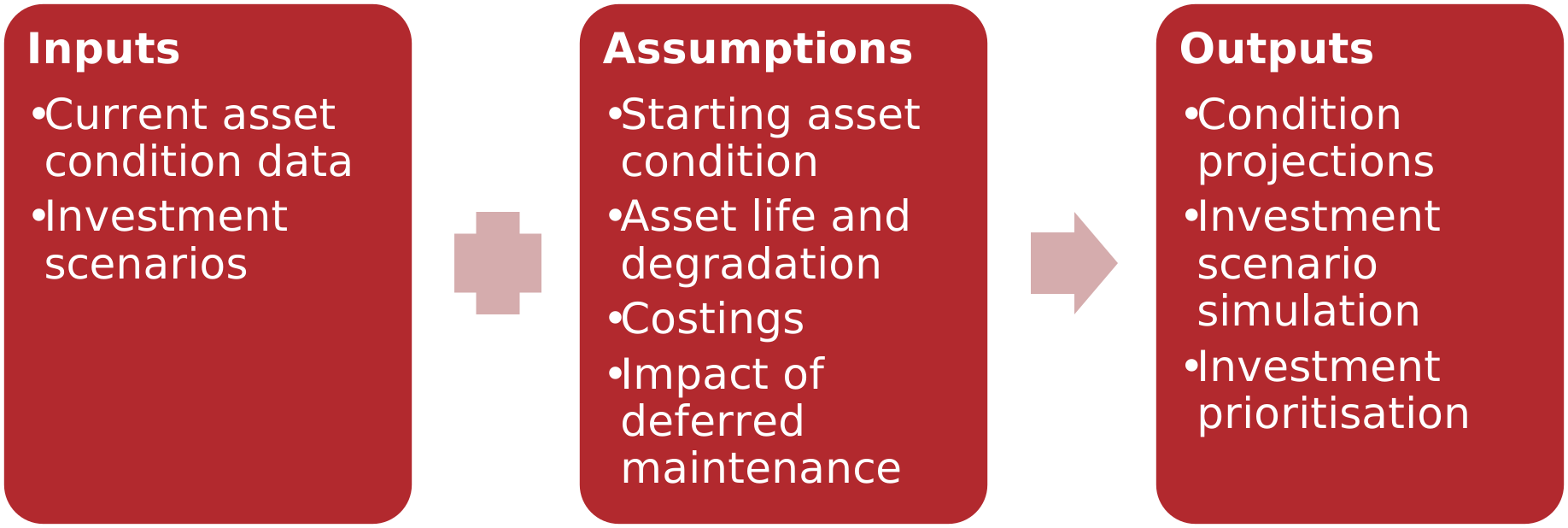
Inputs
Condition forecast models require two types of core data inputs:
- Current asset condition data – Up-to-date asset condition survey data or estimates, following guidance set out in paragraphs B.4 to B.8.
- Investment scenarios – Models should include scenarios for asset maintenance works. Scenarios may be financial (planned expenditure on maintenance and renewals) or descriptive (a list of scheduled works and expected impact on condition).
Some organisations may collect condition data and costings estimates simultaneously. Organisations may use maintenance costings as a model input instead of condition data, subject to them being assured that this enables production of a robust model. In doing so, organisations must ensure that a consistent standard is used for the costings and that they can justify the condition rating to be targeted.
Assumptions
Condition and investment forecast models rely on a series of structured assumptions to ensure outputs are robust and defensible. These assumptions should be calibrated using robust literature or survey evidence and should be validated against survey or performance data collected by organisations over time. Key assumptions include:
- Starting asset condition – Asset condition and priority should be determined using expert judgement, supported by evidence such as condition surveys, usage data, and risk assessments.
- Asset life and degradation – Assumptions on asset degradation and expected lifespan should be drawn from reputable, standardised sources (e.g. Royal Institution of Chartered Surveyors) to ensure projections are consistent with industry standards and best practice.
- Costings – Cost assumptions, including unit rates for maintenance and lifecycle interventions, should be sourced from robust datasets, such as published cost benchmarks, recent tender returns, or validated internal records. Where modelling is required to estimate costs, the methodology should be transparent and defensible.
- Impact of deferred maintenance – Models should assume that deferring maintenance activity will affect whole-life maintenance costs. Deferred maintenance speeds up degradation, increasing future expenditure or shortening asset lifespan. These impacts should be reflected as assumptions for each asset type.
Outputs
Condition forecast models should provide three core outputs:
- Condition projections – Models should illustrate the dynamic relationship between funding and asset condition, projecting how condition evolves under different investment scenarios.
- Investment scenario simulation – Models should test how different asset management strategies affect asset condition, such as prioritising assets with the greatest need, to forecast how condition will change if investment is distributed differently across the asset portfolio.
- Investment prioritisation – Advanced models should provide forecasts capable of disaggregating condition according to asset type and business criticality, supporting risk-based prioritisation and ensuring resources are directed to where they maximise impact. Granularity also supports integration with condition-to-outcomes models.
Approach with data limitations
A good-practice condition and investment forecast model will prepare forecasts at an individual asset level, using a standard degradation curve validated on internal historic data, before aggregating up the individual forecasts to a portfolio-level.
Where data is weaker, organisations may need to estimate degradation curves for portfolios of assets rather than at asset level; draw condition estimates rather than use survey data; weight the use of condition survey data in analysis with confidence ratings of its quality; and make inferences about maintenance needs from failure rates.
These assumptions should only be used where organisations are using a model for the first time and models should be refined over time.
Box B.1 – Example model outputs mock-up
Chart B.1 is a mock-up of a condition forecast model for illustrative purposes. A good condition forecast model can produce a forward look of the demand for maintenance across the asset base, including how overall condition need can be expected to change over time.
Chart B.1 Mock condition forecast as a function of investment (£m)
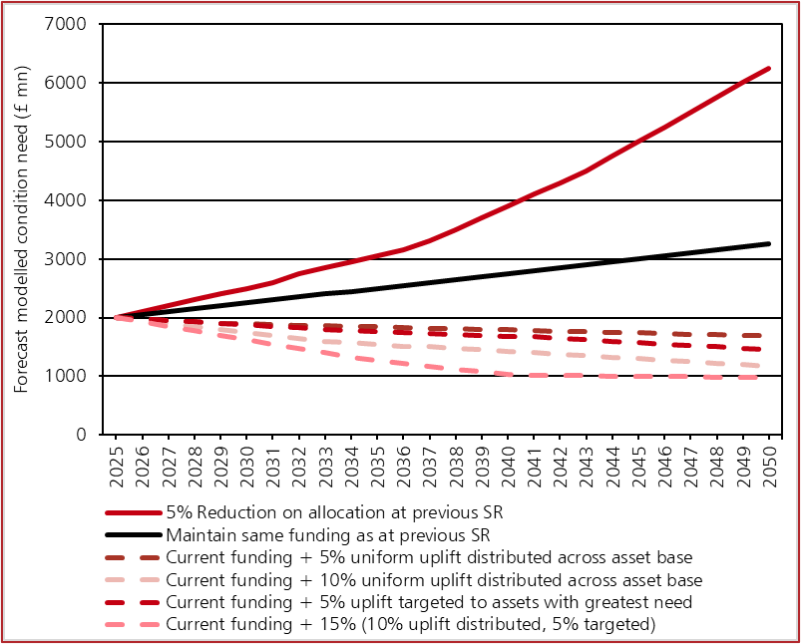
Condition-to-outcomes model
Departments and public bodies should produce a condition-to-outcomes model, which extends the condition and investment forecast to identify the relationship between an asset’s condition and maintenance and the outcomes this enables the delivery of.
A condition-to-outcomes model should incorporate some of the building blocks of the condition and investment forecast, such as the modelled relationship between maintenance investment and condition. This could form part of the same model or a separate model.
A good model should allow organisations to show the impact on policy delivery of different investment scenarios. This should provide evidence on the relationship between maintenance investment and policy outcomes and help understand where resource allocation improves outcome delivery the most.
At SRs, the Treasury will look favourably on bids that use robust evaluation methods and evidence to quantify the relationship between investment options and outcomes.
Approach to developing a model
A sensible starting point for producing an appropriate condition-to-outcomes model is an asset maintenance theory of change. A theory of change should demonstrate the logical links between inputs, activities, outputs, and outcomes of maintenance investment.
Once organisations produce a theory of change, they should analyse the relationships between each logical step (for example, how activities lead to outputs and how outputs lead to outcomes). They may do this in a range of ways, but the Treasury recommends undertaking specific analyses or evaluations which empirically quantify the relationship between each pair of linked stages in the theory of change. This should inform a series of assumptions incorporated in models.
For example, when assessing how asset condition impacts costs that users of assets face, organisations may use a range of evaluation methods to quantify the relationship. This may include surveys of asset users or collecting data on the costs that users face. The method chosen will depend on factors like characteristics of the asset, number of users, and availability of data and evidence.
Organisations should then construct a model that:
- Takes the outputs of the condition and investment forecast on how investment scenarios affect asset condition.
- Link the asset condition to a policy-related output such as asset productivity, capacity or efficiency.
- Link this policy output to policy outcomes, such as specific ways that public service performance is improved by asset productivity.
Illustrative example – local road maintenance
An example of an area where there has been substantial historical analysis on the benefits of asset maintenance is local roads.
Maintenance of the road network is important as it can be considered a public good and many roads are in poor condition. The poor condition of roads affects journey times and damages vehicles for road users, which in turn has a wider economic impact.
The road network also has a significant maintenance backlog, so it is important to consider where resources are best allocated in maintenance budgets to achieve policy outcomes.
Figure B.2 summarises a simplified theory of change for local road maintenance. This is provided for illustrative purposes and should not be interpreted as a description of government policy or analysis.
Figure B.2 Example – simplified theory of change for local roads[footnote 78]
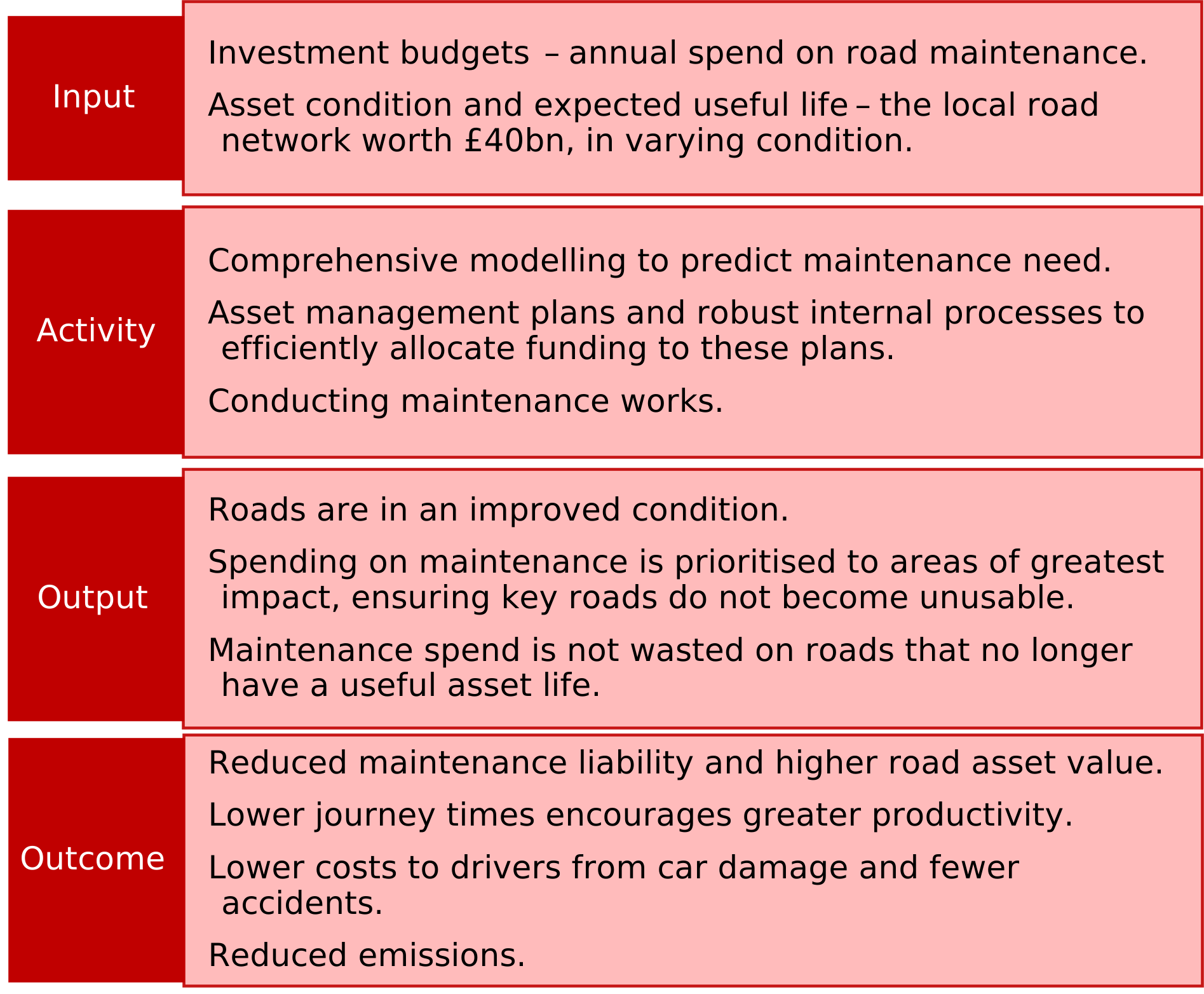
Evaluating performance
After a SR or business case approval, organisations should monitor delivery against agreed plans, capturing the following:
- Actual spend against planned maintenance works. Where an asset management plan sets out plans for maintenance works, organisations should collect evidence of expenditure against plans. This supports evaluation of efficacy and cost estimates.
- Regularly revised condition surveys, compared with previous results. Organisations may find it most useful to produce data visualisations on how condition has changed across the asset base. This could include, for example, changes in condition in business-critical assets or in those requiring the most urgent works
- Analysis on whether works undertaken have improved outcome delivery. This does not necessarily need to be a continuous exercise if one-off evaluations or analysis exercises yield appropriate evidence to inform the development of revised asset management plans.
Organisations should use this ongoing monitoring and data collection to revise their asset management plans.
Annex C: Guidance on appraisal of asset disposals
Introduction
The Green Book sets out guidance on how to appraise policies, programmes and projects. This annex sets out guidance on how to apply the principles in the Green Book to the appraisal of potential disposals of public sector assets. It replaces the 2008 Green Book supplementary guidance on asset valuation and will be reviewed following trialling with departments and updated as required. It will be kept with the broader framework as a ‘live’ document that reflects latest best practice, in line with how the Green Book itself is updated.
This annex expands on principles in Chapter 6 and aims to support appraisals of disposals. Assets should be disposed of when they are surplus, when there is no longer a public interest objective making public ownership desirable, or where policy objectives or asset utilisation could be better served in the private sector. Organisations should consider alternative use of the asset before disposal.
When considering disposals of public sector assets, the type of asset and difference between how society and the private sector value the asset affects the way that value for money (VfM) is assessed.
The Green Book’s Five Case Model provides a framework for appraising asset disposals, ensuring all relevant dimensions – strategic, economic, commercial, financial, and management – are considered. As part of a business case for an asset disposal, issues related to the prospective sale will feature in each as follows:
- The strategic case sets out the underlying rationale for the prospective asset disposal, defining the objectives, desired outcomes, and success criteria.
- The economic case considers the costs and benefits of disposal compared to retention, from a societal perspective.
- The commercial case should examine the best value that can be achieved, given market demand, discount rates and risk premia.
- The financial case should consider nominal cashflow impacts over time and produces financial analysis to inform budgeting.
- The management case sets out practical arrangements for delivering the asset disposal, ensuring it can be implemented.
This guidance considers each of the above cases sequentially.
Figure C.1 Asset disposal appraisal process
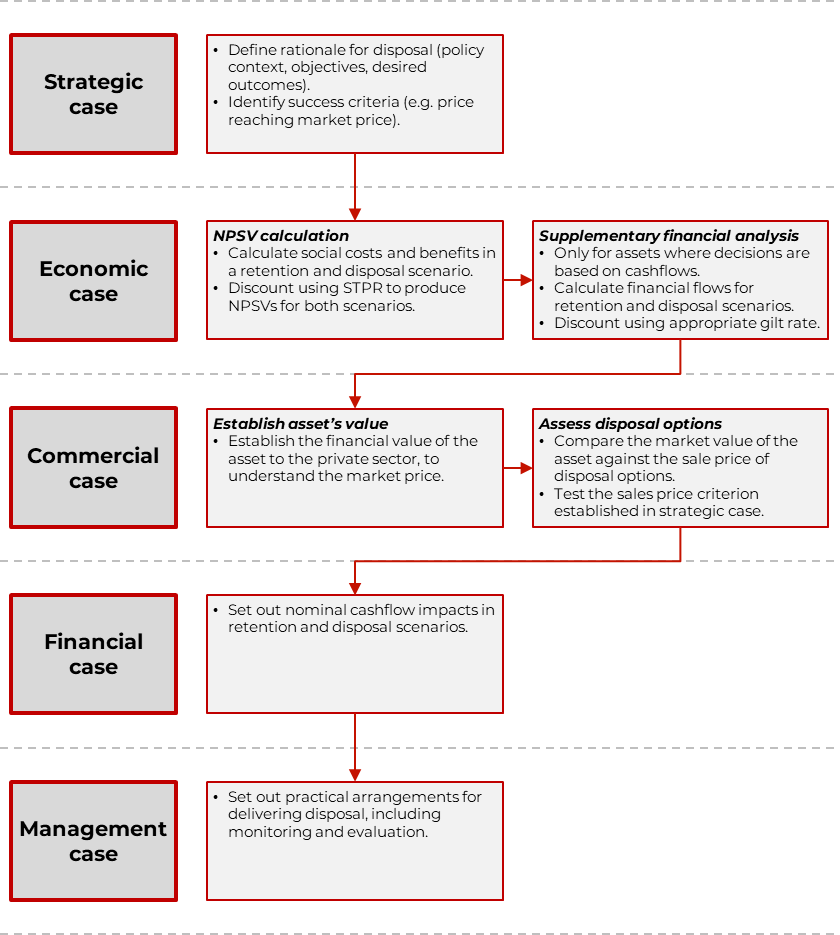
Strategic case
The strategic case establishes the rationale for considering an asset disposal, setting out the objectives and parameters for the transaction. It articulates why the disposal is being proposed, placing it within the wider policy and organisational context.
The strategic case defines what success looks like, not just in financial terms but also in relation to any broader policy goals and non-financial outcomes. By clearly setting out these objectives, the strategic case provides a foundation for option selection and the economic case.
As set out in Chapter 6, disposals should target the best value for the public sector. The strategic case typically identifies as a success criterion that the sale price should aim to achieve the market value of the asset. This implies that all shortlisted options in the economic case would need to meet this criterion. In certain cases, the strategic case may identify a rationale to sell below market value to achieve specific policy objectives, which similarly defines parameters for the economic case where the social benefits must outweigh the foregone proceeds.
Examples of objectives for an asset sale might include:
- Freeing up cash for re-use in other goals from surplus assets, entities that no longer serve a public interest objective, or funds held to meet liabilities that do not transfer financial risk from the taxpayer.
- Supporting development or competitiveness of a particular market, by enabling commercial exploitation of an asset.
- Ensuring improved service provision to users, where it is judged that the private sector would better deliver a particular service and there are no public interest objectives undermined by private ownership.
Defining and prioritising these objectives ensures that the appraisal is focused on delivering agreed strategic benefits, and that all later analysis is aligned with the overarching aims for the disposal.
Economic case
Overview
The economic case comprises an assessment of the social costs and benefits of government ownership versus private ownership of the asset. For assets (e.g. financial assets) where timing of cash receipts or income are the central consideration in disposal, there should be a supplementary assessment of financial costs and benefits. The appraisal should always include a retention scenario as the counterfactual.
Practitioners should assess social costs and benefits that might be expected from retention and disposal, which are then discounted to produce the net present social value (NPSV) of each option.
When calculating the social value of disposal, this should reflect any potential efficiency gains. Assets will be more efficiently utilised in the private sector where this results in increased competitive and/or regulatory incentives. For example, this could arise through:
- The presence of certain pressures in the private sector driving efficiency relative to the public sector, including the threat of bankruptcy or takeover.
- Absence of pressures to pursue other public sector goals that conflict with or divert attention away from efficient asset utilisation.
- Absence of any market distortions or moral hazard created by public sector ownership.
This assumes that other things will remain equal except for the efficiency pressures created by private ownership. In reality, a shift of ownership will likely result in a myriad of changes, such as:
- Externalities material to social welfare that are not accounted for by the market pressures driving private sector economic efficiency.
- The need to meet social welfare objectives in a private ownership scenario may require complex intervention of a regulatory nature, or difficult contractual arrangements, which may be less efficient.
- The potential for the public sector to retain risks or liabilities (including implicit liabilities) associated with the privately owned entity, but having no or limited levers to mitigate the risk.
The assessment of relative efficiency between the public and private sector should be approached analytically rather than assumed, as in specific circumstances public firms can be more efficient that private firms. Relative efficiency depends on context-specific factors, including management incentives, risk allocation, and regulation.
It is necessary to calculate the net present social value (NPSV), accounting for possible externalities as well as wider economic and social impacts. Practitioners can then compare the NPSVs for public and private ownership to assess which option offers best value for money. This judgement is made against the objectives and criteria in the strategic case, ensuring analysis is anchored in the policy objectives.
Calculating Net Present Social Value
Determining the NPSV of an asset’s disposal and retention is a required input for the economic case. The methodology outlined is similar to the Discounted Cash Flow method which is typically used to estimate the value of an investment today.
The social value of asset retention should be determined through a calculation that involves:
- assessing the stream of income (e.g. commercial revenues) and costs (e.g. maintenance and administration) over a period, including any residual asset value or costs of disposal. These costs should fully reflect all endogenous risks (see below) and, where these are not known, should take account of potential optimism bias;
- assessing possible efficiency gains or losses that may be expected from retention;
- assessing other social cost and benefits that might be expected from retention, including externalities or endogenous risks (for example, credit or market risk associated with financial assets); and
- calculating the NPSV of the above.
The social value of asset disposal should be determined by:
- Assessing the asset’s current market value and net off the transaction costs associated with a sale. To do this, it is necessary to assess – before invitations to bidders – that:
- a well-functioning and healthy market exists for the asset;
- the market is of sufficient size to absorb the disposal without distortions;
- the optimal approach to sale execution will be determined to obtain best price;
- the transaction costs are proportionate; and
- the disposal uses a market-consistent assessment of risk and is designed to promote efficient pricing, avoiding information asymmetry or other factors which may disadvantage buyers.
- Assessing possible efficiency gains or losses that may be expected from disposal, including the effectiveness of any competitive or regulatory regime that may follow from asset disposal.
- Assessing the impact of the sale on the price charged to the public sector in any cases where the public sector continues to pay for goods or services after the asset has been sold (for instance, after selling a commercial asset).
- Assessing other social costs or benefits that may arise from disposal.
If there are any social costs and benefits that remain unaffected by retention or disposal, these should be excluded from both sides of the calculation. If there are no social costs or benefits from retention or disposal, the NPSV is not material in the assessment and practitioners should continue onto the supplementary financial analysis.
The Social Time Preference Rate (STPR) should be used to discount the future costs and benefits under the disposal and retention scenarios, reflecting that society prefers to consume in the present.
Some costs and benefits cannot be expressed in monetary terms and are not included in NPSV calculations. Practitioners should ensure that unmonetisable costs and benefits are considered holistically as part of the overall VfM judgement within the economic case.
Treatment of endogenous risk in the economic case
Practitioners should consider the best or most feasible way of capturing the endogenous risks of asset retention (for example, asset income being lower than expected or companies underpinning investments facing financial difficulties) in the NPSV calculation.
As set out above, wherever possible endogenous risk should be captured in cost estimates within the NPSV. For endogenous risks that are not possible to quantify, as with any other unmonetisable costs they should be considered holistically as part of the VfM judgement.
Practitioners may also consider using a risk-adjusted STPR to discount costs and benefits rather than including the risks as cost estimates. This may be appropriate for financial assets (like loans or equity stakes) or commercial entities where there are comparable assets or entities in the private sector, and in circumstances where it is difficult to assess the endogenous risks of continued public ownership.
If doing this, practitioners should consider how the market may price risk premia, by reference to similar asset markets, and incorporate this in asset retention and disposal NPSV calculations. The STPR should be adjusted to exclude 1% exogenous risk costs and the market-based risk premium added. The resulting risk-adjusted STPR can be used to discount retention values and, if suitable, fed into an estimate of market value on disposal using the capital asset pricing model (see Box C.A).
Box C.A The capital asset pricing model
The Capital Asset Pricing Model methodology values an asset through a required return on assets equal to the risk-free rate (the return on government bonds) plus a risk premium, which reflects the covariance of the assets’ expected returns with the wider market.
This is usually expressed as the product of the market risk premium and the “asset beta”, which reflects the particular risk and correlation characteristics of the asset. Expert advice may be required to determine appropriate market data to be used within the asset beta.
The asset beta is calculated by: Beta(i)= Rho (im) x sd(i) / sd(m), where Rho (im) is the correlation coefficient between returns on the asset and on the market and sd (i) and sd(m) are the standard deviations of the asset and market respectively.
Value for money in the economic case
Once NPSVs for the retention and disposal scenarios have been calculated, these are compared to judge whether a proposed disposal represents VfM. Typically, it is considered VfM to sell if the NPSV for disposal exceeds the NPSV of retention.
This judgement is not made in isolation; it is structured by the strategic case which sets out the rationale for a disposal and defines the outcomes it is intended to achieve. By shortlisting the options considered in the VfM assessment against these objectives, decision-makers ensure the recommended option maximises social welfare within the context of the strategic objectives set for the disposal.
Supplementary financial analysis
Where an asset disposal decision has the timing of cash receipts or income as its primary consideration, because there are no or limited wider social costs or benefits (like externalities or efficiency gains or losses) to be reflected in a NPSV, there should be a supplementary analysis that assesses financial value to government under retention and disposal scenarios. This would primarily be applicable to disposals of financial assets like a loan book or an equity stake in a company.
While this is financial analysis not an assessment of social value, it should be considered in the economic case to inform appraisal of the set of options, rather than in the financial case which typically considers the affordability of the preferred option.
In these cases, the key trade-off in deciding whether to dispose of an asset is between receiving upfront cash proceeds in a disposal scenario or continuing to receive financial benefits (and costs) over a longer timeframe in a retention scenario. This should be assessed using the gilt rate to discount future cashflows, as this reflects government’s cost of borrowing and its opportunity cost.
An appropriate gilt rate to use would be one that best matches the duration over which cashflows associated with asset ownership are expected to last with the maturity of the gilt (e.g. discounting cashflows of an asset with a 30-year useful life using the 30-year gilt rate). The financial trade-off of the shortlisted options can then be assessed through comparison of the calculated net present value of the different scenarios. Typically, the option with the highest NPV is the most attractive from a financial perspective.
For funds held to meet specific liabilities or risks, this analysis does not account for increased allocative efficiency from freeing up funds for other uses, which can lead to greater social returns. As set out in Chapter 6, departments should not consider alternative use of funds being assessed for defunding within the business case, but this should be reflected in Treasury advice to ministers.
Commercial case
The commercial case for a disposal outlines how to establish the financial value of the asset to the private sector, seeking to understand the market price and the potential buyer’s willingness to pay. A robust market analysis is required, including assessment of potential buyers, recent comparable transactions, and market appetite for the asset.
It should also set out the approach to structuring and delivering the transaction, ensuring it is feasible and capable of securing best value. Negotiation considerations are linked to this, including an assessment of government’s ability to realise market value.
Risk management is central to the commercial case. The appraisal should identify key risks (e.g. lack of buyer interest, adverse market movements, or disputes over asset valuation) and set out plans for mitigation. This may involve structuring the sale to reduce exposure to risks, setting minimum price thresholds, or including contractual protections. The commercial case should also consider risks around delivery, such as delays, legal challenges, or reputational impacts.
Finally, the commercial case should show how the disposal aligns with government policy and best practice standards. It should demonstrate that the transaction is deliverable and that the approach to market engagement, negotiation, and contract management will secure value for money for the taxpayer.
The choice of sales route is guided by a comparison between the prospective sale price and the estimated market value for the asset. Typically, if the sale price reaches the market value of the asset, this indicates that the sale is financially palatable to government.
This judgement should be preceded and shaped by the objectives defined in the strategic case. For example, if the strategic case identifies broader policy objectives for the sale and does not make achieving market value a sole success criterion, it may be appropriate to consider sale options that would not achieve market value.
Financial case
The financial case typically deals with questions of affordability, which is largely not applicable to asset sales aside from any affordability considerations in the retention case.
The financial case should set out nominal cashflow impacts over time in the retention and disposal scenarios. Practitioners should produce analysis using CBG to inform how asset disposals and revenue retention from disposals are accounted for. This includes how the book value and profit or loss score in capital and resource budgets.
Management case
The management case sets out the practical arrangements for delivering the asset sale, ensuring that all aspects of the transaction are comprehensively planned, resourced, and subject to effective governance. Its purpose is to provide assurance that the sale can be implemented successfully, with clearly defined responsibilities, robust project management processes, and suitable oversight mechanisms.
The commercial case’s approach to market engagement, risk management, and contractual arrangements should be translated into detailed delivery plans, governance structures, and monitoring processes within the management case.
The management case should specify how the transaction will be managed, including roles and responsibilities, governance arrangements, key milestones, and reporting requirements. The management case should also describe processes for managing risk, engaging stakeholders, and monitoring ongoing obligations following the sale. It must also provide assurance that all legal, regulatory, and policy requirements will be met throughout the transaction.
The management case should also outline how a disposal will be evaluated, assessing whether its objectives have been achieved. Plans for evaluation should be set out, clearly defining actions and responsibilities so that lessons for future disposals can be learned.
Annex D: Data Valuation for Appraisal Implementation Guide
Introduction
This annex sets out a practical guide for appraising and/or evaluating data related initiatives in the public sector. It is intended to support analysts who infrequently assess data-related projects, or who are new to the topic, by condensing existing work into a shorter practical document.
This guidance is structured according to the common steps of appraisal, namely:
- Set out a Theory of Change
- Monetise impacts where possible
The following will break these steps down and set out minimum standards, desirable standards, and possible further analysis for each section. Analytical judgement should be used to determine which level is needed for each project, in line with the need for proportionality in appraisal and evaluation. For public bodies who frequently invest in data-related initiatives, it may be beneficial to centrally develop this guidance based on common interventions for that body. An example of this is the Geospatial Commission guidance for valuing public sector location data.
The primary features of data which make valuation for appraisal and evaluation difficult are that it generates value indirectly and that it is non-rival. Since value is often only generated at the end of a series of steps, it is difficult to identify what the applications of the data will be in advance, and even more difficult to identify what the impacts of these applications will be. As it is non-rival, it is possible for the number of these unknown applications and impacts to be wide-ranging.
Appraisal impacts are commonly summarised as the ratio or the difference between monetised benefits and costs: the Benefit Cost Ratio (BCR), or Net Present Social Value (NPSV) respectively. Projects are not chosen solely based on these summary metrics, as some costs and benefits cannot be monetised. As data is a non-rival good which often generates value indirectly, data-related projects are difficult to quantify and hence BCR and NPSV can be poor summaries of their potential value.
Where BCRs and NPSV do not summarise the value of a project well, such as with many data-related projects, there is a need for a strong qualitative case and a focus on embedding monitoring and evaluation into the initiatives.
Note: This guidance assumes that conventional options analysis will have been conducted in conjunction with the relevant stakeholders. These steps may therefore need to be followed multiple times within an appraisal to distinguish between options.
Theory of Change
A ‘theory of change’ is recommended for all appraisals and evaluations and sets out how the inputs and outputs defined in a proposal will lead to the desired policy outcomes. Given the difficulties in identifying and monetising impacts for data-related initiatives, this step can be a particularly important part of analysis for these initiatives, and requires early and strong collaboration with relevant stakeholders, such as policy or technical teams.
Further guidance on developing theories of change is available via the analysis function toolkit.[footnote 79] In general, analysts are advised to keep sections clear and concise with a strong link to the intervention and a logical narrative from inputs to impacts.
Theories of change are often summarised graphically. Types of value derived from data assets can be categorised in multiple ways.[footnote 80] This guidance uses categories of ‘known applications, known impacts’; ‘known applications, unknown impacts’; and ‘unknown applications, unknown impacts’ to break down the theory of change.
A template theory of change using this categorisation is shown in Figure D.1 below.
Figure D.1: Theory of Change template
Inputs
When considering the inputs, public bodies should understand the context and potential value of the data.
- Domain: The domain refers to the wider context in which the data is created and applied, including sector, environment, and user characteristics.
- Minimum analysis: The minimum standard sets out the potential users and user needs as well as the case for change.
- Desirable analysis: The desirable standard addresses the following questions set out in Table 1 in relation to the domain and characteristics of the data:
Table 1: Domain considerations
| Who are the potential users and what are their needs? Identify who would or might use the output and what problem it would solve. |
| What is the existing situation? What staff, skills, technologies, partnerships and processes currently facilitate or limit data use? |
| What is the subject matter of the data? Is it particularly valuable to the economy, society, or the environment? |
| How unique is this data? Is or would HMG be a monopoly provider of this data? |
| Is there an evidence gap this data could fill? |
| What is the longevity of this data? How long is this type of data typically used for? |
| Are there any legal obligations relevant to this data? Would these restrict what the data can be used for? |
| What are the relevant liabilities and risks within this sector? Is data in this sector relatively sensitive or risky? |
Further analysis: Consider the Knowledge Asset evaluation tool set out in Annex B of The Rose Book. This provides additional questions to consider for outlining the context.
Costs
A taxonomy of data-related costs is set out in Research into cost considerations of data sharing. This is summarised in Table 2. Note this list is not exhaustive. There may be project-specific costs, and ongoing costs are likely to be uncertain as future needs and opportunities are unpredictable.
Table D.2: Cost taxonomy
| Cost category | Sub-categories (including but not limited to) |
|---|---|
| Strategy costs | Planning & co-ordinating[footnote 81] Data collection Data procurement |
| Legal and regulatory costs | Compliance (collection and sharing) Data sharing agreements |
| Technical | Software Security Storage Data preparation and cleaning, including metadata |
| Operational | Data quality monitoring Product/interface maintenance, including user support where applicable Product/interface deployment Product/interface dissolution |
| Implicit | Reputation risk Cyber risk Loss of competitive advantage (for data sharing initiatives only) |
Costs can be defined as fixed (overheads), variable, semi-variable, or semi-fixed (step costs). Note that there has been a shift in technology costs from CDEL towards RDEL,[footnote 82] e.g. from one-off hardware costs to ongoing cloud subscriptions.
Minimum analysis: For the minimum standard, public bodies should set out the direct additional costs (RDEL and CDEL) associated with the intervention and include a qualitative description of the implicit costs. They should consider if HMG is committed to the future costs or can easily stop further spending if desired. For example, some data sharing conditions create obligations to share and maintain similar data going forward.
Desirable analysis: As above, but with the addition of a ‘replacement cost’ calculation. Public bodies should set out the total costs associated with producing the data-related initiative. This includes the sunk or future data costs which are necessary but would be borne regardless of the data-related initiative, for example, data collection and management. The categories set out in the taxonomy in Table 2 should be used as a guide, monetising estimates where possible or else quantifying/qualifying categories of costs. You should separate the direct additional costs (set out in the minimum analysis) for use in the financial case from the Net Present Social Value (NPSV) or Benefit Cost Ratio (BCR) calculations used in the economic case.
Further analysis: As above, but with the addition of a ‘workaround’ cost. You should set out the estimated cost for another provider to provide a comparable data-related initiative or achieve comparable outcomes without the initiative. Many data-related initiatives in the public sector build upon existing data assets, meaning that it is cheaper for data owners to create data-related products than for others to do so.
Activity
Categories of interventions include the following:
- Improve or maintain existing data assets or data products
- Create a new data asset or data product
- Data sharing
- Data linking
- Aligning data asset or data product with standards
- Regulations impacting relevant data assets
Minimum analysis: This should detail what the proposed intervention is, setting out how the inputs feed into these activities, and what assumptions this relies on.
Desirable / Further analysis: As above. Set out evidence for each assumption relied upon.
Outputs
Investments in data-related initiatives often change the characteristics of data. These characteristics influence how the data can be used and therefore the value that can be derived from it. Assessing how an intervention changed data characteristics can help identify the resulting outcomes and impacts and strengthen the qualitative case for the intervention. Changes may also increase the flexibility of how a data asset can be used, creating real options.[footnote 83]
The relationship between data characteristics and value is non-linear. Some characteristics exhibit threshold effects: after a certain point, further improvements may generate little additional value, while in other cases new uses only become possible once a threshold is reached.
Characteristics can also interact in complementary and/or contradictory ways. For example, increased granularity can facilitate greater interoperability of a data asset but also increase the legal obligations and risks around a data asset.
A long list of data characteristics which impact the value of data is set out in Annex E of the Value of Data Assets report. For simplicity, these can be categorised as follows:
Table D.3: Data Characteristics
| Data characteristic category | Sub-category examples |
|---|---|
| Data Quality | • Timeliness • Granularity • Completeness • Accuracy • Precision • Representativeness • Size (observations & parameters) |
| Data Usability (FAIR Principles) | • Findability • Accessibility • Interoperability/Linkability • Re-usability |
| Ecosystem characteristics | • Complementary assets (e.g. skills and technology) • Change in point along value chain (e.g. raw data being turned into databases being turned into data intelligence) • Consistency (e.g. compliance with common standards) • Domain factors (e.g. obligations, liabilities and risks) |
Minimum analysis: For the minimum standard, you should identify the primary data characteristics targeted by the intervention and set out how the activities result in these changes, and what assumptions this relies on.
Desirable analysis: As above, with the addition of identifying any secondary or indirect impacts. You should qualitatively explain the changes resulting from the intervention on the overall characteristics of the data asset or data product, setting out evidence for each assumption relied upon.
Further analysis: As above, whilst considering measuring the changes in data characteristics due to the intervention. Annex E in the Value of Data Assets report provides some considerations and links to value for a selection of data characteristics.
Outcomes & impacts
Identifying outcomes and impacts is where valuing data related initiatives can become difficult due to the features of data discussed above. We identify three common categories to consider when assessing outcomes and impacts:
- Known applications, known impacts: These are common when initiatives are created for a specific purpose for specific users.
- Known applications, unknown impacts: These are common when likely applications are novel or innovative. It may also be common when data is made available to new but similar users, who are likely to repeat the same applications as existing users, but with potentially novel or unexpected impacts.
- Unknown applications, unknown impacts: These are common when data is made available to many new users or for many new purposes simultaneously.
Conventional appraisal and evaluation guidance best applies to initiatives within the first category and struggles most with the third.
The outcomes and impacts of data related initiatives are broad and case specific. Table 4 sets out common categories of applications and impacts to consider.
Table D.4: Data applications and impacts
| Stakeholders | Application examples | Impact examples |
|---|---|---|
| • Data owners • Data users • End-users (of applications or consumers of data driven businesses) • Third parties (businesses and citizens) • Data subjects |
• Sell or license databases • Sell or license data intelligence or insights • Improve internal processes • Create new or enhanced data-driven products and services • Build evidence/R&D • Monitoring |
• Revenue • Improved or expanded public services • Improved decision making • Productivity gains (costs avoided, risks reduced) • Accountability • Economic growth (more jobs, more exports, higher wages, etc.) • Innovation |
Minimum analysis: For the minimum standard, you should qualitatively set out: the known or likely applications enabled by changes in data characteristics, and the assumptions underpinning these; the likely users of each application; the direct impact of these applications on relevant stakeholders, including but not limited to users. Relevant methods for identifying applications are set out in Step 4 of the Geospatial Commission guidance and apply to most data types. Any potential negative impacts of the intervention should be included in the costs or risks section.
Desirable analysis: You should qualitatively assess: the end users of data enabled application; the indirect impacts of applications on relevant stakeholders, including but not limited to end users; any spillover effects into the wider economy or society; and any wider externalities. For example, the Transport for London Open Data Initiative has directly benefited journey mapping applications such as Citymapper. Indirectly, these applications reduced travel times for users and, by lowering overall congestion, benefited other travellers in the area. You should also set out the evidence supporting key assumptions and where evidence is limited, describe the implications if those assumptions do not hold.
It should be determined whether it is likely that unknown applications and/or unknown impacts are likely to be significant for this initiative. The following questions should be considered:
Table D.5: Questions to consider unknown applications and impacts
| Does the initiative facilitate many new potential uses or users? Consider changes to use and access conditions to determine whether new and unforeseen applications are likely. |
| Is there evidence from similar initiatives? Consider both previous applications of similar data and impacts of similar initiatives in different domains. If evidence is limited, set out why this is. |
| Does the initiative qualify as ‘Research & Development’? For an activity to be classified as R&D, it must be ‘novel, creative, uncertain in its outcome, systematic and transferable and/or reproducible’. Note that organisational R&D spending is reported differently to general spending by public sector bodies. |
Further analysis: Utilising the above, you should build bespoke evidence on the likely applications and impacts of the initiative. Options include stakeholder engagements, surveys, willingness to pay/accept studies, and pilots or trials. These are advised within the Green Book to reduce levels of uncertainty, moving towards the ‘known application, known impact’ scenario.
Monetise impacts where possible
Monetisation of costs and benefits is used to provide a common metric for comparing different types of impact. It is not the same as benefits being financial or economic, as some social and environmental benefits are monetisable. Chapter 6 of the Green Book sets out a range of non-market valuation techniques for common impacts which do not have clear market prices.
There is no expectation that all benefits can be monetised. Even where impacts are known, monetisation can be difficult. Selected issues and the potential solutions are summarised below.
Table D.6: Selected issues with monetising impacts and solutions
| Impact category | Likely issue in monetising | Solution examples |
|---|---|---|
| Known & monetisable | • Number of impacts (lack of time to monetise individually) • Uncertainty in size |
• Impact prioritisation and monetisation of selected benefits only (exemplar applications and impacts) • Breakeven analysis |
| Known & unmonetisable | • Lack of ability to incorporate into summary figures | • Quantify where possible • Strong qualitative case |
| Unknown impacts from known applications | • Identifying impacts | • Size of the Prize estimates • Reference case studies of similar applications • Scaling factors applied to known impacts or reference case studies |
| Unknown impacts from unknown applications | • Identifying applications | • Stakeholder engagement on likelihood and potential scale of benefits • Reference case studies of similar investments in data and other assets •Detailed qualitative case (see desirable and further analysis sections above) |
The solutions are subject to an increasing number of caveats going down the table. When they are used, it is recommended to:
- Be clear why monetisation, quantification, and/or full identification of impacts is not practical or possible. Refer to the questions in Table 5, and the features of data mentioned in the introduction.
- Be upfront about the limitations and caveats of the methodology, as well as the assumptions being made. Justify these assumptions as much as possible given information constraints.
- Include sensitivity analysis. Vary assumptions and conduct breakeven analysis to determine how much assumptions can be relaxed whilst still recommending the policy.
- Incorporate a robust monitoring and evaluation plan into the appraisal. This will allow for more thorough identification and quantification of benefits in the future. At a minimum, these should include some efforts to monitor who the users of the data are and what the data is being used for.[footnote 84]
- Set out a robust qualitative case, including clear problem definition, policy objectives, stakeholder engagement, and options appraisal, supported by relevant case studies or exemplar applications.
Where effects are monetisable, you should, apply discount factors, and adjust for optimism bias, in accordance with the Green Book.[footnote 85]
Annex E: Management of Debt Owed to Government
Overdue debt is defined as a receivable that has not been paid by the due date,[footnote 86] and can arise through a number of different ways, such as unpaid tax, benefits overpayments, fines and penalties, loans, fees and charges.
Although overdue debt owed to government could be classed as an asset, recovery is not guaranteed and management is therefore covered under separate arrangements set out below rather than in the main body of the Balance Sheet Framework. However, overdue debt should be managed in alignment with the Balance Sheet Framework’s objective to manage public assets and liabilities in a way that protects taxpayers, supports delivery of public services and maintains fiscal sustainability.
The centre for the Government Debt Management Function, based in HM Treasury, provides oversight, expertise, and strategic leadership for the management and resolution of overdue debt handled by government.
Each department and ALB has its own policies, approaches and, in many cases, legislation for how they manage debt. Underpinning this are common standards, practices and skills that define good debt management, set out in the Government Debt Management Strategy and the Debt Functional Standard.
The Government Debt Management Strategy sets the vision for how government manages overdue debt, aiming to:
- prevent avoidable debt upstream and reduce the number falling into problem debt;
- resolve debt to clear standards, pursuing those who avoid repaying and enforcing recovery where appropriate; and,
- improve government capability to resolve debt efficiently, effectively and fairly.
The Debt Functional Standard sets expectations for the management of overdue debt owed to government to help achieve a more consistent approach, improve capability, minimise losses to the exchequer and ensure taxpayers money is spent in the most efficient and effective way, whilst minimising any unnecessary stress on the debtor.
Organisations must manage their overdue debt in line with GDMF standards, Managing Public Money and the Consolidated Budgeting Guidance.
-
Charter for Budget Responsibility’, HM Treasury, January 2025. ↩
-
Financial Transaction Control Framework’, HM Treasury, March 2025. ↩
-
Guidance for Managing Government’s Implicit Liabilities’,HM Treasury, November 2025. ↩
-
Whole of Government Accounts, 2023-24’, HM Treasury, July 2025. ↩
-
Annual Report on the UK Government’s Contingent Liabilities 2025’, UK Government Investments, March 2025. ↩
-
The Balance Sheet Review Report’, HM Treasury, November 2020. ↩
-
Government Financial Reporting Manual’, HM Treasury. ↩
-
InSite Government Property Portal’, Office of Government Property. ↩
-
Government Property Data Standard’, Office for Government Property, February 2023. ↩
-
Strategic Asset Management Plans (SAMPs) Handbook’, Cabinet Office, November 2025. ↩
-
Government Property Strategy 2022-2030’, Government Property Function, August 2022. ↩
-
Table 2, ‘National Accounts articles: Changes to the capital stock estimation methods for Blue Book 2019’, Office for National Statistics, August 2019. Values quoted are weighted averages across industries, with industries weighted by investment flows for each industry. ONS estimates of asset lives are subject to change. Asset lives in Table 3.B are correct as of the date of publication of the article in this reference. ↩
-
Government Financial Reporting Manual’, HM Treasury. ↩
-
Facilities Management Standards for GovS 004: Property’, Office of Government Property, March 2022. ↩
-
As defined in European Standard EN 13306:2017 (Maintenance Terminology). ↩
-
Chapter 6, ‘Managing Public Money’, HM Treasury, June 2025. ↩
-
InSite Government Property Portal’, Office of Government Property. ↩
-
Financial Transaction Control Framework’, HM Treasury, March 2025. ↩
-
Financial Transaction Control Framework’, HM Treasury, March 2025. ↩
-
Arm’s Length Body Sponsorship Code of Good Practice’, Cabinet Office, May 2022. ↩
-
Consolidated Budgeting Guidance’, HM Treasury. ↩
-
Whole of Government Accounts’, HM Treasury, July 2025. ↩
-
Annex 4.16, ‘Managing Public Money’, HM Treasury, June 2025. ↩
-
Guidance for Managing Government’s Implicit Liabilities’, HM Treasury, November 2025 ↩
-
Charter for Budget Responsibility’, HM Treasury, January 2025. ↩
-
Debt Management Report 2025-26’, HM Treasury, March 2025. ↩
-
Public Service Pensions Act 2013’, 2013. ↩
-
Memorandum of Understanding Between HM Treasury and the Bank of England 2025’, HM Treasury and the Bank of England, February 2025. ↩
-
Management of the Official Reserves’, HM Treasury, March 2020. ↩
-
Annex 4.15, ‘Managing Public Money’, HM Treasury, June 2025. ↩
-
Asset sale disclosures: guidance for government’, HM Treasury, March 2019. ↩
-
Managing Surplus Government Property’, Cabinet Office, November 2025. ↩ ↩2
-
InSite Government Property Portal’, Office of Government Property. ↩
-
Annex 4.16, ‘Managing Public Money’, HM Treasury, June 2025. ↩
-
Government buys back 36,347 military homes to improve housing for forces families and save taxpayers billions’, Ministry of Defence, December 2024. ↩
-
Consolidated budgeting guidance: 2025-26’, HM Treasury, February 2025. ↩
-
Annex 4.15, ‘Managing Public Money’, HM Treasury, June 2025. ↩
-
Managing Surplus Government Property’, Cabinet Office, November 2025. ↩
-
UK Infrastructure: A 10 Year Strategy’, UK Infrastructure: A 10 Year Strategy HM Treasury and National Infrastructure & Service Transformation Authority, June 2025. ↩
-
Contingent Liability Approval Framework’, HM Treasury, April 2023. ↩
-
Managing the Risks of PFI Contract Expiry’, Infrastructure and Projects Authority, August 2021. ↩
-
Infrastructure Pipeline’, National Infrastructure & Service Transformation Authority. ↩
-
Annex 4.4, ‘Managing Public Money’, HM Treasury, June 2025. ↩
-
Guidance for the Management of Foreign Exchange Exposure’, HM Treasury, March 2023. ↩
-
Contingent Liability Approval Framework’, HM Treasury, April 2023. ↩
-
Contingent Liability Approval Framework’, HM Treasury, April 2023. ↩
-
[Annual Report on the UK Government’s Contingent Liabilities 2025]Annual Report on the UK Government’s Contingent Liabilities 2025 - UK Government Investments (UKGI), UK Government Investments, April 2025. ↩
-
Rise of Non-Standard Policy Instruments: Can Budgeting Catch Up?’, OECD, May 2023. ↩
-
Guidance for Managing Government’s Implicit Liabilities, HM Treasury, November 2025. ↩
-
Knowledge Asset Senior Responsible Owner: guide to appointing and the role’, Government Office of Technology Transfer, August 2023. ↩
-
Knowledge Asset Management Strategies: guidance for public sector organisations’, Government Office of Technology Transfer, August 2023. ↩
-
Knowledge assets register template’, Government Office for Technology Transfer, April 2021. ↩
-
Government Financial Reporting Manual’, HM Treasury. ↩
-
Valuing your intellectual property’, Intellectual Property Office, January 2022 ↩
-
See Other licences. Whilst the OGL is the default open licence, other licensing options are listed by the National Archives. ↩
-
See: UK Government Licensing Framework. While free, the OGL is subject to IPR and T&Cs for use. ↩
-
Re-use of Public Sector Information Regulations 2015 and Crown copyright in Knowledge Asset Commercialisation’, Government Office for Technology Transfer, October 2025 ↩
-
Managing Intellectual Property and Confidentiality’, Government Office for Technology Transfer, April 2023. ↩
-
Knowledge Asset Commercialisation Guide’, Government Office for Technology Transfer, May 2025. ↩
-
Consolidated budgeting guidance 2025 to 2026’, HM Treasury, February 2025. ↩
-
The UK’s Modern Industrial Strategy, Department for Business and Trade, June 2025. ↩
-
Factors which may influence the desirability of Open access include administrative costs of the value exchange models, sustainable finance options without charging, spillovers of data access, market dynamics in affected markets, sensitivity of potential users to value exchange costs, and distributional factors of end-users. ↩
-
Adaptation of the definition for information assets in The Code of Practice for section 46 of the Freedom of Information Act ↩
-
RPSI regulations 2015. This is the legal definition used in the public sector. Technical use and definitions may vary. E.g. FAIR Principles. ↩
-
The Green Book, HM Treasury, February 2026 ↩
-
The Magenta Book, HM Treasury, July 2025 ↩
-
The Orange Book, GFF and HM Treasury, June 2025 ↩
-
This emphasis on consistency is seen elsewhere for example in health economics, where a standard measure of QALYs (quality-adjusted life years) is used to allow comparison of very different health interventions, even though the QALY is an imperfect estimate. ↩
-
Value of Data summary report, December 2020. To note that externalities can be positive, e.g. data linking can increase the value of data it is linked with, or negative, e.g. data linking can increase the risk of re-identification of anonymised data. ↩
-
Non-rivalry means data can be used for multiple applications without being depleted. ↩
-
Annex D provides an implementation guide for analysts conducting data valuations for the purposes of appraisal and monitoring and evaluation including case studies of valuation. ↩
-
Managing Public Money, HM Treasury, June 2025. When considering value exchange mechanisms, authorities should take note of the principles around charging for information set out in Chapter 6 and Annex 6.2 of MPM. Authorities should ensure that they are not abusing their dominant market position to act in an anti-competitive manner, in accordance with the principles set out in MPM Annex 6.3, and the prohibition of discrimination between re-users and exclusive arrangements (except where necessary for the provision of a service in the public interest) set out in RPSI 2015. Re-use of Public Sector Information Regulations, Government Office for Technology Transfer, October 2025. ↩
-
Commercial, technical, analytical, finance, ethics, data protection and legal teams. ↩
-
The 2026-2030 Government Debt Management Strategy annex has been published as part of the Balance Sheet Framework (Annex E). ↩
-
Government Property Data Standard’, Office of Government Property, February 2023. ↩
-
The AQuA Book’, Cross-government, July 2025. ↩
-
Whole of Government Accounts, 2023-24 sets out the value of the local road network, as quoted in the figure. ↩
-
Theory of Change Toolkit, Office for National Statistics, January 2023. ↩
-
The Code of Practice for section 46 of the Freedom of Information Act categorises the value that information/data has as immediate, operational, evidentiary, potential, and permanent historic value. ↩
-
Includes both initial set-up costs as well as ongoing identification of upgrade needs and new opportunities. ↩
-
State of digital government review, Department of Science, Innovation & Technology, January 2025. ↩
-
Paragraph 6.76, The Green Book, HM Treasury, February 2026. A ‘real option’ is a choice that becomes available through an action or an investment opportunity. ↩
-
The following annexes provide guidance addressing similar problems facing evaluations of data asset investments: Guidance on the Impact Evaluation of AI Interventions;, Supplementary Guide: Handling complexity in policy evaluation, The Magenta Book, July 2025 ↩
-
The Green Book, HM Treasury, February 2026 ↩