Awaab’s Law Phase 2: Guidance for social landlords
Updated 31 July 2026
Applies to England

© Crown copyright 2026
This publication is licensed under the terms of the Open Government Licence v3.0 except where otherwise stated. To view this licence, visit nationalarchives.gov.uk/doc/open-government-licence/version/3 or write to the Information Policy Team, The National Archives, Kew, London TW9 4DU, or email: psi@nationalarchives.gov.uk.
Where we have identified any third party copyright information you will need to obtain permission from the copyright holders concerned.
This publication is available at https://www.gov.uk/government/publications/awaabs-law-phase-2-guidance-for-social-housing-landlords/awaabs-law-phase-2-guidance-for-social-landlords
A note on this guidance
This non-statutory guidance relates to the Hazards in Social Housing (Prescribed Requirements) (England) Regulations 2025, commonly referred to as Awaab’s Law, as it will apply from 30 November 2026 when those Regulations will be amended by the Hazards in Social Housing (Prescribed Requirements) (England) (Amendment) Regulations 2026. It is intended to be a guide to implementation: the Regulations themselves set out the requirements which will apply from 30 November 2026, and landlords should ensure that they familiarise themselves with, and follow, those requirements.
Summary of changes since Phase 1 guidance
The guidance has been updated to reflect amendments to the Regulations that will take effect on 30 November 2026 and feedback received from the ‘test and learn’ process for Phase 1. The following table notes key areas where content has been added or significantly updated. Additionally, minor edits have been made throughout to ensure clarity and accuracy.
| Guidance area | Section | Type of change | Summary of change |
|---|---|---|---|
| Introduction | Section 1 | Updates | Updated text to cover Phase 2 hazards and guidance on triaging hazards. |
| Communication | Section 3 | New section | New section clarifying expectations on informing tenants about Awaab’s Law and using existing campaign materials. |
| Awareness, triage and categorisation of hazards | Section 4 | Updates | Updated text for significant and emergency definitions to reflect draft changes to regulations; additional clarity on the interaction with the Housing Health and Safety Rating System (HHSRS); additional prompt questions to support triaging. The previous ‘Examples’ section has been removed and developed further in the separate guidance on triaging hazards. |
| Access | Section 5.2 | Updates | Expanded guidance on gaining access, including record keeping and tenant engagement. |
| Issuing a written summary | Section 7 | Updates | Introduction of a draft written summary template; clearer expectations on content; additional clarity on when written summaries are required. |
| Making the property safe and supplementary preventative works | Section 8 | New section in 8.2 | New section on Fire Safety to reflect changes proposed in Phase 2 regulations. |
| Examples of Awaab’s Law in practice | Section 10 | New section | New section of diagram-based scenarios to illustrate how timeframes under Awaab’s Law could operate in practice. |
| Further information | Section 15 | Updates | Updated text to reflect changes proposed in Phase 2 regulations |
1. Introduction
Awaab’s Law came into force for the social rented sector on 27 October 2025. From that date social landlords have had to address all emergency hazards and all damp and mould hazards that present a significant risk of harm to tenants to fixed timeframes.
From 30 November 2026, Awaab’s Law will be extended to the following hazards where they present a significant risk of harm:
- excess cold
- excess heat
- falls on the level (including falls on the level, falls on stairs, etc, falls between levels)
- structural collapse
- fire and explosions
- electrical hazards
- domestic hygiene (including personal hygiene and food safety).
In phase 3, we will extend regulations to all remaining HHSRS hazards (apart from overcrowding) where they present a significant risk of harm.
Social landlords should ensure they are preparing for the future expansion of Awaab’s Law. This guidance includes information in relation to all emergency hazards and significant hazards that are in scope for the first and second phase of Awaab’s Law and will be updated to include other hazards ahead of Phase 3 coming into force. We want to make sure that this policy works effectively by taking a ‘test and learn’ approach and will implement any lessons learned between phases.
The phased approach does not mean that social landlords have leeway on addressing dangerous issues in their homes in the meantime. Social landlords should continue to meet their legal duties to keep homes safe by fixing disrepair, and keeping their homes fit for human habitation and free of dangerous ‘category 1’ health or safety hazards. They should continue to meet the outcomes set out by the Regulator of Social Housing in its Safety and Quality standard.
1.1 Context
The Regulations are also known as ‘Awaab’s Law’ in memory of 2-year-old Awaab Ishak, who died tragically in 2020 as a result of a severe respiratory condition due to prolonged exposure to mould in his home. Awaab’s parents had complained repeatedly to their social landlord in the 3 years prior to Awaab’s death, but no action was taken by their social landlord to treat the mould.
Living in hazardous conditions can have a substantial impact on people’s health, safety and wellbeing. While many landlords take timely and effective action to address hazards, Awaab’s Law serves as a legal backstop for the cases where social landlords are failing to make repairs quickly enough, leaving their tenants at risk.
The primary legislation for Awaab’s Law was first introduced through the Social Housing (Regulation) Act 2023, and inserts (or in legal terms ‘implies’) into social housing tenancy agreements a term that requires social landlords to comply with the requirements that are set out in these Regulations. This means all social landlords have to meet the requirements set out in the Regulations. If they do not, tenants can hold their social landlords to account by taking legal action through the courts for a breach of contract. Other avenues of redress are available to tenants via the social landlord’s complaints procedure and the Housing Ombudsman Service.
A summary of the Regulations can be found in Section 15.1.
1.2 Who is this guidance for?
This guidance relates to Awaab’s Law in the social rented sector.
Registered providers of social housing (referred to in this guidance as ‘social landlords’ or ‘landlords’), should use this guidance to support compliance with the requirements under Awaab’s Law. Registered providers are social landlords registered with the Regulator of Social Housing. They may be local authorities or private registered providers of social housing (such as housing associations).
1.3 How to use this guidance
This document has been produced to help social landlords navigate their responsibilities in relation to Awaab’s Law. This guidance is not an authoritative interpretation of the law but intended as a general guide to support implementation. This guidance provides examples of how Awaab’s Law may apply in particular cases. The application of Awaab’s Law will be fact specific and therefore social landlords will need to make their own judgement as to what Awaab’s Law requires in any particular case, with reference to the Regulations themselves. Social landlords must apply judgment where necessary and should create internal policies with the right governance and oversight to ensure they are applied and fit for purpose, in order to ensure compliance with Awaab’s Law.
The guidance is structured to provide detail on the requirements under the regulations relating to Awaab’s Law, followed by information on enforcement. A summary of the Regulations can be found in Section 15.1. To distinguish between guidance on legal obligations under Awaab’s Law and on best practice, the guidance will use the terms ‘must’ and ‘should’ respectively. ‘Must’ means a requirement of the regulations, and ‘should’ means good practice that will support compliance. ‘May’ means best practice actions we would encourage landlords to do where possible.
The document uses specific terminology. To aid with interpretation of the guidance, a list of references can be found in Section 15.2.
Separate Hazards Guidance has been developed alongside this guidance to support social landlords in understanding how to triage the hazards under Awaab’s Law. It is recommended that landlords use the Hazards Guidance as a guide in parallel with this overarching social landlord process guidance for Awaab’s Law.
The Regulations, Hazards Guidance and this guidance should all be considered alongside other relevant legislation and guidance relating to health and safety and repairs in social homes. More information on this can be found in Section 14.
Landlords and housing professionals are encouraged to consult the Hazards in Social Housing (Prescribed Requirements) (England) Regulations 2025 as amended by the Hazards in Social Housing (Prescribed Requirements) (England) (Amendment) Regulations 2026 directly and should take independent legal advice if they are unclear about their obligations under Awaab’s Law or other relevant legislation. We have also publised a copy of the Regulations as amended.
1.4 Awaab’s Law requirements on social landlords
The Regulations mean landlords must:
- Investigate any potential emergency hazards and, if the investigation identifies an emergency hazard, undertake relevant safety work as soon as reasonably practicable. The investigation and the relevant safety work must both be completed within 24 hours of becoming aware of the hazard.
- Investigate any potential significant hazards within 10 working days of becoming aware of them.
- Produce a written summary of investigation findings and provide this to the tenant within 3 working days of the conclusion of the investigation.
- Undertake relevant safety work within 5 working days of the investigation concluding, if the investigation identifies a significant hazard.
- Begin, or take steps to begin, any work required to prevent a significant or emergency hazard recurring (“supplementary preventative work”) within 5 working days of the investigation concluding, if the investigation identifies a significant or emergency hazard. If supplementary preventative work cannot begin within 5 working days it must begin as soon as reasonably practicable, and within 12 weeks.
- Satisfactorily complete supplementary preventative works within a reasonable period.
- Secure the provision of suitable alternative accommodation for the household, at the social landlord’s expense, if relevant safety work cannot be completed within the timeframes set out in this guidance.
- Keep the tenant updated throughout the process and provide information on how to keep safe if the unsafe premises is not vacated.
Upon becoming aware of a potential hazard, social landlords must use all available information to determine if the hazard is potentially a significant or emergency hazard and, if so, complete an investigation within the stated timeframes.
Where the investigation confirms a significant or emergency hazard, social landlords must complete relevant safety work within the stated timeframes, or secure the provision of suitable alternative accommodation until such time as the relevant safety work is completed (or the requirement otherwise comes to an end). Social landlords must also begin, or take steps to begin, supplementary preventative work to stated timeframes.
Timeframes under Awaab’s Law usually begin the day after the triggering event – ie, ‘day 1’ will be the day after the landlord becomes aware of a potential hazard, or the investigation concludes. The exception is the 24 hour timeframe for emergency hazards, which starts as soon as a landlord becomes aware of a potential hazard.
The timeframes set under Awaab’s Law are the maximum timeframes within which landlords must act to comply with Awaab’s Law. Landlords can and should act more quickly if circumstances require, especially in situations where other legislation requires a faster response and/or according to their policies and procedures.
Under Awaab’s Law, social landlords have a defence if they have used all reasonable endeavours to comply with the requirements (Section 10A(5) of the Landlord and Tenant Act 1985). For more on this defence see Section 11.
It is important that landlords keep accurate and up-to-date information about their residents and their homes, as well as clear records of all engagement, investigations and communications with tenants. This will support both landlords and tenants, and can be made use of generally and throughout the Awaab’s Law process. We recommend that landlords have in place robust knowledge and information management processes and keep a record of actions taken under Awaab’s Law.
The Regulations and Explanatory Memorandum for both the 2025 and 2026 regulations should be considered alongside this guidance:
- Hazards in Social Housing (Prescribed Requirements) (England) Regulations 2025
- Hazards in Social Housing (Prescribed Requirements) (England) Regulations 2026
- Regulations as amended
- Explanatory Memorandum to the 2025 Regulations
- Explanatory Memorandum to the 2026 Regulations
1.5 Which type of housing does Awaab’s Law apply to?
See section 10A(1) of the Landlord and Tenant Act 1985.
Awaab’s Law applies to almost all social housing occupied under a tenancy and let by a registered provider. The exception is for social housing occupied under a tenancy which is excepted from the repairing obligation in section 11 of the Landlord and Tenant Act 1985 by section 14 of that Act.
Awaab’s Law applies to temporary and supported accommodation provided as social housing by a registered provider, where the property is occupied under a tenancy agreement. Awaab’s Law does not apply to any housing that is occupied under a licence.
Awaab’s Law does not apply to long leaseholds or other owner-occupied accommodation and low-cost home ownership homes, including shared ownership.
2. Scope of Awaab’s Law
2.1 Hazards in scope of Awaab’s Law requirements
See regulation 3 of the Regulations.
For a hazard to be in scope of the Awaab’s Law repair requirements, it must:
- be a significant or emergency hazard
- be a part of buildings or land for which the social landlord is responsible
- arise from a deficiency (for example, defects, disrepair or lack of maintenance) in a building or land for which the social landlord is responsible
- not result from a breach of contract by the tenant
Where a hazard in scope is identified, repair requirements will usually apply. However, there are some exceptions which are set out in Section 8 of this guidance.
2.2 Buildings or land for which the landlord is responsible
For Awaab’s Law to apply, the hazard must arise from a deficiency in the social home or other building or land for which the social landlord is responsible.
Deficiency is a wide term and covers:
- defects, such as a lack of thermal insulation in the structure of the home that leads to excessive mould growth
- disrepair, such as a broken window or door that could lead to excess cold
- lack of maintenance, such as gaps or holes in walls, vents, skirting boards, that lead to pest infestations
Buildings or land for which the social landlord is responsible are those which the landlord is required to repair or maintain under a lease or statute. The social landlord is also responsible for any land for which it holds the freehold or leasehold if it is the occupier of the land and no-one else is responsible for its repair or maintenance.
Where a hazard is caused by a structural defect or deficiency, such as poor design or missing components, the landlord is responsible for addressing the root cause under Awaab’s Law. For example, if a damp and mould hazard is found to result from the absence of ventilation or poor insulation, the landlord must take appropriate remedial action, such as installing mechanical ventilation or effective insulation; or if a falls hazard is found to result from a poor banister design that allows small children to climb or fall through the gaps, the landlord must take appropriate remedial action, such as installing a new suitable banister.
The social landlord will usually be responsible for the tenant’s home (‘social home’), as set out in their lease, any surrounding land that forms part of the social home occupied by the tenant such as a garden, and neighbouring social housing rented from the landlord. A landlord will also often have responsibility for communal areas and adjacent land. For example, if a tenant has reported a leak in their property that is a result of a burst pipe from a neighbouring property, and the neighbouring property is also rented out by the social landlord, the social landlord would usually be responsible for remedying the issue that is causing the hazard.
Where the defect is within the landlord’s responsibility and is affecting neighbouring properties for which the landlord is not responsible, this would not be covered by Awaab’s Law, but the landlord may separately need to fix these hazards as a result of other obligations: for example, if a burst pipe within the landlord’s property is leaking and causing a hazard in a neighbouring private residence.
New build homes may be covered by warranty. The repair obligations under Awaab’s Law remain the legal responsibility of the landlord, who must investigate and remedy serious hazards such as damp and mould within statutory timeframes regardless of warranty coverage. Where warranty providers are unable to meet these timeframes, the landlord must ensure compliance with Awaab’s Law through alternative means.
2.3 Addressing a hazard outside of the social landlord’s control or responsibility
Hazards are only in scope of Awaab’s Law repair requirements if they arise from a deficiency in the social home or other building or land for which the social landlord is responsible. An example such as a noise hazard caused by anti-social behaviour outside the building would therefore not be in scope.
If a hazard arises from a deficiency in a communal part of a mixed-tenure residential building for which the social landlord is not responsible, this would not be in scope of Awaab’s Law repair requirements.
Where the defect is in a communal area or neighbouring property for which the social landlord does not have responsibility and is not in scope of Awaab’s Law, the social landlord should seek to resolve the issue with the person responsible in line with their wider policies or other legislation. For example, a tenant may report an issue, such as insufficient heating, which upon inspection a social landlord may determine arises from a deficiency in a communal heating system over which they have no control. While this hazard is not in scope of Awaab’s Law repair requirements, the social landlord should take reasonable steps to resolve the issue for their tenant, in line with their wider policies, procedures or other legislation – for example, by engaging with the responsible freeholder or management company. Equally, an issue such as hoarding is not in scope of Awaab’s Law as it does not arise from a deficiency in a building or land. However, landlords are encouraged to engage proactively with tenants where hoarding is identified and address any related concerns through separate, appropriate measures.
2.4 Damage due to breach of contract by the tenant
Hazards that are the result of a breach of contract on the part of the tenant, such as causing deliberate damage to the property, using fixtures and fittings inappropriately (for example, blocking ventilation fans), or where the tenant has made alterations to the property (for example, removing or replacing internal doors) without consent from the landlord, are not in scope of Awaab’s Law. While in these cases social landlords are not subject to Awaab’s Law requirements, they are still responsible for ensuring the homes they let are safe. Landlords should ensure they meet obligations to act, including under their existing policies, procedures or other legislation, and consider how best to support tenants.
It is unacceptable for social landlords to assume that a hazard, such as damp and mould or pest hazards, is based on a tenant’s ‘lifestyle’. Landlords must not fail to act under Awaab’s Law because of such assumptions. It is unavoidable that everyday tasks, such as cooking, bathing, washing and drying laundry will contribute to the production of indoor moisture. These activities are therefore unlikely to constitute a breach of contract on the part of the tenant and should not be a reason not to take action through Awaab’s Law. A landlord that makes the assumption that a hazard caused by the tenant’s ‘lifestyle’ does not require action risks breaching Awaab’s Law.
Likewise, while Awaab’s Law does not apply to overcrowding, other hazards may be exacerbated by overcrowding. In this case, landlords should still take action to make the property safe and prevent the hazard recurring, in line with Awaab’s Law. Landlords should refer to their allocations policies to support overcrowded tenants to move into properties that meet the specific size and needs of their household.
3. Communication
Social landlords are responsible for ensuring tenants are informed of their rights under Awaab’s Law. Landlords should use a range of accessible methods to reach tenants, including digital and non-digital tools. This may include information via the landlord’s website, making tenants aware during estate board meetings and displaying information on newsletter boards. The Make Things Right campaign toolkit offers a variety of downloadable materials on Awaab’s Law, including posters, social media posts, and template wording for letters, emails and websites. Social landlords may use these materials to clearly communicate to their tenants about Awaab’s Law, ensuring tenants are well informed about their rights. The Make Things Right campaign website also has useful information and videos for tenants on Awaab’s Law.
Maintaining open and transparent communication with tenants is essential throughout every stage of the Awaab’s Law process. In addition to the requirements under Awaab’s Law, the Regulator of Social Housing’s Transparency, Influence and Accountability Standard requires registered providers to provide tenants with accessible information about their rights in respect of their landlords’ legal obligations and relevant regulatory requirements that landlords must meet in connection with their homes. It also requires registered providers to ensure that communication with and information for tenants is clear, accessible, relevant, timely and appropriate to the diverse needs of tenants.
Consistent and clear communication builds trust, allows tenants to raise issues promptly, and enables landlords to address hazards swiftly, thereby supporting safer and healthier homes for tenants.
Landlords should consider appropriate ways to record engagement with tenants when a concern is raised under Awaab’s Law, from initial triage to completion of the work to ensure action is transparent.
4. Awareness, triage and categorisation of hazards
Tenants and anyone who would normally be expected to reside in their household should be considered when assessing a hazard. Legal obligations begin under Awaab’s Law when the social landlord becomes aware of a potential emergency or significant hazard (referred to in the legislation as a “relevant matter”) or a material change to a potential hazard (ie, a change in the original reported circumstances).
A social landlord could become aware of a potential hazard or material change to a potential hazard through a variety of mechanisms, for example:
- discovering a potential hazard (or a material change to a potential hazard) during a routine inspection or visit (for example, by housing officers or support staff)
- conducting an investigation into a different or related hazard under Awaab’s Law (for example, by maintenance staff)
- being notified by a third party, including contractors
- being notified/made aware by a regulator or other body (such as a local housing authority, fire and rescue authority, local authority building control body, private building control body, and/or the Housing Ombudsman, the Building Safety Regulator, the Social Housing Regulator, etc)
- a tenant raising an issue affecting their home, or someone raising an issue on behalf of a tenant (a solicitor or other representative, advice or support worker, friend or neighbour)
Where a potential hazard is reported by a third party, the landlord will usually be considered to have become aware of the hazard on the date they are notified by the third party. Where a managing agent for the landlord or a wider part of the business, such as a local authority officer from a different department, becomes aware of the potential hazard this is also likely to establish the landlord’s awareness. In some circumstances a landlord might be considered to become aware of a hazard when a third party employed by them (for example a contractor) becomes aware of it. Whether the landlord ‘becomes aware’ at this point, or instead when the contractor reports the issue, is likely to depend on whether the contractor is, legally, acting as an agent of the landlord. Landlords should take legal advice as to the status of their contractors.
Because hazards reported to or noticed by third parties may constitute awareness of the landlord, landlords are advised to implement robust procedures to ensure that potential hazards can be effectively reported and escalated by relevant parties. Landlords are strongly advised to keep clear records of all engagement, investigations and communications with tenants including where information has been reported by a third party, such as a managing agent or contractor.
Environmental monitoring systems empower social landlords to take proactive responsibility for the health of their properties and tenants. By continuously tracking environmental conditions, these systems help identify early signs of hazards such as damp and mould. Risk notifications generated by environmental monitoring systems indicating the potential for damp and mould to develop, do not, in themselves, necessarily mean that a landlord has been made aware of an issue that constitutes a potential significant or emergency hazard (or a material change to a potential hazard of which they are already aware). However, consistent readings that indicate potential issues should prompt timely investigation and intervention, preventing hazards before they escalate. This approach not only supports compliance with Awaab’s Law but also demonstrates a strong commitment to maintaining safe, healthy homes.
Social landlords should engage with tenants to ensure they understand how they can best identify and report issues and encourage them to do so. Landlords may wish to provide tenants with a guide to help them identify hazards so they may be reported and triaged more effectively and to advise tenants of the most effective way to report potential hazards.
Timeframes under Awaab’s Law are triggered when the landlord becomes aware of a potential hazard or a material change to a potential hazard. As such, landlords will be required to make an initial determination as to whether the hazard is a potential significant or emergency hazard. Triage is part of this initial determination and is not a separate step in the timeframes. To enable landlords to categorise and triage hazards they should take reasonable steps to understand the circumstances of the tenant, including any vulnerabilities of the household which could worsen the potential impact of the hazard such as age, health conditions or disability. Further information regarding the vulnerabilities associated with each hazard can be found in the Hazards Guidance. Consistent and effective record keeping including information on tenants and their homes should support this triage. Landlords should be aware that a tenant does not need to have a specific vulnerability to potentially be at risk from certain hazards.
Landlords should not make assumptions on the underlying causes of a potential hazard and may still need to investigate the deficiency before deciding if it is out of scope for Awaab’s Law, noting that other legislation may still apply.
Scenario: Becoming aware of a potential hazard
During routine maintenance works, a tenant informs a maintenance officer employed by the council that they have noticed damp and mould in their property and want the landlord’s help to remove it. The tenant believes these problems have resulted in her contracting a respiratory illness and experiencing stress.
The maintenance officer then passes on these concerns to the housing management team so that they can be actioned under Awaab’s Law timeframes.
In this scenario, the landlord ‘becomes aware’ of the issue when it is first reported by the tenant to the maintenance officer, because they are an employee of the landlord. It is the landlord’s responsibility to have internal procedures established for reporting and escalation.
Once the landlord becomes aware of the issue, they are responsible for investigating the hazard, determining whether it qualifies as a significant or emergency hazard, given the potential impact on the tenant’s health, and completing the necessary safety works within the timeframes set out under Awaab’s Law.
If the maintenance officer was not an employee but instead an independent contractor, the landlord should ensure that clear instructions are provided and processes are in place requiring the contractor to report any issues raised by tenants directly to the landlord or to inform the tenant how to report further issues.
4.1 Significant and emergency hazards
See regulation 3 of the Regulations.
For hazards that are in scope of Awaab’s Law there are 2 potential categories: significant and emergency hazard. For more information as to how a significant and emergency hazard is assessed see Section 4.2 and 4.3, and the Hazards Guidance which provides more information on triaging. The Awaab’s Law duties flow from the identification of a hazard as a significant or emergency hazard (because they satisfy those definitions) and landlords will need to use all reasonable endeavours to meet these requirements.
From 30th November 2026, when Phase 2 of Awaab’s Law comes into effect, the Regulations will cover all emergency hazards (other than overcrowding) and the following types of significant hazard:
- damp and mould hazards
- excess cold
- excess heat
- falls on the level (including falls on the level, falls on stairs, etc, and falls between levels)
- structural collapse
- fire and explosions
- electrical hazards
- domestic hygiene (including personal hygiene and food safety)
Social landlords should respond to significant or emergency hazards as soon as possible and must respond within Awaab’s Law timeframes. Landlords are required to triage hazards on a case-by-case basis, taking into account tenant’s unique situations and vulnerabilities, as what constitutes an emergency or significant hazard for one household may not be the same for another. Depending on the nature of the issue and the circumstances of tenants, the social landlord should prioritise addressing hazards that warrant a quicker response within these timeframes. For example, a broken downstairs window in a property facing a busy road where a child lives could require a faster response than a similar issue in a block of flats occupied by 2 adults. Landlords should treat Awaab’s Law timelines as a maximum threshold; some hazards may warrant a quicker response to ensure that the needs and safety of tenants are appropriately addressed.
4.2 A ‘significant hazard’
A ‘significant hazard’ is a relevant hazard that poses a significant risk of harm to the health or safety of an occupier of the social home. A ‘significant risk of harm’ is defined in the regulations as ‘a risk of harm to the occupier’s health or safety that a reasonable lessor with the relevant knowledge would make safe within 15 working days’. The assessment of whether a reasonable landlord would make the hazard safe within 15 working days determines whether the hazard falls within the scope of Awaab’s Law. This is an objective test of what a notional ‘reasonable landlord’ would do which the courts can hold landlords to account for.
Landlords should consider the specifics of the case, including the tenants’ circumstances, the severity of the hazard and the scale of works required, but they should focus on what a notional ‘reasonable landlord’ would do, rather than factoring in their own considerations (for example, budget or staff availability).
Landlords will therefore need to factor in the tenants’ circumstances, including the age and physical and mental health of the tenants, as well as what they know about the condition of the home and the nature of the hazard, to assess the likelihood of harm materialising and the potential severity of that harm in the specific circumstances. A tenant does not necessarily have to have a specific vulnerability for a hazard to be deemed a significant hazard: some hazards can pose a danger to anyone.
Landlords must also consider whether a reasonable landlord would be able to make the hazard safe within 15 working days, and should particularly consider where a reasonable landlord would use temporary measures to make a hazard safe where that is necessary as a first step. For example cleaning mould and providing a dehumidifier while scheduling wider works to prevent mould coming back, providing temporary heaters while fixing a boiler, or restricting access to an area that was potentially unsafe while a falls or structural collapse hazard was dealt with, would all be temporary measures a reasonable landlord would use to make something safe if a tenant was at risk of significant harm while the wider issue was being fixed. To note this does not affect wider requirements under Awaab’s Law, and landlords will still need to take action to stop the hazard recurring to Awaab’s Law timescales once they have determined an issue is in scope.
Some issues might only be able to be made safe through large-scale structural work, such as issues with large panel systems. As a reasonable landlord would not be able to make that safe within 15 days, including through temporary measures, this would mean that they would fall out of scope of Awaab’s Law. Such issues will instead need to be addressed through other mechanisms in line with relevant legislation: the safety of tenants must remain paramount.
4.3 An ‘emergency hazard’
‘Emergency hazards’ will be issues that could cause immediate harm to the mental or physical health or safety of tenants if not addressed within 24 hours. Social landlords should use all available information to decide if a hazard is an emergency hazard, based on the specifics of the case.
An emergency hazard is a relevant hazard that poses ‘an imminent and significant risk of harm’ to the health or safety of the occupier in the social home. An ‘imminent and significant risk of harm’ is defined in the regulations as ‘a risk of harm to the occupier’s health or safety that a reasonable lessor with the relevant knowledge would make safe within 24 hours’.
The assessment of whether a reasonable landlord would make the hazard safe within 24 hours determines whether the hazard falls within the scope of Awaab’s Law. What a ‘reasonable lessor’ would do is an objective test to determine if a hazard is within scope of Awaab’s Law. Landlords are not able to use their own circumstances as a reason to not address a hazard to Awaab’s Law timescales but must respond in all cases where a notional ‘reasonable landlord’ would address a particular hazard within the relevant timeframes, including through temporary measures to remove the immediate risk before taking additional actions to remove the hazard. This does not affect wider requirements under Awaab’s Law, and landlords will still need to take action to stop the hazard recurring to Awaab’s Law timescales once they have determined an issue is in scope.
Examples of hazards that could be emergency hazards requiring emergency action include, but are not limited to:
- gas or carbon monoxide leaks
- broken boilers
- total loss of water supply
- electrical hazards such as exposed wiring
- major leaks
- broken external doors or windows that present a risk to home security
- prevalent damp and/or mould that is having a material impact on a tenant’s health
- broken or rotten ceiling joists with high risk of collapse
- broken balcony railings
For some of these examples everyone will be potentially vulnerable, such as gas leaks or fire. Social landlords should also consider if the risk is likely to be exacerbated by a specific condition in relation to the tenant or other circumstances (for example, a broken boiler is likely to be a more severe issue in colder months).
We expect this requirement to be in line with most social landlords’ approach to responding to emergency repairs. Some hazards such as gas leaks will have their own, possibly shorter, statutory timeframes in which the hazards need to be addressed. In these cases, the social landlord must meet the shorter timeframe requirements.
The Hazards Guidance provides more detail on what a reasonable landlord might consider. Social landlords should use the guidance alongside a range of available information to inform decision making including government guidance, such as guidance on damp and mould, and the HHSRS guidance as well as information about the tenant and their home which they already hold or find out about when the hazard is reported. Social landlords may wish to adopt a risk matrix approach within their organisations to help with determining whether there is a significant hazard. They should ensure that records about their tenants and homes are up to date and available to inform assessments.
4.4 Information about the tenant
Whether a hazard is a significant or emergency hazard depends on whether it presents a risk of harm to the occupier’s health or safety that a reasonable social landlord with the relevant knowledge would make safe within 15 working days or within 24 hours, respectively. The relevant knowledge is defined as meaning the knowledge that the social landlord has, or reasonably ought to have, about the health and circumstances of the occupier.
It is therefore important that social landlords maintain accurate and up-to-date information about their properties and the individuals living in them. This includes recording any details shared by tenants that may indicate increased vulnerability to specific hazards, such as physical or mental health conditions, and noting preferred methods of contact and any reasonable adjustments, for example relating to language, communication preferences, or support needs. This information should be used to help determine whether a hazard constitutes a significant or emergency hazard and to inform appropriate next steps, alongside the information gathered when the hazard is first reported. The Regulator of Social Housing’s Consumer Standards already require landlords to use relevant data to understand the diverse needs of tenants and assess whether housing and services are delivering fair and equitable outcomes for tenants.
Information about tenants is personal data and may be sensitive. General Data Protection Regulation (GDPR) informed consent requires individuals to be fully aware of how their data will be used and to have the power to control their data by freely agreeing, specifically, and unequivocally to the processing. In recording and handling this data, social landlords must ensure they comply with UK GDPR and the Data Protection Act 2018, noting that GDPR places special restrictions on the collection and recording of health data.
When triaging hazards, social landlords must consider all relevant information about the tenant and their home, which they may discover through, for example:
- investigations and any other correspondence with the tenants. Social landlords should seek as much relevant information about the issues as possible
- existing records on stock condition and previous reports about issues or maintenance work in the home
- conversations with the tenant when the hazard is first reported
- reports from tenants regarding a health risk or vulnerability (or other information as to the impact of the potential hazard or the risk it poses). A tenant does not need to provide medical evidence of any health conditions, although landlords should take this into account if it is provided. Social landlords should generally take any reports of vulnerabilities at face value
- information received from third parties, for example from medical professionals, social workers or school
Social landlords do not need to factor in the health or safety effects of a hazard on notional or hypothetical tenants, as would be the case for an HHSRS assessment (see Section 4.5).
4.5 Housing Health and Safety Rating System
In the social rented sector, Awaab’s Law will ultimately cover all the Housing Health and Safety Rating System (HHSRS) hazards (except overcrowding).
Awaab’s Law is different to the HHSRS, however, as it is focused on the individual circumstances of the actual resident rather than a notional ‘vulnerable’ occupier. This person-centred approach means a more straightforward assessment should be made which considers the tenant’s circumstances when assessing the risks presented by a hazard. Awaab’s Law therefore does not require a hazard to be at category 1 level under HHSRS in order for it to be in scope as there may be instances where a particular tenant is at a greater risk from hazardous conditions.
For example, a tenant with age or health related vulnerabilities may be at significant risk from a home affected by damp and mould, even if it were scored as a category 2 hazard under the HHSRS.
An HHSRS assessment is not required under Awaab’s Law, so there is no specific requirement for investigators to be HHSRS qualified. The social landlord must, however, ensure that the investigation is carried out by a person who (in the reasonable opinion of the social landlord) is competent to do so and findings should be communicated to and shared with the tenant.
The comprehensive HHSRS guidance will be useful for landlords to familiarise themselves with the revised list of HHSRS hazards as preparation for the extension of Awaab’s Law to more hazards. This guidance also includes photos of different types of hazards which landlords might find useful in developing their internal policies.
4.6 Prompt questions for identifying tenant needs and hazards
Awaab’s Law does not require landlords to make a specialist medical assessment and instead frames the definition of significant and emergency hazards around what a reasonable landlord with relevant knowledge would do. To help frontline housing officers and support staff make an assessment, we have included suggestions of guiding questions to understand their tenants’ needs and assess the condition of their homes. These are intended to be general questions to prompt tenants to share any information they think is relevant, rather than an exhaustive checklist. Social landlords know their tenants best and ultimately should make their own enquiries.
- Are there any circumstances or changes in circumstances in your household we should be aware of?
- Are there any children, older adults, or people with health conditions in the household?
- Does anyone in your household have mobility needs or require adaptations?
- Are you currently receiving any support or treatment from health or social care services?
- Have you or anyone in your household experienced any symptoms or health issues that you believe may be caused or made worse by this hazard?
- Has the hazard impacted your ability to use any essential rooms (such as bedrooms, kitchen, or bathroom)?
- Is there anything else about your situation we should know to help us respond appropriately and promptly?
- Do you require communication or support in a particular format or language for us to assist you effectively?
For prompting questions related to specific hazards, please see the Hazards Guidance.
If landlords are concerned about the medical wellbeing of their tenants they should be advised to consult a medical professional or contact the NHS on 111, or 999 in emergencies.
5. Investigating whether there is a significant or emergency hazard
See regulation 5 and Part 3 of the Regulations.
If a social landlord becomes aware of a potential significant hazard (or material change relating to a potential significant hazard of which the landlord is already aware) (see Section 4.2) they must investigate the hazard within 10 working days. If they have reason to believe it is an emergency hazard, different timeframes apply (see Section 4.3 and Section 5.1.3).
The social landlord must ensure an investigation is conducted by a person who (in the reasonable opinion of the social landlord) is competent to do so. This should be a person with the skills and experience necessary to determine whether the social home is affected by a significant or emergency hazard. A social landlord should use a properly qualified and competent person to investigate where relevant. For example, an electrical hazard should be investigated and remediated by a qualified and competent electrician.
Upon investigation, should a landlord find there is no significant or emergency hazard there is no requirement to rectify it under Awaab’s Law (even if the investigation concludes that a hazard is present but it is not one to which Awaab’s Law applies). However, Awaab’s Law does require the landlord to provide the tenant with a written summary that records this (see Section 7).
5.1 Types of investigations
Under Awaab’s Law there are 4 key types of investigations:
- Standard investigations
- Renewed investigations
- Emergency investigations
- Further investigations
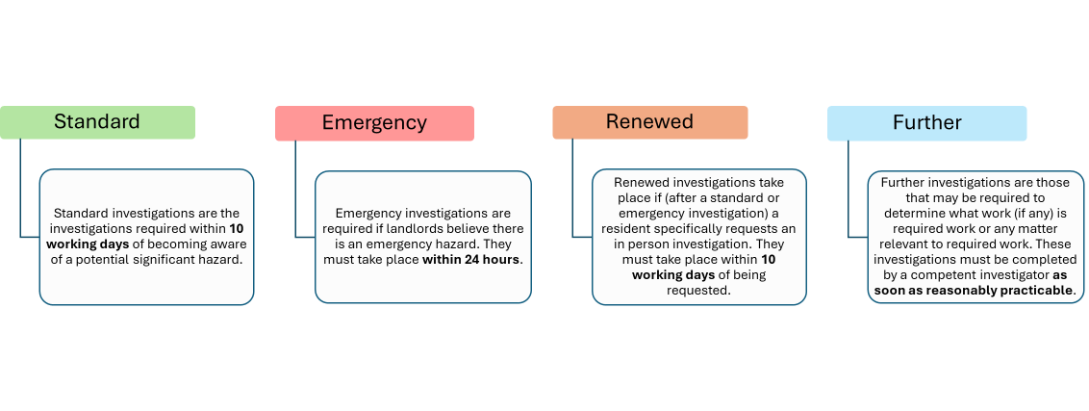
The 4 key types of investigation under Awaab's Law.
5.1.1 Standard investigations
Landlords should conduct a standard investigation within 10 working days of becoming aware of a potential hazard. This must confirm whether or not there is a significant or emergency hazard and must also, if possible, identify the required work to make a property safe and prevent the hazard from recurring. For the purposes of the Regulations, day 1 of the 10 working day timeline is the day after the landlord becomes aware of the potential hazard.
Standard investigations may be conducted either remotely or in person. Landlords should make an informed decision on the most appropriate method based on the specific circumstances. For example, if evidence such as photos or videos is provided that enables the person investigating on behalf of the social landlord to determine whether there is a significant or emergency hazard, it may be possible to conduct the investigation remotely. However, if the tenant explicitly requests an in-person investigation, the landlord must arrange for one to take place (see 5.1.2). The findings of previous investigations, under Awaab’s Law or otherwise, can be taken into account by the investigation.
If a tenant later reports a material change relating to the hazard, or the social landlord becomes aware of a material change through other routes, they must investigate again to the same timeframes. A material change could include a change to the severity of the hazard or a change to the effect it is having on the tenant’s health: for example, if a tenant reports new symptoms or worsening symptoms that may be associated with the hazard, or if they report that the hazard has worsened since the time of investigating. Where there has been a material change, a new ‘standard investigation’ is required under the Regulations, and timeframes under Awaab’s Law start again.
Under the Regulations, social landlords are protected from repeated and unfounded vexatious claims as they will only be required to investigate where there has been a material change to a matter of which they are already aware. This means that social landlords will not be in breach of Awaab’s Law if they fail to respond within timeframes to an issue that they have already investigated, unless they become aware that circumstances have changed.
If, during a standard investigation, the social landlord has reasonable grounds to believe there is an emergency hazard, then they must complete the investigation as an emergency investigation, in line with emergency investigation timeframes. Emergency timeframes will start from the point at which the reasonable grounds to believe that there is an emergency hazard arise (see Section 4.3).
5.1.2 Renewed investigations
If a tenant specifically requests an in-person inspection after an investigation has been done remotely, a ‘renewed’ in-person investigation must be carried out. This must confirm whether or not there is a significant or emergency hazard and must also, if possible, identify the required work to make a property safe and prevent the hazard from recurring. For potential significant hazards, social landlords must complete the renewed investigation within 10 working days of the request, so the timeline for investigation is effectively reset. Tenants should therefore be encouraged to request an in-person inspection in the first instance if they believe one is required. For potential emergency hazards, the tenant may request an in-person investigation within 10 working days if an initial remote investigation concludes there is not an emergency hazard or if the initial investigation finds an emergency hazard but does not identify any relevant safety work to address the emergency hazard.
Under Awaab’s Law, landlords are not required to undertake a renewed investigation if required works to prevent the hazard from recurring have already begun, or if relevant safety work under regulation 5 or a further investigation under regulation 8 is required. However, in a case where a further investigation is required, a landlord is required to conduct an in-person inspection under the provision relating to further investigations, if the tenant so requests.
A diagram illustrating an example renewed investigation is shown in Section 10.
5.1.3 Emergency investigations
Emergency investigations are required if social landlords have reasonable grounds to believe that there is an emergency hazard affecting the social home. The investigation must confirm whether or not there is a significant or emergency hazard and must also, if possible, identify the required work to make a property safe and prevent the hazard from recurring. In these circumstances the social landlord must investigate within 24 hours of them forming that belief. Emergency investigations can be conducted remotely; however, in some cases, an in-person inspection may be necessary to fully assess the severity and underlying cause of the issue. The emergency investigation and work to make the property safe must both take place within 24 hour of the landlord becoming aware of the hazard.
If, during a standard or renewed investigation, the landlord comes to have reasonable grounds to believe that there may be an emergency hazard, the emergency action requirements begin to apply, and the investigation must be completed as an emergency investigation within 24 hours of the completion of the investigation that identified the emergency hazard.
5.1.4 Further investigations
There may be circumstances where the standard, emergency, or renewed investigation is unable to determine the extent of, or underlying cause of, a significant or emergency hazard. In this circumstance a further investigation must be completed as soon as reasonably practicable to determine what work is required to make the property safe and prevent the hazard from reoccurring. For example, if a property is affected by a damp and mould hazard, the standard investigation may conclude that a structural survey is needed to diagnose the underlying cause of damp. The landlord is still required to undertake any relevant safety work identified by the standard, emergency or renewed investigation while further investigations are underway, such as providing a dehumidifier to reduce the condensation coupled with cleaning any mould (for a damp and mould hazard) or providing portable heaters (for excess cold). If it will not be possible to complete the relevant safety work within the initial remediation period because a further investigation is needed to determine what work (if any) is required the requirements relating to temporary rehousing will apply (see Section 9).
The further investigation must include an in-person inspection if the tenant so requests it and an in-person inspection has not already been carried out.
If an investigation has identified relevant safety work, the social landlord must complete this work within 5 working days of the investigation that concludes there is a significant hazard or 24 hours of an investigation that concludes there is an emergency hazard, even if a further investigation is pending. (See Section 4.2 and 4.3.)
Example: Remote inspection
A tenant reports that the lock bolt on their front door is broken and they are unable to securely close it. They have provided a video that shows the issue. The property is a house facing a busy road and the tenant has 2 young children living in the property. The landlord concludes based on the video evidence that this is an emergency hazard. Accordingly, they arrange for a contractor to visit that day to ensure the lock can be replaced and the door secured before the end of the day.
In this scenario, the landlord was able to investigate the hazard remotely: it is clear that a reasonable landlord would make this safe in 24 hours because of the risk of harm to the children posed by the overnight security risk, it is an emergency hazard. While they had 24 hours to address the hazard, they have used their judgement to ensure that the hazard is fixed on the same day it is reported, given the urgency of the risk.
5.2 Access
Landlords should seek to obtain access to the property to investigate and/or complete relevant safety works as quickly as possible.
Clear and early communication with tenants is important in securing access, helping residents to understand why access is required and to help build trust and cooperation throughout the process. This can help to reduce delays, improve engagement, and ensure that any necessary inspections or remedial works are carried out as quickly and effectively as possible. In some cases, tenants may be advised by claims management companies to not provide access. We would encourage landlords and tenants to continue working together to resolve the issue.
It is recommended that landlords keep clear records of their attempts so they can be used as evidence that they have made ‘reasonable endeavours’ if they cannot access the property. This could include maintaining detailed records of all attempted visits, inspections, repair requests and communication with residents, such as logging phone calls, emails and in person visit details.
Reasonable endeavours to gain access could include:
- working with the tenant to arrange a suitable time to visit the property, offering a range of timeslots and considering the tenants’ needs (for example, their working pattern, childcare, any accessibility requirements or adjustments)
- making multiple attempts at various times of the day to contact tenants and using different routes if one fails (for example, phone calls, emails or letters)
- making best efforts to engage with tenants and provide information on why access is needed, any health and safety consequences and what they can expect, in a way that meets their needs (for example, providing translation services and accessible communications, or information about who will be attending to provide reassurance)
- taking into account any issues or barriers to allowing access and working with the tenant to overcome them, including enabling a representative of the tenant such as a family member, friend or support worker to be present during a visit
- working with carers, wellbeing teams and support services to facilitate communication and access for tenants who have additional support needs and may be unable to advocate for themselves
- if the social landlord is unable to access the property within the agreed timeslot, leaving the tenant a notice stating that an attempt was made and providing contact details to arrange an alternative slot
- ensuring that contractors working on behalf of the landlord also act on these points
Not gaining access to a property may be a barrier to investigating or carrying out required safety works. If a tenant is unwilling or unable to provide access to the registered provider within the timeframes, social landlords should not be found in breach for missing the timeframes if they can show they have used all reasonable endeavours to comply.
For example, if a tenant reports a significant hazard but is unable to grant access for inspection within the required 10 working day timeframe as they are on holiday, the landlord should seek to arrange access as soon as reasonably possible and keep a record of conversations. Where landlords respond proportionately, consider the tenant’s individual circumstances, and maintain an accurate record of steps taken to arrange an inspection, landlords are unlikely to be found in breach of Awaab’s Law. However, it would ultimately be for the court to decide if the social landlord had used all reasonable endeavours depending on the individual circumstances.
The Regulations also create an implied covenant by the tenant that the landlord can enter for the purposes of complying with the Regulations. This only permits entry at reasonable times of the day, and if at least 24 hours’ notice in writing has been given to the tenant. The landlord and tenant should work together to agree on a suitable time for access to the property. Tenants are expected to actively engage with the landlord to arrange a convenient appointment, while landlords should clearly communicate that any delays in gaining access may lead to delays in completing the necessary safety work.
We would expect landlords to resolve access issues through constructive engagement with tenants. In extreme circumstances (for example an imminent threat to life), or where access is required to address a significant or emergency hazard affecting another tenant’s health or safety, landlords should consider whether it is appropriate to seek an injunction to require access and should seek legal advice to inform this decision.
Scenario: Landlord gaining access to investigate
The tenant reports damp and mould in multiple areas of the property. In response, the landlord schedules an investigation within 10 working days. However, the tenant is unavailable at the initial allocated time due to a combination of work commitments and childcare responsibilities, which prevent them from being at home to provide access. As a result, the contractor is unable to gain entry. A further appointment is then scheduled for the following day, with the landlord working collaboratively with the tenant to agree on a mutually convenient time.
In the scenario described, the landlord encountered difficulties in gaining access to the property to carry out the relevant safety work. When arranging the initial appointment, the landlord could have taken additional steps to ensure the timing was suitable for the tenant. This could have included following up through a phone call, text, or email to confirm the appointment, and offering a selection of time slots, including evenings or weekends if possible, to better accommodate the tenant’s availability.
If the contractor was unable to gain access, they could have left a clear note at the property with contact details and instructions for rescheduling the visit at a mutually convenient time. In cases involving vulnerable tenants, it may also have been appropriate to liaise with a support worker, family member, or advocate to help coordinate access. Throughout the process, maintaining clear and consistent communication, and documenting all attempts to engage with the tenant, would demonstrate that reasonable endeavours were made to comply with Awaab’s Law regulations and ensure the tenant’s safety.
6. Requirement to take emergency action
See regulation 5 of the Regulations.
The requirement to take emergency action applies if social landlords have reasonable grounds to believe that there is an emergency hazard affecting a social home. In these circumstances they must, as soon as reasonably practicable, and within 24 hours:
- investigate the hazard, and
- if that investigation finds that there is an emergency hazard affecting the home and that there is relevant safety work necessary in relation to that hazard, complete the relevant safety works to make the property safe
A requirement to complete relevant safety work also applies if, should an emergency, standard or renewed investigation conclude that there is an emergency hazard affecting a social home, an investigation finds that there is relevant safety work necessary in relation to that hazard. In this case the landlord must complete the relevant safety works to make the property safe as soon as reasonably practicable, and within 24 hours of the completion of the investigation that identified the emergency hazard.
In some cases, social landlords will already have an approach to immediately address emergencies on the basis of internal policies that are in place for issues such as broken boilers in winter months, broken external doors, or significant leaks. Local authority landlords also are required to carry out some repairs within 24 hours under the Secure Tenants of Local Housing Authorities (Right to Repair) Regulations 1994. Where this is the case, and a repair is already covered by another statutory timeframe, the shorter timeframe will apply.
7. Issuing a written summary to tenants
See Part 4 of the Regulations.
Following the conclusion of an investigation (whether that be standard, emergency, renewed or further investigation) the social landlord must usually produce a written summary of their findings and issue this to the tenant within 3 working days (which runs concurrently with requirements to complete relevant safety works). Day 1 of the timeline for issuing a written summary is the day after the investigation concludes. Where multiple investigations are required for one issue, a social landlord must usually issue a written summary after each investigation.
A written summary is required if:
- required works (both to make the home safe and prevent the problem recurring) are not completed to address either a significant or emergency hazard before the end of the 3 working day period, or
- an investigation concludes that there is no emergency or significant hazard
A written summary would not be required if:
- all required works (both to make the home safe and prevent the problem recurring) are completed to address either a significant or emergency hazard before the end of the 3 working day period. Social landlords must still inform the tenant that the work has been completed and may wish to set out how this has been done, or
- a potential hazard has been triaged as out of scope of Awaab’s Law and no investigation has taken place
For example, if a significant excess heat hazard caused by a faulty heating system was identified, and the heating system was fully fixed within 3 working days, the social landlord would not be required to provide a written summary, though they should continue to keep a record of all repairs and maintenance work carried out for reference. If relevant safety works have been completed but supplementary work is still needed to address underlying issues, then a written summary is required if these are not completed within 3 working days of the investigation concluding.
7.1 Written summary
Regulations specify that the written summary must include the following information:
- whether or not the investigation identified a significant or emergency hazard, and what the hazard is (unless the investigation is a further investigation)
- if action is required under the Regulations, the summary must specify:
- what that action is, and
- a target timeframe for beginning and completing that action
- if no action is required, the written summary must specify:
- that there is no action required under the Regulations, and
- the reasons why there is no action required under the Regulations
- information on how to contact the social landlord
‘Action’ includes any temporary safety measures, follow up investigations, relevant safety work, supplementary preventative works (other than cladding work) and provision of temporary alternative accommodation in circumstances where relevant safety work cannot be completed to timeframes.
Written summaries are intended to support respectful and empathetic communication with tenants. They offer tenants reassurance, foster greater transparency and openness between landlords and tenants - helping to strengthen trust – and serve as a written record of inspections or actions taken for accountability or future disputes that go to the Housing Ombudsman or court. Written summaries should be clear and easy for tenants to understand, making sure that the information provided is helpful. They do not need to be lengthy or technical but must provide an accurate description of the investigation findings and action to be taken. The target timeframes for beginning and completing actions set out in written summaries are not legally binding: however social landlords must take reasonable steps to keep the tenant informed about the timing and progress of the required works, for example if an appointment to do the work needs to be rescheduled, or further relevant information comes to light.
Scenario: Emergency hazard is resolved within 3 working days and a written summary is not required
The tenant reports a serious leak from a wastewater pipe in their bathroom.
Based on the initial report, the landlord has reasonable grounds to believe that there is an emergency hazard affecting the home. Accordingly, the landlord arranges for a contractor to attend within 24 hours to investigate and take action to make the property safe. The contractor visits the same working day and fixes and replaces the wastewater pipe and clears and cleans the area to complete the job.
Since the hazard was both investigated and fully resolved within 3 working days, no written summary was required under Awaab’s Law.
7.2 Written summary template
A written summary template is provided in this section to support social landlords in delivering clear and informative written summaries, within 3 working days of an investigation concluding. Its use is not mandatory, but landlords may find it helpful for ensuring consistency and clarity in their written summaries. To note, not all sections within this template may be required for each written summary and therefore should be adjusted accordingly for each case. For example, not all reported hazards will require supplementary preventative works or suitable alternative accommodation. Information captured within the written summary should also be adapted to take into account tenants’ individual requirements, for example around accessibility.
Written summary template
Dear [Tenant Name],
You reported an [issue] at [Property Address] on [date].
Awaab’s Law means that we must:
- investigate and fix emergency hazards within 24 hours
- investigate potential significant hazards within 10 working days and then fix significant hazards within 5 working days of the investigation finishing
- meet other requirements under the Awaab’s Law Regulations
Further information and guidance on Awaab’s Law can be found on the Make Things Right website and the Awaab’s Law Tenant Guidance.
We have investigated your issue under Awaab’s Law and are writing to explain what we found.
1. What we found
The [virtual / in-person] investigation [did / did not] identify a [significant / emergency] hazard.
[If a significant / emergency hazard was identified – Insert further information about the hazard found.]
[Optional – If a significant / emergency hazard was not identified – insert further information about any non-Awaab’s Law hazard or disrepair issue identified and any associated timescale for repairs.]
[Optional: 2. Safety steps taken
To keep you safe we have:
[Insert measures, for example, sealing affected areas.]
These are to protect your household while we [investigate the issue in more detail/carry out more work.]]
[Optional: 3. Staying safe during repairs
While safety works are being done, we ask you to follow these guidelines to help keep your household safe: [insert information].
We will give extra instructions and support as needed during the repair process.
If you or your household need extra help, for example due to mobility needs, please tell us as early as possible so we can make arrangements.]
4. Follow-up investigations
We have arranged for a [insert suitably qualified professional] to carry out further investigations to better understand the issue. This will help us decide what to do next to fix the issue and prevent it happening again.
As already agreed with you, the [insert investigation type] will take place on [date and time] and is expected to take [time] to complete. Please let us know if things change and these times don’t work for you.
OR
We will aim to look into your issue further on [insert date], and we will aim to have this completed by [insert date]. We will contact you to arrange a suitable time.
5. Fixing the problem
Based on the findings, we will carry out the following safety works: [Insert works, for example, repairs to damp-affected areas].
As already agreed with you, these works will take place on [date and time] and are expected to take around [time] to complete. Please let us know if things change and these times don’t work for you.
OR
The target timescale for beginning the safety works is [insert date], the target timescale for completing the safety works is [insert date]. We will contact you to arrange a suitable time.
6. Stopping the problem coming back
We need to do extra work to stop the problem coming back, such as: [Insert works, for example, drainage improvements].
We will aim to start this by [insert date] and complete it by [insert date]. We will contact you to arrange a suitable time.
7. Somewhere else to stay
If we cannot finish the safety works on or before [insert date that corresponds with the end of the initial remediation period], we will offer you somewhere else to stay until they are completed. We will take reasonable steps to make sure this is suitable for your household’s needs and will contact you to discuss this.
OR
Safety works cannot be completed on or before [insert date that corresponds with the end of the initial remediation period] and therefore we will be offering you somewhere else to stay until your home can be made safe. We will take reasonable steps to make sure this is suitable for your household’s needs and will contact you to discuss this further. You can accept or refuse the offer of alternative accommodation.
[If needed – 8. No further action required
The investigation found that no further action is needed under Awaab’s Law. [Insert full explanation and any supporting evidence.]
[Optional – associated timescale/route for a response to the hazard reported]
[Optional – 9. Complaints process
If you do not agree with this outcome or how this case has been handled, you have the right to raise a complaint. You can find information about the complaints process and the options available to you through the Make Things Right Campaign and in Section 11 of the Awaab’s Law Tenant Guidance.]
We are committed to keeping you informed and keeping your home safe. If you have any questions or concerns, please contact [Housing Officer name] at [phone number] or [email address].
Yours sincerely,
[Officer name]
[Organisation Name]
[Date]
Example Written Summary – significant damp and mould hazard
Dear Mr Smith,
You reported a damp and mould hazard at your home on 18th May 2026.
Awaab’s Law means that we must:
- investigate and fix emergency hazards within 24 hours
- investigate potential significant hazards within 10 working days and then fix significant hazards within 5 working days of the investigation finishing
- meet other requirements under the Awaab’s Law Regulations
Further information and guidance on Awaab’s Law can be found on the Make Things Right website and the Awaab’s Law Tenant Guidance.
We have investigated your issue under Awaab’s Law and are writing to explain what we found.
1. What we found
The in-person investigation identified a significant damp and mould hazard.
We found large areas of damp and mould in the bedroom and living area, which could be a risk to the health and safety of your household if not addressed promptly.
2. Safety steps taken
To keep you safe we have provided a dehumidifier to help reduce moisture levels within the property while further works are arranged. This is to protect your household while we carry out more work.
We explained to you why we took this action and how to use the dehumidifier.
3. Staying safe during repairs
While safety works are being done, we ask you to follow these guidelines to help keep your household safe:
- please use the dehumidifier as advised
- keep the affected areas clear to allow access for works
- keep children and pets away from safety work areas
- follow any instructions given by contractors during works
We will give extra instructions and support as needed during the repair process.
If you or your household need extra help, for example due to mobility needs, please tell us as early as possible so we can make arrangements.
4. Fixing the problem
Based on the findings, we will carry out the following safety works:
- treatment of the damp and mould affected areas
- improvements to ventilation to reduce moisture and improve airflow within the home
As already agreed with you, these works will take place on 23 May at 1pm and are expected to take around 2 hours to complete. Please let us know if things change and these times don’t work for you.
5. Stopping the problem coming back
We need to do extra work to stop the problem coming back, such as:
- improvements to insulation to help stop condensation and reduce the likelihood of damp and mould returning
We will aim to start this by 25th May and complete it by 25th May. We will contact you to arrange a suitable time.
6. Complaints process
If you do not agree with this outcome or how this case has been handled, you have the right to raise a complaint. You can find information about the complaints process and the options available to you through the Make Things Right Campaign and in Section 11 of the Awaab’s Law Tenant Guidance.
We are committed to keeping you informed and keeping your home safe. If you have any questions or concerns, please contact [Housing Officer name] at [phone number] or [email address].
Yours sincerely,
[Officer name]
[Organisation Name]
[19 May 2026]
7.3 Delivery of summary and communication
See regulation 10 of the Regulations.
A written summary can be provided:
- in person
- by post
- by email
- by text message
- left at their home
As with all communications to tenants, landlords should take into account their tenants’ preferences and needs, as well as requirements under the Equality Act and Consumer Standards when deciding how best to communicate with tenants (for example, providing information in their requested language, in an accessible format, etc). When sending the written summary, social landlords should consider whether it is appropriate to include any involved third party in correspondence. For example, if a caregiver is corresponding with the social landlord on the tenant’s behalf or if the tenant has involved a tenant support group or charity.
The timeframe of 3 working days is for the summary to be given by the landlord not received by the tenant. Landlords are encouraged to keep a record of when the written summary was given as this may be needed to evidence compliance.
The written summaries should not be relied upon as the only means of informing tenants about the issues in their home and what action they can expect. Regulation 14 requires social landlords to keep the tenant updated about the timing and progress of required works (see Section 7.4).
The outcomes landlords are expected to deliver when communicating with tenants can be found in the Transparency, Influence and Accountability Standard (2.1.1 and 2.1.2) and Annex 3: Consumer standards 1 April 2024.
7.4 Keeping the tenant updated
See regulation 14 of the Regulations.
The social landlord must take reasonable steps to keep the tenant informed about the timing and progress of required work until the work is completed. If for any reason the work is no longer required the landlord should explain this clearly to the tenant, outlining the reasons so the tenant is fully informed, and provide information about how the tenant may contact the landlord.
Work will no longer be required under Awaab’s Law if:
- the landlord has exhausted all reasonable endeavours to obtain consent for the works, without which it cannot lawfully be undertaken
- an investigation concludes that a home is not affected by a significant or emergency hazard, or
- an investigation concludes that there is no required work in relation to the hazard in question
Landlords should also consider providing tenants with information on how to stay safe while the property is being repaired.
7.5 Decision making and discrimination
Social landlords should take steps to ensure that any individual discretion of case handlers/investigators or anyone else in the decision-making process is not affected by conscious or unconscious bias or prejudice.
Under the Housing Ombudsman’s Complaints Handling Code, social landlords should provide tenants with information about how to raise a complaint or challenge the social landlord’s decision. This should include information about the social landlord’s internal complaints process and how to contact the Housing Ombudsman Service.
8. Making the property safe and supplementary preventative works
See regulation 5 and 13 (for emergency hazards) and regulations 11 and 13 (for significant hazards) of the Regulations.
The regulations distinguish between work to make the property safe, and supplementary preventative work to prevent the hazard recurring.
Relevant safety work must be completed within 5 working days of the investigation ending for significant hazards, and within 24 hours of the landlord becoming aware of the hazard for emergency hazards. Landlords may use temporary measures to make safe if necessary. Landlords should inform tenants if any temporary repairs affect other safety features, such as fire safety systems, even if the impact is short-term. For example, if ventilation works temporarily block a fire escape route or affect smoke alarm coverage, tenants should be made aware. Landlords should ensure that tenants are kept safe while work is being carried out. Social landlords should not expect tenants to undertake work to make their properties safe themselves.
Once the relevant safety work has been completed, the social landlord must ensure the property is kept in the same condition until relevant supplementary preventative work is completed, for example by providing dehumidifiers to manage moisture or providing portable heating and ventilation units. Social landlords should not expect tenants to provide or purchase such appliances or tools.
For both significant and emergency hazards, landlords should start or take steps to start any supplementary preventative work within 5 working days of the investigation that identified it, to stop the hazard from recurring. Requirements relating to the beginning of relevant supplementary preventative work apply to emergency hazards in the same way that they apply to significant hazards.
For both relevant safety work and supplementary preventative work, the 5 working day period begins from the day after the investigation concludes, even if the investigation concludes before the end of the 10 working day window for completing the investigation for significant hazards.
Before beginning any works, social landlords should consider making clear records of the issue causing the hazard, including photographic evidence where necessary; for example, taking photos or samples of mould spores before removing them.
8.1 Interaction with fire safety
8.1.1 Fire Safety Order (FSO)
See regulation 3 of the Regulations.
Awaab’s Law requirements do not apply to fire hazards in communal areas which are already covered by the Regulatory Reform (Fire Safety) Order 2005, such as damaged fire doors, debris obstructing the means of escape or deficiencies in compartmentation. If fire safety issues in communal areas are reported or if landlords become aware of fire safety issues while addressing hazards under Awaab’s Law, they should report them to the Responsible Person or take appropriate steps if they are the Responsible Person.
Tenants should report fire safety concerns in common parts to the Responsible Person for the building. Where concerns are not addressed, they can raise them with the local Fire and Rescue Authority. Fire and Rescue Authorities have powers under the Fire Safety Order to investigate and take enforcement action where appropriate.
Where the authority finds a serious risk that is not being adequately managed it can issue an enforcement notice to say what improvements are needed and by when, being no less than 28 days. Where a risk is deemed so serious that access to premises needs to be prohibited, the authority may serve a prohibition notice with immediate effect.
Awaab’s Law applies to fire hazards within individual flats and homes which are not currently covered by the FSO, for example, issues with broken or missing smoke alarms. Landlords must comply with the relevant statutory timescales. Please see annex on triaging hazards for more detail.
8.1.2 Residential Personal Emergency Evacuation Plan
See regulation 4 of the Regulations.
Under Awaab’s Law, ‘required work’ does not include the Residential Personal Emergency Evacuation Plan (RPEEP) process. This is because RPEEPs, which were introduced from April 2026, are intended to be developed through collaborative assessment and typically are undertaken over longer timeframes on a recurring basis. Landlords should therefore not rush this process to meet Awaab’s Law timeframes. However, wider requirements will continue to apply requiring landlords to assess hazards based on specific circumstances, including taking into account disabilities, and take action if there is a significant or emergency hazard.
8.1.3 Cladding
Awaab’s Law does not cover cladding work. This is because remediating unsafe cladding is usually a longer-term project, and not an emergency repair. Instead, landlords have longstanding legal duties to assess and manage fire safety risks at their building under the Regulatory Reform (Fire Safety) Order 2005 and Part 4 of the Building Safety Act 2022 (where the building is considered a higher-risk building). Where a landlord identifies unsafe cladding, they must act to make the property safe. This might include carrying out remedial work to remove or replace the cladding.
If a fire safety hazard where cladding is a relevant factor is reported to the social landlord, they are still required to carry out other requirements of Awaab’s Law, including the requirement to investigate and carry out other relevant safety works (outside of cladding) to make the property safe, and to keep the tenant updated.
If the unsafe cladding creates an immediate risk of fire and/or smoke spread, which would place residents at risk if they did not quickly evacuate the building, then landlords may be able to manage this risk by:
- temporarily changing the building’s evacuation plan (for example, switching from a “stay put” to a “simultaneous evacuation” strategy) until remediation work is complete, and
- putting interim measures in place (for example, a waking watch patrol) to support the change in evacuation strategy, or
- providing residents with safe alternative accommodation until the remedial work is complete
Social landlords should also consider on a case by case basis whether it would be necessary or appropriate to do any smaller scale or isolated cladding work to address other hazards (for example to improve insulation to address a damp and mould hazard), and should complete these in line with wider policies, procedures and existing duties to keep homes safe and make repairs.
8.2 Beginning further required works
See regulation 13 of the Regulations.
If an investigation concludes there is a significant hazard or an emergency hazard and identifies relevant supplementary preventative work, the social landlord must begin that work within 5 working days of the investigation concluding. Relevant supplementary preventative works are any required works to prevent the hazard from recurring as far as possible (other than cladding remediation).
There may be circumstances where it is not reasonably practicable to begin the relevant supplementary preventative work within 5 working days, for example:
- if the social landlord is unable to secure specialist workers to attend the property within 5 working days
- if the social landlord is unable to secure the required materials for relevant supplementary preventative work within 5 working days
- if the social landlord is unable to secure required approvals, for example from local authority building control or Building Safety Regulator, within 5 working days. In cases where approval from the Building Safety Regulator or other body is needed to undertake repairs and required works, the social landlord should make an application as soon as reasonably practicable
- if the social landlord is unable to contract necessary detailed surveys or assessments such as a structural survey within 5 working days
In such circumstances, the social landlord must take steps within 5 working days of the investigation concluding to secure that the relevant supplementary preventative work begins as soon as reasonably practicable and within 12 weeks. This means that action must be taken as quickly as it reasonably can be, taking into account relevant circumstances such as the availability of materials and labour, with 12 weeks as a backstop. ‘Taking steps’ could include securing an appointment with a specialist for further investigation or securing contractors or sourcing materials for works.
Scenario: Social landlord making a property safe and following up with preventative works
The tenant reports damp and mould in their property, a one-bedroom flat located on the top floor of a converted house. This has increased following heavy rainfall during the winter months and damp is coming through the roof. The landlord identifies this as a potential significant hazard and schedules an investigation within 10 working days. The investigation finds that the damp and mould is being exacerbated by the damage to the roof which requires scaffolding to fix.
In the scenario described, the landlord would need to take action to make the properly safe within 5 working days, which could be cleaning the mould and providing a dehumidifier to remove the immediate hazard. They will also need to start work to fix the damage to the roof to prevent the hazard recurring in the same time period. In this scenario the landlord may not be able to start the work straight away if scaffolders are not available, so they should take steps towards this happening within 5 working days by booking scaffolders and other contractors to start as soon as reasonably practicable, and within 12 weeks of the investigation concluding.
There are 2 potential hazards in the scenario (damp and mould and structural collapse). Landlords should generally not worry about classifying which hazard is present and instead focus on fixing the issue.
8.3 Completion of further required works
See regulation 13(4) of the Regulations.
The social landlord must satisfactorily complete any relevant supplementary preventative works within a reasonable time. What is “reasonable” will depend on the circumstances of an individual case and should reflect the nature and urgency of the problem, tenants’ needs and the scale of relevant works required. Supplementary preventative works to address the underlying issue will likely be more cost effective for the landlord than a ‘quick fix’, preventing ongoing repair costs, and safer for tenants in the long term.
Landlords should follow up with tenants after work has been completed to ensure issues have been fully resolved. This proactive approach ensures the effectiveness of repairs, helps identify potential recurring hazards before they worsen and demonstrates a commitment to maintaining safe and healthy living conditions for tenants.
Social landlords must ensure all work under Awaab’s Law is carried out to the required standard, by appropriately qualified staff or contractors and does not create any further issues or compromise other safety features as a result of completing required safety works. For example, improving ventilation to rectify damp and mould must not damage the compartmentation of the property, which would cause a potential fire safety hazard. Social landlords are responsible for securing relevant sign offs and approvals.
It is good practice to inform the local Fire and Rescue Service where the repairs may change the evacuation strategy for the building or impact any firefighting equipment installed to assist the Fire and Rescue Service in any operational work where this is installed (for example, a Dry Riser). Separately to Awaab’s Law, residents of all blocks of flats must be informed of any changes to the fire risk assessment during and after works are carried out.
8.4 Exceptions to required works
See regulation 4 of the Regulations.
Required works are subject to limited exceptions, including:
- if the significant or emergency hazard results from damage by accidents or ‘acts of god’ (for example, fires, storms, floods), from which social landlords are already exempt from repairing obligations under existing legislation
- if the social landlord cannot lawfully carry out the works due to a lack of approval, for example if they have not been able to get building control or any other approval required before undertaking the work, such as from the freeholder of the building
- if the social landlord cannot, for another reason, lawfully carry out the works
- if the lessee is liable for the work by virtue of their duty to use the premises in a tenant-like manner (or equivalent express covenant)
- any work to repair or maintain anything that the tenant is entitled to remove from the property – for example, white goods belonging to the tenant
Where an exception applies, the work is not required under Awaab’s Law. However, the social landlord should still consider how best to support tenants. They may have obligations to act under their existing policies, procedures or other legislation, and should continue to fulfil their existing duties to keep homes safe and make repairs.
8.5 Use of contractors
Under Awaab’s Law, social landlords are required to meet the requirements set out in the Regulations. When engaging contractors or managing agents, landlords retain full responsibility for ensuring compliance with the Regulations and any other legal obligations, and that contractors are suitably qualified. It is advisable for landlords to review existing contractor agreements to confirm they are consistent with the obligations imposed by Awaab’s Law.
Social landlords should ensure that any contractors they employ for repairs under Awaab’s Law:
- treat tenants with respect and are aware of any accessibility requirements or other considerations when working with tenants
- make every effort to respond to the tenants’ questions relating to the hazard being inspected and next steps
- are aware of any timeframes social landlords are under a statutory duty to meet
- provide social landlords with any relevant information required for written summaries in a timely manner
- report to social landlords any safeguarding or health and safety concerns they become aware of when visiting a property
- ensure works completed to rectify the hazard do not cause further issues that affect the health or safety of residents, for example by compromising other safety features
- report to social landlords any hazards or potential hazards they identify (beyond those being directly addressed) when visiting a property
9. Securing suitable alternative accommodation
See Part 6 of the Regulations.
If the social landlord is unable to complete the relevant safety work within the initial remediation period (5 working days from the completion of the investigation that identified the hazard for a significant hazard or 24 hours for an emergency hazard), they must secure the provision of suitable alternative accommodation at their expense, until the relevant safety work has been completed.
The provision of suitable alternative accommodation must extend to anybody who usually lives in the property as a member of the tenant’s family and in accordance with the lease, including children who would usually stay in the property overnight for at least one night a week.
If the tenant rejects the offer of suitable alternative accommodation they can choose to stay with family or friends instead or choose to stay in their home whilst the property is made safe.
If anyone chooses to remain in the property in the period before the relevant safety work is completed (for example if an alternative rehousing offer is declined, or if only part of the household move out), the social landlord must provide information on any actions that occupants could take or avoid to mitigate the risk of harm, or let the tenant know if they do not think it is possible for the occupant to do anything to mitigate that risk.
9.1 Providing a tenant with suitable accommodation
Where the social landlord must secure the provision of suitable alternative accommodation, they must take into account the needs of the household to assess what is ‘suitable’. This could include:
- ensuring adequate space for the tenants, including the appropriate number of bedrooms given the tenants’ family make up
- considering the location of the property, including distance from tenants’ workplaces or schools
- considering disability or medical needs to ensure accommodation is accessible for tenants
- ensuring that the accommodation is not, itself, affected by hazards or its occupation by the household won’t cause an overcrowding hazard
- if the household has pets, considering accommodation that is pet-friendly or can accommodate animals
- considering the length of stay, as accommodation that is suitable for a short period may not be suitable for a longer time. For example, if a family of 4 is provided accommodation for one night only whilst an emergency hazard is addressed in their home, a hotel may be suitable. If relevant safety work is estimated to take 6 weeks to complete, a hotel would not be suitable due to lack of space and facilities such as a kitchen to prepare meals
Provision of alternative accommodation could include accommodation in vacant social housing stock, private rented homes, short-term lets or where more suitable accommodation is not available, hotel and B&B-type accommodation. Suitability will need to be assessed on a case-by-case basis.
The requirement to secure the provision of suitable alternative accommodation ends if:
- the relevant safety work is completed
- another investigation concludes that there is no significant or emergency hazard or no relevant safety work
- the landlord cannot do the work as they have not been able to secure the necessary consents (and have exhausted all reasonable efforts to secure these)
- the tenants no longer wish to remain in the alternative accommodation, and the tenant gives the social landlord notice of this in writing
Tenants retain the right to return at any point, but if the tenant or any member of their household decides to return to the property the landlord must provide safety advice in accordance with the Regulations.
Once the landlord has provided the tenant with suitable accommodation, they:
- must endeavour to minimise the amount of time tenants are in alternative accommodation by completing relevant safety works as soon as reasonably practicable
- must keep the tenant updated on timing and progress of the required work. This should include reasons for any delays and when the tenant should expect to return home
- should agree with the tenant on what, if any, additional costs and compensation/inconvenience payments there may be to the tenant should they be required to stay in suitable alternative accommodation. This includes reimbursement payments to cover transport, moving and food costs or compensation for time off work
9.2 Provision of safety advice
See regulation 17 of the Regulations..
If a tenant chooses to remain or return to a property where a hazard has been identified in circumstances where the landlord would otherwise be subject to the requirement to temporarily rehouse the tenant’s household, the landlord must provide the tenant with clear, written safety advice. This advice should explain any actions that occupiers can reasonably take, or avoid, to reduce risks to their health or safety until works are completed. Where the landlord does not think that anything can be done to mitigate risks to a tolerable level, landlords must explicitly state that the risk cannot be sufficiently mitigated and provide guidance on any steps that may still help reduce the level of risk. This information must be provided before the end of the initial remediation period, or as soon as reasonably practicable thereafter, and should be communicated in a way that tenants can understand and act on. The landlord should record the advice they have provided to the tenant.
9.3 Tenant refusing alternative accommodation
See regulation 16(1) and 16(2)(e) of the Regulations.
The ultimate decision as to whether to leave their home and move into alternative accommodation sits with the tenant, who may have reasons to decline being moved from their home, even if temporarily. Tenants should be encouraged to inform their social landlord in writing if they wish to make their own arrangements or change agreed arrangements.
Social landlords should therefore make it clear to tenants that they have a choice whether to accept or decline an offer of alternative accommodation, but should make the risks of staying in the home clear to tenants, before the end of the initial remediation period or as soon as reasonably practicable thereafter.
Social landlords may wish to facilitate alternative options if a tenant declines an offer of accommodation (or the whole of the tenant’s household does not want to move to alternative accommodation). This may include additional costs or compensation/inconvenience payments.
It should be noted that raising concerns that a property is unsuitable is not the same as refusing an offer of any alternative accommodation. Should the tenant refuse alternative accommodation as an option, it should be made clear to them that the landlord is not then required to provide further offers of suitable accommodation. However, where a tenant has previously refused an offer of alternative accommodation, social landlords should also consider their wider duties, procedures and policies to keep tenants safe.
Where there has been a material change in circumstances, all relevant requirements under Awaab’s Law are triggered again, including, where applicable, the duty to provide suitable alternative accommodation.
Tenants can choose to return to their home at any time, and the requirement for the social landlord to secure the provision of alternative accommodation will be brought to an end if the tenant notifies the social landlord in writing that they no longer wish to be provided with it.
9.4 Hazards that are out of scope of Awaab’s Law or that cannot be resolved
There may be occurrences where an investigation under Awaab’s Law identifies a significant or emergency hazard but there is no required work under Awaab’s Law, or where an investigation finds there is a hazard but it is not in scope of Awaab’s Law, for example because it is due to a deficiency in neighbouring land for which the landlord is not responsible. In these cases, the social landlord is not required under Awaab’s Law to temporarily or permanently rehouse the tenants.
However, the social landlord may have other legal and regulatory obligations in these circumstances, outside of Awaab’s Law, and may consider temporarily rehousing to keep the tenants safe from dangerous hazards whilst sourcing a new permanent home. If tenants are reallocated to another permanent home, the social landlord should make sure the tenants have the same tenancy rights, and the new property is suitable in terms of size and proximity to the tenants’ original home, schools or places of work.
Awaab’s Law must not be used as a mechanism to permanently rehouse tenants for other purposes, for example estate regeneration.
10. Examples of Awaab’s Law in practice
We have provided some practical examples to illustrate how the timeframes under Awaab’s Law operate. These examples are designed to clarify when the various timeframes are activated and to demonstrate which requirements run concurrently with others.
10.1 Standard investigation
In this example, the standard investigation takes place on working day 10 and finds a significant hazard. The property must be made safe within 5 working days of the investigation concluding at the latest, and the written summary must be issued within 3 working days of the investigation concluding. The landlord must also begin, or take steps to begin, any supplementary preventative works to prevent the significant hazard recurring within 5 working days of the investigation concluding.
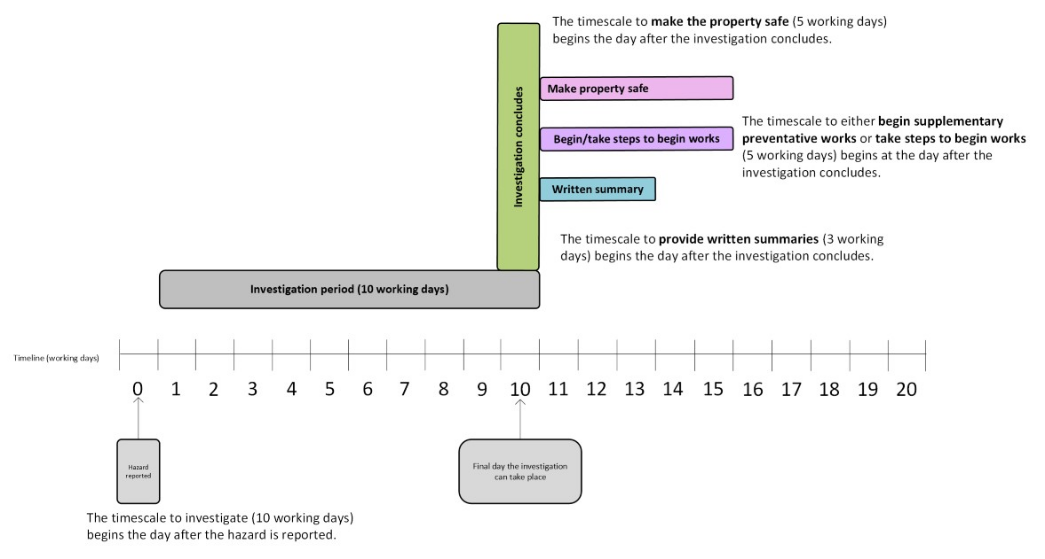
An example of a standard investigation.
10.2 Standard investigation with offer of suitable alternative accommodation
In the following example, the standard investigation takes place on working day 6. The property must be made safe within 5 working days of the investigation concluding, and the written summary must be issued within 3 working days of the investigation concluding. The property could not be made safe within the required timeframe (5 working days) and therefore the requirement to secure the provision of suitable alternative accommodation until the relevant safety work has been completed applies.
The landlord must also begin, or take steps to begin, any supplementary preventative works to prevent the significant hazard recurring within 5 working days of the investigation concluding.
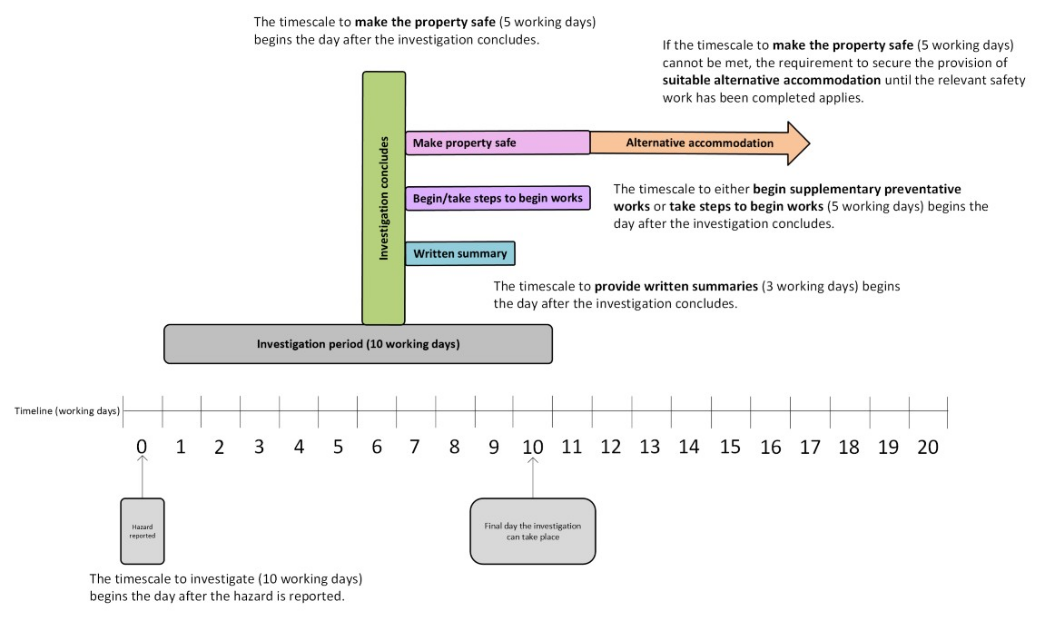
An example of a standard investigation with offer of suitable alternative accommodation.
10.3 Standard investigation concluding outside the scope of Awaab’s Law
In the following example, the standard investigation takes place on working day 7. The investigation concludes that the hazard was out of scope of Awaab’s Law. A written summary must be issued within 3 working days of the investigation concluding, setting out why there is no action required under Awaab’s Law. Any repairs identified should be completed in line with the landlords’ standard repairs policy.

An example of a standard investigation concluding outside the scope of Awaab's Law.
10.4 Renewed investigation
In the following example, a resident reports a hazard to their landlord (day 0). The landlord conducts a standard investigation on working day 6 by analysing photos provided by the tenant which concludes that the hazard is out of scope of Awaab’s Law. They inform the tenant in a written summary (via email) 1 working day after the investigation concludes. The resident is dissatisfied with the outcome and requests the landlord to come and investigate in person, the same day as receiving the written summary (working day 8). The renewed investigation takes place on working day 4 and concludes that there is a significant hazard. Therefore, the property must be made safe within 5 working days of the investigation concluding, and the written summary must be issued within 3 working days of the investigation concluding.
The landlord must begin, or take steps to begin, any supplementary preventative works to prevent the significant hazard recurring within 5 working days of the renewed investigation concluding.
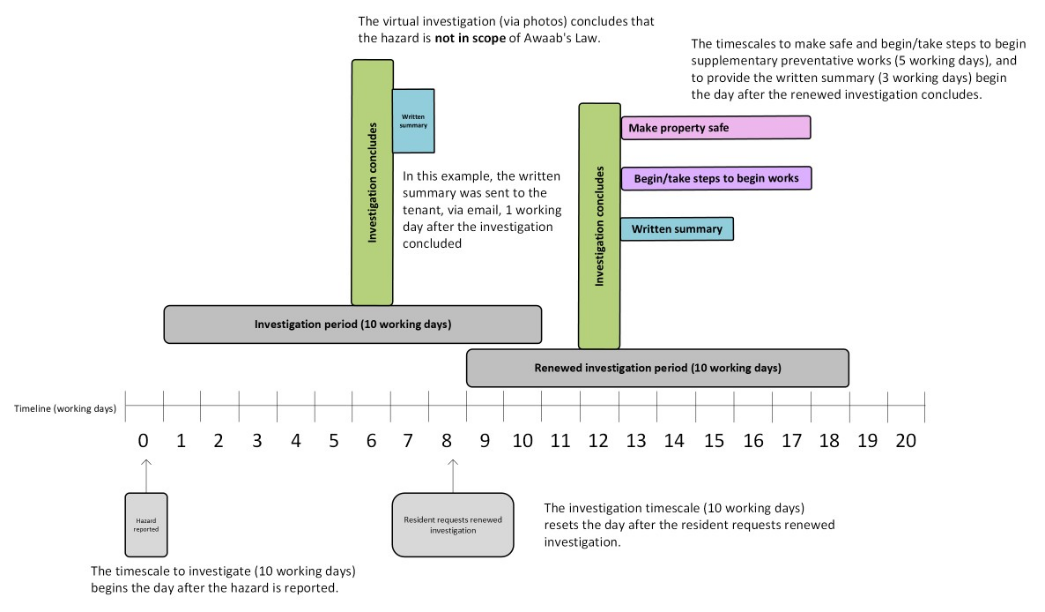
An example of a renewed investigation.
10.5 Standard investigation where further works cannot begin within 5 working days
In the following example, the standard investigation takes place on working day 7. The investigation concludes that there is a significant damp and mould hazard. The hazard requires supplementary preventative works due to the lack of an effective damp proof course and a broken ventilation system in the bathroom. The property must be made safe within 5 working days of the investigation concluding at the latest, and the written summary must be issued within 3 working days of the investigation concluding.
The landlord was unable to begin the supplementary preventative works within 5 working days due to specialists’ availability but took steps to start work by securing an appointment with damp and ventilation specialists. The landlord must begin works as soon as possible, and within 12 weeks at the latest.

An example of a standard investigation where further works cannot begin within 5 working days.
10.6 Emergency investigation with supplementary preventative works
In the following example, the tenant reports a hazard, and the landlord has reason to believe there is an emergency hazard. They must conduct an emergency investigation and make the property safe within 24 hours. The hazard requires further repairs and therefore the landlord must begin, or take steps to begin, any supplementary preventative works to prevent the hazard recurring within 5 working days of the investigation concluding.
The written summary must be issued within 3 working days of the investigation concluding, unless all supplementary preventative works are completed before this point.
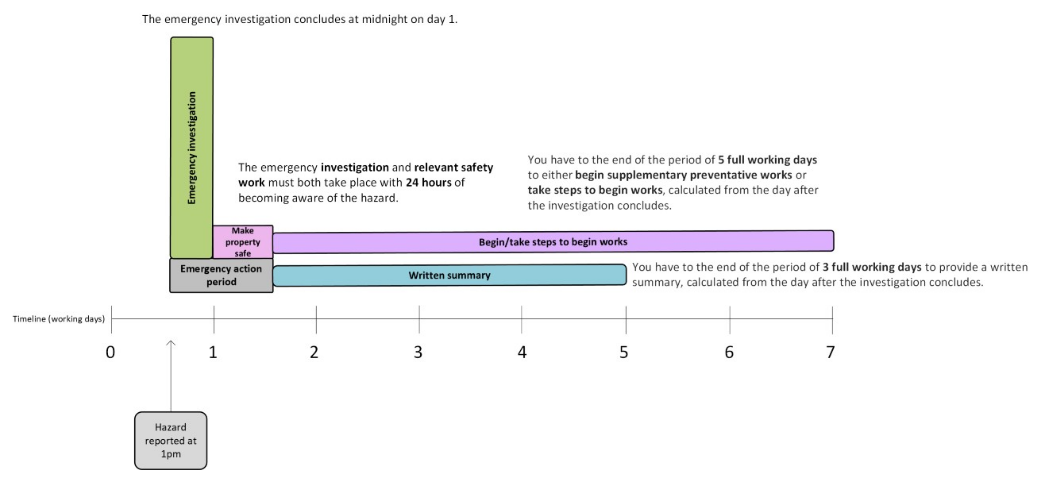
An example of an emergency investigation with supplementary preventative works.
10.7 Emergency investigation with no further works required
In the following example, the tenant reports a hazard, and the landlord has reason to believe there is an emergency hazard and must conduct an emergency investigation and make the property safe within 24 hours. The landlord completes the required work to prevent the hazard recurring within the 24 hour period. No further action is required under Awaab’s Law.
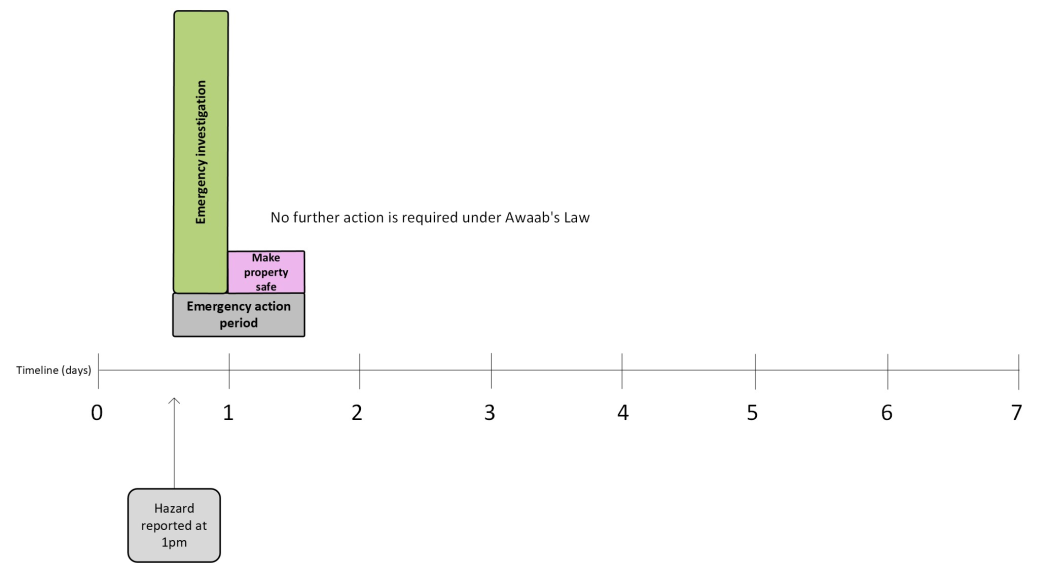
An example of an emergency investigation with no further works required.
11. Defence
11.1 Reasonable Endeavours
Social landlords have a defence for a failure to comply with Awaab’s Law requirements if they can prove that they have used all reasonable endeavours to avoid it, meaning they have taken all reasonable steps to comply with the requirements of the regulations, but it has not been possible for reasons genuinely beyond their control.
Examples could include:
- the landlord may not be able to complete work within the timeframes because the building is high-risk and building control approval from the Building Safety Regulator is required before starting works to make the property safe. In this case, ‘reasonable endeavours’ could be making an application containing all necessary information to the Building Safety Regulator as soon as reasonably practicable. Likewise, other approvals and permissions might be needed from external bodies, and the landlord should show that they are taking the appropriate steps to obtain these in good time
- the landlord may not be able to gain access to the property to complete relevant safety works. For example, the landlord may have made multiple attempts, using different methods, to arrange a suitable time to access the property in line with Section 5.2 but been unable to do so within the given timeframes
- the landlord may have been unable to source specialist contractors or materials within the required timeframes but has used all reasonable endeavours to do so
- the landlord may have used all reasonable endeavours to secure suitable alternative accommodation in line with Section 9.1, but there may be no suitable properties which are within a reasonable distance of schools/places of work or in the local area. In this case the landlord could work with the tenant to identify the best option
If a tenant brings a claim against them for breach of Awaab’s Law, landlords will need to be able to evidence that they used all reasonable endeavours to comply. They should therefore keep clear records of all attempts to comply with Awaab’s Law requirements, including records of all correspondence with tenants and any contractors, including those relating to the provision of suitable accommodation.
Ultimately, it will be for the courts to judge if a landlord is in breach of Awaab’s Law.
12. Transitional Arrangements
See regulation 21 of the Regulations.
The requirements under Awaab’s Law are only triggered when a landlord becomes aware of a potential hazard after the relevant time, or if, after this time, the social landlord becomes aware of a material change to a potential hazard that they were aware of before that time. However, if the social landlord was aware of a potential hazard before the relevant time and a concern about it is reported to them after that time, this will trigger Awaab’s Law requirements from the point of the report.
The relevant time is the time that the regulations came into force in relation to a hazard of the type in question, or, if later, the time that the requirements of the regulations began to apply in relation to the social home in question.
13. Enforcement of Awaab’s Law
Seeking redress through the landlords’ complaints procedure, the Housing Ombudsman and/or other alternative dispute resolution is likely to ensure the issue is addressed much more affordably and to clearer timescales than pursuing court action. Landlords should therefore provide clear communication on how tenants can pursue these routes potentially avoiding unnecessary delays and expense for both parties.
13.1 Social landlord complaint procedure
We would encourage tenants to try and resolve concerns through the social landlord’s formal complaints procedure in the first instance.
This is also encouraged as a form of alternative dispute resolution in the Pre-Action Protocol of the courts’ Civil Procedure Rules that outlines the steps parties must take to exchange information and try to resolve disputes before taking court action. A court may require evidence that this alternative means of resolving the dispute was followed first.
Landlords should follow the Housing Ombudsman’s Complaint Handling Code which sets out best practice for landlord’s complaint handling procedures, to enable a positive complaints culture across the social housing sector.
13.2 Housing Ombudsman Service
The Housing Ombudsman Service provides an independent and impartial service to investigate complaints against registered providers of social housing in England and other member landlords. Tenants can ask the Ombudsman to investigate a complaint if they have completed their social landlord’s internal complaints process and the issue has not been resolved, or if the social landlord is not responding to a complaint. The Housing Ombudsman will adjudicate cases that involve disputes regarding compliance with Awaab’s Law using their usual powers and following their usual processes.
Prior to investigation, the Ombudsman will make any enquiries it considers necessary to resolve a complaint. Landlords should keep accurate records to support this. An Ombudsman investigation may focus on the substantive issues and how a complaint has been handled. This could mean considering whether the landlord complied with the relevant time limits as part of the complaint, along with the landlord’s own policies and procedures. The Housing Ombudsman also has the power to determine maladministration in a case on the basis that a social landlord has failed to comply with, or has not had due regard for, relevant legislation.
If a tenant has made a complaint to their social landlord or to the Housing Ombudsman, social landlords should continue to respond through their own complaint’s procedure, and the Housing Ombudsman can continue their investigation.
13.3 Pre Court action
The Pre-Action Protocol for Housing Conditions Claims relates to claims by tenants and others in respect of poor housing conditions. It is intended to encourage the exchange of information between parties at an early stage and to provide a clear framework within which parties in a housing conditions claim can attempt to achieve an early and appropriate resolution. It sets out the steps the parties should take to avoid unnecessary court action, whilst ensuring remedial works are completed quickly and tenants receive any compensation to which they are entitled.
If court action does take place (see Section 13.4), the court will expect both the social landlord and the tenant to have complied with the Protocol and will consider non-compliance when making orders for costs. This could include ordering the party at fault to pay the other party’s costs.
Tenants should make sure that their social landlords are aware of the disrepair before using the Protocol, but they do not need to have gone through their social landlord’s formal complaint procedure, or a Housing Ombudsman investigation. The timelines for repairs under Awaab’s Law are different to the Protocol and this is not a reason for a landlord not to perform, or to delay in performing, any duty owed by them in law. Additionally, the Ombudsman can issue a determination in cases where the Pre-Action Protocol has been commenced but no formal legal proceedings have been issued. If the landlord does become aware of a potential hazard upon receipt of a formal ‘letter of claim’, this point shall be treated as ‘Day Zero’ for the purposes of Awaab’s Law timeframes, which should be followed as usual.
Court action should not usually get in the way of social landlords taking action on repairs and landlords should continue to make every effort to resolve outstanding issues with the tenant. Tenants and social landlords can, and should, continue to engage on repair works to make the property safe, even if legal proceedings are underway, or a complaint is with the Housing Ombudsman.
13.4 Courts
See regulation 10A(2) of the Landlord and Tenant Act 1985.
Awaab’s Law implies terms into all social tenancy agreements, whether existing or new. These terms require social landlords to comply with all requirements set out in the Regulations. If social landlords do not comply, tenants can take legal action through the courts for breach of contract. Social landlords cannot remove the implied term from contracts. The Regulations provide that any term of a tenancy agreement that seeks to circumvent the Awaab’s Law requirements is void.
If social landlords comply with Awaab’s Law requirements, there should be no need for tenants to resort to court action, which can be stressful, costly and time-consuming for both tenants and social landlords. Court action should be a last resort, and the court may ask for evidence that alternative means of resolving the dispute have been considered.
If a case does reach the court, and the social landlord is found to be in breach, the court can order the social landlord to:
- do the repairs
- pay compensation to the tenant, and/or
- pay some or all of the tenant’s legal costs
Awaab’s Law does not provide for fines to be imposed on social landlords. The court can award the tenant damages as compensation for loss suffered.
When multiple avenues are used to resolve a dispute between tenants and landlords, each will take into account the outcomes of previous processes, including any compensation already awarded. Therefore, duplicate compensation for the same issue should not be granted. For example, if the Housing Ombudsman has already addressed a complaint and awarded compensation, any subsequent court proceedings will consider that prior award when making their decision.
13.5 The Regulator of Social Housing
Unlike the Housing Ombudsman, the Regulator of Social Housing does not have a role in determining individual complaints. Instead, the Regulator’s role involves setting standards which describe the outcomes that registered providers must deliver and holding them to account for meeting those outcomes. The Regulator looks at the performance of the registered provider as a whole, looking at how well the landlord is delivering the outcomes of the standards overall. The Regulator has a range of tools available, including a suite of enforcement powers, which they can use where a provider is unable or unwilling to meet its standards.
On 1 April 2024, a revised set of consumer standards came into force. These include expectations for registered providers on health and safety and repairs as well as providing homes that are decent, safe and well-maintained. The Safety and Quality standard requires registered providers to meet all legal requirements that relate to the health and safety of tenants in their homes and communal areas. Those legal requirements include Awaab’s Law.
Whilst the regulator does not have a role in resolving individual issues, if social landlords consider themselves to be in breach, or if a tenant or other party considers the landlord to be in breach of the requirements under Awaab’s Law, they should consider whether the breach constitutes a material failure to deliver the outcomes required by the Regulator’s standards and refer to the Regulator if so. Where the Regulator considers a provider has significantly failed to deliver the outcomes required by its standards it may take action.
14. Other statutory and regulatory requirements and guidance
In addition to Awaab’s Law it is the social landlord’s responsibility to continue to comply with all other relevant statutory and regulatory requirements relating to housing conditions and health and/or safety. A lack of compliance could place a social landlord at risk of prosecution and/or financial penalties.
This guidance only addresses the legal requirements imposed by Awaab’s Law. Landlords have a responsibility to ensure any works carried out comply with all relevant legislation and regulatory requirements. There may be instances where other requirements overlap with works in scope of Awaab’s Law. In these instances, landlords should meet all required standards and work to the regulations which impose the shortest timeframe, as long as doing so would not result in them breaching alternative regulations - for example, the need to secure building control approval, where appropriate. The Hazards Guidance provides more detail on interactions between specific hazards and wider requirements.
If applicable, social landlords are legally required to fulfil their responsibilities as a Principal Accountable Person, Accountable Person or Responsible Person and comply with all applicable building safety and health regulations, which may include:
- Prevention of Damage by Pests Act 1949
- Defective Premises Act 1972
- Health and Safety at Work Act 1974
- Public Health (Control of Disease) Act 1984
- Landlord and Tenant Act 1985
- Environmental Protection Act 1990
- The Secure Tenants of Local Housing Authorities (Right to Repair) (Amendment) Regulations 1994
- The Gas Safety (Installation and Use) Regulations 1998
- Housing Act 2004
- The Regulatory Reform (Fire Safety) Order 2005
- Decent Homes Standard 2006
- The Building Regulations 2010
- The Control of Asbestos Regulations 2012
- The Construction (Design and Management) Regulations 2015
- Homes (Fitness for Human Habitation) Act 2018
- The Building Safety Act 2022
- The Fire Safety (England) Regulations 2022
- The Smoke and Carbon Monoxide Alarm (Amendment) Regulations 2022
- The Building (Higher-Risk Buildings Procedures) (England) Regulations 2023
- Regulator of Social Housing – Safety and Quality Standard 2024
- The Electrical Safety Standards in the Private Rented Sector (England) (Amendment) (Extension to the Social Rented Sector) Regulations 2025
- The Fire Safety (Residential Evacuation Plans) (England) Regulations 2025
This list is not exhaustive, but it highlights that Awaab’s Law operates alongside, rather than replaces, existing legal duties. Landlords should therefore take a holistic approach to compliance, ensuring that all relevant requirements are met. The legislation and standards are sometimes different for local authority registered providers and private registered providers.
15. Further Information
15.1 Overview of Awaab’s Law regulations
Regulation 1 introduces the Regulations and explains their application.
Regulation 2 defines terms used throughout the Regulations.
Regulation 3 defines “significant hazard” and “emergency hazard”. In relation to an ‘emergency hazard’, the risk of harm must be associated with all HHSRS hazards, except overcrowding. In relation to a ‘significant hazard’, the risk of harm must be associated with exposure to damp and mould, excess cold, excess heat, falls, structural collapse, fire and explosions, electrical hazards and hygiene hazards. They do not include fire hazards in Fire Safety Order regulated parts of a building.
Regulation 4 defines “required work” (ie, work to make the property safe and supplementary preventative work). This does not include any action required under the Fire Safety (Residential Evacuation Plans) (England) Regulations 2025.
Regulation 5 covers the requirement for social landlords to address issues that they have reason to believe are an emergency hazard within 24 hours, including “emergency” investigations. In certain circumstances landlords have longer to complete relevant safety work.
Regulation 6 covers “standard” investigations – ie, the investigations that would first take place when a social landlord becomes aware of a potentially significant hazard (that they do not have reason to believe is an emergency hazard).
Regulation 7 covers “renewed” investigations – which are investigations that must take place in person if a tenant requests it after a standard investigation has concluded.
Regulation 8 covers “further” investigations – which are when a standard, renewed or emergency investigation was unable to determine all the work needed, and a further investigation is required.
Regulation 9 covers the requirement to provide a written summary of findings to tenants after the investigation.
Regulation 10 explains how that summary should be given to tenants.
Regulation 11 is the requirement to complete relevant safety works within 5 working days (more in certain circumstances) if the Regulations require work to address a significant hazard.
Regulation 12 which applies in relation to both significant and emergency hazards, requires a property that has been made safe in accordance with requirements in regulations 5 or 11 to be kept safe until all work required under the Regulations is completed.
Regulation 13 which applies in relation to both significant and emergency hazards, is the requirement to do relevant supplementary preventative work (ie, any work to prevent as far as possible the hazard from recurring).
Regulation 14 requires the social landlord to keep the tenant updated about the timing and progress of required works.
Regulation 15 covers when the requirements to secure suitable alternative accommodation would apply.
Regulation 16 sets out the specific requirements for securing suitable alternative accommodation.
Regulation 17 requires the social landlord to provide safety information if anyone will remain in the property.
Regulation 18 prevents efforts to bypass the requirements in the Regulations.
Regulation 19 provides that if social landlords are found in breach courts can order them to complete actions required under the Regulations.
Regulation 20 provides social landlords with a right of entry for the purposes of compliance with these Regulations at reasonable times of day and on 24 hours’ notice.
Regulation 21 covers circumstances where a social landlord became aware of a relevant issue before the Regulations applied in relation to that issue and that home.
Regulation 22 covers the application of the Regulations where a landlord ceases to be a social landlord, or the interest of the landlord is transferred to a person that is not a social landlord.
Regulation 23 specifies that the Regulations must be reviewed at least every 5 years.
15.2 References in this guidance
‘Awaab’s Law’ means the Hazards in Social Housing (Prescribed Requirements) (England) Regulations 2025 (as amended by the Hazards in Social Housing (Prescribed Requirements) (England) (Amendment) Regulation 2026.
‘Common parts’ means parts of a building that are for shared use by tenants and other occupiers of the building (such as a hallway in a block of flats).
‘Competent investigator’ means a person that, in the reasonable opinion of the social landlord, has the skills, qualifications (where applicable) and experience necessary to determine whether a social home is affected by a significant hazard or emergency hazard.
‘Emergency hazard’ means a relevant hazard that presents an imminent and significant risk of harm (see below) to the health or safety of an occupier of the social home.
‘Hazard’ means any risk of harm to the health or safety of an actual occupier of accommodation that arises from a deficiency in the social home or any building or land in the vicinity of the social home and amounting to a hazard under the HHSRS (excluding overcrowding). A full list of hazards can be found in Schedule 1 to the Housing Health and Safety Rating System (England) Regulations 2005 (as amended by the Housing Health and Safety Rating System (England) (Amendment) Regulations 2026).
‘Imminent and significant risk of harm’ means a risk of harm to an occupier’s health or safety that a reasonable lessor with the relevant knowledge would make safe within 24 hours.
‘Potential hazard’ means any issue in a home that could be an emergency or significant hazard. In the Regulations potential hazards are referred to as ‘relevant matters’.
‘Relevant hazard’ is a prescribed hazard that, in relation to a significant hazard, is a damp and mould, excess cold, excess heat, falls, structural collapse, fire and explosion, electrical or domestic hygiene hazard, or, in relation to an emergency hazard, is any type of prescribed hazard, other than an overcrowding hazard. It must arise from a deficiency in the social home or in any building or land in its vicinity for which the landlord is responsible, and must not be attributable to the tenant’s breach of covenant or to disrepair that the landlord does not have to address because of an exclusion under section 12 of the Landlord and Tenant Act 1985.
‘Initial remediation period’ is the time a landlord has to make the property safe once the investigation has been completed. For an emergency hazard, this has to be done within 24 hours from the time that the landlord becomes aware of an issue which it has reason to believe is an emergency. For a significant hazard, it has to be done before the end of the period of 5 working days, starting on the day after the investigation is completed.
‘Relevant Knowledge’ means the knowledge that the landlord has, or reasonably ought to have, about the health and circumstances of the occupiers of a social home.
‘Registered provider (of social housing)’ means a social landlord registered with the Regulator of Social Housing. These may be local authorities or private registered providers of social housing. Also referred to as ‘landlords’ or ‘social landlords’ in this guidance.
‘Repairs’ means any remedial works required under Awaab’s Law.
‘Required works’ means any work in relation to a significant or emergency hazard that is necessary to make the home safe (ie, to remove the hazard), or to ensure, so far as is possible, that the significant or emergency hazard does not recur. There are some exclusions from this definition which are set out in regulation 4 of the Regulations.
‘Relevant safety work’ means any required work to make a property safe that is not cladding work (see Section 8.1.3).
‘Significant hazard’ means a relevant hazard that poses a significant risk of harm (see below) to the health or safety of an occupier of the social home. Examples for significant hazards can be found in the separate Hazards Guidance.
‘Significant risk of harm’ means a risk of harm to an occupier health or safety that a reasonable lessor with the relevant knowledge would make safe within 15 working days.
‘Social home’ means a property that is social housing (but not shared ownership accommodation), let by a registered provider of social housing under a lease to which section 10A of the Landlord and Tenant Act 1985 applies.
‘Social landlord’ means a local authority social landlord or private registered provider of social housing (such as a housing association registered with the Regulator of Social Housing).
‘Temporary measure’ means a specified action or course of work that a social landlord provides or undertakes to make a hazard safe as a necessary first step, while they consider what further works are required and/or the wider issues are fixed. For a damp and mould hazard, this could include cleaning mould and providing a dehumidifier while scheduling wider works to prevent mould coming back. For a falls or structural collapse hazard, this could be providing temporary heaters while fixing a boiler, or restricting access to an area that was potentially unsafe.
‘Tenant’ includes other occupiers of a home let by a social landlord under a tenancy agreement.
‘The Regulations’ means the Hazards in Social Housing (Prescribed Requirements) (England) Regulations 2025 as amended by the Hazards in Social Housing (Prescribed Requirements) (England) Regulations 2026 (also known as Awaab’s Law).