United Kingdom advanced nuclear pipeline: guidance and expectations for project proposers (accessible webpage)
Updated 4 March 2026
Applies to England and Wales

© Crown copyright 2026
This publication is licensed under the terms of the Open Government Licence v3.0 except where otherwise stated. To view this licence, visit nationalarchives.gov.uk/doc/open-government-licence/version/3 or write to the Information Policy Team, The National Archives, Kew, London TW9 4DU, or email: psi@nationalarchives.gov.uk.
Where we have identified any third party copyright information you will need to obtain permission from the copyright holders concerned.
This publication is available at https://www.gov.uk/government/publications/advanced-nuclear-pipeline-how-to-apply/united-kingdom-advanced-nuclear-pipeline-guidance-and-expectations-for-project-proposers-accessible-webpage
1. United Kingdom Advanced Nuclear Pipeline
1.1 Introduction
The United Kingdom Advanced Nuclear Pipeline (the Pipeline) is part of the Advanced Nuclear Framework (the Framework) published in February 2026. It is managed by the Department for Energy Security and Net Zero (DESNZ). It is a register of privately led advanced nuclear projects that DESNZ believe are in principle sufficiently mature, meaning projects could credibly be delivered in the UK, subject to all applicable UK regulatory and government approvals.
Government and Great British Energy-Nuclear (GBE-N) will work with proposers of privately led advanced nuclear projects to undertake a coordinated three-stage process of engagement, evidence gathering and structured due diligence. The process explores the core aspects of project proposals and assesses their potential viability for deployment in the UK.
As projects progress through each stage of triage and deep dive, the process will scale up the level of detail and effort required, ensuring DESNZ sees sufficient evidence to consider a project’s potential viability. We envisage that the full process to determine whether proposals are ready to join the Pipeline should take four months for mature and comprehensive proposals. This seeks to balance time needed by DESNZ and GBE-N to gather and review evidence with companies’ need for timely decision making to inform commercial plans.
This UK Advanced Nuclear Pipeline Guidance (the Guidance) document sets out further detail on:
- What being part of the Pipeline means
- How project participants can submit proposals for scrutiny.
1.2 Purpose of the Pipeline
The Pipeline will play an important role in how the government supports the development of nuclear projects for the market. It is designed to provide a structured and transparent channel for UK-based, privately led projects to engage with government. The Pipeline is not a dedicated funding mechanism nor a procurement tool. Instead, it is intended to provide a clear process to assess eligible projects and, where appropriate, offer limited in principle endorsement and indicate potential future support.
The Pipeline is designed to give project developers a route to demonstrate the maturity of their project proposals to government, thereby enabling DESNZ to take an informed decision on whether to signal limited in principle endorsement of projects. DESNZ anticipates that signals of limited in principle endorsement will provide project developers and their investors with greater confidence to progress and accelerate their plans.
Neither the Pipeline nor its entry process intend to set out targets or constraints on the number of advanced nuclear projects seeking deployment in the UK. Nor do they intend to set preferences or priorities for reactor technologies, operating models, end users or locations, so long as projects are compliant with the eligibility criteria set out in this document.
The Pipeline is a key component of the government’s wider framework for advanced nuclear. It complements existing programmes and processes such as early regulatory engagement and Generic Design Assessment (GDA) and is designed to work alongside, not replace, these other mechanisms.
The Framework and Pipeline are not intended to, and do not, limit the discretion of Ministers, DESNZ or UK regulatory bodies in the exercise of existing or future powers (including decision making powers) including (without limitation) in relation to policy, legislation, planning, licences and codes. Furthermore, the Framework and Pipeline are not intended to, and do not, create any expectation as to any other future procedure, policy or support mechanisms (including financial) that may or may not be established, including as to whether a project is or is not completed and over what timeframe or in what form.
Membership of the Pipeline is a signal of limited in principle UK government endorsement. It does not guarantee that a Pipeline project will be successfully deployed, including over what timeframe or in what form, which are matters subject to relevant statutory and regulatory approvals.
The UK government’s limited in principle endorsement does not constitute investment advice. Anyone considering investment in a Pipeline project should seek independent investment advice and carry out due diligence.
In order to maintain an appropriate separation between Ministers and officials engaged in decision making functions in connection with a particular Pipeline application, and Ministers and officials involved in other relevant governmental approvals relating to the same project, DESNZ may take such steps as the Department considers reasonable and proportionate, including (without limitation) the implementation of ethical walls and restricted access protocols to relevant information.
The Framework and Pipeline are without prejudice to the application of the National Security and Investment Act 2021, and that certain investments in nuclear projects may require mandatory notification and approval from the Secretary of State or be called in for review.
1.3 Membership of the Pipeline
Seeking membership of the Pipeline is a voluntary process for proposers of advanced nuclear projects.
Entry onto the Pipeline should be seen as a significant milestone, as it provides a formal in principle limited endorsement that government believes a project is credible and potentially deliverable in the UK. This is a signal to investors, regulators, partners, and the wider market that the project has the potential to play a meaningful role in the UK’s future nuclear landscape.
Projects within the Pipeline will:
- Receive a Statement of Limited, In Principle, Endorsement setting out DESNZ and GBE-N’s assessment of the viability of their project.
- Be listed on the DESNZ publicly available Pipeline of advanced nuclear projects, together with key project information.
- Be able to undertake initial engagement with the DESNZ on any future mechanisms which may include the provision of Revenue Support and High Impact, Low Probability (HILP) investor risk protections. The timeline for funding model engagement will be agreed with projects depending on their status when joining the Pipeline. Entry into bespoke negotiations may require further consideration of project readiness and government capacity to resource negotiations. This may include charging arrangements with projects to reimburse third party adviser costs incurred by DESNZ to support such negotiations. Any potential UK government support would remain subject to future government approvals.
- Participate in coordinated engagement with the Advanced Nuclear Business Engagement Unit in DESNZ regarding other enabling elements set out in Part Two of the Framework.
Participation in the Pipeline and its entry process will be subject to agreeing Terms of Participation including:
- A protocol for use of branding and agreement of procedures and common lines for external communications in respect to the Pipeline.
- Adherence to a code of conduct.
- A high-level review process with projects to understand and document their progress towards deployment, together with a management process for significant changes to their plans.
Terms of Participation have been published alongside this Guidance and enshrine the principles set out in Annex B.
1.4 Pipeline Entry Process for Advanced Nuclear Projects
This process is part of the Framework. As such it is aimed at advanced nuclear projects only. By this we mean projects which seek to deploy Small, Advanced and Micro Modular Reactors (SMRs, AMRs and MMRs respectively) in the UK for civil energy use. DESNZ reserves the right to extend this process to other nuclear projects in the future if there is a sufficient market need.
To be considered for entry onto the Pipeline, lead organisations developing advanced nuclear projects must submit a project proposal to DESNZ. Full instructions and information sought in such proposals can be found in Sections 2 and 3.
Project proposers are encouraged to engage with DESNZ prior to submitting a proposal and to give reasonable notice of intention to submit. This will help support both the quality of the proposals received and government’s ability to consider them efficiently and effectively.
The opportunity to submit a project proposal for consideration will commence in March 2026 and remain open as a continuous, ongoing process. DESNZ and GBE-N resource is finite and funded by taxpayers. As such we anticipate that projects with credible proposals will only come forward as and when they are ready so as not to place undue burden on UK taxpayers.
If a situation arises where credible interest in entering the Pipeline and/or managing current Pipeline projects approaches the limit of available resource, DESNZ reserves the right to: deploy those resources as it deems fit, charge for necessary supporting advice, modify the process set out in the Framework and Guidance, including the evaluation timetable and sequencing of assessments, provided that DESNZ will notify those projects affected accordingly. This could involve temporarily suspending the open and continuous Pipeline entry process, potentially including for organisations who have already submitted a proposal but have not been informed of the outcome.
2. Information for Project Proposers
2.1 Pathway to the Pipeline
The Pipeline is composed of three main processes:
- A preliminary eligibility check to confirm that proposals and their project proposers are within the scope of the Pipeline.
- A phased Project Readiness Assessment (PRA) to determine an eligible project’s level of maturity and potential viability against criteria set out in the Guidance. This assessment will be jointly undertaken by DESNZ and GBE-N.
- Invitation to the Pipeline - Eligible projects which have been assessed at or above the threshold set in the Guidance may be invited to join the Pipeline. Issuing an invitation is subject to final ministerial approval in their absolute discretion
2.2 Procedure for submitting proposals
Projects are advised to provide early notice of their intention to submit a proposal, to enable DESNZ and GBE-N to prepare the appropriate resources for the engagement and due diligence process.
Terms of Participation have been published alongside this Guidance. A UKAN Non-Disclosure Agreement is available, on request, to potential proposers.
For any questions regarding the Pipeline or to notify DESNZ of intention to submit a proposal, please contact the Advanced Nuclear Business Engagement Unit in DESNZ: advancednuclear@energysecurity.gov.uk.
2.3 Eligibility for the Pipeline
Proposals are welcomed from projects that that meet the scope of the Framework, and which are aligned with the UK’s national security and non-proliferation responsibilities. DESNZ has set eligibility criteria so that the Pipeline is only open to projects that are within the Framework’s scope, and which meet initial security controls.
The Pipeline also has eligibility criteria regarding projects’ potential timeline to deployment. These have been set so that government can focus limited bandwidth on more mature projects that have a higher likelihood of earlier deployment. This is so that the Pipeline encourages projects that are potentially better able to support the UK’s acceleration to net zero.
Full details of eligibility criteria and additional exclusions are included in Section 6.
High-level eligibility criteria include:
- Projects must support land-based, non-mobile, fission technologies that are either SMRs, AMRs or MMRs that are fuelled by Uranium-235 enriched to up to 20%.
- Projects must be seeking deployment on mainland sites in England or Wales.
- Projects must be seeking to commence construction within 10 years of joining the Pipeline.
- The project proposer must be a registered company.
- Other criteria around solvency and international sanctions.
Proposals from projects outside of these eligibility criteria will not be considered for inclusion on the Pipeline.
Note that information justifying exclusions may come to light during the PRA process or after a project joins the Pipeline. DESNZ reserves the right to disqualify a proposal or remove a Pipeline project if the department becomes aware of relevant issues later in the PRA process or subsequent engagements.
2.4 Information and documents required in a proposal
Proposals should be submitted in the English language.
DESNZ and GBE-N will consider project readiness in five Core Areas that are essential for a substantive advanced nuclear project proposal. These are:
- Technology and supply chain plan
- Developer plan
- Finance, funding and investment plan
- Siting plan
- Operator and end user plan.
Projects should clearly address each of these areas in their proposals and seek to provide as much information as is currently possible to assist DESNZ and GBE-N to undertake their structured due diligence in a timely manner. Significant omissions in any of the core areas may result in the need for further information to be requested, which could delay the process, or refusal to consider the proposal at this time.
Further detail on the information that DESNZ believe to be relevant to each core area is provided in Section 3.
All proposals should be accompanied by the following documents:
- a Declaration of Eligibility (Annex A)
- Terms of Participation, signed by a duly authorised representative of the proposer
- if an NDA is required by a project, UKAN Non-Disclosure Agreement, signed by a duly authorised representative of the proposer
Projects should send their project proposals to advancednuclear@energysecurity.gov.uk.
DESNZ may refuse to consider any proposal which does not comply with requirements contained in, and referred to in, this guidance.
DESNZ and GBE-N shall also have the right to cease their consideration of a proposal or remove a project from the Pipeline respectively if it becomes apparent there is any misrepresentation or deliberate omission in the proposal or the project’s response to any further questions that may be asked.
2.5 Project Readiness Assessment (PRA)
DESNZ and GBE-N will undertake a PRA of proposals to ascertain the level of maturity and potential viability of the proposed project. This will comprise of a phased process of engagement and structured due diligence, including a rapid triage process and a deeper dive into the information and evidence underpinning project claims and assertions.
This process is designed to allow government to undertake the necessary due diligence such that government can take an informed decision to give limited endorsement to a significant infrastructure project. The process is also designed to be repeatable, open, fair and consistent across proposals.
The time needed for DESNZ and GBE-N to undertake engagement, due diligence and assessment of each proposal may vary and is subject to discussion with individual projects. However, for comprehensive proposals that require little or no additional information, DESNZ anticipates the process will follow this approximate timetable at its quickest:
- Projects engage with DESNZ early and provide advanced notice of intention to submit a project proposal.
- Project proposal submitted, DESNZ undertake preliminary checks for eligibility and completeness. Around one week, dependent upon volume of information provided and staff availability.
- DESNZ begins the PRA with a rapid triage. This is expected to take at least four weeks but may also include additional time for an initial exploratory workshop and clarifications.
- DESNZ decision on readiness of project to move to Phase 2 of PRA. Projects will receive feedback irrespective of outcome.
- Projects entering Phase 2 may be requested to provide additional information or evidence to GBE-N. Equally, projects may wish to provide further information on how they will address Phase 1 feedback.
- Once additional information is received, GBE-N will undertake a deep dive of core project areas. This is expected to take three months.
- GBE-N will inform DESNZ of the outcome of its Deep Dive and DESNZ will then decide whether a project should be added to the Pipeline.
- Projects will be informed of the outcome and provided with feedback.
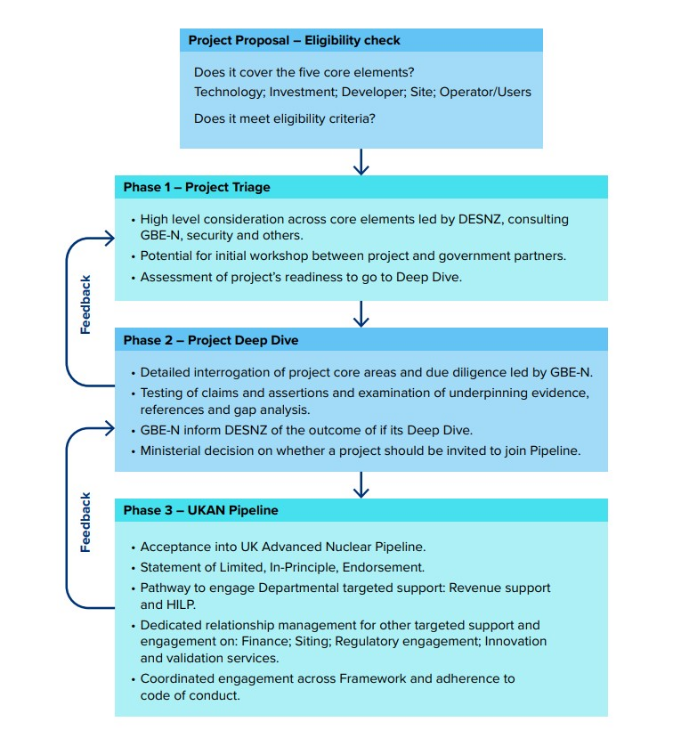
Further details on the PRA are provided in Section 4.
2.6 Proposal Costs and Guidance changes
Project proposers are not entitled to claim from DESNZ any costs or expenses that they may incur in preparing a project proposal irrespective of the outcome.
The department reserves the right to amend or withdraw the guidance for the Pipeline, suspend or to withdraw this opportunity to provide proposals, including for projects who have already submitted a proposal but have not been informed of the outcome.
DESNZ will not be liable for any costs incurred by projects during any stage of the process. DESNZ reserves the right to refuse any proposal that contravenes UK energy, nuclear or security policies or otherwise conflicts with government acting in the public interest.
2.7 Consortium proposals
In the case of a proposal from a consortium, only one proposal covering all partners is required, but the consortium must make clear the proposed role that each partner will play in the project. DESNZ expect the project partners to indicate who in the consortium is authorised to be the lead contact, and the organisation and governance associated with that consortium, as set out in Section 3.
The consortium should also make clear how they will manage any intellectual property rights or commercial information held by consortium members, and any resulting licensing agreements.
DESNZ recognises that arrangements in relation to consortia may (within limits) be subject to future change. Projects should therefore set out the arrangements as currently envisaged. Should the project be successful in joining the Pipeline, members should note that any future proposed change in relation to membership of the consortium, including if a consortium member undergoes a change of ownership, must be notified to DESNZ and will be considered under the review process for the Pipeline.
3. Project Proposals
3.1 What should be in a proposal?
This section identifies the information that DESNZ and GBE-N expect to be included in a project proposal in order for us to carry out a PRA.
DESNZ recognises that companies’ project concepts will be at different development stages and that companies will already have information and evidence available to demonstrate their project’s maturity. DESNZ has not set a specific format or structure for companies to follow when making a proposal so that companies can make use of existing relevant information or documents reducing the administrative burden of presenting a proposal. However, projects must address each of the core areas set out below. We recommend that companies provide as much information as is possible at the time of making the proposal.
A project proposal must include the following:
- A proposal summary
- Evidence supporting the project’s status across five Core Areas
- Technology and supply chain plan
- Developer capability plan
- Finance, funding and investment plans
- Siting plan
- Operation and end user plan
- A declaration of eligibility
These are explained in more detail below.
DESNZ recommends that project proposals should be written using a Claims, Arguments and Evidence (CAE) structure [footnote 1], as this is concise, focused, and based on factual information. CAE is a structured approach which aids the visibility, review and assessment of documentation. The key terms can be defined as follows:
- Claim: A high-level assertion or statement.
- Argument: Supports the claim and provides the link to the supporting evidence. It also allows the supporting justification to be broken up to aid visibility.
- Evidence: Facts and judgements that support the applicable argument(s).
This is a style familiar to organisations seeking to progress through nuclear regulation and will help DESNZ and GBE-N assess proposals within the expected timeframes.
Contributors are encouraged to avoid unnecessary elaboration or content that does not directly support the proposal’s objectives.
To further minimise administrative burden on companies, DESNZ and GBE-N will also seek to draw on information already available to the UK government and/or information produced by the proposing company for similar purposes for other UK or overseas authorities. Therefore, where elements of a proposal have already been reviewed under other UK processes or approvals, such as regulatory early engagement, GDA or the GBE-N technical selection process, a project proposer can authorise DESNZ and GBE-N to make use of that data rather than resubmit duplicative information. DESNZ and GBE-N will also accept information produced for relevant processes or approvals in other nuclear nations. Project proposers should note that export controls may apply.
If possible, project proposers should provide references, links or underpinning evidence. Projects are asked to provide their consent for DESNZ and GBE-N to access information from these other processes. This may reduce the information needed in the proposal, the administrative burden on the proposer and the time taken to consider it. Note, where data is held by a body other than DESNZ or GBE-N, they may require authorisation from a company to share information with us.
DESNZ and GBE-N will also, where available, consider information in the public domain that is pertinent to the proposal and the assessment of the Core Areas (e.g. information or announcements about the chosen technology or other uses of a proposed site).
Proposals should be submitted in English to advancednuclear@energysecurity.gov.uk.
DESNZ recognises that different elements of projects will develop at different speeds as such we anticipate that any given project proposal may be further ahead in some core areas than others. As such, projects should seek to demonstrate those core elements that have been agreed and firmly established and to provide evidence of work undertaken with clear plans to make future progress against less developed core elements.
3.2 Proposal summary
Projects should include a short, high-level summary of the proposal including key project members roles and responsibilities, objectives and timelines.
Projects should include a short description of the proposal suitable for publication, if required, on the public facing products of the Pipeline.
3.3 Core Area 1: Technology and supply chain plan
The PRA will consider whether there is information and supporting evidence in the proposal that a project has agreements in place, or mature and credible plans, to deploy a preferred technology. This will involve an assessment of the three key criteria below:
- Preferred technology,
- Lifetime fuel cycle
- Supply chain
The information that we would expect to see to support each criterion is set out below. However, we recognise that different organisations and projects may have additional relevant information they wish to submit in support of their proposal.
- Preferred technology
- Name of design, type, (e.g. Light Water Reactor, High Temperature Gas Reactor etc) and other key information (e.g. energy output, coolant, moderator, outlet temperatures, any new or novel features, level of design for decommissioning, etc).
- Current operational and design status (e.g. operating, full plant design, conceptual plant design, etc).
- Regulatory status of technology (e.g. full regulatory approvals, being assessed, early engagement, etc) together with any regulatory feedback.
- Progress of engagement or agreements with technology provider (e.g. contractual, negotiation, early engagements, etc).
- How and why the technology fits within the project and its end users. Including any assessments undertaken on needs and requirements.
- Lifetime fuel cycle
- Fuel type, composition, enrichment level, reload schedule, and operational or regulatory status (e.g. fuel in use, qualified, etc).
- Availability of fuel in project timeframe, including initial core and subsequent reloads, and progress of engagement or agreements with fuel providers.
- Demonstration of compliance with the government’s Statement on Civil Nuclear Fuel Use, published alongside the Framework in February 2026.
- Approach to spent fuel and radioactive waste management including status of plans, any research and development (R&D) needed to ensure infrastructure can be developed, and evidence that spent fuel and waste can be made passively safe for disposal in a UK Geological Disposal Facility (GDF).
- Supply Chain
- Status of key technology components (e.g. commercial, off-the-shelf, long-lead bespoke manufacture, materials still in development, full design, etc).
- Availability and market for components regionally, nationally and globally.
- Any plans to develop supply chain resilience for the UK nuclear industry.
3.4 Core Area 2: Developer capability plan
The PRA will consider whether there is information and supporting evidence in the proposal that a project has agreements in place, or mature and credible plans, to access the capabilities needed to develop, construct and commission an advance nuclear technology. This will involve an assessment of the five key criteria below:
- Developer structure
- Engineering, Procurement and Construction (EPC) plan
- Timeline and risks
- Workforce planning
- Social value.
The information that we would expect to see to support each criterion is set out below. However, we recognise that different organisations and projects may have additional relevant information they wish to submit in support of their proposal.
- Developer structure
- Developer organisation and any relevant experience of nuclear or similar sector infrastructure projects, together with progress of engagement or agreements with experienced infrastructure development companies supporting the project.
- Assessment of developer and development plan needs.
-
EPC plan
- Key organisations and any relevant experience, together with progress of engagement or agreements.
- Assessment or planning for EPC elements.
- Timeline and risks
- Timeline for project delivery including key milestones.
- Dependencies, risks and opportunities over the life of the project.
- Resource assessments and plans for lifetime of project.
- Workforce planning
- Workforce capability and capacity needs for the project together with consideration of workforce availability (supply and demand) and plans to address known gaps.
- Skills profile for project and assessment of global, national or regional availability.
- Recruitment and training plans.
- Social value
- Plans or commitments to community engagement, environmental sustainability, economic inclusion, health and wellbeing and legacy impacts.
- Plans or strategies to drive the creation of sustainable UK employment opportunities that reduce economic disparity are diverse, inclusive and open to all.
3.5 Core Area 3: Finance, funding and investment plan
The PRA will consider whether there is information and supporting evidence in the proposal that a project has agreements in place, or mature and credible plans, to understand costs and funding provision for each stage of the project, together with how financial risks and liabilities will be shared or apportioned and with whom. This will involve an assessment of the three key criteria below:
- Costs
- Finance structure and timeline
- Funding and revenue plans.
The information that we would expect to see to support each criterion is set out below. However, we recognise that different organisations and projects may have additional relevant information they wish to submit in support of their proposal.
The Framework establishes that government is willing in principle to provide financing and funding model support to credible projects that represent value for money and where economic risk is held by the privately led project. As such, finance, funding and investment plans can include information regarding public funding support that project sponsors plan to seek. The inclusion of such plans in a project endorsed by the PRA process will not constitute DESNZ agreement to make such support available.
- Costs
- A developed and structured breakdown of the project’s costs together with the level of certainty currently assumed.
- Evidence or assumptions that underpin costs breakdowns.
- Finance structure and timeline
- Plans or agreements in place to provide finance or support for the project across its lifetime.
- Plans and assessments of where control or economic risk sits across the project and its supporting organisations.
- Availability of finance.
- Contribution expected from UK public funding and mitigations in place to minimise this.
- Funding and revenue plans
- Plans, agreements or assumptions on funding and revenue streams for the project in deployment, operation and decommissioning.
- Support expected from UK public funding and mitigations in place to minimise this.
3.6 Core Area 4: Siting plan
The PRA will consider whether there is information and supporting evidence in the proposal that a project has property rights to a location for intended deployment or credible plans to secure property rights such as agreements in place with landowners.
DESNZ recognises that some projects may be considering multiple site options when making a proposal, so mature and credible plans for choosing a preferred site ahead of securing property rights can also be set out. The PRA will also consider information and supporting evidence regarding the suitability of a location for nuclear deployment, and credibility of the pathway to development consent and other location-based licenses and approvals.
The siting plan assessment will involve an assessment of the two key criteria below.
- Preferred site
- Regulatory, planning or other approvals.
The information that we would expect to see to support each criterion is set out below. However, we recognise that different organisations and projects may have additional relevant information they wish to submit in support of their proposal.
- Preferred or chosen site
- Location of key site(s) for project deployment and other core information (e.g., size of site, current status, surrounding area, population demographics etc).
- Status of property rights for preferred site and where the project proposer does not have those rights progress of engagement or agreements with the site owner/rights holder (e.g. contractual, negotiation, early engagements) to provide an overall view of the site acquisition status.
- If known, whether any other parties have property rights for the land (e.g. option agreements) or whether any other parties or projects have similar proposals for the same site.
- How and why the site is suitable for the project, including any assessments undertaken on needs and requirements together with dependencies and infrastructure.
- Risk mitigation, demonstrating consideration of approach to ecological impacts and proximity exclusions.
- If site acquisition is sufficiently developed, status of community engagement undertaken and planned, including social value commitments, early engagement with local authorities, and public acceptance strategies.
- Regulatory, planning or other approvals
- Regulatory status of site (full regulatory approvals, ongoing assessment, early engagement, etc).
- Planning status (e.g. DCO provided, ongoing planning application, early engagement) and potential consistency with planning policy (e.g. could the site be compliant with EN-6 or EN-7 criteria, assessment of local issues, etc). For the avoidance of doubt, any scoring in relation to this core area is not intended to affect pending or future decisions on planning policy.
- Any other significant site approvals required and information on progress towards them.
3.7 Core Area 5: Operation and end user plan
The PRA will consider whether there is information and supporting evidence in the proposal that a project has agreements in place, or mature and credible plans, on planned commercial operation, end user markets and end of project closedown. This will include assessment of the three key criteria below:
- Operator structure
- Planned output users and markets
- Operational waste management and decommissioning strategy.
The information that we would expect to see to support each criterion is set out below. However, we recognise that different organisations and projects may have additional relevant information they wish to submit in support of their proposal.
- Operator structure
- Operator organisation and any relevant experience that organisation has operating nuclear energy generating installations, other energy infrastructure and/or other nuclear installations, together with progress of engagement or agreements securing operator capabilities for the project.
- Assessment of operation needs.
- Planned output users and markets
- Who are the primary and other users of the project outputs (e.g. on-grid generation, private power purchasers such as data centres, hydrogen producers or other heat users, etc).
- Integration with the energy system, including grid connection plans and consideration of other use cases.
- Status of user markets or assessment/modelling of their status at time of deployment.
- Preferred contractual structures and any assessment of dependencies, risks or opportunities.
- Location of key known or assumed users in relation to project.
- Operational waste management and decommissioning strategy
- Assessment of project lifetime wastes and spent fuel or plans to develop them prior to deployment.
- Agreements, progress or engagement on funded decommissioning plans.
- Long term site plans following operation.
3.8 Declaration of eligibility
As noted in Section 2, proposals must meet certain eligibility criteria for a project to be considered for addition to the Pipeline. These are provided in more detail in Section 6.
Proposals from projects outside of these eligibility criteria will not be considered for inclusion on the Pipeline.
Proposals should include a declaration of eligibility in a manner consistent with the text provided in Annex A.
Evidence underpinning claims of eligibility will continue to be tested as part of due diligence during the PRA process, and information may continue to come to light after a project joins the Pipeline. DESNZ reserves the right to disqualify a proposal or remove a Pipeline project if the department becomes aware of relevant eligibility issues later in the PRA process or subsequent engagements
4. Project Readiness Assessment Process
Whilst the PRA is not a competitive process, we will use best practice from previous DESNZ innovation competitions to ensure that proposals are treated consistently, fairly and transparently. This will include similar structures and practices for assessment scoring, assurance and feedback to those that the sector is familiar with.
4.1 Initial checks:
The following initial checks will be undertaken against all proposals prior to them entering Phase 1 – Rapid Triage:
- Preliminary Eligibility Check: The proposal, including the declaration of eligibility will be checked to ensure that the project complies with the eligibility criteria set out in Section 6.
- Completeness Check: The proposal will be checked to ensure that information has been provided in the project summary and across each of the core areas identified by DESNZ. Proposals that do not address one or more of the core areas may not be assessed.
Proposals that do not meet the eligibility criteria or have significant omissions in one or more of the core areas may be rejected and provided with feedback on the issues or omissions identified.
4.2 Phase 1 – Rapid Triage
Complete and eligible proposals will undergo an initial rapid triage. This will comprise officials carrying out a preliminary review of the proposal. This will be carried out by officials with relevant technical, commercial, security and policy expertise.
DESNZ may offer an initial, exploratory workshop to enable officials and project proposers to discuss the proposal, set expectations and seek further information to assist with assessment.
Where DESNZ or GBE-N are already in possession of relevant information on the core elements from other processes or approvals (such as GDA, planning applications, technical selection processes, etc), and consent has been provided to use such information, they will factor this into their consideration. This may assist in reducing the time required for the triage phase.
The rapid triage will make an initial assessment of both a) the claims and arguments provided in the proposal and b) whether there is sufficient information demonstrating a project’s potential viability to support a detailed review of underpinning evidence by GBE-N in the second phase of the PRA – the deep dive.
The rapid triage will be a scored assessment. Scoring will be carried out by a panel of at least three people comprising staff from the Pipeline team within DESNZ and at least one independent member with relevant expertise. Training will be provided to assessors to ensure consistency and fairness across assessments.
The panel will, through a process of individual scoring and moderation, agree a score between 1 and 3 for each of the five Core Areas, assessing the content, claims and arguments provided to ascertain whether they address the criteria set out in Section 3 and provide sufficient evidence for GBE-N to undertake a deep dive.
To progress to Phase 2, a project proposal must score at least 2 in each of the five Core Areas (Technology/supply chain, developer, finance, siting, operator/end user) with a score of 3 in at least one Core Area. A score of 1 in any Core Area will result in a project not progressing irrespective of other scores.
| Score | Description |
|---|---|
| 3 | More than satisfactory: Good, or better, claims and arguments that the project has plans and agreements in place that satisfactorily address the criterion in a Core Area with only minor omissions at most. Substantial evidence provided upon which Phase 2 assessment can be carried out. |
| 2 | Satisfactory: Reasonable claims and arguments that the project has considered or has credible plans to satisfactorily address the criterion set out in a Core Area but some omissions are evident and further clarification is needed. Moderate evidence provided upon which Phase 2 assessment can be carried out. |
| 1 | Not satisfactory: No content and/or weak claims and argument that the project has considered or has credible plans for the criterion set out in a Core Area. Major omissions are evident. No or limited evidence provided upon which GBE-N can carry out a Phase 2 assessment. |
4.2.1 Decision and notification
Rapid triage decisions on whether a project proposal can progress to Phase 2 will be taken by the Senior Responsible Officer (SRO) for the Pipeline, who is a member of the senior civil service with relevant expertise.
The SRO will be assured of the process and informed of the outcomes of the final scored Triage assessment. Where the panel advise that a project meets the requisite thresholds for entry to Phase 2, the SRO will consider, in their absolute discretion, whether there are any national security issues or other overriding reasons that mean it would not be in the public interest to progress assessment to Phase 2 or ultimately give a limited in principle endorsement to that project.
Once the SRO has made their decision, projects and GBE-N will be notified, in writing, of the outcome. Feedback from the triage process on gaps or areas for development will be provided to all projects, irrespective of outcome.
4.2.2 Unsuccessful proposals and re-submission
Project proposers who are unsuccessful in proceeding to Phase 2 will have the opportunity to submit a further or updated proposal in the future. DESNZ anticipates that a project proposer will seek to address any shortcomings or areas for development identified in the feedback on their original proposal before resubmitting.
When re-submitting a proposal, projects may rely on the information provided in their original proposal and should provide additional information demonstrating how they have managed feedback and any shortcomings. DESNZ would expect to see material change in areas where shortcoming have been identified before undertaking a further assessment.
4.3 Phase 2 – Deep Dive
Projects accepted into the second phase of PRA will undergo a deeper and more detailed interrogation of the Core Areas in their proposals, which will be led by staff from GBE-N. This process will further test the claims and assertions made in the proposal as well as examining the underpinning evidence, references and issues identified as part of the triage phase.
GBE-N may issue projects with an information request seeking further detail, clarification and evidence across the five Core Areas. Additionally, project proposers may wish to provide further information and detail to address feedback they have received from triage. Once additional information is received, GBE-N and DESNZ will seek further input, comment and feedback from relevant technical, commercial, security and policy experts. DESNZ will collate information on national security and other key policy areas in parallel.
GBE-N will then undertake a more detailed assessment of the information and evidence in their possession against the five Core Areas. Further engagement, including an additional workshop on one or more of the Core Areas may be required as part of this process. This process is envisaged to take three months but may take more time dependent upon the quality and timeliness of information provided.
Where DESNZ or GBE-N are already in possession of relevant information on the core elements from other processes or approvals (such as GDA, planning applications, technical selection processes, etc) and consent has been provided to use such information, they will factor this into their consideration. This may assist in reducing the time required for the deep dive phase.
Assessment of a project’s viability and readiness to be included in the Pipeline will again be undertaken by scored assessment, carried out by a panel of at least three people comprising of staff from GBE-N, the Pipeline team and at least one independent member with relevant expertise. This will be chaired by GBE-N. Training will be provided to chairs and assessors to ensure consistency and fairness across assessments.
The panel will, through a process of individual scoring and moderation, agree a score between 1 and 5 for each of the five Core Areas, assessing the evidence that underpins the claims and arguments to ascertain whether the criterion set out above in Section 3 are addressed.
Scores could be higher, or lower, than those for the triage stage as this assessment will undertake a more detailed consideration of underpinning evidence.
To be included in the Pipeline, a project must score an aggregate of 15 or above across the five Core Areas (technology/supply chain, developer, finance, siting, operator/end user). A score of 1 in any area will result in a project not progressing irrespective of other scores.
| Score | Description |
|---|---|
| 5 | Excellent: Clear evidence that the project has satisfactorily addressed all the criterion in a Core Area and has binding agreements and credible plans in place to deliver them. |
| 4 | Good: The project has plans and agreements in place that satisfactorily address the criterion in a Core Area with a good evidence base, with only minor omissions or lack of clarity. |
| 3 | Satisfactory: Reasonable evidence that the project has considered or has credible plans to satisfactorily address the criterion in a Core Area but some omissions are evident and further clarification is needed. |
| 2 | Partially unsatisfactory: There is little evidence that the project has considered or has credible plans for satisfactorily addressing the criterion in a Core Area and some omissions are evident. Much more clarification is needed. |
| 1 | Not satisfactory: No, or insufficient, evidence that the project has considered or has credible plans for the criterion set out. Major omissions are evident. |
Following the panel, GBE-N will inform DESNZ of the outcome of the Deep Dive.
4.3.1 Decision and notification
Decisions on whether a project should be invited to join the Pipeline will be taken by DESNZ ministers.
DESNZ ministers will be assured of the process and informed of the final outcomes of the scored deep dive assessment. Where GBE-N advise that a project meets the requisite thresholds for Pipeline entry, ministers will consider, in their absolute discretion, whether there are any national security issues or other overriding reasons that mean it would not be in the public interest to give a limited in principle endorsement to that project.
Once ministers have made their decision, projects will be notified of the outcome. Feedback from the deep dive process on gaps or areas for development will be provided to all projects, irrespective of outcome, to assist in the development of their proposals and plans.
Successful projects will be invited to join the Pipeline, subject to the agreed terms of participation including a communications protocol, code of conduct and a review and change management process.
4.3.2 Unsuccessful proposals and re-submission
Project proposers who are unsuccessful in proceeding to the Pipeline will have the opportunity to submit a further or updated proposal in the future. DESNZ anticipates that a project proposer will seek to address any shortcomings or areas for development identified in the feedback on their original proposal before resubmitting.
When re-submitting a proposal, projects may rely on the information provided in their original proposal and should provide additional information demonstrating how they have managed feedback and any shortcomings. DESNZ would expect to see material change in areas where shortcoming have been identified before undertaking a further assessment.
4.4 Project Readiness Assessment communications
The PRA process is designed to give limited government endorsement when a project demonstrates it is sufficiently mature that such endorsement can help attract further private investment. A negative decision means a project is not yet ready for such an endorsement.
However, DESNZ recognises that an unsuccessful PRA could have a deleterious impact on that project’s ability to attract investment or other commercial support if the decision were interpreted to mean DESNZ believes a project is wholly without merit. DESNZ believes that this type of negative commercial impact on a project is counter to the Framework’s aims of enabling the private sector to develop projects.
As such, DESNZ will not ordinarily make proactive public comment about projects undergoing a PRA. The first proactive public communication DESNZ makes will ordinarily be in the event of a successful PRA, where a project’s limited in principle endorsement will be publicised by adding the project to the Pipeline.
5. Confidentiality
5.1 Privacy Notice
This notice sets out how DESNZ will use the project members’ personal data, and project members’ rights. It is made under Articles 13 and/or 14 of the UK General Data Protection Regulation (UK GDPR).
Project participant’s personal data
We will process the following personal data:
Names and contact details of employees involved in preparing and submitting proposals; Names and contact details of employees proposed to be involved in the project; Names, contact details, age, qualifications, and experience of employees whose CVs are submitted as part of the proposal.
Purpose
DESNZ are processing Project Participant’s personal data for the purposes of the Pipeline PRA exercise described within the remainder of this document, or in the event of legal challenge to such Pipeline PRA.
Legal basis of processing
The legal basis for processing Project Participant’s personal data is that processing is necessary for the performance of a task carried out in the public interest or in the exercise of official authority vested in the data controller, such as the exercise of a function of the Crown, a Minister of the Crown, or a government department; the exercise of a function conferred on a person by an enactment; the exercise of a function of either House of Parliament; or the administration of justice.
Recipients
Project Participant’s personal data will be shared by us with other government departments or public authorities where necessary as part of the Pipeline PRA exercise. DESNZ may share Project Participant’s data if DESNZ are required to do so by law, for example by court order or to prevent fraud or other crime.
Retention
All personal data within proposals will be retained for a period of 15 years from the date of submission of a Proposal.
Project Participant’s individual rights
Project Participants:
- have the right to request information about how their personal data is processed, and to request a copy of that personal data.
- have the right to request that any inaccuracies in their personal data are rectified without delay.
- have the right to request that any incomplete personal data is completed, including by means of a supplementary statement.
- have the right to request that their personal data is erased if there is no longer a justification for them to be processed.
- have the right in certain circumstances (for example, where accuracy is contested) to request that the processing of their personal data is restricted.
- have the right to object to the processing of their personal data where it is processed for direct marketing purposes.
- have the right to object to the processing of their personal data.
International transfers
Project participant’s personal data will not be processed outside the United Kingdom or European Economic Area (EEA).
Complaints
If you consider that your personal data has been misused or mishandled, you may make a complaint to the Information Commissioner, who is an independent regulator. The Information Commissioner can be contacted at:
Information Commissioners Office
Wycliffe House,
Water Lane
Wilmslow,
Cheshire
SK9 5AF
Phone: 0303 123 1113 Email: casework@ico.org.uk
Any complaint to the Information Commissioner is without prejudice to your right to seek redress through the courts.
Contact details
The data controller for your personal data is the Department for Energy Security and Net Zero (DESNZ).
You can contact the DESNZ Data Protection Officer at: DESNZ Data Protection Officer, Department for Energy Security and Net Zero, 3-8 Whitehall Place, London, SW1A 2EG. Email: dataprotection@energysecurity.gov.uk.
6. Eligibility and Exclusions
6.1 Eligibility criteria
Project proposals must meet certain eligibility criteria to be considered for inclusion on to the Pipeline, listed below. Please sign the Declaration of eligibility form, found in Annex A, and append it to your proposal.
Scope: Entry to the portfolio is available for privately led Advanced Nuclear Technology (ANT) (SMR, AMR and MMR) projects. These must be fission, uranium-fuelled (up to 20% enrichment), non-mobile, on-land projects. In this context, “privately led” means projects sponsored by private companies that are not wholly owned or controlled by a UK public authority.
Geographical location: Projects must be for deployment in England and Wales.
Timeline: Projects must be seeking commencement of construction within 10 years of joining the Pipeline.
Constitution: The project proposer (or the lead partner if a consortium) is a registered company.
Terms of Participation: The project proposer agrees to be bound by the UKAN Pipeline Terms of Participation.
Offences: Neither the project proposer (or any of the consortium partners), nor any of its/their directors or officers, have been convicted of any of the offences listed under Section 57 and Schedule 6 of the Procurement Act 2023. This also applies to any parent companies (as defined by Section 1162 of the Companies Act 2006) and to directors and officers of those parent companies.
Sanctions: Neither the project proposer (or any of the consortium partners if a consortium), nor any of its/their directors or officers, are subject to United Nations, European Union or United Kingdom sanctions. This also applies to all entities and individuals in the upward group structure, directors, and officers of those companies.
Solvency: The project proposer (or any of the consortium partners if a consortium) is not in the situation described in Schedule 7 of the Procurement Act 2023 (it is not the subject of insolvency or winding-up proceedings etc., or in any analogous situation arising from a similar procedure under the laws and regulations of any state). This also applies to any parent companies (as defined by Section 1162 of the Companies Act 2006). This also applies to all entities and individuals in the upward group structure, directors and officers of those companies.
Non-proliferation: The project proposer (or each of the consortium partners if a consortium), and all entities in the upward group structure are associated with a country that has both signed and ratified the Treaty on the Non-Proliferation of Nuclear Weapons (NPT) and one of:
- a Voluntary Offer Agreement (VOA)
- or a Comprehensive Safeguards Agreement (CSA)
- or modified Small Quantities Protocol (mSQP),
- and an Additional Protocol (AP) with the International Atomic Energy Agency (IAEA). The AP should be universal, and supplementary to whichever of the three primary safeguards agreements the country has with the IAEA,
The project proposer (or each of the consortium partners if a consortium), and all entities in the upward group structure are not associated with a country which is subject to United Nations or European Union sanctions due to infringements of the NPT, their CSA, or an associated AP. In this context ‘associated with’ is defined as incorporated in, operating in, or owned (directly or indirectly) by nationals of this country.
Sensitive nuclear information or intellectual property: Where lead contractors or sub-contractors have access to sensitive nuclear information or intellectual property regarding the reactor design, they have appropriate security measures in place to protect these.
6.2 Discretionary exclusions
In addition to the eligibility criteria laid out in the guidance above, DESNZ reserves the right to exclude a proposal from the Pipeline or the PRA process on any of the following grounds:
6.2.1 Misrepresentations in their application
Where:
- A project proposer (or one of the consortium partners if a consortium) misrepresents their organisation or proposal
- A proposal includes misleading information
- A proposal contains insufficient information for a PRA to be undertaken.
6.2.2 Obligations in the field of labour law
Where any of the following orders has been made against the organisation or a connected person, or if they have engaged in conduct outside of the UK could result in any such order being made if the conduct occurred in the UK:
(a) a slavery and trafficking prevention order, an interim slavery and trafficking prevention order, a slavery and trafficking risk order or an interim slavery and trafficking risk order under Part 2 of the Modern Slavery Act 2015;
(b) a trafficking and exploitation prevention order, an interim trafficking and exploitation prevention order, a trafficking and exploitation risk order or an interim trafficking and exploitation risk order under Part 4 of the Human Trafficking and Exploitation (Scotland) Act 2015 (asp 12);
(c) a slavery and trafficking prevention order or an interim slavery and trafficking prevention order under Schedule 3 to the Human Trafficking and Exploitation (Criminal Justice and Support for Victims) Act (Northern Ireland) 2015 (c.2 (N.I.));
(d) a labour market enforcement order under section 18 of the Immigration Act 2016.
6.2.3 Obligations in the field of environment law
Where:
(a) the organisation or a connected person has been convicted of an offence (whether in or outside the United Kingdom), and
(b) the conduct constituting the offence caused, or had the potential to cause, significant harm to the environment, including the life and health of plants and animals.
6.2.4 Insolvency
Where the organisation or a connected person has:
(a) become bankrupt (or, in Scotland, its estate has been sequestrated),
(b) become subject to insolvency or winding-up proceedings,
(c) had its assets subject to administration or receivership, including by a liquidator or court,
(d) entered into an arrangement with its creditors,
(e) become subject to a petition or application for any such procedures or arrangements, or
(f) in any jurisdiction, been subject to a procedure or an application the decision-maker considers to correspond to any procedure or application mentioned in paragraphs (a) to (e).
6.2.5 Distortion of competition
Where an agreement or concerted practice to which the organisation or a connected person is party has infringed—
(a) a Chapter I prohibition (within the meaning given by section 2 of the Competition Act 1998), or
(b) any substantially similar prohibition applicable in a jurisdiction outside the United Kingdom.
Where an organisation or a connected person has infringed:
(a) a Chapter II prohibition (within the meaning given by section 18 of the Competition Act 1998), or
(b) any substantially similar prohibition applicable in a jurisdiction outside the United Kingdom.
Where:
(a) the Competition and Markets Authority has made a decision under the Competition Act 1998 that the organisation or a connected person has infringed a Chapter II prohibition, or
(b) a regulator or other authority outside the United Kingdom has made a decision that the organisation or a connected person has infringed any substantially similar prohibition.
Where an organisation or a connected person has engaged in conduct constituting—
(a) an offence under section 188 of the Enterprise Act 2002 (cartel offence), or
(b) a substantially similar offence under the law of a country or territory outside the United Kingdom.
6.2.6 Other obligations
- Where an organisation or a connected person has been in receipt of enforcement/remedial orders in relation to the Health and Safety Executive (or equivalent body) in the last 3 years.
- In the last three years, where an organisation has had a complaint upheld following an investigation by the Equality and Human Rights Commission or its predecessors (or a comparable body in any jurisdiction other than the UK), on grounds of alleged unlawful discrimination.
- In the last three years, where any finding of unlawful discrimination has been made against the organisation by an Employment Tribunal, an Employment Appeal Tribunal or any other court (or incomparable proceedings in any jurisdiction other than the UK).
- Where the organisation has been in breach of section 15 of the Immigration, Asylum, and Nationality Act 2006;
- Where the organisation has a conviction under section 21 of the Immigration, Asylum, and Nationality Act 2006;
- Where the organisation has been in breach of the National Minimum Wage Act 1998.
6.2.7 Grave professional misconduct
Where an organisation or a connected person has engaged in professional misconduct which brings into question the organisation’s integrity including
(a) dishonesty;
(b) impropriety;
(c) a serious breach of ethical or professional standards applicable to the supplier (whether those standards are mandatory or not).
6.2.8 Misrepresentation and undue influence
Where DESNZ determines that the project proposer (or one of the consortium partners if a consortium) has influenced the PRA process of DESNZ or GBE-N to obtain confidential information that may confer upon the organisation undue advantages in the PRA procedure, or to negligently provided misleading information that may have a material influence on decisions concerning exclusion, assessment or being added to the Pipeline.
6.2.9 Breach of tax or social security obligations
Where DESNZ determines that the project proposer (or one of the consortium partners if a consortium) has breached obligations relating to the payment of taxes and/or social security contributions.
7. Glossary of terms
| Term | Definition |
|---|---|
| Advanced Nuclear Policy and Delivery (ANPD) | A deputy-director led team within DESNZ, the ANPD team will be overseeing the Framework workstream. |
| Advanced Nuclear Technologies (ANT) | Small Modular Reactors (SMRs), Advanced Modular Reactors (AMRs), and Micro Modular Reactors (MMRs) using uranium-based fuels for land-based, non-mobile deployment. |
| Advanced Modular Reactor (AMR) | AMRs are factory-fabricated next generation reactors that use novel fuels and coolants beyond traditional light-water technology, enabling higher operating temperatures and versatile applications such as industrial heat and hydrogen production. |
| Code of Conduct | The ethical and professional standards expected of all pipeline participants. |
| Consortium | A group of organisations jointly submitting a project proposal, with one designated as the lead contact. |
| Core Areas | The five main sections required in a proposal: - Technology and Supply Chain Plan, - Developer Plan, - Finance / Funding / Investment Plan, - Siting plan, - Operation and end user Plan. |
| Declaration of Eligibility | A formal statement included in proposals, confirming that the project meets all eligibility criteria for the Pipeline. |
| Deep Dive | The second, more detailed phase of the Project Readiness Assessment, involving in-depth evaluation of the project’s evidence and plans. |
| Department for Energy Security and Net Zero (DESNZ) | The government department responsible for managing the Pipeline and related nuclear innovation policy. |
| Eligibility Criteria | The set of requirements that projects must meet to be considered for the pipeline, including technology type, location, timeline, company status, and compliance with legal standards. |
| Great British Energy – Nuclear (GBE-N) | The Government’s nuclear delivery body with the specialist capability and skills necessary to help deliver the government’s nuclear new build programme. |
| Generic Design Assessment (GDA) | The UK’s regulatory process for assessing the safety, security, and environmental impact of new nuclear reactor designs. |
| Micro Modular Reactor (MMR) | Micro Modular Reactors (MMRs) are ultra-small, factory-fabricated nuclear fission systems - typically producing less than 30 megawatts of electricity - that are designed for transportability and long-duration operation without refuelling, enabling reliable low-carbon power for remote, niche, or off-grid applications. |
| Pipeline participant | A project or organisation that has been accepted onto the Pipeline. |
| Pipeline Team | The team within DESNZ that will oversee the Pipeline workstream. |
| Project proposal | A proposal in respect of a project submitted to DESNZ and GBE-N for assessment as to whether it could be added to the Pipeline. |
| Project proposer | The lead organisation, representing themselves or on behalf of a consortium, submitting a proposal for entry onto the Pipeline. |
| Privately led projects | Projects sponsored by private companies that are not wholly owned or controlled by a UK public authority |
| Project Readiness Assessment (PRA) | The structured, two-phase process (Rapid Triage and Deep Dive) used to evaluate the maturity, viability, and policy alignment of project proposals. |
| Rapid Triage | The initial phase of the PRA, involving a quick assessment of a project’s eligibility and readiness, typically lasting 3–4 weeks. |
| Senior Responsible Officer (SRO) | The senior civil servant responsible for decisions on project progression within the PRA process. |
| Small Modular Reactor (SMR) | SMRs are factory-fabricated, water-cooled fission reactors using up to 5% enriched uranium fuel with power outputs less than ~500MWe i.e. smaller variants of light-water and boiling water reactors that are the most prevalent types of reactors in operation worldwide. |
| Statement of Limited, In-Principle, Endorsement | A formal document issued by DESNZ to projects accepted onto the pipeline, indicating government recognition of the project’s potential viability. |
| Terms of Participation | These set out the conditions of participation for organisations seeking to submit a proposal for assessment to join the Pipeline. |
| UKAN Pipeline or “Pipeline” | The United Kingdom Advanced Nuclear Pipeline - a government-managed process for assessing and endorsing privately led advanced nuclear projects for potential deployment in England and Wales. |
Annex A: Declaration of Eligibility
To: The Department for Energy Security and Net Zero
Having considered the “United Kingdom Advanced Nuclear Pipeline: Guidance and expectations for project proposers” documentation and eligibility criteria set out in Section 6 thereof, we confirm that the information included in this proposal is true and correct to the best of our knowledge.
We also confirm that the following statements are true to the best of our knowledge.
1) The proposed project is “privately-led”. It is sponsored by private companies that are not wholly owned or controlled by a UK public authority.
2) The proposed project is in relation to an Advanced Nuclear Technology (SMR, AMR or MMR) that is:
a. Fission Technology
b. Uranium Fuelled (up to 20% enrichment)
c. Non-mobile
d. On Land
3) The proposed project is for deployment in England or Wales.
4) The proposed project seeks commencement of construction within 10 years of joining the Pipeline.
5) The project proposer (or the lead partner if a consortium) is a registered company.
6) The project proposer agrees to be bound by the United Kingdom Advanced Nuclear Pipeline Terms of Participation.
7) Neither the project proposer (or any of the consortium partners), nor any of its/their directors or officers, have been convicted of any of the offences listed under Section 57 and Schedule 6 of the Procurement Act 2023. This also applies to all entities and individuals in the upward group structure, directors, and officers of those companies
8) Neither the project proposer (or any of the consortium partners if a consortium), nor any of its/their directors or officers, are subject to United Nations, European Union or United Kingdom sanctions. This also applies to all entities and individuals in the upward group structure, directors, and officers of those companies.
9) The project proposer (or any of the consortium partners if a consortium) is not the subject of insolvency or winding-up proceedings or in any analogous situation arising from a similar procedure under the laws and regulations of any state. This also applies to any parent companies (as defined by Section 1162 of the Companies Act 2006). This also applies to all entities and individuals in the upward group structure, directors and officers of those companies.
10) The project proposer (or each of the consortium partners if a consortium), and all entities in the upward group structure are associated with a country that has both signed and ratified the Treaty on the Non-Proliferation of Nuclear Weapons (NPT) and one of:
a. a Voluntary Offer Agreement (VOA)
b. or a Comprehensive Safeguards Agreement (CSA)
c. or modified Small Quantities Protocol (mSQP),
d. and an Additional Protocol (AP) with the International Atomic Energy Agency (IAEA). The AP should be universal, and supplementary to whichever of the three primary safeguards agreements the country has with the IAEA,
11) The project proposer (or each of the consortium partners if a consortium), and all entities in the upward group structure are not associated with a country which is subject to United Nations or European Union sanctions due to infringements of the NPT, their CSA, or an associated AP. In this context ‘associated with’ is defined as incorporated in, operating in, or owned (directly or indirectly) by nationals of this country.
12) Where lead contractors or sub-contractors have access to sensitive nuclear information or intellectual property regarding the reactor design, they have appropriate security measures in place to protect these.
13) Neither the project proposer (or any of the consortium partners if a consortium), nor any of its/their directors or officers, are subject to any of the discretionary exclusionary criteria set out in Section 6 of the UKAN Pipeline Guidance.
Signature (duly authorised on behalf of the project proposer (including any and all consortium members)) ………………………………………………………
Print name……………………………………………………………………………
On behalf of (Project proposers name)…………………………………………………………………………………
Date…………………………………………………………………………………
Annex B: Principles for membership of the Pipeline
1. Detailed Terms of Participation have been published alongside this Guidance and should be taken to enshrine the following principles.
Non-determination
2. The Pipeline is not intended to, and does not, limit the discretion of DESNZ or regulatory bodies in the exercise of existing or future powers in relation to policy, legislation, planning, licences, planning, and codes. Furthermore, the Guidance is not intended to, and does not, create any expectation as to any future procedure or policy that may or may not be established, including as to whether a Project is or is not completed and over what timeframe or in what form.
Code of Conduct
3. Whilst membership of the Pipeline alone does not provide any direct financial assistance or grants, participants of projects on the Pipeline will be expected to adhere to the highest standards of ethical and professional behaviour. To this end participants will be expected to act in accordance with the spirit of the UK Government Code of Conduct for Grant Recipients.
Communications protocol
4. DESNZ, GBE-N and Participants will work collaboratively to ensure that any information made public concerning the Pipeline, its operations, any endorsements it offers, and comments relating to associated Government policy are coordinated, accurate, and representative of all parties’ policies and positions.
5. To this end, all parties will be expected to agree to a high-level communications protocol as set out in draft at Annex B2 for each project.
Review and change control
6. The position of the project upon acceptance to the Pipeline will set a baseline against which any future progress or changes will be considered. This will also set the baseline for any consideration under the provisions of the National Security and Investment Act.
7. DESNZ, GBE-N and Pipeline Participants will review projects on a regular basis to ascertain any progress or developments towards deployment. This will consist of a meeting to undertake a high-level review, with evidence if necessary, against the five Core Areas to consider where a project is in relation to their position upon joining the Pipeline. This meeting will also review progress of the project against its stated milestones and timelines, together with any remediation plans in place.
8. DESNZ and GBE-N may provide feedback to projects on any areas for further development as part of this review.
9. Pipeline Participants must notify DESNZ as soon as they are aware that they are anticipating, undergoing or have undergone a significant material change of circumstances to the substance of the project. This includes:
- Change of Control of the project proposer (or any of the consortium partners if a consortium)
- Change in plans or positions in relation to any of the Core Areas that have been considered during the PRA. This should consider both significant progress made (e.g., new agreements, technology developments, etc…) and any potential material setbacks that the project has experienced.
- Any event or action that would render the project ineligible under the criteria set out in section 6.
10. DESNZ may conduct reviews outside the annual review if a material change of circumstances comes to its attention (whether disclosed by the Pipeline Participant or not).
11. DESNZ and GBE-N will work with project participants to understand the impacts of any significant changes to the substance of the project.
Leaving the UKAN Pipeline
12. DESNZ reserves the right to remove any Project from the UKAN Pipeline and revoke the terms any endorsement at any point, including in the following circumstances:
- Projects that no longer meet the eligibility criteria set out in this Guidance in Section 6.
- Where continued membership of the UKAN Pipeline would be contrary to the interests of national security, otherwise not in the public interest or in DESNZ’s opinion the Project is no longer deliverable.
- Following a review, the Project no longer satisfies the requisite scoring threshold to join the Pipeline; the Project fails to improve its scoring in accordance with any future requirements set by DESNZ; or the Project fails to demonstrate material progress towards meeting the milestones and timelines in their proposals, or any other timelines agreed with DESNZ.
- Failure to inform DESNZ of a material change to a Project (as part of an annual review or otherwise) including a material change of circumstances.
- Projects that are successful in deployment and commence operation will be initially marked on the UKAN Pipeline as completed and removed 1 year later.
13. DESNZ and GBE-N will endeavour to provide UKAN Pipeline participants with notice of intention to remove projects from the UKAN Pipeline and provide an opportunity for the provision of further information, agreement or evidence.
Withdrawal from the UKAN Pipeline
14. Projects may withdraw from the UKAN Pipeline by providing DESNZ with reasonable written notice.
Annex B2: Draft Communications and Branding Protocol
UK Advanced Nuclear Pipeline
Context
1. This protocol has been developed to establish and agree upon the procedures for communications engagement between participants involved in projects on the UK Advanced Nuclear (UKAN) Pipeline, the Department for Energy Security and Net Zero (DESNZ), and the Great British Energy - Nuclear (GBE-N).
2. The application and operation of this protocol will be jointly reviewed on a regular basis and may be amended, subject to the agreement of the Pipeline Participants and DESNZ (collectively referred to as the “parties” and individually as a “party”). It is important to note that this protocol is not legally binding.
3. Pipeline Participants and DESNZ will work collaboratively to ensure that any information made public concerning the Pipeline, its operations, any endorsements it offers, and comments relating to associated Government policy are coordinated, accurate, and representative of all parties’ policies and positions. Pipeline Participants are required to use all reasonable efforts to ensure that their partners and subcontractors are aware of and comply with the provisions of this protocol.
4. All parties must keep each other informed about press enquiries, media coverage, events, or other information that comes to their attention regarding the Pipeline or the individual projects listed within it.
Communications
Use of All Parties’ Logos
5. Each party will, unless otherwise specified, include the logos of the other parties (DESNZ, GBE-N, and UKAN Pipeline participants) as well as any branding associated with the Pipeline in the following instances:
- Paid-for published articles
- Adverts
- Presentation materials
- Websites (for DESNZ, this includes the public Pipeline itself)
- Printed materials for external events
Core lines on the UKAN Pipeline
6. In order to support Pipeline Participants and help ensure that representations made about the Pipeline are accurate and consistent (in line with clause 3), DESNZ will be happy to provide core lines and other communications material on request.
Communications Outside of a Party’s Direct Control
7. During the normal course of business, both written and verbal communications will occur between all parties and external media, which include but are not limited to journalists, trade associations, and trade press. Material published as a result of these interactions may not be directly controlled by the parties. Nevertheless, efforts will be made to ensure that any information made public about the Pipeline, its operations, any endorsements it offers, and comments relating to associated Government policy are accurate, factual, and to the greatest extent possible, reflect all parties’ policies and positions.
8. All parties will adhere to the provisions set out in clauses 3 and 4 when dealing with external communications of this nature.
Branding
9. When branding is used in line with the clauses of this protocol, the Recipient shall, where reasonably practicable given the nature of the communication, indicate that the Project is endorsed by DESNZ using agreed wording as developed in accordance with clause 4). The appropriate branding device, as set out in Appendix A, will also be displayed.
10. Any use of the Pipeline Participant’s organisation’s logo, or any Pipeline material published by DESNZ, must comply with the branding guidelines provided in Appendix A.
Requirement to Inform
11. Each party must inform their designated contacts (as listed in clause 6) about media requests, news stories, or other pertinent information related to the Pipeline or the respective project listed on it in line with the commitments outlined in clause 4.
12. The Pipeline Participant must not claim to represent or state the position or opinion of the Government or GBE-N.
Contacts
- Pipeline Participants Communications Contact:
- DESNZ Communications Contact:
APPENDIX A
[Branding device to acknowledge DESNZ endorsement to be inserted]
APPENDIX B
[Pipeline Participant’s branding guidelines to be inserted]
-
Further information on a claims, arguments and evidence structure can be found here: CAE Concepts – CAE FRAMEWORK or here Safety Case Toolkit - Claims, Arguments and Evidence.pdf ↩