Renewables Obligation (RO) final consultation analytical annex: impact of indexation options (accessible webpage)
Updated 28 January 2026

© Crown copyright 2026
This publication is licensed under the terms of the Open Government Licence v3.0 except where otherwise stated. To view this licence, visit nationalarchives.gov.uk/doc/open-government-licence/version/3 or write to the Information Policy Team, The National Archives, Kew, London TW9 4DU, or email: psi@nationalarchives.gov.uk.
Where we have identified any third party copyright information you will need to obtain permission from the copyright holders concerned.
This publication is available at https://www.gov.uk/government/consultations/renewables-obligation-ro-scheme-indexation-changes/outcome/renewables-obligation-ro-final-consultation-analytical-annex-impact-of-indexation-options-accessible-webpage
The outputs in this annex will differ from the Analytical Annex in the consultation on changes to inflation indexation in the Renewables Obligation scheme, due to updated forecasts published [footnote 1] by the Office for Budget Responsibility on 26th November.
Background on indexation
An inflation measure quantifies the rate at which the general price level of goods and services rises in an economy. It serves to track the cost of living, gauge economic stability, and inform monetary and fiscal policy decisions by central banks and governments. It helps individuals, businesses, and governments understand how their purchasing power is changing and allows for appropriate adjustments to wages, contracts, and interest rates to maintain price stability and economic well-being.
There is often debate about which methodology is most appropriate with the three most common measures used in the UK being the Retail Prices Index (RPI), Consumer Prices Index (CPI), and Consumer Prices Index with Housing (CPIH).
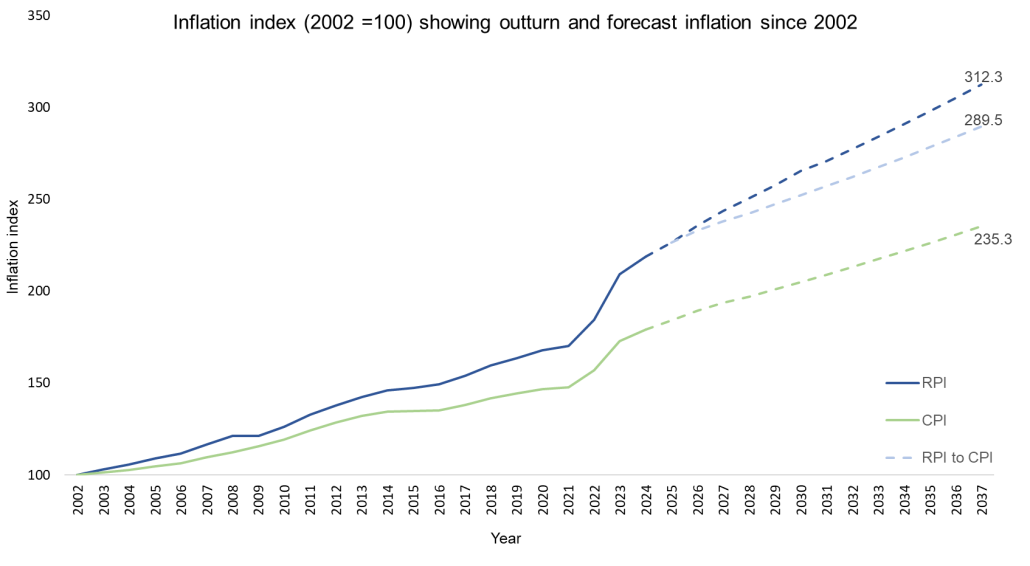
The Office for Budget Responsibility (OBR) produce regular Economic and Fiscal Outlooks that provide projections for RPI and CPI (Figure 1) up to Q1 2031. In general, RPI has consistently tracked higher than both CPI and is expected to remain higher in the future. Beyond Q1 2031, it is assumed that CPI increases at 2.0% with RPI increasing at 2.4% based on OBR long-term forecasts from the publication “The long-run difference between RPI and CPI inflation” [footnote 2].
Figure 1. OBR projections for RPI and CPI. The plot also shows the rate of change for RPI if the CPI methodology was used (which is expected to occur in the future)
Operation of the Renewables Obligation Scheme
The Renewables Obligation (RO) operates as a market-based system of tradable green certificates. The scheme places an obligation on UK electricity suppliers to present a certain number of Renewable Obligation Certificates (ROCs) to the scheme administrator (Ofgem), for each unit of electricity they supplied to non-exempt customers during an obligation year.
Suppliers can purchase these ROCs from generators or traders (with the precise value of a ROC a matter for negotiation) or can meet their annual obligation, in part or in full, by paying into a ‘buy-out’ fund. The prices of ROCs sold through the buy-out fund is set by the Department for Energy Security and Net Zero (DESNZ), the price of which is adjusted by Ofgem each year in line with inflation - currently RPI.
Although the majority of suppliers meet their obligation by purchasing ROCs rather than paying the buyout price, the predefined buyout price is assumed to directly impact on the traded price of a ROC. Any adjustment to the rate of indexation will therefore directly impact on the total spend required by suppliers and the total revenue received by generators.
Impact of the Change of Indexation
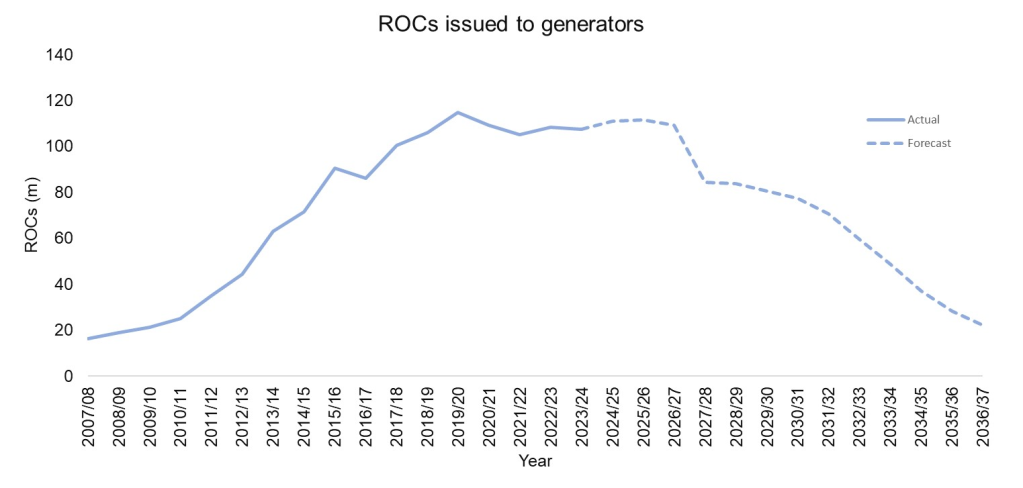
Each year the Department updates its projections for the number of ROCs that are expected to be produced under the scheme (figure 2), with these being used to define the headroom required within the scheme and the obligation for suppliers.
Figure 2. Forecast of the number of ROCs produced each year until the end of the RO scheme (in 2037).
The options under consideration to replace indexation using RPI as set out in the consultation:
option 1) indexation using CPI from 25/26
option 2) indexation using CPI from start of scheme in 02/03 with transitional protection of the current price.
option 2a) indexation using CPI from 15/16 with transitional protection of the current price.
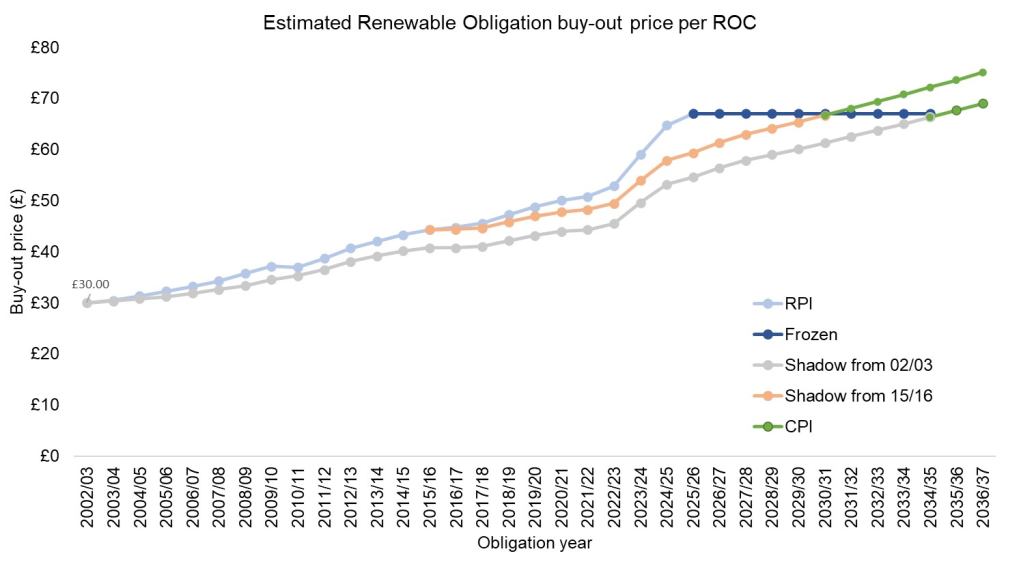
The current estimates as shown in figure 3, find that that option 2 will require the current buy-out price to be frozen for nine years with the next increase in the buy-out price to occur in 2035/36. Option 2a will require the buy-out price to be frozen for five years with the next increase occurring in 2031/32.
Figure 3. Forecast buy-out price comparison of using shadow CPI indexation from 02/03 and 15/16 against RPI frozen at 24/25
The RPI and CPI forecasts from the OBR are used to project buy-out prices (table 1). The impact of the change in indexation (table 2) has been calculated by multiplying the projected ROC volumes by the buy-out prices and uplifted by 10% to account for headroom. The scheme costs are paid by suppliers through the RO and are assumed to be passed onto consumers. As such the savings in table 2 are assumed to be for the consumer.
Changing RO indexation from RPI to CPI (option 1) is forecast to produce savings for the consumer of £60m (24/25 prices) in 26/27 increasing to £270m (24/25 prices) in 30/31. The savings beyond this point reduce as the total generation falls as the scheme closes in 36/37. Generators income would fall by similar amounts.
Freezing the RO indexation is forecast to produce savings for consumers of £320m (24/25 prices) in 26/27 increasing to £840m (24/25 prices) in 30/31 (applicable to both options 2 and 2a as transitional arrangements will be in both options only ending in 31/32 for option 2a). Generators income would fall by similar amounts.
Table 1. The forecast of annual ROC buy-out price based on current RPI and CPI forecasts
| Actual | RPI | Increase (%) | CPI | Increase (%) | |
|---|---|---|---|---|---|
| 2024/25 | £64.73 | ||||
| 2025/26 | £67.06 | ||||
| 2026/27 | £69.90 | 4.2% | £69.33 | 3.4% | |
| 2027/28 | £72.60 | 3.9% | £71.16 | 2.6% | |
| 2028/29 | £74.83 | 3.1% | £72.52 | 1.9% | |
| 2029/30 | £76.90 | 2.8% | £73.85 | 1.8% | |
| 2030/31 | £79.14 | 2.9% | £75.32 | 2.0% | |
| 2031/32 | £80.93 | 2.3% | £76.83 | 2.0% | |
| 2032/33 | £82.81 | 2.3% | £78.37 | 2.0% | |
| 2033/34 | £84.80 | 2.4% | £79.94 | 2.0% | |
| 2034/35 | £86.84 | 2.4% | £81.54 | 2.0% | |
| 2035/36 | £88.92 | 2.4% | £83.17 | 2.0% | |
| 2036/37 | £91.05 | 2.4% | £84.83 | 2.0% |
Table 2. Impact of changing the indexation of the RO scheme.
| 25/26 | 26/27 | 27/28 | 28/29 | 29/30 | 30/31 | 31/32 | 32/33 | 33/34 | 34/35 | 35/36 | 36/37 | |
|---|---|---|---|---|---|---|---|---|---|---|---|---|
| ROCs (m) | 111.5 | 109.2 | 84.5 | 83.8 | 80.7 | 77.3 | 70.6 | 59.5 | 48.7 | 37.1 | 28.3 | 22.3 |
| Buy-out price | ||||||||||||
| RPI | £67.06 | £69.90 | £72.60 | £74.83 | £76.90 | £79.14 | £80.93 | £82.81 | £84.80 | £86.84 | £88.92 | £91.05 |
| Option 1 -CPI | £67.06 | £69.33 | £71.16 | £72.52 | £73.85 | £75.32 | £76.83 | £78.37 | £79.94 | £81.54 | £83.17 | £84.83 |
| Option 2 | £67.06 | £67.06 | £67.06 | £67.06 | £67.06 | £67.06 | £67.06 | £67.06 | £67.06 | £67.06 | £67.68 | £69.04 |
| Option 2a | £67.06 | £67.06 | £67.06 | £67.06 | £67.06 | £67.06 | £68.01 | £69.37 | £70.76 | £72.17 | £73.61 | £75.09 |
| RO scheme cost (£bn, nominal prices) | ||||||||||||
| RPI | £8.2 | £8.4 | £6.7 | £6.9 | £6.8 | £6.7 | £6.3 | £5.4 | £4.5 | £3.5 | £2.8 | £2.2 |
| Option 1 -CPI | £8.2 | £8.3 | £6.6 | £6.7 | £6.6 | £6.4 | £6.0 | £5.1 | £4.3 | £3.3 | £2.6 | £2.1 |
| Option 2 | £8.2 | £8.1 | £6.2 | £6.2 | £6.0 | £5.7 | £5.2 | £4.4 | £3.6 | £2.7 | £2.1 | £1.7 |
| Option 2a | £8.2 | £8.1 | £6.2 | £6.2 | £6.0 | £5.7 | £5.3 | £4.5 | £3.8 | £2.9 | £2.3 | £1.8 |
| RO scheme cost (£bn, 24/25 prices) | ||||||||||||
| RPI | £7.9 | £7.8 | £6.0 | £6.0 | £5.7 | £5.5 | £5.0 | £4.2 | £3.5 | £2.6 | £2.0 | £1.6 |
| Option 1 -CPI | £7.9 | £7.7 | £5.9 | £5.8 | £5.5 | £5.2 | £4.8 | £4.0 | £3.3 | £2.5 | £1.9 | £1.5 |
| Option 2 | £7.9 | £7.5 | £5.6 | £5.3 | £5.0 | £4.7 | £4.2 | £3.4 | £2.7 | £2.0 | £1.5 | £1.2 |
| Option 2a | £7.9 | £7.5 | £5.6 | £5.3 | £5.0 | £4.7 | £4.2 | £3.5 | £2.9 | £2.2 | £1.7 | £1.3 |
| Savings (£m, 24/25 prices) | ||||||||||||
| RPI | £0 | £0 | £0 | £0 | £0 | £0 | £0 | £0 | £0 | £0 | £0 | £0 |
| Option 1 -CPI | £0 | £60 | £120 | £180 | £230 | £270 | £250 | £230 | £200 | £160 | £130 | £110 |
| Option 2 | £0 | £320 | £460 | £620 | £730 | £840 | £860 | £810 | £720 | £600 | £480 | £380 |
| Option 2a | £0 | £320 | £460 | £620 | £730 | £840 | £800 | £690 | £570 | £450 | £350 | £280 |
Impact on generators
The reduction in total income for generators is equivalent to the savings realised by consumers. However, the percentage change in overall RO revenue experienced by individual generators will depend on the timing of their exit from the scheme, as the cumulative impact of indexation changes increases the longer a generator remains within the RO.
The percentage reduction in RO revenue for generators resulting from indexation changes (see Table 3) increases incrementally each year, reflecting the cumulative nature of these impacts. For example, a generator remaining in the scheme until 2036/37 is projected to experience a 6.8% reduction in RO revenue under CPI indexation compared to maintaining RPI. The cumulative change in undiscounted revenue, calculated in 2024/25 prices and assuming constant generation, represents the average of annual reductions. This cumulative impact varies according to the timing of a generator’s exit from the scheme; for instance, a generator leaving in 2030/31 is estimated to see a 2.9% reduction in total RO revenue, whereas one exiting in 2036/37 would face a 4.6% reduction under CPI indexation relative to maintaining RPI.
Table 3. Percentage reduction on RO revenue to generators of changing the indexation of the RO scheme.
| 26/27 | 27/28 | 28/29 | 29/30 | 30/31 | 31/32 | 32/33 | 33/34 | 34/35 | 35/36 | 36/37 | |
|---|---|---|---|---|---|---|---|---|---|---|---|
| Annual change in revenue | |||||||||||
| Option 1 -CPI | 0.8% | 2.0% | 3.1% | 4.0% | 4.8% | 5.1% | 5.4% | 5.7% | 6.1% | 6.5% | 6.8% |
| Option 2 | 4.1% | 7.6% | 10.4% | 12.8% | 15.3% | 17.1% | 19.0% | 20.9% | 22.8% | 23.9% | 24.2% |
| Option 2a | 4.1% | 7.6% | 10.4% | 12.8% | 15.3% | 16.0% | 16.2% | 16.6% | 16.9% | 17.2% | 17.5% |
| Cumulative change in revenue | |||||||||||
| Option 1 -CPI | 0.8% | 1.4% | 2.0% | 2.5% | 2.9% | 3.3% | 3.6% | 3.9% | 4.1% | 4.3% | 4.6% |
| Option 2 | 4.1% | 5.8% | 7.4% | 8.7% | 10.0% | 11.2% | 12.3% | 13.4% | 14.4% | 15.4% | 16.2% |
| Option 2a | 4.1% | 5.8% | 7.4% | 8.7% | 10.0% | 11.0% | 11.8% | 12.4% | 12.9% | 13.3% | 13.7% |
The RO revenue of moving to CPI will remain constant in real terms based on the Government’s inflation target measure of inflation.
The Government does not have readily available information to assess the impact on revenue/profits. Some of the responses to the consultation have suggested that option 1 could reduce the Net Asset Value (NAV) by around 2% and option 2 reduce the NAV by around 6%.
Impact on household bills
At the 25/26 RO setting the obligation placed on GB suppliers was 0.493 ROCs/MWh. The average household electricity usage published by DESNZ [footnote 3] is 3.0 MWh. This gives the supplier an obligation of 1.4923 per average dual fuel household. The buy-out price in 24/25 was £64.73 giving an estimated annual consumer cost of £96.60 (£101.43 including VAT).
Assuming other assumptions remain constant (e.g. housing stock, distribution of electricity usage etc.) the cost for the consumer would change proportionately in line with the total costs of the RO. The estimated savings per household is forecast in table 4.
Table 4: Savings per average GB household (£) - rounded to nearest £
| 26/27 | 27/28 | 28/29 | 29/30 | 30/31 | 31/32 | 32/33 | 33/34 | 34/35 | 35/36 | 36/37 | |
|---|---|---|---|---|---|---|---|---|---|---|---|
| Option 1 - CPI | 1 | 2 | 2 | 3 | 4 | 3 | 3 | 3 | 2 | 2 | 1 |
| Option 2 | 4 | 6 | 8 | 10 | 11 | 11 | 11 | 10 | 8 | 6 | 5 |
| Option 2a | 4 | 6 | 8 | 10 | 11 | 11 | 9 | 8 | 6 | 5 | 4 |
The savings per household decline in the 2030s reflecting the declining overall cost of the RO as we move towards the end of the scheme.
It should be noted that in the November 2025 budget the Government announced that it will pay 75% of RO costs on household electricity bills for 26/27 to 28/29.
Impact on non-domestic bills
The typical usage for non-domestic consumers will vary depending on the sector and size of the business. Impacts for non-domestic consumers are expressed in £/MWh.
At the 25/26 RO setting the obligation placed on GB suppliers was 0.493 ROCs/MWh. The buy-out price in 24/25 was £64.73 giving a cost of £31.91 per MWh.
Assuming other assumptions remain constant (e.g. housing stock, distribution of electricity usage etc.) the cost for the consumer would change proportionately in line with the total costs of the RO. The estimated £/MWh is forecast in table 5.
Table 5: Savings per £/MWh
| 26/27 | 27/28 | 28/29 | 29/30 | 30/31 | 31/32 | 32/33 | 33/34 | 34/35 | 35/36 | 36/37 | |
|---|---|---|---|---|---|---|---|---|---|---|---|
| ROCs (m) | 109.2 | 84.5 | 83.8 | 80.7 | 77.3 | 70.6 | 59.5 | 48.7 | 37.1 | 28.3 | 22.3 |
| £/MWh (2024/25 prices) | |||||||||||
| RPI | £31 | £24 | £24 | £23 | £22 | £20 | £17 | £14 | £11 | £8 | £6 |
| Option 1 -CPI | £31 | £24 | £23 | £22 | £21 | £19 | £16 | £13 | £10 | £8 | £6 |
| Option 2 | £30 | £22 | £22 | £20 | £19 | £17 | £14 | £11 | £8 | £6 | £5 |
| Option 2a | £30 | £22 | £22 | £20 | £19 | £17 | £14 | £12 | £9 | £7 | £5 |
| Savings (24/25 prices) | |||||||||||
| RPI | £0 | £0 | £0 | £0 | £0 | £0 | £0 | £0 | £0 | £0 | £0 |
| Option 1 -CPI | £0 | £0 | £1 | £1 | £1 | £1 | £1 | £1 | £1 | £1 | £0 |
| Option 2 | £1 | £2 | £2 | £3 | £3 | £3 | £3 | £3 | £2 | £2 | £2 |
| Option 2a | £1 | £2 | £2 | £3 | £3 | £3 | £3 | £2 | £2 | £1 | £1 |
| Percentage change | |||||||||||
| RPI | |||||||||||
| Option 1 -CPI | 0.8% | 2.0% | 3.1% | 4.0% | 4.8% | 5.1% | 5.4% | 5.7% | 6.1% | 6.5% | 6.8% |
| Option 2 | 4.1% | 7.6% | 10.4% | 12.8% | 15.3% | 17.1% | 19.0% | 20.9% | 22.8% | 23.9% | 24.2% |
| Option 2a | 4.1% | 7.6% | 10.4% | 12.8% | 15.3% | 16.0% | 16.2% | 16.6% | 16.9% | 17.2% | 17.5% |
Wider Impacts
Following the October consultation on indexation, several respondents indicated that changes to indexation could cause future investments, such as those underpinned by CfDs, to require a higher cost of capital, potentially offsetting any savings achieved through indexation changes. As described in our consultation response, these representations were made on the basis that changes to indexation, particularly Option 2, could significantly erode investor confidence in the UK’s policy stability.
The cost of capital that investors apply in making new investment decisions is forward looking and so is dependent on investors’ forward-looking assessment of future risk. Cost of capital can be estimated by surveying investors for evidence or analysing share price data, however any quantitative modelled estimate is uncertain and ultimately the impact on realised costs of capital will only materialise when new projects are agreed.
Bearing in mind this uncertainty, a few consultation respondents estimated the potential increase in the cost of capital using movements in listed renewables funds’ share prices around the time of the consultation’s publication. Some compared share price changes on the consultation date with their calculated changes in Net Asset Value (NAV), using the difference to estimate the impact on the cost of capital. Others analysed share price movements over a five-day period, adjusting for changes in the FTSE 250, before comparing these to their calculated NAV changes.
The decline in the investment funds’ share prices on the day of the consultation is evident. However, it is inherently difficult to attribute share price movement and volatility to different factors. Over the past six months, the investment funds depicted in Figure 4 have consistently trended downward and underperformed the FTSE 250.
Figure 4. Six-month share price movements compared to FTSE 250
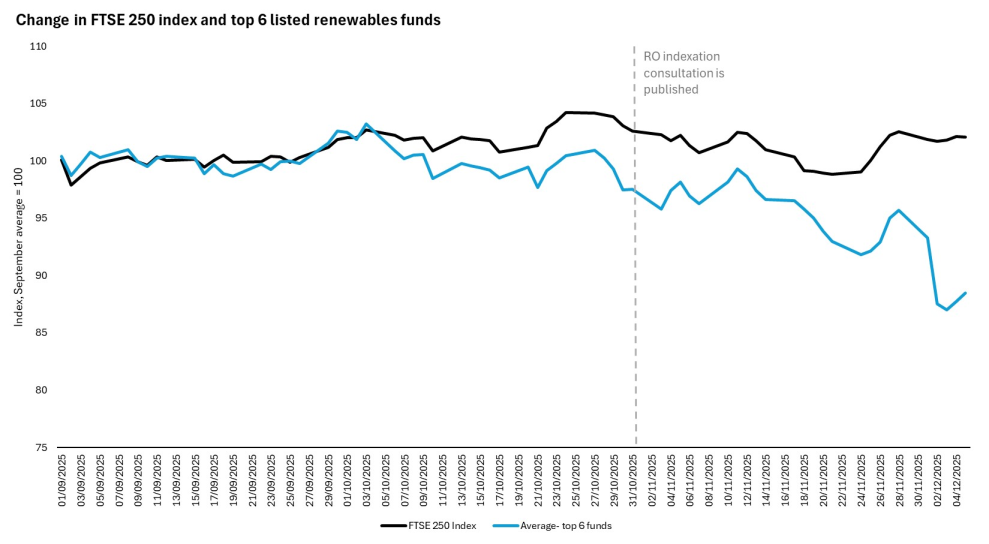
In the week preceding the consultation publication, the FTSE 250 declined by 1.6%, while the six selected investment funds (Bluefield Solar, Foresight Solar, Greencoat UK Wind, NextEnergy Solar, Octopus Renewables and The Renewables Infrastructure Group) fell by 3.2%, resulting in a market-adjusted decline of 1.6%. In the week following the consultation, the FTSE 250 declined by 1.8% and the funds by 5.2%, implying a market-adjusted decline of 3.5%—a deterioration in underperformance by 1.9 percentage points compared to the previous week. We note that some consultation responses suggested Option 1 could reduce Net Asset Value (NAV) by approximately 1-2% and option 2 by around 6-10%.
Overall, the short time period for the observation of both share price moves and share price volatility makes it difficult to reliably estimate a change in the cost of capital with certainty. However, the perception of increased political risk among investors arising from the consultation has been highlighted by multiple stakeholders, particularly under Option 2. This perception could influence the future cost of capital that lenders and investors seek, even if it cannot be directly measured at this time.
-
Office for Budget Responsibility: Economic and fiscal outlook – November 2025. ↩
-
Office for Budget Responsibility: The long-run difference between RPI and CPI inflation. ↩