Equality impact assessment (accessible)
Updated 25 November 2025

© Crown copyright 2025
This publication is licensed under the terms of the Open Government Licence v3.0 except where otherwise stated. To view this licence, visit nationalarchives.gov.uk/doc/open-government-licence/version/3 or write to the Information Policy Team, The National Archives, Kew, London TW9 4DU, or email: psi@nationalarchives.gov.uk.
Where we have identified any third party copyright information you will need to obtain permission from the copyright holders concerned.
This publication is available at https://www.gov.uk/government/consultations/police-pensions-member-contribution-structure/outcome/equality-impact-assessment-accessible
1. Section 1: Title and Outline of issue under consideration
1.1 Amendments to The Police Pensions Regulations 2015: Proposed updates to member contribution structure
This EIA has been drafted to consider the equality implications of the proposed changes arising from the police member contribution consultation, which seeks views on adjustments to the contribution rates or structure for police officers’ pensions in England and Wales.
These changes are necessary to ensure that the overall contribution yield meets the requirements set out following the most recent scheme valuation, maintaining the financial sustainability of the Police Pension Scheme (PPS).
The proposed changes to the PPS member contribution structure are as follows:
- Retaining the Tiered Structure: The existing three-tier structure will be retained, but the thresholds for each tier will be updated to reflect pay increases. This approach was favoured for its administrative simplicity and fairness, as confirmed by the majority of consultation respondents.
- Increasing Tier Thresholds: The thresholds for each contribution tier will be increased in line with known pay increases since 2015. This ensures that the structure remains aligned with current salary levels and maintains fairness across the workforce.
- Switch from FTE to Actual Pay: Member contribution tiers will now be determined based on a member’s actual pensionable pay from the previous scheme year, rather than Full-Time Equivalent (FTE) salary. This change will be assessed annually and is designed to ensure that contributions are proportionate to members’ earnings, supporting fairer outcomes for part-time and flexible workers.
- Ongoing Review: Contribution thresholds will continue to be reviewed as part of the regular scheme valuation cycle, rather than being automatically uplifted by a fixed index such as Consumer Price Index (CPI). This allows for flexibility and alignment with actual pay awards.
These changes are designed to:
- Ensure the overall contribution yield meets the requirements set out by the most recent scheme valuation.
- Support fairness and equity, particularly for part-time officers and those with variable working patterns.
- Maintain the financial sustainability of the Police Pension Scheme while supporting fair and inclusive outcomes.
This EIA will analyse the potential impacts of the first two changes - increasing tier thresholds and the transition to using actual pay - on those with protected characteristics.
Retention of the existing tiered structure and the ongoing review of contribution thresholds have both been considered as part of this assessment and no evidence of discrimination was identified in relation to them, However, the EIA does not consider these aspects explicitly, as they do not relate to changes to the current structure but rather are a confirmation of the tiered structure remaining the same and the future compliance commitments, which are discussed further in Section 5.
To formally implement any changes resulting from the consultation, determinations made under the Police Pensions Regulations will be amended. A further EIA will be prepared to assess the specific impacts of any proposed amendments at the implementation stage.
The PPS is open to all officers, regardless of rank, age, race, sex, or any other protected characteristic. It provides the same generous benefits to every member, ensuring fairness and consistency across the workforce. All of the proposed changes will apply consistently across the three salary tiers, regardless of a member’s identity.
This inclusive approach reflects the scheme’s commitment to equality and supports officers throughout their careers with robust and reliable pension provisions.
1.2 Summary of the evidence considered in demonstrating due regard to the Public-Sector Equality Duty.
- Paper entitled “Analysis to Support the Equality Impact Assessment Police Pension Schemes (England & Wales)” (to be published alongside this EIA and the consultation response)
- Police Workforce Statistics as at 31 March 2025 (published on 23 July 2025) Police workforce, England and Wales: 31 March 2025 - GOV.UK
- Police Workforce Official Statistics in Development (published on 23 July 2025) Police workforce, England and Wales: 31 March 2025 - GOV.UK
- Police Workforce Open Data Tables (published on 23 July 2025) Police workforce open data tables - GOV.UK
- Workplace pension participation and savings trends of eligible employees: 2009 to 2023 (published on 31 July 2024) Workplace pension participation and savings trends of eligible employees: 2009 to 2023 - GOV.UK
- The employment of disabled people 2024 (updated on 20 June 2025) The employment of disabled people 2024 - GOV.UK
2. Section 2: Consideration of aim 1 of the duty: eliminate unlawful discrimination, harassment, victimisation and any other conduct prohibited by the Equality Act 2010
2.1 Age
The potential impact of the new proposals on members of all ages has been considered.
Police workforce statistics as at 31 March 2025 show that (where age information was provided) 12.6% of officers in England and Wales are under the age of 26, 45.5% are aged 26 to 40, 39.6% are aged 41 to 55 and 2.4% are over 55. The age profile varied by rank, with a large proportion of older officers in more senior ranks; for example, while just 1.5% of chief officers were aged 40 and under, 66.4% of constables were aged 40 and under.
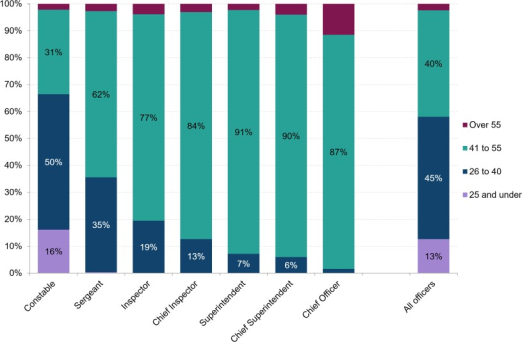
Figure 1: Age breakdown of police officers, by rank, as at 31 March 2025, England and Wales
From 1 April 2022, all active members of the PPS, regardless of their age, are now members of the 2015 Police Pension Scheme. The 1987 and 2006 Schemes closed on 31 March 2022 and all future accruals from 1 April 2022 are now within the 2015 Scheme. The 2015 Scheme will use a Career Average Revalued Earnings (CARE) approach based on pensionable pay throughout the member’s career. As a result of this, the proposal of moving to contribution rates based on actual pensionable pay is more appropriate for determining contributions for a CARE scheme for members of all ages.
Under the current structure, no members fall into Tier 1 across any age group. Most members are in Tier 2, with a greater proportion moving into Tier 3 from age 35 onwards.
The proposed structure includes higher pay thresholds for the contribution tiers, which results in more members (particularly younger members) with lower actual pensionable pay now falling into the lowest contribution tier.
The proposed changes to the member contribution structure will apply to all members regardless of their age.
2.2 Change 1: Increasing Tier Thresholds – Impact on Age:
Direct Discrimination
We have not identified any evidence to suggest that increasing the thresholds for the three tiers of the member contribution structure directly discriminates on the basis of age. This change applies to every member regardless of age.
Indirect Discrimination
The statistical analysis to support the EIA, provided by the Government Actuary’s Department (GAD), which is to be published alongside this report, indicates that younger members aged 17-24 will contribute less on average under the proposed structure than they currently do. This is the only age group with a reduction in average contribution rate. This analysis provides a breakdown of how members of different age groups are distributed across the three tiers. While the 17–24 age group is more heavily represented in tier 1, all age groups are present across all tiers. This demonstrates that the structure is not based on age, but on earnings. Therefore, any differential impact by age is objectively justified by the earnings-based design of the contribution model, which is designed to ensure fairness and equity across the tiers.
2.3 Change 2: Switch from FTE Pay to Actual Pay – Impact on Age:
Direct Discrimination
We have not identified any evidence to suggest that using actual pay rather than FTE pay directly discriminates on the basis of age.
Indirect Discrimination
We do not consider there to be any indirect discrimination on the basis of age. There may be positive impacts as switching to actual pay is fairer to part-time workers, who are found more in older demographics. This change ensures contributions are directly aligned with what each member actually earns rather than require them to pay a higher proportion of their actual earnings as pension contributions compared to their full-time counterparts, which is currently the case.
The proposed changes to the contribution rates or structure will apply equally to all eligible officers, regardless of age.
2.4 Disability
The potential impact of the new proposals on members with any form of disability has been considered.
Police workforce statistics as at 31 March 2025, show that of the 63.9% of officers who declared their disability status, 10.4% described themselves as having a disability.
Table 1: Police officers by disability status, England and Wales, as at 31 March 2025
| Disability status | % of all officers (headcount) |
|---|---|
| Known | 63.9 |
| of which: Yes | 10.4 |
| of which: No | 89.6 |
| Prefer not to say | 2.8 |
| Unknown | 33.3 |
To Note: There was insufficient data available to provide a breakdown of this data across the different ranks in the police.
2.5 Change 1: Increasing Tier Thresholds – Impact on Disability:
Direct Discrimination
We have not identified any evidence to suggest that increasing the thresholds for the three tiers of the member contribution structure directly discriminates on the basis of disability.
Indirect Discrimination
There is no evidence that increasing the tier thresholds will indirectly disadvantage officers with disabilities. Contributions are not determined by disability status, and statutory protections remain in place.
2.6 Change 2: Switch from FTE Pay to Actual Pay – Impact on Disability:
Direct Discrimination
We have not identified any evidence to suggest that using actual pay rather than the currently used FTE pay directly discriminates on the basis of disability.
Indirect Discrimination
We do not consider there to be any indirect discrimination on the basis of disability. The Employment of disabled people 2024[footnote 1] report by the DWP states that disabled people were more likely than non-disabled people to be working part-time (and subsequently fewer hours). Therefore, there may be positive impacts of switching to actual pay, as it is making it fairer to part-time workers. It ensures contributions are directly aligned with what each member actually earns, rather than requiring them to pay a higher proportion of their actual earnings as pension contributions compared to their full-time counterparts, which is currently the case.
The proposed changes to the contribution rates or structure will apply equally to all eligible officers, regardless of disability.
2.7 Gender Reassignment
The potential impact of the new proposals on members who are undergoing or have undergone gender reassignment has been considered.
It is important to note that sex and gender are two different concepts. A person’s gender identity is not always the same as the sex assigned to them at birth, and some people may not identify as having a gender or as non-binary.
Under the Equality Act 2010, gender reassignment is also a protected characteristic and the potential impact of these new proposals on this protected cohort has also been considered.
2.8 Change 1: Increasing Tier Thresholds – Impact on Gender Reassignment:
Direct Discrimination
We have not identified any evidence to suggest that increasing the thresholds for the three tiers of the member contribution structure directly discriminates on the basis of gender reassignment.
Indirect Discrimination
There is no evidence that increasing the tier thresholds will indirectly disadvantage officers on the basis of gender reassignment.
2.9 Change 2: Switch from FTE Pay to Actual Pay – Impact on Gender Reassignment:
Direct Discrimination
We have not identified any evidence to suggest that using actual pay rather than FTE pay directly discriminates on the basis of gender reassignment.
Indirect Discrimination
There is no evidence that using actual pay, rather than FTE pay, will indirectly disadvantage officers on the basis of gender reassignment.
The proposed changes to the contribution rates or structure will apply equally to all eligible officers, regardless of gender reassignment.
2.10 Marriage and Civil Partnership
The potential impact of the new proposals on members who are unmarried, married or in a civil partnership has been considered.
2.11 Change 1: Increasing Tier Thresholds – Impact on Marriage and Civil Partnership:
Direct Discrimination
We have not identified any evidence to suggest that increasing the thresholds for the three tiers of the member contribution structure directly discriminates on the basis of marriage and civil partnership.
Indirect Discrimination
There is no evidence that increasing the tier thresholds will indirectly disadvantage officers on the basis of marriage and civil partnership.
2.12 Change 2: Switch from FTE Pay to Actual Pay – Impact on Marriage and Civil Partnership:
Direct Discrimination
We have not identified any evidence to suggest that using actual pay rather than FTE pay directly discriminates on the basis of marriage and civil partnership.
Indirect Discrimination
There is no evidence that using actual pay, rather than FTE pay, will indirectly disadvantage officers on the basis of marriage and civil partnership.
The proposed changes to the contribution rates or structure will apply equally to all eligible officers, regardless of their relationship status.
2.13 Pregnancy and Maternity
The potential impact of the new proposals on members who take maternity or paternity leave has been considered.
As at 31 March 2025, 1,598 Full-Time Equivalent police officers were on maternity or paternity leave, accounting for approximately 1.1% of all police officers in England and Wales.
These figures are consistent with the previous year and indicate a stable level of maternity and paternity leave across the workforce.
2.14 Change 1: Increasing Tier Thresholds – Impact on Pregnancy and Maternity:
Direct Discrimination
We have not identified any evidence to suggest that increasing the thresholds for the three tiers of the member contribution structure directly discriminates on the basis of pregnancy and maternity.
Indirect Discrimination
There is no evidence that increasing the tier thresholds will indirectly disadvantage officers on the basis of pregnancy and maternity.
2.15 Change 2: Switch from FTE Pay to Actual Pay – Impact on Pregnancy and Maternity:
Direct Discrimination
We have not identified any evidence to suggest that using actual pay rather than FTE pay directly discriminates on the basis of pregnancy and maternity.
Indirect Discrimination
Switching to actual pay is fairer to those who take extended periods of leave, such as those who take maternity leave. It ensures contributions are directly aligned with what each member actually earns rather than require them to pay a higher proportion of their actual earnings as pension contributions compared to their full-time counterparts, which is currently the case.
The proposed changes to the contribution rates or structure will apply equally to all eligible officers, regardless of pregnancy or maternity.
2.16 Race
The potential impact of the new proposals on members of varying ethnic backgrounds has been considered.
Police workforce statistics as of 31 March 2025 (where ethnicity information was provided), show that black officers made up 1.3% of the officers, Asian officers 3.9%, those identifying as a mixed ethnic group made up 2.6%, and those from another ethnic group made up 0.7%.
Representation of minority ethnic officers (excluding white minorities) was lower among senior ranks (chief inspector and above) compared with constables and other ranks.
The table below, presents the breakdown of minority ethnic officers across the ranks:
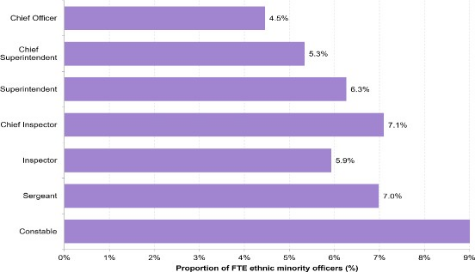
Figure 2: Proportion of police officers who identified as ethnic minorities (excluding White minorities), by rank, as at 31 March 2025, England and Wales
2.17 Change 1: Increasing Tier Thresholds – Impact on Race:
Direct Discrimination
We have not identified any evidence to suggest that increasing the thresholds for the three tiers of the member contribution structure directly discriminates on the basis of race.
Indirect Discrimination
There is no evidence that increasing the tier thresholds will indirectly disadvantage officers on the basis of race.
2.18 Change 2: Switch from FTE Pay to Actual Pay – Impact on Race:
Direct Discrimination
We have not identified any evidence to suggest that using actual pay rather than FTE pay directly discriminates on the basis of race.
Indirect Discrimination
Representation of minority ethnic officers is higher among lower ranks so the move to using actual pay is likely to be favourable to minority ethnic officers overall, as more officers in lower ranks will fall into the lower contribution tiers.
However, there are still minority ethnic officers present at all ranks and the proposed changes will be applied consistently across the workforce, regardless of race.
2.19 Religion or Belief
The potential impact of the new proposals on members with different religious beliefs has been considered.
Table 2: Police officers by religious beliefs, England and Wales, as at 31 March 2025
| Religion or belief | % of all officers (headcount) |
|---|---|
| Known | 67.8 |
| of which: Christian | 41.4 |
| of which: Muslim | 2.5 |
| of which: Sikh | 0.8 |
| of which: Hindu | 0.4 |
| of which: Buddhist | 0.3 |
| of which: Jewish | 0.3 |
| of which: Pagan | 0.1 |
| of which: Any other religion or belief | 2.9 |
| of which: No religion | 51.3 |
| Prefer not to say | 5.0 |
| Unknown | 27.2 |
To Note: There was insufficient data available to provide a breakdown across the different ranks in the police.
2.20 Change 1: Increasing Tier Thresholds – Impact on Religion or Belief:
Direct Discrimination
We have not identified any evidence to suggest that increasing the thresholds for the three tiers of the member contribution structure directly discriminates on the basis of religion or belief.
Indirect Discrimination
We do not currently hold data and are not aware of any evidence which indicates that increasing the tier thresholds will indirectly disadvantage officers on the basis of religion or belief.
2.21 Change 2: Switch from FTE Pay to Actual Pay – Impact on Religion or Belief:
Direct Discrimination
We have not identified any evidence to suggest that using actual pay rather than FTE pay directly discriminates on the basis of religion or belief.
Indirect Discrimination
We do not currently hold data and are not aware of any evidence that indicates that using actual pay, rather than FTE pay, will indirectly disadvantage officers on the basis of religion or belief.
The proposed changes to the member contribution structure will apply equally to all members regardless of their religion or belief.
2.22 Sex
The potential impact of the new proposals on both male and female members has been considered.
Police workforce statistics as at 31 March 2025, show that male officers account for 63.9% of the workforce and female officers account for 36.1% of the workforce.
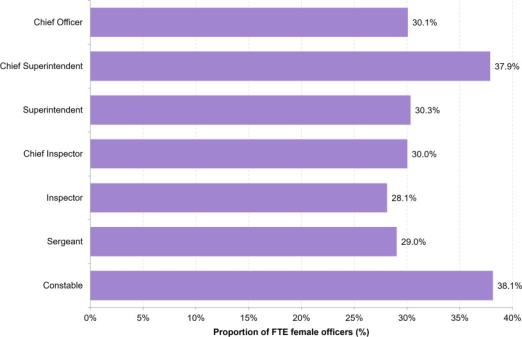
Figure 3: Proportion of female police officers, by rank, as at 31 March 2025, England and Wales
2.23 Change 1: Increasing Tier Thresholds – Impact on Sex:
Direct Discrimination
We have not identified any evidence to suggest that increasing the thresholds for the three tiers of the member contribution structure directly discriminates on the basis of sex.
Indirect Discrimination
We do not currently hold data and are not aware of any evidence which indicates that increasing the tier thresholds will indirectly disadvantage officers on the basis of sex.
2.24 Change 2: Switch from FTE Pay to Actual Pay – Impact on Sex:
Direct Discrimination
We have not identified any evidence to suggest that using actual pay rather than FTE pay directly discriminates on the basis of sex.
Indirect Discrimination
We do not consider there to be any indirect discrimination on the basis of sex. The most recent government statistics regarding women in employment states that 36% of women in employment worked part-time, compared with 14% of men. Therefore, there may be positive impacts to female members, as switching to actual pay is fairer to part-time workers. As previously mentioned, this ensures contributions are directly aligned with what each member actually earns rather than require them to pay a higher proportion of their actual earnings as pension contributions compared to their full-time counterparts, which is currently the case.
There are both male and female officers present at all ranks and the proposed changes will be applied consistently across the workforce, regardless of sex.
2.25 Sexual Orientation
The potential impact of the new proposals on members of different sexual orientations has been considered.
Table 3: Police officers by sexual orientation, England and Wales, as at 31 March 2025
| Sexual orientation | %of all officers (headcount) |
|---|---|
| Known | 65.7 |
| of which: Heterosexual or straight | 91.6 |
| of which: Gay or lesbian | 4.9 |
| of which: Bisexual | 3.3 |
| of which: Other sexual orientation | 0.2 |
| Prefer not to say | 5.8 |
| Unknown | 28.5 |
However, due to the high number of officers not providing this data, a rank breakdown is not available.
2.26 Change 1: Increasing Tier Thresholds – Impact on Sexual Orientation:
Direct Discrimination
We have not identified any evidence to suggest that increasing the thresholds for the three tiers of the member contribution structure directly discriminates on the basis of sexual orientation.
Indirect Discrimination
We do not currently hold data and are not aware of any evidence which indicates that increasing the tier thresholds will indirectly disadvantage officers on the basis of sexual orientation.
2.27 Change 2: Switch from FTE Pay to Actual Pay – Impact on Sexual Orientation:
Direct Discrimination
We have not identified any evidence to suggest that using actual pay rather than FTE pay directly discriminates on the basis of sexual orientation.
Indirect Discrimination
We do not currently hold data and are not aware of any evidence which indicates that using actual pay, rather than FTE pay, will indirectly disadvantage officers on the basis of sexual orientation.
The proposed changes to the member contribution structure will apply equally to all members regardless of their sexual orientation.
3. Section 3: Consideration of aim 2 of the duty: Advancing equality of opportunity between people who share a protected characteristic and people who do not share it
Having due regard to the need to advance equality of opportunity between persons who share a relevant protected characteristic and persons who do not share it involves having due regard, in particular, to the need to:
3.1 (a) Remove or minimise disadvantages suffered by persons who share a relevant protected characteristic that are connected to that characteristic
The proposed changes to the member contribution structure, specifically the increase in salary tiers and the shift from using FTE pay to actual pay, are intended to ensure that contributions are proportionate to earnings. This change helps to minimise disadvantage for officers working part-time or on flexible arrangements, who are more likely to be women or have caring responsibilities. By basing contribution tiers on actual pay rather than FTE, the policy better reflects individual circumstances and avoids disproportionately higher contributions for those working reduced hours.
3.2 (b) Take steps to meet the needs of persons who share a relevant protected characteristic that are different from the needs of persons who do not share it
The revised contribution structure supports officers with protected characteristics by ensuring that access to the 2015 Police Pension Scheme is maintained across the workforce. The scheme is recognised as generous and valuable, and the consistent application of contribution tiers ensures that all officers, regardless of rank, working pattern, or personal characteristics, can participate fully and benefit from the scheme. The move to actual pay also better accommodates officers with non-standard working arrangements, which may be more common among those with disabilities, caring responsibilities, or other protected characteristics.
3.3 (c) Encourage persons who share a relevant protected characteristic to participate in public life or in any other activity in which participation by such persons is disproportionately low
By ensuring that the 2015 PPS remains accessible and equitable, the proposed changes help to promote retention and progression within the police service, particularly for underrepresented groups. The benefits provided by the scheme, such as defined pension accrual and survivor benefits, are the same regardless of rank, with only the pensionable salary varying. This consistency supports fairness and transparency and may encourage greater participation and career development among officers from minority ethnic backgrounds, women, and other groups whose representation in senior ranks remains disproportionately low.
4. Section 4: Consideration of aim 3 of the duty: Fostering good relations between people who share a protected characteristic and persons who do not share it
The proposed changes are not expected to negatively impact relations between individuals who share protected characteristics and those who do not. The policy applies consistently and is based on role and responsibility rather than personal characteristics.
By maintaining a consistent approach and continuing to monitor representation and outcomes through the EIA process, the policy helps to promote understanding and foster good relations among diverse groups within the police service.
5. Section 5: Ongoing compliance with the PSED
We consider that it is not necessary to collate additional information specifically for this policy change, as the Equality Impact Assessment process is conducted in line with each scheme valuation cycle. This ensures that any potential impacts on individuals with protected characteristics are reviewed and assessed at appropriate intervals, in line with changes to scheme design and contribution structures.
The EIA process is designed to identify and evaluate any direct or indirect discrimination that may arise, as well as to assess the extent to which the policy advances equality of opportunity and fosters good relations between different groups. By using the most recent police workforce data, we are able to monitor trends in representation and contribution outcomes across protected characteristics, including sex, race and age.
We will remain engaged with member representatives throughout and after the implementation process, particularly to identify and address any potential areas where discrimination could occur. This ongoing dialogue will support transparency, responsiveness, and continuous improvement in how the contribution structure is applied.
Should any significant changes in workforce composition or policy context arise outside of the valuation cycle, we will revisit the need for additional data collection or interim assessment.
A further EIA will be prepared to assess the specific impacts at the stage that the proposed amendments to regulations are being implemented.
5.1 Review date:
An exact review date cannot be provided at this stage, as the timing will be contingent upon the conclusion of the current scheme valuation by GAD, followed by any resulting consultation to amend the contribution rates. The review process will be initiated once these steps have been completed.
6. Section 6: Section 55 duty (for immigration, asylum and nationality considerations only)
This policy does not relate to immigration, asylum or nationality functions therefore regard to the duty in section 55 of the Borders, Citizenship and Immigration Act 2009 is not needed.
7. Section 7: Risks to vulnerable individuals and other groups
The proposed changes to the member contribution structure are not expected to create or exacerbate risks for vulnerable individuals or groups. The policy relates solely to internal contribution structures within the police workforce and does not directly impact service delivery to the public or access to support services.
8. Section 8: Declaration and sign off
I have read the available evidence, and I am satisfied that this demonstrates compliance, where relevant, with section 149 of the Equality Act 2010 and that due regard has been had to the need to eliminate unlawful discrimination, advance equality of opportunity and foster good relations.
SCS Name & Title: Peter Spreadbury
Directorate/Unit: Police Workforce and Professionalism Unit Lead contact: Usamah Musa
Date: 31/10/2025
-
The employment of disabled people 2024 - GOV.UK accessed 30/10/2025 ↩