Improving the way Ofsted inspects children’s social care: consultation document
Published 7 July 2026
Applies to England

© Crown copyright 2026
This publication is licensed under the terms of the Open Government Licence v3.0 except where otherwise stated. To view this licence, visit nationalarchives.gov.uk/doc/open-government-licence/version/3 or write to the Information Policy Team, The National Archives, Kew, London TW9 4DU, or email: psi@nationalarchives.gov.uk.
Where we have identified any third party copyright information you will need to obtain permission from the copyright holders concerned.
This publication is available at https://www.gov.uk/government/consultations/improving-the-way-ofsted-inspects-childrens-social-care/improving-the-way-ofsted-inspects-childrens-social-care-consultation-document
Foreword
Our purpose
Ofsted’s most important role is to help make children safer.
One of the ways we do this is by carrying out inspections of local authorities and providers in the children’s social care sector.
Through our work, we see the extraordinary commitment of the children’s social care workforce in local authorities and care providers. Whether they are supporting families, stepping in to make children safer, or offering stable, high-quality care, the work they do shapes children’s futures. We recognise that they have an immense responsibility.
At the heart of our work is a goal we all share: making sure that every child, whatever their circumstances, can grow up in a loving, caring home, with the support and relationships that they need to meet their full potential.
The case for change
But we know that there is more to do. Despite the tireless dedication of the children’s social care workforce, many children and families don’t get the support they need – not just to get by, but to succeed and thrive. Some families don’t receive the support they need to keep children safely at home or with their family network. Children are uprooted and moved far away from their families and communities. And a shadow system has emerged: children are living in illegal, unregistered settings hidden from regulatory oversight and without the protections they are entitled to.
The government has a reform programme to tackle these challenges. It aims to:
- shift the system towards providing the ‘Family Help’ type of support earlier
- keep children safely within their families wherever possible
- help all children – including those in care and care leavers – build enduring relationships
- strengthen care provided by extended families and friend networks (‘kinship care’) and foster care
- make sure the right homes are available for children who need specialist and therapeutic care
- improve how children’s social care works together with its partners, including health, police and education
These changes amount to a major national effort to reshape the system, so that it better helps, protects and cares for the children and families who rely on it.
In parallel with these wider government reforms, Ofsted is in the process of starting a new chapter. In 2024, we carried out a consultation we called ‘the Big Listen’ – the largest consultation in our history. This gave us valuable feedback on how all our inspections could be improved.
We are now building directly on what we heard in the Big Listen. We are keeping what we know works, and acting on what children, families and practitioners told us about how we can do better. That means reshaping how we inspect, how we decide the grades we give, and how we reflect the reality of children’s lives through our inspections.
In the Big Listen, we heard that social care practitioners and providers value our frameworks, trust our work, and find that inspections and reporting are helpful in understanding how to improve the quality of provision. But we also heard that change is needed. Leaders of local authorities and social care providers told us that giving a single overall judgement can be misleading because it doesn’t reflect important differences in how well parts of their services are working. And when we spoke with people who have experience of the care system, they told us that inspection reports don’t reflect the reality of their lives and the support they receive.
We plan and carry out inspections using our ‘inspection frameworks’. These set out the process for inspections and the basis for the judgements that we make. They help our inspectors to carry out their work thoroughly, and help us to ensure that our judgements are consistent across all the providers that we inspect. This consultation sets out our proposals for strengthening our inspection frameworks for children’s social care to meet the challenges of today.
We are building on a strong foundation. Our current children’s social care inspection frameworks are based on clear and enduring principles: focusing on what matters most to children, applying consistent and high expectations, and directing attention to where improvement is needed most. The frameworks were created to celebrate and promote excellent practice, while holding weaker local authorities and social care providers to account, and enabling support for improvements to be targeted effectively. These principles remain as relevant as ever – but no good system stays good by standing still.
The proposals in our consultation
This consultation sets out proposals to reform 2 of our children’s social care inspection frameworks: the inspecting local authority children’s services (ILACS) framework, which sets out how we inspect children’s services provided by local authorities; and the social care common inspection framework (SCCIF), which sets out how we inspect and regulate children’s social care providers.
These proposals are intended to strengthen the inspection and regulatory system where this is most needed. They include:
- adopting a set of ‘ambitions’ which we will use to guide all policy-making for ILACS and SCCIF
- aligning our frameworks more closely with the goals of the government’s reforms
- moving beyond headline judgements towards reporting that reflects the real complexity of children’s social care
- improving the ways we seek out the voices of children, young people and families
- using Ofsted’s system‑wide insight to confront the biggest challenges in the care system
- changing the schedule for our ILACS inspections, so they continue to support improvement and focus on the authorities who need it most
Together, these changes will ensure that our inspections stay firmly focused on what matters most to children and young people, and continue to be a force for improvement.
This consultation
This consultation is an opportunity for children, young people, parents, carers, families, local authorities, social care providers and policy-makers to help shape our future inspections. Ofsted is clear that we will only achieve lasting improvement by working together.
We look forward to hearing your views on these proposals. Your feedback will help us to build an inspection system that reflects our shared goals: to improve children’s social care and to give every child the best possible chance in life.
Sir Martyn Oliver, His Majesty’s Chief Inspector
Yvette Stanley, National Director, Regulation and Social Care
About this consultation
Consultation overview
This consultation is to ask for your views on our proposals to reform 2 of the frameworks we use to for our inspections of children’s social care:
- the inspecting local authority children’s services (ILACS) framework, Ofsted’s inspection framework for local authority children’s services
- the social care common inspection framework (SCCIF), our single common inspection framework for inspecting children’s social care providers in England, which covers: adoption support agencies; boarding schools and residential special schools; children’s homes; secure children’s homes; independent fostering agencies; residential family centres; residential holiday schemes for disabled children; residential provision of further education colleges; supported accommodation; and voluntary adoption agencies
We are grateful to all the children, care-experienced young people, local authorities, social care providers, sector bodies, inspectors, social care experts and policy-makers who have contributed to shaping the recommendations in this consultation. The proposals below reflect the insights and experiences you have shared with us.
How to take part
The consultation will run for 12 weeks from 7 July to 28 September 2026.
As well as inviting responses through this online survey, we will hold regular meetings with our Social Care External Advisory Group, which is made up of sector experts, and engage with stakeholders about our proposals – including children, young people, parents, carers, families, local authorities, social care providers, inspectors, social care experts, and the Department for Education (DfE).
Next steps and implementation
As we start to develop our ideas based on the feedback we receive through this consultation, we will engage with stakeholders to refine the detail of our inspection ‘toolkits’, which will set out the criteria that we will use to decide grades (‘evaluation criteria’) in both ILACS and SCCIF inspections.
In developing our toolkits and our policy positions, we will take a ‘test and learn’ approach, testing and piloting changes on a small scale with local authorities and providers to make sure they work as intended, then using what we learn to refine the changes. This will ensure that the new frameworks we develop are suitable for inspections.
Throughout our work on these reforms, we will consider the possible impact of our inspections on those we inspect, and on our own inspectors.
We will publish our response to the consultation in early 2027.
We will then publish our new inspection materials. Before we do this, we will assess the impact of our proposed reforms on:
- leaders’, practitioners’ and inspectors’ workloads, mental health and wellbeing
- equality, diversity and inclusion for children, families, leaders, practitioners and our inspectors
Depending on the findings of this consultation, and on the necessary changes being adopted by the Department for Education, we expect to begin implementing changes as follows:
- All ILACS changes will be implemented from spring 2027
- SCCIF changes will be implemented on a phased basis between spring 2027 and spring 2028; a full implementation timeline for each SCCIF remit will be shared following this consultation
These timelines apply only to changes that result directly from this consultation. They are subject to change, depending on the timelines for Department for Education reforms.
This consultation and the wider government reforms
Several policy changes we are proposing in this consultation could be significantly affected by the government’s reform programme. This includes the government’s consultation on changes to ‘Working together to safeguard children’, its statutory guidance on how agencies should collaborate to help, protect and promote the welfare of children.
The reforms will change some of the responsibilities of local authorities and social care providers. These changes are important, because our inspection frameworks are based on statutory and regulatory requirements. Our inspections and regulatory work reflect what government asks the social care system to deliver.
If the government’s consultation proposals are adopted, and the government’s reform programme is implemented, those changes would need to be introduced before some of our proposed changes could be made.
Summary of proposals
This consultation invites your views on changes that would apply to both the ILACS and SCCIF frameworks, as well as proposals that relate specifically to one or the other.
Proposals affecting both ILACS and SCCIF
We are proposing to:
- adopt a set of ‘ambitions’, which we will use to guide all policy-making for ILACS and SCCIF (proposal 1)
- revise our frameworks in a way that maintains what is currently working while making improvements where they are needed (see proposal 1 for ILACS) and (see proposal 1 for SCCIF)
- further align our inspection frameworks with the Children’s Social Care National Framework, so local authorities and providers have a single consistent set of expectations to work towards (see proposal 1 for ILACS) and (see proposal 1 for SCCIF)
- introduce a 5-point grade scale to provide more nuance in our inspection grades (proposal 2)
- move to a ‘secure fit’ approach to grading, to help ensure that our inspectors’ judgements are consistent, and to help providers understand what improvements are needed (proposal 2)
- introduce ‘report cards’, which we believe offer a clearer way of presenting our inspection findings (proposal 3)
- include data and other supporting information on our report cards alongside our inspection findings (proposal 3)
- build a more consistent and inclusive approach to engaging with children, young people, parents and carers, and families during our inspections (proposal 4)
Proposals affecting only ILACS
We are proposing to:
- introduce new evaluation areas to better align with the Children’s Social Care National Framework, while retaining our focus on the experiences of the different cohorts of children being helped by children’s social care (proposal 1)
- make sure that all of our evaluation areas consider how the local authority helps children create enduring relationships, engages with children and families, and collaborates with other relevant agencies (proposal 1)
- carry out a more comprehensive evaluation of how local authority leaders are meeting their sufficiency duty (ensuring there is enough suitable accommodation available for children in care and care leavers), and place our evaluation of their approach to this, and their use of unregistered provision, under the ‘impact of leaders’ evaluation area (proposal 1)
- make the use of illegal unregistered provision a ‘limiting criterion’ within the relevant evaluation area (whether the grade would be ‘needs attention’ or ‘urgent improvement’ would depend on the particular circumstances of the local authority) (proposal 1)
- for each local authority, make its first inspection under the renewed ILACS framework a standard inspection (proposal 5)
- change our inspection timescale so that we carry out a standard inspection of a local authority every 4 years (plus or minus 6 months), while carrying out focused visits and monitoring visits between inspections (proposal 5)
- maintain our wider suite of ILACS tools: the annual engagement meeting, monitoring, and focused visits (proposal 5)
- consider introducing a new assurance inspection, subject to future funding – this would allow us to revisit local authorities with at least one ‘needs attention’ grade but no ‘urgent improvement’ grades and consider regrading one evaluation area (proposal 5)
Proposals affecting only SCCIF
We are proposing to:
- retain the 3 graded evaluation areas that we currently use across all SCCIF inspections, and introduce a new evaluation area on ‘enduring relationships’ (proposal 1)
- add a new evaluation area on recruitment, assessment and support for foster carers in our SCCIF inspections of independent fostering agencies (proposal 1)
- change the SCCIF grading structure to provide separate grades and a detailed narrative for each evaluation area in order to provide more nuanced information about the provider (proposal 2)
Proposal 1: The content of our inspection frameworks
Our ambitions for children’s social care inspection
We propose adopting a statement of our ambition for our approach to inspection, to help guide and drive the improvements outlined in this consultation. These ambitions are:
-
Our inspections act as a force for good
Our inspections champion the very highest quality of practice, support learning, and improve the quality of social care. They help local authorities and children’s social care providers to deliver the best outcomes for children, young people, parents, carers and families. -
The voices of children, young people, parents, carers and families are at the heart of our inspections
We are committed to improving how we engage with those with lived experience of children’s social care in our inspections. We will make sure that they are routinely and meaningfully involved in the development, implementation and delivery of our frameworks. -
Our inspections have children’s enduring relationships as a central focus
We will place greater emphasis in both of our inspection frameworks on how services nurture and protect children’s connections with people who are important to them. We will look closely at how services work together to ensure children have loving, stable relationships that help them to thrive, both now and in the future. -
Our inspections support local authorities and children’s social care providers to meet the needs of all children, including those with complex lives
We made changes to the SCCIF in 2025 to emphasise that we expect providers’ statements of purpose to be reflected in their day-to-day practice and decision-making. This is particularly important for providers that are set up to look after children with specific or complex needs. As we reform our frameworks, inclusive practice for children in care will be required for a grade of ‘strong standard’ or ‘exceptional’ in both ILACS and SCCIF. -
Our approach encourages providers and commissioners to work together to provide the right homes for children in the right places
There has long been a serious mismatch between the location and type of provision and the needs of children. This has led to far too many children living in unsuitable homes, often far from family and friends. We want our inspections to look more closely at how local authorities are meeting their sufficiency duty and how providers are working with the local authorities to understand and meet the needs of children, both locally and regionally. -
Our inspection frameworks align with government standards and statutory guidance
The government has set out its vision for a children’s social care system that will shift the focus to early support to keep families together where possible and supports children to have happy, settled and fulfilled futures. Our reforms outlined in this document further align our inspection frameworks with the government’s goals for children, young people and families. -
Where possible, our frameworks are aligned to reflect that social care providers and local authorities have a shared responsibility to children
This means that all parts of the inspection process, including the timing of inspection activity, deployment of inspectors and sharing of evidence, should place children’s needs at their centre. Findings in one part of the system should inform prompt appropriate action elsewhere as necessary. A more unified system of inspection reflects the shared responsibilities for children, especially between local authorities and providers. -
We focus our resources where improvement is needed most
We carry out more inspection activities with local authorities and providers at the lower end of the grade scale, and where we are concerned about performance. This has been a long-standing key principle of our social care inspection, and it remains relevant. For ILACS, we set our own inspection schedule – this consultation asks how we can set our schedule in a way that allows us to hold local authorities to account without placing undue burdens on them. (How often we inspect for SCCIF is a government decision.)
We believe these principles build on what we have already achieved, and will further strengthen our inspections so they continue to focus on what matters most for children.
Delivering a better system of accountability will require changes not only to inspection but to the regulatory framework and the standards set by government, which underpin our inspection frameworks. We are working closely with the Department for Education as it considers how best to modernise and strengthen the regulatory system.
Question for ILACS: What do you think about our proposed statement of ambition for children’s social care inspections in relation to ILACS?
Question for SCCIF: What do you think about our proposed statement of ambition for children’s social care inspections in relation to SCCIF?
Question for ILACS: How can ILACS inspections support local authorities to meet the needs of children who have the most complex lives?
Question for SCCIF: How can SCCIF inspections support providers to care for the children who have the most complex lives?
Question for ILACS: How can ILACS inspections encourage providers and local authorities to make sure that children are able to receive the right type of care and support in the right place?
Question for SCCIF: How can SCCIF inspections encourage providers to make sure that children are able to receive the right type of care and support in the right place?
Question for ILACS: What further changes can be made to ensure ILACS inspections focus on what matters for children?
Question for SCCIF: What further changes can be made to ensure SCCIF inspections focus on what matters for children?
ILACS evaluation areas
Why we are proposing to change ILACS evaluation areas
Our inspections must reflect what makes the greatest difference to children’s lives. As expectations on local authorities evolve, it is important that ILACS continues to focus on the impact that social care has on the lives of children and families.
We are therefore proposing to update the ILACS evaluation areas so that they directly align with the Children’s Social Care National Framework, the statutory guidance about the purpose, principles and outcomes local authorities should achieve for children and families, and the enablers of good practice. This will help local authorities to have a more consistent understanding of how high-quality practice improves the experiences of children, young people and families.
Proposed changes to the ILACS evaluation areas
We propose that our judgements continue to focus on the different cohorts of children being supported by children’s social care, but to organise these to reflect how local authorities deliver their services. This would mean that our judgements align with the 4 outcomes and 3 enablers listed in the Children’s Social Care National Framework.
Under our proposals, ILACS would have graded evaluation areas on:
- Experiences of children receiving Family Help (aligned with the Children’s Social Care National Framework Outcome 1)
- Experiences of children in need of protection (aligned with the Children’s Social Care National Framework Outcome 2)
- Local authority engagement with family networks (aligned with the Children’s Social Care National Framework Outcome 3)
- Experiences of children in care (aligned with the Children’s Social Care National Framework Outcome 4)
- Experiences of care leavers (aligned with the Children’s Social Care National Framework Outcome 4)
- Impact of leaders (aligned with the Children’s Social Care National Framework Enablers)
What we are proposing to change
A key part of our proposal is to split our current ‘help and protection’ judgement. This will allow us to shine a light on both in equal measure. (This proposal would depend on the government deciding to amend its statutory guidance ‘Working together to safeguarding children’ after completing its consultation).
This approach recognises the goal of Family Help to provide early, coordinated support to families before needs escalate, while keeping a clear and uncompromising focus on protecting children when they are unsafe. The system only works when we get both right.
We are also proposing to introduce a graded evaluation area on how local authorities engage with family networks. We anticipate that this evaluation area could include, for example, the quality and timeliness of engagement with a child’s wider family network, the timing and quality of family group decision-making (which allows a family network to come together and make a family-led plan in response to concerns about a child, working alongside skilled professionals), and the quality of work to support the care provided by extended families and friend networks (kinship care).
What we are proposing to keep
While our proposals aim to reflect the structure of the Children’s Social Care National Framework wherever possible, to provide local authorities with a single set of expectations to work towards, our proposed evaluation areas will still have separate graded evaluation areas for the experiences of children in care and the experiences of care leavers.
We believe this is the correct approach, because in 45% of current ILACS inspections, these 2 judgements receive different grades. This tells us that children in care and those leaving care do not all receive the same quality of support. Keeping these separate allows us to report more clearly and accurately on the distinct experiences of children in care and those leaving care.
We will also keep the ‘impact of leaders’ evaluation area, which will continue to cover the National Children’s Social Care Framework enablers about leadership and the workforce. The National Children’s Social Care Framework enabler about multi-agency working will be considered across all our evaluation areas.
Cross-cutting themes in our evaluation areas
There are 3 elements of practice that we propose to embed in all our evaluation areas. These are:
- how effectively the local authority engages children, young people, parents, carers and families in making decisions about their lives
- how effectively the local authority supports children and young people to create and maintain enduring relationships
- how effectively the local authority contributes to and leads multi-agency working
We believe that these elements of practice are fundamental to improving children’s lives, so we will consider them across all evaluation areas.
Question for ILACS: What do you think about the proposed changes to ILACS evaluation areas?
Evaluating sufficiency and the use of unregistered provision in the ILACS framework
Why we want to strengthen our approach to unregistered provision
We are proposing to strengthen our approach to unregistered social care provision because we are concerned about its widespread use and the risks it poses to children. Under the Care Standards Act 2000, children’s residential social care settings need to be registered with Ofsted. When they are not, they are operating illegally.
Ofsted cannot inspect or regulate unregistered children’s homes. We can investigate unregistered providers if we receive reports about them operating, but this is not a substitute for regulatory oversight. This means we do not know about the quality of care being provided, or the environments it is provided in, for some of the most vulnerable children in England. This is particularly troubling given what we know from our criminal investigations: many of the children local authorities have placed in these settings are those with the most complex needs.[footnote 1]
When we identify unregistered providers, we issue them with warning letters. But very few then take steps to register. In 2023–24, only 6% of providers served with notices applied for registration, and of those applications, only 8% were successful.[footnote 2] This pattern reflects the consistently poor quality we find in unregistered settings, with providers mostly being unwilling and/or unable to meet the standards required to register.
We recognise the pressures that local authorities face in securing appropriate placements. However, they should only ever place children in settings that meet legal requirements. Local authorities have a duty to ensure that there is sufficient provision available locally.
No child should grow up in a setting that is beyond the reach of independent oversight. The use of unregistered provision is an injustice to children and a national challenge that local authorities, social care providers, Ofsted and national government must collectively address.
Ofsted is committed to playing its role in addressing these challenges. We are working with the Department for Education to reform our registration model for children’s homes, so that we can prioritise applications in places where there are shortages of provision.
Ofsted has also received new powers through the Children’s Wellbeing and Schools Act 2026 to strengthen our ability to act where providers are operating illegally. We are now able to fine unregistered providers. We are also investing significantly in our capacity to identify, investigate and take action against unregistered providers.
At the same time, we must ensure that our inspection frameworks reflect the seriousness and complexity of this issue. We have already updated SCCIF to further ensure that the children with the most complex lives receive care that meets their needs. In 2025 we changed our SCCIF inspection guidance and evaluation criteria to place more of a focus on:
- how the provider promotes and sustains stability for children, especially for those most at risk of instability
- the provider’s decisions about who to provide accommodation and care for, including how they balance the needs of a child requiring a placement with those of children already living in the home
- the timeliness of the provider’s work to prepare children for their next move
- how accurately what the provider does reflects their statement of purpose
We have only recently adopted these changes, and we will evaluate their impact once enough evidence has been gathered through our inspections.
Although these changes are still taking effect, we still want to hear through this consultation how we can go further to ensure that ILACS and SCCIF are aligned in a way that encourages local authorities and providers to develop and sustain provision that meets the needs of the children with the most complex lives. (See the ambitions section for more information.)
In this consultation, we outline how we want to strengthen our ILACS inspections to reflect the seriousness of using unregistered provision. We know that everyone working in children’s social care wants to eradicate the use of illegal, unregistered provision. Every child deserves high‑quality care in a legal, safe and properly regulated setting. Strengthening our inspection frameworks is a necessary element of the wider system effort to achieve this.
Proposals to strengthen our approach to the use of unregistered provision and sufficiency
Where sufficiency and use of unregistered provision sit within the ILACS framework
We currently look at a local authority’s decision to use illegal unregistered provision in the ‘children in care’ judgement (as it relates to children’s experiences) and ‘impact of leaders’ (as it relates to oversight and sufficiency).
We believe that our evaluation will be clearer if it sits within one judgement area. We think the fundamental issue is how well local authorities are meeting their sufficiency duty, so we propose to place our evaluations of sufficiency and unregistered provision within the ‘impact of leaders’ judgement.
Question for ILACS: What do you think about our proposal that inspection activity on sufficiency and use of unregistered provision should sit within the ‘impact of leaders’ judgement in ILACS?
Making the use of unregistered provision a ‘limiting criterion’
We don’t believe that using illegal unregistered provision is compatible with delivering the expected standard of care for children. Commissioning a place in an illegal unregistered setting is a breach of the local authority’s legal duties under the Care Planning, Placement and Case Review (England) Regulations 2010. A local authority that is not meeting its statutory duties cannot reasonably be deemed to have met the standards expected of it.
Therefore, we propose to make use of illegal unregistered provision a ‘limiting criterion’. This means that a local authority using unregistered provision would automatically fall below the requirements to be graded ‘expected standard’ in whichever evaluation area considers this issue. (We are proposing to change the grade scale for ILACS and SCCIF – see proposal 2.)
Whether the grade is ‘needs attention’ or ‘urgent improvement’ would depend on the particular circumstances of the local authority. This would include whether use of unregistered provision is frequent or highly exceptional, and whether leaders have taken effective action to end this and to increase the number of legal placements available to meet their sufficiency duty.
We believe that making the use of unregistered provision a limiting criterion would strengthen accountability in an area where failings have immediate and serious consequences for children’s safety and wellbeing.
Question for ILACS: What do you think about our proposal to make the use of unregistered provision a limiting criterion on ILACS inspections?
Proposal to strengthen our approach to inspecting sufficiency in ILACS
Local authorities have a legal duty to secure a sufficient range of placements to meet the needs of children in care, including those who require emergency placements and/or have complex needs. This is known as the ‘sufficiency duty’. They must also have effective services that support parents, carers, families and kinship carers to keep children living safely within their family networks, preventing the need for care, when it’s in the child’s best interest to do so.
Therefore, we are proposing to look more comprehensively at sufficiency as part of an ILACS inspection. We propose that inspectors would consider:
- the extent, quality and impact of:
- services to prevent the need for care
- support for family networks
- support for kinship carers
- support for foster carers
- their plans for workforce recruitment, retention and development
- the effectiveness of placement commissioning
- how the local authority engages with other local authorities, including through regional commissioning arrangements, to promote local sufficiency
- the local authority’s actions and planning to improve placement capacity, including provision run by the local authority and working in partnership with the independent care sector
Question for ILACS: What do you think about our proposal to change how inspectors look at sufficiency as part of an ILACS inspection?
SCCIF evaluation areas
Why we are proposing to change SCCIF evaluation areas
As we reform SCCIF, we want to build on what is already working well and sharpen our focus on what matters most for children.
SCCIF has always been rooted in children’s experiences and progress. Its evaluation areas focus on the impact for children, reflecting our long-standing view that quality in social care is about much more than just a compliance checklist – that is, adhering to rules and laws. We think this approach remains correct, but we can do more to shine a spotlight on the significant challenges we see in the care system.
Too many children, particularly those with complex or high needs, continue to experience instability and fractured care. Through our inspections, we see how inconsistent relationships can undermine children’s sense of safety, belonging and identity. The government’s wider reforms rightly recognise that enduring, loving relationships are the bedrock of a child’s future. Every child deserves to grow up with people who know them, care for them and stand by them.
We have already strengthened SCCIF so that providers are not discouraged from caring for the children with the most significant needs – those who most need love and stability. Since 2025, it has placed greater emphasis on how providers create and sustain that stability: how they decide who they can care for, how they balance the needs of a child arriving with the needs of those already living in the home, how quickly and thoughtfully they prepare children for their next move, and how closely their day‑to‑day practice reflects the promises set out in their statement of purpose. This is about giving providers the confidence to take children who need them most, without worrying that doing so will unfairly affect their grades.
We believe SCCIF can do more to highlight the importance of enduring and loving relationships. By bringing this into clearer view, we can focus our inspections on the things that truly change children’s lives.
Proposals to change SCCIF evaluation areas
We propose to retain the 3 existing SCCIF graded evaluation areas and introduce a new evaluation area about children’s enduring relationships, to align with the government’s reforms.
This would mean our evaluation areas would be:
- the experiences and progress of children
- children’s enduring relationships (new)
- how well children are helped and protected
- the effectiveness of leaders and managers
We believe that retaining the 3 original evaluation areas provides a strong and proven foundation for assessing quality. But we also need to bring sharper focus to relationships, given the scale of the challenge we see across the care system.
Our evaluation areas and evaluation criteria will continue to be adapted slightly for each SCCIF provider where necessary.
Through this consultation, we will refine how this new evaluation area should be drafted so that it stands independently from the existing SCCIF evaluation areas. And we are working closely with the Department for Education to determine how best to measure this area.
Question for SCCIF: What do you think of our proposal to add an evaluation area on enduring relationships into the SCCIF?
SCCIF: new evaluation areas for independent fostering agencies
For the SCCIF guidance for independent fostering agencies, we propose to introduce a new evaluation area focused on the quality of foster carer recruitment, assessment and support.
Foster carers play a central role in children’s lives: they provide stable, loving homes; they help children form secure relationships; and they support their development and wellbeing. The government has made the strengthening of foster care a clear priority, and ensuring that agencies recruit the right carers, assess them rigorously, and provide high-quality ongoing support is fundamental to achieving this ambition.
A dedicated evaluation area would allow inspection to shine a clearer light on these critical aspects of foster agencies’ work, recognising strong practice and identifying where improvements are needed.
Question for SCCIF: What do you think about our proposal to add ‘the quality of foster carer recruitment, assessment and support’ as an additional evaluation area for independent fostering agencies?
Proposal 2: How we grade
Removing the ‘overall experiences and progress’ judgement in SCCIF
Why we are proposing to remove the ‘overall experiences and progress’ judgement in SCCIF
We have already removed the overall effectiveness grade in ILACS, in response to feedback from local authorities about how the overall grade can mask the complexities of social care practice. (We have also removed the overall effectiveness grade from our education inspection framework.)
In SCCIF, we have a different grading structure from our other inspections. There is no overall effectiveness judgement, but we do have a judgement on the ‘overall experiences and progress of children’, which depends on other grades that are given. The ‘how well children are helped and protected’ evaluation area limits the ‘overall experiences and progress’ grade, and the ‘effectiveness of leaders and managers’ evaluation area is likely to limit the ‘overall experiences and progress’ grade.
This grading structure reflects an important principle: their safety and the quality of leadership directly influence children’s experiences.
However, this model also has limitations. Providers receive one headline judgement that summarises a complex picture. The ‘overall experiences and progress’ grade can overly influence commissioning decisions. It also creates the risk that one issue identified on inspection could affect multiple grades.
We want our inspection reports to provide a rounded picture of what it is like to be a child in each setting, while showing the individual elements that make up that picture. In the Big Listen, children told us that their happiness and safety are the most important things for Ofsted inspection reports to capture, and they spoke about the importance of the relationships that shape their daily lives. We want to be clearer and more transparent in how we report on these.
Proposal to remove the overall experiences and progress judgement in SCCIF
For these reasons, we are proposing to remove the ‘overall experiences and progress’ judgement, so that each evaluation area is graded independently.[footnote 3] No grade would automatically affect another. Each area would have its own clear criteria, making strengths and areas for improvement more visible. This approach offers a clearer, more transparent view of the work providers do that shapes children’s experiences.
We would start our reporting with a narrative summary of children’s overall experiences, in line with our current reporting. This summary would explain inspectors’ overall view of the impact a provider has on children’s lives and outcomes, based on all the evidence they have seen. It would not include a grade. This would ensure that our reports start with – and never lose sight of – what matters most: the experiences and progress of children.
Currently, the frequency of our inspections is set out in regulations that refer to the existing SCCIF grade structure. We are working closely with the Department for Education to discuss the amendments that would be needed to their Fees and Frequency of Inspections Regulations if we decide to adopt this proposal. Specifically, references to the ‘overall experiences and progress’ judgement would need to be removed from Regulation 27(3A), and an alternative legal trigger to determine when we inspect children’s homes more often than once a year would be needed.
Question for SCCIF: What do you think about our proposal to remove the ‘overall experiences and progress’ judgement in SCCIF?
The 5-point grade scale
Why we are proposing to introduce a 5-point grade scale for ILACS and SCCIF
We are also proposing to move from a 4-point scale to a 5-point scale for both ILACS and SCCIF grades, to better reflect variation across the social care sector.
We developed this new grade scale after consulting on all our inspection frameworks in the Big Listen. The new scale offers more nuance and is more firmly based on statutory guidance and government expectations.
We have thought carefully about whether to adopt this 5-point scale in children’s social care, where practice is significantly different from the other sectors we inspect. However, the feedback we received through the Big Listen highlighted the limitations of our current scale. Only 3 in 10 (29%) respondents agreed that the number of social care providers that we judged ‘good’ or ‘outstanding’ gives a strong indication of the overall quality of the children’s social care system, signalling a clear need for change.[footnote 4]
Also, because many people use multiple different types of service that we inspect, it would be helpful for our grade scale to be consistent across different types of inspection.
The proposed 5-point scale introduces 3 distinct grades – ‘expected standard’, ‘strong standard’ and ‘exceptional’ – to describe settings and services where the quality of practice and decision-making are meeting, exceeding or significantly surpassing standards that are expected of them by government. It also introduces a ‘needs attention’ grade for settings that are not meeting the standards set by government, and ‘urgent improvement’ for where there are serious or systemic failures.
The 5‑point scale also gives us a stronger basis for recognising and sharing transformational practice. Local authority representatives have repeatedly called for Ofsted to make fuller use of the insights we gather across the social care system. The new scale would help us make better use of these insights to highlight the strongest practice and share learning across the sector.
Proposal to introduce a 5-point grade scale for ILACS and SCCIF
We propose to introduce a 5-point grade scale for both ILACS and SCCIF. Under SCCIF, we propose to adopt this 5-point scale whether or not we remove the overall experiences and progress judgement.
We are proposing to use the same grade names as in the renewed education inspection framework. We believe that consistent grade labels will make it easier for those who use our education and social care reports to understand what the grades mean.
The grade names would provide a simple shared language. We have drafted proposed grade descriptions which reflect social care practice. As part of this consultation, we will seek feedback on these grade descriptions to ensure that we develop an approach to grading which works for social care.
Our grade descriptions would start from a grade of ‘expected standard’, which would be based on government standards and statutory guidance.
Our inspection frameworks do not create new expectations or add additional requirements. They are shaped directly by what government asks of the system, and provide rigorous but appropriate criteria for our inspectors to use to determine grades.
It is the substance of the grade descriptions that would help to drive excellence across the system.
We want your feedback on how we shape those descriptions, expectations and ambitions.
Why we are proposing to adopt a different approach to grading
We are also proposing to change our approach to how inspectors decide which grades to give.
In our current frameworks, inspectors use a ‘best fit’ approach to grading. This means that they use their professional judgement to weigh the totality of their findings in an evaluation area, and give a grade of ‘good’ if the overall evidence on balance aligns with the evaluation criteria for ‘good’. In practice, this means that most children across the range of services in that evaluation area experience good-quality practice and decision-making.
While this has the benefit of allowing inspectors to use their professional expertise to make judgements that are proportionate to the evidence, it can raise issues of consistency, subjectivity and transparency. These were all issues raised in our Big Listen consultation.
We want to change our approach to grading to make it clearer how inspectors arrive at their judgements. This approach will still allow inspectors to use their professional judgement, so we can retain the proportionality of the current model, but within a more consistent framework that supports fair and comparable grading.
A ‘secure fit’ approach to grading
We are proposing to move to a ‘secure fit’ approach to grading. Using this approach, we will set out the criteria for each of the 5 proposed grades. Local authorities and social care providers will have to demonstrate how they are achieving the full set of evaluation criteria for the ‘expected standard’, ‘strong standard’ and ‘exceptional’ grades.
Inspectors will continue to use their professional judgement to evaluate the evidence and decide what judgement to give. We think a secure fit approach will help inspectors to be more consistent in these judgements.
Inspectors will start by evaluating the evidence they gather against the criteria for the grade of ‘expected standard’. This is because ‘expected standard’ is the minimum we would expect for children and families.
In both ILACS and SCCIF, we have proposed to draft an ‘expected standard’ grade that is based on the legal requirements and expectations set out in statutory guidance. In the case of SCCIF, ‘expected standard’ takes account of the government’s regulatory standards, which providers are required to meet. Our inspection judgements will continue to focus on how effectively these standards translate into positive experiences and progress for children and young people.
The grades of ‘strong standard’ and ‘exceptional’ will each build on the expectations established in the preceding grade. This means that ‘strong standard’ could only be achieved if all criteria for ‘expected standard’ and ‘strong standard’ are met. And similarly, ‘exceptional’ could only be achieved if all criteria for ‘strong standard’ and ‘exceptional’ are met. Building each grade on the one below it will make it clearer how inspectors reach judgements.
A grade of ‘needs attention’ would be given if an evaluation area does not meet all the criteria for ‘expected standard’. This grade indicates that, while inspectors may have found some strengths, the evidence they have gathered suggests that the local authority or social care provider is not yet meeting all government expectations for children and families.
The grade of ‘urgent improvement’ would be given when inspectors identify serious or systemic failures.
When we write the evaluation criteria for each grade, we will make sure that these are aligned with government expectations. However, it does not mean that our criteria will just be simple checklists of compliance – far from it. Rather, it is a set of clear evaluation criteria that inspectors will use to gather evidence and evaluate what impact services and providers regularly or typically have on the lives of children.
In determining grades, we recognise the importance of fairness and proportionality – that is, giving the appropriate amount of weight to each piece of evidence. For an evaluation area covering a large range of activity, minor shortfalls in one small area should not determine the grading. We think this can be avoided by carefully wording the evaluation criteria. Inspectors will also take account of whether leaders are aware of any shortfall and are taking effective action to remedy it.
If we adopt this grade structure, we will work with children, young people, parents, carers and families, inspectors and the sector to refine the detail of the evaluation criteria for each grade.
Because this proposed grading structure is based on a secure fit model rather than the current best fit approach, the new grades, if adopted, would not be directly comparable with the existing 4-point scale. These models work fundamentally differently, so grades awarded under one could not be meaningfully compared with grades awarded under the other.
Our proposed grade descriptions for ILACS
We are proposing to use the following grade scale for ILACS:
| Grade | Description |
|---|---|
| Exceptional | All the ‘strong standard’ evaluation criteria are met, and some are exceeded. Practice makes a significant and lasting positive difference to children’s and families’ lives. This has been sustained over time and is likely to continue. Practice is among the very best nationally and should be shared to help others improve. |
| Strong standard | All the ‘expected standard’ evaluation criteria are consistently met. Decision-making is grounded in evidence and learning from reviews, case law and statutory guidance. Practice contributes to lasting improvement in the experiences of children and families. |
| Expected standard | The local authority meets all ‘expected standard’ evaluation criteria, including the legal requirements and expectations set out in statutory guidance, government standards, and the Children’s Social Care National Framework. But practice is not yet consistently strong. |
| Needs attention | Practice consistently falls below the ‘expected standard’ criteria. While there are no serious or widespread failures that place children at risk of harm, the inconsistent quality of service delivery adversely affects the experiences of some children and families and may limit their progress. There is work to be done to meet all the criteria of ‘expected standard’. |
| Urgent improvement | There are serious or systemic failures. The local authority needs to take urgent action to provide suitable help, protection, care and/or support for children and families. Practice falls well below the expected standard and raises significant concerns about the safety and/or welfare of children. Children’s experiences are poor and they are not making, or are not likely to make, progress. Urgent action is necessary to address failings. |
If we were to adopt this grade scale, it would affect how we schedule our ILACS inspections, which is partly determined by the grades given in our inspections. We are proposing to change our ILACS schedule as part of this consultation, as set out in proposal 5.
The change in grade scale would also affect the Department for Education’s intervention programme. Because this is run by the Department for Education, it is not part of this consultation. However, given its connection to our grades, if we adopt the proposed 5-point scale, the DfE would review its approach. For example, the DfE may:
- issue a statutory direction if a local authority is graded ‘urgent improvement’ in any evaluation area
- leverage sector-led support networks to support the local authority in making the necessary improvements if it is graded ‘needs attention’ in any evaluation area
Our proposed grade descriptions for SCCIF
We are proposing to use the following grade scale for SCCIF:
| Grade | Description |
|---|---|
| Exceptional | All the ‘strong standard’ evaluation criteria are met, and some are exceeded. Practice makes a significant and lasting positive difference to children’s and families’ lives. This has been sustained over time and is likely to continue. Practice is among the very best nationally and should be shared to help others improve. |
| Strong standard | All the ‘expected standard’ evaluation criteria are consistently met. Decision-making is grounded in evidence and learning from reviews, case law and statutory guidance. Practice contributes to lasting improvement in the experiences of children and families. |
| Expected standard | Providers meet all ‘expected standard’ evaluation criteria, including the applicable legal requirements, regulatory standards and expectations set out in statutory guidance, government standards, and the Children’s Social Care National Framework, but practice is not yet consistently strong. |
| Needs attention | Practice consistently falls below the ‘expected standard’ criteria. While there are no serious or widespread failures that place children at risk of harm, the inconsistent quality of service delivery adversely affects the experiences of some children and families and may limit their progress. There is work to be done to meet all the criteria of ‘expected standard’. |
| Urgent improvement | There are serious or systemic failures. The provider needs to take urgent action to provide suitable care and/or support for children and families. Practice falls well below the expected standard and raises significant concerns about the safety and/or welfare of children. Children’s experiences are poor and they are not making, or are not likely to make, progress. Urgent action is necessary to address failings. |
If implemented, we intend to update our policies so that an outcome of ‘needs attention’ in any evaluation area will lead to the next inspection being carried out sooner. We also intend to adopt a similar approach to an outcome of ‘urgent improvement’ in any graded area to the approach we currently take for inadequate ‘overall experiences and progress’ judgements.
If we implement the 5-point grade scale and remove the ‘overall experiences and progress’ judgement, the Department for Education will revise the Fees and Frequency of Inspections Regulations to reflect these changes.
Question for ILACS: What do you think about our proposal to introduce the ‘secure fit’ grading methodology for ILACS inspections?
Question for SCCIF: What do you think about our proposal to introduce the ‘secure fit’ grading methodology for SCCIF inspections?
Question for ILACS: What do you think about our proposal to introduce the 5-point grade scale for ILACS inspections?
Question for SCCIF: What do you think about our proposal to introduce the 5-point grade scale for SCCIF inspections?
Question for ILACS: For each of the following proposed ILACS grades, what do you think about the description we have proposed?
- Exceptional
- Strong standard
- Expected standard
- Needs attention
- Urgent improvement
Question for SCCIF: For each of the following proposed SCCIF grades, what do you think about the description we have proposed?
- Exceptional
- Strong standard
- Expected standard
- Needs attention
- Urgent improvement
Proposal 3: How we report
Report cards for ILACS and SCCIF
Why we are proposing to introduce report cards for both ILACS and SCCIF
Our ILACS and SCCIF reports must work for a wide range of audiences. Local authority leaders and children’s social care providers need clear, detailed information they can use to understand their strengths and areas for improvement. The decisions local authorities and providers make shape children’s lives, not just at the time but well into adulthood.
For these reasons, it is essential that families, carers, young people and others affected by inspection can understand what we have found and why those findings matter.
Local authorities and social care providers are often doing some things well, while needing to improve others. The way we report our inspection findings needs to make these differences clearer, so readers can understand the strengths and areas for development in each evaluation area.
Proposal to introduce report cards
We are therefore proposing to show inspection results in the form of online ‘report cards’ for both ILACS and SCCIF inspections, which we believe offer a clearer way of presenting our inspection findings.
We propose to begin the report cards with a simple colour-coded grid to provide a summary of the grades for each evaluation area. This will allow readers to see the key findings at a glance, before exploring the full detail.
We will follow this with a short summary of what the findings mean for children and families. This reflects our fundamental belief that what truly matters is the impact a local authority or provider has on a child’s life.
We then propose to have a section for each evaluation area. Each of these will list the grade for the area, followed by an expandable drop‑down section explaining the findings for that area in more detail. This will help readers to easily find the sections they are most interested in.
The report card will also include key facts and figures to help readers understand the context for our findings.
Report cards will link to our Ofsted: Explore an Area website, giving readers a clear view of the wider context in which a local authority or provider is operating. Explore an Area will, in turn, present summary data from our social care inspections – but only where it is appropriate to share this information.
If we adopt the report card in our SCCIF inspections, providers whose reports are currently anonymised will continue to have anonymised report cards under the new system.
Visualisations of proposed report cards Below, you can see visualisations of our proposed ILACS and SCCIF report cards. These are first drafts – if we decide to adopt these following this consultation, we will continue to work with children, young people, parents, carers, families, the sector, inspectors and policy-makers to refine our way of reporting.
Draft ILACS report card
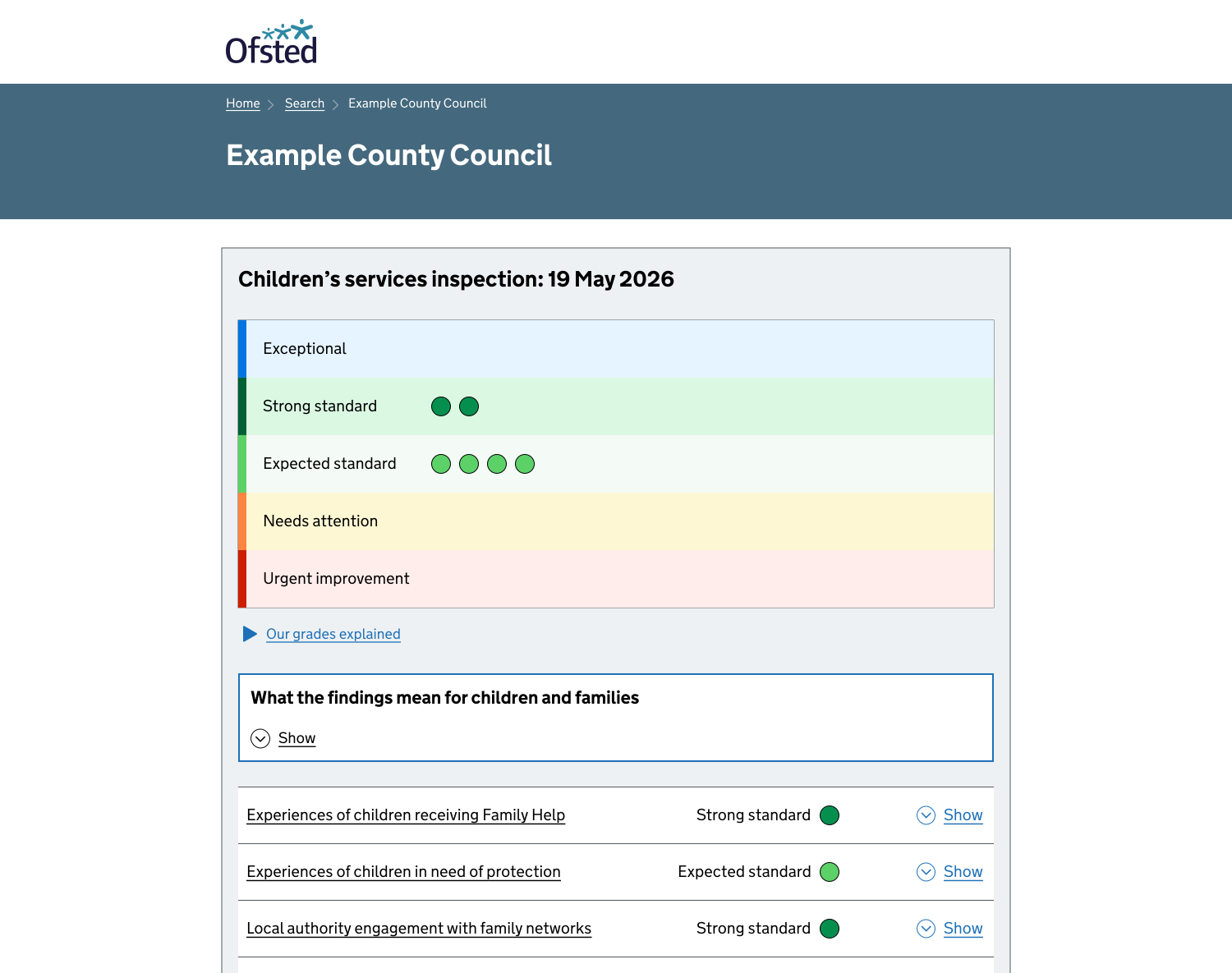
This example shows a report card for an inspection of a local authority’s children’s services. At the top of the report card, there is a 5-point scale consisting of 5 boxes, labelled as follows: ‘exceptional’, ‘strong standard’, ‘expected standard’, ‘needs attention’ and ‘urgent improvement’. The evaluation area scores for a children’s services inspection appear beside the relevant point on the scale. After the 5-point scale, there is a box which describes ‘what the findings mean for children and families’, which can be expanded to show more detail. After this, there are boxes for 3 of the evaluation areas relevant to a children’s services inspection: ‘experiences of children receiving Family Help’, ‘experiences of children in need of protection’, and ‘local authority engagement with family networks’ with their evaluation score. These boxes can also be expanded to reveal more information.
Draft SCCIF report card
Please note that the draft SCCIF report card is formatted for an example children’s home. For other types of SCCIF provider, the report cards will look similar but will be adapted for the provider type.
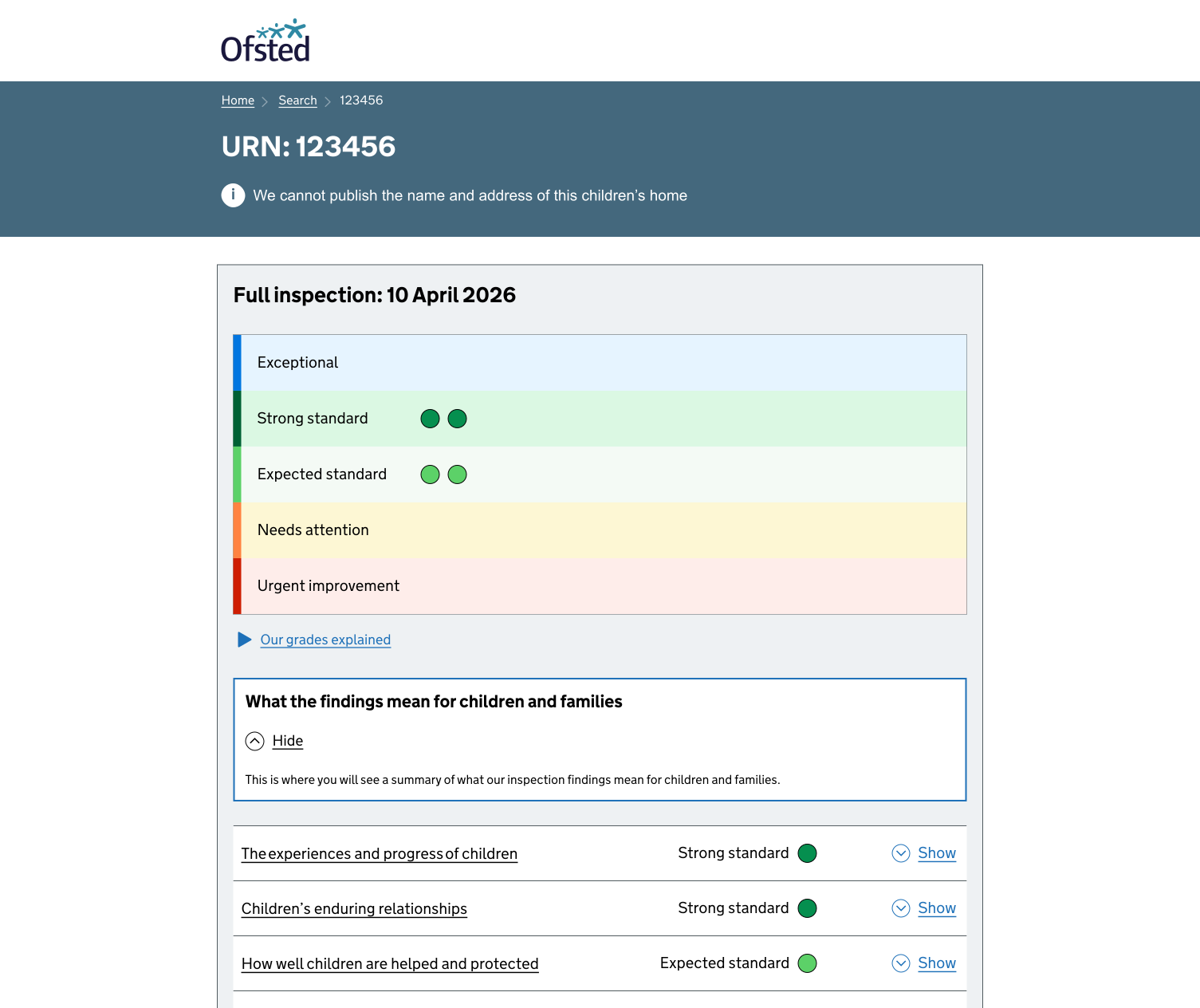
This example shows a report card for a children’s home. At the top of the report card, there is a 5-point scale consisting of 5 boxes, labelled as follows: ‘exceptional’, ‘strong standard’, ‘expected standard’, ‘needs attention’ and ‘urgent improvement’. The evaluation area scores for a children’s home appear beside the relevant point on the scale. After the 5-point scale, there is a box which describes ‘what the findings mean for children and families’, which can be expanded to show more detail. After this, there are boxes for 3 of the evaluation areas relevant to a children’s home: ‘the experiences and progress of children’, ‘children’s enduring relationships’, and ‘how well children are helped and protected ’, with their evaluation score. These boxes can also be expanded to reveal more information.
We believe this structure would help readers to explore our inspection findings more easily, while giving leaders the depth, nuance and insight they need to improve children’s experiences. It would ensure that everyone can work from one shared, accessible report.
Question for ILACS: What do you think about our proposal to introduce report cards for ILACS inspections?
Question for SCCIF: What do you think about our proposal to introduce report cards for SCCIF inspections?
Introducing data on children’s social care report cards
Why we are we proposing to introduce data on our report cards
As part of our proposal to introduce report cards, we want to share data on some of the biggest challenges facing the care system. By presenting clear, relevant data, report cards can help expose these systemic issues and support leaders and practitioners to take meaningful action.
In the Big Listen, children were clear that our current reports do not always reflect their lived experience. Many told us they were not confident that inspections captured the reality of their lives or the impact that services had on their safety, wellbeing and progress.
This feedback reinforces what we already know: too many children’s experiences, and the outcomes that follow, are still not where they need to be. This is why in the Big Listen we said that ‘Children’s outcomes, alongside their safety, should be the focus of our work’.
Currently when we inspect under ILACS and SCCIF, our inspectors have access to a broad range of data to inform their lines of enquiry. However, we do not currently publish a summary of the data we use on inspection. We propose to include a dedicated section for the data that informed the inspectors’ findings in the new report cards.
Including this information would help the public, leaders and practitioners understand the environment that services are working in. And it would help them understand what is working and what is not. Bringing together clear data and rich inspection evidence would provide a more nuanced, transparent and comprehensive picture of quality.
However, we do not want the data we publish to dominate the report cards. Nor do we want to create any perverse incentives for local authorities or children’s social care providers to ‘game’ indicators that were never intended to capture the complexity of children’s lives.
Data will therefore complement, not drive, our inspection judgements. Inspectors will always use their professional expertise to understand how the provider’s context affects the help, protection and care it provides to children. Our focus will remain on the contribution that local authorities and children’s social care providers make to improving children’s lives, and whether decisions are made in children’s best interests.
The data and information that we are proposing to include on ILACS report cards
In ILACS report cards, we propose to present data from the government’s children’s social care dashboard, which is based on the Children’s Social Care National Framework. We are not proposing to reproduce the full dataset, just a small set of indicators that reflect the breadth of practice we inspect. This would only include data that has been published at the time of the inspection.
Examples of data from the children’s social care dashboard we could include are:
- repeat referrals to children’s social care
- repeat child protection plans
- child protection plans for 2 years or longer
- educational engagement or school attendance for children receiving help
- proportion of children in care
- stability indicators for children in care
- children placed more than 20 miles from home
- educational attainment for children in care
- education, employment and training measures for care leavers
We are also considering introducing information on the number of children in unregistered children’s homes and data relating to sufficiency, to accompany our broader changes to how we look at the use of unregistered provision on ILACS inspections.
As further data is added to the government’s dashboard, we would consider whether to add it to the ILACS report card.
We also propose to include further contextual information on our report cards. Currently, the first page of our inspection reports for ILACS may include information on contextual issues specific to the local authority. We propose to build on this, so our report cards would display a consistent set of relevant contextual data and information for each local authority. This would include 2 types of information:
- local authority information:
- where the authority is located
- what type of authority it is
- who its local partners are (for example, in health and the police)
- whether it is newly formed or affected by local government reorganisation
- population information:
- size and demographic makeup (including age profile) of the local population
- deprivation indicators
The data outlined above is indicative of the kind of information we think it would be useful to include on report cards, if they are adopted. But through this consultation we want to hear from the sector, children, families and the public about which data and information would be most meaningful, and how we can avoid creating perverse incentives.
Question for ILACS: What are your views on including data and information in ILACS report cards?
Question for ILACS: Which data and information would be most meaningful to include on an ILACS report card?
The data and information we are proposing to include on SCCIF report cards
The care a child experiences can shape their future – affecting their relationships, their opportunities, and their sense of what is possible. Children’s social care providers play a decisive role in this, and the environments they create can either expand a child’s horizons or limit them.
Through this consultation, we want to understand how the information we publish can best reflect the performance of providers and the context they operate within, and how to ensure that the data we share genuinely supports better outcomes for children.
Currently, our SCCIF reports provide contextual information, where relevant, to help readers understand the setting, such as:
- how long the provider has been registered
- the conditions and categories of registration
- the number of premises and registered categories (for supported accommodation)
- the status of the manager and the responsible or nominated individual
- the number of children the setting is registered to care for
- any enforcement action since the previous inspection
- the number of children at the point of inspection
Where it is appropriate and safe to do so, we propose to share more data and information in our SCCIF reports, to ensure readers have a fuller, more accurate picture of the environments shaping children’s daily lives.
We are considering what data we can publish in report cards that will most effectively bring the challenges facing the care system into view. We want to use the data that is available to us to illuminate the pressures, patterns and realities that shape children’s lives, while always weighing this against our absolute responsibility to protect the identities and privacy of children in care.
Types of data and information we could publish include:
- staff qualifications
- average length of children’s stays
- staff and management turnover
- children’s distance from their home community
These examples are indicative only, and we intend to engage fully with children, young people, families, parents, carers and the sector as we develop our proposals for data to include in our SCCIF report card.
We are mindful of the challenges that come with publishing any data and the risks associated with data driving harmful behaviours. In particular, we would not want to publish data that would incentivise providers not to take children with the most complex lives. As we consider our proposals on SCCIF data, we will be mindful of this challenge.
Also, in settings that care for only a small number of children, we must take particular care with what we publish. When only a handful of children live in or receive support from a given SCCIF setting, the report is anonymised to protect their identities, and any data we publish is carefully tailored to avoid the risk of identification. This will continue, regardless of any changes to the way we report our inspection findings.
Question for SCCIF: What are your views on including data and information in SCCIF report cards?
Question for SCCIF: Which data and information would be most meaningful to include on a SCCIF report card?
Proposal 4: Children, young people, parents, carers and family engagement during inspections
Engaging with children, young people, parents, carers and families on inspection
Why we are proposing to increase our engagement with children, young people, parents, carers and families during our inspections
During inspections, it is vital that Ofsted inspectors engage with people who have lived experience of the children’s social care system. No one is better placed to tell us whether help, protection and care are working than the children and families who live that reality every day.
We already engage with children and young people during both SCCIF and ILACS inspections. Under both inspection frameworks, inspectors use a range of approaches to hear directly from them, using their professional judgement to choose methods that are appropriate and minimise stress, and considering the ethical implications of speaking to people who may currently be in crisis. Recent changes have strengthened this further, including the introduction of surveys in SCCIF, which have helped more children understand when inspections are taking place and have allowed us to hear from a greater range of children.
However, the Big Listen made clear that we need to go further. This consultation gives us an opportunity to build on what is already in place, and to be more ambitious, ensuring that these voices shape our inspections more consistently and meaningfully.
How we are proposing to increase our engagement with children, young people, parents, carers and families during inspections
We want to build a more consistent and inclusive approach to engaging with those with lived experience of children’s social care across both ILACS and SCCIF. We want to ensure that everyone has the opportunity to share their experiences in a way that feels safe, accessible and meaningful to them. This would involve hearing from a wider range of children and young people with different needs and circumstances, and those who care for them.
We are still developing our proposals to improve engagement on inspection, considering how we can do this within the constraints of our inspection methodology.
We want to understand which methods work well, where our current approach falls short, and how we can ensure every person with lived experience of children’s social care, whatever their needs, communication preferences or circumstances, has a genuine opportunity to share their experiences.
We have already held workshops with children and young people ahead of launching this consultation. Throughout the consultation period, we will hold regular meetings with children, young people, parents, carers and families known to social care from a wide range of backgrounds. This will help us to build a rounded understanding of how best to reach them as part of our inspections, and to develop a broader suite of engagement methods to use on inspection.
Question for ILACS: How can we better engage with children and young people during ILACS inspections?
Question for SCCIF: How can we better engage with children and young people during SCCIF inspections?
Question for ILACS: How can we better engage with parents, carers and families during ILACS inspections?
Question for SCCIF: How can we better engage with parents, carers and families during SCCIF inspections?
Proposal 5: ILACS inspection scheduling
The current approach to ILACS scheduling
The ILACS inspection schedule is set by Ofsted through the ILACS framework, while the SCCIF inspection schedule is determined by the Fees and Frequency of Inspections Regulations set by the Department for Education.
Ofsted does not determine the frequency of SCCIF inspections – the Department for Education does. We are therefore not consulting on changes to the SCCIF schedule. This chapter focuses solely on proposed reforms to the ILACS schedule.
The ILACS schedule is based on the premise that the timings of our inspections should be risk‑based, meaning we prioritise our activity where improvement is needed most, taking account of what we already know about each local authority. We use a combination of standard inspections, short inspections, focused visits, monitoring visits and joint targeted area inspections (JTAIs) to provide the right level of scrutiny and support. Standard and short inspections usually happen once every 3 years, plus or minus 6 months. (For more information about these types of inspections, see the Appendix).
Local authorities are currently placed on inspection ‘pathways’ based on the grades of their most recent inspection:
- Local authorities that are graded ‘good’ or ‘outstanding’ for ‘impact of leaders’ and 2 or more of the other judgements will usually receive a short inspection. This will normally take place about 3 years after the previous inspection. In between inspections, the local authority will usually receive a focused visit or a JTAI.
- Local authorities that are graded ‘requires improvement’ for ‘impact of leaders’ or 2 or more of the other judgements at their most recent inspection will usually receive a standard inspection. This will normally take place about 3 years after the previous inspection. In between inspections, the local authority will receive up to 2 focused visits. A focused visit may be replaced by a JTAI.
- Local authorities that are graded ‘inadequate’ for any judgement at their most recent inspection will receive monitoring visits followed by a reinspection. We will usually carry out between 4 and 6 monitoring visits before the reinspection. The reinspection will be a standard inspection.
Why we are proposing to change the ILACS schedule
We recognise that the context in which ILACS operates has changed significantly. Children’s social care reforms and local government reorganisation have changed the operating context of local authorities. Forthcoming local government reorganisation means that the number of local authorities we inspect will increase significantly.
Our model for inspections must evolve to remain effective. We need to ensure that they remain proportionate, targeted, and capable of driving improvement where it will have the greatest impact on children’s lives. As we have considered the proposals in this consultation, we have reflected on how best to uphold these principles in the changing landscape.
Our proposal to change the ILACS schedule
In this context of structural reform and expanded scope, it is vital that we establish a fair, accurate, and consistent baseline of local authority performance. We therefore propose to inspect all local authorities using a standard inspection as their first inspection under the renewed ILACS framework, regardless of their previous grade.
We will retain monitoring and focused visits, carrying these out based on individual inspection findings and ongoing intelligence.
However, we must also consider how best to manage our finite resources in light of this expanded scope, local government reorganisation, and the need for coordination with area SEND inspections. We are mindful of the overall inspection activity we carry out with local authorities. To ensure that our oversight remains both manageable and effective, we propose to change our core cycle from one where local authorities receive an inspection at least once every 3 years (plus or minus 6 months) to one where they receive an inspection at least once every 4 years (plus or minus 6 months).
Alongside a programme of standard inspections under the reformed framework, we propose to continue to deliver focused visits between standard inspections. Local authorities would normally receive 1 or 2 focused visits, depending on the grades at their last inspection and our current assessment of risk.
Should future funding allow, we are also considering whether we could develop a new type of visit between standard inspections for local authorities with one or more ‘needs attention’ grades and no ‘urgent improvement’ grades. These assurance visits would have the capacity to review and, where appropriate, change the grading of one evaluation area. We believe that this would allow us to encourage, recognise and celebrate improvement more quickly.
Local authorities with any ‘urgent improvement’ grades would usually still be reinspected within 3 and a half years, supported by the current programme of up to 6 monitoring visits, and be subject to a standard inspection at the end of the monitoring period. This is the same as our current approach to local authorities with any ‘inadequate’ judgements.
Alongside these changes, we would continue to hold annual engagement meetings with each local authority. But we want to explore how these conversations can play a stronger role in shaping our decisions about visits and inspections. We see these meetings as a vital opportunity to bring together the full breadth of data, intelligence and professional insight that we and local leaders hold, and to use that understanding to improve our decision-making. As part of this consultation, we will consider how to strengthen these meetings to help us target our activity where it will have the greatest impact for children and families.
These proposals aim to create a scheduling model that is responsive and aligned with the needs of children and families. They would strengthen our ability to recognise improvement, intervene earlier where necessary, and maintain a consistent level of inspection across a period of significant reform.
Question for ILACS: What do you think about our proposals for ILACS scheduling?
Question for ILACS: What do you think about the idea to explore assurance visits, which would take place between full inspections, and would review one evaluation area graded ‘needs attention’?
Additional questions
Over the next few months, we will be assessing the impact of our proposed reforms on leaders’, practitioners’ and inspectors’ workloads, mental health and wellbeing, through engagement with the sector.
We want to hear your views about the likely implications of our proposals.
Question for ILACS: What effect do you think the proposed ILACS changes will have on leaders’, practitioners’ and inspectors’ workload and wellbeing?
Question for SCCIF: What effect do you think the proposed SCCIF changes will have on leaders’, practitioners’ and inspectors’ workload and wellbeing?
Question for ILACS: What steps could we take to reduce or manage any unintended consequences of our proposals?
Question for SCCIF: What steps could we take to reduce or manage any unintended consequences of our proposals?
The public sector equality duty requires Ofsted, when exercising its functions, to have due regard to the need to:
- eliminate discrimination, harassment, victimisation, and any other conduct that is prohibited by or under the Equality Act 2010
- advance equality of opportunity between persons who share a relevant protected characteristic and persons who do not share it
- foster good relations between persons who share a relevant protected characteristic and persons who do not share it
Alongside this consultation, we have conducted an initial equality impact assessment to evaluate how the proposed changes to ILACS and SCCIF meet these requirements. We intend to publish an updated assessment after the consultation.
Question for ILACS: Please tell us how you think our proposed changes to ILACS may or may not impact Ofsted’s public sector equality duty.
Question for SCCIF: Please tell us how you think our proposed changes to SCCIF may or may not impact Ofsted’s public sector equality duty.
Question for ILACS: Do you have any other comments about our proposed changes to ILACS?
Question for SCCIF: Do you have any other comments about our proposed changes to SCCIF?
Appendix: ILACS inspection types
Standard and short inspections
ILACS standard inspections and short inspections have the same scope and both give graded judgements on the following areas:
- the experiences and progress of children who need help and protection
- the experiences and progress of children in care
- the experiences and progress of care leavers
- the impact of leaders on practice with children and families
On standard inspections, inspectors gather evidence over 2 weeks of fieldwork. On short inspections they have 1 week of fieldwork.
A short inspection is not a 2-week inspection delivered in 1 week. Inspectors preparing for a short inspection start with a mindset that ‘this is a good local authority’. This assumption is based on:
- the previous inspection judgement
- a focused visit or JTAI that has reinforced earlier findings
- the quality of self-evaluation over the preceding years, which will have been explored during the annual engagement meetings
- data and information that support a view of continuing strong performance
In a short inspection, inspectors will seek to answer 3 questions:
- Have the quality and impact of practice been maintained?
- Are there any areas where the quality and impact of practice have improved?
- Are there any areas where the quality and impact of practice have deteriorated?
Inspectors prioritise gathering evidence on the areas that need the greatest focus. They may quickly close lines of enquiry about practice that needs to improve if the local authority has demonstrated that it has an accurate understanding of the issues and is taking appropriate action.
Focused visits
A focused visit evaluates an aspect of service, a theme or the experiences of a cohort of children. Examples include:
- the ‘front door’
- children in need or on a child protection plan
- planning and achieving permanence
- care leavers
Inspectors do not make graded judgements at the end of a focused visit. We publish a letter setting out strengths and areas for improvement. If inspectors find serious weaknesses, they will identify areas for priority action.
Monitoring visits
Inspectors carry out monitoring visits to local authorities with inadequate judgements. They monitor and report on the local authority’s progress since the inspection. Inspectors will also check that performance in other areas has not declined since the inspection.
We carry out 4 to 6 monitoring visits before a reinspection. We do not give graded judgements. Each monitoring visits results in a letter to the local authority setting out the progress they have made.
Joint targeted area inspections (JTAIs)
JTAIs are not part of the ILACS framework. However, when we carry out a JTAI it replaces one of the ILACS focused visits that we would have carried out.
JTAIs are multi‑agency inspections carried out jointly by:
- Ofsted
- Care Quality Commission (CQC)
- His Majesty’s Inspectorate of Constabulary and Fire & Rescue Services (HMICFRS)
- His Majesty’s Inspectorate of Probation (HMIP)
They evaluate how effectively the safeguarding partners in a local authority area work together at the practice and strategic levels to keep children safe. JTAIs may focus on how well the partners identify and respond to initial need and risk, or they may focus on their response to a particular type of harm (for example, exploitation, neglect or sexual abuse).
JTAIs do not result in graded judgements. We write a letter to the local partnership setting out any strengths, areas for improvement and areas for priority action.
-
Yvette Stanley, ‘Unregistered children’s homes: too many vulnerable children are placed at risk’, Ofsted, 6 December 2024. ↩
-
‘Unregistered children’s homes’, Ofsted, November 2024. ↩
-
For inspections of supported accommodation, we currently use a 3-outcome model. Our proposals to grade each evaluation area independently and to introduce the 5-point scale also apply to these inspections. ↩
-
‘Ofsted: public consultation data tables’, Table 5. ↩