Government response and summary of responses
Updated 15 April 2026

© Crown copyright 2026
This publication is licensed under the terms of the Open Government Licence v3.0 except where otherwise stated. To view this licence, visit nationalarchives.gov.uk/doc/open-government-licence/version/3 or write to the Information Policy Team, The National Archives, Kew, London TW9 4DU, or email: psi@nationalarchives.gov.uk.
Where we have identified any third party copyright information you will need to obtain permission from the copyright holders concerned.
This publication is available at https://www.gov.uk/government/consultations/improving-the-implementation-of-biodiversity-net-gain-for-minor-medium-and-brownfield-development/outcome/government-response-and-summary-of-responses
1. Introduction and context
In May 2025, the government launched an 8-week consultation on improving the implementation of biodiversity net gain for minor, medium and brownfield development. This consultation was supported by a detailed consultation document.
A separate consultation focused on biodiversity net gain (BNG) for nationally significant infrastructure projects (NSIPs) ran in parallel.
The consultation on improving the implementation of BNG for minor, medium, and brownfield development explored 4 key areas:
- improving exemptions
- streamlining the BNG metric process
- increasing flexibility to go off-site for minor development
- brownfield development with open mosaic habitat (OMH)
This government response summarises the feedback received and outlines any resulting changes to policy or processes. Where policy positions have been amended or clarified, these changes are clearly signposted. A detailed summary of responses to each question is presented in Annex A.
2. Respondents
A total of 25,024 responses were received during the consultation period. Of these, 1,139 responses were received through the online portal, Citizen Space. A further 137 written responses were received by email or letter. An additional 23,748 campaign responses were received via email from Wildlife Trust (WT) and Royal Society for the Protection of Birds (RSPB) campaigns. Responses identified as duplicates were discounted, leaving a total of 1,259 non-campaign responses that were analysed alongside the campaign responses.
Defra are grateful to all individuals and organisations who took the time to share their views, experiences, and suggestions. Every response was reviewed and considered in shaping this government response and informing future policy development.
2.1 Stakeholder events
Defra held a series of stakeholder workshops in June and July 2025. This provided Defra with valuable, in-depth feedback prior to the consultation closing. Participants included representatives from local planning authorities, non-governmental organisations, developers, consultancies, professional institutes, academia and wider industry. The Planning Advisory Service ran several additional events for local planning authorities.
2.2 Breakdown of respondents
The consultation had responses from a wide range of respondents across multiple sectors. The largest group was environmental stakeholders, including ecological consultants, environmental consultancies, and environmental non-governmental organisations (eNGOs). Other significant respondent categories included those from the planning and development sector. This included housing developers, local planning authorities, infrastructure providers and planning consultancies, as well as individual members of the public.
In addition to these groups, a substantial number of responses were received via organised campaigns. 13,605 responses were submitted through a WT campaign, and 10,143 responses were received through an RSPB campaign. These campaign submissions were not attributed to specific organisation types and have been categorised separately under ‘campaign’. Where campaign responses directly addressed consultation questions, they have been included in the detailed summary of responses.
A response to the consultation and additional advice was provided by the Office for Environmental Protection (OEP).
2.3 Analysis methodology
All consultation responses were considered in shaping policy and informing this government response. Where multiple submissions were received from the same individual respondent, these were treated as a single response, with all content considered collectively. Consultation responses that were duplicates or contained no content were not counted in response figures. This amounted to 2 duplicates and 3 responses that contained no content.
Responses that did not directly address specific consultation questions were analysed under the most relevant question where this could be ascertained with a sufficient degree of certainty.
The total responses to each question have been counted and all text responses analysed for key themes and suggestions.
The consultation responses received for each question have been summarised. The summaries do not attempt to capture every point made, nor do they cover comments on aspects of policy that fall outside the scope of the consultation. Responses to questions 5 to 14 were considered together, as sentiments and themes expressed by respondents often overlapped or cut across the different exemption questions. When summarising responses, the following terms have been used to describe the frequency of themes in qualitative responses and refers to the percentage of responses to that question as shown below:
| Term | Description |
|---|---|
| Large majority | More than 80% |
| Majority or most | 51% to 80% |
| Half the respondents | 50% |
| Many | 20% to 49% |
| Several | 10% to 19% |
| Small number, a few or some | Less than 10% |
2.4 Consideration of RSPB and Wildlife Trusts Campaign Responses
Overview
Two large email campaigns were received during the consultation: one coordinated by the RSPB and one by the Wildlife Trusts (WT). Both campaigns were generated by individuals completing a pre-constructed template hosted on the organisations’ respective websites. This meant that every campaign response was broadly similar to others from the same campaign.
As most individuals responding through the WT and RSPB campaigns did not provide organisational details, it is not possible to integrate campaign responses into sections breaking down views by sector.
RSPB campaign
The RSPB campaign generated 10,143 email responses. These submissions did not answer specific questions asked in the consultation. Whilst one statement in the RSPB template could be interpreted as applying to several questions on exemptions, determining which question(s) the sentiments expressed relate to would require significant interpretation.
A portion of the RSPB campaign template relates to the separate government consultation on the introduction of BNG for NSIPs. This portion was not analysed as part of this consultation.
All responses were analysed. Responses containing unique text were identified and totalled 1,491. These individual responses were read in full. As the views expressed were not sufficiently specific to be attributed to individual consultation questions, they have not undergone individual question analysis. However, all RSPB campaign responses were noted and considered as part of the government response.
RSPB campaign results
The RSPB campaign generated 10,143 responses, all of which expressed strong support for maintaining BNG. Respondents referred to BNG as “an essential tool for restoring nature and creating greener, healthier places to live”.
All respondents opposed introducing new exemptions for small and medium developments and emphasised that such exemptions would undermine nature recovery and community access to green spaces. Submissions also called for greater ambition in BNG delivery, stating that the current 10% gain is insufficient and that a higher target should be considered.
Wildlife Trust Campaign
The WT campaign generated 13,605 email responses. Respondents answered the multiple-choice component of the following consultation questions: 5, 8, 11, 12, 13, 17, 20, 25 and 26. Most respondents also provided some unique text in answer to question 12, which allowed for qualitative analysis of the responses, alongside analysis of the quantitative data from the multiple choice responses. Results are integrated into and expressed alongside the main body of results in Annex A.
The quantitative content of all 13,605 responses submitted through the WT campaign was analysed. These corresponded to the multiple-choice components of questions 5, 8, 11, 12, 13, 17, 20, 25, and 26 and are reported on alongside the main body of results for the respective questions.
A representative sample of 374 personalised answers to question 12 was randomly selected and qualitatively analysed in a manner identical to the main body of responses submitted. This sample size provides a 95% confidence level with a 5% margin of error, consistent with best practice for large datasets. Qualitative analysis results are reported on alongside the main body of results for question 12.
2.5 Figure 1: Approximate breakdown of respondents to the consultation by reported or assigned type of organisation (not including campaign responses)
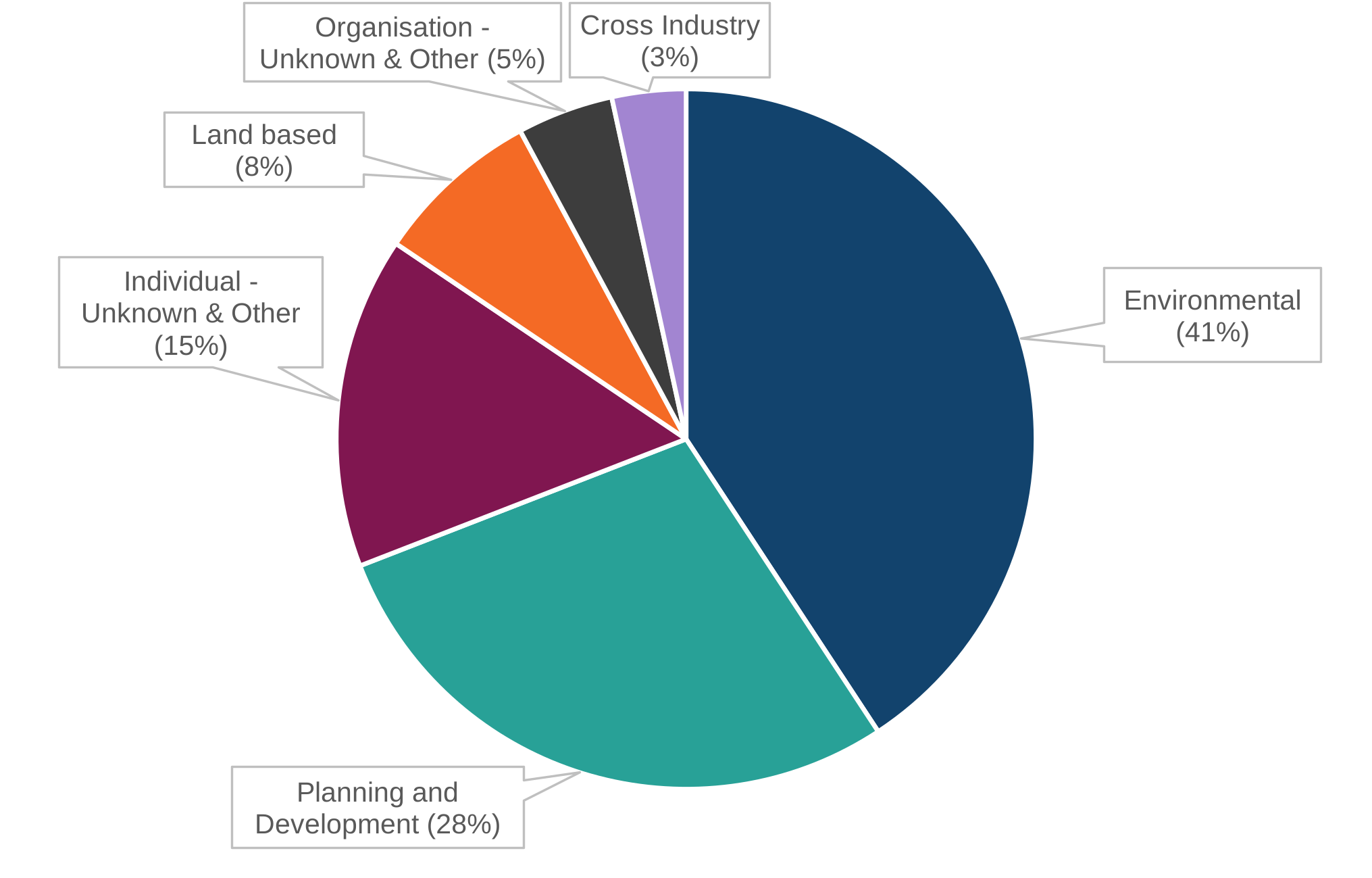
Figure 1 statistics: Approximate breakdown of respondents to the consultation by reported or assigned type of organisation (not including campaign responses):
- environmental – 41%
- planning and development – 28%
- individual (unknown and other) – 15%
- land based – 8%
- organisation unknown and other – 5%
- cross industry – 3%
2.6 Figure 2: Approximate breakdown of campaign versus non-campaign responses
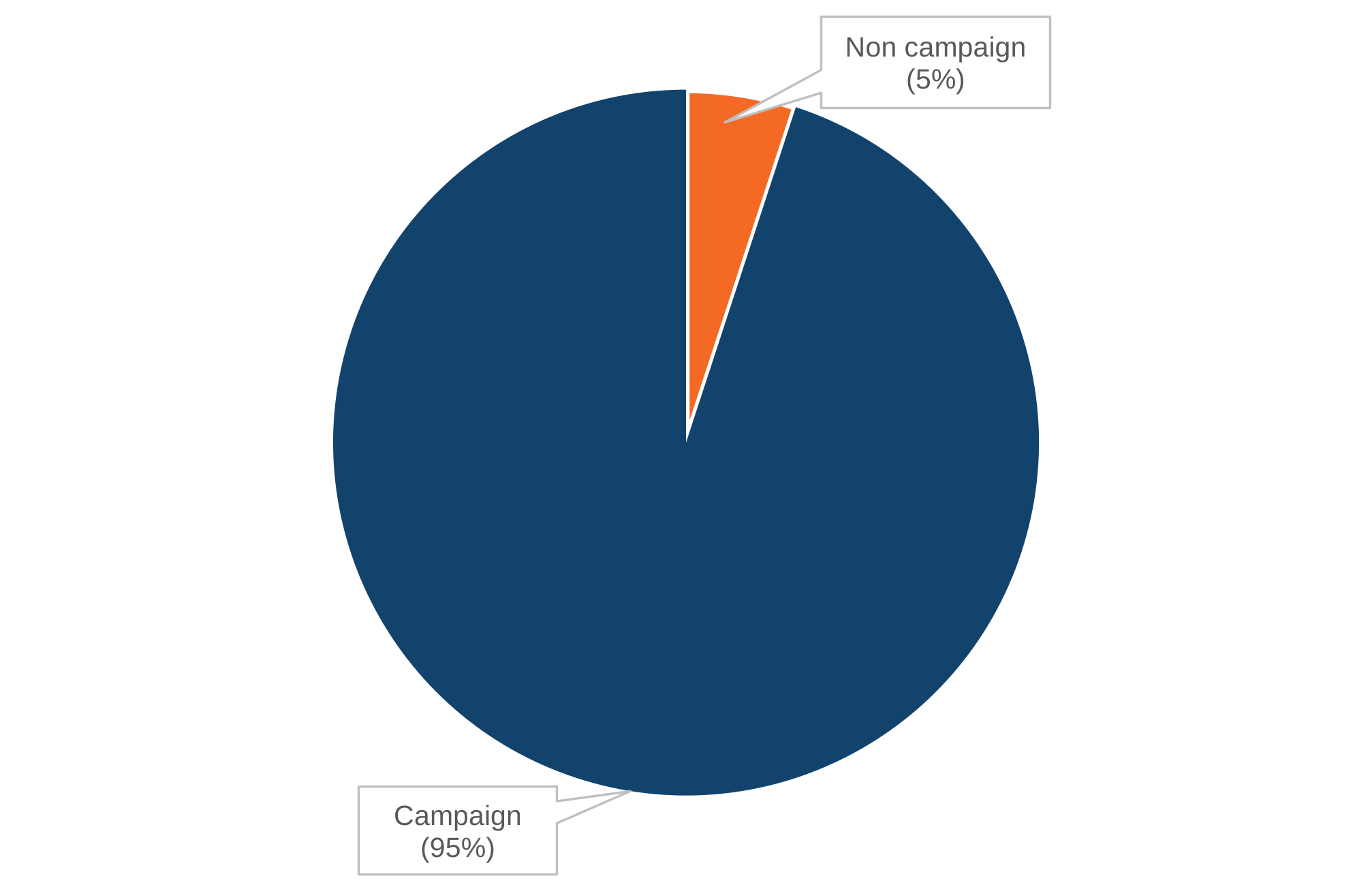
Figure 2: Approximate breakdown of campaign versus non-campaign responses:
-
campaign – 95%
-
non-campaign – 5%
3. Government response part 1: improving exemptions
Summary of changes
BNG is widely considered to be a world-leading environmental policy that requires developers to deliver measurable gains for biodiversity alongside their developments. Since the inception of mandatory BNG in February 2024 we have seen a step change in how developers consider the impact on nature from the outset of the development, with better design and location choices being made. Where impacts cannot be avoided, compensation can be delivered:
- onsite
- off-site, including by purchasing units from the off-site market
- through purchasing statutory biodiversity credits from Natural England (as a last resort)
The government remains committed to BNG and recognises the importance of BNG in delivering nature-positive homes and infrastructure that this country needs.
The 2025 consultation sought views on making changes to simplify BNG following feedback and evidence from the early stages of implementation. The introduction of BNG was a significant change to the planning system. We have seen excellent examples from both the public and private sector of BNG delivery, best practice guidance and training, and a range of digital tools are now available to support the BNG process. However, we have also seen examples of where BNG is not working as intended and is disproportionately costly in some cases, particularly for some smaller development. The consultation explored options to ease some of these burdens.
In December 2025, government announced plans for a new exemption for all development with a site area of 0.2 hectares or less. This is a significant change in how BNG will be applied through the planning system in England. We expect this change to exempt around 50% of residential planning permissions that were required to do BNG up until now. This means the smallest developments, where the cost and administrative burden is proportionately highest, will no longer need to deliver BNG. This will benefit local authority capacity too, meaning they can focus resources on the bigger residential schemes, where greater biodiversity gains can potentially be made.
We recognise that an exemption of this nature and scale will be felt across the whole BNG system. We estimate that around 12% fewer baseline biodiversity units will be compensated for under mandatory BNG when compared with not having the exemption, and that there will be a reduction of around 10% in demand for off-site biodiversity units. However, this loss in demand might be mitigated over time as more development comes forward in response to our wider planning reforms. Nevertheless, increased development rates also increase the number of dwellings exempt and the amount of habitat lost due to the exemptions.
Government considers that this change, along with the additional changes set out below, are proportionate, and will reduce the burdens on the smallest developers. This will benefit the whole BNG system by focusing resources on larger development, which has the greatest impact, and therefore the potential to deliver the greatest benefits to nature.
We understand that developers, habitat bank providers, ecologists and all others involved in the delivery of BNG need stability. This response confirms the changes that will be implemented and sets out the timelines for when these changes are expected to come into effect.
3.1 Exemptions
The consultation sought views on changes to existing BNG exemptions. We considered the following option packages:
- targeted revisions to the existing exemptions
- new exemptions for specific types of planning permissions
- a full exemption for all minor development
3.2 A new area based exemption
A small area based exemption for sites under 0.1 hectares was proposed in consultation responses by a large number of stakeholders, including ecological stakeholders and habitat bank providers.
Government has considered the consultation responses and agrees that an area based exemption is a simplified approach to exemptions that will ease burdens on small developers and local planning authorities.
The area based exemption we are introducing will apply to all development types where the site area within the red line boundary is 0.2 hectares or below. This is a new type of exemption and not an expansion of the impact-based ‘de minimis’ exemption. In line with other BNG exemptions, the new area-based exemption will not apply where onsite priority habitats are impacted.
Government considers this new approach to be simple and deliverable for small developers and local planning authorities. This is because it uses the red line boundary, which is already required for planning purposes, and is clearly defined and enforceable.
The threshold of 0.2 hectares seeks to strike a balance between simplifying the planning process, reducing BNG’s impact on development, and improving biodiversity. It was informed following analysis of the consultation responses (see Annex A - Detailed summary of consultation responses) and a sample of over 1,000 approved planning applications subject to BNG. The analysis considered different thresholds for exemptions, including a full exemption for minor development as consulted on, and an exemption for sites under 0.1 hectares as suggested through the consultation responses. The impacts of different thresholds were considered, including on:
- the number of residential planning applications and the associated number of dwellings that would be exempt from BNG that would previously have been subject to mandatory BNG
- the amount of habitat that would not be mitigated for as a result of further exemption, and the impact on the off-site BNG market
It is important to note that developments exempt from BNG will continue to be subject to a strong suite of environmental protections through national planning policy and guidance and wider regulatory requirements. Planning decisions must still apply the mitigation hierarchy and refuse permission where significant harm to biodiversity cannot be avoided, adequately mitigated or, as a last resort, compensated.
Existing rules on the treatment of irreplaceable habitat continue to apply and are unchanged. BNG does not apply to irreplaceable habitat. Instead, developers must minimise impacts and agree a bespoke compensation strategy where onsite irreplaceable habitat is impacted.
3.3 Reform of existing exemptions
Exemption for self-build and custom build applications
Defra intend to use regulations to reform existing exemptions by removing the exemption for small scale self-build and custom build development.
Most respondents were supportive of removing the self-build and custom build exemption, which will remove burdens from local planning authorities and simplify the BNG framework for developers.
An exemption for a single dwelling house on a site of 0.1 hectares was proposed by the consultation but will not be introduced. We expect small scale single dwellings will be covered by the new 0.2 hectare area based exemption.
‘De minimis’ exemption
Any changes to the de minimis exemption will be considered alongside the future government response to the consultation on BNG for residential brownfield development. The outcome of this consultation will be a factor in any decision on the de minimis exemption, given the consultation includes options that would exempt even more development from BNG if taken forward.
However, regardless of the outcome of the residential brownfield consultation the government considers that a low impact based exemption will likely be required for larger sites. This is because there are certain types of development that have a site area above 0.2 hectares which will have little or no impact on habitat. In these cases, the application of BNG is disproportionate to the benefits, and continuing to exempt them means local authorities can concentrate ecological resources on schemes where the impact is greater. A low impact exemption would cover development such as:
- change of use applications
- installation of solar panels on an industrial building
- replacement of a petrol station with an electric vehicle charging station
- an upward extension of a large block of flats
The de minimis exemption will therefore continue to apply with the existing thresholds at the current time, pending the government response to the residential brownfield consultation. We anticipate that there will be a significant reduction in its use following the introduction of the new 0.2 hectare area based exemption.
More information about the application of the de minimis exemption and examples of the types of development that could be covered is available in the planning practice guidance on BNG.
3.4 New exemptions
We will use regulations to introduce targeted new exemptions for:
- development whose primary objective is to conserve or enhance biodiversity
- temporary planning permissions covering permissions granted for a maximum of 5 years.
- development enhancing parks, playing fields and public gardens
Development whose primary objective is to conserve or enhance biodiversity
The vast majority of respondents supported proposals for this exemption in the consultation, including the Wildlife Trust campaign responses.
We will use regulations to exempt development that is wholly or primarily for the purpose of conserving or enhancing biodiversity. For example, habitat change that requires planning permission or the creation of ponds under the district level licensing scheme. We will consider whether small scale supporting infrastructure should be allowed for the purposes of access for management and monitoring of the habitat.
Defra will work with stakeholders to develop an appropriate definition and accompanying guidance, addressing concerns in the consultation response that misuse of this exemption could inadvertently exempt other types of development.
Separately to the exemption, Defra will also review the drafting of ‘Rule 4’ in the metric, which allows deviations from the standard approach to trading rules in certain defined circumstances. This is to support development that delivers biodiversity improvements but has a more significant capital infrastructure element, meaning it would not qualify for an exemption.
Stakeholder feedback from the consultation suggests the current wording of Rule 4 can limit some project ambitions to deliver significant biodiversity enhancements. This includes projects which restore or support natural processes in transitional habitats (including freshwater, saline estuarine, and intertidal areas) where the full ecological value may not be fully captured by the metric calculation.
Exemption for temporary planning permission
Government will use regulations to introduce a new exemption for temporary development which is for 5 years or less. The scope to deliver onsite BNG is limited due to the temporary nature of the development, as the land needs to be restored to its previous condition, therefore requiring off-site units to be purchased. In some cases, this can create disproportionate burdens and cost pressures for short term temporary development.
Temporary development will be defined as a planning permission granted for a limited period under section 72 of the Town and Country Planning Act 1990.
This exemption will only apply for development where:
- the whole development comprises solely of temporary development
- the temporary development is limited to 5 years or less
Some consultation responses raised concerns that introducing a new exemption could incentivise applicants to seek temporary permissions more frequently, or to rely on a series of temporary consents being repeatedly renewed. Existing planning practice guidance already addresses these risks. Local planning authorities should apply that guidance when considering whether a temporary permission is justified.
As set out in the consultation document, we have considered how BNG should apply when a temporary development later becomes permanent. This was also raised by some consultation responses. We will prepare further planning practice guidance to cover this situation.
This exemption will not apply where onsite priority habitats are affected.
Targeted exemption for development enhancing parks, public gardens and playing fields
We will use regulations to introduce a new targeted exemption for development that enhances parks, public gardens and playing fields, where the development is not already exempt (including by the new 0.2 hectare area-based exemption) and where no onsite priority habitats are impacted.
For playing fields, the exemption will be designed to target sports development at community and local authority playing fields and grounds. To achieve this, it will only apply to development that is ancillary to, and directly related to, the existing lawful use of the site as a playing field (for example, new cricket nets or changing rooms). It will not apply where the proposal forms part of a wider development (for example, a residential or mixed‑use scheme). We will also exclude playing pitches that are enclosed within a sports stadium so professional sporting clubs will not be exempted.
Improvements to community and local authority playing fields provide significant social and public health benefits. However, red line boundaries for these developments can exceed 0.2 hectares to cover an entire playing field. Although baseline habitat is typically low‑distinctiveness modified grassland with limited biodiversity value, the size of the red line means the BNG gain requirement can still be high. This materially increases the cost of improvements and the compliance burden on grassroots clubs and schools.
For parks and public gardens, the exemption is intended for development comprising a package of improvements that cover most of the park or garden, such as upgrading paths, boundary treatments and toilet facilities. These projects deliver social and amenity benefits. However, because a comprehensive package typically requires the red line to be drawn around the whole park, and parks commonly include trees and other habitats of at least medium distinctiveness, the baseline biodiversity value is likely to be high. Achieving a 10% BNG gain in these cases would require substantial onsite or off‑site enhancements, adding significant cost for park managers and risking the viability of projects that depend on limited resources.
For those developments above the 0.2ha threshold, government will make modifications to the biodiversity gain hierarchy, see section 5.1 which mean it will be easier to use off-site biodiversity gains rather than having to deliver on-site which can be difficult with access and use requirements. It also removes the need to enter into legal agreements.
3.5 Minor development
We will not amend regulations to exempt all minor development from BNG.
This option was not supported by consultation responses. The data and analysis set out in the Biodiversity net gain area-based exemption evidence annex supports the case for a new area based exemption and other modifications as a more proportionate approach. This will help alleviate some of the burdens on small developers, without introducing a more significant change to BNG policy that would result from a full exemption for all minor development.
4. Government response part 2: streamlining the BNG metric process
The consultation sought views on changes to the BNG metric and supporting guidance to reduce administrative burden and improve flexibility for minor developments. We considered:
- improvements to the metric tool through digitisation
- revisions to the small sites metric (SSM), guidance and its scope to speed up assessments, reduce misidentification of habitats, and increase flexibility in meeting the BNG requirement
- changes to guidance to incentivise the inclusion of biodiverse features in private gardens
- proportionality of the river condition assessment and changing when and how the watercourse metric is engaged for minor development
4.1 Improvements to the metric tool through digitisation
The consultation sought views on what specific features or improvements would be beneficial in future versions of the metric tools. We plan to move the current excel‑based BNG metric tools to a digital, integrated service that is more accessible, user-friendly, reliable and data‑driven for all users, including smaller developers. We are considering all of the suggestions submitted to the consultation and providing interactive mapping options, as well as ensuring compatibility and integration with other systems used in the BNG process.
4.2 Revisions to the small sites metric (SSM)
The consultation considered the following potential revisions to the SSM:
- changing the criteria for use so the SSM could be used on sites under 1 hectare with no priority habitats present
- amendments to provide more flexibility to meet the BNG requirement onsite, including removing or amending the trading rules, and changing how habitat condition is fixed
- simplifying and amalgamating habitats in the SSM to reduce misidentification and support the use of image analysis
- providing additional guidance to aid identification of habitats and to clarify who is considered a competent person
We do not intend to make the majority of proposed revisions to the SSM at this time. The introduction of the new area based exemption for sites of less than 0.2 hectares is expected to remove more than 50% of the smallest planning applications which are currently delivering mandatory BNG, from the BNG requirement, Many of the challenges cited in the consultation around use of the SSM were raised by the smallest developers, who will be exempt under this threshold. As a result, we do not consider a lot of the further changes necessary for the remaining sites that will continue to use the SSM.
We will not introduce changes to the criteria for use (such as extending the use of the SSM to medium development, protected sites or sites that contain European protected species). These changes were not supported by the large majority of respondents.
However, as we will be taking forward the development of a web-based metric tool, we will consider how best to support small and medium-sized enterprise (SME) developers within the future metric service. For example, exploring how geospatial features could make better use of existing mapping data or utilising image analysis to streamline site baselining for SME developers, when an ecologist is not required.
As part of this, we will consider competency requirements, additional guidance needs for small sites, and potential approaches to address the challenges associated with automated habitat condition. This will include reviewing suggestions raised through the consultation, such as introducing a tiered approach to habitat condition that would allow default values to be overridden where ecological advice has been obtained.
4.3 Changes to the guidance to incentivise the inclusion of biodiverse features in private gardens
The proposal to allow biodiverse features in private gardens to be counted for BNG was not supported by the majority of respondents. Consultation responses highlighted challenges with monitoring and compliance, as well as a risk of overestimating biodiversity value for developments. As such, we will not be taking forward this change.
4.4 Watercourse metric – river condition assessment (RCA) surveying for minor development
The consultation sought views on the proportionality of using the RCA survey method in different scenarios, particularly for minor developments where part of the proposal falls within the riparian zone or where there are no anticipated or likely impacts.
Responses to the watercourse questions highlighted that river condition assessment survey effort should be proportionate to the level of ‘impact’ a development has on the watercourse feature, should be proportionate to the distinctiveness category of the watercourse, and be assessed by a competent ecologist.
The consultation questions focused on minor development and application of watercourse BNG assessment methods. Although the SSM can only be completed for the BNG assessment where ditches, culverts and canals are the only present features, minor development that contains other watercourse features must complete the main metric. As changes to the main metric will apply to both minor and major development proposals, we will therefore consider the following for all proposals:
- explore and test whether a simplified condition assessment could reduce costs, lessen burdens, and save time while retaining ecological integrity
- consider how the simplified condition assessment would work alongside the existing RCA
- explore whether adding a new distinctiveness category for heavily modified watercourses could help ease BNG pressures for sites, particularly where achieving ecological improvements on heavily modified or constrained watercourses is challenging
4.5 Transitionary arrangements
We will put transitionary arrangements in place for any changes to the statutory biodiversity metric, including when moving the metric tools to a digital service. We recognise that applicants may be at different stages of the planning or gain site registration process when updates are introduced. We will therefore provide clear guidance on which metric version can be used, along with a defined period during which previous versions may continue to be accepted.
5. Government response part 3: increasing flexibility to go off-site for minor development
Government remains committed to a thriving off-site market for nature. This is essential to the success not only of BNG policy but to nature recovery objectives more broadly. The market continues to grow and mature, with a wide range of biodiversity units available nationally.
Through the consultation, we tested options to make it quicker, easier and cheaper for developers to access the off-site market. We will implement 2 reforms to support this, creating more opportunities for investment, and increasing flexibility for stakeholders.
The consultation set out options which would increase the flexibility for developers to deliver BNG offsite.
For minor development, options included:
- relaxation of the biodiversity gain hierarchy to allow developers to deliver BNG more easily
- disapplying the spatial risk multiplier to increase access to the off-site market
There was also an option relating to all development to amend the spatial risk multiplier to increase access to the off-site market.
5.1 Biodiversity gain hierarchy
We will use regulations to amend the biodiversity gain hierarchy for minor development only, where it is not already exempt. This will place off-site biodiversity gains on the same preference as enhancement and creation of onsite habitat. For the purposes of these regulations, minor development will be defined as development that is not major development.
The other elements of the biodiversity gain hierarchy will remain in place, with statutory credits remaining the last resort option. Many respondents expressed support for the importance of the mitigation hierarchy, and the principles of first avoiding then mitigating the adverse effects of development remain. BNG continues to support and incentivise this approach. The long standing mitigation hierarchy in national planning policy will also still apply where there is significant harm to biodiversity.
Existing planning policy continues to apply, including setting out that existing trees should be retained wherever possible and that opportunities to improve biodiversity in and around developments should be integrated as part of their design.
However, government considers that this change will support developers by making it easier to access the off-site market and provide surety that this will be accepted by local planning authorities. This will reduce the risk of inappropriate onsite features, or lengthy negotiations occurring.
The existing off-site market rules continue to apply, and developers can purchase units from anywhere in England. Government considers that this change will support the development of the national market.
5.2 Spatial risk multiplier
We will take forward the proposal to assess spatial risk based on local nature recovery strategy (LNRS) areas only, rather than local planning authority (LPA) and National Character Area boundaries as is currently the case. This is to increase flexibility for off-site BNG and better align with future local government reorganisation. This change will apply to all types of development.
This change will enable developers to source off-site units in a larger local area without the multiplier applying (there are currently 48 LNRS areas in England, as opposed to 337 LPA areas). It will also address the increasing disparity in the size of LPAs as a result of wider reforms.
We will keep the existing assessment approach for intertidal habitats, which will continue to be based on Marine Plan Areas. We will also keep the existing approach for the watercourse module, which will continue to use waterbody and operational catchments.
The spatial risk multiplier will not be disapplied for minor development and will remain in place for all development.
The BNG off-site market is maturing, and land managers, farmers and habitat bank providers are responding to local demand. This means availability of biodiversity units is increasing across the country. Therefore, we do not think this step is necessary and we will continue to incentivise off-site provision in the local area of a development site through the spatial risk multiplier.
6. Government response part 4: brownfield development with open mosaic habitat
The consultation addressed the specific challenges that BNG poses for brownfield developments with open mosaic habitat (OMH). It considered:
- updating the metric definition, guidance and condition assessment for OMH to support ecologists with correct identification
- allowing the compensation of OMH with an alternative habitat mosaic with similar ecological benefits
The majority of respondents were supportive of proposals to make updates to the metric definition of OMH habitat, guidance and conditions assessment to support the correct identification of OMH and other urban habitats.
We will work with industry, across the planning regimes, to review and improve the existing biodiversity net gain metric information to assist with clearer identification of OMH and other urban habitats.
We will also review the urban habitat condition sheets and explore and test the creation of a new medium distinctiveness metric habitat type similar to “u1f” ‘sparsely vegetated urban land’ in UKHab. This new habitat type fills a habitat category gap in the metric and could provide a more accurate way of recording the different kinds of habitats that can develop on abandoned or derelict land that do not meet OMH criteria. Habitats on these sites often fall into more than one distinctiveness category, and the current metric categories may not represent this well. We will seek advice from external experts on any proposed changes to urban metric habitats, categories and condition sheets before making them.
Many respondents supported the proposal to allow the compensation of OMH habitat with an alternative habitat mosaic with similar ecological benefits, when no OMH units are available. Therefore, we will seek to make metric and guidance changes for the use of proxy habitats as a suitable alternative to OMH. We will work with industry to ensure any proposed changes align with existing practice and seek advice from external experts before making any changes.
We think these combined measures will reduce costs for developers. Our work to update definitions, guidance and condition assessments for OMH and with industry will lower the risk of habitat misidentification by ecologists and the introduction of a new urban habitat category will provide a more accurate metric representation of urban habitats. Together these will maintain environmental outcomes and give greater flexibility to deliver gains for nature.
Several respondents highlighted that delivering BNG on brownfield land can be more complex and proportionately more costly than on other sites. We are undertaking a further consultation to seek views on a targeted exemption for brownfield residential development. This consultation will explore appropriate definitions of brownfield land and consider a range of potential exemption thresholds, up to 2.5 hectares.
7. Next steps and timelines
There will be several stages to implement the changes set out in this consultation.
Changes to exemptions and the biodiversity gain hierarchy:
Defra will bring forward secondary legislation before summer recess 2026 with the intention of changes coming into force before 31 July 2026 (subject to parliamentary scheduling). These regulations will:
- introduce the new 0.2 hectare area based exemption
- remove the self and custom build exemption
- exempt temporary planning permissions granted for a maximum of 5 years
- amend the biodiversity gain hierarchy for minor development only
Later in 2026 (subject to parliamentary scheduling), following the publication of the government response to the consultation on a possible additional, targeted BNG exemption for brownfield residential development, Defra expects to bring forward secondary legislation to:
- exempt development whose primary objective is to conserve or enhance biodiversity
- exempt targeted development that enhances parks, playing fields and public gardens
Dependent on the outcome of the consultation on a possible BNG exemption for brownfield residential development, this secondary legislation could also include:
- changes to the de minimis threshold
- the introduction of a new, targeted exemption for residential brownfield development if taken forward following consultation
To accompany any legislative changes to exemptions and the biodiversity gain hierarchy, Defra and MHCLG will review and update guidance, planning application forms and gain plan templates where necessary.
Guidance will also be provided on transitional arrangements for local authorities and developers. This will cover how to treat applications in the interim period while changes are being implemented.
Government continues to fund the Planning Advisory Service (PAS) to deliver support and training to local planning authorities. PAS will provide targeted support to local planning authorities to implement the changes set out in this response.
Until changes take effect, the current BNG requirement remains in place and developers should continue to follow existing guidance and legislation when delivering BNG. Planning applications that have been granted subject to the biodiversity gain condition will be required to discharge this condition through the submission and approval of a biodiversity gain plan before development can commence.
Changes to the statutory biodiversity metric
Changes to the statutory metric (including SSM) will require the statutory metric act paper to be re-written and laid before parliament. This includes:
- reform of the spatial risk multiplier
- updates to the metric definition, condition assessment and guidance for OMH
- potential creation of a new medium distinctiveness urban habitat
- allowing alternative habitat delivery as compensation for loss of OMH
- potential changes to the watercourse condition assessment
- potential creation of a new distinctiveness category for heavily modified watercourses
The statutory metric user guides and tools will be updated and republished. We expect these updates to be made later in 2026, subject to parliamentary scheduling.
Further work with stakeholders is needed to review and test proposed changes to the watercourse element of the metric. If the work required to progress these changes is more significant than anticipated, they may be taken forward in a subsequent update to the metric.
Transitional arrangements and guidance will be provided for projects using the current statutory biodiversity metric when the statutory biodiversity metric is updated.
In the future, there will be a digital metric service available but the timescales for this may not align with any changes to the current tools, and these may be initially progressed in the Excel tools.
Advance notice will be given ahead of any change to a digital metric and new guidance would be delivered alongside it. Transitional arrangements would be put in place to support projects already in progress using the Excel tools.
Stakeholder engagement
Defra and MHCLG will continue to engage with stakeholders including PAS, the Future Homes Hub (FHH) and others to ensure a smooth transition to implementation of all the new measures.
Impact assessment
Defra will publish a full impact assessment considering the social, economic and environmental impacts of the options identified through this consultation when the secondary legislation is laid before parliament. Supporting evidence has been published alongside this consultation which estimates the likely impact of different exemptions scenarios, based on sample data from approved planning permissions that are subject to BNG.
8. Annex A – Detailed summary of consultation responses
8.1. Part 1: Improving exemptions
Question 5: Which of the following statements do you most support:
We received 14,759 responses to the multiple-choice question. This question was one of the questions that was answered by responses generated through the Wildlife Trust campaign.
| Response | Percentage of total responses | Percentage of non-campaign responses |
|---|---|---|
| No changes to exemptions | 1% | 19% |
| Some changes to exemptions | 97% | 61% |
| Exempt all minor development | 2% | 20% |
There was an opportunity for respondents to provide text comments. The comments provided were broad and many respondents expressed their overall view of BNG or set out points that listed or summarised their more detailed responses to other questions.
Therefore, opinions expressed by respondents in question 5 have been covered in the exemption questions summaries below, particularly under questions 11 and 12.
Question 6: Do you agree that the self and custom-building exemption should be removed and that it should be replaced with an exemption for a single dwelling house? Please elaborate on your answer
We received 1,131 responses to the multiple-choice question.
| Response | Percentage of responses |
|---|---|
| Yes | 66% |
| No (keep existing exemption) | 19% |
| Don’t know or other | 15% |
Summary of main themes from the open-ended question:
- of those supportive of this change, most stated the difficulty of enforcement and the burden on LPAs to determine the current self and custom build exemption as evidence
- some respondents suggested that the exemption was being misused by developers, supported by data from the Planning Portal showing the number of self-build exemptions being claimed almost doubling in the 5 months following the introduction of mandatory BNG
- a small number of respondents were in favour of removing the self and custom build exemption but not exempting single dwellings
- several respondents expressed their opinion that all builds should deliver gains
Question 7: Do you agree with the proposal for a 0.1 hectare threshold [for the proposed new single dwelling exemption]? Please elaborate on your answer
We received 1,124 responses to the multiple-choice question.
| Response | Percentage of responses |
|---|---|
| Yes | 56% |
| No (keep existing exemption) | 27% |
| Don’t know | 18% |
Summary of main themes from the open-ended question:
- many respondents suggested that ecological safeguards should be in place to ensure that valuable habitat on single dwelling sites is not lost
- some respondents expressed concern that the proposed exemption may be at risk of misuse through developers using loopholes, such as dividing larger developments into single dwelling applications through the planning process
- some respondents suggested a higher threshold than 0.1 hectares, and others suggested a lower threshold
- some respondents were not in favour of any threshold
Question 8: Do you agree the area de minimis threshold should be extended?
We received 14,720 responses to the multiple-choice question. Question 8 was one of the questions that was answered by responses generated through the Wildlife Trust campaign.
| Response | Percentage of total responses | Percentage of non-campaign responses |
|---|---|---|
| Yes | 5% | 64% |
| No | 95% | 36% |
Question 9: If you answered yes to question 8, which of the following thresholds do you think is the most appropriate?
We received 753 responses to the multiple-choice question.
| Response | Percentage of responses |
|---|---|
| 50 square metres | 16% |
| 100 square metres | 40% |
| 250 square metres | 28% |
| Other threshold | 16% |
Question 10 asked respondents to elaborate on their response to question 9
Summary of main themes from the open-ended question:
Several respondents suggested that the current de minimis threshold is too restrictive.
A number of responses from the ecology sector suggested a threshold of 100 square metres. Many who supported this threshold cited the risk of too great a cumulative biodiversity loss if the threshold was bigger.
Many of those who supported an increase to 250 square metres were also in favour of minor development being exempt completely. However, some suggested that if a full exemption for minor development was not taken forward, then de minimis changes would reduce the burden on small developers.
Some respondents, particularly from the environment sector, suggested changing from a de minimis based on ‘impact’ to an area-based exemption of 0.1 hectares. They suggested that this would be less confusing and much clearer for developers and LPAs.
Several respondents suggested that safeguards should be in place if the threshold be raised to avoid loss to priority or important habitat.
Some respondents flagged the risk of misuse or loopholes associated with de minimis. There were also some comments that a threshold raise would not necessarily solve issues but could shift the problem elsewhere.
Question 11: Do you think the BNG requirement should be removed for minor development (for example including up to 9 residential homes)?
We received 14,783 responses to the multiple-choice question. This was one of the questions that was answered by responses generated through the Wildlife Trust campaign.
| Response | Percentage of total responses | Percentage of non-campaign responses |
|---|---|---|
| Yes | 2% | 20% |
| No | 98% | 76% |
| Don’t know | 0% | 3% |
Question 12 asked respondents to provide evidence for their response to question 11
Summary of main themes from the open-ended question:
The majority of respondents raised concerns about the cumulative impacts of biodiversity loss if BNG requirements were removed for minor development, with many highlighting BNG’s contribution to nature recovery.
Several respondents mentioned the importance of BNG in supporting habitat and nature connectivity in urban areas and providing ecosystem services and benefits to people. Some responses stated that the size of the site is not necessarily an indication of biodiversity value and importance.
Several respondents raised concerns about the effect the proposed exemption could have on progress towards the government’s legally binding environmental targets.
Several respondents said that the burden of BNG on SME developers should be reduced. Some added that the BNG requirement is causing an extra ‘hurdle’ for minor development in the planning process and suggesting it is a barrier to home building.
Several respondents said that BNG is costly and burdensome for SMEs and minor development. They pointed out that minor development is often on very constrained sites, and the requirements can be disproportionate to the actual impacts of a scheme. Some respondents also highlighted the lack of availability (and expense) of ecologists required for BNG, and the inconsistency of approaches in LPAs.
Many respondents raised concerns that an exemption for minor development could have a significant impact on the BNG off-site market and the government’s goal to increase private investment into nature recovery.
Several pointed to the impacts on the landowners, including farmers, who have switched their land into off-site BNG delivery and invested heavily on the introduction of BNG. They also pointed to the effect that expanding exemptions could have on their livelihoods.
Several respondents suggested that changes would not speed up housing delivery and that BNG is not a cause of planning delay. They pointed out that many of the challenges and difficulties for minor development pre-date mandatory BNG.
Wildlife Trust campaign responses to question 12
Question 12 was the one question for which Wildlife Trust campaign respondents provided written comments. The following is a summary of the main points raised in the Wildlife Trust responses that were sampled:
- references to the contribution of these sites to overall nature recovery, ecosystem services and benefits for people
- suggestions that exempting minor development from BNG requirements could result in widespread or untracked cumulative biodiversity loss
- the potential impacts on urban biodiversity and green space
- the potential erosion of habitat connectivity and ecological networks
Question 13: If minor development were to be exempted from BNG, do you agree that the de minimis threshold should be extended to cover other types of development outside of the minor development category having little or no impact on biodiversity?
We received 14,725 responses to the multiple-choice question. This was one of the questions that was answered by responses generated through the Wildlife Trust campaign.
| Response | Percentage of total responses | Percentage of non-campaign responses |
|---|---|---|
| Yes | 2% | 27% |
| No | 97% | 61% |
| Don’t know | 1% | 12% |
Question 14 asked respondents to elaborate on their response to question 13
Summary of main themes from the open-ended question:
- comments often reiterated the points made in the previous questions and the respondent’s perspective on BNG as a whole
- many respondents raised concerns about the cumulative impact of biodiversity loss
- several respondents raised concerns about the risk of misuse if the de minimis threshold is extended
Question 15: Do you agree that parks, gardens and playing fields development, [as defined in the consultation document], should be partially exempt from BNG?
We received 1,143 responses to the multiple-choice question.
| Response | Percentage of responses |
|---|---|
| Yes | 31% |
| No | 38% |
| Some but not all | 26% |
| Don’t know | 6% |
Question 16 asked respondents to elaborate on their response to question 15
Summary of main themes from the open-ended question:
- several respondents highlighted the importance of amenity green space for biodiversity and the social and community value of these spaces
- several respondents explicitly opposed exemptions for astroturf or other sealed surfaces
- some respondents suggested that BNG requirements can be burdensome for community-led or publicly funded projects, potentially delaying or preventing delivery
- some respondents were of the opinion that parks, playing fields and gardens do not require their own exemption as issues could be resolved by an increase to the broader de minimis threshold
Question 17: Do you agree that development whose sole or primary objective is to conserve or enhance biodiversity should be exempt from BNG?
We received 14,763 responses to the multiple-choice question. This was one of the questions that was answered by responses generated through the Wildlife Trust campaign.
| Response | Percentage of total responses | Percentage of non-campaign responses |
|---|---|---|
| Yes | 98% | 81% |
| No | 1% | 12% |
| Don’t know | 1% | 7% |
Question 19 asked for evidence and examples in relation to question 17 and 18
Summary of main themes from the open-ended question:
- many respondents gave an example of a development that would be exempt under these proposals.
- several respondents highlighted that even biodiversity-led projects could negatively impact sensitive or protected habitats if not carefully assessed.
- several respondents emphasised the need for clear, enforceable definitions to prevent abuse and ensure only genuine biodiversity projects qualify for this exemption.
- several respondents raised concerns that developers might falsely claim conservation intent to avoid BNG obligation
- some respondents suggested that a site whose sole or primary objective is to conserve or enhance biodiversity should demonstrate ‘no net loss’ of biodiversity
- some respondents suggested that BNG assessment should still be required
Question 20: Do you agree that temporary planning permission should be exempt from BNG?
We received 14,739 responses to the multiple-choice question. This was one of the questions that was answered by responses generated through the Wildlife Trust campaign.
| Response | Percentage of total responses | Percentage of non-campaign responses |
|---|---|---|
| Yes | 3% | 34% |
| No | 96% | 54% |
| Don’t know | 1% | 12% |
Question 21 asked for evidence and examples in relation to question 20
Summary of main themes from the open-ended question:
- many respondents expressed concern that temporary developments can still result in significant or permanent impacts on biodiversity
- several respondents suggested that exemptions should only be granted where proposals are justified on ecological grounds
- several respondents highlighted the risk of temporary permissions being renewed or made permanent
Question 22: If you answered yes to question 20, do you agree with the 5 year time limit?
We received 912 responses to the multiple-choice question.
| Response | Percentage of responses |
|---|---|
| Yes | 33% |
| No | 49% |
| Don’t know | 18% |
Question 23 asked respondents to give reasons for their answer to question 22
Summary of main themes from the open-ended question:
- several respondents suggested that the proposed five-year threshold was too long, with some suggesting a lower limit such as 2 years
- a small number of respondents suggested a threshold longer than 5 years
- a small number of respondents suggested a variable threshold depending on the specific circumstances
8.2. Part 2: Streamlining the BNG metric process
Question 24: Do you think the Small Sites Metric (SSM) should be used for medium development? Please elaborate on your answer
We received 1,139 responses to the multiple-choice question.
| Response | Percentage of responses |
|---|---|
| Yes | 17% |
| No | 69% |
| Don’t know | 14% |
Summary of main themes from the open-ended question:
- many respondents were concerned about this change leading to increased habitat loss or impacts to biodiversity on medium developments utilising the SSM
- many respondents cited the need for qualified ecological advice and a robust assessment with the statutory metric
- some noted that this scale of development would already need to employ an ecologist for other matters so would not need access to the SSM
- many raised the risk that the lack of ecological input and simplified nature of the SSM could lead to inaccuracy or oversimplification
- several respondents thought that the SSM was not fit for purpose, with several raising concerns that if the SSM was extended to medium development, this would just exacerbate the issues with its use
- several respondents expressed support for a single, scalable metric tool that could be used by all developments and adjusted accordingly to account for the scale and complexity of the development
Question 25: Do you think the Small Sites Metric (SSM) should be able to be used on sites with European protected species present? Please elaborate on your answer
We received 14,719 responses to the multiple-choice question. This was one of the questions that was answered by responses generated through the Wildlife Trust campaign
| Response | Percentage of total responses | Percentage of non-campaign responses |
|---|---|---|
| Yes | 2% | 20% |
| No | 97% | 64% |
| Don’t know | 1% | 17% |
Summary of main themes from the open-ended question:
- many respondents were of the opinion that an ecologist, and therefore the main metric, should be required if European protected species (EPS) are present
- many respondents said that the SSM lacks the detail needed to recognise where EPS may be present
- several respondents felt that non-ecologists may misclassify or undervalue habitats that EPS rely on
- several respondents stated that the presence of EPS is already addressed through a separate legal requirement that requires ecological surveying and licensing, and their presence should not automatically preclude the use of the SSM
- some respondents suggested the SSM could be used on sites with EPS present but with safeguards in place, for example requiring an ecologist to complete the SSM
Question 26: Do you think the Small Sites Metric (SSM) should be able to be used on sites with protected sites present? Please elaborate on your answer.
We received 14,708 responses to the multiple-choice question. This was one of the questions that was answered by responses generated through the Wildlife Trust campaign
| Response | Percentage of total responses | Percentage of non-campaign responses |
|---|---|---|
| Yes | 1% | 13% |
| No | 98% | 73% |
| Don’t know | 1% | 15% |
Summary of main themes from the open-ended question:
- many respondents were of the opinion that an ecologist should be completing the metric for protected sites and raised points around there being risks associated with non-ecologists completing the SSM and that a full or detailed assessment is needed
- many respondents suggested that the SSM is not suitable for use on protected sites or does not contain the appropriate habitats, with some making the point that it is unlikely to function given that protected sites are likely to contain rare and distinct habitats
- several respondents raised the point that allowing the SSM to be used on these sites risks undermining BNG policy, for example by inappropriate use leading to breaches of the Habitat Regulations and the Wildlife and Countryside Act
- some respondents noted that potential impacts to protected sites are already assessed and mitigated through the existing planning and environmental regulatory process (for example, habitats regulations assessment or planning conditions)
Question 27: If these changes are taken forward, and the Small Sites Metric (SSM) is re-badged as a low impact metric. Do you think there should be any other restrictions on use of the SSM? Please state what further restrictions you think there should be on the use of the SSM, or why you believe no further restrictions are required
We received 1,029 responses to the multiple-choice question.
| Response | Percentage of responses |
|---|---|
| Yes | 29% |
| No | 34% |
| Don’t know | 37% |
Summary of main themes from the open-ended question:
- many respondents reiterated their opinion that the SSM is not suitable for medium development
- several respondents fundamentally disagreed with the re-badging of the SSM as the ‘low impact metric’, with several raising concerns that the name could lead to inappropriate use of the SSM on larger sites
- several respondents suggested stricter restrictions on use of the SSM such as only being used on sites with low distinctiveness habitats or on sites of a smaller size than 1 hectare
- several suggested that ‘low impact’ needs to be defined in ecological rather than planning terms, considering the impacts to biodiversity on the site only
- several respondents suggested that the competence requirements for use of the SSM needs clarification
- some respondents raised the point that site size is not always proportionate to impact and were of the opinion that a higher number of sites using a simplified version of the biodiversity metric would lead to a cumulative loss in biodiversity
Question 28: Do you think the trading rules should be removed in the Small Sites Metric (SSM) (which contains only medium and low distinctiveness habitats)? Please elaborate on your answer
We received 1,107 responses to the multiple-choice question.
| Response | Percentage of responses |
|---|---|
| Yes | 21% |
| No | 63% |
| Don’t know | 16% |
Summary of main themes from the open-ended question:
- many respondents raised the risk of ‘trading down’ medium distinctiveness habitats for cheaper or easier to create habitats
- several respondents suggested that this would lead to a higher proportion of lower quality habitat being delivered and some were concerned about habitat homogenisation
- many respondents thought that the removal of the trading rules in the SSM would undermine the ecological credibility of BNG
- several respondents supported removal of the trading rules on the grounds it would provide greater flexibility for small sites delivering BNG
- several respondents agreed that more flexibility was needed but favoured reform of the trading rules rather than their complete removal
Question 29: If you answered no to question 28, do you think the trading rules should be amended in the Small Sites Metric (SSM) to allow the losses of any medium distinctiveness habitat to be compensated for with any other medium distinctiveness habitat (but not with low distinctiveness habitats)? Please state why you think the trading rules should or shouldn’t be amended in the SSM
We received 886 responses to the multiple-choice question.
| Response | Percentage of responses |
|---|---|
| Yes | 24% |
| No | 53% |
| Don’t know | 23% |
Summary of main themes from the open-ended question:
- many respondents flagged that habitats have specific value and trading between broad habitat types with different ecological functions could be problematic
- several respondents expressed concern that the change could lead to greater delivery of habitats that are cheaper and easier to create, such as other neutral grassland
- some respondents suggested that the trading rules allow for trading of similar habitats with similar ecological function only, and some specifically mentioned individual trees and the need for flexibility
- several respondents expressed support for this change and the increased flexibility it would allow
Question 30: Do you think habitat condition should be fixed at ‘poor’ for baseline habitats, and ‘moderate’ for the target condition of enhanced habitat in the Small Sites Metric (SSM)? Please elaborate on your answer
We received 1,103 responses to the multiple-choice question.
| Response | Percentage of responses |
|---|---|
| Yes | 16% |
| No | 61% |
| Don’t know | 23% |
Summary of main themes from the open-ended question:
- around half of respondents raised concerns that this would lead to undervaluing of the BNG baseline, with many stating that this change could distort the BNG score, inflating outcomes while delivering less habitat for BNG overall
- many respondents expressed reservations that this approach could devalue the role of professional ecological judgement
- several respondents suggested that this change disregards the precautionary principle
- some respondents were of the opinion that this change would better reflect the typical reality of smaller sites, which often have poor condition baselines
- some suggested that this change would reduce the burdens and costs of BNG for small development
- some respondents were supportive of this change with caveats or mitigations in place, or a tiered or compromise approach
Question 31: Are there any other changes to the Small Sites Metric (SSM) or metric process for minor and medium development that should be considered to overcome challenges or streamline the process?
This question offered only a text response option. 601 respondents provided written comments.
Summary of main themes:
Many respondents suggested there is a need to define a ‘competent person’ clearly.
A number of suggestions were made by many respondents, including:
- improved guidance and training for users
- a tiered competency framework with training or accreditation
- that metrics should only be completed by suitably qualified people
- digitisation of the metrics, including geographic information system (GIS) mapping and built-in guidance
- enhance compatibility with habitat bank and other systems
- provision of illustrated habitat identification tools and clear templates
Question 32: Do you think some habitats of the same broad type with the same value should be amalgamated in the Small Sites Metric (SSM)? Please elaborate on your answer
We received 1,088 responses to the multiple-choice question.
| Response | Percentage of responses |
|---|---|
| Yes | 26% |
| No | 51% |
| Don’t know | 23% |
Summary of main themes from the open-ended question:
- many respondents raised concerns that this proposal presents a risk of ecological oversimplification or loss of accuracy or that it does not account for habitat niches
- several respondents cited concerns about ecological equivalence being undermined and the potential for inappropriate offsetting
- several respondents suggested that the proposal could bring benefits in streamlining or simplifying assessment
- several respondents suggested that additional guidance, visual identification tools and training would be beneficial
Question 33: Do you think the habitats in the Small Sites Metric (SSM) should be reviewed, to ensure they are easily identified by non-ecologists? Please elaborate on your answer
We received 1,087 responses to the multiple-choice question.
| Response | Percentage of responses |
|---|---|
| Yes | 36% |
| No | 48% |
| Don’t know | 15% |
Summary of main themes from the open-ended question:
- many respondents raised concerns around lowering competency, with comments suggesting a competent person should already be able to identify habitats or expressing a preference for using ecologists
- many respondents suggested that clarity, guidance, support and definitions around the identification of habitats could be improved, with several suggesting it would help metric completion without the need for an ecologist, making it cheaper and quicker
- many respondents referred to the risks of either habitat misclassification, ecological integrity, oversimplification or habitat undervaluation, and that sensitive habitats may not be recognised
Question 34: Do you think there should be a watercourse module in the Small Sites Metric (SSM), or should all developments within the riparian zone of watercourse habitats use the main metric tool? Please elaborate on your answer
We received 1,054 responses to the multiple-choice question. However, due to the question being considered ambiguous by a number of respondents the results of the multi-choice responses have not been provided as they could be misleading.
Summary of main themes from the open-ended question:
- many respondents suggested that developments within the riparian zone of watercourse habitats should use the main metric tool and several respondents indicated there should be a watercourse module in the SSM
- many respondents made the point that watercourses are ecologically complex and many specifically referenced the need for professional ecological input for watercourse assessment
- several respondents were of the opinion that the SSM is not suitable for this or an ecologist is needed
Question 35: Do you think providing additional guidance on the identification and management of habitats in the Small Sites Metric (SSM) would be helpful?
We received 1,106 responses to the multiple-choice question.
| Response | Percentage of responses |
|---|---|
| Yes | 81% |
| No | 9% |
| Don’t know | 10% |
The online consultation response portal had no option for text comments but the 59 text responses provided in email submissions were considered.
Summary of main themes from the open-ended question:
- many of the 59 respondents who provide text comments were of the opinion that the SSM should be completed by an ecologist or other suitable professional
- several respondents suggested that additional guidance would not address ‘competence’ issues
- common suggestions regarding guidance included: practical creation and management advice, examples of habitats including imagery, and a checklist or step-by-step guide
Question 36: Do you think more clarity is required within the definition of a competent person undertaking a BNG assessment using the Small Sites Metric (SSM), and reviewing the completed SSM? If yes, do you have any suggestions as to how competency could be defined for the SSM?
We received 1,086 responses to the multiple-choice question.
| Response | Percentage of responses |
|---|---|
| Yes | 79% |
| No | 9% |
| Don’t know | 13% |
Summary of main themes from the open-ended question:
- many respondents expressed a preference for the requirement for some form of training, certification or accreditation for those using the SSM
- many respondents expressed a preference for the requirement of specific appropriate ecological, habitat assessment or management qualifications
- many suggested that membership of a professional body should be a requirement
- some suggested experience should be a consideration
- several respondents expressed a preference for the SSM to be completed only by ecologists
- some respondents suggested that the definition of competence should be broadened beyond ecologists, with some suggesting there should be a list of accepted professions
Question 37: Should a different watercourse condition survey be employed for minor development using the watercourse metric? Please elaborate on your answer
We received 1,066 responses to the multiple-choice question.
| Response | Percentage of responses |
|---|---|
| Yes | 38% |
| No | 30% |
| Don’t know | 32% |
On review of responses to the open-ended question it became clear that caution is needed when interpreting the ‘Yes’ or ‘No’ responses to the multiple-choice question. This is because the response context was often dependent on other factors detailed by each respondent, such as:
- ‘only where there is no impact’
- ‘only across all development types’
- ‘condition should be scaled to impact and not development type’
- ‘significant changes are needed, and condition should be related to hierarchy of river type’
Summary of main themes from the open-ended question:
- many respondents expressed support for the development of a simplified condition survey for minor developments, with several being of the opinion that river condition assessment is too onerous for minor developments
- several respondents suggested that condition assessment should be linked to distinctiveness with the introduction of a hierarchy of watercourse distinctiveness
Question 38: Should a different watercourse condition survey be employed for minor development using the watercourse metric when there is no impact? Please elaborate on your answer
We received 1,058 responses to the multiple-choice question.
| Response | Percentage of responses |
|---|---|
| Yes | 39% |
| No | 28% |
| Don’t know | 33% |
On review of responses to the open-ended question it became clear that caution is needed when interpreting the ‘No’ responses to the multiple-choice question. This is because the response context was often dependent on other factors detailed by each respondent, such as:
- ‘no – in that any changes could lead to inconsistency’
- ‘no – there should be no assessment at all’
- ‘no – no requirement for watercourse net gain for minor development’
These comments were responses to different questions, rather than this consultation question. Of the comments that accompanied ‘Yes’ responses, there were frequently calls for ‘a clear definition of impact’.
Summary of main themes from the open-ended question:
- many respondents expressed support for the development of a simplified condition survey where there is no impact
- many respondents cited the need for sound reasoning or evidence based on a clear definition to demonstrate no direct or indirect impact, to be agreed with an LPA
- many respondents suggested that an ecologist should be engaged to determine whether there is no impact
Question 39: Do you think that minor developments should be able to agree with the relevant planning authority that they do not need to complete the watercourse module of the metric when there is no impact? Please elaborate on your answer
We received 1,010 responses to the multiple-choice question.
| Response | Percentage of responses |
|---|---|
| Yes | 45% |
| No | 37% |
| Don’t know | 19% |
The lower response rate in comparison to other questions may in part be due to an error in the initial upload of the consultation document, which meant respondents were not able to submit a response to this question. After correction, those who had already submitted consultation responses were contacted and invited to provide their full response to question 39, which was manually added to the existing data and analysed.
Summary of main themes from the open-ended question:
- several respondents expressed support for a simplified or proportionate approach to the watercourse module for minor development, with comments raised through other watercourse questions on the need to define a proportionate approach
- several respondents suggested that local planning authorities lack the resources to look into these applications
- several made the point that watercourses are important and require careful assessment even for minor developments
Question 40: What specific features or improvements would you like to see in a digital version of the metric tools?
This question offered only a text response with no multi-choice options. 718 respondents provided written comments.
On a point of clarification, “… digital version of the metric tools” was intended to refer to online versions of the current Microsoft Excel-based metric tools.
Summary of main themes from the open-ended question:
A large majority of respondents were supportive of the idea of digital metric tools.
A small number of respondents were unsupportive of any move away from the current Excel-based metric tools. The majority of these said this was because there are benefits of the Excel tool over a web-based tool or that the Excel tool is sufficient.
A number of suggestions were made for a digital version of the metric tools, including:
- making them user-friendly and accessible
- providing integrated and interactive mapping options
- ensuring compatibility and integration with other systems used in the BNG process
- providing built-in validation and improvements to the way the metric reports errors to users
- maintaining the transparency of the current metric
- providing mobile and offline functionality
- providing training and support resources
- providing options for multi-user collaboration
- that it should support scenario modelling
Question 41: Do you think we should allow biodiverse features to be counted within vegetated gardens being created as part of a development? If yes, do you have any suggestions of how we should account for biodiverse features in vegetated gardens being created as part of a development?
We received 1,106 responses to the multiple-choice question.
| Response | Percentage of responses |
|---|---|
| Yes | 34% |
| No | 54% |
| Don’t know | 12% |
Summary of main themes from the open-ended question:
- the majority of respondents raised concerns about monitoring and compliance if this change was implemented
- several respondents suggested that only specific features should be considered (for example, ponds or log piles)
- several respondents proposed the use of a separate risk-adjusted garden biodiversity score
- several respondents expressed concern over the risk of overestimating biodiversity value
8.3. Part 3: Increasing flexibility to go off-site for minor development
Question 42: Do you agree the biodiversity gain hierarchy should be updated for minor development? Please elaborate on your answer
We received 1,113 responses to the multiple-choice question.
| Response | Percentage of responses |
|---|---|
| Yes | 59% |
| No | 27% |
| Don’t know | 14% |
Summary of main themes from the open-ended question:
- many respondents cited the risk of biodiversity displacement away from onsite and urban areas and the impact on local communities
- many respondents argued that this would allow BNG to contribute to bigger, better and more deliverable habitat creation and enhancement
- several respondents cited the disproportionate compliance burden on small sites, including concerns around long term monitoring and management challenges
- several respondents said that while they supported more flexibility in the hierarchy, it will still be important that any off-site gains should be delivered in the local authority or local nature recovery strategy area, rather than nationally
- some respondents noted the importance of the biodiversity gain hierarchy as fundamental to the delivery of BNG and to reinforce the mitigation hierarchy
Question 43: Would relaxing the biodiversity gain hierarchy for minor development support small developers to deliver BNG more easily? Please elaborate on your answer
We received 1,092 responses to the multiple-choice question.
| Response | Percentage of responses |
|---|---|
| Yes | 59% |
| No | 18% |
| Don’t know | 23% |
Summary of main themes from the open-ended question:
-
several respondents thought that this would reduce admin and cost burdens on smaller developments, thereby easing viability issues
-
some respondents thought that this would help smaller developers overcome specific challenges on small sites, such as spatial constraints that mean the cost of BNG is disproportionate to the biodiversity benefits
- a small number of respondents suggested that this would also reduce burdens on local planning authorities approving biodiversity gain plans, and on monitoring large numbers of small sites
- some respondents stated that the hierarchy is not a problem, as it already allows developers to go to off-site BNG, and instead suggested that high prices of small amounts of biodiversity units plus a limited number of providers in the off-site market were more problematic
- several respondents were concerned that this would lead to poorer biodiversity outcomes overall and that biodiversity could be lost from local and urban areas where people live and work
Question 44: Do you think placing off-site habitat enhancements with the same preference as onsite habitat enhancements for minor development would deliver better outcomes for nature? Please elaborate on your answer (with evidence where possible)
We received 1,082 responses to the multiple-choice question.
| Response | Percentage of responses |
|---|---|
| Yes | 36% |
| No | 38% |
| Don’t know | 26% |
Summary of main themes from the open-ended question:
- many respondents were of the opinion that off-site BNG provides better ecological outcomes through landscape scale delivery, which can boost connectivity and encourages ecological coherence
- several respondents suggested that off-site delivery should be aligned with actions identified in local nature recovery strategies
- many respondents were concerned about loss of local biodiversity in urban areas and the impact on habitat connectivity
- several respondents cited reduced opportunities for community engagement and access to nature
- several respondents suggested BNG can be delivered on-site through good design and existing policy requirements such as green infrastructure
- several respondents felt that smaller developers were not best placed to manage and monitor onsite BNG and that this was better managed by off-site providers
Question 45: Should the spatial risk multiplier (SRM) be disapplied for minor development purchasing off-site units? Please elaborate on your answer
We received 1,101 responses to the multiple-choice question.
| Response | Percentage of responses |
|---|---|
| Yes | 22% |
| No | 58% |
| Don’t know | 20% |
Summary of main themes from the open-ended question:
- many respondents were concerned about the risk of biodiversity displacement away from local areas that are experiencing impacts from development, and that other areas would have a higher concentration of biodiversity gain sites due to external factors such as land prices
- several respondents suggested reducing the strength of the SRM application rather than removing it, and several suggested that the limits could be changed to increase what is considered local for the SRM
- other suggestions included a temporary removal of the SRM whilst the off-site market matures or to move to a distance-based multiplier instead
- some respondents said that the SRM disproportionately affects SME developers, and some that the removal of the SRM would deliver more flexibility for smaller developers and reduce admin costs
Question 46: Should the spatial risk multiplier (SRM) assessment methodology be amended, so that it is based on local nature recovery strategy (LNRS) and National Character Areas rather than local planning authority (LPA) and National Character Areas? Please elaborate on your answer
We received 1,095 responses to the multiple-choice question.
| Response | Percentage of responses |
|---|---|
| Yes | 52% |
| No | 19% |
| Don’t know | 29% |
Summary of main themes from the open-ended question:
- many respondents were concerned that switching to LNRS area would undermine local delivery and community benefits from BNG because they cover a much larger area than LPA area
- several respondents noted that not all LNRSs are published and suggested that no change should be made before there was full coverage
- several respondents supported the change to LNRS boundaries as this would deliver greater ecological benefits over LPA area
- several respondents felt this would give developers greater flexibility and reduce costs by allowing developers to access off-site units in a wider geographic area without attracting the SRM, especially when certain unit types may be scarce locally
- some respondents suggested that this change would support off-site markets
8.4. Part 4: Brownfield development with open mosaic habitat (OMH)
Question 47: Should we review the metric habitat definition, condition assessment criteria and guidance to assist with the correct identification and classification of OMH? Please elaborate on your answer
We received 1,082 responses to the multiple-choice question.
| Response | Percentage of responses |
|---|---|
| Yes | 69% |
| No | 9% |
| Don’t know | 22% |
Summary of main themes from the open-ended question:
- many respondents suggested that the definition for OMH could be improved to be more consistent
- many respondents cited concerns about misidentification
- some respondents made reference to development viability concerns
Respondents made many other suggestions, including:
- that urban design guidance should be provided
- that brownfield should be exempt
- requiring benchmarks in condition assessment sheets
- that no review of the metric habitat definition, condition assessment criteria and guidance is required
- that OMH should be considered as an irreplaceable habitat
- that delivering BNG on some brownfield sites makes development unviable, which they felt conflicted with the government’s brownfield‑first policy
Question 48: Should we allow alternative habitat delivery for the loss of Open Mosaic Habitat? Please elaborate on your answer
We received 1,074 responses to the multiple-choice question.
| Response | Percentage of responses |
|---|---|
| Yes | 37% |
| No | 35% |
| Don’t know | 28% |
Summary of main themes from the open-ended question:
- many respondents referred to the ecological value, uniqueness and importance of OMH, with many citing that alternative habitat would need to meet specific ecological criteria (such as habitat function, structure, location and species needs)
- many respondents referred to OMH being difficult to create
- several respondents cited OMH being a problem for brownfield development
- some respondents were of the opinion that only a like for like habitat replacement should be acceptable
Question 49: Do you have any suggestions as to the habitat mosaic which may provide the same ecological benefits as OMH or the key considerations we should be incorporating? Please state suggestions and considerations
This question offered only a text response with no multi-choice options. 557 respondents provided written comments.
Summary of main themes from the open-ended question:
- many respondents suggested a mosaic design that supports invertebrate diversity to mimic the functions provided by OMH
- many respondents expressed opinions that OMH is the only habitat that provides these ecological benefits, that there is a need to first demonstrate it is not possible to deliver OMH, and that delivery of an alternative habitat mosaic can only proceed in exceptional circumstances
- other suggestions referred to nutrient poor substrates, management and disturbance regimes, and specific habitat types such as scrub, grassland, bare ground, wildflower areas, pools and wetland areas
Question 50: Do you have any further suggestions of how we could improve the viability of brownfield sites with Open Mosaic Habitat present, in relation to their BNG requirement? Please provide suggestions
This question offered only a text response with no multi-choice options. 534 respondents provided written comments.
Summary of main themes from the open-ended question:
- many of the respondents provided suggestions to clarify habitat classification guidance, alter the definition of OMH to aid identification or create a definition of ‘high and low value OMH’
- many respondents made the suggestion to allow alternative habitats to compensate for OMH, for example, brown roofs, grassland and rubble mosaics
- several respondents suggested that guidance for suitable on-site OMH creation options would be beneficial
- several respondents thought that supporting and building confidence in the off‑site OMH market would increase unit supply and lower unit purchase price, improving the viability of brownfield sites with OMH