Heat network technical standards: consultation document
Published 21 January 2026
Applies to England, Scotland and Wales

© Crown copyright 2026
This publication is licensed under the terms of the Open Government Licence v3.0 except where otherwise stated. To view this licence, visit nationalarchives.gov.uk/doc/open-government-licence/version/3 or write to the Information Policy Team, The National Archives, Kew, London TW9 4DU, or email: psi@nationalarchives.gov.uk.
Where we have identified any third party copyright information you will need to obtain permission from the copyright holders concerned.
This publication is available at https://www.gov.uk/government/consultations/heat-network-technical-standards/heat-networks-technical-standards-introducing-a-heat-network-technical-assurance-scheme-hntas
1. General information
1.1 Why we are consulting
Heat networks have a crucial role to play in delivering low carbon, reliable and affordable heating across Great Britain. To ensure networks are performing well and delivering the best possible outcomes for consumers, the Department for Energy Security and Net Zero (DESNZ) has developed a Heat Network Technical Assurance Scheme (HNTAS). This scheme will set the technical requirements that new and existing heat networks need to meet, alongside an assessment and certification process to assure networks are meeting these requirements. This consultation seeks views on the governance arrangements for the scheme, the assurance scheme that the sector will need to engage with to demonstrate compliance and the overarching technical requirements that heat networks will be required to comply with. This consultation focuses on the overall design of the scheme rather than the detailed technical requirements which are set out in separate technical documents. Views on the individual technical requirements will be gathered separately through a dedicated technical feedback process.
1.2 Consultation details
Issued: 21 January 2026
Respond by: 15 April 2026
Enquiries to:
Heat Networks Policy Unit
Department for Energy Security and Net Zero
3 Whitehall Place
London
SW1A 2EG
Email: heatnetworks@energysecurity.gov.uk
Consultation reference: Heat networks technical standards: Introducing a Heat Network Technical Assurance Scheme (HNTAS)
Audiences:
The consultation will be of interest to the heat networks industry and those with a broader interest in decarbonisation of heat, including:
- heat network developers and operators
- local authorities
- housing authorities
- industry trade associations
- managing agents and property management companies
- building owners and landlords
- heat network consumers
- heat network consumer advocacy groups
- energy supply companies
- heat network equipment suppliers
- organisations within the heat network supply chain, specifically metering providers
Territorial extent:
This consultation relates to regulation of heat networks across Great Britain.
Introducing heat network regulation, including technical standards, is reserved in Wales. Legislating for heat is devolved in Scotland, except for consumer protection regulation which is a reserved matter. Although heat network technical standards in Scotland are a devolved matter, the Scottish and UK governments are committed to working together to develop common standards that will apply across Great Britain.
The proposals within this consultation will not extend to Northern Ireland. The regulation of heat networks, including heat network technical standards, are devolved to the Northern Ireland Assembly.
1.3 How to respond
Outline whether responses should be provided in a particular preferred format, where electronic responses should be emailed to, which address to send hardcopy responses to, whether to use different addresses for responses for the devolved administrations, etc.
Respond online at: https://energygovuk.citizenspace.com/energy-security/heat-network-technical-assurance-scheme
or
Email to: heatnetworks@energysecurity.gov.uk
Write to:
Heat Networks Policy Unit
Department for Energy Security and Net Zero
3 Whitehall Place
London
SW1A 2EG
The consultation page for GOV.UK is below. Updates and the draft Metering and Monitoring Standard can be found at https://www.gov.uk/government/consultations/heat-network-technical-standards
Other supporting documents, issued in draft format, can be found at the following locations:
1.4 Confidentiality and data protection
Information you provide in response to this consultation, including personal information, may be disclosed in accordance with UK legislation (the Freedom of Information Act 2000, the Data Protection Act 2018 and the Environmental Information Regulations 2004). The Department of Energy Security and Net Zero intend to share relevant responses with Ofgem, as future regulator of the heat networks sector. We intend to share responses relevant to Scotland with the Scottish government, and responses relevant to Northern Ireland with the Northern Ireland Executive, in accordance with UK legislation.
If you want the information that you provide to be treated as confidential please tell us, but be aware that we cannot guarantee confidentiality in all circumstances. An automatic confidentiality disclaimer generated by your IT system will not be regarded by us as a confidentiality request.
We will process your personal data in accordance with all applicable data protection laws. See our privacy policy.
We will summarise all responses and publish this summary on GOV.UK. The summary will include a list of names or organisations that responded, but not people’s personal names, addresses or other contact details.
1.5 Quality assurance
This consultation has been carried out in accordance with the government’s consultation principles.
If you have any complaints about the way this consultation has been conducted, please email: bru@energysecurity.gov.uk.
1.6 Note on language
This consultation document uses several terms to label core concepts related to the Heat Network Technical Assurance Scheme (HNTAS). Many of these are specific to HNTAS and may be unfamiliar to the reader. Other terms may be commonly used words or phrases that take on a different or more specific meaning when used in the context of this consultation. Where these terms are essential for the reader to understand the proposals and are used multiple times in this document, they have been defined in Annex 1. We recommend you have a copy of Annex 1 open to refer to as you read this document.
2. Introduction
2.1 Background
To reduce energy bills, increase energy security and reach net zero emissions by 2050 we must upgrade how we heat our homes and buildings. Heat networks will play a key role in this and will be vital to keeping costs low for consumers. Heat networks are usually the best option in densely populated locations, and their ability to unlock otherwise-inaccessible local sources of energy (such as waste heat from industry and heat from rivers) will be vital for our energy security.
The heat network market is set to grow rapidly in the next decade, supported by Government investment and regulations that recognise heat networks as a utility on par with gas and electricity. This growth starts from a commitment to securing the best possible outcomes for consumers; that they are protected if something should go wrong, and that existing, underperforming heat networks are improved.
The Warm Homes Plan will set out Government’s broader vision for upgrading and decarbonising buildings so that they are fit for the future, including through heat networks. Our current programme for heat networks includes:
- Heat Network Market Framework: The Energy Act (2023) laid the foundations for heat networks to become a regulated utility. The Heat Networks (Market Framework) (Great Britain) Regulations (2025) establish Ofgem as the regulator for heat networks, starting from 27th January 2026. The same regulations establish Citizens Advice and Consumer Scotland as statutory advice bodies and the Energy Ombudsman as the redress body. These organisations started their new statutory roles on the 1st April 2025.
- Heat Network Zoning: Forthcoming secondary legislation will enable central and local government to work with industry and local stakeholders to identify and designate areas where heat networks are the lowest-cost solution to decarbonising heat. This will provide more certainty and improve market confidence.
- Rights and Powers: Forthcoming legislation will introduce a licencing regime for heat network developers. Licence holders will have access to a range of statutory rights and powers similar to those already available for other utilities. The powers will help to remove blockers to development, including reducing costs, which will increase certainty and therefore investment in the sector.
- Green Heat Network Fund: 49 grant awards totalling nearly £575m have been announced to date, funding the development of new low carbon heat networks and deployment of low carbon technologies in existing heat networks.
- Heat Network Efficiency Scheme: To date £64.2m in capital grants has been awarded to 102 projects (funding delivery of network efficiency improvement measures), and £6.1m in revenue grants has been awarded to 299 projects (funding procurement of specialist third party support to deliver costed heat network optimisation strategies).
- Heat Training Grant: The £5m grant provides support for up to 10,000 trainees in England, with £2m to be spent on 4,000 short training courses covering the lifecycle of a heat network. Course topics will include design, construction, operation, maintenance and billing. From 2023-2025, ten training providers offering the grant were able to provide a discount or rebate of up to £500 to each trainee across all courses.
2.2 Context to this consultation
The introduction of minimum technical standards for heat networks is needed to ensure high performance and good consumer outcomes and is an important element of the overall programme set out in Section 2.1.
The 2022 Heat Network Consumer and Operator Survey (HNCOS) [footnote 1] found that:
- 50% of heat network consumers reported some loss of hot water or heating in their property over a year, significantly higher than non-heat network customers (29%).
- 40% of operators reported unplanned outages and the most common reason for heat network customers reporting that their property had been uncomfortably cold was that the heating had stopped working.
- Heat network customers were also more likely to experience overheating, with customers unable to turn down or turn off their heating.
The 2018 Competition & Markets Authority (CMA) heat networks market study [footnote 2] highlighted that the current lack of enforceable technical standards can compromise operational efficiency and increase costs for customers. Developers are not required to design and build high-quality networks. Poor quality networks lead to higher operation and maintenance costs, which are often passed on to consumers. The study recommended the introduction of minimum technical standards to prevent poorly designed networks and reduce costs for consumers.
In response to poor performance, industry experts developed voluntary technical standards for heat networks. The first edition of the Code of Practice for Heat Networks, known as CP1 [footnote 3], was published in 2015 by the Chartered Institution of Building Services Engineers (CIBSE). CP1 sets out technical guidance and minimum technical standards to ensure heat networks meet energy efficiency performance targets and, as a result, benefit customers through enhanced consumer experience and lower bills.
CP1 was updated by technical specialists in 2020 with support from BEIS, the Association for Decentralised Energy, and the UK District Energy Association. The updated CP1(2020) [footnote 4] has gained widespread acceptance and support in the sector, and since May 2024 is freely available to all thanks to a partnership between CIBSE and DESNZ. However, CP1(2020) is voluntary, and many developers and operators do not follow it. The HNCOS (2022) survey revealed that only 42% of operators were aware of CP1, and of those, only 46% considered their networks fully compliant.
Such evidence underlines the need to institute mandatory, regulatory minimum technical standards in addition to a mechanism through which regulated parties can evidence compliance and a regulatory body can monitor and enforce compliance.
In 2020, the government consulted on developing a regulatory market framework for heat networks [footnote 5] including introducing mandatory minimum technical standards and a certification scheme through which heat network operators could demonstrate compliance. The 2021 government response [footnote 6] set out the support for these proposals and committed government to mandate technical standards, building on CP1(2020) and requiring compliance through Ofgem’s authorisation regime. In line with consultation responses received, government also committed to introducing an assurance scheme so compliance with standards could be demonstrated. The response noted that such an assurance scheme could involve third party certification from an accredited certification body.
Government has since been developing a suite of technical specifications based on CP1(2020), and a corresponding set of assessment and certification procedures. These form the basis of the Heat Network Technical Assurance Scheme (HNTAS), “the scheme”, and will be designated as mandated Code in upcoming legislation [footnote 7]. We anticipate that a Code Manager will be responsible for the Code and managing the scheme. The Code documents have been published in draft format and can be read alongside this consultation.
Two new Standards documents have also been developed, and contain requirements that the draft Code documents refer out to. These are the Heat Network Technical Standard (TS1) [footnote 8] which was published in draft form in November 2025 and the Metering and Monitoring Standard which is published in draft format alongside this consultation.
Much of this development work has been led by FairHeat, a consultancy focused on improving heat network design and operation, who were appointed as the “Technical Author” of HNTAS by DESNZ in November 2022 following a competitive procurement process. FairHeat has been working in close collaboration with a wide range of industry stakeholders to develop the draft Code documents, with over 200 individuals from over 120 organisations involved in the process to date. In tandem, and supported by Gemserv, proposals have been designed for HNTAS’ governance structures, procedures and assurance processes. Draft assessment procedure documents have been developed detailing the assessment activities that need to be undertaken to provide assurance that the requirements in the technical specifications have been met.
In May 2024, DESNZ appointed Gemserv to run a HNTAS pilot programme to test the draft technical requirements and assurance processes on real heat networks. Piloting began in October 2024 and concluded in November 2025, with the scheme being refined in line with lessons learned. Final versions of the technical specifications and assessment procedure documents will be made available before HNTAS commences and once further sector feedback has been gathered and incorporated.
Following publication of the government response to this consultation, some parts of the scheme may be made available for the sector to engage with on a voluntary basis, helping organisations begin working towards compliance ahead of regulation. It is the intention that technical standards will start to be introduced in regulation from 2027.
This consultation seeks views on the proposed HNTAS governance structures, as well as core aspects of the Code itself. It summarises the technical requirements and proposes when and how compliance with these must be demonstrated, via the assessment and certification processes, depending on what stage a network is at in its lifecycle (feasibility, design, construction, or operation).
We aim for complete transparency of the draft Code documents, which are still in development, ahead of regulation. We have already published the draft technical specification and assessment procedure documents for both new build and existing heat networks [footnote 9], to allow sufficient time for the sector to digest, comment and prepare for their introduction.
While this consultation does not seek views on specific individual technical requirements, due to their large number and technical complexity, we will be welcoming views on the requirements within the draft Code documents, the draft Metering and Monitoring Standard and the draft TS1 via a technical feedback process in due course. This process will run in parallel to this policy consultation and is aimed towards stakeholders that have a technical understanding of heat networks. You can sign up to receive updates on this and other matters related to HNTAS by signing up to our newsletter and selecting HNTAS as a topic area here: https://public.govdelivery.com/accounts/UKBEIS_HN/signup/34354
Table 1: Intended HNTAS publication and delivery timeline
| Date | Activity |
|---|---|
| July 2025 | Publication of selected draft technical specifications for new build heat networks |
| August 2025 | Launch of the Introduction to HNTAS training course by the HNTAS Shadow Service Provider, the Building Engineering Services Association (BESA) |
| November 2025 | Publication of the draft Heat Network Technical Standard (TS1) |
| December 2025 | Publication of draft technical specifications and assessment procedures for new build heat networks |
| January 2026 | Publication of draft technical specifications and assessment procedures for existing heat networks Publication of the draft Metering and Monitoring Standard alongside this consultation |
| January - April 2026 | This consultation |
| February – May 2026 | Stakeholder technical feedback submission on draft Code documents, the draft Metering and Monitoring Standard and draft TS1. The consultative exercise on these technical documents will take place in parallel to this policy consultation. |
| May – Winter 2026 | Technical change management process in effect to consider feedback received on draft Code documents, the draft Metering and Monitoring Standard and draft TS1, with revisions made to draft technical documents, as necessary |
| Summer 2026 onwards | Launch of further HNTAS Shadow Training Provider training courses, including assessor training Publication of guidance documents |
| Early 2027 | Response to this consultation published Publication of final Code documents, including technical, assessor and certification specifications Publication of the final Metering and Monitoring Standard Publication of the final TS1 |
| In 2027 | Regulatory commencement of the Heat Network Technical Assurance Scheme |
The proposals in this consultation have cost implications for existing networks that would need to undertake improvement works to meet HNTAS requirements. In some cases, this cost may be considerable, particularly where networks are significantly underperforming relative to HNTAS requirements and where they are operating on a not-for-profit basis. In such cases, cost recovery could be difficult and regressive. We are, therefore, exploring options to support the sector. Recognising that the availability of support will have a significant bearing on the sector’s ability to fund and achieve proposed HNTAS requirements, we are encouraging stakeholder views on a wider set of remit and extent options for the scheme, in relation to existing networks. The relevant proposals can be found in Section 5.3.
Whilst this is a DESNZ consultation, all proposals have been discussed and agreed with Scottish government and Ofgem. The HNTAS Programme Board has been the primary forum through which agreement has been reached. Technical standards in Scotland are a devolved matter, however the governments have agreed that it is in the interests of industry and consumers to have a single set of standards which are understood and applied GB-wide. The proposals in this consultation therefore relate to England, Scotland and Wales (where technical standards are reserved).
2.3 Objectives and Core Principles
The vision of HNTAS is to enable low-emissions, reliable and affordable heat to be delivered to communities in Great Britain via heat networks. HNTAS is designed to be a performance-based assurance programme. Assessing claims made by a Responsible Party (see glossary at Annex 1) to determine if minimum standards will be met (validation process) or have been met (verification process) for specific elements of a heat network. This approach ensures that certain performance outcomes are consistently achieved and maintained.
We have used the objectives and principles below to inform the scheme design. When responding to the consultation it would be helpful if consultees could consider both the objectives and the principles in their comments.
Objectives
-
Improve consumer outcomes by ensuring that all heat network consumers experience a good quality of service and a reliable supply of heat. For consumers, this means addressing issues such as unplanned outages, overheating and inconsistencies in hot water and heating temperatures throughout a building.
-
Improve affordability by reducing capital and operational costs of networks. Improving the performance of heat networks enables operators to run their networks more cost-efficiently, reducing ongoing operation and maintenance costs as well as extending network lifespans to spread end of life replacement costs over a longer period. Performance improvements deliver savings for consumers by reducing the amount of energy and fuel required to provide heat, making consumer bills cheaper.
-
Improve reputation and investor confidence in heat networks by assuring high technical standards are met in new build networks and ensuring that the standard of existing networks is raised over time.
-
Reduce carbon emissions by making heat networks more efficient. Heat networks that are performing well require a significantly lower amount of fuel to meet heat demand needs, reducing carbon emissions and contributing to the UK’s target to reach net zero by 2050.
-
Build evidence by better reporting of information about technical quality to support understanding of the heat network sector and the development of future heat network policy.
Core Principles
-
Outcomes oriented - HNTAS focuses on measurable outcomes rather than rigid processes. The goal is to achieve real-world improvements in heat network performance.
-
Preventative - We aim to prevent issues before they arise. Proactive measures, such as adherence to technical standards during planning and construction, contribute to long-term success.
-
Proportionate - The scheme balances requirements with practicality. We avoid unnecessary burdens on operators and consumers while ensuring meaningful impact.
-
Deliverable - HNTAS sets achievable goals. It is designed to be practical and effective, delivering tangible results.
-
Adaptable - The heat network landscape is ever evolving, and HNTAS must adapt accordingly. Flexibility allows us to address emerging challenges and seize opportunities.
-
Enforceable - Compliance with technical standards is essential. HNTAS provides mechanisms for enforcement, ensuring accountability.
2.4 Elements and Stages
Elements
Heat networks are complex systems comprised of several constituent parts that are often designed, built, owned and operated by different parties. For the scheme to function, the elements of a heat network that are to be assessed and certified therefore need to be identified and clearly defined. This is key to enable the Responsible Party for any given part of a network to be held accountable for meeting and evidencing the required performance standard for the element(s) they have control over. For that reason, assessment and certification will take place at an element level.
Where a Responsible Party has responsibility for multiple elements, we would envisage that those elements would typically be bundled within a single assessment and certification process where possible.
The scheme’s assurance elements are named and described in Table 2. Four of these elements – the energy centre, distribution network, consumer connection and consumer heat system – are present in all heat networks. Whilst all networks have a distribution network, a separate definition has been provided for district and consumer distribution networks, as different scheme performance requirements will apply to each. Substations may or may not be present in any given heat network.
There is high confidence that the elements in Table 2 will enable all heat network typologies, regardless of complexity and size, to be included within HNTAS.
Table 2: The six elements defined for assessment and certification within the scheme
| Assurance Element | Description |
|---|---|
| Energy Centre | Plant room containing heat generation equipment; and/or equipment connecting to an energy source; or a substation which contains heat generation equipment (e.g. building connection with heat pumps or top-up boilers). Typically contains heat generation equipment (e.g. heat pumps, CHPs, chillers), top-up generation equipment (e.g. boilers), plate heat exchangers (PHE), pumps, expansion and pressurisation units, thermal storage, water quality equipment, Building Management System/control equipment, strainers, control valves, and heat meters. |
| District Distribution Network | Any pipework system that is not within a building and distributes thermal energy from one location within a heat network to another. For example, distributing thermal energy from an Energy Centre to a building connection underground. Typically contains pipework, valves, heat meters, and other ancillary equipment. |
| Substation | Connection between distribution networks, which contains an exchange of thermal energy (e.g. via plate heat exchangers), together with requisite ancillary equipment. For example: 1. District Distribution Network serving District Distribution Network (e.g. district pumping station) 2. District Distribution Network serving Communal Distribution Network (e.g. building connection) 3. Communal Distribution Network serving Communal Distribution Network (e.g. pressure break in high rise building) Or a connection between a Distribution Network and a single Consumer Heat System, where the instantaneous hot water system is > 70 kW and/or the heating/cooling system is > 20 kW. Typically contains plate heat exchangers, pumps, expansion and pressurisation equipment, water quality equipment, strainers, heat meters, and control valves. |
| Communal Distribution Network | Any pipework system that is wholly within a building and distributes thermal energy from either an Energy Centre or Building Connection to multiple Consumer Connections. Typically contains pipework, valves, heat meters, and other ancillary equipment. |
| Consumer Connection | Connection between Distribution Network (either District or Communal) and a single Consumer Heat System, where the instantaneous hot water system is ≤ 70 kW and/or the heating/cooling system is ≤ 20 kW. The Consumer Connection typically includes Heat Interface Units and ancillary hot water storage (where applicable), direct hot water storage, dwelling level heat pumps and ancillary hot water storage (where applicable), Cooling Interface Units, meters and monitoring equipment, and other ancillary equipment. |
| Consumer Heat System | The heating and/or cooling, and hot water systems on the consumer side of a Consumer Connection (which may be a Substation). Heat systems consist of distribution pipework and ancillary equipment (such as distribution manifolds) connected to heat emitters which may include radiators, air handling units, fan coil units or underfloor heating. Hot water systems consist of hot water distribution pipework and ancillary equipment connected to outlets and may contain de-centralised storage and/or re-circulation systems. |
Stages
Heat networks progress through several distinct phases within their lifespans (e.g. feasibility, design, construction, and operation and maintenance). Distinct stages within these phases are also evident. These have been set out in Table 3.
For new build heat networks, the Code will set minimum standards and requirements for each of the network elements in Table 2 at each of the network stages in Table 3.
Table 3: The phases and stages of a heat network lifecycle identified for assurance within the scheme.
| Assurance Phase | Stage |
|---|---|
| Feasibility | Stage 1 – Concept Design |
| Design | Stage 2 – Developed Design (optional) Stage 3 – Technical Design |
| Construction | Stage 4 – Construction Design Stage 5 – Installation Stage 6 – Commissioning |
| Operation (initial) | Stage 7 – Operation and Maintenance (initial 2 years) |
| Operation (ongoing) | Stage 8 – Ongoing Monitoring |
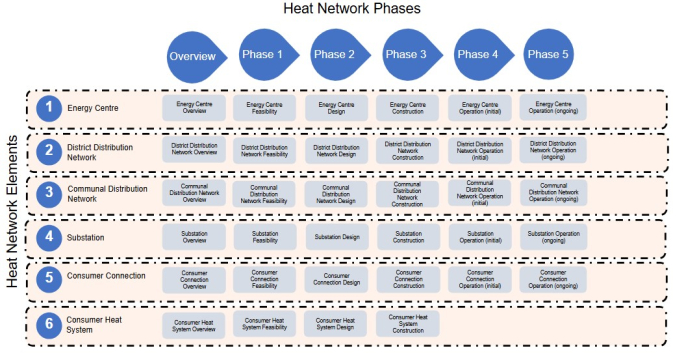
A technical specification document has been developed for each element at each assurance phase, as illustrated in the matrix in Figure 1 below. The exception to this is for the initial and ongoing Operation phases, requirements for which are covered in a single technical specification for each element to improve useability of documents. The material in each technical specification was developed in consultation with its own specialist working group of technical experts that had knowledge specific to each element and phase. In accordance with the scheme rules, Responsible Parties will need to meet the requirements in these technical specifications across all their elements at each of the stages.
Figure 1. A matrix illustrating the 29 HNTAS new build technical specifications.
For a heat network to be assured as having met the requirements which apply to it, we intend that Responsible Parties will need to pass an assessment point at each stage. Upon passing an assessment, a Responsible Party will be awarded a Statement of Conformity (SoC) by a HNTAS registered assessor as evidence they have met the necessary standards.
At the end of each phase, we intend for Responsible Parties to be required to present their Statements of Conformity before they can pass through the end of phase Gateway and progress to the next phase.
At the end of Stage 6 and 7, we propose that Responsible Parties will also be required to demonstrate to a HNTAS certifier employed by a registered HNTAS Certification Body that the necessary Statements of Conformity are in place and that certain other HNTAS obligations have been met in order to be awarded a HNTAS certificate.
Transitional arrangements for networks in Stage 2 and beyond are set out later in this document.
For existing networks, the Code will also set minimum requirements for the network elements in Table 2, but these will be set at various milestone points to enable performance improvements over time.
Consumer Heat System
Whilst elements 1 – 5 in Figure 1 will be included in the assessment and certification scheme across all phases, we propose that element 6 – the Consumer Heat System – will only be included in the scheme up until the end of the construction stage. For new heat networks, it is proposed that assessment and certification of the Consumer Heat System will take place in the pre-operational phases to ensure good design and construction. This will help prevent significant negative impacts once a heat network is operational. However, once residents have moved in, we have evaluated that it would be disproportionately invasive to consumers to require ongoing assessment and certification of the heat network system within the dwelling. Therefore, equipment classified within the Consumer Heat System, such as radiators and domestic hot water pipework, will not be subject to ongoing regulations after commissioning Stage 6. As such, there are no technical specifications for the Consumer Heat System at the operational phases. [footnote 10] It should be noted that element 5 – the Consumer Connections – which includes equipment such as Heat Interface Units, would remain in scope of HNTAS during the operational phase. The implications of this approach for Ambient loop and Shared Ground Loop networks are further considered in Section 3.4.
Consultation question
Question 1: Do you agree with the proposed approach to not include the Consumer Heat System in scope of HNTAS after the construction phase? If not, can you please suggest an alternative approach and set out your justification.
3. Scope of HNTAS
3.1 Networks in scope
In the 2021 consultation response [footnote 11], we said there was a need to develop technical standards that apply to existing heat networks as well as new heat networks, and to heat networks at all scales. Building on this, we propose that HNTAS will move the sector to a mandatory assurance regime for both new heat networks, and the c12,000 existing heat networks across Great Britain, with HNTAS applying to both district and communal heat networks. (See Annex 1 for definitions).
A fundamental question in the scheme design is which networks will be in scope of the specified standards and therefore will be required to engage with the Code Manager and progress through the assessment and certification processes. The expectation is that the same entity that is authorised by Ofgem will also be the entity with responsibility for meeting the new technical standards. Meeting technical standards will be a condition of authorisation for those networks that fall within the scheme’s scope, and it will be a condition of authorisation to sign up to HNTAS and agree to adhere to scheme rules and instructions from the Code Manager.
The Energy Act 2023 defines what a “relevant heat network” is, with subsequent secondary legislation describing two activities:
- operating a relevant heat network;
- supplying heating, cooling or hot water to heat network consumers by means of a relevant heat network.
The expectation is that due to the responsibility for the physical assets of the heat network sitting with the heat network operator, the operator would also be the entity required to meet the new technical standards. Under the Heat Network (Market Framework) (Great Britain) Regulations 2025, a person operates a relevant heat network “if the person controls the transfer on that network of thermal energy for the purposes of supplying heating, cooling or hot water.” There is also a recognition that where there may be more than one person involved in operating a relevant heat network, the person who is entitled to make decisions about modifying the network is taken to operate it. It is expected there would be alignment between the Responsible Party for HNTAS and the person identified as operating the network with responsibility for making decisions about modifying it. The same exemptions will apply in that Ofgem will not be regulating networks exclusively used for air-conditioning, and these systems will also not have to meet the new technical standards.
In terms of defining the scope of HNTAS, there is a balance between delivering on the core objectives of the scheme including reducing emissions, improving reliability and enhancing overall consumer experience, and meeting the core principles of ensuring the scheme is proportionate and deliverable.
3.2 Minimum network size
The proposals in this section only apply to networks serving domestic properties. For proposals on non-domestic or mixed-use networks please refer to the Minimum Network Measurement in Section 3.2.1.
We believe that very small heat networks may struggle to meet the technical requirements of HNTAS and that there should be a de minimis threshold for the scheme. Analysis by the HNTAS Technical Author Fairheat and engagement with engineering experts concluded that the minimum network size to which technical standards could reasonably be applied would be a network of six properties. This is because the assurance elements subject to assessment and certification (see Table 2) – for example an energy centre and a distribution system – would not be commonly present in networks with fewer than six properties. At five properties and below, equipment is more likely to be comparable to a domestic property than a heat network as defined by the elements in HNTAS. Therefore, we propose that no network below six properties, or capacity equivalent, would be required to meet the HNTAS requirements or engage with the Code Manager. For some of these networks, there would still be a requirement to attain authorisation and comply with other regulatory requirements imposed by Ofgem, such as overall reliability requirements to ensure consumers retain core protections.
Even when accounting for the exemption of networks with five or fewer properties, this still leaves 99% of properties and more than 80% of existing domestic heat networks in scope of HNTAS (see Table 4). This creates a proportionality and deliverability challenge, both for the smallest heat network operators and for the scheme. For the smallest operators, the costs of carrying out the upgrade works needed to meet HNTAS requirements would be spread over a smaller number of properties and therefore larger costs are likely to be passed on to consumers. While this would be a concern for existing networks, some of the smaller new build networks would avoid costly retrofits and benefit from lower operational costs in future if they adhered to the Code during the feasibility and design stages. We therefore propose that new networks which are in the feasibility and design stages at scheme launch will be in scope of HNTAS if they have six or more properties.
In terms of scheme deliverability, the cost to the Code Manager in engaging with a wide range of small market participants, including conducting audit and oversight activities, would be significant and result in improved outcomes for only a very small proportion of heat network consumers. For existing networks that are in construction or already supplying consumers at scheme go live, we are therefore proposing HNTAS requirements would only apply for networks with a higher number of properties. The appropriate number of properties at which to set this threshold is, to an extent, an arbitrary decision, as once a network supplies more than six properties HNTAS can easily be applied and there is no significant cost or customer coverage change associated with any threshold number. If set at eleven or more properties, however, this approach would ensure that 97% of properties retain the benefit of HNTAS driven efficiency and reliability improvements, while ensuring the scheme remains proportionate as a regulatory requirement. This approach was derived via stakeholder engagement and discussion, including at the HNTAS Programme Board, where it was agreed that the number of properties on a network is an easy metric to understand for operators and the Code Manager alike. However, we welcome wider stakeholder views on the threshold’s suitability in meeting the scheme’s objectives.
This is particularly the case as it is likely that there are further approaches which would serve the scheme’s objectives. One such option could be to obligate existing networks with six to ten properties to meet only a selection of HNTAS requirements, such as minimum metering and monitoring requirements and a more permissible performance thresholds than other networks will need to demonstrate by certification. Similarly, consideration could be given to bringing existing networks with six to ten properties in scope of the End of Life process where major replacement works are being undertaken (see Section 5.10 for further detail on End of Life). This option would also ensure that the scheme remains proportionate, although may introduce some complexities to deliverability.
Table 4: Heat Network Domestic Customers and Networks by Network Size (properties) for Communal and District Domestic Networks
| Network Size | Networks (cumulative) | Properties (cumulative) | % Networks (cumulative) | % Properties (cumulative) |
|---|---|---|---|---|
| <3 properties | 299 | 584 | 4% | 0.16% |
| <4 properties | 548 | 1331 | 7% | 0.37% |
| <5 properties | 910 | 2779 | 11% | 0.76% |
| <6 properties (proposed new network HNTAS applicability threshold) | 1091 | 3684 | 13% | 1.01% |
| <7 properties | 1382 | 5430 | 17% | 1.49% |
| <8 properties | 1505 | 6291 | 18% | 1.73% |
| <9 properties | 1726 | 8059 | 21% | 2.22% |
| <10 properties | 1830 | 8995 | 22% | 2.47% |
| <11 properties (proposed existing network HNTAS applicability threshold) | 1994 | 10635 | 24% | 2.93% |
| <12 properties | 2078 | 11548 | 25% | 3.18% |
| <13 properties | 2217 | 13228 | 27% | 3.64% |
| <14 properties | 2299 | 14294 | 28% | 3.93% |
| <15 properties | 2383 | 15470 | 29% | 4.26% |
| <20 properties | 2849 | 23410 | 35% | 6.44% |
| Total Domestic | 8165 | 363453 | 100% | 100.00% |
Source: Fairheat
Consultation questions
Question 2: Do you support the use of 6 properties or more for domestic-only networks, or the connection capacity equivalent for non-domestic/mixed use networks, as an appropriate minimum heat network size to which HNTAS participation would be mandatory for new networks after scheme go-live? Please provide reasoning for your answer and, if you answer is ‘no’ please provide an alternative approach .
Question 3: Based on the trade-offs between the benefits and costs of bringing smaller networks in scope of HNTAS, what, in your view, is the appropriate minimum heat network size to which HNTAS participation would be mandatory for existing networks? If this differs from the proposed use of 11 properties for domestic networks , or the connection capacity equivalent for non-domestic/mixed use networks, please provide supporting evidence and justification .
Question 4: Do you consider there to be need to subject existing networks with between six and ten properties to minimum network performance and monitoring requirements, or any other HNTAS requirements? What do you consider to be the implications of doing so?
3.2.1 Minimum network measurement
Whilst the minimum network sizing approach set out in the previous section works well for domestic only networks, there are limitations to using the number of properties as a metric for non-domestic or mixed-use networks. For example, this metric cannot easily be applied to networks with a small number of non-domestic users with high energy use. By defining these users as “properties”, such networks could easily fall below the minimum size threshold for which HNTAS would apply, although it may actually be proportionate to bring them in scope of the scheme. There may be similar challenges in assessing the size of networks that supply both domestic and non-domestic properties.
To resolve this challenge, we propose a separate “connection sizing capacity” metric by which operators of non-domestic or mixed-use networks can identify if their network is in scope of HNTAS requirements. Connection sizing parameters are established at design and, once a network is constructed, do not change in normal operation – an increase would require a physical adjustment. It should be noted that this metric is based on the capacity of end customer connections (e.g. Heat Interface Unit capacity for domestic networks), it is not based on generation capacity at the energy centre which would be lower due to diversity of demand.
As shown in the Market Framework Regulations [footnote 12], 45kW is representative of a single “unit” or dwelling Heat Interface Unit (HIU). Therefore, a network with a total connection capacity of <450kW would represent the equivalent of a network with 10 properties or less. Using this equivalency, any network above the 450kW connection capacity threshold for existing networks, and 225kW for new networks, would be subject to technical standards.
Worked Example
An existing heat network supplies heat to eight flats and a small supermarket.
The supermarket has a 135kW connection capacity. As 45kW is representative of a single dwelling, the supermarket represents the equivalent of 3 dwellings. (135/45 = 3.0)
The eight flats represent a 360kW connection capacity. (8x45=360)
In total the heat network supplies the equivalent of 11 dwellings, representing 495kW connection capacity. (8+3=11, 135+360=495kW)
The network therefore falls within the scope of HNTAS.
Changes in Circumstances
Changes in circumstances may cause small networks to be brought into scope of the scheme. For example, a small network with ten properties, would be brought in scope if it connected to a larger network and subsequently exceeded the established applicability thresholds set out above. In such cases, the smaller network would be required to pass certain assessments prior to connection, to avoid any detrimental impacts on consumers on the larger network. Connections of this nature are likely to occur with increasing frequency following the introduction of Zoning legislation.
Industrial Heat Networks
Heat networks which supply large industrial sites are often specialist, very high temperature and driven by large process heat demands which are closely controlled by the process owner. This makes them significantly different to heat networks serving domestic and commercial buildings. Setting minimum technical standards for these industrial sites would therefore be technically difficult and much more challenging. Furthermore, the potential for consumer detriment arising from excluding these networks would be minimal/negligible. We therefore propose that industrial sites be excluded from HNTAS at the point of scheme launch, with the option to review inclusion later, once the scheme has bedded down.
This exemption would be based on the following definition:
Industrial heat network means a heat network where the heating, cooling or hot water which is supplied by means of that heat network is wholly supplied for an Industrial Process, as outlined in the Town and Country Planning Act [footnote 13], [footnote 14] (e.g. the making, or altering, of any article).
This aligns with the position given in the 2024 Heat Networks Regulation: Consumer Protection consultation response [footnote 15], which states that entities operating or supplying through heat networks exclusively to industrial customers will not be subject to heat network decarbonisation and consumer protection standards, although they would need to be authorised to ensure Ofgem and government have an accurate understanding of heat network coverage across the country.
Consultation question
Question 5: Do you agree with the proposals for minimum network measurement and that industrial networks (as defined above) should be exempt from HNTAS at scheme launch? Please give reasons why you agree or do not agree with the proposal.
3.3 Interaction with Ofgem regulation
The scope of heat networks needing to meet technical standards will interact with the wider approach to Ofgem’s authorisation and associated consumer protection regime. The 2021 [footnote 16] consultation response stated that there would be no de minimis threshold where networks would be exempt from Ofgem regulation. The intent of this was to avoid leaving a significant number of consumers on small heat networks without the benefits of enhanced consumer protection that Ofgem regulation would offer.
The 2023 consultation [footnote 17] on consumer protection reaffirmed this view, although it recognised that the definition of a “heat network” could unintentionally cover some situations which would not ordinarily be recognised as heat networks, such as conversions of an existing domestic property into two separate properties, or addition of an annex to an existing property. The majority of respondents agreed with our proposal not to capture very small building conversions and annexes, and this has been taken forward with further detail on how this has been achieved in the associated decision document [footnote 18].
Ofgem’s authorisation will however, subject to these exemptions, continue to encompass all relevant heat networks, as defined in the Energy Act 2023. Which for the purposes of a district heat network, would mean a heat network by means of which heating, cooling or hot water is supplied to two or more buildings or persons in those buildings.
This creates a situation where Ofgem authorisation will apply to any heat network – subject to exemptions – of two properties or above, whereas HNTAS requirements will not apply to new networks with fewer than six properties (or fewer than 11 properties for existing networks). As detailed above, this is due to the design of the technical standards scheme which requires assessment and certification of different elements, the increased resource costs of the scheme as a consequence for networks without the constituent parts of an energy centre, distribution system, and from a proportionality perspective for existing networks of eleven properties or equivalent to meet the full technical requirements. While these networks would not incur the costs of meeting technical standards or be required to engage with the Code Manager, properties on these networks would continue to benefit from core consumer protections in the regulatory regime overseen by Ofgem.
There will also be a differentiation in approach between existing networks and new networks at the point of HNTAS go-live in how technical standards will interact with Ofgem’s authorisation approach:
- Existing networks operating at the point of Ofgem regulation go-live will, by virtue of the secondary legislation establishing regulation, be treated as authorised at regulatory go-live. As such, they will be obligated to register their details with Ofgem within the initial period. Ofgem registration is not intended to be contingent on HNTAS registration. Registration with the Code Manager will be required once the HNTAS digital service is available.
- Operators of new heat networks will be required to provide evidence that their heat networks comply with the technical standards in the code and that they have entered into an agreement with the Code Manager. Evidence of compliance with the code will be through presentation to Ofgem of the necessary certification. This presentation of evidence of HNTAS certification to Ofgem prior to authorisation is expected to take place at the end of Phase 3 (construction) at the point the network is commissioned, but prior to operation in Phase 4.
- Many heat networks may be built out in phases and as such full certification will not be issued until all phases of the heat network have been completed. HNTAS may therefore provide ‘certification of minimum reliability standards’ based on commissioning and acceptance testing of each phase as it is completed. Ofgem will accept this certification and be able to authorise each phase of the heat network as it is built.
- Due to the sequencing of go-live of Ofgem regulation and the HNTAS scheme, there is a scenario where some new build heat networks are commissioning and being authorised prior to HNTAS being in place. It is expected that authorisation under these circumstances would come with a condition that operators must meet the prescribed standards within set timeframes, as detailed in Section 5.8.
As part of its role in preparing for regulation, Ofgem is also exploring what approaches can be taken to improve performance and efficiency of the smallest networks which will not be compelled to meet the HNTAS technical standards. This includes broad authorisation conditions for all heat networks to maintain security of supply [footnote 19] and help achieve fair outcomes for customers of these networks and, under certain circumstances, application of guaranteed standards of performance (GSOPs) which would mean consumers could be compensated if, for example, reliability falls short of what consumers should be able to rely on.
As explored in the 2024 Heat Networks Regulation: Implementing Consumer Protection consultation [footnote 20], it may not be appropriate for all heat networks to have GSOPs in place, such as those operating on a not-for-profit basis, with the intention that overall standards of performance would be put in place that would require networks to meet the same standards, but use alternative enforcement powers to ensure these are met. Consumers will also benefit from the availability of recourse to Alternative Dispute Resolution. The Energy Ombudsman now takes on complaints from heat network consumers where their complaint cannot be resolved, and the dispute relates to a breach of heat networks regulation by suppliers or operators.
We expect this to achieve resolution of a significant proportion of issues without requirement for involvement by Ofgem from a compliance perspective. DESNZ are also exploring what can be put in place to ensure that even where a small network may not need to meet HNTAS technical standards, they can still access the grants and training to improve performance.
3,4 Ambient loop and Shared Ground Loop Networks
Ambient loop and Shared Ground Loop (SGL) networks are relatively new heat network technologies which are increasingly coming into use. DESNZ are supportive of these innovative approaches and, in recognition of their future role in the market, they are included in the Energy Act 2023 and are in scope of HNTAS. Work is underway to develop the detailed minimum technical requirements and KPIs for them, to be included in draft HNTAS Code documents.
Due to the way in which these systems differ to that of traditional heat networks, consumers on these networks often own an individual heat pump connected to the shared system. As set out in Section 2.4, consumer level heat pumps have provisionally been included within the definition of the consumer connection element, which would subject them to assessment and certification requirements for each assurance phase, from design to ongoing operation. Once supplying heat to consumers, this would entail meeting the HNTAS KPIs and metering and monitoring requirements on an ongoing basis.
Three key themes have been considered in reaching this approach:
- Technical: the level of impact of the equipment on the design and performance of the overall system on an ongoing basis.
- Individual Consumer: the level of impact of the equipment on the cost and reliability to the single consumer.
- Policy: the level of impact of the equipment classification on the wider policy and scheme aims.
Our initial assessment is that heat pumps have a significant impact for each theme and, if not regulated on an ongoing basis, pose an undesirable level of risk to the aims of HNTAS.
Regulating Ambient loop and SGL consumer heat pumps past the point of commissioning may result in Responsible Parties of new networks retaining ownership of the individual heat pumps so they have better control of meeting ongoing HNTAS requirements. For existing systems, this approach may encourage the Responsible Party for the rest of the network infrastructure to buy back consumer owned heat pumps. Where consumers on these systems own their heat pumps, we are not proposing that they are considered Responsible Parties in their own right – as to do so would subject them to authorisation. Where ownership transfer is unfeasible, consideration will need to be given to the handling of this issue. We welcome your views in helping us shape this proposal.
Consultation question
Question 6: What, in your view, are the implications of including consumer heat pumps on Ambient loop and Shared Ground Loop networks within HNTAS past the design and construction phases? If you think an alternative approach is needed, please provide details and reasoning, including (if applicable) if this differs with respect to new build networks and existing networks.
4. HNTAS Governance Structure
4.1 Whole scheme governance structure
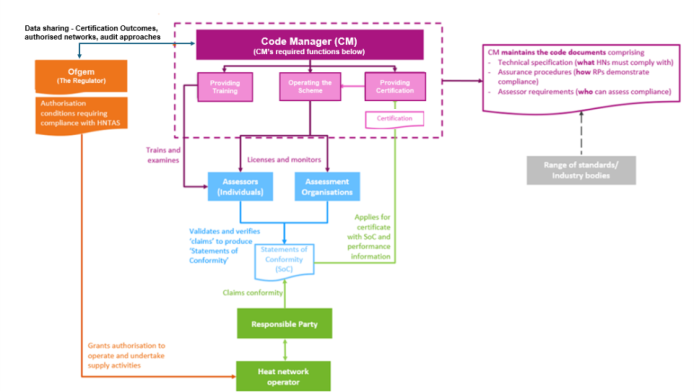
Robust governance is essential to establish and maintain integrity and public confidence in HNTAS. For governance to work effectively and in the interests of the consumer, there need to be clearly defined functions and lines of accountability. The governance and assurance process has been developed with these imperatives in mind.
The Energy Act 2023 provides for Ofgem to be appointed as regulator of the heat networks sector, with the power to authorise individuals or entities to operate heat networks and undertake supply activity. Those authorised parties will be subject to certain authorisation conditions. Compliance with minimum technical standards and other HNTAS requirements is to be one of these conditions. Specifically, for new build networks, passing HNTAS assessments and attaining HNTAS certification will be a prerequisite for becoming authorised. For operators of existing networks, assessment passes and attaining HNTAS certification will be required after a set period of time to ensure performance levels meet requirements. Operators of existing systems will need to attain HNTAS certification within this timeframe if they are to comply with the HNTAS Code and continue to satisfy their technical standards authorisation condition.
We recognise that the duties and responsibilities that will need to be discharged under HNTAS will often lie across multidisciplinary parties, as most networks involve several organisations working in collaboration such as, designers, contractors and operators. To ensure accountability, we therefore propose that each network must have an appointed Responsible Party who is ultimately responsible for the network and the meeting of HNTAS requirements. Typically, this will be the party developing or operating the heat network and, whilst there must always be a named Responsible Party for each heat network, that organisation may change throughout the course of a heat network’s lifecycle. Once a heat network is certified by HNTAS and authorised by Ofgem, the Responsible Party signed up with HNTAS must be the same entity authorised by Ofgem to be the operator of the heat network.
A key role in HNTAS governance is that of the Code Manager. This role could be performed in a number of ways, but we consider it to be optimal for the Code Manager function to be carried out within DESNZ, at least in the initial period of regulation. While powers in the Energy Act allow for the Code Manager to be a body licensed by Ofgem, this is not being pursued as the lead option.
We intend for the main requirements of the Code Manager to include overall responsibility for HNTAS, operating the scheme, and maintaining the Code. The Code documents may comprise:
- Technical specifications (what technical requirements a Responsible Party must ensure its networks comply with)
- Assurance procedures (how a Responsible Party demonstrates compliance)
- Assessor requirements (who is allowed to assess compliance)
- Certifier requirements (who is allowed to certify compliance)
The Energy Act provides for a “designated document” that the Code Manager will have responsibility for overseeing. The intent is that this designated document will be formed of suite of documents setting out the technical standards networks will need to comply with, alongside the governance documents that will set out the accompanying assurance processes. This designation will take place via a future piece of secondary legislation, which will also set out how the designated documents may be modified – including through the change management process overseen by the Code Manager, and directly by Ofgem – and circumstances for revocation or cessation of the designation of the designated documents. The regulations will also provide for the designated documents to refer to other documents including standards, specifications or requirements that may be published at other times.
This allows for the technical specifications to refer out to other industry standards, such as the British Standards Institution standard on the thermal insultation of pipes, or the upcoming BESA HIU Test Standard 2025. CP1 (2020) has now been updated into a new Heat Network Technical Standard (TS1), and this will be the most heavily referenced standard in the technical specifications. It will therefore be important to ensure strong alignment between the HNTAS technical requirements and TS1. With this aim in mind, the continued development of the draft TS1 will ensure it aligns with HNTAS regulatory requirements before HNTAS launches. We expect TS1 will be revised and updated regularly to ensure it builds on the experience of implementation and reflects future technical changes. This is also true of the HNTAS Metering and Monitoring Standard.
In addition to maintaining the Code, we expect that the Code Manager will be responsible for three key functions: operating the scheme, carrying out certification activity, and delivering HNTAS training.
Operating the scheme would involve carrying out the day-to-day operation of HNTAS, with functions that may include: consulting on proposed changes to the Code; handling HNTAS related complaints, disputes and appeals; taking action in cases of non-compliance; and operating, maintaining and running a HNTAS Digital Service.
Carrying out certification activities would involve the running of the certification process, utilising a group of HNTAS certifiers to undertake certification activities and award certificates to heat networks that have satisfactorily evidenced HNTAS compliance. We anticipate that the broad principles of ISO 17020 would be followed, but that accreditation from the UK Accreditation Service (UKAS) will not be required in the early stages of scheme implementation. Certification outcomes would be shared with those undertaking the scheme operation function, via a Digital Service, to enable certified networks to be added to a publicly available register, as well as to enable the Code Manager to accurately monitor compliance levels and overall scheme effectiveness.
Developing and delivering training would involve the Code Manager carrying out the training activities needed to underpin key roles in the scheme. For example, to become a HNTAS assessor or certifier, we would expect that individuals would first need to provide evidence to the Code Manager of having certain qualifications and sufficient technical experience before attending Code Manager led sessions and passing examinations. Utilisation of a group of specialist heat network instructors is expected, with retention of course attendee records. Attendee outcomes would be shared with those undertaking the scheme operation function.
As part of the function of operating the scheme, we intend for the Code Manager to register and monitor Assessment Organisations and individual Assessors. Together, Assessment Organisations and Assessors will play a pivotal role in the scheme - carrying out HNTAS assessments for various elements at various stages in a network’s lifespan. This will entail assessing claims put forward by Responsible Parties with a view to issuing Statements of Conformity where claims have either been validated or verified as HNTAS compliant. Once the necessary Statements of Conformity have been received, a Responsible Party can apply for a certificate by putting forward those Statements and performance data to the Certification Body.
We are exploring how these functions can be carried out most efficiently and for the best value for money. One option is for the Code Manager to appoint a Scheme Operator, Certification Body and Training Provider to carry out these responsibilities. The Code Manger may also wish to appoint a supplier to provide technical support to the Scheme Operator. As we identify the most appropriate entity to act as Code Manager, we will explore the most efficient method for performing the key functions identified. In time, this could involve a blend of outsourcing and the Code Manager evolving to deliver key functions ‘in house’. In all cases, appointed suppliers would only perform functions on behalf of the Code Manager. The Code Manager would remain accountable for the actions or omissions of any suppliers contracted to undertake these functions.
At HNTAS commencement we envisage three main functions: a single Certification Body, Training Provider and the Scheme Operator. However, over time, consideration could be given to having more than one of each entity to bolster HNTAS’ operational resilience, introduce an element of intra-competition between contracted entities to further encourage high quality outcomes, and improve continuity between entities in relation to offboarding and onboarding organisations as contracts end and begin. On the other hand, there may be opportunities to further streamline these structures, and we remain open to simplifications where these would not introduce impartiality concerns, reduce quality of service or remove essential functions.
Code Manager functions
Whilst the precise method for performing these key functions continues to be explored, to aid ease of understanding, throughout the rest of this document functions are referred to as being performed by the following:
- Operating the Scheme – Scheme Operator
- Carrying out certification activities – Certification Body
- Developing and delivering training – Training Provider
Consultation question
Question 7: Do you agree or disagree with our proposed governance structure, and in particular with the appointment of a Code Manager? Please provide reasons for your response.
4.2 Code management committee structures
Accountability for and assurance of the integrity of HNTAS is an integral part of the governance and assurance structure. With a directly appointed DESNZ Code Manager, this is provided for through conditions set by the Secretary of State.
We envisage the need for a Code Management Committee comprised of relevant stakeholders, such as Ofgem, DESNZ and Scottish Government to assist the Code Manager in maintaining the Code.
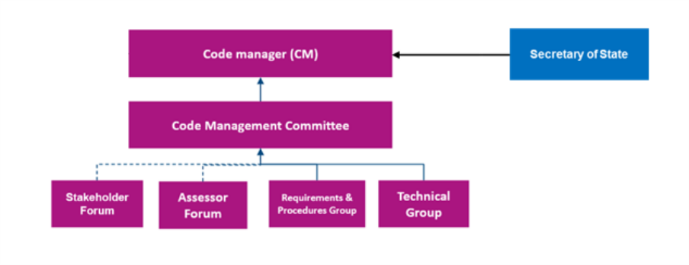
The Code Management Committee might perform such functions as recommending changes to the Code and, under the direction of the Code Manager, ensuring that Code remains fit for purpose. To facilitate this role, we anticipate the need for various key sub-committees, to identify changes that may be needed to the Code, review these and pass Code recommendations to the Code Management Committee for final decision. The core types of Code change could be used to inform the organisation of such sub-committees. For example (see Figure 2):
- An Assessor Forum could gather views from HNTAS Assessors and Assessment Organisations to propose changes that enhance assessment standardisation, among other assessment related matters.
- A Stakeholder Forum could bring together views from heat network consumer advocacy bodies and trade associations to propose changes to the scheme as they relate to the interests of end consumers and other industry players.
- A Procedural Group could propose changes to scheme rules or help further develop guidance, among other related procedural matters.
- A Technical Group could propose changes to the technical specification, including changes as a result of innovation in the sector or where other industry standards referenced in the technical specification have moved on.
Such sub-groups would play a critical role in representing the views, interests and experiences of the full complement of actors impacted by, and interacting with, HNTAS.
Figure 2. Suggested Code Management Committee governance structure
Consultation question
Question 8: Do you agree or disagree with the need for a Code Management Committee and sub-committees to ensure the views, interests and experiences of those involved in, or impacted by, HNTAS are taken into account to further evolve and improve the scheme? Please provide reasons to support your views.
4.3 Establishing a Code Manager
DESNZ acting as the Code Manager
It is proposed that initially, DESNZ will carry out the role of the Code Manager. This has been assessed as the most efficient route to market.
The Code Manager’s functions would be undertaken by DESNZ and, although provided for in the Energy Act 2023, would not necessarily require a Code Manager licence to be issued. DESNZ would monitor the performance of the Code Manager through internal mechanisms, with oversight and enforcement responsibility resting with DESNZ Secretary of State
This does not affect Ofgem’s enforcement role over Responsible Parties as set out in their authorisation conditions, which will remain the same regardless of who undertakes the Code Manager role. Also, this does not rule out Ofgem issuing a Code Manager licence to a different entity at a later date, should it be deemed appropriate for DESNZ to cease carrying out the Code Manager role. There will only be one Code Manager in place at any time, but this approach allows flexibility on who can undertake the role in the future.
We continue to explore potential longer-term governance models for the Code Manager. As these are matters subject to internal processes and decision making, further detail will be included in a later publication. To note, the proposals set out in the rest of this consultation, such as the assessment and certification processes, are not impacted by the type of entity selected to be the Code Manager.
Consultation question
Question 9: Do you support our proposal for the Code Manager to be housed within DESNZ initially, whilst we work through long term governance options? Please provide a justification for your answer.
4.4 Code Manager cost recovery
The Code Manager, and any suppliers it subcontracts to perform its functions, will incur costs from operating the scheme. For example, costs will arise from undertaking monitoring and compliance activity to track Responsible Parties’ compliance with the Code. Code Manager activity will also include the registration of Responsible Parties, collection and collation of performance data, monitoring progress against agreed performance plans as well as undertaking audits. The estimated costs of the Code Manager are expected to be £5-10 million per year under normal operations once the scheme is established. Further information on Code Manager costs is contained in the Options Assessment.
To note, the costs associated with Responsible Parties engaging assessors and certifiers to undertake assessment and certification are expected to be covered by Responsible Parties and are not in scope of Code Manager cost recovery.
Responsibility for ensuring that Code Manger expenditure represents good value for money will lie with DESNZ. For example, the annual costs of the Code Manager will depend heavily on audit volumes, which can be adjusted according to scheme need.
To start with, DESNZ propose to recover these costs from gas and electricity consumers through gas and electricity licence fees. Over time, and as the heat network sector grows, we propose moving to a blended approach of recovering the costs from gas and electricity consumers and heat network consumers after this initial period. This approach is in line with the 2024 Licence Fee Cost Recovery Principles consultation that sets out how Ofgem’s costs for Heat Networks regulation will be recovered [footnote 21]. Following this consultation, this proposal is subject to further Ofgem consultation.
Due to the large number of gas and electricity consumers, spreading the cost of the Code Manager between them would have a relatively smaller impact on bills [footnote 22]. In contrast, recovering these costs solely from heat network operators could result in an unaffordable cost burden being passed onto heat network consumers, as there are a much smaller number of heat network consumers among which to share costs [footnote 23]. Sharing such costs in a nascent sector such as heat networks risks stifling the expansion of the sector, jeopardising a key component of the government’s net zero policy.
DESNZ has considered other sources of funding such as Exchequer funding, however, we have assessed that, in line with wider heat network regulatory cost recovery, this would be unsuitable. Exchequer funding offers the least amount of flexibility if there were to be an underspend or overspend on Code Manager costs.
Consultation questions
Question 10: Do you support our proposal to recover 100% of the Code Manager’s costs through the gas and electricity licence fee mechanism in the short term? Please give reasons or supporting evidence for your answer and clearly outline any alternative proposals.
Question 11: Do you support our proposal to recover the Code Manager’s costs through a blend of gas and electricity licence fees and fees from the heat network sector in the longer term? Please give reasons or supporting evidence for your answer and clearly outline any alternative proposals.
4.5 Code Manager and Responsible Parties relationship
This section seeks views on our proposed approach to the relationship between the Code Manager and heat network operators that will be subject to technical standards.
It is expected that a requirement to meet technical standards and enter into an agreement with the Code Manager would form an authorisation condition for heat network operators.
The new technical standards being introduced through HNTAS are based on the existing voluntary standard CP1 (2020). Currently, there is a process to achieve conformity with CP1, but there is not a legal relationship between CIBSE and the heat network operator. Given the expectation that the Code Manager will be involved in compliance engagement with heat network operators, a voluntary approach with no contractual terms underpinning the relationship is no longer sufficient.
One option for the basis of the relationship between the Code Manager and heat network operators would be an accession agreement, mirroring the approach in gas and electricity codes. Examples such as in the Retail Energy Code and Balancing and Settlement Code (BSC). These documents are concise, with common features of these agreements including identification of the parties, that any joining party agrees to comply with the Code including its terms and conditions and framework agreement and identification of governing law and jurisdiction. A breach of the terms of the agreement means the Code Administrator or Manager can take action against the party that has failed to meet the terms of the agreement. However, as these codes operate as multi-party agreements, this model is less suitable for the expected relationship between heat networks and the Code Manager.
Our preferred approach is a deed poll that operators would be required to sign as a subject of authorisation. The deed poll in gas and electricity is an agreement that the market participant will agree to comply with the Ombudsman’s terms of reference and any decision that they have proposed as a resolution and which the consumer has accepted. A deed poll is a legal document that would be enforceable via redress in the courts both for the Code Manager and third parties. This ability for other organisations or interested parties such as consumers or an alternative redress scheme, provided that this is permitted by regulations as a requirement of the technical standards regime, is the advantage of a deed poll over an accession agreement. Deed polls are also flexible to be able to encompass relevant subsidiary undertakings, such as might be the case for multiple heat networks being operated by one overall operator.
While prior to authorisation there can be no mechanism through which heat networks can be compelled to enter into an agreement with HNTAS, it is expected that Responsible Parties will do so to formalise ongoing engagement with the Code Manager prior to gaining certification. This is the case as Responsible Parties will need to evidence compliance with technical standards before Ofgem will grant heat network operators authorisation to operate and supply.
Consultation question
Question 12. Do you support the preferred approach of a Deed Poll relationship between heat network operators and the Code Manager?
5. HNTAS Requirements: Technical, Assessment and Certification
Draft Code documents have been developed setting out the minimum technical requirements at a series of assessment gateways through design, construction, and commissioning. In line with the 2021 government response to the 2020 heat networks consultation [footnote 24], many of these documents build on existing industry-led initiatives. In particular, the specifications heavily reference the new TS1 which is largely based on CP1(2020) – the voluntary Code of Practice which has gained general acceptance within the sector.
While the draft Code documents and TS1 do not form part of this consultation, those with a technical background may find referring to them useful to aid understanding of the proposals in this section.
The assurance process is important to the successful delivery of HNTAS. It is designed to instil consumer and market confidence in the scheme whilst ensuring that the costs and administrative burdens are proportionate.
There are two separate but interdependent parts to the HNTAS assurance process. The first part is assessment: a system of peer reviews undertaken throughout the design, construction and operation of a heat network, ensuring the right decisions are made at the right time to place all heat networks in a strong position to achieve certification. The second is certification: points at which the actual performance outcomes of a heat network are tested against the KPI requirements and design intentions.
Assessment and certification processes have been designed to reduce risk across projects, which will benefit the sector through improving practices and standards, helping the market to grow, and delivering more reliable and affordable heat for consumers.
Depending on the characteristics of a heat network, there are different assurance pathways. That said, the assurance pathway for all heat networks, regardless of whether the heat network is new or existing, will consist of an assessment regime, a certification regime, and an ongoing monitoring regime.
5.1 Heat network categories
Each of the heat network categories in Table 5 has a different assurance pathway.
Table 5: A summary of network category definitions
| Network Category | Definition |
|---|---|
| New build | A heat network that does not exist at HNTAS launch |
| Pre-operation | A heat network that exists (physically or in project form) but is not supplying heat to consumers at HNTAS launch |
| Existing | A heat network that is operational (supplying heat to consumers) and is pre-authorised by Ofgem when HNTAS launches. Sub network types within this category include: - Networks subject to HNMBR metering requirements - Networks not subject to HNMBR metering requirements |
| Certified networks | A heat network which has received both HNTAS certificates, is authorised by Ofgem and is supplying heat to consumers. Sub network types within this category include: - Networks which have competed the new build assurance pathway - Networks which have completed assurance pathway for existing networks |
| End of Life networks | An operational heat network which is at the end of its operational lifespan and is being replaced or undergoing significant capital works to become HNTAS compliant. Full decommissioning and market exit may occur for some End of Life networks. Sub network types within this category include: - Existing networks which have been declared as End of Life to the Code Manager - Certified networks which have been declared End of Life to the Code Manager once they have reached the end of their functional lifespan |
Initially, all network categories will fall into two main assurance pathways, as shown in Figure 3 below.
Figure 3. Assurance pathways of heat network categories under HNTAS at scheme launch
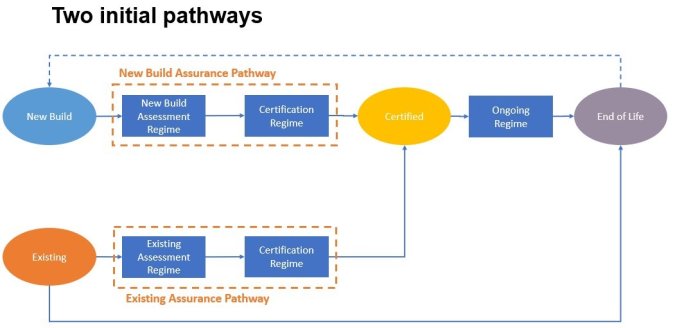
The assurance pathway for existing heat network will become redundant once all existing networks have either achieved certification or declared End of Life (see Section 5.10). After this point, the scheme will only cover the top pathway of New Build, Certified and End of Life networks, as illustrated in Figure 4 below.
Figure 4. Assurance pathways of heat network categories under HNTAS (eventual scheme)

5.2 New build networks
The HNTAS approach separates assessment and certification into two distinct processes, with the proposed stages of gateway assessments and certification shown in Figure 5. The orange areas indicate the gateway assessments, and the green areas indicate the certification points.
Before a heat network can progress from the feasibility to the design phase, we propose there will be a gateway assessment to validate that network is likely to meet future operational performance targets. These targets will take the form of a set of Key Performance Indicators (KPIs) which will be used as the framework for measuring and monitoring heat network performance.
We propose another gateway assessment before a heat network can progress from the design to the construction phase to validate that the design is likely to meet future operational performance targets. Once in the construction phase, there will be an assessment at construction design to again validate that the design is likely to meet future operational performance targets, and assessments at installation and commissioning to verify that the required performance outcomes have been met.
We propose that the assessment at commissioning, when the network is ready to supply heat, be a gateway assessment which needs to be met before a network can progress to the operational phase. There is a clear requirement to have a binary yes/no decision at this point, which we propose be evidenced by the award of a certificate - Certificate 1 - to networks that meet HNTAS requirements. It is anticipated that once the scheme is up and running, Responsible Parties will need a certificate before Ofgem will grant them authorisation to operate that heat network and supply heat to consumers.
It is proposed that the final gateway assessment will take place two years after operation, to ensure technical requirements continue to be met before a final certificate can be issued. Following this, a second and final certificate - Certificate 2 – will be issued.
After receiving Certificate 2, we propose that heat networks move to a light touch ongoing reporting regime, submitting data to the Code Manager through a HNTAS Digital Service at regular intervals to evidence continued compliance. Section 5.4 contains more information on certified networks.
More detailed information about assessors and certifiers, and the requirements to undertake either activity, is set out in Section 6 and 7.
In this section we set out aspects of the technical and assurance requirements, which form part of the HNTAS Code structure. Draft Code documents have been designed and developed in consultation with a range of experts across the heat network industry, culminating in a set of requirements that aims to balance pragmatism and proportionality with the robustness required to inspire confidence in a growing market through validation, verification and certification of each of the elements within a heat network.
Proposed HNTAS approach
Forming part of the Code document structure, the technical specifications set out the technical requirements across all phases of a heat network’s lifespan, for each element of a heat network. There is an assessment procedure document to accompany each of the technical specifications, setting out the assessment activities that need to be undertaken to provide assurance that the requirements in the technical specifications have been met. Each phase is a defined period over the heat network development and operation, and will contain at least one stage, concluding with a gateway review as shown in Figure 5.
Figure 5. New build assurance process
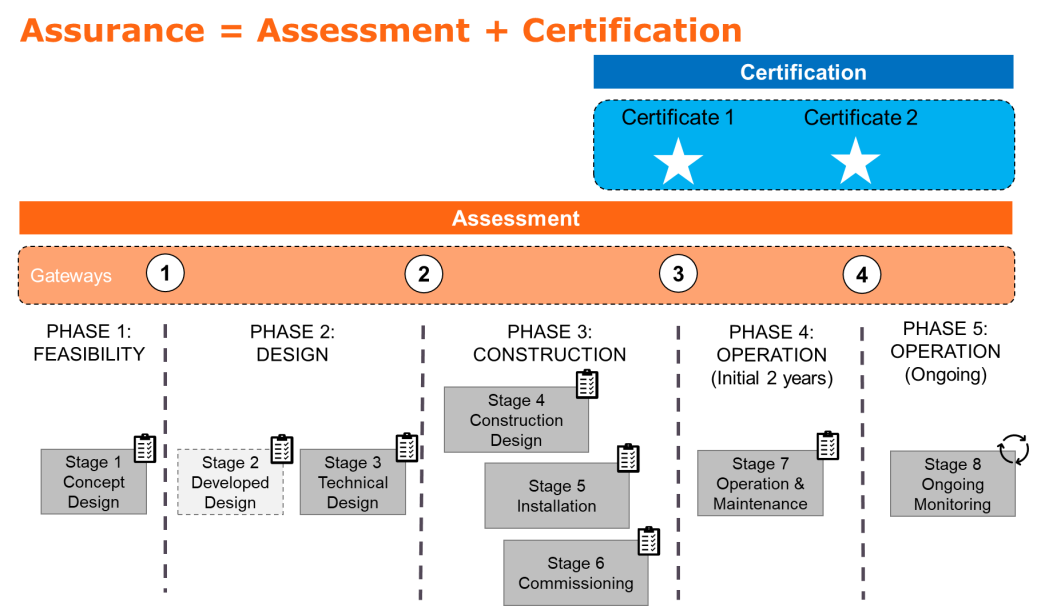
Phases
The technical specifications cover the five phases outlined below:
- Phase 1 - Feasibility
- Phase 2 - Design
- Phase 3 - Construction
- Phase 4 - Operation (initial 2 years)
- Phase 5 - Operation (ongoing)
Each phase has its own document. The exception to this is for the initial and ongoing operation phases, requirements for which are covered in a single technical specification for each element to improve useability of documents.
Stages
Within each phase, there are stages for which there are specific technical standards. If technical standards for a stage are met, the HNTAS assessor will issue a Statement of Conformity as proof of compliance at that stage. The specific technical standards consist of:
-
The technical requirements to be met;
-
The performance monitoring requirements to be met;
-
The key failures to be avoided at each stage;
-
The evidence requirements to be provided to demonstrate conformity with the technical standards and avoidance of key failures.
Key Performance Indicators (KPIs)
The specific KPIs which Responsible Parties will need to demonstrate minimum levels of performance against for each stage. They are split into two types:
-
Assessed KPIs: These are KPIs which are assessed against pre-determined targets and need to be met in order to achieve and maintain HNTAS certification.
-
Reported Metrics: These are KPIs which are not assessed against a pre-determined targets and do not need to be met in order to achieve and maintain certification. However, these KPIs provide valuable information so are required to be reported in the same format as assessed KPIs.
Gateways
Gateways occur at the end of each phase. Before progressing through a gateway to the next phase, certain conditions must be met. Prior to Stage 5, this will involve validation; evidence will be assessed to validate that performance outcomes will be achieved. From Stage 5 onwards, this will involve verification – evidence will be assessed to verify that activities have been undertaken (e.g. installation of insulation) and that performance outcomes have been achieved. This is illustrated in Figure 6 below.
If a network passes an assessment, a Statement of Conformity will be issued by a HNTAS assessor as proof of HNTAS compliance for the relevant stage. All the required Statements of Conformity for the stages within each phase will be needed to pass through an end of phase gateway.
Figure 6. Validation and verification throughout stages
Question 14: Do you agree with the gateways for new build heat networks being at the end of design, then end of construction/commissioning, followed by proof of measured in-use performance after 2 years. If you disagree, please suggest an alternative approach and set out your justification.
Impacts on housing supply
As noted in this consultation’s Options Assessment, introducing heat network technical standards regulation has the potential to act as a barrier to entry as developers may be dissuaded from having to design and build to certain standards. However, evidence from the sector and the HNTAS new build heat network pilot programme indicates that mandatory technical standards can produce Capex cost savings, for example from preventing the oversizing of equipment. Developers, and any contractors they may engage to support in the feasibility, design and construction phases of a heat network, may also find the HNTAS framework and guidance makes the design and build process of a new networks easier.
We are aware that there are concerns that assessments and certification processes may cause delays to the development process and we are exploring how assessment and certification activities can take place throughout stages to reduce bottlenecks and mitigate against this risk.
Heat networks are one of many heating solutions developers may choose to use and there may be cases where alternative options may be more appropriate. For this reason, and those noted above, we have assessed that HNTAS is unlikely to have any significant impact on housing supply or Government housebuilding targets.
Consultation question
Question 15: If you anticipate that introducing HNTAS will have any impact on the Government’s housing supply ambitions please provide expected impacts with reasoning and evidence to support your answer.
5.3 Existing networks
It is clear that many existing heat networks would find it difficult and cost prohibitive to meet the HNTAS minimum standards we are proposing for new heat networks. We are also aware that once an adequate standard of performance has been achieved, the additional measures required to reach the new build standard, such as rerouting large tracts of pipework, are likely to be some of the costliest and most disruptive to residents, whilst yielding only marginal improvements in consumer outcomes. In recognition of this, some of the standards for existing networks will be less stringent than standards imposed on new builds.
We also acknowledge that it will take time for many existing heat networks to make the improvements needed to achieve satisfactory performance. Therefore, we are proposing a pragmatic transitionary approach of several years to bring existing networks up to standard, with achievable milestones throughout to support a steady improvement in performance over time. The milestones in the existing network assurance pathway are outlined in Table 5, with all existing networks required to meet these within a defined period of time.
It should be noted that Table 6 does not apply to End of Life heat networks, which will be assured under a separate pathway set out in Section 5.10.
Table 6: Proposed milestones for existing networks
| Milestone | Requirement |
|---|---|
| Milestone 1 | Register heat network |
| Milestone 2 | Demonstrate meeting minimum metering and monitoring requirements Demonstrate meeting threshold performance, with a Milestone 2 Statement of Conformity |
| Milestone 3 | Submit Heat Network Performance Improvement Plan (to reach certification) |
| Milestone 4 | Certification 1 – meeting performance requirements |
| Milestone 5 | Certification 2 – meeting operation and maintenance requirements |
The timescales for existing networks to meet these milestones depend on if they are currently subject to HNMBR metering requirements, and are detailed later in this section.
On their journey to meeting minimum standards, heat network operators will need to register their heat network and meet a minimum threshold performance relatively soon after HNTAS commences. This minimum threshold performance will primarily focus on consumer outcomes, ensuring that networks are under control and achieving minimum levels of reliability. At this stage, it is likely that the following will need to be evidenced by Responsible Parties to a HNTAS assessor before they can be issued with a Milestone 2 Statement of Conformity:
- Heat losses are no higher than 400 W/dwelling
- Bypass flow rates are below a certain level
- Certain reliability requirements have been met (e.g. the number of unplanned interruptions does not exceed unacceptable levels)
- Minimum water quality standards have been met, and suitable water quality monitoring equipment has been installed
- Network equipment is in a condition that meets a minimum acceptable standard
- A certain amount of network resilience is present (e.g. back up energy generation)
Heat metering and monitoring will also need to be installed. Once metering is in place, networks will be able to accurately measure, evidence and submit performance data to HNTAS, as well as identify any performance issues.
This is a necessary precursor to devising a Performance Improvement Plan stating the measures Responsible Parties need, and intend, to undertake to improve network performance and reliability to the levels required to achieve the HNTAS standard by the certification deadline. These Plans will also provide the Code Manager with an understanding about whether planned measures are sufficient and achievable within the required timescales. Only once all measures in the plan have been completed and the network can evidence that it has met HNTAS minimum standards, can it attain full certification. A certification deadline has been set to ensure all existing networks are fully certified as having good performance within a set period of time.
In order to attain certification, is likely that the following will need to be evidenced to an assessor:
- Heat losses are no higher than 200 W/dwelling
- Bypass flow rates are below a certain level
- Stable and acceptable flow temperature
- Stable and acceptable differential between flow and return temperatures
- The number of unplanned interruptions is acceptable
- Minimum water quality requirements continue to be met
- Heat meters have been installed in the energy centre, at the entry point to all buildings and at dwelling level for all end consumer connections
In determining appropriate milestone deadlines, heat network operator deliverability has been balanced against consumer outcome considerations. Milestones have been set to provide heat network operators an achievable timeframe to meet requirements, whilst avoiding unnecessary delays to performance improvements, particularly for the poorest performing networks, so that instances of consumer detriment are addressed as soon as feasible.
To further support this swift rectification of unacceptable levels of service, milestones deadlines have been set as the maximum time heat network operators will be given to achieve certain requirements; operators should look to improve their networks at the earliest possible point and ahead of these deadlines if it is deliverable and realistic to do so.
Networks that are already performing to certification standard and have two years’ of operational data to demonstrate this at the point of HNTAS commencement need only register their network before proceeding to seek certification. Such an approach will allow networks to skip milestones (e.g. the Performance Improvement Plan) if they are already up to the HNTAS certification standard.
We believe that this approach will ensure the following principles are upheld:
- The market is able to comply, requirements are deliverable
- The very worst performing networks are caught and addressed in a timely manner
- There is a steady improvement in performance over time
- Every network is fully certified to a minimum level of performance by a set future date
- Certification is protected, with HNTAS only certifying schemes that have good performance
There is an alternative option, which is to stop at milestone 2 and set the requirements for achieving a Milestone 2 Statement of Conformity as the final certification standard (e.g. heat losses no higher than 400W/dwelling). Analysis indicates that relaxing the final requirements in this way could reduce costs to Responsible Parties by roughly half compared to the 200W/dwelling threshold. However, this cost saving is balanced against significantly constraining the positive impacts of the scheme. Whilst this option would improve the performance of all networks up to the same level, this baseline would be to such a low standard, that only the very worst performance issues (unacceptable levels of unplanned outages, severe overheating) would be addressed. Setting standards at this level would not achieve the policy intent of bringing systems up to a good standard for consumers. Networks would still be allowed to operate with poor performance, and consumers would still experience high costs. There would be a large disparity between new build and existing heat network performance. We do, however, welcome views on the viability of this option.
Consultation question
Question 16: Do you support the proposed milestones for existing heat networks given in Table 6, or do you think there is a case for the final certification standard to be set at Milestone 2? Please provide reasons for your answer including your assessment of the impact on consumers of your preferred option.
5.3.1 Interactions with Heat Network Metering and Billing Regulations
We propose that milestone timeframes differ for networks which are already subject to metering obligations under the Heat Networks Metering and Billing Regulations [footnote 25] (HNMBR), and those which are not. The HNMBR already requires operators of some heat networks to install heat metering devices on their networks. This largely applies to heat networks built after 2014 (when the HNMBR came into force), although some networks, such as those with supported housing or student accommodation or where metering has been evidenced as not cost effective, are exempt from the requirement.
Approach for networks already required by HNMBR to install customer level meters
We propose that networks which already have a legal obligation to fit metering should be required by HNTAS to have installed metering and monitoring, including at dwelling level, relatively soon after HNTAS launches, with shorter timeframes for achieving full certification. We are aware that compliance levels with HNMBR metering requirements are low and rectifying this will take time. Considering this, we engaged several of the largest housing associations with heat networks to make sure the shorter 3-year deadline still provides sufficient time for operators to meet this, and other, milestones. The suggested timetable for networks which are not subject to HNMBR metering requirements is outlined in Table 7 below, with timeframes measured from scheme commencement.
Even on newer heat networks which became operational after 2014, some customers experience poor outcomes. There will therefore be a need for such networks to make improvements to meet the initial minimum threshold performance, demonstrated through a Milestone 2 Statement of Conformity awarded by a HNTAS assessor. Taking into account procurement and delivery timeframes, we propose the deadline for achieving milestone 2 be the end of Year 3. Similarly, we propose an approved Performance Improvement Plan be in place by the same deadline given that sufficient data should be available by this point to conduct an optimisation study.
In cases where a Performance Improvement Plan is needed, we propose granting Responsible Parties 3 years following the approval of their plan to undertake works needed to reach HNTAS certification requirements, with a further 2 years to demonstrate certification requirements continue to be met. This being the case, a network will be awarded Certificate 2 and move onto a regime of ongoing reporting.
Table 7: Proposed milestone dates for networks already required by HNMBR to install customer level meters (i.e. most networks built after 2014)
| Milestone | Year | Requirement |
|---|---|---|
| Milestone 1 | 1 | Register heat network |
| Milestone 2 | 3 | Demonstrate meeting minimum metering and monitoring requirements, including full plant room, block level and dwelling level metering for all end user connections Demonstrate meeting threshold performance, with a Milestone 2 Statement of Conformity |
| Milestone 3* | 3 | Submit Heat Network Performance Improvement Plan (to reach certification) |
| Milestone 4 | 6 | Certification 1 - meeting performance requirements |
| Milestone 5 | 8+ | Certification 2 – meeting operation and maintenance requirements |
*Milestone 3 would not be required if a network achieves certification within three years of HNTAS launch
+ Depends on meeting operation and maintenance requirements, and may be extended if a sufficiently good reason has been provided for why those cannot yet be demonstrated. Conversely, if sufficient data is available to prove a network has consistently met performance requirements for two years at Milestone 4, Certificate 2 may be awarded alongside Certificate 1.
Approach for networks not required by HNMBR to install customer level meters
For older heat networks built before 2015, and any others which aren’t subject to HNMBR customer level metering requirements, we propose that the initial requirements for metering and monitoring are less stringent (limited to metering in the plant room of the energy centre and the entry point to all building blocks on the network), with longer timeframes for submitting a Performance Improvement Plan and achieving full certification. The suggested timetable for networks which are subject to HNMBR metering requirements is outlined in Table 8 below.
Many of these networks will not have any metering and monitoring systems in place at all. Therefore, a period of time following the initial metering deadline will need to be allowed for heat network operators to understand performance and carry out optimisation studies to develop, submit, and have a Performance Improvement Plan assessed. Based on experience from the Heat Network Efficiency Scheme, we have concluded that a year should be sufficient for carrying out this process, and therefore propose this milestone deadline is set at 4 years.
End user metering will remain a condition of full HNTAS certification. The 5 year deadline for having dwelling level metering in place for all end customer connections is something we would like to receive further feedback on. When milestones were first devised for existing networks, we had set this to a longer deadline of 8 years which had been tested with a number of housing associations and consumer advocacy groups. However, allowing Responsible Parties 8 years to meet this milestone has wider implications for consumers. In particular, consumption based billing and improved billing transparency is contingent on having the right metering in place and therefore we have determined that it is appropriate to test a 5 year deadline in this consultation.
The earlier deadline may bring benefits of earlier billing accuracy and transparency, but is balanced against potentially:
- Introducing another assessment point if the deadline is to be meaningfully upheld
- Run counter to the most practical approach of undertaking works; many operators may find it more time and cost efficient to install meters at the same time as undertaking other improvement works, an approach which also reduces disruption to residents
- Making the deadline unachievable
Given that the extent of required works is likely to be greater for older networks and the potential complexities associated with the installation of customer meters, it is proposed that the period for delivering works is extended to 4 years, after the submission of a Performance Improvement plan (compared to 3 years for networks already subject to HNMBR metering requirements). As such, it is proposed that the deadline for achieving Certification 1 is Year 8.
As with networks that are already required by HNMBR to install customer level meters, we propose that Certificate 2 would need to be obtained within 2 years of being awarded Certificate 1.
Table 8: Proposed milestone dates for networks not required by HNMBR to install customer level meters (e.g. networks built before 2015)
| Milestone | Year | Requirement |
|---|---|---|
| Milestone 1 | 1 | Register heat network |
| Milestone 2 | 3 | Demonstrate meeting minimum metering and monitoring requirements, with full plant room and block level metering and reporting Demonstrate meeting threshold performance, with a Milestone 2 Statement of Conformity |
| Milestone 3a* | 4 | Submit Heat Network Performance Improvement Plan (to reach certification) |
| Milestone 3b | 5 | Demonstrate metering and monitoring requirements at dwelling level for all end user connections |
| Milestone 4 | 8 | Certification 1 - meeting performance requirements |
| Milestone 5 | 10+ | Certification 2 – meeting operation and maintenance requirements |
*Milestone 3 would not be required if a network achieves certification within three years of HNTAS launch
+ Depends on meeting operation and maintenance requirements, and may be extended if a sufficiently good reason has been provided for why those cannot yet be demonstrated. Conversely, if sufficient data is available to prove a network has consistently met performance requirements for two years at Milestone 4, Certificate 2 may be awarded alongside Certificate 1.
Consultation question
Question 17: Do you agree with the milestones for existing networks? If you think there is a case for requiring these milestones for existing networks to be met more quickly or more slowly, please give details to explain your answer.
Question 18: What is your estimation of the cost of meeting the Milestone 2 and Milestone 4 requirements? Please provide information such as the size, age, and number of consumer connections on your network to help contextualise your estimates. Please also indicate if your network is fully metered.
Question 19: If not already provided in your answer to question 18, what is your estimation of the costs this approach would create for private landlords, registered providers of social housing, leaseholders or their respective tenants? Are there any particular scenarios we should be aware of? Where possible, please provide quantitative evidence to support your answer.
We understand that operators of unmetered networks are unlikely to have an accurate understanding of their network’s baseline performance and will therefore be limited in understanding what improvement measures they will need to undertake - and the associated cost - of reaching HNTAS standards. Such operators may be unable to answer questions 18 and 19.
Interaction with cladding remediation
We are aware that consumers on some heat networks are also subject to ongoing cladding remediation work and the associated costs of that work. To protect heat network consumers from undue disruption and unsupportable costs, there is a need for coordination and alignment between heat network retrofit work undertaken to attain HNTAS certification and works related to cladding remediation. We therefore propose that where cladding remediation work is expected to cause delays in meeting HNTAS milestones, the Responsible Party should engage with the Code Manager as early as possible. We anticipate that the Code Manager will then consider each scenario on a case-by-case basis.
Mixed Age heat networks
Many heat networks are built out over an extended time, and therefore consist of elements or sub networks that were built at different times and are of different ages. Within the context of the regulatory framework and HNTAS, we refer to this category of network as Mixed Age networks.
Newer parts of a network are likely to be in better condition than older parts, and it may often be appropriate for different parts of the network to follow different assurance pathways. Consequently, for the scheme to work effectively, there is a need to devise an approach to determine which assurance pathway applies to different parts of such networks.
We suggest that a different assurance pathway may be applied to different parts of a network, as long as that part is no smaller than a building (i.e. communal network).
Worked Example
A district heat network is made up of an Energy Centre built in 2016, which supplies heat through a district distribution network to a domestic block of flats with a communal network constructed in 2010 and a new non-domestic office block with a communal network constructed in 2022.
The network’s Responsible Party registers the entire network within a year of HNTAS commencement.
Both the district distribution network and non-domestic office block are already subject to HNMBR metering requirements and follow the associated assurance pathway, installing customer level meters, demonstrating minimum threshold performance and submitting a Performance Improvement Plan by end of Year 3. Improvement works are carried out, in line with the Performance Improvement Plan, and Certificate 1 is obtained by the end of Year 6 with Certificate 2 obtained by the end of Year 8.
The domestic block of flats does not have any metering in place when HNTAS commences and follows the assurance pathway for networks that are not subject to HNMBR metering requirements. In this case, the domestic block of flats is treated as a separate sub-network.
Plant room metering is already present, and block level metering at the entrance to the flats is fitted by the end of Year 3, with end customer metering beginning to be installed. The network also undertakes minor works and meets the minimum threshold requirement, obtaining a Milestone 2 Statement of Conformity for the sub-network by the end of Year 3. The Responsible Party submits a Performance Improvement Plan for the sub-network by the end of Year 3 and completes the installation of all customer level meters by the end of Year 5. Having undertaken more significant improvement works to the communal distribution network and consumer connections, the sub-network obtains Certificate 1 by the end of Year 8. The sub-network continues to demonstrate meeting the HNTAS certification requirements through metering data and obtains Certificate 2 by the end of Year 10.
By the end of Year 10 the entire network is fully certified and moves into the HNTAS ongoing reporting regime.
Where an existing network is extended, all new elements would need to attain HNTAS certification prior to supplying consumers via that extension. We would not expect the original elements of the network to need reassessment or recertification, unless the extension significantly affected the performance of the rest of the network.
Consultation question
Question 20 Do you think our proposed treatment of Mixed Age heat networks is effective in appropriately applying different assurance pathways to newer and older parts of a heat network? Please provide reasons for your response.
5.4 Certified networks
We are keen to ensure this is a deliverable scheme, that is proportionate and does not place undue burden or cost on heat network operators or consumers. The proposed approach during the Operation and Maintenance stages is shown in Figure 7. This applies to both new build and existing networks that have received Certificate 2 and is based on a soft-landing period to prove performance in practice within 2 years of receiving Certificate 1, followed by an assessment gateway using a HNTAS assessor. If the network achieves HNTAS minimum performance standards, then it moves into Stage 7 where the heat network operator regularly submits data to the HNTAS digital service to show HNTAS KPIs continue to be met.
Exceptions based reporting will avoid the need for Responsible Parties to continue undertaking regular independent inspections, and the cost involved in paying for ongoing assessment. However, for a light-touch reporting regime to work effectively, heat networks will need to have good quality metering and data capture systems in place, and a centralised audit function will be required to investigate networks if data submitted shows that HNTAS KPIs are no longer met. In the event KPIs fall outside required parameters, further assessments may be triggered. Essentially, this will allow a level of ongoing self-reporting and monitoring for certified networks that consistently meet the minimum performance levels.
Figure 7. Proposed approach during operation of a heat network
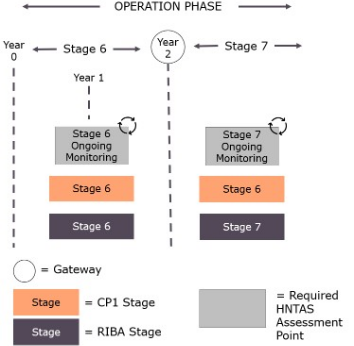
We propose compliance will largely be against the same set of KPIs as for new build heat networks. However, we have identified some KPIs, such as those relating to heat losses and performance should be less stringent for existing heat networks. Table 9 below outlines examples of KPI areas for existing networks for which we propose modified targets.
Table 9: Proposed approach for existing network requirements by KPI category
| Key Performance Indicator | Existing System Requirements |
|---|---|
| Monitoring and data capture | As per HNTAS new build requirements (for Phase 4 Operation stage) |
| Reliability | As per HNTAS new build requirements (for Phase 4 Operation stage) |
| Heat Losses | Modified target (threshold set to 400 W/dwelling for the 3 year milestone, and 200 W/dwelling to reach final certification). This is in comparison to the proposed new build heat loss threshold of 100 W/dwelling. |
| Performance | Mix of modified targets and HNTAS new build targets (for Phase 4 Operation stage) |
| Water Quality | As per HNTAS new build (for Phase 4 Operation stage) |
5.5 HNTAS assessment and certification
For both new build and existing networks, having assessments prior to certification will ensure that the great majority of heat networks pass at the point of certification. For new build networks, gateway assessments at feasibility and design are intended to validate that KPIs will be met in future. Gateway assessments at the end of construction are intended to verify that the network meets KPIs and has avoided key failures.
At the end of the heat network build process, there needs to be a decision on whether that network meets the minimum technical requirements as set out by HNTAS, and a decision as to whether that heat network can be issued with a HNTAS certificate to evidence this is the case. This is important to provide operators of, and consumers on, a network reassurance that minimum performance thresholds have been met. Certification results (i.e. if a network has attained a certificate or not) will at this stage be provided to Ofgem who require information on compliance with technical standards to inform their authorisation decisions.
There is therefore a requirement to have separate assessment and certification processes, which are proposed to be based on the following principles.
Assessment
1) Assessment based on ISO 17029 validation and verification principles
2) Gateways throughout the process with a requirement for Statements of Conformity to be granted before a network can proceed to the next phase
3) Registered Assessment Organisations, with HNTAS registered Assessors
4) Clear impartiality rules, which allow for both 2nd and 3rd party Assessors
Certification
1) Certification by an independent third-party Certification Organisation based on ISO 17020 principles
2) Certificate 1 issued after commissioning but before customers are supplied heating and hot water
3) Certificate 2 issued after 2 years of operation before a network can fully move to the exception reporting regime
4) Statements of Conformity from the assessment process will be a required input to certification
5.6 Metering and monitoring
5.6.1 Metering and Monitoring Standard
In order to measure heat usage and achieve real world improvements in heat network performance, it is vital that the right metering and monitoring infrastructure is in place.
Metering and monitoring systems are fundamental to the measuring of heat network performance data and reporting of KPIs as part of HNTAS. Consumer protection considerations for metering and monitoring systems are also crucial, ensuring that systems provide accurate, transparent, and accessible data for end users while mitigating data security risks. A minimum standard of metering and monitoring will allow operators to accurately bill consumers based on their consumption, monitor performance, and maintain and evidence compliance. It will also provide data to the Code Manager, HNTAS assessors and certifiers to track whole sector performance and inform assessment and certification decisions.
We have engaged with sector representatives to develop a HNTAS Metering and Monitoring Standard across all heat network elements for both communal and district heat networks. As with other HNTAS requirements, we propose that new build heat networks will need to comply with all requirements within the standard from HNTAS launch, while existing heat networks will be granted extended timeframes to comply. The Code documents refer out to requirements in the Metering and Monitoring Standard. A draft is published alongside this consultation.
As illustrated in Figure 8 below, the technical requirements in the Metering and Monitoring Standard broadly cover two main components of metering and monitoring systems:
- Monitoring points including metering points (e.g. thermal energy meters or utility meters) and sensors (e.g. temperature, pressure and water quality sensors) which measure and collect data required to assess performance against KPIs; and
- Automatic and Remote Monitoring Systems (ARMS) which measure, extract, record, and store data, as well as transform raw data, calculate and report KPIs to the Code Manager.
Figure 8. Summary of metering and monitoring system functions
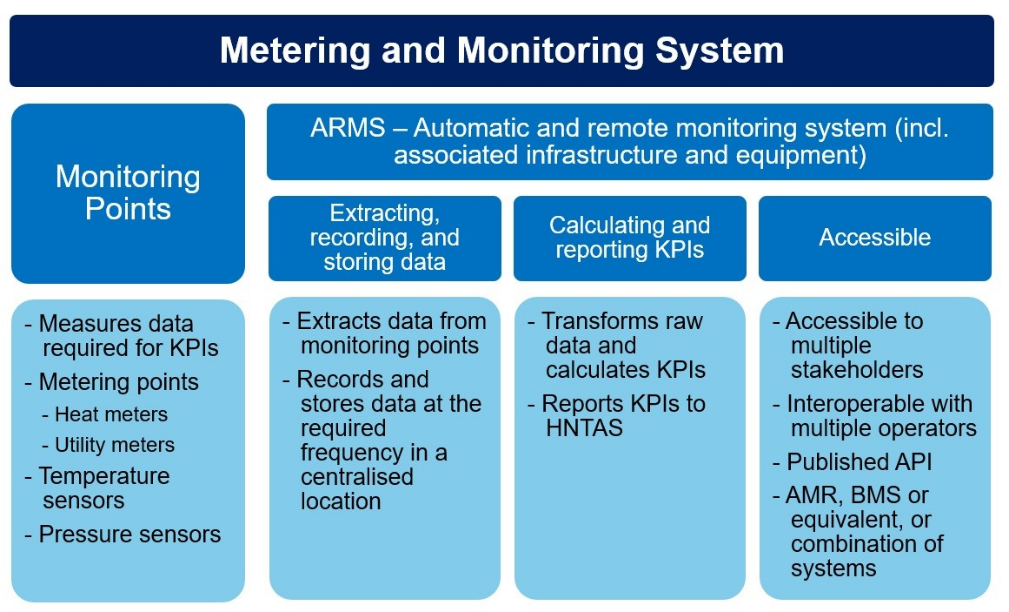
The consumer protection requirements in the Metering and Monitoring Standard broadly cover two further areas:
- Smart metering systems which include the software, infrastructure and associated equipment that enables two-way communication between heat network suppliers and consumers. Meter accuracy and data security requirements underpin this area.
- A Metering and Monitoring Strategy which Responsible Parties will need to produce, setting out how data collection requirements to calculate KPIs will be met, how these will be measured, extracted, recorded, and stored at the required read frequency, how the raw data will be transformed, and how KPIs will be calculated and reported.
Whilst the proposed consumer protection metering requirements are not strictly HNTAS requirements, we propose they are checked as part of the HNTAS assessment and certification process to simplify the demonstration of compliance for Responsible Parties.
Consultation questions
Question 21: Do you agree that the HNTAS Metering and Monitoring Standard should cover both the monitoring points and the Automatic and Remote Monitoring Systems (ARMS)? Please provide reasons for your answer.
Question 22: Do you agree that the HNTAS Metering and Monitoring Standard should also cover smart metering systems and a Metering and Monitoring Strategy? Please provide reasons for your answer.
5.6.2 Metering and monitoring milestones and timelines
The installation of metering and monitoring infrastructure is a crucial HNTAS milestone. Timelines should allow sufficient time for procurement and installation works, but without causing undue delay in improving performance and consumer outcomes. Heat network operators in the social housing sector with existing networks have stated they would find it challenging to install meters at dwelling level quickly due to the level and cost of work required, issues with gaining access into properties to carry out installation and the time required to procure meters. Consumer groups, on the other hand, have expressed that they wish to see works complete and customers benefiting from adequate protection in a timely manner.
To ensure that regulation is proportionate and deliverable, we proposed different timelines for different categories of networks at dwelling levels and at plantroom (energy centre) and network (building) levels.
The timelines we propose for metering milestones are as follows:
- New networks – metering and monitoring systems must be in place for HNTAS assessment and certification before the network supplies heat.
- All existing networks – Metering and Monitoring Strategy submitted, and Automatic and Remote Monitoring System (ARMS) specified within three years of HNTAS commencing.
- Networks required by HNMBR to have customer level meters – should already have meters installed, but where they do not, or if their metering does not conform to HNTAS minimum standards [footnote 26], they should install metering and monitoring systems and demonstrate compliance with HNTAS requirements at plantroom, network and end customer levels within three years of HNTAS commencing.
- Networks not required by HNMBR to have customer level meters – these were generally commissioned before 2015, or otherwise exempted from installing customer level meters by HNMBR, and will be allowed more time to carry out works. They should be able to demonstrate compliance with HNTAS metering and monitoring requirements at plantroom and network levels by year 3, and at end customer level by year 5 of HNTAS coming into force.
Consultation question
Question 23: Do you agree with the proposed metering milestones and timelines for existing networks? Do you agree that they allow sufficient time for installation while ensuring consumer outcomes and network performances can be improved as soon as practicable? If you disagree, please set out your reasons and a justification for an alternative proposal.
5.6.3 Consumer protection measures: “smart meter” features
In our 2023 consumer protection consultation, [footnote 27] we proposed features for advanced meter infrastructure (AMI), or “smart meters”, and received generally positive responses.
Some “smart meter” features, such as data visualisation for consumers (e.g. by mobile app, in-home display, or HIU display) and the ability to remotely change payment mode, [footnote 28] are more focused on protecting consumers and less directly relevant to monitoring the technical standards of heat networks. These were therefore not included in the original intended scope of HNTAS metering standards during engagement with stakeholders. However, we now propose that “smart meter” requirements should also be mandated and added to the HNTAS metering and monitoring specification to fully realise the benefits for consumers, and make sure the sector would not need to follow multiple specifications.
“Smart meter” requirements are due to include information provision obligations to ensure consumers can access relevant information (via in-home displays), requirements enabling remote switching and disconnection to establish protections around remote heat supply disconnection, and compatibility requirements to enable integration between different metering solutions and parties. Further proposed requirements cover data storage to enable the secure storage of data in the event of an ARMS fault, payment and billing information to support the accurate billing of consumers, and issue identification to facilitate the detection of faults with the metering and monitoring system.
We propose that metering in new heat networks should comply with “smart meter” requirements before supplying heat. For existing networks with installed meters which do not comply with “smart meter” requirements, we propose that these should be replaced before a Responsible Party obtains their first HNTAS certificate, or earlier if the meters reach the end of their life.
Consultation question
Question 24: Do you agree that “smart meter” requirements should also be mandated, and included in the HNTAS metering and monitoring specifications?
5.6.4 Consumer protection measures: metering data security
Data security is another area that cuts across heat network technical standard and consumer protection policy. Heat network customer dwelling metering data is personal data, and as such should be collected, stored, processed and transmitted in line with the UK General Data Protection Regulation (GDPR).
We are aware that the UK GDPR cites encryption as an example of an appropriate measure to secure personal data. We are also aware of the popularity of unencrypted metering communication protocols, such as the unencrypted wired M-Bus protocol. Unencrypted systems allow unauthorised parties to gain access to readable personal data if they can access them, presenting a data security risk.
We understand that heat network systems with domestic shut-off valves, which some prepayment applications utilise, carry an increased risk when using unencrypted protocols. This is because it is possible for these shut off valves to be activated without the consumer’s knowledge.
We therefore propose that unencrypted communication protocols should not be permitted, where such network extend beyond the secure perimeter of the consumer premises [footnote 29], or where it is not possible to implement adequate physical security measures to mitigate the risk of interception.
For existing heat networks, we propose allowing the interim usage of unencrypted communication protocols, on heat networks that do not have disconnection features, up until the point they obtain the first HNTAS certificate, or earlier if those meters reach the end of their life (similar to “smart meter” requirements above), unless adequate physical security measures can be implemented.
For existing networks with unencrypted communication protocols which do have remote disconnection features, we propose that the disconnection function should be removed, or meters should be replaced as soon as possible, and no later than five years after HNTAS commences, unless adequate physical security measures can be implemented.
Further details on meter data security can be found in the draft Metering and Monitoring Standard. We welcome views on the risks and the need to encrypt these systems.
Consultation questions
Question 25: Do you agree with our proposal to disallow the use of wired M-Bus, and other unencrypted communication protocols, on new heat networks with remote disconnection capability from the point at which HNTAS commences?
Question 26: Do you agree with our proposal to allow the continued use of unencrypted communication protocols, where they are already in place on existing systems, until either the first HNTAS certificate deadline, or until meters reach the end of their life (whichever is soonest)?
Question 27: Do you agree that unencrypted systems with remote disconnect should have the function removed or meters/protocol be replaced as soon as possible and within five years after HNTAS commences?
5.6.5 Consumer protection measures: meter accuracy
Ensuring accurate metering is important for the successful delivery of HNTAS, as well as consumer protection measures such as accurate consumption-based billing. Within existing legislation there is limited coverage for initial metering accuracy for new build networks and new metering systems; and ongoing meter accuracy for existing networks and determining which systems must be replaced.
To address issues with initial metering accuracy we propose that a definition of a minimum level of accuracy is required. The Heat Network (Metering and Billing) Regulations 2014 [footnote 30] mention meter accuracy but are not prescriptive about a standard or accuracy classes. To address this, we therefore propose that all heat meters should meet the equivalent of at least accuracy Class 2 of the MID 2014. [footnote 31]
There are also no standards in the UK with regards to ongoing meter accuracy, with meter replacement typically done according to manufacturers’ recommendations (if considered at all). This is a significant issue as many existing meters are old and are operating with unknown inaccuracies. We propose that requirements are set out for ongoing testing and recalibration.
Under HNMBR, the Office for Products Standards and Safety (OPSS) has responsibility for regulating heat metering accuracy, ensuring metering devices comply with established metering standards. In our 2023 consumer protection consultation and response [footnote 32] we noted the intention to revoke HNMBR. Building on that consultation, we consider that the appropriate time to proceed with revocation of metering requirements in HNMBR is when HNTAS comes into force, to ensure continuity and avoid any regulatory gap in meter accuracy requirements. We propose that HNTAS regulation provide for the Code Manager to take responsibility for meter accuracy functions, simplifying the regulatory landscape by reducing the number of organisations that operators are required to interact with.
We anticipate regulatory activities to include requiring heat meter calibration intervals, coordinating and administering a sampling and testing scheme, supporting the certifying of heat meter testing laboratories, along with other initiatives ensuring metering devices continue to accurately measure, memorise, and display heat consumption data. Heat network customers would also benefit if they could have the opportunity to challenge their metering accuracy, as is the case with gas and electricity customers.
Consultation questions
Question 28: Do you agree with our approach to set the minimum level of accuracy at the equivalent of at least Class 2 of the MID 2014?
Question 29: Do you agree that ongoing testing and recalibration is required for existing networks?
5.6.6 Current exemptions in HNMBR for customer level metering
HNMBR [footnote 33]: sets out three buildings classes: the viable class for which the installation of final customer meters is mandatory, the exempt class for which final customer meters do not need to be installed, and the open class for which final customer meters must be installed if the result of a cost-effectiveness assessment is positive. We indicated in our response to the 2023 Heat networks regulation - consumer protection consultation that we would remove the open class and cost effectiveness tool under the new regulatory regime, in line with the objective of increasing meter installation. We now intend to remove the viable and exempt class categories and move to mandating the installation of customer level meters, and the adherence to other requirements in the Metering and Monitoring Standard, by default for all heat networks in scope of the scheme.
HNMBR exempt some buildings on heat networks from final customer level metering requirements, such as supported housing, almshouse accommodation, student accommodation or leasehold properties. Largely, this is because consumers in these property types are not commonly billed for their heating and hot water based on their consumption. However, the benefits of metering and monitoring go beyond consumption based billing and, once HNTAS is introduced to provide a framework for good performance, this will be even more so the case.
Metering and monitoring systems are essential for detecting heat network performance issues and enabling targeted rectification, as well as enabling consumers to better understand and control their energy usage.
We recognise that in some instances, exemptions are necessary and will need to continue to apply following the launch of HNTAS, but in general we expect to move to a position of increased metering. For a small number of heat networks there may be good reasons, such as technical difficulties and physical constraints, why customer level meters are not able to be installed (we do not anticipate such difficulties for building level meters). For example, some listed heritage buildings may be prevented by other legislation from carrying out works to install customer level meters.
We propose that these situations should be dealt with through the HNTAS approach of handling permitted non-conformities, with Responsible Parties able to apply for dispensations on a case by case basis by submitting an application to their HNTAS assessor setting out the reasons, mitigating measures, and impact of not installing metering, following which it would be decided if the dispensation should be granted as a permitted non-conformity (see Section 5.9 for further detail).
Supported housing, almshouse and student accommodation
Supported housing and almshouses often have a high proportion of vulnerable residents, and stakeholder engagement indicates that their access to reliable heating and hot water without unnecessary outages should be protected as a priority.
These heat networks will be required to meet milestones to install metering by the slower timelines for existing heat networks which are not currently required by HNMBR. For new buildings, the installation of metering and monitoring systems will be required at plant room, block and dwelling level during construction for the heat network to gain HNTAS certification and be authorised to supply heat to consumers.
Many heat networks supplying these building types, particularly almshouses, are likely to be small and, where they supply fewer than 11 dwellings, would not be subject to HNTAS metering and monitoring requirements. We see this as a proportionate approach.
The current HNMBR provides that where customer level meters are installed, customers must be billed based on actual heat consumption, unless it is not technically possible or economically justifiable to do so. We note that it might not always be suitable for supported housing, almshouse accommodation and purpose-built student accommodation to use consumption-based billing for heat. We therefore propose that in mandating the installation of meters in these buildings, they should continue to be able to use other billing methods if appropriate to do so. For the same reason, we propose that “smart meter” requirements should not be made mandatory for these buildings.
Consultation question
Question 30: Do you agree with the proposal to extend metering requirements to existing buildings of supported housing, almshouse accommodation and purpose built student accommodation, so that they can be covered by HNTAS?
Leasehold properties which prevent consumption-based billing
We also believe that consumers in these buildings would benefit from increased metering and monitoring. There is also a case for consumption-based billing, which better protects consumers and promotes energy efficiency, to be adopted in leasehold buildings previously exempted by HNMBR.
However, some leases may impose installation and maintenance costs on leaseholders. With respect to the adoption of metering and monitoring systems - and any other improvement work undertaken to meet HNTAS requirements - that may impose installation and maintenance costs on leaseholders, the government will seek to legislate to resolve interactions with existing residential leases.
Consultation question
Question 31: Do you think HNTAS requirements, including metering requirements, should be applied to buildings with leasehold related HNMBR exemptions? Please provide reasons for your answer.
Question 32: What options do you think should be explored to better enable the adoption of consumption-based billing in buildings with leasehold related HNMBR exemptions?
Question 33: Do you foresee any challenges arising from the installation of metering and monitoring systems and/or the undertaking of performance improvement works to meet HNTAS requirements in networks supplying leasehold customers? Please provide potential solutions to these challenges.
Heat cost allocators
A Heat Cost Allocator (HCA) is a device that is used to measure the difference of temperature between hot water within a radiator and the temperature outside the radiator, from which it estimates how much heat is being transferred from that radiator. The current HNMBR provides for the use of HCAs for open class buildings where it is not cost effective or technically feasible to install heat meters.
We previously consulted on the use of HCAs in the 2023 Heat networks regulation - consumer protection consultation. This was on the basis that HCAs were significantly less accurate, with strong variations in the level of accuracy depending on make, radiator type and manner of installation. These variations mean that it is almost impossible to design a consistent accuracy standard for HCAs.
We have further considered that HCAs are not able to meet the HNTAS monitoring requirements. This is because HCAs do not have the ability to measure the flow and return temperatures and flow rates of heat transfer fluid moving through pipework around a building. Instead, HCAs are limited to monitoring the temperatures of and around radiators. Regular monitoring of flow and return temperatures and flow rates is essential to understanding heat network performance and reporting against HNTAS KPIs.
We therefore propose that HCAs will not be allowed to be used instead of thermal energy meters, unless in exceptional cases where HCAs are proposed as a mitigation measure for non-conformities in metering. A key example of this would be in a listed building where meter installation is fundamentally impossible.
We acknowledge that some heat networks will have installed HCAs as part of the HNMBR regulations, based on cost effectiveness assessments required under Regulation 6. As HCAs generally cost significantly less to install compared to a meter and do not deliver similar outcomes, we are not proposing to allow HCA installations to remain as an alternative to metering in those cases. To allow a reasonable transition in these instances, buildings within the scope of HNTAS with HCAs installed instead of dwelling level heat meters, will need to have dwelling level heat meters in place by the slower timelines for existing heat networks which are not required by HNMBR to have metering.
Consultation question
Question 34: Do you agree with the proposal to disallow the use of heat cost allocators to demonstrate compliance with HNTAS requirements? Please give reasons why you agree or do not agree with the proposal.
5.7 Powers of entry
Heat network operators sometimes need to conduct essential installation, maintenance or repair works on heat network equipment, including the metering and monitoring system. Some of these works may need to be carried out within people’s homes. In these cases, it is essential that all reasonable efforts should be taken by the heat network operator to obtain access to properties on a voluntary and cooperative basis. The heat network operator must offer clear and responsive communications, advance notice, flexible scheduling and multiple contact attempts to residents. Only in exceptional circumstances where access is still denied after all reasonable efforts have been made should the use of power of entry be considered.
In the 2024 Heat Networks Regulation: Implementing consumer protections consultation, we set the intention to provide heat network operators with similar powers of entry as gas and electric suppliers. [footnote 34] We propose providing powers of entry [footnote 35] to allow heat network operators to access both domestic and non-domestic properties, for the following reasons:
- Essential maintenance of heat network technology
- Installation of pre-payment meters
The powers of entry and the protections for installation of pre-payment meters were already set out in the 2024 Heat Networks Regulation: Implementing Consumer Protection consultation and response. This consultation will cover those for the essential maintenance of heat network technology in England and Wales [footnote 36], which we propose to include –
- Essential maintenance (including removal and replacement) of heat network equipment for health and safety reasons, and for meeting required technical standards
Just like gas and electricity suppliers, heat network operators need access to install, maintain and repair essential equipment. For heat networks this may include heat interface units (HIUs), heat pipes, hot water cylinders, shut-off valves and metering and monitoring systems
In addition, a lot of issues affecting the technical performance of a heat network often arise at dwelling level. Issues arising in components like the HIU, heating systems, heating controls and hot water cylinders can impact the performance of the whole heat network. In such cases, heat network operators need to have the power to access properties to resolve issues affecting these components [footnote 37]. Without these powers, it might not be possible for those heat networks to meet HNTAS technical standards. More importantly, however these powers are needed to gain emergency access to properties in the event of a safety issue, such as a burst pipe, to protect customers in that dwelling and other consumers that may be affected by the issue on the heat network. We therefore propose to grant heat network operators powers of entry for the purposes of installing and maintaining parts of a heat network [footnote 38], including metering and monitoring systems.
Metering and monitoring at end customer level is an integral part of the system. In our 2023 consumer protection consultation, we asked whether it was feasible to require dwelling level meters to be installed in common areas in order to minimise the need to enter people’s homes. We received mixed responses, with some stakeholders highlighting that heat meters are often within the HIUs installed in properties, and that installing meters far from HIUs might compromise their accuracy. Responses also indicated that installing meters in common areas might result in access difficulties for customers, or that in some buildings the common area simply was not spacious enough to have end customer meters installed. While there might be relatively more scope for new heat networks to be designed in such a way to enable installing end customer meters in common areas (but some meters would still be within HIUs), it is anticipated that a considerable number of existing heat networks will need to have end customer meters installed within properties. In our engagement with existing heat networks, the single biggest concern raised by stakeholders about metering timelines was gaining access to properties. Apart from installation and replacement of meters, there are also instances where access to properties may be required to carry out essential maintenance or to test heat meters to validate their accuracy. We see access to properties as a necessity in these cases, and propose granting heat network operators this power.
It is essential that metering and monitoring systems are accurate to support the effective delivery of the scheme and to ensure fair and transparent billing for consumers. Under HNMBR, OPSS has powers to enter premises to verify the accuracy of meters. As the responsibilities for oversight and enforcement transition to the Code Manager under HNTAS, it is necessary that these powers are transferred accordingly. This will enable the Code Manager to carry out essential testing and verification activities, thereby maintaining the integrity of the scheme and protecting consumer interests.
Consultation question
Question 35: Do you have any comments on our proposal to provide heat network operators powers of entry to conduct necessary maintenance of heat network equipment for health and safety reasons, meeting required technical standards and to install and maintain metering systems?
Question 36: Do you have any comments on our proposal to provide the HNTAS Code Manager with powers of entry to enable meter accuracy activities to be conducted, replicating the powers of entry currently provided to OPSS under HNMBR?
Protection
Gaining access to people’s homes is not a matter to be taken lightly, and appropriate safeguards should be in place. For reference, in the 2023 Heat Networks Regulation – Consumer Protection consultation we set out proposed protections to be included in the Regulations for using the power of entry to install a pre-payment meter (PPM) for debt management purposes. Those include, for example, that all other efforts at debt recovery must have been made, that the power cannot be used where a meter can be remotely switched to pre-payment mode, and that a warrant to enter the premises of a vulnerable customer must be sought individually (instead of in bulk for a whole building). In addition, making reference to similar guidance for gas and electricity, we propose that for heat networks PPMs should not be installed for certain groups of vulnerable consumers.
The impact of equipment maintenance or installing heat meters on customers is likely to be short disruption of heating, instead of prolonged disconnection which might be the case for the installation of PPMs. In terms of proportionality it should not require the same extensive protection in the case of PPMs, but it is still important to ensure the power of entry is invoked in an appropriate manner and only as a last resort.
In the UK gas and electricity markets, legislation provides for the power of entry to be used only under warrant by a justice who is satisfied that admission is reasonably required. A warrant should not be granted unless at least 24 hours’ notice is given to the occupier (except in an emergency and if entry is refused by the occupier). We propose to replicate these provisions in heat network regulation.
Furthermore, we propose that additional protection should be in place for maintenance of equipment (except in cases of emergency for health and safety reasons) and installing and maintaining meters. Below are some safeguards that we believe may be appropriate. Heat network operators should:
- Establish that entering a dwelling is the only feasible option in the circumstances
- Make multiple attempts to contact and obtain consent to enter, using appropriate channels of communication, especially with regard to vulnerable customers [footnote 39]
- Give sufficient advance notice (e.g. no less than 14 days)
- Minimise disruption and complete works within the shortest period of time, and avoid multiple-day entry
- Give regard especially to the situation of vulnerable customers
- Not request multiple entries within a certain period (e.g. half a year), especially for vulnerable customers
We will look for opportunities to engage stakeholders before finalising these rules to ensure customers are treated to a high standard.
Consultation question
Question 37: Do you have any comments on our approach to provide necessary and proportionate protection to customers regarding the use of power of entry?
5.8 Pre-operation networks
This document has so far outlined the proposed approach for two types of network: new build heat networks that do not exist at scheme launch, and existing heat networks which are already operational and supplying heat to consumers at scheme launch. However, there are some networks that fall in between these categories: heat networks that exist in a design or construction phase but are not yet supplying heat to consumers at the point of scheme launch. These networks fall into a category of their own: pre-operation networks. By definition, these networks will start supplying heat to customers at some point after January 26th 2027, once the initial period of heat network regulation has concluded, and therefore will not be automatically authorised by Ofgem. Pre-operation networks will need to apply to Ofgem to be authorised. See Table 10 below for a summary of network category definitions.
Table 10: A summary of network category definitions.
| Network Category | Definition |
|---|---|
| New build | A heat network that does not exist at HNTAS launch |
| Pre-operation | A heat network that exists (physically or in project form) but is not supplying heat to consumers at HNTAS launch |
| Existing | A heat network that is operational (supplying heat to consumers) and is pre-authorised by Ofgem when HNTAS launches. Sub network types within this category include: - Networks subject to HNMBR metering requirements - Networks not subject to HNMBR metering requirements |
| Certified networks | A heat network which has received both HNTAS certificates, is authorised by Ofgem and is supplying heat to consumers. Sub network types within this category include: - Networks which have competed the new build assurance pathway - Networks which have completed assurance pathway for existing networks |
| End of Life networks | An operational heat network which is at the end of its operational lifespan and is being replaced or undergoing significant capital works to become HNTAS compliant. Full decommissioning and market exit may occur for some End of Life networks. Sub network types within this category include: - Existing networks which have been declared as End of Life to the Code Manager - Certified networks which have been declared End of Life to the Code Manager once they have reached the end of their functional lifespan |
Some pre-operational heat networks will have the capability to follow the same assurance pathway and requirements as new build networks. Where this holds true, generally these networks should follow the new build assurance pathway, to attain higher build standards and more ambitious performance levels, benefitting developers in the short term and future operators and consumers in the longer term.
Other pre-operational networks, which are further along the development process, may be better suited to following a modified version of the existing network assurance process.
Treating pre-operation networks as either new build networks or existing heat networks rather than as a separate category with its own unique assurance pathway, will allow this type of heat network to follow the pre-established new build or existing assurance pathways. In doing so, the overall complexity of HNTAS is reduced and pre-operation heat networks will be encouraged to begin operating within the regulated structure as soon as possible after scheme launch.
The network categories in Table 10 and their assurance pathways are given in Figure 9 below.
Figure 9. Network categories and their assurance pathways
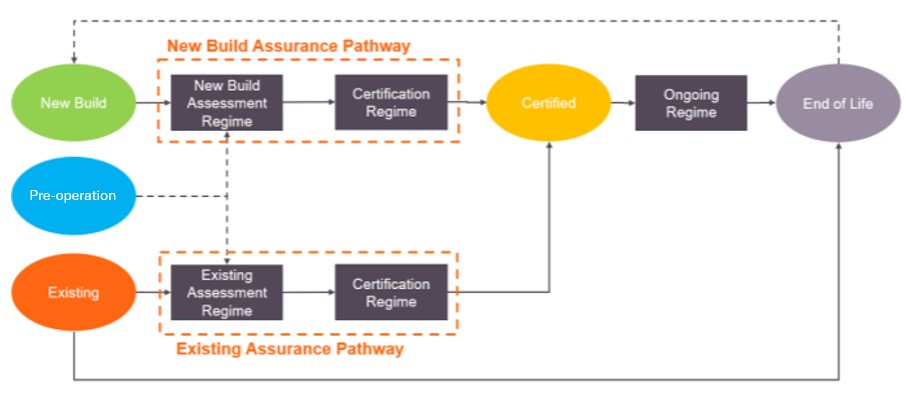
We have assessed there to be three primary factors to best determine if a pre-operation network should follow the assurance pathway for new build or existing networks:
- Has the planning application been submitted?
- Has the Mechanical and Electrical (M&E) construction contract been signed?
- Are the elements of the heat network due to be completed within 2 years of scheme launch?
Each of these factors represent a key point in a heat network’s development, after which the cost and difficulty of making changes increases and both the number of options and impact of those changes on performance reduces. In determining which assurance pathway pre-operation networks will be required to follow, and at which point in those pathways these networks should enter, we have aimed to provide a balance between assessing schemes at the earliest HTNAS stage possible (to maximise the impact of changes at the lowest cost) whilst avoiding networks entering the pathways at a stage that may require excessive dispensation requests, or result in disproportionate and costly changes. Figure 10 sets out the decision tree for pre-operation networks.
1) Planning application
Planning applications are a significant step in the development and construction of a heat network as they outline the building architecture and envelope for approval from the local authority. Once this application is approved, there will be constraints placed on certain aspects of heat network design, such as pipe routing. This will place limits on eventual performance. As planning is a very costly and time intensive exercise, it would not be proportionate to require networks that have been through planning to resubmit.
Therefore, it is proposed that any pre-operation network that is pre-planning will be treated as a new build heat network and will be required to follow the full new build assurance pathway through stages 1-7 (see Section 5.2).
We propose that heat networks that have already gained planning permission will be put on a modified new build pathway that takes into consideration the ceiling on performance able to be achieved due to spatial constraints. To streamline assessments during design, all projects post-planning and pre-contract will be assessed at HNTAS Stage 3 onwards. This means all ongoing designs at scheme launch will be assessed at the point of design completion, this will then allow the heat network to continue through the later new build assurance stages. To avoid creating a backlog of dispensation requests, it is proposed that new build KPI thresholds are relaxed and that these networks will instead be required to meet the KPI thresholds set for the first certification milestone on the existing heat network assurance pathway.
2) M&E construction contract
The signature of the M&E construction contract is a key step between design and construction, as such contracts confirm the costs and timeline of construction. After an M&E contract is signed, any changes made to the finalised design would be extremely costly and highly likely to require repricing from the contractor with variations made to the original contract.
Once in contract, we consider that it would be very complicated to fit these heat networks into the new build assurance pathway. We therefore propose they are instead directed down the existing heat network assurance pathway, with three years from scheme launch to demonstrate meeting the more permissive performance thresholds, as evidenced with a Milestone 2 Statement of Conformity, and six years to meet the first certification performance thresholds (see Section 5.3).
3) Completion date
Typically, the ownership of a heat network is transferred from the developer to an operator once construction has been completed and before operation begins. The party responsible for making, and paying for, any changes needed to meet the existing network performance thresholds will depend on when this handover takes place.
If changes are made before the handover, costs would be met by the developer. If changes are made after the handover, costs would be met by the heat network operator, and potentially its associated consumers. If construction projects are due to be completed before the three year deadline for existing heat networks to attain a Milestone 2 Statement of Conformity, heat network operators and their consumers would need to carry these costs and may have very limited time within which to make changes.
Therefore, we propose that if a network (or network elements) is due to be completed within two years of HNTAS commencing, it would be treated as an existing heat network and would be expected to meet the permissive KPI thresholds evidenced by a Milestone 2 Statement of Conformity within three years of HNTAS’ launch. This would provide the heat network operator at least one year to make any required changes
If a heat network (or heat network elements) is due to be completed more than two years after HNTAS commencement, we consider that there would not be sufficient time for the adopting heat network operator to meet the permissive KPI thresholds evidenced by a Milestone 2 Statement of Conformity within three years of HNTAS’ launch. Consequently, we propose that the developer of that heat network (or heat network elements) will be expected to meet the more stringent KPI thresholds set for the first certification milestone for existing heat networks on completion of construction prior to handover. This approach avoids additional costs being pushed on to the adopting party and its consumers.
Figure 10. Pre-operation network decision tree
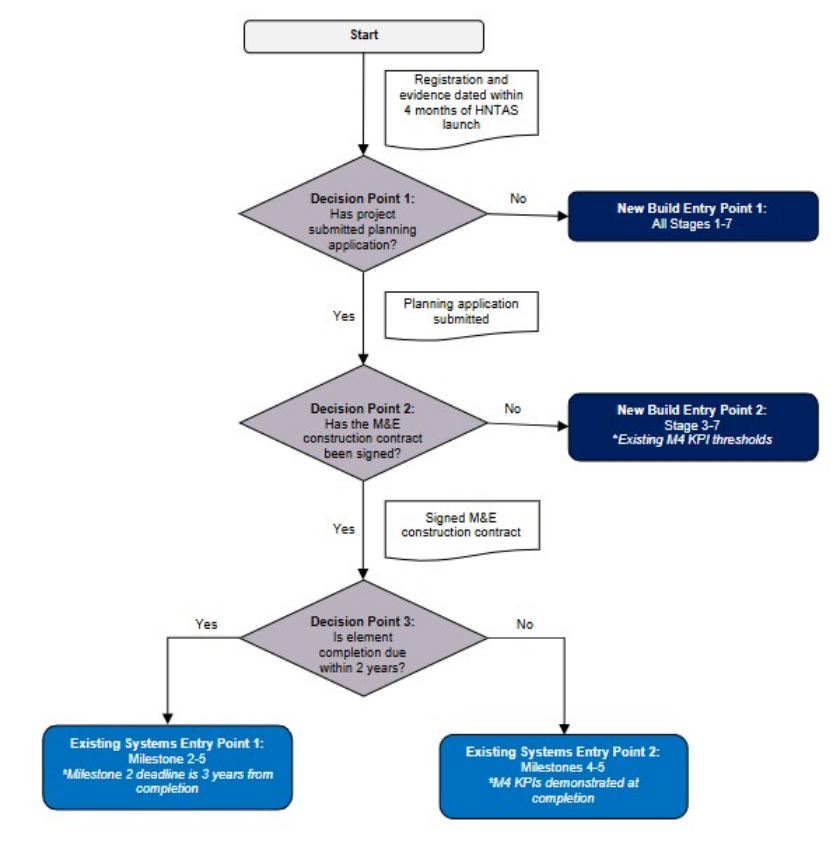
As with all heat networks in scope of HNTAS, it is proposed that the first assurance milestone of all pre-operation heat networks is to register their elements on the HNTAS Digital Service. In so doing, we propose that Responsible Parties use the decision tree in Figure 10 to declare the information that will determine which assurance pathway they must follow and at which point in the assurance process they must enter that pathway. It is also proposed that a time limit for this is set to 4 months following scheme launch. To note, we have set a registration deadline of a year on all other categories of heat network, but we have assessed that this time limit should be shorter for pre-operation networks given that Responsible Parties will need earlier clarity as to how they will be treated under HNTAS. Furthermore, an earlier registration deadline for these heat networks will reduce the opportunity for Responsible Parties to game the system by timing out to follow the more permissive existing heat network assurance pathway when they should be following the more stringent new build pathway.
Consultation questions
Question 38: Do you agree that heat networks which have not yet submitted planning applications at the point of HNTAS commencement should be subject to the same requirements and assurance pathway as new build networks? Please provide reasons for your answer.
Question 39: Do you agree that heat networks which have already submitted planning applications but have not yet signed M&E construction contracts at the point of HNTAS commencement should be subject to the new build requirements and assurance pathway from stage 3 (i.e. technical design) onwards? Please provide reasons for your answer.
Question 40: Do you agree that two years from completion is an appropriate timeframe to base the decision on the appropriate entry point at which pre-operation heat networks would join the existing network assurance pathway? Please provide reasons for your answer.
Question 41: Do you agree that pre-operation heat networks should register to a shorter deadline than other categories of heat network? Please provide reasons for your answer.
5.9 Permitted non-conformities
This section only covers the approach to permitted non-conformities for new build networks, although it is expected that a similar approach could be applied to existing systems in due course.
HNTAS covers a wide range of different heat networks with varying characteristics. One of the ways in which HNTAS can be adapted to the majority of different heat network types is via a Statement of Applicability. As outlined in Section 2.4, not all of the technical requirements will be applicable to every assessed heat network. In many cases, this may simply be because some smaller communal heat networks do not have all of the elements that are present in larger district systems (e.g. they may not have district distribution pipework). Clearly, there will be no need to meet technical requirements for elements which aren’t present. All requirements that are applicable and all that are non-applicable to a heat network will be identified by the relevant duty holder and agreed with the network’s assigned HNTAS assessor, before being recorded in a Statement of Applicability. This provides a record of which technical requirements a heat network is legally required to meet.
However, while the scheme aims to accommodate most network types, it does not cover every possible scenario. Consequently, there will be instances where a duty holder is unable to meet the technical requirements, even when those requirements are applicable to their heat network. For the purposes of this consultation, such requirements are referred to as non-conformities within this document. In a small number of cases there may be a good reason to permit these non-conformities. Broadly, we propose that permitted non-conformities would fall within the following two categories, although this is not an exhaustive list:
- They are unavoidable. For example:
- Physical constraints in the retrofit of a heat network into a listed building may prevent pipework being installed in the most optimal route, or prevent insulation being fitted to the required thickness, which could result in heat losses which exceed HNTAS thresholds. So far as these risks are mitigated up to the point that is practicable, it would not be reasonable to prevent the building and authorisation of such a heat network. This non-conformity should therefore be permitted.
- They have a negligible or low impact on network performance. For example:
- Specific technology applications may result in non-conformities for certain aspects of the technical specifications, such as a network using a cheap low carbon energy from waste heat source that is a considerable distance from the consumer connection point which exceeds HNTAS heat loss thresholds due to significant district distribution losses. As above, so far as this risk is mitigated to the greatest extent possible, it would run counter to sector growth and decarbonisation objectives to prevent the development of such a heat network. This non-conformity should therefore be permitted.
Accepting non-conformities for a select number of circumstances that fit into these categories is critical if the scheme is to promote sector growth and innovation. The converse also holds true; if the scheme were not to permit unavoidable and low impact non-conformities, this would likely dissuade developers from adopting heat networks in some situations, such as retrofit, and discourage the update of more novel, lower carbon energy sources, such as geothermal minewater.
We consider that the need to permit a non-conformity may occur primarily at three points in a network’s assurance journey: prior to assessment, at assessment or at certification.
Consultation question
Question 42: Do you support the proposal to permit non-conformities in certain circumstances where non-conformities are unavoidable and have a negligible impact on heat network performance?
Question 43: In addition to physical constraints and specific technology applications, are there any other categories of non-conformities that you think should be permitted? We are interested in suggestions where permitting non-conformities would have little impact on network performance and would not negatively impact consumer outcomes.
5.9.1 Prior to assessment: process for granting dispensation for unavoidable non-conformities
We consider that it will be the role of the duty holder to identify any requirements that may need a dispensation application as early as possible to ensure that an appropriate risk mitigation plan is devised and followed to reduce negative impact.
In order for an unavoidable non-conformity to be permitted, we propose that the relevant duty holder submit a dispensation application to their HNTAS Assessor. This would involve setting out the reason for the non-conformity, outlining any mitigating measures that have been taken and identifying the impact of the non-conformity on HNTAS KPIs. For any impacted KPIs, we propose that the relevant duty holder propose new KPI thresholds that are achievable should the non-conformity persist, with a justification for the new thresholds.
Once an Assessor has received a dispensation application, they will review it and determine if they should grant or reject the dispensation. Factors they will need to account for in this determination include, among other things, if the non-conformity is indeed unavoidable and if the impact on network performance is low enough to be permissible. In keeping with the scheme’s core objective to improve consumer outcomes, we would expect that any dispensation application containing a non-conformity which, if permitted, would result in the failure of the network to meet reliability KPIs would be rejected. Should the Assessor be satisfied that the non-conformity is unavoidable, all mitigation measures have been undertaken and the proposed new KPI thresholds are acceptable, dispensation can be granted. Should the Assessor be dissatisfied, they will reject the application, although they may request certain parts of the application to be reworked or ask clarificatory questions that may prompt an application’s re-examination or resubmission.
We have assessed that it would be disproportionate for every dispensation application and Assessor decision to be sent to the Code Manager, or Scheme Operator acting on behalf of the Code Manager, for review. However, should any cases arise in which an Assessor feels unable to make a decision, for example due to lack of information, it may be appropriate for them to seek guidance from their Assessor Organisation, the Code Manager or Scheme Operator.
Further consideration will be given to placing appropriate limitations on the extent to which Assessors can make decisions on dispensation applications. This is likely to be more relevant in the early years of the scheme, when we would expect escalation to be the default position. It will be critical that consistent decisions are made across all Assessor Organisations, to protect the credibility of the scheme. Over time, the expectation is for Code Manager rulings on dispensations to be made available to Assessors, so they can draw on a library of “case law” examples to make decisions in line with previous Code Manager rulings. Where there is a precedent, there should be no need for Assessors to escalate decision making to the Code Manager or Scheme Operator.
Consultation question
Question 44: Do you support the process outlined for duty holders to submit, and assessors to grant, a dispensation for permitted non-conformities?
5.9.2 At assessment: process for permitting non-conformities
We foresee that some non-conformities may present themselves during an HNTAS assessment. A duty holder may present a non-conformity within their claim, or the Assessor may identify a non-conformity during the assessment itself.
In the event that the non-conformity is presented by the duty holder as part of the claim, we would expect the same information to be present as would be required if the duty holder had submitted a dispensation application prior to the assessment.
In the event that the non-conformity is identified by the Assessor, the Assessor would provide an indicative risk score to the duty holder to help them decide whether they need to address it (if it’s likely not to be permitted), or if the risk appears low enough that it will likely be permitted. Following this, if the duty holder decides that they wish to progress with the non-conformity application (rather than address the non-conformity), they should provide the Assessor with the same information in relation to the non-conformity that otherwise would have been required within a dispensation application, had they submitted one.
We propose that if the Assessor is in a position to take forward a review of the non-conformity, they would undertake another risk-based evaluation, using a standard risk assessment matrix to weigh the severity of the non-conformity’s impact (ranging from no impact to performance outcomes up to major impact on performance KPIs) against probability. Where a non-conformity presents a low risk of failure to meet KPIs, we propose that an Assessor permit it, and issue a Statement of Conformity (assuming that all other assessment requirements have also been met). Where a non-conformity presents a medium or above risk of failure to meet KPIs, we propose that an Assessor does not permit the non-conformity, and therefore does not issue a Statement of Conformity, but instead submits a Statement of Non-conformity.
We recognise that there may be instances where a network has multiple non-conformities which, held together, may represent a risk far greater than if each were to be evaluated individually. Therefore, where multiple non-conformities are present on a single network, we propose that a summed risk evaluation is undertaken to aggregate risk impacts which should be taken as one to inform the Assessor decision.
Consultation question
Question 45: Do you support the process outlined for the handling of non-conformities present at assessment?
5.9.3 At certification: process for permitting non-conformities
We expect that non-conformities related to inability or failure to meet technical requirements up to the end of the construction phase will be handled prior to certification. Therefore, non-conformities present at the point of certification are likely to be limited to non-conformities with performance requirements identified during acceptance testing, with required duty holders not being in place, and/or Statements of Conformity not being in place.
As with non-conformities at the assessment stage, we anticipate that non-conformities at certification may issue from two sources: either the duty holder presenting a non-conformity within their application for certification, or the Certifier identifying a non-conformity during the certification process.
In either case, the duty holder must provide a valid justification for the non-conformity and evidence any mitigating measures that have been undertaken. A Certifier may request further evidence be provided or mitigating actions undertaken.
We propose that if the Certifier is in a position to take forward a review of the non-conformity, they take into consideration and permit cases in which consumer heat acceptance testing requirements have not been met where the non-conformity is a KPI, there is clear evidence demonstrating that all practicable mitigations have been taken and the resulting performance does not have a significant impact on network or consumer outcomes. An example of a consumer heating system non-conformity at Acceptance Testing is where the domestic hot water delivery time exceeds the HNTAS requirement of 45°C in 45 seconds by a small margin. In this example, the risk cannot be further mitigated as the domestic hot water design cannot be changed to meet the requirement without incurring a high construction expense, which is not proportionate as the impact on the wider heat network performance and consumer outcome is limited. There may also be some cases in which the absence of Statements of Conformity is permitted if these are justified (e.g. if the heat network is missing Statements of Conformity for the design stages if HNTAS launched when the heat network was in the construction phase).
We propose that Certifiers do not permit non-conformities which arise from failing acceptance testing requirements for all other elements (excepting the consumer heat system as above, where impact can be better contained) which impact KPIs on an ongoing basis. We also propose that an unjustified absence of Statement of Conformities and failure to have a Designated Operator and Responsible Party in place should not be permitted.
In cases where a Certifier permits a non-conformity we would expect that a certificate would be issued (assuming that all other certification requirements have also been met). In cases where a non-conformity is not permitted, and requests for additional information or mitigating action have been unsuccessful, we would expect that the certificate would be withheld and the Certifier would instead issue a HNTAS Failure Notice, containing all of the information relevant to the withholding of the certificate.
Consultation question
Question 46: Do you support the process outlined for the handling of non-conformities present at certification?
5.10 End of Life networks
Most heat networks in the UK have a functional lifespan of about 25 years, although this can extend up to 40 years in some cases, depending on how well a network has been designed, built and maintained. Evidence suggests that heat networks in the UK are generally not being replaced until they are between 35 and 40 years old. Based on HNMBR and Heat Network Efficiency Scheme data, it is estimated that approximately one third of heat networks in the UK are currently operating past the end of their functional lifespan. These heat networks are often the source of the worst consumer outcomes and will need to be replaced or undertake major capital renovations to become HNTAS compliant. Within the context of the regulatory framework and HNTAS, we refer to this category of heat network as End of Life.
As the duration of a heat network’s functional lifespan can vary significantly, we have judged it inappropriate to apply a blanket operational time constraint after which point a heat network should be considered End of Life. Heat network owners and operators hold most information with respect to the individual networks they operate and are therefore best placed to consider the full cost implications of replacement or major renovations. As such, we propose that Responsible Parties should have the right to declare to HNTAS if they deem their network to be End of Life. We would expect a Responsible Party to take into account the ability of their heat network to cost-effectively meet the KPIs set for existing heat networks within the specified deadlines, before declaring End of Life.
Typically, decisions would be made at an element level, or for a bundle of elements. For example, a communal distribution network within a building would become ‘new’ after End of Life replacement.
In order to allow such networks to be subject to a set of requirements more suitable to supporting network replacement, rather than gradual improvement over time, we propose that Responsible Parties would need to declare their network as End of Life within 3 years of HNTAS commencement. This deadline will ensure they are not inadvertently obligated to meet the 3 year deadline of achieving the minimum performance requirements for existing heat networks (see Section 5.3).
Unless and until a network declares itself End of Life, that heat network will be subject to the relevant existing heat network requirements. The requirement to register with the Code Manager within a year of HNTAS commencement will continue to apply to heat networks that declare End of Life before the registration deadline. We recognise that early declaration is beneficial as setting networks on the End of Life trajectory sooner may help the Responsible Party with financial planning and maximising the amount of time to effect replacement. This would also apply in cases where a Responsible Party determines that it would be more appropriate to exit the market and move to an alternative non-heat network heating solution. Therefore, it is suggested that, from the point of registration, Responsible Parties will be given the option to declare their heat network (or elements within their heat network) as End of Life. If the Responsible Party deems it more appropriate, they will still be able to declare their heat network as End of Life after the registration point.
Where a heat network has surpassed its functional lifespan and a Responsible Party decides not to declare it as End of Life, that would be permissible under HNTAS but the heat network would then be subject to the more stringent requirements that will apply to existing heat networks. Should a heat network choose this path and subsequently fail to meet the necessary requirements, it would face the same non-compliance actions as any other existing network (see Section 8.1 for further detail on complaints and enforcement against heat network operators).
In so declaring a heat network as End of Life, we propose that a heat network would be exempted from many of the requirements that other existing heat networks will be subject to. This is to minimise redundant expenditure; we recognise that it would be uneconomical to make heat networks carry out short term improvement works when these would only be superseded by a full system replacement a few years later. Where the cost of major capital renovations may increase consumer bills, this approach also helps to minimise cost increases to consumers in the longer term.
We are therefore proposing that End of Life heat networks will only be obligated to undertake works ahead of full system replacement where these are necessary to protect consumers from unacceptable levels of poor performance. Primarily, short term works will need to ensure consumers receive a reliable heat supply. We believe this strikes the right balance between allowing Responsible Parties to undertake works in a financially prudent manner, whilst protecting consumers from the most detrimental effects of being on an End of Life heat network.
To support End of Life heat networks on their trajectory towards replacement, we propose that a Mobilisation Plan be submitted within 5 years of HNTAS commencement. Within the Mobilisation Plan, the Responsible Party would need to demonstrate passing the Stage 3 (Design) assessment gateway for each of the constituent elements of the replaced network by providing a Statement of Conformity. Replacement elements would generally be subject to new build performance thresholds. The plan would also need to set out the timeframes within which replacement works are intended to be completed and Certificate 1 attained, within the bounds of the 8 year deadline. We propose that a risk register be submitted alongside the Plan. Evidence from industry demonstrates that full network replacement should take no longer than 3 years to deliver. As such, we understand that this is a reasonable and deliverable deadline.
The final End of Life requirement is identical to the final part of the new build assurance process: demonstrating that performance thresholds continue to have been met and key failures avoided 2 years after the new elements of the replacement network have been in operation, and the attainment of Certificate 2 if an assessor and certifier deems this to be the case. Following the award of Certificate 2, a heat network would then be permitted to move into exception reporting (see Section 5.4 for further detail). A summary of the proposed minimum timelines and milestones for End of Life Networks is outlined in Table 11 below.
Table 11: Proposed minimum timelines and milestones for End of Life networks
| Milestone | Year | Requirement |
|---|---|---|
| Milestone 1 | 1 | Register heat network |
| Milestone 2* | 3 | Declare as End of Life network (otherwise treated as a standard existing heat network) Demonstrate meeting threshold reliability requirements |
| Milestone 3* | 5 | Submit Mobilisation Plan with accompanying Stage 3 Design Statement Conformity for relevant network elements |
| Milestone 4 | 8 | Certificate 1 (against HNTAS new build requirements) |
| Milestone 5 | 10 | Certificate 2 (against HNTAS new build requirements) |
*Milestones 2 and 3 may be bypassed if a network achieves Certificate 1 by Year 3.
Managing risks of disorderly exit and non-compliance with these requirements
Some End of Life heat network operators may opt to exit the market rather than undertake a whole system replacement. While it is not an aim of HNTAS to force Responsible Parties out of the market, the orderly transfer of ownership and/or assets is a normal feature of any sector and business, particularly where major works are anticipated.
HNTAS and the End of Life process has been designed with this in mind, with Responsible Parties having up to 5 years from regulatory commencement to consider the scale of work required to comply with requirements once they have declared End of Life, consider funding options and where difficulties with this are anticipated, explore options to transfer heat network assets in an orderly manner. During this period, they will also be required to comply with the broader consumer protection requirements overseen by Ofgem.
This broader authorisation framework includes requirements on financial resilience and continuity arrangements which Ofgem have recently consulted on [footnote 40] and which authorised heat networks will be required to comply with. These conditions require heat networks to manage their finances responsibly, and to have arrangements in place to support the orderly transfer of their network and authorisation to another party if needed.
Regulations will prevent End of Life status being used as a mechanism to avoid meeting HNTAS requirements through wilful misrepresentation, such as where the Responsible Party does not intend to carry out the redesign and replacement works submitted in their Mobilisation Plan or when they do not genuinely intend to exit the market.
We consider there is a strong incentive on Responsible Parties to comply with End of Life requirements and proactively plan for their heat network to be replaced. Consequences of noncompliance are outlined in Section 8.1.
In addition, the provision of heating and hot water are part of broader legal requirements, or commercial incentives, in housing which create a strong motivation to ensure continued provision of these services through replacement, renewal or alternative provision. For example, under the Landlord and Tenant Act 1985 there are obligations on landlords to keep in repair and working order installations for the supply of utilities including heating and heating water. The Repairing Standard in Scotland was introduced in the Housing (Scotland) Act 2006 and sets out duties placed on landlords to ensure properties meet a minimum physical standard including the provision of heating and hot water. To note that Responsible Parties that are subject to the Landlord and Tenant Act 1985 and the Repairing Standard in Scotland, and who are looking to exit the heat network market, will be responsible for transitioning to a different heating technology and any costs this may involve. Further analysis of other common heat network ownership models is found in Ofgem’s consultation [footnote 41].
In exceptional circumstances, if a heat network has failed to engage with the End of Life process, exhausted commercial options to exit the market, and where these prevailing incentives have not led to another interested party ‘stepping in’ to ensure continued provision of heating and hot water, there are a number of possible outcomes through insolvency arrangements to ensure customers remain on supply. As an ultimate backstop, we are putting in place a Special Administration Regime (SAR), to be used if other insolvency routes would not ensure customers remain on supply during any disorderly exit.
SAR arrangements are not designed to act as a safety net for Responsible Parties looking to exit the market in a disorderly way due to the introduction of HNTAS requirements. There will be stringent processes, conditions and mechanisms in place that must be met before SAR can be triggered; SAR will be governed by a rigorous framework to prevent misuse and to ensure it is only used when all other options to preserve continuity of supply have been exhausted and once Responsible Parties have fully evidenced this. Accessing SAR will be upheld by the Secretary of State, who will be the only person authorised to decide if a heat network can enter into a SAR. Information about the conduct of Responsible Parties will be taken into account in any decision made.
If a Responsible Party declares themselves insolvent or seeks to exit the market by voluntary company wind up, they will need to comply with existing insolvency law, which carries significant liabilities and other serious consequences of misrepresentation.
Consultation questions
Question 47: Do you agree with the milestones for End of Life heat networks? If you think there is a case for requiring these milestones to be different, or to be met more quickly or more slowly, please give details to explain your answer.
Question 48: What is your estimation of the impact HNTAS will have on heat network insolvency and market exit risks? Do you agree that the risk is low and manageable? Further to existing proposals, what mitigations would you suggest?
Question 49: Do you have views on how, in the event that a heat network has failed to engage with the End of Life process, exhausted commercial options to exit the market, and where these prevailing incentives have not led to another interested party ‘stepping in’, policy can support market led insolvency arrangements?
5.11 Data requirements
A HNTAS digital service is in development, to receive and store HNTAS data. Work is also underway to develop an Ofgem authorisation digital service, to receive and hold authorisation data. We anticipate the two services will be interoperable with the functionality to pass the necessary data between them.
Data requirements will form a ‘Golden Thread’ throughout all stages of a heat network’s life, requiring actors to submit data up the HNTAS chain, ultimately into the HNTAS and Ofgem digital services. We hope that much of this data submission will be automated to minimise time and cost, particularly during the ongoing reporting stages where KPIs may be submitted directly to HNTAS.
We do not think it is necessary for all granular data (e.g. all meter reading data) be passed up the chain into the HNTAS digital service. Actors will only be required to submit data that is necessary to demonstrate compliance. During assessment phases, we intend for data to be submitted according to the hierarchy shown in the data pyramid (see Figure 11). Data will be held in a common format, and we expect the majority of data required for ongoing reporting will be submitted to the data services via Application Programming Interfaces.
The HNTAS digital service will hold the necessary high level performance data for all heat networks but then pass a simple pass/fail signal to Ofgem that communicates if certification has been achieved, which will form one piece of evidence that will be necessary for an application prior to the granting of an authorisation to operate a new heat network, following the initial period. For existing heat networks, the pass/fail signal to Ofgem will aid Ofgem in monitoring which heat networks are certified and which may be candidates for future enforcement.
Heat Network Golden Thread
We envisage a data approach similar to the golden thread set out in the Building Safety Act. The working HNTAS definition is:
The golden thread is the information that allows you to understand a heat network and the steps needed to maximise heat network performance, now and in the future.
The golden thread aims to give the right people the right information at the right time to maximise heat network performance, and support duty holders and Responsible Parties in managing this process. The golden thread is a process that shows a heat network’s compliance journey with HNTAS. It is an approach to delivering an outcome and not a product or ‘software solution’.
The Responsible Party always retains overall responsibility for the heat network. However, we also anticipate formalising new roles around heat networks – Designated Designer, Designated Contractor, and Designated Operator. These roles would be designated by the Responsible Party in order to lead the design, construction and day-to-day operation on their behalf, at each relevant stage of the heat networks life. Again, this reflects the approach of the Building Safety act to ensure there is someone directly responsible during design, construction and operation. These duty holders will be responsible for developing, submitting, and handing over the evidence pack throughout the project life.
Figure 11. Hierarchy of heat network data submission
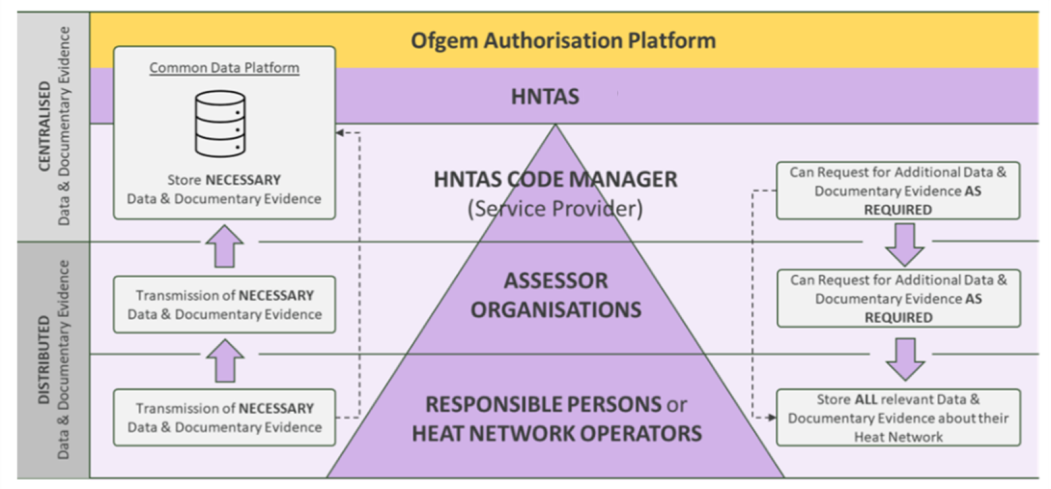
Consultation questions
Question 50: Do you agree with the general approach set out in the data hierarchy (pyramid) above?
Question 51: Do you support the development of a ‘golden thread’ of evidence throughout a network’s life, to ultimately be maintained by the heat network operator?
Question 52: Do you agree with the appointment of duty holders (Designated designer, Contractor and operators) to ensure responsibilities are clear at each stage?
6. Assessors
6.1 Assessment stages
As set out in Section 2.4 and 5.2, assessments against the technical specifications will be required to pass end of phase gateways throughout the planning, design, construction and operation stages of a project, for each heat network element. At each gateway the Responsible Party, or their designated duty holders, will submit a Claim of Conformity. For the design stages, this claim is subject to assessment to validate that the HNTAS requirements will be fulfilled. For the installation stage onwards, this claim is subject to assessment to verify that the HNTAS requirements have been fulfilled.
If the assessor is satisfied that the HNTAS requirements will be, or have been, met then they will issue a Statement of Conformity. The project may not progress onto the next phase unless it has passed the previous assessment gateway.
Assessment will be undertaken by qualified individuals registered as HNTAS assessors. In some cases, individual assessors will work for a HNTAS-registered Assessment Organisation.
Assessment will be broadly based on ISO 17029 principles, although assessors will not require UKAS accreditation. In line with established ISO 17029 process requirements assessment at each gateway will follow three main steps, which are ‘execution’, ‘review’ and ‘decision’.
These steps are designed to take place sequentially, and can be defined as follows:
- Execution: Performing the validation / verification of the claim, based on the available evidence, and producing a draft outcome statement.
- Review: Confirming if the Execution was fully and appropriately carried out.
- Decision: Deciding whether to validate or verify the claim being made, based upon the outputs of the Execution and Review.
A HNTAS assessor will be registered to complete one or more of the execution, review and/or decision-making activities, depending on their qualifications and experience. More information about assessor applications and requirements can be found under the ‘Assessor approval categories’ heading, below.
An important principle of HNTAS is that self-review is never permissible. This means that the review and decision-making steps must be completed by an individual who was not involved in the execution step. More information about this is provided under the ‘Impartiality rules’ heading, below.
To help to ensure this separation of duties, assessors completing ‘review’ and ‘decision’ activities must be acting on behalf of a HNTAS-registered Assessment Organisation. Assessment Organisations are required to have access to sufficient HNTAS-registered assessors so that they are able to put in place processes to ensure that there is clear distinction between execution, review, and decision activities. The Scheme Operator is expected to manage a register of HNTAS-registered Assessment Organisations and HNTAS-registered assessors on behalf of the Code Manager.
We propose that any instances where the correct process on the execution, review and decision are not followed by an assessor individual should be handled by the relevant Assessor Organisation in the first instance. Should further escalation be required, or if the noncompliance is with the Assessor Organisation itself, the Scheme Operator should handle the issue, with a requirement to report such cases directly to the Code Manager.
The primary enforcement option for non-compliance with this process is expected to be removal from the register by the Code Manager. Assessments will not be able to be undertaken by Assessment Organisations or assessors not on the register. Section 6.4 and 6.6 provide further detail on monitoring and auditing proposals for Assessment Organisations and assessor individuals, and Section 8.2 outlines in further detail our proposals for handling disputes, appeals and complaints and the possible enforcement consequences arising from these.
Consultation questions
Question 53: Do you agree with the proposed assessment stages, and the roles for assessors and Assessment Organisations set out? If not, please provide details.
6.2 Assessor approval categories
Individual assessors may be registered by the Code Manager following a review of their suitability, knowledge, qualifications and experience.
An individual assessor can be registered to validate/verify claims for different heat network elements (energy centre, customer connection, etc) at each of the five HNTAS assessment gateways (feasibility, design, construction, etc). For each element and gateway an assessor may be registered to complete assessment activities as an executor, reviewer and/or decision-maker, depending on their level of experience.
Table 12 illustrates how assessment stages and heat network elements might be mapped to the levels of assessment. A matrix like this might be presented during the application process. An applicant would need to indicate which combinations they wish to apply for, and – for each – the highest level at which they wish to be approved (i.e. executor, reviewer, decision-maker).
Table 12. How assessment stages and heat network elements might be mapped to the levels of assessment
| Stage | Feasibility | Developed Design | Detailed Design | Construction | O&M |
|---|---|---|---|---|---|
| Check | Validate | Validate | Validate | Validate & Verify | Verify |
| Energy centre | Decision maker | Decision maker | Decision maker | Decision maker | Decision maker |
| District distribution network | Review | Review | Execute | Execute | Execute |
| Communal distribution network | N/A | N/A | N/A | N/A | N/A |
- A HNTAS-registered executor cannot be a reviewer or decision-maker.
- A registered reviewer can execute or review but cannot be a decision-maker.
- A registered decision-maker can deliver all three functions (although under impartiality rules they could not be a reviewer or decision maker for assessments which they executed).
When making an application to the Code Manager, prospective assessors should indicate which category or categories of assessment they wish to be considered for. There will be no limit to how many stages or elements an assessor can apply for, provided they are suitably experienced. The following minimum requirements are proposed:
- Execution requires minimum 3 years relevant experience, Chartered Engineer not required.
- Review requires minimum 5 years’ experience, Chartered Engineer preferred but not essential.
- Decision requires minimum 8 years’ experience and Chartered Engineer.
UKAS accreditation will not be mandatory for assessors under any category.
Dividing assessors in terms of the assessment gateway stage, heat network element and assessment activity they can undertake is intended to increase accessibility of the scheme for prospective assessors, particularly those who are highly specialised in one specific area. It may also help Responsible Parties and duty holders find suitably qualified assessors to meet their needs. For example, if a developer specifically requires someone to execute assessment activity for a communal distribution network at the end of the construction phase, then it should be straightforward to identify potential assessors who are registered in that field.
At the end of the assessment stages the process will be reviewed by the certification body comprised of certifiers (see Section 7 for more detail on certifiers).
Consultation questions
Question 54: Do you agree with the proposed approach of registered Assessment Organisations issuing Statements of Conformity at various stages of a heat network’s life?
Question 55: Do you agree that accreditation of assessment activities should be divided in the way set out? Do you have any views on the minimum experience and qualification level for each assessment activity? Please provide details.
6.3 Assessor application and approval process
Prospective assessors will apply to the Code Manager to become a HNTAS registered assessor using a standard form. This form and the application criteria will be developed by the Code Manager once established, but at minimum applicants must specify the assessment categories they wish to be considered for, relevant qualifications and experience, and necessary personal information.
The Code Manager may request additional information to support the application, if required. If the applicant meets minimum requirements then they will be invited to complete any mandatory HNTAS-specific training. As long as they pass this training, the candidate will proceed to interview.
Prospective assessors will be interviewed by a panel of two or more appropriately qualified and experienced individuals, drawn from an interviewer pool which the Code Manager will establish. Interview panels will be tailored to ensure they have the correct balance of knowledge to scrutinise the categories of assessment being applied for. As HNTAS becomes established interview pool members will ideally themselves be HNTAS assessors.
The interview panel will recommend an outcome to the Code Manager. Their recommendation may be to grant the applicant HNTAS registration for some, but not all of the assessment categories applied for. Where one or more categories are rejected, the panel will provide the Code Manager with reasons. If the Code Manager accepts the panel’s recommendation, then the outcome will be communicated to the applicant in an appropriate and timely manner.
We envisage that by applying to be a HNTAS registered Assessor Organisation or individual Assessor, the applicant agrees to a set of Rules of Registration and relevant policies. The Rules of Registration will bind the new assessor to relevant HNTAS processes and procedures, including requirements for record keeping and cooperation with audits. The Code Manager will have the power to unilaterally vary the standard HNTAS Rules of Registration and relevant policies, with reasonable notice.
A process will be set up to consider valid appeals from candidates who are rejected either before or after the interview stage, including candidates who are partially successful (i.e. accepted for some categories, but not all that they applied for).
The new assessor will be added to a public-facing register, including details of the specific HNTAS categories they are registered in.
Consultation question
Question 56: Do you agree with the application process for individual assessors? If not, then please provide details.
6.4 Assessor oversight and continuing development
Registered HNTAS assessors will need to maintain their competence through a combination of training and continuing professional development.
Mandatory training for assessors will be specified and provided by the Code Manager, covering areas such as HNTAS-specific processes, techniques and tools. Training may be updated and expanded as HNTAS develops, to take account of changes to scheme rules, processes, techniques and tools, or to address any common issues identified by the Code Manager. Successful completion of mandatory training will be required before an assessor can be registered or re-registered. Each individual assessor will be responsible for ensuring their training remains up to date, although this may also be a requirement of any Assessment Organisations they are employed by.
Assessors will be subject to oversight and occasional audit by the Code Manager. Audit may be triggered by: proactive sampling by the Code Manager; in response to incidental intelligence arising from oversight of Assessment Organisations or the certification process; or as a direct result of specific concerns being raised.
Under the HNTAS Rules of Registration individual assessors will be required to keep auditable records of their work. They must share these records with the Code Manager when requested, on a confidential basis and in line with data protection legislation.
Under the HNTAS Rules of Registration assessors will be required to undergo periodic checks to retain their HNTAS assessor registration. It is proposed that an in-depth check should be required no more than three years after initial registration. Where assessors have been registered in different assessment categories at different times, the Code Manager should rationalise their checks as far as possible. For example, if an assessor was registered to conduct execution and review on energy centres in one year, then execution and review on thermal sub-stations the following year, a single checking process could potentially cover both categories.
We expect that this checking process would involve a review of sampled HNTAS work by an appropriate member of the interviewer pool, potentially followed by a panel interview similar in format to the initial application process. The Code Manager may specify additional re-registration criteria as HNTAS develops. It is recognised that in the early years of HNTAS, opportunities to engage in assessment activity may be more sporadic as the heat network sector grows and develops, and the Code Manager will take this into account e.g. when requiring samples of previous work. Where the checking process indicates that the individual assessor may no longer meet requirements, further action (e.g. submission of further evidence or the completion of prescribed training) may be required.
Assessors who ultimately cannot meet checking requirements will have their HNTAS registration revoked and will be marked as such on the public-facing register. [Partial revocation will be possible, meaning that an assessor may lose their registration to complete some activities (e.g. to assess one type of heat network element) but retain their registration in other areas. An appeals process will be available for revoked assessors.
Consultation question
Question 57: Do you agree with the proposed assessor oversight, training and re-accreditation processes set out? If not, please provide details.
6.5 Assessment Organisation application and registration process
As set out in Section 6.1, assessment review and decision-making activities may only be carried out by individual assessors who are acting on behalf of a HNTAS-registered Assessment Organisation.
Assessment Organisations must have access to a suitable pool of HNTAS-registered assessors (or qualified individuals intending to seek HNTAS registration) which the organisation will coordinate to carry out assessment activities. There will be no minimum size or skill range required for assessor pools, but the prospective organisation must be able to satisfy the Code Manager that it will have access to sufficient expertise to meet client needs and satisfy impartiality rules.
Heat network developers and similar organisations may apply to become a registered Assessment Organisation in their own right, with the explicit intent of maintaining a pool of internal staff to conduct assessment of its own heat networks. This is permissible provided rules on impartiality can be met (see Section 6.7 for more detail on impartiality rules).
Specific requirements for prospective Assessment Organisations will be developed and finalised once the Code Manager is in place. Beyond basic checks into suitability, fitness, knowledge and expertise it is proposed that Assessment Organisations will require, among other things:
- suitable business processes in place, including quality checks and audits which will follow the broader principles of ISO 17029 as well as those proposed in Section 6.7 below
- Cyber Essentials certification
The application and registration process for Assessment Organisations will be broadly similar to that for individual assessors, including:
- an application made to the Code Manager using a standard form
- an initial sift and background checks (with the Code Manager requesting additional information as necessary)
- a panel interview of representatives from the prospective Assessment Organisation
- a process for valid appeals made by unsuccessful organisations
- successful organisations abide by the HNTAS Rules of Registration and relevant policies binding them to the scheme rules and processes, which may be varied by the Code Manager with reasonable notice
- newly registered Assessment Organisations are added to the public-facing register
It is important to note that being a registered HNTAS Assessment Organisation will not entitle the organisation to receive any payments from the Code Manager. It is envisaged that most assessment activities should be funded through commercial arrangements between the Assessment Organisation and those commissioning the work (i.e. Responsible Parties or duty holders).
Consultation question
Question 58: Do you agree with the proposed accreditation process for Assessment Organisations? Do you have any views on the minimum requirements for Assessment Organisations? Please provide details.
6.6 Assessment Organisation oversight
Registered HNTAS Assessment Organisations will need to maintain their fitness to provide assessment functions. Part of this will involve ensuring their employed assessors adhere to their own personal training and continuing professional development obligations, as set out in the Section 6.4. Oversight of Assessment Organisations themselves will largely reflect the proposed oversight arrangements for individual assessors also detailed in Section 6.4, including:
- periodic audit by the Code Manager which may be triggered by proactive sampling, incidental intelligence or in response to specific concerns
- requirement on Assessment Organisations to keep auditable records of their work and make these available to the Code Manager on request, taking account of data protection legislation and commercial sensitivity.
Assessment Organisations will be required to undergo checks every three years at minimum to retain their registration, including a review of sampled HNTAS work and a panel interview similar in format to that required during the application process.
Where an Assessment Organisation no longer meets requirements and remedial action (e.g. submission of further evidence) has failed, they will have their registration revoked and will be marked as such on the public-facing register. An appeals process will be available for revoked Assessment Organisations.
Consultation question
Question 59: Do you agree with the proposed Assessment Organisation oversight and re-accreditation processes set out? If not, please provide details.
6.7 Impartiality rules
Detailed guidance on impartiality standards during the assessment and certification process will be drafted and published as HNTAS develops. There are two aspects of impartiality which we are seeking views on in this consultation: second-party assessment, and project specific consultancy advice.
HNTAS assessment will be based on selected principles and elements of ISO 17029, although as noted above UKAS accreditation will not be mandatory for assessors. One of the core principles of ISO 17029 which we intend to carry into HNTAS is impartiality of the assessment process.
First-party assessment (i.e. self-review) will never be permissible under HNTAS. This means that the body which submits a claim of conformity at a HNTAS assessment gateway cannot also be the body which validates/verifies that claim.
It is proposed that second-party assessment should be permissible under HNTAS, subject to certain controls. Second-party assessment is where a body which has an interest in the claim of conformity also validates/verifies that claim.
Allowing second-party assessment means that one department [footnote 42] of an organisation (e.g. a heat network developer) may be managing the project which is subject to assessment and submit the claim of conformity, while another department of the same organisation supplies HNTAS-registered assessors to execute assessment activity. In this instance the department providing assessment would be considered a second-party: it did not submit the claim of conformity, but it does hold an interest in the claim as part of the wider organisation.
Review and decision-making activities must always be carried out by a third-party, i.e. a body which is independent of and has no interests in the claim of conformity. This is why it is proposed that review and decision-making assessment activities must be carried out by an assessor working for an Assessment Organisation. Assessment Organisations must ensure that HNTAS impartiality rules are fully incorporated into their processes and complied with, in line with their contract with the Code Manager.
In the case of consultancy organisations, ISO 17029 only permits generic, non-project specific consultation, such as provision of technical standards and training. It is proposed that under HNTAS, limited project specific advice may be provided by assessors, in the specific case that a heat network is at risk of failing to meet requirements. For example, a consultant might carry out a pre-audit before assessment, identify areas of non-compliance and provide recommendations on steps required to achieve compliance. In this instance the consultant would be a second-party to the body providing the claim. Having shared this type of project specific advice the consultant could go on to execute assessment activity under HNTAS. The same consultancy organisation could potentially also undertake review and decision-making activities, if they were a registered Assessment Organisation and review/decision was completed by a different individual to the individual who completed the execution (i.e. a third party with no interest in the claim).
Allowing execution of assessment activities by second-party bodies in these instances should increase the pool of available assessors, supporting the successful introduction of HNTAS. Allowing a degree of project specific consultation as outlined above should also support compliance against the new standards. Any risks related to second-party execution of assessment activities (for example, the risk of self-interest influencing decisions) should be mitigated in an effective and timely manner by the mandatory review and decision by an impartial third-party. In the unlikely event that this mitigation is not sufficient then a project which has not satisfied HNTAS impartiality standards will be picked up at the certification stage, when remedial action may be taken.
It will ultimately be for the Responsible Party on any project to manage the risk of engaging second-party assessment, recognising that if HNTAS impartiality standards are not met during the planning, design and construction stages then this may lead to delays in achieving certification at the end of the project.
Consultation question
Question 60: Do you agree with proposals to allow second-party execution of assessment activities under HNTAS? Do you agree that project specific consultancy advice should be permitted where it helps ensure standards are met? If not, please provide details.
7. Certifiers
7.1 Role of certifiers
As set out in Section 5, at the end of the HNTAS assessment process, networks must obtain certification. HNTAS certification will be granted based on the decision of HNTAS certifiers employed by a Certification Body registered by the Code Manager. This Certification Body will act on behalf of the Code Manager.
New build heat networks will first require certification at the end of the commissioning stage, before supply of heat to customers can begin (corresponding with assessment gateway 3). The certifier’s role is to provide an independent, objective, third-party review of the detailed information and evidence gathered and assessed throughout design and build stages, to ensure that:
- a ‘golden thread’ of auditable information exists detailing the network’s development from the feasibility and design stages through to the end of construction;
- the required Statements of Conformity were granted at each assessment stage according to proper process;
- key performance indicators (KPIs) have been met; and
- impartiality standards were correctly applied throughout.
For existing heat networks, the first HNTAS certificate is required no more than 6 years after scheme commencement for networks built in 2015 or after, and no more than 8 years after scheme commencement for pre-2015 networks. Certification should be sought as soon as the network’s agreed improvement plan has been implemented (or as soon as possible if no improvement plan is required). Certification for existing networks will follow a similar approach to the bullet points set out above, comprising a review of evidence and process throughout the prior assessment stages, delivery of the agreed improvement plan and achievement of KPIs.
For all heat networks a second HNTAS certificate is required no more than two years after the first certificate was granted (corresponding with assessment gateway 4). At this point the certification process will again review the ‘golden thread’ of information, evidence and Statements of Conformity across the entire assessment process, this time including two years of operation and monitoring under HNTAS and delivery of KPIs during that period.
Following grant of a second certificate the initial HNTAS assessment and certification process is completed. The certified heat network will move to a regime of exception reporting, with monitoring of performance against KPIs on a mainly automated basis.
Consultation question
Question 61: Do you agree with the proposed certification process and timings, and the role of certifiers set out? If not, please provide details.
7.2 Centralisation of certification
It is proposed that the delivery of HNTAS certification functions should be delegated to a single, centralised Certification Body which will coordinate the activities of individual certifiers across Great Britain. Centralising HNTAS certification will ensure a consistent approach is being applied, as well as providing stability in the early years of HNTAS and greater adaptability to change as the scheme develops and becomes established. Centralised certification will also allow a higher level of scrutiny and oversight of both heat networks and assessors, which will give the Code Manager a stronger understanding of how the scheme is operating.
The HNTAS Certification Body will follow the broad principles of EN 17020. This will ensure that the organisation delivering HNTAS certification meets national standards of quality, impartiality and competence. In the medium term it is recognised that it may be necessary to allow HNTAS certification activities to operate without UKAS accreditation, to enable the Certification Body to accumulate evidence to demonstrate competence to UKAS and achieve accreditation in due course if this is required.
It is possible that the first HNTAS Certification Body will be appointed by DESNZ, with the contract novated to the Code Manager, once it is established. We expect the Certification Body to be appointed for a fixed contract duration, with the potential to extend provided good quality service can be evidenced.
Once the first Certification Body’s contract has elapsed, eligible organisations will be invited to bid to the Code Manager using a detailed bidding process which will be developed and publicised as required. The successful organisation will sign a HNTAS certification contract with the Code Manager, binding them to the scheme rules and processes. The Code Manager will have the power to unilaterally vary the wording of this contract with reasonable notice. Failure to comply with the terms of the contract (for example, failure to meet the demand for certification in a timely manner) may lead to the Certification Body’s status being withdrawn.
We anticipate that the number of existing organisations with capacity to provide a HNTAS certification function is likely to be low. Centralising the function therefore decreases the risk of a lack of available Certification Bodies rendering HNTAS inoperable – either because there are not enough providers in the first instance, or because one or more leaves the market after HNTAS launches. With centralised certification these risks still exist, but the Code Manager will have a much greater degree of oversight of certification capacity and will be able to prepare for and mitigate any upcoming challenges which might risk undermining successful operation of the scheme.
The centralised approach to certification will be periodically reviewed by the Code Manager to ensure it remains the best model as HNTAS and the heat network market establish across Great Britain. If the market grows to a point where it could be feasible and beneficial to move to a decentralised certification model with multiple Certification Bodies, then this option will remain open. Such a decentralised approach would mirror the proposed approach to Assessment Organisations.
Consultation question
Question 62: Do you agree that HNTAS certification function should be carried out by a single, centralised Certification Body, that is an appropriately qualified body, appointed by the Code Manager?
7.3 Certifier accreditation
The centralised Certification Body will maintain a pool of HNTAS certifiers to deliver this function across Great Britain.
The criteria for an individual to become a HNTAS certifier will be broadly similar to the criteria required to become a HNTAS assessor. Similarly, the application process and ongoing requirements for certifiers are expected to be largely consistent with those for assessors. Against this it is recognised that the role of individual certifiers is likely to require less technical expertise than that of an assessor, as certifiers will primarily be reviewing and agreeing evidence which has already been validated and verified by assessors.
It will be possible for an individual to be a HNTAS certifier and a registered HNTAS assessor, if they can meet the application requirements. However, an individual would not be permitted to act as both an assessor and certifier on the same project.
Consultation question
Question 63: Do you have any views on the criteria or process for individual HNTAS certifiers? If so, please provide details.
8. Complaints, Appeals and Enforcement
It will be the responsibility of the HNTAS Code Manager to monitor the performance of regulated parties with respect to their compliance with the Code. As detailed in Section 4.5, we intend to require regulated heat network operators to enter into a legal agreement with the Code Manager as a condition of authorisation. By entering into this agreement, we expect that heat network operators will be agreeing that the Code Manager can use certain levers if they do not comply with the Code. For example, HNTAS could pursue heat network operators through the courts or potentially levy charges.
Monitoring performance of regulated parties in respect of compliance with the authorisation conditions will be the responsibility of Ofgem as regulator.
The Code Manager may add resolved disputes to its published guidance on Code interpretation, anonymously setting out the issues raised, HNTAS rulings or opinions, and the reasoning behind these. This will gradually build a set of HNTAS ‘case law’ outcomes which can be used to avoid similar disputes in the future.
8.1 Complaints and enforcement against heat network operators
From the point at which a Responsible Party enter into an agreement with the Code Manager by signing a deed poll with the Code Manager (see Section 4.5), the Responsible Party and any designated duty holders must comply with the requirements set out in the Code. If a Responsible Party has not signed the deed poll and presents themselves for HNTAS assessment or certification, this will be identified by HNTAS assessors and certifiers; the deed poll will need to be signed before the Responsible Party can pass assessments or gain certification.
If a regulated party does not enter into an agreement with the Code Manager, as there will at that point be no established relationship between the heat network and the Code Manager, Ofgem will be able to take action where this represents a breach of an authorisation condition.
Following certification, the Responsible Party and their designated duty holders must continue to comply with requirements set out in the Code or appended to their certificate. These will include, among other things, requirements around maintaining technical performance and providing data in a timely manner.
Whether arising from data monitoring or a complaint, where a heat network operator fails to meet the technical standards or comply with the conditions, we propose that the first party to take action would be the Code Manager, as it is responsible for the overall operation of the scheme. In such cases, the Code Manager (or its appointed Scheme Operator) may obtain information from a heat network, including through inspection, to ascertain the veracity of the non-compliance. As part of its ongoing oversight, the Code Manager may also schedule audits with heat networks from time to time.
Certified heat network operators will be given a period to remedy noncompliance. This period will be set by the Code Manager on a case-by-case basis to ensure proportionality and deliverability. Failure to remedy noncompliance in the prescribed manner and time period would allow the Code Manager to withdraw certification and take formal action. The Code Manager will likely maintain a public register of withdrawn certificates to provide greater transparency to both current and prospective consumers of named heat networks. A public register would also serve to dissuade other certified heat network operators from becoming noncompliant.
Prior to withdrawing certification, the Code Manager may explore alternative actions, such as financial penalties, to encourage operators to remedy network noncompliance. We would expect the Code Manager to consider factors such as fairness, proportionality and effectiveness when exploring such alternatives.
Joint audit approach
The requirements of the audit approach for HNTAS, covered above, are designed to ensure that a heat network’s performance continues to meet the technical requirements of the Code, with reporting obligations and inspection requirements being an enduring condition of certification. Where there are reasonable grounds that a certificate holder is failing to comply with the conditions of its certificate, this can trigger an audit, with the Code Manager scheduling and detailing the methodology of the audit.
One potential complication is that as well as the HNTAS audit approach, Ofgem will be overseeing a separate audit function as part of its regulatory responsibilities in the sectoral regime. This approach is expected to be based on the appointment of external auditors, with a mix of random sampling and targeted audits in cases where intelligence indicates particularly poor consumer outcomes – this is subject to the Ofgem Authorisation, Monitoring, Audit, Compliance and Enforcement consultation [footnote 43], the Ofgem response to which is due to be published in the coming months.
Given the likelihood that an issue causing consumer detriment e.g. reliability issues, may also be triggering failure to meet the performance metrics required to maintain HNTAS certification, there are scenarios where a network would become of interest to both Ofgem and the Code Manager for the purposes of an audit. It will be the responsibility of Ofgem and the Code Manager to share data on planned future audits to ensure that there is proportionality – e.g. a heat network is not unnecessarily the subject of two concurrent audits – and also that where there is shared areas of focus, there is not duplication of information requested, e.g. a potential joint approach could be considered.
Ofgem role
The intended Ofgem approach to compliance and enforcement across the broader regulation of the heat network sector was detailed in the 2023 Heat Networks Regulation: Consumer Protection consultation and corresponding Government response. [footnote 44] The requirement for applicable networks to enter into an agreement with the HNTAS Code Manager will be an authorisation condition. The detail of the authorisation conditions heat networks will need to meet was included in the November 2024 consultation [footnote 45], but it is expected that the detail of meeting technical standards will be held in the Code documents, and the authorisation condition will simply be a requirement for applicable networks to enter the necessary agreement with the Code Manager. Consequently, if a regulated party does not enter into an agreement with the Code Manager, as there will at that point be no established relationship between the heat network and the Code Manager, Ofgem will be able to take action where there is a breach of this authorisation condition.
In terms of how Ofgem will monitor this, Ofgem will have opportunities to check compliance with the obligation to sign up to the Code Manager at the point of authorisation for operators of new heat networks, and at the point of registration for operators of existing heat networks via the digital systems. In the case of new heat networks, authorisation would not be granted if the applicant is not able to present the requisite certificates demonstrating technical compliance. As such, any heat network operator seeking authorisation without first engaging with the Code Manager would be unable to gain authorisation to operate. Ofgem registration is not intended to be contingent on HNTAS registration. Registration with the Code Manager will be required once the HNTAS digital service is available.
The Code Manager’s core responsibilities will include the audit and oversight of parties including heat network operators. In some extremely rare scenarios, where all other avenues of engagement by the Code Manager have been pursued unsuccessfully and there are no other options, there may be cases that are ultimately referred to Ofgem as a breach of the authorisation condition requiring acceding to, and complying with, the directions of the Code Manager.
Consultation question
Question 64: Do you agree with our proposed arrangements for handling complaints against and non-compliance of heat network operators? Do you consider that remedies other than withdrawal of certificates, such as financial penalties on non-compliant heat network operators, would be appropriate?
8.2 Complaints and appeals against Assessment Organisations
If an applicant (e.g. a heat network operator) disputes the decision of an Assessment Organisation, such as declining to award a Statement of Conformity, and the appeal procedures of the Assessment Organisation are not able to resolve the dispute, the appellant or the Assessment Organisation could seek guidance from the Code Manager. The Code Manager will review the evidence from both sides and provide a written opinion. The Assessment Organisation will then review its own decision. We propose that the opinion of the Code Manager be non-binding, as HNTAS will be a third-party certification scheme under which only HNTAS registered Assessment Organisations can award a Statement of Conformity.
Where there is an alleged breach of registration rules by the Assessment Organisation, either arising from a complaint or the Code Manager’s oversight, the Code Manager would notify the Assessment Organisation of the alleged breach and required remediation. The Assessment Organisation would be able to respond. If it fails to remedy or challenge a major nonconformance (minor ones could become major if left unresolved), the Code Manager may decide to withdraw its registration. In such a case, the Assessment Organisation may request a Code Management Committee hearing, while the registration is suspended in the meantime. The Code Management Committee would consider the report from the Code Manager and the grounds of the Assessment Organisation before giving written opinion with reasons, and the Code Manager would review its original decision. The Code Manager is not bound to follow the Code Management Committee’s opinion as the Code Manager is ultimately accountable for delivery of the scheme. The Code Manager will also likely maintain a public register which will show the dates for which any registration was valid.
Complaints regarding the work or conduct of individual assessors may also be submitted to the Code Manager, which will set out the handling procedures.
Consultation question
Question 65: Do you agree with our proposed arrangements in handling complaints and appeals against Assessment Organisations? Are there any other factors you think we should take into consideration in how complaints and appeals against Assessment Organisations are handled?
8.3 Complaints and Appeals made in relation to suppliers contracted to perform Code Manager functions
Should the Code Manager outsource any of its functions, there is a need for robust processes to handle any complaints and appeals brought against contracted suppliers.
In the event that a Certification Body, Training Provider or Scheme Operator are appointed as contractors of the Code Manager, they would be accountable to the Code Manager and, ultimately, to the DESNZ Secretary of State. Any complaint about their conduct could be directed to the Code Manager to enforce remedies through contractual mechanisms. We would expect the Code Manager to have appropriately robust arrangements for exit management and transfer to a new provider as required.
We propose that any appointed Certification Body will require appropriate complaint procedures in its terms of reference. If a dispute brought against the Certification Body is not able to be resolved by going through these procedures, we believe complainants should be able to take the case to the Code Manager, and ultimately to the DESNZ Secretary of State.
If an applicant (e.g. a heat network operator) disputes the decision of an appointed Certification Body, such as declining to award a certificate, they could similarly make use of the appeal procedures of the Certification Body. If an appeal is unable to be resolved, the appellant or the Certification Body could seek guidance from the Code Manager.
Consultation question
Question 66: Do you agree with our proposed arrangements in handling complaints and appeals against the Certification Body, Training Provider and Scheme Operator? Are there any other factors you think we should take into consideration in how complaints and appeals against these entities are handled?
Complaints, Appeals and Enforcement against the Code Manager
The Code Manager’s complaints handling procedures would also provide for circumstances where the complaint is directed against the Code Manager’s activities, be these outsourced or performed in-house. Where possible, the staff investigating should be separate to those involved in the subject matter. Circumstances and procedures for referral of a complaint to the Code Management Committee would be set out. It is expected that DESNZ would establish a complaints procedure, with escalation up to the Secretary of State if required. A complainant may follow these procedures under specific scenarios, such as having a complaint against the Code Manager. (For further detail see Section 4.3).
If an applicant (e.g. a heat network operator) disputes the decision of the Code Manager, such as deciding to withdraw a certificate, they may request, via the Code Manager, that the Technical Group review the decision. The Technical Group will review the evidence and provide a written opinion, and the Code Manager will review its original decision in light of such opinion.
The Code Manager maintains the Code and updates it as appropriate. When the Code Manager publishes its decision to change the Code, an interested party may submit an appeal within a time period. If the Code Manager establishes that the appeal has a basic level of validity, the relevant change proposal would be withheld until the appeal has been determined by the Code Manager, which may also involve the Code Management Committee in the process.
Consultation question
Question 67: Do you agree with our proposed arrangements in handling complaints and appeals against the Code Manager?
Secretary of State role
With DESNZ initially housing the Code Manager function, the Secretary of State will directly oversee the performance of the Code Manager, who will report directly to and be accountable to the Secretary of State, to ensure the Code Manager is meeting the conditions set by the Secretary of State.
The Code Manager, and any external entities the Code Manager appoints to outsource functions of its role would be expected to meet a level of performance in discharge of their functions. Expected performance levels would be set by the Secretary of State via conditions, and performance against these levels is accountable to the Secretary of State. The performance of external entities contracted to perform Code Manager functions will be managed through contractual mechanisms.
Consultation question
Question 68: Do you agree with the proposed measures against the Code Manager to ensure that the Secretary of State is able to intervene in cases of poor performance?
9. Incentives
Although analysis shows that implementing HNTAS can save both capital expenditure in design and operational expenditure, DESNZ recognise that some of the HNTAS minimum requirements and procedures could place both time and cost pressures on the heat network sector. In order to mitigate this and help smooth the transition into HNTAS, DESNZ are considering what financial and non-financial incentives could be introduced to assist the sector, as well as any opportunities to leverage in existing schemes such as the Heat Network Efficiency Scheme and the Heat Training Grant. Incentives might include:
- Grants and/or financial support for installing equipment required by HNTAS, such as metering and monitoring equipment or HIUs
- Grants and/or financial support for undertaking services required by HNTAS (e.g. the development of Performance Improvement Plans or subsided assessment costs).
- Financial incentives for early moves (early-bird) toward HNTAS certification
- Deadline extensions for early movers with very large portfolios
- Fast tracks to encourage early adoption and certification under HNTAS
- Subsidised training to support all the above
In general, DESNZ believe that incentives should target the worst performers first, but this cannot be at any cost. We would expect Responsible Parties to carefully assess the cost and benefit to their consumers of retrofit versus following the path to declare a network End of Life. The objectives of the incentives under consideration is to lead to quick wins and raising the bottom of the market.
Consultation questions
Question 69: Do you believe that there is a need for additional grands and/or financial support for installing particular types of equipment to support HNTAS. If so, what types of equipment would you propose?
Question 70: Do you believe there is a need for additional grants and/or financial support for services undertaken as part of HNTAS? If so, what types of services would you propose?
Question 71: Do you believe there is a need to encourage early movers toward HNTAS certification. If so, what form would incentives take and when would these need to be applied?
Question 72: Do you believe there is a need for subsidised training to support all the above? Please specify what you believe are the key skills gaps.
Question 73: Please suggest any other types of incentives not considered above that could assist existing heat networks in becoming compliant with HNTAS?
We expect that new build heat networks will be able to self-fund their compliance with HNTAS and therefore will not require financial support. DESNZ believe that new-build heat networks should be able to meet all the HNTAS requirements as part of the design and construction processes. There are clear incentives built-in to HNTAS for new builds. New heat networks will not be allowed to begin construction until they have demonstrated compliance with technical standards at the design stage. Similarly, new build heat networks will fail to achieve certification and will not be granted authorisation to supply heat if they have not followed HNTAS requirements throughout construction. This will prevent the building of poorly-designed networks, ensuring that good performance outcomes will be achieved and the need for costly retrofits will be avoided.
We estimate that an average new build heat network can save £900/dwelling from following HNTAS procedures, largely due improved designs avoiding the purchase and installation of oversized equipment. There can however be additional design costs which would offset some of the savings. We have also considered that the new build sector is well supported by grants through the Green Heat Network Fund. DESNZ are therefore not considering HNTAS incentives for the new build heat network sector.
Question 74: Do you agree that incentives should focus on supporting and encouraging existing heat networks as they are likely to have a more difficult transition pathway to meeting HNTAS requirements?
9.1 Removing barriers
There may also be other potential initiatives that could play a significant role in bringing HNTAS requirements to the sector and improving network performance. Whilst these are not strictly incentives, they could be seen as removing barriers that are currently holding back the sector. DESNZ are considering setting up a more targeted procurement framework to form an essential part of the ‘incentives’ landscape. Standards could be raised through the screening and approval process of appointing framework providers. This could take the form of a DESNZ ‘single point of entry’ procurement framework, directly targeted at existing heat networks. This could have Lots including:
- Metering and monitoring procurement framework [footnote 46] - A DESNZ/HNTAS supported/recognised procurement framework for pre-accredited meter and Automatic Remote Monitoring suppliers/installers.
- HIU procurement framework - a DESNZ/HNTAS supported/recognised HIU procurement framework to provide an easy/quick route to procure the supply/installation/commissioning of HIUs, most of which include modern controls, metering and monitoring.
- Consultancy services – a DESNZ/HNTAS supported/recognised procurement framework to provide an easy route to procure consultancy services aimed at developing solutions and overcoming problems in existing heat networks.
- Assessor services - a DESNZ supported provide an easy route to procure HNTAS assessor services. Although Assessment Organisations would be registered with HNTAS, a publicly available list of HNTAS registered assessors with could help facilitate a swifter and easier contracting process. This could cover assessors across both the new-build and operational phases.
Consultation question
Question 75: Do you think introducing this type of strengthened and targeted framework could help the heat network sector? Are there other areas that could form part of the frameworks?
10. Carbon Emissions: Calculating and Reporting
Reducing carbon emissions is one of HNTAS’ core objectives. The introduction of HNTAS will raise the performance and efficiency of existing heat networks over time, enabling systems to significantly lower the amount of fuel needed to meet heat demand as improvements are made. As over 90% of heat networks currently utilise gas-fired boilers as their primary heat generation technology, across all heat networks this represents a sizeable decrease in fuel and associated carbon emissions. Even assuming a phased decarbonisation to 2050, across all existing heat networks, we estimate that HNTAS will result in 11.6 MtCo2e of carbon savings between 2026-2050. However, if existing heat networks were not to decarbonise or decarbonised more slowly than expected, this could rise to up to 25.3 MtCo2e.
As new build networks will be required to meet HNTAS standards at the design and construction stages before becoming operational, new systems will be designed so that unnecessary carbon emissions are avoided from the outset. Together, the reduction in carbon emissions produced by existing heat networks over time, and the prevention of avoidable carbon losses in new build heat networks, will help meet the UK’s net zero target.
In order to monitor the impact of HNTAS on carbon emissions, it will be necessary for heat networks to report their emissions figures. The measurement of heat network carbon performance also underpins other areas of government policy and funding programmes such as the Green Heat Network Fund and heat network zoning.
In the recent Heat Network Zoning consultation (2023) [footnote 47], the government set its ambition to introduce a national zoning emissions limit, measured in gCO2e/kWh, for new and expanding heat networks in zones from 2030.
HNTAS will not require heat networks to meet a carbon emissions limit in order to be granted certification. However, as HNTAS will be collecting and assessing various data for heat networks from the initial stages of design and construction through to operation, there is a strong incentive to utilise HNTAS data collection processes to capture and calculate carbon. This will aid in the implementation of the zoning limit, whilst streamlining reporting processes for industry by providing a single data collection and reporting point for carbon data.
To support the introduction of the carbon emissions limit in zones and standardise the way in which heat network carbon emissions are calculated, we plan to develop and publish a heat networks carbon calculation methodology in summer 2025. We propose that this calculation methodology is provided as an online tool hosted on the HNTAS Digital Service, allowing heat network operators to have a real-time view of their carbon emissions. We envisage that the tool will be equipped with different factors to meet various reporting needs, including predicting future emissions at the design and construction stages, reporting past emissions, and calculating carbon emissions on an ongoing basis.
Whilst this will primarily assist operators of heat networks in new and expanding zones to understand their performance against the 2030 carbon requirement, we intend to make the tool available to all heat network operators in scope of HNTAS, regardless of if they are subject to the 2030 carbon emission limit or not. For heat networks outside of designated zones, the HNTAS carbon reporting mechanism will be useful for operators to better understand their carbon impact and provide emissions information to their consumers. It will also be an important step forward in enabling the government to track sector trends to inform future policymaking. The government will continue to review whether this data should be used to regulate the emissions of heat networks outside of zones in the future.
Consultation question
Question 76: Please provide any other comments you may have on the policy proposals within the consultation.
11. Consultation questions
Question 1: Do you agree with the proposed approach to not include the Consumer Heat System in scope of HNTAS after the construction phase? If not, can you please suggest an alternative approach and set out your justification.
Question 2: Do you support the use of 6 properties or more for domestic-only networks, or the connection capacity equivalent for non-domestic/mixed use networks, as an appropriate minimum heat network size to which HNTAS participation would be mandatory for new networks after scheme go-live? Please provide reasoning for your answer and, if you answer is no please provide an alternative approach.
Question 3: Based on the trade-offs between the benefits and costs of bringing smaller networks in scope of HNTAS, what, in your view, is the appropriate minimum heat network size to which HNTAS participation would be mandatory for existing networks? If this differs from the proposed use of 11 properties for domestic networks, or the connection capacity equivalent for non-domestic/mixed use networks, please provide supporting evidence and justification.
Question 4: Do you consider there to be need to subject existing networks with between six and ten properties to minimum network performance and monitoring requirements, or any other HNTAS requirements? What do you consider to be the implications of doing so?
Question 5: Do you agree with the proposals for minimum network measurement and that industrial networks (as defined above) should be exempt from HNTAS at scheme launch? Please give reasons why you agree or do not agree with the proposal.
Question 6: What, in your view, are the implications of including consumer heat pumps on Ambient loop and Shared Ground Loop networks within HNTAS past the design and construction phases? If you think an alternative approach is needed, please provide details and reasoning, including (if applicable) if this differs with respect to new build networks and existing networks.
Question 7: Do you agree or disagree with our proposed governance structure, and in particular with the appointment of a Code Manager? Please provide reasons for your response.
Question 8: Do you agree or disagree with the need for a Code Management Committee and sub-committees to ensure the views, interests and experiences of those involved in, or impacted by, HNTAS are taken into account to further evolve and improve the scheme? Please provide reasons to support your views.
Question 9: Do you support our proposal for the Code Manager to be housed within DESNZ initially, whilst we work through long term governance options? Please provide a justification for your answer.
Question 10: Do you support our proposal to recover 100% of the Code Manager’s costs through the gas and electricity licence fee mechanism in the short term? Please give reasons or supporting evidence for your answer and clearly outline any alternative proposals.
Question 11: Do you support our proposal to recover the Code Manager’s costs through a blend of gas and electricity licence fees and fees from the heat network sector in the longer term? Please give reasons or supporting evidence for your answer and clearly outline any alternative proposals.
Question 12. Do you support the preferred approach of a Deed Poll relationship between heat network operators and the Code Manager?
Question 13: Do you agree with the proposed approach of KPIs, Statements of Conformity and assessment gateways that will ultimately contribute to certification? Please give reasons why you agree or do not agree with the proposal.
Question 14: Do you agree with the gateways for new build heat networks being at the end of design, then end of construction/commissioning, followed by proof of measured in-use performance after 2 years. If you disagree, please suggest an alternative approach and set out your justification.
Question 15: If you anticipate that introducing HNTAS will have any impact on the Government’s housing supply ambitions please provide expected impacts with reasoning and evidence to support your answer.
Question 16: Do you support the proposed milestones for existing heat networks given in Table 6, or do you think there is a case for the final certification standard to be set at Milestone 2? Please provide reasons for your answer including your assessment of the impact on consumers of your preferred option.
Question 17: Do you agree with the milestones for existing networks? If you think there is a case for requiring these milestones for existing networks to be met more quickly or more slowly, please give details to explain your answer.
Question 18: What is your estimation of the cost of meeting the Milestone 2 and Milestone 4 requirements? Please provide information such as the size, age, and number of consumer connections on your network to help contextualise your estimates. Please also indicate if your network is fully metered.
Question 19: If not already provided in your answer to question 18, what is your estimation of the costs this approach would create for private landlords, registered providers of social housing, leaseholders or their respective tenants? Are there any particular scenarios we should be aware of? Where possible, please provide quantitative evidence to support your answer.
Question 20: Do you think our proposed treatment of Mixed Age heat networks is effective in appropriately applying different assurance pathways to newer and older parts of a heat network? Please provide reasons for your response.
Question 21: Do you agree that the HNTAS Metering and Monitoring Standard should cover both the monitoring points and the Automatic and Remote Monitoring Systems (ARMS)? Please provide reasons for your answer.
Question 22: Do you agree that the HNTAS Metering and Monitoring Standard should also cover smart metering systems and a Metering and Monitoring Strategy? Please provide reasons for your answer
Question 23: Do you agree with the proposed metering milestones and timelines for existing networks? Do you agree that they allow sufficient time for installation while ensuring consumer outcomes and network performances can be improved as soon as practicable? If you disagree, please set out your reasons and a justification for an alternative proposal.
Question 24: Do you agree that “smart meter” requirements should also be mandated, and included in the HNTAS metering and monitoring specifications?
Question 25: Do you agree with our proposal to disallow the use of wired M-Bus, and other unencrypted communication protocols, on new heat networks with remote disconnection capability from the point at which HNTAS commences?
Question 26: Do you agree with our proposal to allow the continued use of unencrypted communication protocols, where they are already in place on existing systems, until either the first HNTAS certificate deadline, or until meters reach the end of their life (whichever is soonest)?
Question 27: Do you agree that unencrypted systems with remote disconnect should have the function removed or meters/protocol be replaced as soon as possible and within five years after HNTAS commences?
Question 28: Do you agree with our approach to set the minimum level of accuracy at the equivalent of at least Class 2 of the MID 2014?
Question 29: Do you agree that ongoing testing and recalibration is required for existing networks?
Question 30: Do you agree with the proposal to extend metering requirements to existing buildings of supported housing, almshouse accommodation and purpose-built student accommodation, so that they can be covered by HNTAS?
Question 31: Do you think HNTAS requirements, including metering requirements, should be applied to buildings with leasehold related HNMBR exemptions? Please provide reasons for your answer.
Question 32: What options do you think should be explored to better enable the adoption of consumption-based billing in buildings with leasehold related HNMBR exemptions?
Question 33: Do you foresee any challenges arising from the installation of metering and monitoring systems and/or the undertaking of performance improvement works to meet HNTAS requirements in networks supplying leasehold customers? Please provide potential solutions to these challenges.
Question 34: Do you agree with the proposal to disallow the use of heat cost allocators to demonstrate compliance with HNTAS requirements? Please give reasons why you agree or do not agree with the proposal.
Question 35: Do you have any comments on our proposal to provide heat network operators powers of entry to conduct necessary maintenance of heat network equipment for health and safety reasons, meeting required technical standards and to install and maintain metering systems?
Question 36: Do you have any comments on our proposal to provide the HNTAS Code Manager with powers of entry to enable meter accuracy activities to be conducted, replicating the powers of entry currently provided to OPSS under HNMBR?
Question 37: Do you have any comments on our approach to provide necessary and proportionate protection to customers regarding the use of power of entry?
Question 38: Do you agree that heat networks which have not yet submitted planning applications at the point of HNTAS commencement should be subject to the same requirements and assurance pathway as new build networks? Please provide reasons for your answer.
Question 39: Do you agree that heat networks which have already submitted planning applications but have not yet signed M&E construction contracts at the point of HNTAS commencement should be subject to the new build requirements and assurance pathway from stage 3 (i.e. technical design) onwards? Please provide reasons for your answer.
Question 40: Do you agree that two years from completion is an appropriate timeframe to base the decision on the appropriate entry point at which pre-operation heat networks would join the existing network assurance pathway? Please provide reasons for your answer.
Question 41: Do you agree that pre-operation heat networks should register to a shorter deadline than other categories of heat network? Please provide reasons for your answer.
Question 42: Do you support the proposal to permit non-conformities in certain circumstances where non-conformities are unavoidable and have a negligible impact on heat network performance?
Question 43: In addition to physical constraints and specific technology applications, are there any other categories of non-conformities that you think should be permitted? We are interested in suggestions where permitting non-conformities would have little impact on network performance and would not negatively impact consumer outcomes.
Question 44: Do you support the process outlined for duty holders to submit, and assessors to grant, a dispensation for permitted non-conformities?
Question 45: Do you support the process outlined for the handling of non-conformities present at assessment?
Question 46: Do you support the process outlined for the handling of non-conformities present at certification?
Question 47: Do you agree with the milestones for End of Life heat networks? If you think there is a case for requiring these milestones to be different, or to be met more quickly or more slowly, please give details to explain your answer.
Question 48: What is your estimation of the impact HNTAS will have on heat network insolvency and market exit risks? Do you agree that the risk is low and manageable? Further to existing proposals, what mitigations would you suggest?
Question 49: Do you have views on how, in the event that a heat network has failed to engage with the End of Life process, exhausted commercial options to exit the market, and where these prevailing incentives have not led to another interested party ‘stepping in’, policy can support market led insolvency arrangements?
Question 50: Do you agree with the general approach set out in the data hierarchy (pyramid) above?
Question 51: Do you support the development of a ‘golden thread’ of evidence throughout a network’s life, to ultimately be maintained by the heat network operator?
Question 52: Do you agree with the appointment of duty holders (Designated designer, Contractor and operators) to ensure responsibilities are clear at each stage?
Question 53: Do you agree with the proposed assessment stages, and the roles for assessors and Assessment Organisations set out? If not, please provide details.
Question 54: Do you agree with the proposed approach of registered Assessment Organisations issuing Statements of Conformity at various stages of a heat network’s life?
Question 55: Do you agree that accreditation of assessment activities should be divided in the way set out? Do you have any views on the minimum experience and qualification level for each assessment activity? Please provide details.
Question 56: Do you agree with the application process for individual assessors? If not, then please provide details.
Question 57: Do you agree with the proposed assessor oversight, training and re-accreditation processes set out? If not, please provide details.
Question 58: Do you agree with the proposed accreditation process for Assessment Organisations? Do you have any views on the minimum requirements for Assessment Organisations? Please provide details.
Question 59: Do you agree with the proposed Assessment Organisation oversight and re-accreditation processes set out? If not, please provide details.
Question 60: Do you agree with proposals to allow second-party execution of assessment activities under HNTAS? Do you agree that project specific consultancy advice should be permitted where it helps ensure standards are met? If not, please provide details.
Question 61: Do you agree with the proposed certification process and timings, and the role of certifiers set out? If not, please provide details.
Question 62: Do you agree that HNTAS certification function should be carried out by a single, centralised Certification Body, that is an appropriately qualified body, appointed by the Code Manager?
Question 63: Do you have any views on the criteria or process for individual HNTAS certifiers? If so, please provide details.
Question 64: Do you agree with our proposed arrangements for handling complaints against and non-compliance of heat network operators? Do you consider that remedies other than withdrawal of certificates, such as financial penalties on non-compliant heat network operators, would be appropriate?
Question 65: Do you agree with our proposed arrangements in handling complaints and appeals against Assessment Organisations? Are there any other factors you think we should take into consideration in how complaints and appeals against Assessment Organisations are handled?
Question 66: Do you agree with our proposed arrangements in handling complaints and appeals against the Certification Body, Training Provider and Scheme Operator? Are there any other factors you think we should take into consideration in how complaints and appeals against these entities are handled?
Question 67: Do you agree with our proposed arrangements in handling complaints and appeals against the Code Manager?
Question 68: Do you agree with the proposed measures against the Code Manager to ensure that the Secretary of State is able to intervene in cases of poor performance?
Question 69: Do you believe that there is a need for additional grands and/or financial support for installing particular types of equipment to support HNTAS. If so, what types of equipment would you propose?
Question 70: Do you believe there is a need for additional grants and/or financial support for services undertaken as part of HNTAS? If so, what types of services would you propose?
Question 71: Do you believe there is a need to encourage early movers toward HNTAS certification. If so, what form would incentives take and when would these need to be applied?
Question 72: Do you believe there is a need for subsidised training to support all the above? Please specify what you believe are the key skills gaps.
Question 73: Please suggest any other types of incentives not considered above that could assist existing heat networks in becoming compliant with HNTAS?
Question 74: Do you agree that incentives should focus on supporting and encouraging existing heat networks as they are likely to have a more difficult transition pathway to meeting HNTAS requirements?
Question 75: Do you think introducing this type of strengthened and targeted framework could help the heat network sector? Are there other areas that could form part of the frameworks?
Question 76: Please provide any other comments you may have on the policy proposals within the consultation.
12. Next steps
We welcome responses to the proposals outlined in this consultation. The consultation closes on 15 April 2026. Following the closure of this consultation, we will aim to provide the government’s response in due course.
We will also be welcoming feedback on the information in the draft technical documents via a technical feedback process. This process will run in parallel to the HNTAS policy consultation and is aimed towards stakeholders that have a technical understanding of heat networks.
We will continue our ongoing engagement with stakeholders as we advance our proposals.
13. Annex 1: Glossary
| Term | Definition |
|---|---|
| Acceptance Testing | A demonstration that the performance of a heat network element is in accordance with the design intent, operating procedures and KPIs. |
| Appeal | When a party challenges a decision, seeking a different outcome, often by having that decision reviewed by a different (higher) body |
| Applicant | A person who applies for a heat network authorisation |
| Assessed KPIs | Key performance Indicators which are assessed against pre-determined targets throughout the Operation and Maintenance stages in order to achieve and maintain HNTAS certification. |
| Assessment | The act of validating and verifying claims of conformity made by applicants |
| Assessment Organisation | An organisation registered by HNTAS to carry out assessment activities and issue Statements of Conformity. The organisation has structured internal processes to conduct the HNTAS assessments. It comprises of Individual Assessors who carry out the assessment activities. |
| Assessor (Individual Assessor) | An individual registered by the Code Manager to carry out assessment activities. |
| Authorisation | The granting by Ofgem to a heat network operator permission to supply heat to consumers. |
| Authorisation Conditions | Any general authorisation conditions or specific authorisation conditions that apply in relation to the heat network authorisation. |
| BEIS | Department of Business, Energy & Industrial Strategy: https://www.gov.uk/government/organisations/department-for-business-energy-and-industrial-strategy |
| Certification | The formal confirmation by a Code Manager-appointed Certification Body that the claims made in relation to a Heat Network’s compliance with the HNTAS Code have been satisfactorily assessed and that performance outcomes satisfy KPI requirements |
| Certification Body | An organisation sub-contracted by the Code Manager and registered by HNTAS to carry out certification activities. The organisation has structured internal processes to conduct Certification. It is comprised of Certifiers who carry out the certification activities. |
| Claim of Conformity | The claim that the design, construction, commissioning, and/or operation of a heat network will meet or does meet specific performance requirements, and no key failures are present. |
| Code Manager | The entity responsible for the day to day running and oversight of HNTAS. This entity will also be responsible for managing any proposed changes to Code documents. |
| Communal heat network | A type of heat network in which heating, cooling or hot water is supplied only to a single building divided into separate premises or persons in those premises. |
| Designated Contractor | An organisation or individual appointed by the Responsible Party to take control of compliance with HNTAS requirements during the construction phase of a heat network project. They have responsibility for conforming to the Technical Standards, although the Responsible Party ultimately remains accountable. |
| Designated Designer | An organisation or individual appointed by the Responsible Party to take control of compliance with HNTAS requirements during the feasibility and design phase of a heat network project. They have responsibility for conforming to the Technical Standards, although the Responsible Party ultimately remains accountable. |
| Designated Operator | An organisation or individual appointed by the Responsible Party (heat network operator) to carry out operation and maintenance of the heat network, and take control of compliance with HNTAS requirements during the operation phase of a heat network project. They have responsibility for conforming to the technical standards, although the Responsible Party ultimately remains accountable. |
| DESNZ | Department for Energy Security and Net Zero: https://www.gov.uk/government/organisations/department-for-energy-security-and-net-zero |
| Dispute | Conflicting claims of rights, or demands by a party, met by contrary claims or demands by another. |
| District heat network | A type of heat network in which heating, cooling or hot water is supplied to two or more buildings or persons in those buildings. |
| Heat network | A network that, by distributing a liquid or a gas, enables the transfer of thermal energy for the purpose of supplying heating, cooling or hot water to a building or persons in that building (and includes any appliance the main purpose of which is to heat or cool the liquid or gas). |
| Heat Network Metering & Billing Regulations (HNMBR) | Regulation which came into force initially in 2014, to drive energy efficiency and reduce carbon emissions from heating. The energy efficiency is achieved through the installation of metering devices and billing based on consumption. |
| HNTAS Programme Board | Oversight and decision making Board for the HNTAS programme. Attended by DESNZ, Scottish government, Ofgem, FairHeat, Gemserv, Heat Trust and Heat Network Trade Association representatives. |
| HNTAS Coordinator | Person appointed to manage the HNTAS processes within a heat network project. They are responsible for collating evidence requirements, submitting claims and coordinating between duty-holders, Assessors/Assessment Bodies and the Certification Body. |
| Key Performance Indicators (KPIs) | A quantifiable metric used to measure performance of a heat network. The KPI values and thresholds are to be defined during the design stages, and the heat network shall be designed to ensure KPIs can be achieved in operation. |
| Metering and Monitoring System | The Metering and Monitoring System refers to a heat network’s monitoring points and Automatic and Remote Monitoring Systems (ARMS). The Metering and Monitoring System is required to measure, extract, record and store data, as well as transform raw data, calculate KPIs, and report to the Code Manager. |
| Ofgem | Office of Gas and Electricity Markets. Independent regulator governed by the Gas and Electricity Markets Authority (GEMA). |
| Regulated Party/ Heat Network Operator | That entity authorised by Ofgem, having control of the heat network and able to make decisions in respect of the heat network that is described in the authorisation. The operator will be accountable for the day to day operation of the heat network and providing a reliable supply of heat. It may delegate some of these responsibilities to a Designated Operator, but remains accountable under the terms of its authorisation. |
| Responsible Party | The Responsible Party is an organisation accountable for compliance with the Technical Standards and HNTAS requirements, and are typically the party developing or operating the heat network. The Responsible Party appoints a Responsible Person to carry out the functions of the role, and shall also appoint a HNTAS Coordinator, Designated Designer, Designated Contractor and Designated Operator (at the necessary stages). |
| Responsible Person | The Responsible Person is appointed by the Responsible Party to carry out the functions of the role and to serve as primary point of contact at the Responsible Party. |
| Scheme Operator | An external entity to whom the Code Manager may choose to outsource certain of its functions. |
| Shared Ground Loop | Where 2 or more properties are heated by individual ground source heat pumps connected to it. |
| Stage | A period of the heat network development or operation. Technical Standards, contained within the Technical Specification, are relevant and applied at each stage. Assessment is based on fulfilment with the Technical Specification at each stage. |
| Statement Of Conformity | Declaration by the Assessor of the outcome of the assessment process at each stage. |
| Training Provider | An organisation sub-contracted by the Code Manager to carry out training activities. The organisation has structured internal processes to conduct HNTAS training activities and is comprised of trainers who carry out these activities. |
| Validation | The activity carried out by an Assessor to confirm the plausibility that a claim will meet HNTAS requirements through examining evidence that specified requirements will be fulfilled. Validation is applied to claims regarding events that have not yet occurred or results that cannot yet be obtained (prediction of truthfulness). |
| Verification | The activity carried out by an Assessor to confirm that a claim meets HNTAS requirements through examining objective evidence that specified requirements have been fulfilled. Verification is the process for evaluating a claim based on historical data and information to determine whether the claim is materially correct and conforms with specified requirements. Verification is applied to claims regarding events that have already occurred or results that have already been obtained (confirmation of truthfulness). |
14. Annex 2: Other relevant consultations
This annex outlines previous and upcoming heat network consultations which are relevant to material in this consultation. Consultations are listed in chronological order.
| Consultation Title | Consultation date and link | |
|---|---|---|
| Heat Networks: building a market framework | Consultation ran from February to June 2020 Government response published December 2021 Link to consultation document and government response: https://www.gov.uk/government/consultations/heat-networks-building-a-market-framework |
|
| Cost recovery of regulation | Consultation ran from December 2021 to February 2022 Government response published June 2022 Link to the consultation document and government response: https://www.gov.uk/government/consultations/recovering-the-costs-of-heat-networks-regulation |
|
| Heat networks regulation: consumer protection | Consultation ran from August to October 2023 Government response published April 2024 Link to consultation document and government response: https://www.gov.uk/government/consultations/heat-networks-regulation-consumer-protection |
|
| Heat networks regulation: Implementing consumer protections | Consultation ran from November 2024 to January 2025 Government response published August 2025 Link to consultation document and government response: https://www.gov.uk/government/consultations/heat-networks-regulation-implementing-consumer-protections |
|
| Ofgem Authorisation, Monitoring, Audit, Compliance and Enforcement Consultation | Consultation ran from November 2024 to February 2025 Government response published in August 2025 Link to consultation document and government response: https://www.ofgem.gov.uk/consultation/heat-networks-regulation-authorisation-and-regulatory-oversight |
|
| Ofgem Heat networks regulation: authorisation conditions consultation | Consultation ran from November to December 2025 Link to consultation document: https://www.ofgem.gov.uk/consultation/heat-networks-regulation-authorisation-conditions Consultation response due in 2026 |
|
| Heat networks technical standards: Introducing a Heat Network Technical Assurance Scheme (HNTAS) | This consultation |
-
Heat Network Consumer and Operator Survey (2022). Findings based on a sample size of 130 heat network operators. Available at: https://www.gov.uk/government/publications/heat-network-consumer-and-operator-survey-2022 ↩
-
Competition and Markets Authority heat networks market study (2018). Available at: https://www.gov.uk/cma-cases/heat-networks-market-study ↩
-
CP1 Heat networks: Code of Practice for the UK (2015): Available at: https://www.cibse.org/knowledge-research/knowledge-portal-search/archived-cp1-heat-networks-code-of-practice-for-the-uk-pdf-2015 ↩
-
CP1 Heat networks: Code of Practice for the UK (2020). Available at: https://www.cibse.org/knowledge-research/knowledge-portal/cp1-heat-networks-code-of-practice-for-the-uk-2020-pdf ↩
-
Consultation on Heat Networks: Building a Market Framework (February 2020). Available at: https://assets.publishing.service.gov.uk/media/5e875aba86650c18c6afea87/heat-networks-building-market-framework-condoc.pdf ↩
-
Government Response to the consultation on Heat Networks: Building a Market Framework (December 2021). Available at: https://assets.publishing.service.gov.uk/media/61c47750e90e071965f133ee/heat-networks-market-framework-consultation-govt-response.pdf ↩
-
Designating a document as mandated Code means the requirements within it become legal obligations for those in scope of the legislation. ↩
-
Heat Network Technical Standard 1 (TS1) (November 2025). Available at: Draft: Heat network technical standard (TS1) - GOV.UK ↩
-
HNTAS draft Code documents (2025 and 2026). Available here: Heat Network Technical Assurance Scheme (HNTAS): draft Code documents - GOV.UK ↩
-
To note, once components within the Consumer Heat System have reached the end of their operational lifespan, the need for major replacement works would bring this element back into scope under the End of Life assurance pathway. See Section 5.10 for further information on End of Life. ↩
-
Government Response to the consultation on Heat Networks: Building a Market Framework (December 2021). Available at: https://assets.publishing.service.gov.uk/media/61c47750e90e071965f133ee/heat-networks-market-framework-consultation-govt-response.pdf ↩
-
The Heat Networks (Market Framework) (Great Britain) Regulations 2025, Part 3, Section 13 (2)(b)(ii), https://www.legislation.gov.uk/ukdsi/2025/9780348266474/regulation/13 ↩
-
The Town and Country Planning Act (Use Classes) Order 1987. Available at: https://www.legislation.gov.uk/uksi/1987/764 ↩
-
Town and Country Planning (Hierarchy of Developments) (Scotland) Regulations 2009. Available at: https://www.legislation.gov.uk/ssi/2009/51/regulation/1/made ↩
-
Government Response to the consultation on Heat Networks Regulation: Consumer Protection (2024). Available at: https://www.gov.uk/government/consultations/heat-networks-regulation-consumer-protection ↩
-
Government Response to the consultation on Heat Networks: Building a Market Framework (December 2021). Available at: https://assets.publishing.service.gov.uk/media/61c47750e90e071965f133ee/heat-networks-market-framework-consultation-govt-response.pdf ↩
-
Consultation on Heat Networks Regulation – Consumer Protection (2023). Available at: Heat network consumer protection consultation ↩
-
Government Response to the consultation on Heat Networks Regulation: Consumer Protection (2024). Available at: https://www.gov.uk/government/consultations/heat-networks-regulation-consumer-protection ↩
-
Consultation on authorisation conditions (2025). Available at: https://www.ofgem.gov.uk/consultation/heat-networks-regulation-authorisation-conditions ↩
-
Consultation on Heat Networks Regulation: Consumer Protection (2024). Available at: https://www.gov.uk/government/consultations/heat-networks-regulation-consumer-protection ↩
-
Consultation on licence fee cost recovery principles (2024). Available at: https://www.ofgem.gov.uk/consultation/consultation-licence-fee-cost-recovery-principles-january-2024 ↩
-
Estimates indicate that spreading the Code Manger cost among gas and electricity customers would add 20-40p per year to the average gas and electricity customers’ bill. ↩
-
100% recovery of Code Manager costs through heat networks would result in an additional £10-20 on the average annual consumer bill. This assumes £5-10m is spread evenly between 500,000 customers. ↩
-
Government Response to the consultation on Heat Networks: Building a Market Framework (December 2021). Available at: https://assets.publishing.service.gov.uk/media/61c47750e90e071965f133ee/heat-networks-market-framework-consultation-govt-response.pdf ↩
-
The Heat Network (Metering and Billing) Regulations 2014. Available at: https://www.legislation.gov.uk/uksi/2014/3120 ↩
-
If existing networks have installed meters which conform to HNTAS minimum standards, but do not meet the HNTAS ARMS requirements, we propose allowing 5 years for their communications systems to be upgraded, in line with the same, slower timelines as networks which are not currently subject to HNMBR metering obligations. This is because such networks already have meters that are able to report HNTAS data and provide some transparency to consumers. ↩
-
Appendix III of the Consultation on Heat Networks Regulation – Consumer Protection (2023). Available at: Heat network consumer protection consultation ↩
-
The function to remotely change to pre-payment mode removed the need for heat network operators to use powers of entry to gain access to properties for the purpose of force-fitting a pre-payment meter. The operator will need to carry out appropriate assessments, including identifying relevant vulnerability, and give sufficient notice before switching payment method remotely. This approach, and the relevant safeguards, can be found in the Implementing consumer protections consultation and response (2024). Available at: https://www.gov.uk/government/consultations/heat-networks-regulation-implementing-consumer-protections ↩
-
Local wired M-bus connected from meters to an ARMS device within the property would be fine, provided that the ARMS then uses an encrypted communication protocol for the communication beyond the property. ↩
-
The Heat Network (Metering and Billing) Regulations 2014. Available at: https://www.legislation.gov.uk/uksi/2014/3120 ↩
-
Measuring instruments (MID) Directive 2014/32/EU. Available at: https://single-market-economy.ec.europa.eu/single-market/european-standards/harmonised-standards/measuring-instruments-mid_en ↩
-
Consultation on Heat Networks Regulation – Consumer Protection (2023) and Government Response (2024). Available at: https://www.gov.uk/government/consultations/heat-networks-regulation-consumer-protection ↩
-
The Heat Network (Metering and Billing) (Amendment) Regulations 2020. Available at: https://www.legislation.gov.uk/uksi/2020/1221/contents/made ↩
-
In relation to powers of entry for gas and electric suppliers, the Rights of Entry (Gas & Electricity Boards) Act 1954 empowers gas and electricity operators to enter premises, if need be by force, under warrant by a justice who is satisfied that admission is reasonably required. This power underpins the more specific provisions under the Gas Act 1986 and the Electricity Act 1989 which cover situations such as inspecting, maintaining, removing, re-installing, adjusting, disconnecting and testing gas fittings, gas meters, service pipes, electric plants, electric lines, electric meters, pre-payment meters, and also for disconnecting supply. ↩
-
Paragraph 56(a) of Schedule 18 Energy Act 2023 provides that regulations may “confer powers to enter premises for the purposes of installing, inspecting, repairing, replacing, altering or removing meters or other equipment.” ↩
-
Similar powers are to be provided in Scotland in other legislation. ↩
-
Although HNTAS does not include KPIs for consumer heating systems in the operational stages, issues within properties could still affect network-wide performance and operators need to be able to deal with them. We are also aware that different ownership structures exist in the sector and where customers own dwelling component such as the HIU may lead to an increased likelihood of refusing access by the homeowner. ↩
-
Including removal and replacement, and also inspection in the event of heat meter tampering, etc. ↩
-
For example, making translation services and accessible formats (e.g. braille, large print, easy read) available. ↩
-
Heat networks regulation: authorisation conditions and guidance on measures to mitigate the risk and impact of financial failure (2025). Available at: https://consult.ofgem.gov.uk/energy-supply/heat-networks-mitigating-financial-failure/supporting_documents/heat-network-regulation-authorisation-conditions-and-guidance-on-measures-to-mitigate-the-risk-and-impact-of-financial-failurepdf ↩
-
Heat networks regulation: authorisation conditions and guidance on measures to mitigate the risk and impact of financial failure (2025). Available at: https://consult.ofgem.gov.uk/energy-supply/heat-networks-mitigating-financial-failure/supporting_documents/heat-network-regulation-authorisation-conditions-and-guidance-on-measures-to-mitigate-the-risk-and-impact-of-financial-failurepdf ↩
-
‘Department’ in this context is intended to refer to management structures – two teams reporting to separate management structures could be considered to be different departments. ↩
-
Heat networks regulation: authorisation and regulatory oversight (2025). Available at: https://www.ofgem.gov.uk/consultation/heat-networks-regulation-authorisation-and-regulatory-oversight ↩
-
Consultation on Heat Networks Regulation – Consumer Protection (2023). Available at: Heat network consumer protection consultation ↩
-
Implementing consumer protections consultation and response (2024). Available at: https://www.gov.uk/government/consultations/heat-networks-regulation-implementing-consumer-protections ↩
-
In considering metering timelines, some stakeholders, particularly those in the social housing sector, have expressed concern that they are subject to inflexible and protracted procurement procedures. These processes may result in unavoidable delays in obtaining meters and installation services prior to fitting. In some cases, stakeholders have observed that such procurement processes can extend beyond two years. The establishment of a metering and monitoring procurement framework could help counter the delay caused by these processes. ↩
-
Heat Network Zoning Consultation (December 2023) Available at: https://www.gov.uk/government/consultations/proposals-for-heat-network-zoning-2023 ↩