Consultation Document: The Merchant Shipping (Domestic Passenger Ships) (Safety Management Code) Regulations 2027
Published 21 October 2026

© Crown copyright 2026
This publication is licensed under the terms of the Open Government Licence v3.0 except where otherwise stated. To view this licence, visit nationalarchives.gov.uk/doc/open-government-licence/version/3 or write to the Information Policy Team, The National Archives, Kew, London TW9 4DU, or email: psi@nationalarchives.gov.uk.
Where we have identified any third party copyright information you will need to obtain permission from the copyright holders concerned.
This publication is available at https://www.gov.uk/government/consultations/consultation-on-merchant-shipping-domestic-safety-management-code-regulations/consultation-document-the-merchant-shipping-domestic-passenger-ships-safety-management-code-regulations-2027
Section 1: Overview of this consultation
Aim
1.1 This consultation seeks your views on a new Statutory Instrument (“the new Regulations”) which revokes and replaces the Merchant Shipping (Domestic Passenger Ships) (Safety Management Code) Regulations 2001 (SI 2001/3209) (“the 2001 Regulations”). The purpose of the new Regulations is to update and improve the safety management requirements for domestic passenger ships and to ensure that UK domestic legislation which gives effect to the Safety Management Code for Domestic Passenger Ships (“the DSM Code”) is fully operable post EU exit.
1.2 The basis on which the 2001 Regulations were made and the requirements they set out makes replacing them with the new Regulations necessary to enable the UK to continue to effectively implement and enforce the obligations in the DSM Code on both UK flagged ships wherever they may be, and non-UK flagged ships whilst operating in UK waters. The new Regulations broadly restate existing requirements, remove reliance on obsolete vires in repealed legislation and modernise the regulatory framework to maintain the operability of the regime, while also strengthening and enhancing the safety management, audit, survey and certification framework, including the introduction of a requirement for operators to be issued with a Document of Compliance.
Views sought:
1.3 Your views are sought on any aspect of the proposal to make the new Regulations and accompanying MSN (containing the DSM Code) and related guidance. A more in-depth explanation of the areas for consideration can be found in Section 2 of this consultation document. In particular, your views are sought on the associated costs, impacts and any potential unintended consequences.
1.4 A full list of consultation questions is contained in Section 5 of this consultation document.
Deadline for responses
1.5 Responses are welcomed from 21 October 2026 to 17 November 2026.
1.6 Following the conclusion of this consultation and consideration of the feedback, the new Regulations and associated documents in this package will be finalised, including any revisions made as a result of responses to this consultation.
Section 2: Areas for consideration
Background
2.1 The DSM Code is based on general principles and objectives and expressed in such terms that it can be applied to domestic passenger ships. For the purposes of the DSM Code, these are passenger ships engaged on domestic voyages, that is voyages where the ship does not call into a foreign port. The DSM Code does not apply to ships complying with the International Safety Management (ISM) Code.
2.2 The purpose of the DSM Code is to establish a new common standard for the safe operation of domestic passenger ships which do not comply with the ISM Code. The DSM Code is kept concise and as simple as possible, enabling it to be applied to a wide variety of domestic passenger ships (i.e., carrying more than 12 passengers) and developed by each operator with responsibility for one or more such passenger ships to meet the needs of that operator.
2.3 Its primary objectives are to:
- Ensure safety at sea by preventing human injury and loss of life;
- Prevent damage to and pollution of the marine environment; and
- Ensure compliance with applicable regulations and rules.
2.4 Operators with responsibility for operating one or more domestic passenger ships are required to develop and implement safe working practices and a safe working environment in the following areas:
- health, safety and environmental protection;
- procedures to ensure the safe operation of ships in compliance with relevant rules;
- lines of communication between personnel ashore and afloat;
- procedures for reporting accidents; and
- procedures for responding to emergency situations.
2.5 The new Regulations will allow the Maritime and Coastguard Agency (“the MCA”) to continue to develop, implement and monitor compliance with the requirements and positively encourage and promote improvements in the safety standards and safety culture in the domestic passenger ship fleet.
Proposed Changes
2.6 The purpose of the DSM Code is to ensure the continuation of a common safety standard for the safe operation of passenger ships which are not required to comply with the International Safety Management Code. The DSM Code applies to all domestic passenger ships except those that comply with the International Safety Management Code (“the ISM Code”), i.e. passenger ships that in broad terms operate internationally or which operate domestically[footnote 1] but comply with the ISM Code.
2.7 The DSM Code has intentionally been kept concise and as simple as possible, to enable it to be effectively applied to domestic passenger ships. The requirements are currently set out in the 2001 Regulations. The proposal to make the new Regulations is necessary as there is no other viable alternative to secondary legislation as a means of effectively making the required changes. The powers which will form the basis of the new Regulations will ensure that all aspects of operating an effective safety management system are covered. Without the new Regulations in place, it will not be possible for the UK to continue to effectively monitor and enforce safety standards on the fleet of UK passenger ships that operate only in domestic waters, thus jeopardising the safety of those onboard passenger vessels. The standard of safety and the safety culture on board UK passenger ships could be adversely affected.
2.8 The proposed changes which the new Regulations will introduce when replacing the 2001 Regulations are therefore as follows:
a) the use of powers which ensure the safety management systems requirements apply and can be updated fully in the future;
b) the introduction of an updated, comprehensive framework for the audit of operators and their ships, and the issue of documents of compliance to operators and the certification of their ships, to ensure the more effective regulation of the operation of safety management systems on ships and the removal of anomalies in the existing framework. This more closely reflects the ISM framework and represents the modern standard.
c) the amendment of the Safety Code for Passenger Ships operating solely within UK categorised waters contained in MSN 1823(M) and MSN 1823(M) Edition 2 Amendment 1 to remove SMS requirements from those documents and instead make those ships subject to the safety management standards set out in the new Regulations and MSN 1869(M) amendment 2 (see further detail below);
d) the introduction of an operator level Document of Compliance. This has the potential to reduce burdens for some operators, and MCA surveyors (further detail below).
Amendment of both version of MSN 1823(M)
2.9 It is also proposed to amend Chapter 16 on Safety Management in both versions of the Safety Code for Passenger Ships operating solely within UK categorised waters contained in MSN 1823(M) and MSN 1823(M) Edition 2 Amendment 1 to remove the safety management system requirements. This proposal will ensure that Safety Code Ships are subject to safety management requirements of the DSM Code as set out in MSN 1869(M) Amendment 2[footnote 2].
2.10 It is believed that there will be no additional burden for ships within the scope of the new Regulations as they all currently comply with the updated DSM system in any event.
Operator level Document of Compliance
2.11 The introduction of an operator-level Document of Compliance (DOC) within the DSM framework formalises the outcome of the existing office audit process, without changing the underlying audit regime. Previously, the office audit date was reflected indirectly through the re-issue of Domestic Safety Management Certificates (DSMCs) across each vessel, which could result in multiple certificates being reissued following a single audit. Under the revised approach, the DOC is issued at Operator level to demonstrate compliance of the safety management system. While the overall requirements remain unchanged, this reduces duplication in certification activity, resulting in a reduction in administrative burden for MCA surveyors preparing and issuing certificates, and a corresponding saving for operators who will no longer require multiple DSMCs to be re-issued following a single office audit.
Summary of Options and Recommendations
2.12 “Do nothing” is the baseline against which Options 1 and 2 are assessed. As the problem under consideration is the alignment of UK legislation with international standards with which the UK is committed to comply, this is not a viable option - there is no viable option other than regulation. As such, no non-regulatory measures have been considered.
Option 1 – Publish MIN/advice to industry (Non-regulatory) This is also an unsuitable option as by not amending the Regulations the MCA is unable to promote, develop and monitor the requirements need to positively and pro-actively encourage improvements in the safety standards and safety culture in the domestic passenger fleet.
Option 2 – Publish/amend SI (Regulatory) Amending these Regulations is the preferred option as it will help ensure that the MCA can continue to effectively monitor and enforce compliance with the Domestic Safety Management Code with the appropriate regulatory measures. There is no other viable alternative of achieving those objectives.
Section 3: Responding to this consultation
3.1. There are specific questions highlighted in section 5 of this document and information on how to respond to this consultation document.
Consultees
3.2. Anyone may respond to this consultation, and consideration will be given to all responses. We will be particularly interested to hear from operators of passenger ships affected by the Regulations.
Duration
3.3. This consultation is open for 4 weeks from 21 October. The deadline for responses is 17 November.
Submitting your response
3.4. The preference is for consultation responses to be emailed to HQ_ISMISO@mcga.gov.uk Any questions should also be sent to this email address. You can also send in your response by post to: Maritime and Coastguard Agency, Spring Place, (Attn: James Naidoo, Maritime Safety Management Operations Team), 105 Commercial Road, Southampton SO15 1EG.
3.5. When responding, representative groups are asked to give a summary of the people and organisations they represent, and where relevant who else they have consulted in reaching their conclusions.
Freedom of Information
3.6. Information provided in response to this consultation, including personal information, may be subject to publication or disclosure in accordance with the Freedom of Information Act 2000 (FOIA) or the Environmental Information Regulations 2004.
3.7. If you want the information that you provide to be treated as confidential, please be aware that, under the FOIA, there is a statutory Code of Practice with which public authorities must comply and which deals, amongst other things, with obligations of confidence.
3.8. In view of this it would be helpful if you could explain to us why you regard the information you have provided as confidential. If we receive a request for disclosure of the information, we will take full account of your explanation, but we cannot give an assurance that confidentiality can be maintained in all circumstances. An automatic confidentiality disclaimer generated by your IT system will not, of itself, be regarded as binding on the Department/MCA.
3.9. The MCA will process your personal data in accordance with the data protection framework and, in the majority of circumstances, this will mean that your personal data will not be disclosed to third parties.
Data Protection
3.10. The MCA is carrying out this consultation to gather evidence to inform the development and implementation of policy and legislation (in accordance with section 86(4) of the Merchant Shipping Act 1995). This consultation and the processing of personal data that it entails is necessary for the exercise of our functions as a government department. If your answers contain information that allows you to be identified, under data protection law, the MCA, as an Executive Agency of the Department for Transport, will be the Controller for this information.
3.11. The MCA will use your contact details to send you information about the consultation, for example if we need to ask follow-up questions. You do not have to give us this personal information but if you do choose to provide it, it will not be used for any other purpose without your permission.
3.12. Details about how the MCA looks after personal data, your rights, how to complain, and how to contact our Data Protection Manager can be found on gov.uk at:
3.13. Your information will be kept securely on the MCA’s IT system and any written responses will be held in a secure file and cabinet and kept for up to five years, until a post-implementation review has been completed.
3.14. If you do not wish to remain on this list, please let us know at HQ_ISMISO@mcga.gov.uk
Section 4: Outline of plans beyond this consultation
4.1. Once this consultation closes, we will review all responses. In considering the responses we will apply appropriate weight to those from organisations and individuals with specialist knowledge of the subject area.
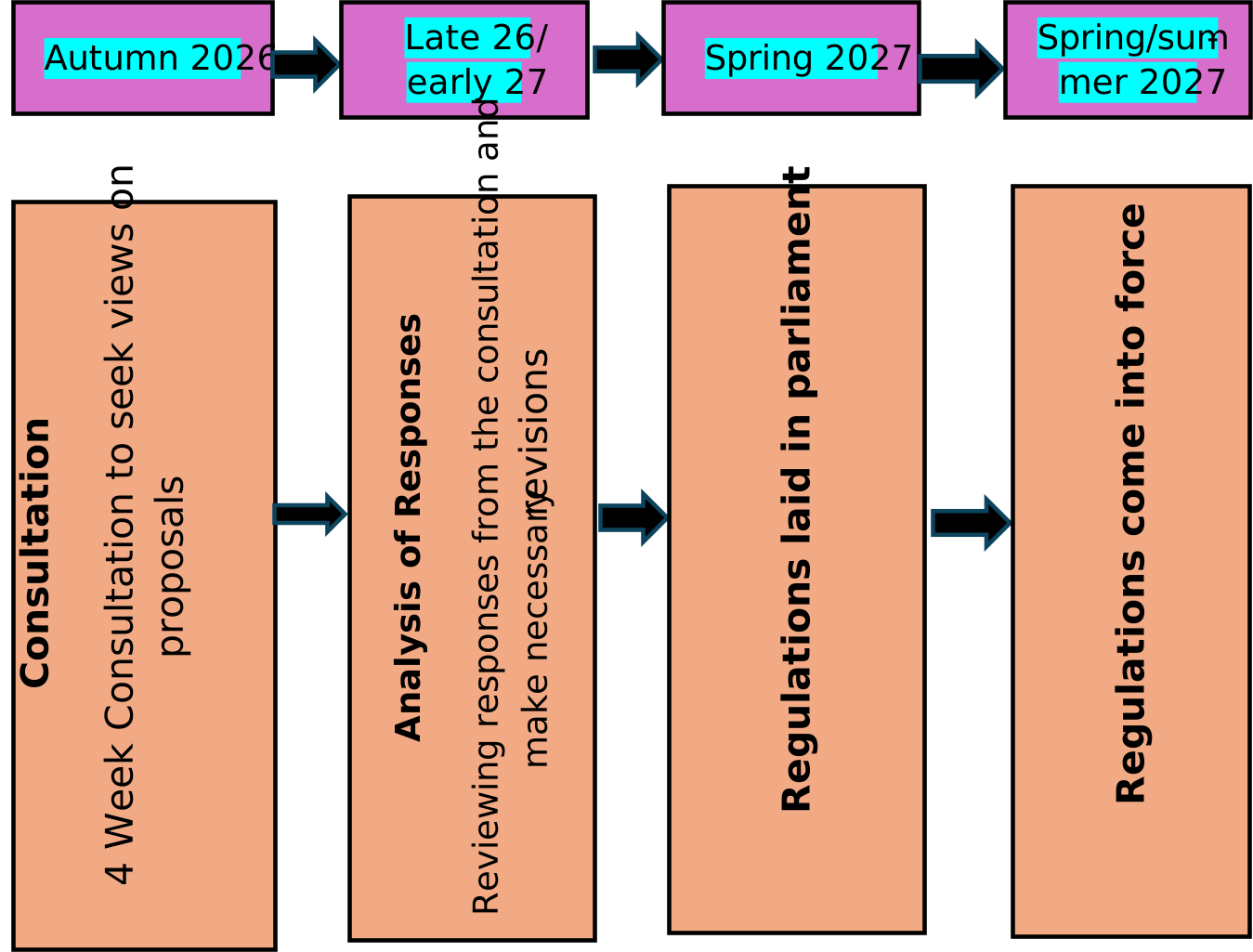
4.2. We will be analysing the responses during late autumn of 2026 and early 2027. Our aim is to publish an overview of the responses and the MCA’s comments within at most 3 months of the end of the consultation, which will be made available on www.gov.uk on the same page as the consultation documents. To be notified of changes to this page, subscribe here free of charge.
4.3. Where appropriate the draft of the new Regulations, accompanying guidance and De Minimis Assessment will be revised to take into account the consultation responses.
4.4. Our aim is for the new Regulations to come into force in the spring of 2027. The Regulations will be published on www.legislation.gov.uk
4.5. Merchant Shipping Notice MSN 1869 (M) Amendment 2 will be published with the Regulations.
4.6. An overview timetable is below for reference:
Section 5: Consultation Response Form
The Consultation Response Form can be found here
Section 6: Conduct of this consultation
6.1. This consultation has been conducted in accordance with the Cabinet Office Consultation Principles.
Consultation principles
6.2. The Cabinet Office Consultation Principles can be found at Consultation Principles 2018
Feedback on conduct of consultation
6.3. If you have any comments regarding the conduct of this consultation, please contact the Consultation Co-ordinator at consultation.coordinator@mcga.gov.uk
6.4. We are continually trying to improve the way in which we conduct consultations and appreciate your views. We would be grateful if you could complete and return the attached feedback form. These should be submitted to the Consultation Co-ordinator (consultation.coordinator@mcga.gov.uk) and are not affected by the deadline for this consultation.
6.5. If you require this consultation in an alternative format, please contact either the Consultation Co-ordinator or the named official conducting this consultation.
-
Regulation 4 of the draft of the new Regulations specifies the operational parameters for passenger ships falling within the scope of the DSM Code. ↩
-
Both versions of MSN 1823 are given legal effect by the Merchant Shipping (Passenger Ships) (Safety Code for UK Categorised Waters) Regulations 2010 (SI 2010/680), and therefore the changes to those MSNs are made under powers in the 2010 Regulations. ↩