Radon services for homeowners or householders
Find information about radon, and guidance on how to order a radon risk report or gas test kit to assess your risk.
Radon is a colourless, odourless radioactive gas. You cannot see, smell or taste it, so you need special equipment to measure it.
It is formed by the radioactive decay of the small amounts of uranium that occur naturally in all rocks and soils.
Where radon is found
Radon is found everywhere. In most places, indoors and outdoors, levels are low and the risk to health is small.
In some parts of the country, homes may be at higher risk because of the ground they are built on, as well as how the property is built and used.
To see if your property is in an area with higher levels of radon, check the radon map.
How radon affects your health
- radon increases your risk of lung cancer
- the higher the radon level and longer the exposure, the greater the risk
- radon causes over 1,100 deaths from lung cancer each year in the UK (from independent report Radon and Public Health)
- the risk from radon is higher if the person is an ex-smoker and significantly greater for current smokers
How radon causes harm
Radon breaks down into tiny radioactive particles that you can breathe in. These particles can become trapped in your lungs and release radiation, which damages lung tissue.
This damage increases the risk of lung cancer. The risk is higher for people who smoke or have smoked.
Radon mainly affects the lungs. There is no clear evidence that it causes other types of cancer or harm.
Understanding radon levels
There will always be some level of radon in a property, as radon is everywhere.
Radon in the air is measured in becquerels per cubic metre (Bq m⁻³). A becquerel is a measure of radioactivity.
The average level of radon in UK homes is 20 Bq m⁻³.
Action and Target Levels help you decide whether you should take steps to reduce radon levels.
Action Level:
The Action Level is 200 Bq m⁻³
The Action Level is used to identify homes where action to reduce radon levels is recommended.
If the results from your home radon gas test kit show an annual average radon level at or above 200 Bq m⁻³, UKHSA recommends that you take steps to reduce it.
Target Level:
The Target Level is 100 Bq m⁻³.
You should use the Target Level if there are smokers or ex-smokers living in the property, as they are at greater health risk from radon exposure.
The Target Level should also be used when carrying out remediation work in existing buildings.
Radon in homes
Radon mainly comes from the ground, but levels in a building depend on a combination of factors. These include the type of ground, how the building is built, and how it is used.
Every building contains some radon, but levels are usually low. Levels can vary between neighbouring homes and with different living habits.
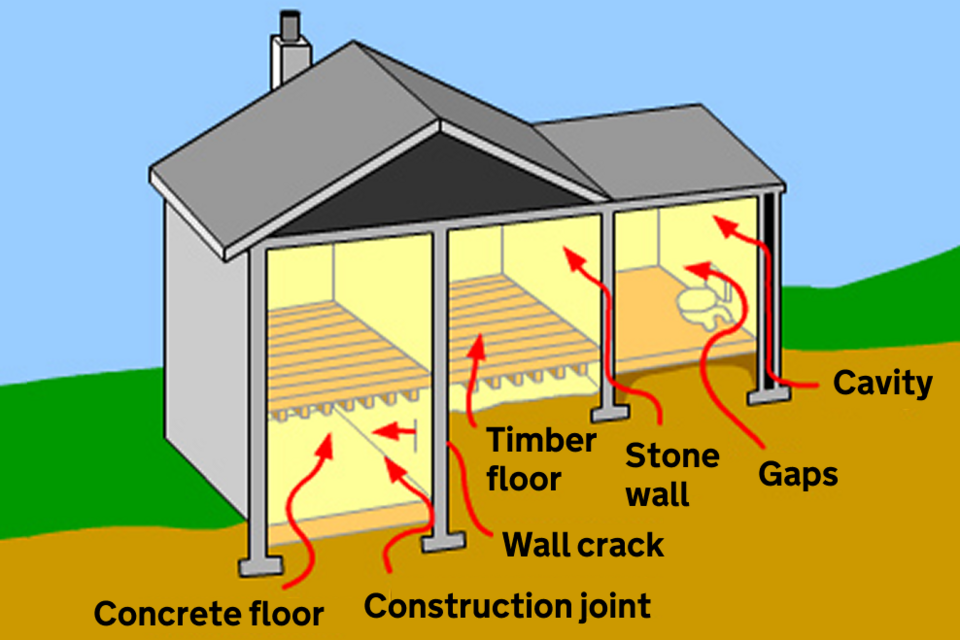
Radon can enter a building through gaps and openings such as:
- concrete floor
- construction joint
- wall crack
- timber floor
- stone wall
- gaps (in wall)
- cavity
To measure your exposure to radon in your home, the property must be occupied during the test.
Radon services
Check if you should test for radon
-
Find out if your property is in a radon Affected Area by using the free radon map
-
If your property is in a radon Affected Area, you can order a radon risk report for your address for £3.90.
The report shows the likelihood, as a percentage, of radon levels in a property being above the Action Level advised by the UKHSA.
This report is suitable for buildings up to 25 metres in any direction (this does not refer to the height of the building or basement depth).
Measuring the level of radon in your home
Order a home radon gas test kit to find out your household annual average level of radon in your property.
A measurement kit costs £52.80 and includes 2 detectors, which should be place in your property for a period of 3 months.
After the testing period, you will receive a result report which shows the level of radon at your address and gives advice on whether you should take any action.
Order a home radon gas test kit
What to do if you have high levels of radon
The ground is the main source of radon. If the level of radon in your property is high, there is certain building work you can do to reduce the level. This is called ‘remedial work’.
Types of remedial work
Simple steps like sealing around loft hatches, blocking large gaps in floors, or adding extra ventilation will not lower radon levels on their own. When used alongside other effective measures, they can help reduce radon levels. Completely sealing floors is difficult and can cause rot in wooden floors.
The main types of remedial work are:
There is different guidance on how to reduce the radon level for cellars and basements.
Radon for home buyers and sellers
Whether you are buying a new property or selling your current property the issue of radon may come up. Learn what you need to know when buying or selling a property located in a radon Affected Area.