Planning Act 2008: Procedures for reviewing and amending National Policy Statements
Guidance on the National Policy Statement review and amendment process.
Applies to England
Introduction
1. The Planning Act 2008 (the Planning Act) created a development consent regime for major infrastructure projects in the fields of energy, transport, water, waste water, and waste. Part 3 of the Planning Act sets out the thresholds above which certain types of infrastructure projects are considered to be nationally significant infrastructure projects (NSIPs) and require development consent.
2. National Policy Statements (NPSs) that are designated under section 5 of the Planning Act set out national policy in relation to categories of projects within each infrastructure field (as set out in section 14(6) of the Planning Act). The function of an NPS is to:
a) establish the need for a particular type of infrastructure;
b) provide the policy framework for the preparation and assessment of applications for development consent by providing guidance to applicants, setting out general principles and policies, and guidance on the assessment and decision-making of an application for development consent; and
c) identify the approach to consideration of certain generic impacts to ensure that environmental, community, and other impacts are properly assessed.
3. The relevant Secretary of State must decide a Development Consent Order (DCO) application in accordance with any relevant NPS unless one or more of the exceptions specified under section 104(4) to (8) of the Planning Act apply.
4. NPSs may also be a material consideration in making decisions on planning applications under the Town and Country Planning Act 1990 or other consenting routes.
5. NPSs are the primary policy framework within which the Examining Authority makes its recommendations to Ministers on individual DCO applications, and against which the relevant Secretary of State is required to determine an application. Key to an effective Planning Act regime is therefore ensuring that NPSs are, and remain, fit for purpose. Where NPSs are out-of-date, it can become more difficult to use them as a basis for decisions, particularly where NPSs lags behind other legislative, policy and guidance changes. This risks increasing the time needed to prepare, examine, and make decisions on DCO applications. It also increases the risk of legal challenge.
6. It is therefore important that there is regular consideration of whether and when to review NPSs to ensure effective and legally robust decision making in line with the latest government policy and guidance, or any other relevant information. The Secretary of State must review each NPS whenever they consider it appropriate to do so, having considered the statutory criteria set out in section 6 of the Planning Act.
7. On 18 February 2026, the Planning and Infrastructure Act 2025 (PIA) amended the Planning Act to introduce additional review requirements for NPSs, with the effect that the Secretary of State must:
a) carry out a full review of each NPS within the ‘initial period’ in accordance with the transitional arrangements. The initial period is calculated in accordance with section 6ZA of the Planning Act and set out in Figure 3 of this guidance and subsequently amend the NPS (unless the NPS is withdrawn); and
b) carry out a full review and subsequently amend each NPS no later than five years from the date of designation or the date of the last amendment (subject to the very limited statutory exception provided in section 6(5C) of the Planning Act).
8. This obligation to review and amend continues unless and until the Secretary of State withdraws the designation of a statement as an NPS. The amendment of an NPS may be material or non-material.
9. The PIA introduced, in section 9(11) of the Planning Act, a streamlined procedure for making material amendments to an NPS which reflect published government policy, changes to legislation, changes to published documents referred to in the relevant NPS, or court decisions where it is relevant to the interpretation of the NPS. This procedure is known as the ‘reflective amendment procedure’ and is discussed further in paragraph 32 of this guidance.
10. The term ‘routine amendment procedure’ has been adopted for the pre-existing procedure for amending NPSs and is outlined from paragraph 34 of this guidance.
11. The use of ‘routine’ and ‘reflective’ has been adopted for the purposes of this guidance to distinguish between the two procedures for making a material change to an NPS. These terms are not indicative of the scale or timing of the change, solely the amendment procedure being followed.
Purpose
12. This guidance provides further information on the procedures for reviewing and amending NPSs. This includes:
a) the procedure for reviewing NPSs in full or in part and the options available to the Secretary of State once a review is complete;
b) the procedures for amending NPSs, which may be:
i. the requirements for material changes to an NPS (via either the routine or reflective amendment procedure) including obligations of relevant departments to the appropriate Select Committees and obligations to carry out an Appraisal of Sustainability and Habitats Regulation Assessment;
ii. the requirements for non-material changes to an NPS (being minor amendments); and
iii. the transitional arrangements introduced by the PIA.
13. This guidance also outlines relevant considerations for identifying the appropriate amendment procedure and includes statutory and suggested timescales for reviews and amendments.
14. This guidance is for the benefit of applicants, statutory consultees, interested parties and the general public, as well as the relevant government departments carrying out the NPS reviews. Key aims of this guidance are to:
a) enable consistent application of NPS review and amendment procedures;
b) promote best practice in accordance with the Planning Act obligations; and
c) promote fairness, transparency and proportionality.
Legal status
15. This guidance is non-statutory and has been published to aid government departments and others engaged in reviewing and amending NPSs. Nothing in this guidance should be taken as indicating that any requirement of the Planning Act or any other law or legal principle may be overridden. The guidance does not in any way replace the statutory provisions of the Planning Act, nor does it add to their scope. Only the courts can give an authoritative interpretation of legislation.
Reviewing National Policy Statements
16. Under section 6(1)(a) of the Planning Act, the Secretary of State must review each NPS in full or in part whenever the Secretary of State considers it appropriate to do so. Subject to the transitional period discussed from paragraph 54 of this guidance, sections 6(1)(b), 6(5A) and 6(5B) of the Planning Act also requires the Secretary of State to undertake a full review of each NPS at intervals of no more than five years unless and until the NPS’s designation is withdrawn.
17. The Secretary of State also has the discretion to decide to carry out supplementary reviews of an NPS in addition to the five yearly requirement. Section 6(3) of the Planning Act sets out matters that the Secretary of State must consider when deciding when to review an NPS; this includes a significant change in circumstances of any of the policy basis included in the NPS, whether the changes was anticipated and whether the change in circumstance makes a material difference to the policies as set out in the NPS. The same considerations apply when considering whether to review part of an NPS, set out in section 6(4) of the Planning Act.
18. The factors considered when carrying out the review will vary depending on the circumstances which prompted the review, but may for example include significant changes to social, environmental and/or economic data, and wider policy relevant to that NPS. The above mentioned factors should not be taken as being exhaustive as there may be other considerations that are relevant to the decision on when to review an NPS (in full or in part). For example, under section 10 of the Planning Act, the Secretary of State must exercise these functions with the objective of contributing to the achievement of sustainable development, and in doing so must have particular regard to the desirability of mitigating, and adapting to, climate change, and achieving good design.
19. Given the importance of NPSs and the legal role they play in determining the outcome of DCO applications, the question of whether it is appropriate to review an NPS should be considered regularly, and the five yearly review requirement should act as a ‘back stop’ rather than the prompt for a review. The exact timing of a review will depend on how specific circumstances apply to each NPS.
20. Whenever a decision is made to review an NPS, section 6(4A) of the Planning Act requires the relevant Secretary of State to lay a statement before Parliament announcing the review.
21. Where the Secretary of State decides to carry out a review of an NPS, unless the Secretary of State has announced a decision to suspend all or part of the NPS, the NPS will remain in effect throughout the duration of the review.
22. Section 11 of the Planning Act sets out that, where the Secretary of State considers that certain conditions are met, they have the power to suspend the operation of all or any part of an NPS until the review of that NPS or relevant part of that NPS has been completed (see page 12, Consideration of National Policy Statements in Decision Making). The relevant Secretary of State should also consider whether and when the requirements of the Environmental Assessment of Plans and Programmes Regulations 2004 (SEA Regulations) apply prior to making a decision to suspend all or part of the NPS.
Options following completion of a review
23. Following a full or partial review, and depending on when the NPS was last amended, the Secretary of State may decide to:
a) make a material change (under the routine or reflective amendment procedures);
b) make a non-material change (minor amendment);
c) leave an NPS as it is (where permissible); or
d) withdraw an NPS.
24. The circumstances in which each of these options is available is presented in Figure 1.
25. Five yearly reviews: As presented in Figure 1, following the completion of a full review to comply with the five-yearly review and amendment requirement the Secretary of State must either:
a) make a material change (routine or reflective amendment);
b) make a non-material change (minor amendment) to the NPS; or
c) withdraw the NPS.
26. Under section 6(5A)(b), the Secretary of State must not leave the NPS as it is as this is not compliant with the five-yearly review and amendment requirement.
27. Supplementary reviews: If supplementary reviews are carried out within the five yearly review and amendment period, the Secretary of State may leave the NPS as it is under section 6(5)(c) of the Planning Act.
28. Partial reviews: Where a partial review is undertaken and results in amendments to the NPS, this will not be sufficient to meet the requirement to undertake a full review every five years. Similarly, where there is a review of (and amendments to) part of an NPS as a result of the criteria in section 9(11) being fulfilled, this will also not meet the full five yearly review requirement.
29. Where following a full or partial review, a decision is made to withdraw the NPS or leave it as it is (where this option is available), the Secretary of State will make this decision known through a written ministerial statement to Parliament or other public announcement, such as a press release. Before making the decision, the relevant Secretary of State must consider whether and when the requirements of the SEA Regulations apply as part of that decision.
30. Subsequent sections of this guidance explain the material and non-material change procedures to follow where the outcome of a review is a material or non-material amendment to an NPS.
Figure 1: Review and amendment process for NPSs
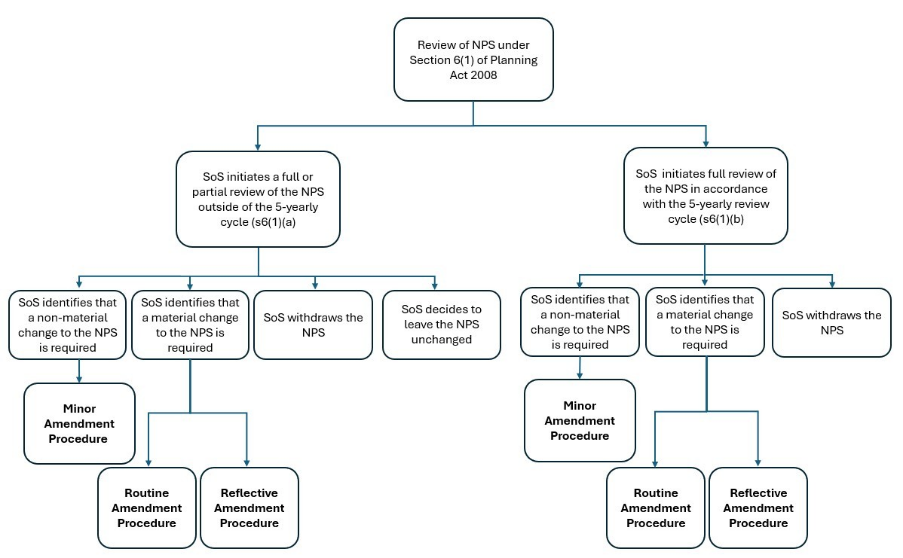
This figure is a flow chart that shows the review and amendment process for NPSs. It shows that after the NPS is reviewed under section 6(1) of the Planning Act, the Secretary of State initiates a review outside or in accordance with the 5-yearly cycle. Depending on what the Secretary of State identifies and decides and whether the NPS is being updated as part of the 5-yearly cycle or outside, the NPS update may follow a minor, routine or reflective amendment procedure
Material changes to a National Policy Statement
31. A material change to an NPS is one where the policy position is materially or substantially different to that set out in the designated NPS and as such it should be amended. There are two routes under which material changes can be made to an NPS:
a) the ‘routine amendment procedure’; or
b) the ‘reflective amendment procedure’.
32. The procedures for each of these are set out in this guidance and presented in Figure 2.
Routine amendment procedure
33. After reviewing an NPS in full or in part, if the relevant Secretary of State determines an NPS requires material amendments, the following requirements must be met under the routine amendment procedure:
a) the Secretary of State must consider whether and when the requirements of the SEA Regulations may apply before making a decision. The SEA Regulations will require an environmental assessment of the amendment if it is likely to have significant environmental effects. This is in addition to the requirement under section 6(6) of the Planning Act where an appraisal of the sustainability of the policy set out in the proposed amendments must be carried out. However, the Appraisal of Sustainability (AoS) usually also fulfils the requirements of the SEA Regulations; and
b) a Habitats Regulation Assessment must be carried out if required under the Conservation of Habitats and Species Regulations 2017;
c) under section 6(7) of the Planning Act, the Secretary of State may only amend an NPS if:
i. the consultation and publicity requirements in section 7 and the parliamentary requirements in section 9 have been complied with; and
ii. either:
- the consideration period of 21 sitting days has expired without the House of Commons resolving that the proposed amendments should not be proceeded with; or
- the amendment has been approved by resolution of the House of Commons after being laid before Parliament before the end of the consideration period.
34. Where a routine amendment is made, the amendment, or the NPS as amended, must be published and laid before Parliament.
Reflective amendment procedure
35. The purpose of the reflective amendment procedure is to allow certain types of material changes to an NPS to be made under a more streamlined process than the routine amendment procedure.
36. Depending on the nature of the changes, they will have been subject to public consultation, judicial consideration or a degree of Parliamentary scrutiny.
37. Reflective amendments are considered a material change to the NPS as the changes are assumed to be materially different from the existing policy. Where there is no material change to the policy, the non-material change procedure should be followed as described in (see paragraph 42) or the NPS can be left as it is.
38. Section 9(11) of the Planning Act sets out that the reflective amendment procedure can be used where amendments proposed to an NPS reflect:
a) published government policy relating to the NPS, such as changes to the National Planning Policy Framework;
b) legislative changes, such as new enactments, revocations, amendments or repeals to existing legislation since the NPS was last amended. For example, changes to thresholds for when a project is classified as an NSIP under the Planning Act;
c) changes to documents referred to in the NPS such as sectoral spatial plans, technology updates, guidance and best practice; or
d) any court decisions handed down since the NPS was last amended relevant to the interpretation of the NPS or legislation it refers to.
39. If the relevant Secretary of State identifies a change as meeting the definition of a reflective amendment, the Secretary of State is to lay a statement in Parliament explaining how the amendments fall within the definition of a reflective amendment. The Secretary of State will also write to the relevant Select Committee at the start of the public consultation period and Ministers will make themselves available to speak to the Select Committee during the consultation period where practically possible. Where a Select Committee publishes a report during the consultation period, the government will take this into account before finalising the NPS. In addition, the following requirements must be met under the reflective amendment procedure:
a) the Secretary of State must consider whether and when the requirements of the SEA Regulations may apply before making a decision. The SEA Regulations will require an environmental assessment of the amendment if it is likely to have significant environmental effects. This is in addition to the requirement under section 6(6) of the Planning Act where an appraisal of the sustainability of the policy set out in the proposed amendments must be carried out. However, the AoS usually also fulfils the requirements of the SEA Regulations;
b) a Habitats Regulation Assessment must be carried out if required under the Conservation of Habitats and Species Regulations 2017; and
c) under section 6(7) of the Planning Act, the Secretary of State may only amend an NPS if:
i. the consultation and publicity requirements in section 7 and the parliamentary requirements in section 9 have been complied with; and
ii. either:
- the consideration period of 21 sitting days has expired without the House of Commons resolving that the proposed amendments should not be proceeded with; or
- the amendment has been approved by resolution of the House of Commons after being laid before Parliament before the end of the consideration period.
40. Where a reflective amendment is made, the amendment, or the NPS as amended, must be published and laid before Parliament.
Non-material changes to a National Policy Statement
41. Where the Secretary of State considers an amendment to an NPS is required, however the proposed amendment(s) does not materially affect the policy set out in the NPS, the Secretary of State should follow the non-material amendment procedure as set out in section 6(8) of the Planning Act.
42. Where a non-material change (minor amendment) to an NPS is proposed, the Secretary of State is not required to follow the consultation and publicity requirements set out in section 7 of the Planning Act, however, must still consider whether and when the requirements of the SEA Regulations may apply before making a decision. The SEA Regulations will require an environmental assessment of the amendment if it is likely to have significant environmental effects. While non-material amendments are those which do not materially affect the policy of the NPS and are therefore unlikely to have any significant environmental impacts, whether the SEA regulations may apply should still be considered.
43. Where a non-material amendment is made, the amendment, or the NPS as amended, must be published and laid before Parliament
Figure 2: Process for updating an NPS
Step 1: Identify need for review
Mandatory 5-year review of an NPS (s 6(1)(b) and 6(5A)(b)) or Secretary of State (SoS) considers a review of an NPS in part or in full if appropriate (s 6(1)(a)). SoS must amend each NPS within the initial period set out in s 6ZA, and then at least every 5 years thereafter.
Step 2: Announce review
SoS lays statement before Parliament announcing review, whether it be a full or partial review (s 6(2) and 6(4A)).
Step 3: Conduct review
Review can be of the whole of the NPS or part of it (s 6(2) to (4)). Reasons for deciding to review an NPS (s 6) can include significant policy change or case law/legislation developments relevant to the interpretation of the NPS or development to which the NPS relates.
Step 4: Following the review, SoS must decide to (s 6(5)) either:
-
Amend the NPS: proceed to classify amendment phase (Step 5); or
-
Withdraw the NPS: publish decision to withdraw NPS (end of process – need to consider SEA requirements); or
-
Leave the NPS as it is: Publish decision to retain NPS (end of process). This option is not available during the “initial period” (s 6ZA(6)).
Step 5: Classify amendment
- Non-material change (minor amendment): the proposal does not materially affect the policy of the NPS (see column 1 of the table); or
2a. Material change (routine amendment): the proposal does not fall into category (1) or (2b) (see column 2a of the table); or
2b. Material change (reflective amendment): the proposal falls within s 9(11) (see column 2b of the table).
| 1. Non-material change (minor amendment) | 2a. Material change (routine amendment) | 2b. Material change (reflective amendment) |
|---|---|---|
| SoS may make amendment without consultation on public policy (s 696, s 6(8)) | Prepare draft amendment | Same as 2a |
| SoS publishes draft and any final requirements / amendments | Conduct appraisal of sustainability (s 6(6)) | Same as 2a |
| SoS publishes and lays before Parliament the amendment, or NPS as amended (s 6(9)) | Consider SEA requirements | Same as 2a |
| Consultation, publicity, parliamentary scrutiny | Consultation, publicity, parliamentary scrutiny | |
| SoS to carry out consultation and publicity (s 7(2) and 8(1)) | SoS to carry out consultation and publicity (s 7(2) and 8(1)) | |
| SoS must lay the proposal before Parliament (s 9(2)) | SoS must lay the proposal before Parliament (s 9(2)) | |
| SoS must lay a response to any resolution or recommendation of either House of Parliament (s 9(4)–(5)) | SoS is not required to lay a response to any resolution or recommendation of either House of Parliament (s 9(8A)) | |
| Making the amendment | Making the amendment | |
| SoS may amend an NPS if the House of Commons approves the amendment or does not, within the consideration period, resolve that the proposal amendment should not be proceeded with (s 6(7)) | Same as 2a | |
| SoS publishes and lays before Parliament the amendment, or NPS as amended (s 6(9)) | Same as 2a |
Consideration of National Policy Statements in decision making
44. Under section 108 of the Planning Act, where a DCO application is made and an NPS has effect for that application, the relevant Secretary of State:
a) may decide the relevant NPS requires review (in full or in part) due to a change in circumstances since the NPS was first published or last reviewed; and
b) if so, has the power to direct that the examination of the DCO application be suspended until a decision is made that the NPS should be either amended, have its designation withdrawn or be left in its current state.
45. Where such a review is undertaken the existing NPS will continue to have effect for the purposes of the Planning Act until a decision is made that the NPS should be either amended, have its designation withdrawn or be left in its current state.
46. Any emerging draft NPS is potentially capable of being an ‘important and relevant’ consideration in the decision-making process under sections 104 and 105 of the Planning Act. However, the extent to which it is important and relevant is a matter for the relevant Secretary of State to consider with regard to the specific circumstances of each DCO application.
47. When a new NPS, an amendment to an NPS, or an NPS as amended is laid in Parliament, it should include or be accompanied by a statement confirming when the new or amended version of the NPS will begin to apply to DCO applications.
48. Where changes are made to the Planning Act which amend the thresholds for when a project is classified as an NSIP, this may not align with the NPS review period and therefore NPSs may not always reflect all categories of NSIPs.
National Policy Statement review timetable
49. Under section 6(1) of the Planning Act, the relevant Secretary of State must review an existing NPS at least every 5 years. However, where circumstances merit, earlier consideration can and should be given. Any such decision will be communicated publicly.
50. The review and amendment process under the routine amendment procedure is likely to take approximately 18 months and may take up to 24 months from the announcement that a review will take place.
51. The review and amendment process under the reflective amendment procedure should be shorter. We anticipate the reflective amendment procedure should take 6 to 12 months.
52. Depending on the circumstances, we would expect the review process to be shorter where the outcome of the review is that the NPS should be withdrawn, left as it is (where this is permitted) or subject to non-material changes only.
Transitional provisions
53. The new review requirements and procedures for NPSs in the Planning Act came into force on 18 February 2026. As set out in the Levelling-up and Regeneration Act 2023 (Commencement No. 9) and Planning and Infrastructure Act 2025 (Commencement No. 1 and Transitional Provisions) Regulations 2025.
54. All NPSs must be amended within the relevant ‘initial period’ as defined in section 6ZA of the Planning Act. Section 6ZA introduces what is in effect a transitional period to bring all NPSs into the new cycle of required amendments.
55. NPSs which were designated before 18 February 2021 and have not been amended since, first need to be fully reviewed and amended by 18 February 2028 (unless the NPSs designation is withdrawn) (subject to the very limited statutory exception provided in section 6(5C) of the Planning Act). The Secretary of State does not have the option to leave the NPS as it is following this full review. From the date it is amended, the NPS will start a five yearly review and amendment cycle.
56. NPSs designated after 18 February 2021 will be subject to their own transitional period for a review and amendment, calculated according to their date of designation or most recent amendment (subject to the very limited statutory exception provided in section 6(5C) of the Planning Act). Section 6ZA of the Planning Act and Figure 3 in this guidance set out how the initial review and amendment requirement will apply to each NPS. In response to this transitional period review of each NPS, the Secretary of State can only amend or withdraw an NPS. It is not an option to leave an NPS as it is.
Figure 3: Timetable for updating National Policy Statements
| National Policy Statement | Designation / Last Update | Next Update Due By |
|---|---|---|
| EN-1 Overarching NPS for Energy | 6 January 2026 (update) | 6 January 2031 |
| EN-2 NPS for Natural Gas Electricity Generating Infrastructure | 17 January 2024 (update) | 17 January 2029 |
| EN-3 NPS for Renewable Energy Infrastructure | 6 January 2026 (update) | 6 January 2031 |
| EN-4 NPS for Natural Gas Supply Infrastructure and Gas and Oil Pipelines | 17 January 2024 (update) | 17 January 2029 |
| En-5 NPS for Electricity Networks Infrastructure | 6 January 2026 (update) | 6 January 2031 |
| EN-6 NPS for Nuclear Power Generation | 23 June 2011 (designated) | Required to be updated or withdrawn by 18 February 2028 |
| Geological Disposal Infrastructure | 17 October 2019 (designated) | Required to be updated or withdrawn by 18 February 2028 |
| EN-7 NPS for Nuclear (fission) Energy Generation | 18 December 2025 (designated) | 18 December 2030 |
| National Networks [covers road, rail, strategic rail freight interchanges] (NNNPS) | 24 May 2024 (update) | 24 May 2029 |
| Ports | 26 January 2012 (designated) | Required to be updated or withdrawn by 18 February 2028. Draft update of NPS has already gone through consultation and Parliamentary (Select Committee) scrutiny stages, Due to be laid in Parliament for 21 sitting days and then designated (subject to Parliamentary approval) April/May 2026 |
| Airports – new runway capacity and infrastructure at airports in the South-East of England (ANPS) | 26 June 2018 (designated) | Will be required to be updated or withdrawn by 18 February 2028. |
| Water Resources Infrastructure | 8 July 2025 (update) | 8 July 2030 |
| Hazardous Waste | 18 July 2013 (designated) | Required to be updated or withdrawn by 18 February 2028 |
| Waste Water | 9 February 2012 (designated) | Required to be updated or withdrawn by 18 February 2028 |
Annex A: Glossary
| Term | Definition |
|---|---|
| Appraisal of Sustainability (AoS) | A document that must be produced before designating or amending an NPS. The AoS also fulfils the requirements of the Environmental Assessment of Plans and Programmes Regulations 2004) which requires the formal environmental assessment of certain plans and programmes which are anticipated to have significant effects on the environment. |
| Conservation of Habitats and Species Regulations 2017 | Legislation governing the Habitats Regulation Assessment process, which must be undertaken where amendments to an NPS may affect protected sites. |
| Consideration Period | The 21 sitting-day period following the laying of proposed NPS or NPS amendments before Parliament, during which the House of Commons may resolve not to proceed with the statement or the amendments. |
| Full Review | A single review relating to all of the NPS, as defined in section 6(2) of the Planning Act. |
| Habitats Regulation Assessment (HRA) | An assessment undertaken when an NPS amendment may impact protected habitats or species, as required under the Conservation of Habitats and Species Regulations 2017. |
| Material Change | A change that materially affects the policy in an NPS. Material changes to an NPS can be made under either the routine amendment procedure or reflective amendment procedure, depending on the type of change. |
| Non‑material Change | A minor amendment to an NPS that does not materially alter policy. These do not require consultation or the parliamentary process set out in sections 7 and 9 of the Planning Act, though the amendment must still be laid before Parliament. |
| Partial Review | A review of only part of an NPS, undertaken where the Secretary of State considers that only specific sections require reconsideration. Partial reviews are discretionary and cannot satisfy the statutory five‑year full review requirement on their own. |
| Reflective Amendment Procedure | A streamlined process for making material changes that reflect updates already agreed by Parliament such as new legislation, published government policy, or court decisions under section 9(11) of the Planning Act. Reflective amendments avoid duplication of parliamentary scrutiny and follow a simplified amendment route. |
| Routine Amendment Procedure | The routine amendment procedure is the standard, full process for making material changes to a National Policy Statement after a full or partial review. |
| Transitional Period | Provisions introduced via the Planning and Infrastructure Act 2025, requiring all NPSs to undergo a full review and amendment within defined periods following commencement of the measures. |