Vocational and other qualifications quarterly: January to March 2026
Numbers of certificates issued for vocational and other qualifications in England (excluding GCSEs, AS and A levels, Advanced Extension Awards, apprenticeship end-point assessments, Extended Project Qualifications and T Level Technical Qualifications).
Applies to England
Documents
Details
We are improving this release
Complete this short survey to share your views on which qualifications, breakdowns and certificates should be reported.
You can also register as a user to stay informed and involved in the future development of these statistics.
Context for headlines this quarter
This quarter’s trends have been affected by Pearson BTEC qualifications being reported earlier compared to 2025. This shift in reporting contributed to the large increase in certificate numbers for qualifications at level 1/level 2 this quarter compared to quarter 1 2025. We expect to see a corresponding decrease in quarter 2. This reporting change was made to better reflect all certificates related to the January series for BTEC Tech Award qualifications in the quarter 1 figures.
This quarter’s increase in certificate numbers for English for Speakers of Other Languages qualifications may be related to changes to immigration requirements. In May 2025, the Home Office proposed changes to immigration requirements including a requirement for new applicants for certain individual visas to need B2 English, a higher standard than the previous B1. This policy change was subsequently implemented and introduced from 8 January 2026 for some visas, with changes to other visas coming into force from 26 March 2027.
The decrease in functional skills qualification certificate numbers this quarter may be related to changes to apprenticeship requirements. From 11 February 2025, apprentices aged 19 and over are no longer required to hold or achieve English and maths qualifications to complete their apprenticeship. Apprentices aged 16 to 18 must still achieve these qualifications.
Key headlines
-
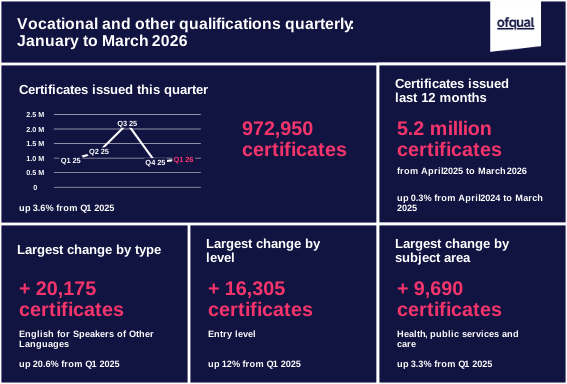
In quarter 1 2026, a total of 972,950 certificates were issued across 6,203 qualifications for vocational and other qualifications, an increase in certificates of 3.6% compared with quarter 1 2025. The number of certificates issued in the 12 months from April 2025 to March 2026 (5.2 million) increased by 0.3% compared with the previous 12 months from April 2024 to March 2025.
-
Among qualification types, the largest absolute increase in certificate numbers was for English for Speakers of Other Languages (from 98,125 certificates in quarter 1 2025 to 118,300 certificates in quarter 1 2026, an increase of 20.6%), likely due to the change in immigration requirements noted above. Additionally, there was a 21.0% increase in certificate numbers for other general qualifications (from 8,825 certificates in quarter 1 2025 to 10,680 certificates in quarter 1 2026). The largest absolute decrease in certificate numbers was for Functional Skills (from 52,390 certificates in quarter 1 2025 to 44,730 certificates in quarter 1 2026, a decrease of 14.6%), likely due to the change in apprenticeship requirements noted above. Additionally, there was a 16.1% decrease in certificate numbers for other life skills qualifications (from 45,845 certificates in quarter 1 2025 to 38,470 certificates in quarter 1 2026).
-
Among qualification levels, the largest absolute increase in certificate numbers was for entry level qualifications (from 135,540 certificates in quarter 1 2025 to 151,845 certificates in quarter 1 2026, an increase of 12.0%). Additionally, there was a 92.9% increase in certificate numbers for level 1/level 2 qualifications (from 12,010 certificates in quarter 1 2025 to 23,170 certificates in quarter 1 2026), largely due to the change in data reporting by Pearson noted above. The largest absolute decrease in certificate numbers was for level 2 qualifications (from 275,550 certificates in quarter 1 2025 to 270,785 certificates in quarter 1 2026, a decrease of 1.7%).
-
Most qualification sector subject areas saw an increase in the number of certificates issued compared with quarter 1 2025. Among sector subject areas, the largest absolute increase in the number of certificates issued was for health, public services and care (from 297,180 certificates in quarter 1 2025 to 306,870 certificates in quarter 1 2026, an increase of 3.3%). Additionally, there was a 14.9% increase in certificate numbers for digital technology (from 16,615 certificates in quarter 1 2025 to 19,100 certificates in quarter 1 2026). The largest absolute decrease in the number of certificates issued for a sector subject area was for education and training (from 22,515 certificates in quarter 1 2025 to 21,205 certificates in quarter 1 2026, a decrease of 5.8%).
-
The top 3 qualifications with the highest numbers of certificates issued in quarter 1 2026 were TCL Entry Level Certificate in ESOL International Speaking and Listening (Entry 3) (GESE Grade 5) (B1.1) with 40,900 certificates, followed by FAA Level 3 Award in Emergency First Aid at Work with 32,140 certificates and Qualsafe Level 3 Award in Emergency First Aid at Work (RQF) with 31,670 certificates.
-
The top 3 awarding organisations with the most certificates issued in quarter 1 2026 were City & Guilds with 95,990 certificates, followed by Highfield Qualifications with 84,670 certificates and Trinity College London with 80,720 certificates. These 3 awarding organisations also had the most certificates issued in quarter 1 2025.
-
The top 3 awarding organisations with the most certificates issued in the 12 months from April 2025 to March 2026 were Pearson with 708,910 certificates, followed by City & Guilds with 537,430 certificates and NCFE with 328,635 certificates. These 3 awarding organisations also had the most certificates issued in the previous 12 months from April 2024 to March 2025.
Datasets
The dataset underlying this release is available separately and can be explored visually in our interactive visualisation for Vocational and other qualifications over time.