Background Information and Methodology Note: Unfulfilled eligibility in the benefit system: financial year ending (FYE) 2026 estimates
Published 14 May 2026
Applies to England, Scotland and Wales

© Crown copyright 2026
This publication is licensed under the terms of the Open Government Licence v3.0 except where otherwise stated. To view this licence, visit nationalarchives.gov.uk/doc/open-government-licence/version/3 or write to the Information Policy Team, The National Archives, Kew, London TW9 4DU, or email: psi@nationalarchives.gov.uk.
Where we have identified any third party copyright information you will need to obtain permission from the copyright holders concerned.
This publication is available at https://www.gov.uk/government/statistics/unfulfilled-eligibility-in-the-benefit-system-financial-year-ending-fye-2026-estimates/background-information-and-methodology-note-unfulfilled-eligibility-in-the-benefit-system-financial-year-ending-fye-2026-estimates
Introduction
This note assesses the quality of Unfulfilled eligibility in the benefit system: financial year ending (FYE) 2026 estimates using the European Statistics System (ESS) Quality Assurance Framework (QAF). This is the method recommended by the Government Statistical Service (GSS) Quality Strategy. Statistics are of good quality when they are fit for their intended use.
The ESS QAF measures the quality of statistical outputs against the dimensions of
-
relevance
-
accuracy and reliability
-
timeliness
-
accessibility and clarity
-
comparability and coherence
The GSS also recommends assessment against 3 other principles in the ESS QAF. These are
-
trade-offs between output quality components
-
confidentiality and transparency
-
balance between performance, cost and respondent burden
These dimensions and principles cross the three pillars of trustworthiness, quality and value in the Code of Practice for Statistics.
This note also outlines the methodology used to produce these statistics.
1. Overview of the Statistics
1.1 Status of the Statistics
Unfulfilled Eligibility statistics were first produced in FYE 2024 and were published as ‘official statistics in development’. For FYE 2026, DWP’s chief statistician reviewed the status of the statistics in line with the Code of Practice for Statistics and has concluded that they now meet the required standards for trustworthiness, quality and value as set out in the code of practices for statistics that all producers of statistics should adhere to. As a result, the “in development” label had been removed from this publication.
From May 2026, these statistics are classed as ‘official statistics’.
You are welcome to contact us directly with any comments about these statistics, or about how we meet the standards set out in the Code of Practice, by emailing the statistical production team at enquiries.fema@dwp.gov.uk.
Alternatively, you can contact OSR by emailing regulation@statistics.gov.uk or through the OSR website.
1.2 History of the Statistics
We measure Unfulfilled Eligibility so we can understand the levels, trends, and reasons behind it. This understanding supports decision making on what actions DWP can take to reduce the level of Unfulfilled Eligibility in the benefit system.
The statistics were first produced in Financial Year End (FYE) 2024 having previously been included with the fraud and error in the benefit system publication as Claimant Error underpayments.
The purpose of the statistics is to measure Unfulfilled Eligibility so we can understand the levels, trends, and reasons behind it. This helps supports decision making around reducing the level of Unfulfilled Eligibility in the benefit system. The statistics also feed directly into DWP’s accounts each year.
1.3 Background Information
The main statistical release, reference tables and charts provide estimates of Unfulfilled Eligibility for benefit expenditure administered by the Department for Work and Pensions (DWP). This includes a range of benefits for which we derive estimates using different methods, as detailed below. For further details on which benefits are included in the total Unfulfilled Eligibility estimates please see Appendix 1. More information can be found online about the benefit system and how DWP benefits are administered.
The Unfulfilled Eligibility statistics provide estimates of the rate and amount of extra money that claimants could have been eligible for had they provided the correct information to the department. The estimates cover all benefits that the department is responsible for. They are based on the same data used for the fraud and error statistics and reviews are undertaken in the same way for both sets of estimates.
The estimates of Unfulfilled Eligibility for each benefit have been derived using three different methods, depending on the frequency of their review (see section 5 for details).
1.3.1 Benefits reviewed this year
Unfulfilled Eligibility has been measured for FYE 2026 for Universal Credit (UC), Housing Benefit (HB), Disability Living Allowance (DLA), Pension Credit (PC), State Pension (SP) and Personal Independence Payment (PIP).
Expenditure on measured benefits accounted for 91% of all benefit expenditure in FYE 2026.
Estimates are produced by statistical analysis of data collected through annual survey exercises, in which independent specially trained staff from the department’s Performance Measurement (PM) team review a randomly selected sample of cases for benefits reviewed this year. See section 3 for more information on the sampling process.
Benefits were sampled within the period July 2024 – August 2025 , with Unfulfilled Eligibility reviews carried out within the period September 2024 – October 2025. For more information on the sample period for individual benefits please see Appendix 1 of the statistical report. The following number of benefit claims were sampled and reviewed by the PM team:
| Benefit | Sample size | Percentage of claimant population reviewed | |
|---|---|---|---|
| Universal Credit | 3,998 | 0.07% | |
| State Pension | 1,496 | 0.01% | |
| Housing Benefit | 2,976 | 0.16% | |
| Pension Credit | 1,991 | 0.15% | |
| Disability Living Allowance | 1,198 | 0.09% | |
| Personal Independence Payment | 1,384 | 0.04% | |
| Total | 13,043 | 0.05% |
The sample is taken throughout the year; the number of claims in payment on each benefit can vary throughout the year, so the average number of claims in payment throughout the year has been used to calculate the percentage being reviewed. Overall, approximately 0.05% of all claims in payment for the benefits measured this year were reviewed by the PM team.
Information about the Performance Measurement Team can be found online.
1.3.2 Benefits reviewed previously
Since 1995, the department has carried out reviews for various benefits to estimate the level of fraud and error in a particular financial year following the same process outlined above. The Unfulfilled Eligibility statistics are based on the same reviews, but the calculation methodology is different. As the Unfulfilled Eligibility estimates were new in FYE 2024, estimates based on this methodology are only available since FYE 2023. For benefits last reviewed prior to FYE 2023, the Claimant Error underpayment rate found when they were last reviewed for the fraud and error statistics is used. There is a slight difference in methodology for the calculation of Unfulfilled Eligibility and Claimant Error underpayments. This relates to the netting adjustment and has a minimal impact on the estimates. For some benefits, both methodologies are identical because the netting adjustment has no impact. In FYE 2026 around 7% of total expenditure related to benefits reviewed previously. Please see Appendix 1 for details of benefits reviewed previously.
1.3.3 Benefits never reviewed
The remaining benefits, which account for around 2% of total benefit expenditure, have never been subject to a specific review. These benefits tend to have relatively low expenditure which means it is not cost effective to undertake a review. For these benefits, the estimates are based on assumptions about the likely level of Unfulfilled Eligibility (for more information please see section 3).
1.3.4 Limitations of the statistics
The estimates do not include reviews of every benefit each year. This year, Disability Living Allowance was measured; it was last measured in FYE 2024. Also, this year the passported and non passported pension age client groups were measured rather than the passported Working Age Housing Benefit client group that was measured in FYE 2025.
This document includes further information on limitations – for example, changes this year (section 1.8), omissions to the estimates and our sampling approach (section 3).
Longer time series comparisons may not be possible for some levels of reporting due to methodology changes. Our main publication and supplementary tables indicate when comparisons should not be made.
We do not provide sub-national estimates of Unfulfilled Eligibility as we are unable to break the statistics down to this level.
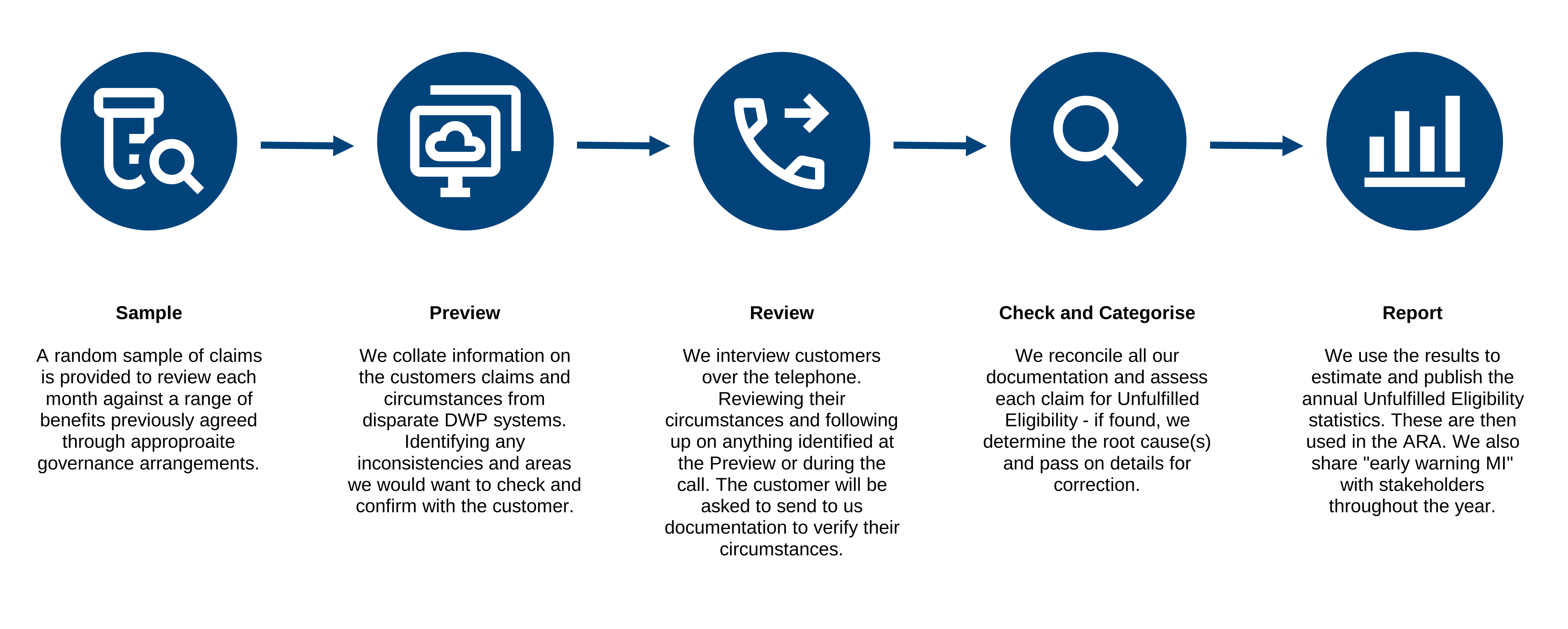
1.4 Customer journey
1.5 Relevance
Definition: Relevance is how the statistics meet the needs of current and potential users for both coverage and content. Innovation is pursued to continuously improve statistical output.
This document supports our main publication which contains estimates of the level of Unfulfilled Eligibility in the benefit system in Financial Year Ending (FYE) 2026.
The National Audit Office takes account of the amount of Unfulfilled Eligibility when they audit DWP’s accounts each year.
Within DWP these statistics are used to evaluate, develop, and support Unfulfilled Eligibility policy, strategy and operational decisions, initiatives, options, and business plans through understanding the causes of Unfulfilled Eligibility.
The Unfulfilled Eligibility statistics published in May each year feed into the DWP accounts. The FYE 2026 estimates published in May 2026 feed into the FYE 2026 DWP annual report and accounts.
The Unfulfilled Eligibility estimates are also used to answer Parliamentary Questions and Freedom of Information requests, and to inform DWP Press Office statements on Unfulfilled Eligibility.
The Department for Work and Pensions (DWP) Unfulfilled Eligibility in the benefit system statistics provide estimates of Unfulfilled Eligibility for benefits administered by the DWP and local authorities.
The series has been developed to provide information to various users for policy development, monitoring and accountability, as well as providing academics, journalists and the general public, data to aid informed public debate.
The statistics:
-
include DWP benefits and those administered by local authorities
-
are the primary DWP indicator for levels of Unfulfilled Eligibility in the benefit system
-
are in the DWP business plan
-
are important for DWP assurance on the impact of anti-Unfulfilled Eligibility activity across the business
The publication is essential for providing our stakeholders with:
-
a consistent time series for assessing Unfulfilled Eligibility trends over time
-
data to assess current DWP Unfulfilled Eligibility policy and evaluate recent changes to these or business processes
-
the evidence base for assessing the potential effect of future Unfulfilled Eligibility policy options and programmes
-
robust data to inform future measurement options
-
estimates of Unfulfilled Eligibility for the DWP annual report and accounts
-
data to measure government performance relating to objective 5 of the DWP single departmental plan: transform our services and work with the devolved administrations to deliver an effective welfare system for citizens when they need it while reducing costs and achieving value for money for taxpayers. Read the latest plan (correct at the time of publication of this document, May 2026).
We recognise that our users will have different needs and we use a range of different methods to contact them. We frequently meet internal DWP users to discuss their requirements. Externally, we regularly engage with the National Audit Office as they audit DWP’s annual report and accounts which include estimates of the amount of money claimants could have got through Unfulfilled Eligibility. We also engage, as needed, with HM Revenue and Customs and the Cabinet Office.
Engagement with other external users is usually through the DWP statistical pages of this website where we:
-
invite users to share their comments or views about our National Statistics, or to simply advise us how they use our statistics
-
advise users of updates and changes to our statistics through the future statistics release calendars and our Unfulfilled Eligibility in the benefit system collection page
1.6 Accessibility and Clarity
Definition: Accessibility is the ease with which users can access the data, also reflecting the format in which the data are available. Clarity refers to the quality and sufficiency of the metadata, illustrations and accompanying advice.
1.6.1 Accessibility
Our statistics comply with the Public Sector Bodies accessibility regulations. Our statistical publication and accompanying Background Information and Methodology Note is released on gov.uk in an HTML format, allowing it to be read by accessibility software. Due to the size and complexity of our supplementary tables, we release two versions, which have the same contents:
-
one set that is in an ODS format that complies with all accessibility good practices, allowing it to be easily read and understood by accessibility software
-
one set that is released in an XLS format, which contains formatting and spacing to make it easier to read by non-accessibility software users
1.6.2 Clarity
A glossary of all acronyms that are used in the publication can be found in section 9. There is also a full list of Unfulfilled Eligibility reasons that feature in our publication, along with a description of how these can occur, this can be found in Appendix 2.
1.7 Timeliness and Punctuality
Definition: This dimension measures that the statistics are released in a timely and punctual manner. Timeliness refers to the lapse of time between publication and the period to which the data refer. Punctuality refers to the time lag between the actual and planned dates of publication.
The Unfulfilled Eligibility in the benefit system report is usually published around 7 months after the main reference period.
Due to the time taken to undertake the interviews and gather follow up information, final data from the reviews is not made available to analysts until 4-5 months after the start date of the last interviews. The production of the statistics and reference tables, and the associated clearance processes, then takes the analytical team about 2 months to prepare.
DWP pre-announce the date of release of the Unfulfilled Eligibility in the benefit system report at least 4 weeks in advance on this website and the UK Statistics Authority publication hub, in accordance with the Code of Practice for Statistics.
The statistics are published at 9.30am on the day that is pre-announced. The release calendar is updated at the earliest opportunity to inform users of any change to the date of the statistical release and will include a reason for the change. All statistics will be published in compliance with the release policies in the Code of Practice for Statistics.
1.8 Data Revision and methodology changes
Revisions to our statistics may happen for a number of reasons. When we make methodology changes that impact our estimates, we may revise the estimates for the previous year to allow meaningful comparisons between the two. Where we introduce major changes, we may denote a break in our time series and recommend that comparisons are not made back beyond a certain point.
In our FYE 2026 publication we have revised:
- The monetary value of Universal Credit Unfulfilled Eligibility
1.8.1 Planned
The following changes incorporate minor adjustments reflecting operational and policy changes, as well as small revisions arising from a methodological review. These updates do not have a material impact on the Unfulfilled Eligibility estimates. Figures published for Financial Year Ending (FYE) 2025 will be restated to reflect these changes and enable accurate comparisons over time.
The National Statistics Code of Practice allows for revisions of figures under controlled circumstances: “Statistics are by their nature subject to error and uncertainty. Initial estimates are often systematically amended to reflect more complete information. Improvements in methodologies and systems can help to make revised series more accurate and more useful.”
Consistency of recording Fraud and Error and Unfulfilled Eligibility where a change of circumstances does not impact the claimant’s award
We identified inconsistencies in our recording of errors and Unfulfilled Eligibility, where a change of circumstances does not impact the claimant’s award. To ensure consistent measurement and accurate reporting of the loss to the public purse, we are no longer recording any Fraud and Error (F&E) or Unfulfilled Eligibility that occurs on the same element of a claim when the award amount remains unchanged.
Where the award is affected, we will record a single overpayment or Unfulfilled Eligibility value, calculated as the difference between the impact of the error and the impact of the Unfulfilled Eligibility. This only applies when the claimant is responsible for both the overpayment and the Unfulfilled Eligibility – if the overpayment is due to Official Error, then both will continue to be recorded separately.
In isolation this change removed £10 million from Universal Credit FYE 2025 Unfulfilled Eligibility.
1.8.2 Unplanned
Unplanned revisions of figures in reports in this series might be necessary from time to time. Under this Code of Practice, the Department has a responsibility to ensure that any revisions to existing statistics are robust and are freely available, with the same level of supporting information as new statistics.
Correction to State Pension expenditure for FYE 2025
The expenditure figure that we used for State Pension in FYE 2025 was incorrect. Although the State Pension rates were unaffected, the upper confidence interval of the monetary value of Unfulfilled Eligibility on State Pension was overstated.
We have corrected this issue and restated the State Pension confidence intervals on the monetary value of Unfulfilled Eligibility.
1.9 Confidentiality, Security, Transparency
All of our data is handled, stored and accessed in a manner which complies with Government and Departmental standards regarding security and confidentiality, and fully meets the requirements of the Data Protection Act (2018).
Access to this data is controlled by a system of passwords and strict business need access control.
As per the statistical code of practice a small number of internal key stakeholders get pre-release access to the statistics, 24 hours before their release. See pre-release access to DWP statistics - GOV.UK for more information and a list of job titles and organisations that appear in this group which is given early access.
Any general overview of planned methodology changes to the statistics will be announced through the Statistical Work Programme as well as more details given when the statistics are pre-announced.
1.9.1 Rounding Policy
In the publication and supplementary tables, the following rounding conventions have been applied:
-
percentages are rounded to the nearest 0.1%
-
expenditure values are rounded to the nearest £100 million
-
headline monetary estimates are rounded to the nearest £10 million
-
monetary estimates for Unfulfilled Eligibility reasons are rounded to the nearest £1 million
The proportion of claims with Unfulfilled Eligibility is rounded to the nearest 1% in the publication and expressed in the format “n in 100 cases”. The supplementary tables present the same values as a percentage rounded to the nearest 0.1%.
Individual figures have been rounded independently, so the sum of component items do not necessarily equal the totals shown.
2. Statistical Presentation
2.1 Overview of dissemination process
Collection page for the Unfulfilled Eligibility statistics.
FYE 2026 estimates, including reference tables.
2.2 Data Description
The statistical release gives a narrative on the overall levels of Unfulfilled Eligibility in the benefit system. It also contains timeseries data (where available) on the benefits that were reviewed in the current year, with the focus mainly on comparisons between this financial year and the last financial year that particular benefit was measured.
Alongside the statistical release is a set of supplementary tables. These contain:
-
A timeseries of the rates and monetary values of Unfulfilled Eligibility, overall in the benefit system and at a benefit level (where available), back to FYE 2023.
-
A breakdown of rates and monetary values of Unfulfilled Eligibility for each benefit reviewed in this financial year by the reason for Unfulfilled Eligibility. This breakdown is done for this financial year and the last financial year that particular benefit was measured (where available).
-
A timeseries of the proportion of claims with Unfulfilled Eligibility on each benefit measured, back to FYE 2023 (where available).
2.3 Statistical Concepts and Definitions
The main publication presents estimates of Unfulfilled Eligibility. It estimates how much extra money benefit claimants could be getting if they told us accurately about their circumstances.
We present these in percentage terms (of expenditure on a benefit) and in monetary terms, in millions of pounds.
95% Confidence Interval
Confidence intervals provide an indication of how precise an estimate is. For more information see: Uncertainty and how we measure it for our surveys - Office for National Statistics
Estimate
An estimate is an indication of the value of an unknown quantity based on observed data. It provides information about unknown values in the population that we are trying to measure.
Population
A population is any entire collection of items from which we may collect data. It is the entire group that we are interested in, which we wish to describe or to draw conclusions about (generally benefit claimants or expenditure in the context of this report). There are two different types of population referred to in sampling:
-
The Target Population - consists of the group of population units from whom we would like to collect data (e.g. all people claiming a benefit).
-
The Survey Population - consists of the group of population units from whom we can collect data (e.g. all claimants with sufficient case details on our datasets). The Survey Population is sometimes referred to as the ‘Sampling Frame.’
Sample
A group selected (randomly in the context of this report) from a larger group (known as the ‘population’). Through analysing the sample, we aim to draw valid conclusions about the larger group.
2.4 Measures within the publication
2.4.1 Monetary Value of Unfulfilled Eligibility (MVUE)
To calculate the MVUE across the benefits, we apply the Unfulfilled Eligibility percentage rates to the total annual expenditure for each benefit. This means that the MVUE is affected by increases and decreases in expenditure, even if Unfulfilled Eligibility percentages remain unchanged. We see the impacts of this in our estimates for benefits not reviewed in the financial year, where we use the same rate of Unfulfilled Eligibility from previous years but apply it to the expenditure on the benefit in the financial year (which will have changed from the year before).
Although expressing Unfulfilled Eligibility in monetary terms (i.e. MVUE terms) might be helpful for a reader to contextualize the figures, we recommend making comparisons on a year-on-year basis based on the percentage rates of Unfulfilled Eligibility. This is particularly important for benefits where the expenditure changes by a large amount each year, as comparisons of monetary amounts can be misleading. For example, on a benefit with growing expenditure, it can be possible for the monetary amount of Unfulfilled Eligibility to increase, even if the percentage rate of Unfulfilled Eligibility has actually gone down.
2.4.2 Proportion of claims with Unfulfilled Eligibility
As well as MVUE we report a measure on the proportion of claims with Unfulfilled Eligibility. This is calculated as follows:
Proportion of claims with Unfulfilled Eligibility = (number of claims in the sample with Unfulfilled Eligibility) / (number of claims in the sample)
2.5 Frequency
The Unfulfilled Eligibility in the Benefit System statistics are produced annually. The collection can be found on the government website.
The publication strategy is held within the collection pages. and information on release dates is available on the government website.
The future coverage and scope of the official statistics “Unfulfilled Eligibility in the Benefit System” is kept under review and users are kept informed of our plans via our Release Strategy document: Release Strategy Document.
3. Statistical Processing
3.1 Source Data
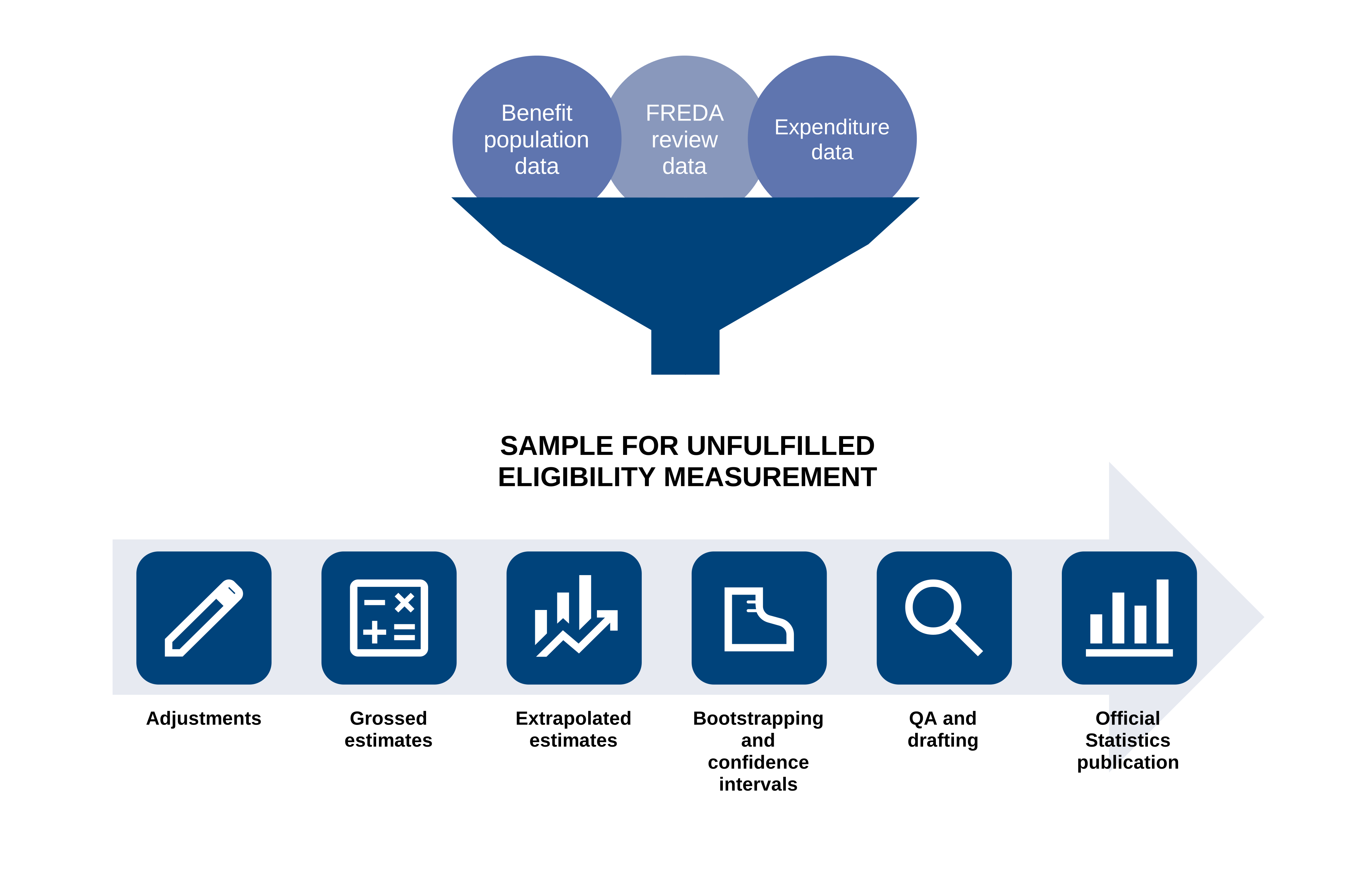
Unfulfilled eligibility measurement relies on three data sources:
-
Raw sample held on ‘FREDA’ (the database on which the review outcomes are recorded), is used to identify the Monetary Value of Unfulfilled Eligibility (MVUE) for individual cases, categorise its cause and quantify it as a proportion of the sample.
-
Benefit population data to estimate the extent of Unfulfilled Eligibility across the whole claimant caseload from the sample data.
-
Expenditure data to estimate the total MVUE to the department, (aligning with the Spring Forecast published forecasts).
We take a sample of benefit claims from our administrative systems. DWP’s Performance Measurement (PM) team contact the benefit claimants to arrange a review. The outcomes of these reviews are recorded on a bespoke internal database called FREDA. We use data from here to produce our estimates.
Sub-categories of Unfulfilled Eligibility reasons are used to provide more details about the nature of the Unfulfilled Eligibility. Details on Unfulfilled Eligibility classifications can be found in the glossary at Appendix 2.
Further information on the data we use to produce our estimates is contained within section 4, section 5 and section 6 of this report.
3.2 Data Collection
The Unfulfilled Eligibility statistics are determined using a sample of benefit records, since is it not possible to review every benefit record. The sample of benefit records provide data from which inferences are made about the Unfulfilled Eligibility levels in the whole benefit claimant population.
The number of benefit records to be reviewed is determined by a sample size calculation. The sample size calculation is used to ensure that a sufficient number of benefit records are sampled, which allows meaningful changes in the levels of Unfulfilled Eligibility to be detected for the whole benefit claimant population.
Benefit records are selected on a monthly basis from data extracts of the administrative systems. The population from which the samples are drawn are the benefit records that are in payment in a particular assessment period, that is where there is evidence of a payment relating to the previous month. This is known as the liveload.
The monthly samples are taken from the liveload in advance of the scheduling of the benefit reviews, to give time for the sample to be checked and for background information to be gathered on each benefit record sampled. Any benefit record relating to a claimant who has been previously sampled in the last 6 months or meets specific exclusion criteria (e.g. terminally ill) will not be reviewed.
We use simple random sampling to select the sample of benefit records for each benefit that is reviewed in the financial year. Benefit records are sampled randomly to ensure an equal chance of being selected for the sample.
The sampling methodology is used to attempt to minimise selection bias in the sample and aims to select a sample that is representative of the entire benefit claimant case population.
The benefits sampled for this year and the methodologies applied are as follows:
Simple random sample:
-
Disability Living Allowance
-
Pension Credit
-
Universal Credit
-
State Pension
-
Personal Independence Payment
Housing Benefit methodology uses simple random sampling stratified by Primary Sampling Unit (PSU) and four different client groups:
-
Working Age in receipt of IS, JSA, ESA, PC or UC
-
Working Age not in receipt of IS, JSA, ESA, PC or UC
-
Pensioners in receipt of IS, JSA, ESA, PC or UC
-
Pensioners not in receipt of IS, JSA, ESA, PC or UC
Note: For HB, the client groups reviewed in FYE 2026 were the two Pensioner client groups, which were both last measured in FYE 2024.
3.2.1 Abandoned Cases
Of the benefit records sampled, there are some that are not eligible for a review according to strictly defined criteria for abandonment. Benefit records that fall into this category could include:
-
the claimant has a change of circumstances that ends their award before the interview can take place
-
the claimant has had a benefit reviewed in the last six months
-
if the claimant or their partner is terminally ill
When such cases occur in the sample, they are replaced by another case from a reserve list. However, for a small number of abandoned cases replacement is not possible for practical reasons. This occurs when cases are abandoned towards the end of the review year, which means that there is not enough time for a replacement case to complete the full process.
3.2.2 Abandoned Cases FYE 2026
It is the decision of the Performance Measurement (PM) team, during the preview stage of a case, if a case should be abandoned.
The following table shows the main reason for cases abandoned for each benefit:
| Abandonment Reason / Benefit | DLA | HB | PC | PIP | SP | UC | Total | |||||||||||||||
|---|---|---|---|---|---|---|---|---|---|---|---|---|---|---|---|---|---|---|---|---|---|---|
| Benefit not in payment/ceased or suspended | 14 | 150 | 94 | 23 | 0 | 202 | 483 | |||||||||||||||
| Planned/Recent activity within 6 months of the start of the sample | 475 | 223 | 5 | 146 | 0 | 426 | 1275 | |||||||||||||||
| Sensitive issues | 0 | 51 | 57 | 11 | 27 | 26 | 172 | |||||||||||||||
| Corporate Appointee with no named contact | 0 | 2 | 12 | 22 | 4 | 6 | 46 | |||||||||||||||
| Incorrectly sampled | 0 | 32 | 0 | 5 | 0 | 0 | 37 | |||||||||||||||
| Miscellaneous | 27 | 56 | 21 | 52 | 62 | 84 | 302 | |||||||||||||||
| Total cases abandoned | 516 | 514 | 189 | 259 | 93 | 744 | 2,315 | |||||||||||||||
| Total cases reviewed | 1,198 | 2,976 | 1,991 | 1,384 | 1,496 | 3,998 | 13,043 | |||||||||||||||
| Abandonment rate | 43% | 17% | 9% | 19% | 6% | 19% | 18% | |||||||||||||||
| Percentage point change from previous year | - | -24% | -1% | -1% | 1% | 1% | -2% |
The five most common abandonment reasons (excluding ‘miscellaneous’) accounted for 87% of total abandonments, a similar proportion to FYE 2025. While the overall contribution of these five reasons remained stable, the distribution across individual reasons changed between financial years.
These changes largely reflect differences in the benefits reviewed. For example, the inclusion of Disability Living Allowance (DLA) in FYE 2026 affected the proportion of abandonments attributed to particular reasons. ‘Planned or recent activity within six months of the start of the sample’ accounted for 28% of abandonments in FYE 2025, increasing to 55% in FYE 2026.
In FYE 2025, Carers Allowance was reviewed (but not in FYE 2026) and only a small number of Carers Allowance cases were abandoned (2 cases) for this reason. In contrast, DLA, which was not reviewed in FYE 2025, accounted for 475 abandonments in FYE 2026.
In FYE 2026, DWP reviewed pension Age Housing Benefit (HB) claims, this was made up of both non-passported pension age and passported pension age client groups. This differs to FYE 2025, when only passported working age claims were reviewed. Rates of abandonment vary by client group due to the differing circumstances of the claimants in these groups. Passported working age claimants are most likely to move off HB as they move from temporary accommodation into more permanent housing, where costs will be covered by Universal Credit. As a result, fewer HB cases were abandoned in FYE 2026 (514) when pension age client groups were reviewed, compared to FYE 2025 (1,236) when the passported working age group was reviewed.
Below are updated descriptions for the top five abandonment reasons as well as details of the miscellaneous category for FYE 2026.
Benefit not in Payment/ceased or suspended
This was the second largest cause of abandonment, with more than 40% of these abandonments being UC claims. These are claims no longer in payment either because the claimant is no longer entitled to the benefit or because they are now claiming another benefit. This is primarily related to the time lag between sample selection and the commencement of reviews.
Planned/Recent activity within 6 months of the start of the sample
This was the largest category accounting for more than half of all abandonments. Over 70% related to DLA and UC. This category includes cases where action has already taken place, or is planned by the Department, such as appeals, renewals or interventions for PIP. For UC, this may include reviews within other areas of DWP being done on the claim, while for HB it could be due to engagement with the local authority.
Sensitive Issues
This reason is mainly used when the claimant or partner is terminally ill or has recently died.
Corporate Appointee with no named contact
These cases occur when a review is planned but the appropriate corporate appointee cannot be identified to act on the claimant’s behalf.
Incorrectly Sampled
This reason is primarily used where claims have been sampled for a PM review but do not belong to the HB client group(s) being measured, or where the case is migrating case to UC.
Miscellaneous
This category includes all other reasons for abandonment that do not fall into the main categories above.
All abandonment reasons fall within pre-defined criteria. These circumstances are unavoidable, outside operational control, or cannot be identified at the sample production stage.
3.2.3 Unfulfilled eligibility review process
For all benefits, benefit review officers normally check for Unfulfilled Eligibility by comparing the evidence obtained from the review to that held by the department.
The review process involves the following activity:
-
Previewing the case by collating information from a variety of DWP or Local Authority (LA) systems to develop an initial picture and to identify any discrepancies between information from different sources.
-
Interviewing the claimant (or a nominated individual where the claimant lacks capacity) using a structured and detailed set of questions about the basis of their claim. The interview is completed as a telephone review in the majority of cases. However, where this is not appropriate, there is usually also the option for a completed review form to be returned by post.
-
The interview aims to identify any discrepancies between the claimant’s current circumstances and the circumstances upon which their benefit claim was based.
3.2.4 Estimated Outcomes
Most years there are a small number of cases where the review process had not been completed at the time of the analysis and production of results. As a result, estimates for the final outcomes for these cases have been made in the analysis using either the review officer (RO) estimation of the most likely outcome, or the results from the reviews of similar cases that had been completed.
3.2.5 Recording Information
Case details relating to the Unfulfilled Eligibility reviews are recorded on internal bespoke software (the system is known as FREDA), to create a centrally held data source. This can then be matched against our original sample population to produce a complete picture of Unfulfilled Eligibility against review cases across our sample.
3.2.6 Omissions from the estimates
The Unfulfilled Eligibility estimates do not capture every possible element of Unfulfilled Eligibility. Some cases are not reviewed due to the constraints of our sampling or reviewing regimes (or it is impractical to do so from a cost or resource perspective) and some cases are out of scope of our measurement process. The time period that our reviews relate to means that any operational or policy changes in the last five months of the financial year are usually not covered by our measurements.
For most omissions from our estimates, we make adjustments or apply assumptions to those cases. For some omissions we assume that the levels of Unfulfilled Eligibility for those cases are the same as for the cases that we do review, and for other omissions we apply specific assumptions where we expect the levels of Unfulfilled Eligibility to be different.
This section details the omissions from the estimates as far as possible. The examples that follow are not an exhaustive list but are an attempt at providing further details on known omissions in the estimates.
There are a number of groups of cases that we are unable to review or which we do not review. Some of the main examples of these are as follows:
New and short-term cases
We are unable to review short duration cases (of just a few weeks in duration) due to the time lags involved in accessing data on the benefit caseloads, drawing the samples, and preparing these for reviewing. For these cases, we assume the rates of Unfulfilled Eligibility are the same as in the rest of the benefit caseloads. We do, however, also make an adjustment using “new cases factors” to try to ensure that the results are representative across the entire distribution of lengths of benefit claims.
It can take time for new cases to be available for sampling, meaning they are potentially under-represented in the sample. Analysis was undertaken to quantify the impact of these potential exclusions.
New cases make up a small proportion of cases for most benefits. The table below shows the yearly average percentage that are less than three months old at a given time.
| Benefit | Average number of cases less than three months old | Source | |
|---|---|---|---|
| Universal Credit | 8.5% | Official monthly data for November 2024 to October 2025 | |
| State Pension | 1.9% | Estimated using quarterly pension data for May 2024 and ONS population data | |
| Personal Independence Payment | 3.6% | Official monthly data for August 2024 to July 2025 | |
| Housing Benefit | 5.5% | Official monthly data for September 2024 to August 2025 | |
| Disability Living Allowance | 1.7% | Official quarterly data for August 2024 to May 2025 | |
| Pension Credit | 2.8% | Official quarterly data for August 2024 to May 2025 |
To investigate the impact of this exclusion, a simulation of the sampling process was performed and repeated multiple times with these cases included. Sensitivity analysis was then carried out across all benefits to estimate the impact of excluding new cases if the Unfulfilled Eligibility rate were doubled, halved, or remained the same.
The age of a case when it becomes available for sampling differs by benefit. Based on these timescales, analyses were undertaken using an exclusion period of either 6 weeks or 3 months.
Overall, this analysis showed that, because short term cases make up such a small percentage of total cases at any given time and many are available to be sampled later in the period, the impact on final published figures for all benefits is negligible.
The impact of excluding new cases is no more than 0.1 percentage points difference in the estimated Unfulfilled Eligibility rate across all benefits.
It would be expected that the rate of Unfulfilled Eligibility in new cases would typically be lower than the full population of claimants since they have recently been assessed. The outcomes of this analysis fall within the estimated confidence intervals and there is little impact on the published statistics, therefore no adjustment is required.
Unclaimed benefits
We are only able to sample claimants who are in receipt of a benefit payment. Eligible claimants that have not made a benefit claim are not included in these figures. Income-related benefits: estimates of take-up is a separate DWP publication about take-up of benefits.
Nil payment claims
A case is considered to be nil payment if there is a claim in place but the total award being paid is zero. These cases are not included when the sample is selected. Some benefits do not allow a nil award, meaning all active claimants are receiving some payment.
| Level of Unfulfilled Eligibility in excluded group | Estimated change in PIP Unfulfilled Eligibility | Impact on PIP Unfulfilled Eligibility estimate | Impact on overall Unfulfilled Eligibility estimate | |
|---|---|---|---|---|
| Double the published rate on terminally ill cases | + £0.8million | + 0.0 p.p | + 0.0 p.p | |
| Half the published rate on terminally ill cases | + £0.2million | + 0.0 p.p | + 0.0 p.p |
Note: For a very small proportion of the PIP caseload (0.1%), the combination of award rates (daily living and mobility) is reported as nil-nil. Investigations suggest that award rates may be temporarily shown as nil for a short period whilst a claim review is in process, after which the new award rate is set. These cases will be monitored.
Nil payment claims are a potential source of Unfulfilled Eligibility that is not included in the sample.
Universal Credit
For the year up until August 2025 the most recent year for which data was available for analysis, the number of nil-payment claims ranged from 7.4% to 9.3%, with 8.3% being the average. Simulating the sampling process shows around 8.3% of claims that would otherwise be sampled are missed due to this. The potential impact of doubling the Unfulfilled Eligibility rate in this group is 0.3% of the UC expenditure.
Pension Credit
Only a very small percentage of Pension Credit claimants are in nil-payment at any given time. For the most recent year of data available this number was less than one percent. Simulating the sampling process shows that over 99.7% of cases sampled would be the same even if the nil-payment cases were included in the group available for sampling. This means that, even under a worst‑case assumption where the Unfulfilled Eligibility rate for excluded cases is doubled, the overall impact remains negligible and rounds to zero.
Exclusions specific to PIP
The monthly samples are taken from live PIP claims in advance of the scheduling of the benefit reviews. Any benefit record relating to a claimant who meets specific exclusion criteria (e.g. terminally ill, reviewed in the last three months) will not be reviewed. The potential impact of each excluded group is summarised below.
Terminally ill cases
Terminally ill claimants make up a very small percentage of PIP claimants, typically around 1%. Sensitivity analysis was used to assess the impact of excluding these cases, by assuming a worst‑case scenario in which their Unfulfilled Eligibility rate was double that of the sampled population.
Estimated impact of excluding terminally ill cases on the PIP Unfulfilled Eligibility rate:
| Level of Unfulfilled Eligibility in excluded group | Estimated change in PIP Unfulfilled Eligibility | Impact on PIP Unfulfilled Eligibility estimate | Impact on overall Unfulfilled Eligibility estimate | |
|---|---|---|---|---|
| Double the published rate on terminally ill cases | + £0.8million | + 0.0 p.p | + 0.0 p.p | |
| Half the published rate on terminally ill cases | + £0.2million | + 0.0 p.p | + 0.0 p.p |
Note that the PIP Unfulfilled Eligibility analysis applies to cases that are not on the highest award (enhanced mobility with enhanced daily living) as the estimates are already adjusted to account for this exclusion. See the benefit-specific adjustments section for more details.
The above analysis demonstrates that any additional Unfulfilled Eligibility that may exist in the excluded PIP terminally ill cases is extremely small. The total estimated level of Unfulfilled Eligibility would have a negligible difference for the above scenarios if terminally ill cases were included in the sample. Therefore, no adjustment has been made to the statistics because of this exclusion.
Scheduled reviews
PIP awards are reviewed regularly. The period between reviews is set on an individual basis and ranges from 9 months to 10 years, with the majority of claimants having a short-term award of 0-2 years. If a claim has had a planned award review in the last 92 days, has a review ongoing, or a review due in the next six weeks then it is not eligible to be sampled.
A simulation of the sampling process was performed and repeated multiple times to investigate the impact of this exclusion.
Cases with an upcoming review would be expected to have a higher propensity for Unfulfilled Eligibility due to the length of time since their last review. By the same reasoning cases that have had a review completed recently would be expected to have a lower propensity for Unfulfilled Eligibility.
In our statistics an assumption is made that the excluded cases are similar to those sampled and so no adjustments are made. We investigated the impact of alternative assumptions on our estimates and results are shown in the table below.
For this analysis we assumed that a recent review would resolve potential Unfulfilled Eligibility. Therefore, we have estimated the impact of the excluded cases having half the Unfulfilled Eligibility of the sample, and as a worst-case scenario having double the Unfulfilled Eligibility of the sampled cases.
The table below shows these assumptions and their estimated difference to the published amounts and rates.
| Estimated difference from published | Impact on PIP Unfulfilled Eligibility estimate | Impact on overall Unfulfilled Eligibility estimate | |
|---|---|---|---|
| Assumption of half the sampled Unfulfilled Eligibility on excluded recently reviewed cases | - £105.5million | - 0.4 p.p | - 0.0 p.p |
| Assumption of double the sampled Unfulfilled Eligibility on excluded recently reviewed cases | - £210.9million | + 0.7 p.p | - 0.1 p.p |
The worst‑case scenario is included purely for illustration: even under an implausibly high level of Unfulfilled Eligibility, the adjusted estimate would still lie within or close to the published FYE 2026 confidence intervals for PIP. Therefore, no adjustment is required.
Exclusions specific to DLA
The monthly samples are taken from live DLA claims in advance of the scheduling of the benefit reviews. Any benefit record relating to a claimant who meets specific exclusion criteria (e.g., terminally ill, reviewed in the last three months) will not be reviewed. We assume the rates of Unfulfilled Eligibility for these cases are the same as the rest of the DLA caseload. The potential impacts of each excluded group are summarised below.
Working age cases
DLA is being replaced by other benefits. New claims to DLA can only be made for children.
Adults of working age and pensioners aged 65 or over prior to 8 April 2013 (DLA 65+), already in receipt of DLA, will continue to get DLA as long as they remain eligible for it.
In FYE 2026, we have reviewed claims for DLA children only with the DLA 65+ rate found in FYE 2024 rolled forward. Working‑age cases were not reviewed in FYE 2024 or FYE 2026, as any change in circumstances ends the DLA award and requires the claimant to move to PIP.
We exclude current pensioners who were under 65 on 8 April 2013 who would also have their DLA payment ended if a change of circumstances was found and they would have to claim PIP.
As DLA working age claims with a change in circumstances cannot be measured, we have excluded them from our sensitivity analyses and adjustments.
Terminally ill cases
Terminally ill claimants make up a very small percentage of DLA claimants, typically less than 1%. Sensitivity analysis was used to assess the impact of excluding these cases, by assuming a worst‑case scenario in which their Unfulfilled Eligibility rate was double that of the sampled population.
| Level of Unfulfilled Eligibility in excluded group | Estimated change in DLA Unfulfilled Eligibility | Impact on DLA Unfulfilled Eligibility estimate | Impact on overall Unfulfilled Eligibility estimate | |
|---|---|---|---|---|
| Double the published rate on terminally ill cases | + £0.5million | + 0.0 p.p | + 0.0 p.p | |
| Half the published rate on terminally ill cases | - £0.2million | + 0.0 p.p | + 0.0 p.p |
Note that DLA claims on the highest rate award (higher rate mobility and high care) have been excluded from this analysis as they are in receipt of the full entitlement.
The above analysis demonstrates that any additional Unfulfilled Eligibility that may exist in the excluded DLA terminally ill cases is extremely small. The total estimated levels of Unfulfilled Eligibility would have a negligible difference for the above scenarios if terminally ill cases were included in the sample. Therefore, no adjustment has been made to the statistics because of this exclusion.
Scheduled reviews
DLA children awards are reviewed on renewal, however DLA 65+ awards are not routinely reviewed. Around 28% of the sample was abandoned due to cases having a scheduled review or a recent review, and they were therefore excluded from the sample estimates.
In our statistics an assumption is made that the excluded cases are similar to those sampled and so no adjustments are made. We investigated the impact of alternative assumptions on our estimates and results are shown in the table below.
Cases with an upcoming review would be expected to have a higher propensity for Unfulfilled Eligibility due to the length of time since their last review. By the same reasoning cases that have had a review completed recently would be expected to have a lower propensity for Unfulfilled Eligibility.
However, it was not possible to break down the excluded cases into the two review types of recent review and scheduled review. Assuming a higher proportion of one or the other would lead to an over or underestimation of the impact on the Unfulfilled Eligibility estimate. Therefore, we have made the assumption that 50% of each type of review was present in the excluded cases and used this assumption in the analysis.
Two scenarios were tested:
1. Double the sample Unfulfilled Eligibility rate on the scheduled review cases and half the sample Unfulfilled Eligibility on the recently reviewed cases.
2. Double the sample Unfulfilled Eligibility rate on the scheduled review cases and zero Unfulfilled Eligibility on the recently reviewed cases.
The table below shows these assumptions and their estimated difference to the published amounts and rates.
| Estimated difference from published | Impact on DLA Unfulfilled Eligibility estimate | Impact on overall Unfulfilled Eligibility estimate | |
|---|---|---|---|
| Assumption of double the sampled Unfulfilled Eligibility in scheduled reviews and half the Unfulfilled Eligibility in recent reviews | + £48.9million | + 0.6 p.p | + 0.0 p.p |
| Assumption of double the sampled Unfulfilled Eligibility in scheduled reviews and zero Unfulfilled Eligibility in recent reviews | + £0.0million | + 0.0 p.p | + 0.0 p.p |
These differences all fall within the published confidence intervals for the rate of Unfulfilled Eligibility for DLA in FYE 2026, and the conclusion therefore is no adjustment is needed.
Time lags
The time lags involved in the Unfulfilled Eligibility measurement process mean that further omissions are possible. Any policy or operational changes in the last five months of the financial year will not usually be covered by the reviews feeding into the publication, as the reviews tend to finish in the October of that financial year. In addition, some cases do not have a categorisation by the time the estimates are put together. “Estimated outcomes” are generated for these cases for the purposes of the statistics, made by the review officer estimating the most likely outcome of the case, or based on the results from the reviews of similar cases that have been completed.
For all benefits we carried out additional work to better understand any implications of major policy/operational changes within the financial year. The conclusion was that we felt the sample period was representative of the financial year. See section 5 for further details.
UC surplus self-employed profit/loss
For UC, we only measure income in the assessment period we are checking. Self-employed people must report their income on a monthly basis. If they receive income that removes their entitlement to UC in one month, and this is above the surplus earnings threshold, then any extra income is carried forward into the next month (the surplus earnings threshold is defined as £2,500 above the amount that removes their entitlement to UC in that month). If a self-employed claimant incurs a loss of any amount within an assessment period, this loss is also rolled forward to the next assessment period. When reviewing the benefit, any rolled forward income or loss is assumed to be correct.
Work Capability Assessment
When ESA was measured between FYE 2014 and FYE 2023, the measurement of ESA did not include a review of the Work Capability Assessment; this is also the case for the Work Capability Assessment for claimants on UC.
There is potential for there to be Unfulfilled Eligibility related to the Limited Capability for Work Related Activity (LCWRA) element. We are currently unable to review the LCWRA element of UC consequently, Unfulfilled Eligibility on this element of UC is omitted from the estimates.
Latest figures on LCWRA show around 2,000,000 households on UC are awarded this element. We estimate the impact on the headline statistics is minimal, but we expect if we had measured this element there would be approximately £100 million additional UC Unfulfilled Eligibility. The confidence intervals for the monetary value of Unfulfilled Eligibility on UC are £1,100 million to £1,490 million therefore, the omission was taken to be negligible, and no adjustment was made to the UC Unfulfilled Eligibility estimates.
3.2.7 Non-sampling error
Sources of non-sampling error are difficult to measure. However, where possible, these uncertainties have been quantified and combined with the sampling uncertainties, to produce the final estimates. Quality assurance processes are undertaken to mitigate against particular types of error (for example, data entry error).
Possible sources of non-sampling error that may occur in the production of the Unfulfilled Eligibility statistics include:
-
Data entry error – the survey data is recorded on a database by DWP staff. Data may be transcribed incorrectly, be incomplete, or entered in a format that cannot be processed. This is minimised by internal validation checks incorporated into the database, which can prevent entry of incorrect data and warn staff when an unusual value has been input. Analysts undertake further data consistency checks that are not covered by the internal database validations.
-
Measurement error – the survey data collected from the benefit reviews are used to categorise an outcome for each case. The correct categorisation is not always obvious, and this can be recorded incorrectly, particularly for complex cases. To reduce any inaccuracies, a team of expert checkers reassess a selection of completed cases before any statistical analysis is carried out. This evidence is used as a feedback mechanism for the survey sample staff and also for the statistical analysis.
-
Processing error – errors can occur during processing that are caused by a data or programming error. This can be detected by a set of detailed quality assurance steps that are completed at the end of each processing stage. Outputs are compared at each stage to identify any unexpected results, which can then be rectified.
-
Non-response error – missing or incomplete data can arise during the survey. Supporting evidence to complete the benefit review may not be provided, or the claimant may not engage in the review process altogether. In other cases, the benefit review may not have been completed in time for the analysis and production of results. An outcome is imputed or estimated in these cases, by different methods that are detailed in this document.
-
Coverage error – not all of the benefit caseload can be captured by the sampling process. There is a delay between the sample selection and the claimant interview, and also a delay due to the processing of new benefit claims, which excludes the newest benefit claims from being reviewed. An adjustment is applied to ensure that the duration of benefit claims within the sample accurately reflects the durations within the whole caseload.
The list above is not exhaustive and there are further uncertainties that occur due to assumptions made when using older measurements for benefits that have not been reviewed this year. There are also some benefit-specific adjustments that are part of the data processing.
3.3 Data Validation
An automated code is regularly run by the statistical team to identify potential anomalies in the source data. These cases are flagged and passed back to the team that carries out the benefit reviews for further investigation. There is a long list of checks that are carried out by the code, but a few examples of the validations are:
-
Cases that are abandoned but have had a benefit review
-
Universal Credit cases where the claimant is over State Pension age
-
Universal Credit and non Passported Housing Benefit cases where the claimants has over £16k in Capital
3.4 Data compilation & methodology
3.4.1 Methodology for Benefits reviewed this year
Benefits that have been reviewed this year account for 91% of the total benefit expenditure.
For each of the benefits reviewed this year a random sample of cases was taken. See section 3.1 for further details.
The claimant is contacted and a review carried out with evidence requested to verify their circumstances as outlined in the Unfulfilled Eligibility reviews part of section 3.
Finally, a case is categorised as having Unfulfilled Eligibility or no Unfulfilled Eligibility.
At the completion of the work programme at the end of February we take all cases that the benefit reviewing team have done which are not abandoned. There are specific scenarios and adjustments that we then take into account. These are detailed below:
3.4.1.1 Adjustments
A series of adjustments are made to the sample data. These are to allow for various characteristics of the benefits and how their data is collected and recorded and are not applied universally. The following table highlights which adjustments apply to each of the benefits reviewed in FYE 2026:
| SP | DLA | PC | HB | UC | PIP | |||||||
|---|---|---|---|---|---|---|---|---|---|---|---|---|
| New Cases Factor | N | N | Y | Y | N | N | ||||||
| Capping | Y | Y | Y | Y | Y | Y | ||||||
| Special Rules End of Life | N | N | N | N | N | Y |
3.4.1.1.1 Capping
A case may have Unfulfilled Eligibility of more than one ‘type’ which sum to a total greater than the award difference. To ensure that the total Unfulfilled Eligibility does not exceed the total award difference, we ‘cap’ the Unfulfilled Eligibility amount.
3.4.1.1.2 New cases factors
New cases factors are an adjustment applied to help ensure that the durations on the sample accurately reflect the duration on benefit within the population.
As a result of the time required to collect the information needed to review a case, as well as other operational considerations, there is an unavoidable delay between sample selection and case review. This delay means that fewer low duration claims will be represented in the sample of cases, which artificially introduces a bias around claim durations at the point of interview.
3.4.1.1.3 Special Rules End of Life (SREL)
PIP claimants are considered to be particularly vulnerable, therefore it is not always deemed appropriate to put a claimant through the review process. This is the case for terminally ill PIP claimants.
Instead, an adjustment is made to the PIP estimates to account for their exclusion from the sample. 96% of terminally ill PIP claimants receive the highest award. For this reason, the Unfulfilled Eligibility rate in this group is not considered to be the same as for the rest of the PIP population, and an adjustment is made based on this assumption.
The impact of the SREL adjustment can be found in section 3.
3.4.1.2 Grossing
Grossing is the term used to describe the creation of population estimates from the sample data; sample results are scaled up to be representative of the whole population.
Example of a simple grossing factor ‘G’, if we were to sample 100 cases from a population of 1,000:
G = N ÷ n
= 1000 ÷ 100
= 10
Where ‘N’ is the population or sampling frame from which the cases are selected, and ‘n’ is the sample size taken.
The above grossing factor shows that, in this example (sampling 100 cases from a population of 1,000), then each case would have a grossing factor of 10 (i.e. each sample case represents 10 cases from the population). Hence if a case was shown to have Unfulfilled Eligibility, this would represent 10 cases with Unfulfilled Eligibility once grossed.
UC is replacing a selection of legacy benefits. As this process continues the UC caseload will increase whilst those other benefit caseloads will decrease. As a result, grossing for all benefits is calculated on a monthly basis. This ensures that Unfulfilled Eligibility identified at the start of the year is grossed up by less than Unfulfilled Eligibility identified at the end of the year if the caseload is increasing (or vice versa if it is decreasing).
Grossing factors are different for each benefit due to the sample, population and adjustments made.
3.4.1.3 Extrapolation
The grossed results provide a core estimate of levels of Unfulfilled Eligibility. Extrapolation aligns the monetary amount with the benefit expenditure, which is particularly important given the sample period and the financial year do not fully align.
The central estimates produced following extrapolation are based on reviews of random samples and hence are subject to uncertainty. This uncertainty surrounding a central estimate is associated with both the variance of the outcome within the sample and the size of the sample from which it is calculated. A 95% confidence interval is used to indicate the level of uncertainty. It shows the range of values within which we would expect the true value of the estimate to lie. A wider range for the confidence interval implies greater uncertainty in the estimate.
Confidence intervals are calculated using a statistical technique called bootstrapping. It is used to approximate the sampling distribution for the central estimate. The sampling distribution describes the range of possible values, for the central estimate, that could occur if different random samples had been used.
Bootstrapping is a computationally intensive technique that simulates resampling. A computer program is used to take 4,000 resamples with replacement, of equal size, from the initial sample data. The percentage rate of Unfulfilled Eligibility is calculated for each of the resamples. These estimates are ordered from smallest to largest and this gives the approximated sampling distribution.
The 95% confidence intervals are obtained from the bootstrapping results, by taking the 100th estimate (2.5th percentile) and the 3,900th estimate (97.5th percentile). We also check the median estimate (50th percentile) against our actual central estimate to ensure that no bias exists.
3.4.1.4 Creating the total, working age and pension age Housing Benefit figures
Housing Benefit (HB) is composed of working age and pension age client groups i.e. those that receive housing benefit who are of working age or who have reached pension age respectively. These groups are subdivided further into standard and passported groups:
-
Working Age in receipt of IS, JSA, ESA, PC or UC (Passported)
-
Working Age not in receipt of IS, JSA, ESA, PC or UC (Standard)
-
Pensioners in receipt of IS, JSA, ESA, PC or UC (Passported)
* Pensioners not in receipt of IS, JSA, ESA, PC or UC (Standard)
It is not possible to conduct a review of the total HB population in one year, therefore one or more client groups are usually selected. The rates of the selected group(s) are measured to find those client group’s specific rates. The rates of client groups not reviewed are carried over from when they were previously measured. The total HB rate is then calculated by extrapolating the rate of the groups measured, and those carried over from previous measurements, by their expenditure proportion. Any changes observed at a total level can only be attributed to the group(s) reviewed. To provide a simple example:
Assume that all 4 groups are of equal proportion (25% of expenditure) and the last time each group was measured found a UE rate of 1% resulting in a total HB UE rate of 1%. If HSWA was found to have a UE rate of 2%, the total HB UE rate would change based on its proportion – in this instance being 25% (or ¼) of the total. The equation below shows this relationship:
HB Total =
(HSWA rate ÷ HSWA proportion) + (HSPA rate ÷ HSPA proportion) +
(HPWA rate ÷ HPWA proportion) + (HPPA rate ÷ HPPA proportion)
= (0.02 ÷ 4) + (0.01 ÷ 4) + (0.01 ÷ 4) + (0.01 ÷ 4)
= 0.0125 = 1.25%
An additional factor in total HB rates are the shifting proportions of the client groups between each year. If one group is more prone to higher rates of UE and that group saw a reduced proportion of the total HB expenditure relative to the other groups, the total HB UE rate may appear to fall when that group simply makes up a smaller proportion of the total. Using the same rates as the previous example, if the proportion of HSWA dropped from 25% to 12.5% (or 1/8) and HSPA increased from 25% to 37.5% (or 3/8) compared to the other client groups, it would result in a lower total HB UE rate, shown below:
HB Total =
(HSWA rate ÷ HSWA proportion) + (HSPA rate ÷ HSPA proportion) +
(HPWA rate ÷ HPWA proportion) + (HPPA rate ÷ HPPA proportion)
= (0.02 ÷ 8) + 3(0.01 ÷ 8) + (0.01 ÷ 4) + (0.01 ÷ 4)
= 0.01113 = 1.13%
Comparing 1.13% to the previous example’s 1.25% shows simply changing the proportions of the client groups can result in total HB UE changing. Our UE stats take into account these expenditure proportions based on the most recent Spring Forecast figures provided.
3.4.1.5 Creating the total Disability Living Allowance figures
Since Disability Living Allowance is composed of client groups in a similar way to Housing Benefit, and not all client groups are measured every year, a similar approach is used to create the overall DLA rate. This entails using the proportion of expenditure each client group makes up, to essentially created a weighted average.
3.4.1.6 Adjustment relating to State Pension abroad contributions
Residents who spend part of their working lives abroad will accumulate National Insurance credits in the country/countries which they have worked. These National Insurance credits can be used to increase the award value they receive in addition to their current State Pension entitlement. Cross-checking abroad pension contributions is complicated, with the communication and sharing of data between different governments being complex. This makes cross-referencing claimants entitlement and the overall award value difficult.
This complexity means that Performance Measurement team abandon State Pension claimants who reside in Great Britain and receive abroad pension. However, as State Pension calculations can be complex and the addition of abroad contributions likely increasing this complexity, it is important to quantify the impact this small group of abandoned cases might have had on the overall State Pension rates.
Analysis was undertaken where the current Unfulfilled Eligibility rate was applied as well as two times and three times the current rate to understand the impact of abroad contribution cases on the overall Unfulfilled Eligibility rate. Analysis showed that that the impact was minimal and when rounded to two decimal places, the impact of abroad cases on the overall rate rounded to a 0.00% change at one, two and three times the current Unfulfilled Eligibility rate.
3.4.2 Methodology for Benefits previously reviewed
Some benefits which were not measured this year were measured in previous years. For these benefits we apply the rate from the last time the benefit was measured to the current year’s expenditure, to get an estimate of the monetary value of Unfulfilled Eligibility.
As the Unfulfilled Eligibility estimates were new in FYE 2024, estimates based on this methodology are only available from FYE 2023. For benefits last reviewed prior to FYE 2023, the Claimant Error underpayment rate found when they were last reviewed for the fraud and error statistics is used. There is a slight difference in methodology for the calculation of Unfulfilled Eligibility and Claimant Error underpayments. This relates to the netting adjustment and has a minimal impact on the estimates. For some benefits, both methodologies are identical because the netting adjustment has no impact.
In FYE 2026 around 7% of total expenditure related to benefits reviewed previously. Of this expenditure, around 99% related to benefits reviewed previously using the Unfulfilled Eligibility methodology, with 1% related to benefits reviewed previously using Claimant Error underpayment methodology.
3.4.3 Methodology for Benefits never reviewed
We use multi criteria decision analysis to choose which benefits we should measure each year. Some benefits have a small amount of expenditure and therefore are unlikely to ever be selected for measurement. For each of the benefits that have never been reviewed, we use a similar benefit or passporting benefit’s rate of Unfulfilled Eligibility as a proxy. We then apply that to the expenditure on that unreviewed benefit to get an estimate of the monetary value of Unfulfilled Eligibility.
For more information on the proxies used, please see the “Benefits never reviewed” section of Appendix 1.
Benefits that have never been reviewed account for 2% of the total benefit expenditure.
3.4.4 Creating the overall rate of Unfulfilled Eligibility
The overall percentage estimate is the sum of the monetary value of Unfulfilled Eligibility for all benefits reviewed this year, those reviewed in previous years and those never reviewed divided by the overall expenditure.
The central estimate is the estimate obtained from the sample data. It provides our best guess of the unknown value that we are trying to measure.
Confidence intervals are calculated for the percentage estimates, to quantify the statistical uncertainty associated with the central estimate. Some adjustments are made to confidence intervals for individual benefits before this is calculated for overall Unfulfilled Eligibility:
-
Confidence intervals for benefits reviewed previously are deliberately widened.
-
Confidence intervals may be widened further if it is believed that non-sample error could impact the accuracy of the estimates. For more information on non-sample error please see Section 5 “Accuracy and Reliability”.
-
Confidence intervals are widened for the benefits never reviewed, whereby the standard error is assumed to be 40% of the central estimate, to reflect greater uncertainty given the less robust method of estimation for these benefits.
3.4.5 Calculation of the proportion of cases with Unfulfilled Eligibility
Each year we also calculate the proportion of cases with Unfulfilled Eligibility in the benefits that are reviewed in this financial year. Rather than give each case the same weighting, we use the grossing factors which are calculated in section 3.4.1.2, to work out what each case represents in the population.
Section 2.4.2 gives the calculation that is carried out however, there are a couple of adjustments which are made to ensure the figures are representative of the benefit population:
-
Zero payment cases: Universal Credit cases still live but with zero entitlement are not included in our sample for benefit reviews. However, when calculating the proportion of cases with Unfulfilled Eligibility on Universal Credit, we scale the final figure to account for these cases.
-
Special Rules End of Life: Personal Independence cases that are terminally ill are not included in our sample (as mentioned in section 3.4.1.1.3). When calculating the proportion of cases with Unfulfilled Eligibility on Personal Independence Payments, we scale the final figures to account for these cases and assume these cases are benefit correct.
For Housing Benefit and Disability Living Allowance we also combine the client groups in a similar way to how we work out the monetary value of Unfulfilled Eligibility. We use the proportions of the benefit expenditure to weight the individual client group proportions of cases with Unfulfilled Eligibility to form the totals.
4. Quality Management
4.1 Quality Assurance of Source Data
Performance Measurement (PM), who carry out the benefit reviews which underpin these statistics have a thorough quality assurance process:
-
For new starters in PM, all cases are initially checked by an experienced reviewing officer.
-
All cases with Unfulfilled Eligibility are sent to an Error Control Officer (ECO) from the benefit that is being reviewed. ECO’s sit within benefit operations and will confirm whether the Unfulfilled Eligibility is correct against benefit legislation (both in terms of monetary amount and root cause).
-
Selected complex cases with Unfulfilled Eligibility then go to a dedicated assurance team within PM, who then review the case again for accuracy.
A data validation code is also run regularly on the source data. For more information, please see section 3.3.
Internal quarterly Management Information (MI) is generated throughout the year to help inform the department about the current levels of Unfulfilled Eligibility. The MI is produced at a benefit and Unfulfilled Eligibility reason level, enabling emerging trends and changes to be identified. This helps highlight areas that require further investigation or action. Any notable movements are analysed in more detail to confirm that changes in the underlying data are expected and can be appropriately explained.
4.2 Quality Assurance During Development
Most year the code that creates these statistics undergoes development. Checks carried out will vary depending on what the impact of the change is.
If the development is around efficiency and code best practice, and will not change the figures, then a rerun of the previous year will be done to ensure that is the case and the figures match what was generated previously.
If the development is making a change to the methodology and therefore, we expect the figures to change, we will again test the code on the previous year and output all cases that have been impacted. These cases will then be checked to ensure that the difference in the figures is to be expected.
4.3 Routine Quality Assurance
The code which generates the statistics includes multiple Quality Assurance checks that are carried out throughout the process. These checks include:
-
the creation of Unfulfilled Eligibility rates, for each benefit, at each stage of the process
-
case volumes for each benefit within key datasets
-
the value of key figures used in the calculation, such as new case factors, expenditure and expenditure factors
These outputs are used to carry out QA checks throughout the production process. Figures are compared across different runs within the same year and against previous years to identify trends and highlight any potential anomalies.
In addition, QA checks are run at the end of each section of the code to confirm that all key variables are populated and that there are no missing values. Further checks compare the outputs of the statistical model with each other to ensure internal consistency.
Once the statistics have been produced, the results are checked against internal Management Information (MI) to ensure consistency. To ensure the accuracy of the supplementary tables, an automated checker is run on each table to validate them against the raw outputs from the statistical model.
Before publication a small Quality Assurance group is formed. This group compromises experts from across the benefits measured and across Unfulfilled Eligibility policy. This group help check both the numbers and our statistical release narrative for accuracy.
Finally, the publication is reviewed by the Head of Profession for Statistics at DWP, to ensure that the commentary is impartial.
4.4 Independent assessors
Every year these statistics are fully audit by the National Audit Office (NAO). This includes:
-
a review of our sampling methodology, sampling documentation and sampling omissions
-
a random selection of cases from our sample are rechecked to ensure that NAO get the same results as Performance Measurement
-
a review of the code which takes the raw sample data and creates the central estimates and confidence intervals for each benefit reviewed in this financial year
-
checks to ensure consistency with the results from the raw data and the results of the code in the bullet above
-
a review of the creation of the overall levels of Unfulfilled Eligibility
5. Accuracy and Reliability
Definition: Accuracy is the proximity between an estimate and the unknown true value. Reliability is the closeness of early estimates to subsequent estimated values.
The statistics are calculated from the results of a survey sample, which are recorded on an internal DWP database. The survey combines data collated from DWP administrative systems and local authority owned Housing Benefit systems, with data collected from the claimant during an interview.
The estimates obtained are subject to various sources of error, which can affect their accuracy. Both sampling and non-sampling error are considered in producing the statistics and data is only released where it is reliable.
Sampling error arises because the statistics are based on a survey sample. The survey data is used to make conclusions about the whole benefit caseload. Sampling error relates to the fact that if a different sample was chosen, it would give different sample estimates. The range of these different sample estimates expresses the sample variability. Confidence intervals are calculated to indicate the variability for each of the estimates. More detail on central estimates and confidence intervals is provided in section 2.3.
More detailed information about the quality of the statistics can be found earlier in this document. This includes discussion of the limitations of the statistics, possible sources of bias and error, non-sampling errors and elements of Unfulfilled Eligibility that are omitted from the estimates.
5.1 Interpretation of the results
Care is required when interpreting the results presented in the main report:
-
The estimates are based on a random sample of the total benefit caseload and are therefore subject to statistical uncertainties. This uncertainty is quantified by the estimation of 95% confidence intervals surrounding the estimate. These 95% confidence intervals show the range within which we would expect the true value of Unfulfilled Eligibility to lie.
-
When comparing two estimates, users should consider the confidence intervals surrounding each of the estimates. The calculation to determine whether the results are significantly different from each other is complicated and takes into account the width of the confidence intervals. We perform this robust calculation in our methodology and state in the report whether any differences between reporting years are significant or not.
-
Unless specifically stated within the commentary in the publication or in the supplementary tables, none of the changes for benefits reviewed this year are statistically significant at a 95% level of confidence when compared to the previous measurement.
As well as sampling variation, there are many factors that may also impact on the reported levels of Unfulfilled Eligibility and the time series presented.
These estimates are subject to statistical sampling uncertainties
Sampling variation may arise as outlined above, as well as uncertainties due to assumptions made to account for incomplete or imperfect data or using older measurements.
The sample year and the financial year do not align
This means that a proportion of expenditure for benefits reviewed this year cannot be captured by the sampling process. This is mainly because of the delay between sample selection and the interview of the claimant, and the time taken to process new benefit claims, which excludes the newest benefit claims from the review. The estimates in the supplementary tables in this release have been extrapolated to account for the newest benefit claims which are missed in the benefit reviews and cover all expenditure.
Some Unfulfilled Eligibility may be very difficult to prevent
The measurement methodology will treat a case as having Unfulfilled Eligibility, even where the claimant has promptly reported a change and there is only a short processing delay.
Data is only released where it is reliable.
6. Coherence and comparability
Definition: Comparability is the degree to which data can be compared over time, region or other domain. Coherence is the degree to which the statistical processes use the same concepts and harmonised methodology. With the goal being able to combine and make joint use of related data from different data sources.
Our publication provides information on the estimates over time. Where breaks in the statistical time series are unavoidable, users are informed within the report by a text explanation, with clear sectioning within the time series supplementary tables and detailed footnotes.
Any changes made to the DWP or local authority administrative system data are assessed in terms of their impact on Unfulfilled Eligibility strategy and policy. These are then impacted against the Unfulfilled Eligibility measurement review process and communicated to our internal users and the National Audit Office through our change of methodology log. The same is true for any changes made to business guidance, processes and review methodology, as well as our own calculation methodology.
We agree some methodology changes in advance with internal stakeholders using change request and change notification procedures.
External users are notified of any changes to methodology in the ‘Methodology Changes’ section of the Unfulfilled Eligibility in the benefit system report. Substantial changes to the report structure or content will be announced in advance on the Unfulfilled Eligibility in the benefit system collection.
The Unfulfilled Eligibility in the benefit system statistics form the definitive set of estimates for Great Britain. They are underpinned by reviews of benefit claimants in England, Wales and Scotland.
The benefit expenditure figures used in the publication also include people resident overseas who are receiving United Kingdom benefits, except for Financial Assistance Scheme payments, which also cover Northern Ireland. All other benefit expenditure on residents of Northern Ireland is the responsibility of the Northern Ireland Executive. The benefit expenditure figures do not include amounts devolved to Scottish Government (which is forecasted to be £5.2 billion in FYE 2026). Reporting the levels of Unfulfilled Eligibility of this benefit expenditure is the responsibility of Social Security Scotland. Their estimates for FYE 2025 were published as part of their annual report.
These statistics relate to the levels of Unfulfilled Eligibility in the benefit system in Great Britain. All percentages in this document are rounded to the nearest 0.1%.
Social Security Scotland report the levels of Unfulfilled Eligibility for benefit expenditure devolved to the Scottish Government within their annual report and accounts.
When comparing different time periods within our publication, we recommend comparing percentage rates of Unfulfilled Eligibility rather than monetary amounts. This is because the amount of Unfulfilled Eligibility in pounds could go up, even if the percentage rate of Unfulfilled Eligibility stays the same or goes down, if the amount of benefit we pay out in total goes up compared to the previous year.
7. Trade-offs between output quality components
Definition: Trade-offs are the extent to which different dimensions of quality are balanced against each other.
The main trade-off for these statistics is timeliness against accuracy. We always assess the right balance taking into account fitness for purpose and fully explaining any compromises in accuracy for improved timeliness.
We wait a considerable amount of time for the data to be as complete as possible before our publication process begins, to ensure that the estimates are based on data which is as final and robust as possible. This means that we usually publish data around 7 months after the main reference period.
8. Performance, cost and respondent burden
The DWP Unfulfilled Eligibility in the benefit system statistics are produced from survey data which have a high respondent burden. A compulsory interview, lasting between approximately 30 minutes and 2 hours, is required for all cases sampled for Unfulfilled Eligibility checking.
The total DWP cost for production of these statistics is approximately 151 staff (full-time equivalent).
DWP are continuously looking at more cost effective and efficient options for sourcing and collecting data, reducing the burden on the respondent and the production of the estimates.
9. Glossary of abbreviations
| Term | Definition | ||
|---|---|---|---|
| AA | Attendance Allowance | ||
| CA | Carer’s Allowance | ||
| DLA | Disability Living Allowance | ||
| DWP | Department for Work and Pensions | ||
| ESA | Employment and Support Allowance | ||
| FEMA | Fraud and Error Measurement and Accuracy | ||
| FYE | Financial Year Ending | ||
| HB | Housing Benefit | ||
| HMRC | His Majesty’s Revenue and Customs | ||
| IS | Income Support | ||
| JSA | Jobseeker’s Allowance | ||
| LA | Local Authority | ||
| MVUE | Monetary Value of Unfulfilled Eligibility | ||
| PC | Pension Credit | ||
| PIP | Personal Independence Payment | ||
| PM | Performance Measurement team | ||
| PSU | Primary Sampling Unit | ||
| SP | State Pension | ||
| UC | Universal Credit | ||
| UE | Unfulfilled Eligibility |
10. Feedback
The Unfulfilled Eligibility in the Benefit System statistics are published by the Department for Work and Pensions (DWP).
Lead Analyst/Statistician: Richard Stoneham
If you would like to offer feedback or require further information on these statistics, please contact enquiries.fema@dwp.gov.uk
For media enquiries on these statistics, please contact DWP Press Office: 020 3267 5144
Appendix 1: List of benefits included in Unfulfilled Eligibility estimates
1.1 Benefits reviewed this year
Universal Credit
State Pension
Housing Benefit – Pension Age
Disability Living Allowance
Pension Credit
Personal Independence Payment
1.2 Benefits reviewed previously
1.2.1 Reviewed previously using Unfulfilled Eligibility methodology
Carer’s Allowance (last reviewed FYE 2025)
Housing Benefit:
-
Passported working age (last reviewed FYE 2025)
-
Non-passported working age (last reviewed FYE 2023)
Employment Support Allowance (FYE 2023)
Attendance Allowance (last reviewed FYE 2022)
1.2.2 Reviewed previously using Claimant Error underpayment methodology
Jobseeker’s Allowance (last reviewed FYE 2019)
Income Support (last reviewed FYE 2015)
Incapacity Benefit (last reviewed FYE 2011)
1.3 Benefits never reviewed
Maternity Allowance (proxy measure: Employment and Support Allowance rates relating to Abroad, Eligibility Conditions and Earnings only)
Severe Disablement Allowance (proxy measure: Employment and Support Allowance rates relating to Abroad, Eligibility Conditions and Earnings only)
Financial Assistance Scheme (proxy measure: No Unfulfilled Eligibility)
Industrial Death Benefit (proxy measure: Pension Credit Living Together rate only)
Winter Fuel Payments (proxy measure: No Unfulfilled Eligibility)
State Pension Transfers (proxy measure: State Pension)
Cold Weather Payments (proxy measure: No Unfulfilled Eligibility)
Widow’s Benefit / Bereavement Benefit (proxy measure: Employment and Support Allowance Contributory only element and rates relating to Eligibility Conditions only)
Industrial Disablement Benefit (proxy measure: Personal Independence Payment)
Armed Forces Independence Payment (proxy measure: Personal Independence Payment)
Christmas Bonus (proxy measure: No Unfulfilled Eligibility)
Cost of Living Payments (proxy measure: No Unfulfilled Eligibility)
Statutory Sick Pay (proxy measure: No Unfulfilled Eligibility)
Statutory Maternity Pay (proxy measure: No Unfulfilled Eligibility)
Appendix 2: Further information on types of Unfulfilled Eligibility reported
The definition of Unfulfilled Eligibility is included at the start of this document. This section includes additional information on how we classify Unfulfilled Eligibility, including a detailed list of the types of Unfulfilled Eligibility we report for benefits reviewed in this financial year.
Note that our methodology states that all Unfulfilled Eligibility found on a case is recorded separately and the full values of each Unfulfilled Eligibility are recorded in isolation of one another. This can lead to the sum of the Unfulfilled Eligibility values being higher than the difference between the claimant’s award pre and post review. In such cases a capping calculation is performed to ensure that the sum of the Unfulfilled Eligibility does not exceed this difference, so that the monetary value of Unfulfilled Eligibility is not over-reported. This can lead to some of the originally captured Unfulfilled Eligibility raw sample values being reduced during the calculation of the estimates.
A glossary of the current Unfulfilled Eligibility types is given below:
-
Abroad – failing to report or incorrectly reporting when the claimant or partner has returned to live in Great Britain.
-
Capital – failing to report a decrease or incorrectly reporting the amount of savings in bank or building society accounts, cash, ISA/PEPs, premium bonds, other property interests or shares.
-
Childcare Costs – failing to report or under reporting the amount of childcare costs paid.
-
Earnings/Employment – failing to report a decrease or overstating the amount of earnings from full or part-time work undertaken during the claim by the claimant or their partner. This work can be for an employer or self-employment.
-
Elements – failing to report or incorrectly reporting that the claimant or partner is caring for a disabled person for at least 35 hours per week.
-
Eligibility Conditions – failing to report changes or incorrectly reporting the personal circumstances of a partner in which they are incorrectly deemed ineligible, for example immigration status.
-
Functional Needs – failing to report a deterioration in their condition or a new medical condition, or overstating their ability, where this affects their ability to carry out any of the activities on which PIP or DLA or AA is considered.
-
Hospital/Registered Care Home – failing to report or incorrectly reporting when the claimant or partner is no longer in hospital or a registered care home.
-
Household Composition – failing to report or incorrectly reporting changes in household composition, for example a non-dependant leaving.
-
Housing Costs – failing to report increases or under reporting the amount of housing costs they pay, including rent and service charges.
-
Income - Occupational and Personal Pensions – failing to report decreases or overstating the amount of income received from a non-state pension obtained through contributions paid in past employment schemes, annuities, or personal investments.
-
Income - Other – failing to report decreases or overstating the amount of income coming into the household from sources such as sick pay from work, spousal maintenance, partner’s student income, unemployment, or similar insurance policy payments.
-
Income - DWP Benefits – failing to report decreases, overstating the amount received from another benefit or the ceasing of another benefit.
-
Living Together – failing to report when a claimant lives with another person and maintains a joint household.
-
Tax Credits – failing to report a decrease or the amount or existence of tax credits.
-
Other – this covers a range of different cases not covered in the categories above or below.
Appendix 3 List of historical methodology changes
Below is a list of the historical methodology changes that have been made since FYE 2024.
| Methodology Change | Included in which published report |
|---|---|
| Incorrectness: Removal of non-Causal Link errors on cases found Inconclusive or Not Fraud, which we were unable to review. In the FYE 2024 release, Unfulfilled Eligibility was incorrectly excluded from a subset of cannot review cases which understated overall incorrectness figures. FYE 2024 figures will be re-stated. This predominately effects Universal Credit and Housing Benefit. | Unfulfilled Eligibility in the Benefit System: FYE 2025 Estimates |
ISBN: 978-1-78659-923-0