Sub-national road transport fuel consumption statistics: methodology summary, 2005-2024 (web accessible)
Updated 30 June 2026

© Crown copyright 2026
This publication is licensed under the terms of the Open Government Licence v3.0 except where otherwise stated. To view this licence, visit nationalarchives.gov.uk/doc/open-government-licence/version/3 or write to the Information Policy Team, The National Archives, Kew, London TW9 4DU, or email: psi@nationalarchives.gov.uk.
Where we have identified any third party copyright information you will need to obtain permission from the copyright holders concerned.
This publication is available at https://www.gov.uk/government/statistics/uk-road-transport-fuel-consumption-at-regional-and-local-authority-level-2005-to-2024/sub-national-road-transport-fuel-consumption-statistics-methodology-summary-2005-2024-web-accessible
Overview
This document summarises the methodology used to produce the UK road transport fuel consumption estimates at regional and local authority level. Fuel consumption by road vehicles is calculated by the methodology used to estimate total UK emissions for road transport in the latest National Atmospheric Emissions/Greenhouse Gas Inventory (the 2024 NAEI/GHGI) and is consistent with internationally agreed procedures and guidelines for reporting emission inventories. In fact, it goes beyond what is required by the guidelines because of the availability of transport data in the UK.
The methodology combines traffic activity data (from the Department for Transport’s (DfT’s) national traffic census) with fleet composition data and fuel consumption factors. The fleet turnover model uses comprehensive vehicle licensing statistics and annual mileage data from MOT records, covering years between 2007 and 2024. These have been supplemented with additional DfT data from the Continuing Survey of Road Goods Transport (CSRGT) and National Travel Survey to develop vehicle survival rates and mileage with age profiles that vary by year and have been used to update the fleet turnover model. The fleet turnover model uses vehicle licensing statistics, MOT data, vehicle kilometre (VKM) data and Automatic Number Plate Recognition (ANPR) data to determine the proportion of VKMs travelled by fuel type for vehicles of different Euro emission standards from 1990 to 2024. Fuel consumption factors are based on a combination of published compilations of factors derived from vehicle emission test data from European sources and factors from industry on the fuel efficiency of cars sold in the UK. In the former case, representative samples of vehicles are tested over a range of drive cycles associated with different average speeds on different road conditions: there are many parameters that affect the amount of fuel a vehicle uses and average vehicle speed is one of them, so the NAEI uses functions that relate fuel consumption to average speed.
In the latest 2024 NAEI/GHGI, fuel consumption factors for all vehicle types are derived from the fuel consumption-speed relationships and are updated according to COPERT version 5.8. COPERT stands for “Computer Programme to Calculate Emissions from Road Transport” is a model and database of vehicle emission factors developed on behalf of the European Environment Agency (EEA) and is used to calculate emissions from road transport. It is a source of factors recommended for national inventory reporting in the European Monitoring and Evaluation Programme (EMEP)/EEA Emissions Inventory Guidebook (2024). This included a method for passenger cars which applies a year-dependent ‘real-world’ correction to the average type-approval fuel factor weighted by new car sales in the UK from 2005-2024. The new car average type-approval fuel factors for cars in different engine size bands were provided by the Society of Motor Manufacturers and Traders). The ‘real-world’ uplift uses empirically derived equations in the Guidebook that take account of average engine capacity and vehicle mass. Fuel consumption factors for light goods vehicles (LGVs), heavy goods vehicles (HGVs), buses, coaches and motorcycles are used directly from COPERT 5.8.
Methodologies for calculating fuel consumption and emissions are periodically updated as our understanding of the factors that affect them improves. Also, the input data used to calculate them are updated as DfT revises information, provides more detail in the information gathered and as new information becomes available. Consequently, revisions to the trends in calculated values of road transport fuel consumption and emissions are an inevitable consequence as the science and evidence base improves. The NAEI uses consistent data and approaches to meet the needs of Greenhouse Gas Inventory compilations and those for air quality pollutant emissions.
An overarching requirement in the case of calculating fuel consumption and CO2 emissions at the national level for international inventory reporting is the need for the total fuel consumption to be consistent with trends in petrol and diesel consumption reported in Digest of UK Energy Statistics (DUKES). This is to comply with the United Nations Framework Convention on Climate Change (UNFCCC) reporting system which requires emissions of CO2 to be based on fuel sales. However, it should be noted that this constraint is not required under the national reporting requirements (such as the mapping of local authority fuel consumption) as explained in the Mapping fuel consumption section. To fulfil the UNFCCC reporting requirement, a normalisation process is used to make the bottom-up calculated estimates of petrol and diesel road vehicle (DERV) fuel consumption add up to the amounts given in DUKES. A small adjustment to the use of DUKES figures on petrol and DERV consumption is first made to account for the amount of these fuels used in off-road applications, e.g., lawn mowers, portable generators, inland waterway vessels etc., and in the Crown Dependencies. We use a separate model to calculate their fuel consumption and deduct this from the figures in DUKES to give the total amount used by road transport. The significance of this is that if we modify the methods or factors used to calculate national fuel consumption for just one class of vehicle (say, diesel cars), then those calculated for other vehicle types using the same fuel (for example, HGVs) have to be changed to ensure the total DERV still adds up to the DUKES values.
Any changes made to the methods used to calculate fuel consumption at national level will be reflected in the factors used to calculate fuel consumption for individual types of vehicles on individual types of roads in the spatial mapping. However, when mapped at a local authority level, we calculate emissions on individual road links from factors consistent with the national inventory, but without any normalisation applied to match the total (summed over all road links) with the figures in DUKES. This should provide a more representative picture of fuel use by road link which traffic activity is based on instead of constraining the data to total fuel sales as reported by DUKES, so should provide more reliable local estimates.
National fuel consumption total compared to DUKES fuel consumption statistics
How well does the calculated fuel consumption at a national level compare with total fuel consumption statistics given in DUKES?
Before the normalisation is carried out to obtain the national fuel consumption and GHG estimates, it is worth comparing the petrol and diesel fuel consumption calculated by the bottom-up method based on traffic, fleet and emission factor data with that indicated by figures published in DUKES. For the 2024 NAEI, the bottom-up method produces estimates for petrol and diesel consumption in 2024 that are 11.8% and 6.9% larger than in DUKES respectively. It should be noted that the DUKES figures are corrected for the small amounts of these fuels used off-road and in the Crown Dependencies. The fuel reconciliation also considers the amount of biofuel consumption; the bottom-up method for calculation of national fuel consumption is based on fuel consumption factors and traffic data so will include consumption of biofuels which is not included in the petrol and diesel figures given in DUKES.
The biofuel activity data is taken from His Majesty’s Revenue & Customs (HMRC) and Renewable Transport Fuel Obligation (RTFO) statistics. These are then calculated as a fraction of the petrol and diesel activity as provided by DUKES. As only yearly totals are available, the same fraction is applied to all vehicles across all road types.
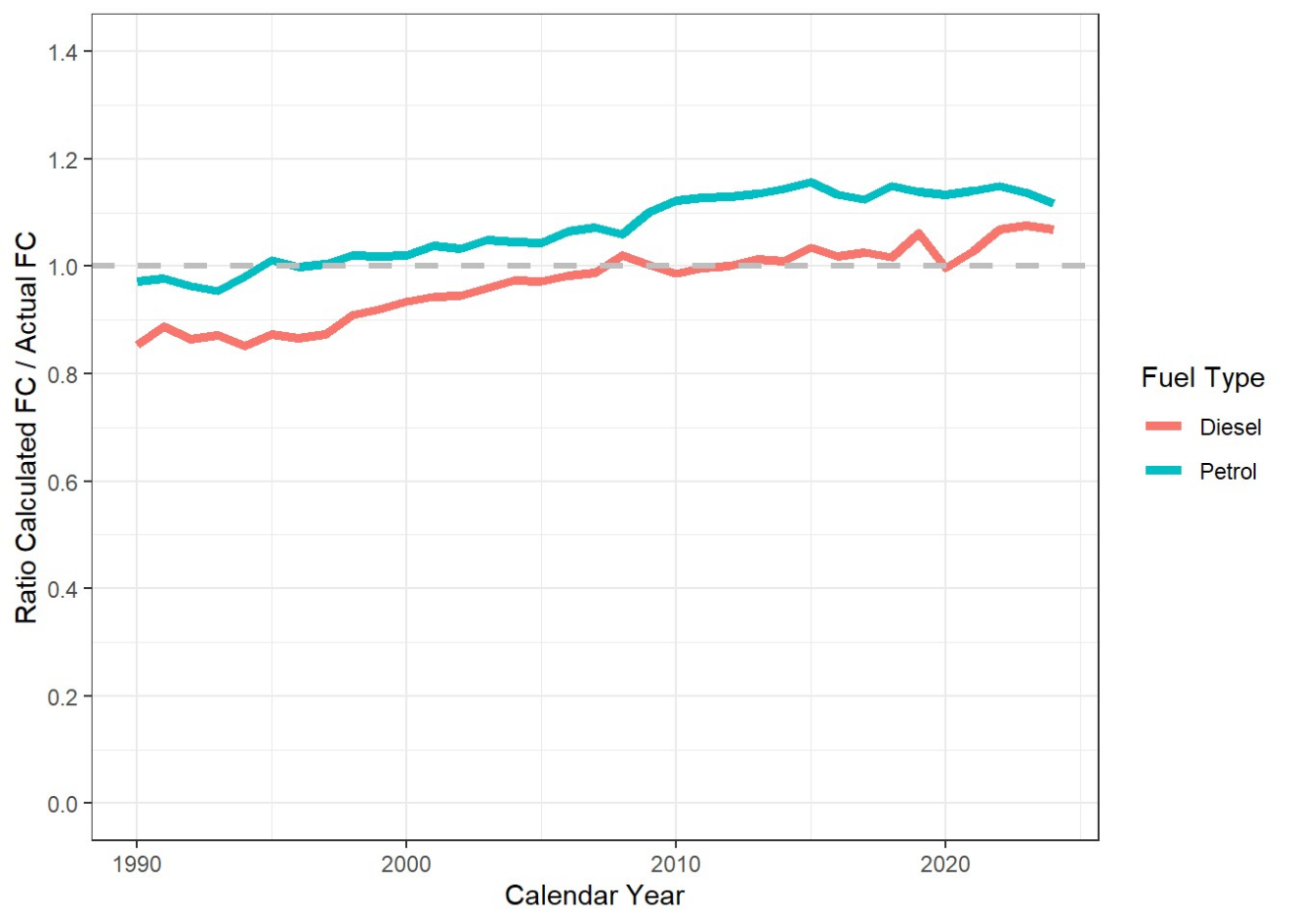
Figure 1 shows the ratio of calculated fuel consumption to the figures in DUKES based on total fuel sales of petrol and diesel in the UK on a like-for-like basis after correcting for Crown Dependencies, off-road mobile machinery and inland waterways consumption, and biofuels. The largest deviation from the DUKES figures is for petrol, with a maximum deviation of 16% in 2015. The closer the ratio is to 1, the closer the agreement with fuel sales data.
Figure 1: Ratio of calculated consumption of petrol and diesel fuel based on traffic movement and fuel consumption factors summed for different vehicle types, relative to the DUKES figures for these fuels based on fuel sales in the UK
The differences will be due to model uncertainties including uncertainties in the VKM data and fleet information used and especially in the fuel consumption factors based on samples of vehicles taken to represent the fleet. It is also important to bear in mind the very transient nature of emissions and fuel consumption and that the modelling approach masks the variability in fuel performance of even the same vehicle as it is driven under different conditions, with idling, acceleration, deceleration and cruising modes over a cycle all having very different fuel consumption rates.
Given the inherent uncertainties in the method used in calculating fuel consumption for the national fleet, the agreement between the pre-normalised calculated estimates and figures in DUKES is considered reasonable.
Mapping fuel consumption
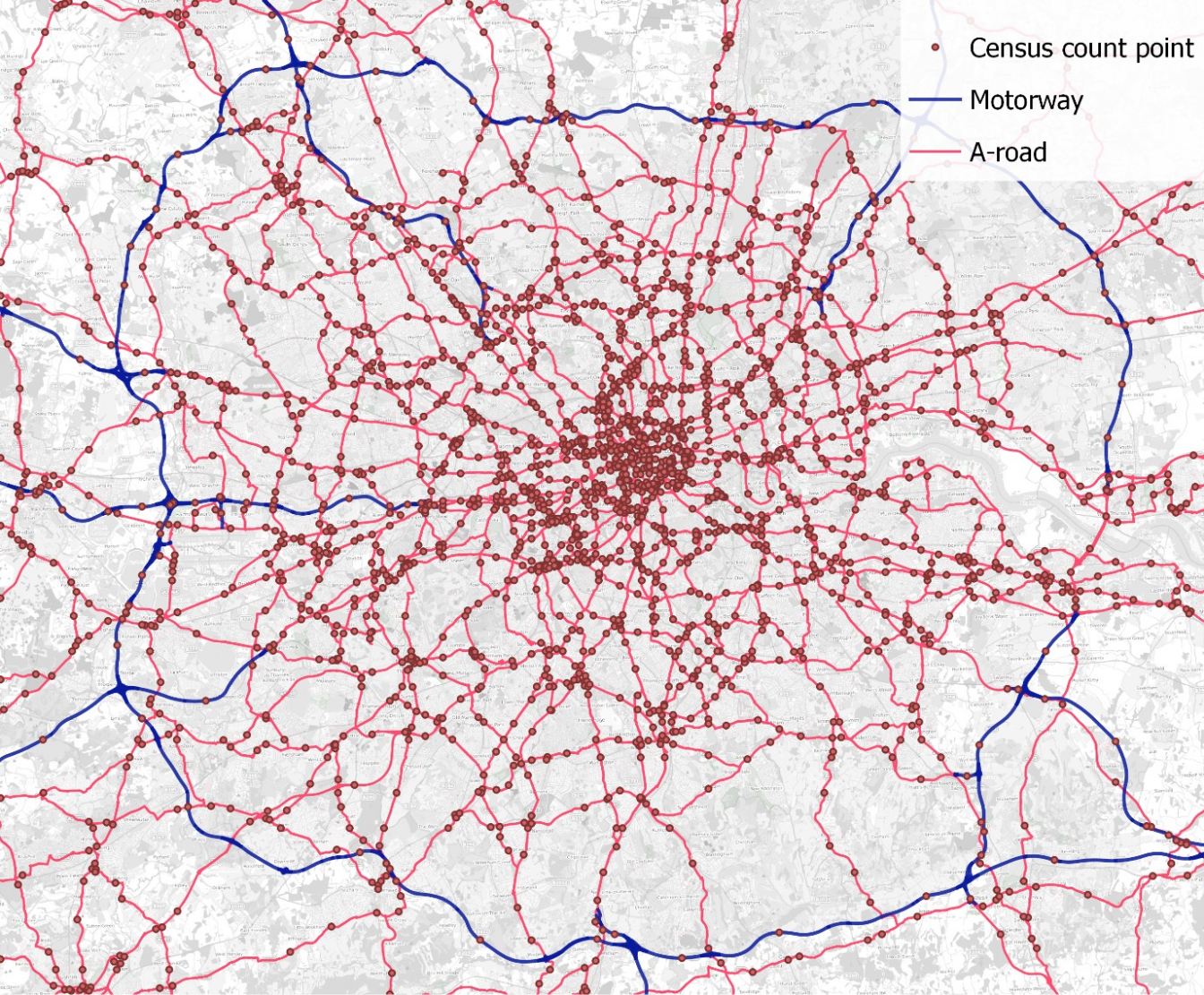
The base map of the UK road network used for calculating fuel consumption from road traffic has been developed from two mapping datasets. The Ordnance Survey Open Roads (OSOR) dataset (see Figure 2) provides locations of all roads (motorways, A-roads, B-roads and unclassified roads) in Great Britain. For Northern Ireland a dataset of roads was obtained from Ordnance Survey of Northern Ireland, part of Land and Property Services Northern Ireland.
Figure 2: Illustration of OSOR road network and DfT count point data for the Greater London area.
© Crown copyright. All rights reserved DESNZ. Licence number 100037028 [2025].
© OpenStreetMap contributors.
Traffic flow data for major roads (A-roads and motorways) are available on a census count point basis for both Great Britain (DfT) and Northern Ireland (Department for Infrastructure (DfI), Northern Ireland). The data comprise counts of each type of vehicle as an Annual Average Daily Flow (AADF), aggregated up to annual flows by multiplying by 365. These AADF statistics take account of seasonal variation using ‘expansion factors’ applied to single day counts based on data from automatic counts for similar roads and vehicle types. Differences between Great Britain and Northern Ireland datasets should be noted. Coverage of roads in Great Britain is considerably denser than that for Northern Ireland. Additionally, in Northern Ireland, some count points record total vehicles, rather than including any detail about different vehicle types. An average split of different vehicle types has been assumed in these cases.
For Northern Ireland, traffic counts were allocated according to the proximity of the point where the count was made and major roads with the same road number – i.e., each link has the nearest count point with the same road number assigned to it using a computer script.
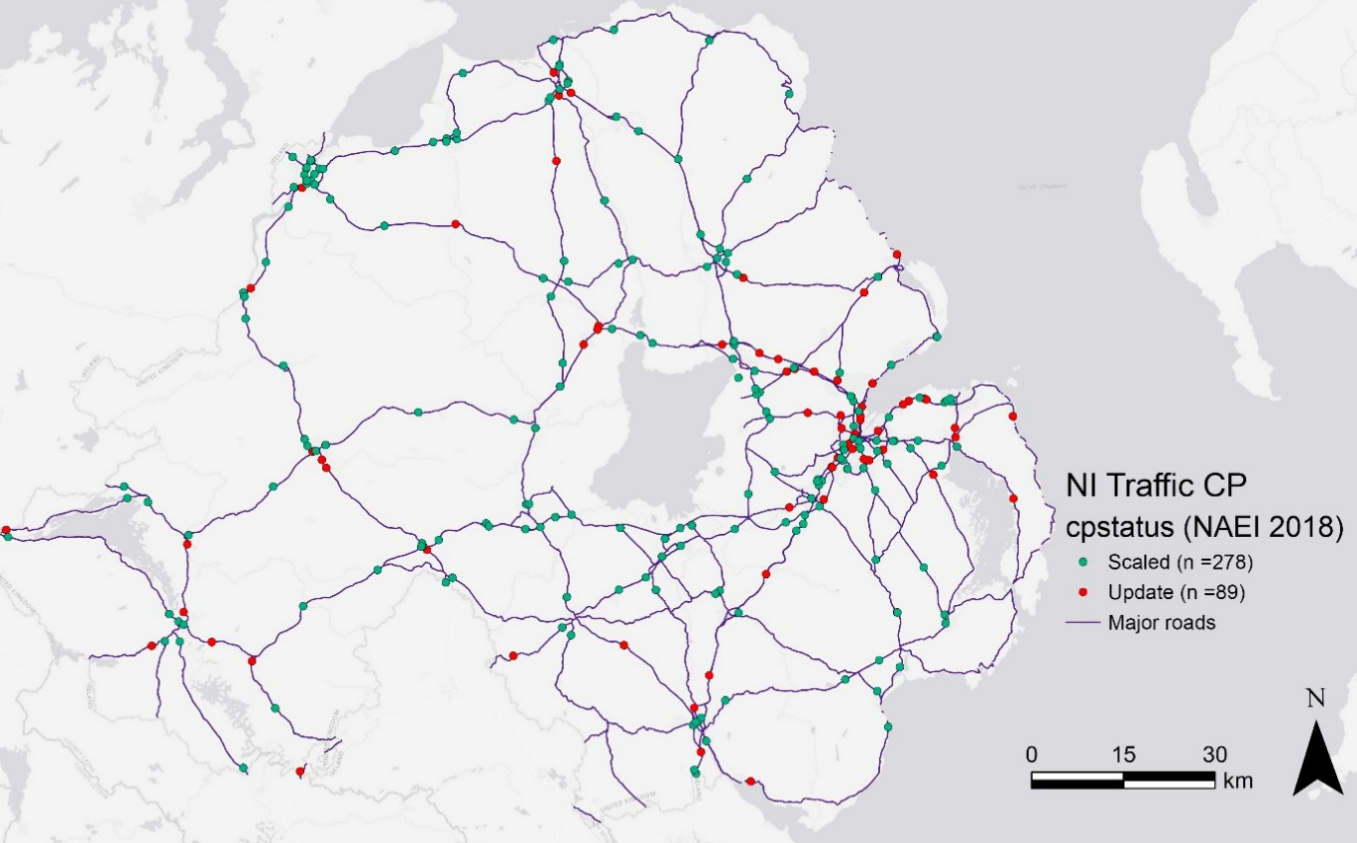
Since the 2018 dataset, the DfI have provided a lower number of traffic count points than they had previously. From a total of 367 count points in 2017, only 55 are updated with recent data, as shown in Figure 3 below. This led to adopting a scaling factor using historic traffic counts for Northern Ireland. This enabled the scaling of 312 traffic points to fill in the gaps. A similar approach has been utilised throughout the time series to fill data gaps and thus created a more detailed model of traffic flow. This method continues for the year 2024.
Figure 3: Map of Northern Ireland’s major roads and traffic count points
© Crown copyright. All rights reserved DESNZ. Licence number 100037028 [2025].
Alongside the decrease in count points, in the 2018 to 2024 datasets the vehicular classification is different; LGVs and cars have been merged into a single class. Therefore, in order to have a consistent vehicular classification across the timeseries and across the UK, the historic traffic pattern data by road type and urban status, is utilised to generate a LGV to Car ratio.
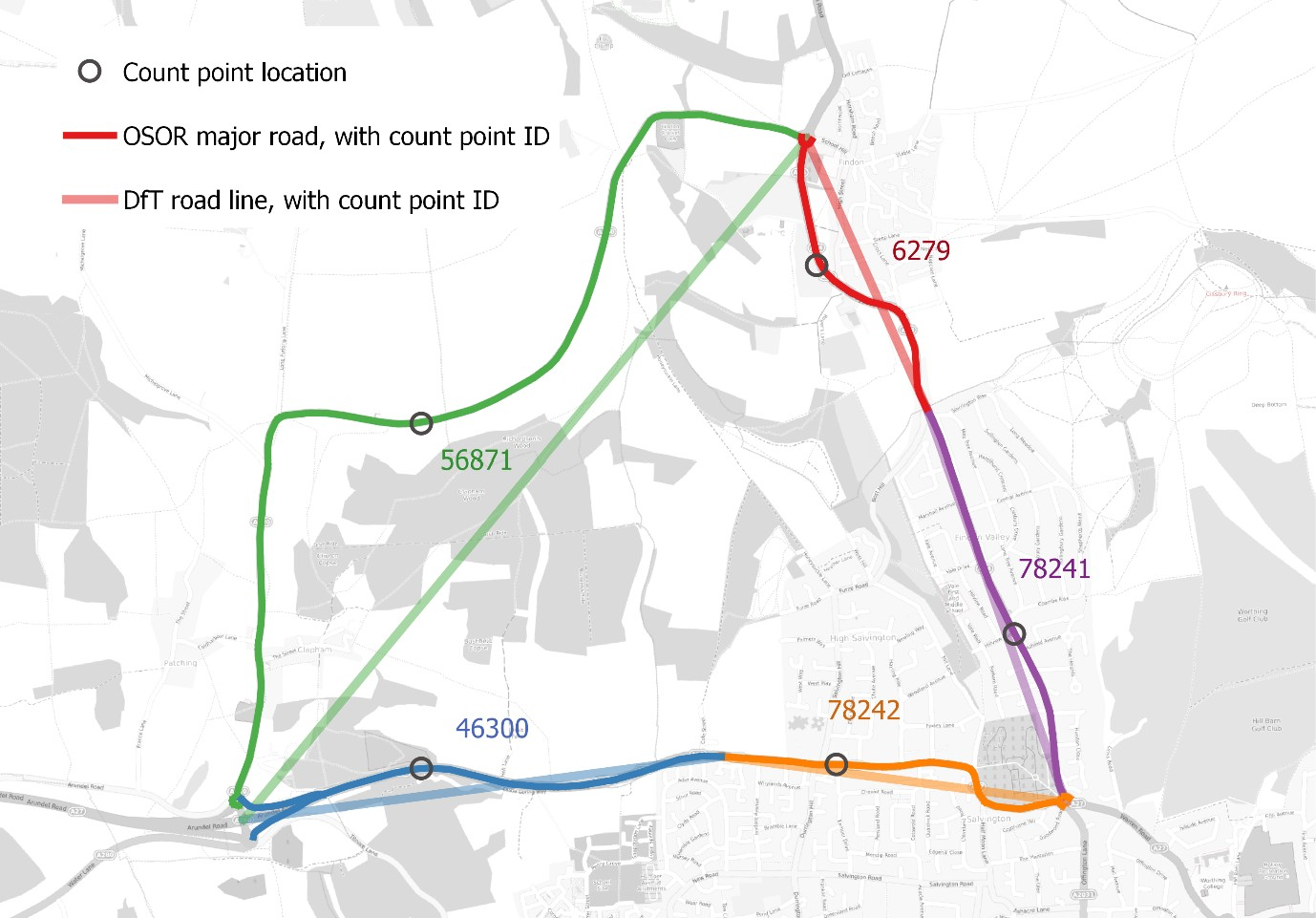
For Great Britain, the OSOR network is more complex than the Northern Ireland road network, and count point allocation required a different approach. Here, count points were allocated to a section of the major road network according to shared road number and spatial proximity to the stretch of road that each count point covers (see Figure 4). This was done by using a highly simplified, straight line, Department for Transport (DfT) representation of the start and end of each count points’ coverage (‘count point lines’). A series of computer-based processes were used to automatically perform this allocation. Where count point lines overlapped Local Authority boundaries, OSOR roads were split at that boundary and each split assigned to the relevant local authority. Automated allocation was followed up with manual checking and verification.
Figure 4: Traffic flows are assigned to the road network (Ordnance Survey Open Roads) by selecting OSOR sections that fall between the start and end points of traffic census count point coverage (DfT road line).
© Crown copyright. All rights reserved DESNZ. Licence number 100037028 [2024].
© OpenStreetMap contributors.
Traffic flows in the majority of minor roads have been modelled based on average regional flows and fleet mix (data from DfT) in a similar way to previous years. Regional average flows by vehicle type have been applied to each type of minor road – B and C roads or unclassified roads. These data were obtained from DfT.
For Northern Ireland vehicle-specific minor road flows have been calculated from 2014 data which provides information on VKMs travelled for vehicle types and by road types.
County level VKM estimates have been obtained from DfT (unpublished) and used to ensure consistency between the NAEI and DfT modelling, to correct at county level the estimates of VKMs in the NAEI mapping.
The next step after mapping vehicle movements is to apply the fuel consumption factors discussed earlier. The urban or rural classification of a section of OSOR road covered by a count point (here called a ‘count point road’) was determined through the following logic:
1. Count point roads that have at least two-thirds of their DfT defined length within an urban area: classify as urban.
2. Count point roads that have at least two-thirds of their DfT defined length outside an urban area: classify as rural.
Count point roads not captured by cases 1 or 2 were split at the urban boundary to create two new count points, one urban for the section within the boundary and one rural for the section outside of the boundary. Count point roads intersecting urban areas more than twice were classed based on the majority urban or rural length of the whole road section. Splits of less than 100m were given the urban or rural classification of their counterpart, and splits of less than 15% of the total count point road length were manually inspected for validity.
The vehicle kilometres travelled by electric vehicles are calculated and removed from the vehicle count.
For cars and buses, the proportion of electric vehicles varies each year by road type and land use; A-roads, motorways and minor roads all have a separate EV proportion, with A-roads and minor roads further split into urban and rural. For other vehicle types, the same proportion of EVs is applied to all road types, with the fraction only changing by year. In London, all vehicle types are split out by area type (Central, Inner, Outer).
The proportion of vehicle kilometres travelled by electric vehicles in 2024 is shown in table 1 below. These proportions are given as the percentage of VKM travelled by electric vehicles for each vehicle type on major and minor roads. For example, of all the VKM travelled by buses on major roads, 8.92% was done by electric vehicles and the other 91.08% by vehicles with conventional combustion engines (including hybrids).
Table 1: VKM travelled by electric vehicles on major and minor roads in 2024, as a proportion of VKM travelled by all motor vehicles.
| Vehicle Type | VKM on major roads | VKM on minor roads |
|---|---|---|
| Buses | 8.92% | 5.35% |
| Cars | 7.77% | 7.92% |
| HGVs | 0.22% | 0.19% |
| LGVs | 2.94% | 2.94% |
| London Taxis | 37.85% | 39.63% |
| Motorcycles | 0.00% | 0.00% |
Note: London Taxis includes Black cabs only – private hire vehicles (for example, Uber) are not counted here. London taxis are not included in the ‘Cars’ totals.
Similarly, the VKM of hybrid cars are split out from the VKM of passenger vehicle count based road type (urban, rural, motorway) and London area type. Hybrid specific fuel consumption factors are then applied separately for full hybrid and plug-in hybrid vehicles.
Changes made to the 2005-2023 estimates
The entire time series is revised each year to take account of methodological improvements and data updates. The main revisions this year include:
- Using actual automatic number plate recognition (ANPR) data for 2023, which was not available for last year’s publication. This has led to an upward revision for fuel consumption from petrol cars and a reduction for diesel cars that year.
- Higher natural gas consumption in 2023 due to updated DUKES data.
- A decrease in petrol LGV consumption, and a proportionate increase in diesel LGV consumption since 2015, due to using a new source of data for the petrol/diesel activity proportions, which is the DfT Road Carbon and Fuel Fleet model (RoCaFF) model.
These changes have had little impact on the total fuel used, as can be seen from table 2, below.
Table 2: The recalculation of fuel between this year’s and last year’s publication (fuel used in ktoe).
| Year | Latest Release | Previous Release | Recalculation |
|---|---|---|---|
| 2005 | 41,894 | 41,991 | -0.23% |
| 2006 | 42,579 | 42,681 | -0.24% |
| 2007 | 43,140 | 43,246 | -0.24% |
| 2008 | 42,600 | 42,702 | -0.24% |
| 2009 | 41,705 | 41,804 | -0.24% |
| 2010 | 41,286 | 41,403 | -0.28% |
| 2011 | 40,752 | 40,860 | -0.26% |
| 2012 | 40,676 | 40,780 | -0.25% |
| 2013 | 40,632 | 40,735 | -0.25% |
| 2014 | 41,395 | 41,497 | -0.25% |
| 2015 | 42,058 | 42,173 | -0.27% |
| 2016 | 42,707 | 42,822 | -0.27% |
| 2017 | 42,995 | 43,103 | -0.25% |
| 2018 | 42,926 | 43,039 | -0.26% |
| 2019 | 43,037 | 43,151 | -0.26% |
| 2020 | 34,529 | 34,622 | -0.27% |
| 2021 | 38,171 | 38,268 | -0.25% |
| 2022 | 40,108 | 40,232 | -0.31% |
| 2023 | 39,877 | 39,625 | 0.64% |
Uncertainties
An assessment is done for the Greenhouse Gas Inventory on the uncertainties in the estimate of total UK fuel consumption by this method. The uncertainty will largely reflect the uncertainties in the VKM, fleet composition data and fuel consumption factors used for each vehicle type. The uncertainties at national level will be relatively small (<10%) given the data sources that are used. Most of the uncertainty will be due to the fuel consumption factors and how applicable these are to vehicles in the UK fleet as they are based on measurements from various sources in Europe on relatively small samples of vehicles. However, the fairly close agreement between the calculated consumption of petrol and diesel at national level and figures in DUKES on fuel sales (Figure 1) suggests the overall estimates can be considered reasonable.
The uncertainties in estimates at local and regional level, though, are expected to be considerably higher. This will be partly due to local variations in the national fleet in terms of the vehicle age and fuel mix. For example, the traffic in some areas may be made up of a higher proportion of diesel cars or older cars than in other areas. There will be local variations in the average speed, levels on congestion or style of driving. The model currently assumes the same average speed for vehicles on the same type of road across the country. Variations in the maintenance of vehicles, poor tyre inflation and use of auxiliary units like air conditioning may also occur. The approach in COPERT 5 to calculating fuel consumption by passenger cars takes into account a ‘real world’ uplift to the factors as measured under laboratory test conditions, but still cannot account for local variability in these other factors that can affect fuel consumption.
Variations in local traffic behaviour are expected to be significant sources of uncertainty in local estimates of fuel consumption. The rate of fuel consumption is highly variable in situations where there are large amounts of stop-start, acceleration-deceleration behaviour, so in areas where there is frequent traffic congestion the uncertainty in estimates of fuel consumption will be considerably higher than in areas where traffic is usually flowing more freely. In general, one should expect higher levels of uncertainty in estimates of fuel consumption in urban areas than in non-urban areas. Road gradients also have a significant impact on fuel efficiency of vehicles, so estimates of fuel consumption in areas where the landscape is hilly will be more uncertain than in areas where the landscape is predominantly flat.
There will also be higher uncertainties in estimates of fuel consumption for large heavy-duty vehicles (HGVs and buses) than smaller light duty vehicles (cars and vans). This is for several reasons. First, there have been far fewer tests done on fuel consumption and emissions from heavy-duty vehicles (HDVs) and how these vary with driving behaviour. There is also a wide variation in fuel efficiency of HDVs because of the wide range of size, vehicle weight and configuration in this group of vehicles (for example HGVs vary in weight from 3.5 tonnes up to 50 tonnes, but this information is not given in the local traffic count data used). The uncertainty is compounded by variation in load carried by HGVs. For example, some vehicles of a given size will be carrying no load, while others will be fully laden. Fuel consumption by HDVs is also especially sensitive to road gradient.
The failure to reflect certain local measures to reduce transport CO2 emissions would introduce uncertainty in the estimates in some areas. These might, for example, be in areas where low carbon buses or other types of low carbon emitting vehicles have been introduced.
As a rule of thumb, areas where estimates of fuel consumption by road transport are most uncertain are likely to be those where there is frequently congested urban traffic and those with high levels of heavy-duty vehicle activity. Areas which are major conurbations are likely to show high levels of uncertainty because of the likelihood of more frequent congested traffic conditions. Areas where motorways make a significant contribution to the overall fuel consumption may on the one hand have less uncertainty because traffic is normally free flowing, but on the other hand may have this partly offset by the large proportion of HDVs that are usually characteristic of these road types. Flat, rural areas dominated by smaller towns are likely to have among the lowest levels of uncertainty in their fuel consumption estimates.
The variation in the composition of the vehicle fleet on local roads in terms of fuel type can only really be assessed by conducting surveys or examining any ANPR data that may be available in each area. Since the 2010 inventory, ANPR data have been used to define the petrol and diesel car mix. The ANPR data confirmed that there is a preferential use of diesel cars on motorways, and that preferential usage of diesel cars also extended to urban roads as well, although not to the extent as seen on motorways.
For Northern Ireland, the ANPR data show that there was no major difference in the proportion of diesel cars observed on different road types and that the proportion was similar to that implied by the licensing data. As a result, it is assumed that there is no preferential use of diesel cars, and the petrol/diesel mix in car kilometres should follow the proportion as indicated by the licensing statistics provided by the DfI.
An appreciation of the potential variation in the car fleet by region could be gained by examining vehicle licensing statistics by postcode, but some care has to be taken in interpreting this information as vehicles are not constrained to be on roads where the vehicle is registered. Company car registrations pose a particular problem. Nevertheless, the variation in fleet composition around the national average implied by local licensing data could be used in a quantitative uncertainty analysis.
Accredited Official Statistics designation
Accredited Official Statistics are called National Statistics in the Statistics and Registration Service Act 2007.
These Accredited Official Statistics were independently reviewed by the Office for Statistics Regulation (OSR) in June 2014 and had their accreditation reviewed in September 2018. They comply with the standards of trustworthiness, quality and value in the Code of Practice for Statistics and should be labelled ‘Accredited Official Statistics’. Our statistical practice is regulated by the OSR.
OSR sets the standards of trustworthiness, quality and value in the Code of Practice for Statistics that all producers of official statistics should adhere to.
DESNZ has published a number of Official Statistics standards and policies that it follows.
You are welcome to contact us by emailing EnergyEfficiency.Stats@energysecurity.gov.uk with any comments about how we meet these standards.
Alternatively, you can contact OSR by emailing regulation@statistics.gov.uk or via the OSR website.