Mapping greenhouse gas emissions and removals for the land use, land use change and forestry sector (LULUCF) (web accessible)
Updated 30 June 2026

© Crown copyright 2026
This publication is licensed under the terms of the Open Government Licence v3.0 except where otherwise stated. To view this licence, visit nationalarchives.gov.uk/doc/open-government-licence/version/3 or write to the Information Policy Team, The National Archives, Kew, London TW9 4DU, or email: psi@nationalarchives.gov.uk.
Where we have identified any third party copyright information you will need to obtain permission from the copyright holders concerned.
This publication is available at https://www.gov.uk/government/statistics/uk-local-authority-and-regional-greenhouse-gas-emissions-statistics-2005-to-2024/mapping-greenhouse-gas-emissions-and-removals-for-the-land-use-land-use-change-and-forestry-sector-lulucf-web-accessible
Land Use, Land-Use Change and Forestry in the National Inventory
The Department for Energy Security and Net Zero (DESNZ) takes the lead in the UK in preparing the annual Inventory of Greenhouse Gas Emissions for the United Nations Framework Convention on Climate Change (UNFCCC). DESNZ contract Ricardo to compile the overall greenhouse gas emissions inventory and they in turn subcontract the UK Centre for Ecology and Hydrology (UKCEH) and Forest Research (FR) to prepare the data relating to Land Use, Land-Use Change and Forestry (LULUCF) in the UK.
This report is prepared in order to describe the methods used to spatially disaggregate the emissions and removals in the LULUCF sector to enable the compilation of LULUCF estimates for Local Authorities (LAs) and Protected Landscapes (National Parks (NPs), National Landscapes (NLs) and Areas of Outstanding National Beauty (AONBs)) as part of DESNZ’s assistance to LAs and Protected Landscapes in tracking progress on decarbonisation.
The LULUCF data reported in the annual inventory is prepared in accordance with the reporting requirements of the UNFCCC. These estimates are made using dynamic models of changes in stored carbon, driven by land use change (LUC) data. For forestry, the CARBINE model (developed and run by FR) deals with plant carbon, dead organic matter, soil carbon and harvested wood products and is driven by the area of land newly afforested each year, management practices and harvesting. Changes in soil carbon are driven by estimated time series of land use transitions between grassland, cropland, forest land and settlement land uses. These models, and those for other LULUCF activities (e.g. nitrogen fertilisation of forest soils, drainage and rewetting of organic soils), are run for each of the four countries of the UK to report emissions and removals of greenhouse gases (CO2, CH4 and N2O). Until the 1990-2004 inventory (submitted in 2006) no data were reported in map format at a scale below the Devolved Governments (DGs) (England, Scotland, Wales and Northern Ireland); here we report results from methods to provide estimates of LULUCF emissions and removals at LA scale for the 2024 inventory year (published in 2026). Results at Protected Landscape scale are not reported here, but are available as stand alone datasets.
The LULUCF Sector differs from other sectors in the Greenhouse Gas Inventory in that it contains both sources and sinks of greenhouse gases. The sources, or emissions to the atmosphere, are given as positive values; the sinks, or removals from the atmosphere, are given as negative values. The values reported here are given as net emissions/removals, that is the sum of emissions and removals for each category.
Land Use Categories
The IPCC Guidelines for National Greenhouse Gas Inventories (IPCC 2006, IPCC 2014, IPCC 2019) describe a uniform structure for reporting emissions and removals of greenhouse gases. This format for reporting can be seen as “land based”; all land in the country must be identified as having remained in one of six classes since a previous survey, or as having changed to a different (identified) class in that period. The 6 land classes are:
- A: Forest Land
- B: Cropland
- C: Grassland
- D: Wetlands
- E: Settlements
- F: Other land.
There is a seventh category for the pool of harvested wood products, category G.
The IPCC (2006) guidelines for LULUCF accommodate differences in national land-use classification systems. Emissions from the drainage and rewetting of peatlands, are reported under most LULUCF land use categories. For the purposes of this report peatlands and organic soils may be considered synonymous. These are compiled following guidance for estimating emissions from inland organic soils set out in chapters 2 and 3 of the 2013 IPCC Wetlands Supplement, and employing the Tier 2 methodological approach for implementation described in the BEIS (now DESNZ) funded wetlands report (Evans et al. 2017), with additional updates summarised in section A.5.1.4 of the National Inventory Document Annexes (Brown et al. 2026). Emissions from drained and rewetted organic soils have been allocated to their local authorities in the UK using the peat condition mapping outputs from Evans et al. (2017) alongside spatial location of rewetting and peat extraction activities. The majority of peatland area is reported in the Grassland category, which includes semi-natural bog categories, extensive and intensive grassland, and rewetted bog or fen from semi-natural bog and intensive and extensive grassland. Emissions from active peat extraction (onsite, and off-site for horticultural peat), as well as organic soils affected by historical peat extraction are reported under Wetlands. Naturally occurring emissions and removals from pristine areas of bog and fen, and rewetted bog or fen from Forest Land, Cropland, peat extraction, and pre-1990 rewetted fen are included in LULUCF reporting under Wetlands. Emissions of CO2, CH4, and N2O from drained organic soils under Forest, Cropland and Settlement are reported in those respective categories. Emissions from the combustion of peat used as fuel are reported in the energy sector of the country of consumption.
The Other Land category is predominantly made up of bare rock and scree and no emissions or removals are reported. In addition, it is assumed that there are very few, if any, transitions of land to a type that is classified as ‘Other’.
Figure 1: UK Sector 4 land-use transitions showing categories for carbon stock change.
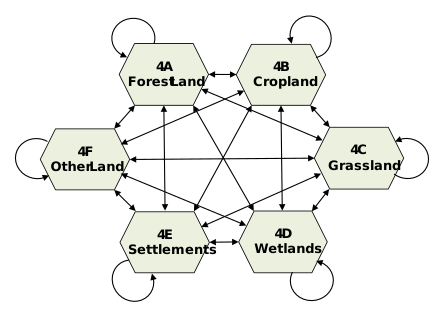
The UK land-use change matrix can be simplified to that shown in Figure 1, including Forest Land (A), Cropland (B), Grassland (C), Wetlands (D), and Settlements (E). For each land use and land-use transition, the change in stocks of carbon in living biomass (above and below ground), dead biomass and soil organic matter should be reported. In Figure 1 each arrow represents the possible change for an area of land between two time points.
Different activities are associated with each land use or land-use change. For example, ‘afforestation’ refers to all land-use change to Forest Land, ‘drainage’ activity can relate to Forest Land, Cropland, Grassland, Wetlands, and Settlement. ‘Peat extraction’ affects Wetlands. The change in carbon stocks of living biomass, dead biomass and soil organic matter must be reported for each activity together along with other relevant non-CO2 gases (i.e. CH4 and N2O).
Further subdivision of the classes by ecosystem, administrative region or time of occurrence of change is also encouraged in the IPCC Good Practice Guidance. For the UK, the data are currently subdivided into England, Scotland, Wales and Northern Ireland where possible. Subdivision into smaller units is appropriate for modelling purposes and the development of estimates at local authority scale as described in this report.
Territorial Emissions Sectors
The UK implemented the Territorial Emissions Sectors (TES) structure for domestic inventory reporting in 2024. Details of what is included in each TES category are given in Annex 2.
The activities reported within LULUCF TES categories (sorted by order of magnitude) are listed in Table 1. The data are presented as TES Subsector and Category UK total emissions/removals (Gg CO2e) for 2024 as reported in the 1990-2024 Inventory (excluding emissions from the UK’s Overseas Territories and Crown Dependencies). Full details of methodologies are given in the National Inventory Document (Brown et al. 2026).
Note that the IPCC 5th Assessment Report (AR5) Global Warming Potentials (GWPs) are used to convert N2O and CH4 to carbon dioxide equivalents (CO2e) in this report and dataset.
Table 1: The UK CO2e emissions and removals in Land Use, Land-Use change and Forestry for 2024 grouped by Territorial Emission Subsector and Category. Within each Subsector the Categories have been sorted by order of magnitude.
| TES Subsector | TES Category | Gases | 2024 Gg CO2e |
|---|---|---|---|
| Forestry | Forest land remaining forest land | Carbon, N2O | -18,103.19 |
| Land converted from forest land | Carbon, CH4, N2O | 2,042.37 | |
| Land converted to forest land | Carbon, N2O | 190.13 | |
| Peatland | Cropland drained | Carbon, CH4 | 4,273.30 |
| Intensive grassland drained | Carbon, CH4 | 3,398.25 | |
| Modified bog undrained | Carbon, CH4, N2O | 2,165.02 | |
| Domestic extraction | Carbon, CH4, N2O | 1,993.49 | |
| Modified bog drained | Carbon, CH4, N2O | 792.96 | |
| Extensive grassland drained | Carbon, CH4, N2O | 644.07 | |
| Eroding modified bog undrained | Carbon, CH4, N2O | 634.89 | |
| Near-natural bog | Carbon, CH4, N2O | 203.61 | |
| Industrial extraction | Carbon, CH4, N2O | 188.94 | |
| Eroding modified bog drained | Carbon, CH4, N2O | 132.39 | |
| Rewetted bog | Carbon, CH4, N2O | 119.09 | |
| Rewetted fen | Carbon, CH4, N2O | 83.89 | |
| Settlement drained | Carbon, CH4, N2O | 32.09 | |
| Rewetted modified bog | Carbon, CH4, N2O | 30.73 | |
| Forest drained | Carbon, CH4, N2O | 5.02 | |
| Near-natural fen | Carbon, CH4, N2O | -1.18 | |
| Cropland mineral soils change | Grassland converted to cropland | Carbon, N2O | 5,119.46 |
| Cropland remaining cropland | Carbon | 4,189.73 | |
| Settlement converted to cropland | Carbon | -59.17 | |
| Grassland mineral soils change | Grassland remaining grassland | Carbon, N2O | -4,966.75 |
| Cropland converted to grassland | Carbon | -3,624.01 | |
| Settlement converted to grassland | Carbon | -376.93 | |
| Settlement | Land converted to settlement | Carbon, N2O | 1,595.08 |
| Settlement remaining settlement | Carbon, N2O | 1,590.37 | |
| Bioenergy crops | Miscanthus | Carbon | 18.60 |
| Short rotation coppice | Carbon | -16.77 | |
| Other LULUCF | Grassland miscellaneous | Carbon, CH4, N2O | 438.65 |
| Cropland miscellaneous | Carbon, CH4, N2O | -306.21 | |
| Forest miscellaneous | Carbon, CH4, N2O | 73.55 | |
| Wetland miscellaneous | Carbon | 0.00 |
Note: Forestry, Harvested Wood Products is not included in the LA or Protected Landscape estimates because of insufficient data for distributing the emissions and removals.
Changes in net emissions/removals from the LULUCF Sector over time are dominated by the decrease in CO2 net emissions. While CH4 emissions are fairly stable over time, they dominate LULUCF overall net emissions by gas in CO2 equivalents over the time series (Brown et al. 2026). This is due to CH4 emissions from drained and rewetted organic soils. Emissions of greenhouse gases are produced by undrained modified, rewetted and near natural peatlands (note that CH4 emissions from near-natural bogs are cancelled out by CO2 uptake in CO2-equivalent terms), drainage ditches on peatlands, biomass burning during wildfires or the conversion of Forestry to other land uses. Direct and indirect emissions of N2O are also produced from nitrogen fertilisation of new forests and soil mineralisation following land-use change. Emissions of non-CO2 gases from agricultural land (e.g. due to fertilisation) are reported in the Agriculture sector of the Greenhouse Gas Inventory. Estimates in the 2024 LULUCF sector of the inventory for the different GHGs are -6,761.78 Gg CO2 for carbon dioxide, 5,745.64 Gg CO2e for methane (or 205.20 Gg CH4), and 1,300.99 Gg CO2e for nitrous oxide (or 4.91 Gg N2O) across the UK in 2024.
Coverage
The LULUCF emissions/removals are disaggregated to three boundary types: LAs, NPs and NL/AONBs. Unlike LAs, the NPs, NLs and AONBs do not have contiguous spatial coverage across the UK, and any emissions/removals that fall outside these boundaries are assigned to ‘Not a NP’ or ‘Not an AONB’ and not included in the final datasets.
The methods used for disaggregating each activity from DG to LA scale are described below. The level of spatial detail available differs between activities. For all activities there is currently no spatial activity data available for the Isle of Scilly, hence all LULUCF emissions and removals are estimated as zero for this LA.
Disaggregation methodologies
The methodology for disaggregating the DG LULUCF data to LA and Protected Landscape scale spans two main workflows which are described below.
Land Use Change tracking maps
Data preparation
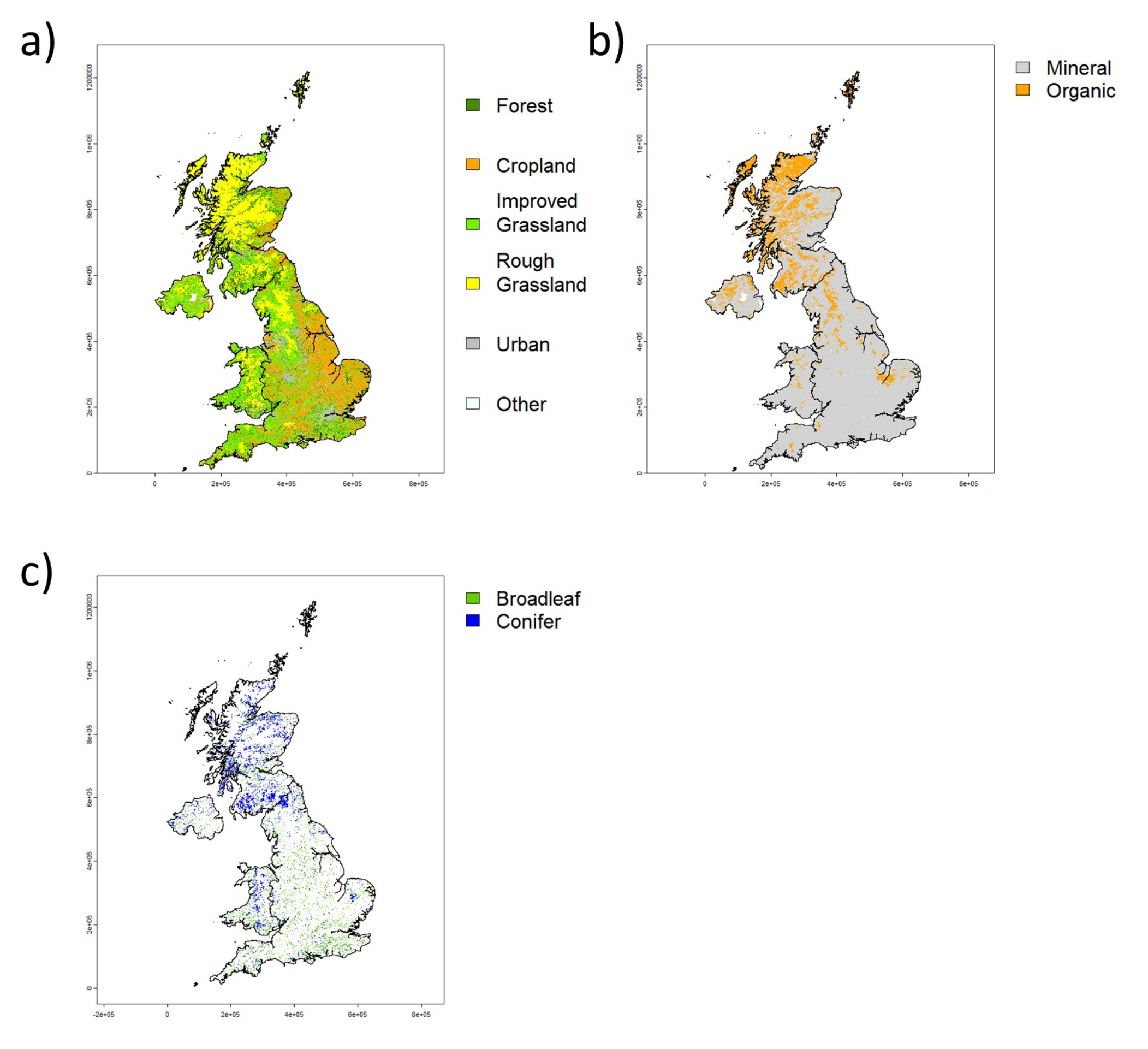
This methodology uses land use change (LUC) variables calculated from the Land Use Change Tracking project (LUC-T) spatial maps (Levy et al. 2020, 2021; Rowland et al. 2021). Outputs from this project include land use classification maps at 100m x 100m spatial resolution and an annual temporal resolution. Land is classified as Forest, Cropland, Grassland (Improved Pasture), Rough Grassland, Urban and Other land. This data is produced using a Bayesian data assimilation approach, with full details provided in the project reports (Levy et al. 2020, 2021; Rowland et al. 2021). An example of the gridded data is shown in Figure 2a.
This data is then supplemented with soil and forest type data.
A raster soil type map (showing locations of mineral and organic soils) at 100m grid scale is produced from the organic soil basemaps in England, Scotland, Wales and Northern Ireland (see Figure 2). The gridded data is shown in Figure 2b.
Maps of forest type are produced for each year, assigning each 100m x 100m forest grid cell in the LUC-T land use maps as either broadleaf or conifer. Forest type data for 2005, 2010, 2015, 2018 and 2020 for GB, and 2020 for Northern Ireland (produced for the LUC-T project as described in Rowland et al. 2021), are re-categorised to broadleaf and conifer, with an ‘unspecified’ category assigned to useful remaining data, such as that classified as ‘woodland’ or ‘unknown’. This unspecified data is then reassigned to broadleaf or conifer based on the nearest neighbour. Subsequently, for each LUC-T land use map from 1985-current inventory year, the forest type data from the closest year available is used, and forest grid cells are categorised as broadleaf or conifer based the value from the forest type map intersecting the grid cell location. As the LUC-T land use maps are produced from a probabilistic model, plus forest type data does not have 100% coverage, not all forest grid cells will align with forest inventory data. In this case, if the grid cell location from the land use map does not intersect forest on the forest type map, the closest broadleaf/conifer value to the grid cell is used. Figure 2c shows an example of the gridded data output.
Figure 2: Raster files used as inputs for calculating spatial variables. (a) Land use categories from LUC-T in 2020; (b) Soil types; (c) Forest types in 2020.
Calculating spatial LUC variables
The spatial LUC variables are calculated based on the three sets of maps: land use, soil type and forest type. The spatial variables to be calculated fall into five categories:
- Current land use: grid cells where the land use in the year being considered (2005-current inventory year) and the soil type matches the condition. For example, Current Cropland on mineral soil.
- Land use changes in the last year: grid cells where the current land use and the land use in the previous year (for 2005-current inventory year, so requires data 2004-current inventory year), as well as the soil type match the conditions. For example, settlement to Cropland in the last year on all soils.
- Land use changes in the last three years: grid cells where the current land use and the most recent land use change in the previous three years, as well as the soil type, match the conditions (requires data 2002-current inventory year). For example, Grassland to Forest Organic in the previous 3 years.
- Land use changes in the last 20 years: grid cells where the current land use and the most recent land use change in the previous 20 years, as well as the soil type, match the conditions. In some cases the land use prior to the change is specified and in others it can be any land use. (requires data 1985-current inventory year). For example, Cropland to Forest Mineral < 20 years.
- Land remaining the same land use for at least the last 20 years: grid cells where the current land use, soil type and forest type (for forest land use cells) match the condition and the grid cell has remained in the same land use for at least the last 20 years (requires data 1985-current inventory year). For example, Broadleaf Forest on Mineral >= 20 years.
A full list of the spatial variables required are in Annex 1, matched to the emissions/removals they are used to disaggregate. The columns “Group”, “From Land Use”, “To Land Use” and “Soil Type” specify how the variable is defined.
The spatial LUC variables are calculated for each year in the disaggregation time series (2005-current inventory year), by looking back over the 20 years prior to each year. Where a grid cell has undergone multiple land use changes within the previous 20-year period, only the most recent land use change is considered when categorising it into the variables.
This produces 100m x 100m spatially gridded data for each year covering the whole UK for each spatial variable.
Disaggregating emissions/removals
LULUCF Inventory totals are disaggregated to LAs and Protected Landscapes according to the spatial LUC variables. Each inventory emissions/removal total is disaggregated based on the number of grid cells from the relevant spatial LUC variable within the LA and Protected Landscape polygons. Inventory emissions are matched with spatial variables to be used for disaggregation as in Table A1. The number of grid cells from the relevant spatial LUC variable in each polygon is divided by the total number in the DG. The proportions are calculated for each year (2005-current inventory year). When calculating how many grid cells are in each polygon, grid cells are assigned to polygons based on whether the midpoint of the cell lies within the polygon. To apportion the emissions/removals DG totals for each year from the inventory are multiplied by the spatial LUC variable proportions for the year associated with each polygon. In cases where, for a given spatial LUC variable and year, a DG contains no grid cells for that spatial variable but there is a non-zero emission/removal total to disaggregate, the proportions from the most recent year with grid cells in the DG are used. In cases where the LUC-T data has not been produced for the current inventory year, proportions from the previous year are used for all spatial LUC variables (this is the case for 2021 to 2024 as currently the LUC-T methodology only runs to 2020).
Organic Soil Maps
This methodology utilises organic soil base maps of peatland condition, Google Earth data of active peat extraction and peatland rewetting data. Firstly, using point location data for organic soil rewetting sites, annual areas of peatland rewetting are added to the polygon organic soil base maps to create an annual time series of peatland condition category which includes accounting of rewetting activity. Secondly, annual peat extraction polygon areas derived from Google Earth imagery are used to calculate annual maps of active peat extraction and rewetted peat extraction. The peatland condition category and peat extraction time series can then be intersected with LA and Protected Landscape boundaries. See Table 2 below for details on input data.
Table 2: Details of data inputs used in organic soil rewetting and peat extraction calculations.
| Layer | Year | Description | Reference |
|---|---|---|---|
| England base map | 2013 | Organic soil vector polygon data covering England, including peatland condition category | Evans et al. (2017); Brown et al. 2026 |
| Scotland base map | 1990 | Organic soil vector polygon data covering Scotland, including peatland condition category | Evans et al. (2017); Brown et al. 2026 |
| Wales base map | 1990 | Organic soil vector polygon data covering Wales, including peatland condition category | Evans et al. (2017); Brown et al. 2026 |
| NI base map | 2007 | Organic soil vector polygon data covering Northern Ireland, including peatland condition category | Evans et al. (2017); Brown et al. 2026 |
| Rewetting sites | 2000 - 2012 | Rewetting site data covering E/S/W/NI. Includes XY location, total area and peatland condition category. Rewetting is known to occur between 2000-2012 but no specific year given | Evans et al. (2017); Brown et al. 2026 |
| Scotland rewetting sites post 2012 | 2013 - current year | Scotland year-specific rewetting data from 2013 onwards. Includes XY location and peatland condition category | Peatland Action, unpublished. |
| NI rewetting sites post 2019 | 2020 – current year | NI year-specific rewetting data from 2020 onwards. Includes XY location and peatland condition category | DAERA, unpublished. |
| England rewetting sites, post 2020 | 2021 – current year | England year-specific rewetting data from 2021 onwards. Includes XY location and peatland condition category | Natural England (NCPGS Restoration sites), unpublished |
| Peat Extraction annual shapefiles | 2002, 2005, 2010, 2014 - current year | Peat extraction extent shapefiles created from Google Earth imagery. Covering E/S/W/NI | Brown et al. 2026 |
| Local Authority boundaries E/S/W | 2023 | Local authority boundary vector polygon shapefile for E/S/W | ONS Open Geography Portal |
| Local Authority Boundaries NI | 2012 | Local authority boundary vector polygon shapefile for NI. NI is a separate shapefile due to different coordinate system | Open Data Northern Ireland |
| National Park Boundaries, E/S/W | 2023 / 2002, 2010 / 2017 | National Park boundary vector polygon for shapefile covering E/S/W. There are no NPs in NI. | Natural England |
| Scottish Government NRW | |||
| AONB/National Landscape boundaries, E/W/NI | 2020 / 2022 / 2016 | AONB/National Landscape boundary vector polygon for shapefile covering E//W/NI. There are no AONBs in Scotland. | Natural England NRW OpenDataNI |
Data preparation
Due to some non-spatial (for example, DG level) data used in the main LULUCF inventory, preparation of the organic base maps and rewetting site data is required before they can be used for spatial disaggregation.
Drainage and bare peat assumptions for mapped areas of ‘Eroded’ Bog are applied to LAs and Protected Landscapes by splitting ‘Eroded’ polygons proportionally between four peatland condition categories (Eroding Drained, Eroding Undrained, Modified Bog Drained, Modified Bog Undrained). For each DG the Eroded polygons from the organic base map are selected and split based on DG specific proportions. Each polygon is split individually into the four categories to ensure equal distribution across the DA.
Rewetting site data is given as point location data with peatland condition category and total area rewetted for each site. In the main LULUCF inventory, Modified Bog sites are rewetted from three different peatland condition categories (Modified Bog, Extensive Grassland and Eroding Modified Bog, based on DG specific proportions). To calculate spatially explicit rewetting from the correct peatland condition category all Modified Bog rewetting sites are split into three with areas calculated based on DG specific proportions.
Further, additional site information is required and calculated for each site prior to running rewetting calculations, including:
- Average rewetting (2000 – 2012): Rewetting is known to occur between 2000 – 2012 but as no specific year is given the 2000 – 2012 average is removed annually (note that for Scotland post-2012, England post-2020 and NI post-2019 year-specific rewetting is given and therefore averages are not required).
- Site minimum and maximum: rewetting site calculations are unlikely to find an area of the exact average rewetting area. The site minimum and maximum provide upper and lower thresholds in which to calculate area that still rounds to the correct area in hectares.
- Peatland condition match variable: peatland condition category names vary slightly between data inputs; this variable ensures rewetting site soil categories can be matched to the organic base maps.
Calculation methodology
The following methodology is used to create a time series of organic soil maps for each DA.
1. Using peat extraction spatial data create an annual time series of peat extraction areas (including rewetted peat extraction sites where peat extraction areas decrease). Peat extraction areas are not available for all years in the time series - the missing years are filled in linearly with the difference between available years. Land to peat extraction is calculated in LULUCF from three grassland categories based on DG specific proportions. The underlying peatland condition categories in the organic base maps are not necessarily consistent with this assumption. Therefore, the peat extraction time series is not combined into the organic soil maps. However, to ensure spatially consistent cumulative areas the merged peat extraction areas are intersected with the organic base layer to identify organic areas that should not be used in rewetting calculations.
2. For each site in the rewetting site dataset (point location datasets with variable fixed -point uncertainties) the aim is to reassign areas of relevant initial peatland condition to rewetted. Where no year specific data for rewetting exists the average annual rewetting area is used. Rewetting is assumed to be spatially correlated to the site (i.e. rewetting occurs in soils closest to the point identifying the site location). When every site in the year has been calculated, this map is used as the input for the next year of calculations.
3. The baseline year for England and NI are in the middle of the time series. To deal with this, areas are retrospectively added in to the time series from baseline year to 2000 using the same assumptions as the main rewetting calculations. Although the final disaggregation is only required from 2005, rewetting must be calculated back to 2000 to ensure consistent cumulative areas.
4. Intersect the peat extraction time series and organic rewetting time series with LA and Protected Landscape boundary data.
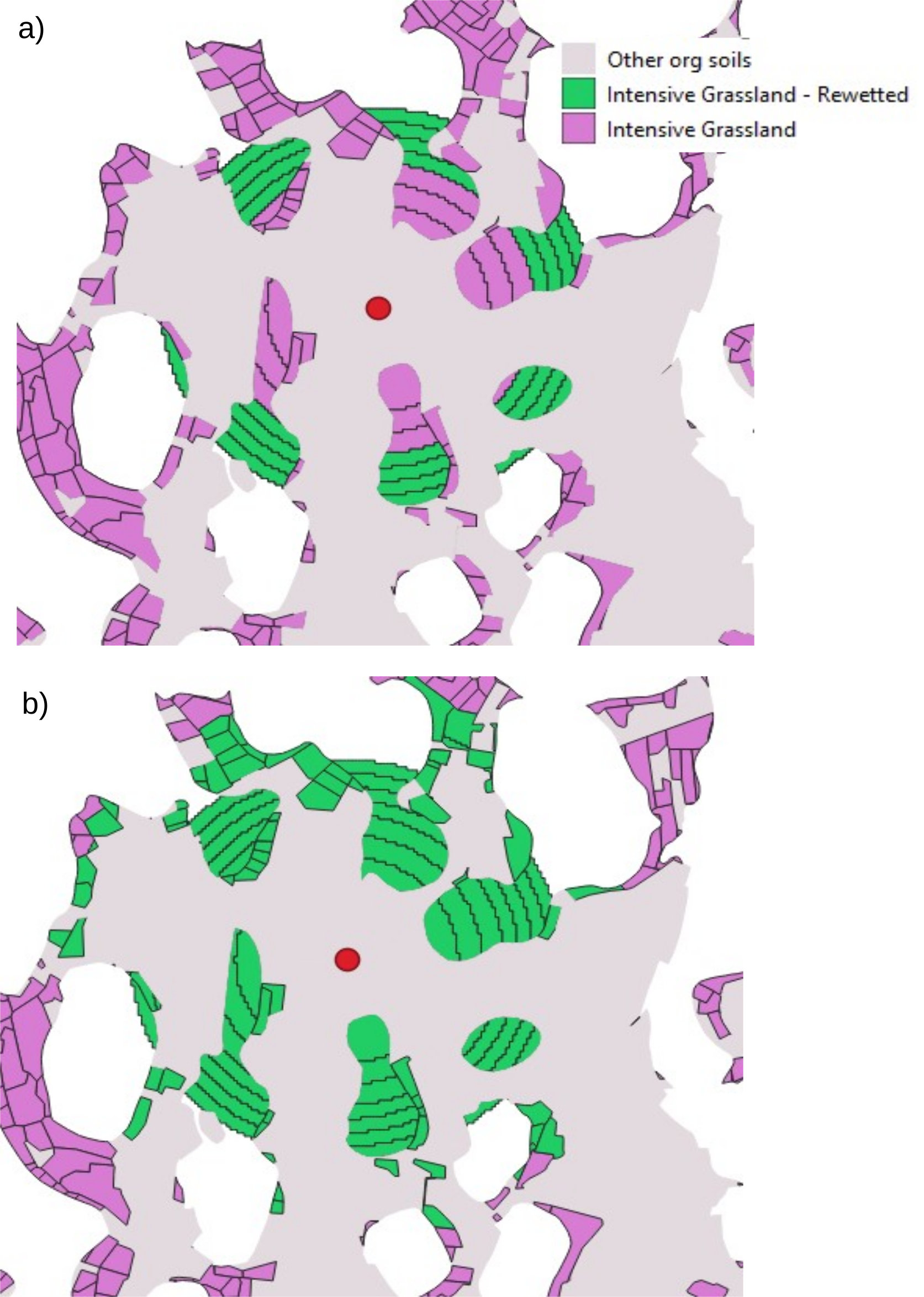
Examples of rewetted calculations are given in Figure 3 which shows rewetting in Northern Ireland in 2003 for an Intensive Grassland rewetting site. As the baseline for Northern Ireland is 2007, retrospective areas were added in to 2000 – the concentric circles in Figure 3a. There are 4 years of rewetting shown in green (2000 – 2003), with the non-rewetted Intensive grassland shown in purple.
Figure 3b below shows the same site in NI in the year 2010. As the figure shows, the entirety of the retrospectively added areas have been rewetted, and rewetting areas after the baseline year are being summed from the base map polygons. Restoration activity data supplied as polygon features rather than point-locations would improve this representation.
Figure 3: Organic soil rewetting calculations for an intensive grassland rewetting site in Northern Ireland (red dot). Where: (a) demonstrates retrospective area addition for 2000-2003; (b) demonstrates cumulative rewetting in 2010.
Disaggregating emissions/removals
The analysis described above produces tables with the area of each peatland condition category in each LA and Protected Landscape in each year, for each DG. These areas are converted to proportions of the DG total for each peatland category in each LA and Protected Landscape. These proportions are then used to disaggregate the DG emissions/removals totals by multiplying the DG totals by the peatland category area proportions. The emission/removal totals are disaggregated according to peatland condition category. The current peatland condition category (for each year) is used to disaggregate the emissions.
Methodological updates
During disaggregation of the 1990-2024 inventory, updates were made to the organic soils methodology, primarily for improvements in efficiency and consistency. These are listed below:
- Updated spatial split of Modified Bog Drained, Modified Bog Undrained, Eroding Modified Bog Drained and Eroding Modified Bog Undrained areas for Scotland. This improves the spatial representation of these peat conditions and removes the need for additional post-processing.
- Updated spatial split of Modified Bog Drained, Modified Bog Undrained, Eroding Modified Bog Drained and Eroding Modified Bog Undrained areas for England. Required due to the England basemap updates from the reassignment of all domestic extraction peat areas to other peat condition categories (Clilverd et al. 2025) which was implemented in the 1990-2024 inventory (Table 3).
- Updated peat condition category and emissions category matching for all DGs. Updates and revised assumptions to maintain consistency with the main inventory and reflect the addition of new activity data. The main updates are listed below:
- Updated disaggregation area category for distributing Domestic Extraction Rewetted Bog emissions from Industrial Extraction Rewetted Fen to Domestic Extraction. This affects spatial distribution of Rewetted bog emissions in England, Scotland and Northern Ireland (there is no Domestic Extraction in Wales)
- Category match reassignment: Forest to Rewetted Bog areas previously included in Rewetted Fen emissions distribution were updated to align with the main inventory. Affects spatial distribution of Rewetted Fen emissions in all DGs.
- Category match reassignment: Eroding Modified Bog Drained to Rewetted areas previously matched to Rewetted Modified Bog emissions distribution were updated to match with Rewetted Bog to align with the main inventory. Affects spatial distribution of Rewetted Bog and Rewetted Modified Bog emissions in all DGs.
- Updated category match, new activity data now allows for Eroding Modified Bog Undrained (wasted) emissions to be distributed using Eroding Modified Bog Undrained areas (previously Eroding Modified Bog Drained). This affects the spatial distribution of Eroding Modified Bog Undrained emissions in England only.
- Application of improved data formats and R functions within the spatial data timeseries code, significantly improving efficiency and reducing computational requirements.
- Forest to Wetland non-soil emissions have been updated from Excel calculation to a coded R model. This model now uses calculated areas of Forest to Wetland rewetting from the organic area timeseries outputs, rather than point data of rewetting sites to disaggregate emissions.
Forestry
In the UK National Inventory gains and losses in pools of carbon in standing trees, litter and soil in conifer and broadleaf forests and in harvested wood products are calculated by a carbon accounting model, CARBINE. Forests accumulate carbon (by removing CO2 from the atmosphere) in their biomass and soils as they grow, but timber harvesting, planting activities and drainage disturb this accumulation and result in loss of carbon via emissions of carbon dioxide, and other greenhouse gases to the atmosphere. The net carbon stock change at any one time depends on the balance between these different activities. Forestry management cycles operate over long timescales (40+ years), so the rate of carbon dioxide removal now is driven by the rate of forest planting in previous decades. Three parameters are required for the model:
- areas of new forest planted in each year in the past
- areas deforested each year
- management/harvesting pattern
For mapping at LA scale, the mineral soil and biomass (living biomass, dead wood and litter) carbon stock change from the CARBINE model for England, Scotland, Wales and Northern Ireland were disaggregated using the LUC-T methodology. Similarly, the N2O from mineralisation and fertilisation and the Carbon, N2O and CH4 from controlled burning following deforestation were disaggregated using the LUC-T methodology.
Figure 4 shows the distribution of carbon stock change (biomass and mineral soil) and emissions from mineral soil drainage due to forest land remaining forest land (> 20 years old) per local authority area, expressed as tonnes of carbon dioxide equivalent per square kilometre (tCO2e per km2). Maps of total CO2e emissions/removals per LA can be misleading due to the wide range of areas across authorities – maps tend to be dominated by the Highland region of Scotland, therefore tCO2e per km2 are presented instead.
Figure 5 shows the distribution of carbon stock change (biomass and mineral soil) and emissions from mineral soil drainage for land converted to forest land (< 20 years prior to the reporting year) by local authority. In some local authorities there are net emissions for this category as within the 20-year time period the carbon gains from the forest biomass do not yet outweigh the losses from the soil disturbance.
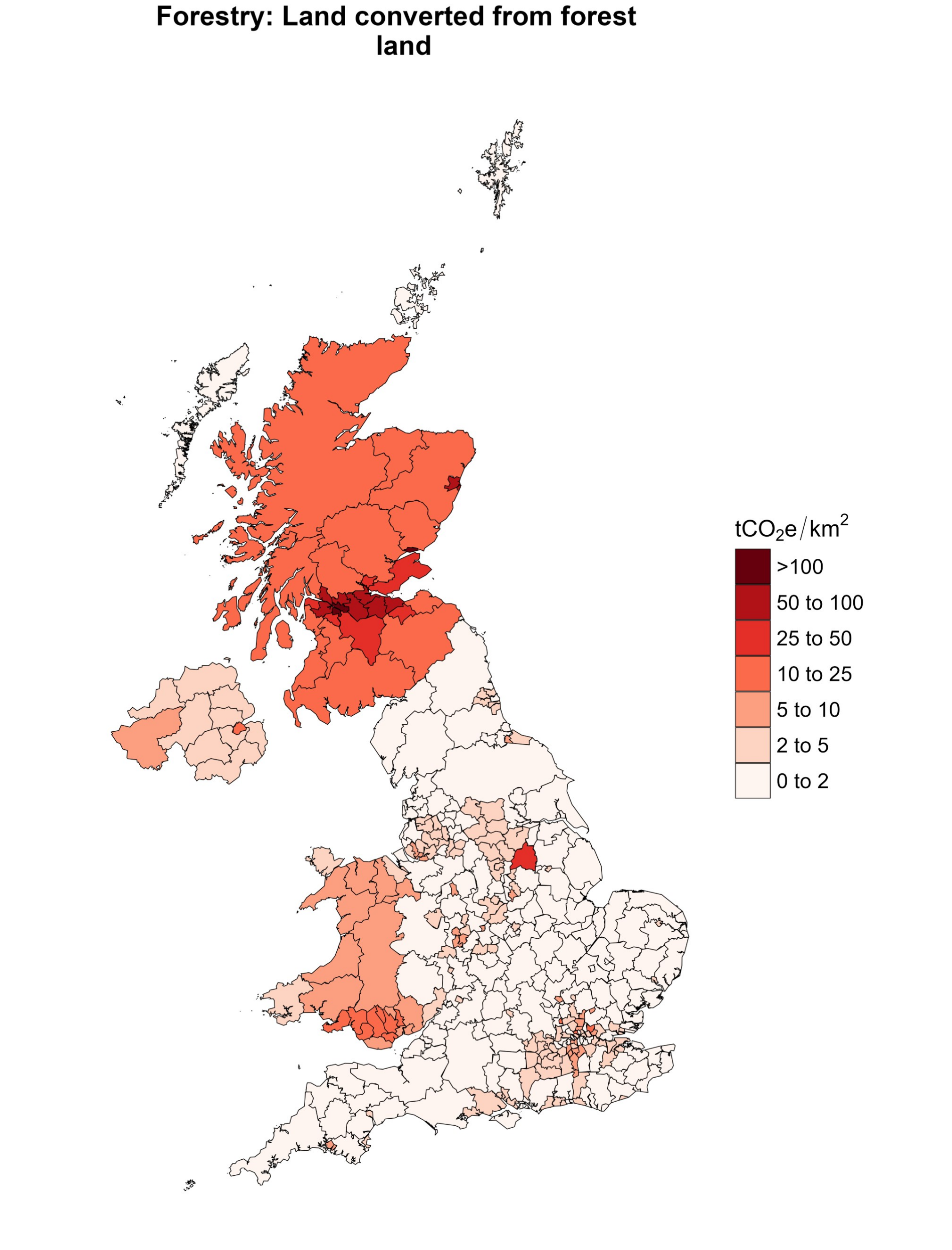
Figure 6 shows the distribution of carbon stock change (biomass and mineral soil), emissions from mineral soil drainage and emissions from controlled burning following land converted from forest land (deforestation) by local authority. The biomass losses and controlled burning emissions are assumed to occur in the year of deforestation, whereas the mineral soil carbon stock change occurs over much longer timescales. As the LUC-T disaggregation methodology is based on probabilistic LUC data and deforestation is both rare and difficult to distinguish from felled forest areas awaiting replanting, the in-year deforestation emissions are disaggregated using the LUC-T variable for Forest remaining Forest. The mineral soil changes are disaggregated using the LUC-T land from forest 20-year variables, as for other soil carbon stock change. The potential of using woodland loss spatial data from the National Forest Inventory to disaggregate deforestation was investigated in 2024. It did not provide a simple solution, but it may be a useful data source in the future.
Differences in these emissions/removals categories compared to the previous inventory (1990-2023) are due to forestry modelling and activity data updates (see the Recalculations section) and disaggregation methodology updates for Forest to Wetland non-soil emissions (see Methodological updates section).
Figure 4: Distribution of Forestry: Forest land remaining forest land net emissions/removals from the atmosphere in 2024 per local authority area expressed as tCO2e per km2.
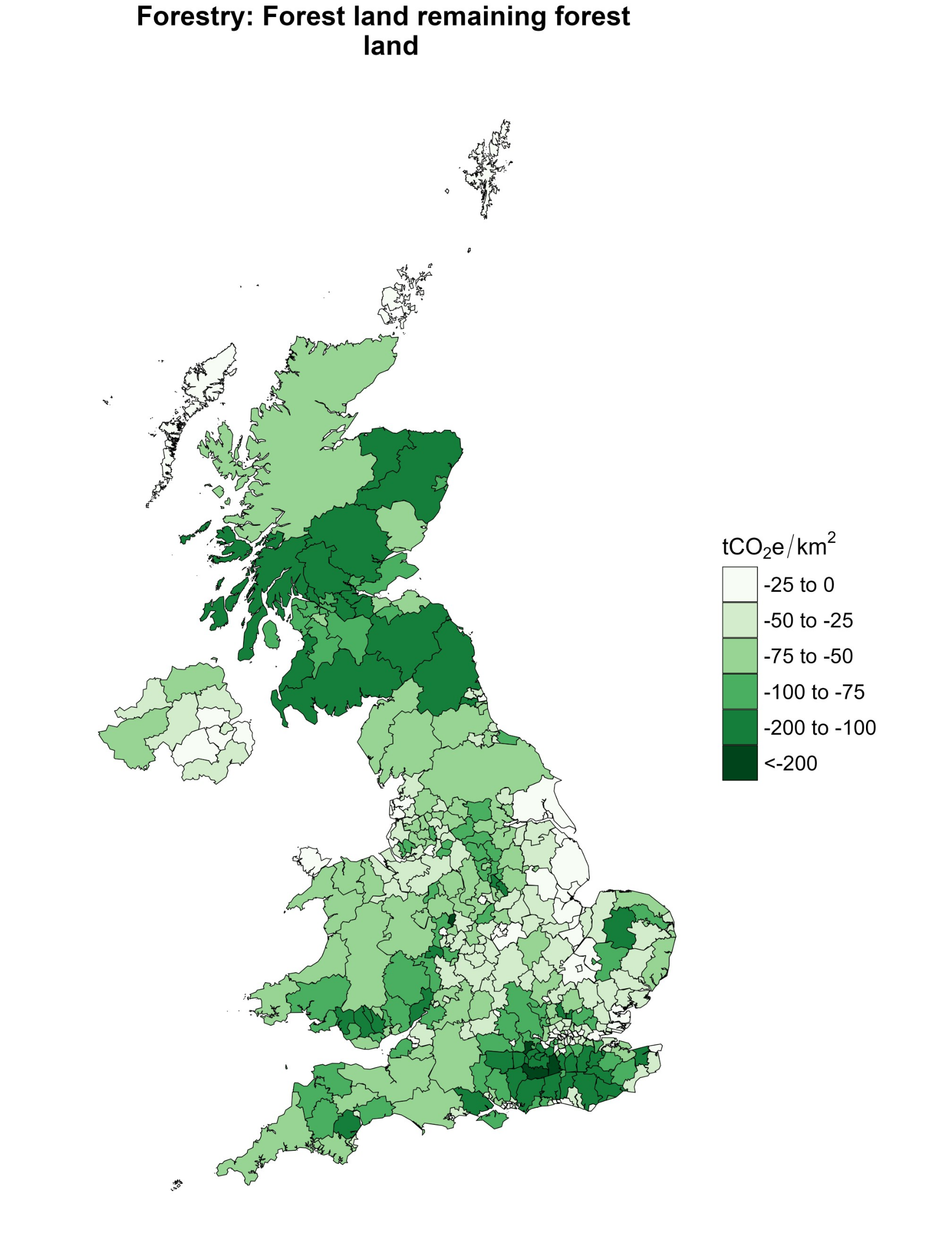
Figure 5: Distribution of Forestry: Land converted to forest land net emissions/removals from the atmosphere in 2024 per local authority area (tCO2e/km2).
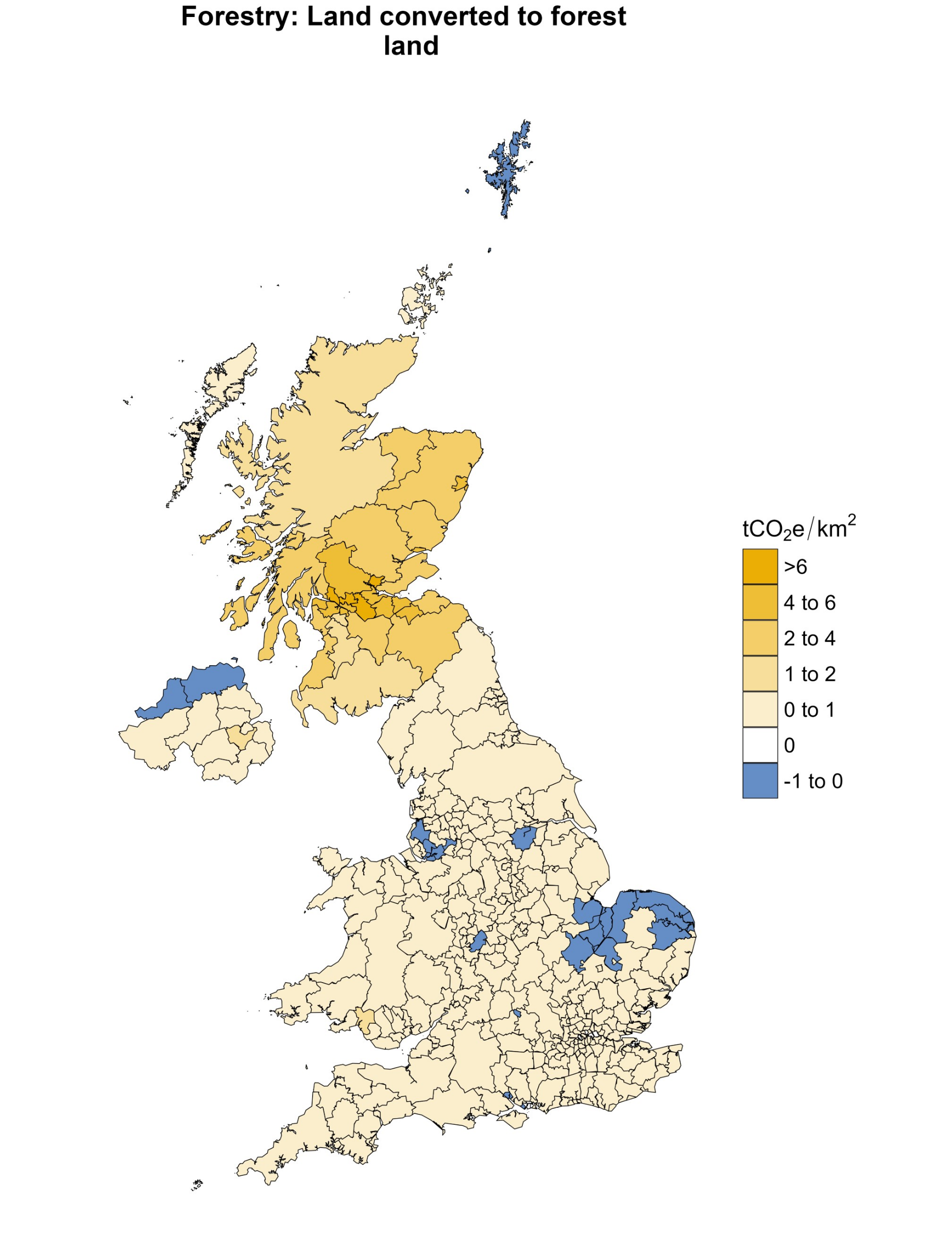
Figure 6: Distribution of Forestry: Land converted from forest land net emissions/removals from the atmosphere in 2024 per local authority area (tCO2e/km2).
Peatland
Agricultural
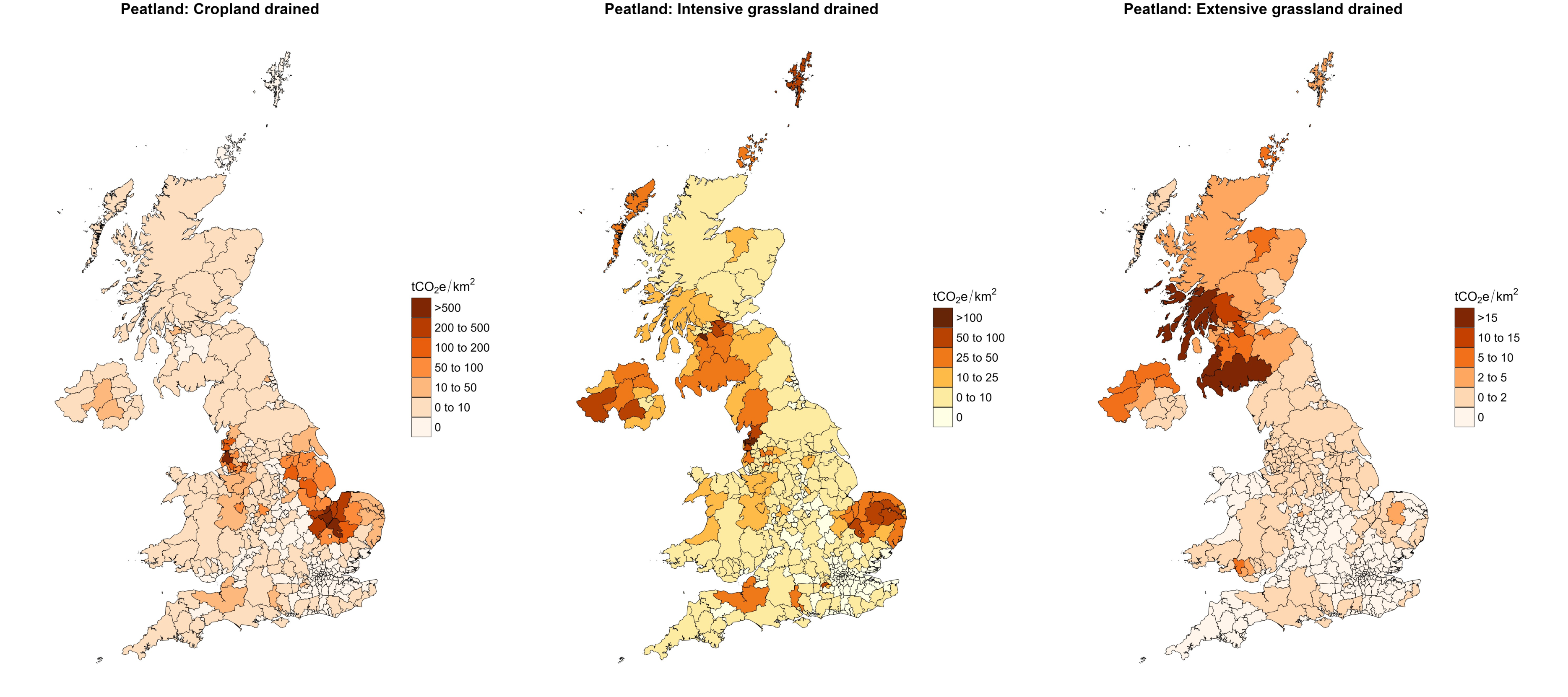
Around 15% of UK peatlands were drained many decades ago for cropland and intensive and extensive grassland, and continue to lose carbon from the soil as CO2, and CH4, as well as emit significant amounts of N2O associated with organic matter decomposition. Emissions from drained organic soils under Cropland are largely concentrated in the East, North Midlands and Northwest of England and are associated with deep (>40cm depth) and wasted peat (organic soils that were previously deep peat and now mapped as retaining less than 40 cm of peat). Like Cropland, Intensive Grassland (defined as grassland which has been fertilised, ploughed and re-seeded, high-density grazed or hay-cropped) has high GHG emissions per unit area and can also occur on wasted peat in England. Extensive Grassland (defined as unfertilised permanent grassland, lower-density grazed or hay-cropped) follows a slightly different spatial pattern to intensive grassland as these peatlands typically occur at higher elevations, though are mapped as grazing land below the upland boundaries (Figure 7). Differences in these emissions categories compared to the previous inventory (1990-2023) are due to organic soil activity data updates (see Recalculations section).
Figure 7: Net carbon dioxide, nitrous oxide and methane emissions Peatland: Cropland drained, Intensive Grassland drained, and Extensive Grassland drained in 2024 per local authority area (tCO2e/km2).
Peat extraction
On-site CO2, CH4 and N2O emissions and off-site CO2 emissions from Domestic Peat Extraction for fuel and Industrial Peat Extraction for horticulture are calculated for the LULUCF inventory based on the following data:
- The Mineral Extraction in Great Britain Business Monitor PA1007 which provides data on the volume of domestic and industrial peat extracted;
- The UK Growing Media Monitor (GMA 2022) which gives data on volumes of horticultural peat sold;
- The BGS Directory of Mines and Quarries (DMQ) and BritPits database
- Peat condition mapping outputs from Evans et al. (2017) which gives the location of peat extraction sites;
- The UKCEH Google Earth dataset which provides information on the area and activity of peat extraction sites.
The DMQ and BritPits data give the location of active peat extraction, and mapping outputs from the BEIS (now DESNZ) funded Wetlands Supplement project (Evans et al. 2017) also provide areas of historical domestic and industrial extraction, we have assumed that the carbon emission applies to this combined area (see Brown et al. 2026).
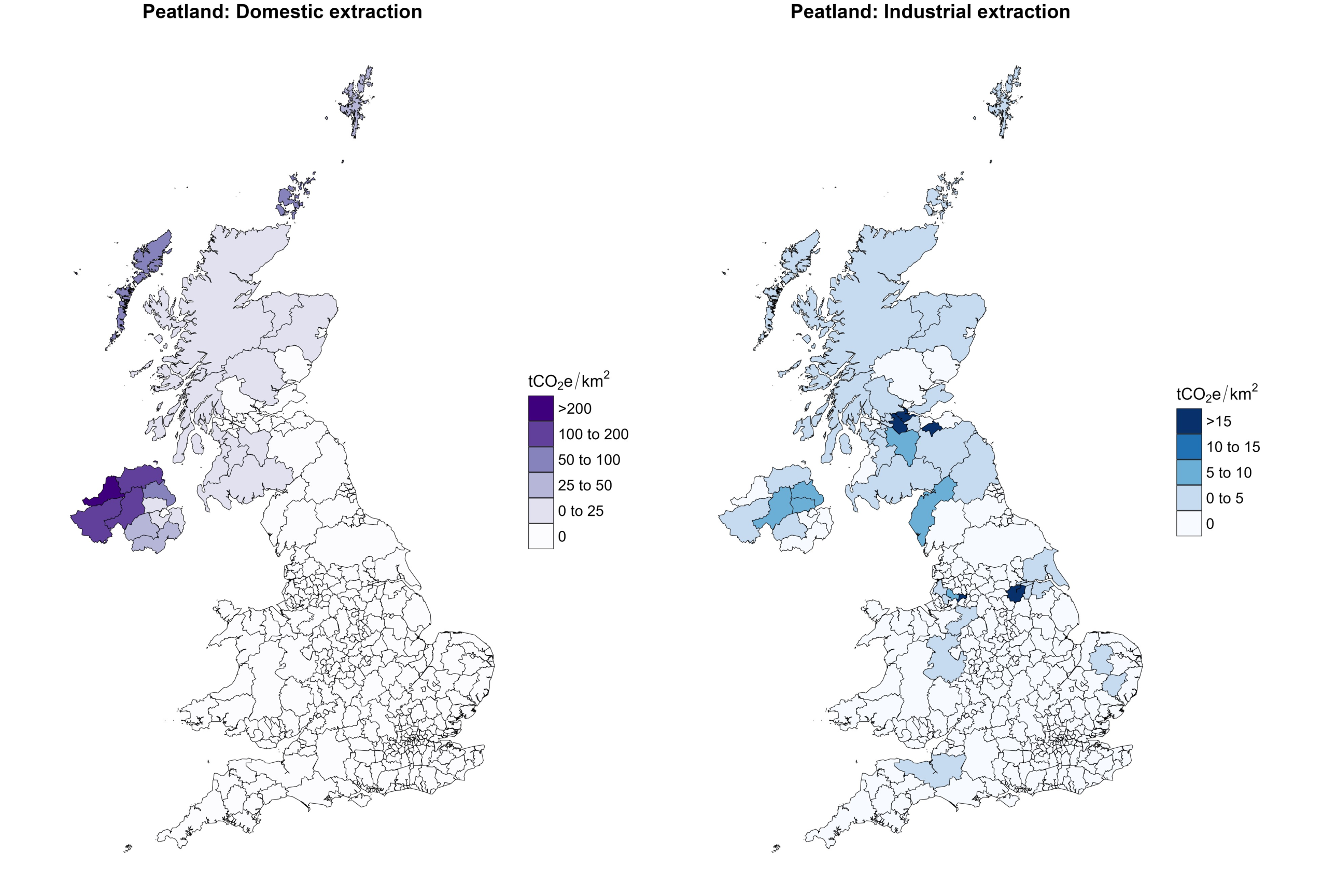
Emissions are disaggregated using the organic soil maps methodology. Local authorities with no peat extraction activities have zero emissions from peat extraction. Differences in these emissions categories compared to the previous inventory (1990-2023) are due to organic soil activity data updates (see Recalculations section). See Figure 8.
Figure 8: Net carbon dioxide, methane and nitrous oxide emissions from Peatlands: Domestic extraction and Industrial extraction per local authority area (tCO2e/km2) in 2024.
Forest and settlement
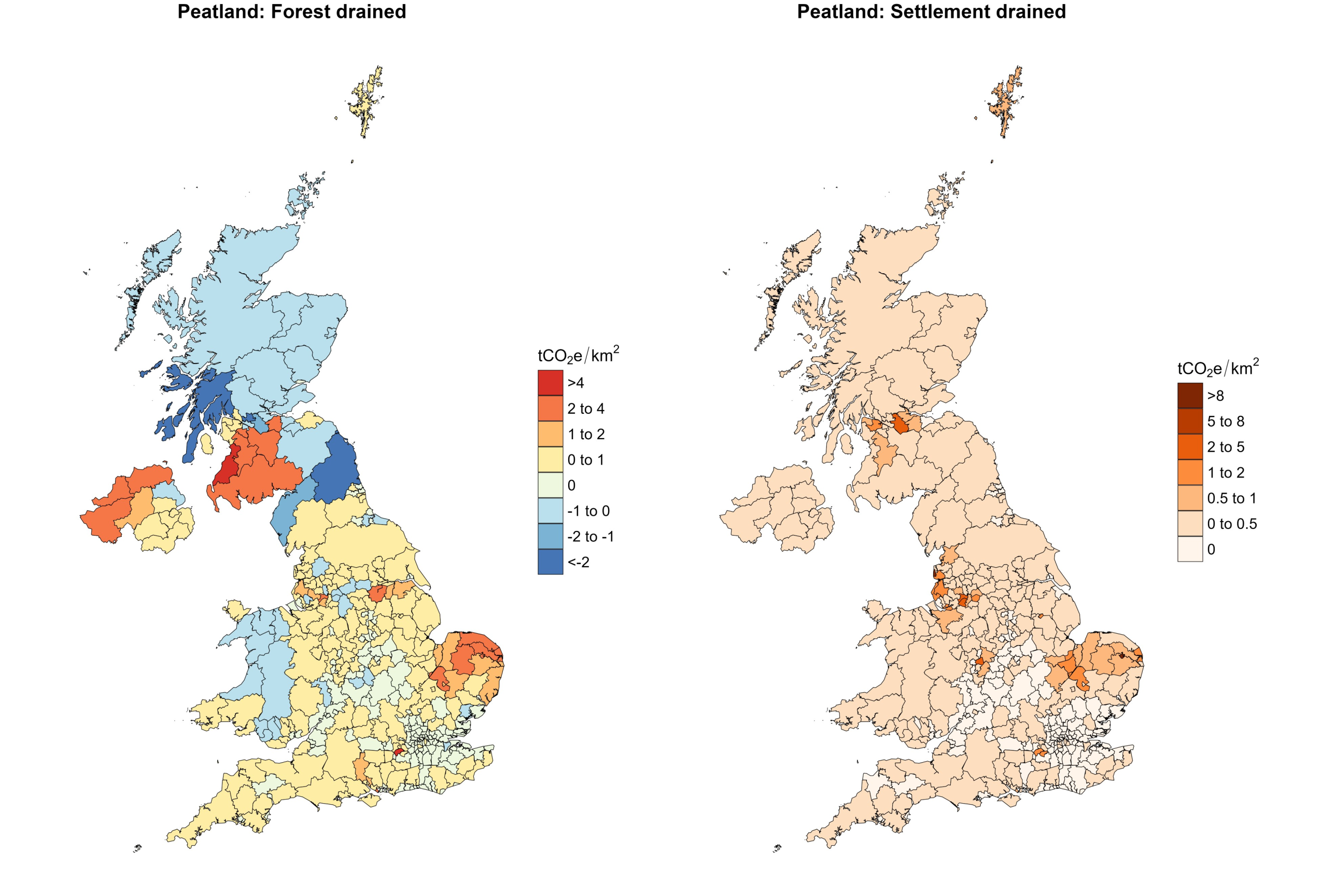
Net emissions due to drainage of organic soils under Forest Land and Settlement are shown in Figure 9. Forest drained includes soil carbon stock change from CARBINE modelling, CO2 emissions from indirect fluvial export of particulate organic carbon (POC) and dissolved organic carbon (DOC), emissions of direct CH4, indirect CH4 from ditches, and N2O emissions, which are disaggregated to LA scale using the organic soil map methodology. The distribution of emissions from drained organic soils under Forest is focused in Scotland where peat extent and the location of forests are both high (Figures 4 and 5). Net emissions are close to zero in some LAs where accumulation of new carbon from litter inputs to the soil counterbalances the loss of old carbon due to drainage of the soil. Emissions from Settlement on organic soils mostly occur in lowland regions where population density is higher. Differences in these emissions/removals categories compared to the previous inventory (1990-2023) are due to organic soil activity data updates (see Recalculations section).
Figure 9: Net carbon dioxide, methane and nitrous oxide emissions from Peatlands: Forest drained and Settlement drained per local authority area (tCO2e/km2) in 2024.
Upland – modified
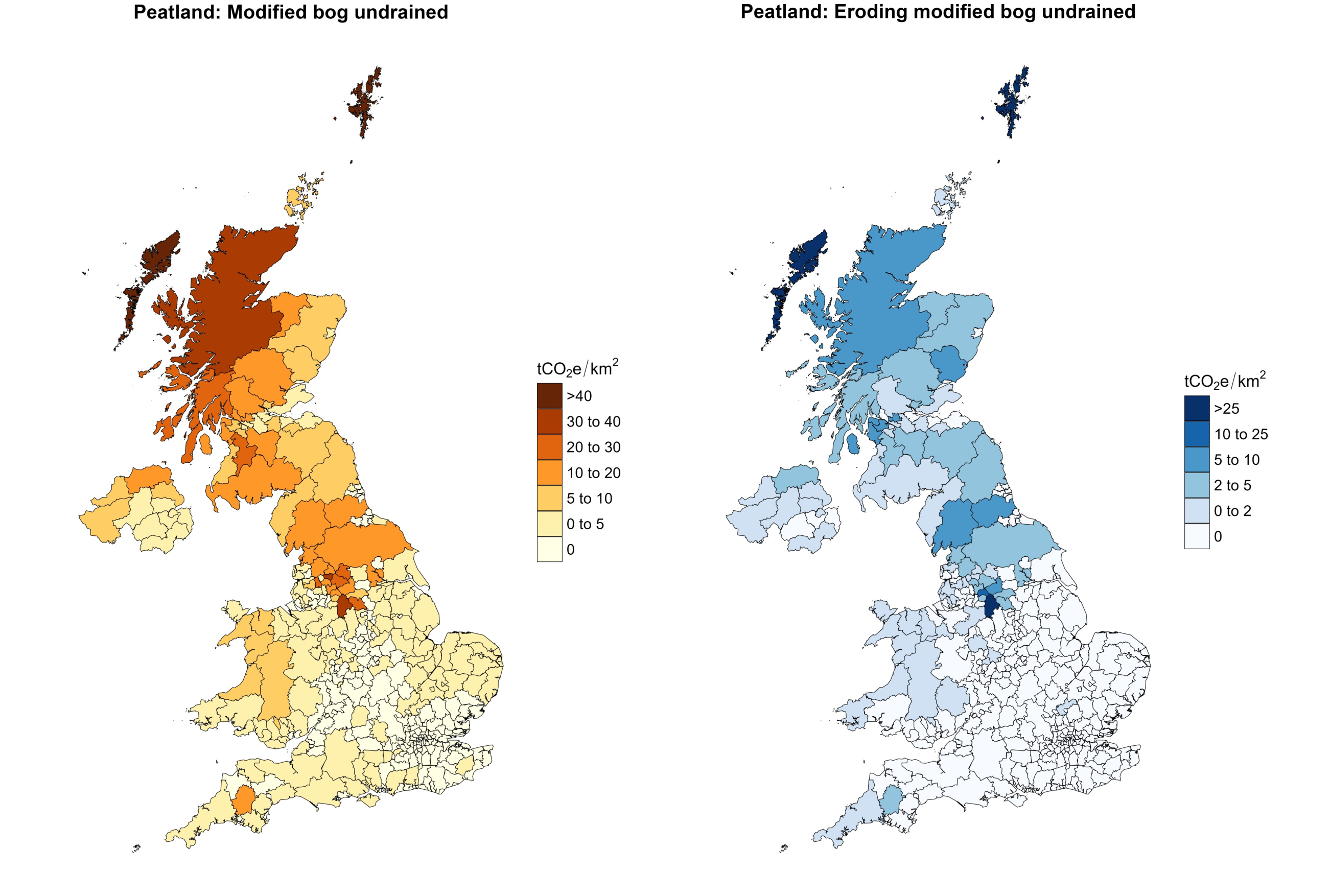
Large areas of UK peatlands are in a semi-natural state, predominantly heather- and grass-dominated bog that are modified to a degree by drainage, grazing and burning-management practices, which affects the strength of carbon sequestration. Emissions of CO2, CH4 and N2O from drained and undrained Modified Bog and Eroding Modified Bog (bare peat) are disaggregated to the LA level using the organic soil maps methodology and are reported under Grassland. These peatland habitats occur predominantly in the uplands , with patterns of highest emissions for semi-natural peatlands (drained and undrained Modified Bog and Eroding Modified Bog) in the Highlands and Islands of Scotland, the Pennines in Northern England, North West and Mid Wales, and North and West Northern Ireland (Figures 10 and 11). Differences in these emissions categories compared to the previous inventory (1990-2023) are due to organic soil activity data updates (see Recalculations section) and disaggregation methodology improvements (see Methodological Updates section).
Figure 10: Net carbon dioxide, methane and nitrous oxide emissions from Peatlands: Modified Bog drained and Eroding Modified Bog drained per local authority area (tCO2e/km2) in 2024.
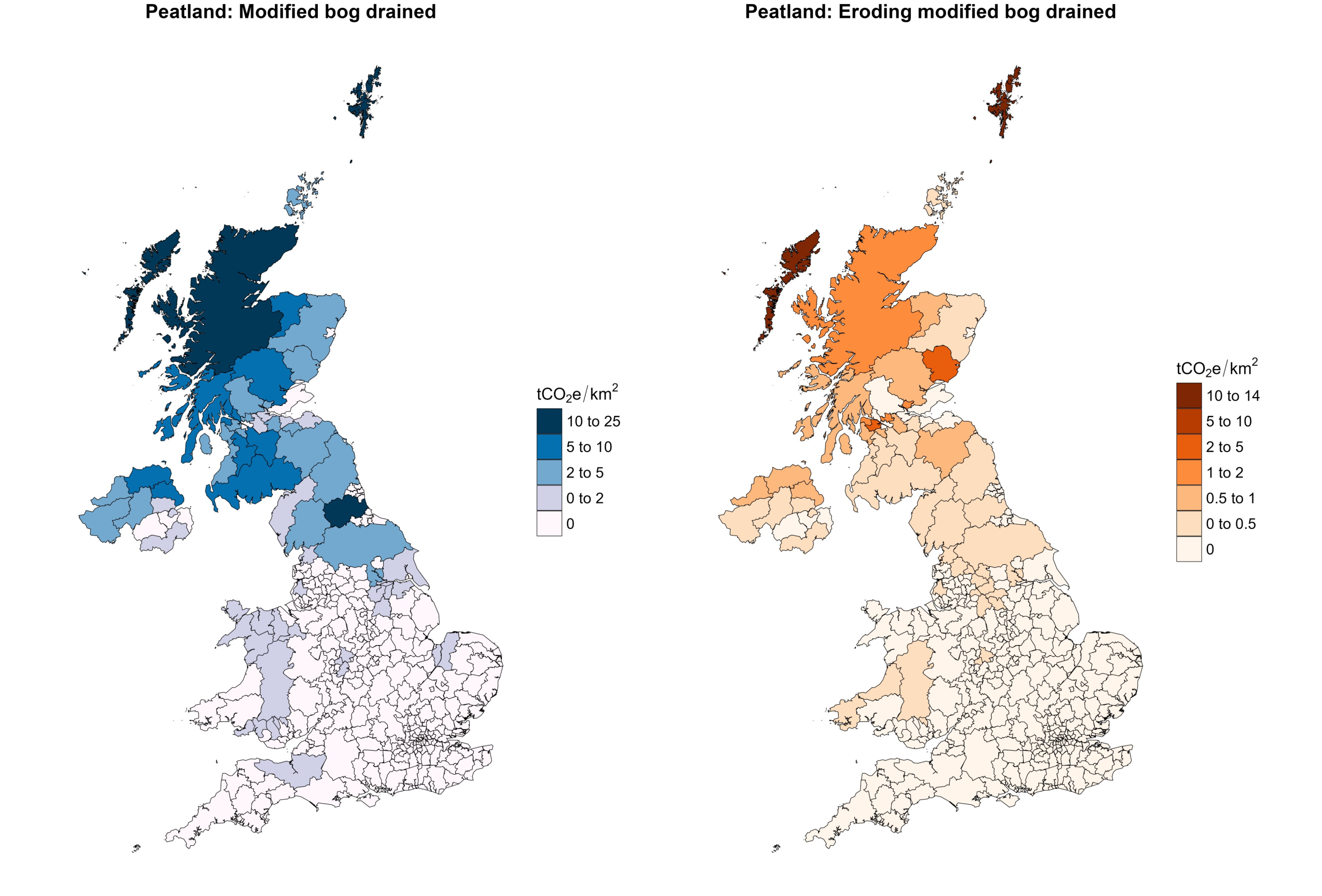
Figure 11: Net carbon dioxide, methane and nitrous oxide emissions from Peatlands: Modified bog undrained and Eroding modified bog undrained per local authority area (tCO2e/km2) in 2024.
Upland – near-natural
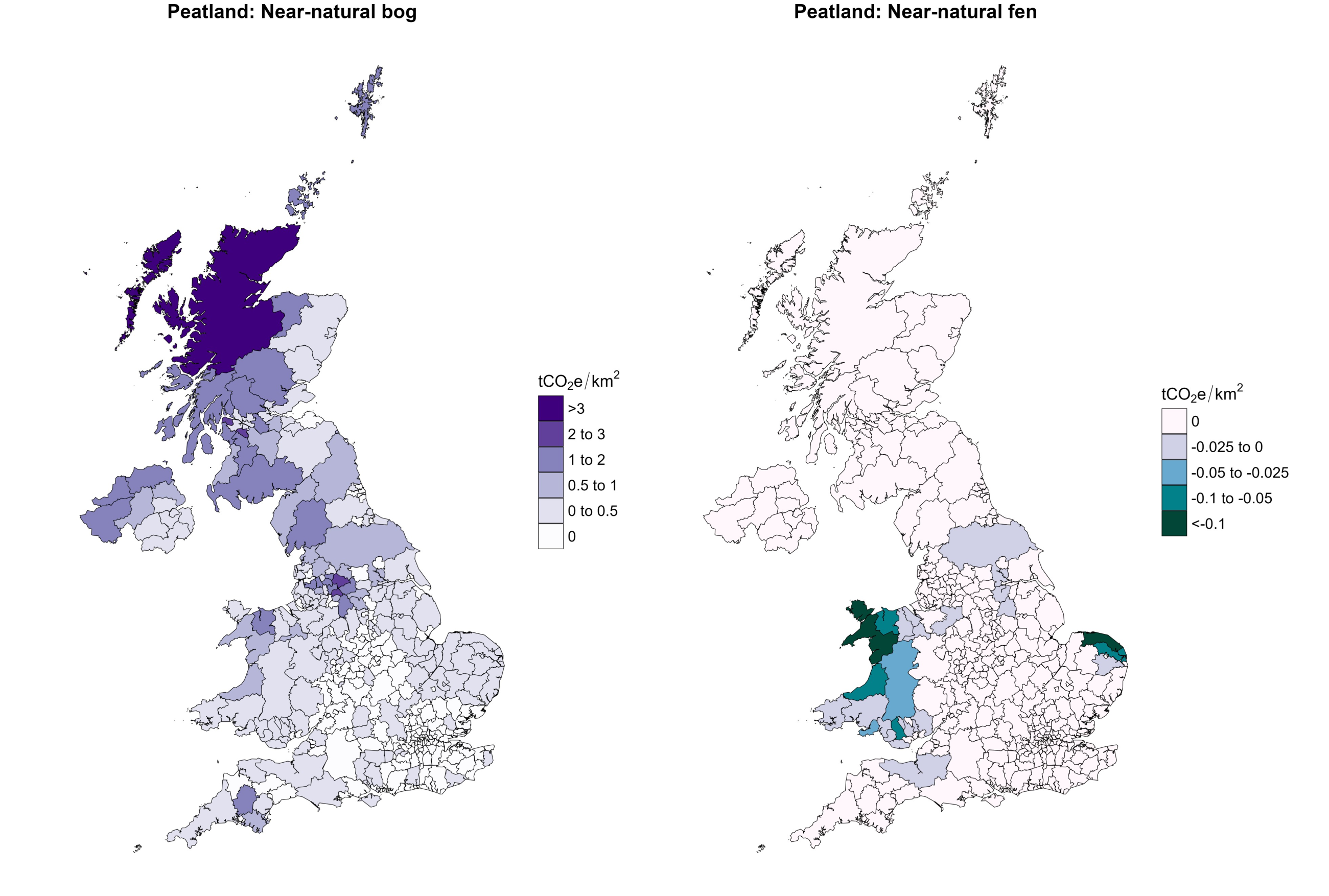
In a natural state, peatlands are important long-term sinks for carbon, which is counterbalanced by similar emissions of methane in CO2 equivalent terms (N2O emissions from undrained near-natural peatlands are assumed to be negligible). The emissions / removals for Near-Natural Bog and Fen are disaggregated using the organic soil map methodology. The area of Near Natural Fen that could be definitively mapped from available datasets is limited, thus Near-Natural Fen is largely included with Near Natural Bog, except in Wales and selected areas in England, mostly in the Norfolk Broads (Evans et al. 2017). See Figure 12. Differences in these emissions/removals categories compared to the previous inventory (1990-2023) are due to organic soil activity data updates. New areas of Near-natural Fen are present in England, due to the domestic extraction reassignment (see the Recalculations section).
Figure 12: Net carbon dioxide, methane and nitrous oxide emissions from Peatland: Near-Natural Bog and Near-Natural Fen per local authority area (tCO2e/km2) in 2024.
Rewetted
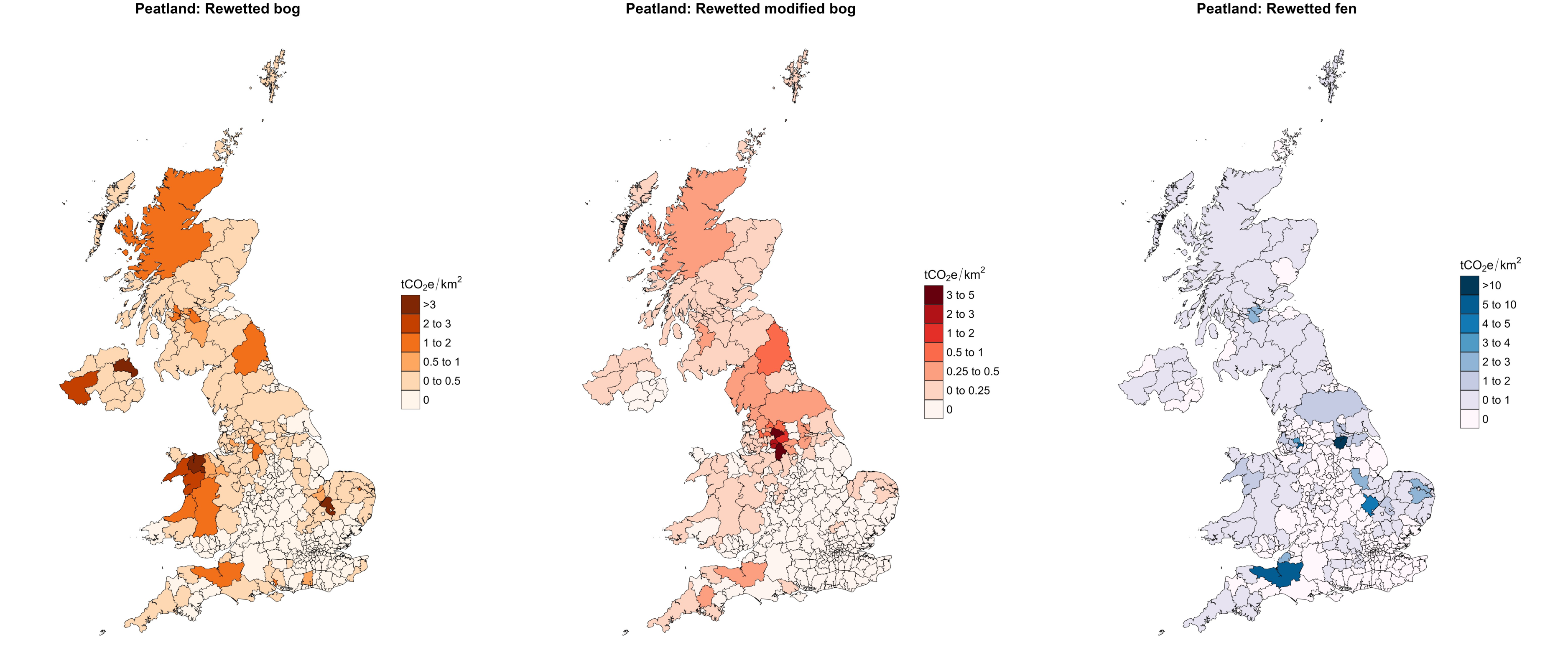
Rewetted peatlands are reported under Grassland and Wetland categories (see LULUCF category description in the Categories section). Rewetting has largely occurred from 2000 onwards and is increasing in practice as regions attempt to restore natural functioning of peatlands and long-term sinks for carbon. Disaggregation is carried out using the organic soil maps methodology. LAs with lands that have undergone peatland restoration (rewetting) are shown in Figure 14 as those exhibiting either a small source or near zero CO2e emissions. Separate emission factors are applied to rewetted peatlands depending on the starting condition of the restored lands to take account of the faster trajectory for restoration success associated with rewetting habitats that already have semi-natural vegetation and are functioning in a near-healthy state (see Section A5.1.4.7 of the NID, Brown et al. 2026). Accordingly, rewetted semi-natural habitats, reported as Rewetted Modified Bog under Grassland, have the lowest emission factors. Rewetted Fen (from cropland, intensive and extensive grassland) and Rewetted Bog (from forest, extracted, and eroding modified bog) are from more heavily modified peatlands and are a small source of GHG emissions.
The mitigation impacts of peatland restoration are largely from avoided soil emissions due to the conversion of drained organic soils to rewetted peatlands, which are accounted for in the final emissions from remaining drained peatlands in Figures 7 to 10. Differences in these emissions categories compared to the previous inventory (1990-2023) are due to organic soil activity data updates (see Recalculations section), and disaggregation methodology improvements (see Methodological updates section).
Figure 13: Net carbon dioxide, methane and nitrous oxide emissions from Peatlands: Rewetted Bog, Rewetted Modified Bog and Rewetted Fen per local authority area (tCO2e/km2) in 2024.
Cropland and Grassland mineral soils change
Change from one land use type to another results in a change in soil carbon stocks over time. The change in vegetation cover and management will affect the amount of carbon that goes into the soil from biomass decomposition. This is represented by emissions or removals which continue for decades after the change in land use until equilibrium carbon stocks characteristic of the new land use are reached. When the LUC results in soil carbon emissions the corresponding direct and indirect N2O emissions from soil mineralisation are also calculated.
For the LULUCF inventory, the method for assessing changes in soil carbon stock due to land-use change on mineral soil links a matrix of area changes at country level to a dynamic model of carbon stock change. In the 1990-2020 inventory a major improvement was made to the land use change matrices which are now derived annually using a Bayesian data assimilation approach combining data from Earth Observation, land cover surveys and agricultural land statistics (Brown et al 2026, Annex section A5.1.4.2).
The LUC-T methodology is used to disaggregate to LA scale (see Figure 2). The pattern of emissions and removals across the UK for each land-use type is dependent on the ratio of land-use change in each LA in relation to the total for that devolved government. For example, the majority of land-use change to both Cropland and Grassland in Scotland occurs in the south and east of the country.
Figure 14 shows the distributions of net emissions/removals from mineral soils as a result of land use change for Cropland remaining Cropland (> 20 years old) and for Grassland and Settlement converted to Cropland within the last 20 years.
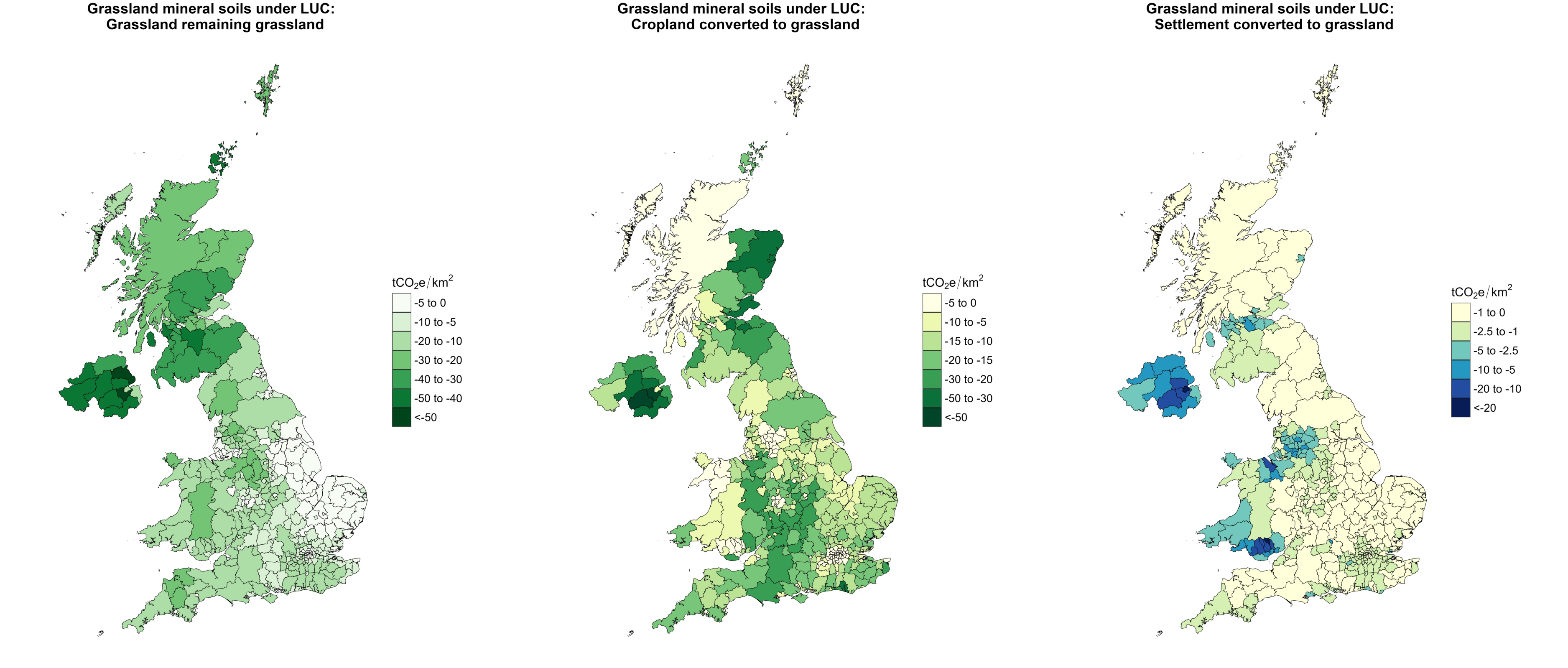
Figure 15 shows the same for Grassland remaining Grassland and for Cropland and Settlement converted to Grassland.
Figure 14: Distribution of Cropland mineral soils change: Cropland remaining cropland, Grassland converted to cropland and Settlement converted to cropland net emissions/removals (tCO2e/km2) in 2024.
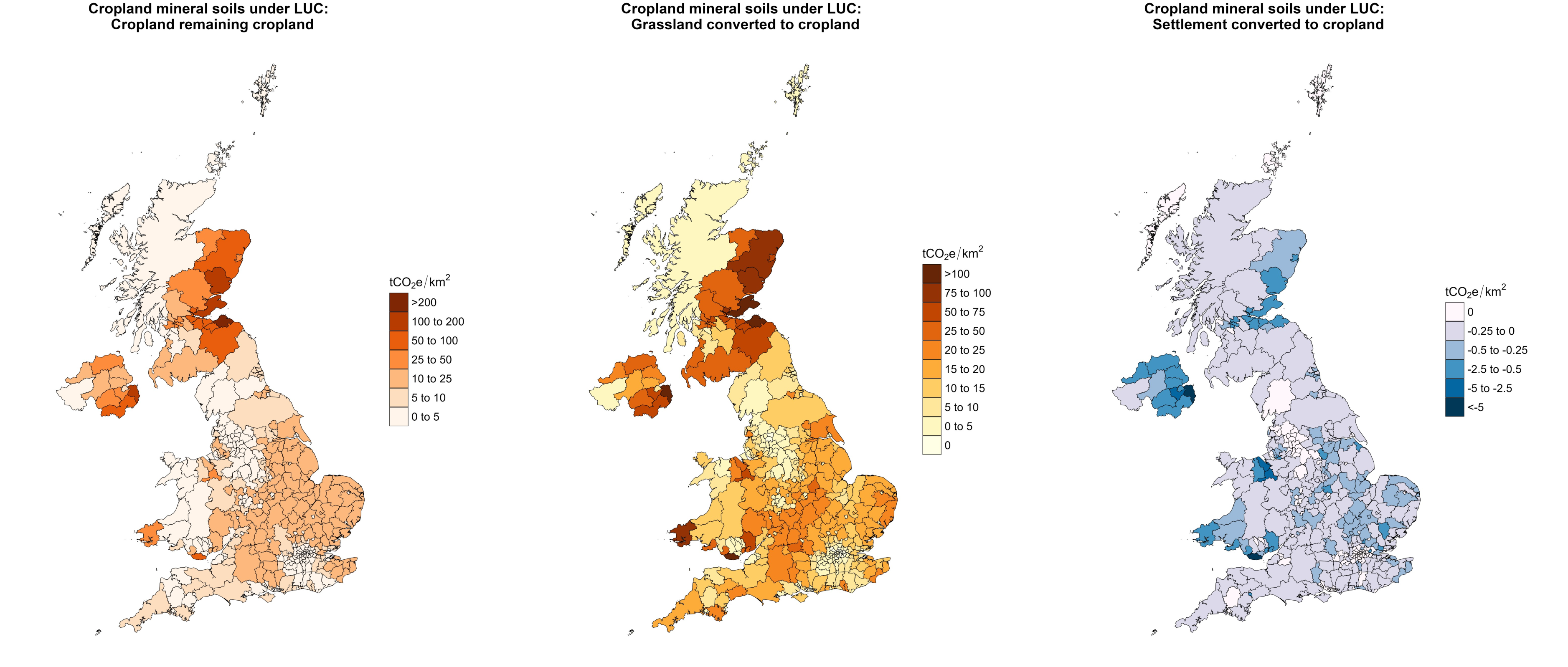
Figure 15: Distribution of Grassland mineral soils change: Grassland remaining grassland, Cropland converted to grassland and Settlement converted to grassland net emissions/removals (tCO2e/km2) in 2024.
Settlement
The mineral soil carbon stock changes and direct and indirect N2O emissions from Land use change to Settlement are calculated in the same way as described for Cropland and Grassland above.
The different land-use types have different biomass carbon densities per area at equilibrium. Change from one land use type to another can result in an increase or decrease in biomass carbon density per area. For the LULUCF inventory, estimates of emissions and removals from non-forest biomass are made using the Land-Use Change matrix approach. Changes in carbon stocks in biomass due to land-use change are based on the same area matrices used for estimating changes in carbon stocks in soils. The biomass carbon density per area for Settlement was assigned by expert judgement based on the work of Milne and Brown (1997). Average biomass densities per area for Cropland and Grassland used in the non-forest biomass LUC model are the same as those used in the cropland and grassland management calculations, based on a UK-relevant literature review in Moxley et al. (2014). Five basic land uses were assigned initial biomass carbon densities per area, then the relative occurrence of these land uses in the four countries of the UK were used to calculate mean biomass carbon densities per area for each of the IPCC types, Cropland, Grassland and Settlements. The mean biomass carbon densities per area for each land type were then weighted by the relative proportions of change occurring between land types in the same way as the calculations for changes in soil carbon densities per area. Changes between these equilibrium biomass carbon densities per area were assumed to happen in a single year. The emissions / removals from biomass losses occurring from land use change to Settlement are disaggregated to LA using the LUC-T methodology.
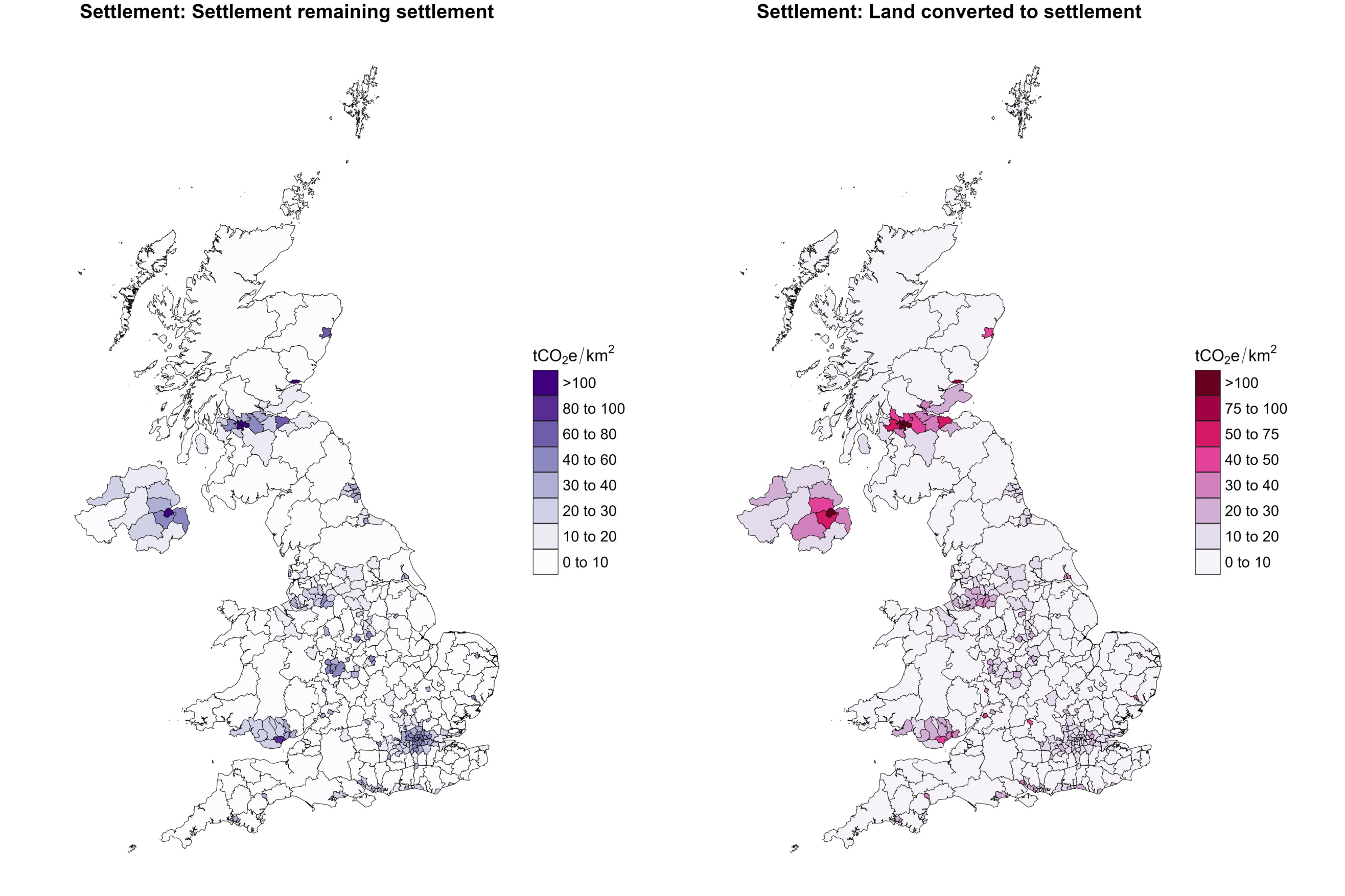
Figure 16 presents the net soil emissions for Settlement remaining Settlement (> 20 years old) and soil and biomass emissions for all land uses converted to Settlement. As expected, the net emissions are concentrated in urban areas of the UK due to expansion of existing towns and cities.
Figure 16: Distribution of Settlement: Settlement remaining settlement and Land converted to Settlement net emissions/removals (tCO2e/km2) in 2024.
Bioenergy Crops
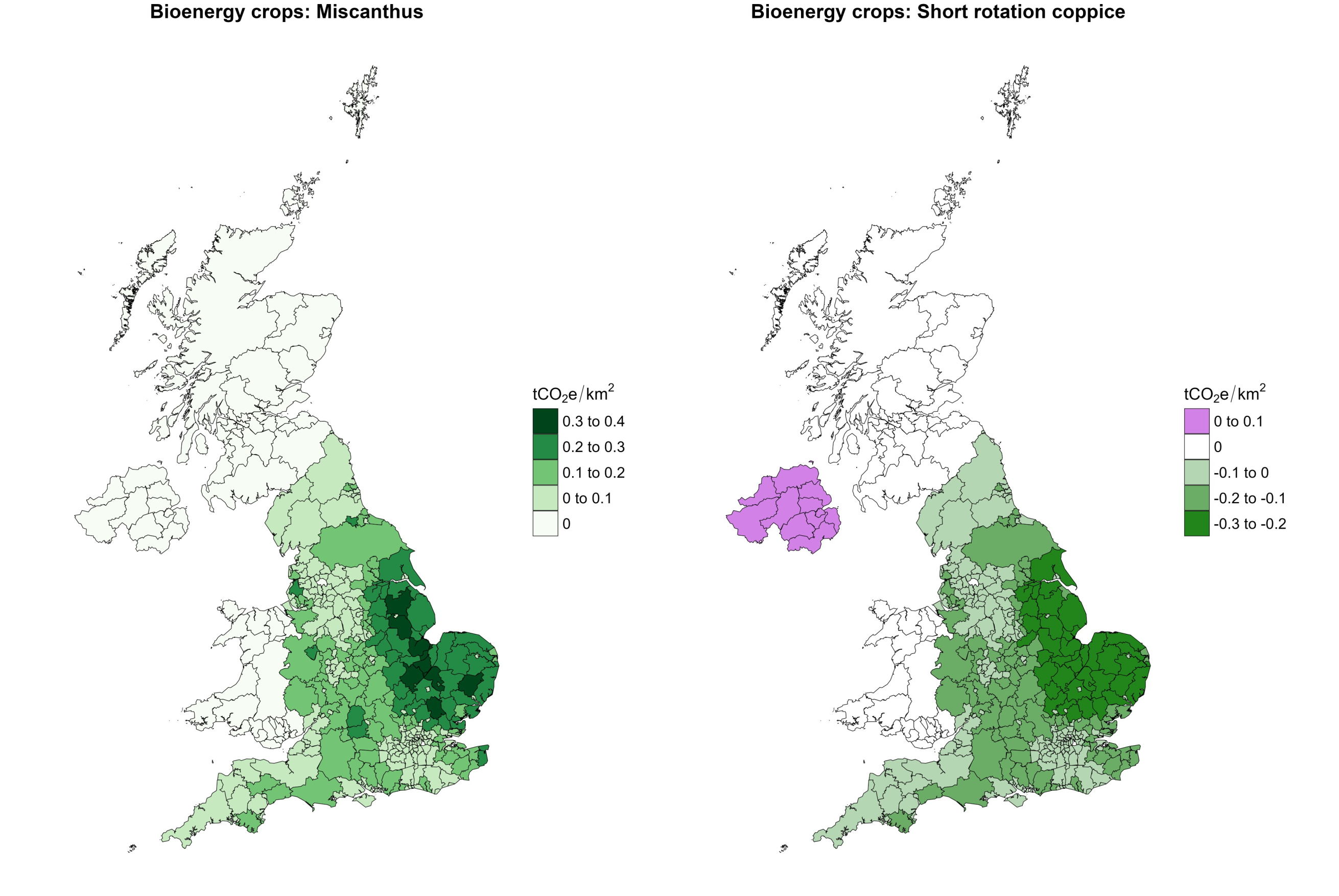
Emissions and removals for two bioenergy crops, Miscanthus and short rotation coppice arise from cropland management calculations for both soil and biomass.
Soil cropland management activities including inputs of fertiliser, manure and crop residues have an impact on soil carbon stocks. Data on the areas under the main crop types are obtained from the annual June Agricultural Censuses carried out by each UK devolved government (Defra, 2025a; Welsh Government, 2024; Scottish Government, 2024; DAERA, 2024). Data on the areas of Cropland receiving inputs of manure, fertiliser and crop residues are obtained from the annual British Survey of Fertiliser Practice (Defra 2025b).
Changes in biomass carbon stocks arising from cropland management include change between annual crops, orchards, bioenergy crops and set aside and fallow. Information on emission factors were derived from a literature review described in Moxley et al. (2014). The emissions and removals are disaggregated to the LA level using the LUC-T methodology based on the areas of total Cropland. Figure 17 shows the combined soil and biomass net emissions/removals for the bioenergy crops. Note that activity data for Miscanthus is only available for England and for short rotation coppice is only available for England and Northern Ireland. Compared to the previous inventory (1990-2023) there is no change to the historical timeseries.
Figure 17: Distribution of Bioenergy crops: Miscanthus and Short rotation coppice net emissions/ removals (tCO2e/km2) in 2024.
Other LULUCF
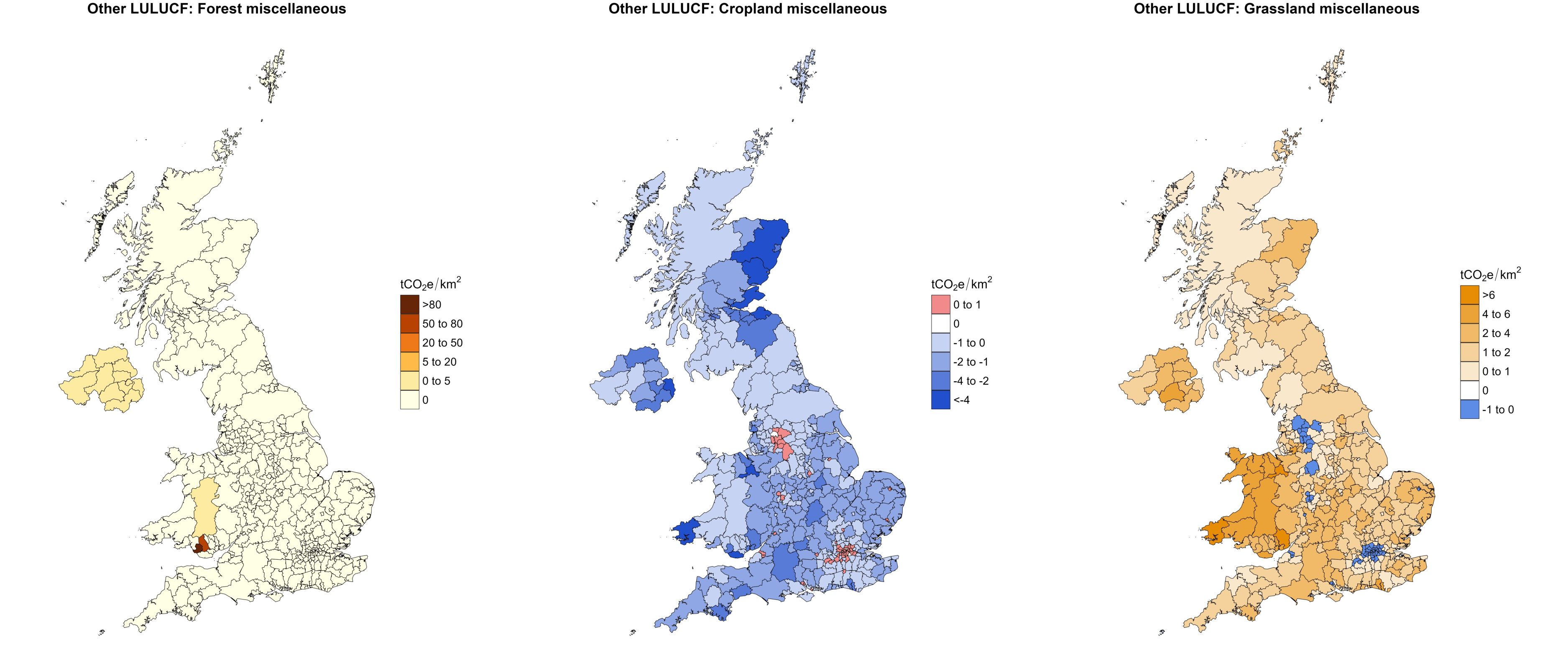
Within the TES classification there are some LULUCF emissions/removals which do not fall within any of the main sub-sectors described above. These have been grouped to Other LULUCF and contain miscellaneous emissions for Forest, Cropland, Grassland and Wetland.
The Forest miscellaneous category contains only emissions from wildfires occurring on forest land.
The Cropland miscellaneous category contains emissions/removals from non-forest biomass as a result of land use change, from mineral soils and biomass from management of non-bioenergy crops and from wildfires on cropland.
The Grassland miscellaneous category contains emissions/removals from non-forest biomass as a result of land use change, from biomass from grassland management and from wildfires on grassland.
The Wetlands miscellaneous category contains only emissions from biomass losses upon reservoir creation.
Information on areas of wildfires on forest, cropland and grassland in the UK are available from the Fire Service Incident Response System (IRS). This dataset is available at individual grid referenced fire level for Great Britain and as a national total for Northern Ireland. Hence, in Great Britain wildfires can be assigned to the LA in which they occurred, and in Northern Ireland the emissions are assigned to LAs in proportion to the total area of forest, crop or grassland in each LA. In 2024 there were no wildfires on Forest in England or Scotland, or on Cropland in Scotland and Wales in the Fire Service datasets.
Emissions/removals from non-forest biomass arising from land use change to Cropland and Grassland are calculated and disaggregated in the same way as for Settlement (described above).
Emissions/removals from cropland management activities for non-bioenergy crops are calculated and disaggregated in the same way as for bioenergy crops (described above).
Changes in biomass carbon stocks arising from Grassland management activities include change between shrubby and non-shrubby grassland types and hedge creation and removal. Data on areas of grassland types are derived from the Countryside Surveys of 1990, 1998 and 2007 (UKCEH, 2020a). Information on emission factors were derived from a literature review described in Moxley et al. (2014). The emissions and removals are disaggregated to the LA level using the LUC-T methodology.
Emissions from biomass losses upon reservoir creation (over 1km2) are calculated using a range of activity data on new reservoirs created since 1990. Only five large reservoirs have been established in the UK since 1990, three in England and one each in Scotland and Wales. No new reservoirs were created in 2024, hence no emissions map is presented in this report.
Figure 18 shows the net emissions/removals for the Forest, Cropland and Grassland miscellaneous categories for 2024. Changes in trend for these emissions/removals categories compared to the previous inventory (1990-2023) are due to updates to the cropland management activity data for England (see Recalculations section) and inclusion of the latest year of wildfire activity data.
Figure 18: Distribution of Other LULUCF: Forest miscellaneous, Cropland miscellaneous and Grassland miscellaneous net emissions/removals (tCO2e/km2) in 2024.
LULUCF Totals
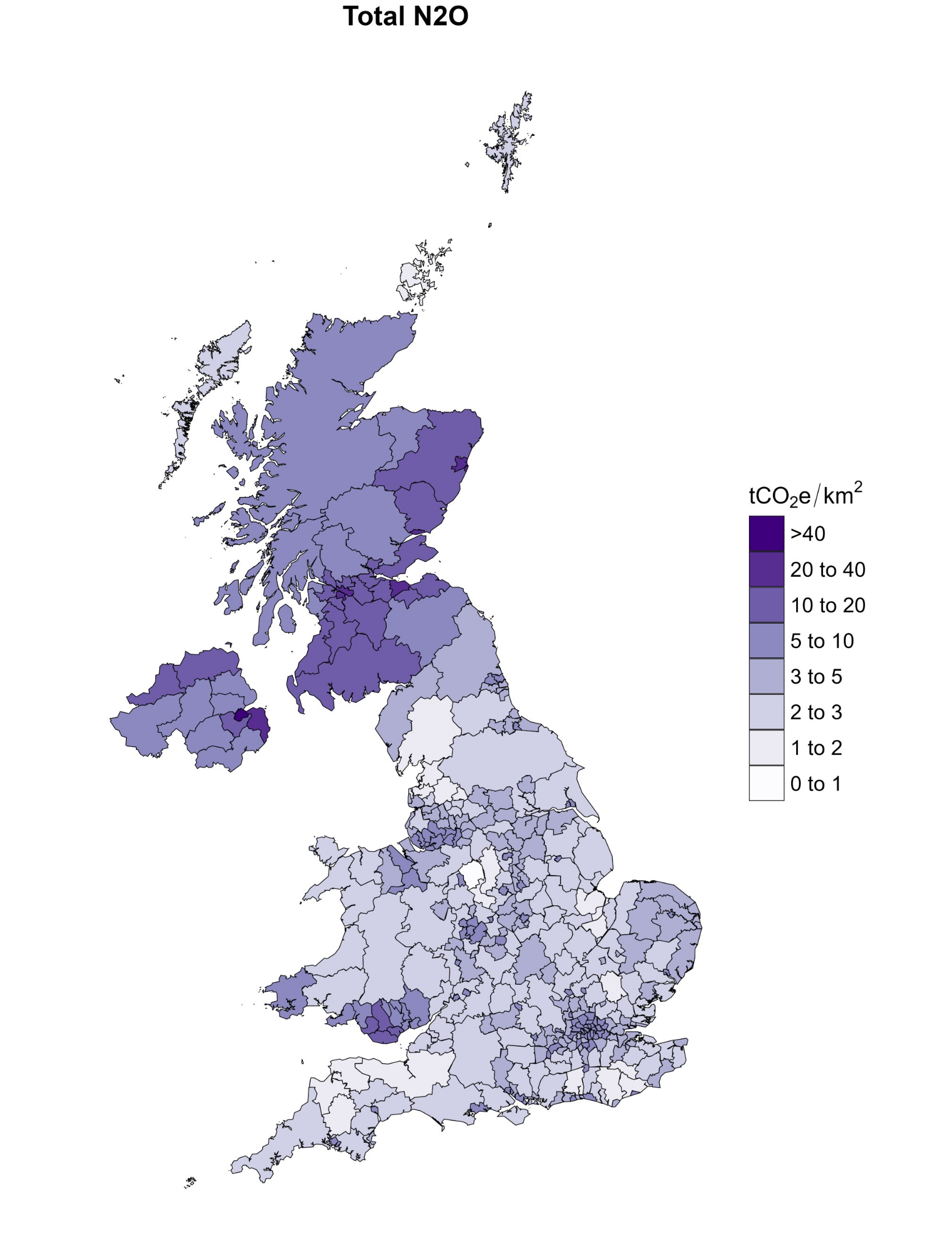
The total greenhouse gas emissions and removals for the UK land use, land-use change and forestry sector (excluding harvested wood products which cannot be mapped) are shown in Figure 19. Maps of emissions and removals of individual gases, CO2, CH4, and N2O are shown in Figures 20 to 22.
Figure 19: Emissions or removals of GHGs from land use, land-use change and forestry per local authority area (tCO2e/km2) in 2024.
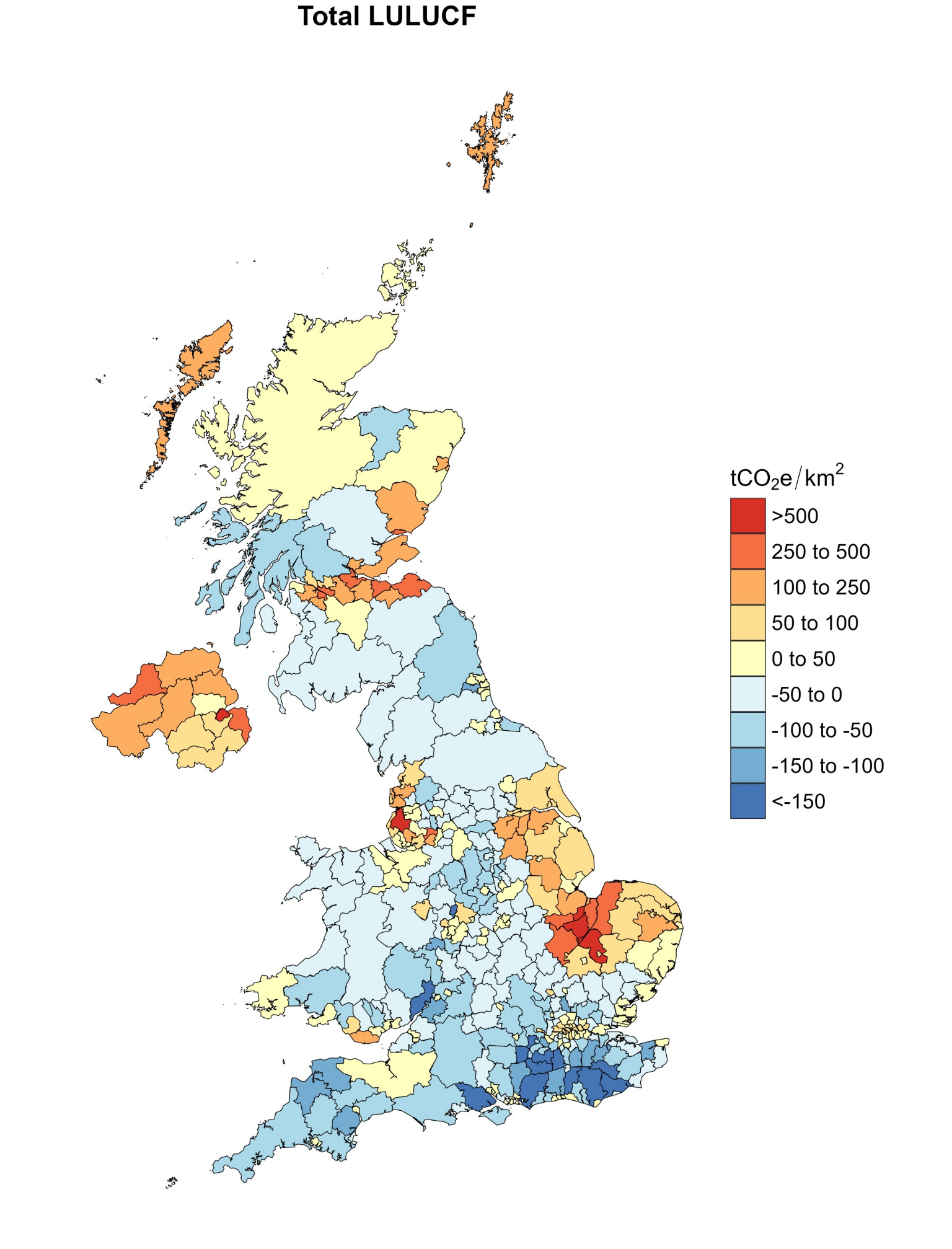
Figure 20: Emissions or removals of carbon from land use, land-use change and forestry per local authority area (tCO2e/km2) in 2024.
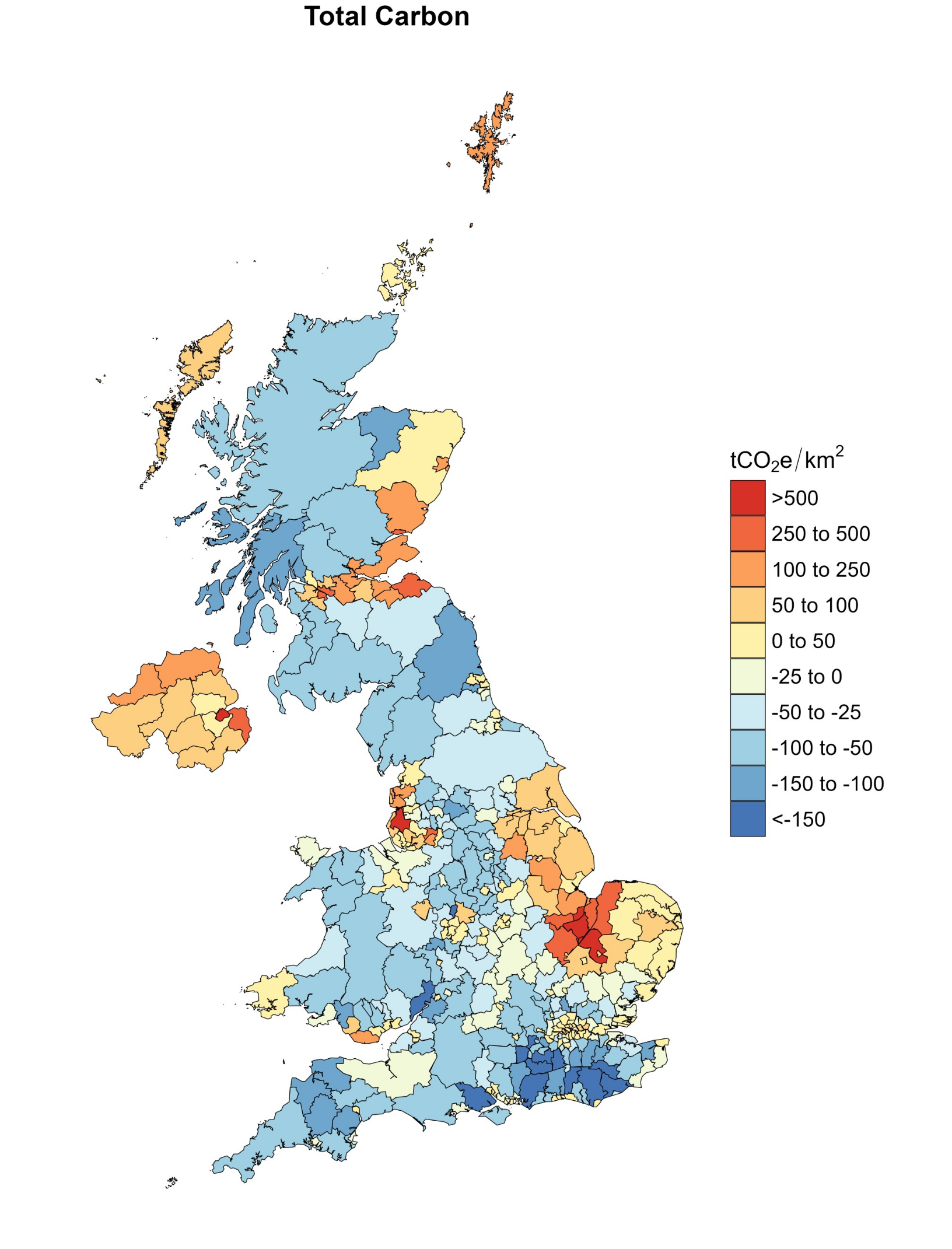
Figure 21: Emissions or removals of methane from land use, land-use change and forestry per local authority area (tCO2e/km2) in 2024.
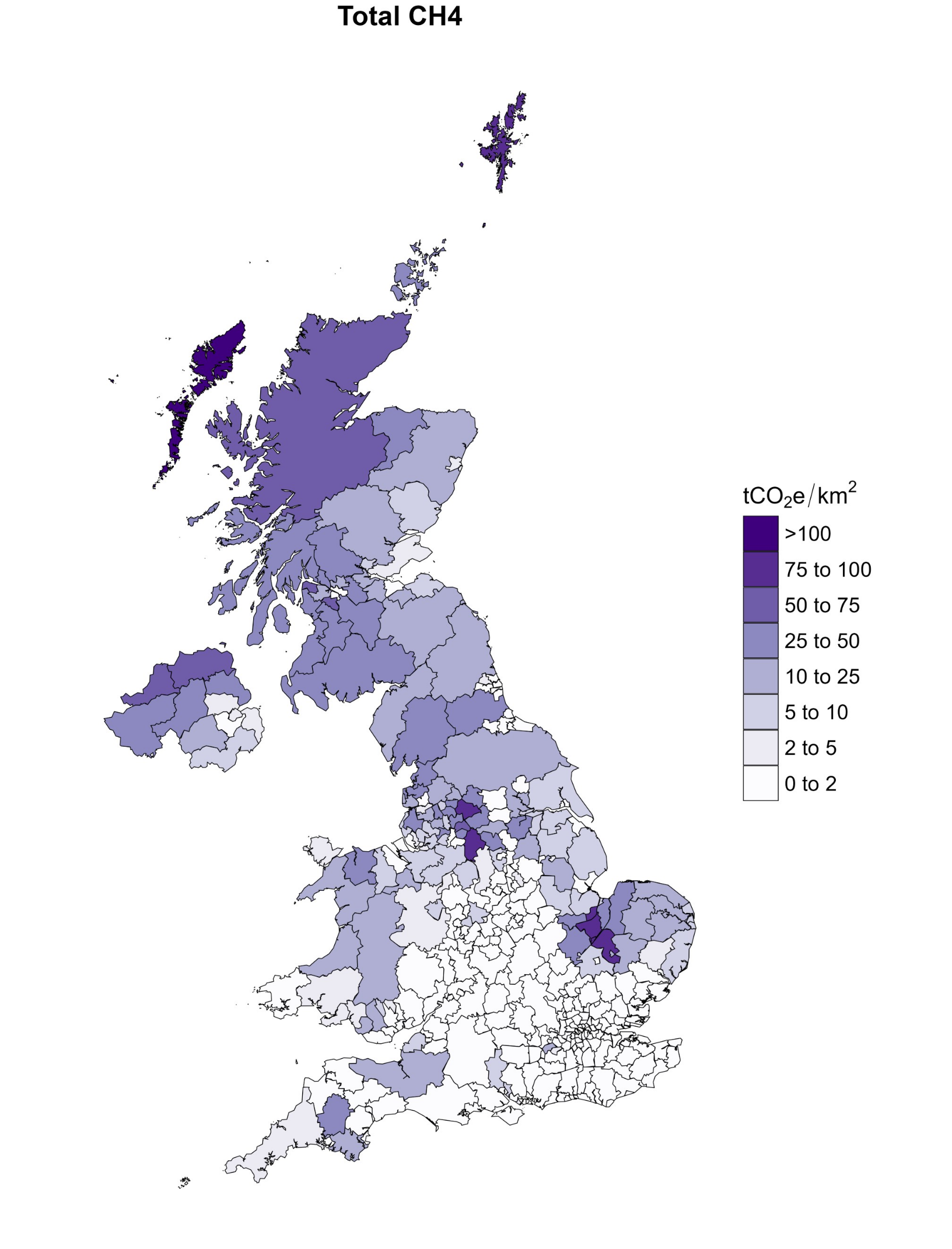
Figure 22: Emissions or removals of nitrous oxide from land use, land-use change and forestry per local authority area (tCO2e/km2) in 2024.
Uncertainties
The uncertainties in calculating the LULUCF inventory are described in an annex of the National Inventory Document (see Table A 5.1.60 in Brown et al. 2026) and range from 12-197% for CO2, 33-92% for CH4 and 34-158% for N2O in 2024 depending on the LULUCF sector activity. Additional uncertainty is associated with disaggregating the dataset to LA or Protected Landscape scale. It is estimated that the uncertainty in the disaggregation process is in the range of 20-30% on decadal timescales, though probably higher for annual estimates.
There is low uncertainty in the LA mapping of emissions associated with wildfire occurrence and emissions from organic soils due to fine-scale spatial input data.
Moderate uncertainty in the disaggregation process is attributed to emissions from soils due to land-use change, soils due to drainage, and the minor categories where the LUC-T disaggregation methods were employed (such as Non-Forest Biomass on Cropland and Grassland). The LUC-T methodology is probabilistic, therefore although spatial location of unchanged land and the trend in land use change is well constrained, the spatial location and timing of land use change is less certain.
There is higher uncertainty in the mapping of deforestation than the other land use changes which use the LUC-T methodology, due to challenges in identifying deforestation rather than land felled and awaiting restocking. Hence, the area of land remaining forest is used to disaggregate deforestation emissions. Similarly, the yearly evolution of the forest sink at LA level is assumed to follow the country level estimates relatively closely, but without explicit representation of forest management operations (including clear-fell operations) this introduces high uncertainty associated with the forest sink reported at LA or Protected Landscape scale for specific years.
Recalculations
The National Inventory is often updated to include improved, or new, datasets and modelling techniques. See Table 3 (in the PDF version of this document) for an overview of recalculations. More detailed descriptions of the changes can be found in the UK National Inventory Document and annexes (Brown et al. 2026).
References
Brown P, Cardenas L, Del Vento S, MacCarthy J, Mullen P, Gorji, S, Richmond B, Thistlethwaite G, Thomson A, Wakeling D, Willis D, Anthony S, Aston C, Bahou J, Barber R, Broomfield M, Buys G, Carnell E, Carswell A, Clilverd H, Dragosits U, Elliott M, Gibbs, M, Gilhespy S, Gluckman R, Hamilton N, Hampshire K, Henshall P, Hobson M, Ingledew D, Karagianni E, Kelsall A, King K, Levy P, Manning A, Marshall O, Matthews R, Milne A, Nickerson R, O’Doherty S, Pang Y, Passant N, Pearson B, Pitt J, Raine B, Redington A, Rose R, Richardson J, Sandars D, Skirvin D, Stanley K, Stewart R, Thornton A, Tomlinson S, Vaughan A, Walker C, Watterson J, Wong J, Young D, Young H (2026). UK Greenhouse Gas Inventory, 1990 to 2024: Annual Report for Submission under the Framework Convention on Climate Change. https://naei.energysecurity.gov.uk/reports/uk-greenhouse-gas-inventory-1990-2024-annual-report-submission-under-framework-convention
Clilverd, H.M., Nickerson, R., Jovani-Sancho, A.J., Thomson, A., Evans, C. 2025. Assessing the status of historic domestic fuel peat extraction sites. UKCEH report to Defra. pp36.
DAERA (2024) Agricultural Census in Northern Ireland 2024 https://www.daera-ni.gov.uk/publications/agricultural-census-northern-ireland-2024
Defra (2025a). Structure of the agricultural industry in England and the UK at June. https://www.gov.uk/government/statistical-data-sets/structure-of-the-agricultural-industry-in-england-and-the-uk-at-june#full-publication-update-history
Defra (2025b). British Survey of Fertiliser Practice: Fertiliser Use on Farm Crops for Crop Year 2024. Data for preceding years comes from earlier versions of the same publication. https://www.gov.uk/government/statistics/latest-british-survey-of-fertiliser-practice-report
Evans, C., Artz, R., Moxley, J., Smyth, M-A., Taylor, E., Archer, N., Burden, A., Williamson, J., Donnelly, D., Thomson, A., Buys, G., Malcolm, H., Wilson, D., Renou-Wilson, F., and Potts, J. (2017). Implementation of an emission inventory for UK peatlands. Report to the Department for Business, Energy and Industrial Strategy, Centre for Ecology and Hydrology, Bangor.88pp. https://naei.energysecurity.gov.uk/reports/implementation-emissions-inventory-uk-peatlands
GMA (2022). Growing media monitor. Trends in the composition of UK growing media supplied 2011 to 2022. Growing Media Association. https://hta.org.uk/growingmediamonitor
IPCC (2006). 2006 IPCC Guidelines for National Greenhouse Gas Inventories, Prepared by the National Greenhouse Gas Inventories Programme, Eggleston H.S., Buendia L., Miwa K., Ngara T. and Tanabe K. (eds). Published: IGES, Japan.
IPCC (2014). 2013 Supplement to the 2006 IPCC Guidelines for National Greenhouse Gas Inventories: Wetlands, Hiraishi, T., Krug, T., Tanabe, K., Srivastava, N., Baasansuren, J., Fukuda, M., and Troxler, T.G. (eds). Published: IPCC, Switzerland.
IPCC (2019) 2019 Refinement to the 2006 IPCC Guidelines for National Greenhouse Gas Inventories, Calvo Buendia, E., Tanabe, K., Kranjc, A., Baasansuren, J., Fukuda, M., Ngarize, S., Osako, A., Pyrozhenko, Y., Shermanau, P. and Federici, S. (eds). Published: IPCC, Switzerland.
Levy, P., Tomlinson, S., Buys, G. and Thomson, A. (2020) Improving Land Use Change Tracking in the UK Greenhouse Gas Inventory WP-A Approach and Datasets Report. https://naei.energysecurity.gov.uk/reports/improving-land-use-change-tracking-uk-greenhouse-gas-inventory-final-outputs-report
Levy, P., Tomlinson, S. and Raine, B. (2021) Improving Land Use Change Tracking in the UK Greenhouse Gas Inventory – Report on final outputs November 2021. https://naei.energysecurity.gov.uk/reports/improving-land-use-change-tracking-uk-greenhouse-gas-inventory-final-outputs-report
Milne, R. and Brown T.A. (1997). “Carbon in the vegetation and soils of Great Britain.” Journal of Environmental Management 49(4): 413-433.
Moxley, J., Angelopoulos, N., Buckingham, S., Laidlaw, S, Malcolm. H., Norton, L., Olave, R., Rees, R., Rowe, R., Tomlinson, S., Thomson, A., and Topp, K. (2014) Capturing the effect of Cropland and Grassland Management on biomass carbon stocks in the UK LULUCF inventory. Unpublished report by CEH for Department of Energy and Climate Change contract TRN265/09/2011.
Natural England (2020). https://data.gov.uk/dataset/8e3ae3b9-a827-47f1-b025-f08527a4e84e/areas-of-outstanding-natural-beauty-england. Accessed 1st April, 2022.
Natural England (2023). Natural Parks (England). https://www.data.gov.uk/dataset/334e1b27-e193-4ef5-b14e-696b58bb7e95/national-parks-england, Accessed 5th January, 2024.
Natural Resources Wales (2017). National Parks. https://data.gov.uk/dataset/949976cb-f952-4405-9fa1-bf531fdca0f5/national-parks, Accessed 27th March, 2020.
Natural Resources Wales (2022). https://data.gov.uk/dataset/b40871c7-ab45-44f1-8989-47f872e4a9da/areas-of-outstanding-natural-beauty-aonbs. Accessed 1st April, 2022
Office for National Statistics (2025) Local Authority Districts (May 2025) Boundaries UK BFC (V2). https://geoportal.statistics.gov.uk/datasets/ons::local-authority-districts-may-2025-boundaries-uk-bfc-v2/about, Accessed 2nd February 2026.
OpenDataNI (2016). https://data.gov.uk/dataset/f803cb72-e3d2-44df-8a0c-19a496bd7a5d/areas-of-outstanding-natural-beauty.
OpenDataNI (2023) OSNI Open Data - Largescale Boundaries - Local Government Districts (2012) https://www.opendatani.gov.uk/@land-property/osni-open-data-largescale-boundaries-local-government-districts-2012, Accessed 28th February 2023.
Rowland, C., Buys, G., Clark, L., Correia, V., Ditchburn, B., Evangelides, C., Higgins, A., Marston, C., Morton, D., Olave, R., O’Neil, A., Tomlinson, S., Walker, A., Watterson, J., Whitton, E., Williamson, J. and Thomson. A. (2021) BEIS Land-Use Tracking Project – WPB Final Report. https://naei.energysecurity.gov.uk/reports/improving-land-use-change-tracking-uk-greenhouse-gas-inventory-final-outputs-report
Scottish Government (2002). Loch Lomond and The Trossachs National Park Designated Boundary. https://data.gov.uk/dataset/6f63d73d-c45d-4947-8ad0-2d6f52b200ff/loch-lomond-and-the-trossachs-national-park-designated-boundary, Accessed 27th March, 2020.
Scottish Government (2010). Cairngorms National Park Designated Boundary. https://data.gov.uk/dataset/8a00dbd7-e8f2-40e0-bcba-da2067d1e386/cairngorms-national-park-designated-boundary. Accessed 27th March, 2020.
Scottish Government (2024) Results from the Scottish Agricultural Census: June 2024 https://www.gov.scot/publications/results-from-the-scottish-agricultural-census-june-2024/documents/agricultural-census—june-2024—detailed-tables/
UKCEH (2020a) Countryside Survey. EIDC. 2020. https://catalogue.ceh.ac.uk/id/2069de82-619d-4751-9904-aec8500d07e6.
Welsh Government (2024) Survey of Agricultural and Horticulture, June 2024. https://www.gov.wales/survey-agriculture-and-horticulture-june-2024
Annex 1
Inventory categories and spatial variables used for LUC-T disaggregation
| Inventory emission category | Gas | Spatial Variable | Group | From Land Use | To Land Use | Soil Type |
|---|---|---|---|---|---|---|
| Remaining broadleaf forest on mineral soil & biomass CSC | Carbon | Broadleaf Mineral >= 20 years | Remaining Land | NA | Forest Broadleaf | Mineral |
| To broadleaf forest on mineral soil & biomass CSC | Carbon | Broadleaf Mineral < 20 years | 20 year LUC | Any | Forest Broadleaf | Mineral |
| Remaining conifer forest on mineral soil & biomass CSC | Carbon | Conifer Mineral >= 20 years | Remaining Land | NA | Forest Conifer | Mineral |
| To conifer forest on mineral soil & biomass CSC | Carbon | Conifer Mineral < 20 years | 20 year LUC | Any | Forest Conifer | Mineral |
| Remaining broadleaf forest on organic soil & biomass CSC | Carbon | Broadleaf Organic >= 20 years | Remaining Land | NA | Forest Broadleaf | Organic |
| To broadleaf forest on organic soil & biomass CSC | Carbon | Broadleaf Organic < 20 years | 20 year LUC | Any | Forest Broadleaf | Organic |
| Remaining conifer forest on organic soil & biomass CSC | Carbon | Conifer Organic >= 20 years | Remaining Land | NA | Forest Conifer | Organic |
| To conifer forest on organic soil & biomass CSC | Carbon | Conifer Organic < 20 years | 20 year LUC | Any | Forest Conifer | Organic |
| Remaining forest on mineral soil draining and rewetting | N2O | Current Forest Mineral | Current Land Use | NA | Forest | Mineral |
| To forest inorganic fertiliser application and indirect N2O (deposition and leaching) | N2O | Grassland to Forest Organic in previous three years and Settlement to Forest in previous three years | Change in previous three years | Grassland, Settlement | Forest, Forest | Organic, All |
| Cropland to forest land use change soils direct N2O and indirect N2O (leaching) | N2O | Cropland to Forest Mineral < 20 years | 20 year LUC | Cropland | Forest | Mineral |
| Grassland to forest land use change soils direct N2O and indirect N2O (leaching) | N2O | Grassland to Forest Mineral < 20 years | 20 year LUC | Grassland | Forest | Mineral |
| Settlement to forest land use change soils direct N2O and indirect N2O (leaching) | N2O | Settlement to Forest Mineral < 20 years | 20 year LUC | Settlement | Forest | Mineral |
| Cropland management soil | Carbon | Current Cropland Mineral | Current Land Use | NA | Cropland | Mineral |
| Cropland management biomass | Carbon | Current Cropland | Current Land Use | NA | Cropland | All |
| Cropland remaining Cropland CSC | Carbon | Cropland Mineral >= 20 years | Remaining Land | NA | Cropland | Mineral |
| Grassland to Cropland Non-forest Biomass | Carbon | Grassland to Cropland in the last year | Change in previous year | Grassland | Cropland | All |
| Settlement to Cropland Non-forest Biomass | Carbon | Settlement to Cropland in the last year | Change in previous year | Settlement | Cropland | All |
| Forest to Cropland land use change soils: CSC, direct N2O and indirect N2O (leaching) | Carbon, N2O | Forest to Cropland Mineral < 20 years | 20 year LUC | Forest | Cropland | Mineral |
| Grassland to Cropland land use change soils: CSC, direct N2O and indirect N2O (leaching) | Carbon, N2O | Grassland to Cropland Mineral < 20 years | 20 year LUC | Grassland | Cropland | Mineral |
| Settlement to Cropland land use change soils CSC | Carbon | Settlement to Cropland Mineral < 20 years | 20 year LUC | Settlement | Cropland | Mineral |
| Deforestation to Cropland: Dead Organic Matter, Living Biomass, Burning | Carbon, N2O, CH4 | Forest >= 20 years | Remaining land | NA | Forest | All |
| Grassland management biomass | Carbon | Current Grassland | Current land use | NA | Grassland | All |
| Grassland remaining Grassland: CSC, direct N2O and indirect N2O (leaching) | Carbon, N2O | Grassland Mineral >= 20 years | Remaining land | NA | Grassland | Mineral |
| Cropland to Grassland Non-forest Biomass | Carbon | Cropland to Grassland in the last year | Change in previous year | Cropland | Grassland | All |
| Settlement to Grassland Non-forest Biomass | Carbon | Settlement to Grassland in the last year | Change in previous year | Settlement | Grassland | All |
| Deforestation to Grassland: Dead Organic Matter, Living Biomass, Burning | Carbon, N2O, CH4 | Forest >= 20 years | Remaining land | NA | Forest | All |
| Forest to Grassland Land Use Change soils: CSC, direct N2O and indirect N2O (leaching) | Carbon, N2O | Forest to Grassland Mineral < 20 years | 20 year LUC | Forest | Grassland | Mineral |
| Cropland to Grassland Land Use Change soils: CSC | Carbon | Cropland to Grassland Mineral < 20 years | 20 year LUC | Cropland | Grassland | Mineral |
| Settlement to Grassland Land Use Change soils CSC | Carbon | Settlement to Grassland Mineral < 20 years | 20 year LUC | Settlement | Grassland | Mineral |
| Settlement remaining Settlement: CSC, direct N2O and indirect N2O (leaching) | Carbon, N2O | Settlement Mineral >= 20 years | Remaining land | NA | Settlement | Mineral |
| Deforestation to Settlement: Dead Organic Matter, Living Biomass, Burning | Carbon, N2O, CH4 | Forest >= 20 years | Remaining land | NA | Forest | All |
| Forest to Settlement Land Use Change soils: CSC, direct N2O and indirect N2O (leaching) | Carbon, N2O | Forest to Settlement Mineral < 20 years | 20 year LUC | Forest | Settlement | Mineral |
| Cropland to Settlement Land Use Change soils: CSC, direct N2O and indirect N2O (leaching) | Carbon, N2O | Cropland to Settlement Mineral < 20 years | 20 year LUC | Cropland | Settlement | Mineral |
| Grassland to Settlement Land Use Change soils: CSC, direct N2O and indirect N2O (leaching) | Carbon, N2O | Grassland to Settlement Mineral < 20 years | 20 year LUC | Grassland | Settlement | Mineral |
| Cropland to Settlement Non-forest Biomass | Carbon | Cropland to Settlement in last year | Change in previous year | Cropland | Settlement | All |
| Grassland to Settlement Non-forest Biomass | Carbon | Grassland to Settlement in last year | Change in previous year | Grassland | Settlement | All |
| Forest Wildfires | Carbon, N2O, CH4 | Current Forest | Current Land Use | NA | Forest | All |
| Cropland Wildfires | N2O, CH4 | Current Cropland | Current Land Use | NA | Cropland | All |
| Grassland Wildfires | N2O, CH4 | Current Grassland | Current Land Use | NA | Grassland | All |
Annex 2
Territorial Emission Sector descriptions
| TES Subsector | TES Category | Notes |
|---|---|---|
| Forestry | Forest land remaining forest land | Carbon stock change in biomass and mineral soils for forests > 20 years old. Emissions from drainage of mineral soils under forest. |
| Land converted from forest land | Carbon stock change in biomass and mineral soils from deforested land. Direct and indirect N2O emissions from soil mineralisation following deforestation. Emissions from controlled burning following deforestation. | |
| Land converted to forest land | Carbon stock change in biomass and mineral soils from forests < 20 years old. Direct and indirect N2O emissions from soil mineralisation from forests < 20 years old. Direct and indirect N2O emissions from forest fertilisation. | |
| Harvested wood products | Carbon stock change from harvested wood products from all forest. Note this is not disaggregated to LA scale. | |
| Cropland mineral soils change | Cropland remaining cropland | Carbon stock change in mineral soils from cropland > 20 years old. Direct and indirect N2O emissions from soil mineralisation from cropland >20 years old are reported in the Agriculture sector. |
| Grassland converted to cropland | Carbon stock change in mineral soils from cropland < 20 years old. Direct and indirect N2O emissions from soil mineralisation. | |
| Settlement converted to cropland | Carbon stock change in mineral soils from cropland < 20 years old. | |
| Grassland mineral soils change | Cropland converted to grassland | Carbon stock change in mineral soils from grassland < 20 years old. |
| Grassland remaining grassland | Carbon stock change in mineral soils from grassland > 20 years old. Direct and indirect N2O emissions from soil mineralisation. | |
| Settlement converted to grassland | Carbon stock change in mineral soils from grassland < 20 years old. | |
| Peatland | Cropland drained | Emissions from drained cropland on organic soils. Not including N2O which is reported in the Agriculture sector. |
| Domestic extraction | On-site emissions from domestic peat extraction (fuel use). | |
| Eroding modified bog drained | Emissions from drained eroding modified bog (bare peat). | |
| Eroding modified bog undrained | Emissions from undrained eroding modified bog (bare peat). | |
| Extensive grassland drained | Emissions from drained extensive grassland on organic soils. | |
| Forest drained | Emissions from drained forest on organic soils. | |
| Industrial extraction | On-site and off-site emissions from industrial peat extraction (horticultural use). | |
| Intensive grassland drained | Emissions from drained intensive grassland on organic soils. Not including N2O which is reported in the Agriculture sector. | |
| Modified bog drained | Emissions from drained modified bog (semi-natural heather and grass dominated bog). | |
| Modified bog undrained | Emissions from undrained modified bog (semi-natural heather and grass dominated bog). | |
| Near-natural bog | Emissions/removals from near-natural bog. | |
| Near-natural fen | Emissions/removals from near-natural fen. | |
| Rewetted bog | Emissions from rewetted bog. | |
| Rewetted fen | Emissions from rewetted fen. | |
| Rewetted modified bog | Emissions from rewetted modified (semi-natural) bog. | |
| Settlement drained | Emissions from drained settlement on organic soils. | |
| Settlement | Settlement remaining settlement | Carbon stock change in mineral soils from settlement > 20 years old. Direct and indirect N2O emissions from soil mineralisation. |
| Land converted to settlement | Carbon stock change in mineral soils and biomass from settlement < 20 years old. Direct and indirect N2O emissions from soil mineralisation. | |
| Bioenergy crops | Miscanthus | Carbon stock change in biomass and mineral soils from the management of Miscanthus crops. |
| Short rotation coppice | Carbon stock change in biomass and mineral soils from the management of short rotation coppice crops. | |
| Other LULUCF | Forest miscellaneous | Emissions from wildfires on forest land. |
| Cropland miscellaneous | Emissions from wildfires on cropland. Carbon stock change from non-forest biomass on land converted to cropland. Carbon stock change in biomass and mineral soils from the management of non-bioenergy crops. | |
| Grassland miscellaneous | Emissions from wildfires on grassland. Carbon stock change from non-forest biomass on land converted to grassland. Carbon stock change in biomass from grassland management. | |
| Wetland miscellaneous | Carbon stock change in biomass from reservoir creation. |