Travel time measures for local 'A' roads: January to December 2025 report
Published 14 May 2026
Applies to England

© Crown copyright 2026
This publication is licensed under the terms of the Open Government Licence v3.0 except where otherwise stated. To view this licence, visit nationalarchives.gov.uk/doc/open-government-licence/version/3 or write to the Information Policy Team, The National Archives, Kew, London TW9 4DU, or email: psi@nationalarchives.gov.uk.
Where we have identified any third party copyright information you will need to obtain permission from the copyright holders concerned.
This publication is available at https://www.gov.uk/government/statistics/travel-time-measures-for-the-strategic-road-network-and-local-a-roads-january-to-december-2025/travel-time-measures-for-local-a-roads-january-to-december-2025-report
About this release
This statistical release presents information about travel times on Local Highway Authority managed ‘A’ roads in England. The measures in this release are estimated using in-vehicle Global Positioning Systems (GPS) observations.
An accompanying release covers data on the Strategic Road Network (SRN). Due to methodological differences between the local ‘A’ Road and SRN data these are not directly comparable, see the methodology and technical details section for further details.
These are accredited official statistics [footnote 1] and were independently reviewed by the Office for Statistics Regulation in 2012. For more information, see the About these statistics section.
Definitions of key terminology can be found in the glossary.
Notes on the methodology and sample
These travel-time measures are based on data matched to the Ordnance Survey Highways Network representation of the local ‘A’ road network in England.
Sample changes and series break
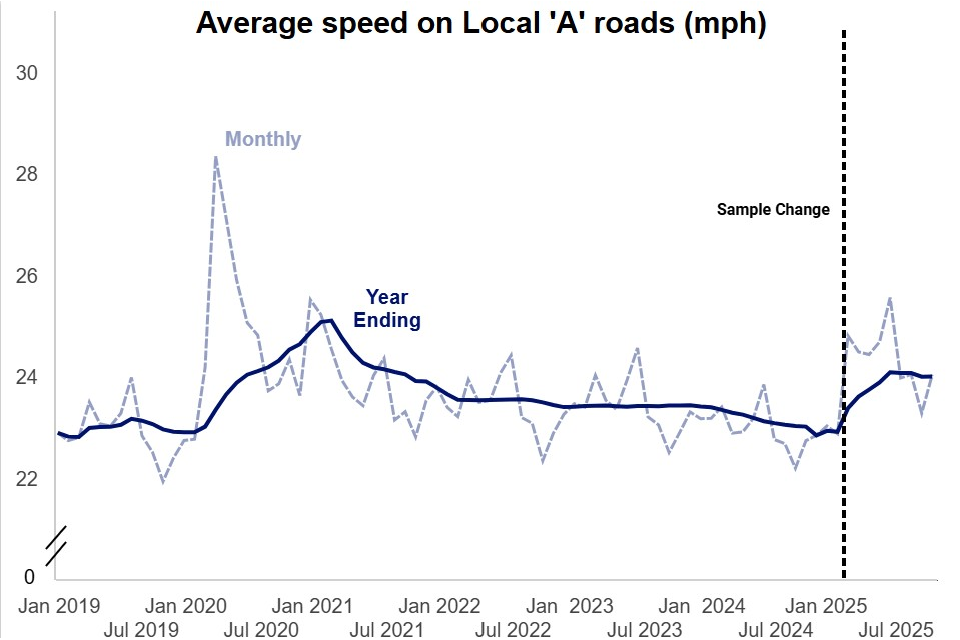
There has been a step change in congestion statistics due to changes in the underlying vehicle sample for the local ‘A’ roads data from April 2025. It is therefore not possible to compare this new data over a longer time period. The change in the sample is not consistent across the country. The areas with the largest changes in sample have shown the largest changes in average speed and delay.
Further information about the impact of this change in sample can be found in the Methodology Note.
1. Headline Statistics
On local ‘A’ roads in England in 2025, the average speed was 24.0 miles per hour (mph).
The average delay on local ‘A’ roads in England in 2025 was 41.5 seconds per vehicle per mile (spvpm).
There has been a large step change in congestion statistics due to changes in the underlying vehicle sample for the local ‘A’ roads data from April 2025. It is therefore not possible to compare this new data over a longer time period.
2. National Overview
This section contains annual average speed and delay values for all of England for the year ending December 2025.
2.1 Speed
The average speed on Local ‘A’ roads in England across 2025 was estimated to be 24.0 mph.
Chart 1: Average speed on Local ‘A’ roads in England (Table CGN0503a)
2.2 Delay
The average delay on Local ‘A’ roads in England across 2025 was estimated to be 41.5 spvpm.
Chart 2: Average delay on local ‘A’ roads in England (Table CGN0504a)
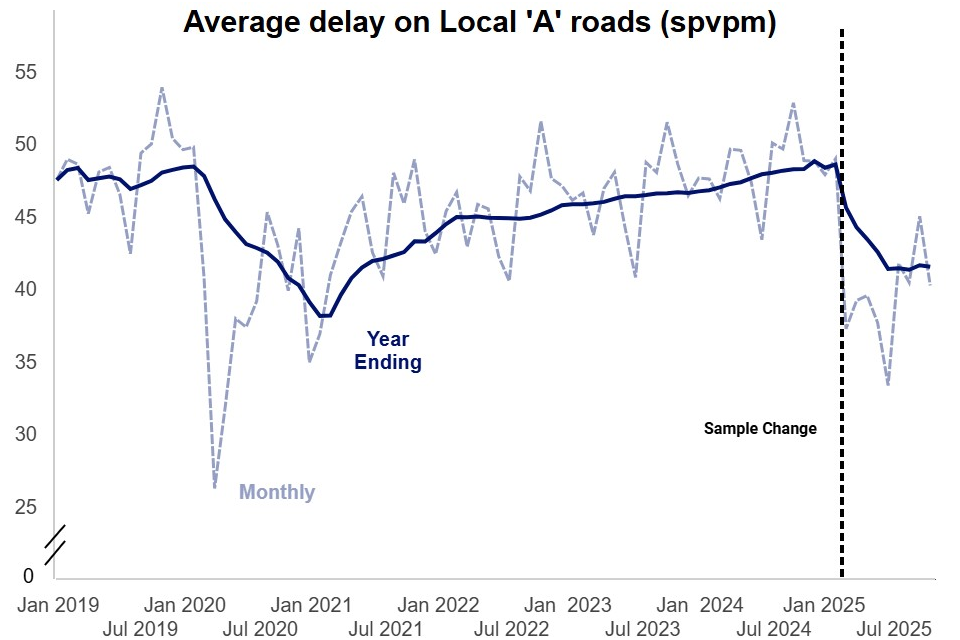
It is important to note that delay is affected by free flow speeds. As a result, a fixed absolute decrease in observed speeds will translate into a higher level of delay with a low free flow speed relative to those with a high free flow speed. An example of this is illustrated in Infographic 1.
Infographic 1: Illustrative example of average of delay
3. Peak Times Breakdown
This section contains average speed and delay values for all of England for the year ending December 2025, split across the following time periods:
-
Weekday Morning Peak – 7am to 10am Monday to Friday
-
Weekday Inter Peak – 10am to 4pm Monday to Friday
-
Weekday Evening Peak – 4pm to 7pm Monday to Friday
-
Weekday Off Peak – 7pm to 7am Monday to Friday
In general, the lowest speeds and highest delay values are observed in the morning and evening peak periods.
3.1 Speed
Average speed split by time period for 2025 is given in Table 2 below:
Table 2: Average annual speed on local ‘A’ roads split by time period (Table CGN0503a)
| Time Period | 2025 Average speed (mph) |
|---|---|
| Weekday Morning Peak | 22.7 |
| Weekday Inter Peak | 23.4 |
| Weekday Evening Peak | 21.6 |
| Weekday Off Peak | 29.1 |
3.2 Delay
Average delay split by time period is given in the Table 3 below:
Table 3: Average annual delay on local ‘A’ roads split by time period (Table CGN0504a)
| Time Period | 2025 Average delay (spvpm) |
|---|---|
| Weekday Morning Peak | 49.4 |
| Weekday Inter Peak | 44.9 |
| Weekday Evening Peak | 57.6 |
| Weekday Off Peak | 17.5 |
4. Urban/Rural Split
This section contains average speed and delay values for all of England for the year ending December 2025, split between urban and rural roads.
4.1 Speed
For the year ending December 2025, the average speed on urban classified local ‘A’ roads was 17.1 mph.
For the year ending December 2025, the average speed on rural classified local ‘A’ roads 34.3 mph.
4.2 Delay
For the year ending December 2025, the average delay on urban classified local ‘A’ roads was 71.1 spvpm.
For the year ending December 2025, the average delay on rural classified local ‘A’ roads was 19.8 spvpm.
It is important to note that urban roads generally have lower free flow speeds than rural roads. As a result, a fixed absolute decrease in observed speeds will generally translate into a higher level of delay on urban roads relative to rural roads.
5. Sub-national Transport Bodies (STBs) Breakdown
This section contains average speed and delay values for the year ending December 2025, split by sub-national transport body. Map 1 displays the geographic coverage and delay values of the STBs.
What are STBs?
The Sub-national Transport Bodies are transport bodies formed of multiple local highways authorities to provide large-scale strategic governance. STBs are given statutory power through secondary legislation.
5.1 Speed
Annual average speeds for the STBs for the year ending December 2025 are given in Chart 3. Values for the year ending December 2024 are given for comparison.
Chart 3: Average speed on local ‘A’ roads by Sub-national Transport Bodies (Table CGN0503b)
| STB | 2025 Average Speed (mph) |
|---|---|
| Transport for the North | 23.6 |
| Midlands Connect | 25.9 |
| England’s Economic Heartland | 29.6 |
| Transport East | 29.9 |
| Greater London Authority | 15.1 |
| Transport for the South East | 26.1 |
| Western Gateway | 26.5 |
| Peninsula Transport | 29.1 |
A map displaying average speed on the Strategic Road Network split by Sub-national Transport Body is published on ArcGIS Online.
5.2 Delay
Annual average delay values for the STBs for the year ending December 2024 are given in Chart 4. Values for the year ending December 2024 are given for comparison.
Chart 4: Average delay on local ‘A’ roads by Sub-national Transport Bodies (Table CGN0504b).
| STB | 2025 Average Delay (spvpm) |
|---|---|
| Transport for the North | 42.5 |
| Midlands Connect | 36.3 |
| England’s Economic Heartland | 29.4 |
| Transport East | 28.8 |
| Greater London Authority | 85.8 |
| Transport for the South East | 35.2 |
| Western Gateway | 34.1 |
| Peninsula Transport | 24.8 |
Map 1: Average delay on local ‘A’ roads by Sub-national Transport Body in England, 2025 (Table CGN0504b)

6. Local Authority Breakdown
This section contains average speed and delay values for the year ending December 2025, split by Local Highway Authority.
A map displaying average speed on local ‘A’ roads, split by Local Highway Authority is published on ArcGIS Online.
Average delay on Local ‘A’ Roads split by Local Highway Authority is shown in Map 2.
Map 2: Average delay on local ‘A’ roads by Local Highway Authority in England, 2025 (Table CGN0504d)

7. Further Geographic Breakdowns
Further geographic breakdown of speed and delay on Local ‘A’ Roads are included in the data tables as described below. Interactive maps visualising these breakdowns as well as those presented above are published on ArcGIS Online.
7.1 Combined Authorities
Data is available for combined authorities within the data tables CGN503c and CGN0504c.
7.2 Road Level
Travel time measures for individual Local ‘A’ roads are available from 2021 onwards. The annual average speed and average delay for individual roads can be found in Tables CGN0503e and CGN0504e.
8. Coronavirus (COVID-19) effect on congestion
The coronavirus (COVID-19) pandemic has had a marked impact on everyday life, including on congestion on the road network.
Exploratory analysis was conducted for 2020 to estimate the impact of the coronavirus pandemic on congestion and can be found at the storymap included with the 2020 annual publication. A fall in the number of vehicles on the roads could be seen from when the national lockdown was announced in March 2020. Therefore, data has been considered as “affected by the pandemic” from 12 March 2020 to March 2022.
As with previous years, most road traffic has trended back towards levels seen before the pandemic.
9. Context and user feedback
The local ‘A’ road measures presented in this release were developed to provide a more complete picture of travel times on local ‘A’ roads and to align with measures introduced for the SRN.
Following user feedback this release has developed the statistics to include Subnational Transport Body level data for the SRN and local ‘A’ roads. Interactive maps have also been developed using ArcGIS Online for the SRN and local ‘A’ roads. We will continue to review the content and presentation of these statistics, which we expect to develop further over time. Please contact us with any feedback you have, or if you would like further information.
10. Methodology and technical details
Average Speed and Delays are calculated from in-vehicle GPS units and weighted by road traffic flows to better represent the volume of traffic at different locations and times of day. For the Local ‘A’ roads data, the sample includes cars and vans.
It is important to note that although figures are produced for average speed and average delay on both the Local ‘A’ and SRN networks, they are not directly comparable. The methodological differences between the Local ‘A’ road and SRN data prevents comparison between the 2 road types. A full explanation and further information on the data used, methodology, quality assurance and other sources of data can be found in the Background Quality Report. Data throughout this release is compared on an annual basis, rather than quarterly within year, due to seasonality.
Due to sample changes in the purchased GPS dataset a break in the timeseries has been introduced from April 2025. A comparison of the consistent sample from 2023 and the complete sample has been calculated to understand the impact of this change on the average speed and delay statistics. Further information on this change can be found in the methodology note.
11. Glossary
The glossary below contains some key terms utilised in this statistical release and how these are defined.
| Term | Definition |
|---|---|
| Average Speed | Speed is measured in miles per hour and is an estimate of the physical level of congestion across the entire day (24-hour period). The metric weights speed observations from a sample of vehicles so that it is representative of traffic volumes. The weighting for local ‘A’ roads accounts for associated traffic flows, time period, month, urban or rural classification, and local authority. |
| Average Delay | Delay is measured in seconds per vehicle per mile and is the difference between free flow travel times and recorded average journey times across the entire day (24-hour period). This metric is indicative of the relative congestion on the network. Road users do not typically expect free flow conditions and will perceive delay relative to their expected conditions. |
| Free Flow Speed | Free Flow for Local ‘A’ roads is measured as the 85th percentile speed observation for each individual road section. Free flow speeds are ‘capped’ at national speed limits to give an estimated speed of traffic if there was no congestion. |
| Urban and Rural Roads | For statistical purposes, DfT defines ‘urban’ roads to be those within a settlement of 10,000 people or more. This is consistent with the Rural and Urban Area Classification 2011. All other roads are defined as ‘rural’. |
| SRN | Strategic Road Network. The SRN covers ‘A’ roads and motorways that are operated by National Highways. |
| STB | Sub-national Transport Body. The STBs are transport bodies formed of multiple local highways authorities to provide large-scale strategic governance. STBs are given statutory power through secondary legislation. |
12. About these statistics
These official statistics were independently reviewed by the Office for Statistics Regulation and confirmed as accredited statistics in 2012. They comply with the standards of trustworthiness, quality and value in the Code of Practice for Statistics and should be labelled ‘accredited official statistics’.
13. Next update
The next quarterly table update in this series is expected to be published in June 2026. This will contain monthly, and annual (year ending) figures, for the period April 2025 to March 2026. This will include new figures for the period January 2026 to March 2026.
The next annual written report is expected to be published in February 2027 and will contain annual figures for 2026.
Instructions for printing and saving
Depending on which browser you use and the type of device you use (such as a mobile or laptop) these instructions may vary.
You will find your print and save options in your browser’s menu. You may also have other options available on your device. Tablets and mobile device instructions will be specific to the make and model of the device.
14. How to search
Select Ctrl and F on a Windows laptop or Command and F on a Mac
This will open a search box in the top right-hand corner of the page. Type the word you are looking for in the search bar and press enter.
Your browser will highlight the word, usually in yellow, wherever it appears on the page. Press enter to move to the next place it appears.
15. Contact us
Road congestion and travel times
Email congestion.stats@dft.gov.uk
Media enquiries 0300 7777 878
To hear more about DfT statistical publications as they are released, follow us on X at DfTstats.
-
Accredited official statistics are called National Statistics in the Statistics and Registration Service Act 2007. Accredited Official Statistics Policy – Office for Statistics Regulation ↩