2025 Break in the Local A road series: Methodology note on the implications of a sample change for the Local A road Congestion statistics
Updated 30 September 2026
Applies to England, Scotland and Wales

© Crown copyright 2026
This publication is licensed under the terms of the Open Government Licence v3.0 except where otherwise stated. To view this licence, visit nationalarchives.gov.uk/doc/open-government-licence/version/3 or write to the Information Policy Team, The National Archives, Kew, London TW9 4DU, or email: psi@nationalarchives.gov.uk.
Where we have identified any third party copyright information you will need to obtain permission from the copyright holders concerned.
This publication is available at https://www.gov.uk/government/publications/road-congestion-and-travel-time-statistics-information/2025-break-in-the-local-a-road-series-methodology-note-on-the-implications-of-a-sample-change-for-the-local-a-road-congestion-statistics
1. Background
Congestion statistics are based on data provided by Ctrack/Inrix from multiple GPS data sources.
The dataset prior to 2025 had primarily been formed by four data streams from different sources. The sample has two data streams which have remained consistent, whilst there have been important quality improvements to the remaining data streams.
The changes in data streams have led to a change in the composition of the overall sample. Previously, there were a larger number of vans in the sample.
All trips by all vehicle classes are real trips and reflect the performance of the road network at a given point in time, however the driving profiles of vans and cars tend to behave differently. Although all trips are true values, the sample bias can alter average speed and delay values due to its composition.
The change in sample composition has brought the vehicle profile into greater balance with vehicle journeys and now includes more cars.
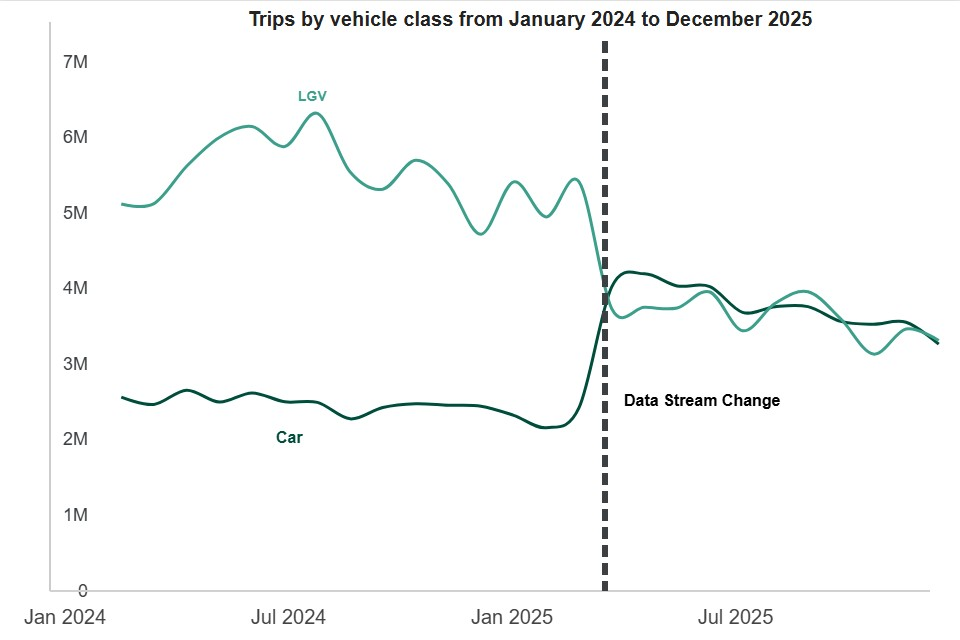
Chart 1: Trips by vehicle class from January 2024 to December 2025
There are also regional biases in the sample change, as not every data provider covers the entire country. In the change from Jan-Mar 2025 to Apr-Jun 2025, we see a decrease in the total vehicle hours recorded for London and the North West regions, while there are smaller increases in vehicle hours for the South West, East of England and Yorkshire and The Humber. Although we do flow-weight our statistics to be representative of traffic on the network, this change in sample composition will also have an impact in congestion for these regions that can have a cumulative impact in the national figures.
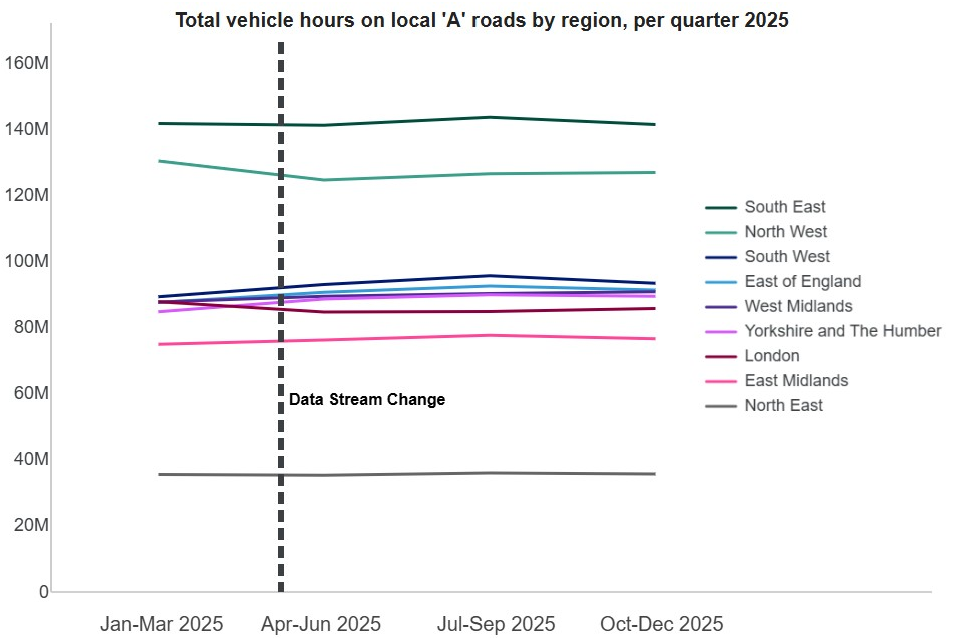
Chart 2: Total vehicle hours by region from January 2024 to December 2025
2. Statistical evaluation
A comparison of the trends seen in the consistent data streams and the trend for combined data streams was undertaken. This showed that the change in sample of for the updated data stream did have an impact on magnitude and trends.
A Pettitt test was used on both the consistent data streams and combined data streams to identify months with statistically significant shifts in trends on the time series. For the combined data streams, the probable point of change (K) was identified as April 2025 with a very high degree of significance for speed (p<0.008) and delay (p<0.003).
For the consistent provider data streams, the Pettitt test found no significant point of change.
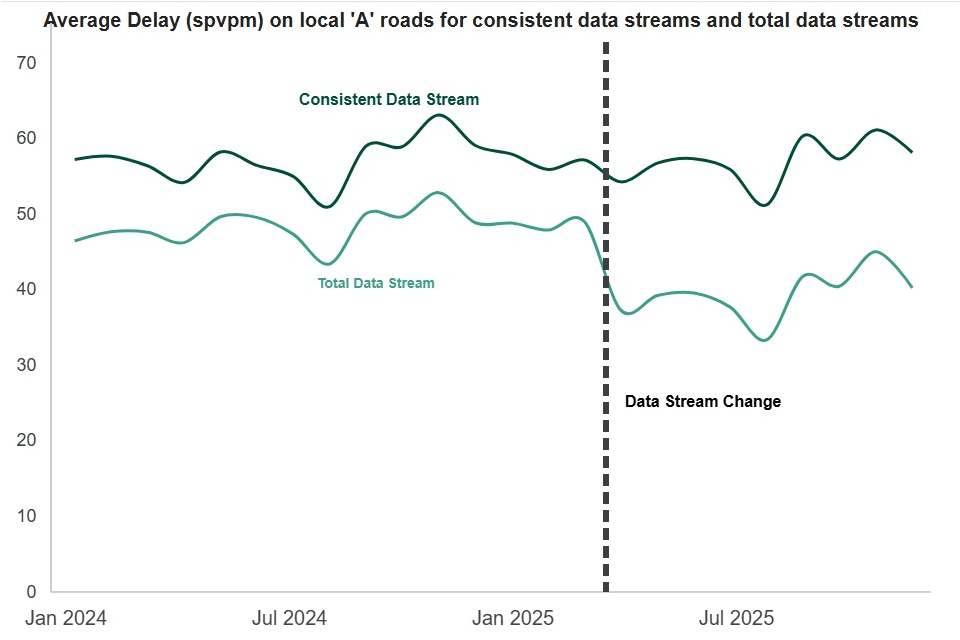
Chart 3: Total and Consistent Provider data stream average delay from January 2024 to December 2025
3. Conclusion
We would expect some changes in GPS sample as a standard part of the evolving dataset. However, the more fundamental change seen in the sample composition has resulted in statistical break in the series.
Whilst we are still making the data from 2021 onwards available to users, year on year comparison between 2025 and prior to 2025 should be treated with caution and do not recommend that conclusions should be drawn from those comparisons.
As part of our active management of quality of the statistical series, we will continue to monitor the sample profile. The decision to recommend a break in the series will only be made where there are statistical significant shifts in trend and/or magnitude.
4. Instructions for printing and saving
Depending on which browser you use and the type of device you use (such as a mobile or laptop) these instructions may vary.
Tablets and mobile devices normally have the option to “find in text” and “print or save” in their sharing or quick options menu of their browser, but this will vary by device model.
5. How to search
Select Ctrl and F on a Windows laptop or Command and F on a Mac
This will open a search box in the top right-hand corner of the page. Type the word you are looking for in the search bar and press enter.
Your browser will highlight the word, usually in yellow, wherever it appears on the page. Press enter to move to the next place it appears.
6. Contact details
Road congestion and travel times
Email congestion.stats@dft.gov.uk
Media enquiries 0300 7777 878