Travel time measures for the Strategic Road Network: January to December 2025 report
Published 14 May 2026
Applies to England

© Crown copyright 2026
This publication is licensed under the terms of the Open Government Licence v3.0 except where otherwise stated. To view this licence, visit nationalarchives.gov.uk/doc/open-government-licence/version/3 or write to the Information Policy Team, The National Archives, Kew, London TW9 4DU, or email: psi@nationalarchives.gov.uk.
Where we have identified any third party copyright information you will need to obtain permission from the copyright holders concerned.
This publication is available at https://www.gov.uk/government/statistics/travel-time-measures-for-the-strategic-road-network-and-local-a-roads-january-to-december-2025/travel-time-measures-for-the-strategic-road-network-january-to-december-2025-report
About this release
This statistical release presents information about travel times on the Strategic Road Network (SRN) - the roads managed by National Highways. The measures in this release are estimated using in-vehicle Global Positioning Systems (GPS) observations.
An accompanying release covers data on the local ‘A’ roads. Due to methodological differences between the local ‘A’ Road and SRN data these are not directly comparable, see the methodology and technical details section for further details.
These are accredited official statistics [footnote 1] and were independently reviewed by the Office for Statistics Regulation in 2012. For more information, see the About these statistics section.
Definitions of key terminology can be found in the glossary.
Notes on the methodology and sample
These travel time measures are based on data matched to National Highways’ National Traffic Information Service (NTIS) network in England.
The SRN covers ‘A’ roads and motorways that are operated by National Highways.
1. Headline Statistics
On the SRN in 2025, average speed was 56.6 mph. This is up 1.3% from 55.9 mph in 2024.
The average delay in 2025 was 11.0 seconds per vehicle per mile (spvpm). This is down 6.0% from 11.7 spvpm in 2024.
Table 1: Average annual speed and annual delay on the SRN per year (Tables CGN0404a and CGN0405a)
| Year | 2021 | 2022 | 2023 | 2024 | 2025 |
|---|---|---|---|---|---|
| Average speed (mph) | 58.9 | 58.1 | 57.0 | 55.9 | 56.6 |
| Average delay (spvpm) | 8.5 | 9.3 | 10.5 | 11.7 | 11.0 |
2. National Overview
This section contains annual average speed and delay values for all of England for the year ending December 2025.
2.1 Speed
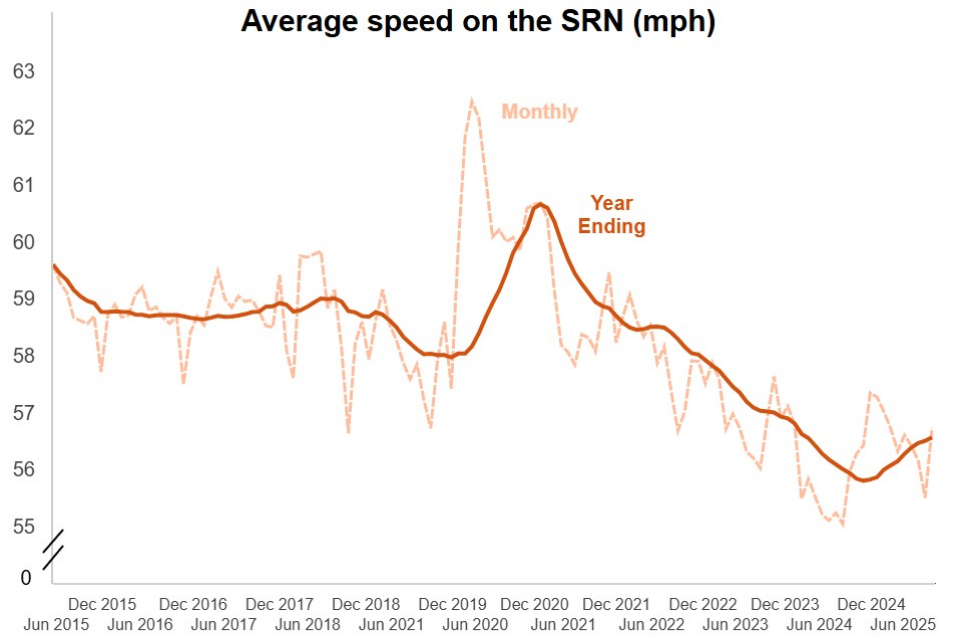
The average speed on the SRN in 2025 was estimated to be 56.6 mph, a 1.3% increase from 55.9 mph in 2024.
Prior to March 2020, average speed had remained relatively stable at between 58 mph and 59 mph. Between late 2022 and 2024, average speeds had been gradually declining to below pre-pandemic level.
Chart 1: Average speed on the SRN (Table CGN0404a)
2.2 Delay
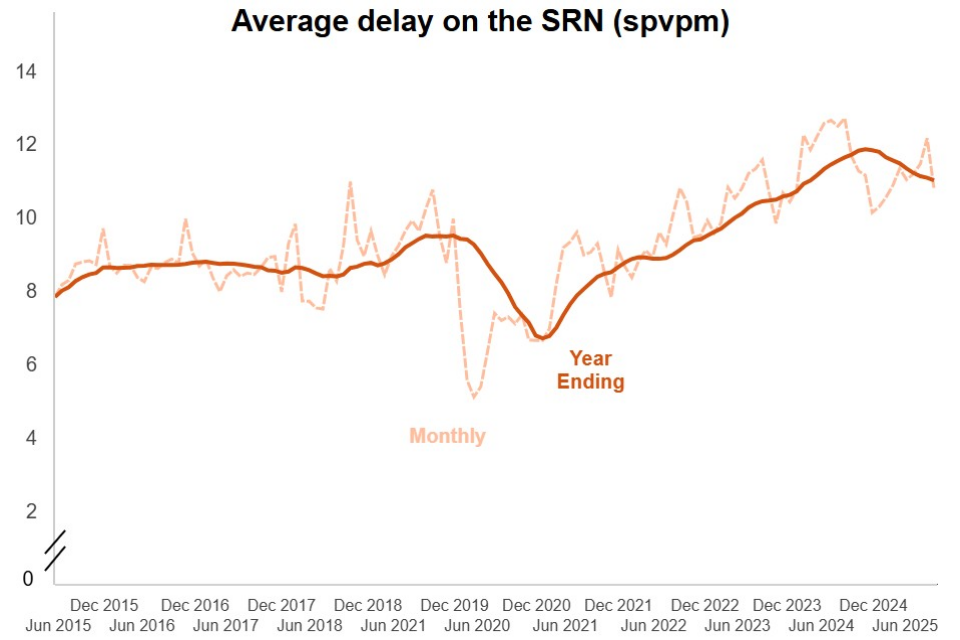
The average delay on the SRN across 2025 was estimated to be 11.0 spvpm, a 6.0% decrease from 11.7 spvpm in 2024.
Prior to March 2020, average delay had remained relatively stable between 8.6 spvpm and 9.0 spvpm. Between late 2022 and 2024, average delay had been gradually increasing to above pre-pandemic levels
Chart 2: Average delay on the SRN (Table CGN0405a)
3. Sub-national Transport Bodies (STBs) Breakdown
This section contains average speed and delay values on the SRN for the year ending December 2025, split by sub-national transport body (STB). Map 1 displays the geographic coverage and delay values of the STBs.
What are STBs?
The Sub-national Transport Bodies are transport bodies formed of multiple local highways authorities to provide large-scale strategic governance. STBs are given statutory power through secondary legislation.
Travel time measures for sub-national transport bodies on the SRN are available from January 2019 onwards. The annual average speed and average delay for SRN roads within STBs can be found in Tables CGN0404b and CGN0405b.
3.1 Speed
Annual average speeds for the STBs for the year ending December 2025 are given in Chart 3. Values for the year ending December 2024 are given for comparison.
Chart 3: Average speed on the SRN by Sub-national Transport Bodies (Table CGN0404b)
| STB | 2024 Average Speed (mph) | 2025 Average Speed (mph) |
|---|---|---|
| Transport for the North | 56.6 | 57.2 |
| Midlands Connect | 55.1 | 56.1 |
| England’s Economic Heartland | 56.7 | 57.4 |
| Transport East | 55.4 | 56.0 |
| Greater London Authority | 47.6 | 48.9 |
| Transport for the South East | 55.2 | 56.2 |
| Western Gateway | 56.7 | 57.0 |
| Peninsula Transport | 59.1 | 60.1 |
A map displaying average speed on the Strategic Road Network split by Sub-national Transport Body is published on ArcGIS Online.
3.2 Delay
Annual average delay values for the STBs for the year ending December 2025 are given in Chart 4 Values for the year ending December 2024 are given for comparison.
Chart 4: Average delay on the SRN by Sub-national Transport Bodies (Table CGN0405b)
| STB | 2024 Average Delay (spvpm) | 2025 Average Delay (spvpm) |
|---|---|---|
| Transport for the North | 11.1 | 10.5 |
| Midlands Connect | 12.4 | 11.5 |
| England’s Economic Heartland | 11.7 | 10.9 |
| Transport East | 12.0 | 11.2 |
| Greater London Authority | 21.0 | 19.2 |
| Transport for the South East | 12.9 | 11.7 |
| Western Gateway | 9.9 | 9.6 |
| Peninsula Transport | 7.6 | 6.8 |
Map 1: Average delay on the SRN by Sub-national Transport Body in England, 2025 (Table CGN0405b)

4. Further Geographic Breakdowns
Further geographic breakdown of speed and delay on Local ‘A’ Roads are included in the data tables as described below. Interactive maps visualising these breakdowns as well as those presented above are published on ArcGIS Online.
4.1 Combined Authorities
Data is available for combined authorities within the data tables CGN0404c and CGN0405c.
4.2 Road Level
Data available at road level from 2021 and average speed and average delay figures can be found in: CGN0404e and CGN0405e.
4.3 Junction Level
Several roads saw significant decreases to travel times following the end of the emergency areas construction programme in Spring 2025. Areas that have seen an increase in the average travel times have typically been going through significant work programs, such as the A38(M) and the Bromsgrove Road enhancement programme in the East Midlands or the A141 overnight roadworks in Huntingdonshire.
Travel time measures for individual junctions on the SRN are available from 2021. The annual average speed and average delay figures for individual junctions can be found in CGN0404d and CGN0405d.
A map displaying average speed on the Strategic Road Network at junction level is published on ArcGIS Online.
Map 2: Average delay on the SRN at a junction level in England, 2025 (Table CGN0405d)
Map showing average delay (seconds per vehicle per mile) on the Strategic Road Network in England at junction level. Average delay on the SRN is highest closest to most major cities (over 20 spvpm) and then lowest near the border counties and the East and Southwest coast (less than 5 spvpm). See Table CGN0405d for full data.

While junction level changes in speed and delay between years may appear large in some cases, the variations should be interpreted with caution. When travel time figures are based on data from a single road, they are more sensitive to disturbances such as road works and other local events. Therefore, road level speed and delay are expected to have greater variation from year to year than national figures.
5. Coronavirus (COVID-19) effect on congestion
The coronavirus (COVID-19) pandemic has had a marked impact on everyday life, including on congestion on the road network.
Exploratory analysis was conducted for 2020 to estimate the impact of the coronavirus pandemic on congestion and can be found at the storymap included with the 2020 annual publication. A fall in the number of vehicles on the roads could be seen from when the national lockdown was announced in March 2020. Therefore, data has been considered as “affected by the pandemic” from 12 March 2020 to March 2022.
As with previous years, most road traffic has trended back towards levels seen before the pandemic.
6. Context and user feedback
Measures for the Strategic Road Network (SRN) were developed as part of the first Road Investment Strategy (RIS1), which sets out a long-term programme for England’s SRN.
Following user feedback this release has developed the statistics to include Subnational Transport Body level data for the SRN and local ‘A’ roads. Interactive maps have also been developed using ArcGIS Online for the SRN and local ‘A’ roads. We will continue to review the content and presentation of these statistics, which we expect to develop further over time. Please contact us with any feedback you have, or if you would like further information.
7. Methodology and technical details
Average speed and delay are calculated from in-vehicle GPS units and weighted by road traffic flows to better represent the volume of traffic at different locations and times of day. For the SRN data, the sample includes all vehicle types.
It is important to note that although figures are produced for average speed and average delay on both the Local A and SRN networks, they are not directly comparable. The methodological differences between the Local ‘A’ road and SRN data prevents comparison between the 2 road types. A full explanation and further information on the data used, methodology, quality assurance and other sources of data can be found in the Background Quality Report. Data throughout this release is compared on an annual basis, rather than quarterly within year, due to seasonality.
8. Glossary
The glossary below contains some key terms utilised in this statistical release and how these are defined.
| Term | Definition | |
|---|---|---|
| Average Speed | Speed is measured in miles per hour and is an estimate of the physical level of congestion across the entire day (24-hour period). The metric weights speed observations from a sample of vehicles so that it is representative of traffic volumes. The weighting for the SRN accounts for associated profile flows by time period. | |
| Average Delay | Delay is measured in seconds per vehicle per mile and is the difference between free flow travel times and recorded average journey times across the entire day (24-hour period). This metric is indicative of the relative congestion on the network. Road users do not typically expect free flow conditions and will perceive delay relative to their expected conditions. | |
| Free Flow Speed | Free Flow on the SRN is taken as the speed limit for each individual road section, as though there was no congestion. | |
| SRN | Strategic Road Network. The SRN covers ‘A’ roads and motorways that are operated by National Highways. | |
| STB | Sub-national Transport Body. The STBs are transport bodies formed of multiple local highways authorities to provide large-scale strategic governance. STBs are given statutory power through secondary legislation. |
9. About these statistics
These official statistics were independently reviewed by the Office for Statistics Regulation in 2012. They comply with the standards of trustworthiness, quality and value in the Code of Practice for Statistics and should be labelled ‘accredited official statistics’.
10. Next update
The next quarterly table update in this series is expected to be published in June 2026. This will contain monthly, and annual (year ending) figures, for the period April 2025 to March 2026. This will include new figures for the period January to March 2026.
The next annual written report is expected to be published in February 2027 and will contain annual figures for 2026.
11. Instructions for printing and saving
Depending on which browser you use and the type of device you use (such as a mobile or laptop) these instructions may vary.
You will find your print and save options in your browser’s menu. You may also have other options available on your device. Tablets and mobile device instructions will be specific to the make and model of the device.
12. How to search
Select Ctrl and F on a Windows laptop or Command and F on a Mac
This will open a search box in the top right-hand corner of the page. Type the word you are looking for in the search bar and press enter.
Your browser will highlight the word, usually in yellow, wherever it appears on the page. Press enter to move to the next place it appears.
13. Contact us
Road congestion and travel times
Email congestion.stats@dft.gov.uk
Media enquiries 0300 7777 878
To hear more about DfT statistical publications as they are released, follow us on X at DfTstats.
-
Accredited official statistics are called National Statistics in the Statistics and Registration Service Act 2007. Accredited Official Statistics Policy – Office for Statistics Regulation ↩