Domestic Transport Usage by Mode
Updated 15 October 2026

© Crown copyright 2026
This publication is licensed under the terms of the Open Government Licence v3.0 except where otherwise stated. To view this licence, visit nationalarchives.gov.uk/doc/open-government-licence/version/3 or write to the Information Policy Team, The National Archives, Kew, London TW9 4DU, or email: psi@nationalarchives.gov.uk.
Where we have identified any third party copyright information you will need to obtain permission from the copyright holders concerned.
This publication is available at https://www.gov.uk/government/statistics/daily-domestic-transport-use-by-mode/domestic-transport-usage-by-mode
These statistics are official statistics. They comply with the standards of trustworthiness, quality, and value in the Code of Practice for Statistics. More information about these statistics can be found in the methodology note.
Planned changes to future releases
The department has published its response to user feedback, gathered in summer 2026, regarding changes that we believe would increase the value of the series for users.
These changes will be rolled out in early 2027.
Usage of transport by mode from October 2025
Usage is shown as a percentage of pre-COVID-19 baseline; baselines used vary between modes (see the methodology note for further information). For rail, usage is shown as a 7-day rolling average ending on the indicated date. For all other modes, daily usage for weekdays (excluding bank holidays) is shown.
National Rail excluding the Elizabeth line data from August 2024 remains provisional until updated adjustment factors for the Elizabeth line are available.
Figure 1: Transport usage as a proportion of pre-COVID-19 levels, Great Britain, October 2025 to October 2026
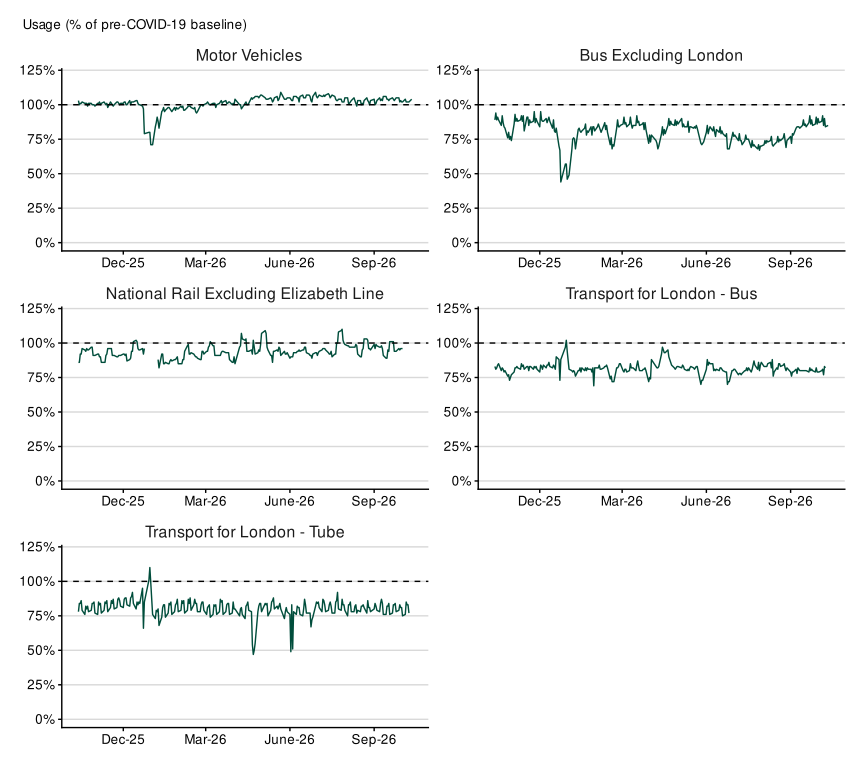
Description of figure 1: This figure presents a series of 5 line charts which show transport usage as a proportion of pre-COVID-19 levels, for motor vehicles, buses (excluding London), National Rail excluding the Elizabeth line and Transport for London (TfL) tube and buses over the last 12 months. The demand on the above transport modes have generally stabilised to new levels, reflecting usage unaffected by COVID-19. Over the past year, bus and TfL usage has generally remained below pre-COVID-19 levels, while usage of National Rail excluding the Elizabeth Line has settled closer to pre-COVID-19 levels than other public transport modes. Motor vehicles usage has generally returned to pre-COVID-19 levels.
For all modes, usage fluctuates day-to-day, and bus usage outside of London is heavily impacted by school holidays throughout the year. Sharp changes in modal usage are as a result of weather events, industrial action or other events. More detail about this can be found in the footnotes of the published data table.
Table 1 below compares the range of usage during the current and previous publishing periods[footnote 1] for each mode as a percentage of the pre-COVID-19 baseline. For all modes except rail, transport usage excludes weekends and bank holidays, with rail presenting a 7-day rolling average of usage for all days.
The exclusion of weekends and bank holidays for all modes except rail, is to prevent direct comparisons between these days and weekdays. This is because usage over weekends and bank holidays is less representative of typical weekday usage patterns (see the methodology note for further information). Weekend usage across all modes provided in this series is available in the tables that accompany this release.
The publishing periods vary between some modes due to data lags, which are specified in Table 1.
Table 1: Latest transport usage, by mode
| Mode | Publishing period | Latest usage at date | Commentary |
|---|---|---|---|
| Rail (GB excluding Elizabeth Line) | 31 Aug to 4 Oct 2026 | 96% (Sunday 4 October 2026) | Passenger journeys in the week ending Sunday 4 October 2026 were 96% of those observed in the equivalent week in 2019. In the current publishing period weekly average usage figures have been between 89% to 101%, compared to 90% to 103% in the last publishing period (3 August to 30 August 2026). These figures exclude Elizabeth Line services usage. |
| Bus (GB excluding London) | 8 Sep to 12 Oct 2026 | 85% (Monday 12 October 2026) | Bus boardings outside of London on Monday 12 October 2026 were 85% of the volume observed on the equivalent day in the third week of January 2020. This is 4 percentage points lower compared to the equivalent day in the previous year (89% on Monday 13 October 2025). In the current publishing period weekday bus usage has been between 83% to 92% of the pre-COVID-19 baseline, in comparison to between 69% to 83% in the last publishing period (11 August to 7 September 2026). |
| London Bus | 5 Sep to 9 Oct 2026 | 82% (Friday 9 October 2026) |
TfL bus boardings on Friday 9 October 2026 were 82% of the equivalent day in 2019. In the current publishing period weekday TfL bus usage has been between 77% to 83% of the pre-COVID-19 baseline, in comparison to between 76% to 88% in the last publishing period (8 August to 4 September 2026). |
| London Tube | 5 Sep to 9 Oct 2026 | 77% (Friday 9 October 2026) | Tube entries and exits on Friday 9 October 2026 were 77% of the equivalent day in 2019. Weekday tube usage in the current publishing period has been between 75% to 87% of the pre-COVID-19 baseline, in comparison to between 77% to 86% in the last publishing period (8 August to 4 September 2026). |
| Motor Traffic (GB) | 8 Sep to 12 Oct 2026 | 104% (Monday 12 October 2026) | On Monday 12 October 2026 traffic volumes were 104% of the levels during the first week of February 2020. This is 1 percentage point higher compared to the equivalent day in the previous year (103% on Monday 13 October 2025). Weekday usage in this publishing period has been between 102% to 106% of the pre-COVID-19 baseline, in comparison to 99% to 105% in the last publishing period (11 August to 7 September 2026). |
-
National Rail and TfL data are lagged compared to other modes due to the availability of data at time of publishing. ↩