Tax-Free Childcare Statistics Commentary June 2026
Published 26 August 2026

© Crown copyright 2026
This publication is licensed under the terms of the Open Government Licence v3.0 except where otherwise stated. To view this licence, visit nationalarchives.gov.uk/doc/open-government-licence/version/3 or write to the Information Policy Team, The National Archives, Kew, London TW9 4DU, or email: psi@nationalarchives.gov.uk.
Where we have identified any third party copyright information you will need to obtain permission from the copyright holders concerned.
This publication is available at https://www.gov.uk/government/statistics/tax-free-childcare-statistics-june-2026/tax-free-childcare-statistics-commentary-june-2026
1. About this release
This is a quarterly publication of Tax-Free Childcare (TFC) statistics. Tax-Free Childcare provides help with childcare costs for working parents.
For every £8 a parent pays into their Tax-Free Childcare account the government will add an extra £2, up to a maximum of £2,000 per child per year. For disabled children the maximum is £4,000 per year.
Tax-Free Childcare and Department for Education funded hours
A key policy change affecting the use of Tax-free Childcare is the expansion of the Department for Education (DfE) 15 or 30 funded hours scheme in England.
In 2024, 15 hours funded childcare became available for the first time for children aged under 3. This was rolled out to children aged 2 in April 2024 (phase 1) and children aged over 9 months in September 2024 (phase 2).
A further expansion has made 30 hours funded childcare available to these age groups from September 2025 (phase 3). For details on the funded hours scheme see: Best Start In Life
For more information about Tax-Free Childcare see the summary information in the Background and Guidance note or visit guidance on Tax-Free Childcare on GOV.UK.
Publication Information
This is an official statistics publication. Statistical tables to accompany this commentary are available in the accompanying spreadsheet
Coverage: United Kingdom
Frequency of release: Quarterly
Next Release: November 2026
For queries or feedback on this publication, please contact: TFC Statistics
For press queries, please contact: HMRC Press Office
2. Summary
This release published new monthly data for April, May, and June 2026. Key points for this release are:
- there were 602,000 families using TFC for 745,000 children in June 2026
- TFC account usage reduced in April and May before rising in June to return to similar levels as the end of the previous quarter. This levelling-off follows an increase in usage in the previous two quarters since the September 2025 expansion of funded childcare
- the government spent £55.7 million on TFC top-up in June 2026, remaining below the July 2024 peak (£62.3 million)
3. Families and children using Tax-Free Childcare
Figure 1: Families using TFC accounts and government top-up paid (£m), by month
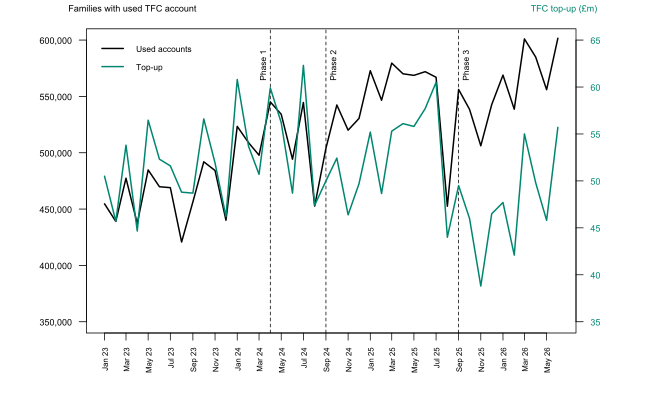
Key points of note from Figure 1:
- the 602,000 families with used TFC accounts in June 2026 is marginally higher than the number of families with used accounts in March 2026, representing the largest number of used accounts since the rollout of TFC, following an overall increase in the previous two quarters
- government top-up spending also followed a similar pattern, increasing at the end of the quarter in line with higher account usage. However, at £55.7 million, top-up in June 2026 is at a similar level to the same point last year, £57.7 million in June 2025, and remains lower than the 3-year peak of £62.3 million in July 2024
3. Families and children using Tax-Free Childcare
Figure 2: Government top-up (£) per family using TFC, by month
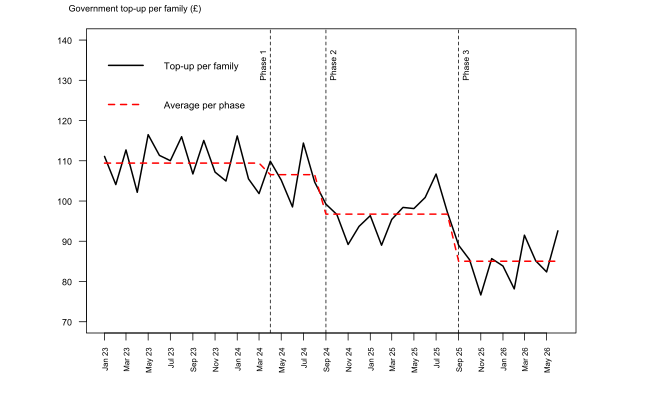
Key points of note from Figure 2:
- monthly TFC top-up, as a per family average, reduced from £85 in April 2026 to £82 in May 2026, before rising to £93 in June
- in this quarter there was a slight increase in monthly figures for top-up per family. However, the levels of top-up per family have remained below the pre-September 2025 average as the need for TFC is substituted by the DfE 30 hours funded childcare scheme and its subsequent expansions
- before the first expansion in April 2024 (see the Background and Guidance note for details of the expansions of this scheme) average top-up per family was £110 per month. This has decreased with each phase of the expansion and since the third phase in September 2025 the average monthly top-up is £85 per family
5. Patterns by age group
Figure 3: Number of children with used TFC accounts by age group, by month
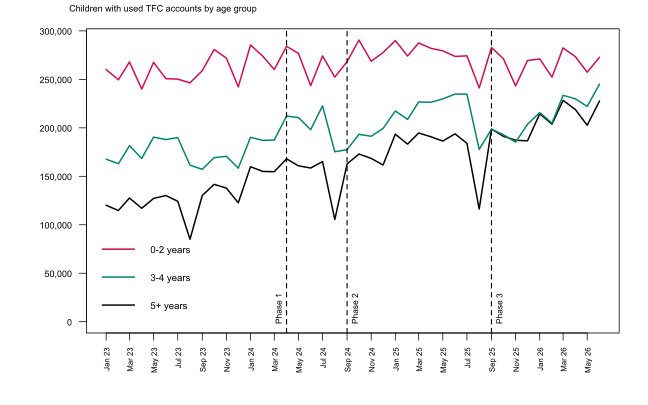
Key points of note from Figure 3:
- usage for children aged 0 to 2 has remained fairly stable throughout 2026, after a gradual decrease over 2025
- usage for children aged 3 to 4 increased this quarter, particularly in June 2026 which saw a greater increase than the usual seasonal impacts for this time of year
- children aged 5 and over followed the trend of children aged 3 to 4, rising to their highest level since the implementation of TFC