Sub-regional fuel poverty in England, 2026 report (2024 data) (accessible webpage)
Published 14 May 2026
Applies to England

© Crown copyright 2026
This publication is licensed under the terms of the Open Government Licence v3.0 except where otherwise stated. To view this licence, visit nationalarchives.gov.uk/doc/open-government-licence/version/3 or write to the Information Policy Team, The National Archives, Kew, London TW9 4DU, or email: psi@nationalarchives.gov.uk.
Where we have identified any third party copyright information you will need to obtain permission from the copyright holders concerned.
This publication is available at https://www.gov.uk/government/statistics/sub-regional-fuel-poverty-report-2026-2024-data/sub-regional-fuel-poverty-in-england-2026-report-2024-data-accessible-webpage
Summary findings
- The overall level of fuel poverty in England in 2024 was 9.9% using the Low Income Low Energy Efficiency (LILEE) fuel poverty metric.
- The West Midlands was the region with the highest rate of fuel poverty (12.1%) followed by Yorkshire and the Humber (11.3%).
- The 20 Local Authorities with the highest rates of fuel poverty in 2024 all had a fuel poverty rate higher than 12%. Of these Local Authorities, the largest number were in the West Midlands (8), with the other Local Authorities with the highest rates in East Midlands (4), North West (4), Yorkshire and the Humber (2), London (1) and South West (1).
- The lowest regional levels of fuel poverty were in the South East (8.2%), the North East (9.2%) and the East of England (9.3%).
- The 20 Local Authorities with the lowest levels of fuel poverty in 2024 all had a fuel poverty rate lower than 8%. The vast majority of these Local Authorities were in the South East (16), with the other Local Authorities being in London (2) and East of England (2).
What you need to know about these statistics
Estimates of fuel poverty at the regional level are taken from the national fuel poverty statistics for 2024. Estimates at the sub-regional level are official statistics in development and are modelled and constrained to regional totals. These should only be used to look at general trends and identify areas of particularly high or low fuel poverty. They should not be used to identify detailed trends over time.
Sub-regional fuel poverty, 2026 (2024 data)
1. Introduction
Fuel poverty in England is measured using the Low Income Low Energy Efficiency (LILEE) fuel poverty metric, which was set out in the Fuel Poverty Sustainable Warmth strategy published in February 2021. The LILEE indicator considers a household to be fuel poor if both:
- it is living in a property with an energy efficiency rating of band D, E, F or G as determined by the most up-to-date Fuel Poverty Energy Efficiency Rating (FPEER) Methodology;
- its disposable income (income after housing costs (AHC) and energy needs) would be below the poverty line[footnote 1].
The government is interested in the amount of energy people need to consume to have a warm, well-lit home, with hot water for everyday use, and the running of appliances. Therefore, fuel poverty is measured based on required energy bills rather than actual spending. This ensures that those households who have low energy bills simply because they actively limit their use of energy at home, for example, by not heating their home are not overlooked.
The annual fuel poverty statistics are Accredited Official Statistics which provide a comprehensive view of the latest statistical trends and analysis of fuel poverty in England. These statistics report on the proportion of all households in fuel poverty in England and the depth of their fuel poverty. The report also looks at the key drivers of fuel poverty and how the prevalence and severity of fuel poverty differ by various household and dwelling characteristics.
The sub-regional statistics are Official Statistics in Development (see Annex). These complement the Accredited Official Statistics on fuel poverty, by estimating the number and proportion of fuel poor households at smaller geographical levels, for example, Local Authority (LA) level. The sub-regional statistics do not report on the average fuel poverty gap.
The headline statistics detailed in the 2026 annual report are based on projections to 2025, so provide more timely estimates of fuel poverty down to regional level. The sub-regional fuel poverty estimates are based on the final version of the 2024 modelled data and cannot be run for 2025 using this methodology.
This year’s annual report, and a detailed methodology on how fuel poverty is calculated, can be found as part of the fuel poverty statistics collection. Since 2019, sub-regional breakdowns have been produced based on the LILEE indicator. However, sub-regional breakdowns are also available between 2010 and 2018 based on the Low Income High Costs (LIHC) indicator.
Accompanying tables
For each of the following geographical levels, estimates are available for the total number of households, the number of fuel poor households, and the proportion of households in fuel poverty:
- Table 1: English Region (former Government Office Region)[footnote 2]
- Table 2: Region, County, Unitary & Local Authority
- Table 3: Parliamentary Constituency (2024 boundaries)
- Table 4: Lower Super Output Area (LSOA)
Interactive map
An interactive map for indicators of domestic energy efficiency and energy consumption is available which includes the percentage of households in fuel poverty down to Lower Layer Super Output Area. The fuel poverty data for 2024 will be made available shortly after this report is released on publication day through our interactive map.
2. Regional fuel poverty
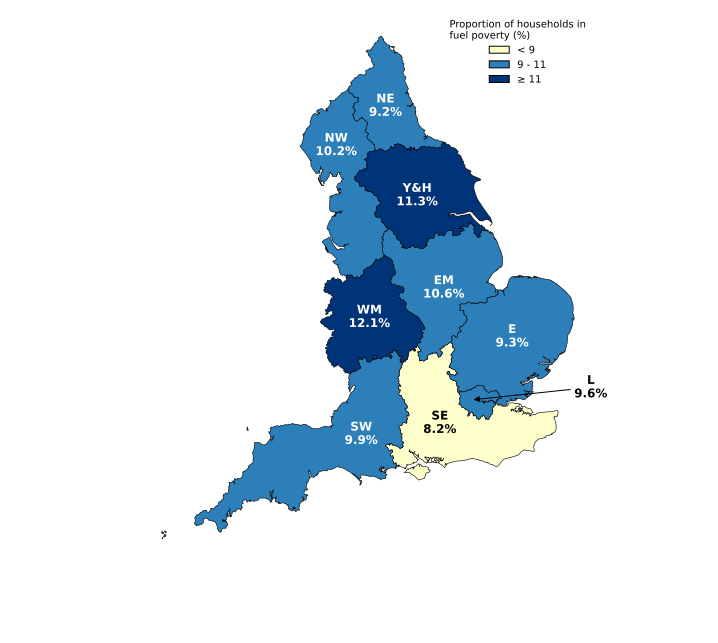
Examining nationwide statistics, a high level of variation in the rates of fuel poverty between regions can be observed, ranging from 8.2% in the South East to 12.1% in the West Midlands.
The highest regional rates of fuel poverty in 2024 were in the West Midlands (12.1%) and Yorkshire and the Humber (11.3%). The West Midlands had the lowest median (after housing costs) equivalised income of all regions at £27,288. Yorkshire and the Humber had a median income below the national median (£30,025) of £29,677, median equivalised fuel costs above the national average (£2,098) of £2,136, and a median fuel poverty energy efficiency rating (FPEER) below the national median (70) of 69. In contrast, the West Midlands has a median equivalised fuel cost of £2,093 and a median FPEER of 70 that matches the national average. It is likely instead that the West Midland’s high fuel poverty rate is driven by the low median income.
Households in the North East and North West also had median (AHC) incomes under the national median of £30,025. The North East had a fuel poverty rate below the national average, which can be partially attributed to smaller than typical home sizes (with median floor area of 80m2, less than the national median of 84m2) and higher typical median FPEER, at 71. The North West had a fuel poverty rate slightly above the national average.
The lowest fuel poverty rates were in the South East (8.2%), the North East (9.2%), and the East of England (9.3%). The South East had the lowest rate of fuel poverty in England due to having the highest median income at £33,645 and equivalised fuel costs and FPEER in line with the national average.
Between 2023 to 2024, the fuel poverty rate decreased for all regions except London, where the rate increased marginally from 9.3% to 9.6%. The overall fuel poverty levels decreasing corresponds to the higher energy efficiency (from an increased proportion of households achieving A-C FPEER energy efficiency) and lower fuel costs. This is discussed further in Annex E of the annual fuel poverty statistics report. A detailed breakdown of fuel poverty statistics by region for 2024 is available in Table 5 of the supplementary tables.
In the annual fuel poverty statistics (report section 3.1.7) the fuel poverty gap is reported on as an indicator of the depth of fuel poverty, but this is not modelled at sub-regional level. This indicator shows that in 2024, fuel poor households in the South West had deeper levels of fuel poverty than other regions in England, requiring a larger reduction in fuel costs needed for a household to not be in fuel poverty at £511. This is partly explained by having the highest median fuel costs, at £2,175, and the joint largest home sizes, with median floor area of 88m2.
Further information on the drivers of regional differences in fuel poverty is detailed in the annual fuel poverty report (section 3.1.7), based on estimates of fuel poverty to 2025.
Figure 1: Proportion of households in fuel poverty, by region, 2024
3. Sub-regional fuel poverty
Maps provide a useful way of displaying variation in fuel poverty rates across different geographical areas. Figure 2 shows the proportion of households in fuel poverty in England at Local Authority (LA) level.
Figure 2: Proportion of households in fuel poverty by Local Authority, 2024
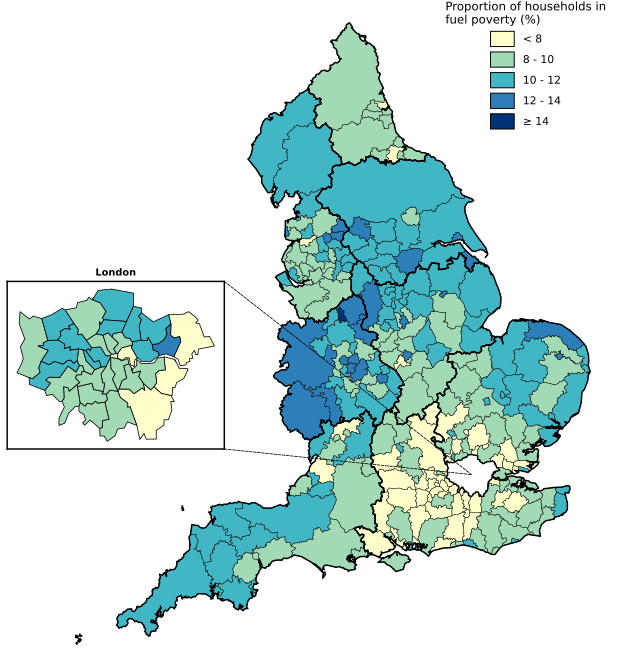
The Local Authorities with the highest rate of fuel poverty are shown in dark blue. The 20 Local Authorities with the highest levels of fuel poverty in 2024 all had a fuel poverty rate higher than 12%. The 5 Local Authorities with the highest levels of fuel poverty were Isles of Scilly (17.3%), Stoke-on-Trent (14.8%), Blackpool (13.9%), Birmingham (13.8%), and Sandwell (13.5%).
The Local Authorities with the lowest levels of fuel poverty are shown in light yellow. The 20 Local Authorities with the lowest levels of fuel poverty in 2024 all had a fuel poverty rate lower than 8%. The 5 Local Authorities with the lowest levels of fuel poverty were Wokingham (5.6%), Bracknell Forest (5.8%), Surrey Heath (5.8%), Hart (6.0%), and Eastleigh (6.0%).
The largest regional range in Local Authority fuel poverty estimates was observed in the South West (7.3% in South Gloucestershire to 17.3% in Isles of Scilly). The smallest regional range in Local Authority fuel poverty estimates was observed in the North East (7.8% in Stockton-on-Tees to 10.0% in County Durham).
Figure 2 shows an inset of London in more detail. In London, the highest level of fuel poverty across all Local Authorities was in Barking and Dagenham (12.8%), and the lowest level of fuel poverty was recorded in the City of London (6.3%).
The level of variation in the rate of fuel poverty within a region differs quite substantially at lower geographic areas. Figure 3 plots the fuel poverty rates for the 33,755 Lower layer Super Output Areas (LSOA) by region. This shows that the largest difference between the top and bottom 10% of LSOAs was in the West Midlands where the 90th percentile was 11.4 percentage points higher than the 10th percentile. Therefore, as well as being the region with the highest rate of overall fuel poverty, it also had the largest variation between the 90th and 10th percentiles between local areas. The second largest range was the Yorkshire and the Humber with a gap of 10.3 percentage points. London had the smallest variation in fuel poverty rates with a difference of 7.6 percentage points between the 90th and 10th percentiles.
Figure 3: Proportion of households in fuel poverty, LSOAs within Region, 2024
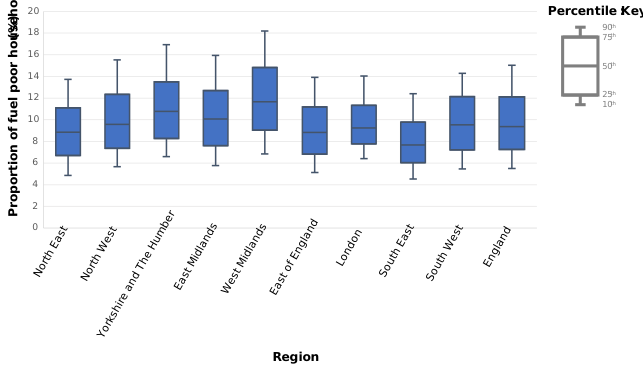
The box plot shows the median and interquartile range of the proportion of fuel poor households in LSOAs by region. The whiskers represent the 10th and 90th percentile LSOAs for each region.
4. Methodology
Fuel poverty statistics are based on data from the English Housing Survey (EHS). Given the sample size of the EHS in 2024 (14,501 households with physical surveys in the combined 2023/24 and 2024/25 dataset[footnote 3], it is not possible to reliably estimate fuel poverty levels in smaller geographical areas, such as Local Authorities, without the use of statistical modelling.
A logistic regression model is created, matching data from the EHS on whether a household is fuel poor or not (as the binary dependent variable) with data from other sources available for all Census Output Areas (OA), e.g. Experian data (as the independent variables). The factors used in the modelling are set out in the sub-regional methodology documentation, alongside other details of the methodology. Note that the set of predictor variables were newly determined for this year’s statistics. This resulted in five of the previous variables remaining, but with employment status being replaced by region.
The model is used to estimate the levels of fuel poverty for all OAs across England; these are then aggregated to higher level geographies, which are constrained to the regional totals. This modelling approach introduces the possibility that atypical small areas are not accurately picked up by the model and will be influenced by the regional trend in fuel poverty rate. For example, the figure and trend for Cornwall will be influenced by the trend for the South West region.
In 2013, the former Department for Energy & Climate Change undertook an internal review of the methodology used to produce sub-regional estimates of fuel poverty, in conjunction with Office for National Statistics (ONS) Methodology Advisory Service. This review found that estimates of fuel poverty were robust at Local Authority level, but not robust at lower levels of geography. In particular, estimates of fuel poverty at Lower Super Output Area (LSOA) should be treated with caution. These estimates should only be used to look at general trends and identify areas of particularly high or low fuel poverty due to their high uncertainty. They should not be used to identify trends over time within an LSOA, to rank LSOAs within a year, or to compare LSOAs with similar fuel poverty levels due to very small sample sizes and consequent instability in estimates at this level.
Annex: Further information
Revisions policy
The Department’s statistical revisions policy sets out the revisions policy for these statistics, which has been developed in accordance with the UK Statistics Authority Code of Practice for Statistics.
Official Statistics in Development
These statistics are deemed Official Statistics in Development as work is ongoing to improve the modelling approach used to produce these statistics. The current approach uses constrained regional totals and limited predictor variables which are known to yield estimates that are of lower quality at smaller geographies. We keep this modelling approach under review, and for this year’s statistics have updated the model variables and coefficients.
We have previously investigated options to incorporate administrative data as the base from which fuel poverty is modelled at sub-regional level, rather than using a sample-based approach such as the EHS. Under this approach fuel poverty statistics would be based on small area data on energy efficiency (such as Energy Performance Certificates (EPC)), matched with other data sources, to form a more up to date and accurate picture of fuel poverty for small areas in England. This alternative approach should increase the reliability of estimating fuel poverty at sub-regional levels, by making more use of real-world data through EPCs to more accurately determine the household’s Energy Efficiency Rating. While work on this alternative approach has paused since the previous statistics release, we plan to revisit development of a new methodology when resources can be allocated to this work.
When alternative methods are sufficiently developed, we will share details of the new method and the impact on the estimates with users.
User engagement
Users are encouraged to provide comments and feedback on how these statistics are used and how well they meet their needs. Comments on any issues relating to this statistical release are welcomed and should be sent to: fuelpoverty@energysecurity.gov.uk
The Department’s statement on statistical public involvement and engagement sets out the department’s commitments on public engagement as outlined by the Code of Practice for Statistics.
Pre-release access to statistics
Some ministers and officials receive access to these Official Statistics up to 24 hours before release. Details of the arrangements for doing this and a list of the posts that receive pre-release access to these statistics can be found in the Department’s statement of compliance with the Code of Practice for Statistics.
Contact
Responsible statistician: Oliver Haines
Email: fuelpoverty@energysecurity.gov.uk
Media enquiries: 020 7215 1000
-
The poverty line (income poverty) is defined as an equivalised disposable income of less than 60% of the national median in Section 2 of the ONS publication: Persistent poverty in the UK and EU: 2017. ↩
-
These are Official Statistics and are presented in the Fuel Poverty detailed tables 2026 (2024 data), alongside the Annual fuel poverty statistics report: 2026. ↩
-
More information on the EHS combined dataset can be found in Annex B.4 of the Annual Fuel Poverty Statistics report. ↩