Smart meters in Great Britain, quarterly update September 2026: statistical bulletin
Published 26 November 2026
Applies to England, Scotland and Wales

© Crown copyright 2026
This publication is licensed under the terms of the Open Government Licence v3.0 except where otherwise stated. To view this licence, visit nationalarchives.gov.uk/doc/open-government-licence/version/3 or write to the Information Policy Team, The National Archives, Kew, London TW9 4DU, or email: psi@nationalarchives.gov.uk.
Where we have identified any third party copyright information you will need to obtain permission from the copyright holders concerned.
This publication is available at https://www.gov.uk/government/statistics/smart-meters-in-great-britain-quarterly-update-september-2026/smart-meters-in-great-britain-quarterly-update-september-2026-statistical-bulletin
This report includes an update from all large energy suppliers in the market in Great Britain at the end of September 2026, with data from small suppliers up to end 2025.
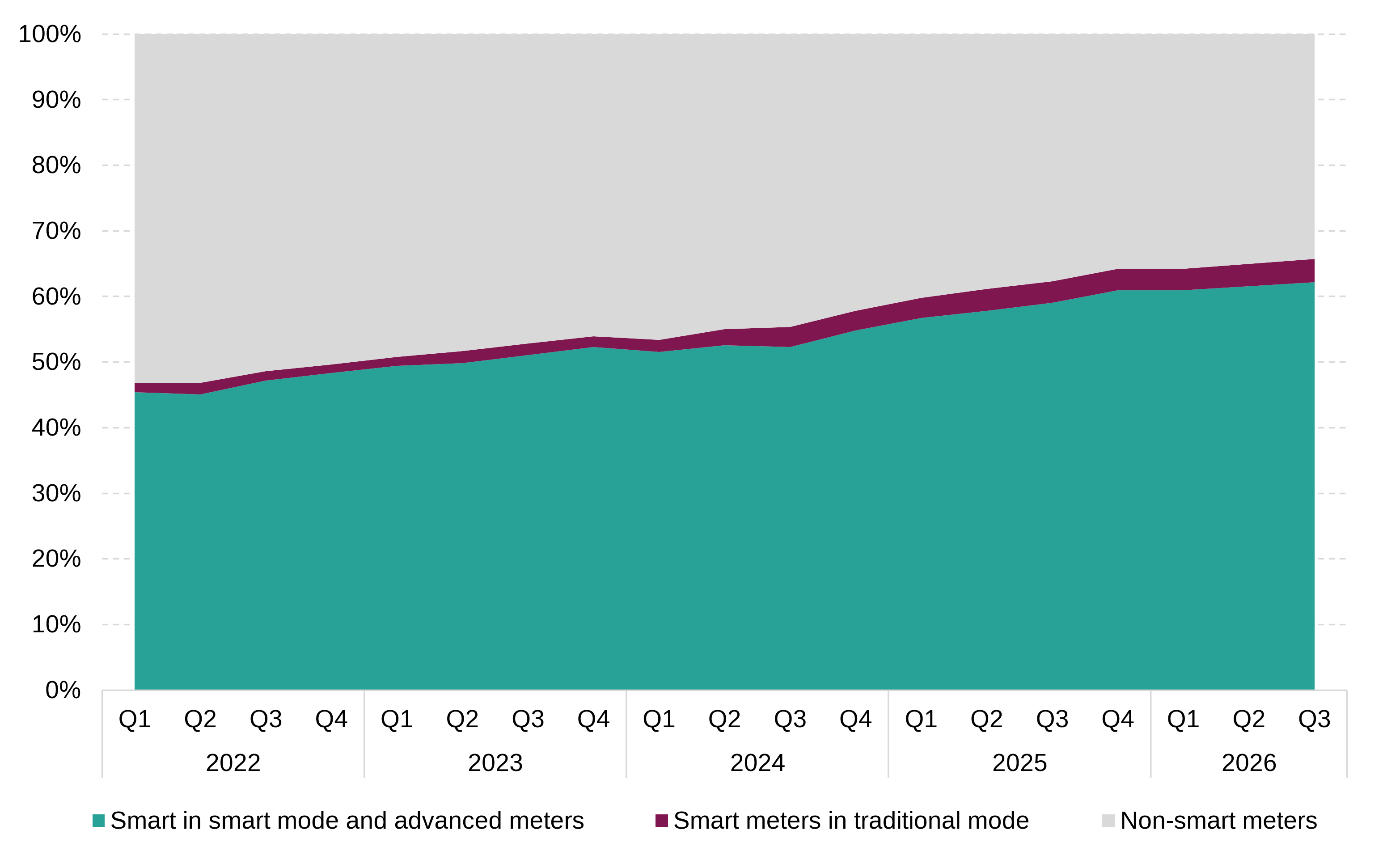
At the end of September 2026 there were 42.0 million smart and advanced meters in homes and small businesses across Great Britain up from 41.6 million at end June 2026, making up 73% of all meters, as shown in Figure 1. Of the 40.7 million smart meters, 93% were operating in smart mode. This means they are communicating remotely with the customer’s energy supplier. Table 1 gives a breakdown of meters operated by large energy suppliers at the end of September 2026, and those operated by small energy suppliers at the end of December 2025 (the latest data available).
Figure 1: Breakdown of energy meters by type, end September 2026
Large and small energy suppliers, domestic and non-domestic
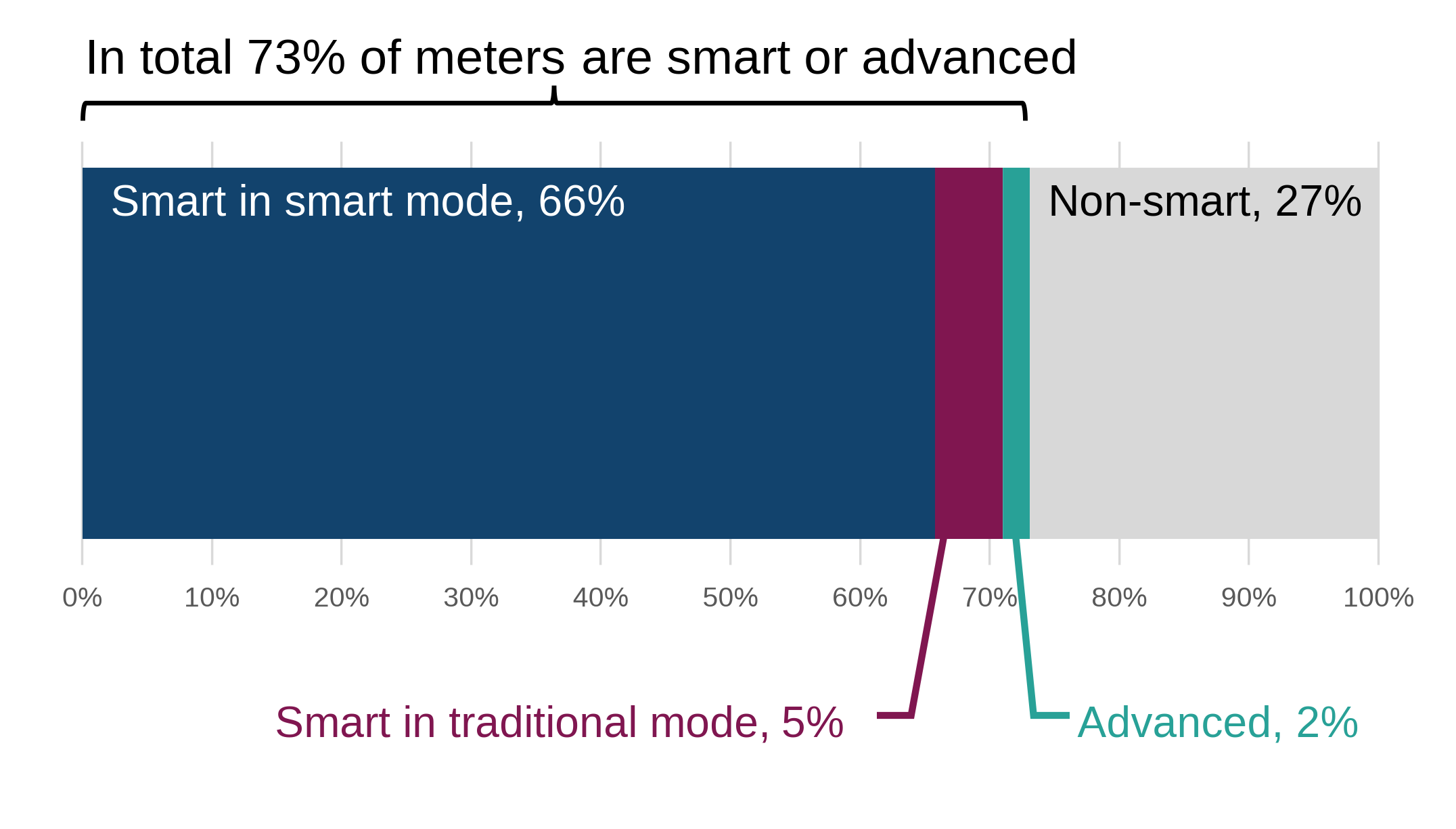
Table 1: Meters operating to end September 2026
Domestic and non-domestic, rounded to nearest thousand
| Large Suppliers (September 2026) | Small Suppliers (December 2025) | Total | |
|---|---|---|---|
| Smart meters in smart mode | 37,300,000 | 453,000 | 37,753,000 |
| Smart meters in traditional mode | 2,945,000 | 52,000 | 2,996,000 |
| Advanced meters | 700,000 | 520,000 | 1,220,000 |
| Non-smart meters | 15,008,000 | 428,000 | 15,435,000 |
| All Meters | 55,952,000 | 1,453,000 | 57,405,000 |
Between July and September 2026 1.1 million smart and advanced meters were installed by large suppliers in homes and small businesses across Great Britain. Table 2 shows the breakdown by smart and advanced meters.
Of these 519,000 were new installations, and 595,000 were replacements. New installations are where a smart or advanced meter is installed in a new metering point or replaces a non-smart meter. Replacements are carried out to ensure continuation of smart services where an existing smart or advanced meter has been installed. This includes when meters have reached the end of their operational life, or to ensure they are compatible with the latest communications technology.
Table 2: Smart and advanced meters installed by large energy suppliers by installation type in Q3 2026
Domestic and non-domestic, rounded to nearest thousand
| New Installations | Replacements | Total | |
|---|---|---|---|
| Smart | 514,000 | 592,000 | 1,106,000 |
| Advanced | 5,000 | 3,000 | 8,000 |
| Total | 519,000 | 595,000 | 1,113,000 |
What you need to know about these statistics:
Smart meters are a major national infrastructure upgrade that help make the energy system cheaper, cleaner and more reliable. They give consumers real‑time information on energy use via an In-Home Display, helping them manage consumption, save money and cut emissions. Smart meters send readings automatically to suppliers, improving billing accuracy, and support the transition to a low‑carbon system by enabling tools such as smart tariffs and better demand management. The programme is led by the Department for Energy Security & Net Zero, regulated by Ofgem, and delivered by energy suppliers.
This quarterly release provides statistics on smart meters in Great Britain. It covers the number of smart and advanced meters installed in domestic and smaller non-domestic properties by large energy suppliers in Q3 2026. This includes new installation activity, where smart or advanced meters are installed in a new metering point or replaces a non-smart meter as well as replacements of existing smart meters, which are needed to ensure continuation of smart services where an existing smart or advanced meter has been installed. The release also includes statistics on the total number of meters they operated on 30 September 2026. Installation activity by small energy suppliers during 2025 and the number of meters they operated at the end of 2025 are also included.
The release continues the revised format, of HTML publication, supporting tables and tidy long-form data, first introduced in the Q2 2026 release.
The next quarterly release is scheduled for 18 March 2027.
1. Meters in Domestic Properties
1.1 Meters installed in domestic properties
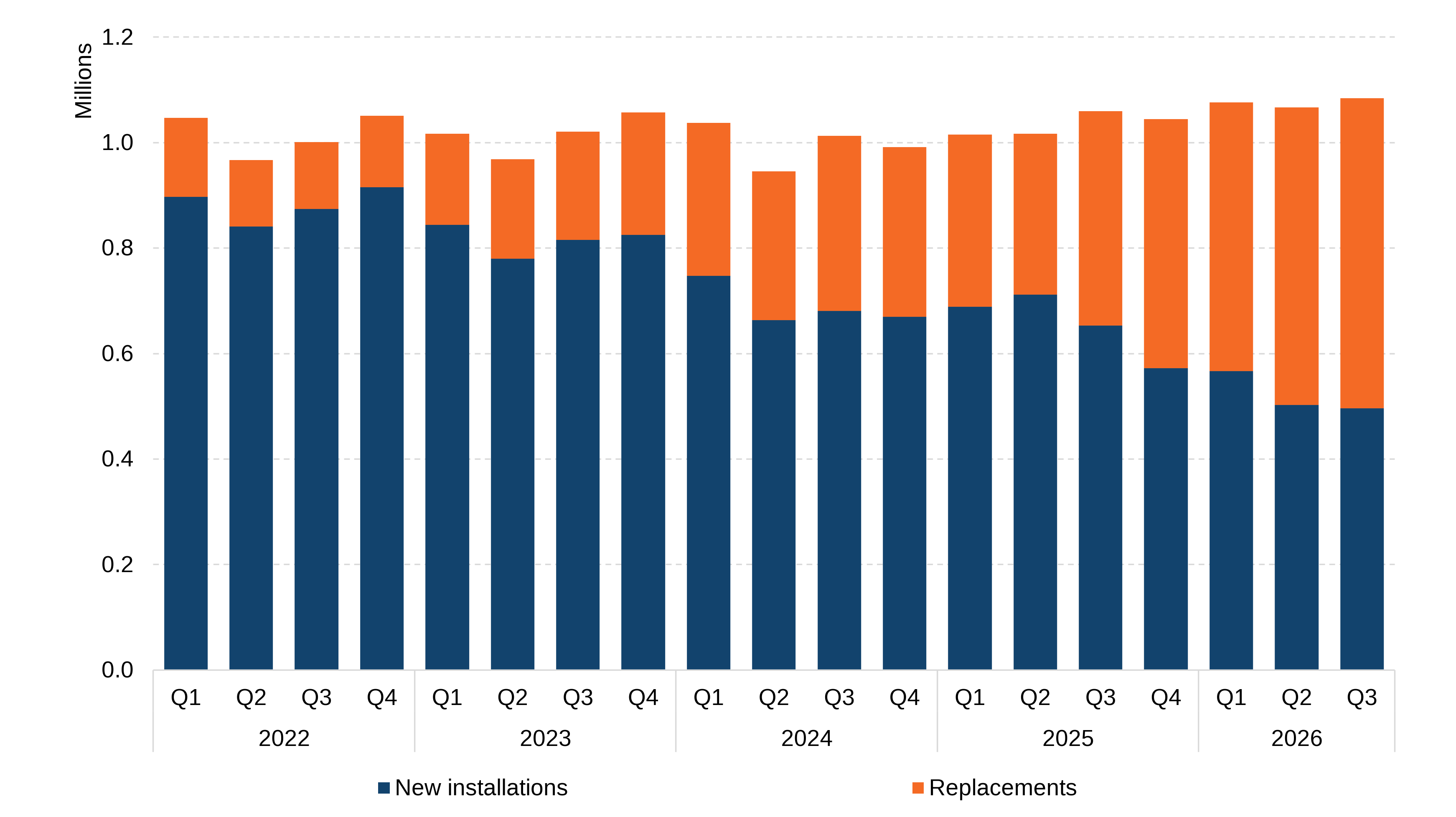
Large energy suppliers carried out 1,084,000 installations in homes during Q3 (July to September) 2026, of which 496,000 were new installations, with the remaining 588,000 being replacements. Quarterly domestic installation activity by large energy suppliers over recent years is shown in Figure 2. This shows that overall domestic installation volumes have been consistent since 2022 at approximately 1.0 million installations a quarter. However, the proportion of total installation activity that is replacements has increased over the last four years to 54% in Q3 2026.
Figure 2: Domestic smart meter installations carried out by large energy suppliers in Great Britain from 2022
1.2 Operational meters in domestic properties
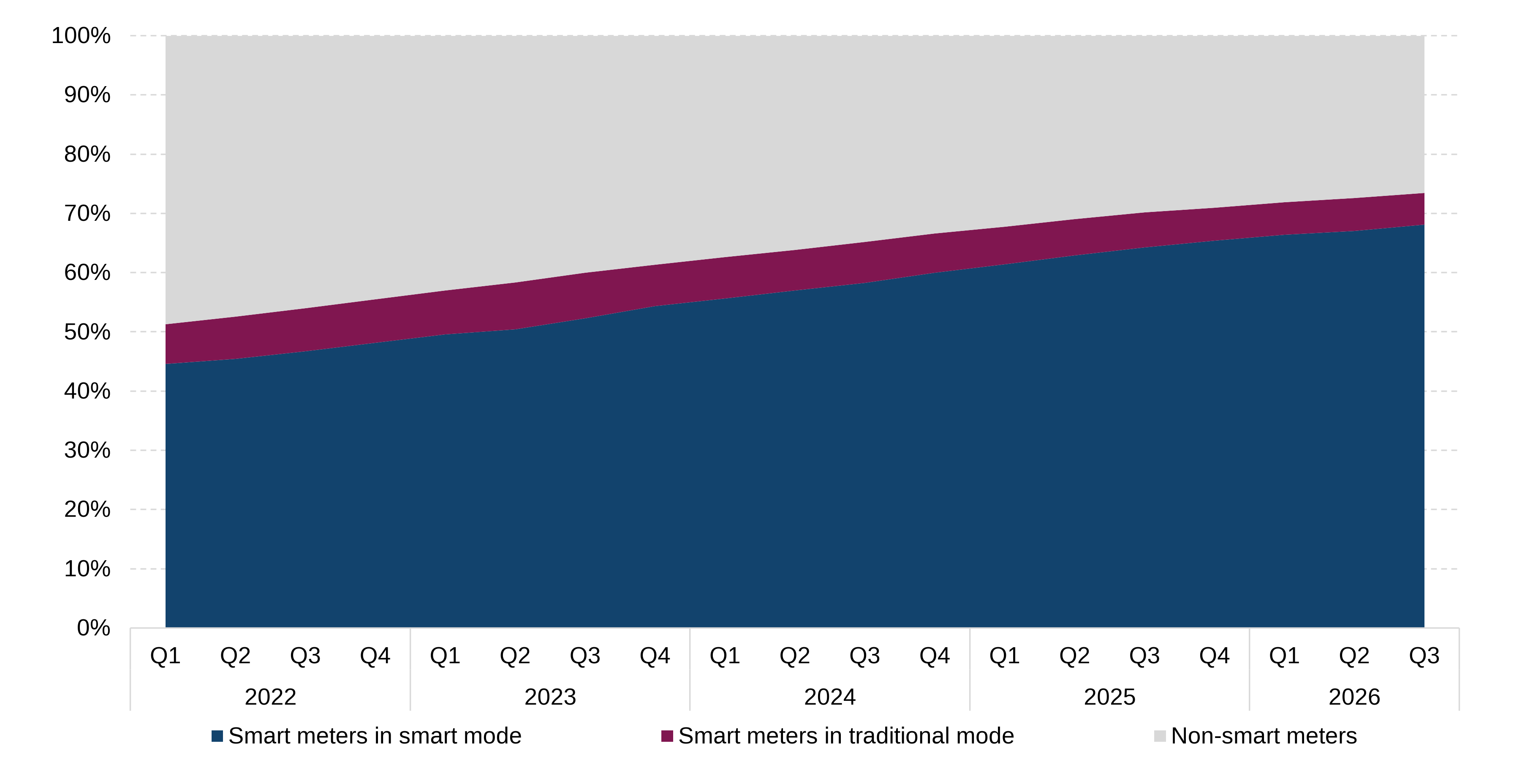
Large energy suppliers operate over 99% of all domestic energy meters, with the remaining 0.7% operated by small energy suppliers (who report data once a year). At the end of September 2026, large energy suppliers operated 40 million smart meters in domestic properties for both electricity and gas (of which 93% were operating in smart mode). They also operated 14 million non-smart meters, therefore over 73% of all meters operated by large energy suppliers were smart. Total domestic meters operated by large energy suppliers over recent years is shown in Figure 3.
The proportion of domestic properties with a smart meter (operated by all energy suppliers) can be approximated by smart electricity meter coverage. While not all households are connected to the gas grid, all have access to electricity. Over three quarters (76%) of properties have a smart electricity meter (comprising 72% with one in smart mode and 3.6% with one in traditional mode). The remaining 24% of homes have a non-smart electricity meter. Over half of homes (57%) have a smart gas meter (comprising 51% operating in smart mode, 6.1% in traditional mode). In addition, 24% of homes have a non-smart gas meter and the remaining 18% have no gas meter[footnote 1].
Figure 3: Domestic energy meters operated by large energy suppliers in Great Britain from 2022
2. Meters in smaller non-domestic sites
The non-domestic energy retail market, as well as non-domestic energy metering, differs from the domestic market in several ways:
- in the non-domestic market small energy suppliers (who report data once a year) provide energy to approximately a third of all metering points, compared to 0.7% for domestic
- only a quarter of non-domestic meters are gas meters, compared to approximately 45% for domestic
- in some circumstances non-domestic customers may have advanced meters installed, rather than smart meters
2.1 Meters installed in smaller non-domestic sites
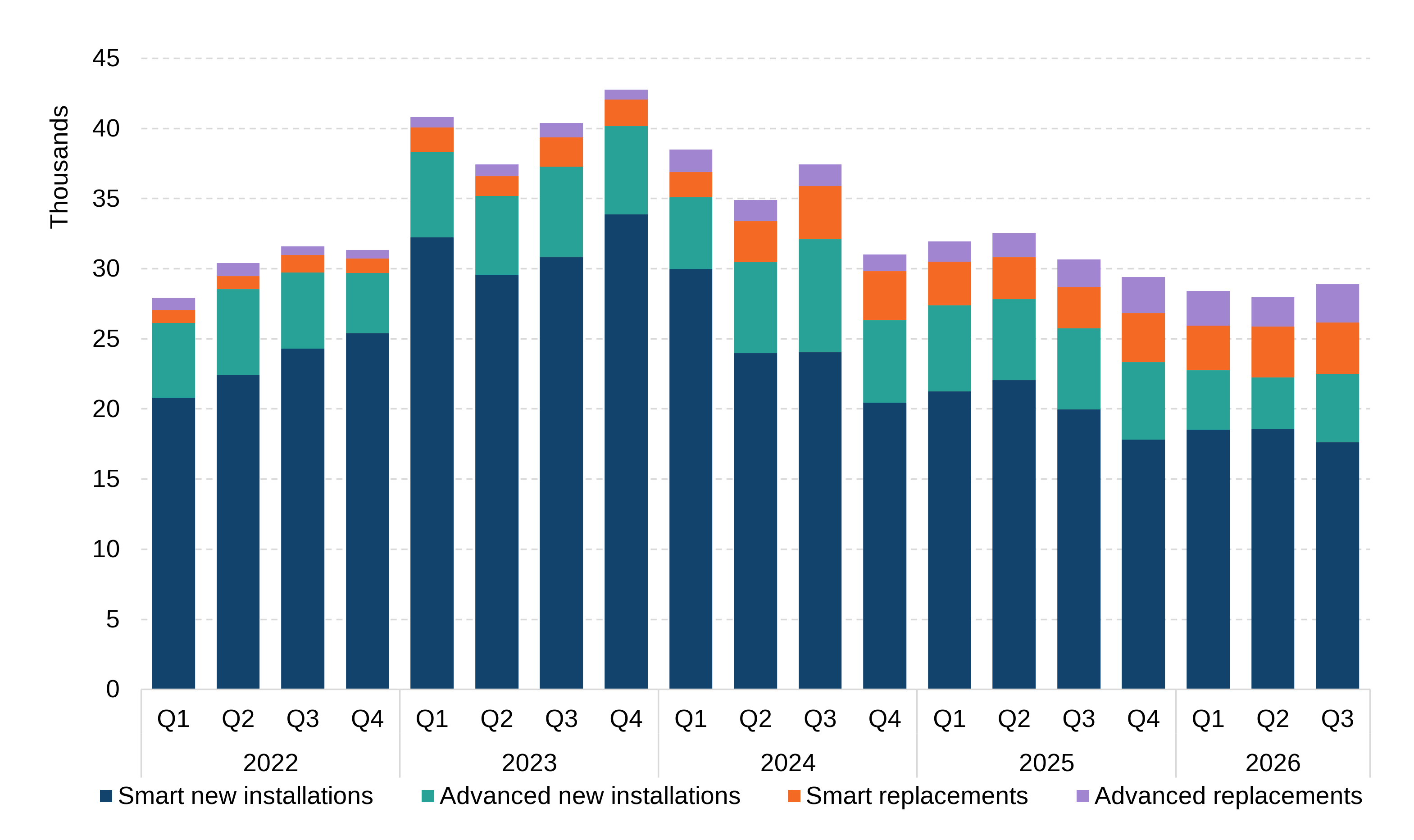
Large energy suppliers carried out 29,000 installations at smaller non-domestic sites during Q3 2026. Most of these installations were smart meters (21,000), of which 18,000 were new installations and 4,000 were replacements [footnote 2]. The remaining 8,000 were advanced meters, comprising 5,000 new installations and 3,000 replacements. Quarterly non-domestic installation activity by large energy suppliers over recent years is shown in Figure 4. Total installation volume is up 3.3% compared to Q2 2026 but down 5.7% compared to Q3 2025. Like the domestic sector, the proportion of installations that are replacements is also up on Q2 2026 (1.7 percentage points) but represents a smaller proportion of total installation activity (22%).
Figure 4: Quarterly smart & advanced meter installations carried out by large energy suppliers at smaller non-domestic sites in Great Britain since 2022
2.2 Operational meters in smaller non-domestic sites
At the end of September 2026, large energy suppliers operated 1.3 million smart and advanced meters in smaller non-domestic sites. Of these 0.7 million were advanced meters and 0.6 million were smart meters (89% of which were in smart mode). Combined, 66% of non-domestic meters operated by large energy suppliers were smart or advanced. Quarterly non-domestic meters operated by large energy suppliers over recent years is shown in Figure 5.
Including small energy suppliers, for which the latest data is from the end of December 2025, there are a total of 2.1 million smart and advanced meters in smaller non-domestic sites, 68% of all non-domestic meters covered by the rollout.
Figure 5: Meters at smaller non-domestic sites operated by large energy suppliers in Great Britain from 2022
Further information
Methodology Note
Further information about these statistics can be found in the Technical Information.
Revisions policy
The Department for Energy Security & Net Zero statistical revisions policy sets out the revisions policy for these statistics, which has been developed in accordance with the UK Statistics Authority Code of Practice for Statistics.
Uses of these statistics
The data associated with this release is used in internal analysis to help form policy decisions and is also used by industry to monitor trends in the roll-out. The data within and associated with this publication are also used to answer Parliamentary questions and Freedom of Information requests.
User engagement
Users are encouraged to provide comments and feedback on how these statistics are used and how well they meet user needs. Comments on any issues relating to this statistical release are welcomed and should be sent to: smartmeter.stats@energysecurity.gov.uk
The Department for Energy Security & Net Zero statement on statistical public engagement and data standards sets out the department’s commitments on public engagement and data standards as outlined by the Code of Practice for Statistics.
Pre-release access to statistics
Some ministers and officials receive access to these statistics up to 24 hours before release. Details of the arrangements for doing this and a list of the ministers and officials that receive pre-release access to these statistics can be found in the Department for Energy Security & Net Zero statement of compliance with the Pre-Release Access to Official Statistics Order 2008.
Contact
Responsible statistician: Mita Kerai
Email: smartmeter.stats@energysecurity.gov.uk
Statistical enquiries: 0300 068 5044
Media enquiries: 020 7215 1000
General enquiries: smartmetering@energysecurity.gov.uk