Safety in the Children and Young People Secure Estate: Update to December 2025
Published 30 April 2026
Applies to England and Wales

© Crown copyright 2026
This publication is licensed under the terms of the Open Government Licence v3.0 except where otherwise stated. To view this licence, visit nationalarchives.gov.uk/doc/open-government-licence/version/3 or write to the Information Policy Team, The National Archives, Kew, London TW9 4DU, or email: psi@nationalarchives.gov.uk.
Where we have identified any third party copyright information you will need to obtain permission from the copyright holders concerned.
This publication is available at https://www.gov.uk/government/statistics/safety-in-the-children-and-young-people-secure-estate-update-to-december-2025/safety-in-the-children-and-young-people-secure-estate-update-to-december-2025
Main Points
| 489 assault incidents Oct to Dec 2025, of which 24 were serious 318 different children and young people involved as assailants or fighters |
The annualised rate of assault incidents per 100 children and young people per year was 432.6 in the 3 months October to December 2025, which is an increase of 6% compared to the same period last year. The number of unique children and young people involved in incidents as assailants or fighters decreased by 15% in the 3 months October to December 2025 compared to the same period last year, from 374 to 318. |
| 235 assault incidents on staff Oct to Dec 2025, of which 12 were serious | The annualised rate of assault incidents on staff per 100 children and young people per year was 207.9 in the 3 months October to December 2025, an increase of 10% compared to the same period last year. |
| 400 self-harm incidents Oct to Dec 2025 78 different children and young people self-harmed Jul to Sep 2025 |
The annualised rate of self-harm incidents per 100 children and young people per year was 353.9 in the 3 months October to December 2025, an increase of 32% compared to the same period last year. The number of unique children and young people self-harming decreased by 6% in the 3 months October to December 2025 compared to the same period last year, from 83 to 78. |
| No deaths reported in the year to Dec 2025 | Prior to the end of December 2025, the last death in the Children and Young People Secure Estate was in June 2019. |
This Safety in the Children and Young People Secure Estate (CYPSE) Bulletin publishes statistics across all CYPSE sectors, excluding the Secure School which was temporarily closed in August 2025, for assaults, self-harm and deaths from April 2014 to December 2025.
Assaults, self-harm incidents and deaths are refreshed quarterly, with use of force incidents and separations in all sectors being refreshed annually in July.
Where the presented statistics cover the period of the Covid-19 pandemic, it must be considered and accounted for when comparing time periods.
1. Statistician’s Comment
These statistics present data up until December 2025 across each sector of the CYPSE excluding the Secure School. Throughout these statistics, the latest reporting quarter is annualised and compared to the same annualised period from the previous year.
The CYPSE comprises the distinct sectors of Young Offender Institutions (YOIs), a Secure Training Centre (STC), Secure Children’s Homes (SCHs) and a Secure School. Each sector is operated under a different model which is governed by different rules. Caution should be taken when comparing sectors to each other. More information can be found in the accompanying guide to the bulletin.
Given the CYPSE’s small population size, individual children and young people (CYP) can significantly impact statistics. This is particularly apparent within SCHs where site populations are lowest, however it can also be seen across the larger sites.
Girls can be placed in all sectors other than YOIs. The impact of these placements can often be seen clearly within these statistics. There have been no girls in the YOI sector since November 2024. The decision to no longer place girls in the YOI sector was made permanent in March 2025.
In this document it is shown that there has been an increase of 6% in the rate per 100 CYP per year in assault incidents when comparing the 3 months October to December 2025 to the same period from last year although the rate of serious assault incidents per 100 CYP per year are shown to have decreased overall by 34%.
Assault incidents where a staff member is assaulted have seen the largest rise in the SCHs where the rate of assaults on staff for the 3 months October to December 2025 increased by 91% when compared to the same period last year, 66 assaults up from 37.
The rate of self-harm incidents has increased by 14% when comparing the 3 months October to December 2025 to the same period from last year. The largest sector increase has been seen in the STC sector, with the rate of self-harm for the 3 months October to December 2025 increasing by 215% when compared to the same period last year, 148 incidents up from 55.
The rate of self-harm incidents is strongly influenced by small numbers of individuals self-harming multiple times, especially amongst girls, who are 11 times more likely to self-harm than boys with the annual rate of self-harm for girls of 2,532.4 incidents per 100 CYP per year in the 12 months to December 2025, compared to the rate for boys of 230.2 incidents per 100 CYP per year.
Deaths of children and young people are fortunately rare and there were no deaths between July 2019 and December 2025 in the CYPSE.
Statistics for separations and use of force within the CYPSE are updated annually with the next update covering the period April 2024 to March 2026 due to be published 30th July 2026.
2. Assaults: April 2014 to December 2025
Assault incident rate increased compared to same period last year
In the 3 months October to December 2025, there were 489 assault incidents in the CYPSE involving 318 different Children and Young People (CYP) as assailants or fighters. The annualised rate of assault incidents was 432.6 per 100 CYP per year, an increase of 6% when compared to the same period in 2024 when the rate was 408.5 incidents per 100 CYP per year.
Assault incidents on staff rate increased compared to same period last year
In the 3 months October to December 2025, there were 235 incidents in the CYPSE where staff were assaulted. The annualised rate of assault incidents on staff was 207.9 per 100 CYP per year, an increase of 10% compared to the same period in 2024 when the rate was 189.7 incidents per 100 CYP per year.
Figure 1: Rate of assaults and fights by quarter from April 2014 to March 2018 and assault incidents from April 2019 to December 2025
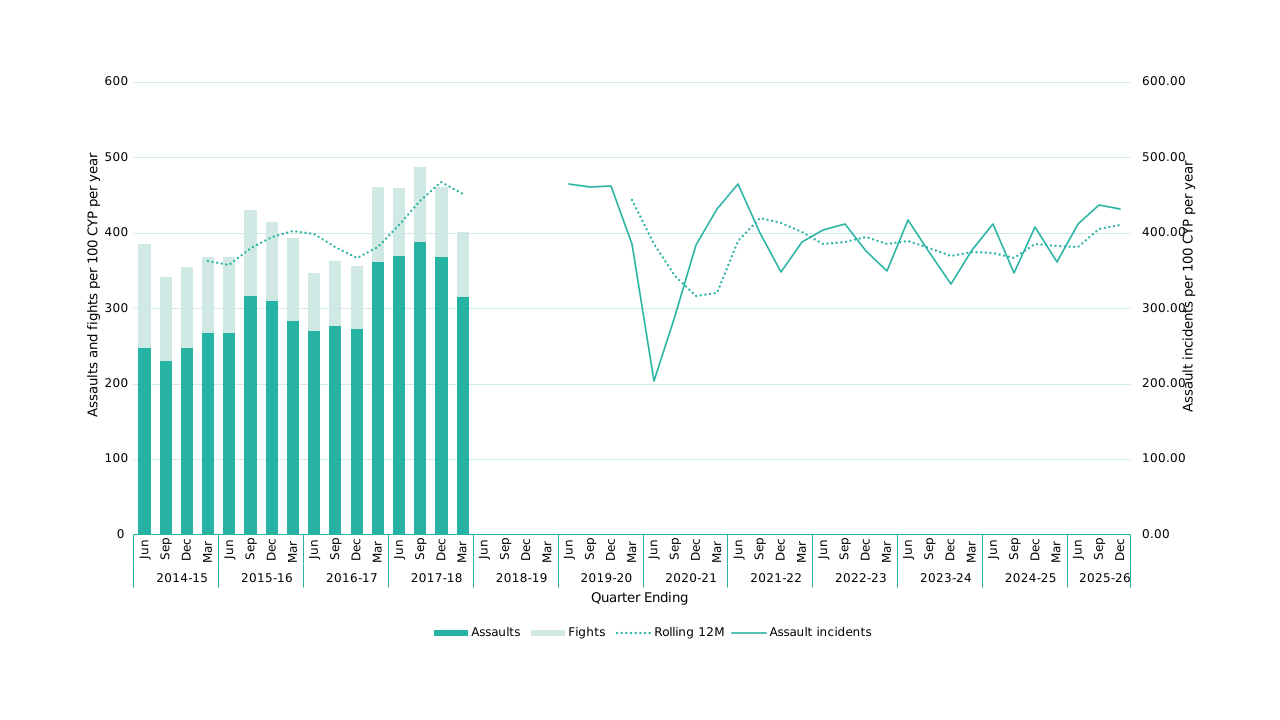
The definition and counting rules of assaults changed from April 2019 (April 2018 for YOIs) and hence no long-term trends are available and there was no estate-wide figure in 2018/19. Figure 1 illustrates the trends before and after the break.
The rate of assault incidents fell substantially at the outset the Covid-19 pandemic. In the last full quarter prior to the pandemic, the 3 months October to December 2019, the assault rate per 100 CYP per year was 466.4.
For the most recent quarter, the 3 months October to December 2025, the rate of assaults was 432.6 incidents per 100 CYP per year which is an increase of 6% when compared to the same period last year, the 3 months October to December 2024.
In the latest 3 months October to December 2025 there were 235 assault incidents on staff at a rate of 207.9 incidents per 100 CYP per year, a 10% increase compared to the same 3 months last year where the rate was 189.7 incidents per 100 CYP per year with 248 assault incidents on staff.
The rate of serious assaults in the 3 months October to December 2025 was 21.1 incidents per 100 CYP per year, which is a decrease of 34% in comparison to the same period last year where the rate was 32.1 incidents per 100 CYP per year.
During the 3 months October to December 2025 there were 318 unique assailants / fighters compared to 374 over the same period in 2024.
During the 3 months October to December 2025 there were 125 unique CYP victims compared to 126 over the same period in 2024.
Figure 2: Rate of assault incidents per 100 CYP per year from October 2024 to December 2024 and from October 2025 to December 2025
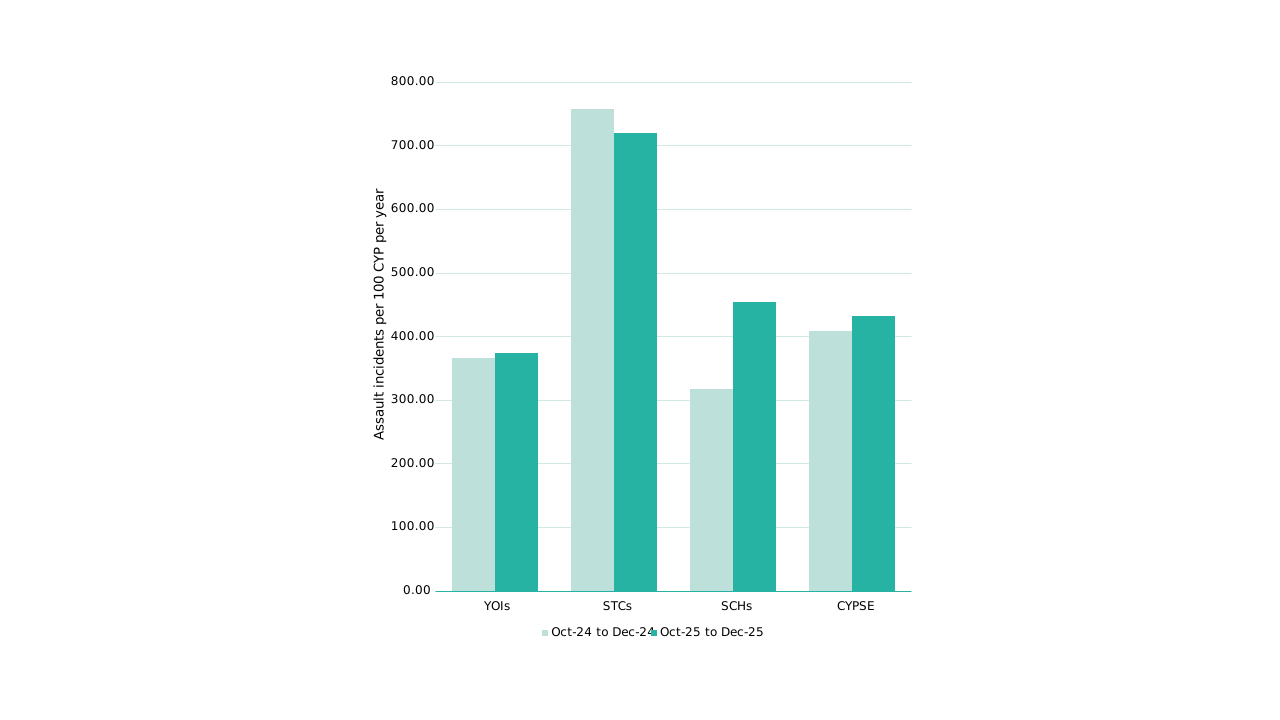
Figure 2 illustrates the CYPSE-wide rate of assault incidents increased during the 3 months October to December 2025, increasing in the YOI and SCH sectors and decreased in the STC sector when compared to the same period last year. The lowest assault rates in the 3 months October to December 2025 were recorded in YOIs.
In the 3 months October to December 2025, the comparative rate of assaults across the sectors were 374.0 incidents per 100 CYP per year in YOIs, an increase of 2%; 720.5 incidents per 100 CYP per year in the STC, a decrease of 5%; and 453.9 incidents per 100 CYP per year in SCHs, an increase of 43%.
The rate of assaults on staff in the 3 months October to December 2025 was highest within the STC sector at 485.0 incidents per 100 CYP per year, an increase of 14% compared to the same period last year. For the SCH sector the rate was 325.6 incidents per 100 CYP per year, a 91% increase when compared to the same period last year. In YOIs the rate for the 3 months October to December 2025 was 126.4 incidents per 100 CYP per year, a decrease of 16% on the same period last year.
When looking at protected characteristics, the rates of involvement as an assailant or fighter over the 12 months to December 2025 were higher than other age groups for CYP aged 10 to 14 years at 918.3 incidents per 100 CYP per year, for CYP from a Black background at 839.1 incidents per 100 CYP per year, for Muslims at 782.8 incidents per CYP per year and for girls at 1,321.9 incidents per 100 CYP per year.
The groups with the highest rate of involvement as a victim were CYP aged 10 to 14 years, at 135.0 incidents per 100 CYP per year, for CYP who were not of Asian, Black, Mixed or White ethnicities at 156.6 incidents per 100 CYP per year and for boys at 114.2 incidents per 100 CYP per year.
3. Self-Harm: April 2014 to December 2025
Self-harm incident rate increased compared to same period last year
In the 3 months October to December 2025 there were 400 incidents of self-harm involving 78 different CYP. The annualised rate was 353.9 incidents per 100 CYP per year, an increase of 32% compared to the same period last year.
Figure 3: Rate of self-harm incidents per 100 CYP per year from April 2014 to December 2025
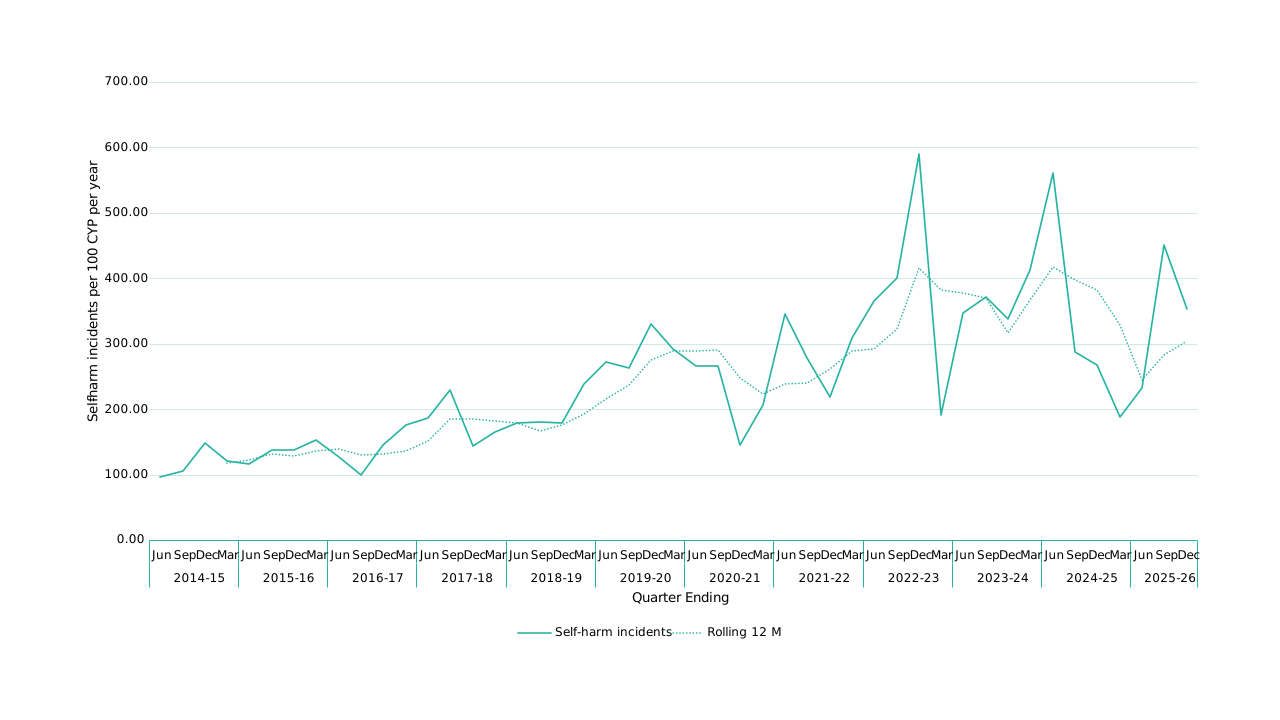
The self-harm rate for the 3 months October to December 2025 was 353.9 incidents per 100 CYP per year, an increase of 32% compared to the same period last year.
The number of unique children and young people self-harming in the 3 months October to December 2025 was 78, compared to 83 unique children and young people who self-harmed in the 3 months October to December 2024.
Figure 4: Rate of self-harm incidents per 100 CYP per year from October 2024 to December 2024 and from October 2025 to December 2025
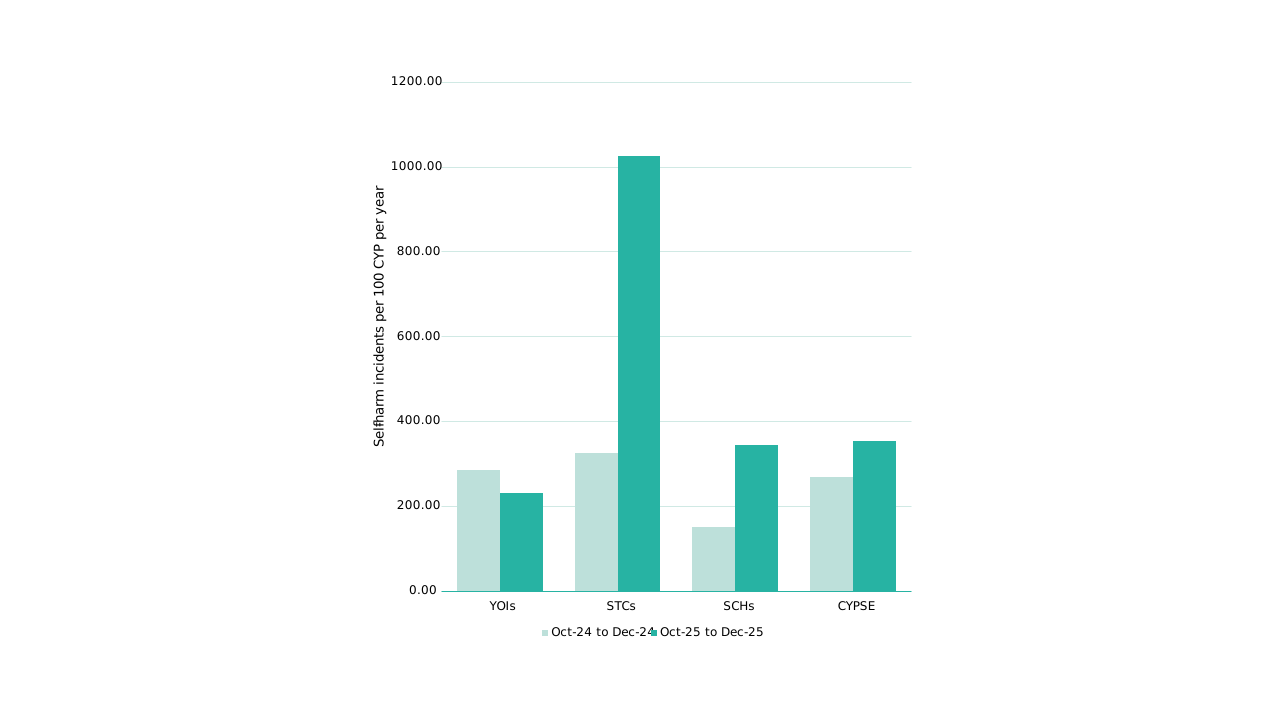
Figure 4 illustrates that the rate of self-harm incidents during the 3 months October to December 2025 increased in the STC and SCH sectors, and decreased in the YOI sector when compared to the same period last year. The lowest self-harm rates in the 3 months October to December 2025 were recorded in the YOI sector.
In the 3 months October to December 2025, the comparative rates of self-harm across the sectors were 232.3 incidents per 100 CYP per year in YOIs, a decrease of 18%; 1,025.4 incidents per 100 CYP per year in the STC, an increase of 215%; and 345.4 incidents per 100 CYP per year in SCHs, an increase of 127% when compared to the same period last year.
The rate of self-harm incidents is influenced by small numbers of individuals self-harming multiple times, so it is important to consider the number of different individuals self-harming as well as the overall count of incidents. The highest rate of unique CYP self-harming over the 3 months October to December 2025 was in the STC (16 different self-harmers from an average population of 57.3), followed by the SCH sector (20 different self-harmers from an average population of 80.5) and then the YOI sector (43 different self-harmers from an average population of 311.0).
The number of self-harm incidents that resulted in an injury requiring treatment in the 3 months October to December 2025 was 80, representing 20.0% of self-harm incidents. The number of self-harm incidents that required hospital attendance in the 3 months October to December 2025 was 7, representing 1.8% of self-harm incidents.
Despite making up around 3.0% of the total average population over the 12 months ending December 2025 (an average of 14.4 girls out of a total average population of 472.3), girls were responsible for over 25% of all self-harm incidents (364 incidents out of a total 1,418).
Within protected characteristic groupings, self-harming was most common over the 12 months to December 2025 among 10 to 14-year-olds (729.2 incidents per 100 CYP per year), White CYP (420.6 incidents per 100 CYP per year) and girls (2,532.4 incidents per 100 CYP per year) in comparison to others in the group.
4. Deaths: April 2014 to December 2025
No deaths were reported in the CYPSE in the 12 months ending December 2025
Deaths of children and young people are rare and there were no deaths in the 12 months ending December 2025. Between April 2014 and December 2025 there have been three deaths of children and young people within the CYPSE.
-
Two at Cookham Wood YOI, in July 2015 and June 2019
-
One at Hillside SCH, in February 2017
-
All deaths were due to natural causes
Further Information
Accompanying files
As well as this bulletin, the following products are published as part of this release:
-
A guide providing further information on how the data are collected and processed, as well as an assessment of data quality. The revisions policy, other statistical issues and a glossary of terms used are also covered in the guide.
-
A set of summary tables covering both the latest quarter and annual summaries of the data back to 2014/15.
Contact
Press enquiries should be directed to the Ministry of Justice press office:
Tel: 020 3334 3536
Email: newsdesk@justice.gov.uk
Other enquiries about these statistics should be directed to:
Louisa Hutton-Adams
Youth Custody Service
HM Prison and Probation Service
1 Ruskin Square
Ruskin Road
Croydon
CR0 2WF
Email: YCSInformationAndPerformance@justice.gov.uk
Next update: 30th July 2026 (assaults, self-harm, separations, use of force, deaths)
Next update: 29th October 2026 (assaults, self-harm, deaths)
URL: https://www.gov.uk/government/collections/youth-justice-statistics#youth-secure-estate-statistics-
© Crown copyright
Produced by the Ministry of Justice.
Alternative formats are available on request from YCSInformationAndPerformance@justice.gov.uk