Respiratory syncytial virus (RSV) maternal vaccination coverage in England: November 2025 report
Updated 1 October 2026
Applies to England

© Crown copyright 2026
This publication is licensed under the terms of the Open Government Licence v3.0 except where otherwise stated. To view this licence, visit nationalarchives.gov.uk/doc/open-government-licence/version/3 or write to the Information Policy Team, The National Archives, Kew, London TW9 4DU, or email: psi@nationalarchives.gov.uk.
Where we have identified any third party copyright information you will need to obtain permission from the copyright holders concerned.
This publication is available at https://www.gov.uk/government/statistics/respiratory-syncytial-virus-rsv-maternal-vaccination-coverage-in-england/respiratory-syncytial-virus-rsv-maternal-vaccination-coverage-in-england-november-2025-report
Published 2 April 2026
This report presents monthly vaccine uptake data for the maternal respiratory syncytial virus (RSV) immunisation programme in England, focusing on the period up to November 2025. This report includes vaccine uptake estimates for pregnant women who delivered in the fifteenth month of the maternal vaccination programme in November 2025.
Main points
The main messages of this report are:
- 64.1% (25,343 out of 39,525) of women that reported giving birth during the survey month received an RSV vaccine
- uptake varied by NHS commissioning region, with the highest uptake reported in the South West region (72.7%) and the lowest in the London region (53.4%) (Table 1)
- uptake varied across integrated care boards (ICBs) with the highest uptake reported in the Hampshire and Isle of Wight ICB (76.8%) and the lowest in Birmingham and Solihull (44.6%) (Table 2)
- uptake varied by ethnic group, with the highest uptake reported among the Chinese ethnic group (78.0%) and the lowest among the Black - Caribbean ethnic group (34.7%) (Table 3)
Help us improve this resource
This vaccine uptake report has been designated as an Official Statistics release. As part of this process, we are seeking feedback from users to ensure the publication meets your needs.
We would be grateful if you could take a few minutes to complete a short survey and share your views.
Your input will play an important role in shaping the development of this publication. Thank you for your time and support.
Analysis of maternal RSV vaccine uptake
Maternal uptake of the RSV vaccine is assessed monthly to monitor the reach and impact of the national immunisation programme. Given the programme’s design, uptake is defined as the proportion of pregnant women who delivered in the reporting month and had received the RSV vaccine during pregnancy. This metric serves as a proxy for vaccine coverage by infant birth month, reflecting the extent of passive immunity conferred to newborns.
The monthly uptake trend among pregnant women who have delivered since the programme’s launch is presented in Figure 1. This trend shows that uptake increased in the first few months of the programme and has been increasing gradually since June 2025.
Figure 1. RSV vaccine uptake (%) trend among pregnant women by month of delivery, measured in November 2025
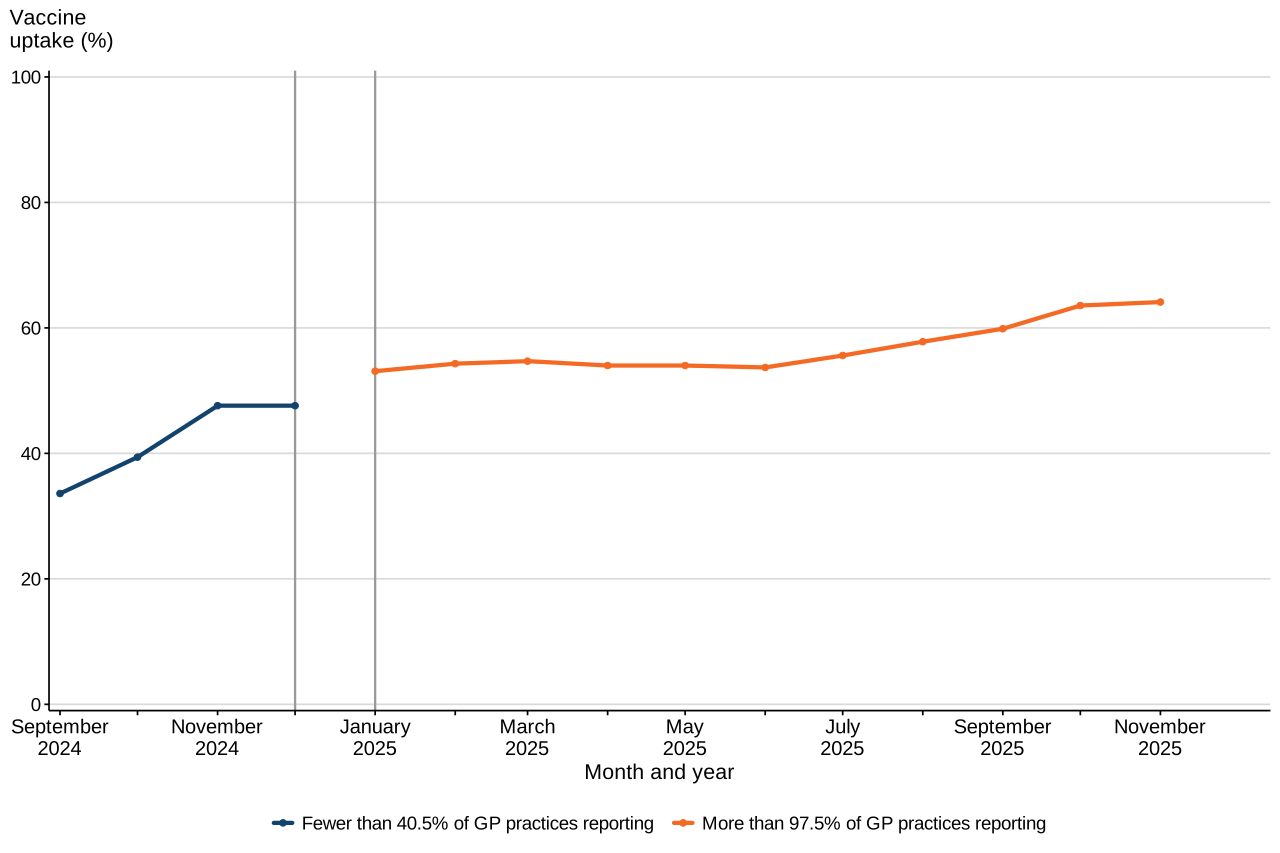
Note 1: the vertical lines represent a change in the percentage of GP practices used to calculate RSV vaccine uptake. Up to December 2024, vaccine uptake was estimated based on data from a single supplier covering fewer than 40.5% of GP practices. From January 2025 onwards, vaccine uptake was based on data from more than 97.5% of GP practices and is more representative of national vaccination uptake.
To further explore variation in uptake, the uptake by commissioning region is shown in Table 1, while the breakdown of uptake by ethnicity is shown in Table 2.
Table 1. RSV vaccine uptake (%) in pregnant women, measured in November 2025, by NHS commissioning region
| Commissioning region | RSV uptake (%) |
|---|---|
| North East and Yorkshire | 67.1 |
| North West | 62.6 |
| Midlands | 61.1 |
| East of England | 67.3 |
| London | 53.4 |
| South East | 70.8 |
| South West | 72.7 |
Table 2. RSV vaccine uptake (%) in pregnant women, measured in November 2025, by ICB
| ICB code | ICB name | RSV uptake (%) |
|---|---|---|
| QE1 | Lancashire and South Cumbria | 61.3 |
| QF7 | South Yorkshire | 63.3 |
| QGH | Herefordshire and Worcestershire | 70.5 |
| QH8 | Mid and South Essex | 65.4 |
| QHG | Bedfordshire, Luton and Milton Keynes | 61.9 |
| QHL | Birmingham and Solihull | 44.6 |
| QHM | North East and North Cumbria | 69.1 |
| QJ2 | Derby and Derbyshire | 66.0 |
| QJG | Suffolk and North East Essex | 70.0 |
| QJK | Devon | 74.4 |
| QJM | Lincolnshire | 68.9 |
| QK1 | Leicester, Leicestershire and Rutland | 65.3 |
| QKK | South East London | 59.8 |
| QKS | Kent and Medway | 64.9 |
| QM7 | Hertfordshire and West Essex | 66.5 |
| QMF | North East London | 45.6 |
| QMJ | North Central London | 49.1 |
| QMM | Norfolk and Waveney | 73.7 |
| QNC | Staffordshire and Stoke-On-Trent | 69.7 |
| QNQ | Frimley | 69.1 |
| QNX | Sussex | 71.6 |
| QOC | Shropshire, Telford and Wrekin | 73.7 |
| QOP | Greater Manchester | 61.8 |
| QOQ | Humber and North Yorkshire | 74.6 |
| QOX | Bath and North East Somerset, Swindon and Wiltshire | 76.1 |
| QPM | Northamptonshire | 69.8 |
| QR1 | Gloucestershire | 73.6 |
| QRL | Hampshire and Isle of Wight | 76.8 |
| QRV | North West London | 53.7 |
| QSL | Somerset | 70.3 |
| QT1 | Nottingham and Nottinghamshire | 61.1 |
| QT6 | Cornwall and the Isles of Scilly | 73.6 |
| QU9 | Buckinghamshire, Oxfordshire and Berkshire West | 70.6 |
| QUA | Black Country | 46.9 |
| QUE | Cambridgeshire and Peterborough | 70.6 |
| QUY | Bristol, North Somerset and South Gloucestershire | 69.5 |
| QVV | Dorset | 71.7 |
| QWE | South West London | 62.4 |
| QWO | West Yorkshire | 62.6 |
| QWU | Coventry and Warwickshire | 67.5 |
| QXU | Surrey Heartlands | 72.6 |
| QYG | Cheshire and Merseyside | 64.7 |
Table 3. RSV vaccine uptake (%) in pregnant women, measured in November 2025, by ethnicity
| Ethnic group [note 2] | RSV uptake (%) |
|---|---|
| Any other ethnicity code | 65.7 |
| Asian - any other Asian | 64.9 |
| Asian - Bangladeshi | 51.3 |
| Asian - Indian | 70.7 |
| Asian - Pakistani | 47.7 |
| Black - African | 50.3 |
| Black - Caribbean | 34.7 |
| Black - Other Black | 45.7 |
| Chinese | 78.0 |
| Ethnicity - unknown | 57.9 |
| Mixed - any other Mixed background | 54.7 |
| Mixed - White and Asian | 67.3 |
| Mixed - White and Black African | 52.4 |
| Mixed - White and Black Caribbean | 45.5 |
| White - any other White background | 51.8 |
| White - British | 71.4 |
| White - Irish | 67.4 |
| Other ethnic group | 48.8 |
Note 2: the ‘Ethnicity - unknown’ group combines all records where ethnicity was not provided. This includes people whose ethnicity was not recorded, not stated, or who refused to give their ethnicity.
Further detail, including uptake figures broken down by local authority, can be found in the November 2025 data tables.
Uptake figures
This monthly report presents RSV vaccine uptake for women who delivered in the fifteenth month of the RSV vaccination programme in November 2025.
Overall, the monthly RSV maternal vaccine uptake for November 2025 was 64.1%. In addition, this report reveals notable differences in uptake with uptake between regions differing by 19.3 percentage points. Uptake differed across ICBs, with a gap of 32.2 percentage points between the highest‑uptake and lowest‑uptake ICBs. There is also a gap of 43.3 percentage points observed in the uptake between ethnic groups.
This month’s report includes data from both major GP IT suppliers, significantly expanding the data available in previous reports. It includes data from 99.0% of GPs in England, up from 40.4% of participating GPs previously in the first 4 months (September to December 2024) of the vaccination programme. This has been made possible by improvements in data quality and permits a more representative analysis of uptake and trends across England.
Since the RSV maternal vaccination programme has now been running for fifteen months (up to the reporting month), an increasing number of pregnant women are receiving the vaccine during their eligible window. This growing awareness and notification from gestation week 20 onwards have contributed to a gradual increase in monthly vaccine uptake from 40.5% in September 2024 to the current figure reported for November 2025. As the programme continues and more women are informed earlier in their pregnancies, monthly vaccination uptake is expected to gradually increase.
Data sources and methodology
More information is available in our quality and methodology information (QMI) report.
The maternal RSV vaccination report will be released monthly, presenting vaccination uptake data only for the specific reporting month, without cumulative figures from previous months. The reporting period for the current report is from 1 November 2025 to 30 November 2025. This report focuses on pregnant women who delivered in the survey month, regardless of gestational age at birth.
GP-level RSV vaccine uptake data is automatically uploaded via participating GP IT suppliers to the ImmForm website each month. ImmForm data is validated and analysed by the UK Health Security Agency (UKHSA) to check data completeness, query any anomalous data and describe epidemiological trends.
Since September 2024, the reporting data collected includes:
- denominator: number of women who delivered in the survey month, excluding miscarriages and stillbirths, regardless of gestational age
- numerator: number of women receiving RSV vaccination from week 28 of pregnancy up until delivery
- refusals: number of women in the denominator who refused RSV vaccination between week 28 of pregnancy and delivery
To ensure accurate denominators are extracted from GP IT systems by the automated survey and precise uptake estimates are calculated, the methodology uses a monthly data extraction process with a three-month reporting lag to allow enough time for relevant information to be recorded. For example, data from September 2024 was extracted on 1 December, 2024.
The data presented in this report for November 2025 is based on data received from both major GP IT suppliers, accounting for 99.0% of all national GP practices participating during the reporting month.
The December 2025 maternal RSV vaccination uptake report is scheduled to be released on 7 May 2026.
Background information
The RSV vaccine has been offered to pregnant women in England since September 2024 to address the significant burden of RSV-related illness, hospitalisations and deaths, particularly among infants under six months of age and older adults, who are at increased risk of lower respiratory tract infection (LRTI) (see the Green Book on immunisation). In 2023, the Joint Committee on Vaccination and Immunisation (JCVI) issued a full statement recommending the implementation of a maternal RSV vaccination programme. This recommendation was based on robust evidence demonstrating the safety and effectiveness of RSV vaccines in protecting infants during their most vulnerable period.
The vaccine is recommended as a year-round programme to be administered from 28 weeks of gestation onwards. This timing aligns with the optimal window for passive antibody transfer to the foetus, ensuring effective protection against severe RSV-related illness. From 1 September 2024 (the programme start date), all women who are at least 28 weeks pregnant are advised to receive the vaccine as soon as possible, with vaccination continuing to be recommended for all eligible women throughout pregnancy up until delivery. Additionally, the vaccine will be reoffered for every subsequent pregnancy to maintain consistent coverage and protection.
This monthly report includes vaccine uptake data for women who delivered in November 2025.
Programme delivery
The programme is delivered through GP and maternity services, ensuring accessible vaccination opportunities for eligible pregnant women across England. In addition, the RSV vaccine is available through the community pharmacy delivery model at approximately 37 sites across two ICBs in the East of England. It is also available at up to 200 additional community pharmacy sites across the Midlands, North West, and London commissioning regions during the 2025 to 2026 expansion phase.
Previous monthly reports are available at RSV maternal vaccination coverage in England.
Related statistics
- RSV maternal vaccination coverage in England
- Surveillance of respiratory syncytial virus: winter 2024 to 2025
- NHS England vaccination statistics
- PHW Wales RSV vaccination surveillance
- Respiratory Syncytial Virus (RSV) Pregnancy Vaccination in Scotland
Further information and contact details
Feedback and contact information
For feedback or any enquiries relating to this document and the RSV vaccination uptake, please contact rsv@ukhsa.gov.uk.
Official statistics
Our statistical practice is regulated by the Office for Statistics Regulation (OSR). OSR sets the standards of trustworthiness, quality and value in the Code of Practice for Statistics that all producers of official statistics should adhere to.
You are welcome to contact us directly by emailing rsv@ukhsa.gov.uk with any comments about how we meet these standards. Alternatively, you can contact OSR by emailing regulation@statistics.gov.uk or via the OSR website.
UKHSA is committed to ensuring that these statistics comply with the Code of Practice for Statistics. This means users can have confidence in the people who produce UKHSA statistics because our statistics are robust, reliable and accurate. Our statistics are regularly reviewed to ensure they support the needs of society for information.