Annual Prison Performance Ratings 2025/26
Published 30 July 2026
Applies to England and Wales

© Crown copyright 2026
This publication is licensed under the terms of the Open Government Licence v3.0 except where otherwise stated. To view this licence, visit nationalarchives.gov.uk/doc/open-government-licence/version/3 or write to the Information Policy Team, The National Archives, Kew, London TW9 4DU, or email: psi@nationalarchives.gov.uk.
Where we have identified any third party copyright information you will need to obtain permission from the copyright holders concerned.
This publication is available at https://www.gov.uk/government/statistics/prison-performance-ratings-2025-to-2026/annual-prison-performance-ratings-202526
1. Introduction
The Annual Prison Performance Ratings 2025/26 report presents an official assessment of prisons across England and Wales for the performance year 1 April 2025 to 31 March 2026. This report assigns data-driven ratings from 4 (Outstanding performance) down to 1 (Performance of serious concern) for each measure in the 2025/26 Prison Performance Framework resulting in an overall prison rating.
2. Main Points
| There has been an increase in the proportion of prisons rated as outstanding since 2024/25 | ↑ | 16 (13.3%) prisons were given a rating of outstanding, 4 prisons more than in 2024/25. 81 (67.5%) prisons were rated as good or higher. |
| There was a decrease in the proportion of prisons rated as serious concern compared to 2024/25 | ↓ | 14 (11.7%) prisons were given a rating of serious concern which is a decrease of 8 prisons from 2024/25. |
| Category C Foreign National, Category C Trainer, Female, High Security and Open were strong overall performers | No prisons in these groups received a rating of serious concern | |
| 8 of the prisons that have received an Urgent Notification (UN) since 2017 were rated as serious concern | 9 out of the 13 adult prisons to receive a UN since 2017 were Reception prisons. |
3. Statistician’s Comment
Over the 2025/26 performance year (1 April 2025 to 31 March 2026) 81 (67.5%) prisons were rated as good or outstanding, an increase from 60 (50.4%) in the 2024/25 performance year. 14 (11.7%) prisons were given a rating of serious concern, a decrease from 22 (18.5%) in the previous performance year.
However, caution should be exercised when comparing prison performance ratings over time. Different frameworks were used in previous years to reflect HMPPS priorities of the time. When priorities change, measures in the prison performance framework are amended to reflect these changes. Additionally, to help incentivise performance improvement, targets for some measures are set relatively based on outturns from the previous performance year rather than on absolute performance.
In 2024/25 a series of measures were implemented to help manage the significant capacity pressures the prison estate faced. The impact of these pressures, and the measures to address them, will have varied across the estate but likely had a negative impact on performance ratings for that year. The improvements seen in the 2025/26 prison performance ratings should be compared in light of the poorer outcomes from 2024/25, rather than necessarily considered a reflection of positive absolute performance in the year. Consequently, while the results provide some evidence of improved performance, the scale of change in ratings is likely to overstate the extent of improvement in underlying prison performance.
Despite this, there is evidence of improved performance. For example, although levels remain high, the overall rates of assaults on staff and rates of self-harm declined in 2025/26 as compared to 2024/25.
4. Background
The 2025/26 prison performance framework used 33 outcome-focused measures to formally assess prisons. HMPPS manage and own the performance framework, which is structured against six main priority areas. These are:
-
Safety
-
Security
-
Respect
-
Purposeful Activity
-
Preparation for Release
-
Organisational Effectiveness
Most of the measures within the framework utilise a data-driven “performance against target” model to assess the performance of each prison. Further information about the performance framework, performance measures that make up each priority area, descriptions of the functional groups and detail regarding the methodology, thresholds, and rules applied can be found in the Annual Prison Performance Ratings Guide 2025/26 accompanying this bulletin. Details of which prisons belong to which functional group can be found in the Annual Prison Performance Ratings 2025/26 Supplementary Tables that accompany this bulletin.
Each prison has been assigned one of four ratings to reflect annual performance.
Figure 1: Rating definitions
| Rating | Definition |
|---|---|
| 4 | Outstanding performance |
| 3 | Good performance |
| 2 | Performance of concern |
| 1 | Performance of serious concern |
Following the production of the data-driven performance ratings, a moderation process took place where a panel reviewed any evidence provided to determine the final performance rating for each prison. The analysis in this publication reflects the data-driven breakdowns at measure level along with the final moderated overall prison rating.
For 2025/26, the performance ratings of 5 prisons were adjusted through the moderation process. These prisons are noted in Tables 1 and 4 of the Supplementary Tables.
5. Annual Prison Performance Ratings
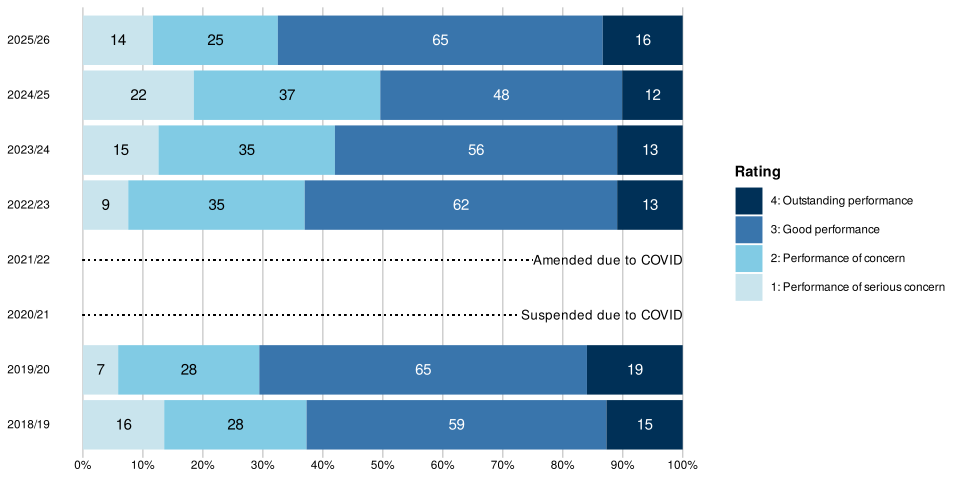
In 2025/26, prison performance ratings have increased compared to 2024/25. Figure 2 shows the distribution of prisons by rating per year since 2018/19. However, performance frameworks have changed markedly over recent years and therefore caution should be taken when making year on year comparisons.
Figure 2: Annual Prison Performance Ratings 2018/19 to 2025/26
(Source: Annual Prison Performance Ratings 2025/26 Supplementary Tables; Table 4)
-
For 2025/26, the number of prisons rated as concern or serious concern was 39 (32.5%). This is a decrease from 59 (49.6%) in 2024/25.
-
14 (11.7%) prisons were given a rating of serious concern in 2025/26, representing a decrease from 2024/25 and a return to levels more in line with the wider time series.
-
Prisons rated as outstanding represented 13.3% of prisons and is the largest number of prisons rated 4 since 2019/20 excluding the COVID affected performance years.
A total of 8 prisons received lower ratings than the previous year, while 35 prisons improved. Figure 3 shows the changes in prison performance ratings from 2024/25 to 2025/26.
Figure 3: Changes in Prison Performance Ratings from 2024/25 to 2025/26
(Source: Annual Prison Performance Ratings 2025/26 Supplementary Tables; Table 4)
| 2025/26 Rating | |||||
|---|---|---|---|---|---|
| 1: Performance of serious concern | 2: Performance of concern | 3: Good performance | 4: Outstanding performance | ||
| 2024/25 Rating | 1: Performance of serious concern | 11 | 5 | 6 | 0 |
| 2: Performance of concern | 2 | 15 | 20 | 0 | |
| 3: Good performance | 1 | 5 | 38 | 4 | |
| 4: Outstanding performance | 0 | 0 | 0 | 12 |
6. Prison Function Ratings and Performance Drivers
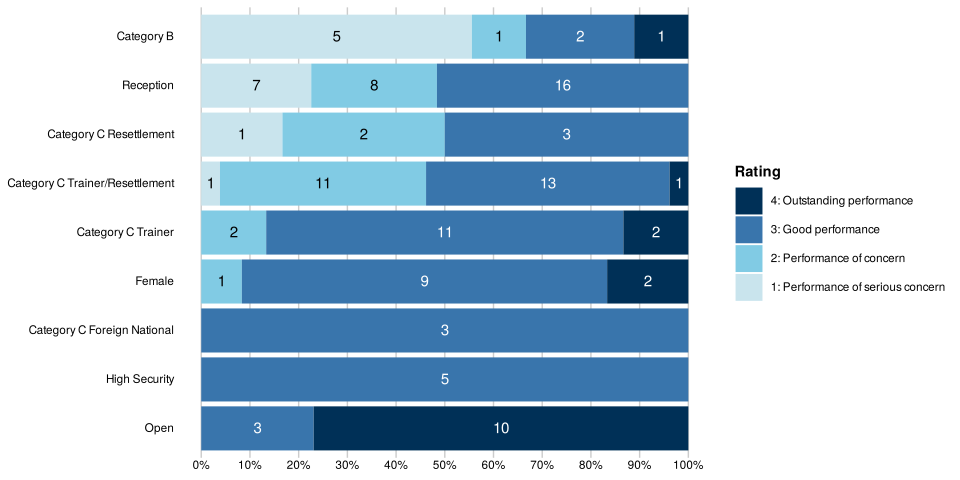
Within Figure 4 below, the distribution of overall prison performance ratings are shown by functional groups. For how these groups are defined, please refer to Section 8 of the Annual Prison Performance Ratings Guide 2025/26.
-
All functional groups had prisons that were rated as having good performance.
-
Across all the groups, Category B prisons performed least well in terms of ratings, with 6 (66.7%) rated as of concern or of serious concern.
-
Open prisons performed the best in terms of ratings, with 10 (76.9%) rated as outstanding and 100% rated as good or higher.
-
Prisons in the Category C Foreign National, Category C Trainer, Female, High Security and Open groups had no prisons attaining a rating of serious concern.
Figure 4: Annual Prison Performance Ratings 2025/26 by Prison Function
(Source: Annual Prison Performance Ratings 2025/26 Supplementary Tables; Table 1)
7. Urgent Notifications
HM Inspectorate of Prisons (HMIP) have invoked an Urgent Notification (UN) at 13 adult prisons since the process was introduced in 2017. Figure 5 below shows the Annual Prison Performance Ratings for 2025/26 for those prisons where an Urgent Notification (UN) has been invoked by HMIP. Nearly all of these prisons were rated as either concern or of serious concern in 2025/26, except for Exeter and Chelmsford which were rated as good.
Figure 5: Annual Prison Performance Ratings 2025/26 for Prisons where an Urgent Notification has been invoked by HMIP
(Source: HM Inspectorate of Prisons)
| Prison | Functional Group | UN Issued | Performance Rating 2025/26 |
|---|---|---|---|
| Woodhill | Category B | 17 March 2026 / 30 August 2023 | 1 |
| Swaleside | Category B | 17 December 2025 | 1 |
| Pentonville | Reception | 16 July 2025 | 1 |
| Winchester | Reception | 23 October 2024 | 1 |
| Manchester | Category B | 09 October 2024 | 2 |
| Rochester | Category C Trainer/Resettlement | 30 August 2024 | 2 |
| Wandsworth | Reception | 08 May 2024 | 1 |
| Bedford | Reception | 15 November 2023 / 12 September 2018 | 1 |
| Bristol | Reception | 26 July 2023 / 11 June 2019 | 2 |
| Exeter | Reception | 18 November 2022 / 30 May 2018 | 3 |
| Chelmsford | Reception | 26 August 2021 | 3 |
| Birmingham | Reception | 16 August 2018 | 1 |
| Nottingham | Reception | 17 January 2018 | 1 |
For more information about Urgent Notifications, please see: Urgent Notification - GOV.UK (www.gov.uk)
8. Further Information
8.1 Accompanying Files
The following products are also published as part of this release:
-
Annual Prison Performance Ratings Guide 2025/26, providing further information on how the data are collected and processed to derive prison performance ratings;
-
Annual Prison Performance Ratings 2025/26 Supplementary Tables, providing underlying data and the rating for each measure by prison;
-
YCS Annex: 2025/26, YCS Annex Guide: 2025/26 and YCS Annex Table: 2025/26, providing further information on Youth Custody Service Performance;
-
Attendance at Education courses by Prison Annex 2025/26, providing further information on education attendance and allocation at prison level.
Press enquiries should be directed to the Ministry of Justice press office.
Other enquiries about these statistics should be directed to:
J Sullivan
Email: CustodialPerformance.Enquiries@justice.gov.uk
9. Official Statistics
Our statistical practice is regulated by the Office for Statistics Regulation (OSR). OSR sets the standards of trustworthiness, quality and value in the Code of Practice for Statistics that all producers of official statistics should adhere to.
You are welcome to contact us directly with any comments about how we meet these standards.
Alternatively, you can contact OSR by emailing regulation@statistics.gov.uk or via the OSR website.