Main findings: ownership of children’s social care providers in England 2025
Published 27 November 2025
Applies to England

© Crown copyright 2025
This publication is licensed under the terms of the Open Government Licence v3.0 except where otherwise stated. To view this licence, visit nationalarchives.gov.uk/doc/open-government-licence/version/3 or write to the Information Policy Team, The National Archives, Kew, London TW9 4DU, or email: psi@nationalarchives.gov.uk.
Where we have identified any third party copyright information you will need to obtain permission from the copyright holders concerned.
This publication is available at https://www.gov.uk/government/statistics/ownership-of-childrens-social-care-providers-in-england-2025/main-findings-ownership-of-childrens-social-care-providers-in-england-2025
This is the main findings report for the ownership of children’s social care providers 2025 release. The following are also available:
- underlying data
- methodology
- pre-release access list
Main findings
- The 20 largest owners accounted for 25% of all children’s homes
- 6 owners of independent fostering agencies (IFAs) were ranked among the largest owners of 25% of all fostering places. These 6 IFA owners accounted for 19% of all fostering places in England
- 18 owners accounted for 25% of all supported accommodation premises
- Amalfi Midco Limited (CareTech) and G Square Healthcare Private Equity LLP (Keys) own far more children’s homes than any of the other largest owners – between them they own 9% of all children’s homes
- Most new registrations of children’s homes this year were from smaller owners
- The West Midlands has the highest proportion of children’s homes belonging to the largest owners, 32%, compared to London where 43% of homes belong to private single owners
- 11 owners operate across children’s homes, fostering and supported accommodation
Introduction
This release provides information about the ownership of children’s homes, IFAs and supported accommodation in England as at 31 March 2025. It includes information about the sector ownership of social care providers as well as the owners that have the largest number of children’s homes, provide the largest number of fostering places through the IFAs they own, or own the largest number of supported accommodation premises.
The ownership data in these statistics is based on Ofsted data that we have joined to public data from Companies House. The information held and published by Companies House is provided by companies themselves and is not verified by Companies House. While the companies or corporate bodies are registered in the UK, some may be owned by organisations based overseas; however, this ownership is not visible in the data. Ofsted has tried to confirm the accuracy of the data by contacting the largest owners. The owner names used throughout this release are presented as retrieved from Companies House, or as verified by owners. If a company is better known by another name, the commonly recognised name appears in brackets. Further details are provided in the methodology report.
Ownership in children’s social care
Children’s social care provision can be owned and run by a local authority or other public sector body, or by an organisation or individual from the private or voluntary sectors. The voluntary sector includes charities, trusts and not-for-profit organisations, while the private sector mainly includes for-profit enterprises.
Ownership structures in children’s social care can be highly complex. Some providers are ultimately controlled by parent undertakings or investors that may be several layers up the ownership chain.
Private provision
As at 31 March 2025, there were 81,770 children in care, of which 40% were in private provision.
Private sector provision plays a prominent role in children’s homes. Private ownership has grown steadily in recent years and now accounts for 84% of all children’s homes. Most new registrations in 2024–25 are also from the private sector, reinforcing the trend. Alongside this shift, there has been a noticeable move towards smaller-capacity homes within the private sector.[footnote 1]
Largest owners of children’s social care
In this release, we focus on the top-level owners – that is, the companies, corporate bodies or parent undertakings at the end of the ownership chain.
We measure owners’ sizes relative to all children’s social care provision across all sectors. To measure the proportion of each provision type that each owner represents:
- for owners of children’s homes, we count the number of providers
- for owners of IFAs, we count the number of all approved fostering places
- for owners of supported accommodation, we count the number of premises
For each provision type, the owners that make up the top 25% based on the above measures are referred to as the ‘largest owners’.
Children’s homes
There were 4,009 children’s homes of all types as at 31 March 2025, offering 15,742 places. As reported in children’s social care in England, children’s homes have rapidly increased in number over recent years.
To measure owner size, we use the total number of children’s homes. As at 31 March 2025, 20 owners accounted for 25% of all children’s homes. Almost all (19) of the largest owners are in the private sector, with 1 owner in the voluntary sector (Action for Children).
The largest owners vary in size – 2 are substantially larger than the rest – and the number of children’s homes owned ranges from 18 to 220 homes.
Table 1: Largest owners of all types of children’s homes as at 31 March 2025, by providers
| Position | Owner | Number of children’s homes | Places | Sector |
|---|---|---|---|---|
| 1 | Amalfi Midco Limited (CareTech) | 220 | 877 | Private |
| 2 | G Square Healthcare Private Equity LLP (Keys) | 156 | 621 | Private |
| 3 | Picnic Topco Limited (Esland) | 68 | 165 | Private |
| 4 | HCS Group Limited | 59 | 216 | Private |
| 5 | Liberi Topco Limited (Compass) | 52 | 268 | Private |
| 6 | The Shaw Trust Limited | 51 | 166 | Private |
| 7 | Aspris Holdco Limited | 50 | 212 | Private |
| 8 | Care Today/Parallel Parents Limited | 44 | 170 | Private |
| 9 | Range Topco Limited | 40 | 135 | Private |
| 10 | Wordsworth Topco Limited (Witherslack) | 38 | 241 | Private |
| 11 | Ursae Bidco Limited (Nutrius) | 36 | 151 | Private |
| 12 | Ardenton UK Limited | 31 | 78 | Private |
| 13 | Action for Children | 23 | 136 | Voluntary |
| 14 | Foundation Investment Partners Management LLP | 22 | 72 | Private |
| 15 | Life Change Holdings Limited | 22 | 44 | Private |
| 16 | Reflexion Care Group Limited | 21 | 70 | Private |
| 17 | Meadows Care Holdco Limited | 20 | 64 | Private |
| 18 | Your Chapter Topco Limited | 18 | 70 | Private |
| 19 | Blue Mountain Homes Limited | 18 | 57 | Private |
| 20 | Timeout Property Limited | 18 | 33 | Private |
Amalfi Midco Limited (CareTech) is the largest owner with a total of 220 children’s homes, offering 877 places, 5% of all children’s homes. One in 5 of their children’s homes (43) is registered for a single place.
G Square Healthcare Private Equity LLP (Keys) has the next highest number of children’s homes, with 156 homes offering 621 places, 4% of all children’s homes.
Ownership groups
In this section, we focus on ownership groups. In some cases, multiple organisations (responsible bodies) are linked to a single owner. The structure and composition of these groups vary across the largest owners.
To illustrate this variation, we compared the 2 largest owners of children’s homes:
- Amalfi Midco Limited (CareTech) oversees 12 organisations responsible for 220 children’s homes, with Cambian Childcare Limited accounting for 83% of these.
- In contrast, G Square Healthcare Private Equity LLP (Keys) owns 25 organisations responsible for 156 children’s homes, with its largest constituent, Keys Child Care Limited, representing 19% of the total.
Figure 1: Proportion of children’s homes owned by Amalfi Midco Limited (CareTech) and G Square Healthcare Private Equity LLP (Keys), by top 3 organisations, as at 31 March 2025

1. The length of each bar represents the number of homes owned by the organisation. Segments represent the organisations within ownership groups that are responsible for children’s homes; the 3 organisations with the most homes are shown in the legend and all other organisations’ homes are aggregated into ‘remaining organisations’ buckets.
View the data for Figure 1 in an accessible table format.
Children’s homes new registrations
Of the 674 children’s homes that were registered during the year, 8% (55 homes) belong to the largest owners. The majority of homes registered during 2024–25 (60%, 404) are owned by the smallest owners with fewer than 4 homes each: 33% of new homes (220) have single owners, 27% of new homes (184) belong to owners with 2 or 3 homes.
Regional distribution
Children’s homes are distributed unevenly across the country, with 26% of all children’s homes located in the North West. The regional distribution of children’s homes belonging to the largest owners, combined, very closely resembles the overall distribution of all children’s homes. Among the largest owners of children’s homes, 29% of their children’s homes are in the North West.
Some of the largest owners have homes spread throughout the country, while others are more concentrated in particular regions.
The 2 largest owners, Amalfi Midco Limited (CareTech) and G Square Healthcare Private Equity LLP (Keys), both own children’s homes across all regions except London. Amalfi Midco Limited (CareTech) has a particularly strong presence in the North West, where almost a third of its homes are located (68 homes, 31%).
Other owners of children’s social care illustrate different regional patterns. For example, Liberi Topco Limited (Compass) has homes in all regions except London, but very few in the North West (2), South West (2) and East Midlands (3). The Shaw Trust Limited concentrates its homes in the East Midlands (35 homes), with smaller numbers in the South West (7), whereas Life Change Holdings Limited only owns children’s homes in the North West, with 21 of its 22 homes in Lancashire.
Regional ownership
The vast majority of all children’s homes (84%) are privately owned. However, within regions, the profile of ownership sector type varies.
Almost 1 in 3 children’s homes in the West Midlands belong to the largest owners of children’s homes with 204 children’s homes, 32% of homes in the region.
The North West has the most children’s homes, and the largest owners represent 28% of homes in the region (294 homes).
London, which has the fewest children’s homes, is more reliant on smaller private owners. The largest owners together account for only 8 children’s homes in London (3%), whereas private owners with a single home make up 43% of homes (107).
Figure 2: Percentage of children’s homes in each region owned by the largest owners, as at 31 March 2025

1. A lighter hue indicates a lower percentage.
View the data for Figure 2 in an accessible table format.
Independent fostering agencies
Most children in care are in fostering placements (67%). Foster care can be provided by local authorities or IFAs. As at 31 March 2025, there were 339 IFAs in England, most of which (84%) are privately owned.
To measure owner size, we use the total of all approved fostering places in England. Data about fostering places is sourced from the annual fostering data collection. More information about the fostering sector can be found in the Fostering in England 1 April 2024 to 31 March 2025 official statistics.
As at 31 March 2025, 6 IFA owners have been ranked among the largest providers of fostering in terms of total approved places, including 1 IFA Trust.
Owners of IFAs may have multiple providers and organisations within their ownership groups. IFAs tend to be smaller in capacity in terms of total approved places, compared to fostering services run by local authorities, but there are a small number of privately owned IFAs that have over 500 places. Most IFA owners are ‘single’ providers, owning 1 IFA each, while 12% of IFA owners (19 private owners and 7 voluntary owners) have 2 or more IFAs.
The largest IFA owner is SSCP Spring Topco Limited which has a total of 23 IFAs across the 13 organisations (responsible bodies) in their ownership group. SSCP Spring Topco Limited has the most approved fostering places, with 13% of all IFA places which amounts to 6% of all fostering places.
Similar to the ownership profile for children’s homes, two of the largest IFA owners are substantially larger than the rest. SSCP Spring Topco Limited and the second largest IFA owner, Ursae Bidco Limited (Nutrius), are both more than double the size of the next largest owner in terms of approved places.
Table 2: Largest owners of IFAs as at 31 March 2025, by places
| Position | Owner | Places | Sector |
|---|---|---|---|
| 1 | SSCP Spring Topco Limited | 4,735 | Private |
| 2 | Ursae Bidco Limited (Nutrius) | 4,725 | Private |
| 3 | Liberi Topco Limited (Compass) | 2,235 | Private |
| 4 | Orange Cloud Topco Limited | 1,520 | Private |
| 5 | Midhurst Child Care Limited | 1,105 | Private |
| 6 | Birmingham Children’s Trust Community Interest Company | 1,025 | Voluntary |
1. Owner total IFA places may not equal the sum of provider level IFA places in the underlying dataset due to rounding.
Supported accommodation
Supported accommodation became a regulated form of provision in April 2023. Every supported accommodation service provider must be registered separately with Ofsted. A provider may operate multiple premises where young people are accommodated. Supported accommodation providers may be registered to provide multiple categories of accommodation across multiple premises.
As at 31 March 2025, there were 893 supported accommodation providers (840 owners) with a total of 8,118 premises.
To measure owner size, we use the total number of open and pending premises. Range Topco Limited is the largest owner of supported accommodation, owning 337 premises.
Stepping Stone Projects is the largest owner within the voluntary sector, with 164 premises across the country.
Although voluntary owners account for a total of 19% of all supported accommodation premises, the owners tend to be larger compared to the private owners. The average number of premises for voluntary owners was 26 premises while, in the private sector, the average was 8 premises.
Table 3: Largest owners of supported accommodation as at 31 March 2025, by premises
| Position | Owner | Number of premises | Sector |
|---|---|---|---|
| 1 | Range Topco Limited | 337 | Private |
| 2 | Bedspace Group Limited | 202 | Private |
| 3 | Stepping Stone Projects | 164 | Voluntary |
| 4 | Places for People Living+ Limited | 126 | Private |
| 5 | The Royle Trust Limited | 123 | Private |
| 6 | Mosscare St. Vincent’s Housing Group Limited | 115 | Private |
| 7 | Step by Step Partnership Limited | 115 | Private |
| 8 | Active 8 Support Services Limited | 112 | Private |
| 9 | Inicio Group Limited | 99 | Private |
| 10 | Kent County Council | 97 | Local Authority |
| 11 | Framework Housing Association | 68 | Voluntary |
| 12 | Gipsil Limited | 68 | Private |
| 13 | YMCA Robin Hood Group | 67 | Voluntary |
| 14 | Adullam Homes Housing Association Limited | 67 | Voluntary |
| 15 | SHAP Limited | 67 | Voluntary |
| 16 | Nottingham Community Housing Association Limited | 64 | Voluntary |
| 17 | Depaul UK | 60 | Voluntary |
| 18 | Brightsky Youth Services Limited | 59 | Private |
The North West has a quarter of all supported accommodation premises. Of the largest owners of supported accommodation premises, 42% of these are in the North West.
Figure 3: Percentage of supported accommodation premises and the proportion of those owned by the largest owners, by region, as at 31 March 2025
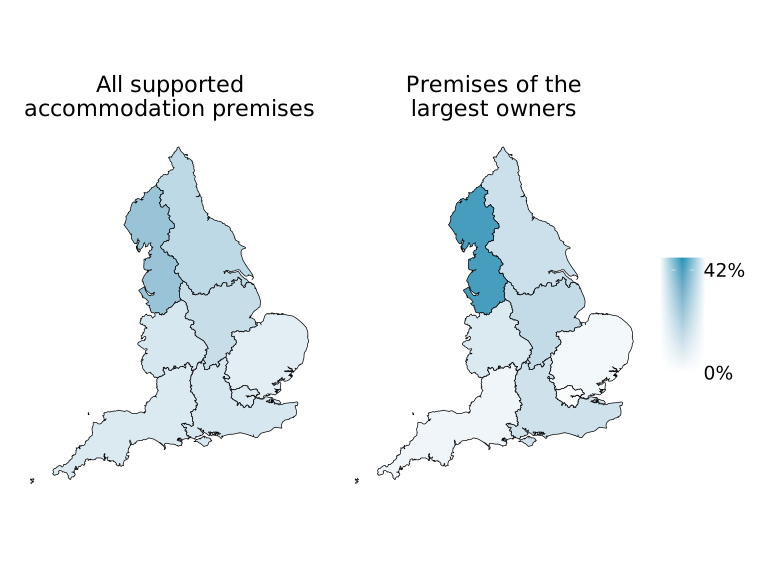
1. In both maps, a lighter hue indicates a lower percentage.
View the data for Figure 3 in an accessible table format.
Ownership across different types of social care
Some owners in children’s social care operate across different types of provision. This means that a single owner might own children’s homes, IFAs and/or supported accommodation services – all within the same ownership chain.
As at 31 March 2025, there were 144 owners offering some combination of different provision types. Most of these (108) owned children’s homes as well as supported accommodation.
There are 11 owners that offer provision across the 3 different provision types.
Ursae Bidco Limited (Nutrius) has 3 provision types and is also among the largest owners of 2 of the 3 types (children’s homes and IFAs).
Liberi Topco Limited (Compass) offers 2 types of provision, children’s homes and IFAs, and is among the largest owners for both. Similarly, Range Topco Limited is among the largest owners for both children’s homes and supported accommodation.
Amalfi Midco Limited (CareTech), the largest owner of children’s homes, offers all 3 provision types. The Shaw Trust Limited offers 3 types and was also among the largest children’s homes owners. Midhurst Child Care Limited, fifth among the largest IFA owners, also offers 3 provision types.
Table 4: Owners that own provision across children’s homes, IFAs and supported accommodation
| Owner | Number of children’s homes | Number of fostering places | Number of supported accommodation premises | Sector |
|---|---|---|---|---|
| Amalfi Midco Limited (CareTech) | 220 | 635 | 8 | Private |
| The Shaw Trust Limited | 51 | 45 | 34 | Private |
| Ursae Bidco Limited (Nutrius) | 36 | 4,725 | 24 | Private |
| Midhurst Child Care Limited | 11 | 1,105 | 1 | Private |
| CFS Care Limited | 9 | 35 | 14 | Private |
| Together For Children Sunderland | 8 | 370 | 10 | Voluntary |
| Barnardo’s | 6 | 280 | 45 | Voluntary |
| Empower Family Group Limited | 5 | 20 | 5 | Private |
| Fair Ways Community Benefit Society | 3 | 70 | 4 | Voluntary |
| St Christopher’s Fellowship | 2 | 85 | 5 | Voluntary |
| Achieving for Children | 1 | 155 | 4 | Voluntary |
Figure 4: Number of owners that operate across different types of provision
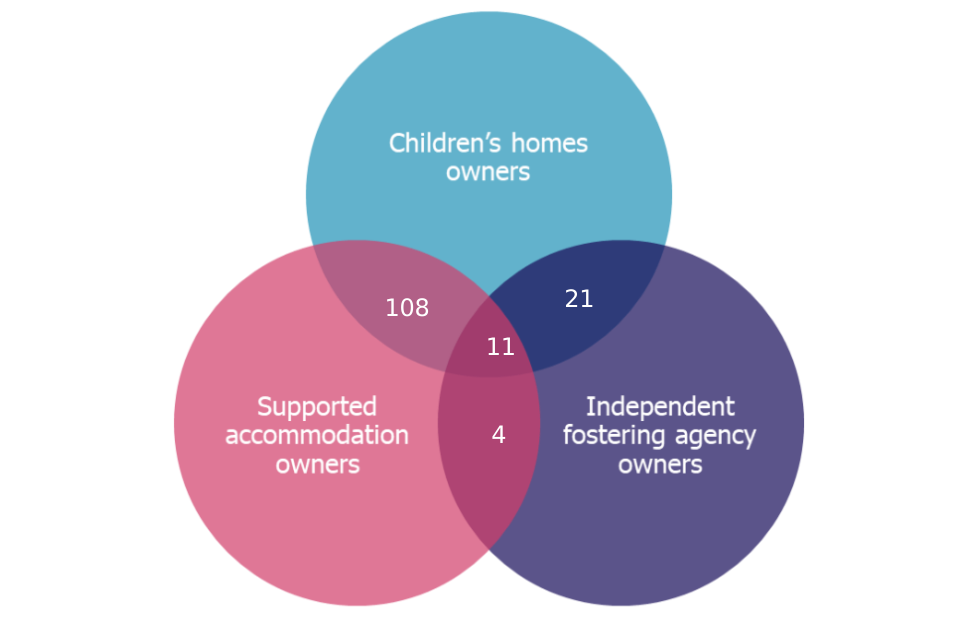
View the data for Figure 4 in an accessible table format.
Notes
As this is the first release of this publication as official statistics in development, we have only reported on data as at 31 March 2025. In future publications, we will look at how ownership structures and patterns have been changing across the sector, and include a time series.
Contacts
If you are a member of the public and have any comments or feedback on this publication, please contact Rebecca Vincent (socialcaredata@ofsted.gov.uk).
Acknowledgments
Thanks to the following for their contribution to this statistical release: Kathryn Kaal.
Glossary
Definitions of terms are in the statistical glossary.
Annex: data tables for figures
This section contains the underlying data in an accessible table format for all figures.
Data for Figure 1: Proportion of children’s homes owned by Amalfi Midco Limited (CareTech) and G Square Healthcare Private Equity LLP (Keys) by top 3 organisations, as at 31 March 2025
| Owner | Organisation | Percentage of owners’ children’s homes |
|---|---|---|
| Amalfi Midco Limited (CareTech) (12 organisations) | Cambian Childcare Limited | 83% |
| Amalfi Midco Limited (CareTech) (12 organisations) | ROC Northwest Limited | 5% |
| Amalfi Midco Limited (CareTech) (12 organisations) | Caretech Community Services Limited | 3% |
| Amalfi Midco Limited (CareTech) (12 organisations) | Remaining 9 organisations | 9% |
| G Square Healthcare Private Equity LLP (Keys) (25 organisations) | Keys Child Care Limited | 19% |
| G Square Healthcare Private Equity LLP (Keys) (25 organisations) | Keys Care Limited | 12% |
| G Square Healthcare Private Equity LLP (Keys) (25 organisations) | Keys Group Progressive Care & Education Limited | 8% |
| G Square Healthcare Private Equity LLP (Keys) (25 organisations) | Remaining 22 organisations | 62% |
See Figure 1.
Data for Figure 2: Percentage of children’s homes in each region owned by the largest owners, as at 31 March 2025
| Region | Percentage of children’s homes owned by the largest providers |
|---|---|
| East of England | 20% |
| East Midlands | 28% |
| London | 3% |
| North East, Yorkshire and Humber | 26% |
| North West | 28% |
| South East | 18% |
| South West | 26% |
| West Midlands | 32% |
See Figure 2.
Data for Figure 3: Percentage of supported accommodation premises and the proportion of those owned by the largest owners, by region, as at 31 March 2025
| Region | All supported accommodation premises | Premises of the largest owners |
|---|---|---|
| East of England | 7% | 3% |
| East Midlands | 14% | 15% |
| London | 9% | 1% |
| North East, Yorkshire and Humber | 16% | 13% |
| North West | 25% | 42% |
| South East | 10% | 12% |
| South West | 9% | 4% |
| West Midlands | 10% | 9% |
See Figure 3.
Data for Figure 4: Number of owners that operate across different types of provision
| Owners of children’s homes and IFAs | 21 |
| Owners of children’s homes and supported accommodation | 108 |
| Owners of IFAs and supported accommodation | 4 |
| Owners of children’s homes, IFAs, and supported accommodation | 11 |
See Figure 4.
-
‘Children’s social care in England’, Ofsted, July 2025. ↩