Operation of police powers under the Terrorism Act 2000 and subsequent legislation: Arrests, outcomes, and stop and search, Great Britain, quarterly update to December 2025
Updated 18 September 2026
Applies to England and Wales

© Crown copyright 2026
This publication is licensed under the terms of the Open Government Licence v3.0 except where otherwise stated. To view this licence, visit nationalarchives.gov.uk/doc/open-government-licence/version/3 or write to the Information Policy Team, The National Archives, Kew, London TW9 4DU, or email: psi@nationalarchives.gov.uk.
Where we have identified any third party copyright information you will need to obtain permission from the copyright holders concerned.
This publication is available at https://www.gov.uk/government/statistics/operation-of-police-powers-under-tact-2000-to-december-2025/operation-of-police-powers-under-the-terrorism-act-2000-and-subsequent-legislation-arrests-outcomes-and-stop-and-search-great-britain-quarterly-u
Revision to data and commentary
A small number of errors have been identified in recent Terrorism Act 2000 outputs, which have now been revised. Changes made are as follows:
- data relating to freight examinations conducted under Schedule 7 has been updated in Quarterly tables Q_S_04a and Q_S_04b, Annual tables A_S_03a and A_S_03b and associated commentary in section 5.3.
All other tables and figures are unaffected.
Forthcoming release: Home Office statistics release calendar
Home Office responsible statistician: Jodie Hargreaves
Press enquiries telephone: 0300 123 3535
Public enquiries: HSAI_Statistics@homeoffice.gov.uk
This release covers the use of police powers under terrorism and subsequent legislation in Great Britain on a quarterly basis up to the year ending 31 December 2025. It also covers arrests for terrorist-related activity under other legislation such as the Police and Criminal Evidence Act (PACE).
The Accredited Official and Official statistics in this release use a range of data sources. More information is available in Section 6.3.
Upcoming changes
We are seeking feedback from users to help us improve future releases of the Operation of police powers under the Terrorism Act 2000 statistical publication and inform ongoing decisions about the content and frequency of this publication. Please complete our short user survey online to tell us how you use this publication, which parts you find most useful, and any other comments or feedback you may have. The survey should take no longer than 15 minutes to complete, and your views will help shape future publications. Responses can be submitted until 23:59pm on Sunday 12 April 2026.
Main results
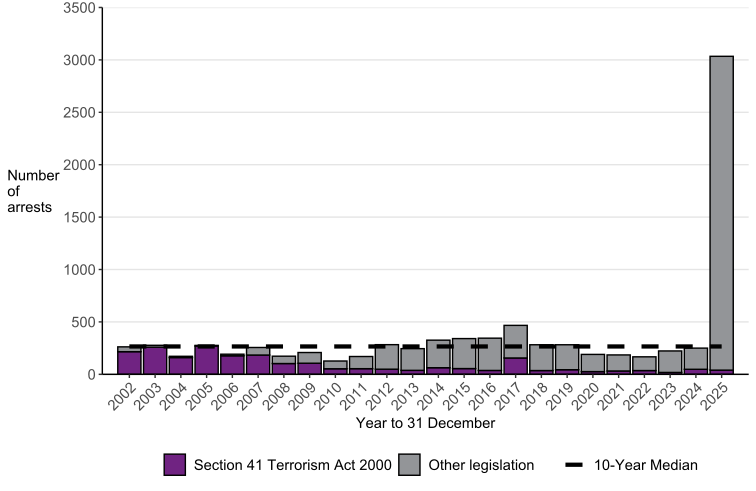
- higher levels of terrorism-related arrests persisted across consecutive periods in 2025: there were 3,034 arrests for terrorism-related activity in the year ending 31 December 2025, representing a rise of 1,114% compared with the previous year (250)
- impact of Palestine Action proscription: 2,779 out of 3,034 arrests (92%) were linked to supporting Palestine Action, following its proscription on 5 July 2025
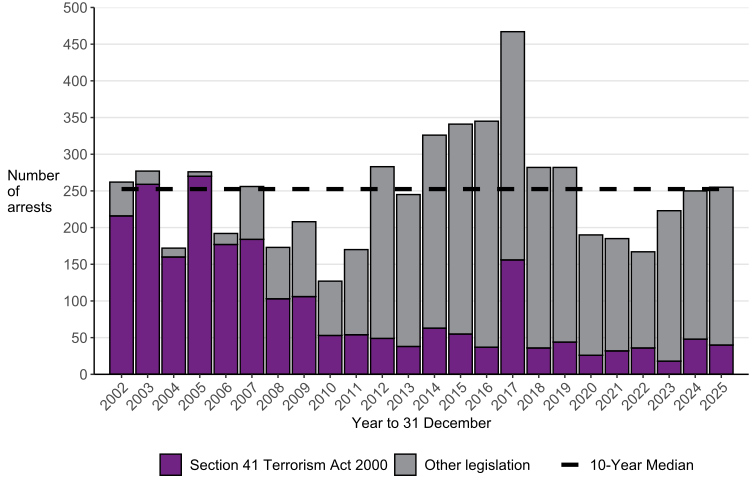
- other terrorism-related arrests: once Palestine Action proscription related arrests are removed, there were 255 arrests, a 2% increase compared with the previous year (250). Of these, 69 arrests (27%) occurred in the most recent quarter (October to December 2025), a 13% decrease on the previous quarter (July to September 2025)
- charging decisions: 16% (486) of arrests made so far have resulted in a charge, including 412 linked to supporting Palestine Action
- continued demographic shift driven by Palestine Action arrests: arrests linked to supporting Palestine Action, where sex is known, were 6.5 times more likely to be female with an average age of 59 compared to 31 for all other arrests
- the proportion of terrorism-related arrests involving minors was lower in 2025 than at its recent peak: 40 individuals aged 17 and under were arrested, including one linked to supporting Palestine Action, with minors making up 15% of non-Palestine Action arrests (39 of 253) where the age is known, down from 16% in the year ending December 2024
Data presented is based on the latest position with each case as at the date of data provision from the Counter Terrorism Policing Headquarters (CTPHQ) Coordination Centre (2 February 2026).
Figure 1a: Arrests for terrorist-related activity, by legislation, years ending 31 December 2002 to 31 December 2025, Great Britain
Source: CTPHQ Coordination Centre (see annual data table A.01)
Notes:
- Figures for the year ending 31 December 2002 include data from 11 September 2001 onwards.
- ‘Other legislation’ includes arrests under non-terrorism legislation, such as the Police and Criminal Evidence Act (PACE) 1984.
- Includes arrests that are considered by the CTPHQ Coordination Centre to be terrorism-related, either at the time of arrest or at a subsequent point in the investigation.
- Average line represents the median number (266) of annual arrests over the last 10 years.
Figure 1b: Arrests for terrorist-related activity, excluding those arrested for supporting Palestine Action, by legislation, years ending 31 December 2002 to 31 December 2025, Great Britain
Source: CTPHQ Coordination Centre (see annual data table A.01)
Notes:
- Figures for the year ending 31 December 2002 include data from 11 September 2001 onwards.
- ‘Other legislation’ includes arrests under non-terrorism legislation, such as the Police and Criminal Evidence Act (PACE) 1984.
- Includes arrests that are considered by the CTPHQ Coordination Centre to be terrorism-related, either at the time of arrest or at a subsequent point in the investigation.
- Average line represents the median number (253) of annual arrests over the last 10 years.
For the remaining sections:
- court proceedings: in the year ending 31 December 2025, 67 persons were tried for terrorism-related offences, 24 less than in the year ending 31 December 2024
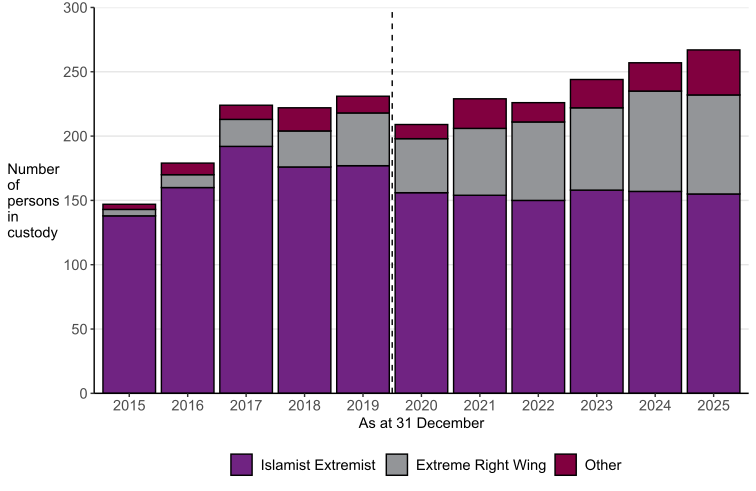
- terrorist prison cohort reaches new high: as of 31 December 2025, there were 267 persons in custody for terrorism and terrorism-connected offences in Great Britain, an increase of 10 from the year ending 31 December 2024 (257)
- stop and search under Section 43 (TACT 2000): in the year ending 31 December 2025, 94 persons were stopped and searched by the Metropolitan Police Service (MPS) under section 43 of Terrorism Act (TACT) 2000; this was an increase of 32% compared to the year ending 31 December 2024 (71)
- arrests following Section 43 stop and search: there were 14 arrests resulting from a section 43 stop and search, in the year ending 31 December 2025
For more information on court proceedings, see Section 3.
For more information on terrorist prisoners, see Section 4.
For more information on other police powers under the Terrorism Act 2000, see Section 5.
1. Introduction
1.1 Main changes and additions to this release
There have been changes to the data presented within this publication:
- since the proscription of Palestine Action on 5 July 2025, arrests linked to supporting the group have materially altered the volume and demographic makeup of terrorism-related arrests
- to preserve clarity and time-series compatibility, arrests and charges relating to supporting Palestine Action will be shown separately, while still being included in the overall total of all arrests in this release
- the separation does not imply the cohort has been treated differently to other arrests and charges
- any figures reported as Palestine Action-related refer to arrests made on or after 5 July 2025, following proscription, where Counter Terrorism Policing determined the primary reason for arrest was on suspicion of supporting Palestine Action
- as this information is not captured as standard during arrest, figures may be subject to recording inconsistencies
2. Arrests and outcomes
Main results
- there were 3,034 arrests for terrorism-related activity in the year ending 31 December 2025, representing a rise of 1,114% compared with the previous year; 2,779 of these arrests were linked to supporting Palestine Action, following its proscription on 5 July 2025
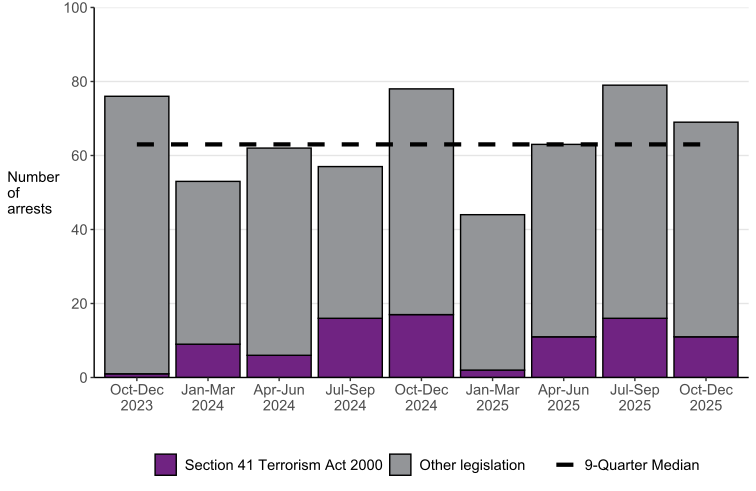
- of the remaining 255 arrests, 69 occurred in the most recent quarter October to December 2025, a decrease of 13% compared with July to September 2025 (79)
- 16% (486) of arrests made have so far resulted in a charge, including 412 under Section 12 or Section 13 of the Terrorism Act 2000 linked to supporting Palestine Action
- there were 14 instances where a request for access to a solicitor was delayed
These statistics cover arrests in Great Britain where there was suspicion of involvement in terrorist-related activity, either at the time of arrest or later in the investigation. Some cases initially treated as terrorism-related may result in non-terrorism charges.
Outcomes include charges, prosecutions and other resolutions, with demographic information provided for those arrested, charged and convicted. Figures are based on the date of arrest so users can track outcomes for arrests in each period.
2.1 Arrests linked to supporting Palestine Action
This section provides more detail on arrests linked to supporting Palestine Action. It includes data on:
- arrests
- charges
- sex
- age
- ethnic appearance
- nationality
Arrests
There were 2,779 arrests for terrorism-related activity in the year ending 31 December 2025 linked to supporting Palestine Action, following its proscription on 5 July 2025.
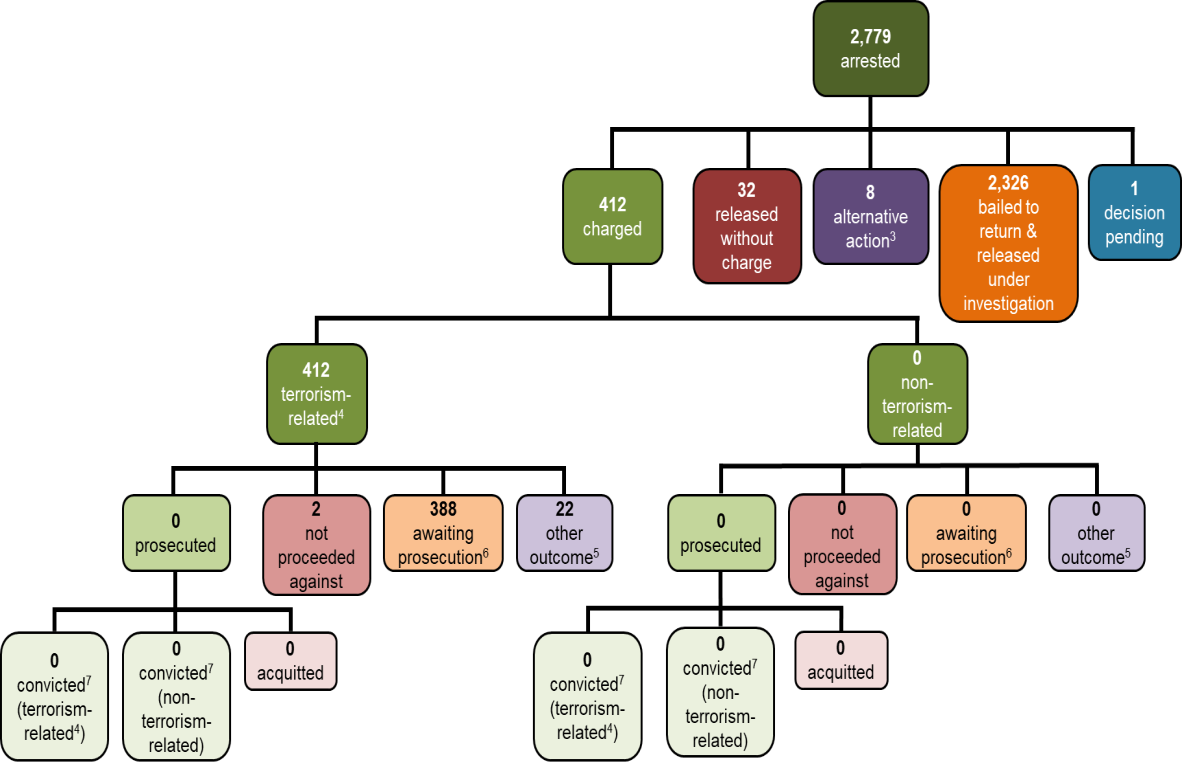
Of the 2,779 Palestine Action arrests, 412 were charged, 32 were released without charge, 8 had alternative action, one had a decision pending and 2,326 were bailed to return and released under investigation.
A flow chart (Figure 2.1) summarises the process from arrest through to charge and prosecution for arrests linked to supporting Palestine Action following its proscription on 5 July 2025.
Figure 2.1: Arrests linked to supporting Palestine Action, and outcomes in Great Britain in the year ending 31 December 2025
Source: CTPHQ Coordination Centre (see annual data tables from A.01 to A.07)
Notes:
- Based on time of arrest, between 1 January 2025 and 31 December 2025.
- Data presented is based on the latest position with each case as at the date of data provision from CTPHQ Coordination Centre (2 February 2026).
- ‘Alternative action’ includes a number of outcomes, such as cautions, detentions under international arrest warrant, transfer to immigration authorities. See annual data table A.03 for a complete list.
- Terrorism-related charges and convictions include some charges and convictions under non-terrorism legislation, where the offence is considered to be terrorism-related.
- The ‘other’ category includes other cases/outcomes such as cautions, transfers to Immigration Enforcement Agencies, the offender being circulated as wanted, and extraditions.
- Cases that are ‘awaiting prosecution’ are not yet complete. As time passes, these cases will eventually lead to a prosecution, ‘other’ outcome, or it may be decided that the individual will not be proceeded against.
- Excludes convictions that were later quashed on appeal.
Charges
At the time of data provision, of the 2,779 arrests for terrorist-related activity linked to supporting Palestine Action in the year ending 31 December 2025, 412 (18%) resulted in a charge, including 8 under Section 12 and 404 under Section 13 of the Terrorism Act 2000.
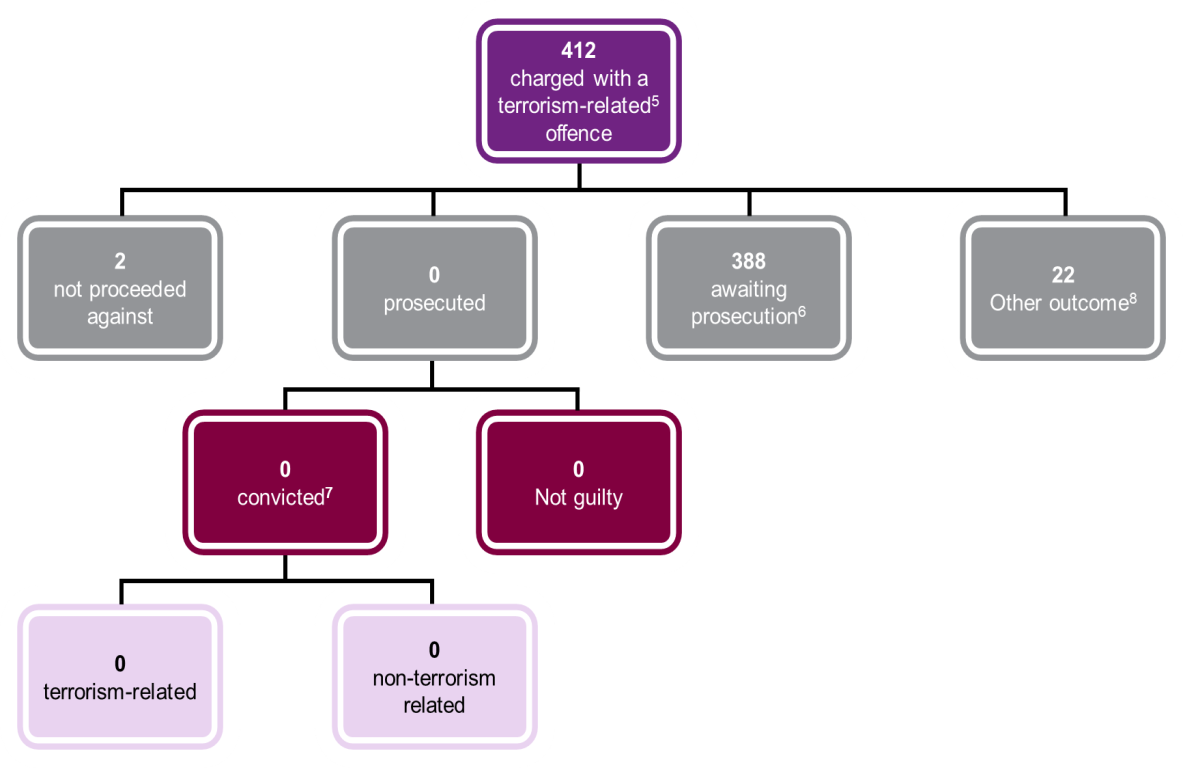
Of the 412 charged with terrorism-related offences which are linked to supporting Palestine Action, 388 are awaiting prosecution, 22 had other outcomes, and 2 were not proceeded against.
Given the number of cases still to be finalised in the year ending 31 December 2025, the current charge rate may change over time. Until all cases in a given period are finalised, care should be taken when comparing charge rates over time.
The effect on the total number of arrests will be minimal but the number of charges and convictions currently reported will likely increase in future releases, especially for cases from the more recent quarters where a greater number have not yet reached the point of charge or conviction.
Figure 2.2: Outcomes following a charge for a terrorism-related offence, for charges linked to supporting Palestine Action, year ending 31 December 2025, Great Britain
Source: CTPHQ Coordination Centre (see annual data table A.06c)
Notes:
- Based on the time of arrest.
- A more detailed flow chart can be found in Section 2, ‘Arrests and outcomes’.
- Data presented is based on the latest position with each case as at the date of data provision from CTPHQ Coordination Centre (2 February 2026).
- The chart does not include outcomes following non-terrorism-related charges.
- Terrorism-related charges and convictions include some charges and convictions under non-terrorism legislation, where the offence is considered to be terrorism-related.
- Cases that are ‘awaiting prosecution’ are not yet complete. As time passes, these cases will eventually lead to a prosecution, ‘other’ outcome, or it may be decided that the individual will not be proceeded against.
- Excludes convictions that were later quashed on appeal.
- Includes other cases/outcomes such as cautions, transfers to UK Border Agencies, the offender being circulated as wanted and extraditions.
Sex
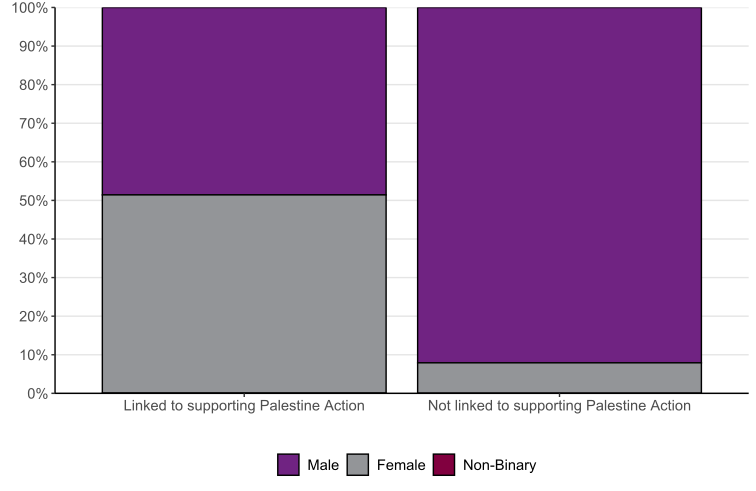
Of the 2,773 arrests linked to supporting Palestine Action, where sex is known, 1,347 (49%) were male, 1,425 (51%) were female and one was non-binary.
Arrests linked to supporting Palestine Action, where sex is known, were 6.5 times more likely to be female than other arrests in year ending December 2025.
This means that, unlike previous years where the vast majority of those arrested for terrorism-related activity were males, the proportions of male and female arrests for year ending December 2025 were more equal.
Figure 2.3: Proportion of persons linked to supporting Palestine Action and all other arrests, by sex, year ending 31 December 2025, Great Britain
Source: CTPHQ Coordination Centre (see annual data table A.09)
Notes:
- As recorded by the police at time of arrest.
- Data presented is based on the latest position with each case as at the date of data provision from CTPHQ Coordination Centre (2 February 2026).
Age
Of the 2,779 arrests on suspicion of supporting Palestine Action, where the age is known, 2,523 were aged 30 or above, with those aged 25 to 29 years, 21 to 24 years and 18 to 20 years accounting for 4%, 4% and 1% respectively.
Arrests linked to supporting Palestine Action, have considerably altered the age profile of arrests in this period with these arrests having an average age of 59 compared to 31 for all other arrests.
Table 2.1: Minimum, maximum and average ages of persons arrested for terrorist-related activity, for year ending December 2025
| Arrests linked to supporting Palestine Action | All other arrests | |
|---|---|---|
| Minimum Age | 17 | 13 |
| Average Age | 59 | 31 |
| Maximum Age | 89 | 86 |
Source: CTPHQ Coordination Centre (see annual data tables from A.10)
Notes:
- As recorded by the police at time of arrest.
- Data presented is based on the latest position with each case as at the date of data provision from CTPHQ Coordination Centre (2 February 2026).
Ethnic appearance as recorded by the arresting officer
Figures in this section are based on the ethnic appearance of the person being arrested as recorded by the arresting officer.
Since June 2022, the data on those arrested for terrorism-related offences by ethnic appearance use the ONS 18+1 ethnicity codes, in line with the Census 2011 categories.
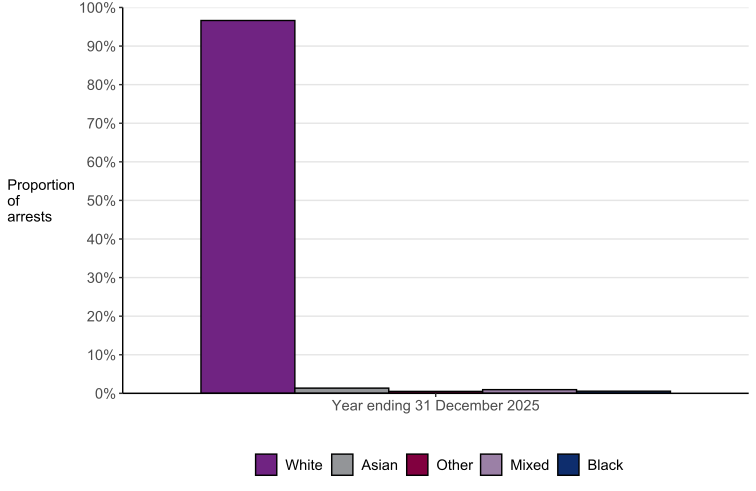
Of arrests linked to supporting Palestine Action, where the ethnicity is known, arrests for those of White ethnic appearance accounted for 97% of arrests (1,717 out of 1,777).
Figure 2.4: Proportion of persons linked to supporting Palestine Action arrested, by ethnic appearance, 31 December 2025
Source: CTPHQ Coordination Centre (see annual data table A.11b)
Notes:
- As recorded by the police at time of arrest.
- Excludes those whose ethnicity is not known (for instance, ‘Not stated’).
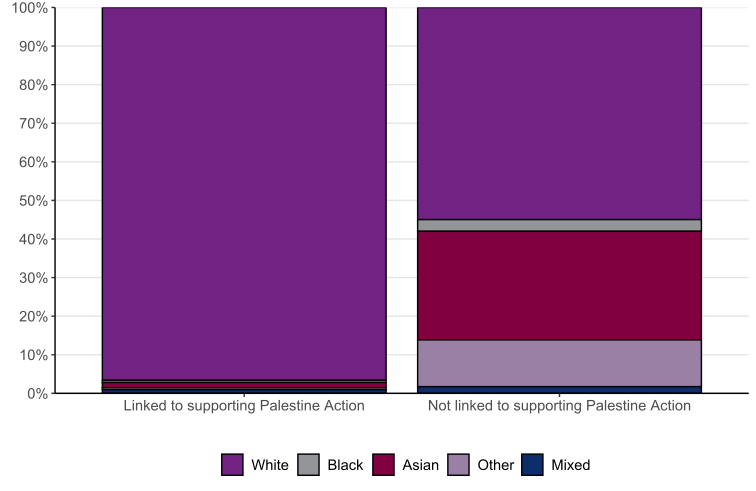
Figure 2.5: Proportion of persons linked to supporting Palestine Action and all other arrests, by ethnic appearance, year ending 31 December 2025
Source: CTPHQ Coordination Centre (see annual data table A.11b)
Notes:
- As recorded by the police at time of arrest.
- Excludes those whose ethnicity is not known (for instance, ‘Not stated’).
Nationality
Of those whose arrests were linked to supporting Palestine Action, and whose nationalities are known, 96% (1,841 out of 1,918) consider themselves British or British dual nationality.
Table 2.2: Number of persons arrested on suspicion of supporting Palestine Action, in year ending 31 December 2025, by self-defined nationality
Numbers and percentages, Great Britain
| Self-defined nationality | Total in year ending December 2025 | Proportion of all arrests, where nationality is known (%) |
|---|---|---|
| Great Britain | 1,841 | 96.0 |
| Ireland | 28 | 1.5 |
| Germany | 6 | 0.3 |
| Netherlands | 5 | 0.3 |
| United States | 5 | 0.3 |
| India | 5 | 0.3 |
| Italy | 4 | 0.2 |
| Pakistan | 3 | 0.2 |
| Hungary | 2 | 0.1 |
| Poland | 2 | 0.1 |
| Not Declared | 861 |
Source: CTPHQ Coordination Centre (see annual data table A.12a)
Notes:
- The nationalities presented here are those declared by persons at the time of arrest and may differ from their country of origin.
- Only the first 10 countries, by number of persons arrested for terrorist-related activity, are included in the table.
- Figures for Great Britain include those with ‘British dual’ nationality.
2.2 Arrests not linked to supporting Palestine Action
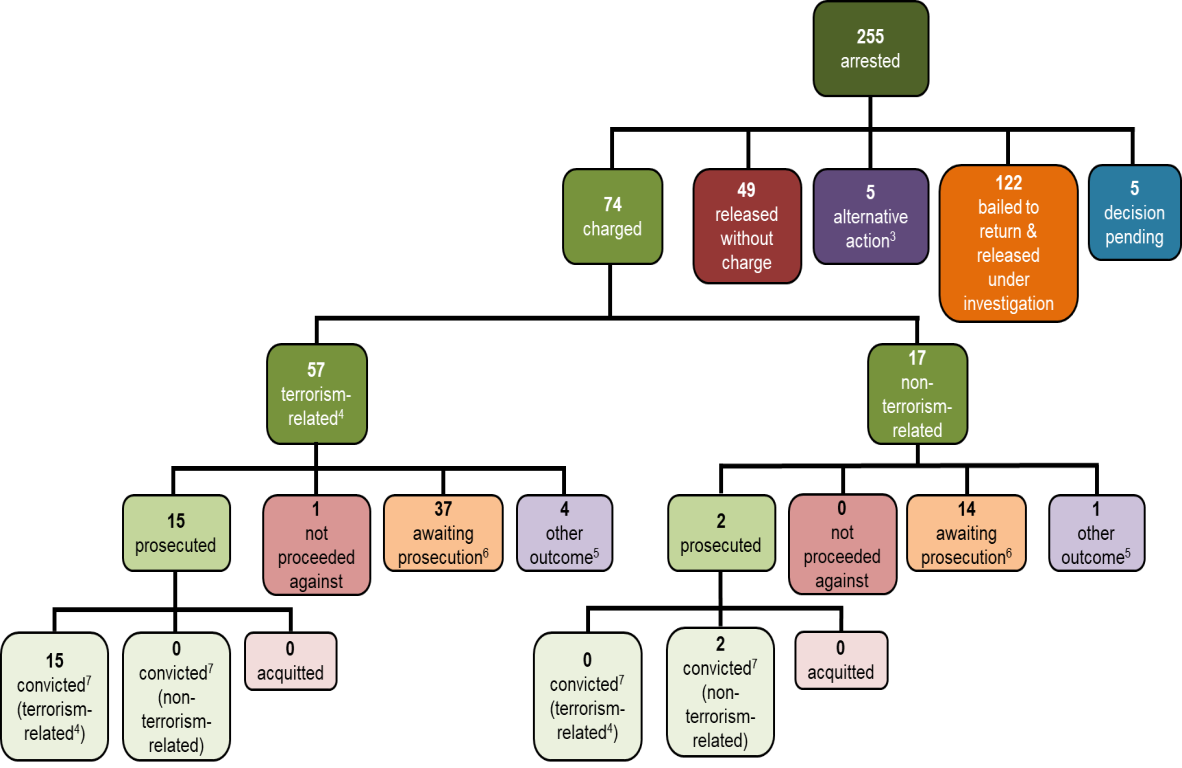
In the year ending 31 December 2025, there were 255 arrests for terrorist-related activity not linked to supporting Palestine Action. This represents an increase of 2% compared to arrests made in the year ending December 2024 (250). Of the 255 arrests:
- 69 occurred in the most recent quarter October to December 2025, an increase of 13% compared with July to September 2025 (79)
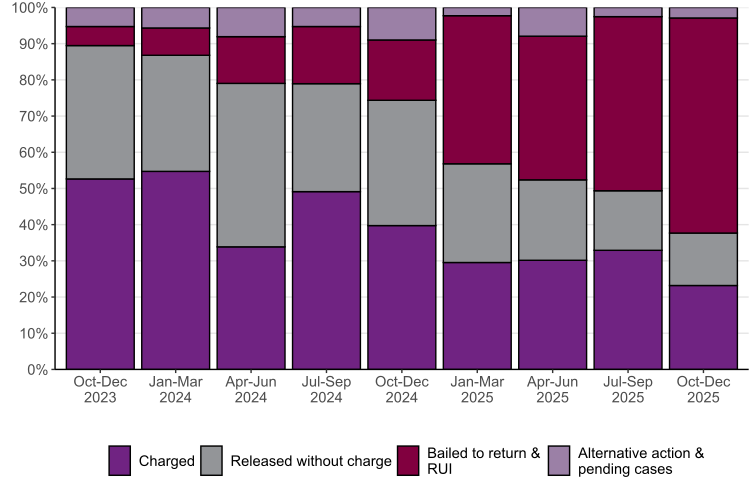
- 74 were charged, 49 were released without charge, 5 had alternative action, 5 had a decision pending, 122 were released on bail to return and released under investigation
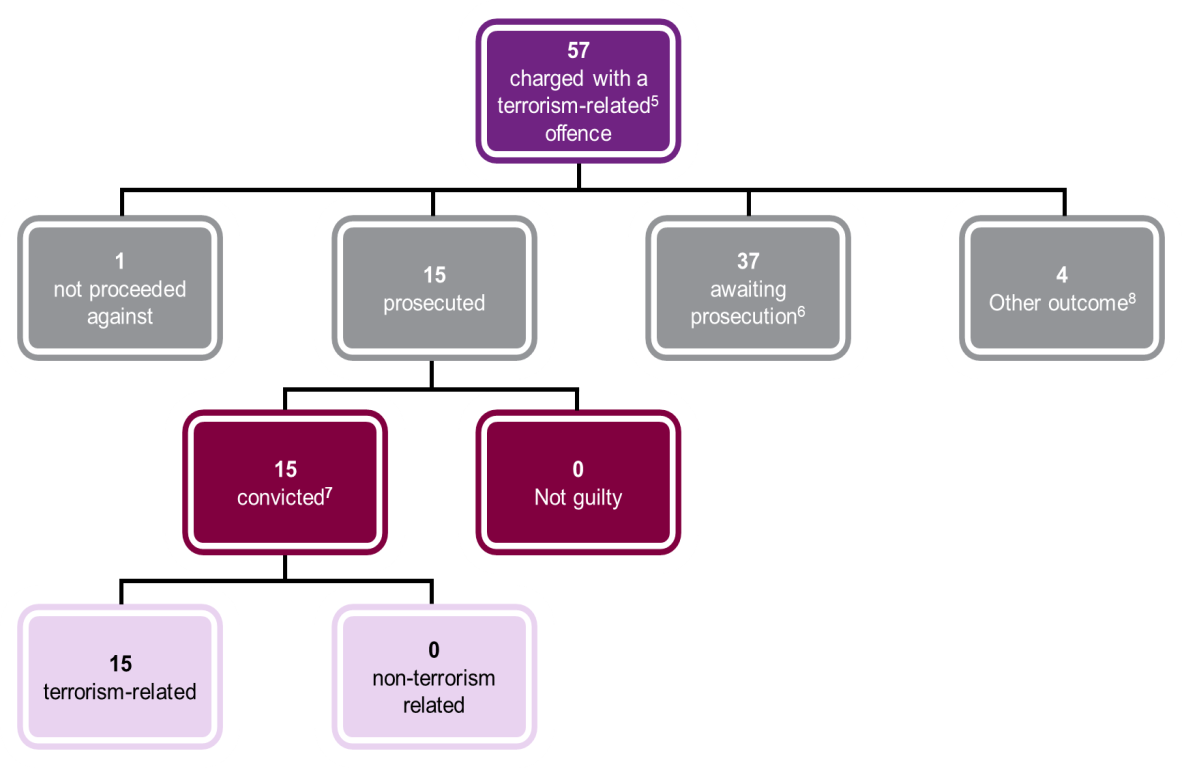
- of the 74 individuals charged, 57 were charged under terrorism‑related legislation; this included 12 individuals charged with an offence under section 5 of the Terrorism Act 2006 (preparation of terrorist acts) and 10 charged under section 58 of the Terrorism Act 2000 (collection of information useful to terrorism)
Fifteen individuals charged with terrorism‑related offences were prosecuted, all of whom were convicted of terrorism‑related offences.
Figure 2.6: Non-Palestine Action linked arrests and outcomes in Great Britain in the year ending 31 December 2025
Source: CTPHQ Coordination Centre (see annual data tables from A.01 to A.07)
Notes:
- Based on time of arrest, between 1 January 2025 and 31 December 2025.
- Data presented is based on the latest position with each case as at the date of data provision from CTPHQ Coordination Centre (2 February 2026).
- ‘Alternative action’ includes a number of outcomes, such as cautions, detentions under international arrest warrant, transfer to immigration authorities. See annual data table A.03 for a complete list.
- Terrorism-related charges and convictions include some charges and convictions under non-terrorism legislation, where the offence is considered to be terrorism-related.
- The ‘other’ category includes other cases/outcomes such as cautions, transfers to Immigration Enforcement Agencies, the offender being circulated as wanted, and extraditions.
- Cases that are ‘awaiting prosecution’ are not yet complete. As time passes, these cases will eventually lead to a prosecution, ‘other’ outcome, or it may be decided that the individual will not be proceeded against.
- Excludes convictions that were later quashed on appeal.
2.3 Arrests by legislation
In the year ending 31 December 2025, there were 3,034 arrests for terrorist-related activity in Great Britain, 40 (1%) of which were under Section 41 of Terrorism Act 2000 giving police officers the power to arrest persons suspected of terrorism-related offences without a warrant. The remaining 2,994 arrests (99%) were made under other legislation which includes arrests under non-terrorism legislation, such as the Police and Criminal Evidence Act (PACE) 1984.
Figure 2.7: Arrests for terrorist-related activity, by legislation, years ending 31 December 2002 to 31 December 2025, Great Britain
Source: CTPHQ Coordination Centre (see annual data table A.01)
Notes:
- Figures for the year ending 31 December 2002 include data from 11 September 2001 onwards.
- ‘Other legislation’ includes arrests under non-terrorism legislation, such as the Police and Criminal Evidence Act (PACE) 1984.
- Includes arrests that are considered by the CTPHQ Coordination Centre to be terrorism-related, either at the time of arrest or at a subsequent point in the investigation.
- Average line represents the median number (266) of annual arrests over the last 10 years.
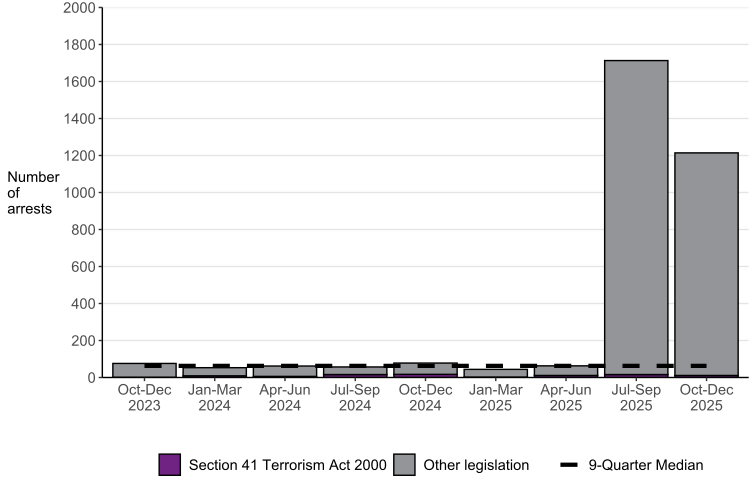
In the latest reported quarter, October to December 2025, there were 1,214 arrests. This is a decrease of 29% compared to July to September 2025, when there were 1,713 arrests.
Figure 2.8: Arrests for terrorist-related activity, by legislation, 9 quarters to 31 December 2025, Great Britain
Source: CTPHQ Coordination Centre (see quarterly data table A.01)
Notes:
- ‘Other legislation’ includes arrests under non-terrorism legislation, such as the Police and Criminal Evidence Act 1984.
- Includes arrests that are considered by the CTPHQ to be terrorism-related, either at the time of arrest or at a subsequent point in the investigation.
- Average line represents the median number (63) of quarterly arrests over the last 9 quarters.
Figure 2.9: Arrests for terrorist-related activity, excluding supporting Palestine Action, by legislation, 9 quarters to 31 December 2025, Great Britain
Source: CTPHQ Coordination Centre (see quarterly data table A.01)
Notes:
- ‘Other legislation’ includes arrests under non-terrorism legislation, such as the Police and Criminal Evidence Act 1984.
- Includes arrests that are considered by the CTPHQ to be terrorism-related, either at the time of arrest or at a subsequent point in the investigation.
- Average line represents the median number (63) of quarterly arrests over the last 9 quarters.
2.4 Pre-charge detention under Section 41 of the Terrorism Act 2000
Further details of the legislation can be found in the user guide.
The data breakdown for arrests under Section 41 by period of detention and outcome has been updated to include records that were previously marked as ‘Unknown’.
Further details on the length and outcomes of detentions under section 41 of TACT 2000 can be found in annual data table A.02.
2.5 Other powers under Schedule 8 to TACT 2000
From the year ending September 2021 publication onwards, data has been collected and published:
- the number of persons detained and applications for extension of detention in Great Britain under PACE and Schedule 8 of the Terrorism Act 2000
- the number of requests made for access to a solicitor by persons detained under these provisions
These statistics are classed as official statistics in development. More information about official statistics in development can be found on the UK Statistics Authority website. Home Office statisticians aim to improve the quality of the data in future releases by working with data providers to improve quality assurance procedures.
In the year ending 31 December 2025, there were 30 warrants of further detentions, which include multiple warrants for the same individual.
Under Section 41 of TACT 2000, a person detained in police custody under the terrorism provisions is entitled to consult a solicitor privately. A police officer of at least the rank of superintendent can authorise a delay in permitting a detained person to consult a solicitor if they believe that exercising this right will result in any of the consequences listed in Schedule 8. Please see the user guide for further information.
Between 1 October 2025 to 31 December 2025, there were 1,214 terrorism-related arrests. There were 14 instances where a request for access to a solicitor was delayed.
2.6 Charges
In line with the general convention for Home Office criminal justice statistics, when a person is charged or prosecuted for multiple offences at the same time, only the most serious offence is counted – usually the one that carries the highest penalty. This ‘principal offence rule’ means the statistics provide a count of individuals charged rather than the total number of charges. More detailed information on the principal offence rule can be found in the accompanying user guide. Further details of the legislation under which persons have been charged following an arrest for a terrorism-related activity can be found in annual data tables A.05a to A.05c.
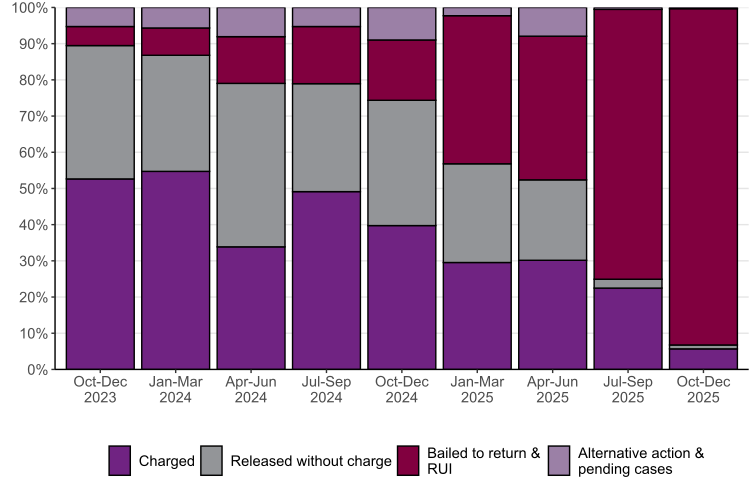
At the time of data provision, of the 3,034 arrests for terrorist-related activity in the year ending 31 December 2025, 486 (16%) resulted in a charge. Of these charges 469 were for terrorism-related offences.
Given the number of cases still to be finalised in the year ending 31 December 2025, the current charge rate may change over time. Until all cases in a given period are finalised, care should be taken when comparing charge rates over time.
Figure 2.10: Charging outcomes following an arrest for terrorist-related activity, 9 quarters to 31 December 2025, Great Britain
Source: CTPHQ Coordination (see quarterly data table A.03)
Notes:
- ‘Alternative action’ includes for instance, cautions for non-TACT 2000 offences, detentions under the Mental Health Act 1983, recall to prison.
- ‘Bailed to Return’ includes those released on bail pending further investigation, and those who have absconded from bail. Those who were released under investigation (RUI) were previously unable to be recorded separately and were recorded as ‘released without charge’.
Figure 2.11: Charging outcomes following an arrest for terrorist-related activity, excluding those linked to supporting Palestine Action, 9 quarters to 31 December 2025, Great Britain
Source: CTPHQ Coordination (see quarterly data table A.03)
Notes:
- ‘Alternative action’ includes for instance, cautions for non-TACT 2000 offences, detentions under the Mental Health Act 1983, recall to prison.
- ‘Bailed to Return’ includes those released on bail pending further investigation, and those who have absconded from bail. Those who were released under investigation (RUI) were previously unable to be recorded separately and were recorded as ‘released without charge’.
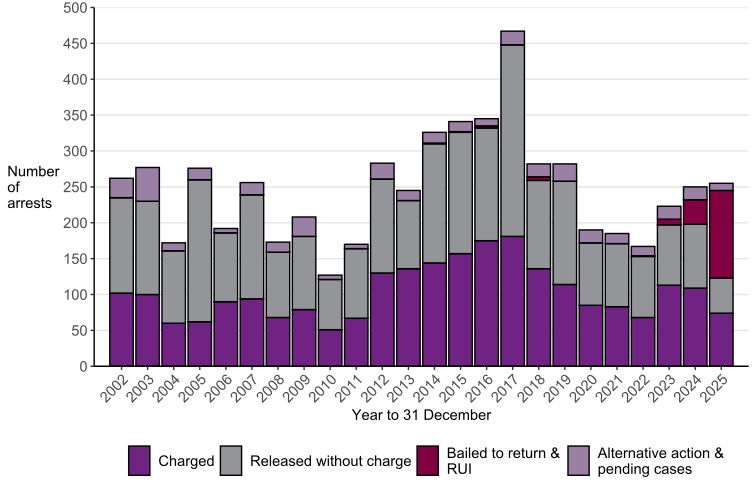
Charge rates have remained consistent since the year to 31 December 2018 (48%, 136 out of 282 arrests) with a mean rate of 45% between year to 31 December 2018 and year to 31 December 2024. In the most recent reporting period, year to 31 December 2025, the charge rate is 16% (486 out of 3,034 arrests). However, as cases progress over time, figures published in this release are likely to be revised. The effect on the total number of arrests will be minimal but the number of charges and convictions currently reported will likely increase in future releases, especially for cases from the more recent quarters where a greater number have not yet reached the point of charge or conviction.
Figure 2.12: Charging outcomes following an arrest for terrorist-related activity, excluding those linked to support Palestine Action, year ending December 2002 to December 2025, Great Britain
Source: CTPHQ Coordination Centre (see annual data table A.03)
Notes:
- ‘Alternative action’ includes cautions for non-TACT offences, detentions under the Mental Health Act, recall to prison, and transfers to immigration authorities.
- ‘Bailed to Return’ includes those released on bail pending further investigations, and those who have absconded from bail. Those who were released under investigation were previously unable to be recorded separately and were recorded as ‘released without charge’.
2.7 Prosecutions
As with charges, statistics on prosecutions are based on the principal offence rule, (see Section 2.5). Where an individual is prosecuted for more than one offence at a time, they are classified in terms of a single offence – usually the most serious.
Figure 2.13 shows the outcomes following a charge for a terrorism-related offence.
Further details of the specific legislation under which persons have been convicted following a charge for a terrorism-related offence can be found in annual data tables A.08a to A.08c.
Figure 2.13: Outcomes following a charge for a terrorism-related offence, for all remaining charges, year ending 31 December 2025, Great Britain
Source: CTPHQ Coordination Centre (see annual data table A.06c)
Notes:
- Based on the time of arrest.
- A more detailed flow chart can be found in Section 2, ‘Arrests and outcomes’.
- Data presented is based on the latest position with each case as at the date of data provision from CTPHQ Coordination Centre (2 February 2026).
- The chart does not include outcomes following non-terrorism-related charges.
- Terrorism-related charges and convictions include some charges and convictions under non-terrorism legislation, where the offence is considered to be terrorism-related.
- Cases that are ‘awaiting prosecution’ are not yet complete. As time passes, these cases will eventually lead to a prosecution, ‘other’ outcome, or it may be decided that the individual will not be proceeded against.
- Excludes convictions that were later quashed on appeal.
- Includes other cases/outcomes such as cautions, transfers to UK Border Agencies, the offender being circulated as wanted and extraditions.
2.8 Demographics of persons arrested for terrorism-related activities
This section provides more detail on the demographic and other characteristics of persons arrested. It includes data on:
- sex
- age
- ethnic appearance
- nationality
Sex
Unlike previous years where the vast majority of those arrested for terrorism-related activity were males, the proportions of male and female arrests for year ending December 2025 were more equal. Of the 3,026 arrests where the sex was known, there were 1,445 females (48%), a 29-percentage point increase from year ending 31 December 2024 (48, 19%). In comparison, there were 1,580 males (52%), a 29-percentage point decrease from the year ending 31 December 2024 (202, 81% of persons arrested).
Of the 253 arrests not linked to supporting Palestine Action, where sex is known, for year ending 31 December 2025, 233 (92%) were male and 20 (8%) were female, compared to year ending 31 December 2024 where 81% of arrests where male and 19% were female.
Age
As in previous years, those aged 30 and above accounted for the most arrests (2,640, 87%). Those aged 30 and above increased from 49% of all arrests to 87% compared to the year ending 31 December 2024.
Of the 253 arrests not linked to supporting Palestine Action, where the age was known, in year ending 31 December 2025, those aged 30 and above decreased from 122 to 117 compared to the year ending 31 December 2024 (49% to 46% of persons arrested). The number of arrests increased for those aged 18 to 20 and 21 to 24 years compared to the previous year, increasing by 3 and one-percentage points respectively. Those aged 17 and under decreased compared to the year ending 31 December 2024, from 40 to 39 and saw a one-percentage point decrease to 15%. Arrests for those aged 25 to 29 decreased from 31 individuals to 30.
Ethnic appearance as recorded by the arresting officer
Figures in this section are based on the ethnic appearance of the person being arrested as recorded by the arresting officer.
Since June 2022, the data on those arrested for terrorism-related offences by ethnic appearance use the ONS 18+1 ethnicity codes, in line with the Census 2011 categories.
In cases where ethnicity is known, arrests for those of White ethnic appearance accounted for 92% of arrests (1,844 out of 2,008) compared to 53% for the previous year. Arrests for those of Asian ethnic appearance accounted for 4% of arrests (89 out of 2,008) compared to 28% for the previous year.
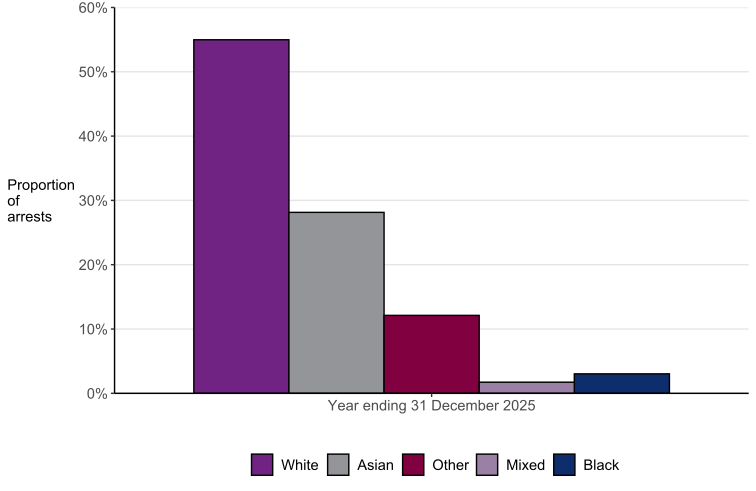
Of the cases not linked to Supporting Palestine action, where the ethnic appearance was known, arrests for those of White ethnic appearance accounted for 55% of arrests (127 out of 231). Arrests for those of Asian ethnic appearance accounted for 28% of arrests (65 out of 231). Arrests for those of all other ethnic appearances accounted for 14% of arrests (32 out of 231).
Figure 2.14: Proportion of persons arrested for terrorist-related activity, excluding those linked to supporting Palestine Action, by ethnic appearance, 31 December 2025
Source: CTPHQ Coordination Centre (see annual data table A.11b)
Notes:
- As recorded by the police at time of arrest.
- Excludes those whose ethnicity is not known (for instance, ‘Not stated’).
Nationality
Of those arrested in the year ending 31 December 2025, where the self-defined nationality is known, 94% considered themselves to be of British or British dual nationality, up from 72% compared to the year ending 31 December 2024.
Overall, the proportion of those arrested who consider themselves British or British dual nationality has remained stable over the last 13 years. The proportion has not fallen below 67% over the last 13 years. Overall, since 11 September 2001 (when the data collection began), 72% of those arrested considered themselves to be of British or British dual nationality.
Of the arrests not linked to supporting Palestine Action, 74% considered themselves to British or British dual nationality, the same proportion as year ending 31 December 2024.
Table 2.3: Number of persons arrested for terrorist-related activity, since 11 September 2001, by self-defined nationality
Numbers and percentages, Great Britain
| Self-defined nationality | Total since Sep 11 2001 | Proportion of all arrests (%) |
|---|---|---|
| Great Britain | 5,618 | 71.8 |
| Algeria | 198 | 2.5 |
| Iraq | 192 | 2.5 |
| Pakistan | 186 | 2.4 |
| Iran | 112 | 1.3 |
| Afghanistan | 101 | 1.3 |
| Turkey | 96 | 1.2 |
| Ireland | 90 | 1.2 |
| Somalia | 87 | 1.1 |
| Sri Lanka | 71 | 0.9 |
Source: CTPHQ Coordination Centre (see annual data table A.12a)
Notes:
- The nationalities presented here are those declared by persons at the time of arrest and may differ from their country of origin.
- Only the first 10 countries, by number of persons arrested for terrorist-related activity, are included in the table.
- Figures for Great Britain include those with ‘British dual’ nationality.
3. Court proceedings
Main results
- in the year ending 31 December 2025, 67 persons were tried for terrorism-related offences, 24 less than in the year ending 31 December 2024
- of the 67 persons tried for terrorism-related offences, 62 were convicted (93%)
- of the 62 persons convicted of terrorism-related offences, 36 (58%) pleaded guilty and 26 (42%) entered a not-guilty plea
This section presents statistics on prosecutions for terrorism-related offences in England and Wales. It provides data on the number of persons prosecuted and convicted, including information on the legislation under which they were prosecuted. It also provides information on the length and type of sentence that each convicted person received. Data in this section is based on the trial completion date and is not directly comparable to the prosecutions data in Section 2, ‘Arrests and outcomes’, which is based on the date of arrest.
Data is provided to the Home Office by the Crown Prosecution Service (CPS) Counter Terrorism Division (CTD). The data covers terrorism-related court cases that were completed in the 16 years from the year ending December 2010, up to the year ending December 2025.
The breakdown of data for terrorism-related offences by sentence lengths for defendants tried and convicted by the Crown Prosecution Service after March 2024 is excluded within this release as this data is not available to the Home Office.
3.1 Court proceedings
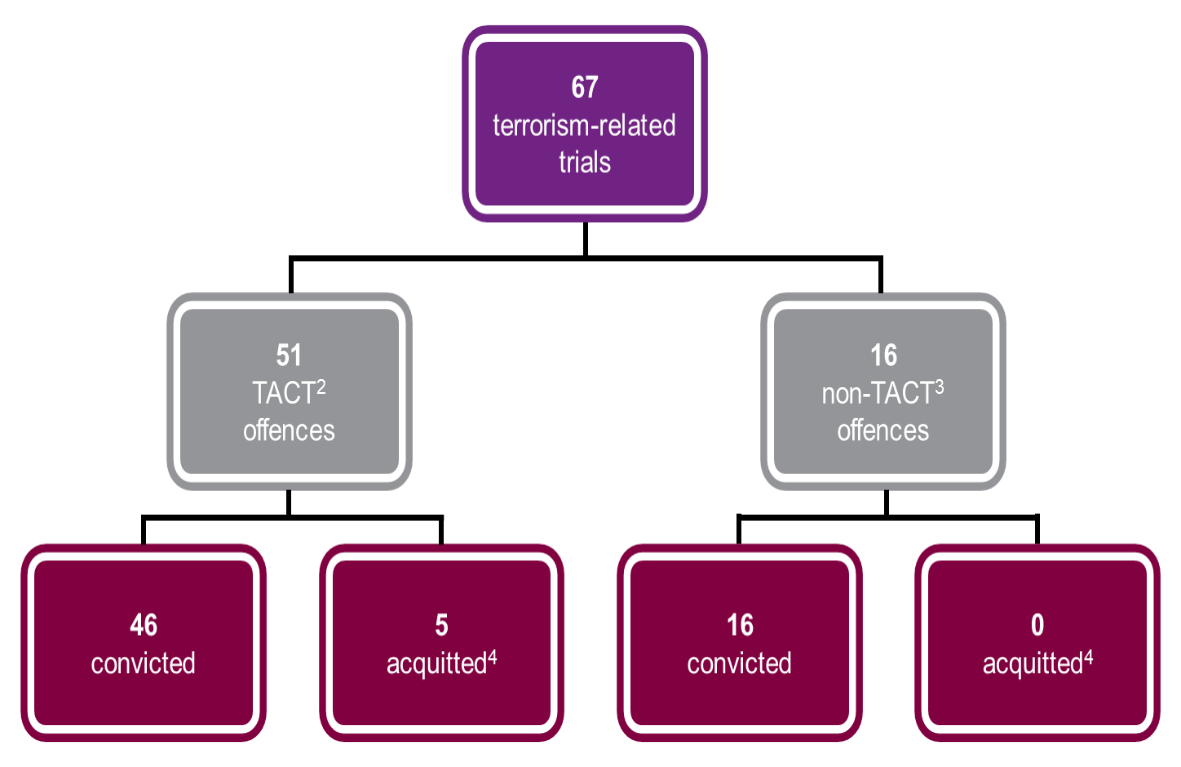
In the year ending 31 December 2025, 67 persons were tried for terrorism-related offences, 24 less than in the year ending 31 December 2024. Conviction rates have remained consistent in recent years, with 94% (61 out of 65) of trials leading to a conviction in the year ending 31 December 2023, and 97% (88 out of 91) of trials in the year ending 31 December 2024.
The latest year had the third highest conviction rate recorded in a year ending December since comparable records began in December 2010, with 93% (62 out of 67) of trials in the year ending 31 December 2025 leading to a conviction. Figure 3.1 shows the outcomes for the 67 persons proceeded against.
Figure 3.1: Outcome of terrorism-related trials under TACT and non-TACT legislation, year ending 31 December 2025, England and Wales
Source: CPS CTD (see annual data tables C.01 to C.03)
Notes:
- Based on the principal offence for which the defendant was prosecuted against.
- TACT offences include offences specifically under terrorism legislation.
- Non-TACT offences include offences under other legislation.
- Can include trials ending in a hung jury, or where the prosecution offered no evidence.
Of the 62 persons convicted of terrorism-related offences, 36 (58%) pleaded guilty and 26 (42%) entered a not-guilty plea. This was a slightly higher proportion compared with the year ending 31 December 2024, where 45 of the 88 persons convicted (51%) entered a guilty plea. Data on this can be found in Table C.03 within the quarterly and annual data tables.
Data in this release is presented on the principal offence basis. This means that, when a person is tried for multiple offences in the same trial, the most serious offence with the largest sentence is shown in the data tables.
In the year ending 31 December 2025, the principal offences with the most convictions are Section 2 of TACT 2006 (dissemination of terrorist publications) with 11 convictions, Section 58 of TACT 2000 (collection of information useful for an act of terrorism) with 10 convictions, Schedule 7 of TACT 2000 (port and border controls) with 7 convictions and Section 5 of TACT 2006 (preparation for terrorist acts) with 7 convictions.
Of the 5 individuals acquitted in the year ending December 2025, one was proceeded against for a Section 2 TACT 2006 offence, one was proceeded against for a Counter-Terrorism act 2008 offence, one was proceeded against for a Section 13 TACT 2000 offence, one was proceeded against for a Schedule 7 TACT 2000 offence and one was proceeded against for a sections 15-19 TACT 2000 offence.
4. Terrorist prisoners
Main results
- as at 31 December 2025, there were 267 persons in custody for terrorism and terrorism‑connected offences in Great Britain. This is the highest number since comparable records began, surpassing the previous peak of 266 persons recorded at 31 March 2025
- of those in custody, the majority (58%) were categorised as holding Islamist-extremist views; a further 29% were categorised as holding Extreme Right-Wing ideologies and 13% were categorised as holding Other ideologies
- of the latest data available (year ending 30 September 2025) a total of 46 prisoners held for terrorism and terrorism-connected offences were released from custody in Great Britain
Statistics presented in this section give information on the number of persons in custody for terrorism and terrorism-connected offences in Great Britain, including the jurisdictions of England and Wales, and Scotland. This includes both those that had been convicted and those being held on remand (that is, held in custody until a later date when a trial or sentencing hearing will take place). This section includes breakdowns of their ideology, self-defined ethnicity, self-defined nationality and self-defined religion.
Data for this section is provided by His Majesty’s Prison and Probation Service (HMPPS) and the Scottish Prison Service (SPS). Data on the number of prisoners released covers the 9 quarters to 30 September 2025. Prisoner release figures up to 31 December 2025 are not yet available as these will form a subset of the prison releases statistics which will be published by the Ministry of Justice in their Offender management statistics quarterly release in April 2026.
4.1 Persons in custody
As at 31 December 2025 there were 267 persons in custody for terrorism and terrorism-connected offences in Great Britain. This is the highest number since comparable records began, surpassing the previous peak of 266 persons recorded at 31 March 2025. It represents a 4% increase year-on-year, with 257 persons held in custody as at 31 December 2024.
Of those in custody, 155 (58%) were categorised as holding Islamist-extremist views, 2 less compared to the year ending 31 December 2024. A further 77 (29%) were categorised as holding Extreme Right-Wing ideologies, one less than the year ending 31 December 2024. The remaining 35 prisoners (13%) were categorised as holding beliefs related to Other ideologies.
Figure 4.1: Number of persons in custody for terrorism and terrorism-connected offences, by ideology, year ending December 2015 to year ending December 2025, Great Britain
Source: HMPPS and SPS (see annual data table P.01)
Notes:
- The ‘Other’ category includes any prisoners holding ideologies including Dissident Irish Extremist, Domestic Extremist, Left Wing Extremist, no specific ideology, and not known.
- Following changes agreed with the prison service, for figures at 31 December 2020 onwards, we have adopted the definition ‘terrorism-connected offender’ to replace the previously used definition ‘terrorism-related offender’ for this time-series.
As at 31 December 2025, the majority of persons in custody for terrorism and terrorism-connected offences in Great Britain have the United Kingdom as their self-declared nationality (214 out of 267, 80%). The next highest self-declared nationalities include Iraq, Iran, Italy and Poland, where 7 (3%) persons declared themselves Iraqi, 5 (2%) as Iranian, 3 (1%) as Italian, and 3 (1%) as Polish.
Of the 267 persons in custody for terrorism and terrorism-connected offences in Great Britain with a self-declared religion, 159 were Muslim (60%), 55 (21%) were Christian and 37 (14%) declared themselves as having no religion. One individual’s religion was not recorded.
4.2 Persons released from custody
HMPPS, Counter Terrorism Policing and the Security Service work jointly to manage the risk of terrorism-related releases, including by forecasting releases and prioritising resource at a national level towards the greatest threat. Upon release, terrorists are subject to strict licence conditions which severely limit their activity.
A total of 46 terrorist prisoners were released from custody in Great Britain in the year ending 30 September 2025. In comparison, there were 55 terrorist prisoners released in the year ending 30 September 2024. The 46 releases include 13 offenders released between July 2025 and September 2025. There were 2 less releases in the latest quarter (13) compared to the previous quarter (15). The majority (28, 61%) of releases in year ending September 2025 were in the last 6 months, between April 2025 and September 2025.
Of the 46 released from custody, 16 had received sentences of less than 4 years, and 28 had sentences of 4 years or more. No one was released following an indeterminate sentence for public protection. No one serving a life sentence was released, whilst 2 persons had been convicted but not yet sentenced.
5. Other police powers under the Terrorism Act 2000
Main results
In the year ending 31 December 2025:
- 94 persons were stopped and searched by the MPS under section 43 of TACT 2000; this was an increase of 32% compared with a total of 71 in the year ending 31 December 2024, and the second lowest number since data collection began
- there were 14 arrests resulting from a section 43 stop and search in the latest year, 4 more than the year ending 31 December 2024
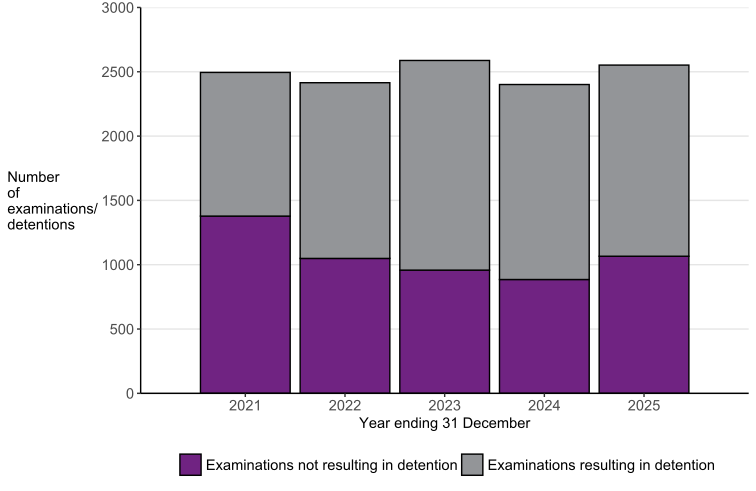
- 2,552 persons were subject to the use of Schedule 7 to TACT 2000 in Great Britain; this was an increase of 6% compared with the year ending 31 December 2024 (where there were 2,401 examinations)
- 52% of examinations made under Schedule 7 of TACT 2000 in the United Kingdom resulted in at least one biometric identifier being taken from an individual (1,376 persons out of 2,654 examinations)
Section 5 presents statistics on the use of stop and search powers available to the police under the Terrorism Act 2000 (TACT 2000). It includes data on the number of stop and searches, and resultant arrests, carried out under section 43 of TACT 2000 (by the MPS only) and section 47A of TACT 2000 (by all police forces). It also contains data on the use of powers under Schedule 7 to TACT 2000 in Great Britain. More information on these powers can be found in the user guide.
5.1 Stop and search under Section 43 of the Terrorism Act 2000
Section 43 of TACT 2000 allows a constable to stop and search a person whom he/she reasonably suspects to be involved in terrorist activity. This section includes data from MPS only and excludes ‘vehicle only’ stops and searches.
The statistics in this release on the number of stops and searches carried out by the MPS and persons arrested as a result of these, between 1 April 2023 and 31 December 2025, were provided to the Home Office by the MPS on 15 January 2025.
Users should note that there may be some variation in the figures reported for the same financial year and quarter between this statistical release and those in the Police powers and procedures England and Wales statistics due to the live nature of the data, where we expect small differences for different dates of data extraction and any updates made to records after each publication.
Data on section 47a stop and search is provided to the Home Office by police forces, and data on section 43 stop and search is currently provided on a quarterly basis for this release by MPS only. Data on section 43 stop and search is available for all police forces in the annual ‘Police powers and procedures’ stop and search report.
In the year ending 31 December 2025, there were no stop and searches under section 47a of TACT 2000. Further details on the use of section 47a can be found in the code of practice for the exercise of stop and search powers.
In the year ending 31 December 2025, 94 persons were stopped and searched by MPS under section 43 of TACT 2000, an increase of 32% when compared with the 71 in the year ending 31 December 2024. The number of persons stopped and searched has decreased by 91% since data collection began in the year ending 31 December 2011.
Since June 2024, the data on stops and searches of persons made by the Metropolitan Police under section 43 of the Terrorism Act 2000 by self-defined ethnicity are published using the ONS 18+1 self-defined ethnicity codes.
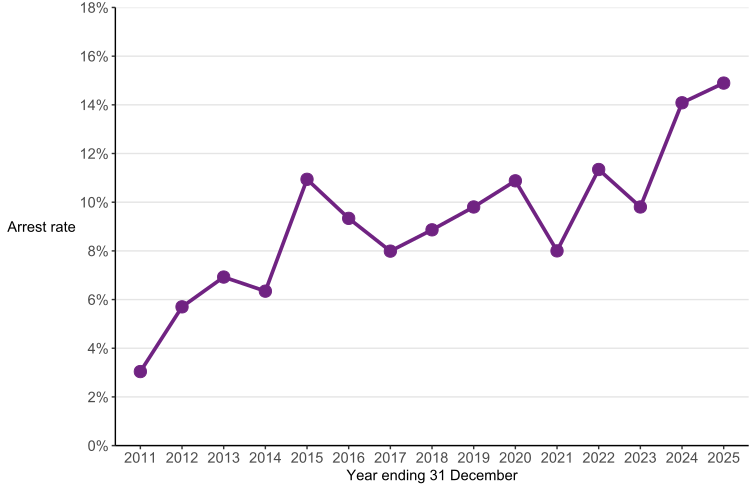
In the year ending 31 December 2025, there were 14 arrests resulting from a section 43 stop and search (up by 4), and a 40% increase from a total of 10 in the year ending 31 December 2024.
Figure 5.1: Stop and searches under section 43 of TACT 2000, year ending December 2011 to year ending December 2025, MPS

Source: MPS (see annual data table S.01)
Notes:
- Excludes ‘vehicle only’ searches.
In the year ending 31 December 2025, 15% of stops (14 arrests out of 94 stops) resulted in arrests, one percentage point higher than the year ending 31 December 2024. This is the highest arrest rate for year ending December data since comparable records began (year ending 31 December 2011), however the search and arrest numbers are much lower than previous years.
Figure 5.2: Arrest rate following stop and searches under section 43 of TACT 2000, year ending December 2011 to year ending December 2025, MPS
Source: MPS (see annual data table S.01)
Notes:
- Excludes ‘vehicle only’ searches.
Details on the overall use of stop and search in England and Wales can be found in the Home Office ‘Police powers and procedures, England and Wales’ annual statistical release. MPS also publishes monthly reports on the use of stop and search within its force area.
Ethnicity was stated in only 52% of stops (49 of 94) in the year ending 31 December 2025, a lower proportion compared to the year ending 31 December 2024 (47 of 71, 66%). The proportion of cases where ethnicity was known was at its highest at 93% in the year ending December 2013 and has declined since. This information relies on the individual stopped being willing to define their ethnicity and the officer recording it accurately.
In cases where the ethnicity was known:
- 35% identified as ‘Asian or Asian British’
- 31% identified as ‘White’
- 14% identified as ‘Arab or Other’
- 18% identified as ‘Black or Black British’
- 2% identified as ‘Mixed’
5.2 Schedule 7 to TACT 2000
Under Schedule 7 to TACT 2000, an examining officer has several powers, the uses of which are covered in this section. These include:
- examinations of persons and resultant detentions
- strip-searches
- refusals to postpone questioning (usually to enable an individual to consult a solicitor)
- examinations of goods
Data on Schedule 7 is provided to the Home Office by the Counter Terrorism Policing Headquarters (CTPHQ). This section includes annual breakdowns for the last 14 years up to the year ending December 2025.
Data has also been provided on how frequently other powers have been used in Great Britain under Schedule 7 to restrict or qualify a person’s access to a solicitor. As well as ‘refusal to postpone questioning’, which has been published since 2016, this release now also covers use of powers where a person is:
- required to consult a solicitor by phone
- delayed access to a solicitor
- required to consult in sight and hearing of a qualified officer
From the year ending June 2019 publication onwards, data on the number of examinations made under Schedule 7 of TACT 2000 in the United Kingdom and the number of intra-UK examinations has also been collected. An intra-UK examination is when a person has been examined at a UK port either before or after a journey between one UK port and another UK port. This includes journeys between or within England, Wales, Northern Ireland and Scotland.
Moreover, as of the June 2021 publication of this release, data on the number of persons where one or more biometric identifier was taken during an examination made under Schedule 7 of TACT 2000 in the United Kingdom has also been provided. For the purposes of this statistical publication, a biometric identifier (taken during an examination under Schedule 7) includes photographs, fingerprints, and DNA samples.
Examinations and resultant detentions
An examining officer may stop and question individuals entering and leaving the country through ports, airports, international rail stations and the border area. When necessary they may also detain and search individuals. The aim is to determine whether or not that person is or has been concerned with the commission, preparation or instigation of acts of terrorism.
In the year ending 31 December 2025, a total of 2,552 persons were subject to the use of this power in Great Britain. This increased by 6% compared with the year ending 31 December 2024 (where there were 2,401 examinations), and a 96% decrease since the data was first collected in the year ending 31 December 2012 (when 60,127 persons were examined under Schedule 7). From 1 January 2012 to 31 December 2025, there has been a mean 19% decrease in examinations each year.
Figure 5.3: Number of Schedule 7 to TACT 2000 examinations and resultant detentions, year ending December 2021 to December 2025, Great Britain
Source: CTPHQ (see quarterly data table S.04a)
Notes:
- Excludes examinations of unaccompanied freight.
There was a large reduction in examinations under Schedule 7 of TACT 2000 between 2019 and 2021 due to the impact of the COVID-19 pandemic on international travel. Passenger numbers at air and seaports in particular were at unprecedented low levels. There has also been increased public scrutiny of this power in recent years, which may have driven a more targeted approach in its use. This is reflected in the increased rate of detention, with 58% of examinations in Great Britain in the year ending 31 December 2025 resulting in a detention (see Figure 5.3).
Since June 2022, data on examinations and resultant detentions made under Schedule 7 of the Terrorism Act 2000 by self-defined ethnicity are published using the self-defined ethnicity codes based upon the ONS 16+1 self-defined ethnicity codes with the addition of the ‘O2-Arab’ category, which comes under the ‘Other’ group.
Ethnicity was stated in 93% of cases. In cases where the ethnicity was known:
- 41% identified as ‘Chinese or Other’
- 26% identified as ‘Asian or Asian British’
- 19% identified as ‘White’
- 10% identified as ‘Black or Black British’
- 4% identified as ‘Mixed’
Figure 5.4: Number of Schedule 7 to TACT 2000 examinations and resultant detentions, 9 quarters to 31 December 2025, Great Britain

Source: CTPHQ (see quarterly data table S.04a)
Notes:
- Excludes examinations of unaccompanied freight.
In the year ending 31 December 2025, 2,654 examinations were made under Schedule 7 of TACT 2000 in the United Kingdom, an increase of 6% compared to the year ending 31 December 2024 when 2,501 examinations were made. Of the 2,654 examinations made in the year ending 31 December 2025, 307 (12%) were intra-UK examinations, compared to 328 of 2,501 (13%) in the year ending 31 December 2024.
In the year ending 31 December 2025, 52% of examinations made under Schedule 7 of TACT 2000 resulted in at least one biometric identifier being taken from an individual (1,376 persons out of 2,654 examinations).
5.3 Other powers under Schedule 7 to TACT 2000
The following section includes information on several additional powers under Schedule 7 to TACT 2000. This includes:
- strip-searches
- postponement of questioning refusals
- examinations of goods (sea and air freight)
Data on these powers has been collected by the Home Office since April 2015.
In the year ending 31 December 2025:
- 6 strip-searches were carried out under the power
- a total of 761 air freight examinations were carried out (an increase of 19% compared with the year ending 31 December 2024)
- 26 sea freight examinations (a decrease of 85% compared with the year ending 31 December 2024) were conducted in Great Britain
- there were no occasions where postponement of questioning (usually to enable an individual to consult a solicitor) was refused
Furthermore, data has been provided on how frequently powers have been used to restrict or qualify a person’s access to a solicitor by requiring the person to consult a solicitor by phone, delaying access to a solicitor, and requiring the person to consult in sight and hearing of a qualified officer. This data has been collected since April 2019.
In the year ending 31 December 2025, there were 2 instances where an individual was delayed access to a solicitor.
Details on each power can be found in the user guide.
5.4 Cordons under section 33 of the Terrorism Act 2000
Section 33 of TACT 2000 gives police officers of at least the rank of superintendent the power to authorise the use of a cordon in an area where it is considered expedient to do so for the purposes of a terrorist investigation. A police officer may order persons and drivers to leave cordoned areas and prohibit pedestrian or vehicle access. Cordons are typically set up to investigate a suspected package or to deal with the consequences of a terrorism-related incident. Further information on this power can be found in the user guide.
Prior to the year to December 2020, cordons data was collected on a ‘Year to March.’ basis. Following a recommendation from the Independent Reviewer of Terrorism Legislation, cordons data is now being collected on a calendar year basis. To give the 2020 figures a direct comparison, we have also republished 2019 figures on a calendar year basis.
In the year ending 31 December 2025, there were 9 cordons set up in Great Britain, down from 12 in the year ending 31 December 2025. Both of these periods are considerably below the peak number of cordons in a 12-month period (51 cordons in the year ending March 2018).
Of the 9 cordons set up in 2025, 6 were set up by Greater Manchester Police, a decrease from 10 in the year ending 31 December 2024. Two were set up by the Metropolitan Police Service and one by West Midlands Police.
6. About these statistics
This data, formerly known as ‘National statistics’, is ‘Accredited official statistics’. Accredited official statistics are called National statistics in the Statistics and Registration Service Act 2007. These statistics have been independently reviewed by the regulator and found to comply with the standards of trustworthiness, quality and value in the Code of Practice for Statistics. Further information about Accredited official statistics can be found on the Office for Statistics Regulation’s (OSR) website. These statistics meet the highest standards of trustworthiness, impartiality, quality and public value, and are fully compliant with the Code of Practice for Statistics. As part of the assessment process, the Home Office reviewed and improved the user guide that accompanies this release, which contains more information about the strengths and limitations of the various datasets within the publication, as well as the steps taken to engage with users. Further details on the assessment process can be found on the UK Statistics Authority website.
6.1 Additional information and enquiries
Accountability statement
Our statistical practice is regulated by the OSR which sets the standards of trustworthiness, quality and value in the Code of Practice for Statistics that all producers of official statistics should adhere to. You are welcome to contact us directly via HSAI_Statistics@homeoffice.gov.uk with any comments about how we meet these standards. Alternatively, you can contact OSR by emailing regulation@statistics.gov.uk or via the OSR website.
Future releases
The information published in the ‘Operation of police powers under the Terrorism Act 2000’ statistics is kept under review, taking into account the needs of users, and burdens on suppliers and producers, in line with the Code of Practice for Statistics. If you have any comments, suggestions or non-data enquiries, please contact the team via email using: HSAI_Statistics@homeoffice.gov.uk. For freedom of information requests please contact: FOIRequests@homeoffice.gov.uk.
Feedback and enquiries
We welcome feedback on the statistics release. If you have any feedback or enquiries about this publication, please contact the HSAI Statistics team via email.
6.2 Accompanying user guide and tables
The user guide provides further details on this release, including the strengths and limitations of the datasets, and the quality assurance processes involved in the production of this release. It also includes a summary of the criminal justice process, a glossary of terms used, and details about the legislation and categories mentioned in this release.
6.3 Data sources
The ‘Arrests and outcomes’ section contains data provided by the CTPHQ Coordination Centre and includes statistics for Great Britain on the:
- number of arrests for terrorist-related activity and outcomes (such as charges and convictions) following such arrest
- number of charges and convictions broken down by legislation used
- sex, age, ethnicity, and nationality of those arrested, charged and convicted
The ‘Court proceedings’ section uses data from the CPS CTD and includes statistics for England and Wales on the:
- number of persons proceeded against by CPS CTD for terrorism-related offences
- number of persons that have been prosecuted and convicted, broken down by the legislation used
The ‘Terrorist prisoners’ section uses data from HMPPS and the SPS and includes statistics for Great Britain on the:
- number and ideology of persons in custody for terrorism and terrorism-connected offences
- ethnicity, nationality and religion of those in custody
- number of persons released from custody by sentence length
The ‘Other police powers under TACT 2000’ section uses data provided by the MPS and Counter Terrorism Policing HQ, and includes statistics on the:
- number of stops and searches carried out by MPS under section 43 of TACT 2000
- number of stops and searches carried out by police under section 47a of TACT 2000
- number of examinations and subsequent detentions made in Great Britain under Schedule 7 to TACT 2000
- data on goods examinations, strip searches and on refusals of requests to postpone questioning (usually to enable an individual to consult a solicitor) under Schedule 7 to TACT 2000
The user guide provides further details on this release, including the strengths and limitations of the datasets, and the quality assurance processes involved in the production of this release. It also includes a summary of the criminal justice process, a glossary of terms used, the legislation and the categories referred to in this release.
6.4 Other related publications
The annual ‘Stop and search and arrests’ publication provides information on use of various powers by police in England and Wales including: arrests for notifiable offences, stop and searches under section 1 PACE and associated legislation and searches under section 60 of the Criminal Justice and Public Order Act 1994, police custody, pre-charge bail, breath tests, motoring offences, and detentions under the Mental Health Act 1983.
The annual ‘Individuals referred to and supported through the Prevent programme’ publication contains official statistics in development on the number of individuals recorded as having been referred to and supported through the Prevent programme due to concerns they were susceptible to a risk of radicalisation.
Northern Ireland Security statistics are published by the Northern Ireland Office at Northern Ireland Terrorism Legislation - Annual Security Statistics 2023.