Mortality profile: statistical commentary December 2025
Published 2 December 2025
Applies to England

© Crown copyright 2025
This publication is licensed under the terms of the Open Government Licence v3.0 except where otherwise stated. To view this licence, visit nationalarchives.gov.uk/doc/open-government-licence/version/3 or write to the Information Policy Team, The National Archives, Kew, London TW9 4DU, or email: psi@nationalarchives.gov.uk.
Where we have identified any third party copyright information you will need to obtain permission from the copyright holders concerned.
This publication is available at https://www.gov.uk/government/statistics/mortality-profile-december-2025-update/mortality-profile-statistical-commentary-december-2025
What’s new
The majority of indicators in the mortality profile have been updated with new mortality rates for the single year of 2024, and the 3-year period of 2022 to 2024. Due to revisions to population estimates, rates have been revised for the single years 2022 and 2023, and the 3-year periods of 2020 to 2022 and 2021 to 2023.
Four new indicators have been produced for the profile:
- mortality rate for deaths involving chronic obstructive pulmonary disease, all ages
- mortality rate from pancreatic cancer, all ages
- mortality rate from liver cancer, all ages
- under 75 mortality rate from heart disease and stroke
The alcohol profile was also updated on 2 December 2025. More recent data was added for indicators of alcohol-specific and alcohol-related mortality and findings are summarised below.
New and updated indicators are listed in the appendix.
Main findings
Compared with 2023, the all-cause all-age mortality rate for 2024 reduced significantly for both sexes. Rates have reduced year-on-year since they peaked in 2020, the first year of the COVID-19 pandemic. In 2024, the female rate was significantly lower than the pre-pandemic rate for 2019, while the male rate was similar to 2019.
However, there are slight differences in trends by cause of death and age group. Despite a decrease between 2023 and 2024, the male all-cause premature mortality rate (deaths under age 75) remained higher than 2019, as did the male rate for deaths from liver disease (both all ages and deaths under 75).
The alcohol-specific mortality rate (deaths wholly due to alcohol), for both sexes combined reduced significantly in 2024. This was the first fall since the increase seen during the COVID-19 pandemic. The 2024 rate remained significantly higher than the rate in 2020, however.
Wide inequalities in mortality between areas in England remain. The all-cause all-age mortality rate in the North East in 2024 was 26% higher than London, the region with the lowest rate. The difference was larger for premature mortality. The premature mortality rate in the North East in 2024 was 37% higher than the South East, which had the lowest rate.
Detailed findings
Principal causes of death
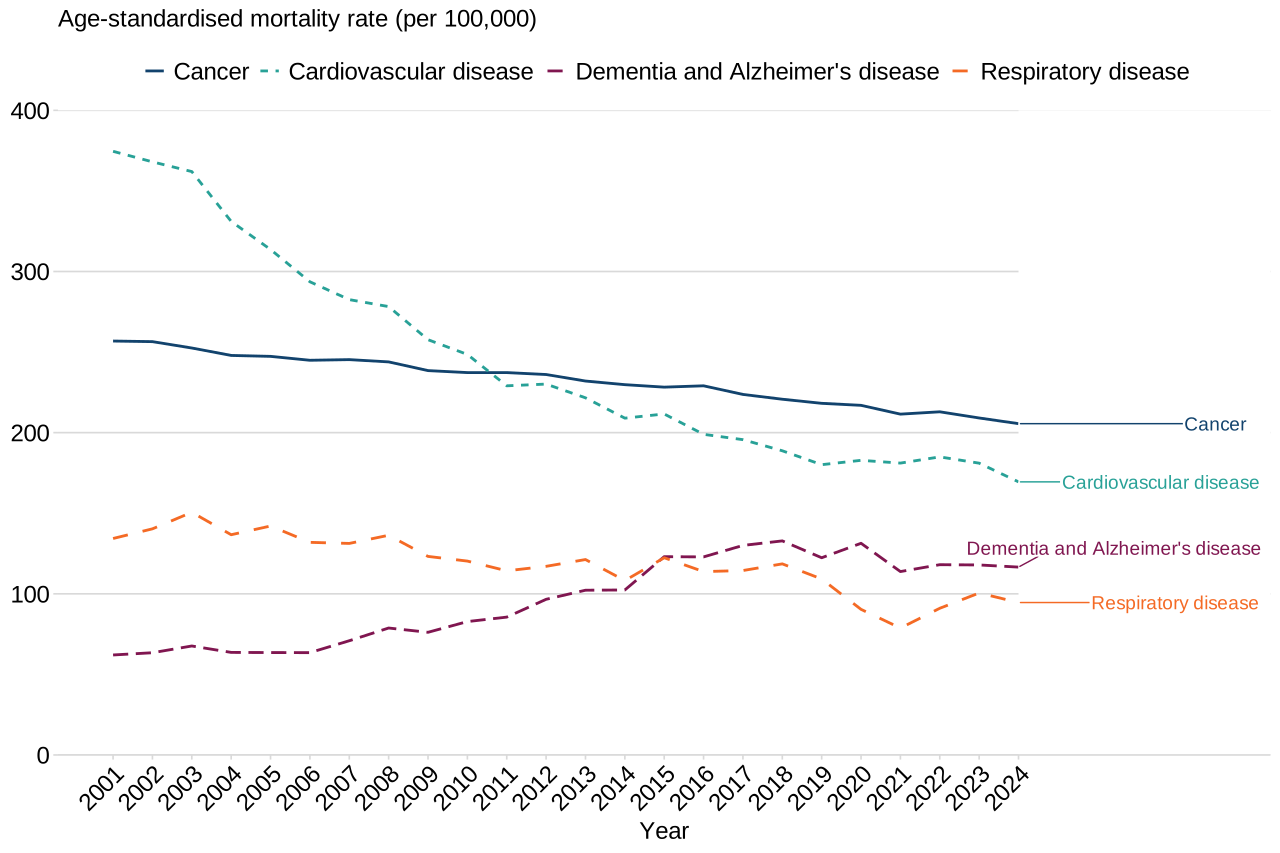
Deaths from the principal causes of deaths (cardiovascular disease, cancer, respiratory disease, and dementia and Alzheimer’s disease) accounted for 74% of deaths in England in 2024. Trends in mortality rates for these causes are shown in figures 1 and 2.
Figure 1: male age-standardised mortality rates for principal causes of death, all ages, England, 2001 to 2024

Source: Office for Health Improvement and Disparities (OHID), based on Office for National Statistics data
Figure 2: female age-standardised mortality rates for principal causes of death, all ages, England, 2001 to 2024
Source: OHID, based on Office for National Statistics data
Long term trends for principal causes of death
Between 2001 and 2024, the male mortality rate from cardiovascular disease fell by 51%, while the female rate fell by 55%. There was a smaller decrease for cancer mortality rates (males 26%, females 20%). However, cancer mortality rates decreased consistently across this period, while the decrease in cardiovascular disease rates slowed in the decade before 2020, and there were increases in some years since 2019 (see figures 1 and 2).
The male mortality rate for respiratory disease also fell, by 35%, between 2001 and 2024 and the female rate fell by 30%. In contrast to other principal causes, rates for dementia and Alzheimer’s disease increased over this period (59% males, 88% females) (see figures 1 and 2).
Further commentary on trends in selected causes of death in people aged under 75 can be found in the Public Health Outcomes Framework statistical commentary, published in November 2025.
Recent trends for principal causes of death
For both sexes, mortality rates from cancer, cardiovascular disease and respiratory disease in 2024 were significantly lower than 2023. The cancer and respiratory rates were also significantly lower than the pre-pandemic rates in 2019 for both sexes. For cardiovascular disease, the female rate in 2024 was significantly lower than 2019, but the male rate remained similar.
Death rates for both sexes from dementia and Alzheimer’s disease have remained relatively stable in recent years but the 2024 rates were significantly lower than 2019.
Alcohol-specific and alcohol-related mortality
The alcohol-specific mortality rate (deaths wholly due to alcohol) had remained relatively stable between 2006 and 2019, but it increased by 39% between 2019 (10.8 per 100,000) and 2023 (15.0 per 100,000). The rate then reduced significantly to 13.8 per 100,000 in 2024. This was the first fall since the increase seen during the COVID-19 pandemic, however the 2024 rate remained significantly higher than the rate in both 2019 and 2020.
The alcohol-related mortality rate (deaths wholly or partially caused by alcohol) reduced significantly from 40.7 per 100,000 in 2023 to 38.9 per 100,000 in 2024. This was also the first fall since 2020 but the 2024 rate was significantly higher than the rate in 2019.
Other causes of death
While mortality rates from many causes of death have improved in recent years, rates for some causes have increased.
The mortality rate for liver disease increased by 42% between 2001 and 2024, from 18.6 per 100,000 to 26.3 per 100,000. Between 2023 and 2024, the female rate remained stable, but the male rate reduced significantly. The 2024 female rate was similar to 2019, but the male rate remained higher.
Accidental deaths have gone up over the last decade. Between 2011 to 2013 and 2022 to 2024, the rate increased by 41% from 21.9 per 100,000 to 30.9 per 100,000.
Mortality from infectious and parasitic diseases has gone up significantly in recent years (this cause group does not include deaths from COVID-19 or influenza). The rate in 2018 to 2020 was 7.4 per 100,000 but it has increased in every period since then, rising to 12.4 per 100,000 in 2022 to 2024.
Mortality rates for deaths involving hypertensive disease and diabetes increased between 2001 and 2024, by 119% and 82% respectively.
Geographical inequalities: regions and local authorities
In 2024, the mortality rate from all causes in England was 923 per 100,000 population, but substantial inequalities between different parts of the country remain.
The North East had the highest all-cause mortality rate in 2024 (1,044 per 100,000). This was 26% higher than London, the region with the lowest rate (828 per 100,000).
For those under age 75, the premature mortality rate from all causes in England was 329 per 100,000 population. Regional rates ranged from 289 per 100,000 in the South East to 395 per 100,000 in the North East.
In 2024, Blackpool was the upper tier local authority with the highest under 75 rates for deaths from all causes, cardiovascular disease and liver disease.
The North East had the highest alcohol-specific mortality rate in 2024 (21.1 per 100,000), almost double the rate in London, the region with the lowest rate (10.9 per 100,000).
Stoke-on-Trent was the upper tier local authority with the highest alcohol-specific mortality rate in 2024 (29.0 per 100,000), over 5 times higher than Redbridge, the area with the lowest rate (5.4 per 100,000).
Background
The mortality profile brings together a selection of mortality indicators, including from other OHID data tools such as the Public Health Outcomes Framework, making it easier to assess outcomes across a range of causes of death.
The mortality profile provides mortality rates for both selected chapters within the International Classification of Diseases, Tenth Revision (ICD-10) and specific causes within chapters. The choice is based primarily on those leading causes of mortality with the highest numbers of deaths and causes which are most relevant in public health.
Mortality rates produced for the mortality profile are directly age-standardised rates which adjust for differences in the age structure of the population between areas and population groups.
Indicators have been produced using 3-year moving averages and single year (where appropriate) time periods for England, English regions, NHS regions, upper and lower tier local authorities, and integrated care boards (ICBs). Deprivation deciles based on upper and lower tier local authorities, as well as by lower layer super output areas, are also available.
Indicators for lower layer super output area deprivation deciles were not updated in December 2025 as population estimates for these areas were not available. Deprivation deciles will be updated in 2026 to incorporate the 2025 Index of Multiple Deprivation.
To make counts of cause-specific deaths comparable over time, comparability ratios have been used. More information on comparability ratios can be found in the ‘Definitions’ view of cause-specific indicators within the mortality profile.
Revisions
Due to corrections to mid-2022 and mid-2023 populations at national and sub-national levels, to account for updated estimates of international migration in England and Wales, data has been revised for the single years of 2022 and 2023, and for the 3-year periods of 2020 to 2022 and 2021 to 2023. This change has had a minor effect on the rates for these time periods. Across all indicators, the largest changes were observed in the all-cause mortality rate for all ages:
- in 2022, the biggest rate change was an increase of 9 per 100,000 in the male rate in Rochford
- in 2023, the biggest rate change was a decrease of 27 per 100,000 in the male rate in Watford
- in 2020 to 2022, the biggest rate change was an increase of 3 per 100,000 in the male rate in Rochford
- in 2021 to 2023, the biggest rate change was an increase of 9 per 100,000 in the male rate in Tower Hamlets
For enquiries or feedback about the mortality profile, email pha-ohid@dhsc.gov.uk.
Appendix
In this update, the following indicators have been updated, with data added for the 3-year period 2022 to 2024, the single year of 2024, and revised data for the 3-year periods of 2020 to 2022 and 2021 to 2023, and the single years of 2022 and 2023:
- mortality rate from all causes, all ages and under 75s
- mortality rate from cancer, all ages
- mortality rate from lung cancer, all ages and under 75s
- mortality rate from breast cancer, all ages and under 75s
- mortality rate from prostate cancer, all ages
- mortality rate from leukaemia and lymphoma, all ages
- mortality rate from colorectal cancer, all ages and under 75s
- mortality rate from cardiovascular disease, all ages
- mortality rate from ischaemic heart disease, all ages and under 75s
- mortality rate from stroke, all ages and under 75s
- mortality rate for deaths involving hypertensive disease, all ages
- mortality rate for deaths involving diabetes, all ages
- mortality rate from liver disease, all ages
- mortality rate from cirrhosis and other diseases of liver, all ages and under 75s
- mortality rate from respiratory disease, all ages
- mortality rate from influenza and pneumonia, all ages
- mortality rate for deaths involving influenza and pneumonia, all ages
- mortality rate from chronic lower respiratory disease, all ages and under 75s
- mortality rate from chronic obstructive pulmonary disease, all ages
- mortality rate for deaths due to COVID-19, all ages and under 75s
- mortality rate for deaths involving COVID-19, all ages and under 75s
- mortality rate from dementia and Alzheimer’s disease, all ages
- mortality rate for deaths involving dementia and Alzheimer’s, all ages
The following indicators have been updated, with data added for the 3-year period 2022 to 2024, and revised data for the 3-year periods 2020 to 2022 and 2021 to 2023:
- under 75 mortality rate from leukaemia and lymphoma
- mortality rate from oesophageal cancer, all ages
- mortality rate from bladder cancer, all ages
- mortality rate from stomach cancer, all ages
- stillbirth rate
- neonatal mortality rate
- post-neonatal mortality rate
- child mortality rate (1 to 17 years)
- mortality rate from accidents, all ages and under 75s
- mortality rate from accidental falls, all ages
- mortality rate from infectious and parasitic diseases, all ages
The following indicators have been updated, with data added for the single year 2024, and revised data for the single years 2022 and 2023:
- alcohol-related mortality
- alcohol-specific mortality
The following indicators have been added to the Mortality profile, with data added for the 3-year periods of 2001 to 2003, up to 2022 to 2024, and for single years from 2001 to 2024:
- mortality rate for deaths involving chronic obstructive pulmonary disease, all ages
- under 75 mortality rate from heart disease and stroke
- mortality rate from pancreatic cancer, all ages
The following indicators have been added to the Mortality profile, with data added for the 3-year periods 2001 to 2003, up to 2022 to 2024:
- mortality rate from liver cancer, all ages
The following indicators have been added to the Mortality profile from other Fingertips profiles, and have had all data refreshed to match other outputs in the Mortality profile:
- under 75 mortality rate from alcoholic liver disease
- mortality rate from asthma, all ages