Annex: Independent child trafficking guardianship statistics, year ending March 2025
Published 14 May 2026

© Crown copyright 2026
This publication is licensed under the terms of the Open Government Licence v3.0 except where otherwise stated. To view this licence, visit nationalarchives.gov.uk/doc/open-government-licence/version/3 or write to the Information Policy Team, The National Archives, Kew, London TW9 4DU, or email: psi@nationalarchives.gov.uk.
Where we have identified any third party copyright information you will need to obtain permission from the copyright holders concerned.
This publication is available at https://www.gov.uk/government/statistics/modern-slavery-nrm-and-dtn-statistics-january-to-march-2026/annex-independent-child-trafficking-guardianship-statistics-year-ending-march-2025
1. Introduction
The Independent Child Trafficking Guardianship (ICTG) service is currently rolled out in selected sites across England and the whole of Wales[footnote 1]. It was initially piloted in 2017 by early adopter sites before expanding to cover around two-thirds of local authority areas in England and Wales in May 2021. Independent Child Trafficking Guardians (ICTGs) provide an independent source of advice and support for children who are suspected of being victims of modern slavery, irrespective of nationality or immigration status. They advocate on the child’s behalf and work to ensure their best interests are reflected in the decision-making undertaken by public authorities involved in their care, whilst helping them navigate criminal justice, immigration and social care systems.
The service is currently delivered by Barnardo’s and is funded by the Home Office. To date, 3 evaluations of the ICTG service have been published which have assessed changes made to the service as it has been rolled out[footnote 2].
Within ICTG sites, if a child is suspected of being a victim of modern slavery, they are referred to the ICTG service by first responder organisations. The child should also be referred to the local authority through normal safeguarding routes and be referred by first responders to the National Referral Mechanism (NRM), the UK’s framework to identify and support potential victims of modern slavery.
The ICTG service records a range of data including a child’s age, primary exploitation type and nationality, to facilitate informed decisions about the support they require. Length of support and reasons for closure are recorded at the end of the child’s stay in the ICTG service. This annex provides an overview of statistics for children referred to the ICTG service in the year ending March 2025 (April 2024 to March 2025). Data tables are also published, containing quarterly statistics from January 2017 to March 2025.
2. Referrals
2.2 Overall
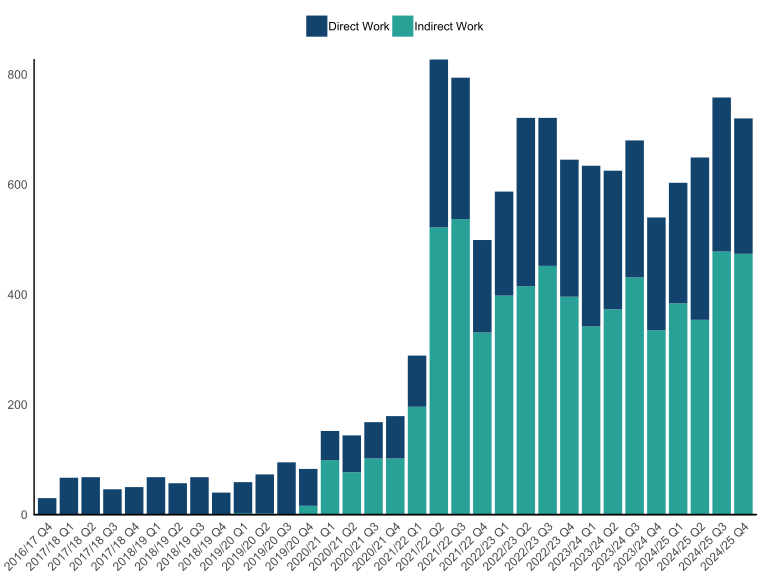
In the year ending March 2025, there were 2,730 potential child victims of modern slavery referred to the ICTG service. This was a 10% increase from the year ending March 2024 (2,479). From January 2017 to March 2025, the ICTG service received 11,739 referrals for potential child victims of modern slavery[footnote 3].
When referrals are received by Barnardo’s, they are assessed as needing either direct support or indirect support. The ICTG service model provides one-to-one direct support for children with no parental responsibility in the UK and consists of a combination of face-to-face and remote support. From 2019 to 2020, following an assessment undertaken of the service, the model began providing indirect support for children for whom there is someone with parental responsibility. Indirect support takes a multi-agency approach, whereby ICTGs work with relevant professionals already supporting children who have been trafficked. In exceptional circumstances where there are particularly vulnerabilities, children with a figure of parental responsibility in the UK can also receive direct support.
In the year ending March 2025, 62% (1,690) of referrals were assessed as needing indirect support, and 38% (1,040) were assessed as needing direct support (figure 1; data table 1A). Referrals to the ICTG service increased steeply from the second half of 2021 due to expansion of the service to cover two-thirds of local authorities in England and Wales. However, they have since broadly stabilised.
Figure 1: Number of ICTG referrals
Source: Barnardo’s, Home Office
Notes:
- Statistics are provided from 2017 which is when Barnardo’s began delivering the roll out of the ICTG service.
3. ICTG sites
The ICTG service covers a range of local authorities in England and Wales responsible for the safeguarding of children, which are broadly grouped into 17 ‘sites’. A full list of sites can be found in the Interim guidance for ICTGs.
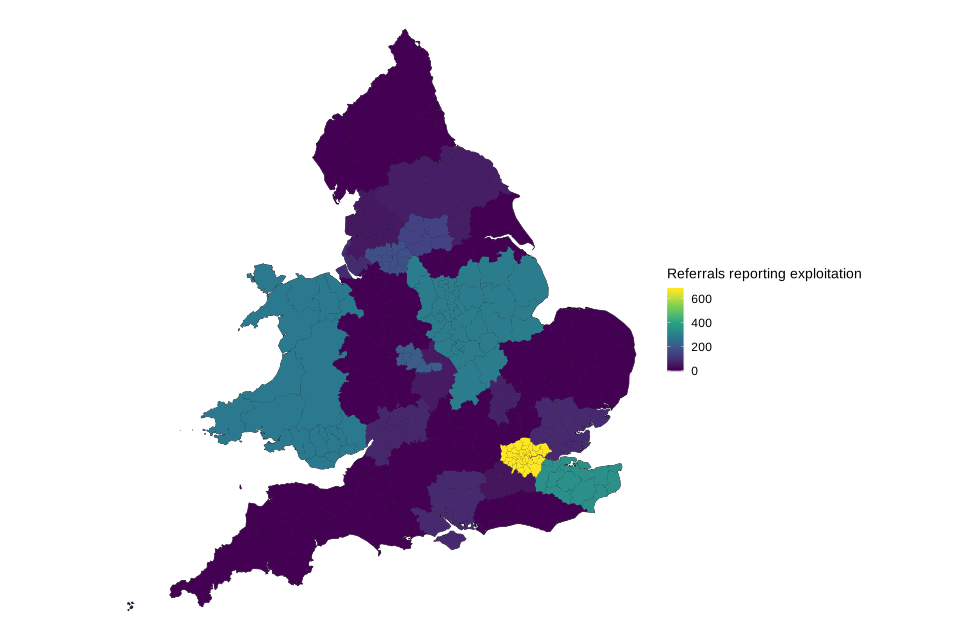
Almost half of the 2,730 referrals made during the year ending March 2025 were made by just 3 sites, namely Greater London (24%; 683 referrals), Kent (12%; 352 referrals) and East Midlands (10%; 292 referrals) (figure 2; data table 2A).
A small number of referrals may come from outside an ICTG site, or a child may be transferred to a new local authority outside an ICTG site while in the service, meaning the local authority responsible for a child may change. For the former, these cases are closed after immediate safeguarding advice and guidance has been provided to the referee. For the latter, Barnardo’s will support with the transfer of information for that child and their general transition to the new responsible local authority, before closing the case.
Figure 2: Number of ICTG referrals by site, year ending March 2025
Source: Barnardo’s, Home Office
Notes:
- Areas in white are those in England where the ICTG service does not currently operate.
- The London Borough of Croydon is included in Greater London.
3.1 Age group
Of the 2,730 children referred into the ICTG service in the year ending March 2025, the majority were aged 15 to 17 (83%; 2,395), with 16% (476) aged 14 or below (data table 3A).
Between 2021 and 2024, the ICTG service piloted provision of support to those in need beyond their eighteenth birthday. This extended provision was piloted in ICTG sites in Greater London (including the London Borough of Croydon), the North (Merseyside, North Yorkshire and West Yorkshire) and the Midlands (Warwickshire and West Midlands). An evaluation of this provision was published in 2024.
3.2 Gender
In the year ending March 2025, 79% (2,154) of children referred to the ICTG service were male and 21% (574) were female (data table 4A).
3.3 Nationality
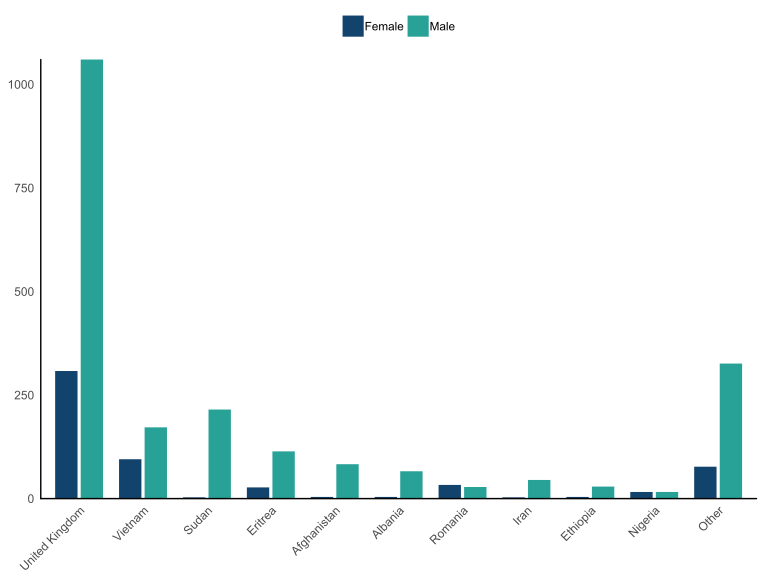
Half of those referred the ICTG service in the year ending March 2025 were UK nationals (50%; 1,369), of whom 78% (1,060) were male and 22% (308) were female.
The second most common nationality of referrals in that period was Vietnamese (10%; 267). Of these, 64% (172) were male and 36% (95) were female. The third most common nationality was Sudanese (8%; 218). Of these, 99% (215) were male and 1% (3) were female (figure 3; data table 5A).
Figure 3: Number of ICTG referrals by nationality, year ending March 2025
Source: Barnardo’s, Home Office
Notes:
- Less commonly referred nationalities are grouped as ‘Other’.
3.4 Unaccompanied asylum-seeking children
An unaccompanied asylum-seeking child (UASC) is a person aged 17 and under who is applying for asylum, is separated from both parents, and is not being cared for by an adult who in law or by custom has responsibility to do so. In the year ending March 2025, 34% (930) of the referrals to the ICTG service were recorded as being a UASC.
3.5 Location of exploitation
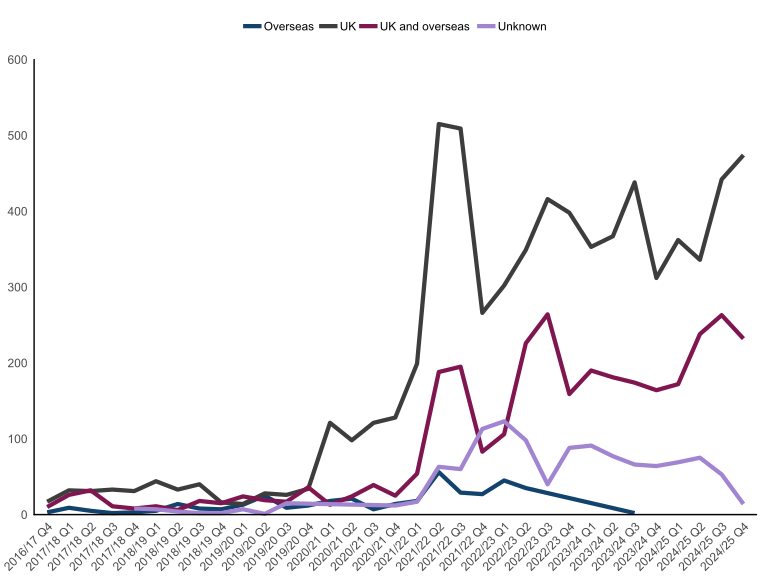
When children are referred to the ICTG service, their exploitation is recorded as either occurring in the UK, overseas, or a combination of both. In the year ending March 2025, exploitation which took place exclusively in the UK was most often recorded, accounting for 59% (1,614) of all children referred into the service. Referrals for UK exploitation rose steeply in the middle of 2021 but have since generally fallen.
An additional 33% (905) of children were recorded as experiencing exploitation both in the UK and overseas in the year ending March 2025.
There were no referrals during this period for children recorded as experiencing exploitation exclusively overseas. Numbers have consistently been lower than those recorded as experiencing exploitation exclusively in the UK and their number has been declining since June 2022, with none referred since October 2023. (figure 4; data table 6A).
Figure 4: Number of ICTG referrals by location of exploitation, 2016 to 2025
Source: Barnardo’s, Home Office
Notes:
- These statistics refer to information recorded at the point of referral, and information may change over time as the child discloses more about their circumstances and experiences.
- Graph excludes referrals with ‘other’ recorded as the location of exploitation.
3.6 Exploitation type
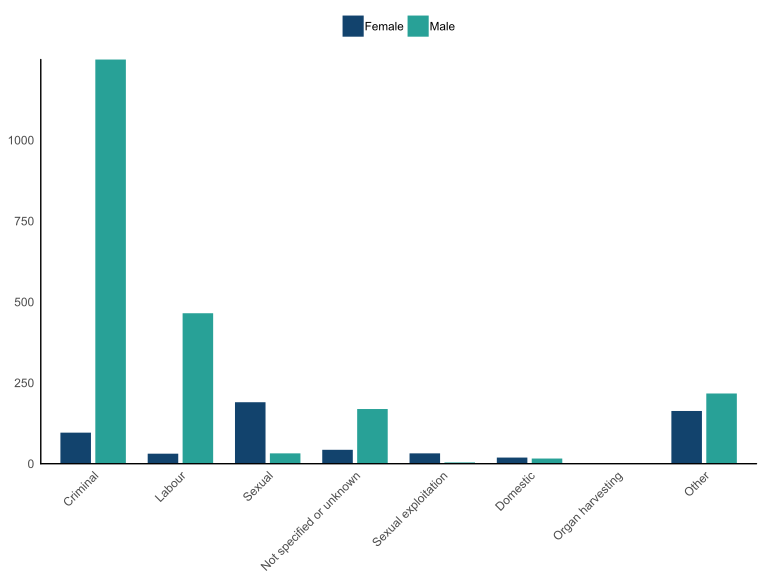
Children referred to the ICTG service report experiencing a range of exploitation types as set out in the modern slavery statutory guidance. These statistics, however, refer to the primary exploitation type. In the year ending March 2025, the most frequently reported of these was criminal (49%; 1,346). Of those who reported criminal exploitation, 93% (1,324) were male and 7% (96) were female.
The second most reported primary exploitation type in the year ending March 2025 was labour (18%; 96), of which 94% (465) were male and 6% (31) were female. The third most reported primary exploitation type (when excluding exploitation that was not specified or unknown) was sexual (8%; 222). Of those who reported sexual exploitation, 15% (32) were male and 85% (190) were female (figure 5; data table 7A).
Figure 5: Number of ICTG referrals, by exploitation type and gender, year ending March 2025
Source: Barnardo’s, Home Office
Notes:
- Less commonly reported exploitation types are grouped as ‘Other’.
- ‘Not specified or unknown’ often includes children who had their exploitation disrupted before it was undertaken in the UK, and the child or professional did not know what the intended exploitation might be.
4. Support
4.1 Reasons for support ending
In the year ending March 2025, 2,029 children had their ICTG cases closed. Support for a child in the ICTG service may end for a variety of reasons. This includes instances where further work by the service is not required because the child’s needs have been met; the child receives a negative decision in the NRM meaning they no longer qualify for support; or the child turns 18 (unless they qualified for support as part of the post-18 support pilot)[footnote 4]. The Interim guidance for ICTGs details more information on exiting and transition from the ICTG service.
Of the 2,029 ICTG cases closed in the year ending March 2025, the most common reason for closure was that further work was not required because the child’s needs have been met (63%; 1,272). An additional 2% (46) were closed because the child had turned 18, and 12% (244) were closed because there were no trafficking concerns (data table 8A).
4.2 Support length
Data on support length within the ICTG service for this period has not been included due to data quality issues identified. The Home Office is working with Barnardo’s to improve data quality so that data on support length can be included in future publications.
5. Quality information
These statistics are produced in accordance with quality requirements of the Code of Practice for Statistics. It uses guidance published on the Government Analysis Function, which considers 5 aspects of quality:
- relevance
- accuracy and reliability
- timeliness and punctuality
- accessibility and clarity
- coherence and comparability
This section also discusses data sources, production and quality assurance of statistics.
Relevance
Statistics on children supported by the ICTG service are used to build a picture of how potential child victims of modern slavery are supported in England and Wales. The information is also used to contribute to an understanding of the profile of children supported. The statistics do not capture the children who are supported by other schemes outside of the ICTG service.
Accuracy and reliability
Data is based on an extract from Barnardo’s taken in April 2024. These statistics are taken from a database which is updated and cleaned to reflect changes that have been introduced to the service model, and to remove any duplicates. As such, the statistics are subject to change over time and so may differ from data included in previous evaluations.
All percentages in this bulletin are rounded to the nearest whole percentage point.
Timeliness and punctuality
These statistics were published 4 months after a data extract was taken from Barnardo’s. This allowed time for the statistics to be collated and quality assured.
Accessibility and clarity
This bulletin has been published to reflect accessibility criteria outlined in guidance published by the Government Analysis Function.
Coherence and comparability
Detailed statistical breakdowns are provided from 2017 as this is when Barnardo’s was contracted to run the ICTG service.
Broadly consistent data recording practises (with exception of changes to ICTG site coverage) allow for meaningful comparisons over time. ICTG sites have changed over time to include more or different local authorities, so it is recommendation that caution is taken when comparing statistics across different years.
Data source
ICTG data is taken from an administrative database maintained by Barnardo’s. Referral forms record information about children, such as age, exploitation type and nationality. Further information is sought from the ICTG assessment team. Length of support and closure reasons are recorded at the end of the child’s stay in the ICTG Service.
Statistical production
This statistical bulletin has been produced to the highest professional standards and is free from political interference. It has been produced by statisticians working in the Home Office Analysis and Insight Directorate under the Home Office’s Statement of compliance with the Code of Practice for Official Statistics, which covers Home Office policy on revisions and other matters.
Data is cleaned using reproducible and tested code. The code reformats data for statistical production, such as by grouping the data into categories (for example age groups) and standardises spelling. Following this, the statistics are collated and outputted as a bulletin with accompanying graphs.
The Chief Statistician, as Head of Profession, reports to the National Statistician regarding all professional statistical matters and oversees all Home Office National Statistics products regarding the Code, being responsible for their timing, content and methodology.
Quality assurance
Data cleaning and grouping is done using reproducible code, which is split into sections to first provide a cleaned dataset, and then produce the bulletin and graphs. The latter 2 are manually cross-checked with the dataset. Reproducible code also allows analytical colleagues to test and validate the production.
6. Related publications
An evaluation of ICTGs for early adopter sites was published in July 2019. Additionally, an assessment of ICTGs was published in October 2020, and an ICTG Modern Slavery Act evaluation was published in May 2024.
Latest and previous statistical releases can be found in the National Referral Mechanism statistics collection.
Raw NRM data is published on UK Data Service.
Statistics and analysis of the devolved decision-making pilot for child victims of modern slavery was published in November 2025.
Feedback and enquiries
We are always looking to improve the accessibility of our documents. If you find any problems, or have any feedback, relating to accessibility, or general questions regarding this publication, please email us NRMStatistics@homeoffice.gov.uk
For press enquires: pressoffice@homeoffice.gov.uk; 0300 123 3535
-
A full list of ICTG sites can be found in the interim guidance. ↩
-
An evaluation of ICTGs for early adopter sites was published in July 2019. A further assessment of ICTGs was published in October 2020, and an ICTG Modern Slavery Act evaluation was published in May 2024. ↩
-
First responder organisations are designated organisations that help support potential victims of modern slavery by referring individuals into the National Referral Mechanism (NRM). ↩
-
As recommended in the Independent Review of the Modern Slavery Act 2015, cases of missing children are kept open until the child is found. Therefore, children whose closure reason indicates they were missing at closure were normally those who turned 18. ↩