MOD biannual civilian personnel report: October 2025
Published 13 November 2025

© Crown copyright 2025
This publication is licensed under the terms of the Open Government Licence v3.0 except where otherwise stated. To view this licence, visit nationalarchives.gov.uk/doc/open-government-licence/version/3 or write to the Information Policy Team, The National Archives, Kew, London TW9 4DU, or email: psi@nationalarchives.gov.uk.
Where we have identified any third party copyright information you will need to obtain permission from the copyright holders concerned.
This publication is available at https://www.gov.uk/government/statistics/mod-biannual-civilian-personnel-report-october-2025/mod-biannual-civilian-personnel-report-october-2025
This statistical release presents figures on the strengths, inflow and outflow of civil servants employed by the Ministry of Defence (MOD). Definitions of terms used in this publication are present throughout.
For further data and information on the MOD Biannual Civilian Personnel Report, please visit:
- MOD Biannual Civilian Personnel Excel ODS table
- MOD Biannual Civilian Personnel Report statistics
- MOD Biannual Civilian Personnel Background Quality Report
Accredited Official Statistics publication
Accredited Official Statistics are called National Statistics in the Statistics and Registration Service Act 2007.
The Biannual Civilian Personnel Report (BCPR) was introduced as a publication in April 2018 replacing the previously published Quarterly Civilian Personnel Report (QCPR). They comply with the standards of trustworthiness, quality and value in the Code of Practice for Statistics and should be labelled ‘Accredited Official Statistics’.
Accreditation can be broadly interpreted to mean that the statistics:
- meet the needs of the identified users;
- are well explained and readily accessible;
- are produced according to sound methods; and
- are managed impartially and objectively in the public interest.
Further information on the accreditation process can be found here: Accreditation explanation web page
Once statistics have been designated as Accredited Official Statistics it is a statutory requirement that the Code of Practice shall continue to be observed. Further details about how this report has been developed since its confirmation as an Accredited Official Statistic can be found in the Background Quality Report.
Our statistical practice is regulated by the Office for Statistics Regulation (OSR). OSR sets the standards of trustworthiness, quality and value in the Code of Practice for Statistics that all producers of official statistics should adhere to.
You are welcome to contact us directly with any comments about how we meet these standards. Alternatively, you can contact OSR by emailing regulation@statistics.gov.uk or via the OSR website.
Updates to the publication
In order to focus on the MOD civil servant population, Locally Engaged Civilians (LECs) are now reported separately within table 7 in the accompanying excel tables. LECs are not civil servants and they are recruited overseas exclusively for employment in support of the UK Armed Forces.
As part of on-going Defence Reform initiatives, introduced by Secretary of State for Defence, Rt Hon John Healey MP, a structural change to the way that MOD civil servants are organised has been introduced. At the point of publication, these changes have not impacted the presentation of information within this report; however, future reports may be updated to reflect these.
In line with the Code of Practice for Statistics, to ensure our statistics provide maximum value, the below changes are being considered for future editions of the Biannual Civilian Personnel Report Accredited Official Statistic. With the introduction of Defence Reform initiatives these changes will help ensure the report remains relevant to users and representative of the MOD.
-
Expand the grade section to present Civil Service equivalent grades for all MOD civil servants (currently only presenting MOD Main grades). This will also include removing the industrial/non industrial grade split and providing grade equivalence for industrial grades.
-
Present method of entry categories and outflow reason categories for total MOD civil servants, and remove the individual break downs for MOD Main and Executive Agencies.
-
When available, replace MOD TLBs with the new MOD structures.
If you have any comments, please let us know at Analysis-Civilian-Enquiries@mod.gov.uk
Main Points
At 1 October 2025 the MOD civil servant FTE total was 55,286 a decrease of 1,513 (2.7%) compared with 1 October 2024. The headcount was 57,370, a decrease of 1,417 (2.4%) compared with 1 October 2024.
The decrease in both FTE and headcount strength reflects the Department’s continued focus on affordability and value for money within workforce plans.
For the 12 months from 1 October 2024 to 30 September 2025, 3,249 civil servants inflowed to the MOD, a decrease of 1,728 (34.7%) compared with the previous 12 months.
For the 12 months from 1 October 2024 to 30 September 2025, 4,694 civil servants left the MOD, a decrease of 1,212 (20.5%) compared with the previous 12 months.
MOD Civil Servants
The MOD civil servant FTE at 1 October 2025 was 55,286, a decrease of 1,513 FTE (2.7%) compared with 1 October 2024 (56,799).
The MOD civil servant headcount at 1 October 2025 was 57,370, a decrease of 1,417 (2.4%) compared with 1 October 2024 (58,787).
Strength: Total number of personnel employed at a specific time point.
Headcount: A measure of the size of the workforce based on the number of personnel employed rather than by their FTE proportion.
Full Time Equivalence (FTE): A figure that allows part-time workers’ hours to be put into the same units as full-time workers.
Figure 1 shows that at 1 October 2025 MOD Main Top Level Budgetary areas (TLBs) had the largest FTE share of 63.6%. MOD Executive Agencies accounted for 33.4%, and Royal Fleet Auxiliary’s share was the smallest at 3.0%.
Figure 1: Breakdown of MOD Civil Servants by Main Groups (FTE), 1 October 2025
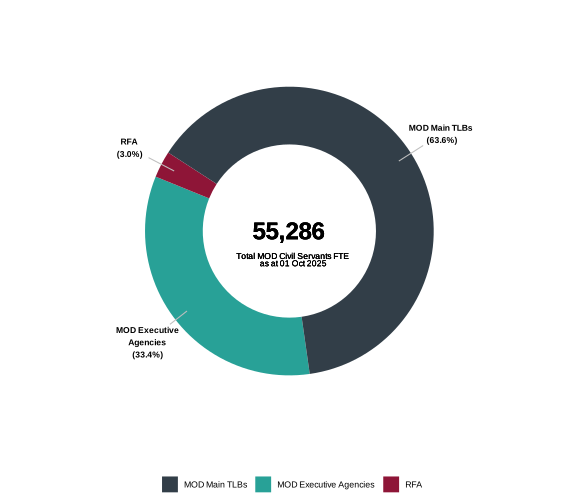
Table 1 shows the FTE net change in MOD civil servants between 1 October 2024 and 1 October 2025. MOD Executive Agencies had the highest percentage change with a decrease of 3.9%.
Table 1: MOD Civil Servants by Main Groups (FTE)
| 1 October 2024 | 1 October 2025 | Difference (number) |
Difference (% change) |
|
|---|---|---|---|---|
| MOD Main TLB | 35,944 | 35,157 | -788 | -2.2% |
| MOD Main Executive Agencies | 19,218 | 18,465 | -753 | -3.9% |
| Royal Fleet Auxiliary | 1,636 | 1,664 | 28 | 1.7% |
| MOD Civil Servants | 56,799 | 55,286 | -1,513 | -2.7% |
MOD Main Top Level Budgetary areas (TLBs) are the major organisational groupings of the Department directly responsible for the planning, management and delivery of departmental capability. These are Navy Command, Army TLB, HQ Air Command, Head Office, Cyber & Specialist Operations Command, Defence Infrastructure Organisation and Defence Nuclear Organisation. Please see glossary for further information.
MOD Executive Agencies are self accounting units that have greater freedom than other government departments in managing their own financial and management activities. These are UK Hydrographic Office, Defence Science & Technology Laboratory, Submarine Delivery Agency, and Defence Equipment & Support. Please see glossary for further information.
Royal Fleet Auxiliary are a civilian-manned fleet, owned by the MOD, which supports Royal Navy ships around the world, supplying warships with fuel, ammunition and supplies.
MOD Civil Servants: MOD civil servants employed within MOD Main TLBs, Executive Agencies and Royal Fleet Auxiliary.
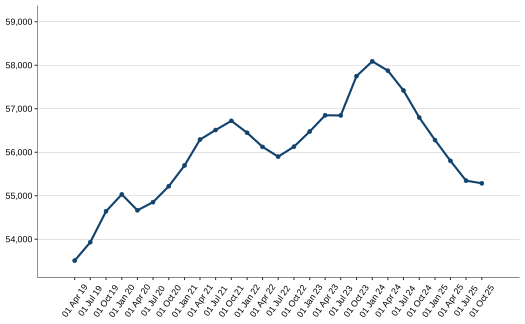
The MOD civil servant FTE workforce showed an overall increasing trend from 1 April 2019, peaking in strength at 1 January 2024 (Figure 2). Since 1 January 2024, the number of MOD civil servants has been steadily decreasing, returning to levels similar to 1 July 2020.
The decrease in both FTE and headcount strength reflects the Department’s continued focus on affordability and value for money within our workforce plans. As set out in the Spring statement on 26 March 2025, the government was determined to make the public sector more productive, driving value for money and improving services for working people. Defence remains committed to delivering both government’s and Department’s priorities.
Figure 2: MOD Civil Servants FTE, 1 April 2019 to 1 October 2025
MOD Main Civil Servants by Grade
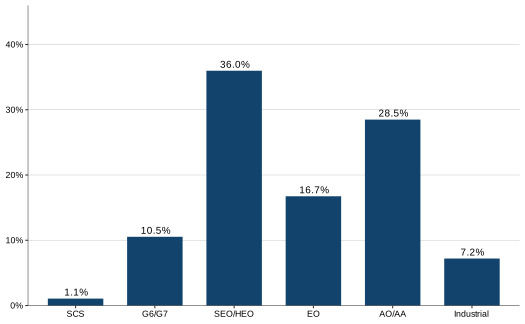
Figure 3 shows the breakdown by grades of MOD civil servants (FTE) in MOD Main TLBs. At 1 October 2025, Senior and Higher Executive Officers accounted for the highest proportion at 36.0%, followed by Administrative Officers and Assistants at 28.5%. The remaining proportions were shared between Grade 6 & 7 personnel (10.5%), Executive Officers (16.7%), Industrial personnel (7.2%) and the smallest section: SCS at 1.1%.
The proportion of MOD Main civil servants in Industrial grades has slowly decreased since 1 April 2019. The proportion has ranged from 11.7% at 1 April 2019 to 7.2% at 1 October 2025.
Please note, calculations for grade proportions are based solely on known grade, and exclude personnel with other grade (103 personnel) at 1 October 2025.
Non-industrial personnel undertake work such as administration, analysis, policy, procurement, finance, medicine, dental care, teaching, policing, science and engineering. Non-industrial grades are shown in terms of Civil Service grade structure and based on substantive grade.
Industrial personnel are employed primarily in a trade, craft or other manual labour occupations. This covers a wide range of work done by industrial technicians, air freight handlers, storekeepers, vergers and drivers etc.
Figure 3: Proportion of FTE MOD Main Civil Servants by Grade*, 1 October 2025
* Excludes unknown grades.
Inflow and Outflow
Inflow The number of personnel joining the department within a monthly, quarterly or financial year period.
Outflow The number of personnel leaving the department within a monthly, quarterly or financial year period.
Inflow and outflow figures exclude any movement of personnel within the department. Inflow and outflow of Royal Fleet Auxiliary are also excluded.
The total annual inflow of MOD civil servants in the 12 months from 1 October 2024 to 30 September 2025 was 3,249, a 34.7% decrease (1,728) compared with that in the previous 12 months (Table 2).
Defence Equipment & Support (DE&S) showed the highest percentage change for inflow with a 68.2% decrease, followed by MOD Executive Agencies (excluding DE&S) with a 60.9% decrease and MOD Main TLBs with a 17.7% decrease (Table 2).
In February 2025, the Office for Veterans’ Affairs (OVA) moved from the Cabinet Office to the MOD which resulted in 46 civil servants inflowing.
Table 2: Inflow of MOD Civil Servants (Headcount)
| 1 October 2023 to 30 September 2024 |
1 October 2024 to 30 September 2025 |
Difference (number) |
Difference (% change) |
|
|---|---|---|---|---|
| MOD Main TLBs | 3,171 | 2,611 | -560 | -17.7% |
| MOD Main Executive Agencies (excluding DE&S) |
873 | 341 | -532 | -60.9% |
| Defence Equipment & Support (DE&S) |
933 | 297 | -636 | -68.2% |
| MOD Total | 4,977 | 3,249 | -1,728 | -34.7% |
The annual outflow of MOD civil servants in the 12 months from 1 October 2024 to 30 September 2025 was 4,694, a 20.5% decrease (1,212) compared with the previous 12 months (Table 3). MOD Executive Agencies (excluding DE&S) showed the highest percentage change for outflow at a 38.2% decrease, whilst Defence Equipment & Support (DE&S) had a 12.9% decrease compared with the previous 12 months.
Table 3: Outflow of MOD Civil Servants (Headcount)
| 1 October 2023 to 30 September 2024 |
1 October 2024 to 30 September 2025 |
Difference (number) |
Difference (% change) |
|
|---|---|---|---|---|
| MOD Main TLBs | 4,163 | 3,406 | -757 | -18.2% |
| MOD Main Executive Agencies (excluding DE&S) |
908 | 561 | -347 | -38.2% |
| Defence Equipment & Support (DE&S) |
835 | 727 | -108 | -12.9% |
| MOD Total | 5,906 | 4,694 | -1,212 | -20.5% |
The two most common reasons for leaving the MOD for MOD civil servants from 1 October 2024 to 30 September 2025 were resignation and retirement, accounting for 39.9% and 34.5%, respectively (Figure 4).
Figure 4: Outflow by Reason of MOD Civil Servants, 1 October 2024 to 30 September 2025
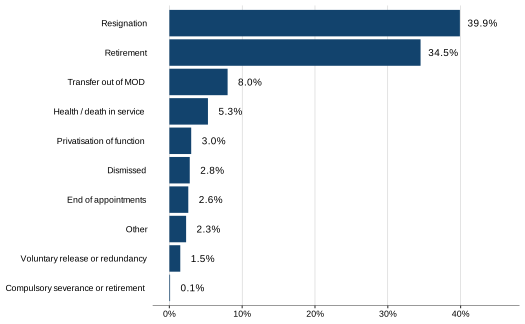
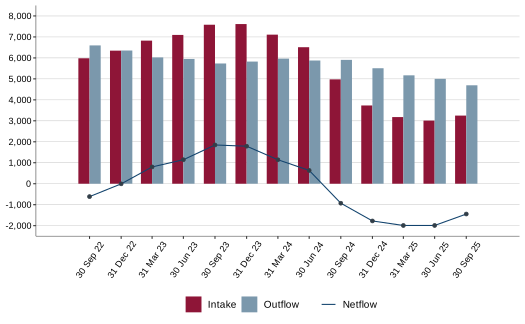
Figure 5 shows the overall net flow of MOD civil servants per 12 months. From 1 January 2023 through to 1 January 2024 net flow rates were neutral or positive, peaking at 1 January 2024. Since then, the net flow began decreasing before finally turning negative by September 2024, resulting in decreasing numbers of overall MOD civil servants. This negative net flow reflects the Department’s continued focus on affordability and value for money within our workforce plans.
For the 12 months from 1 October 2024 to 30 September 2025, the outflow of MOD civil servants was 4,694 and the intake 3,249, resulting in negative 1,445 net flow.
Figure 5: Inflow and Outflow of MOD Civil Servants (Headcount), 1 October 2021 to 30 September 2025
Glossary
Civil Servants: Staff employed by the Crown (appointed by departments or executive agencies). Their roles, grades and salaries are broadly comparable and whilst they usually work for one specific department or agency, and they are able to apply for postings across most other areas of government.
Locally Engaged Civilians are employees who are recruited overseas exclusively for employment in support of the UK Armed Forces. LECs are employed on terms and conditions analogously with local employment law and market forces, and not those of the UK.
Navy Command: A MOD Main Top Level Budgetary area (TLB) for the Royal Navy and Royal Marines. Formed on 1 April 2006 by the merger of the Commander-in-Chief Fleet and the Chief of Naval Personnel/ Commander-in-Chief Naval Home Command.
Army TLB: A MOD Main Top Level Budgetary area (TLB) for the Army. Performs a similar role to Navy Command within the context of trained Army formations and equipment. As of 1 April 2025 responsibility for Ministry of Defence Police (MDP) and Military Guard Service (MGS) transferred to Army TLB within Security Joint Command (SJC).
HQ Air Command: A MOD Main Top Level Budgetary area (TLB) for the Royal Air Force (RAF). Incorporates the RAF’s Personnel and Training Command and Strike Command with a single fully integrated Headquarters, which equips the RAF to provide a coherent and coordinated single Air focus to the other Services, MOD Head Office, the Permanent Joint Headquarters and the rest of MOD.
Head Office: A MOD Main Top Level Budgetary area (TLB). (Previously listed as Head Office & Corporate Services). Established as at 1 April 2012. Lead areas of activity include acting as Head of Establishment for London HO Buildings and associated support requirements, the production of the Department’s Resource Accounts, Governance support for MOD Trading Funds and Senior Finance Office (SFO). SFO is responsible for ensuring that decisions are taken with due regard to affordability and value for money. For the purposes of this reporting, Head Office also includes Defence Business Services (DBS) and Ministry of Defence Police (MDP). As of 1 October 2024 responsibility for Ministry of Defence Police (MDP) transferred to Defence Infrastructure Organisation (DIO).
Cyber & Specialist Operations Command (CSOC): As of 1 September 2025 UK Strategic Command changed their official title to Cyber & Specialist Operations Command (CSOC). This change in title from UK Strategic Command to CSOC reflects the Command’s evolved role and enhanced responsibilities following the SDR, particularly its leadership of the cyber domain, including the integration of specialist capabilities, and our commitment to delivering effects across Defence. CSOC retains all functions and roles of UK Strategic Command, for date points prior to 1 September 2025 the new title will used in place of UK Strategic Command for consistency of presentation across time series where appropriate.
Defence Infrastructure Organisation: A MOD Main Top Level Budgetary area (TLB). Established as at 1 April 2011, DIO manages the military estate, including accommodation for Service personnel and their families, on behalf of the MOD. It replaced Defence Estates and includes TLB property and facilities management functions previously situated within other TLBs. As of 1 October 2024 responsibility for Ministry of Defence Police (MDP) transferred to Defence Infrastructure Organisation. As of 1 April 2025 responsibility for Ministry of Defence Police (MDP) and Military Guard Service (MGS) transferred to Army TLB within Security Joint Command (SJC).
Defence Nuclear Organisation (DNO): A MOD Main Top Level Budgetary area (TLB). Established as at 1 April 2016. The MOD organisation that oversees all defence nuclear headquarters business, including investment in future nuclear submarines and retired nuclear equipment dismantling and disposal.
UK Hydrographic Office (UKHO): An Executive Agency which provides navigation charts and other hydrographic information and services to Defence, primarily the Royal Navy and commercial shipping.
Defence Science & Technology Laboratory (DSTL): An Executive Agency established in July 2001. It carries out impartial scientific and technical research and supplies advice to the MOD and other government departments.
Submarine Delivery Agency (SDA): An Executive Agency established in April 2018, SDA manages the procurement, in-service support and disposal of UK nuclear submarines, which are some of the most complex equipment in the world. They deliver to the Royal Navy the capabilities essential to the Continuous at Sea Deterrent (CASD) - the cornerstone of national security.
Defence Equipment & Support (DE&S): A bespoke trading entity responsible for equipping and supporting the UK’s Armed Forces. They manage a vast range of complex projects to buy and support all the equipment and services that the Royal Navy, British Army and Royal Air Force need to operate effectively. They work closely with industry, including through partnering agreements and private finance initiatives. As at 1 April 2024 DECA formally transferred within DE&S.
Defence Electronics Components Agency (DECA): An Executive Agency established in April 2015. DECA is a trusted MOD and industry partner with a highly professional team aiming to provide benchmark supporting services as the principal in-house government organisation dedicated to maintenance, repair, overhaul, upgrade, procurement and managed service provision in the defence avionics, electronics and components field. As at 1 April 2024 DECA formally transferred within DE&S.
Further Information
Rounding
Tables and Charts within this document
Percentages and related change in percentage points across time periods are calculated from unrounded data and rounded to one decimal place. Totals and sub-totals are rounded separately and so may not equal the sums of their rounded parts. This also applies to data expressed in terms of Full-Time Equivalents (FTE).
Excel tables accompanying this publication
An updated MOD Disclosure Control and Rounding policy has been published on GOV.UK and we have applied this policy to the statistics in the accompanying Excel tables. The policy is available at MOD statistics: policies.
Disclosure control will still be applied to statistical or numeric information to safeguard the confidentiality of individuals. ‘Disclosure control’ refers to the efforts made to reduce the risk of disclosure, such as applying statistical methods to protect ‘personally identifiable information’ (PII) in aggregated data tables. These safeguards can take many forms (e.g. data suppression, rounding, recoding etc.).
Revisions
Occasionally errors can occur in statistical processes. Procedures are constantly reviewed to minimise this risk. Should a significant error be found, or if figures change due to improvements to methodologies or changes of definitions then a correction may be required. Corrections which would have a significant impact on the utility of the statistics will be corrected as soon as possible, by reissuing the publication. Minor errors will also be corrected, but for convenience these corrections may be timed to coincide with the next release of the publication.
All corrected figures will be identified by the symbol [r]. Corrections will only be marked in the first edition of each publication that the corrected figures appear in. If the figures appear again in future editions they will not be marked as corrected.
Since the last release of the Biannual Civilian Personnel Report in May 2025, an error was identified in the rounding methodology of FTE figures within annex_1a of the accompanying ODS excel tables, and as a result four figures have been changed by no more than the value of 0.5. This has made no significant impact on figures presented. For further detail, please see the Background Quality Report.
Background Quality Report
The background quality report provides more detailed information about the quality of data used to produce this publication and any statistics derived from that data. MOD civilian personnel statistics: background quality reports
Contact us:
Responsible statistician: Analysis Civilian Head of Branch Further information/mailing list: Analysis-Civilian-Enquiries@mod.gov.uk Background quality report: Background quality report
Would you like to be added to our contact list, so that we can inform you about updates to these statistics and consult you if we are thinking of making changes? You can subscribe to updates by emailing:
Analysis-Civilian-Enquiries@mod.gov.uk