6. Tax gaps: Other taxes
Published 18 December 2012

© Crown copyright 2012
This publication is licensed under the terms of the Open Government Licence v3.0 except where otherwise stated. To view this licence, visit nationalarchives.gov.uk/doc/open-government-licence/version/3 or write to the Information Policy Team, The National Archives, Kew, London TW9 4DU, or email: psi@nationalarchives.gov.uk.
Where we have identified any third party copyright information you will need to obtain permission from the copyright holders concerned.
This publication is available at https://www.gov.uk/government/statistics/measuring-tax-gaps-methodological-annex/6-tax-gaps-other-taxes
Introduction
The ‘other taxes’ gaps include:
- Stamp Duty Land Tax gap
- Stamp Duty Reserve Tax gap
- Inheritance Tax gap
- Landfill Tax gap
- Petroleum Revenue Tax gap
- ‘other taxes, levies and duties’ gap, which includes:
- Aggregates Levy gap
- Air Passenger Duty gap
- Climate Change Levy gap
- Customs Duty gap
- Digital Services Tax gap (introduced in tax year 2021 to 2022)
- Insurance Premium Tax gap
- Plastic Packaging Tax gap (introduced in tax year 2022 to 2023)
- Soft Drinks Industry Levy gap (introduced in tax year 2018 to 2019)
Except for the Inheritance Tax gap, methodologies for ‘other taxes’ gaps are illustrative; we use the best available data, simple models and management assumptions to build an estimate of the tax gap. The Petroleum Revenue Tax gap is only estimated up to the 2014 to 2015 tax year. After this, the estimate was discontinued due to the Petroleum Revenue Tax gap being zero-rated from 1 January 2016.
Stamp Duty Land Tax gap
Overview
The Stamp Duty Land Tax (SDLT) gap is estimated using an illustrative methodology based on a combination of management information and assumptions.
The SDLT gap is calculated from the amount of SDLT outstanding, referred to here as ‘tax at risk’ (TAR). The following components have been identified as the main contributors to the tax gap:
- TAR from SDLT avoidance cases being investigated and those unknown to the department
- SDLT not paid due to evasion
- SDLT reliefs that are improperly claimed
- SDLT not paid due to other associated losses
Step by step calculation
-
Estimate avoidance TAR using an agreed stakeholder proportion of SDLT avoidance cases data, uplifting for unknown cases to the department.
-
Estimate evasion TAR using an agreed stakeholder proportion of SDLT receipts, assuming expected tax recoverable through HMRC compliance activity.
-
Estimate TAR from improperly claimed reliefs using an agreed stakeholder proportion of SDLT relief amounts legitimately claimed, assuming the expected tax recoverable through HMRC compliance activity.
-
Estimate other associated losses TAR using an agreed stakeholder proportion of SDLT receipts, assuming the expected tax recoverable through HMRC compliance activity.
-
Sum the estimates from avoidance, evasion, reliefs improperly claimed and other associated losses for the total SDLT tax gap.
Methodology
Avoidance
This reflects TAR from avoidance cases being investigated by HMRC, largely relating to mass-marketed and other avoidance schemes. Additionally, we apply an assumption that HMRC can only recover 75% of the TAR involved in these cases.
It would be impossible for HMRC to know about every case of SDLT avoidance, because the associated paperwork has not been completed or has been deliberately falsified and not yet discovered. Expert opinion suggests that HMRC is aware of approximately 80% of all transactions involving SDLT where TAR has resulted. For this reason, a non-detection multiplier of 1.25 has been used to ‘uplift’ the amount of known TAR to account for this.
Evasion
This reflects a percentage of the total amount of SDLT receipts (as published in the HMRC tax receipts bulletin) not initially paid due to evasion. Internal discussions with subject matter experts suggest that this amounts to 1% of the published SDLT receipts each year, with around 50% of this recoverable in line with other non-avoidance activity.
Reliefs improperly claimed
Improperly claimed reliefs take different forms and there are more than 30 different reliefs claimed for SDLT. All reliefs are considered for this calculation. Internal discussions with subject matter experts suggest that up to 5% of these claims may be falsely claimed. Additionally, there is an assumption that HMRC recovers 10% of the TAR involved in these cases. This considers the large number of reliefs for which compliance work has not yet begun and the small number of cases open into those reliefs that have been targeted.
Other associated losses
This reflects a percentage of the total amount of SDLT receipts (as published in the HMRC tax receipts bulletin) not initially paid due to other associated losses. Internal discussions with subject matter experts suggest that this amounts to 0.5% of the published SDLT receipts each year, with around 50% of this recoverable in line with other non-avoidance activity.
Data Issues and Limitations
Estimates for years prior to 2011 to 2012 include the amount of SDLT avoided using tax avoidance schemes. These were artificial structures constructed solely to avoid SDLT that the department was aware of. This was calculated by multiplying the number of disclosures of tax avoidance schemes (DOTAS) regimes, the estimated tax under consideration each year and the estimated number of users of each DOTAS scheme. This is excluded from 2011 to 2012 onwards because no further DOTAS schemes related to SDLT have been revealed to the department.
Estimates for years prior to 2015 to 2016 include threshold manipulation (another form of SDLT evasion). This occurred when the sale value of a property was artificially reduced to below a threshold to reduce the SDLT liability. Previously, SDLT was charged at a single rate based on the value of the total purchase price.
From 4 December 2014, SDLT liabilities changed to incremental rates applied only to the portion of the purchase price that falls within each rate band. This significantly reduced the potential value of tax lost due to threshold manipulation.
For this reason, estimates after this point do not include threshold manipulation. As a result of these exclusions, figures from 2015 to 2016 onwards are not directly comparable to previous years.
Uncertainty rating
The uncertainty rating for the SDLT gap estimate is ‘high’. While the scope of the tax base aims to capture key identified risks, assumptions of non-compliance activity used within the methodology are derived from expert opinion. This carries inherent uncertainty in the absence of comparable data, particularly around other associated losses, limiting our ability to provide a more robust estimate of the tax gap. The rating is unchanged from ‘Measuring tax gaps 2025 edition’.
Stamp Duty Reserve Tax gap
Overview
The Stamp Duty Reserve Tax (SDRT) gap is estimated using an illustrative methodology, whereby a proxy indicator is used for the percentage of the total amount of SDRT receipts (as published in the HMRC tax receipts bulletin) not initially paid. Internal discussions with subject matter experts suggest that this amounts to 1% of the published SDRT receipts each year.
Step by step calculation
-
Estimate the tax gap using an assumed proportion of SDRT receipts.
Uncertainty rating
The uncertainty rating for the SDRT gap estimate is ‘very high’. This is largely reflective of the highly illustrative methodology derived as an assumption of receipts data, lacking insight into wider non-compliance. The rating is unchanged from ‘Measuring tax gaps 2025 edition’.
Inheritance Tax gap
Overview
The Inheritance Tax gap model estimates the tax gap using risk-based audits, focusing on the riskiest estates and trusts rather than a random sample of businesses. To prevent a few very large under-declared tax cases from distorting overall results, the model applies an extreme value methodology, ensuring a more typical picture of non-compliance.
Audit data is available from 2013 to 2014 onwards. For earlier years, the Inheritance Tax gap has been calculated by scaling estimates published in ‘Measuring tax gaps 2020 edition’, using the ratio between the old and new results in the years where both are available.
Since the ‘Measuring tax gaps 2021 edition’, the Inheritance Tax gap extreme value methodology has been expanded to include liabilities arising from transfers of assets into and out of trusts, as well as charges that are due every ten years. As some compliance checks remain open for recent years, projections are used to provide the best current estimates. A non-detection multiplier, based on expert judgement, accounts for undetected non-compliance.
Step by step calculation
-
Estimate the under-declared tax in observed risk-based audits.
-
Project recent estates in line with the number of deaths and probate cases.
-
Estimate the extreme value central estimate.
-
Apply the non-detection multiplier to account for unidentified tax due.
-
Subtract compliance yield from the gross tax gap.
Methodology
Data sources
The Inheritance Tax gap model draws primarily on operational audit data from HMRC’s risk-based enquiries. These audits provide detailed information on identified under-declarations within the Inheritance Tax population and form the core evidence base for the estimates.
The Inheritance Tax population is not well-defined, but it is approximated using the total number of estates above the nil-rate band and the number of charges due on trusts. Sensitivity analysis has been carried out that confirms that the population number has limited impact on the output.
Internal data on the total number of theoretically chargeable estates is not readily available for the most recent 2 years being estimated. We project this figure using the number of deaths and probate applications in the corresponding financial year. These are published by the Office for National Statistics and the Ministry of Justice respectively.
Operational audit data is available from 2013 to 2014 onwards, so earlier years use the figures published at the time.
Audit outcomes
HMRC carries out risk-based compliance checks to determine whether the correct amount of Inheritance Tax has been declared. The outcome of each check might show no issues, or it may identify additional tax that should have been declared. These outcomes provide the direct evidence of non-compliance that the model uses.
Some checks identify very large amounts of under-declared tax, while most identify much smaller amounts. To prevent a small number of unusually large cases from distorting the overall results, the model uses an extreme value methodology that reduces their influence while keeping them in the dataset. This makes the final estimates more stable and reflective of typical patterns of non-compliance across the mid-sized population.
Forecasting open risks
Some Inheritance Tax compliance risks remain open at the point of estimation. To estimate the tax gap for each year, it is necessary to make assumptions about the cases that are yet to be settled when the compliance check results are analysed. For open risks, the model pairs each risk with a similar closed risk and uses the observed yield from the matched case as the forecast. These forecast values are replaced by actual outcomes in subsequent ‘Measuring tax gaps’ editions once the underlying risks have been settled.
Extreme value methodology (central bound estimate)
The extreme value methodology is used to estimate under-declared tax when most of the value is concentrated in a small number of cases.
Extreme value methodology is a statistical technique used to understand data characterised by extreme outlier observations. An example of this would be where a small number of data points make up a large majority of the total value. This is known as the power law or 80-20 rule, where approximately 80% of the yield comes from 20% of enquiries.
-
Use risk-based audit results: Estimate under-declared tax from observed risk-based audits.
-
Identify extreme value behaviour: Results typically show that a small number of cases account for most of the under-declared tax.
-
Apply a threshold cut-off: Exclude cases below the threshold so that only those consistent with the expected distribution are included.
-
Fit a power-law model: Fit a power law model to the remaining cases to estimate under-declared tax among high-yield risks.
-
Estimate unaudited cases: Estimate the number of similar above-threshold cases among estates that were not subject to risk-based audits.
Upper and lower bounds are produced alongside the central Inheritance Tax gap estimate. These account for uncertainty that arises from the forecasting of yield for risks that are unresolved and the goodness-of-fit calculated during the power law fitting process.
Model adjustments
Non-detection
Not all incorrect returns or under-declared tax will be identified through risk-based audits. To account for this, the model applies a non-detection multiplier, which adjusts the audit results to better reflect the true level of non-compliance in the Inheritance Tax population. This multiplier is based on HMRC expert opinion and is reviewed regularly to ensure it reflects the latest understanding of audit effectiveness.
Table A6.1: Non-detection multiplier in the Inheritance Tax gap
| Tax Years | Multiplier |
|---|---|
| 2013 to 2014 onwards | 1.7 |
Compliance yield
Compliance yield for Inheritance Tax is attributed to the year when the case is worked initially rather than the year in which compliance activity is settled. Hence, it differs from compliance yield published in HMRC’s Annual Report and Accounts.
In the Inheritance Tax gap model, compliance yield is calculated as the total yield from closed risks plus the estimated yield from open risks, ensuring that all compliance activity is aligned to the correct liability year. This provides a more accurate reflection of the tax collected within the period and helps maintain consistency with the risk-based audit data underpinning the model.
Differences between the forecast yield and actual yield may lead to revised tax gap estimates in subsequent publications, but the use of forecasting reduces the chance that these revisions are significant. The tax gap for more recent years is likely to be subject to larger revisions because a higher proportion of the compliance yield is estimated.
Sources of Error
There are 2 main sources of error that may cause the true Inheritance Tax gap to differ from the model estimates.
First, systematic uncertainty arises when risk-based audit results under-report the true level of non-compliance or when parts of the population are not fully captured. As outlined above, the model applies a non-detection multiplier to audit results to account for non-compliance that audits do not identify.
Second, variations in risk-based data occur because risking approaches change over time, which can affect the amount of tax identified and introduce differences between years.
Uncertainty rating
The uncertainty rating for the Inheritance Tax gap estimate is ‘high’. This means that the model has fair coverage of the tax base and most forms of non-compliance. The extreme value methodology is the most suitable for the population but relies on highly sensitive assumptions and uses compliance data sensitive to year-on-year compliance activity.
Areas of uncertainty include the projections applied for years where it is necessary to forecast the expected compliance yield for risks that are ongoing. Uncertainty also arises from the non-detection multiplier values applied to compliance results to account for non-compliance that is missed or not fully investigated in an audit.
Landfill Tax gap
Overview
The Landfill Tax gap estimates the difference between the Landfill Tax that should be paid on waste disposed of at permitted landfill sites and the amount that is actually paid. Since 2018, unauthorised waste sites came into the scope of Landfill Tax. The tax gap therefore includes tax that should have been paid on waste disposed of at unauthorised waste sites from 2018 to 2019 onwards. The estimate covers England and Northern Ireland only, as Landfill Tax has been devolved to Scotland since April 2015 and to Wales since April 2018.
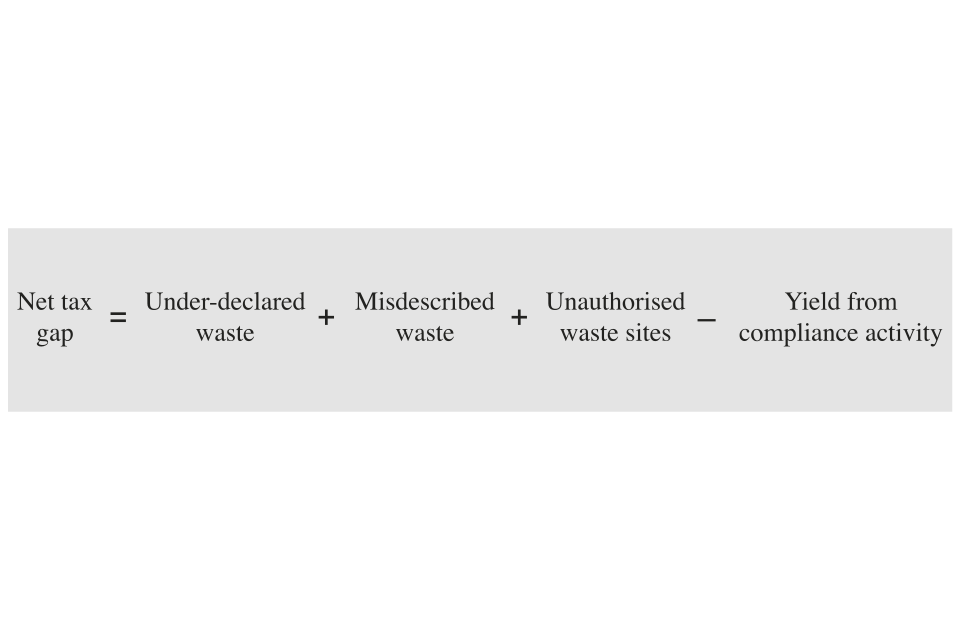
It is calculated using an illustrative approach that combines modelling, proxy indicators and expert judgement, drawing on HMRC, Environment Agency and publicly available data. The final figure brings together estimates of under-declared waste, misdescribed waste and waste at unauthorised sites, and is reduced to a net tax gap by subtracting tax recovered through HMRC compliance activity.
Step by step calculation
-
Estimate the gap from misdescription of waste using tonnage data from Landfill Tax receipts.
-
Estimate the gap under-declaration of waste by taking the average of 2 methods, using tonnage data from Landfill Tax receipts, legal exports and waste sent to incineration.
-
Estimate the gap from unauthorised waste sites using tonnage data from unauthorised waste sites.
-
Sum the estimates from misdescription, under-declaration and unauthorised waste sites to estimate the total gross gap.
-
Use compliance data from HMRC cases closed in the tax year to estimate the compliance yield, applying a moving average to smooth year-on-year volatility.
-
Deduct compliance yield from the gross gap to calculate the net Landfill Tax gap estimate.
Methodology
Tax in scope
Landfill Tax is due on waste disposed of at permitted landfill sites and at unauthorised waste sites as a disincentive to landfilling and to encourage better waste management. The tax gap measures the difference between the amount of Landfill Tax that should theoretically be paid when waste is disposed of at permitted landfill sites and unauthorised waste sites, and the amount that is actually paid.
Prior to 1 April 2018, tax was not due on waste disposed of at unauthorised waste sites, and so unauthorised waste sites were excluded from the methodology up to and including 2017 to 2018. Waste disposed of at unauthorised waste sites became taxable from 1 April 2018 and so is included in the tax gap estimate for tax years 2018 to 2019 onwards. As a result, Landfill Tax gap estimates from 2018 to 2019 onwards are not directly comparable with earlier years.
Under-declaration of waste
Under-declared waste is estimated in 2 ways and averaged to calculate a central estimate. In the first method, a trend line is fitted to HMRC data on taxable tonnes over time, then the expected and actual tonnages of waste are compared. Landfill Tax tonnage data is published in the HMRC Environmental Taxes Bulletin. The estimate is refined to take account of diversion of waste away from landfill to incineration (published in Defra local authority collected waste management statistics) and export of refuse derived fuel (published in EA international waste shipments statistics).
We assume nearly all of this diverted waste is taxable at the standard rate if sent to landfill. In the second method, a proxy indicator is used to estimate under-declaration. This assumes that all landfill site operators have under-declared taxable waste by 5% per year, and that this under-declared amount should be taxed at the standard rate.
Misdescription of waste
There are 2 rates of Landfill Tax, standard and lower rate. A trend line is fitted to HMRC’s published statistics on the tonnage of lower rate waste declared over time. Expected tonnage of lower rate waste is then compared with declared lower rate waste. Landfill Tax tonnage data is published in the HMRC Environmental Taxes Bulletin.
We assume 25% of the difference between expected and declared lower rated waste constitutes the tax base under consideration. The tax under consideration is then the difference between the standard and lower rates of waste applied to this tonnage.
The misdescription estimate for the tax year 2024 to 2025 has been projected based on the estimate for 2023 to 2024. This is due to data from the latest year producing an unreliable estimate.
Unauthorised waste sites
The tax gap is based on Environment Agency (EA) data on estimated tonnage for known illegal waste sites. This data has been revised for ‘Measuring tax gaps 2026 edition’ following an EA review of their tonnage data.
Sites that gained an exemption or the appropriate permit have been excluded from our calculation, as have sites that have evidence of being stopped, regulated or cleared before 1 April 2018. Tonnage from active sites included in a given tax year will be excluded from subsequent tax years to avoid double counting. The standard rate of Landfill Tax has been applied to the remaining sites to calculate the tax gap for England. The estimate is uplifted to account for Northern Ireland (NI), which is not covered by EA data. This is done by applying the ratio of total tax liabilities in England and NI to the estimate for the unauthorised waste sites tax gap in England.
Model adjustments
Compliance yield
Some of the gross tax gap is recovered through HMRC compliance activity. As compliance yield can vary substantially year-on-year, this is smoothed using a moving average.
Between tax years 2005 to 2006 and 2021 to 2022, this is smoothed using a 3-year moving average.
From the tax year 2022 to 2023 onwards, this is smoothed using a 6-year moving average due to increased volatility in recent years. This is an update to the methodology since ‘Measuring tax gaps 2025 edition’.
Tax gap calculation
The gross tax gap estimate is defined as the sum of under-declared waste, misdescribed waste and waste from unauthorised waste sites. The smoothed compliance yield estimate is subtracted from the gross gap to estimate the net tax gap.
Sources of error
There are several sources of error that may affect the Landfill Tax gap estimate. It is estimated using an illustrative method that combines different data sources (such as tax receipts, compliance data and waste estimates) due to limitations in direct measurement:
-
the methodology uses historic trend lines to derive expected taxable tonnage and compares this to actual reported tonnage
-
historic trend lines may not reflect recent behaviour, potentially introducing error into the tax gap estimate
-
the model is also sensitive to assumptions, such as the proportion of waste that is under-declared or misdescribed, which may introduce error into the estimate
-
the model relies on information about waste disposed of at unauthorised sites, which is inherently hidden and difficult to measure; as a result, estimates of illegal disposal may be uncertain
-
no adjustment is made for non-detection of Landfill Tax non-compliance
Uncertainty rating
The Landfill Tax gap uncertainty rating is ‘high’, reflecting limitations in both the data and the assumptions used in the model. While the approach covers most waste within the scope of Landfill Tax, there are potential gaps in the tax base and some types of non-compliance may not be captured. The methodology is illustrative and relies on long-standing assumptions, with uncertainty around the modelling of misdescription and unauthorised waste sites, and no adjustment for non-detection.
Petroleum Revenue Tax gap
The Petroleum Revenue Tax gap is only estimated up to the 2014 to 2015 tax year. After this, the estimate was discontinued due to Petroleum Revenue Tax gap being zero-rated from 1 January 2016.
Other taxes, levies and duties
The ‘other taxes, levies and duties’ gap includes:
- Aggregates Levy
- Air Passenger Duty
- Climate Change Levy
- Customs Duty
- Digital Services Tax
- Insurance Premium Tax
- Plastic Packaging Tax
- Soft Drinks Industry Levy
Overview
The ‘other taxes, levies and duties’ gap is based on an illustrative method, where a proxy indicator for the scale of revenue losses across ‘other taxes, levies and duties’ is produced by estimating the weighted average percentage of the overall tax gap each year and applying this to receipts.
The average percentage revenue losses should not be considered estimates of the true percentage losses across Aggregates Levy, Air Passenger Duty, Climate Change Levy, Customs Duty, Digital Services Tax, Insurance Premium Tax, Plastic Packaging Tax and Soft Drinks Industry Levy, as this is unknown. Many of these taxes are very different from one another in nature and are therefore subject to different rules. The true tax gaps are therefore likely to vary across these taxes.
Step by step calculation
-
Take the total receipts for Aggregates Levy, Air Passenger Duty, Climate Change Levy, Customs Duty, Digital Services Tax, Insurance Premium Tax, Plastic Packaging Tax and Soft Drinks Industry Levy (as published in the HMRC tax receipts bulletin).
-
Calculate a weighted average percentage tax gap from the overall tax gap estimate.
-
Apply the weighted average percentage tax gap to these receipts to calculate the tax gap estimate for the other taxes, levies and duties gap.
Uncertainty rating
The uncertainty rating for the ‘other taxes, levies and duties’ gap is ‘very high’. This is because the model is highly illustrative and the true other taxes, levies and duties gaps are likely to be markedly different.