Leasehold term remaining by household characteristics and household satisfaction, 2023 to 2024: Factsheet
Updated 19 June 2026
Applies to England

© Crown copyright 2026
This publication is licensed under the terms of the Open Government Licence v3.0 except where otherwise stated. To view this licence, visit nationalarchives.gov.uk/doc/open-government-licence/version/3 or write to the Information Policy Team, The National Archives, Kew, London TW9 4DU, or email: psi@nationalarchives.gov.uk.
Where we have identified any third party copyright information you will need to obtain permission from the copyright holders concerned.
This publication is available at https://www.gov.uk/government/statistics/leasehold-term-remaining-2023-to-2024-factsheet/leasehold-term-remaining-by-household-characteristics-and-household-satisfaction-2023-to-2024-factsheet
1. Main findings
There were 4.8 million individual leases registered against just over 4 million households in England in 2023 to 2024.
The average length remaining on all leases was 480 years. The average length remaining on the most junior (shortest) lease was 458 years.
There were a total of 412,000 households living in properties with 80 years or less remaining on the lease. Of these, 204,000 households were owner occupied.
Households in flats were significantly more likely to have less time remaining on their lease than those in houses (381 years remaining compared to 613 years).
Older owner occupied households, where the household reference person was aged 65+, were more likely to live in households with a lease term of 80 years or less (15%) than households where the HRP was aged between 30 and 44 (3%).
Owner occupied leasehold households who indicated they were “very satisfied” with being an owner occupier were more likely to have a higher average lease term remaining (520 years) than those who were “fairly satisfied” (379 years).
Looking at satisfaction with tenure and leasehold status more generally, owner occupied leaseholders were less likely to say they were “very satisfied” with being an owner occupier (77%) compared to owner occupied freehold households (86%).
2. Time remaining on lease
There were 4.8 million leases registered against properties occupied by households in England in 2023-24. This includes some households with multiple leases registered against the property. The mean average length remaining on these leases was 480 years, figure 1 underlying data.
Households may occupy properties that are subject to multiple lease agreements. This typically occurs when a freeholder leases the property to an individual or organisation, who then sub-leases it to the eventual occupier or “owner.” In such arrangements, each sub-lease or “junior” lease must have a shorter term than the head lease it derives from, as a lease cannot exceed the duration of the lease above it. When analysing the relationship between lease length and household ownership or occupancy, this report focuses on the most junior (or shortest) lease applicable to the household. A fuller explanation of households with multiple leases can be found in the technical annex.
The following chart shows the lease length remaining for all residential leases in England. This will include some leases registered against the same properties. Just over a third (35%) of leases had over 900 years remaining on their term. A tenth (10%) had 80 years or fewer remaining, with a very small minority having already expired (<1%). There was also a cluster of leases with between 80 to 125 years remaining (30%). This likely reflects the shorter leases more generally associated with flats. Further details on this are provided in the following sections.
Figure 1. All leases, leasehold term analysis, 2023-24
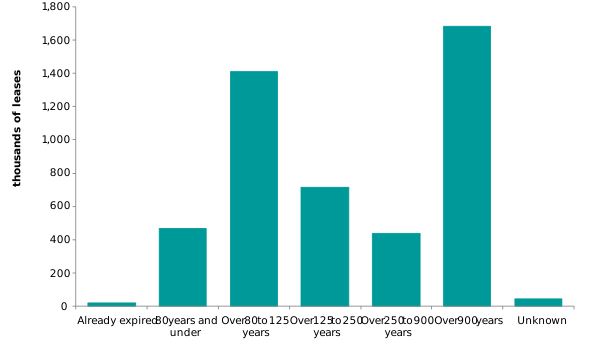
Term remaining for all leases, households in England 2023 - 2024
Sources: English Housing Survey, 2 year combined data 2022/23 – 2023/24; HM Land Registry, leasehold households, excludes households in properties unable to be matched to the Land Registry title property database
There were just over 4 million households with at least one lease in England in 2023-24, figure 2 underlying data.
The following chart focuses solely on the most junior (or shortest) lease associated with households in England. In the case of households living in properties with multiple leases, this is the lease ending soonest. As might be expected given the large degree of overlap between the data, the results were comparable. The majority of households had a junior lease with either 900 or more years remaining (34%) or 80 to 125 years remaining (33%). Given these data excluded all senior leases (where more than one lease existed against a household’s property), it was unsurprising to find the average lease length remaining was shorter than that for all leases (458 compared to 480 years), figure 2 and annex table 2.
Figure 2. Junior leases, leasehold term analysis, 2023-24
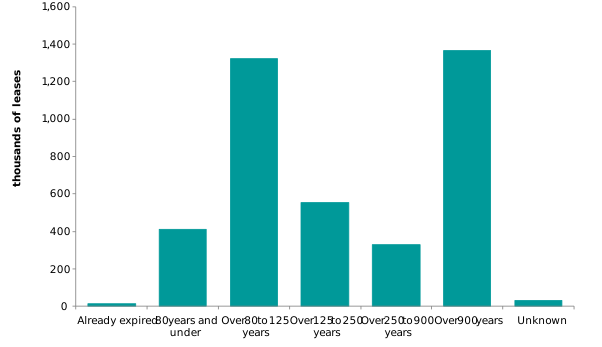
Leasehold term remaining for the most junior (or shortest) lease, households in England 2023 - 2024
Sources: English Housing Survey, 2 year combined data 2022/23 – 2023/24; HM Land Registry, leasehold households, excludes households in properties unable to be matched to the Land Registry title property database
3. Time remaining on lease by dwelling characteristics
There were significant differences in the average lease length remaining between leasehold households in different tenures.
Owner occupied and private rented leasehold houses had the longest average time remaining on the junior leases associated with the property, 481 and 449 years remaining respectively. This was significantly higher than leasehold households in both housing association and local authority social rented sector homes (353 and 227 years respectively), annex table 1.
Looking exclusively at owner occupied households (where those in residence might be expected to experience the consequences of a shorter lease), around 204,000 households were living with a lease under 80 years (9%).
Owner occupied households in flats were significantly more likely to have less time remaining on their lease than those in houses (358 years remaining compared to 638 years). This was driven by the higher proportion of owner occupied households in flats with between 80 and 125 years remaining on the lease (48%) compared to houses (14%), and reflects the fact flats are more likely to be granted an initial lease term of 125 years or less.
Similar proportions of households in flats and houses had leases of under 80 years (8% and 11% respectively), annex table 2.
4. Time remaining on lease by household characteristics
This section primarily focuses on the relationship between household characteristics and leasehold length for those in owner occupied leasehold households. This is because households in the private rented and social rented sectors would not normally be expected to deal with leasehold issues (the responsibility would fall to the landlord). Data is provided on the relationship between all leasehold households and household characteristics in annex table 3.
Focusing on the household make-up of owner occupied leasehold households, there was little difference in mean lease length remaining between households with and without dependent children and those of single or mixed occupancy.
There was no significant difference in the average mean length remaining for owner occupied households by the age of the household reference person (HRP). However, households with an older HRP (65 or over) were those most likely to have a lease with under 80 years remaining (15%), significantly higher than households where the HRP was aged between 30 and 44 (3%), annex table 4.
Owner occupied leasehold households where the HRP was retired were most likely to have a lease with under 80 years remaining (15%). This was significantly higher than households where the HRP was in full-time (7%) or part-time work (4%). This was perhaps unsurprising given the prevalence of shorter lease terms among older HRPs, annex table 4.
There were also notable differences in average lease length remaining for owner occupied leasehold households by the ethnicity of the HRP. Households where the HRP was from a black ethnic background had a lower average lease term remaining (296 years) than those from white (493 years) or Asian (487 years) ethnic backgrounds. HRPs from a black ethnic background were also significantly more likely to have fewer than 80 years remaining on their lease (23%) compared to HRPs with a white (9%) and Asian (5%) ethnic background.
There was little difference in lease terms remaining between owner occupied leasehold households by gender or health condition of the household reference person.
Whilst there was no difference in the average remaining lease length for owner occupied households by household income quintile, households in the lowest income quintile were significantly more likely to have a lease with fewer than 80 years remaining (13%) compared to households on the highest income quintile (6%), annex table 4.
5. Satisfaction with tenure by time remaining on lease
As in the previous section, this section focuses on owner occupied leasehold households. Data for all households is available in annex table 5.
There was an association between leaseholder satisfaction with tenure and the length of time remaining on the lease.
Owner occupied leasehold households who indicated that they were “very satisfied” with being an owner occupier were significantly more likely to have a higher average lease term remaining (520 years) than other owner occupier leaseholders (253-379 years).
Figure 3. Average lease length for shortest lease by satisfaction with being an owner occupier, 2023-24
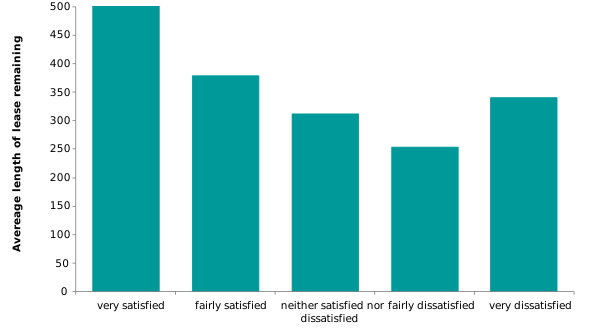
Average lease length remaining for shortest lease by satisfaction with being an owner occupier, households in England, 2023 - 2024
Sources: English Housing Survey, 2 year combined data 2022/23 – 2023/24; HM Land Registry, owner occupiers only, excludes don’t knows and households in properties unable to be matched to the Land Registry title property database
For leasehold households who were “very satisfied” with being an owner occupier, the largest grouping was those with a lease term remaining of over 900 years (40%), this was significantly higher than the equivalent proportion among those “fairly satisfied” (27%). For those “fairly satisfied” the largest grouping was for leases with between 80 to 125 years remaining (41% compared to 29% for those “very satisfied”). This may be a result of lower satisfaction levels among leaseholders living in flats, where lease length terms tend to be shorter, annex table 6.
6. Satisfaction with tenure by leasehold status
The final section of this report explores differences in overall satisfaction levels between those in freehold and leasehold households and the tenures within this. The freehold and leasehold status of the household was determined by matching with Land Registry information rather than relying on survey responses.
Looking across all tenures where the property was freehold, these households were more satisfied overall with their tenure (“very satisfied”, 70%) than households where the property was leasehold (“very satisfied”, 57%), annex table 7.
Within tenures, the highest levels of satisfaction with tenure were among owner occupiers in both leasehold and freehold households. Among owner occupier freeholders, 86% of households were “very satisfied” with being an owner occupier, this was higher than the 77% of leaseholder owner occupiers who indicated they were “very satisfied”.
Leaseholder owner occupiers are more likely to live in flats than freehold owner occupiers, therefore it is helpful to compare satisfaction with tenure between those in differing dwelling types on the basis that satisfaction with tenure is likely influenced by the type of dwelling. Looking solely at those living in houses, owner occupier leaseholders still demonstrated lower satisfaction levels with their tenure (“very satisfied”, 80%) than owner occupier freeholders in houses ( “very satisfied”, 87%), annex table 9.
7. Enquiries
Media enquiries:
telephone: 0303 444 1209
Email: newsdesk@communities.gov.uk
Public enquiries and Responsible Statisticians:
Stephen Pottinger
Robin Hulme
Email: ehs@communities.gov.uk
Information on Official Statistics in development is available via the Office for Statistics Regulation.
Information about statistics at MHCLG is available via the Department’s website.