Commentary - Individual Voluntary Arrangements Outcomes and Providers 2025
Published 27 February 2026
Applies to England and Wales

© Crown copyright 2026
This publication is licensed under the terms of the Open Government Licence v3.0 except where otherwise stated. To view this licence, visit nationalarchives.gov.uk/doc/open-government-licence/version/3 or write to the Information Policy Team, The National Archives, Kew, London TW9 4DU, or email: psi@nationalarchives.gov.uk.
Where we have identified any third party copyright information you will need to obtain permission from the copyright holders concerned.
This publication is available at https://www.gov.uk/government/statistics/individual-voluntary-arrangements-outcomes-and-providers-2025/commentary-individual-voluntary-arrangements-outcomes-and-providers-2025
Released
27 February 2026
Next release
February/March 2027
Media enquiries
press.office@insolvency.gov.uk
+44 (0)30 3003 1743
Statistical enquiries
Edward Tuersley (author)
David Webster (responsible statistician)
1. Main Messages
-
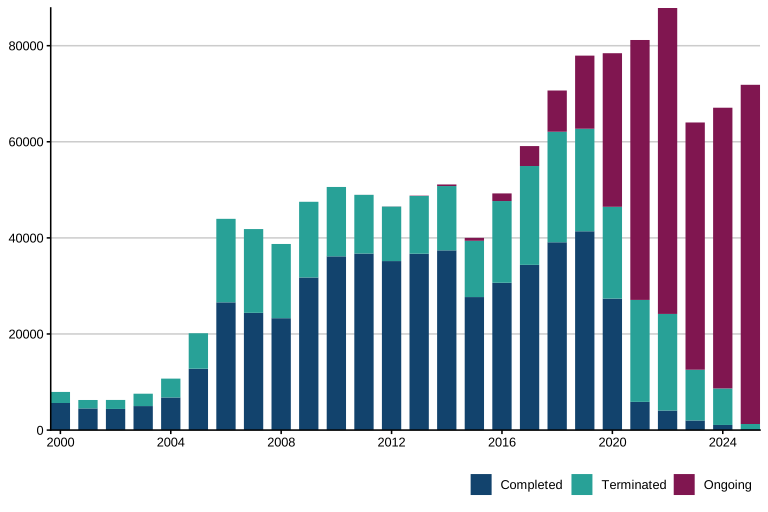
In 2025, 71,855 IVAs were registered in England and Wales, higher than the 67,089 registered in 2024, but lower than the record-high annual numbers seen between 2019 and 2022. Six firms accounted for more than half of new IVAs registered in 2025.
-
In England and Wales, one in 17 IVAs (6.0%) registered with the Insolvency Service in 2024 terminated within one year of being approved. This was similar to the one-year termination rate in 2023 (5.8%). One-year termination rates have been stable over the last four years.
-
The two-year termination rate for IVAs registered in 2023 was 13.2%, which was lower than the rate of 14.6% for IVAs registered in the previous year. However, the three-year termination rate for IVAs registered in 2022 was 21.0%, a slight increase compared to those registered in 2021.
-
Termination rates over the lifetime of an IVA were approximately one in three (34%) for IVAs registered between 2016 and 2018. IVAs registered between 2019 and 2021 show signs of lower lifetime termination rates. For these IVAs, the first three years, which is when the majority of terminations occur, coincided with the implementation of support measures in response to the COVID-19 pandemic. A definitive trend for 2022 and later is difficult to establish, as more than 70% of IVAs registered in these years were still ongoing at the end of 2025. However, for 2022, the three-year termination rate was higher than for 2019 to 2021, but lower than for 2016 to 2018.
Figure 1: In 2025, the annual number of IVAs was higher than in 2024, but lower than the record high numbers between 2019 and 2022.
Number of IVAs by year registered, England and Wales, 2000 to 2025
Source: Insolvency Service
Information going back to 1990 can be found in Table 1 of the accompanying tables.
In 2023, changes to the wider regulatory landscape were introduced. These included a ban by the FCA (Financial Conduct Authority) on debt-packagers receiving remuneration for referrals to IVA firms. Additionally, recognised professional bodies adopted a new Statement of Insolvency Practice regarding take-on procedures.
2. Things you need to know about this release
This statistical release shows the outcome status of individual voluntary arrangements (IVAs) registered between 1990 and 2025 in England and Wales and a breakdown of the number of IVAs registered by provider from 2015 to 2025. IVAs in Northern Ireland and Protected Trust Deeds in Scotland are not included in this release. The Accountant in Bankruptcy publishes individual insolvency statistics for Scotland. The Insolvency Service also publishes monthly Individual Insolvency Statistics for England and Wales, Scotland and Northern Ireland. These releases include all types of individual insolvency.
An IVA is a legally binding agreement for a debtor to repay creditors some or all of what they are owed over a period of time (usually five or six years). IVAs in this publication are classified as ‘ongoing’, ‘completed’ or ‘terminated’. Completed means that the IVA has ended, with the debtor having fulfilled their obligations under the agreement. In this case, the debtor is no longer required to repay any amounts for the debts covered by the agreement. Terminated means that the agreement has ended because the debtor has failed to keep to the terms of the arrangement. In this case, the debtor remains liable for the outstanding debts. Further information can be found in the Glossary.
These statistics are derived from administrative records held by the Insolvency Service, an executive agency of the Department for Business and Trade. All IVAs are required to be registered with the Insolvency Service. IVAs in this report are broken down by the year in which they were registered. Most IVAs are registered within 14 days of the date the IVA is approved by creditors.
The completion and termination numbers in these statistics reflect notifications received by the Insolvency Service by 7 February 2026. In some cases, the Insolvency Service may not have been notified about the completion or termination of IVAs from 2025 and earlier by this date. Therefore, the termination and completion rates presented in these statistics may be a slight underestimate.
IVA termination rates are calculated by dividing the number of IVAs registered in a given year that terminated by 31 December 2025, by the total number of IVAs registered in that year. As a higher proportion of recent registrations remain ongoing, termination rates for more recent years will increase in the future.
3. Individual voluntary arrangements as a proportion of total individual insolvencies
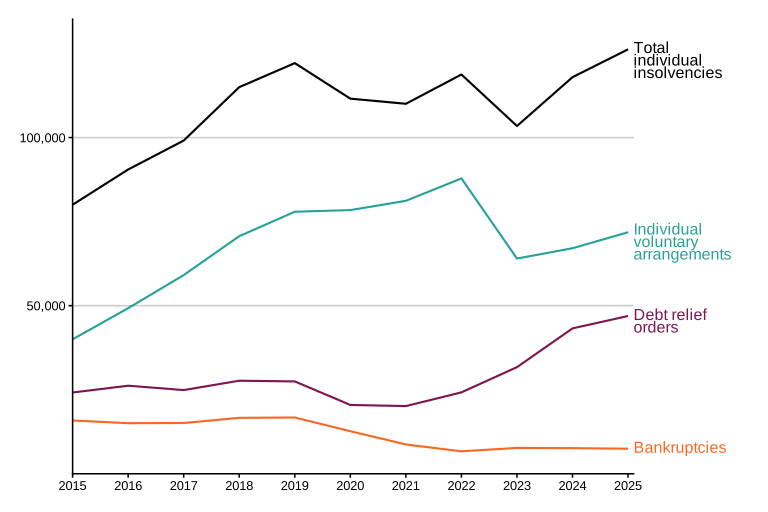
As shown in Figure 2, the number of new IVAs registered each year increased from approximately 50,000 between 2015 and 2017 to more than 75,000 in each year between 2019 and 2022. Although the 71,855 IVAs registered in 2025 was higher than for 2024, the figure remained lower than annual numbers between 2019 and 2022.
IVAs accounted for 57% of all individual insolvencies in 2025, the same proportion as in 2024, but down from 62% in 2023 and over 70% between 2020 and 2022. Despite this decline, the proportion of IVAs remains higher than it was a decade ago (in 2015) when IVAs represented 50% of all individual insolvencies. The decrease in the proportion of IVAs relative to all individual insolvencies in the past 3 years was driven by a growing volume of debt relief orders (DROs) during this period. For more information on individual insolvencies, see the monthly Individual Insolvency Statistics Releases.
The decline in IVA numbers in 2023 coincided with changes to the wider regulatory landscape. These included a ban by the FCA (Financial Conduct Authority) on debt-packagers receiving remuneration for referrals to IVA firms. Additionally, recognised professional bodies adopted a new Statement of Insolvency Practice regarding take-on procedures.
Figure 2: The rise in individual insolvency numbers in 2025 was driven by debt relief orders and IVAs, while bankruptcies remained relatively stable.
Number of insolvencies by year registered, England and Wales, 2015 to 2025
Source: Insolvency Service
More information about individual insolvencies, including longer-term trends, can be found in the Individual Insolvency Statistics Releases.
4. Termination of individual voluntary arrangements
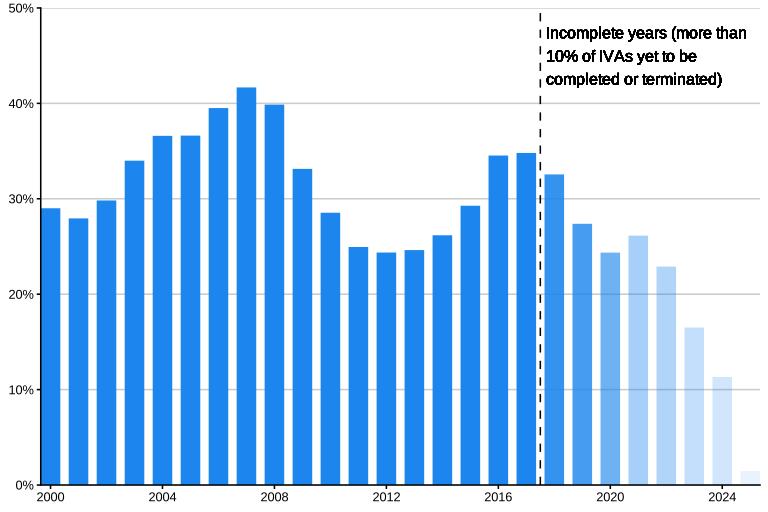
IVAs are terminated when the debtor fails to keep to the terms of the arrangement. Figure 3 shows the percentage of IVAs that terminated, calculated by dividing the number of IVAs registered in a given year that terminated by 31 December 2025 by the total number of IVAs registered in that year.
The termination rate peaked at 42% for IVAs registered in 2007, before declining to 24% for IVAs registered in 2012. The introduction of the IVA Protocol in 2008 is likely to have reduced IVA termination rates by introducing more flexibility to account for debtors’ individual circumstances.
IVA termination rates were higher for IVAs registered between 2015 and 2018 than the historically low levels in the preceding years. The rate of 35% for IVAs registered in 2017 was the highest since 2008, with 7% of cases still ongoing. To date, 33% of IVAs registered in 2018 and 27% of IVAs registered in 2019 have terminated. As 12% of IVAs registered in 2018 and 20% of IVAs registered in 2019 remained ongoing as at 31 December 2025, termination rates for these years are likely to increase slightly.
While most IVAs that have lasted five or more years are successfully completed, some are likely to be terminated. Historically, lifetime termination rates have typically been approximately 1-3 percentage points higher than the rate after five years. For example, for IVAs registered in 2015, 27% terminated within five years, with an additional 2% terminating after five further years, for a total termination rate of 29%.
IVAs registered in 2019 and 2020 show signs of lower lifetime termination rates (27% and 24%, respectively) compared to the preceding three years. For these IVAs, the first three years, which is when the majority of terminations occur, coincided with the implementation of support measures in response to the COVID-19 pandemic.
In contrast, early data indicates higher termination rates for IVAs registered in 2021, 2022 and 2023 than for those registered in 2019 and 2020, although over 65% of these cases were still ongoing at the end of 2025, making it difficult to establish a definitive trend. As at 31 December 2025, 26% of IVAs registered in 2021, 23% registered in 2022 and 17% registered in 2023 had terminated.
Figure 3: IVA termination rates were higher for IVAs registered between 2015 and 2018 than in the preceding years.
Percentage of IVAs terminated by year registered as at 31 December 2025, England and Wales, 2000 to 2025
Source: Insolvency Service
Bars to the right of the dashed line are faded, because more than 10% of IVAs in these years are still ongoing and the termination rates for these years are likely to increase. The proportion of ongoing IVAs in these years is shown in Table 1 below. An indication of trends for more recent years can be found in the one-, two- and three-year IVA termination rates below.
Table 1: The majority of IVAs registered between 2021 and 2025 remain ongoing, because IVAs typically last at least five years.
Number and percentage of IVAs by status as at 31 December 2025, England and Wales, 2015 to 2025
| Year | Total | Completed (no.) | Completed (%) | Terminated (no.) | Terminated (%) | Ongoing (no.) | Ongoing (%) |
|---|---|---|---|---|---|---|---|
| 2015 | 40,005 | 27,690 | 69% | 11,710 | 29% | 605 | 2% |
| 2016 | 49,256 | 30,659 | 62% | 17,009 | 35% | 1,588 | 3% |
| 2017 | 59,106 | 34,385 | 58% | 20,572 | 35% | 4,149 | 7% |
| 2018 | 70,670 | 39,085 | 55% | 23,006 | 33% | 8,579 | 12% |
| 2019 | 77,931 | 41,381 | 53% | 21,337 | 27% | 15,213 | 20% |
| 2020 | 78,432 | 27,367 | 35% | 19,103 | 24% | 31,962 | 41% |
| 2021 | 81,184 | 5,875 | 7% | 21,218 | 26% | 54,091 | 67% |
| 2022 | 87,848 | 4,065 | 5% | 20,108 | 23% | 63,675 | 72% |
| 2023 | 64,018 | 1,997 | 3% | 10,567 | 17% | 51,454 | 80% |
| 2024 | 67,089 | 1,067 | 2% | 7,601 | 11% | 58,421 | 87% |
| 2025 | 71,855 | 207 | 0% | 1,056 | 1% | 70,592 | 98% |
Information going back to 1990 can be found in Table 1 of the accompanying tables.
5. Percentage of IVAs terminating within one to four years of registration
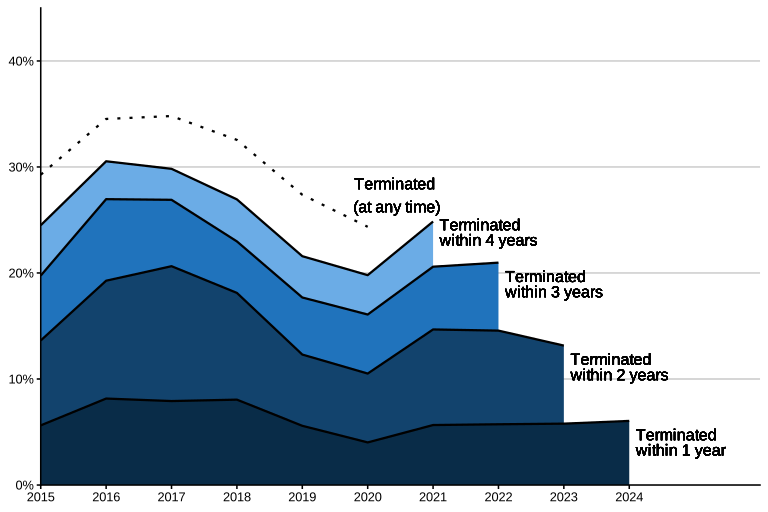
Figure 4 shows the proportion of IVAs that terminated within one, two, three and four years of approval. Only complete years as at 31 December 2025 are shown. For example, for IVAs registered in 2023, only two full years have passed, so three- and four-year termination rates cannot be shown for that year.
The most common annual period for an IVA to terminate is between one and two years after approval. However, for IVAs registered in 2019 and 2020, over half of all terminations occurred more than two years after they were approved. This was not the case for IVAs registered between 2016 and 2018, for which earlier terminations were more common.
One in 17 IVAs (6.0%) registered with the Insolvency Service in 2024 terminated within one year of being approved. This was similar to the one-year termination rates for IVAs registered in 2023, 2022 and 2021, and higher than the record-low one-year termination rate in 2020 (4.0%), which coincided with temporary support measures in response to the COVID-19 pandemic. However, the one-year termination rate over the past four years is lower than the rate for IVAs registered between 2016 and 2018.
The two-year termination rate of 13.2% for IVAs registered in 2023 was lower than the rates in 2022 (14.6%) and 2021 (14.7%). The rate for 2023 was higher than during the COVID-19 pandemic but lower than for IVAs registered between 2016 and 2018.
The three-year termination rate for IVAs registered in 2022 was 21.0%, which was slightly higher than 2021 (20.6%) and higher than the 10-year record low of 16% for IVAs registered in 2020. The lower three-year termination rate for IVAs registered in 2020, however, is consistent with the decline in IVA terminations during the COVID-19 pandemic.
Reductions in termination rates for IVAs registered in 2019 and 2020 coincided with the temporary guidance for the IVA protocol effective between 20 April 2020 and 31 December 2021 in response to the coronavirus (COVID-19) pandemic. The initial version of the guidance allowed individuals with existing IVAs to reduce payments by up to 25% and take a payment holiday of up to three months. Revised guidance in September 2020 increased this to up to a 50% reduction in payments and up to a six-month payment holiday. With the introduction of a revised IVA protocol effective from 1 August 2021, the provisions in the temporary COVID-19 guidance were phased out for new IVAs and came to an end for all IVAs on 31 December 2021.
Figure 4: The one-year termination rate for IVAs registered in 2024 remained similar to preceding years, while the two-year termination rate for IVAs registered in 2023 was lower than for 2022 and 2021.
Termination rates of IVAs by year registered as at 31 December 2025, England and Wales, 2015 to 2025
Source: Insolvency Service
More detailed information, including cumulative termination rates within three months to two years after approval, can be found in Table 2 of the accompanying tables.
6. New individual voluntary arrangement registrations by firm
Table 2 shows a list of largest IVA firms by the volumes of IVAs registered in 2025. Six firms (The Insolvency Group, My Debt Plan, PayPlan Partnership, Bennett Jones, J3 Debt Solutions and Creditfix) were responsible for 52% of the IVAs registered in 2025. The largest provider, The Insolvency Group, was responsible for 20% of IVAs registered in 2025.
The top 18 firms accounted for more than 90% of registered IVAs in 2025, which is the same number as in 2024. This is more than in 2023, when 16 firms accounted for more than 90% of IVAs.
Note that numbers of IVAs by firm presented below reflect the Insolvency Service administrative system as at the date of data extraction in February 2026. The numbers may not reflect all changes resulting from the transfer of IVAs between providers.
Table 2: Six firms accounted for over half of registered IVAs in 2025
| Insolvency practitioner firm | New registrations | Percentage |
|---|---|---|
| The Insolvency Group | 14,215 | 19.8% |
| My Debt Plan | 5,470 | 7.6% |
| PayPlan Partnership | 5,150 | 7.2% |
| Bennett Jones Insolvency | 4,260 | 5.9% |
| J3 Debt Solutions | 4,224 | 5.9% |
| Creditfix | 3,741 | 5.2% |
| UK Debt Expert Group | 3,710 | 5.2% |
| Anchorage Chambers | 3,696 | 5.1% |
| AFA Insolvency | 3,341 | 4.6% |
| Lawson Fox | 3,125 | 4.3% |
| United Insolvency | 2,477 | 3.4% |
| McCambridge Duffy | 2,263 | 3.1% |
| Advice Centre Group | 1,903 | 2.6% |
| Freeman Jones | 1,783 | 2.5% |
| IVA Help | 1,756 | 2.4% |
| PayPlan Bespoke Solutions | 1,650 | 2.3% |
| Insolvency Guidance Group | 1,529 | 2.1% |
| MoneyPlus Insolvency | 1,087 | 1.5% |
| Other | 6,475 | 9.0% |
| Total | 71,855 | 100.0% |
Breakdowns for 2015 to 2025 are available in Table 3 of the accompanying data tables.
Some cleaning of the data has been carried out to merge multiple names associated with the same provider. For example, IVAs assigned to ‘Lawson Fox Business Recovery’ and ‘Lawson Fox Debt Solutions’ are both included under ‘Lawson Fox’.
7. Data and Methodology
7.1 Data Sources
Data used for this report are based on information entered by insolvency practitioners and then uploaded to the Insolvency Service systems. More information on the administrative systems used to compile insolvency statistics can be found in the Statement of Administrative Sources.
7.2 Coverage
Statistics are presented for England and Wales only due to differences in legislation and policy. IVAs in Northern Ireland and Protected Trust Deeds in Scotland are not included in this release. The Accountant in Bankruptcy publishes individual insolvency statistics for Scotland. The Insolvency Service also publishes monthly Individual Insolvency Statistics for England and Wales, Scotland and Northern Ireland. These releases include all types of individual insolvency.
7.3 Methodology and data quality
More detailed methodology and quality information has been published alongside this commentary in the accompanying Methodology and Quality document.
The main quality and coverage issues to note are:
-
IVAs in England and Wales are counted within the Insolvency Service official statistics releases once they are registered with the Insolvency Service. However, there is often a time lag between the date on which the IVA is accepted and date of registration by licensed insolvency practitioners. If this time lag varied substantially between years, it is possible that the number of IVAs registered in a year would not accurately reflect the number of IVAs actually started within that year. However, current monitoring suggests that the time lag is fairly stable, with most IVAs registered within 14 days of the approval date.
-
The same dataset is used for this publication as for the monthly Individual Insolvency Statistics.
-
Data used for this report are based on information entered by insolvency practitioners and then uploaded to the Insolvency Service systems. While some validation checks are undertaken when the information is uploaded, not all errors can be detected. For example, 93 terminated IVAs (0.05% of the total number since 2015) are shown as having a negative duration, and a further 77 (0.04%) show a duration of zero days. These are included in the ‘unknown’ category in Table 2. It is unlikely that data entry errors are large enough to substantially change the conclusions of this report.
-
The completion and termination numbers in these statistics reflect notifications received by the Insolvency Service by 7 February 2026. In some cases, the Insolvency Service may not have been notified about the completion or termination of IVAs from 2025 and earlier by this date. Therefore, the termination and completion rates presented in these statistics may be a slight underestimate.
-
The duration of an IVA is measured as the length of time from the date of approval of creditors to the date it terminated. For consistency with the other tables and the monthly Insolvency Statistics, the registration date is still used to assign an IVA to a particular year.
-
Revoked and suspended IVAs are included in the terminated category. However, the number of revoked and suspended IVAs is small (less than 0.01% of the total).
-
The numbers of IVAs by firm reflect the firm in the Insolvency Service administrative system as at the date of data extraction.
7.4 Revisions
These statistics are subject to scheduled revisions, as set out in the published Revisions Policy. Revisions typically tend to be made as a result of data being entered or changed on administrative systems after the previous publication cut-off date for data being extracted to produce the statistics. Revisions can also be caused by changes in methodology as described above. Such revisions tend to be small in the context of overall totals; nonetheless any figures in this release that have been revised since the previous edition have been highlighted in the ‘Notes’ column of the relevant tables.
8. Glossary
8.1 Key Terms used within this statistical bulletin
| Term | Definition |
|---|---|
| Bankruptcy | A form of debt relief available for anyone who is unable to pay their debts. Assets owned will vest in a trustee in bankruptcy, who will sell them and distribute the proceeds to creditors. Discharge from debts usually takes place 12 months after the bankruptcy order is granted. Bankruptcies result from either Debtor application – where the individual is unable to pay their debts, and applies online to make themselves bankrupt, or Creditor petition – if a creditor is owed £5,000 or more, they can apply to the court to make an individual bankrupt. These statistics relate to petitions where a court order was made as a result, although not all petitions to court result in a bankruptcy order. |
| Debt Relief Order (DRO) | A form of debt relief available to those who have a low income, low assets and debt no more than a specified value. There is no distribution to creditors, and discharge from debts takes place 12 months after the DRO is granted. DROs were introduced in April 2009. Following an announcement on 6 March 2024, the £90 administration fee to obtain a DRO was abolished on 6 April 2024. Furthermore, on 28 June 2024, the criteria for DRO eligibility were expanded. The debt threshold was increased from £30,000 to £50,000 and the allowable value of an exempt motor vehicle was increased from £2,000 to £4,000. |
| Individual Voluntary Arrangement (IVA) | A voluntary means of repaying creditors some or all of what they are owed. Once approved by 75% or more of creditors, the arrangement is binding on all. IVAs are supervised by licensed Insolvency Practitioners. |
| IVA: Completion | Where the supervisor has issued a certificate (“the completion certificate”) stating that the debtor has complied with their obligations under the arrangement. |
| IVA: Ongoing | Where the IVA has commenced and remains in progress. |
| IVA: Termination | Where the supervisor has issued a certificate (“Certificate of Termination”) ending the arrangement because of the debtor’s failure to keep to the terms of the arrangement. Reasons for termination include, for example, missing payments or falling into arrears, change of circumstances where reduced payments are not agreed, and the discovery of higher debts not included on the initial application. |
| IVA Protocol | A voluntary agreement providing an agreed standard framework for dealing with consumer IVAs. Where a protocol IVA is proposed and agreed, insolvency practitioners and creditors agree to follow the processes and agreed documentation. |