Income Dynamics: quick guide
Published 26 March 2026

© Crown copyright 2026
This publication is licensed under the terms of the Open Government Licence v3.0 except where otherwise stated. To view this licence, visit nationalarchives.gov.uk/doc/open-government-licence/version/3 or write to the Information Policy Team, The National Archives, Kew, London TW9 4DU, or email: psi@nationalarchives.gov.uk.
Where we have identified any third party copyright information you will need to obtain permission from the copyright holders concerned.
This publication is available at https://www.gov.uk/government/statistics/income-dynamics-2010-to-2024/income-dynamics-quick-guide
Key things you need to know about Income Dynamics 2010 to 2024.
What is Income Dynamics?
Income Dynamics (ID) uses data from the Understanding Society survey to produce a measure of disposable household income for each individual.
ID presents analysis of income in the following ways:
-
Persistent Low Income: statistics on percentages of individuals in low income for at least 3 of the previous 4 survey periods
-
Movements within the income distribution: looking at how individuals have moved within the income distribution
-
Movements in and out of relative low income (also called low income entries and exits): including analysis on the role of factors that may be linked to these movements
Information on persistent low income and low income entries and exits is provided for all individuals, children, working-age adults, and pensioners. These measures also include a range of breakdowns so that they can be explored by factors of interest, such as the presence of long-standing illness or disability, ethnicity, country and region, and working status.
How is income measured in ID?
ID produces a measure of income available to each individual based upon the amount of income available to their household.
Household income includes the following components:
-
labour income – usual pay and self-employment earnings, and includes income from second jobs
-
miscellaneous income – educational grants, payments from family members and any other regular payments
-
private benefit income – includes trade union and/or friendly society payments, maintenance or alimony and sickness or accident insurance, and income from Student Loans or Tuition Fee Loans
-
investment income – private pensions and/or annuities, rents received, income from savings and investments
-
pension income – occupational pensions income
-
state support – tax credits and all state benefits including State Pension and Universal Credit
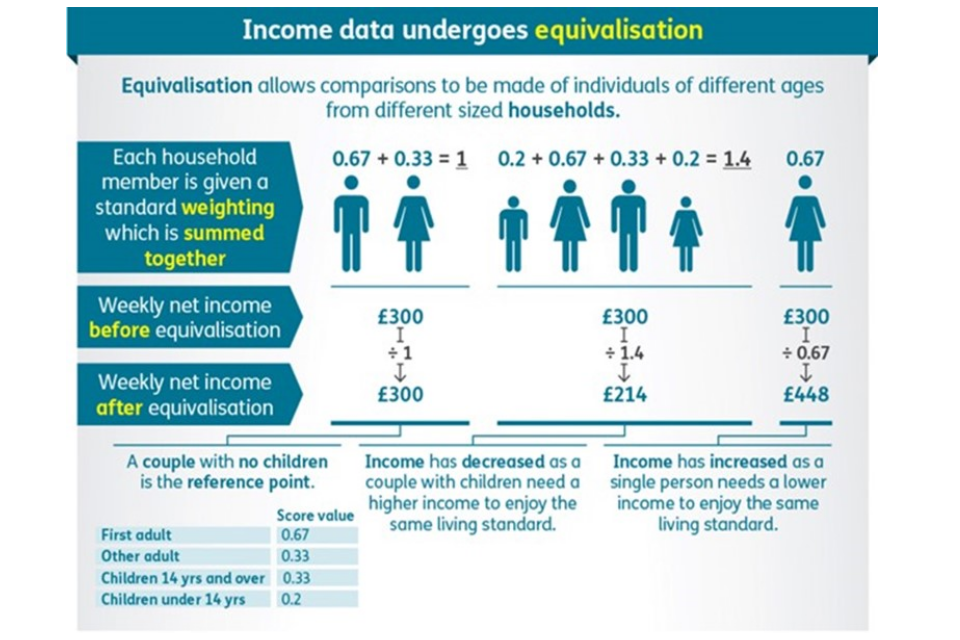
To estimate the amount of household income that is available to each individual in that household, we adjust household income to reflect the household’s size and composition. This adjustment is called equivalisation. Equivalisation aims to make individual incomes comparable. It does this by giving each household member a weighting. Different weightings are used depending on whether analysis is conducted before or after housing costs – see next section for more information on before and after housing costs analysis. These weightings are added together to create a household weighting factor. The household’s weekly net income is then divided by this factor to produce an ‘equivalised’ income, which is the same for each member of the household. The process of equivalisation results in the income of a single person being adjusted upwards, and that of an individual in a household containing children being adjusted downwards.
Figure 1: How household income is equivalised (BHC)
Once each individual has been assigned an equivalised household income, a median value for this income can be identified. An individual is then determined to be in relative low income if their equivalised household income is less than 60% of the median.
ID statistics are presented both Before Housing Costs (BHC) and After Housing Costs (AHC)
| BHC income | AHC income | |
|---|---|---|
| How measured | An income measure that is net of: Income tax, National Insurance, and Council tax. | Derived by deducting housing costs (mortgage interest and rent payments) from BHC income. |
| Pros and cons of approach | BHC measures can be useful if interested in net income levels, and comparing these between individuals in different types of household, particularly non-pensioner households (see opposite). | AHC measures can be useful when comparing what is left to live with after housing costs have been paid. AHC measures may be better when looking at pensioner incomes: pensioner income BHC may be lower than that of other individuals, but pensioners may also have lower housing costs. |
About the data
ID uses data from the Understanding Society survey. Understanding Society, led by the University of Essex, is a longitudinal survey of individuals in the United Kingdom which has been running since 2009. Each survey period or ‘wave’ runs for 2 calendar years. In the survey period 2023 and 2024, the longitudinal sample included over 39,000 individuals.
Understanding Society added a new sample of individuals to the survey in the wave which ran in 2022 and 2023. We are now using data which includes this sample in our statistics. This means that statistics which include data from this period onwards are not fully comparable to those preceding them. The main ID report explains this change in more detail.
Who is and isn’t included?
Individuals not living in private households at the start of the survey in 2009 were not included. This means that the original sample excluded people living in institutional forms of accommodation such as nursing or retirement homes. Understanding Society has complex rules about which sample members remain in the survey as household circumstances change – please see the ID Background information and methodology note for more information.
How accurate are our statistics?
Results from surveys are best estimates, and not precise figures – in general terms the smaller the sample size, the larger the uncertainty. We are unable to quantify how accurate our estimates are, but please note that some differences between groups or from year to year may not reflect changes in the wider population. Our report and tables note where small sample sizes might be affecting the certainty associated with our estimates.
Which ID publication should be used to find statistics on earlier time periods?
Each year we re-run all our analysis (from 2010 and 2011) on the latest Understanding Society data release. Each data release contains revisions made by the Understanding Society team to make the data more accurate, based on updated information about individuals and households in the sample. This means that some statistics that we have previously published are changed in the most recent publication. Because these revisions result from improvements to data quality, it is always best to refer to the most recent ID publication. In addition, since its first publication, ID has introduced improvements and developments over time, meaning that successive publications have become more comprehensive.
How to use ID
| ID can be used to explore | ID cannot be used for |
|---|---|
| Rates of persistent low income among different population groups, broken down by key demographic and socio-economic characteristics | Saying conclusively that differences between groups and change over time exists in the wider population (ID does not publish information on how much uncertainty surrounds the statistics). |
| The sample composition to see if certain groups appear to be over-represented among those in persistent low income | Estimating numbers in the general population – ID does not contain grossing factors to enable this. |
| Rates of movement into and out of low income (low income entries and exits) | Small area level estimates of income or low income – the sample size is not large enough to provide sub-regional estimates. Please see ONS’ Income estimates for small areas, England and Wales, and DWP’s Children in Low Income Families: Local Area Statistics. |
| Analysis of how different factors – such as changes in income sources or employment – are related to low income entry and exit | Establishing the causes of persistent low income or of low income entry and exit. ID analysis focuses upon associations between 2 variables e.g. employment and persistent low income. Other factors may influence that relationship, such as disability or qualifications, or more difficult factors to measure such as local job markets or discrimination. |
| Income mobility over time – this analysis is across the whole income distribution | Single year estimates of the percentage of individuals in low income – use HBAI for these. ID includes single wave estimates of low income in our methodology tables, but these are based on 2 calendar years. |
More detailed supporting information about ID can be found in our Background information and methodology report), and in our ID Tables Guide, which provides detail on what ID statistics are available, and further guidance on interpretation.
Related information and statistics
The following ONS publications provide useful information and guidance on alternative sources of data on earnings and income:
-
explaining income and earnings: important questions answered Income Dynamics is Official Statistics and is regulated by the Office for Statistics Regulation (OSR). Standards of trustworthiness, quality and value are set out by the OSR in the Code of Practice for Statistics.
Details of Accredited Official Statistics and Official Statistics produced by the Department for Work and Pensions can be found via the following links:
Information about planned developments for DWP’s Official Statistics can be found in the DWP Statistical Work Programme.