How many Citizenship grants have been issued in the UK?
Published 26 November 2026

© Crown copyright 2026
This publication is licensed under the terms of the Open Government Licence v3.0 except where otherwise stated. To view this licence, visit nationalarchives.gov.uk/doc/open-government-licence/version/3 or write to the Information Policy Team, The National Archives, Kew, London TW9 4DU, or email: psi@nationalarchives.gov.uk.
Where we have identified any third party copyright information you will need to obtain permission from the copyright holders concerned.
This publication is available at https://www.gov.uk/government/statistics/immigration-system-statistics-year-ending-september-2026/how-many-citizenship-grants-have-been-issued-in-the-uk
Back to ‘Immigration system statistics, year ending September 2026’ contents page
This release covers the year ending (YE) September 2026. The “year ending” period includes the 12 months up to and including the YE month. For example, YE September 2026 includes the 12 months between 1 October 2025 and 30 September 2026. All annual comparisons are with the YE September 2025 (unless indicated otherwise).
This chapter was previously part of “How many Indefinite Leave to Remain (Settlement and EUSS settled status) and Citizenship grants have been issued in the UK?”
Since the August 2026 publication, citizenship statistics have been presented in a separate chapter from indefinite leave statistics. This presentational change has been introduced to improve the clarity of reporting by reflecting citizenship as a distinct stage of the migration journey. The change affects the structure of the publication only and does not affect the underlying statistics.
Additional information is provided in the ‘About the statistics’ section and in the user guide.
1. Citizenship
People with British citizenship have the right to live and work in the UK without any immigration control and can apply for a British passport. British citizenship is defined by the British Nationality Act 1981. People may be eligible for British citizenship (or ‘naturalisation’) for several reasons. Further details on the eligibility to apply for British citizenship can be found on GOV.UK.
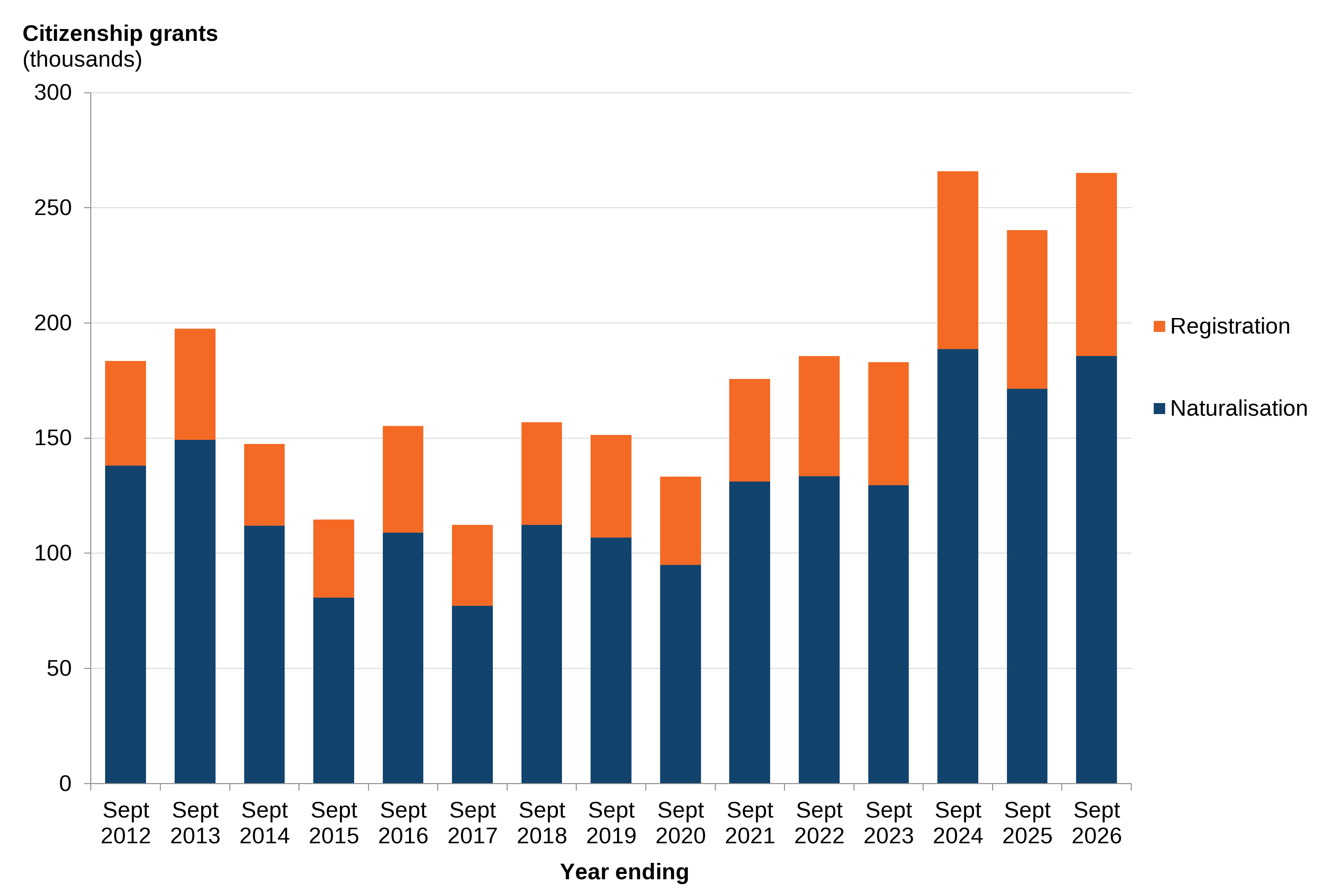
British citizenship grants remained at historically high levels in the YE September 2026, just below the record reached in the YE December 2024.
Figure 1: Grants of citizenship in the UK, by application type, YE September 2012 to YE September 2026
Source: Citizenship detailed datasets - Cit_D02
1.1 Overview
In the YE September 2026, there were 265,052 grants of British citizenship, an increase of 10% from the previous year and just below the record high of 267,475 in the YE December 2024. The increase in grants in recent years is likely to reflect, in part, an increase in the number of people granted indefinite leave, who have subsequently gone on to be granted for British citizenship.
Applications for British citizenship also increased, reaching a record high of 319,759 in the YE September 2026, up 17% from the previous year and continuing a generally upward trend since 2016.
1.2 British citizenship grants by naturalisation and registration
There were 185,536 grants of citizenship through naturalisation, an increase of 8% from the YE September 2025. Naturalisation is the process by which a non-British adult may acquire British citizenship.
Individuals applying based on residence must normally have lived in the UK for at least 5 years and held indefinite leave for at least 12 months before applying. Those married to, or in a civil partnership with, a British citizen, are subject to a shorter qualifying residence period of 3 years and may apply as soon as they have obtained indefinite leave, without the additional 12-month waiting period. These 2 routes are presented separately within the naturalisation figures in the accompanying published citizenship data tables, reflecting the different eligibility requirements set out under sections 6(1) and 6(2) of the British Nationality Act 1981.
Almost three-quarters (74%) of naturalisation grants were based on residence, with 136,647 grants in the YE September 2026, an increase of 11% compared with the YE September 2025. A further 48,889 grants were based on marriage or civil partnership to a British citizen, broadly unchanged from the previous year.
In the YE September 2026, there were 79,516 grants of British citizenship through registration, an increase of 16% from the YE September 2025. Registration enables individuals to acquire British citizenship through either a legal entitlement or a discretionary process. It is most used by children and by individuals with a qualifying connection to the United Kingdom or its overseas territories.
In the latest year, 84% of registration grants were made under legislative provisions enabling the registration of children as British citizens, including where a parent has become settled or a British citizen. A further 15% were granted on other grounds, generally reflecting a qualifying connection to the UK or its overseas territories. The remaining 1% were granted under the new Irish citizen registration route, introduced on 22 July 2025 under the British Nationality (Irish Citizens) Act 2024. This enables eligible Irish citizens who have been resident in the UK for at least 5 years to register as British citizens.
1.3. British citizenship grants by nationality
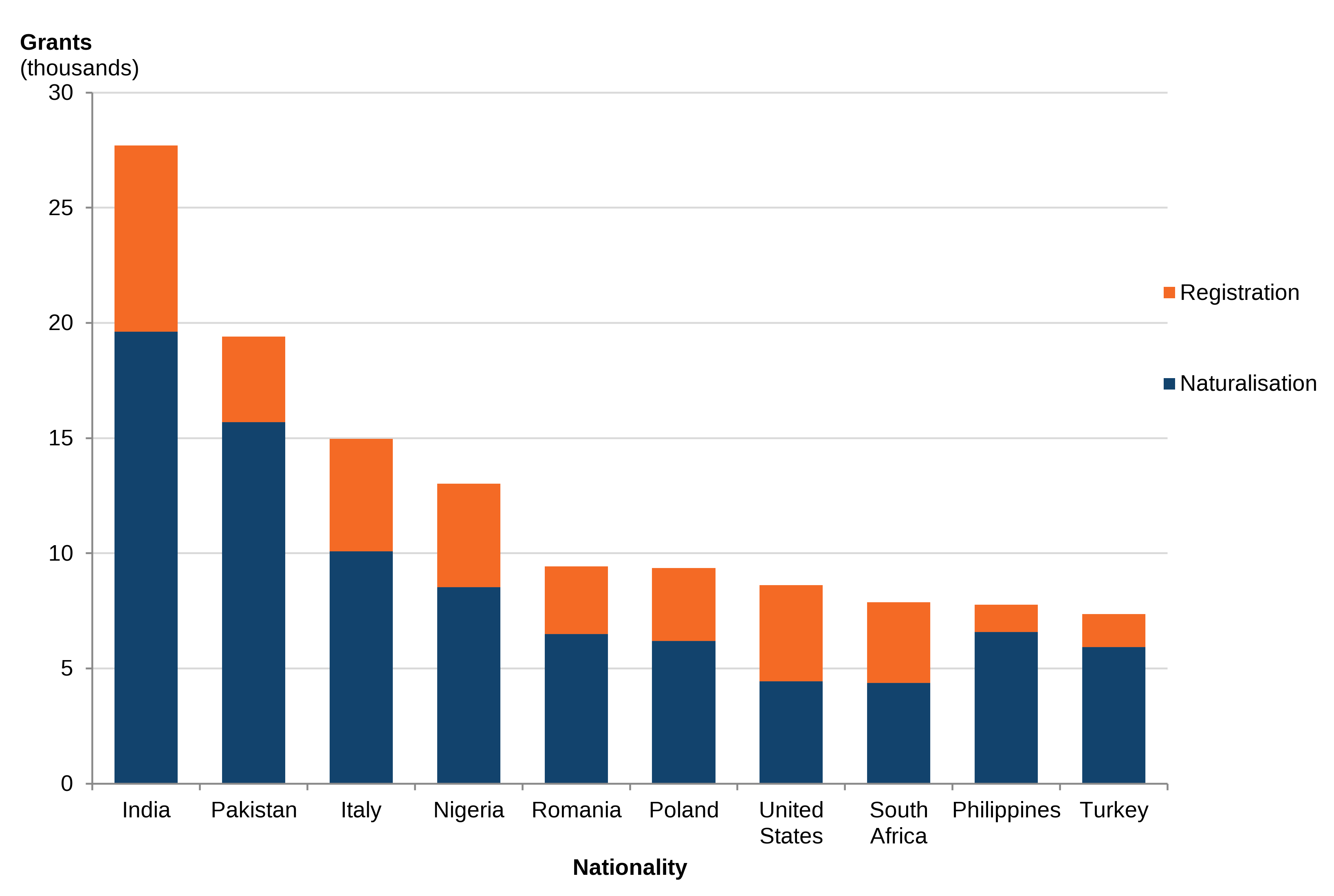
Figure 2: Top 10 nationalities for citizenship grants, by application type group, YE September 2026
Source: Citizenship detailed datasets - Cit_D02
Indian (27,704) and Pakistani (19,414) nationals were the largest nationality groups granted British citizenship in the YE September 2026. Grants to Indian nationals increased by 25% compared with the previous year, while grants to Pakistani nationals decreased by 3%. Both nationalities have consistently been among the largest groups granted British citizenship, with most grants acquired through naturalisation, reflecting longstanding settlement trends.
Among EU nationals, Italian nationals accounted for the highest number of British citizenship grants (14,970), followed by Romanian (9,434) and Polish (9,364) nationals. These nationalities have also consistently been among the largest groups granted settled status under the EU Settlement Scheme (EUSS), which provides a route to indefinite leave through which eligible individuals may subsequently acquire British citizenship.
2. About the statistics
The underlying casework systems on which this data is based are undergoing a process of change and therefore the published numbers may change in future quarters. In some cases, data will be unavailable. For more information see section 2.7 of the user guide.
British citizens can live and work in the UK free of any immigration controls. They can apply for a British passport, register to vote in all forms of election and referenda, and share in all the other rights and responsibilities of their status. If someone is not already a British citizen based on where and when they were born, or their parents’ circumstances, they can apply to become one.
Naturalisation and Registration are legal processes through which an individual can become a British citizen and obtain the same rights and privileges as someone who was born a British national. Dual citizenship (also known as dual nationality) is allowed in the UK. This means people can be both a British citizen and a citizen of other countries. Further details on these legal processes can be found in the user guide.
The statistics in this section show the number of applications and grants for British citizenship.
2.1. Changes to citizenship statistics
The following changes have been introduced in this edition:
Discontinuation of Cit_D03 – British citizenship ceremonies attended
The Home Office has formally discontinued publication of table Cit_D03: British citizenship ceremonies attended, from this release. Statistics on the number of British citizenship ceremonies attended have not been published since 2021 because of quality concerns with the underlying administrative data.
For more information, please see section 10.2 of the user guide. Feedback on this change can be submitted to MigrationStatsEnquiries@homeoffice.gov.uk.
Expanded citizenship statistics
Within detailed table Cit_D02, the Home Office has reintroduced the application type breakdowns, which provide further detail on the grounds for which an applicant has applied for, and been granted, citizenship. This follows improvements in data availability and quality.
3. Data tables
Data referred to here can be found in the following tables:
We welcome your feedback
If you have any comments or suggestions for the development of this report, please provide feedback by emailing MigrationStatsEnquiries@homeoffice.gov.uk. Please include the words ‘PUBLICATION FEEDBACK’ in the subject of your email.
We’re always looking to improve the accessibility of our documents. If you find any problems or have any feedback relating to accessibility, please email us.
See Section 6 of the ‘About this release’ section for more details.