What is being done to stop organised immigration crime?
Published 26 February 2026

© Crown copyright 2026
This publication is licensed under the terms of the Open Government Licence v3.0 except where otherwise stated. To view this licence, visit nationalarchives.gov.uk/doc/open-government-licence/version/3 or write to the Information Policy Team, The National Archives, Kew, London TW9 4DU, or email: psi@nationalarchives.gov.uk.
Where we have identified any third party copyright information you will need to obtain permission from the copyright holders concerned.
This publication is available at https://www.gov.uk/government/statistics/immigration-system-statistics-year-ending-december-2025/what-is-being-done-to-stop-organised-immigration-crime
Back to ‘Immigration system statistics, year ending December 2025’ contents page
This is not the latest release. View latest release.
This release goes up to the year ending (YE) December 2025. The “year ending” period includes the 12 months up to and including the YE month. For example, YE December 2025 includes the 12 months between 1 January 2025 and 31 December 2025.
Additional information is provided in the ‘About the statistics’ section and in the user guide.
1. Organised immigration crime
Organised immigration crime (OIC) involves offences which have the effect of exploiting vulnerable migrants by smuggling them across borders for profit, including offences committed by organised criminal groups (OCGs).
OCGs are comprised of individuals, working together, with the intent and capability to commit serious crime on a continuing basis, which includes elements of planning, control, coordination, structure and group decision-making.
The Border Security Command (BSC), established in July 2024, provides cross-system strategic leadership across partners in the border security system to tackle the facilitators of OIC and wider border security threats. The BSC unites efforts across the National Crime Agency (NCA), intelligence agencies, police, Immigration Enforcement and Border Force, to strengthen border protection and target smuggling gangs facilitating entry to the UK, including small boat crossings. More details on the BSC and its priorities can be found at Delivering Border Security - GOV.UK.
The Border Security, Asylum and Immigration Act 2025 received Royal Assent on 2 December 2025. This is a crucial part of the Government’s plans to secure the border and to intercept, disrupt and prevent organised criminality. Targeted new offences tackle the business model of those smuggling individuals into the UK, whilst broader powers to collect data on individuals will enhance the intelligence picture for law enforcement agencies seeking to prosecute organised crime.
1.1 Organised immigration crime disruptions
An OIC disruption is when an agency takes proactive or reactive action in response to a threat, where it can evidence an impact upon an OCG or individual involved in serious organised crime (SOC), intended to prevent them being able to operate at their previous level of criminality. Disruptions may include various forms of law enforcement action such as asset seizures, equipment seizures, revocation of licenses, arrests, convictions or sentences.
The BSC uses OIC disruption activity along with other data provided by the NCA and Home Office to assess its performance and impact on border security threats.
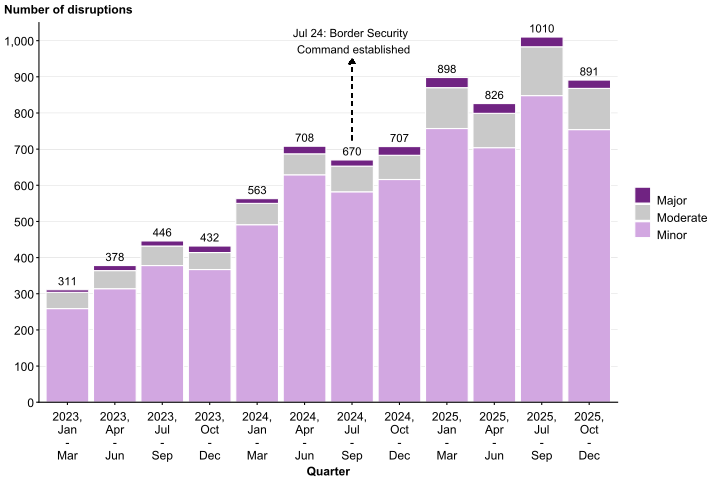
OIC disruptions have increased by more than one-third in the YE December 2025 compared to the previous year.
In YE December 2025, there were 3,625 disruptions of OIC recorded, 37% more than in the previous year (2,648). This is a continuation of increased enforcement activity since 2023, with OIC disruptions having steadily increased from an average of 392 disruptions per quarter in 2023, to 906 per quarter in the latest year (see Figure 1). This includes a 69% increase in disruptions in 2024 compared to 2023.
OIC disruptions are categorised by operational agencies in three groups reflecting the level of threat impacted. These are defined as major, moderate and minor as follows:
- major disruptions include activity with a significant and/or long-term impact in the context of the threat; for example, prison sentence(s) given to key member(s) of the OCG, dismantling the group long term
- moderate disruptions include activity with a notable and/or medium-term impact in the context of the threat; for example, arrest of OCG members and seizure of significant amounts of cash disrupting criminality temporarily as the OCG cannot purchase more commodity
- minor disruptions include activity with a minimal and/or short-term impact in the context of the threat; for example, arrest of lower-level members of the OCG whilst transporting criminal commodity reducing the volume and frequency of the OCGs criminality
Further details of the categorisations being used are provided in the user guide.
The number of OIC disruptions has increased across all levels of threat.
There were 105 major OIC disruptions recorded in YE December 2025, 40% more than the number of major disruptions the previous year.
Examples of recent disruptions can be seen in this report from the Home Office, UK hosts first major international summit to tackle illegal migration and this report by NPCC covering Police crackdown on organised immigration crime first in multi-agency operation of its kind.
Also in YE December 2025 there were 457 moderate disruptions and 3,063 minor disruptions, up 79% and up 32% from the previous year respectively.
Figure 1: Disruptions of OIC, by threat level, January 2023 to December 20251,2
Source: Organised immigration crime summary dataset, year ending December 2025 - OIC_01
Notes:
- Data provided is a count of ‘lead disruptions’, excluding ‘support disruptions’ to avoid double counting.
- Data is taken from a live operational system and as a result, subject to revision as more information on the disruption is provided onto the systems. Data for more recent periods will initially undercount the total number of disruptions as additional cases are retrospectively recorded.
2. About the statistics
The OIC statistics were first published in November 2025 as ‘Official Statistics’. They have not yet been independently reviewed by OSR.
These statistics in this chapter refer to the number of events where OIC disruptions have been conducted across different government and law enforcement agencies. These agencies are listed in Section 11.3 in the user guide.
The revision policy for these statistics is under review. In the meantime, the entire series of data are revised in each release. Therefore, data should be considered provisional.
Data is taken from a live operational system and as a result, subject to revision as more information on the disruption is provided onto the systems. Data for more recent periods will initially undercount the total number of disruptions and figures will increase as additional cases are retrospectively recorded. Comparisons over time should be made with caution.
Data on OIC disruptions is provided to the Home Office by the NCA and gathered from the Immigration Enforcement Criminal and Financial Investigations (CFI) team and Home Office Intelligence.
This data represents UK-led disruptions only and does not include where UK Law Enforcement has supported international upstream disruptions.
Data reported by individual law enforcement agencies (LEAs) may differ from this release dependent on the time of publication and data definitions used.
Due to fewer mandatory reporting requirements across different LEAs, in particular the National Police Chiefs’ Council (NPCC) police forces, data prior to 2023 will not be directly comparable to future years and therefore has been excluded from this release.
Quality of the data is dependent on the recording and quality assurance by the respective agencies.
These figures represent the majority of OIC disruptions in the UK. However, data from agencies not currently captured in our reporting is not included. Reporting agencies include the NCA, Home Office, NPCC, Police Service of Scotland and Police Service of Northern Ireland.
Data on asset recovery, using Proceeds of Crime Act Powers, is reported in Asset recovery statistics - GOV.UK. The bulletin covers criminal confiscation powers and civil forfeiture powers, where OIC comes under the classification of ‘Other’, alongside other offence types.
Data on the use of out of court disposals, defendants prosecuted, offenders convicted, remand and sentencing decisions in England and Wales is reported in the Ministry of Justice’s quarterly Criminal justice statistics - GOV.UK. Data on outcomes of offences which involve OIC can be found in the outcomes by offence tool.
3. Data tables
Data referred to here can be found in the following tables:
We welcome your feedback
If you have any comments or suggestions for the development of this report, please provide feedback by emailing MigrationStatsEnquiries@homeoffice.gov.uk. Please include the words ‘PUBLICATION FEEDBACK’ in the subject of your email.
We’re always looking to improve the accessibility of our documents. If you find any problems or have any feedback relating to accessibility, please email us.
See Section 6 of the ‘About this release’ section for more details.