Housing Benefit Debt Recoveries statistics: April 2025 to September 2025
Published 4 March 2026

© Crown copyright 2026
This publication is licensed under the terms of the Open Government Licence v3.0 except where otherwise stated. To view this licence, visit nationalarchives.gov.uk/doc/open-government-licence/version/3 or write to the Information Policy Team, The National Archives, Kew, London TW9 4DU, or email: psi@nationalarchives.gov.uk.
Where we have identified any third party copyright information you will need to obtain permission from the copyright holders concerned.
This publication is available at https://www.gov.uk/government/statistics/housing-benefit-debt-recoveries-statistics-april-2025-to-september-2025/housing-benefit-debt-recoveries-statistics-april-2025-to-september-2025
Housing Benefit (HB) is an income-related benefit that is intended to help meet housing costs for rented accommodation.
This publication contains statistics for Great Britain (GB) on the amount of HB that local authorities (LAs) have identified as overpaid to claimants, the amount of HB recovered by LAs, and the amount of HB written off by LAs.
The latest statistics in this release cover figures for Quarter 1 and 2 for financial year ending (FYE) 2026 (April 2025 to September 2025). The narrative in this publication focuses on quarterly time periods. Further data can be found in the accompanying data tables, which contain quarterly data on a GB, regional and local authority level, as well as quarterly GB timeseries data from Q1 FYE 2009.
Figures within this release have been rounded in line with our rounding policy. Figures in the text, charts and tables within this bulletin may not sum due to rounding. Figures in the graphs are plotted using unrounded numbers.
The graph showing annual Housing Benefit overpayments recovered and written off as a proportion of available debt is only included in the September release and not the March release, due to it requiring a full financial year of data.
The next statistics release will be 02 September 2026.
We are seeking user feedback on this statistical publication. Send comments to cbm.stats@dwp.gov.uk
1. Main stories
The statistics show that for the first two quarters of FYE 2026:
-
LAs identified a total of £205 million overpaid HB - £15 million less than the total amount identified in the first two quarters of FYE 2025.
-
LAs recovered a total of £210 million overpaid HB - £12 million less than the total amount recovered in the first two quarters of FYE 2025.
-
LAs wrote off a total of £43 million overpaid HB – £9 million more than the total amount written off in the first two quarters of FYE 2025.
-
At the start of Q2 FYE 2026, there was an outstanding total of £1.45 billion overpaid HB - £127 million less than the outstanding total at the start of Q2 FYE 2025.
2. What you need to know
These statistics are produced using data from the clerical Housing Benefit Debt Recovery (HBDR) returns, submitted by LAs each quarter. In some instances, LAs cannot submit data or cannot provide information for some fields. At the start of this statistical series, the amount of missing data was more prevalent, and a decision was made to impute estimates for GB totals. Resultantly, up to Q2 FYE 2017, data within the ODS tables and charts contain imputed GB totals, based on estimates for missing data. From Q3 FYE 2017, the data return rate has been high enough that no estimates have been made for missing data. In the latest publication, returns were received covering 99.9% of HB claimants in GB.
These statistics are published bi-annually, in March and September. The March publication contains data for the first two quarters of the financial year (April to September). The September publication contains finalised data for the whole of the financial year.
The volume of HB claims has been impacted by the roll-out of Universal Credit (UC), which was completed in December 2018. Since then, the majority of new applications for working-age claimants have been processed through UC across GB. The volume of people claiming HB has been steadily decreasing and has continued to fall with the existing move-to-UC policy, which has had an impact on both the amount of overpaid HB identified by LAs, and the amount of overpaid HB that they recover.
A small number of people are still able to apply for HB, including pensioners, and working-age claimants who are in supported or temporary accommodation. Read more about who can get Housing Benefit.
Users can access the accompanying data tables and the background information and methodology document for further information.
3. Total amount of outstanding HB overpayments
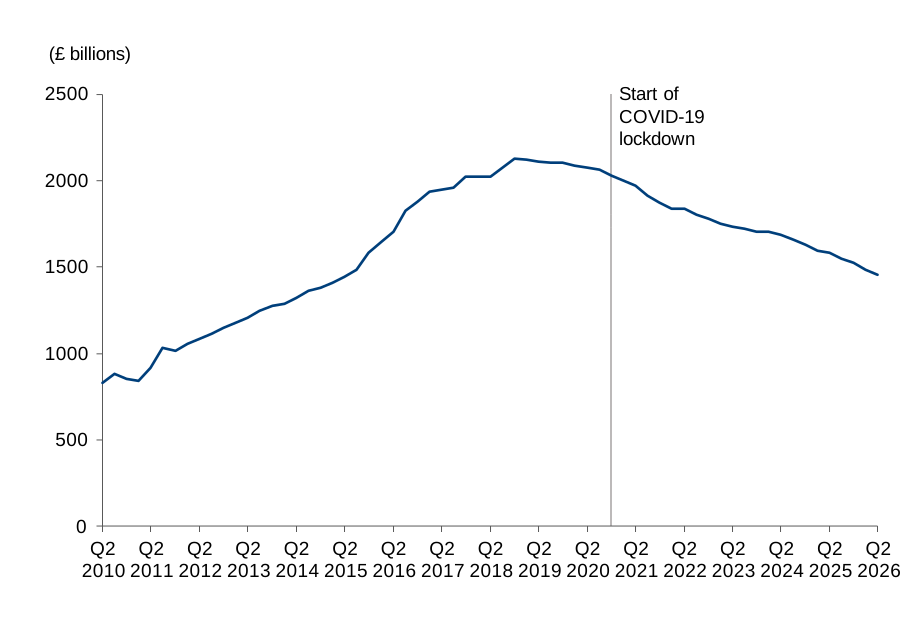
The total amount of outstanding HB overpayment in GB was £1.45 billion at the start of Q2 FYE 2026
Quarterly total outstanding HB overpayments in GB from Q1 FYE 2010 to Q2 FYE 2026
Source: Housing Benefit Debt Recovery Data Tables. Figures in this graph are plotted at quarterly intervals throughout the financial year.
Note: GB figures up to Q2 of FYE 2017 are “imputed” totals, based on estimates of missing LA data. From Q3 of FYE 2017 data return rates are high enough that no estimates are made and figures are based on actual LA returns.
At the start of Q2 FYE 2026, the total outstanding amount of HB overpayments for GB stood at £1.45 billion. This was £127 million (8%) less than at the start of Q2 FYE 2025.
The value of outstanding overpayments followed a gradually increasing trend from the start of the timeseries, until it reached a peak of £2.12 billion in Q4 FYE 2018. Since then, the total outstanding overpayment has followed a continuous downward trend.
The total amount of outstanding HB overpayments in GB is directly influenced by the changing trends in the amount of HB overpayments identified and HB overpayments recovered and written off.
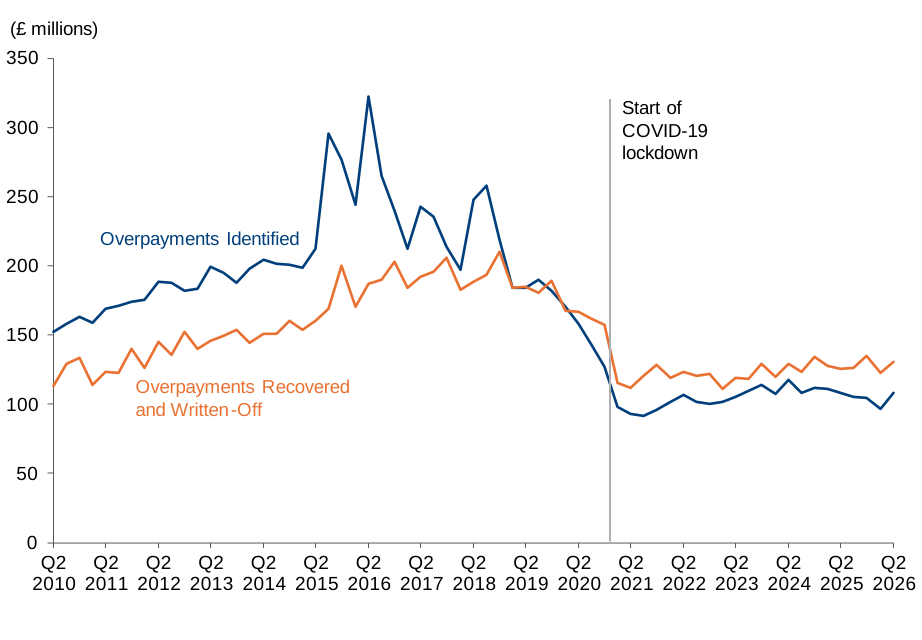
The total amount of HB overpayments identified in the first two quarters of FYE 2026 (£205 million) was lower than the total amount of HB overpayments recovered and written off by LAs (£254 million)
Quarterly amount of HB overpayments identified and recovered and written off in GB from Q1 FYE 2010 to Q2 FYE 2026
Source: Housing Benefit Debt Recovery Data Tables. Figures in this graph are plotted at quarterly intervals throughout the financial year.
Note: GB figures up to Q2 of FYE 2017 are “imputed” totals, based on estimates of missing LA data. From Q3 of FYE 2017 data return rates are high enough that no estimates are made and figures are based on actual LA returns.
In the first two quarters of FYE 2026, LAs in GB identified a total of £205 million overpaid HB. In the same period, LAs recovered £210 million HB overpayments and wrote off £43 million HB overpayments (£254 million).
Prior to the end of FYE 2018, the total amount of overpaid HB identified was always greater than the amount recovered or written off. Since then, the total amount of outstanding HB overpayments has fallen because LAs have recovered and written off more HB overpayments than they newly identify per quarter.
Total amount of outstanding HB overpayments by region, at the start of Q2 FYE 2026
| Region | Total amount of outstanding HB overpayments (£ millions) | % of GB total | |
|---|---|---|---|
| Great Britain | 1,454 | 100% | |
| North East | 41 | 3% | |
| North West | 133 | 9% | |
| Yorkshire and The Humber | 72 | 5% | |
| East Midlands | 62 | 4% | |
| West Midlands | 124 | 9% | |
| East of England | 91 | 6% | |
| London | 537 | 37% | |
| South East | 168 | 12% | |
| South West | 75 | 5% | |
| Wales | 39 | 3% | |
| Scotland | 112 | 8% |
Source: Housing Benefit Debt Recovery Data Tables.
Note: Figures in the table are rounded to the nearest 1 million. Percentages are calculated using unrounded data and then rounded to the nearest whole number. Therefore, percentages in some cases may not sum to 100.
At the start of Q2 FYE 2026, 90% of the total outstanding HB overpayments were from LAs in England, 8% were from LAs in Scotland and 3% were from LAs in Wales. The region with the highest outstanding HB overpayments was London, with a total of £537 million (37% of GB total).
4. Total amount of identified HB overpayments
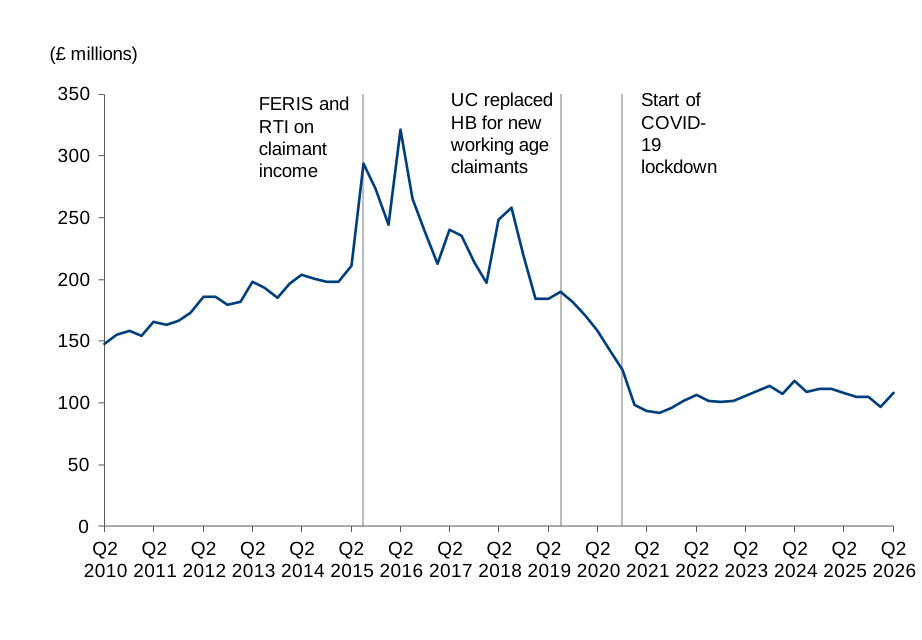
The total amount of HB overpayments identified in GB for Q1 and Q2 of FYE 2026 was £205 million
Quarterly amount of HB overpayments identified in GB from Q1 FYE 2010 to Q2 FYE 2026
Source: Housing Benefit Debt Recovery Data Tables. Figures in this graph are plotted at quarterly intervals throughout the financial year.
Note: GB figures up to Q2 of FYE 2017 are “imputed” totals, based on estimates of missing LA data. From Q3 of FYE 2017 data return rates are high enough that no estimates are made and figures are based on actual LA returns.
In the first two quarters of FYE 2026, the total amount of HB overpayments identified was £205 million.
Since Q1 FYE 2022, the total amount of HB overpayments identified has remained broadly stable. Prior to this, the total amount of HB overpayments identified fluctuated, however, followed a generally increasing trend to Q2 FYE 2016 where it reached a high of £321 million, followed by a generally decreasing trend to Q1 FYE 2022.
Factors influencing the amount of HB overpayment identified by LAs include:
- Fraud and Error Reduction Incentive Scheme (FERIS) – introduced in Q3 FYE 2015, this scheme provided grants and incentive payments to help LAs to identify and prevent HB overpayment. At a similar time, the real-time information (RTI) system was implemented as a joint strategy between DWP and HMRC, which allows LAs to verify HB claims against actual income. These checks led to undeclared income, and consequently overpaid HB, being identified by LAs.
- Rollout of Universal Credit (UC) – since Q3 FYE 2019, UC was made available in all parts of the UK for new claimants, and existing claimants who wished to move from HB to UC (voluntary migration). The managed migration process began in April 2023, with the aim of moving all eligible HB claimants to the housing element of UC.
-
COVID-19 – in Q4 FYE 2020 and FYE 2021, many LAs redeployed staff away from processing and debt recovery to other frontline activities, and restricted face-to-face meetings between staff and claimants during lockdown events.
- HB Award Accuracy Initiative (HBAA) – this process was introduced by DWP in Q1 FYE 2020, to support LAs in proactively identifying unreported changes, by targeted data matching to identify HB cases with the highest risk of an undeclared change. LAs participating in the initiative are provided funding to help them undertake HB Full Case reviews, HB matching Service referrals and correct recording on IT systems.
Total amount of HB overpayments identified by LAs, by region, in the first two quarters of FYE 2026
| Region | Total amount of HB overpayments identified (£ millions) | % of GB total | |
|---|---|---|---|
| Great Britain | 205 | 100% | |
| North East | 6 | 3% | |
| North West | 19 | 9% | |
| Yorkshire and The Humber | 14 | 7% | |
| East Midlands | 14 | 7% | |
| West Midlands | 27 | 13% | |
| East of England | 16 | 8% | |
| London | 48 | 23% | |
| South East | 27 | 13% | |
| South West | 14 | 7% | |
| Wales | 7 | 4% | |
| Scotland | 13 | 6% |
Source: Housing Benefit Debt Recovery Data Tables.
Note: Figures in the table are rounded to the nearest 1 million. Percentages are calculated using unrounded data and then rounded to the nearest whole number. Therefore, percentages in some cases may not sum to 100.
In the first two quarters of FYE 2026, 90% HB overpayments identified were from LAs in England, 6% from LAs in Scotland and 4% from LAs in Wales. Per region, the total amount of HB overpayments identified ranged between £6 million in the North East (3% of GB total) and £48 million in London (23% of GB total).
Average amount of HB overpayment identified per claimant per month, by region, for the first two quarters of FYE 2026
| Region | Average amount of HB overpayment newly identified per claimant per month | |
|---|---|---|
| Great Britain | £20.29 | |
| England | £21.49 | |
| North East | £10.88 | |
| North West | £15.66 | |
| Yorkshire and The Humber | £17.02 | |
| East Midlands | £22.73 | |
| West Midlands | £26.83 | |
| East of England | £20.21 | |
| London | £26.84 | |
| South East | £24.43 | |
| South West | £19.43 | |
| Wales | £14.54 | |
| Scotland | £12.83 |
Source: Housing Benefit Debt Recovery Data Tables and HB Caseload Statistics.
Note: This table provides the average amount of HB overpayment identified per claimant, per month, to allow for comparisons between regions with different HB caseloads. This table cannot, however, be used as an indication of typical levels of overpayment per region.
In the first two quarters of FYE 2026, LAs in GB identified total overpaid HB equivalent to £20.29 per claimant, per month. LAs in London identified the highest amount of overpaid HB per claimant, equivalent to £26.84 per month, LAs in the North East identified the lowest amount of overpaid HB per claimant, equivalent to £10.88 per month. In England, LAs identified HB overpayments equivalent to £21.49 per claimant per month, compared to £14.54 in Wales and £12.83 in Scotland.
5. Total amount of HB overpayments recovered
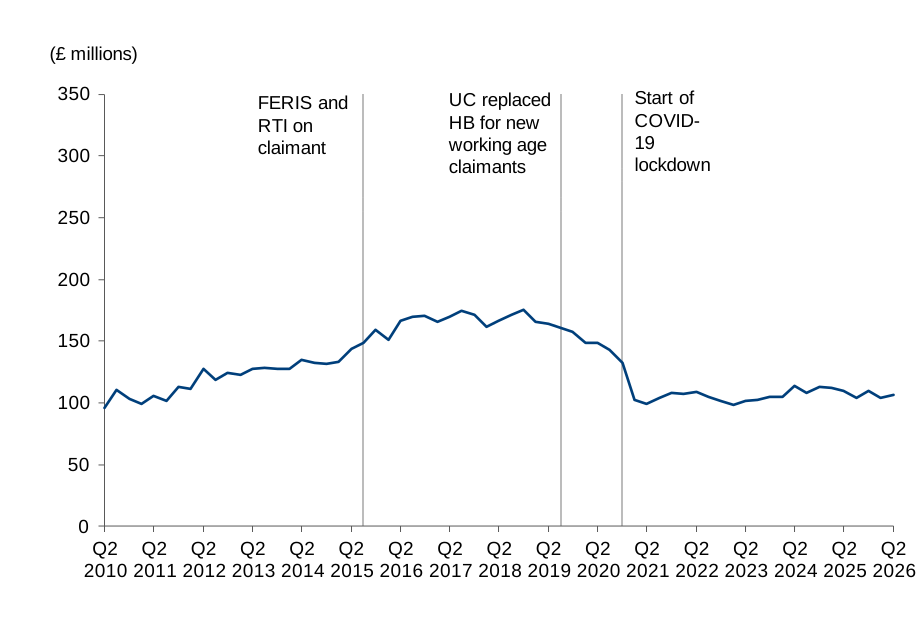
The total amount of HB overpayments recovered in GB in the first two quarters of FYE 2026 was £210 million.
Quarterly amount of HB overpayments recovered in GB from Q1 FYE 2010 to Q2 FYE 2026
Source: Housing Benefit Debt Recovery Data Tables. Figures in this graph are plotted at quarterly intervals throughout the financial year.
Note: GB figures up to Q2 of FYE 2017 are “imputed” totals, based on estimates of missing LA data. From Q3 of FYE 2017 data return rates are high enough that no estimates are made and figures are based on actual LA returns.
In the first two quarters of FYE 2026, the total amount of HB overpayment recovered was £210 million.
From the start of the statistical series, the total amount of HB overpayment recovered followed a general upward trend, peaking at £175 million in Q4 FYE 2018, before steadily decreasing to £99 million at Q2 2021, with a particularly notable fall of £30 million between Q4 FYE 2020 and Q1 FYE 2021, coinciding with the Covid-19 pandemic. Following this, the total amount of HB overpayment recovered has been broadly comparable, fluctuating between £98 million and £113 million.
Total amount of HB overpayment recovered, by region, for the first two quarters of FYE 2026
| Region | Total amount of HB overpayments recovered (£ millions) | % of GB total |
|---|---|---|
| Great Britain | 210 | 100% |
| North East | 6 | 3% |
| North West | 21 | 10% |
| Yorkshire and The Humber | 13 | 6% |
| East Midlands | 11 | 5% |
| West Midlands | 29 | 14% |
| East of England | 15 | 7% |
| London | 55 | 26% |
| South East | 28 | 13% |
| South West | 14 | 7% |
| Wales | 7 | 3% |
| Scotland | 12 | 6% |
Source: Housing Benefit Debt Recovery Data Tables
Note: Figures in the table are rounded to the nearest 1 million. Percentages are calculated using unrounded data and then rounded to the nearest whole number. Therefore, percentages in some cases may not sum to 100.
In the first two quarters of FYE 2026, 91% of HB overpayments recovered were by LAs in England, 6% by LAs in Scotland and 3% by LAs in Wales. Per region, the total amount of HB overpayments recovered ranged between £6 million in the North East (3% of GB total) and £55 million in London (26% of the GB total).
6. HB overpayments written off
The total amount of HB overpayments written off in GB in the first two quarters of FYE 2026 was £43 million
Total amount of HB overpayment written off in GB, from Q2 FYE 2010 to Q2 FYE 2026
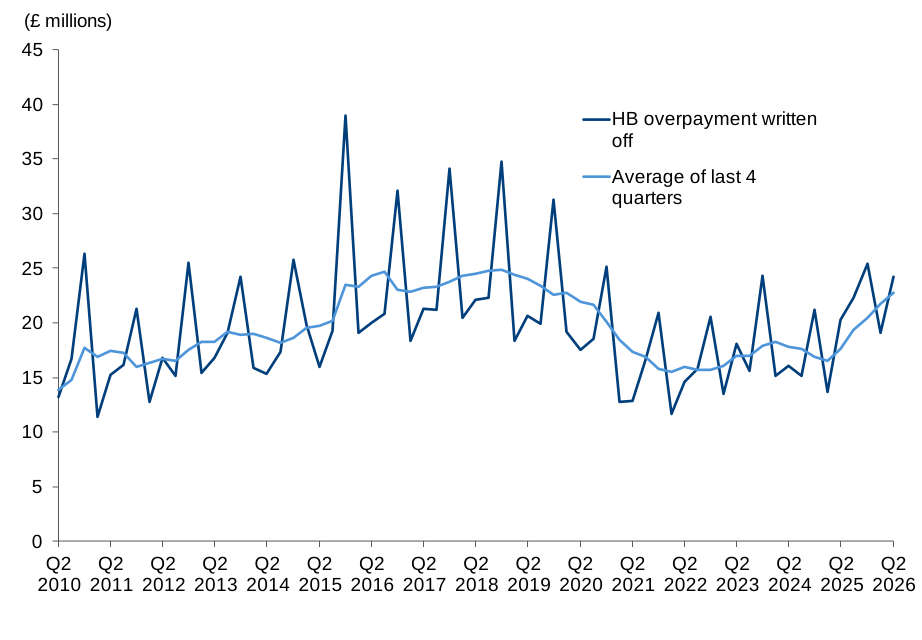
Source: Housing Benefit Debt Recovery Data Tables. Figures in this graph are plotted at quarterly intervals throughout the financial year.
Note: GB figures up to Q2 of FYE 2017 are “imputed” totals, based on estimates of missing LA data. From Q3 of FYE 2017 data return rates are high enough that no estimates are made and figures are based on actual LA returns.
It is useful to note that in Q4 of each year the amount of overpaid HB written off by LAs increases, due to the end of the financial year. A rolling average figure is included in this chart for each quarterly time point, to help smooth this seasonality and illustrate the trend over time. Further information can be found in our background information and methodology document.
In the first two quarters of FYE 2026, the total amount of HB overpayments that LAs wrote-off was £43 million.
From the beginning of the series, the rolling average figures show a generally upward trend to Q3 FYE 2016, where the rolling average figure reaches £24.7 million. Following this, the rolling average fluctuates slightly, before reaching a series high of £25 million in Q4 FYE 2018. From this point, the rolling average figures fall steadily to Q1 FYE 2022, where the average amount written off was £15.5 million. Since Q1 FYE 2022, the trend has fluctuated, showing short periods of increases and decreases, and rolling average figures between £15.5 million and £22.8 million.
Total amount of HB overpayments written off, by region, in the first two quarters of FYE 2026
| Region | Total HB overpayments written-off (£ millions) | % of GB total |
|---|---|---|
| Great Britain | 43 | 100% |
| North East | 1 | 2% |
| North West | 4 | 9% |
| Yorkshire and The Humber | 2 | 6% |
| East Midlands | 2 | 5% |
| West Midlands | 4 | 8% |
| East of England | 4 | 8% |
| London | 15 | 34% |
| South East | 4 | 10% |
| South West | 3 | 6% |
| Wales | 2 | 4% |
| Scotland | 3 | 7% |
Source: Housing Benefit Debt Recovery Data Tables
Note: Figures in the table are rounded to the nearest 1 million. Percentages are calculated using unrounded data and then rounded to the nearest whole number. Therefore, percentages in some cases may not sum to 100.
In the first two quarters of FYE 2026, 90% of HB overpayments written-off was made by LAs in England, 7% by LAs in Scotland and 4% by LAs in Wales. Per region, the total amount of HB overpayments written-off ranged between £1 million in the North East (2% of the GB total) to £15 million in London. (34% of the GB total).
7. About these statistics
This publication contains Official Accredited statistics based on the Housing Benefit Debt Recovery (HBDR) returns, collected from LAs each quarter. These statistics are compiled following the standards of trustworthiness, quality and public value set out within the Code of Practice for Statistics.
Our statistical practice is regulated by the Office for Statistics Regulation (OSR). OSR sets the standards of trustworthiness, quality and value in the Code of Practice for Statistics that all producers of official statistics should adhere to.
You are welcome to contact us directly with any comments about how we meet these standards. Alternatively, you can contact OSR by emailing regulation@statistics.gov.uk or by visiting the OSR website.
Publication schedule
These statistics are published twice a year, in March and September. The March publication contains data for the first two quarters of the financial year (April to September). The September release publishes data for the whole of the financial year. In cases where LAs have notified us of changes to their first two quarters’ data or provided a late Quarter 1 or Quarter 2 return after the deadline for the March publication, these will be incorporated into the September publication.
Supplementary statistics
Data tables are released alongside this publication, containing the figures underpinning the statistical summary and charts. These tables also contain breakdowns at an LA level, as well as the regional and GB figures presented in this publication.
Genuine variations between months can occur at a LA level. For example, some of these are caused by time limited issues or localised changes in operational policy. Hence, figures for individual LAs should be interpreted with care.
LAs are also asked to provide a breakdown between overpaid “Rent Allowance” (HB paid to LA tenants) and “Rent Rebate” (HB paid to housing association and private sector tenants). This breakdown is illustrated in the supplementary data tables, in those LAs for which it is available.
Data completeness
Up to Q2 of FYE 2017, when an LA did not send a data return, GB totals were imputed using methodology detailed in the background information and methodology note. From Q3 of FYE 2017 the return rate improved to a point that imputation of GB totals was no longer necessary, and all figures in the series from this date are from actual returns.
It is worth noting that the Debt Recovery amounts are derived from LA finance systems. Sometimes changes to LAs’ IT processes and system conversions can result in higher levels of LA non-returns whilst these changes are taking place. Sometimes we need to omit certain LA data due to concerns over the quality of the data, however, the omission of LA data does not change the story in the release but can sometimes have a slight impact on regional level figures.
Cyber attacks can also impact a small number of LA’s data returns and in cases it may be necessary to omit figures from the statistics in-line with our standard approach for handling missing data or data with quality concerns.
Comparability
As well as missing data, the background information and methodology note describes a number of other factors that need to be considered when comparing data. These include:
-
It is not possible to make direct comparisons between the amount of HB overpayments that LAs identify during a particular period and the amount of overpayment that they recover in the same period. This is because HB overpayments are not necessarily identified in the same period with that which they occurred. Similarly, HB overpayments may also be recovered in a different period than the one in which they are identified.
-
The volume of people claiming HB has been consistently decreasing through voluntary migration to UC, which replaces HB for most working age claimants. The managed migration (Move to UC scheme) began in April 2023 and continues to reduce the HB caseload as claimants transition to claim the housing element of UC.
-
The FERIS introduced in Q3 FYE 2015 provided LAs with grants and incentive payments to help them identify and prevent overpaid HB. At a similar time, the real-time information (RTI) system was implemented as a joint strategy between DWP and HMRC, which allows LAs to verify HB claims against actual income. These checks led to undeclared income, and consequently led to an increase in overpaid HB being identified.
-
At the start of the COVID-19 pandemic, many LAs redeployed staff away from processing and debt recovery to other frontline activities, and restricted face-to-face meetings between staff and claimants during lockdown events.
-
LAs sometimes identify an amount by which a HB claimant has been overpaid but then revise this amount at a later date. For example, “underlying entitlement” may be retrospectively applied to an overpayment, reducing the amount that the claimant was originally thought to owe. Conversely, an LA may retrospectively reverse their decision to write-off an overpayment. These revisions sometimes lead to a discrepancy between figures for one quarter and the next.
The total amount of HB overpayment at the start of a quarter should, in theory, equal the amount of outstanding overpayment at the start of the previous quarter, plus the amount of any identified overpayment during the previous quarter, minus the amount of any overpayment recovered and written-off during the previous quarter. However, sometimes this is not always the case due to revisions made in Q4 to overpayments that LAs first identified in previous quarters. The background information and methodology note describes this issue in more detail.
Rounding policy
Data presented in this publication have been rounded in line with our rounding policy, as outlined in the background information and methodology note. Typically, figures within this release are rounded to the nearest million, except for figures written off which have been rounded to the nearest 100,000.
In the supplementary data tables, data provided by LAs has been summed to generate regional and national totals, and then subsequently rounded to the nearest 1,000. As a result of this rounding, the sum of the LA figures shown in the tables may be slightly different to the regional and national totals.
Official Accredited Statistics status
The UK Statistics Authority has designated these statistics as Accredited Official Statistics (previously National Statistics), at June 2012, in accordance with the Statistics and Registration Service Act 2007 and signifying compliance with the Code of Practice for Statistics.
Accredited Official Statistics status means that our statistics meet the highest standards of:
-
trustworthiness
-
quality
-
public value
Once statistics have been designated as Accredited Official Statistics it is our responsibility to maintain compliance with these standards. In order to assess the quality of the HBDR statistics, in July 2021, LAs were sent a survey, asking them a number of questions about how they complete their returns. Information collected on this survey has been incorporated into the background information and methodology note.
Other Official Accredited and Official Statistics
Read details of other Official Accredited and Official Statistics produced by DWP and see the schedule of statistical releases upcoming over the next 12 months and a list of the most recent releases.
Our background information and methodology note provides further information on the HBDR statistics, source of these statistics, and the processes involved in developing and releasing these statistics.
Feedback and contact information
DWP would like to hear your views on our statistical publications. If you use this publication, we would be interested in hearing what you use it for and how well it meets your requirements. Please email feedback to cbm.stats@dwp.gov.uk.
Users can also join the StatsUserNet ‘Welfare, Wellbeing and Housing’ community in which DWP announces items of interest to users and replies to users’ questions.
Press enquiries should be directed to the DWP Press Office.
Other enquiries should be directed by email to:
Lead Statistician: Kate Walker at cbm.stats@dwp.gov.uk
ISBN: 978-1-78659-943-8