Grants Statistics Bulletin 2024 to 2025
Published 24 March 2026

© Crown copyright 2026
This publication is licensed under the terms of the Open Government Licence v3.0 except where otherwise stated. To view this licence, visit nationalarchives.gov.uk/doc/open-government-licence/version/3 or write to the Information Policy Team, The National Archives, Kew, London TW9 4DU, or email: psi@nationalarchives.gov.uk.
Where we have identified any third party copyright information you will need to obtain permission from the copyright holders concerned.
This publication is available at https://www.gov.uk/government/statistics/government-grants-statistics-2024-to-2025/grants-statistics-bulletin-2024-to-2025
1. Purpose of this report
This report accompanies the release of the Government grants register 2024 to 2025. This report provides context to this grants data, an overview of grant spending and guidance notes on how the data has been compiled.
This release is classified as Official Statistics. The details of the ongoing improvements to these statistics are outlined in the statistics development plan accompanying this publication.
Government grants register 2024 to 2025 data release covers:
-
General grants and formula grants (at both scheme and award level) across all government departments.
-
Grants funded during the period 1 April 2024 to 31 March 2025.
-
Grants that are new for 2024 to 2025 and grants that were set up in previous years which have continued to be active in 2024 to 2025.
-
Exchequer-funded grants (this excludes grants funded by devolved governments of Scotland, Wales and Northern Ireland); this includes overseas aid provided by the UK government as grants.
-
Any central government departments or arm’s length bodies (ALBs) that manage exchequer funded grants.
This data does not include:
-
Grants-in-aid – these are funds allocated from one part of government to another part of government, for example, central government funding for the running costs of non-departmental public bodies (NDPBs).
-
Details of awards made by Local Authorities.
-
Details of fraud and error.
There are a number of notes and caveats that will help inform the interpretation of this data. A summary of these, as well as departmental statements, can be found at the end of this report. Full details can be found in the Quality and Methodology Information document, published alongside this report. Note that values presented in this report are rounded. Therefore totals may not equal the sum of their parts, and percentages may not add up to exactly 100%. The statistics in this report are based on unredacted data, so will not exactly match any statistics calculated directly from the accompanying government grants register.
We would appreciate your feedback to help us improve future publications. This can be provided via this feedback form.
2. Introduction to government grants
Government grants are funds intended to be permanently transferred[footnote 1] from a government organisation, to a grant recipient[footnote 2], in order to fulfil a policy or public interest need. Unlike contracts/procurements (e.g. for the purchase of goods or services), grants are provided with the focus on the outcomes and impacts of the activities being funded. Usually grants are awarded to finance (or reimburse expenditure on) the recipients’ activities in order to further the implementation of government policy or public interest, where it is neither appropriate nor possible for the government organisation to carry out those activities itself.
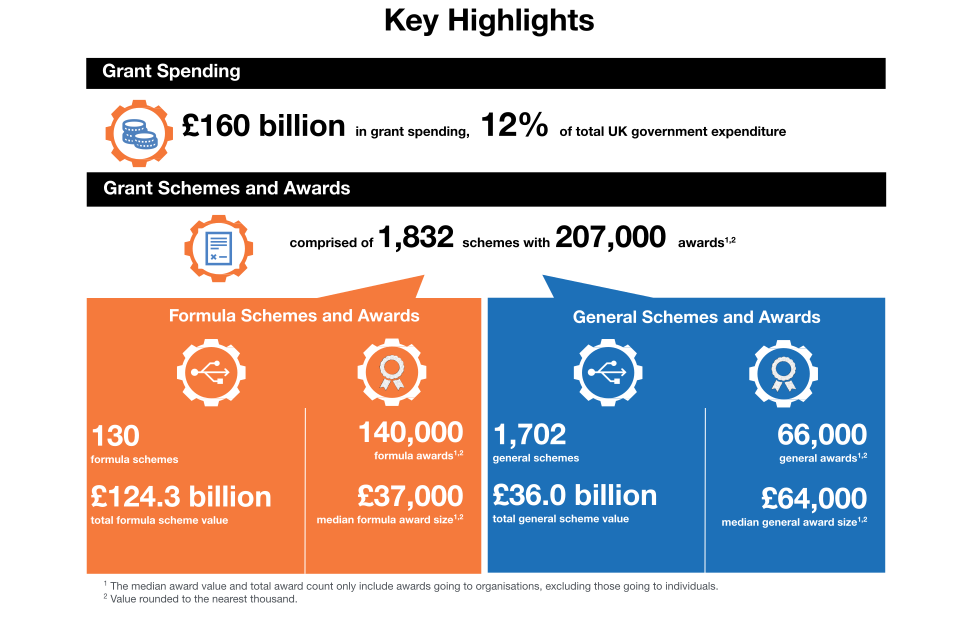
Grant spending accounts for around 12% of total UK government expenditure.[footnote 3] Government grant funding plays an important role domestically, in areas such as education, research, civil society and innovation, and abroad through international aid projects.
Grants can be used for a number of purposes, including providing financial subsidies to deliver activities and outcomes, supporting government policy initiatives, and funding research, development and innovation. Examples of grant funding from 2024 to 2025 include awards to meet the government’s environmental commitments, support adult social care and provide humanitarian assistance abroad.
2.1 Allocation of government grants
There are two allocation methods by which grants are issued:
-
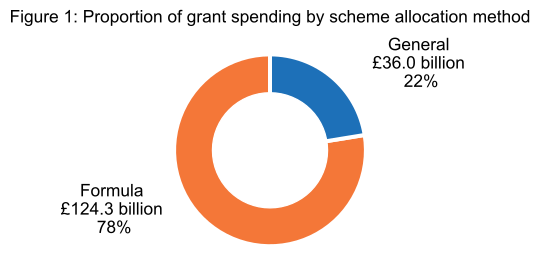
Formula grants: are those calculated by way of a formula. This funding is provided, in recognition of specific criteria, by central government to organisations such as local authorities, schools and the police. Funding is determined by factors relevant to the purpose, such as population or number of pupils who receive free school meals. These grants account for 78% (£124.3 billion across 130 schemes) of government grant spending.
-
General grants: allow the government to secure policy objectives which the market cannot, such as innovation and research, and they allow an effective funding route for the voluntary and charitable sectors, for example to address homelessness and regional inequalities. General grants account for 22% (£36.0 billion across 1,702 schemes) of government grant spending.
Source: Accompanying statistical tables – Table 1
2.2 Total grant spend by department and allocation method
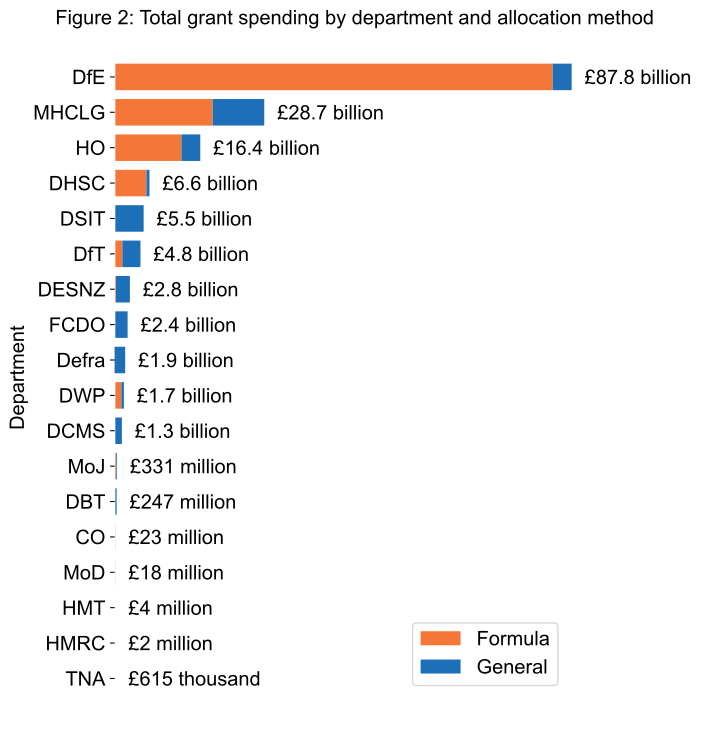
The government spent £160 billion on grants in 2024 to 2025. This is a 5% increase from £153 billion in 2023 to 2024. The Department for Education (DfE) gave out the greatest amount of money as grants, accounting for £87.8 billion (55%) of the total value of government grants. This includes the Dedicated Schools Grant (DSG), the General Annual Grant (GAG), and the 16-19 Education Grant; these three schemes account for a combined total of £70.1 billion. Large grant giving departments also include the Ministry of Housing, Communities and Local Government (MHCLG) and the Home Office (HO), which together with DfE gave out £132.9 billion (83%) of the total value of government grants.
Source: Accompanying statistical tables – Table 1
Note: Total grant spending for the Department for Environment, Food & Rural Affairs (Defra) in 2024 to 2025 includes a large negative accounting adjustment. Further information can be found in the departmental statements at the end of this bulletin.
3. How grant spending has changed over time - from financial years 2018 to 2019 up to 2024 to 2025
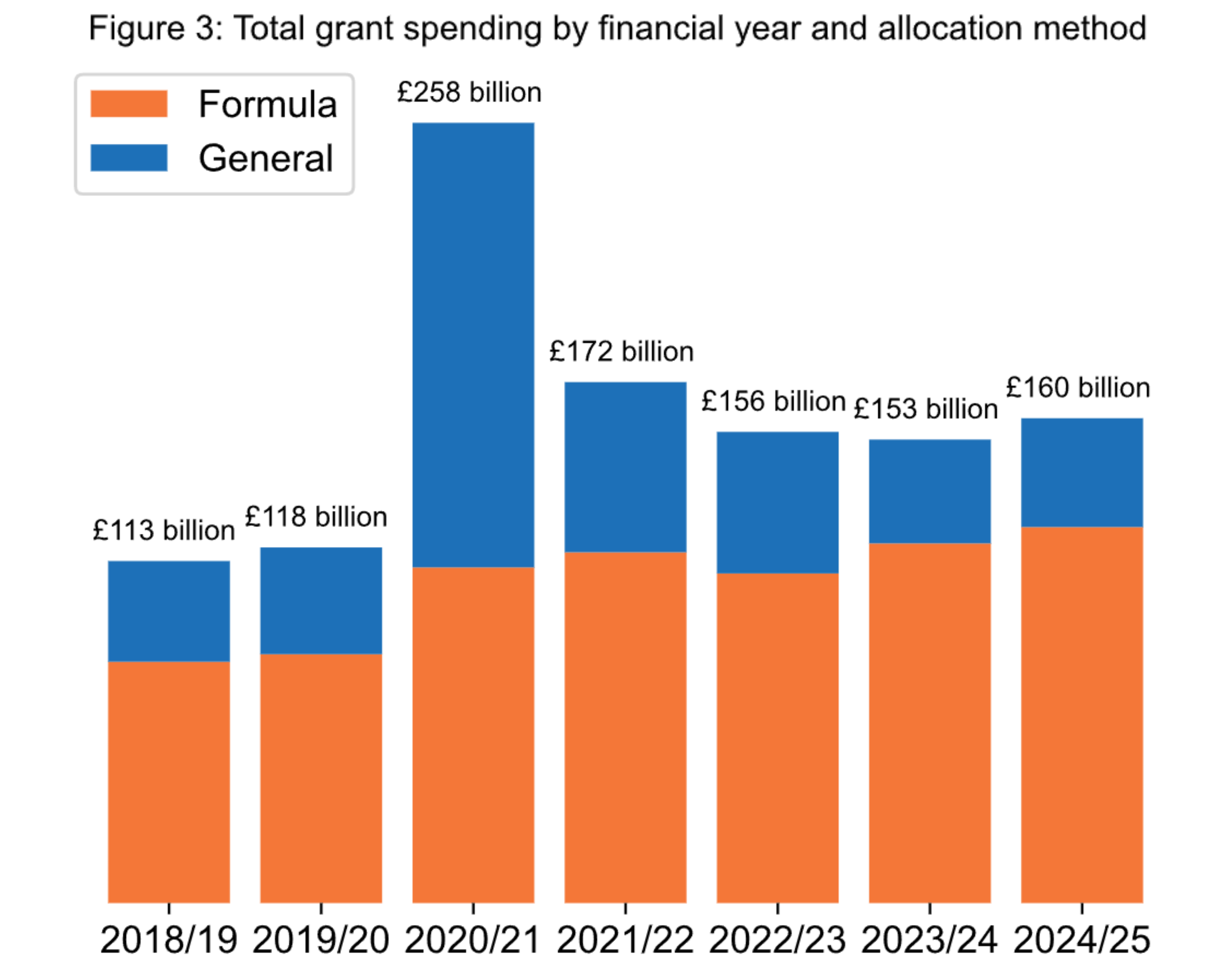
In the financial years prior to 2020 to 2021, grants spending was broadly static at £113 billion in 2018 to 2019, and £118 billion in 2019 to 2020. This spend was dominated by formula grant schemes, making up around 70% of spend in both years.
In 2020 to 2021 and 2021 to 2022, grant spending played a key role in the UK government’s response to the COVID-19 pandemic. Grant spending in 2020 to 2021 was £258 billion, more than doubling compared to previous years, with general grant spending higher than formula grant spending for the first time. Grant spending in 2021 to 2022 decreased by 33% compared to 2020 to 2021, however it remained significantly higher than in earlier years. This was largely due to the continuation of grant spend to support the COVID-19 response, as well as increased formula grant spending to support economic recovery. The breakdown of this spending mostly returned to previous patterns, with formula grant spending making up 67% of total grant spending.
Grant spending in 2022 to 2023 decreased by 10% compared to 2021 to 2022. This was driven by the closure of large grant schemes supporting the COVID-19 response, such as the HM Revenue & Customs’ (HMRC) Coronavirus Job Recovery Scheme.
Since 2022 to 2023, grant spending has remained relatively stable. In 2024 to 2025 grant spending has increased by 5% overall compared to 2023 to 2024. Despite the overall value remaining consistent, grant spending by specific departments has changed. For example, grant spending by the Department for Science, Innovation & Technology (DSIT) increased by 12% due to increases in schemes managed by UK Research and Innovation (UKRI), grant spending by the Department of Health & Social Care (DHSC) increased by 12% due to increases in Adult Social Care schemes, and grant spending by the HO increased by 9% due to increases in schemes relating to pension grants for the Police and Fire services. Details on grant spending over time for all departments can be found in Table 1 of the statistical tables accompanying this bulletin.
Source: Accompanying statistical tables – Table 1
4. Formula grants in financial year 2024 to 2025
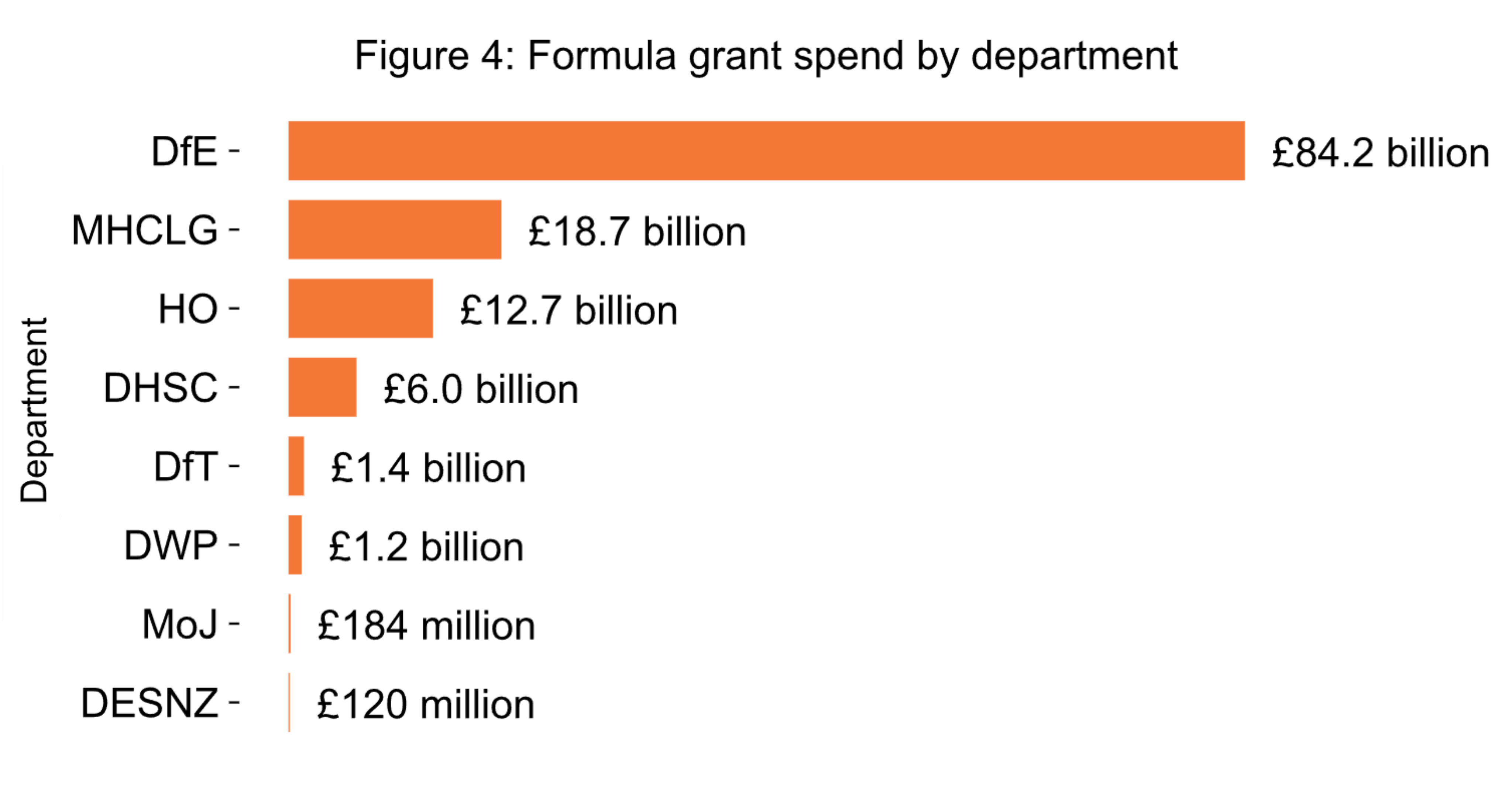
Formula grants are those calculated by way of a formula. This funding is provided, in recognition of specific criteria, by central government to organisations such as local authorities, schools and the police. Funding is determined by factors relevant to the purpose, such as population or number of pupils who receive free school meals. These grants account for 78% (£124.3 billion across 130 schemes) of government grant spending. This is a 5% increase on the value in 2023 to 2024, when £118.9 billion was funded via formula schemes.
Source: Accompanying statistical tables – Table 1
Note: Total formula grant spending for the Defra in 2024 to 2025 is negative due to a large negative accounting adjustment, and has therefore been excluded from this chart. Further information can be found in the departmental statements at the end of this bulletin.
The largest formula grant funder is the DfE who provided £84.2 billion in formula grant funding during 2024 to 2025. Outside of the DfE, the next largest formula grant schemes are the HO’s £5.5 billion Police Main Grant and the MHCLG’s £5.5 billion Business Rates Section 31 Grant Reconciliations. See table 1 below for details on these schemes, and the government grants register, accompanying this bulletin, for details of all grant schemes.
Table 1: The 10 largest formula grants schemes
| Department | Scheme Name | Purpose and objectives | Value |
|---|---|---|---|
| DfE | Dedicated Schools Grant (DSG) | DSG is the main revenue funding local authorities receive from the DfE for school budgets under section 14 of the Education Act 2002. It is divided into four blocks: early years, schools, high needs, and central school services. | £32.8 billion |
| DfE | General Annual Grant (GAG) | The main revenue funding for academies, paid monthly. It includes two parts: the school budget share (calculated on the same basis as for maintained schools in the same local authority) and the minimum funding guarantee. | £31.8 billion |
| DfE | 16-19 Education | Funds a range of providers—including Futher Education colleges, sixth‑form colleges, independent learning providers and higher education institutions—to deliver 16–19 education and support. | £5.5 billion |
| HO | Police Main Grant | Statutory funding to all Police and Crime Commissioners as the Police Main Grant, awarded under statute each year. | £5.5 billion |
| MHCLG | Business Rates Section 31 Grant Reconciliations | Compensates local authorities for Business Rates reliefs given. | £5.5 billion |
| MHCLG | Social Care Support Grant | Grant to support immediate pressures being experienced by authorities delivering social care. | £5.0 billion |
| DHSC | Public Health Ring-fenced Grant 2024 to 2025 | Provides ring-fenced revenue and capital funding to upper tier and unitary local authorities in England to discharge their public health functions, improve population health and reduce health inequalities. | £3.7 billion |
| HO | MHCLG Formula Funding (previously DCLG Funding) | Part of the Police Grant Report set by the Home Secretary. | £3.5 billion |
| DfE | Pupil Premium | Pupil Premium is a grant to improve outcomes for disadvantaged pupils in England and to provide pastoral support for children. | £2.9 billion |
| HO | Police Pensions Annually Managed Expenditure Grant | Statutory funding to Police, as the Police Pensions Annually Managed Expenditure Grant, awarded under statute each year. | £2.1 billion |
5. General grants in financial year 2024 to 2025
General grants allow the government to secure policy objectives which the market cannot, such as innovation and research, and they allow an effective funding route for the voluntary and charitable sectors, for example to address homelessness and regional inequalities.
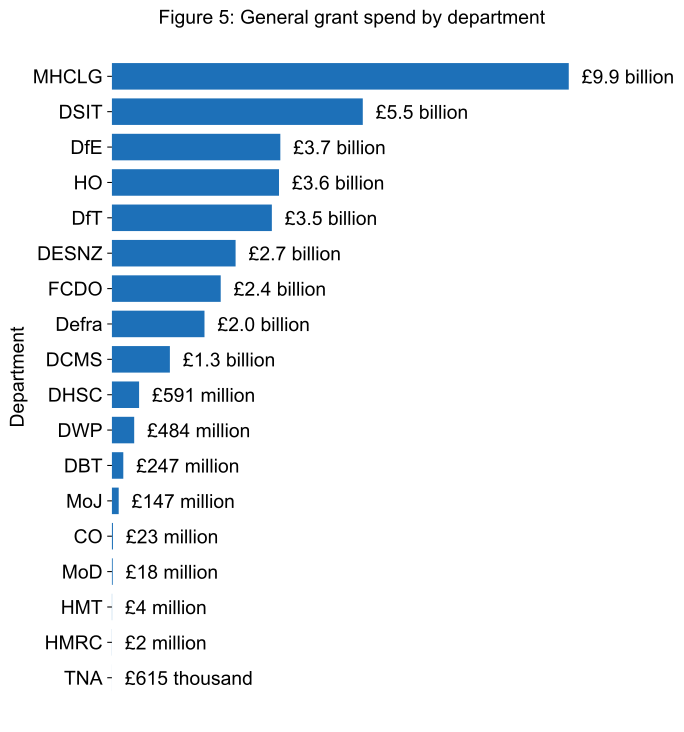
General grants account for 22% (£36.0 billion) of the value of government grants spending and 93% (1,702) of the volume of grant schemes in 2024 to 2025. This is a 5% increase on the value in 2023 to 2024, when £34.2 billion was funded via general grants.
Source: Accompanying statistical tables – Table 1
The largest general grant funder is the MHCLG who spent £9.9 billion on general grants during 2024 to 2025. The three largest general grant schemes are the MHCLG’s £1.8 billion Homes England: Strategic Partnerships 21-26 scheme, the Department for Energy Security and Net Zero (DESNZ)’s £1.2 billion Renewable Heat Incentive - Domestic and Non-domestic scheme, and the DSIT’s £1.2 billion UKRI - Innovate UK - Scheme. See table 2 below for details on these schemes, and the government grants register, accompanying this bulletin, for details of all grant schemes.
Table 2: The 10 largest general grants schemes
| Department | Scheme Name | Purpose and objectives | Value |
|---|---|---|---|
| MHCLG | Homes England: Strategic Partnerships 21-26 | The Affordable Homes Programme 2021-2026 (AHP 2021-26) is a £7.4 billion investment programme providing grant funding to support the capital costs of developing affordable housing for rent or sale. AHP 2021-26 offers two routes to access funding, Continuous Market Engagement (scheme-by-scheme); and Strategic Partnerships (volume grant allocations to ambitious partners). Through the AHP 2021-26 programme, there is an emphasis on partners’ use of Modern Methods of Construction (MMC), the delivery of high-quality sustainable design and working closely with housebuilders who are small to medium-sized enterprises (SME). | £1.8 billion |
| DESNZ | Renewable Heat Incentive (RHI) - Domestic and Non-domestic | The RHI scheme provides financial incentive to increase the uptake of renewable (low carbon) heating technologies. The RHI objectives are to: increase the amount of heat produced from renewable sources; reduce carbon emissions from heating homes and business premises; help to grow supply chains which can support a national transition from fossil fuel to low-carbon heating technology from the 2020s. | £1.2 billion |
| DSIT | UKRI - Innovate UK - Scheme | Innovate UK is the UK’s national innovation agency. We support business-led innovation in all sectors, technologies and UK regions. We help businesses grow through the development and commercialisation of new products, processes, and services, supported by an outstanding innovation ecosystem that is agile, inclusive, and easy to navigate. For details see https://www.ukri.org/councils/innovate-uk/ | £1.2 billion |
| MHCLG | UK Shared Prosperity Fund (UKSPF) | UKSPF brings together the DfE and the MHCLG, to invest £2.6 billion with a primary focus on pride in place, alongside additional adult numeracy (Multiply) interventions. Interventions can be selected from a menu of options. All Local Authorities will receive a fund allocation. | £1.2 billion |
| DfT | City Region Sustainable Transport Settlements (CRSTS) | The CRSTS aims to create a more consolidated and devolved model of transport funding and deliver significant improvements for users. | £1.1 billion |
| DSIT | UKRI - Engineering and Physical Sciences Research Council (EPSRC) - Scheme | EPSRC creates knowledge in engineering and physical sciences for UK capability to benefit society and the economy. For details see https://www.ukri.org/councils/epsrc/ | £881 million |
| Defra | Rural Payment Agency (RPA) Countryside Stewardship | The main priority for Countryside Stewardship is to protect and enhance the natural environment, in particular through: increased biodiversity; improved habitat and expanded woodland areas; improved water quality; and improved air quality. | £809 million |
| MHCLG | Levelling Up Fund | The Levelling Up Fund brings together the Department for Transport (DfT), the MHCLG, and HM Treasury (HMT) to invest £4.8 billion in high value local infrastructure across the three investment themes of Transport; Town Centre Regeneration; and Culture. The Fund has two core objectives which are: 1. To invest in local infrastructure that has a visible impact on people and their communities and 2. To support economic resilience and recovery. | £795 million |
| DfE | Priority School Building Programme - Private Finance Local Authority & Voluntary Aided School Revenue Grant | This revenue funding is to maintain the condition of selected repaired schools through Public Private Partnership based on the commercial principles of competition, efficiency and value-for-money. | £752 million |
| MHCLG | Homes England: Affordable Homes Programme (AHP) 2021-26 (Continuous Market Engagement) | The AHP provides grant funding to registered providers to support the delivery of affordable housing. | £674 million |
5.1 General grant awards by allocation method in financial year 2024 to 2025
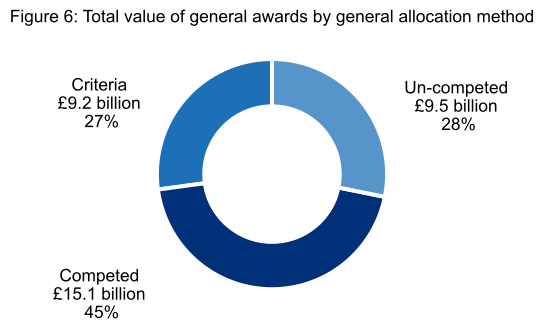
There are three means by which general grants are allocated to recipients:
-
Competed - applications are invited and evaluated, with awards made based on the outcome of the application. In 2024 to 2025 these grants had a total value of £15.1 billion. Competed grant awards in 2024 to 2025 had an average (median) value of £55,000. As per the Grants Functional Standard, competition should be the default allocation method, wherever appropriate.
-
Un-competed - grants are awarded to a single organisation or individual without a competition, for example where there is only a single organisation that has the capability of delivering the objectives. In 2024 to 2025 these grants had a total value of £9.5 billion. Un-competed grant awards in 2024 to 2025 had an average (median) value of £95,000.
-
Criteria - disseminated based on specific qualifying criteria, for example grants to assist those affected by floods. In 2024 to 2025 these grants had a total value of £9.2 billion. Criteria grant awards in 2024 to 2025 had an average (median) value of £100,000.
Source: Accompanying statistical tables – Table 2
Note that these totals are calculated based on award level data, and average (median) value are calculated based only on awards to organisations. Therefore these totals do not add up to the other general grants totals in this report.
6. Grant schemes by COFOG in financial year 2024 to 2025
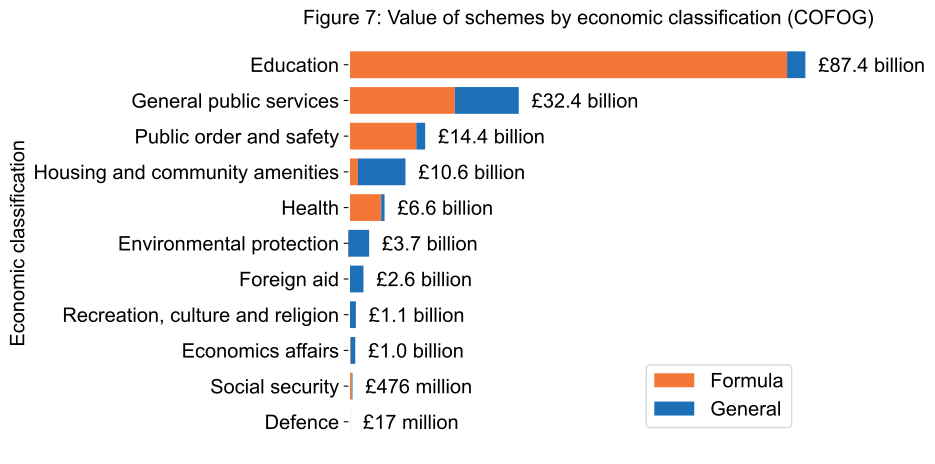
We can classify grants by their area of economic activity using the Classification of the functions of government (COFOG). COFOG defines the broad objectives of government activity. The UK government classifies £87.4 billion of its grants spending as Education (see COFOG definitions for details on what areas of spending this category includes). General public services (£32.4 billion) is the second largest classification.
Source: Accompanying statistical tables – Table 3
7. Data Notes
Full notes for each data field are included in the scheme and award level data accompanying this report. Below are the key notes that users should be aware of when interpreting this data:
-
The location recorded on the register is not necessarily reflective of the ultimate beneficiary of grant funding. The address may represent the head office of the initial recipient, rather than where the money is actually spent.
-
Some data has been redacted at both scheme and award level in the published data, where there is a requirement by law and data protection regulations; where data has been redacted at award level but not scheme level, this will result in a difference between scheme-level and award-level data values.
-
Grants-in-aid are excluded from this publication; grants-in-aid are funds allocated from one part of government to another part of government, for example, central government funding for the running costs of non-departmental public bodies (NDPBs).
-
Financial figures can be reported on either a cash or accruals basis. We are working with departments to make this consistent for future publications.
-
Some data is completely redacted for reasons of national security or commercial security. The statistics in this document and the accompanying statistical tables are calculated based on un-redacted data. This means that the statistics in this report won’t completely match the full published dataset.
-
Some recipient information is redacted due to it containing personal information or for national security or commercial security reasons. These details are replaced with [Redacted] in the dataset.
-
Average (median) award values only include awards going to organisations, excluding those going to individuals, and are rounded to the nearest thousand.
-
Where central government provides grant funds to an organisation that then provides onwards grants to end recipients, only the grant to the initial organisation (e.g. the local authority) is included in this data.
8. Departmental statements about the data in this report
CO
The Cabinet Office (CO) data contained within the Government Grants Information System (GGIS), and therefore within this publication includes all CO grants. This includes some grants made by the Office of Veterans Affairs (OVA) while they were a part of the CO. The OVA transferred to the Ministry of Defence (MoD) during the financial year 2024 to 2025 so may have further grants under MoD.
DBT
The Department for Business and Trade (DBT) reports grant figures based on budget figures, not payments. The sum of all grant schemes is represented in the Statistical Reporting Figure. Commercially sensitive data is not published therefore the published data will not correlate exactly to the Statistical Reporting Figure.
DCMS
In the Department for Culture, Media and Sport (DCMS) data, some award figures quoted are the original budget values rather than actuals.
The National Citizen service (NCS) closed on the 31st March 2025 after submitting their data to the GGIS - some minor data queries raised by CO have therefore not been addressed due to agreement with DCMS that they do not impact the overall data quality.
The negative values in the National Heritage Memorial Fund (NHMF) data are due to repayment of excess money where the recipient has not spent the full awarded amount.
Defra
The Defra data covers core Defra grants and those administered by its Arm’s Length Bodies. Where data is available reported data includes actual values, but in some instances budgeted values may have been reported instead. The data published in the government grants register includes only Defra grants funded by the UK Exchequer.
In the financial year 2024 to 2025, Defra continued the agricultural transition, implementing planned reductions to Delinked Payments and continued to support thriving rural economies and communities through its Environmental Land Management Schemes. Due to larger reduction rates than expected on Delinked Payments, as well as differing accounting treatment between RPA & Defra Group, data in the publication may differ to that recorded in the Annual Report and Accounts 2024-2025. Furthermore, due to Spending Review 2021 ending in the financial year 2024 to 2025, many schemes did not have future budgets confirmed and therefore schemes may have been entered as ending in the financial year 2024 to 2025. Because of this, some schemes may not include complete details of further funding. Differences in scheme and award values under the Delinked Payments scheme are due to accruals vs cash-based accounting. Scheme values indicate accrual accounting treatment as scheme values reconcile back to the Defra and RPA Annual Report & Accounts (ARA). In the financial year 2023 to 2024 the entire value of Delinked Payments was accrued, and this was reflected in the GGIS. However in the financial year 2024 to 2025 due to increased reduction levels there was a writeback in the scheme, which was reflected in the ARA and therefore similarly has been reflected at scheme level in the GGIS, creating a negative scheme value. However, at award level, this reflects actual awards made and therefore is done on a cash basis. As such, awards are still being made and therefore award values are positive. The writeback at scheme level, will result in a smaller volume of awards being made in future years, however as this decision was taken in the financial year 2024 to 2025, this effect will not be present in the GGIS until the financial year 2025 to 2026 onwards.
This year’s publication continues the reporting of primary sub-outcomes for select schemes within their aims and objectives. These outcomes relate to the current Outcomes Framework which is in the process of being refreshed.
DESNZ
The data contained within this publication shows a single year snapshot of DESNZ grant spend as it is held on the GGIS at the point of publication and is an assessment of grant schemes run by DESNZ. References to the Department for Business, Energy & Industrial Strategy (BEIS) relate to funding activity initiated by that department prior to 2023 machinery of government changes now overseen by DESNZ.
The figures represent either budgeted or actual expenditure, depending on the information available at time of publication completion.
Grant payments may need to be recovered from recipients for a variety of reasons depending on the grant conditions or for associated reconciliation activity and this is demonstrated in negative values which net off at the overall scheme level.
Some scheme details may not be included in the publication report due to their sensitive nature, for reasons of national security or due to ongoing data settlement activities for the period.
DfE
The DfE 2024 to 2025 GGIS return reports grant scheme and award expenditure for both the departmental group and the Office for Students (OfS).
The return is prepared on a resource expenditure basis, consistent with previous years. Negative expenditure figures reflect net recoveries, such as the clawback of prioryear funding. The scheme and award level data reported on GGIS account for 99.5% and 99.9% respectively of the departmental group and the OfS’ total 2024 to 2025 grant expenditure. Some scheme totals include accounting adjustments that cannot be attributed to individual award recipients, causing differences between schemelevel and awardlevel totals. Undertaking further investigation to achieve a 100% completion rate at both levels was not considered proportionate in terms of value for money.
Each award line represents a grant recipient; for academies, the recorded recipient may be either the academy or its trust. Where identified in the reporting process, the return excludes grant in aid to other government departments and grant in kind (such as construction work procured on behalf of educational organisations).
DfT
The DfT’s grant allocation for the financial year 2024 to 2025 centred on sustaining the transport network, strengthening local and regional connectivity, and accelerating the transition to cleaner travel. Funding prioritised the major rail and road bodies that maintain national infrastructure, while also supporting local authorities to improve roads, public transport, and active travel networks. Additional grants backed reforms to bus services, investment in zero emission vehicles and buses, and programmes aimed at reducing carbon emissions and improving air quality. Overall, the allocation reflected a balance between maintaining essential services, progressing long term infrastructure upgrades, and supporting decarbonisation and regional growth.
DHSC
The DHSC data contained within the GGIS, and therefore within this publication, represents an approximate picture of DHSC grant schemes in the financial year 2024 to 2025.
DSIT
The DSIT has provided information for DSIT Core schemes along with Partner Organisations Building Digital UK, Met Office, UKRI and UK Space Agency. Data on DSIT Overseas Development Assistance (ODA) funded international research schemes is also published annually as part of the FCDO Statistics on International Development. These figures may differ due to differences in presentation by financial or calendar year and on an accrual or cash basis. Data for these schemes is based on DSIT 2022 assurance letters issued to its Partner Organisations covering the period 2023, 2024 and 2025. Since then, new assurance letters have been issued, covering 2023, 2024 and 2025, which override those budgets.
The Global Challenges Research Fund spend data includes refunds that were received during the financial year. For some partner organisations the total value of their refunds exceeded their expenses, which is reflected as a negative total spend value.
FCDO
The data contained within this Government Grants Register shows a single year snapshot of FCDO grant spend as it is held on the GGIS at the point of publication. The most accurate and up to date information on FCDO programmes can be found under FCDO transparency releases on gov.uk. All ODA, including FCDO grant funding, is published to the International Aid Transparency Initiative (IATI) standard on Development Tracker.
HMRC
This data covers core grants administered by HMRC with data reported including actual values for the financial year 2024 to 2025.
HO
The data excludes non-grant funding such as contracts, Grants-in-Aid, non-UK Exchequer funded grants or schemes which have been identified as sensitive in nature or for reasons of national security. The figures represent budgeted values which are subject to variations and may not have been spent in full.
MHCLG
The MHCLG data is on a cash payment basis for schemes and awards, which is consistent with prior years’ treatment, and therefore excludes accounting adjustments such as accruals. Grants to local authorities include the Revenue Support Grant which finances revenue expenditure and capital grants which finance non-current assets. These are agreed through the local government finance settlement. In addition, specific grants are distributed outside the settlement.
Grant payments may need to be recovered from recipients for a variety of reasons depending on the grant conditions. Where recoveries are made income is recognised at the point that the invoice, or other notice requiring repayment, has been issued. The negative values relate to grant recoveries which net off with the overall scheme at programme level. The Local Government Finance Settlement for the financial year 2024 to 2025 made available up to £64.7 billion, an increase in Core Spending Power of up to £4.5 billion or 7.5% in cash terms on the financial year 2023 to 2024. The Ministry agreed the Local Government Finance Settlement for the financial year 2025 to 2026, which made available over £69 billion to local authorities, providing a 6.8% cash terms increase in councils’ Core Spending Power compared to the financial year 2024 to 2025. This included an £880 million uplift to the Social Care Grant, £270 million for the Children’s Social Care Prevention Grant and a £600 million Recovery Grant to help places most in need. The increase was approved by Parliament and contributes to our objective of bringing stability to local government finances.
The Ministry consolidated 11 grants, collectively worth over £650 million, into the Local Government Finance Settlement. This is only the first step in our ambitions beyond the financial year 2026 to 2027 to simplify local government funding, which will give councils much greater certainty and flexibility. The financial year 2023 to 2024 and 2024-25 saw significant funding streams to support the local growth agenda, including Towns Fund and the Levelling Up Fund. The significant decrease in plans for the financial year 2025 to 2026 is linked to some of the local growth programmes coming to their final stages, such as Levelling Up Partnerships and Future High Streets, alongside a substantial reduction in the UK Shared Prosperity Fund which is entering a transitional year ahead of an updated long term local growth model. The Homes England agency’s largest grant programme is the Affordable Housing Grant programme. This aims to increase the supply of new affordable and shared ownership homes in England. Strategic Partnership Deals is part of the Affordable Housing Grant Programme, these partnerships provide additional support to Registered Providers for the construction of affordable homes. Business rates retention (top ups) are excluded from this publication as these are redistributed business rate grant payments funded through the collection of tariff amounts under the rate retention system and are not funded via the UK Exchequer. The Authority Acts for Awards are automatically associated to the relevant Scheme Authority Act on the GGIS and may not be individually verified. A Scheme may have more than one relevant Authority Act.
MoD
The MoD data covers all general grants made in the financial year 2024 to 2025, including those administered by the Armed Forces Covenant Fund Trust (Non-Departmental Public Body sponsored by MoD).
TNA
Our Scoping, Cataloguing and Consortium Grants are funded by the Archives Revealed partnership, comprising the National Lottery Heritage Fund, The Wolfson Foundation, the Pilgrim Trust and The National Archives.
-
unless unused or misspent ↩
-
a third party that is separate from the government organisation ↩
-
Calculated based on the Office for Budget Responsibility’s Public finances databank figure for total managed expenditure at the time of publication. ↩