Get Britain Working: Labour Market Insights January 2026
Updated 30 April 2026
Applies to England, Scotland and Wales

© Crown copyright 2026
This publication is licensed under the terms of the Open Government Licence v3.0 except where otherwise stated. To view this licence, visit nationalarchives.gov.uk/doc/open-government-licence/version/3 or write to the Information Policy Team, The National Archives, Kew, London TW9 4DU, or email: psi@nationalarchives.gov.uk.
Where we have identified any third party copyright information you will need to obtain permission from the copyright holders concerned.
This publication is available at https://www.gov.uk/government/statistics/get-britain-working-labour-market-insights-january-2026/get-britain-working-labour-market-insights-january-2026
The Get Britain Working: Labour Market Insights publication series builds on the Get Britain Working White Paper Analytical Annex, which included new analysis of the UK labour market.
The publication contains some core statistics which will be updated with each release, while other statistics will be published on a one-off basis or updated less frequently. Each edition will include contextual analysis on a specific topic, helping readers build understanding on a different subject with each release. In this publication the focus is on young people statistics.
Please note that because these statistics are new, they are ‘Official Statistics in Development’. They will be tested with users in line with the standards of trustworthiness, quality, and value in the Code of Practice for Statistics.
1. Main stories
Here are the main headlines from the publication:
-
In September 2025, the overall into-work rate for customers in the ‘Searching for work’ conditionality regime in Britain was 7.1%. Higher rates are often found in more rural local authorities and Jobcentre Plus districts.
-
The proportion of customers who move into work who sustain employment for at least 3 months fluctuates around 70%.
-
The measure of worklessness has ranged between 70% and 80% in recent years. It is lowest for younger customers, and higher for customers aged 50 and over.
-
Young people on Universal Credit (UC) are more likely to work in administrative, or accommodation and food service roles compared to other age groups.
-
In England, for the year ending July to September 2025, the North East had the highest NEET rate, while the South East had the lowest NEET rate.
-
Rural local labour market types have the highest uptake in apprenticeships of those aged 16 to 24 years.
-
Local labour market types with more adverse labour market characteristics have the highest percentages of young people aged 16 to 24 years on the UC ‘Searching for work’ conditionality regime.
-
‘Industrial retirement’, ‘Coastal industry and ‘Towns in transition’ local labour market types have the highest proportion of young people aged 16 to 24 years with a health condition on UC and in the ‘No work requirements’ conditionality regime.
-
‘Coastal industry’ has the highest percentage of those aged 16 to 24 years who are inactive due to health-related reason in the past 3 years.
2. What you need to know
Universal Credit
Universal Credit (UC) is a single, usually monthly payment, administered by the Department for Work and Pensions (DWP). It is the primary working-age benefit.
UC customers are required to do certain work-related activities to receive UC. These activities depend on which of the 6 conditionality regimes the customer is placed in[footnote 1]. Each person will be assigned one of 6 conditionality regimes, based on their assessed capability and circumstances. These 6 conditionality regimes are:
-
Searching for work
-
Working - with requirements
-
No work requirements
-
Working - no requirements
-
Planning for work
-
Preparing for work
For more information on the definition of UC and the conditionality regimes please see the glossary section of the accompanying Background Information and Methodology paper.
Statistics about the people on UC, including their conditionality regime are also published on Stat Xplore monthly.
Most of the analysis focuses on the ‘Searching for work’ conditionality regime. This conditionality regime is for customers who are not working or working with low earnings. In this regime a customer is required to take action to secure work - or more or better paid work if they already have a job.
This publication also provides information about UC customers in the ‘No work requirements’ conditionality regime with a health condition. Customers can report a health condition that restricts their ability to work either when they first claim UC or later as a change of circumstances.
A customer can self-certify for up to 7 days, after which medical evidence is required in most circumstances. Once medical evidence, usually a fit note, is accepted by DWP, the customer joins the UC Health Journey and is referred for a Work Capability Assessment (WCA) if the health condition continues for more than 4 weeks. There are some exceptions to this.
Prior to a WCA outcome, the customer remains in the ‘Searching for work’ regime but with tailored conditionality. Following a WCA, if not capable to work, a customer is found to have either limited capability for work (LCW) (and placed in ‘Preparing for work’) or limited capability for work and work-related activity (LCWRA) (and placed in ‘No work requirements’).
Into-work rate
The into-work rate is defined as the proportion of UC ‘Searching for work’ regime customers who have earnings in one assessment period who did not have earnings in the preceding assessment period.
Given this definition, the rate could miss some movements out of, and back into, work which happens within the time of 2 assessment periods if earnings are present in both. Higher into-work rates do not always correspond with a higher number of people moving into work. For example, if the same number of people start work in 2 different months, the into-work rate will be lower in the month with more people looking for work.
The amount of UC someone is eligible for is calculated based on their circumstances each month. These are called ‘assessment periods’. A customer’s UC payment is based on their circumstances in the previous assessment period, and their first assessment period starts on the day they make a claim. Assessment periods are monthly and begin on the same day each month.
Sustained employment rate
The 3-month (and 6-month) sustained employment rate is defined as the proportion of UC ‘Searching for work’, ‘Working - with requirements’ and ‘Working - no requirements’ conditionality regime customers who started earning in a given assessment period and who have continued to earn for each of the following 2 (or 5) assessment periods. This means that they will have sustained earnings for 3 (or 6) months – and therefore sustained employment.
Measure of worklessness
The worklessness rate is defined as the proportion of UC ‘Searching for work’ regime customers who did not have earnings in a given assessment period, and who then did not have earnings in the 5 subsequent assessments periods. This means that they had 6 consecutive months of no earnings – and therefore of not being in work. Individuals can count towards the indicator in multiple assessment periods, if worklessness continues or reappears. Each assessment period without earnings is a base month that the individual can be included in the indicator, if they are in the ‘Searching for work’ conditionality regime in the first month of the 6-month tracking period.
Not in education, employment or training (NEET)
People are considered to be in education or training if they are enrolled on an education course and are still attending or waiting for term to start or restart; are doing an apprenticeship; are on a government-supported employment or training programme; are working or studying towards a qualification; have had job-related training or education in the last 4 weeks. People not in education, employment or training (NEET) is anybody who is not in any of the forms of education or training listed above and not in employment. As a result, a person identified as NEET will always be either unemployed or economically inactive.
Young people who are NEET meet this definition and are aged 16 to 24 years old.
Local labour market types
Analysis of sub-national labour markets often focuses on the differences between regions of the United Kingdom (UK). However, regional analysis masks considerable differences in labour market outcomes at the local level. Focus on regions can also obscure the fact that there are similarities between different local labour markets that are not geographically close to each other.
To obtain a better understanding of sub-national labour markets, we have conducted ‘cluster analysis’ to categorise local authorities (LAs) into ‘local labour market types’, based on key labour market variables, rather than geographic location.
Our local labour market types were first published as part of the Get Britain Working White Paper: Analytical Annex. In this publication we build on this analysis and provide some updated breakdowns of key labour market variables, and how they have changed since the pandemic across the different local labour market types.
Our cluster analysis was based on 6 local labour market variables that are listed below. Please refer to the accompanying Background Information and Methodology paper for more information on the data sources for these variables.
A. Number of UC ‘Searching for work’ and Jobseekers’ Allowance customers in the local authority (LA)
B. LA employment rate
C. LA working-age work-limiting disability rate
D. Proportion of LA working-age population with at least level 4 qualifications[footnote 2]
E. LA musculoskeletal condition rate
F. Proportion of LA population with a mental health condition
This cluster method creates groups of LAs such that the difference between each cluster group member within each cluster is minimised in terms of the 6 variables, yet the difference between cluster groups of local authorities is maximised. This is intended to create coherent groups of LAs that are distinct from each other. Applying this method to our data resulted in 14 groups of LAs (which we call ‘local labour market types’). We reviewed the groups created and drew out common features within each of the 14 groups to generate pen portraits of the different local labour market types.
Not in education, employment or training (NEET) risk factor index
The NEET risk factor index (PDF, 3.96MB) was created by the National Centre for Social Research for Youth Futures Foundation. A cohort study of people born in 1989 to 1990 was used to explore the extent and degree of overlap between different forms of economic disadvantage among young people (aged 13 to 25) in England, and how experiencing multiple types of marginalisation may increase the risk of young people NEET. A higher NEET risk score for a geographical area indicates a higher chance of young people in that area being or becoming NEET. Risk scores are not the same as actual or projected NEET rates for individual areas.
3a. The into-work rate
The following statistics focus on customers in the ‘Searching for work’ conditionality regime. For customers in this regime who are out of work, we monitor proportions of customers who move into work. This is referred to as the ‘into-work rate’.
In September 2025, the overall into-work rate for customers in the ‘Searching for work’ conditionality regime in Britain was 7.1%
There is seasonality of into-work rates with lowest rates often seen at the start of the year, and highest rates in April and October
Figure 1: Monthly into-work rates, Great Britain, January 2019 to September 2025
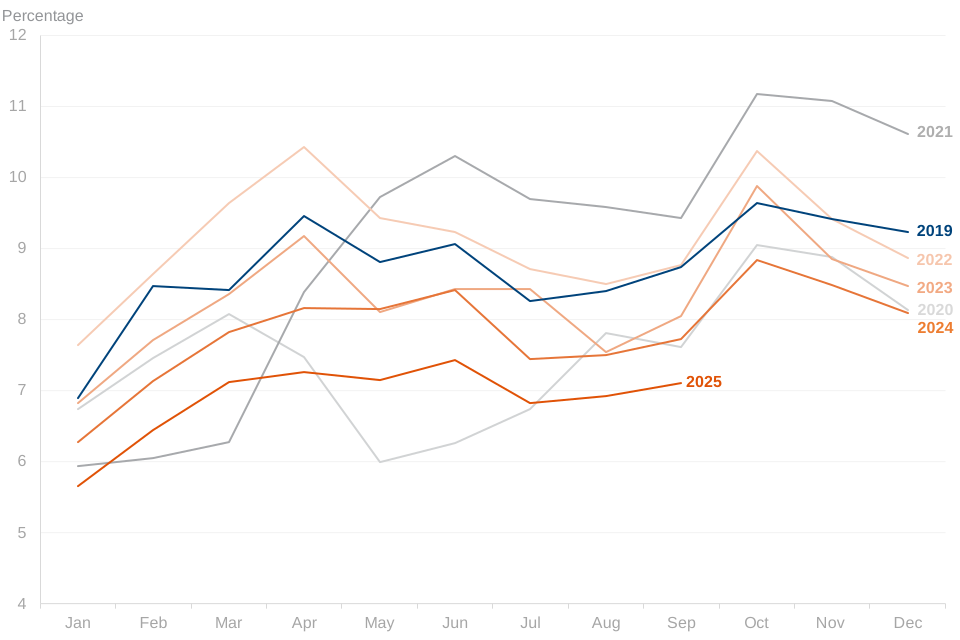
The into-work rate is influenced by the time of year. When comparing into-work rates, it is important to compare the same month across years due to this seasonality. Rates are generally lower in January and February, and the highest rates are seen in April and October, with a fall in rates over the summer. These seasonal trends are highlighted in Figure 1.
Figure 1 also shows the fall in the proportion of customers moving into work in more recent years. Given that into-work rates in 2020 and 2021 were heavily influenced by the COVID-19 pandemic, the into-work rates for these years are represented in grey.
3b. Into-work rate by local authority and Jobcentre Plus district
The following statistics focus on customers in the ‘Searching for work’ conditionality regime. For customers in this regime who are out of work, we monitor proportions of customers who move into work. This is referred to as the ‘into-work rate’.
Into-work rates are influenced by the local labour market, and some variation between local authorities and Jobcentre Plus districts is to be expected.
Note that the data tables published alongside this publication include a longer time series of into-work rates by local authority and Jobcentre Plus district (from 2019).
There is variation in into-work rates across Britain with higher rates often found in more rural local authorities
Figure 2: Monthly average into-work rate by local authority, Great Britain, October 2024 to September 2025
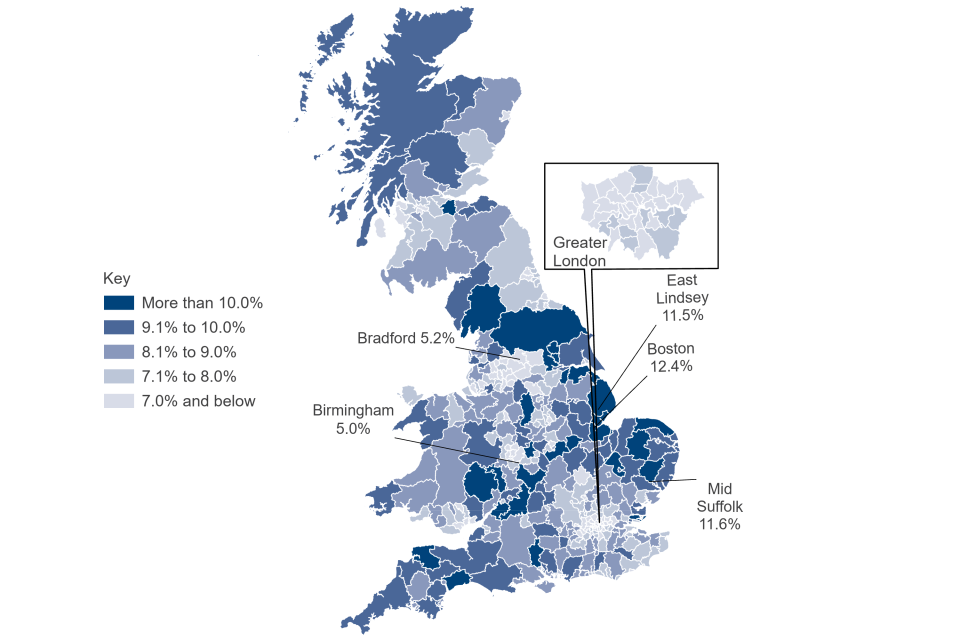
From October 2024 to September 2025, over a quarter of local authorities had an average monthly into-work rate of 9.0% or higher, as shown in Figure 2. The local authorities with the highest average monthly into-work rate were Boston (12.4%), Mid Suffolk (11.6%) and East Lindsey (11.5%). In contrast, Birmingham and Bradford had the lowest average into-work rate over this period (5.0% and 5.2% respectively).
There is variation in into-work rates between Jobcentre Plus districts with higher rates often found in districts predominately made up of rural areas
Figure 3: Monthly average into-work rate by Jobcentre Plus district, Great Britain, October 2024 to September 2025

Figure 3 shows that 21 of the 34 Jobcentre Plus districts had an average monthly into-work rate in the range 7.1% to 9.0%, over the 12 months from October 2024 to September 2025. The districts with the highest average monthly into-work rate were North East Yorkshire & Lincolnshire (9.6%), Norfolk and Suffolk (9.5%) and Devon and Cornwall (9.3%). In contrast, Birmingham and Solihull had the lowest average into-work rate over this period (5.1%).
4. Sustained employment of Universal Credit customers
The focus of the sustained employment rate is on ‘Searching for work’, ‘Working - with requirements’ and ‘Working - no requirements’ conditionality regime customers, who have started to earn and who have managed to immediately sustain earnings.
The proportion of customers who move into work who sustain employment for at least 3 months (the 3-month sustained employment rate) fluctuates around 70%
Figure 4: 3-month sustained employment rate, Great Britain, January 2019 to September 2025

Figure 4 shows the 3-month sustained employment rate has marginally increased in recent years. In September 2025 the 3-month sustained employment rate was 69.8%. This means, of those who started working 3 months ago (in July 2025), 69.8% remained in work throughout August and September 2025, and so sustained employment for 3 months.
The proportion of customers who move into work who sustain employment for at least 6 months (the 6-month sustained employment rate) fluctuates around 50%
Figure 5: 6-month sustained employment rate, Great Britain, January 2019 to September 2025

Figure 5 shows the 6-month sustained employment rate has marginally increased in recent years. In September 2025 the 6-month sustained employment rate was 54.2%. This means, of those who started working 6 months ago (in April 2025), 54.2% remained in work for all months between April 2025 and September 2025, and so sustained employment for 6 months.
5. Measure of worklessness of Universal Credit customers
The focus of the worklessness rate is on customers who have 6 consecutive months of no earnings. It covers customers in the ‘Searching for work’ conditionality regime at the start of the 6 months.
The proportion of ‘Searching for work’ conditionality regime customers who have 6 consecutive months of no earnings (the worklessness rate) has ranged between 70% and 80% in recent years
Figure 6: Worklessness rate, Great Britain, January 2019 to September 2025
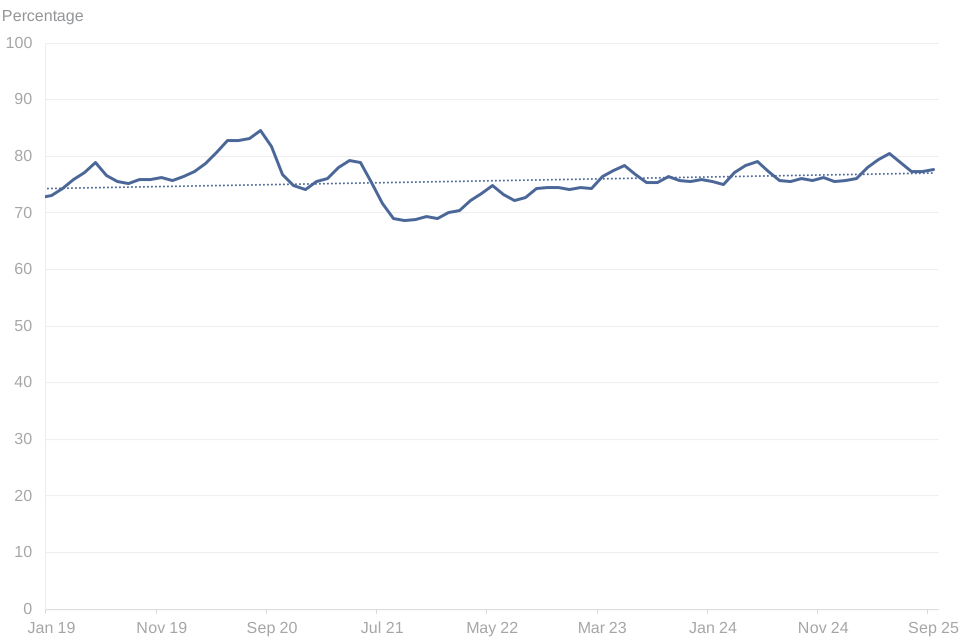
Figure 6 shows that the measure of worklessness for customers in the ‘Searching for work’ conditionality regime has ranged between 70% and 80% in recent years. The worklessness rate for September 2025 was 77.7%. This means, of those who were not working 6 months ago (in April 2025), 77.7% have remained out of work for all the months between April 2025 and September 2025 and so have had 6 consecutive months of being out of work.
The worklessness rate is lowest for younger customers, and higher for customers aged 50 and over
Figure 7: Worklessness rate by age group, Great Britain, January 2019 to September 2025
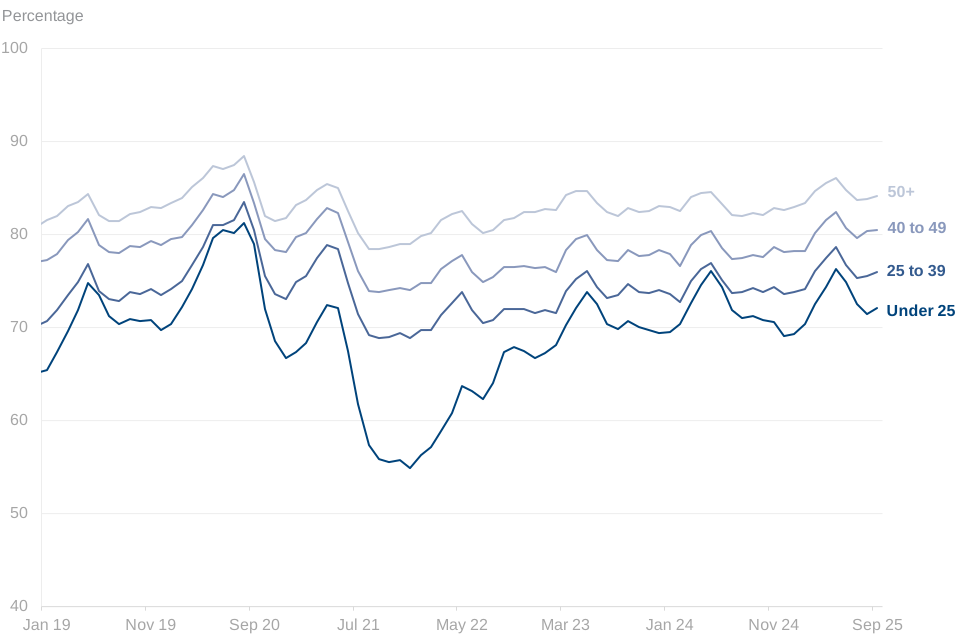
Figure 6 shows that the worklessness rate for customers in the ‘Searching for work’ conditionality regime varies with age group and that it increases as age increases. Figure 7 also shows how the worklessness rate was particularly low for young people following the COVID-19 pandemic. Customers in other age groups saw less variation over the post-COVID-19 pandemic period.
6. People on Universal Credit in employment by age group
Young people on Universal Credit (UC) are more likely to work in administrative, or accommodation and food service roles compared to other age groups
Figure 8: Sector breakdown for people on UC in employment by age group, Great Britain, March 2025

Figure 8 shows the largest 5 industrial sectors as a proportion of total employment for people on UC, broken down by age group. Although the age groups share the same top 5 sectors, there is variation in the percentages each sector accounts for. For young people aged 16 to 24 years, administrative and support service activities account for the largest share of employment among all sectors, unlike age groups 25 to 49 years and 50 to 64 years. The second largest share of employment is in the accommodation and food service activities, which reflects the strong presence of younger workers in hospitality roles.
A breakdown of how people on UC in employment are spread across all industrial sectors of the economy is available in Table 6 of the accompanying data tables.
7. Young people aged 16 to 24 years who are not in education, employment or training (NEET) across England’s regions
England has considerable variation in NEET rates. For the year ending July to September 2025, the North East had the highest NEET rate, while the South East had the lowest NEET rate
Note that the data tables published alongside this publication include a number of young people that are NEET by England’s region and a time series of NEET rates by England’s regions (from 2019).
Figure 9: NEET rates for those aged 16 to 24 years, with confidence intervals, by England’s regions, July to September 2025

For the year ending July to September 2025 the North East has the highest NEET rate, meaning young people who are NEET make up a larger proportion of that age group in comparison to other regions.
8. Young people aged 16 to 24 years who are not in education, employment or training (NEET) across England’s local labour markets
Analysis of sub-national labour markets typically focuses on regional differences across the UK. However, regional analysis can mask considerable variation at the local labour market level. Labour market types often share similar characteristics even when they are geographically distant, and these similarities strongly influence youth outcomes.
The NEET rate of a local labour market type does not correspond to the NEET rate of the local authorities that make up that local labour market type.
The ‘Industrial retirement’ local labour market type has the highest average NEET rate; over twice the rate of the ‘High growth centres’ local labour market type
Figure 10: Rate of young people aged 16 to 24 years who are NEET by local labour market type, England, October 2022 to September 2025

Figure 10 shows that the proportion of young people aged 16 to 24 years who are not in education, employment or training (NEET) differs markedly by local labour market type. The local labour market types with the lowest average NEET rates are ‘High growth centres’ (9.2 percentage points) and ‘Small cities and large towns’ (9.6 percentage points). The local labour market types with the highest average NEET rates are ‘Industrial retirement’ (23.9 percentage points) and ‘Towns in transition (17.7 percentage points). The following are examples of local authorities in these local labour market types: ‘High growth centres’ (Reading), ‘Small cities and large towns’ (Bristol), ‘Industrial retirement’ (Blackpool), and ‘Towns in transition’ (Barnsley).
9. Risk factor of young people aged 16 to 24 years not being in education, employment or training (NEET) across England’s local labour markets
There is significant variation in the risk of young people becoming NEET across local labour market types
Figure 11: Risk factor of young people aged 16 to 24 years becoming NEET, England, July 2025 to September 2025

The patterns found in Figure 10 are consistent with NEET risk factor scores found in Figure 11, which indicate that ‘Industrial retirement’, ‘Urban industrial legacy’ and ‘Towns in transition’ have the greatest vulnerability, while ‘High growth centres’ and ‘Affluent commuter belt’ remain the most resilient. The following are examples of local authorities in these local labour market types: ‘Industrial retirement’ (Chesterfield), ‘Urban industrial legacy’ (Leicester), ‘Towns in transition’ (Barnsley), ‘High growth centres’ (Reading), and ‘Affluent commuter belt’ (Buckinghamshire).
10. Apprenticeship participation of young people aged 16 to 24 years by local labour market type
Rural local labour market types have the highest uptake in apprenticeships of those aged 16 to 24 years
Figure 12: Apprenticeship participation of young people aged 16 to 24 years by local labour market type, England, August 2024 to July 2025

As shown in Figure 12, rural local labour market types dominate apprenticeship uptake, with ‘Remote rural’ showing the highest participation (6.4%). This contrasts with urban local labour market types, where apprenticeship engagement remains below 2.0%. An example of a local authority in the ‘Remote rural’ local labour market type is ‘Wiltshire’.
11a. Percentage of young people aged 16 to 24 years on the Universal Credit ‘Searching for work’ conditionality regime by local authority and local labour market type
Note that the data tables published alongside this publication include a longer time series of ‘Searching for work’ caseload proportion by local authority for those ages 16 to 24 years (from 2019). Breakdown by parliamentary constituency is also available in data table 15.
There is variation in the percentage of young people aged 16 to 24 years on the Universal Credit ‘Searching for work’ conditionality regime across Britain
Figure 13: Monthly average percentage of young people aged 16 to 24 years on the Universal Credit ‘Searching for work’ conditionality regime by local authority, Great Britain, November 2024 to October 2025

From November 2024 to October 2025, just under 1 in 10 local authorities (8.6%) had an average monthly percentage of young people aged 16 to 24 years on the Universal Credit ‘Searching for work’ conditionality regime of 6.0% or above, as shown in Figure 13. The local authorities with the highest average percentage were ‘Birmingham’ and ‘Bradford’ (8.1%). In contrast, ‘Cambridge’ and ‘Bath and North East Somerset’ had the lowest percentage over this period (1.1%).
Local labour market types with more adverse labour market characteristics have the highest percentages of young people aged 16 to 24 years on the Universal Credit ‘Searching for work’ conditionality regime
Figure 14: Monthly average percentage of young people aged 16 to 24 years on the Universal Credit ‘Searching for work’ conditionality regime by local labour market type, Great Britain, November 2024 to October 2025

Figure 14 shows that the ‘Urban industrial legacy’ (for example, Burnley) and ‘Industrial retirement’ (for example, Blackpool) local labour market types have the highest average percentage of people aged 16 to 24 years on the Universal Credit ‘Searching for work’ conditionality regime, with 6.1%. In contrast, ‘Traditional affluent’ (for example, Cambridge) and ‘Affluent commuter belt’ (for example, St. Albans) have the lowest percentage at 2.5%.
11b. Percentage of young people aged 16 to 24 years on the Universal Credit ‘No work requirements’ conditionality regime with a health condition by local authority and local labour market type
Note that the data tables published alongside this publication include a longer time series of ‘No work requirements’ with a health condition caseload proportion by local authority for those ages 16 to 24 years (from 2019). Breakdown by parliamentary constituency is also available in data table 18.
There is a regional disparity in the percentage of young people aged 16 to 24 years on the Universal Credit ‘No work requirements’ conditionality regime with a health condition across Britain
Figure 15: Monthly average percentage of young people aged 16 to 24 years on the Universal Credit ‘No work requirements’ conditionality regime with a health condition, Great Britain, October 2024 to September 2025

From October 2024 to September 2025, around one in ten local authorities (9.7%) had an average monthly percentage of young people aged 16 to 24 years on the Universal Credit ‘No work requirements’ conditionality regime with a health condition of 4.0% and above, as shown in Figure 15. The average percentage for Wales is 3.8%, Scotland is 3.2% and England is 2.3%. The local authorities with the highest average percentage were ‘Hartlepool’ (5.6%), ‘Neath Port Talbot’ (5.1%) and ‘Blaenau Gwent’ (5.1%). In contrast, ‘Oxford’ (0.6%), ‘Cambridge’ (0.7%) and ‘Guildford’ (0.8%) had the lowest proportion over this period.
‘Industrial retirement’, ‘Coastal industry’ and ‘Towns in transition’ local labour market types have the highest percentage of young people aged 16 to 24 years on the Universal Credit ‘No work requirements’ conditionality regime with a health condition
Figure 16: Monthly average percentage of young people aged 16 to 24 on the Universal Credit ‘No work requirements’ conditionality regime with a health condition by local labour market type, Great Britain, October 2024 to September 2025

Figure 16 shows that ‘Industrial retirement’ (4.1%), ‘Coastal industry’ (3.7%) and ‘Towns in transition’ (3.6%) have the highest average percentages of those aged 16 to 24 years on the Universal Credit ‘No work requirements’ conditionality regime with a health condition. In contrast, ‘High growth centres’ (1.2%), ‘London and diverse inner city’ (1.5%) and ‘Affluent commuter belt’ (1.6%) have the lowest percentages. The following are examples of local authorities in these local labour market types; ‘Industrial retirement’ (Blackpool), ‘Coastal industry’ (Port Talbot), ‘Towns in transition’ (Barnsley), ‘High growth centres’ (Oxford), ‘London and diverse inner city’ (Camden) and ‘Affluent commuter belt’ (St Albans).
12. Long-term sickness/disability inactivity rate of young people aged 16 to 24 years by local labour market type
‘Coastal industry’ local labour market type has the highest rate of those aged 16 to 24 years who are inactive due to a health-related reason
Figure 17: Average long-term sickness/disability inactivity rate of those aged 16 to 24 years by local labour market type, Britain, October 2022 to September 2025
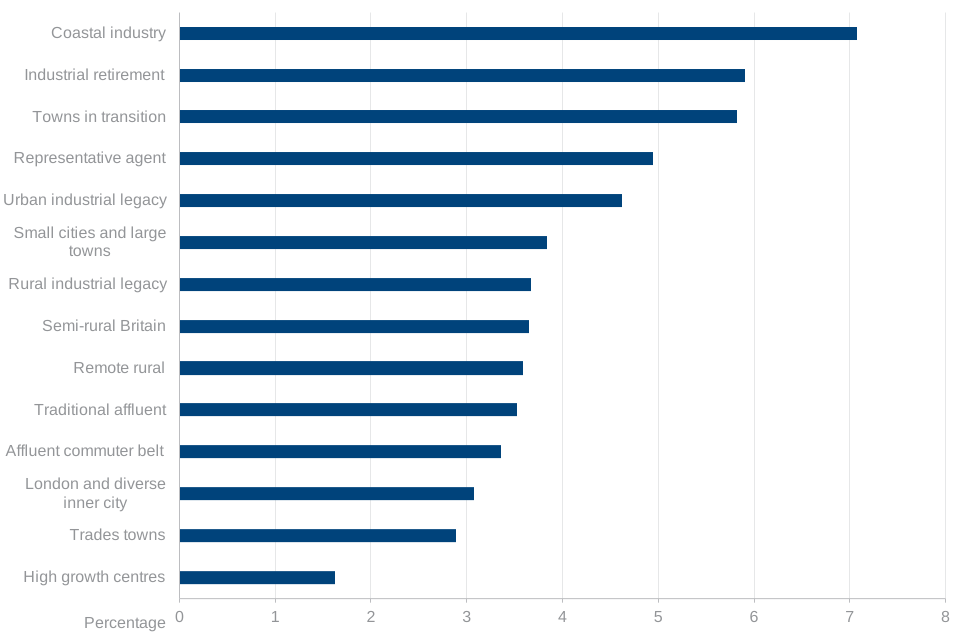
Figure 17 highlights that inactivity linked to sickness among those aged 16 to 24 years is lowest in ‘High growth centres’ (1.6%) and highest in ‘Coastal industry’ (7.1%). This suggests health-related barriers to participation are concentrated in coastal and industrial legacy areas. The following are examples of local authorities in these local labour market types; ‘High growth centres’ (Oxford) and ‘Coastal industry’ (Port Talbot).
13. About these statistics
An accompanying Background Information and Methodology paper and set of data tables complementing the results presented are available alongside the publication. This document, the statistics release and data tables can be found via the collections page.
These statistics are official statistics in development. Our statistical practice is regulated by the Office for Statistics Regulation (OSR). OSR sets the standards of trustworthiness, quality, and value in the Code of Practice for Statistics that all producers of official statistics should adhere to.
Contact information
To contact the DWP publication team email labour.marketstatistics@dwp.gov.uk.
For media enquiries contact the DWP Press Office.
Feedback is welcome.
ISBN: 978-1-78659-925-4
Next edition: April 2026
-
Users should note that UC statistics uses the term ‘conditionality regime’ in place of conditionality groups and labour market regime. Available at: Universal Credit statistics: background information and methodology - GOV.UK. ↩