Farming Investment Fund statistics September 2025
Published 29 January 2026

© Crown copyright 2026
This publication is licensed under the terms of the Open Government Licence v3.0 except where otherwise stated. To view this licence, visit nationalarchives.gov.uk/doc/open-government-licence/version/3 or write to the Information Policy Team, The National Archives, Kew, London TW9 4DU, or email: psi@nationalarchives.gov.uk.
Where we have identified any third party copyright information you will need to obtain permission from the copyright holders concerned.
This publication is available at https://www.gov.uk/government/statistics/farming-investment-fund-statistics-september-2025/farming-investment-fund-statistics-september-2025
1. Main Messages
-
As of 30th September 2025, Farming Equipment and Technology Fund has received 30,200 full applications across four annual rounds and paid £124.5 million to claimants. FETF 2024 has the highest claim amount paid at £55.9 million.
-
By quantity, the most funded items under Farming Equipment and Technology Fund are Heat Detection System Ear Tag Collar or Ankle Band (FETF91). These are followed by Nipple Drinker Systems (FETF266A) and Cow Mattresses (FETF222A).
-
As of 30th September 2025, Farming Investment Fund Large Grants have received 6,800 online applications and 1,500 full applications across 9 themes. £37.1 million has been paid out to claimants. All themes are either accepting new claims or still in application stages.
-
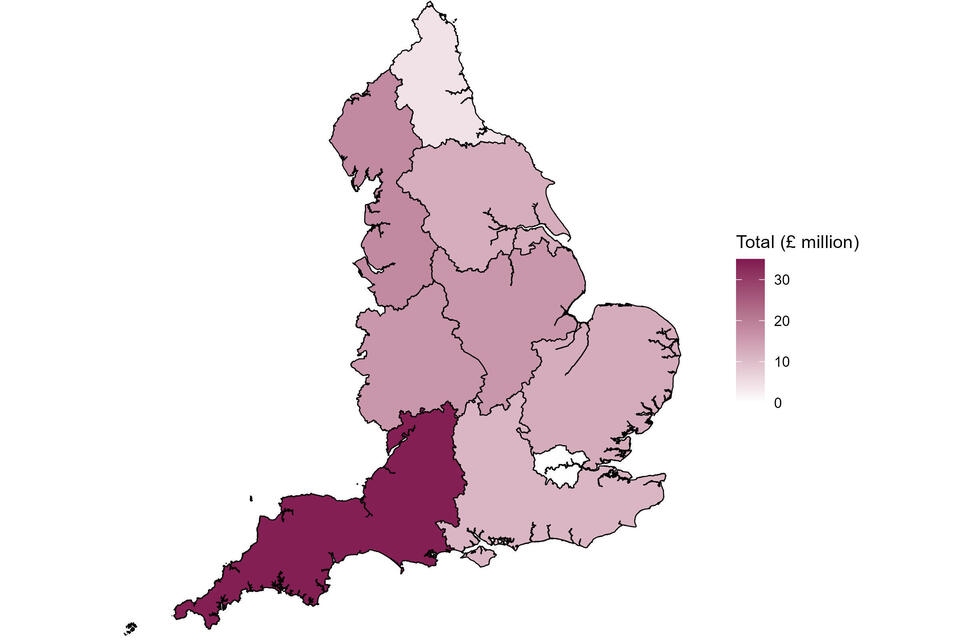
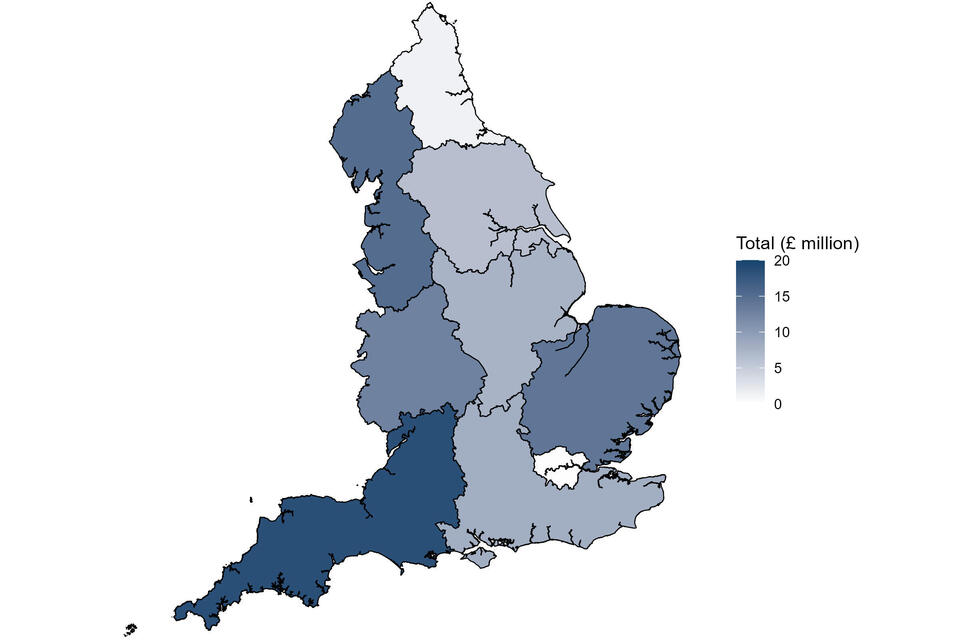
The International Territory Level One (ITL1) areas that have received the most funding are South West and North West. This applies to both Farming Equipment and Technology Fund and Large Grants separately.
2. Background
The Farming Investment Fund (FIF) is a series of grants to promote productivity, sustainability and improved animal welfare within England’s agriculture. Grants are available to farm businesses to invest in technology, equipment and infrastructure. A full list of FIF schemes can be found here
The Farming Equipment and Technology Fund (FETF) offers competitive grants to help businesses buy items that improve productivity, manage slurry and improve animal health and welfare. As of 30th September 2025, there have been four application rounds of FETF.
FIF also provides grants towards larger investments on farms, referred to in this publication as “Large Grants”. These competitive grants cover a range of themes, as detailed in Table 3, each with a specific focus and requirements. Some of these grants have also previously been referred to as “Farming Transformation Fund” in wider Defra publications.
This is the first statistical release to update on the application and claim status of the Farming Investment Fund. In addition, a breakdown of claim payments by financial year, ITL2 region, and items funded under FETF are reported in this release.
3. Farming Equipment and Technology Fund
As of 30th September 2025, FETF has received 30,200 full applications across all rounds. Application numbers have increased with each consecutive round, with FETF 2025 receiving the highest number of full applications (9,500).
13,200 claims have been paid across all FETF schemes, to a value of £124.5 million. The highest amount has been under the FETF 2024 scheme (£55.9 million).
The claim window for FETF 2025 is open from September 2025 until March 2026, therefore a low number of claims had been received at time of writing. For this reason, FETF 2025 has been excluded from statistics regarding claim payments for this publication.
Table 1: Claim amounts paid to businesses through the Farming Equipment and Technology Fund
| Scheme | Amount Paid |
|---|---|
| FETF Round One | £34.4 million |
| FETF 2023 Productivity & Slurry | £22.1 million |
| FETF 2023 Animal Health & Welfare | £12.1 million |
| FETF 2024 Productivity | £31.5 million |
| FETF 2024 Slurry | £7.9 million |
| FETF 2024 Animal Health & Welfare | £16.5 million |
| Total FETF Round One | £34.4 million |
| Total FETF 2023 | £34.2 million |
| Total FETF 2024 | £55.9 million |
| Total Farming Equipment & Technology Fund | £124.5 million |
Further information on application and claim amounts can be found in the accompanying dataset.
3.1 Items Funded
The most popular FETF items funded are “Heat Detection System Ear Tag Collar or Ankle Band” (FETF91), “Nipple Drinker System” (FETF266A) and “Cow Mattresses” (FETF222A).
Table 2: Top five items funded through the Farming Equipment and Technology Fund
| Item | Number Funded |
|---|---|
| FETF91 - Heat Detection System Ear Tag Collar or Ankle Band | 113,160 |
| FETF266A - Nipple Drinker System | 68,660 |
| FETF222A – Cow Mattresses | 31,810 |
| FETF226A - Rubber Flooring Mats for Cattle | 27,260 |
| FETF229A - Flexible Cubicle Divider | 16,860 |
Further information on items funded can be found in the accompanying dataset.
Individual items have a pre-determined maximum grant amount per item purchased. For instance, in FETF 2023, an individual item of FETF91 had a grant amount of £29, whereas FETF45 had a grant amount of £18,720. Therefore, the number of items funded does not indicate the distribution of spending.
This statistic has summarised based on item code, however some items may also change item code across rounds.
A full list of items and their grant amounts can be found in the round manuals listed in the definitions section.
3.2 Projects funded by ITL1 region
Location of FETF funding is determined by the postcode provided for where the items are intended to be used or stored. This is different to the methods determining location for Large Grants.
Figure 1 shows the location of FETF claim payments per ITL1 area for all rounds. The accompanying dataset provides detail on claim payments location by round and theme. More information about ITLs (International Territorial Levels) can be found here.
Figure 1: Heatmap of English ITL1 areas showing Farming Equipment & Technology Fund funding, value
Further information on funding location can be found in the accompanying dataset.
4. Farming Investment Fund Large Grants
As of 30th September 2025, FIF Large Grants had received 6,800 online applications across all themes and application rounds. 1,500 projects submitted a full application following an invitation from the RPA. 660 projects, valued at £84.3 million, had been approved at full application level.
The highest number of applications was received by Improving Farm Productivity round two (2,220 online applications and 690 full applications).
As of 30th September 2025, 380 Large Grants projects had received claim payments worth £37.1 million. However, claim windows on all themes were still open to projects issued a Grant Funding Agreement (GFA).
Table 3: Claim amounts paid to businesses through the Farming Investment Fund Large Grants
| Scheme | Amount Paid |
|---|---|
| Adding Value Round One | £10.5 million |
| Improving Farm Productivity Round One | £9.7 million |
| Improving Farm Productivity Round Two | £7.7 million |
| Slurry Infrastructure Round One | £2.8 million |
| Slurry Infrastructure Round Two | £245,000 |
| Water Management Round One | £5.8 million |
| Water Management Round Two | £363,000 |
| Total Farming Investment Fund Large Grants | £37.1 million |
Further information on application and claim amounts can be found in the accompanying dataset.
4.1 Projects funded by ITL1 region
Location of Large Grants funding is determined by the postcode provided for where the business undertaking the project is located. This does not necessarily provide the location where the project is being undertaken. This is different to the methods determining location for FETF.
Figure 2 shows the location of Large Grant claim payments per ITL1 area for all themes and rounds. The accompanying dataset provides detail on claim payments location by round and theme. More information about ITLs (International Territorial Levels) can be found here.
Figure 2: Heatmap of English ITL1 areas showing Farming Investment Fund Large Grant funding, value
Further information on funding location can be found in the accompanying dataset.
5. About these statistics
5.1 Datasets
These statistics are created using Rural Payments Agency data, with the exception of the International Territorial Levels ITL1 and ITL2 which are sourced from the Office for National Statistics as at November 2025.
5.2 Revisions Policy
This release has no scheduled revisions. Unscheduled revisions will follow the Defra policy on revisions and corrections.
6. Definitions
6.1 Farming Equipment and Technology Fund (FETF)
FETF employs a single-stage application process. Applicants provide a full application listing required equipment eligible for funding. The Rural Payments Agency (RPA) reviews this application and, if approved, returns a Grant Funding Agreement (GFA) to the applicant.
FETF provides equipment lists prior to application on all rounds, specifying the items that can be funded through the round and minimum specifications for funding. Between rounds, item lists and specifications can change based on stakeholder consultation. Items must be purchased from a supplier or manufacturer in order to qualify for funding.
All rounds of FETF have been competitive, based on application score. Prior to application, items are attributed individual scores based on benefits and industry adoption. Modifiers, such as vet visits and application history, can also influence application score subject to round and theme. Further information can be found in round manuals.
Where rounds had multiple themes, applicants were able to apply to more than one, with a maximum of one application per theme. Applicants were also able to apply to multiple rounds of FETF.
Farming Equipment and Technology Fund Round One
The first round of the Farming Equipment and Technology Fund (FETF Round One) launched in November 2021, accepting applications until January 2022. Claims were received until October 2022, with successful claims paid as a single lump sum in arrears.
Grants were for a minimum of £2,000 and a maximum of £25,000 at a fixed rate based on the average market value of the item. The precise grant amount available was listed in the item specifications prior to application.
Information about FETF Round One can be found here.
Farming Equipment and Technology Fund 2023
Farming Equipment and Technology Fund 2023 (FETF 2023) separated items into two themes: Productivity & Slurry and Animal Health & Welfare.
Grants were for a minimum of £1,000 and a maximum of £25,000 per theme at a fixed rate based on the average market value of the item. The precise grant amount available was listed in the item specifications prior to application.
Productivity & Slurry applications opened from February 2023 until April 2023, and from March 2023 until June 2023 for Animal Health & Welfare. Claim submission deadlines for both themes were confirmed on an individual basis when issued a Grant Funding Agreement.
Information about FETF 2023 can be found here.
Farming Equipment and Technology Fund 2024
Farming Equipment and Technology Fund 2024 (FETF 2024) further separated items into three themes: Productivity, Slurry and Animal Health & Welfare.
Productivity and Slurry applications opened from March 2024 until April 2024, and from March 2024 until May 2024 for Animal Health & Welfare. Claims for all themes were received until January 2025.
Grant availability varied by theme. Grants for Productivity and Slurry items were for a minimum of £1,000 and a maximum of £50,000. Grants for Animal Health & Welfare items were for a minimum of £1,000 and a maximum of £25,000.
Grants changed to a variable rate in FETF 2024. The RPA paid a grant amount of 50% or 60% towards either:
-
the average cost of the item, if the item cost the applicant above the expected average cost provided in the item lists prior to application.
-
the actual cost paid for the item, if the item cost less than the expected average cost provided in the item lists prior to application.
The expected average cost, percentage paid towards the item, and the maximum grant amount were listed in the item specifications prior to application.
Information about Farming Equipment and Technology Fund 2024 can be found here.
Farming Equipment and Technology Fund 2025
Farming Equipment and Technology Fund 2025 (FETF 2025) retained the three grant themes of Productivity, Slurry and Animal Health & Welfare.
Applications for all themes opened from May 2025 until July 2025. Claims for all themes are being received until March 2026.
Grants for all themes were for a minimum of £1,000 and a maximum of £25,000. FETF 2025 used a variable rate similar to FETF 2024. The RPA paid a grant amount of 40% or 50% towards either:
-
the average cost of the item, if the item cost the applicant above the expected average cost provided in the item lists prior to application.
-
the actual cost paid for the item, if the item cost less than the expected average cost provided in the item lists prior to application.
The expected average cost, percentage paid towards the item, and the maximum grant amount were listed in the item specifications prior to application.
Information about Farming Equipment and Technology Fund 2025 can be found here.
6.2 Farming Investment Fund Large Grants
Application Process
The application process for Large Grants differs from the Farming Equipment & Technology Fund, possessing at least two stages.
Initially, project details are submitted by the applicant through an online checker (referred to as an ‘online application’). The RPA reviews the online application to assess the eligibility and how well the project fits the funding priorities.
Some themes have further requirements prior to full application, such as a vet visit or design assessments. However, these only apply to specific themes, detailed further within the grant guidance documents. The outcomes of these stages are not detailed in this statistic.
If the online application scores highly enough, the project is invited to make a full application. Full applications require a higher degree of evidence for the project, including planning, financial and contextual information as requested by the RPA.
If a grant is offered following a full application, the RPA will issue a GFA to the applicant. When issued a GFA, a maximum of three claims can be submitted throughout the course of the project, paid in arrears once work is finished.
Water Management grant
Water Management grants offer subsidies towards building of on-farm reservoirs and irrigation features. Arable and horticultural businesses were eligible to apply.
Round one opened for online applications from November 2021 to January 2022. Where invited, full applications were received until November 2022 across multiple tranches.
Round two opened for online applications from April 2023 to July 2023. Where invited, full applications were received until October 2024.
Across both rounds, businesses could apply for between £35,000 and £500,000 to cover a maximum rate of 40% of eligible costs of a project.
Further information on Water Management grants can be found here for round one and here for round two.
Slurry Infrastructure grants
Slurry Infrastructure grants subsidise improvement or expansion of slurry storage capacity for at least six months, dependent on livestock. This also includes equipment required to cover and manage slurry stores.
Round one opened for online applications from December 2022 to January 2023. Where invited, full applications were received until June 2024.
Round two opened for online applications from November 2023 to January 2024. Where invited, full applications were received until June 2025.
Across both rounds, businesses could apply for between £25,000 and £250,000 to cover a maximum rate of 50% of actual invoice costs at claim stage.
Further information on Slurry Infrastructure grants can be found here for round one and here for round two.
Adding Value grant
The Adding Value grant offers funding to agricultural or horticultural growers and producers to add value to eligible agricultural products following harvest or rearing. This could include equipment intended to process, pack and market products.
Round one opened for online applications from June 2022 to July 2022. Where invited, full applications were received until January 2024. As of 30th September 2025, there was only one round of Adding Value grants.
Businesses could apply for between £25,000 and £300,000 to cover 40% of eligible project costs.
Further information on the Adding Value grant can be found here.
Improving Farm Productivity grants
The Improving Farm Productivity grants were open to horticultural and farm businesses, as well as contractors in this sector. The grants aimed to improve farm and horticultural productivity through technology to aid crop and livestock production, improve nutrient management and increase energy resilience.
Round one opened for online applications from January 2022 to March 2022. Where invited, full applications were received until January 2023.
Round one offered grants to support the use of robotic and innovation equipment and installation of slurry treatment equipment. Businesses could apply for between £35,000 and £500,000 across both themes, to cover 40% of costs. If applying for both themes, the maximum grant amount remained at £500,000 across both projects.
Round two opened for online applications from January 2025 to March 2024. Where invited, full applications were received until June 2025.
Round two allowed businesses to apply for between £25,000 and £500,000 towards robotic and automated equipment, covering 50% of eligible project costs. Businesses could also apply for between £15,000 and £100,000 towards solar equipment, covering up to 25% of costs. Both types of equipment could be applied for at their respective intervention rates, however the maximum grant amount could not exceed £500,000 when combined.
Further information on Improving Farm Productivity grants can be found here for round one and here for round two.
Calf Housing for Health and Welfare grant
The Calf Housing for Health and Welfare grant offered subsidies to beef and dairy farmers to build or upgrade existing housing for calves. This is delivered as part of the Animal Health and Welfare Pathway. As at 30th September 2025, there was only one round of Calf Housing for Health and Welfare grants.
Round one opened for online applications from September 2023 to November 2023. Where invited, full applications were received until April 2025, with some granted extensions until July 2025.
Grants were available for between £15,000 and £500,000 to cover a proportion of project costs. The intervention rate varied by equipment, covering up to 40% of eligible costs for Calf Housing, and 25% of associated solar photovoltaic (PV) systems.
Further information on the Calf Housing for Health and Welfare grant can be found here.
Laying Hen Housing for Health and Welfare grant
The Laying Hen Housing for Health and Welfare grant towards infrastructure projects aimed at improving poultry welfare and environmental sustainability. This is delivered as part of the Animal Health and Welfare Pathway. As at 30th September 2025, there was only one round of Laying Hen Housing for Health and Welfare grants.
Round one opened for online applications from June 2024 to September 2024. Where invited, full applications are being received until April 2026.
The grants offer two rates based on project type, however businesses can only apply for one project type.
Grants for comprehensive projects are available for between £15,000 and £500,000 to cover 40% of eligible project costs. However, the grant only funded 25% of costs towards rooftop solar PV systems associated with the project.
Grants for veranda-only projects are available for between £5,000 and £100,000 to cover 40% of project costs. Veranda-only projects are also non-competitive, provided on a first-come-first-serve basis.
Further information on the Hen Housing for Health and Welfare grant can be found here.
7. Official status
The option uptake and business data within this publication are Official statistics. Official statistics are statistics produced by Crown bodies and other organisations included on one of the Official Statistics Orders, on behalf of the UK government and devolved administrations. These are official statistics, guided by the UK Statistics Authority’s Code of Practice for Statistics.
8. Contact details
Joseph Butler
Email: FCPStatsandReporting@defra.gov.uk