Forecasts of Farm Business Income by type of farm, England, 2025/26
Updated 8 September 2026
Applies to England

© Crown copyright 2026
This publication is licensed under the terms of the Open Government Licence v3.0 except where otherwise stated. To view this licence, visit nationalarchives.gov.uk/doc/open-government-licence/version/3 or write to the Information Policy Team, The National Archives, Kew, London TW9 4DU, or email: psi@nationalarchives.gov.uk.
Where we have identified any third party copyright information you will need to obtain permission from the copyright holders concerned.
This publication is available at https://www.gov.uk/government/statistics/farm-business-income/forecasts-of-farm-business-income-by-type-of-farm-england-202526
Forecasts of Farm Business Income by type of farm, England, 2025/26
This statistical release provides forecasts of Farm Business Income (total output generated by the farm business minus total farm costs) for 2025/26 alongside results from recent years (Table 1.1). Data on farm business incomes are used to monitor and evaluate Government policies and to inform wider research into the economic performance, productivity and competitiveness of the agricultural industry. The data are also widely used by the industry for benchmarking.
These figures are for March/February years with the latest estimates covering the 2025 harvest and including the 2025 delinked Basic Payment Scheme (which is included within the total farm output and therefore contributes to Farm Business Income). Actual survey results for this period will be published in December 2026.
The forecasts for 2025/26 are derived from information available in early February 2026 for prices, livestock populations, marketings, crop areas, yields and input costs. They are intended as a broad indication of how incomes for each farm type are expected to move compared with 2024/25. For longer term trends see the Farm Income time series.
The forecasts are subject to a margin of error, reflecting, in particular, the fact that farm income is derived as the relatively small difference between total output and total input; small percentage changes in either of these can result in large percentage changes in income.
It should also be noted that, within each year, there is a wide range in income across farms around the average figures published here.
Key results
-
With the exception of dairy farms and lowland grazing livestock farms, average Farm Business Income (FBI) is expected to fall in 2025/26. This continues the considerable variability seen in incomes across recent years. It is important to view these changes in the context of long term trends and a series from 2004/05 is published in the Farm Income time series.
-
The picture is mixed in terms of key drivers, but lower cereal prices compounded by extremely variable yields in 2025 are forecast to be a major factor impacting FBI, alongside the reduction to the delinked Basic Payment and, in some cases, lower agri-environment payments. Small increases to total input costs are also expected to be a contributory factor lowering FBI for some farm types.
-
On cereal farms, FBI is expected to fall by two thirds to £17,000 reflecting a combination of lower output from cereals and the reduction to the delinked Basic Payment. At £54,000, average FBI for general cropping farms is forecast to halve compared to 2024/25, with a decrease in crop output a key factor.
-
On dairy farms, average FBI is forecast to rise by 45% to £224,000. The primary driver is expected to be the higher volume of milk produced across the survey year (March 2025 to February 2026) rather than farmgate price, which saw a downward trend towards the end of the period.
-
On lowland grazing livestock farms increased output from cattle, supported by exceptionally strong prices, is expected to be a key determining factor increasing FBI by 9% to £45,000.
-
At £37,000, average FBI for Less Favoured Area (LFA) grazing livestock farms is forecast to be 8% lower than 2024/25 with reduced output from the delinked Basic Payment and lower income from agri-environment payments more than offsetting an increase in livestock output.
-
Lower output from pigs (reflecting downward movement for finished and store pig prices) is forecast to be one of the main factors driving down FBI by around 41% for specialist pig farms to £75,000.
-
No income forecasts have been produced for specialist poultry or horticulture farms as forecasts would be subject to a considerable degree of uncertainty, reflecting both the structure of this sector and the relatively small sample of these farms in the Farm Business Survey.
-
Although variation between farm types is forecast, the 2025 delinked Basic Payment is expected to fall by just over two thirds at the all farm level and average net income from agri-environment payments be around 5% lower. This fall follows considerable increases to agri-environment payments for some farm types in 2024/25.
Points which apply throughout
-
The Farm Business Survey is the source for all data presented in tables and figures unless otherwise stated.
-
All figures relate to England, unless otherwise stated and, on average, cover a March to February fiscal year, with the most recent year shown ending in February 2026. Fiscal years are shown in YYYY/YY format, for example, the period of 2024 is shown as 2024/25. To ensure consistency in harvest/crop year and commonality of subsidies within any one Farm Business Survey year, only farms which have accounting years ending between 31 December and 30 April are included in the survey. Aggregate results are presented in terms of an accounting year ending on the last day of February, which is the approximate average of all farms in the Farm Business Survey.
-
All financial figures have been rounded to the nearest £100 except forecasts which are rounded to the nearest £1,000. All percentages have been rounded to the nearest 1% and have been calculated using the unrounded data.
-
The data presented are current values unless otherwise stated.
-
The acronym ‘LFA’ refers to Less Favoured Area. These areas were established in 1975 to provide support to mountainous and hill farming areas. They are areas where the natural characteristics (geology, altitude, climate, short growing season, low soil fertility, or remoteness) make it difficult for farmers to compete.
-
The forecasts reflect the 2025 delinked Basic Payment. In 2025, payments up to £30,000 attracted a 76% reduction, over £30,000 a 100% reduction.
-
Historically the forecasts have only considered changes to agri-environment payments. However, from 2024/25, to reflect the growing importance and increasing scale of agri-environment activities, an estimation for associated costs has been incorporated. These are included in the forecasts for all farm types.
-
While output from diversification activities has always been included, in an effort to improve this part of the forecast estimates, a new approach has been taken for 2025/26 based on the diversified output trends seen in recent years across Farm Business Survey respondents.
User engagement
In line with Defra’s User Engagement for Statistics Policy Statement and the Code of Practice for Official Statistics we are committed to ensuring that our statistics are of value and meet user needs and we welcome any feedback or suggestions regarding this publication. To provide feedback, you can email us at: fbs.queries@defra.gov.uk . You can also register as a user of the FBS statistics publications. Registering as a user means we will be able to contact you regarding any user engagement activities that we may run, such as seeking feedback on proposed changes.
1 Farm Business Income by farm type
Figure 1.1 Average Farm Business Income (£ per farm) by farm type, England 2024/25 and 2025/26 forecast
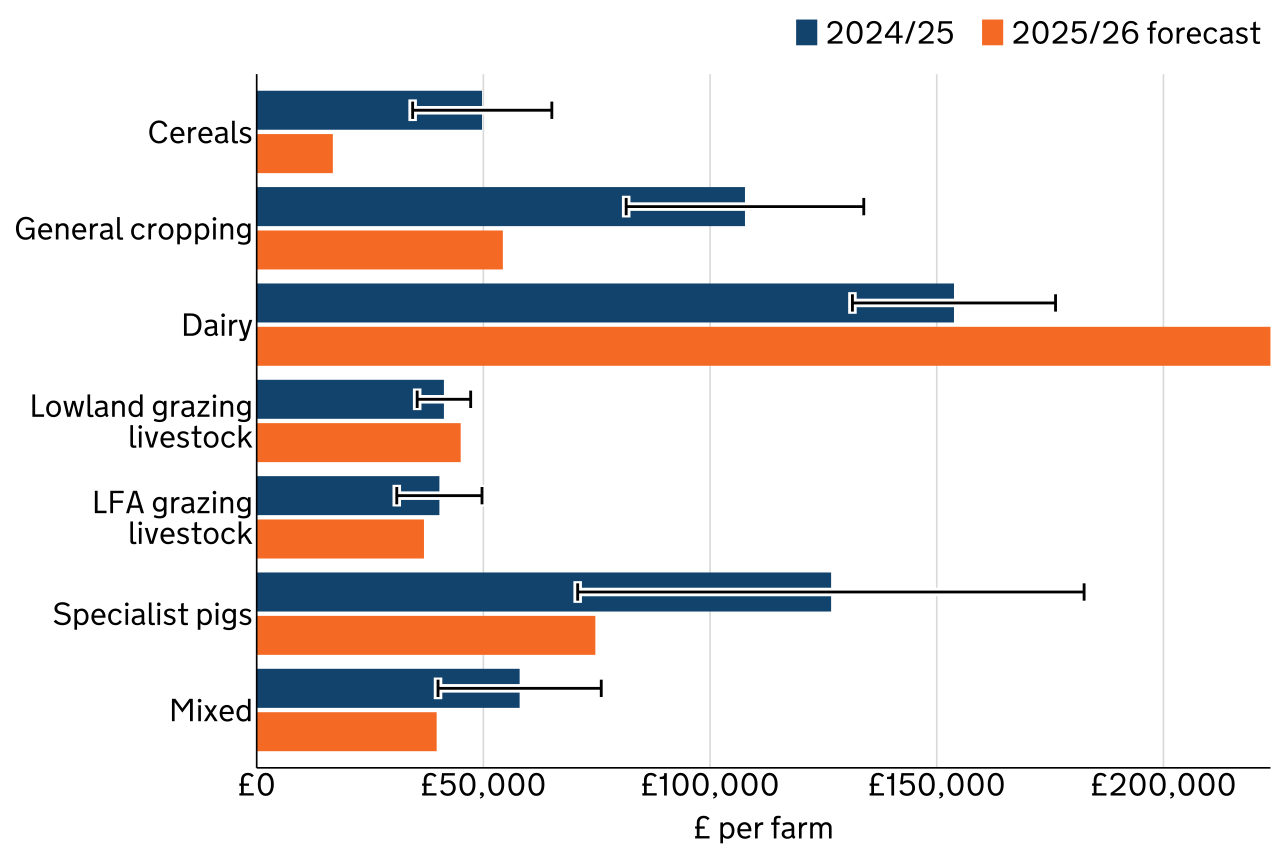
Figure note:
- The legend is presented in the same order as the bars.
- 2024/25 values are shown here with 95% confidence intervals, which give an indication of the degree of uncertainty around an estimate; the lower and upper limits show the possible range around the published averages.
Table 1.1 Average Farm Business Income per farm at current prices (£/farm)
| Farm Type | 2022/23 | 2023/24 | 2024/25 | 2025/26 forecast | % Change from 2024/25 to 2025/26 |
|---|---|---|---|---|---|
| Cereals | 143,300 | 41,500 | 49,700 | 17,000 | -66% |
| General cropping | 116,400 | 104,400 | 107,700 | 54,000 | -50% |
| Dairy | 228,600 | 73,000 | 153,800 | 224,000 | 45% |
| Grazing livestock (Lowland) | 24,100 | 18,500 | 41,300 | 45,000 | 9% |
| Grazing livestock (LFA) | 25,100 | 25,100 | 40,300 | 37,000 | -8% |
| Specialist pigs | 72,500 | 134,600 | 126,700 | 75,000 | -41% |
| Mixed | 67,200 | 22,700 | 58,000 | 40,000 | -32% |
Table notes:
- Data for forecast year rounded to the nearest thousand.
- The percentages shown are calculated against the unrounded figures and are rounded to the nearest 1%.
- Years ending at end of February.
1.2 Average Farm Business Income per farm in real terms at 2025/26 prices (£/farm)
| Farm Type | 2022/23 | 2023/24 | 2024/25 | 2025/26 forecast | % Change from 2024/25 to 2025/26 |
|---|---|---|---|---|---|
| Cereals | 164,400 | 44,800 | 51,600 | 17,000 | -67% |
| General cropping | 133,600 | 112,700 | 111,800 | 54,000 | -51% |
| Dairy | 262,300 | 78,700 | 159,700 | 224,000 | 40% |
| Grazing livestock (Lowland) | 27,700 | 20,000 | 42,900 | 45,000 | 5% |
| Grazing livestock (LFA) | 28,800 | 27,100 | 41,900 | 37,000 | -12% |
| Specialist pigs | 83,200 | 145,200 | 131,500 | 75,000 | -43% |
| Mixed | 77,200 | 24,500 | 60,200 | 40,000 | -34% |
Table notes:
- Data for forecast year rounded to the nearest thousand.
- The percentages shown are calculated against the unrounded figures and are rounded to the nearest 1%.
- Years ending at end of February.
- Real terms prices use the latest GDP deflator data, published 20 February 2026 at: http://www.ons.gov.uk/economy/grossdomesticproductgdp/timeseries/ybgb/ukea.
1.1 Cereal Farms
In 2025/56, average Farm Business Income on cereal farms is expected to fall by two thirds to £17,000 (Figure 1.1 and Table 1.1). This represents the lowest income level seen for cereal farms since the present time series began in 2004/05. The fall is forecast to be largely driven by lower output from cereals along with the reduction to the delinked Basic Payment. For cereals, limited rain in some regions led to poor germination, while the summer drought particularly impacted crops on lighter soils which experienced significant water and heat stress. Overall, yields were extremely variable and this variability coincided with plentiful global supplies placing downward pressure on prices. On average, output from wheat fell by around 6% and barley 22%, reflecting both the lower prices and yields. For barley, the situation was compounded by a 10% reduction in crop area. Oilseed rape output increased on these farms, but not enough to offset the larger reduction for cereal enterprises meaning total crop output was 9% lower than 2024/54. For cereal farms, output from the delinked Basic Payment is forecast to fall by 72% and the net income from agri-environment payments is expected to fall by around 11%. Total input costs are expected to increase slightly (1%) with falls for building depreciation, seeds and other crop costs being offset by increases for other inputs including labour and fertilisers. Based on the trends seen in recent years, output from diversified activities is forecast to rise by around 7%.
1.2 General Cropping Farms
At £54,000, average Farm Business Income on general cropping farms is forecast to halve in 2025/26 (Figure 1.1 and Table 1.1). Lower crop output, which is predicted to fall by 13%, is expected to be a key factor. Output for oilseed rape and field beans is forecast to rise. However, it is anticipated that these increases will be more than offset by lower output for cereal crops, potatoes and sugar beet. For potatoes, lower prices due to a plentiful European crop and slightly lower yields are expected to reduce output. Compared to 2024/25, output from sugar beet is forecast to fall by just over a quarter mainly due to a reduction in crop area and average price. Input costs are predicted to rise by around 2% with increases to labour, crop and machinery costs the biggest contributors. An increase in diversified output of around 10% (based on recent trends) is expected to be insufficient to offset the combined reduction to output from the delinked Basic Payment and net income from agri-environment activities.
1.3 Dairy Farms
For dairy farms, Farm Business Income is forecast to rise by 45% to £224,000 in 2025/26 (Figure 1.1 and Table 1.1), bringing average income towards the high point level seen in 2022/23. The primary driver is expected to be the higher volume of milk produced between March 2025 to February 2026 (an increase of around 7% at the England and Wales level, Defra statistics), rather than farmgate price, which saw a downward trend towards the end the survey period. Cull cow and dairy breeding cattle prices, which remain robust, are also predicted to have a positive impact on livestock output, which is forecast to rise by 11%. Input costs are expected to increase by 3% largely driven by considerably higher feed costs following the summer drought, which forced some farmers to place their cows on full rations much earlier than usual. Output from diversification is forecast to rise by around 9% (based on trends in recent years for diversified activities) and net income from agri-environment payments by a quarter. For dairy farms, average output from the delinked Basic Payment is predicted to fall by nearly two thirds compared to 2024/25.
1.4 Lowland Grazing Livestock Farms
On lowland grazing livestock farms average Farm Business Income is expected to increase by 9% in 2025/26 (Figure 1.1 and Table 1.1) to £45,000, the highest level for this farm type since the present timeseries began in 2004/05. Output from cattle enterprises, which typically make the biggest contribution to livestock output on lowland farms, is forecast to increase by 17% supported by exceptionally strong prices for both store and finished animals. Output from sheep is expected to remain similar to 2024/25 with continued firm prices for store and finished lambs tempered by slightly lower throughput. A small fall in net income from agri-environment payments will be more than offset by higher output from diversified activities (estimated based on recent trends). Taking all these factors together, along with the reduction to the delinked Basic Payment, total output at the business level is forecast to increase by 4%. Input costs are expected to rise by 2% with feed seeing the largest cost increase. This is likely to reflect the impact of the hot summer on grass growth and be driven by a combination of increased volumes (rather than price) for purchased feed along with higher fodder prices.
1.5 Less Favoured Area (LFA) Grazing Livestock Farms
At £37,000, Farm Business Income on LFA grazing livestock farms is forecast to be 8% lower than 2024/25, which saw the highest level of income for this farm type since the present series began in 2004/05. Livestock output is expected to increase by 13% with similar drivers to lowland farms alongside continuing high values for sheep breeding stock, often an important source of income on upland farms. Based on recent trends, a rise of around 5% to diversified output is expected. However, these increases will be more than offset by the fall in output from the delinked Basic Payment combined with lower net income from agri-environment payments, resulting in total output unchanged at the business level when compared to 2024/25. At the same time, input costs are forecast to rise by 2%. While small increases are expected across a range of inputs, as with lowland farms, the main contributing factor is forecast to be feed costs which are predicted to increase by 13%.
1.6 Specialist pig farms
The Farm Business Survey sample for specialist pig farms is relatively small, meaning that individual farms can have a large influence on the results and the results should be treated with caution.
On specialist pig farms average Farm Business Income is predicted to fall by 41% to £75,000 (Figure 1.1 and Table 1.1) with a 7% drop in output from pig enterprises the main driver. Although production is expected to be reasonably stable, finished pig prices, while remaining relatively strong in the first part of the year, declined steadily over the second half of the survey period. Store and cull sow prices also moved downwards. It has been assumed that pig output on contract rearing pig farms will not be impacted to the same extent by the fall in pig prices. Therefore, the overall impact of pig price decreases is dampened within the forecasts as contract rearing farms are significant contributors to the Farm Business Survey sample. Crop output is also expected to fall along with output from the delinked Basic Payment. Based on recent trends, output from diversified activities is expected to increase by around 9%. At the business level, these combined factors are predicted to produce a fall in total output of 7%. Input costs are expected to be 1% lower with a 5% reduction in feed costs (reflecting lower grain prices) the main driver.
1.7 Mixed Farms
On mixed farms, Farm Business Income is expected to fall by 32% to £40,000 (Figure 1.1 and Table 1.1). This type of farm reflects all the enterprises found in the more specialist farm types reported above. The decrease in average income is forecast to be primarily due to a fall in crop output of 11% (largely driven by cereals). The lower delinked Basic Payment is also expected to be another key factor reducing overall Farm Business Income. Input costs are predicted to rise by 2%, most notably for labour, feed and fertilisers.
2 What you need to know about this release
2.1 Availability of results
All Defra statistical notices can be viewed at:
www.gov.uk/government/organisations/department-for-environment-food-rural-affairs/about/statistics
Results from the Farm Business Survey, including time series in spreadsheet format, can be found at:
www.gov.uk/government/collections/farm-business-survey
The next release is expected to be in October/November 2024. The definitive publication date will be announced on the research and statistics webpage on gov.uk.
2.2 Contact details
Responsible statistician: Alison Wray
Public enquiries: fbs.queries@defra.gov.uk
For media queries between 9am and 6pm on weekdays:
Telephone: 0330 041 6560
Email: newsdesk@defra.gov.uk
2.3 National Statistics Status
Accredited official statistics are called National Statistics in the Statistics and Registration Service Act 2007. An explanation can be found on the Office for Statistics Regulation website. Our statistical practice is regulated by the Office for Statistics Regulation (OSR). OSR sets the standards of trustworthiness, quality and value in the Code of Practice for Statistics that all producers of official statistics should adhere to.
These accredited official statistics were independently reviewed by the Office for Statistics Regulation in January 2014. They comply with the standards of trustworthiness, quality and value in the Code of Practice for Statistics and should be labelled ‘accredited official statistics’.
You are welcome to contact us directly with any comments about how we meet these standards (see contact details above). Alternatively, you can contact OSR by emailing regulation@statistics.gov.uk or via the OSR website.
Since the latest review by the Office for Statistics Regulation, we have continued to comply with the Code of Practice for Statistics, and have made the following improvements:
-
Reviewed and improved data presentation to better meet accessibility guidelines.
-
Automated production of the statistics using Reproducible Analytical Pipelines (RAP).
-
Reviewed and improved accompanying commentary.
3 Technical note
3.1 Survey coverage, weigthing and accuracy
The Farm Business Survey (FBS) only includes farm businesses with a Standard Output of at least £21,000, based on activity recorded in the previous June Survey of Agriculture and Horticulture. In 2024/25, the sample of 1,426 farms represented approximately 49,300 farm businesses in England.
Initial weights are applied to the FBS records based on the inverse sampling fraction for each design stratum (farm type and farm size). Dataset table 16 from the Farm Accounts in England publication (published 22 January 2026) shows the distribution of the sample compared with the distribution of businesses from the 2025 June Survey of Agriculture. These initial weights are then adjusted, using calibration weighting, so that they can produce unbiased estimates of a number of different target variables. These variables have been updated due to the Basic Payment Scheme data no longer being available in 2024/25. The detailed technical note on the weighting methodology has been updated to reflect the changes in the calibration model.
As a result of the weighting changes, the data 2022/23 and 2023/24 were revised in the 2024/25 Farm Business Income publication. Alongside this change, the 2024 Standard Labour Requirement coefficients were also applied back to 2022/23. More detailed information about the FBS can be found on the Technical notes and guidance page. This includes information on the data collected, information on calibration weighting and definitions used within the FBS.
In common with other statistical surveys, the published estimates from the FBS are subject to sampling error, as we are not surveying the whole population. More detailed information about the FBS and the data collected can be found at: https://www.gov.uk/farm-business-survey-technical-notes-and-guidance.
The forecasts shown in this release for 2025/26 are provisional, based on information available in early February 2026 for prices, livestock populations, marketings, crop areas and yields. The relative changes, compared to the previous 12 months, are then applied to aggregate data from the most recent FBS for each robust farm type. A level of estimation is necessary, particularly for variables where no market information is available. Outturn results (which will be published in December 2026 based on results for the 2025/26 FBS), could differ from these forecasts for several reasons. These include changes to the sample and to the weighting framework. In 2024/25, of the 1,426 farms that were included in the FBS sample around 150 farms came into the sample that weren’t present in 2023/24. In addition, the FBS weights are refreshed each year in line with the latest farm population data from the June Survey of Agriculture.
3.2 Farm type classification
From 2023/24, the classification of farms is based on 2017 Standard Output (SO) coefficients. The 2022/23 results have been recalculated and presented in this release to allow comparability between 2022/23 and 2023/24. The results published here are therefore not directly comparable with those published in earlier years, which are based on previous SO coefficients. More details on the impact of the SO change can be found on the Farm Business Survey Technical notes and guidance page.
3.3 Definition of Farm Business Income
For non-corporate businesses, Farm Business Income represents the financial return to all unpaid labour (farmers and spouses, non-principal partners and their spouses and family workers) and on all their capital invested in the farm business, including land and buildings. For corporate businesses it represents the financial return on the shareholders capital invested in the farm business.
In essence Farm Business Income is the same as Net Profit, which as a standard financial accounting measure of income is used widely within and outside agriculture. Using the term Farm Business Income rather than Net Profit, gives an indication of the measure’s farm management accounting rather than financial accounting origins, accurately describes its composition and is intuitively recognisable to users as a measure of farm income.