English Housing Survey 2024 to 2025: age cohorts
Published 14 May 2026
Applies to England

© Crown copyright 2026
This publication is licensed under the terms of the Open Government Licence v3.0 except where otherwise stated. To view this licence, visit nationalarchives.gov.uk/doc/open-government-licence/version/3 or write to the Information Policy Team, The National Archives, Kew, London TW9 4DU, or email: psi@nationalarchives.gov.uk.
Where we have identified any third party copyright information you will need to obtain permission from the copyright holders concerned.
This publication is available at https://www.gov.uk/government/statistics/english-housing-survey-2024-to-2025-age-cohorts/english-housing-survey-2024-to-2025-age-cohorts
Introduction and main findings
The English Housing Survey (EHS) is a national survey of people’s housing circumstances and the condition and energy efficiency of housing in England. It is one of the longest standing government surveys and was first run in 1967.
This report
This report focuses on housing across the life course and is split into four chapters.
The three age cohorts we focus on for this report are households with a Household Reference Person (HRP) aged 16 to 34, households with a HRP aged 35 to 64 and households with a HRP aged 65 or over. For ease in reporting, we refer to these three age cohorts throughout this report as being “aged 16 to 34”, “aged 35 to 64” and “aged 65 or over” respectively.
The first chapter gives an overview of households in the three age cohorts of interest, including demographic characteristics and housing circumstances.
The second chapter focuses on the housing circumstances of the youngest age cohort, including household moves from tenure to tenure, mortgage details for mortgagors, buying expectations for this age group, the proportion of income spent on housing costs, overcrowding and well-being.
The third chapter examines the housing circumstances of the middle age cohort - those aged 35 to 64, including first-time buyers, mortgage information and their reasons for moving.
Finally, the fourth chapter focuses on the housing circumstances of the oldest age cohort, those aged 65 or over, and presents findings about their reasons for moving with a focus on specialist and adapted accommodation, under-occupation, the proportion of income spent on housing costs and well-being.
Background
This report brings together the latest evidence from the English Housing Survey (EHS) on housing across the life course.
Previous research, including recent EHS reports like the 2023-24 Experiences of the housing crisis report, focused on the housing challenges facing households today. Issues such as overcrowding, increasingly unaffordable housing costs and difficulty getting on the housing ladder can all have a relationship to the age of householders. For example, the report cited above shows younger households are more likely to live in overcrowded homes, spend a higher proportion of their income on housing costs, and believe it will take them longer to get on the housing ladder.
Less research has focused on the housing-related challenges facing middle and older age groups – those aged 35 to 64 and those aged 65 or over, though mid to older age can drive housing circumstances and needs. While many aged 65 or over are outright owners and/or living in underoccupied homes, households with HRPs in this age group are more likely to be retired, with lower incomes. They also face more age-related and health issues impacting their housing choices, which are less present in younger age cohorts. Around half of those aged 65 or over are living with someone with a long-term illness or disability, increasingly report loneliness since the pandemic and face additional barriers to moving home, such as their home being specifically adapted to their needs.
Those in the middle age cohort have particular housing needs and concerns too. Households with a HRP between 35 and 64 are more likely to have dependent children in the home, which can come with an increased need for bedroom space, as well as increased costs associated with this. There’s also a need for stability and housing security due to this, which is more likely achieved with home ownership rather than private renting. As a result, we see more people in this age cohort becoming home owners for the first time, or moving to larger homes – for households with children, but also for those purchasing homes on their own.
Taken together, we can see that age is associated with significant housing challenges – related to affordability, well-being, household type or characteristics – across all age cohorts. These themes will be explored in more detail throughout this report.
Main findings
Demographics of age cohorts
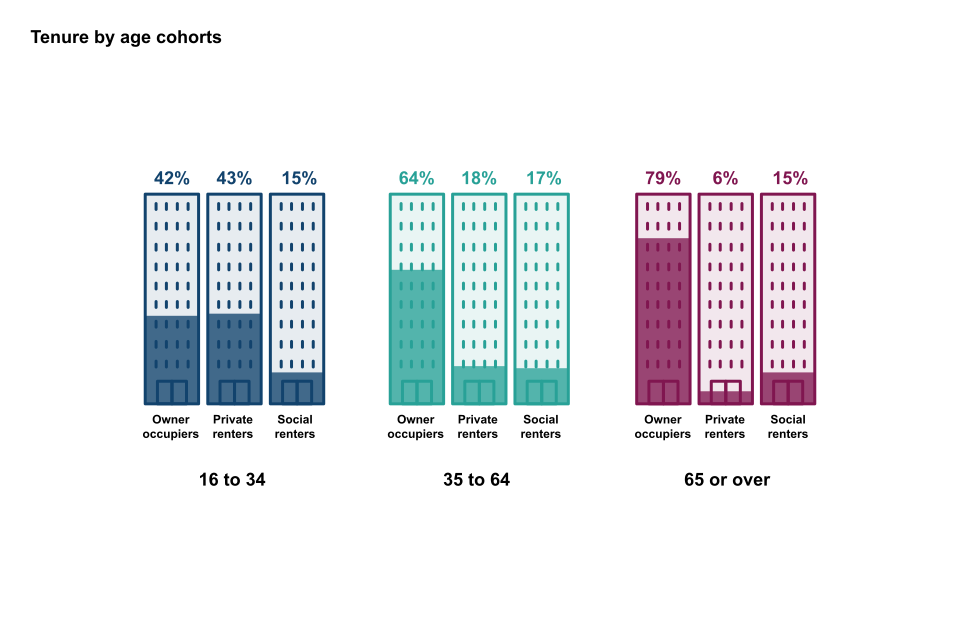
Of those with HRPs aged 16 to 34, 42% were owner occupiers in 2024-25, with a similar proportion of private renters (43%). The remaining 15% were social renters.
Both of the older age cohorts had a higher proportion of owner occupiers (64% for those aged 35 to 64 and 79% for those aged 65+) and therefore less private and social renters than the 16-34 age cohort.
Nearly a third (32%) of those aged 65 or over were in the lowest income quintile (one), while a further 27% were in the second lowest income quintile (two). These were larger proportions than those aged 16 to 34 or those aged 35 to 64.
A greater proportion of those aged 35 to 64 were in the highest income quintile (five) at 27% than those aged 16 to 34 (21%) or those aged 65 or over (7%).

16-34 age cohort
In the EHS 2024-25, just over two-thirds (69%) of those aged 16 to 34 expected to buy a home eventually, similar to the proportion who thought this 10 years ago (69% in 2014-15).
In 2024-25, just under half (49%) expected it would take 5 years or longer before they bought a home, one-third (34%) expected it to take between 2 to 5 years, while 11% expected it to take 1 to 2 years.

35-64 age cohort
In 2024-25, there were about 352,000 households with a HRP aged 35 to 64 who were recent first time buyers – an increase from 155,000 in 2014-15.
In 2024-25, 2 in 5 (41%) of recent first time buyers aged 35 to 64 were couples with dependent children and 1 in 4 (25%) were couples with no children – similar proportions as in 2014-15. However, the proportion of recent first time buyers who were one person households has increased from 9% in 2014-15 to 25% in 2024-25.

65 and over age cohort
Households in the 65 and over age group who said they were not planning to move were asked their reasons why. The most commonly selected reasons were: because their home currently meets their household needs (76%), they like the local area where they live (73%), they like the size/features of their home (69%), they currently live close to friends or family (53%) and moving would be inconvenient or disruptive (26%).
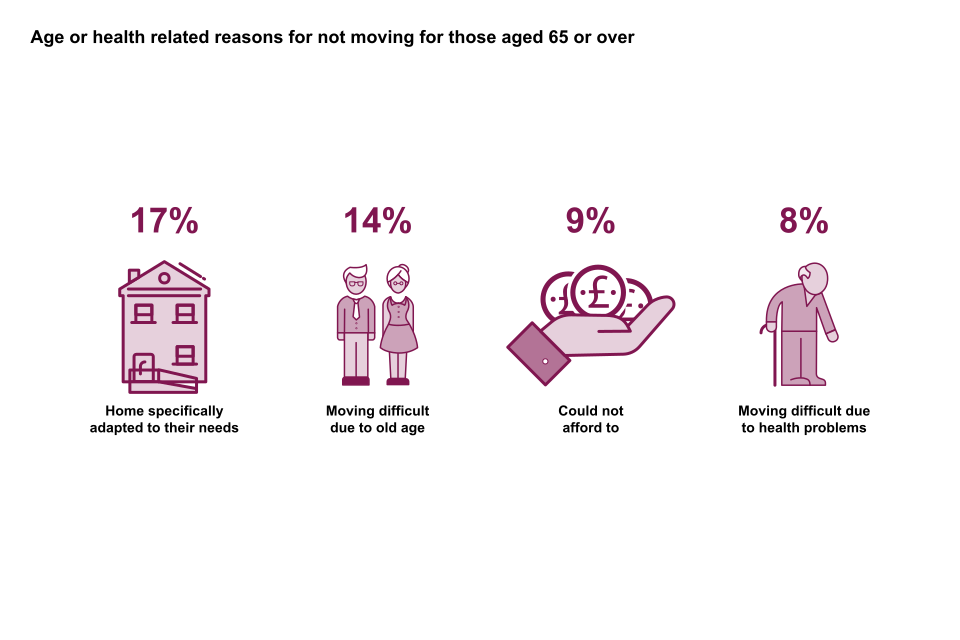
Smaller proportions did not want to move for reasons that were age related or personal to their circumstances, such as because their home was specifically adapted to their needs (17%), moving was difficult due to their old age (14%), they could not afford to (9%) and because moving was difficult due to their health problems (8%).
Trends across age cohorts
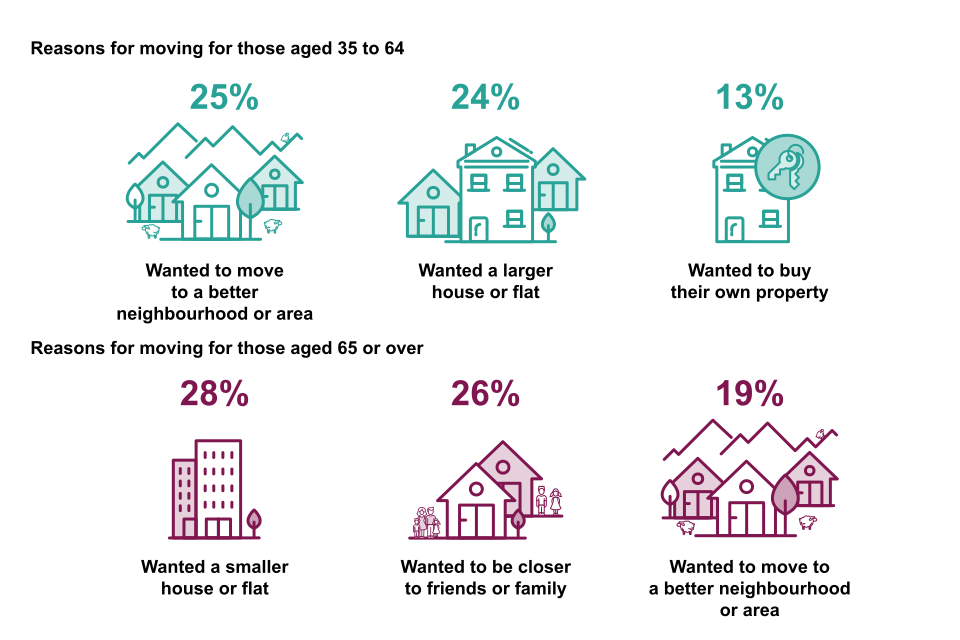
Reasons for moving differed substantially by age group. The most common reasons those aged 35 to 64 gave for wanting to move was because they wanted to move to a better neighbourhood or area (25%, 622,000 households), wanted a larger house or flat (24%, 587,000 households) and wanting to buy their own property (13%, 319,000 households).
In comparison, the most common reasons for those aged 65 or over for wanting to move was because they wanted a smaller house or flat (28%, 151,000 households), followed by 26% (139,000 households) who wanted to move to be closer to friends or family and to live in a better neighbourhood or area (19%, 99,000 households).
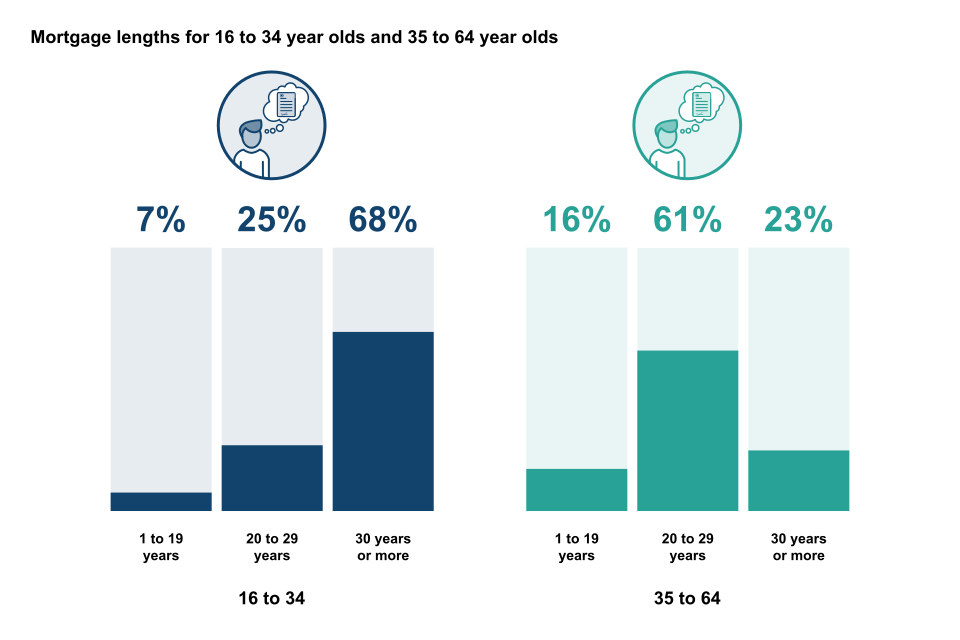
For those aged 16 to 34, the most common mortgage length was 30 years or more (68%), followed by a quarter (25%) who had 20 to 29 year mortgages and 7% who had mortgages of less than 20 years.
However, for those in the 35 to 64 age cohort, the most common mortgage length was 20 to 29 years (61%), with 23% having a mortgage of 30 years or more and the remaining 16% having a one to 19 year mortgage.
For the youngest age cohort (16 to 34) who had bought property, the most common sources of deposit were: savings (78%), gift or loan from family (29%) and sale of previous home (21%).
For those aged 35 to 64, the top sources were the same but in a slightly different order, with savings (55%) still the most common source, followed by sale of previous home (49%) and gift or loan from family (13%).

Acknowledgements and further queries
Each year the English Housing Survey relies on the contributions of a large number of people and organisations. The Ministry of Housing, Communities and Local Government (MHCLG) would particularly like to thank the following people and organisations, without whom the 2024-25 survey and this report, would not have been possible: all the households who gave up their time to take part in the survey, the National Centre for Social Research, the Building Research Establishment (BRE) and CADS Housing Surveys.
This report was produced by Suhul Ahmed, Yoli Oswald and Charlie Ridley-Johnson at The National Centre for Social Research, in collaboration with Kelly Finnerty at MHCLG.
If you have any queries about this report, would like any further information or have suggestions for analyses you would like to see included in future EHS reports, please contact ehs@communities.gov.uk.
The responsible analyst for this report is: Kelly Finnerty, Data, Analysis, Statistics and Surveys Division, MHCLG. Contact via ehs@communities.gov.uk.
1. Profile of age cohorts
This chapter provides an overview of the demographic characteristics of the three age cohorts. It first examines the age cohorts by tenure and compares 2024-25 to findings from 10 years ago in 2014-15, before moving on to summarise the demographic characteristics of these cohorts now, including the quality of their home.
To put these findings into context, it is worth noting that due to the way the Household Reference Person (HRP) is defined (as the person in whose name the accommodation is owned or rented; in the case of joint owners or renters: the person with the higher income, if income is the same: the person who is oldest) results in HRP’s being more likely to be male where there are joint owners or renters and the income criteria means they are more likely to be of working age in the higher income quintiles in the case of joint ownership too.
Age and tenure, over time
In 2024-25, there were approximately 4.4 million households where the HRP was aged 16 to 34, about 13.2 million households where the HRP was aged 35 to 64 and roughly 7.5 million households where the HRP was aged 65 or over in England, Annex Table 1.1.
Looking first at those aged 16 to 34, 42% in this age cohort were owner occupiers in 2024-25. This was a similar proportion to the 43% who were private renters – the only age cohort where the proportion of households living in owner occupied or private rented accommodation was similar. Those aged 16 to 34 were more likely to live in private rented homes than those in other age cohorts, and less likely to be owner occupiers than other age cohorts.
Most of those aged 35 to 64 (64%) and of those aged 65 or older (79%) were owner occupiers. In addition, 18% of those aged 35 to 64 years old were private renters as well as 6% of those aged 65 or older.
The proportion of each age cohort living in social rented accommodation was similar (varying from 15% to 17%).
Compared to 10 years ago, in 2014-15, there are now a higher proportion of households aged 16 to 34 living in owner occupied homes (2024-25: 42%; 2014-15: 31%), fewer privately renting (2024-25: 43%; 2014-15: 50%) and fewer living in social rented housing (2024-25: 15%; 2014-15: 18%).
Meanwhile, for those aged 35 to 64, there are now fewer households in this age group living in owner occupied homes (2024-25: 64%; 2014-15: 68%) and more living in private rented homes (2024-25: 18%; 2014-15: 16%) than in 2014-15. The proportion living in social housing has remained stable (both 17%).
For those aged 65 or older, there are more households living in owner occupied homes (2024-25: 79%; 2014-15: 77%) and fewer living in social housing (2024-25: 15%; 2014-15: 18%) in 2024-25 than 10 years ago in 2014-15. The proportion of households with a HRP aged 65 or older living in private rented accommodation has remained similar (both 6%).
Demographic and economic characteristics of age cohorts
Gender of HRP
Across age cohorts, a greater proportion of HRPs were male than female (ages 16 to 34: 54% male, 46% female; aged 35 to 64: 57% male, 43% female; aged 65 or over: 53% male, 47% female). This is in line with figures for EHS households in 2024-25 as a whole, where 55% of HRPs were male and 45% of HRPs were female, Annex Table 1.2.
Households aged 35 to 64 had a higher proportion of male HRPs at 57% and a lower proportion of female HRPs at 43% than those aged 65 or over (53% male, 47% female). The dominant household type for the 35 to 64 age cohort is couples with dependent children and the definition of the HRP makes them more likely to be male, because of the link to income and the higher likelihood of women in this age cohort working part time or in the home while raising children.
Long-term illness or disability
Looking across the different age cohorts, as the age of HRP increased, so too did the proportion of households in each age group where someone living there had a long-term illness or disability, Annex Table 1.3.
For those aged 16 to 34, just under a quarter (24%) lived in a home with someone with a long-term illness or disability. This rises to just over a third (35%) for those aged 34 to 65 and to nearly half of those aged 65 or over (49%).
Ethnicity
Just under a quarter (24%) of households with a HRP aged 16 to 34 were also households where the HRP was from a minority ethnic group. This was a greater proportion than households aged 35 to 64, where 20% of households had a minority ethnic HRP, and those aged 65 or over, where only 5% of households had a minority ethnic HRP.
Income quintiles
Nearly a third (32%) of those aged 65 or over were in the first (lowest) income quintile, while a further 27% were in the second lowest income quintile (two). This was a higher proportion than those aged 16 to 34 (income quintile one: 16%; income quintile two: 17%) or those aged 35 to 64 (income quintile one: 15%; income quintile two: 17%).
A higher proportion of those aged 35 to 64 were in the highest income quintile (five) at 27% than those aged 16 to 34 (21%) or those aged 65 or over (7%).
It is important to put these figures into context. Households with a HRP aged 65 or over mainly had a pension as their main source of income, which tends to provide a lower income than earnings from work. Additionally, it takes time to build careers and for people to achieve higher-earning salaries, so it is unsurprising the middle age cohort had a higher income than the youngest age cohort.
Household type
Broadly, the household type of different age cohorts reflect the life course.
Nearly a third (31%) of those aged 16 to 34 were living as a couple without children, this household type was less prevalent (21%) for those aged 35 to 64, but more prevalent (37%) for those aged 65 or over. Therefore, a greater proportion of those aged 65 or older were living in this type of household than the other age cohorts.
More than a fifth (22%) of those aged 16 to 34 and 28% of those aged 35 to 64 were living as a couple with dependent children, whereas fewer than 1% of households aged 65 or over were this type.
Just under 1 in 10 (9%) of those aged 16 to 34 were living in shared households, where adults were sharing a home with other adults, a higher proportion than either those aged 35 to 64 or those aged 65 or over (both 1%).
Over half (54%) of those aged 65 or over were living in single person households. This was the highest proportion of any age cohort, greater than the 28% for those aged 16 to 34 and 26% of those aged 35 to 64.
Length of residency
Generally, those aged 16 to 34 lived in their current home for less time, and as the age of the cohort increased so too did the length of time households lived in their current home.
Just over a fifth (21%) of those aged 16 to 34 had lived in their home for less than one year, compared to 6% of those aged 35 to 64 and 2% of those aged 65 or over.
Just under a quarter (24%) of those aged 35 to 64 lived in their home for 5 to 9 years, and a further 24% lived in their home for 10 to 19 years – higher proportions than those aged 16 to 34 or those aged 65 or over.
Nearly 2 in 5 (39%) of those aged 65 or older lived in their home for 30 years or more, a greater proportion than the other age cohorts.
Satisfaction with accommodation
Overall, rates for satisfaction with accommodation were high across all three age cohorts. The majority of those aged 16 to 34 (84%), those aged 35 to 64 (87%) and those aged 65 or over (94%) were satisfied with their accommodation, with those aged 16 to 34 being the least satisfied and those aged 65 or over the most satisfied, Annex Table 1.4.
The same proportion (both 8%) of those aged 16 to 34 and those aged 35 to 64 were dissatisfied with their accommodation. Meanwhile for those aged 65 or over, 3% were dissatisfied with their home.
Decent homes
For a dwelling to be considered ‘decent’ under the Decent Homes Standard it must:
- meet the statutory minimum standard for housing (the Housing Health and Safety System (HHSRS) since April 2006), homes which contain a Category 1 hazard under the HHSRS are considered non-decent
- be in a reasonable state of repair
- have reasonably modern facilities and services
- provide a reasonable degree of thermal comfort
The Decent Homes Standard (DHS) was introduced as a regulatory standard in the social rented sector in 2006. In the owner occupied and private rented sector, the DHS is not a regulatory standard, though it is tracked through the EHS. Regulatory standards in the private rented sector are assessed against the existing Housing Health and Rating System (HHSRS), i.e. Criterion A of the DHS.
On 28 January 2026, the government announced a new Decent Homes Standard to apply to both private and social rented sectors from 2035. This report presents data on the existing Decent Homes Standard.
Overall, the majority of each age cohort lived in a decent home, with 86% of those aged 16 to 34 and 85% of those aged 35 to 64 and those aged 65 or over living in decent homes, Annex Table 1.5.
Nevertheless, this does mean a sizeable minority of between 14% and 15% of each age cohort (a similar level across age cohorts) were living in homes classified as non-decent. This represents around 581,000 households where the HRP was aged 16 to 34, just under two million households where the HRP was aged 35 to 64 and about 1.1 million households where the HRP was aged 65 or over.
2. Housing circumstances of those aged 16 to 34
This chapter looks specifically at households where the HRP was aged between 16 and 34 years old. It focuses first on household moves, before reporting findings on mortgage types and deposits for home ownership, buying expectations, housing costs, overcrowding and well-being.
Household moves
Overall, about 919,000 households with a HRP aged 16 to 34 moved in the last year, Annex Table 2.1.
Many of these moves were made by households in the private rented sector, either through churn within the sector (moving from one private rented home to another) or through moves out of the private rented sector into other tenures.
Just over two-fifths (43%) of households who bought a home in the last year had previously been private renters. Two-thirds (66%) of current private renters had previously been private renters.
Deposits and mortgages
Deposit as a proportion of purchase price
Some 45% of buyers between 16 to 34 years old put down a deposit between 10 and 19% of their home’s purchase price. Smaller proportions reported deposit values of between 1 and 9% of purchase price (17%), between 20 and 29% of purchase price (19%) and between 30 and 99% of purchase price (17%), Annex Table 2.2
Type of mortgage
Nearly all mortgagors aged 16 to 34 had a repayment mortgage (98%). Fewer than 1% had an endowment mortgage (interest only), Annex Table 2.3.
Length of mortgage
In the EHS 2024-25, over two-thirds (68%) of mortgagor households aged 16 to 34 had a mortgage length of 30 years or more. This was the most common mortgage length for this age cohort, Annex Table 2.4.
A further quarter (25%) had a mortgage length of 20 to 29 years, while smaller proportions had a mortgage length of 1 to 19 years (7%).
Sources of deposit
The majority of mortgagors aged 16 to 34 had funded their deposit from their savings (78%). This was the most commonly selected source of deposit for this age group, Annex Table 2.5.
A further 29% reported the source of deposit coming in part or in full from a gift or loan from their family, and 21% from the sale of a previous home. Smaller proportions reported that the source of deposit was from an inheritance (7%), another source (3%) or indicated the question was not relevant because they had a 100% mortgage (2%). Please note that respondents could have selected more than one source for their deposit.
Buying expectations
In the EHS 2024-25, just over two-thirds (69%) of those aged 16 to 34 expected to buy a home eventually. This was more than the 31% of those aged 16 to 34 who did not expect to eventually buy a home, Annex Table 2.6.
This was very similar to the attitudes held by those aged 16 to 34 who took part in the EHS in 2014-15, 10 years ago. Just over two-thirds (69%) expected to buy a home eventually, while 31% did not expect to eventually buy a home.
Expected time needed before purchasing
Respondents who expected to buy a home were asked how long they thought it would take before they would be able to do so. Just under half (49%) of those in the youngest age cohort expected it would take 5 years or longer before they bought a home.
A further 34% expected it to take 2 years but less than 5 years to buy a home, while 11% expected it to take at least 1 year but less than 2 years.
Expect to buy their current home
Respondents were also asked if they expected to buy the current home they lived in. In 2024-25, 13% expected to buy the home they were currently living in. The majority (87%) therefore did not expect to buy their current home.
Proportion of income spent on housing costs
Private renters spent the highest average proportion of their income on their housing costs, followed by social renters, with mortgagors spending the lowest proportion of their income on housing. In 2024-25, mortgagors aged 16 to 34 spent an average (mean) of 19% of their gross household income on their mortgage. Meanwhile, private renters aged 16 to 34 spent an average of 36% of their income on rent, while social renters spent an average of 30% of their income on rent, Annex Table 2.7.
Mortgagors and renters in this age cohort in 2014-15 spent similar proportions of their income on their housing costs as in 2024-25. Mortgagors spent an average of 19% of their income on their mortgage, while private renters spent an average of 37% and social renters an average of 29% of their income on rent in 2014-15.
Region
The average proportion of income spent on housing costs varied by region. Mortgagors in London spent a higher proportion of their income on housing on average (28%) than those living in the rest of England (18%). When compared to 10 years ago, mortgagors aged 16 to 34 and living in London spent a similar proportion of their income on mortgage costs in 2024-25 as in 2014-15 (28% and 24% respectively).
Private renters aged 16 to 34 living in London in 2024-25 spent on average around a half (47%) of their income on rent, a greater proportion of their income compared to those living in the rest of England, who spent on average one-third of their income (33%). The average proportion of income spent on rent by private renters aged 16 to 34 living in London was similar in 2024-25 as in 2014-15 (46%).
Similar to private renters, social renters aged 16 to 34 living in London spent a greater average proportion of their income on rent (42%) than those living in the rest of England (28%). The average proportion of income spent on rent by all social renters aged 16 to 34 was similar in 2024-25 as in 2014-15 (30% and 29% respectively).
Income quintiles
The EHS reports on income quintiles, where all households are divided into five equal groups based on their gross household income (i.e. those in the bottom 20%, the next 20% and so on). These can be used to compare income levels of specific groups to the overall population.
Generally, as income increased, the proportion of income spent on housing costs decreased. This is the same across the different tenure groups.
Taking the different tenures in turn, for mortgagors aged 16 to 34, the average proportion of income spent on mortgage costs was greatest for those in the lowest income quintile (one) at 76% of income, and least for those in the highest income quintile (five) at 15% of income.
Similarly, for private renters aged 16 to 34, those in the lowest income quintile spent substantially more, on average, on housing costs as a proportion of their income (78%) than those in the highest income quintile (20%).
Meanwhile, for social renters aged 16 to 34, those in the lowest income quintile spent an average of 39% of their income on rent, compared to 13% of those in income quintile four, the highest reportable quintile (few social renters are in the highest income quintile).
Dependent children
For renting households aged 16 to 34, those without dependent children tended to spend a higher average proportion of their income on rent. For private renters, the average proportion of income spent on rent was 38% for those without dependent children, compared to 31% for those with dependent children. For social renters, this was 37% for those without dependent children compared to 26% for those with dependent children.
The average proportion spent on housing costs for mortgagors aged 16 to 34 was similar for those without dependent children (20%) to those with dependent children (18%).
Overcrowding
Levels of overcrowding are measured using the bedroom standard (see glossary for more detail). This is the difference between the number of bedrooms needed to avoid undesirable sharing (given the number, ages and relationship of the household members) and the number of bedrooms available to the household.
Since the number of overcrowded households included in each survey year is too small to enable reliable overcrowding estimates for any single year, data from the three most recent survey years (2024-25, 2023-24 and 2022-23) were combined to produce the overcrowding estimates in this section. Care should be taken in interpreting individual year-on-year changes.
In 2024-25, around 203,000 households with a HRP aged 16 to 34 were living in overcrowded accommodation. This represents 5% of households with a HRP aged 16 to 34, Annex Table 2.8.
Compared to 10 years ago in 2014-15, the rate of overcrowding for this age cohort remained stable. In 2014-15, 204,000 households with a HRP aged 16 to 34 were living in overcrowded accommodation. This represents 5% of households with a HRP aged 16 to 34.
Well-being
In the EHS, well-being is measured using the following four questions:
- Overall, how satisfied are you with your life nowadays? Referred to as ‘life satisfaction
- Overall, to what extent do you feel the things you do in your life are worthwhile? Referred to as ‘life is worthwhile’
- Overall, how happy did you feel yesterday? Referred to as ‘happiness’
- Overall, how anxious did you feel yesterday? Referred to as ‘anxiety’
For most questions, respondents are asked to give their answers on a scale of 0 to 10 where 0 is ‘not at all’ and 10 is ‘completely’. These questions have been included in the EHS since 2013-14.
These questions are the standard well-being questions developed by the Office for National Statistics (ONS) for the Measuring National Well-being Programme which aims to produce accepted and trusted measures on well-being in the UK.
In the EHS 2024-25, for those aged 16 to 34 scores for thinking life is worthwhile (mean of 7.7), happiness (7.4) and anxiety (3.2) were similar to (meaning statistically insignificant from) scores reported by 16 to 34 year olds in 2014-15 (life is worthwhile (7.8), happiness (7.4) and anxiety (3.0), Annex Table 2.9.
Those aged 16 to 34 in the EHS 2024-25 reported lower mean scores for life satisfaction at 7.5 compared to those aged 16 to 34 in the EHS 2014-15 (at 7.6).
Respondents were also asked about loneliness in the EHS 2024-25. Loneliness is not measured on a scale of 0 to 10 but instead by asking respondents how often they feel lonely. Response options range from ‘Often or always’ to ‘Never’. This question was included in the EHS for the first time in 2019-20.
This loneliness question is from the National Indicators of Loneliness and is a standard question used to measure loneliness.
A fifth (20%) of HRPs aged 16 to 34 felt lonely often, always or some of the time. Breaking this down, 6% often or always felt lonely and 14% felt lonely some of the time. While this is less than the 59% who hardly ever or never felt lonely (hardly ever 51%; never 27%), this nonetheless represents a sizeable proportion of households with a HRP aged 16 to 34 who report feeling lonely. A further 21% of HRPs aged 16 to 34 in 2024-25 occasionally felt lonely, Annex Table 2.10.
This was similar to 2019-20, where 20% of HRPs aged 16 to 34 felt lonely often, always or some of time, 20% felt lonely occasionally and 60% felt lonely hardly ever or never.
3. Housing circumstances of those aged 35 to 64
This chapter looks specifically at households where the HRP was aged between 35 and 64 years old. It focuses first on the demographics of recent first-time buyers in this age group, before moving on to discuss the deposit and mortgage types of mortgagors aged 35 to 64 and the reasons households in this age group move home.
Demographic characteristics of recent first time buyers
Recent first time buyers are those who bought a home for the first time in the last 3 years and had not previously owned a property. These figures often fluctuate year on year due to small sample sizes and should be considered indicative only.
Overall, in 2024-25 there were about 352,000 households with a HRP aged 35 to 64 who were recent first time buyers. Compared to 10 years ago in 2014-15, this is an increase from 155,000 first time buyers aged 35 to 64, Annex Table 3.1.
Ethnicity of HRP
In 2024-25, two-thirds (66%) of recent first time buyers ages 35 to 64 had a white HRP and one-third (34%) had an ethnic minority HRP, Annex Table 3.1.
Compared to 10 years ago, the proportions of recent first time buyers aged 35 to 64 with a white HRP and those with an ethnic minority HRP were similar (2014-15 white HRP: 63%; ethnic minority HRP: 37%).
Income quintiles
Recent first time buyers in 2024-25 aged 35 to 64 tended to be in the highest two income quintiles, with a third (34%) in income quintile four and 31% in the highest income quintile (five). Perhaps unsurprisingly, just 5% of recent first time buyers were in the lowest income quintile (one), Annex Table 3.1.
Compared to 10 years ago, this pattern was similar. Apparent differences between 2014-15 and 2024-25 in the proportion of those in income quintile four (2014-15: 26%; 2024-25: 34%) and those in the highest income quintile (five) (2014-15: 41%; 2024-25: 31%) were not significant.
Household type
In 2024-25, 41% of recent first time buyers aged 35 to 64 were couples with dependent children, the most common household type for recent first time buyers in this age cohort. In 2014-15, couples with dependent children were also the most common household type (50%) for recent first time buyers aged 35 to 64, Annex Table 3.1.
This was significantly higher when compared to the two groups with the next highest proportions in 2024-25, both 25%, for one person households and households of couples with no children.
In 2014-15, a similar proportion of recent first time buyers (31%) aged 35 to 64 were also couples with no children living in the home. However, when compared to 10 years ago, the proportion of recent first time buyers in this age cohort who were one person households has increased, from 9% in 2014-15 to 25% in 2024-25.
Deposits and mortgages
Deposit as a proportion of purchase price
Just under a third (32%) of mortgagors aged 35 to 64 put down a deposit of between 30 and 99% of purchase price. This was similar to the 30% of mortgagors aged 35 to 64 who put down a deposit of between 10 and 19% of purchase price, Annex Table 3.2.
Smaller proportions reported putting down a deposit of between 1 and 9% of purchase price (15%) or of between 20 and 29% of purchase price (17%).
Type of mortgage
Similar to the 16 to 34 age cohort, the majority (94%) of mortgagors aged 35 to 64 had a repayment mortgage, Annex Table 3.3.
Smaller proportions reported they had an interest only with no linked investment mortgage (2%) or an endowment mortgage (interest only) (2%).
Length of mortgage
Some 61% of mortgagors aged 35 to 64 had a mortgage length of between 20 and 29 years. Around a quarter reported having a mortgage length of 30 or more years (23%) and 16% reported having a mortgage length of between 1 and 19 years, Annex Table 3.4.
Given the age of HRPs in this age cohort, many are projected to still be paying off their mortgages either as they are approaching or during retirement.
Sources of deposit
Over half (55%) of mortgagors aged 35 to 64 had used savings as a source of their deposit. This was the most commonly selected source of deposit. A further 49% had sourced their deposit, in part or in whole, from the sale of a previous home, Annex Table 3.5.
Smaller proportions reported their deposit was sourced from a gift or loan from family (13%), that they had used a 100% mortgage (5%), from an inheritance (5%), from a loan/bridging loan (1%) or from another source (3%). Please note that respondents could have selected more than one source for their deposit.
Reasons for moving or not moving
For those aged 35 to 64 years old, the two most commonly selected reasons for wanting to move were to move to a better neighbourhood or area (25%) or to a larger house or flat (24%), Annex Table 3.6.
Smaller proportions reported they moved because they wanted to buy (13%), for job related reasons (13%), for some other reason not listed as an answer option (13%), to live closer to friends or relatives (10%) or due to divorce or separation (10%).
The survey also asked those who did not want to move from their current home, why this was the case. For those aged 35 to 64, the three most commonly selected reasons for not wanting to move were because they like their local area (69%), because their current home meets all their household needs (67%) or because they like the current size or features of their home (64%), Annex Table 3.7.
A further 52% of mortgagors aged 35 to 64 reported they had not moved home because they currently lived close to friends or relatives.
Smaller proportions reported they did not want to move home because moving is inconvenient or disruptive (27%), because the local schools suit their children (26%) or for job related reasons (25%). A fifth (21%) said they did not want to move because they could not afford to do so.
Meanwhile, 13% reported they did not want to move because their home was specifically adapted to their household needs, 11% wanted to wait for their children to leave home and 10% wanted to wait for retirement.
4. Housing circumstances of those aged 65 or over
This chapter looks specifically at households where the HRP was aged 65 or over. It focuses first on the reasons households in this age group have chosen to move recently or to have not moved, before examining under-occupation, housing costs and well-being.
Reasons for moving or not moving
The most common reason for those aged 65 or over for wanting to move was because they wanted a smaller house or flat (28%). This was similar to the 26% who wanted to move because they wanted to be closer to friends or family, Annex Table 4.1.
Smaller proportions reported they wanted to move because they wanted to live in a better neighbourhood or area (19%), for some other reason not included as an answer option (18%), for other family or personal reasons (12%), due to divorce or separation (6%), to move in with friends or family (6%), because their previous accommodation was unsuitable (6%) or because they had been asked to leave by their landlord (5%).
Those who were not planning to move were asked their reasons why.
The two most commonly selected reasons for why those aged 65 or over did not want to move was because their home currently meets their household needs (76%) or because they like the local area where they lived (73%), Annex Table 4.2.
Seven in ten (69%) reported they did not want to move because they liked the size or other features of their home and over half (53%) did not want to move because they currently lived close to friends or family. Around a quarter reported that they did not want to move because moving was inconvenient or disruptive (26%).
About 1.1 million households (17%) reported they did not want to move because their current home was specifically adapted to their needs (about 1.1 million households). A further 14% reported they did not want to move because moving was difficult with their old age (about 884,000 households) and 8% because moving was difficult due to their health problems (490,000 households).
In addition, some 9% of households aged 65 or over reported they did not want to move because they could not afford to.
Under-occupation
Levels of under-occupation are measured using the bedroom standard (see glossary for more detail. This is the difference between the number of bedrooms needed to avoid undesirable sharing (given the number, ages and relationship of the household members) and the number of bedrooms available to the household. A household is deemed under-occupied if it has two or more spare bedrooms than required based on the bedroom standard.
In the EHS 2024-25, around 3 in 5 (58%) of those aged 65 or over were under-occupying their home. This represents 4.3 million households, Annex Table 4.3.
This was a significant increase when compared to 10 years ago in 2014-15, where 53% of those aged 65 or over were under-occupying their home. This corresponds to about 3.4 million households under-occupying their home in this age cohort in 2014-15.
Proportion of income spent on housing costs
In discussing the proportion of income spent on housing costs it is worth noting that 74% of households with a HRP aged 65 or over were outright owners. These households are not represented in these tables as they have no direct housing costs from mortgage or rent.
In the EHS 2024-25, mortgagors aged 65 or older spent a lower average (mean) proportion of their income on housing costs (16%) than those 65 or older in either of the two rented sectors, Annex Table 4.4.
Social renters aged 65 or older spent a lower proportion of their income on rent (29%) than private renters in the same age cohort (37%).
Mortgagors, private renters and social renters aged 65 over in 2024-25 spent a similar proportion of their income on housing costs on average as those in 2014-15 (2014-15 mortgagor: 13%; private renter: 37%; social renter: 30%).
Region
Mortgagors and private renters aged 65 or over and living in London spent (statistically) similar proportions of their income on housing costs as those living in the rest of England.
Meanwhile for social renters, those aged 65 or over living in London spent a higher average proportion of their income on rent at 34% than those living in the rest of England (28%).
Income quintiles
Generally, for households aged 65 or over (and in keeping with the trend seen in younger age cohorts) as income increased the average proportion of income spent on housing costs decreased.
Looking specifically at the different tenure groups, mortgagors aged 65 or over and in the lowest income quintile spent over a third (37%) of their income on housing costs, compared to 11% for mortgagors in the highest income quintile.
Private renters aged 65 or over in the lowest income quintile spent the highest average proportion of income on rent (47%), compared to 18% for those in the highest income quintile.
Similarly, social renters aged 65 or over in the lowest income quintile spent a higher proportion of their income on rent (35%) than those in the highest income quintile (8%).
Well-being
In the EHS, well-being is measured using the following four questions:
- Overall, how satisfied are you with your life nowadays? Referred to as ‘life satisfaction’.
- Overall, to what extent do you feel the things you do in your life are worthwhile? Referred to as ‘life is worthwhile’.
- Overall, how happy did you feel yesterday? Referred to as ‘happiness’.
- Overall, how anxious did you feel yesterday? Referred to as ‘anxiety’.
For most questions, respondents are asked to give their answers on a scale of 0 to 10 where 0 is ‘not at all’ and 10 is ‘completely’. These questions have been included in the EHS since 2013-14.
These questions are the standard well-being questions developed by the Office for National Statistics (ONS) for the Measuring National Well-being Programme which aims to produce accepted and trusted measures on well-being in the UK.
In the EHS 2024-25, those aged 65 or over had reported mean well-being scores of 7.8 for life satisfaction, 8.0 for feeling life is worthwhile, 7.8 for happiness and 2.4 for anxiety, Annex Table 4.5.
Compared to 10 years ago, similar mean well-being scores were reported by those aged 65 or over for feeling life is worthwhile (2014-15: 8.0) and anxiety (2014-15: 2.4). However, those aged 65 or over reported lower scores for life satisfaction (2014-15: 8.0; 2024-25: 7.8) and happiness (2014-15: 7.9; 2024-25: 7.8) in 2024-25 than in 2014-15.
Respondents were also asked about loneliness in the EHS 2024-25. Loneliness is not measured on a scale of 0 to 10 but instead by asking respondents how often they feel lonely. Response options range from ‘Often or always’ to ‘Never’. This question was included in the EHS for the first time in 2019-20.
This loneliness question is from the National Indicators of Loneliness and is a standard question used to measure loneliness.
In 2024-25, 22% of HRPs aged 65 or over felt lonely often, always or some of the time. Breaking this down, 7% felt lonely often or always, and 15% felt lonely some of the time. A further 17% felt lonely occasionally. Three in five (61%) HRPs aged 65 or over hardly ever or never felt lonely: 25% felt lonely hardly ever and 36% never felt lonely, Annex Table 4.6.
Compared to 2019-20, the first time loneliness questions were asked in the EHS, the proportion of HRPs aged 65 or over who felt lonely hardly ever or never has remained stable (2019-20: 60%; 2024-25: 61%). However within this group, the proportion of HRPs aged 65 or over who say they never feel lonely increased to 36% in 2024-25, compared to 29% in 2014-15.
Technical notes and annex tables
Further details on the English Housing Survey methodology and glossary of terms can be found in the Technical Notes and glossary.
Underlying data for this report are published as Annex Tables