Employment Data Lab Analysis: Social Mobility Foundation Aspiring Professionals Programme
Published 19 November 2025

© Crown copyright 2025
This publication is licensed under the terms of the Open Government Licence v3.0 except where otherwise stated. To view this licence, visit nationalarchives.gov.uk/doc/open-government-licence/version/3 or write to the Information Policy Team, The National Archives, Kew, London TW9 4DU, or email: psi@nationalarchives.gov.uk.
Where we have identified any third party copyright information you will need to obtain permission from the copyright holders concerned.
This publication is available at https://www.gov.uk/government/statistics/employment-data-lab-analysis-social-mobility-foundation-aspiring-professionals-programme/employment-data-lab-analysis-social-mobility-foundation-aspiring-professionals-programme
This Employment Data Lab report presents estimates of the impact of the Social Mobility Foundation’s Aspiring Professionals Programme (APP), on the education and employment outcomes of the programme participants. The APP is aimed at supporting students in Year 12, lower sixth or S5 in Scotland from low socio-economic backgrounds across the UK. Participants have access to the programme from sixth form, through undergraduate study and on to graduation (typically five years).
The results in this report have been generated using quasi-experimental techniques which introduce some uncertainty. The results should be used with a degree of caution. Further information can be found in section 7: About these statistics, and in an associated methodology report.
Headline statistics
Increase in earnings
During the 7th tax year after starting the programme, on average, participants earned between £1,700 and £3,000 more than had they not participated. The result was statistically significant.
Increase in degrees obtained from Russell Group universities
Between 8 and 11 percentage points more participants obtained a degree from a Russell Group university after starting the programme than had they not participated. This result is statistically significant.
The main analysis focuses on a sub-group of 4,354 evaluated participants (out of 7,213) who applied to the programme between September 2011 and September 2016, and were between the ages of 16 and 18. (for more information about exclusions from the evaluation see Who was evaluated as part of the analysis?).
For this report the Employment Data Lab team used administrative data to analyse participants’ education and labour market outcomes for seven years after starting the programme.
Participants were compared to a comparison group of similar individuals to evaluate the programme.
The headline statistics were chosen before starting the analysis as the primary outcome measure to assess the success of the programme.
1. What you need to know
What is the Employment Data Lab?
The Employment Data Lab is a service provided by a team of analysts at the Department for Work and Pensions (DWP). The Data Lab provides group-level benefits and employment information to organisations who have worked with people to help them into employment. The purpose is to provide these organisations with information to help them understand the impact of their programmes. More information about the Employment Data Lab and its background.
What is the Aspiring Professionals Programme (APP)?
The APP, delivered by the Social Mobility Foundation, supports students from low socio-economic backgrounds across the UK in Year 12, lower sixth or S5 in Scotland, through university and into their first graduate job. The APP aims to help students get into top universities, such as Russell Group[footnote 1] universities. The programme also aims to help participants secure high quality graduate jobs and improve labour market outcomes, such as earnings.
The APP targeted students from low socio-economic backgrounds based on several different measures of disadvantage such as:
-
eligibility for Free School Meals
-
experience of being in care
-
whether someone would be the first generation of their family to attend university
-
household income (lower than £45,000)
-
whether someone’s parent or guardian was unemployed
Students who are eligible for Free School Meals or care experienced can be eligible for the programme on those criteria alone. Students who are not eligible for Free School Meals or care experienced need to meet at least two of the above socio-economic status criteria to be eligible for the programme. Students also had to meet grade related eligibility requirements. These include having four GCSEs at grade A or 7 or four National fives at grade A or B and being predicted ABB at A Levels or ABBB at Scottish Highers.
Over the course of the programme, participants are offered skills building and career workshops which are generally between 1-3 hours, depending on the content, though could extend to as long as a day (or 2-days overnight). Typical content that is covered at workshops can include:
-
networking skills
-
Universities and Colleges Admissions Service (UCAS) information, advice and guidance (application process, standing-out, personal statements, deadlines etc)
-
job application information, advice and guidance (how to write a CV well, application process, standing-out, recruitment centres)
-
field or area-specific information (that is, law, medicine, Oxbridge-specific information and guidance)
During the first year after joining the programme, participants are also offered personalised university application support along with the information, advice and guidance provided through workshops. The personalised university application support can include personal statement checking, where an adult volunteer reads and provides feedback on a student’s UCAS application personal statement. This can also include volunteers providing mock tests or interviews to students for some specific fields of study or universities (like medicine, law, Oxbridge). From the first year of the programme, participants are also connected with an industry mentor in their target career field. Participants also get the opportunity to attend week-long work-experience with employer partners.
During their undergraduate studies, students on the programme could also receive mentoring from a volunteer in their target career field. Participants can also receive employment support such as CV or cover letter checking and mock interviews. Through its recruiter pipeline, Social Mobility Foundation also works with specific partner employers who offer extra support and consideration to students on the APP who apply for internships or full-time employment. All APP activities are offered on an optional basis, so participants can take part in as many or as few activities as they choose.
Who was evaluated as part of this analysis?
Data was shared on 7,213 participants who started[footnote 2] the programme between September 2011 and September 2017. The main impact analysis focusses on a subset of 4,354 participants who were between 16 and 18 when they started the programme. Others were excluded from the analysis for various reasons, such as:
-
we were unable to match their details to the records we hold
-
they started the programme outside of England, so we do not hold any education history data
-
they had fewer than four GCSEs at grade A or 7 or high, so they were outside the target group for the programme
-
they applied to the programme after September 2016, so they do not have seven full years of education and employment outcomes
For more details see Appendix A.
Participant information
Of the 4,354 participants included in this analysis, the available administrative data indicated:
-
62% were female and 38% were male
-
average age was 16 years
-
42% were Asian, 28% were white, 17% were black and 13% were other ethnicities (including missing)
-
average Income Deprivation Affecting Children Index (IDACI) measure was 35%
-
38% had previously been eligible for Free School Meals (FSM)
-
7% had previously had Special Educational Needs (SEN) provisions
-
the average number of GCSEs with grades A or 7 or higher was 8
-
11% had been employed at some point in the two years before starting the programme
Further information on those who were and were not included as part of the analysis and missing markers in the administrative data can be found in Appendix A and Appendix B.
The analysis in this report
This report presents analysis on the impact of the APP by comparing education, employment and benefit outcomes of participants to those of a matched comparison group who did not participate. The comparison group is used to estimate the outcomes of participants had they not participated in the programme and was created using a method called propensity score matching (PSM). Further information about how the analysis was conducted can be found in the associated methodology document.
The following primary outcome measures were selected for this evaluation before the analysis was undertaken.
Primary outcome measures
The average annual earnings of the group in the 7th tax year after starting the programme.
The percentage of the group who obtained a degree from a Russell Group university at any time during the seven years after starting the programme.
The main analysis in this report (section 2 and section 3) presents the impacts of an individual participating in the APP.
2. The labour market impacts of the programme over time
The results show that the programme led to:
- higher average annual earnings during 7th tax year
- more classed as employed at seven years
An increase in average annual earnings during seventh tax year
During the 7th tax year after starting the programme participants earned between £1,700 and £3,000 more than had they not participated. The result was statistically significant.
An increase in employment at seven years
Between 0 and 3 percentage points more programme participants were classed as employed seven years after starting the programme than had they not participated. This result is statistically significant.
Employment Data Lab reports use four categories of labour market status (see section 7 for more details). The analysis in this section presents earnings and employment outcomes and impacts over the seven years after starting the programme. This period can include two years to complete A-levels, three years to complete an undergraduate degree, and two years of employment outcomes after completing an undergraduate degree. The participants are compared to a comparison group used to estimate the outcomes they would have achieved had they not participated in the programme. The difference between the groups can be interpreted as the impact of the programme.
Figure 1 shows the average annual salary of the participant and comparison groups in each of the seven tax years after the tax year of programme start. Table 1 provides numerical values for the participant and comparison groups’ average earnings as well as the difference between the two groups, which is the impact of the programme. The results show that the programme led to a statistically significant increase in participants’ average annual earnings from four to seven tax years after start. These results also show larger average annual earnings and impacts in later tax years as participants begin leaving education and entering the labour market.
Figure 2 shows the percentages of the participant and comparison groups in the Employed labour market category in the two years before participants started the programme and the seven years after. Table 2 provides a breakdown of the participant and comparison groups’ employment status at seven different points in time (yearly intervals from one to seven years after start). The results indicate the programme led to a statistically significant increase in participant employment from two years to seven after starting the programme. However, the size of the impacts (2-3ppt central impacts) was small compared to the percentage of participants in employment (80 percent by year seven). This indicates that the large increase in annual earnings is unlikely to be driven solely by an increase in the percentage in employment (with non-zero earnings).
Further variables can be found in Table11 in Appendix E.
Figure 1: Graph showing the average annual earnings of the participant (dark blue) and comparison (light blue) groups in each of the seven tax years after the tax year they started the programme
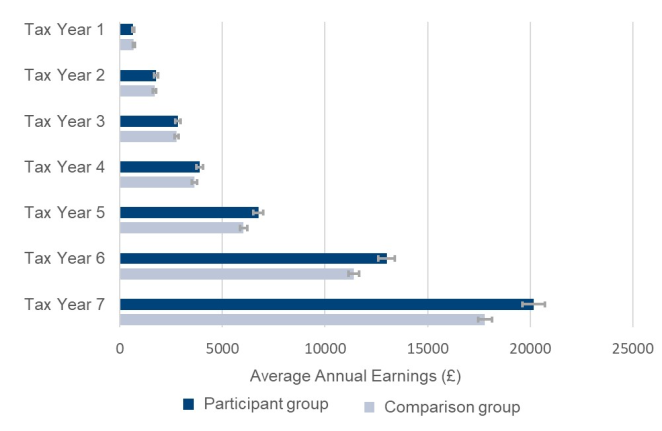
Table 1: Showing the average annual earnings for each group during each tax year from the first tax year after start to the seventh tax year after start
| Average annual earnings during the: | Participant group (£) | Comparison group (£) | Impact: Central (£) | Impact: Lower (£) | Impact: Upper (£) | Sig. |
|---|---|---|---|---|---|---|
| 1st tax year after start | 700 | 700 | 0 | 100 | 0 | no |
| 2nd tax year after start | 1,800 | 1,700 | 100 | 0 | 200 | no |
| 3rd tax year after start | 2,800 | 2,800 | 100 | -100 | 200 | no |
| 4th tax year after start | 3,900 | 3,600 | 300 | 100 | 500 | yes |
| 5th tax year after start | 6,800 | 6,000 | 700 | 400 | 1,000 | yes |
| 6th tax year after start | 13,000 | 11,400 | 1,600 | 1,100 | 2,100 | yes |
| 7th tax year after start | 20,200 | 17,800 | 2,400 | 1,700 | 3,000 | yes |
Note: Values are rounded to the nearest hundred pounds.
Figure 2: Plots showing the impact of the programme on the numbers in each labour market category over time
The plots on the left (in orange) show the percentages of the participant (solid line) and comparison (dotted line) groups in each category. The difference (or impact of the programme) is shown on the right in blue. The darker blue line shows the central estimate, and the shaded blue area is the 95% confidence interval.
2(a & b) – Employed: The impact plot (b) shows the programme had a positive and statistically significant effect on the percentage of participants who were employed in the second through seventh years after programme start. The outcomes plot (a) shows the percentage of both groups that were employed increased over time as young people left full time education and began to enter the labour market. Plot (a) then shows that approximately 80 percent of participants were in employment seven years after start, so the impact in plot (b) represents a relatively small increase in employment.
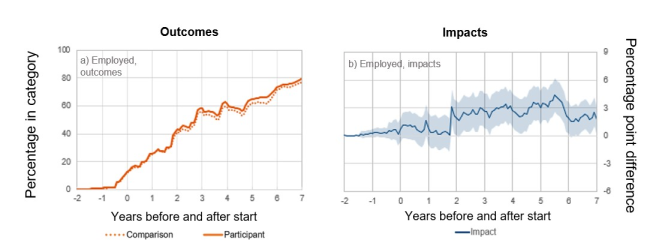
Table 2: Showing the percentage of each group in the Employed category at the end of each year from one to seven years after starting the programme. The impact, or difference, is shown along with an indication of statistical significance
The “upper” and “lower” values give the confidence interval around the central estimate of the impact. Percentage points are denoted by ppt.
| Percentage of group in category: | Participant group (%) | Comparison group (%) | Impact: Central (ppt) | Impact: Lower (ppt) | Impact: Upper (ppt) | Sig. |
|---|---|---|---|---|---|---|
| Employed (1 year) | 26 | 25 | 1 | -1 | 3 | no |
| Employed (2 years) | 44 | 42 | 2 | 0 | 4 | yes |
| Employed (3 years) | 58 | 56 | 3 | 1 | 5 | yes |
| Employed (4 years) | 62 | 59 | 3 | 1 | 5 | yes |
| Employed (5 years) | 65 | 62 | 3 | 1 | 5 | yes |
| Employed (6 years) | 73 | 71 | 2 | 0 | 4 | yes |
| Employed (7 years) | 80 | 78 | 2 | 0 | 3 | yes |
Note: Values are rounded to the nearest whole number, so impacts statistically significant at the 95% level of confidence may have a confidence interval with a lower bound of zero.
3. Impact on education and training
The results show that the programme led to:
- more degrees obtained from Russell Group universities in the seven years after start
- more level 6 qualifications obtained in the seven years after start
An increase in degrees obtained from Russell Group universities at seven years
The percentage of participants who obtained a degree from a Russell Group university after starting the programme was between 8 and 11 percentage points more than had they not participated. This result is statistically significant.
An increase in level 6 qualifications at seven years
The percentage of participants who passed a level 6 course at any point in the seven years after programme start was between 1 and 4 percentage points greater than it would have been had they not participated. This result is statistically significant
Note: Specific limitations mean that the figures in this section should be treated with a greater degree of caution. See section 7 for more details.
The figures and tables in this section show the impact of the programme on course enrolment and courses passed with a particular focus on Higher Education. Key aims of the APP were to increase university enrolment and to increase degree attainment, particularly from Russell Group universities.
Table 3 shows the impact of the programme on the percentage of participants who enrolled at a Russell group university or obtained a degree from a Russell Group university at any point during the seven years after start. This shows that the programme had a large statistically significant positive impact on both the percentage of participants who were enrolled at a Russell Group university, and the percentage of participants who obtained a degree from a Russell Group university at some point during the seven years after start.
Table 3: Showing the percentage of the participant and comparison groups who enrolled at or obtained a degree from a Russell Group university at any point during the seven years after start
| Percentage of group at Russell Group universities | Participant group (%) | Comparison group (%) | Impact: Central (ppt) | Impact: Lower (ppt) | Impact: Upper (ppt) | Sig. |
|---|---|---|---|---|---|---|
| Enrolled – during seven years after start | 59 | 49 | 11 | 9 | 12 | yes |
| Obtained a degree - during seven years after start | 53 | 43 | 9 | 8 | 11 | yes |
Figure 3 and Table 4 present graphic and numerical representations of the percentage of participants and comparators who passed a course at a specified level[footnote 3] at any point during the seven years after starting the programme. The results suggest the programme led to a statistically significant increase in the number people passing level three (A-level or equivalent) and level six (bachelor’s degree or equivalent) courses. However, the impact on level three and level six courses passed is small compared to the overall percentage of participants who passed those courses (approximately 100 percent and 65 percent respectively). The results also suggest that the programmes led to a statistically significant reduction in the number of people passing entry level courses. While the impact on entry level courses passed is statistically significant only a small percentage (approximately one percent) of participants and comparators passed entry level courses.
Figure 3: Graph showing the percentage of the participant (dark blue) and comparison (light blue) groups who passed a course at the specified level at any point during the seven years after they started the programme
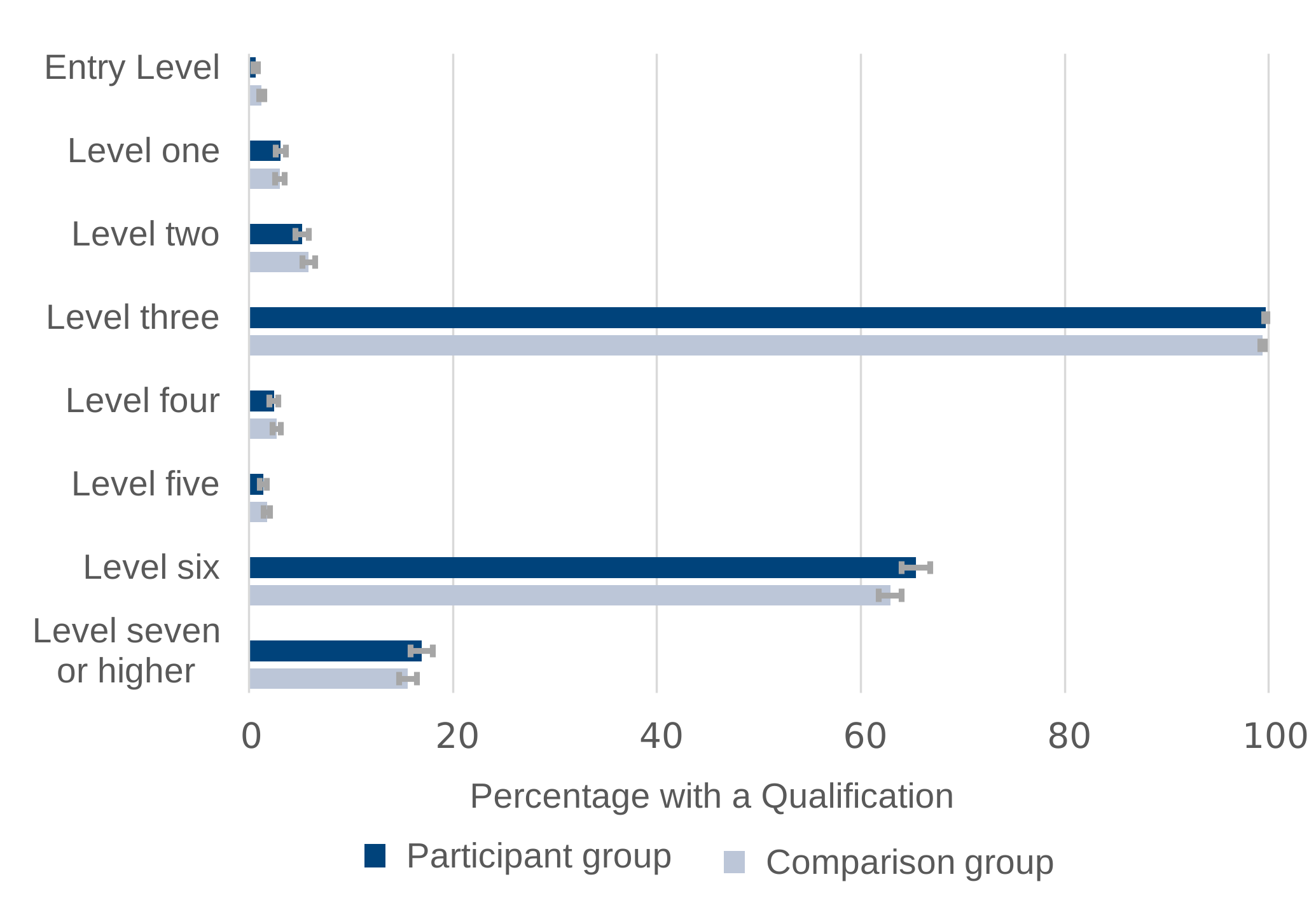
Table 4: Showing the percentage of the participant and comparison groups who passed an education or training course at the specified level at any point during the seven years after start
| Percentage who passed a course at: | Participant group (%) | Comparison group (%) | Impact: Central (ppt) | Impact: Lower (ppt) | Impact: Upper (ppt) | Sig. |
|---|---|---|---|---|---|---|
| Entry level | 1 | 1 | -1 | -1 | 0 | yes |
| Level one | 3 | 3 | 0 | -1 | 1 | no |
| Level two | 5 | 6 | -1 | -2 | 0 | no |
| Level three | 100 | 99 | 0 | 0 | 1 | yes |
| Level four | 2 | 3 | 0 | -1 | 0 | no |
| Level five | 1 | 2 | 0 | -1 | 0 | no |
| Level six | 65 | 63 | 2 | 1 | 4 | yes |
| Level seven or higher | 17 | 16 | 1 | 0 | 3 | no |
Note: Values are rounded to the nearest whole number, so impacts statistically significant at the 95% level of confidence may have a confidence interval with an upper or lower bound of zero.
Table 5 shows the percentage of participants and comparators who obtained a specified class of degree at any point during the seven years after start. This shows that for each degree class (First, Upper Second, Lower Second, Third) there was no statistically significant difference between the two groups. This would indicate that academic performance while at university was similar for both the participant and matched comparison groups.
Table 5: Showing the percentage of the participant and comparison groups who obtained the specified degree class at any point during the seven years after starting the programme
| Percentage of group who obtained degree class at any point during seven years after start: | Participant group (%) | Comparison group (%) | Impact: Central (ppt) | Impact: Lower (ppt) | Impact: Upper (ppt) | Sig. |
|---|---|---|---|---|---|---|
| First | 24 | 23 | 1 | -1 | 3 | no |
| Upper second | 33 | 32 | 1 | -1 | 3 | no |
| Lower second | 7 | 7 | 0 | -1 | 1 | no |
| Third | 1 | 1 | 0 | 0 | 0 | no |
Table 6 shows the percentage of participants and comparators who enrolled in a Higher Education or Further Education course at any point during the seven years after start. The results suggest the programme led to a statistically significant increase in the percentage of participants who enrolled in Higher Education, but the programme had no statistically significant impact on the percentage of participants who enrolled in Further Education. However, the impact on Higher Education enrolment was relatively small given that over 90 percent of the participant and comparison groups were enrolled in higher education at some point during the seven years after start. This indicates the large increase in the percentage of participants who obtained degrees from Russell Group universities is unlikely to be driven solely by an increase in Higher Education enrolment or degree attainment.
Table 6: Showing the percentage of the participant and comparison groups who were enrolled in Further Education or Higher Education at any point during the seven years after starting the programme
| Enrolled at any point during the seven years after start: | Participant group (%) | Comparison group (%) | Impact: Central (ppt) | Impact: Lower (ppt) | Impact: Upper (ppt) | Sig. |
|---|---|---|---|---|---|---|
| Further Education | 31 | 32 | -1 | -3 | 1 | no |
| Higher Education | 95 | 92 | 2 | 1 | 3 | yes |
Note: Limitations mean that the figures in this section should be treated with a greater degree of caution. See section 7 for more details.
4. Longer term impacts
For a subset of 1,453 early programme participants, it is possible to observe longer term outcomes, particularly labour market outcomes. For participants who applied to the APP on or before September 2013 it is possible to observe ten tax years of annual earnings outcomes. The impacts of the programme on average annual earnings eight, nine, and ten tax years after start can be estimated for this subgroup, allowing for additional years of potential labour market progression and associated impacts to be observed. Tables and figures below represent this subgroup of the main cohort.
Figure 4 shows the average annual salary of the participant and comparison groups in each of the ten tax years after the tax year of programme start for this subset. Table 7 provides numerical values for the participant and comparison groups’ average earnings as well as the difference between the two groups, which is the impact of the programme. The results show that the programme led to a large statistically significant increase in participants’ average annual earnings from five to ten tax years after start. The longer-term earnings outcomes also show that, for early programme participants, average earnings and the impact of the programme on average earnings continued to rise after the seventh tax year after start.
Further variables can be found in Table 12 in Appendix E.
Figure 4: Graph showing the average annual earnings of the participant (dark blue) and comparison (light blue) groups in each of the ten tax years after the tax year they started the programme
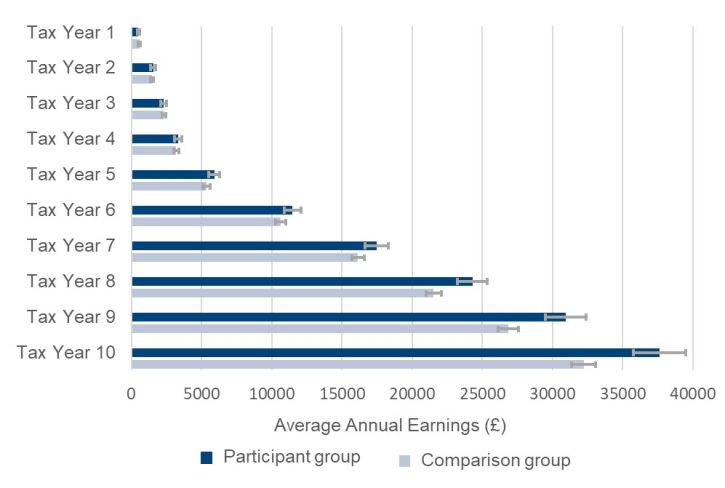
Table 7: Showing the average annual earnings for each group during each tax year from the first tax year after start to the tenth tax year after start
| Average annual earnings during the: | Participant group (£) | Comparison group (£) | Impact: Central (£) | Impact: Lower (£) | Impact: Upper (£) | Sig. |
|---|---|---|---|---|---|---|
| 1st tax year after start | 500 | 600 | -100 | -200 | 100 | no |
| 2nd tax year after start | 1,600 | 1,500 | 100 | -100 | 300 | no |
| 3rd tax year after start | 2,300 | 2,300 | 0 | -200 | 200 | no |
| 4th tax year after start | 3,300 | 3,200 | 100 | -200 | 400 | no |
| 5th tax year after start | 5,900 | 5,400 | 600 | 100 | 1,000 | yes |
| 6th tax year after start | 11,500 | 10,600 | 900 | 200 | 1,600 | yes |
| 7th tax year after start | 17,500 | 16,100 | 1,300 | 400 | 2,300 | yes |
| 8th tax year after start | 24,300 | 21,500 | 2,800 | 1,600 | 4,000 | yes |
| 9th tax year after start | 30,900 | 26,900 | 4,100 | 2,500 | 5,700 | yes |
| 10th tax year after start | 37,600 | 32,200 | 5,400 | 3,300 | 7,500 | yes |
Note: Values are rounded to the nearest hundred pounds.
5. How to use the results of this report
Two primary outcome measures were chosen to assess the success of this programme. The results suggest that the programme had a positive statistically significant impact on both measures. This suggests the programme has been successful at:
-
increasing the average annual earnings of participants during the seventh[footnote 4] tax year after the tax year they started the programme
-
increasing the percentage of participants who obtained a degree from a Russell Group university during the seven years after starting the programme
A range of secondary outcome measures were also analysed in this report (see Appendix E) and can be used to learn more about the impacts of the programme. Results marked as statistically significant indicate an estimate that is unlikely to have occurred by chance (and more likely to be a causal impact of the programme). If a result is not statistically significant it does not mean that there was no impact, it just means there was insufficient evidence to verify this to the required threshold.
The estimates in this report were generated using quasi-experimental methods that can be less reliable than experimental methods such as a randomised control trial. The results should be used with a degree of caution.
The estimates were also generated using a subset of APP participants, notably those in the age range of 16 to 18 who applied to the programme on or before September 2016. Care should be taken in generalising the results to those outside of this group.
The estimates relate to a programme working in a particular context. This report makes no assessment as to whether these impacts are generalisable to different contexts. The estimates were also made in a “business as usual” setting where participants and comparators were free to go on to access other support.
6. Social Mobility Foundation in their own words
Social Mobility Foundation have provided a description of their programme in their own words and a response to the analysis. You can find the Social Mobility Foundation’s response to analysis next to the Employment Data Lab’s analysis.
7. About these statistics
This report presents estimates of the impact of a programme. This is achieved by comparing the outcomes of the programme participants to a credible estimate of their outcomes had they not participated in the programme. This is often referred to as the counterfactual. In this report the counterfactual was generated using a quasi-experimental technique called Propensity Score Matching (PSM). This involves constructing a comparison group of individuals who did not participate in the programme but who are matched on key characteristics that affect whether an individual takes part in the programme and the outcomes that they experience as a result of participation.
Once this comparison group has been constructed the outcomes of the two groups can be compared to generate the estimate of the impact of the programme. More information about this technique and how it is used in the Data Lab can be found in the methodology report.
Categorisation
The analysis in this report is based on the labour market outcomes of the participants (and a matched comparison group) in the two years before and seven to ten years after starting the intervention. This report uses four categories of labour market status for the analysis:
-
Employed: People who are either employed or self-employed
-
Looking for Work: People who are in receipt of Jobseeker’s Allowance (JSA), or in the Universal Credit (UC) “intensive work search”, “light touch out of work”, “light touch in work”, or “working enough” conditionality regimes.
-
Inactive: People who are in receipt of inactive benefits such as Employment and Support Allowance (ESA) or in the UC “no work requirements” or “work focussed interview” conditionality regimes. Several other benefits also fall into this category, though the numbers of people on these benefits is small. See methodology report for details.
-
Other: People who do not fall into the above three categories, this could include people who are in full-time education and not working or receiving benefits or those who are in custody.
These categories are not mutually exclusive, and it is possible to be in more than one category. For example, someone working fewer than 16 hours a week may also be in receipt of JSA and would be classed as “employed” and “looking for work”.
Statistical significance
The report highlights if the results are statistically significant or not. A statistically significant result is one that is unlikely to have occurred by chance because of sampling error. If a result is not statistically significant it does not mean that the intervention has no impact, it simply means that there is not enough evidence to verify this to a required threshold. In this report, unless otherwise stated, the threshold for significance is 95%.
This report sometimes presents the central estimate of a result along with the upper and lower confidence values. These upper and lower values create a range that you would expect the estimate to fall within if the test was to be redone, within a certain level of confidence. This level is set at 95 per cent unless otherwise stated. The confidence intervals will typically be stated in the tables of results and be presented on graphs and plots as either error bars or shaded regions.
Limitations
PSM is used to construct a comparison group of individuals that are matched on key characteristics that are linked to a person’s participation in the programme and the outcome variables of interest. The validity of the technique used in this report rests on the assumption that all the characteristics that are linked to a person’s participation in the programme and the outcome variables of interest have been sufficiently accounted for in the analysis, either explicitly or otherwise. This is a strong assumption that cannot be tested and depends on the data available and on the nature of each programme and its participants. This is reviewed on a case-by-case basis in the Data Lab and impact evaluations are only carried out where the validity of this assumption is plausible. That said, these are quasi-experimental techniques that tend to be less robust than true experimental methods, such as a randomised control trial, and the results must be treated with a degree of caution. For more details see Appendix C.
Also, in PSM some participants will be excluded from the analysis because they have no matched comparator with a similar propensity score. This can potentially bias findings if that group has different outcomes. However, a sufficiently small percentage had no matched comparator, so this does not raise concerns about the representativeness of the results (for more information see Appendix C).
The programme offered university application support which is likely to appeal to people who want to attend university; this in turn is likely to affect whether someone volunteers for the programme and outcomes such as university enrolment and degree attainment. Whether or not someone wants to go to university is not directly observable in the administrative data. However, some variables such as subjects studied and previous grades may be good proxies to indirectly account for likelihood of attending university, so variables related to previous GCSE grades and A-level subjects studied have been included in the matching to mitigate this risk. Also, programme participants were selected based on high academic achievement (four or more A or A* GCSE grades), so a comparison group with similar academic achievement was selected. Table 6 showed that over 90 percent of both the participant and matched comparison groups enrolled in higher education at some point after start, so this indicates that previous grades and subjects studied are good predictors of university enrolment.
Where to find out more
Read the Employment Data Lab analysis, information and guidance.
8. Statement of compliance with the Code of Practice for Statistics
The Code of Practice for Statistics (the Code) is built around 3 main concepts, or pillars:
-
trustworthiness – is about having confidence in the people and organisations that publish statistics
-
quality – is about using data and methods that produce statistics
-
value – is about publishing statistics that support society’s needs
The following explains how we have applied the pillars of the Code in a proportionate way
Trustworthiness
Employment Data Lab reports, such as this, are published to provide User Organisations with an estimate of the impact of their programmes that support employment. Releasing them via an ad hoc publication will give equal access to all those with an interest in them.
Quality
The methodology used to produce the information in this report has been developed by DWP analysts in conjunction with the Institute for Employment Studies. The information is based on data from the User Organisation and Government administrative data. The calculations have been quality assured by DWP analysts to ensure they are robust.
Value
Producing and releasing these estimates provides User Organisations and the public with useful information about employment support provision that they may not have otherwise been able to generate or obtain.
Appendix A: Exclusions from the treatment group
Social Mobility Foundation shared data on 7,213 participants who took part in the programme between September 2011 and September 2017. The main impact analysis focussed on a subset of these participants who were aged 18 years old or under when they started the programme and started the programme on or before 1 September 2016. This was to ensure that participants were likely to have completed A-levels and University; and thus, that participants were unlikely to still be in full-time education six or seven years after start.
Figure 5 shows the distribution of programme start dates for all 7,213 programme participants, along with reasons for exclusion from the analysis. Blue bars show the start dates for the participants who could be matched to a NINO and were in England when they started the programme. The start date distribution shows an increase in annual cohort size and number of exclusions over time. However, differences in the percentage of the annual cohort excluded over time are small.
Figure 6 shows the stages that individuals were excluded from the analytical process. The final group of 4,354 participants, comprising the main analysis group used in the PSM, represent approximately 81% of the matched participants who took part during the relevant period.
Figure 5 shows the distribution of start dates of the programme participants
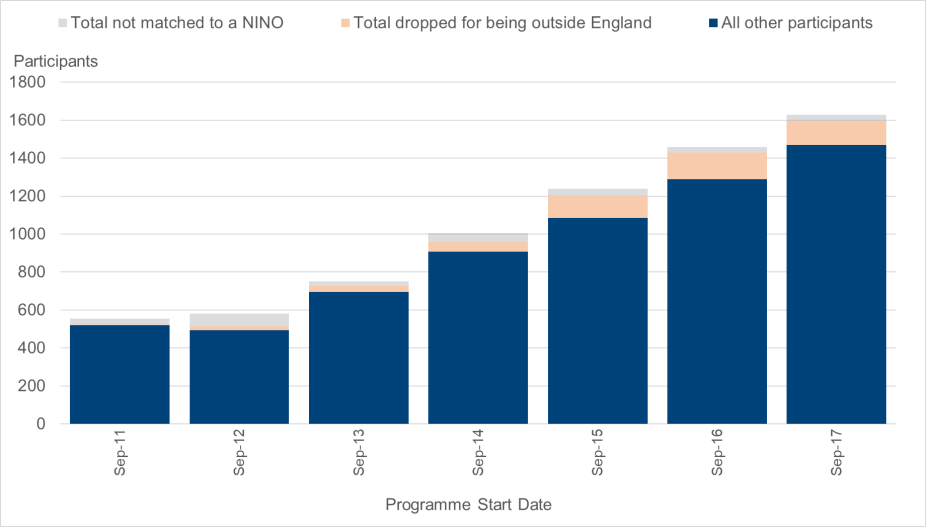
Figure 6 presents a diagram showing the numbers of participants and the stages at which they were excluded from the analysis
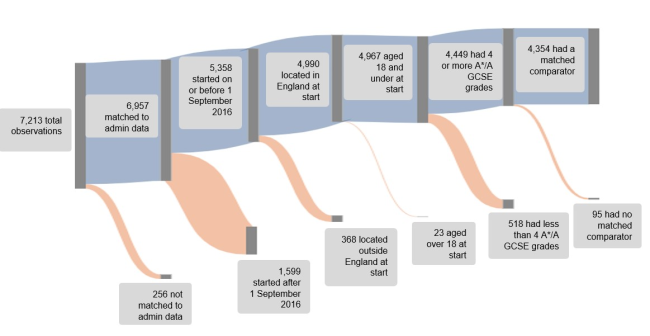
Table showing numbers of participants and the stages at which they were excluded from the analysis data from Figure 6
| Included participants | Reason for inclusion | Excluded participants | Reason for exclusion |
|---|---|---|---|
| 6957 | Matched to admin data | 256 | Not matched to admin data |
| 5358 | Started on or before 1 September 2016 | 1599 | Started after 1 September 2016 |
| 4990 | Located in England at start | 368 | Located outside England at start |
| 4967 | Aged 18 and under at start | 23 | Aged over 18 at start |
| 4449 | Had 4 or more A/A* GCSE grades | 518 | Had less than 4 A/A* GCSE grades |
| 4354 | Had a matched comparator | 95 | Had no matched comparator |
Appendix B: Participant group information
The following table displays the participant group information for the full analysis sample who could be matched to administrative data. This is then broken down into the “evaluated”; those who were selected for the evaluation, the “non-evaluated”; those who were excluded from the evaluation, and “all” of the participants, for whom data was available. This table only includes participants who could be linked to the administrative data.
Table 8: Showing characteristics, benefits and employment information for the participant group (%)
| Variable | Evaluated | Non-Evaluated | All |
|---|---|---|---|
| Observations | 4,354 | 2,603 | 6,957 |
| Age (mean years) | 16 | 16.2 | 16.1 |
| 18 years or under (%) | 100 | 99 | 100 |
| Over 18 years (%) | 0 | 1 | 0 |
| Male (%) | 38 | 35 | 37 |
| SEN marker set (%) | 7 | 7 | 7 |
| FSM marker set (%) | 38 | 27 | 34 |
| Care leaver/adopted marker (%) | x | x | 1 |
| Child in need marker (%) | 2 | 3 | 2 |
| Exclusion marker (%) | 2 | 2 | 2 |
| Permanent exclusion marker (%) | x | x | x |
| IDACI (%) | 35 | 22 | 30 |
| Employed marker (%) | 11 | 14 | 12 |
| Child on Child Benefit claim marker (%) | 97 | 92 | 95 |
| Other ethnicity (%) | 8 | 5 | 7 |
| Asian ethnicity (%) | 40 | 27 | 35 |
| Black ethnicity (%) | 17 | 14 | 16 |
| Chinese ethnicity (%) | 2 | 1 | 2 |
| Mixed ethnicity (%) | 4 | 3 | 4 |
| White ethnicity (%) | 28 | 25 | 27 |
| Missing ethnicity (%) | 1 | 25 | 10 |
| Entry level qualification (%) | 100 | 74 | 90 |
| Level 1 qualification (%) | 100 | 74 | 90 |
| Level 2 qualification (%) | 100 | 74 | 90 |
| Level 3 qualification (%) | 2 | 5 | 3 |
| Level 4 qualification (%) | x | x | x |
| Level 5 qualification (%) | x | x | x |
| Level 6 qualification (%) | x | x | x |
| Level 7 qualification (%) | x | x | x |
| Level 8 qualification (%) | x | x | x |
| Enrolled in ‘School’* at start (%) | 98 | 75 | 89 |
| Enrolled in Further Education* at start (%) | 21 | 19 | 20 |
| Enrolled in Higher Education at start (%) | x | x | x |
| Number of A*/A GCSE grades | 8 | 6 | 7 |
| Number of B GCSE grades | 2 | 2 | 2 |
| Number of C GCSE grades | 0 | 1 | 0 |
| Number of A-level courses enrolled in | 4 | 2 | 3 |
Note: Some figures which have been suppressed for disclosure control purposes are denoted by an x.
*The ‘School’ category covers any education or training spells captured in the School Census, Pupil Referral Unit Census, Alternative Provision Census, Key Stage 4 or Key Stage 5 datasets
*Education categories are not mutually exclusive and do not sum to 100 as individuals studying A-levels at Further Education colleges may be flagged as in the ‘School’ and Further Education categories
Appendix C: Matching the comparison group
PSM is used to construct a comparison group of individuals that are matched on key characteristics that are linked to a person’s participation in the programme and the outcome variables of interest. More information about this technique and how it is used in the Data Lab can be found in the methodology report.
Before proceeding with the analysis, the Data Lab team assessed the plausibility of constructing a comparison group that satisfies the conditional independence assumption that underlies PSM (see methodology report for more details). The programme was targeted at individuals with some characteristics that were well represented in the available data such as Free School Meal eligibility and GCSE grades. However, the programme was targeted at individuals who wanted to go to university, a characteristic that was not explicitly observable in the data. Other observable characteristics such as GCSE grades and A-level subjects studied, which were well represented in the available data, have been used to indirectly control for this to some degree. As over 90 percent of both the participant and matched comparison groups enrolled in higher education at some point after start, this indicates that previous grades and subjects studied can be used to identify a comparison group who are also interested in attending university.
The comparison pool was selected from the Department for Education’s (DfE) administration data and was restricted to only include individuals who were in the same age range as the participants at the time of the programme start and who completed their GCSEs during an academic year that would have made them eligible to apply for the APP (2010/2011-2017/2018 academic year). This group was then assigned a pseudo-start date of 1 September in the year after they completed their GCSEs. As the programme recruited one cohort per academic year, participants did not have an exact programme start date and only had a cohort year. Therefore, all participants were assigned a start date of the first day of the academic year of their cohort, so all start dates and pseudo-start dates fell of 1 September.
This group was then reduced further in additional steps:
-
first, stratified sampling was used to match the distribution of A or 7 or above GCSE grades between the participant and comparison groups. This ensures the two groups have similar levels of academic achievement and therefore programme eligibility.
-
the comparison pool was restricted further by stratified sampling that matched the distributions of the comparison and participant Key Stage 4 IDACI values to match the levels of lower super output area deprivation between the groups
These steps resulted in a comparison pool of approximately 26,000 individuals who were then used in the matching process.
The matching estimator used to generate the impact estimates presented in this report was nearest neighbour matching using 100 nearest neighbours and a bandwidth of 0.01. Nearest neighbour matching involves running through each participant and matching them with the closest eligible individuals from the comparison pool, determined by closeness of the propensity scores. The sensitivity of the impact estimates to the choice of matching estimator was tested using a range of estimators and found to be insensitive. Further information about matching estimators can be found in the methodology and literature review documents.
Table 9 below shows a sample of the variables used in the matching process and the mean values of these variables both before and after matching. The table shows that before matching, the participant and comparison groups are not well matched, or balanced, as shown by sizeable differences in the mean values. After matching, the mean values of the participant and comparison groups are much closer. The percent bias and p-value columns provide information on how big the residual difference is and if this difference is statistically significant. Ideally one would like the percent biases to be small (below 5%) and there to be no statistically significant differences i.e., p-values above 0.05 (the 95 percent confidence level threshold).
Table 10 also presents summary statistics that relate to how well matched the participant and comparison groups are for the main run. It shows values for Rubin’s B, Rubin’s R and the maximum and median percent biases, all of which meet commonly accepted thresholds for the selected approach (see the methodology report for more details). The table also shows there were 80 participants (1.80 percent) who were off support (had no matched comparator). This is a sufficiently small percentage so as not to raise concerns about the representativeness of the results.
Table 9 showing mean value of each control variable for the main run, before and after matching
| Variable | Unmatched Comparison Group | Unmatched participant group | Matched comparison group | Matched participant group | Percent bias | P value |
|---|---|---|---|---|---|---|
| KS4_IDACI | 33 | 35.3 | 36.1 | 35.2 | -4.8 | 0.02 |
| CHAR_INT_YEAR_2015 | 17.8 | 21.6 | 23.5 | 21.7 | -4.7 | 0.04 |
| DFE_ETHNICITY_MISSING | 3.3 | 0.9 | 1.4 | 0.9 | -3.7 | 0.02 |
| GEOG_CLUSTER_13 | 34.6 | 62.2 | 63.4 | 62 | -2.9 | 0.18 |
| DFE_FSM | 15 | 38.5 | 36.9 | 38 | 2.8 | 0.26 |
| DFE_C_month_m_24 | 96.7 | 98.7 | 98.3 | 98.7 | 2.6 | 0.13 |
| DFE_C_month_m_21 | 96.7 | 98.7 | 98.3 | 98.7 | 2.6 | 0.13 |
| DFE_C_month_m_18 | 96.7 | 98.7 | 98.3 | 98.7 | 2.6 | 0.13 |
| DFE_C_month_m_15 | 96.7 | 98.7 | 98.3 | 98.7 | 2.6 | 0.13 |
| DFE_ETHNICITY_WHITE | 53.8 | 27.4 | 26.5 | 27.7 | 2.6 | 0.2 |
| SPELL_WORK_m3 | 9.8 | 6.8 | 5.9 | 6.6 | 2.4 | 0.21 |
| SPELL_WORK_m2 | 12.7 | 9.5 | 8.6 | 9.3 | 2.1 | 0.28 |
| SPELL_WORK_m9 | 2.8 | 1.7 | 1.2 | 1.5 | 2.1 | 0.22 |
| SPELL_WORK_m12 | 2.1 | 1.2 | 0.8 | 1 | 2 | 0.2 |
| SPELL_WORK_m6 | 3.4 | 1.8 | 1.4 | 1.7 | 2 | 0.23 |
| SPELL_WORK_m15 | 1.5 | 0.9 | 0.6 | 0.8 | 1.6 | 0.32 |
| SPELL_A_HIST | x | x | x | x | -1.6 | 0.47 |
| SPELL_HIST_CHB_CHILD | 96.4 | 96.8 | 96.6 | 96.9 | 1.6 | 0.46 |
| SPELL_HIST_DLA | 1.1 | 1.6 | 1.4 | 1.6 | 1.5 | 0.5 |
| GCSE_AA | 7.6 | 7.7 | 7.7 | 7.8 | 1.5 | 0.49 |
| SPELL_HIST_PIP | x | x | x | x | 1.5 | 0.56 |
| ALEVEL_MATH | 56.9 | 68.3 | 68.9 | 68.2 | -1.4 | 0.49 |
| CHAR_INT_YEAR_2014 | 17.7 | 18.6 | 18.1 | 18.6 | 1.4 | 0.53 |
| ALEVEL_BIOLOGY | 42.7 | 48.2 | 48.8 | 48.2 | -1.3 | 0.56 |
| GEOG_CLUSTER_4 | 3.3 | 1.7 | 1.5 | 1.7 | 1.2 | 0.47 |
| ALEVEL_SOC | 6.7 | 6.5 | 6.1 | 6.4 | 1.2 | 0.58 |
| ALEVEL_HIST | 21.6 | 20.9 | 20.6 | 21.1 | 1.1 | 0.6 |
| SPELL_HIST_UC | x | x | x | x | -1.1 | 0.6 |
| academic_framework | 3.2 | 3.4 | 3.4 | 3.4 | -1.1 | 0.58 |
| ALEVEL_CHEMISTRY | 43.2 | 54.2 | 54.7 | 54.2 | -1.1 | 0.62 |
| ALEVEL_ENG_LIT | 19.6 | 18 | 18.4 | 18 | -1.1 | 0.62 |
| CHAR_INT_YEAR_2012 | 16.4 | 10.2 | 9.8 | 10.1 | 1 | 0.58 |
| SPELL_WORK_m24 | x | x | x | x | 1 | 0.38 |
| GEOG_CLUSTER_2 | 7.9 | 5 | 4.8 | 5.1 | 1 | 0.59 |
| DFE_ETHNICITY_CHINESE | 1.8 | 2.1 | 2.2 | 2.1 | -1 | 0.65 |
| GEOG_CLUSTER_9 | 4.2 | 0.9 | 0.8 | 1 | 1 | 0.44 |
| SPELL_HIST_HB | x | x | x | x | 1 | 0.68 |
| CHAR_INT_YEAR_2016 | 14.9 | 25.6 | 25.2 | 25.5 | 0.9 | 0.69 |
| CHAR_INT_YEAR_2013 | 17 | 13.8 | 13.5 | 13.8 | 0.9 | 0.65 |
| DFE_CIN | 1.2 | 1.9 | 2 | 1.9 | -0.9 | 0.7 |
| SPELL_WORK_m18 | x | x | x | x | 0.9 | 0.46 |
| CHAR_AGE_SQ | 256.1 | 257.4 | 256.8 | 256.8 | 0.9 | 0.68 |
| CHAR_AGE | 16 | 16 | 16 | 16 | 0.9 | 0.68 |
| GEOG_CLUSTER_10 | 8.2 | 5.1 | 4.9 | 5.1 | 0.8 | 0.66 |
| SPELL_WORK_m21 | x | x | x | x | 0.8 | 0.49 |
| ALEVEL_RE | 7.2 | 6.1 | 5.9 | 6.1 | 0.8 | 0.69 |
| ALEVEL_GEOG | 12.4 | 9.4 | 9.1 | 9.4 | 0.8 | 0.69 |
| CHAR_INT_YEAR_2011 | 16.2 | 10.2 | 9.9 | 10.2 | 0.8 | 0.68 |
| DFE_ETHNICITY_ASIAN | 21.5 | 40 | 40.1 | 39.8 | -0.8 | 0.73 |
| ALEVEL_PSYCH | 22.3 | 18.8 | 18.5 | 18.8 | 0.8 | 0.71 |
| GEOG_CLUSTER_3 | 3.9 | 1.1 | 1 | 1.1 | 0.8 | 0.59 |
| DFE_CLA | x | x | x | x | -0.8 | 0.76 |
| CHAR_SEX | 39.7 | 38.1 | 37.9 | 38.3 | 0.8 | 0.72 |
| SPELL_HIST_EMPLOYMENT | 15.7 | 11.7 | 11.1 | 11.4 | 0.7 | 0.71 |
| GEOG_CLUSTER_12 | 6.3 | 1.5 | 1.4 | 1.5 | 0.7 | 0.58 |
| DFE_SEN | 6.2 | 7.3 | 7 | 7.1 | 0.7 | 0.75 |
| GEOG_CLUSTER_8 | 3 | 1.2 | 1.1 | 1.1 | 0.6 | 0.7 |
| ALEVEL_PHYSICS | 25.4 | 25.7 | 25.4 | 25.7 | 0.6 | 0.78 |
| DFE_ETHNICITY_BLACK | 9.6 | 17.1 | 17.3 | 17.1 | -0.6 | 0.81 |
| SPELL_HIST_IS | x | x | x | x | 0.6 | 0.78 |
| dfe_level_3_start | x | x | x | x | -0.5 | 0.8 |
| GEOG_CLUSTER_14 | 7.4 | 2.8 | 2.8 | 2.9 | 0.5 | 0.75 |
| SPELL_WORK_m1 | 14.6 | 11 | 10.6 | 10.7 | 0.5 | 0.79 |
| CHAR_CHILDREN | x | x | x | x | -0.5 | 0.62 |
| SPELL_HIST_CHB_PARENT | x | x | x | x | -0.5 | 0.62 |
| SPELL_HIST_CTC | x | x | x | x | -0.5 | 0.62 |
| DFE_C_start | 95.8 | 98.2 | 98.2 | 98.1 | -0.5 | 0.78 |
| GEOG_CLUSTER_5 | 2.2 | 0.2 | 0.1 | 0.2 | 0.4 | 0.6 |
| DFE_A_start | 28 | 21.5 | 21.5 | 21.4 | -0.4 | 0.84 |
| ALEVEL_MATH_FURT | 11 | 14.1 | 14 | 14.1 | 0.4 | 0.86 |
| GEOG_CLUSTER_MISSING | x | x | x | x | 0.4 | 0.87 |
| GEOG_CLUSTER_11 | 1.5 | 0.8 | 0.8 | 0.8 | 0.3 | 0.86 |
| DFE_C_week_m1 | 68.9 | 81.1 | 80.9 | 80.8 | -0.3 | 0.89 |
| GCSE_B | 2 | 1.9 | 1.8 | 1.8 | -0.3 | 0.9 |
| DFE_ETHNICITY_OTHER | 4.2 | 8.2 | 8.1 | 8.2 | 0.3 | 0.92 |
| ALEVEL_ECON | 13 | 21.7 | 21.5 | 21.4 | -0.2 | 0.92 |
| ALEVEL_SUM | 3.7 | 3.6 | 3.6 | 3.6 | -0.2 | 0.9 |
| DFE_ETHNICITY_MIXED | 5.8 | 4.3 | 4.4 | 4.4 | -0.2 | 0.93 |
| GCSE_C | 0.5 | 0.4 | 0.4 | 0.4 | -0.2 | 0.93 |
| GEOG_CLUSTER_6 | 2.9 | 2 | 1.9 | 2 | 0.2 | 0.93 |
| DFE_exclusion | 1.5 | 1.7 | 1.7 | 1.7 | -0.2 | 0.94 |
| GEOG_CLUSTER_1 | x | x | x | x | 0.2 | 0.8 |
| ALEVEL_GOV_POLITICS | 5.4 | 6.5 | 6.5 | 6.5 | 0.1 | 0.97 |
| GEOG_CLUSTER_7 | 13.7 | 15.2 | 15.1 | 15.1 | 0 | 1 |
| CHAR_INT_MONTH_9 | 100 | 100 | 100 | 100 | 0 | 1 |
| SPELL_HIST_WTC | x | x | x | x | 0 | 1 |
| SPELL_HIST_JSA | x | x | x | x | 0 | 1 |
| SPELL_HIST_BB | x | x | x | x | 0 | 1 |
| SPELL_HIST_BSP | x | x | x | x | 0 | 1 |
| SPELL_HIST_ESA | x | x | x | x | 0 | 1 |
| SPELL_HIST_IB | x | x | x | x | 0 | 1 |
| SPELL_HIST_ICA | x | x | x | x | 0 | 1 |
| SPELL_HIST_PIB | x | x | x | x | 0 | 1 |
| SPELL_HIST_SDA | x | x | x | x | 0 | 1 |
| SPELL_HIST_WB | x | x | x | x | 0 | 1 |
| PIT_SANC_HIST | x | x | x | x | 0 | 1 |
| PIT_INT_HIST | x | x | x | x | 0 | 1 |
| PIT_INT_START | x | x | x | x | 0 | 1 |
| PIT_REF_START | x | x | x | x | 0 | 1 |
| PIT_REF_START | x | x | x | x | 0 | 1 |
| DFE_permanent | x | x | x | x | 0 | 1 |
| dfe_level_0_start | 100 | 100 | 100 | 100 | 0 | 1 |
| dfe_level_1_start | 100 | 100 | 100 | 100 | 0 | 1 |
| dfe_level_2_start | 100 | 100 | 100 | 100 | 0 | 1 |
| dfe_level_4_start | x | x | x | x | 0 | 1 |
| dfe_level_5_start | x | x | x | x | 0 | 1 |
| dfe_level_6_start | x | x | x | x | 0 | 1 |
| dfe_level_7_start | x | x | x | x | 0 | 1 |
| dfe_level_8_start | x | x | x | x | 0 | 1 |
| DFE_C_month_m_12 | 100 | 100 | 100 | 100 | 0 | 1 |
| DFE_C_month_m_9 | 100 | 100 | 100 | 100 | 0 | 1 |
| DFE_C_month_m_6 | 100 | 100 | 100 | 100 | 0 | 1 |
| DFE_C_month_m_3 | 100 | 100 | 100 | 100 | 0 | 1 |
| SPELL_H_HIST | x | x | x | x | 0 | 1 |
Note: Some figures which have been suppressed for disclosure control purposes are denoted by an x.
Note: The definition of the matching variables can be found in the methodology document.
Table 10: Propensity score matching summary statistics used to assess the success of the matching for the main analytical run
| Summary Statistics | |
|---|---|
| Matching estimator | 100 Nearest Neighbours |
| bandwidth/calliper | 0.01 |
| Rubin’s B | 11.84 |
| Rubin’s R | 0.75 |
| Max % bias | 4.82% |
| Median % bias | 0.91% |
| Number on support | 4,354 |
| Number off support | 80 |
| Percent off support | 1.80% |
Appendix D: Regional cluster analysis
This analysis took advantage of cluster analysis carried out within DWP that groups the Local Authorities of Great Britain into 14 groups based on a range of variables about key features of the local labour market. These include local employment rates, unemployment-related benefit caseload, qualification levels, variables related to mental and physical health and/or disability characteristics of the local population.
This cluster information was used as a control variable in the propensity score matching.
Appendix E: Tables of results
Table 11: Showing the full list of generated results for the main run featuring all participants aged 18 and under who applied on or before September 2016
See Table 11 in The Social Mobility Foundation Aspiring Professionals Programme tables OpenDocument (ODS) file.
Note: Some figures which have been suppressed for disclosure control purposes are denoted by an x.
Table 12: Showing the full list of generated results for the main run featuring all participants aged 18 and under who applied on or before September 2013
See Table 12 in in The Social Mobility Foundation Aspiring Professionals Programme tables OpenDocument (ODS) file.
Note: Some figures which have been suppressed for disclosure control purposes are denoted by an x.
Appendix F: Earnings Impacts for Additional Subgroups
Table 13: Showing the average annual earnings for all participants who took part in the programme on or before 1 September 2016 alongside a number of subgroups during the seventh tax year after starting the programme
| Number of Observations | Participant group (£) | Comparison group (£) | Impact: Central (£) | Impact: Lower (£) | Impact: Upper (£) | Statistically significant | |
|---|---|---|---|---|---|---|---|
| All Participants | 4,354 | 20,200 | 17,800 | 2,400 | 1,700 | 3,000 | yes |
| Female | 2,752 | 19,500 | 17,500 | 2,000 | 1,300 | 2,700 | yes |
| Male | 1,697 | 21,200 | 18,100 | 3,100 | 2,000 | 4,200 | yes |
| NUTS level 1 region at start, London | 2,755 | 20,600 | 18,000 | 2,600 | 1,700 | 3,400 | yes |
| NUTS level 1 region at start, North West | 584 | 18,600 | 17,500 | 1,100 | -400 | 2,600 | no |
| NUTS level 1 region at start, West Midlands | 457 | 19,800 | 18,000 | 1,900 | 100 | 3,600 | yes |
| Other NUTS level 1 region at start | 653 | 20,600 | 18,200 | 2,400 | 800 | 3,900 | yes |
| Asian | 1,871 | 21,000 | 18,300 | 2,700 | 1,700 | 3,800 | yes |
| Black | 761 | 18,600 | 16,600 | 2,000 | 600 | 3,400 | yes |
| White | 1,222 | 21,000 | 18,600 | 2,400 | 1,300 | 3,500 | yes |
| Other ethnicity | 595 | 17,600 | 16,400 | 1,200 | -500 | 2,900 | no |
Appendix G: Glossary of Terms
| Term | definition |
|---|---|
| Care experienced | Refers to individuals who have spent any amount of time in the care system at any point. |
| Common support/ On Support/ Off support | Once propensity scores have been assigned for each observation, the overlap of propensity scores between the participants and comparison group is called ‘common support’. Those who fall in the overlap are referred to as ‘on support’, those who do not fall into the overlap are ‘off support’. |
| Comparison group | Carefully selected subset of the comparison pool, selected to have outcomes as similar as possible, to act as a counterfactual. |
| CIN | Child in Need |
| DfE | Department for Education |
| DLA | Disability Living Allowance |
| DWP | The Department for Work and Pensions |
| ESA | Employment and Support Allowance |
| ESF | European Social Fund |
| FSM | Free School Meals |
| GCSE | General Certificate of Secondary Education |
| IDACI | Income Deprivation Affecting Children Index measures the proportion of all children aged 0 to 15 living in income deprived families in each lower super output area |
| JSA | Jobseeker’s Allowance |
| NEET | Not in Employment, Education or Training |
| NUTS | Nomenclature of Territorial Units for Statistics |
| Participant group | The people who took part in the programme being evaluated. |
| PIP | Personal Independence Payment |
| Programme | The employment support provision under investigation. |
| Pseudo-start date | Dates assigned to the comparison pool in lieu of the real programme start dates of the participant group. |
| PSM | Propensity Score Matching |
| Quasi-Experimental | An experimental technique that looks to establish a cause and effect relationship between two variables, where the assignment to the participant or comparison group is not random. |
| Rubin’s B & R | A test used to evaluate the matching in PSM |
| Russell Group | A group of universities including: University of Birmingham, University of Bristol, University of Cambridge, Cardiff University, Durham University, University of Edinburgh, University of Exeter, University of Glasgow, Imperial College London, King’s College London, University of Leeds, University of Liverpool, London School of Economics, University of Manchester, Newcastle University, University of Nottingham, University of Oxford, Queen Mary University of London, Queen’s University Belfast, University of Sheffield, University of Southampton, University College London, University of Warwick and University of York. |
| S5 | The fifth year of secondary school in Scotland. Students typically study Highers (similar to A-levels). |
| SEN | Special Educational Needs |
| Statistically significant | Describes a result where the likelihood of observing that result by chance, where there is no genuine underlying difference, is less than a set threshold. In the Data Lab reports, this is set at 5 per cent. |
| UC | Universal Credit |
| UCAS | Universities and Colleges Admissions Service |
| User Organisation | The organisation using the employment data lab service. |
-
More information about Russell Group universities ↩
-
Actual start dates were not supplied, so the first day of the academic year (when APP applications open) was used as the start date. This would be the first day of the academic year after participants completed their GCSEs. ↩
-
For more information see What qualification levels mean: England, Wales and Northern Ireland - GOV.UK ↩
-
Analysis of longer-term outcomes suggest earnings impacts persist through the tenth tax year after start. ↩