DESNZ Public Attitudes Tracker: Net Zero and climate change, Spring 2026, UK
Published 2 July 2026

© Crown copyright 2026
This publication is licensed under the terms of the Open Government Licence v3.0 except where otherwise stated. To view this licence, visit nationalarchives.gov.uk/doc/open-government-licence/version/3 or write to the Information Policy Team, The National Archives, Kew, London TW9 4DU, or email: psi@nationalarchives.gov.uk.
Where we have identified any third party copyright information you will need to obtain permission from the copyright holders concerned.
This publication is available at https://www.gov.uk/government/statistics/desnz-public-attitudes-tracker-spring-2026/desnz-public-attitudes-tracker-net-zero-and-climate-change-spring-2026-uk
The DESNZ Public Attitudes Tracker is a nationally representative annual survey of adults (aged 16+) in the UK that tracks public awareness, attitudes and behaviours relating to the policies of the Department for Energy Security and Net Zero (DESNZ), such as energy and climate change.
This report provides a summary of the headline findings relating to Net Zero and climate change from the Spring 2026 wave of the Tracker, which ran from 16 March to 21 April 2026.
Notes for interpretation of findings
Differences between groups are only reported where they are statistically significant at the 95% confidence interval level.
The annual personal income referred to in the report is a self-reported measure.
Line charts included in this report, based on a longer time series, use abbreviated season names in the x-axis (e.g. Spring 2026 = Spr 2026).
The age-related findings are reported using six age groups (16-24, 25-34, 35-44, 45-54, 55-64, 65 and over). In some cases, findings across age groups have been combined to describe a general trend, for example, ‘between 78% and 88% of people aged 45 and above’ refers to the range of percentages for the three age groups 45-54, 55-64 and 65+.
Please note that some of the geographical findings have fluctuated over time. These variations may, in part, be due to the base sizes in specific areas and the wide geographic area covered by regions. This also applies to other subgroup findings that have low base sizes.
Two summary self-reported measures are used in this report:
- ‘Awareness’ encompasses all respondents who said they had heard of a particular concept or technology, including those who said they know ‘hardly anything but I’ve heard of this’, ‘a little’, ‘a fair amount’ or ‘a lot’.
- ‘Knowledge’ encompasses those who said that they know ‘a fair amount’ or ‘a lot’ about a topic.
Awareness of Net Zero
In June 2019, the government announced a target which will require the UK to bring all greenhouse gas emissions to Net Zero by 2050. Before asking about the level of awareness, respondents were provided with a brief description as follows: ‘The UK government is aiming to reduce UK greenhouse gas emissions to ‘Net Zero’ by 2050. This will involve significantly reducing emissions produced by our industries, transport, food, and homes. Any remaining emissions will be balanced by actions that reduce greenhouse gases already in the atmosphere, such as planting trees’.
Figure 1.1 displays the longer-term trends in overall awareness (had at least heard of it) and knowledge (a lot/fair amount) of Net Zero (line chart). It also displays the detailed awareness and knowledge data for the most recent two waves alongside the baseline (bar chart).
In Spring 2026, overall awareness of Net Zero remained stable at 89%, while overall knowledge increased from 50% in Winter 2025 to 53% in Spring 2026.
Over the longer term, awareness has remained broadly stable, at around nine in ten since Winter 2021. There has been slightly more fluctuation in levels of knowledge (between 46% and 53% over the period of tracking).
Figure 1.1: Awareness of the concept of ‘Net Zero’ (% based on all people), Autumn 2021 to Spring 2026
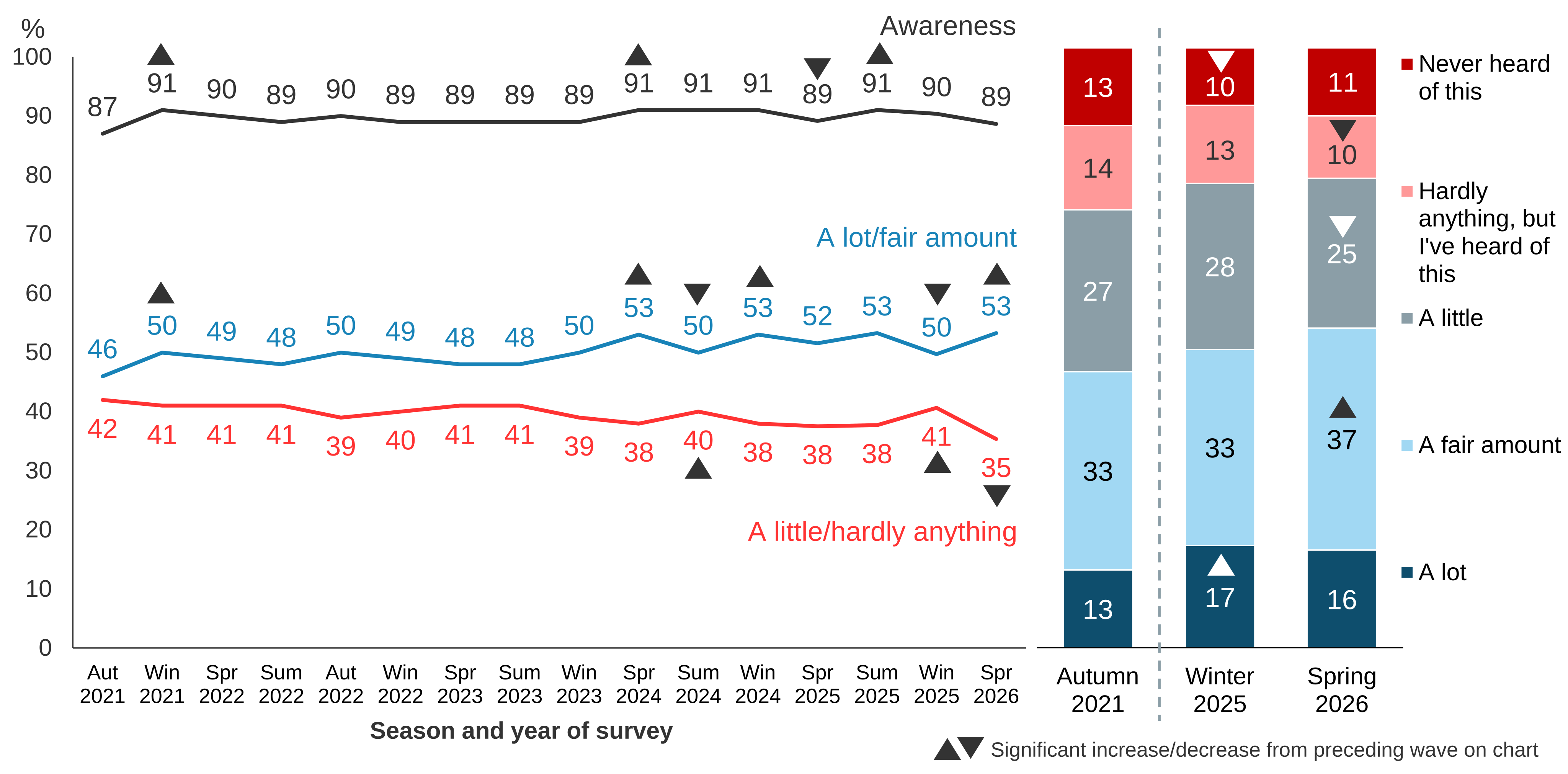
NZKNOW. The UK government is aiming to reduce UK greenhouse gas emissions to ‘Net Zero’ by 2050. This will involve significantly reducing emissions produced by our industries, transport, food, and homes. Any remaining emissions will be balanced by actions that reduce greenhouse gases already in the atmosphere, such as planting trees. Before today, how much, if anything, did you know about the concept of ‘Net Zero’?
Base: All wave respondents – Autumn 2021 (5,558), Winter 2021 (3,705), Spring 2022 (4,374), Summer 2022 (4,489), Autumn 2022 (4,158), Winter 2022 (3,572), Spring 2023 (4,405), Summer 2023 (3,998), Winter 2023 (3,741), Spring 2024 (4,085), Summer 2024 (3,640), Winter 2024 (3,214), Spring 2025 (3,411), Summer 2025 (3,526), Winter 2025 (3,282), Spring 2026 (3,388) (Asked each wave).
Note: On the line chart, arrows denote a significant difference between one wave and the next. For the bar chart, significant differences are noted between Autumn 2021 and Winter 2025, and between Winter 2025 and Spring 2026.
Analysis by subgroups
Self-reported knowledge of Net Zero was higher among the following subgroups:
- People in age groups 55 and over: between 58% and 61%, compared with between 45% and 50% of those in age groups 16 to 44.
- People with a degree: 67% compared with 51% of those with another kind of qualification and 25% of those with no qualifications.
- People living in the South West (64%), and in Yorkshire and the Humber and the East Midlands (both 58%); in contrast, the lowest levels were reported in the North East (44%), the West Midlands and the East of England (both 45%), and Northern Ireland (46%).
Concern about climate change
In Spring 2026, 78% said they were concerned overall about climate change, and a third said they were very concerned (34%) (Figure 1.2); these levels remained unchanged from Winter 2025.
Over time, aside from some minor fluctuations, overall concern has steadily declined from 85% in Autumn 2021 to 78% in Spring 2026. The proportion who were very concerned has, in general, followed a similar pattern, falling from 44% to 34% over the period of tracking, with sharper decreases tending to occur in Winter waves.
Figure 1.2: Concern about climate change (% based on all people), Autumn 2021 to Spring 2026
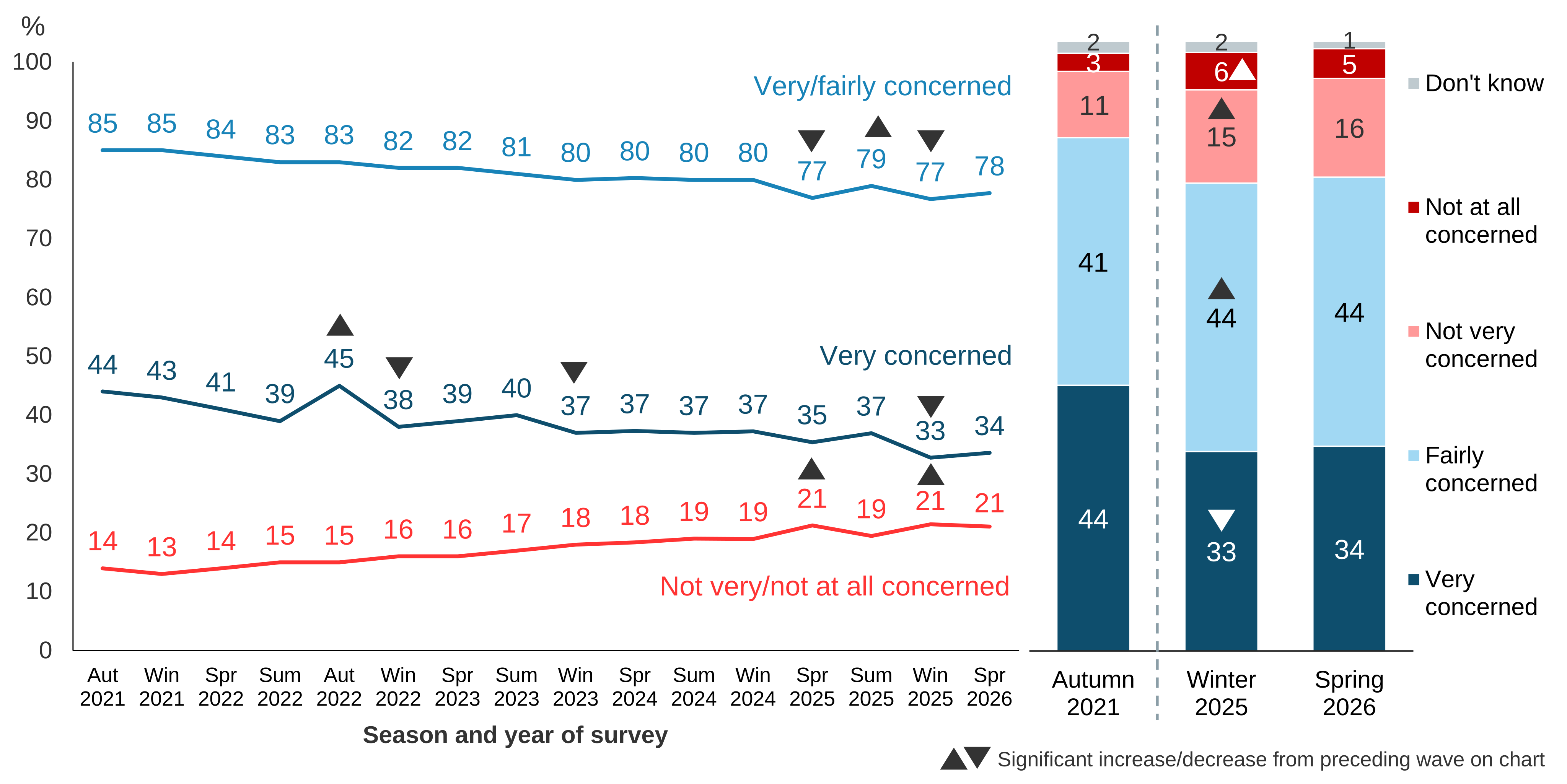
CLIMCONCERN. How concerned, if at all, are you about climate change, sometimes referred to as ‘global warming’?
Base: All wave respondents – Autumn 2021 (5,557), Winter 2021 (3,701), Spring 2022 (4,375), Summer 2022 (4,490), Autumn 2022 (4,158), Winter 2022 (3,571), Spring 2023 (4,405), Summer 2023 (3,998), Winter 2023 (3,739), Spring 2024 (4,086), Summer 2024 (3,644), Winter 2024 (3,213), Spring 2025 (3,408), Summer 2025 (3,531), Winter 2025 (3,281), Spring 2026 (3,386) (Asked each wave).
Note: On the line chart, arrows denote a significant difference between one wave and the next. For the bar chart, significant differences are noted between Autumn 2021 and Winter 2025, and between Winter 2025 and Spring 2026.
Analysis by subgroups[footnote 1]
The proportion reporting that they were very concerned about climate change was higher among the following subgroups:
- People with a degree: 44% compared with those with another kind of qualification (27%), and those with no qualifications (25%).
- People living in the South West (40%); in contrast people living in Northern Ireland (25%), the North East (28%) and in the North West and West Midlands (both 29%) were least likely to be very concerned.
Consistently over time, climate change concern has been higher for women than men. However, over time concern has fallen more for men than women, leading to an increased gender gap. For example, when the time series started in Autumn 2021, 87% of women and 82% of men were concerned overall about climate change (a 5-percentage point difference), while in Spring 2026, 83% of women and 72% of men said they were concerned (an 11-percentage point difference).
Further findings on Net Zero and climate change
In previous waves, questions were included on other topics relating to Net Zero and climate change. The latest findings relating to these topics can be found as follows:
- Attitudes towards Net Zero, see Summer 2025 report on Net Zero and climate change - section on ‘Attitudes towards Net Zero’
- Attitudes towards climate change, see Summer 2025 report on Net Zero and climate change - section on ‘Attitudes towards climate change’
- Self-reported behaviours that could help to tackle climate change, see Summer 2025 report on Net Zero and climate change - section on ‘Behaviours to tackle climate change’
- Which behaviours are thought to have the biggest impact on tackling climate change, see Summer 2025 report on Net Zero and climate change - section on ‘Behaviours thought to have the biggest impact on tackling climate change’
- Level of trust in information sources on climate change, see Summer 2025 report on Net Zero and climate change - section on ‘Information on tackling climate change’
- Sources of information on climate change and information needs, see Winter 2025 report on Net Zero and climate change - section on ‘Information on tackling climate change’
- Attitudes to action on climate change, see Winter 2025 report on Net Zero and climate change - section on ‘Attitudes to action on climate change’
- Perceptions on the role of the UK as a global leader in tackling climate change, see Winter 2025 report on Net Zero and climate change - section on ‘Climate change leadership’
-
Age is not included in the subgroup analysis as no clear differences were reported. ↩