DCMS Sectors Economic Estimates: Research and Development (R&D), 2024 - Technical and Quality Assurance Report
Published 30 April 2026

© Crown copyright 2026
This publication is licensed under the terms of the Open Government Licence v3.0 except where otherwise stated. To view this licence, visit nationalarchives.gov.uk/doc/open-government-licence/version/3 or write to the Information Policy Team, The National Archives, Kew, London TW9 4DU, or email: psi@nationalarchives.gov.uk.
Where we have identified any third party copyright information you will need to obtain permission from the copyright holders concerned.
This publication is available at https://www.gov.uk/government/statistics/dcms-sectors-economic-estimates-research-and-development-rd-2024/dcms-sectors-economic-estimates-research-and-development-rd-2024-technical-and-quality-assurance-report
This document covers the following topics:
- an overview of the content covered in the statistical release ‘DCMS Sectors Economic Estimates: Research and Development (R&D), 2024’
- an overview of DCMS sectors, how they are defined, and limitations of these definitions.
- the methodology underlying the statistical release, including data sources.
- the processes used to check that the estimates have been produced correctly.
- other sources of information for the DCMS sectors.
- further information, including contact details for DCMS statisticians.
1. Overview of release
The statistical release ‘DCMS Sectors Economic Estimates: Research and Development (R&D), 2024’ provides an estimate of expenditure on research and development (R&D) by businesses within DCMS sectors and subsectors.
The Business Enterprise Research and Development (BERD) survey was used to generate estimates of DCMS sector R&D expenditure. The Office for National Statistics (ONS) is the provider of the underlying data used for the analysis presented within this release. As such, the same data sources are used for DCMS estimates as for national estimates, enabling comparisons to be made on a consistent basis.
This release includes estimates for the 2024 survey period for the first time, as well as revised estimates for 2022 and 2023, due to revisions to the underlying ONS BERD dataset. These revisions are due to more in-depth validation of BERD results since 2022, combined with revised and late survey returns.
Due to sampling and methodology changes to the BERD survey in 2022, estimates in this release are not directly comparable to previous estimates produced using BERD data for years before 2022. This includes estimates published by the ONS on Expenditure on research and development performed in UK businesses in the Creative Industries sector, 2020. More information on these changes is available in section 3.1 of this technical report.
1.1 Official statistics in development
These statistics are labelled as official statistics in development. Official statistics in development are official statistics that are undergoing development and will be tested with users, in line with the standards of trustworthiness, quality and value in the Code of Practice for Statistics.
These R&D estimates are designed to complement our other economic estimates to give a deeper understanding of the economic performance of DCMS sectors to the UK economy. They are being published as official statistics in development because:
- We will be exploring further improvements, including the feasibility of additional breakdowns and the development of measures to understand the quality of the estimates, such as standard errors.
- We are continuing to seek user feedback on the usefulness of the statistics, the suitability of the methodology used and how clearly the statistics are communicated, including explanations about quality.
In this release we have introduced a number of improvements, including:
- Adding a breakdown for DCMS sectors based on ownership (overseas-owned vs UK-owned)
- Publishing inflation-adjusted estimates for total R&D expenditure by DCMS sector and by region for DCMS sectors and the creative industries.
We will continue to seek user feedback about this release. We will consider this feedback and make an assessment about whether the statistics still remain in development or if the label can be removed for the next annual R&D release, expected in 2027. If you have any feedback on this release, please send this to evidence@dcms.gov.uk.
Our statistical practice is regulated by the Office for Statistics Regulation (OSR). OSR sets the standards of trustworthiness, quality and value in the Code of Practice for Statistics that all producers of official statistics should adhere to.
You are welcome to contact us directly with any comments about how we meet these standards by emailing evidence@dcms.gov.uk.
Alternatively, you can contact OSR by emailing regulation@statistics.gov.uk or via the OSR website.
1.2 Users
The users of these statistics fall into five broad categories:
- ministers and other political figures
- policy and other professionals in DCMS and other government departments
- industries and their representative bodies
- charitable organisations
- academics
The primary use of these statistics is to monitor the performance of the industries in the DCMS sectors, helping to understand how current and future policy interventions can be most effective.
2. Sector definitions
In February 2023, Machinery of Government changes meant that responsibility for the digital and telecoms sectors moved from DCMS to the newly created Department for Science, Innovation and Technology (DSIT). Since April 2024, Economic Estimates for the digital sector have been published by DSIT, which can be found here.
2.1 Overview of DCMS Sectors
Main sector definitions
The sectors for which DCMS has responsibility are:
- civil society
- creative industries
- cultural sector
- gambling
- sport
- tourism
However, estimates of R&D expenditure by businesses in the civil society are not available in this release as the sector cannot be uniquely identified in the ONS Business Enterprise Research and Development (BERD) survey.
Further, the definition for tourism in this publication is not the same as the one used in other Economic Estimates publications. Therefore the results should not be compared across the different Economic Estimates publications. More details on this are available in section 2.2.
In order to measure the size of the economy it is important to be able to define it. DCMS uses a range of definitions based on internal or UK agreed definitions. Definitions are predominantly based on the Standard Industrial Classification 2007 (SIC) codes. This means nationally consistent sources of data can be used and enables international comparisons. Details of the UK SIC 2007 are available on the Standard Industrial Classification website.
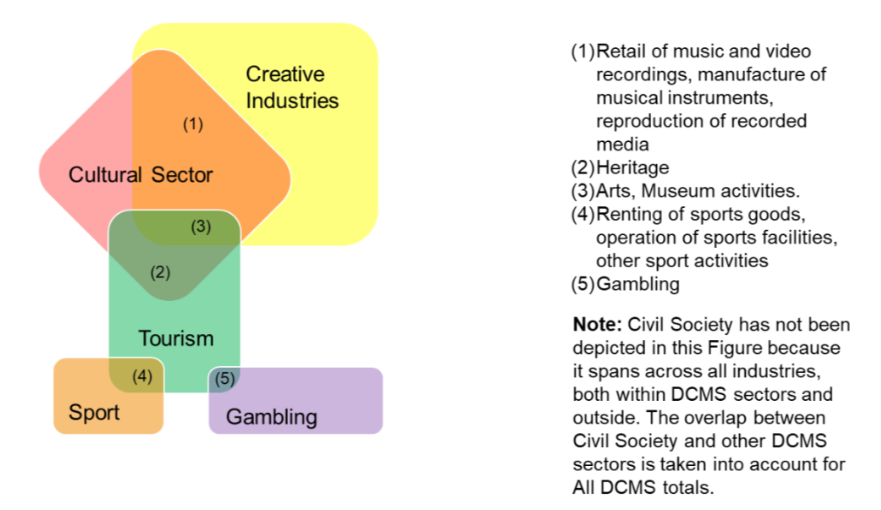
Each sector definition has been designed to be the best possible measure of that individual sector. There are overlaps between DCMS sectors, whereby an industry (as defined by 4-digit SIC codes) may be used in two sector definitions. In particular, the cultural sector is defined using SIC codes that are nearly all within the creative industries. These overlaps are accounted for in the Economic Estimates series to avoid double counting in DCMS sector totals.
Figure 1 below visually shows the overlap between DCMS sectors in terms of SIC codes. Users should note that this does not give an indication of the magnitude of the value of overlap. A list of SIC codes appearing in each sector and subsector can be found in the tables accompanying the release.
Figure 1: Overlap of SIC codes within DCMS sectors
2.2 Details of DCMS sector definitions
This section looks at sector definitions used in this release in more detail, and provides an overview of limitations. These sector definitions have been independently reviewed by the Office for Statistics Regulation (OSR) as part of their accreditation of a number of DCMS Sector Economic Estimates.
DCMS sector definitions are mostly based on the Standard Industrial Classification (SIC) framework which is used to classify business establishments and other statistical units by the type of economic activity in which they are engaged. The SIC system is internationally recognised, making it useful for comparisons across sectors, countries and over time. However, there are known limitations with the classification framework. As the balance and make-up of the economy changes, the SIC, finalised in 2007, is less able to provide the detail for important elements of the UK economy related to DCMS sectors.
The SIC codes used to produce DCMS sector definitions are a ‘best fit’, subject to the limitations described in the following section.
Creative industries
The creative industries were defined in the government’s 2001 Creative Industries Mapping Document as “those industries which have their origin in individual creativity, skill and talent and which have a potential for wealth and job creation through the generation and exploitation of intellectual property”. Based on this definition, DCMS worked closely with stakeholders to determine which occupations and industries should be considered creative.
The creative industries were determined on the basis of creative intensity (the proportion of occupations in an industry that are creative), following the dynamic mapping process set out in a 2013 paper published by Nesta:
- Through consultation, a list of creative occupations was identified.
- The proportion of creative jobs in each industry was calculated (the creative intensity)
- Industries with creative intensity above a specified threshold (30%) are considered creative industries
The definition is a UK definition based on internationally consistent industrial classifications which means estimates are comparable to the wider economy and useful internationally. See the creative industries Economic Estimates methodology note for a more detailed explanation of how the definition has been derived.
The definition used for the creative industries in this release does not allow consideration of the value added of “creative” to the wider economy, such as Creative Occupations outside the creative industries. DCMS policy responsibility is for creative industries across the economy and therefore this is a limitation with the current approach.
Cultural sector
DCMS defines the cultural sector as those industries with a cultural object at the centre of the industry. DCMS proposed and consulted on a definition of the cultural sector in 2016, based on the availability of data through the SIC framework. There are limitations to the DCMS measurement of the cultural sector arising from the lack of detailed disaggregation possible using the standard industrial classifications. There are some cases where culture forms a small part of an industry classification and therefore cannot be separately identified and assigned as culture using standard data sources, this is particularly the case for the heritage sector.
It is recognised that, due to the limitations associated with SIC codes, the SIC code used in past publications as a proxy for the heritage sector (91.03 - Operation of historical sites and building and similar visitor attractions) is likely to be an underestimate of this sector’s value. We have changed the name of the heritage sector to ‘Operation for historical sites and similar visitor attractions’ to reflect this. We have been working on assessing methodologies for producing heritage sector economic estimates based on a broader definition which more accurately reflects the heritage sector. We are continuing to develop this methodology.
Sport
The definition of sport used in the release includes only those 4-digit SIC codes which are predominately sport. This aligns with the international statistical definition of sport based on the EU agreed Vilnius definition, and allows the contribution of sport to be considered in a way which is consistent with other DCMS sectors.
Tourism
The definition of tourism in this release differs to that used in most DCMS sector economic estimates releases, and results should not be directly compared. In this release we therefore refer to the tourism industries rather than the tourism sector.
Tourism is defined by the characteristics of the consumer in terms of whether they are a tourist or resident. This, therefore, differs from “traditional” industries such as gambling which are defined by the goods and services produced themselves, and means that a different approach to defining the industry is used.
In the majority of DCMS sector Economic Estimates publications, estimates for the tourism sector are based on a satellite account approach, which estimates the direct economic impact of tourism on the economy as a proportion of each individual industrial class - the tourism ratio. The tourism ratios are taken from the Office for National Statistics (ONS) Tourism Satellite Account (TSA) and TSA provisional indicator. The tourism satellite account does not provide estimates of R&D expenditure by businesses in the tourism sector. The figures in this release are therefore based on a “tourism industries” approach, which counts any establishment in an industry (SIC code) for which the principal activity is a tourism characteristic activity, i.e. it includes 100% of the businesses in a subset of the standard industrial classes.
As such, the estimates for the tourism industries in this release are larger than they might otherwise have been under a satellite account approach and therefore account for a greater proportion of the DCMS Sector total than in other economic estimates publications. Estimates produced using these two different approaches should not be compared.
2.3 Additional sector definitions
Additional analysis is presented in the R&D release for the audio visual sector and the computer games sector.
Audio-visual sector
The definition of the audio visual sector (see below) is intended to reflect the sectors covered by the EU Audio Visual Media Services Directive.
- 59.11 - Motion picture, video and television programme production activities
- 59.12 - Motion picture, video and television programme post-production activities
- 59.13 - Motion picture, video and television programme distribution activities
- 59.2 - Sound recording and music publishing activities
- 60.1 - Radio broadcasting
- 60.2 - Television programming and broadcasting activities
- 63.91 - News agency activities
- 63.99 - Other information service activities n.e.c.
- 77.22 - Renting of video tapes and disks
- 77.4 - Leasing of intellectual property and similar products, except copyrighted works
Computer Games Sector
The computer games sector combines the 4-digit SIC code 58.21 (Publishing of Computer Games) and 62.01/1 (Ready-made interactive leisure and entertainment software development).
A number of software programming companies in 62.01 – ‘Computer programming activities’ may also contribute to the output of computer games, as part of a range of programming activities. This is not included in these computer games estimates, but will have been implicitly included in the ‘IT, software and computer services’ group (creative industries) in the main estimates.
3. Methodology
This chapter summarises the methodology used to produce the research and development expenditure by businesses in DCMS sectors.
3.1 Business Enterprise Research and Development (BERD) Survey
The Business Enterprise Research and Development (BERD) Survey is an annual survey which measures expenditure on research and development (R&D) by UK businesses. The survey uses the Organisation for Economic Co-operation and Development (OECD) definition set out in the Frascati Manual 2015, where R&D is defined as “creative and systematic work undertaken in order to increase the stock of knowledge – including knowledge of humankind, culture and society – and to devise new applications of available knowledge”. R&D must contain an appreciable amount of novelty.
In 2022, the BERD Survey incorporated a new sample design in which the sample was drawn from the whole of the Inter-departmental Business Register (IDBR). Since the 2022 survey, returns from the BERD survey are weighted to represent the whole population of businesses on the IDBR. Sampling directly from the IDBR ensures that the sample measures the level of R&D performed by businesses across the whole UK economy more effectively than our previous approach. It also more accurately measures the breakdowns of total R&D expenditure, such as regional distribution and type of R&D performed. This new approach replaces the methodology used in previous years, where the survey results only represented businesses in a pre-established reference list, rather than the whole business sector. As a result of changes to the BERD survey design, estimates in this release are not directly comparable to previous estimates produced using BERD data for the years before 2022, other than the UK total.
The sample size is now far larger than it used to be, with approximately 38,500 businesses in the UK sampled for 2022 and approximately 20,000 sampled in 2023 and 2024. This compares with 5,400 UK businesses sampled in previous years. Data from the 2022 BERD survey was used to optimise the design for the 2023 survey, targeting areas performing R&D and due to this better targeting, the sample size was reduced to around 20,000 UK businesses.
Further information about the introduction of the new sample design and new methods for calculating R&D results is available in the ONS Update on transformation of research and development statistics: November 2024 article and in the Business enterprise research and development QMI.
R&D by businesses in Northern Ireland is measured in a separate survey conducted by the Northern Ireland Statistics and Research Agency (NISRA). The results from this survey are aggregated with those collected from the survey of businesses in Great Britain to form UK estimates.
R&D can be measured by the expenditure on R&D performed by a business, or by the funding received by a business for R&D work. These are often, but not always, the same. Performance is regarded as a more accurate measure than funding received, as not all funds received may be used as intended. This release reports on R&D expenditure in UK businesses, irrespective of the country of residence of the ultimate owner or users of the R&D produced.
Industrial classifications of businesses in this release come from the Inter-Departmental Business Register (IDBR), which classifies businesses based on the principal activity performed by the business. Returns from the BERD survey are weighted to represent the wider population of non-sampled businesses for BERD on the IDBR.
We have used microdata from the BERD survey to produce estimates of R&D expenditure by businesses in DCMS sectors, in line with ONS methodology wherever possible. Statistical disclosure control methodology is applied to the dataset before release. This is to make sure that information attributable to an individual business is not identifiable in any published outputs.
3.2 Comparisons over time
We advise caution when interpreting comparisons over time. The ONS advises that while all estimates produced using the BERD data are affected by sample rotation, the impact of this can be more pronounced when analysing the data by industry, which may affect estimates for DCMS sectors. As such, industry estimates are more useful as a point in time estimate only, as data movements between years may not necessarily reflect the actual R&D growth in these industries.
We particularly advise caution in making comparisons for smaller DCMS sectors, such as the sport sector, tourism industries, cultural sector and gambling sector, which are likely to be more impacted by the effects of sampling rotation.
For this reason, in this publication’s report we have only included comparisons over time for DCMS as a whole and the creative industries. Smaller sectors such as the sport sector, tourism industries, cultural sector and gambling sector are not included as they are likely to be more impacted by the effects of sampling rotation.
Inflation-adjusted estimates over time
In this release, for the first time we have published estimates of R&D expenditure by businesses in the included DCMS sectors using constant prices (2024 prices) to produce inflation-adjusted (real terms) estimates over time for breakdowns by DCMS sector and by ITL region for DCMS sectors overall and the creative industries. This uses the new R&D deflator developed by the ONS for all UK businesses which is consistent with the Blue Book 2025.
As the ONS R&D deflator is not available at industry level, these estimates do not account for any differences in inflation between industries. Further information is available in the technical report. In the data tables, we present breakdowns of R&D expenditure by sector and by region in both current and constant prices (2024 prices).
3.3 Summary of data sources
In summary, the data presented in this report on research and development expenditure by businesses
- are based on official statistics data sources
- are based on internationally-harmonised codes
- have been calculated to follow the ONS methodology as closely as possible
- are based on survey data and, as with all data from surveys, there will be an associated error margin surrounding these estimates
4. Quality assurance processes
This chapter summarises the quality assurance processes applied during the production of the DCMS sectors Economic Estimates: Research and Development (R&D), 2024 statistics. This includes a detailed account of the quality assurance processes and the data checks carried out by our data providers (Office for National Statistics, ONS) as well as by DCMS.
4.1 Quality assurance processes at ONS
Quality assurance at ONS takes place at a number of stages, outlined below. The information presented here is taken from the Business Enterprise Research and Development Survey QMI report and should be credited to the ONS.
BERD uses electronic questionnaires and survey responses are validated at the point of entry, with potential anomalies checked with the respondent. This helps improve the quality of the data reported.
Statistical disclosure control methodology is applied to BERD data. This is to make sure that information attributable to an individual business is not identifiable in any published outputs. More information can be found on the ONS Disclosure control web pages.
Further quality assurance includes:
- the detection and treatment of outliers
- application of imputation for missing values
- expansion estimation to account for non-sampled businesses. This method uses a weight which is applied to survey returns to estimate for the non-sampled businesses, non-responders or those businesses that provided invalid returns.
4.2 Quality assurance processes at DCMS
The majority of quality assurance of the data underpinning this release takes place at ONS, through the processes described above. However, further quality assurance checks are then carried out within DCMS. Production of the analysis is typically carried out by one member of staff, whilst quality assurance is completed by at least another member, to ensure an independent evaluation of the work.
Data requirements and data delivery
For the BERD data, DCMS discussed our data requirements with the ONS and these are formalised as a Data Access Agreement (DAA). The DAA covers which data are required, the purpose of the data, and the conditions under which ONS provide the data. Discussions of requirements and purpose with ONS improved the understanding of the data at DCMS, helping us to ensure we receive the correct data and use it appropriately.
DCMS checks that the data delivered by ONS match what is listed in the DAA. For this particular release we check that:
- We have received all data at the 4 digit SIC code level, which is required for us to aggregate up to produce estimates for our sectors and sub-sectors.
- Data at the 4 digit SIC code has not been rounded unexpectedly. This would cause rounding errors when aggregating up to produce estimates for our sectors and subsectors.
Data analysis quality assurance checks
At the analysis stage, data are aggregated to produce information about DCMS sectors and sub-sectors. Disclosure control is also applied as part of this process. The R&D statistics lead ensures that a number of quality assurance checks are undertaken during this process. These checks typically include whether:
- there is any missing data
- the correct data have been used for the analysis e.g. has the 2024 data been used to derive the 2024 figures for DCMS sectors, or has the 2023 data been used by mistake?
- the correct SIC codes have been aggregated together to form DCMS sector and sub-sector estimates. Are all SIC codes we require included? Are there any non-DCMS SIC codes that have been included by accident?
- Whether disaggregations sum to the overall total e.g. do sub-sectors within the creative industries sum to the creative industries total?
- checking it is not possible to derive disclosive data from the figures that will be published
A statistics colleague not involved in the coding and analysis process checks whether:
- any new code or changes to code used in the calculations (in this case using the statistical software: R) makes sense and produces the expected results
- the correct input data is used (incorporating any revisions, latest available data)
- further calculations and analysis are correct.
Finalised figures are disseminated within OpenDocument Format tables and published on GOV.UK. These are produced by the R&D statistics lead. Before publishing, a quality assurer checks the data tables as well as the report to ensure minimal errors. This is checked against a QA log where comments can be fed back and actioned accordingly. The quality assurer also makes sure any statements made about the figures (e.g. regarding trends) are correct according to the analysis and checks for spelling or grammatical errors.
Proofreading and publication checks are done at the final stage, including:
- checking the figures in the publication match the published tables
- checking the footnote numbering is correct
- making sure hyperlinks work
- checking chart/table numbers are in the correct order
- ensuring the publication is signed off by the DCMS Head of Profession for Statistics
- contacting press office to ensure they are aware of the release date
- checking the published GOV.UK page again after publishing
Post publication
Once the publication is released, DCMS reviews the processes and procedures followed via a wash up meeting. This occurs usually a week after the publication release date and discusses:
- what went well and what issues were encountered
- what improvements can be made for next time
- what feedback have we received from engaging with users
5. External data sources
It is recognised that there were always different ways to define sectors, but their relevance depends on what they are needed for. Government generally favours classification systems which are:
- rigorously measured,
- internationally comparable,
- nationally consistent, and
- ideally applicable to specific policy interventions.
These are the main reasons for DCMS using SIC code based definitions for its sectors. However DCMS accept that there are limitations with this approach, and alternative definitions can be useful where a policy-relevant grouping of businesses crosses existing Standard Industrial Classification (SIC) codes.
6. Further information
Our statistical practice is regulated by the Office for Statistics Regulation (OSR). OSR sets the standards of trustworthiness, quality and value in the Code of Practice for Statistics that all producers of official statistics should adhere to. You are welcome to contact us directly with any comments about how we meet these standards. Alternatively, you can contact OSR by emailing regulation@statistics.gov.uk or via the OSR website.
For enquiries on this release, please email evidence@dcms.gov.uk.
For general enquiries contact:
Department for Culture, Media and sport
100 Parliament Street London
SW1A 2BQ
Telephone: 020 7211 6000