Concessionary Travel Statistics: year ending March 2025
Updated 24 March 2026
Applies to England

© Crown copyright 2026
This publication is licensed under the terms of the Open Government Licence v3.0 except where otherwise stated. To view this licence, visit nationalarchives.gov.uk/doc/open-government-licence/version/3 or write to the Information Policy Team, The National Archives, Kew, London TW9 4DU, or email: psi@nationalarchives.gov.uk.
Where we have identified any third party copyright information you will need to obtain permission from the copyright holders concerned.
This publication is available at https://www.gov.uk/government/statistics/concessionary-travel-statistics-year-ending-march-2025/concessionary-travel-statistics-year-ending-march-2025
Revision
Following our usual process, this publication has been updated with data on next current expenditure on concessionary travel that was not available when these statistics were originally published (26 November 2025). The Ministry of Housing, Communities and Local Government (MHCLG) have since published that data so tables BUS08di, BUS08dii, BUS08ei and BUS08eii have been revised to include it.
Revision
These statistics have been revised since the original release (26 November 2025), as a result of updates to the underlying data and a processing enhancement. They do not reflect changes in concessionary travel.
This revision mostly affected specific Transport Concessionary Authorities.
Changes include:
⠀⠀⠀• incorporating updates from Travel Concession Authorities
⠀⠀⠀• imputing data for net current expenditure for TCAs that were unable to provide figures
Impact on national figures
Headline figures for England remain the same to two significant figures. Statistics for the year ending March 2025 have been revised by:
⠀⠀⠀• -0.05% for older and disabled concessionary travel passes
⠀⠀⠀• no change to older and disabled concessionary bus journeys
⠀⠀⠀• +0.05% for average concessionary bus journeys per pass
About this release
This release presents statistics on concessionary travel in England, which are based on survey data collected from Travel Concession Authorities (TCAs). Concessionary travel relates to when eligible people travel on reduced (or free) fares.
These statistics cover:
- older and disabled concessionary passes
- concessionary bus journeys
- payments made by TCAs to reimburse operators
- financial breakdowns for operating concessionary schemes
These statistics are summarised for 3 key area types: London, metropolitan (met) areas, and non-metropolitan (non-met) areas.
More details on the journeys and individuals that fall within the scope of concessionary travel, as well as the definitions used in this release, are provided in the definitions section, with additional information provided on the guidance page.
Headline figures
In England, comparing the year ending March 2025 with the year ending March 2024, there were:
- 8.9 million older and disabled concessionary travel passes, up 1%
- 624 million concessionary bus journeys, up 4%
- £795 million reimbursed to bus operators by TCAs, up 8% (constant prices)
- £995 million in net current expenditure on concessionary travel, up 8% (constant prices)
In this year’s data collection, TCAs were able to provide revised figures for specific survey questions. For the year ending 2024, we incorporated these revisions wherever TCAs provided updated figures that passed our validation checks, and these have been reflected accordingly in the publication tables.
These statistics have always been revised each year to use any new information, in order to be as accurate as possible. The revisions are usually minor and do not affect the overall narrative of these statistics.
Older and disabled concessionary passes
The number of concessionary passes is typically sourced from administrative databases. Whilst this provides a reasonable proxy for the number of pass holders, they will include some inactive passes, those issued to people who are deceased, and those who no longer live in the area. This can mean that the figures presented for older passes per hundred eligible older people can sometimes be greater than 100 at the Transport Concession Authority Level.
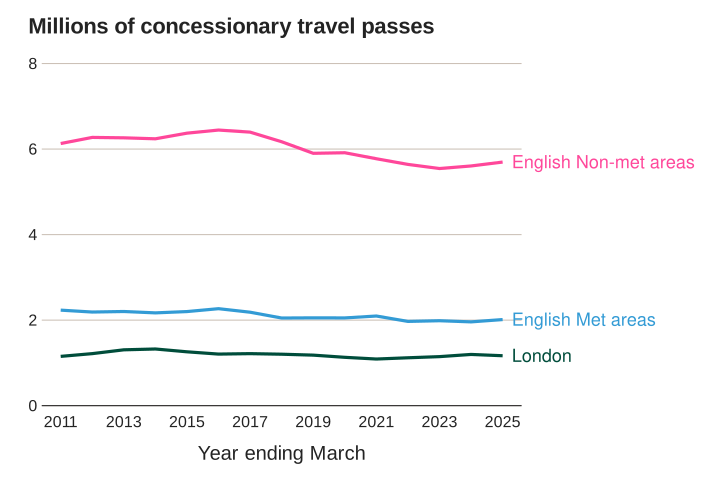
There were 8.9 million older and disabled concessionary passes in England in the year ending March 2025, an increase of 1% compared with the year ending March 2024.
Across England, this figure breaks down as:
- 1.2 million in London, down 3%
- 2.0 million in metropolitan areas, up 3%
- 5.7 million in non-metropolitan areas, up 2%
Most of these concessionary passes in England were for older people (89%) rather than disabled people (11%). The proportion varies slightly by area type.
Chart 1: Older and disabled concessionary passes by area status, England, year ending March 2011 to 2025 (BUS08a)
Year-on-year changes in the number of concessionary passes should be treated with caution. They can be impacted when Travel Concession Authorities:
- perform manual exercises to clean their records
- change their pass renewal policy
- encourage take up of the scheme
Older and disabled concessionary passes in England peaked in the year ending March 2016 at 9.9 million and had been slowly decreasing up until the year ending 2023. After this they began to increase again, though still remaining below the peak (Chart 1).
Since the year ending March 2011, older and disabled concessionary passes (Chart 1) are:
- up 1% in London
- down 8% in metropolitan areas
- down 9% in non-metropolitan areas
Concessionary bus journeys
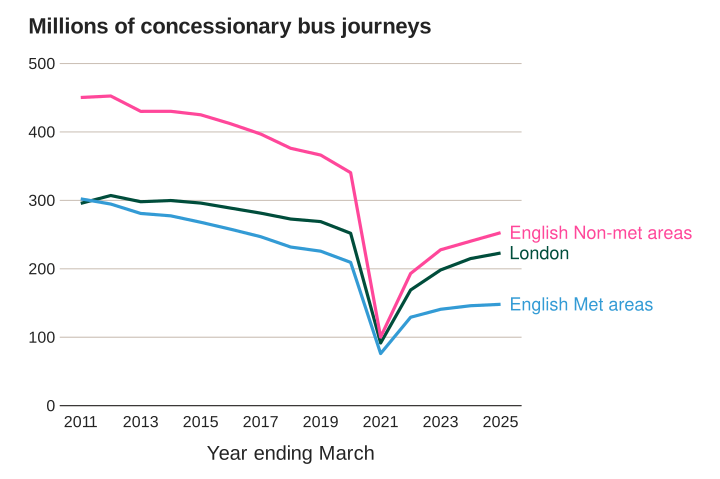
There were 624 million concessionary bus journeys in England in the year ending March 2025, an increase of 4% compared with the year ending March 2024.
Across England, this figure breaks down as:
- 223 million in London, up 4%
- 148 million in metropolitan areas, up 1%
- 253 million in non-metropolitan areas, up 5%
Chart 2: Concessionary bus journeys by area status, England, year ending March 2011 to 2025 (BUS08a)
These figures are broadly in line with trends seen in the Annual Bus Statistics for elderly and disabled bus journeys in England outside London.
Efforts were made in 2024 to align the methodology of the concessionary journey figures for London in the Annual Bus Statistics with how the concessionary travel journey figures are produced.
This led to data for concessionary journeys in the Annual Bus Statistics being revised to no longer include passengers using the 60 plus London Oyster card. This is a commercial discount offered by TfL, rather than being paid for by local government, so it was determined that it should not be included in the concessionary travel journey figures. As a result the concessionary journey figures for London in the Annual Bus Statistics are now broadly comparable with the figures presented in this release.
Concessionary bus journeys in England peaked in the year ending March 2012 at 1.05 billion and gradually declined until the coronavirus pandemic. In the year ending March 2021, concessionary bus journeys were affected by the coronavirus pandemic, decreasing by 66% to a record low of 268 million. In the year ending March 2025, concessionary bus journeys increased by 4% compared with the year ending March 2024, reaching 78% of pre-pandemic levels (the year ending March 2020), up from 75% of pre-pandemic levels in the previous year (Chart 2).
Since the year ending March 2011, concessionary bus journeys in each area type have broadly followed the England trend (Chart 2). In the year ending March 2025, recovery after the coronavirus pandemic varied slightly by area type, with:
- London reaching 89% of pre-pandemic levels, up from around 85% in the previous year
- metropolitan areas reaching 71% of pre-pandemic levels, up from 70% in the previous year
- non-metropolitan areas reaching 74% of pre-pandemic levels, up from 71% in the previous year
Concessionary bus journeys per pass
An average of 70.3 concessionary bus journeys were made per statutory pass in England for the year ending March 2025, an increase of 2% compared with the year ending March 2024.
The number of journeys per pass is typically much higher in London than other areas. In the year ending March 2025, there were 191.0 journeys per pass in London, compared to 73.6 in metropolitan areas and 44.4 in non-metropolitan areas.
Chart 3: Concessionary bus journeys per statutory pass by area status, England, year ending March 2011 to 2025 (BUS08a)
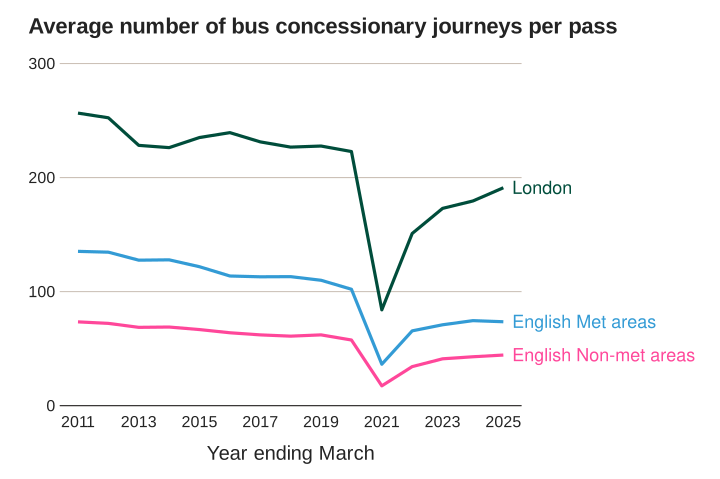
Concessionary bus journeys per statutory pass in England peaked in the year ending March 2011 at 110 journeys per pass and gradually declined until the coronavirus pandemic (Chart 3). In the year ending March 2021, journeys per pass were affected by the coronavirus pandemic, dropping by 66% to a record low of 29.9. In the year ending March 2025, journeys per pass saw an increase of 2% compared with the year ending March 2024 and have now recovered to 80% of pre-pandemic levels (the year ending March 2020).
Since the year ending March 2011, concessionary bus journeys per statutory pass in each area type have broadly followed the England trend (Chart 3). In the year ending March 2025, recovery after the coronavirus pandemic varied slightly by area type, with:
- London at 86% of pre-pandemic levels, compared with 81% in the previous year
- metropolitan areas reaching 72% of pre-pandemic levels, compared with 73% in the previous year
- non-metropolitan areas reaching 77% of pre-pandemic levels, compared with 74% in the previous year
Expenditure on concessionary travel at constant 2025 prices (adjusted for inflation)
Net current expenditure is the amount of money spent by TCAs on running the concessionary travel scheme in their area. This covers both the statutory and discretionary elements (if offered by the TCA), including:
- reimbursement to bus operators
- administration
- pass production costs
- employee costs
There is more than one source available for figures on concessionary travel spending. The statistics presented here are based on the Concessionary Travel survey for consistency with other figures, such as reimbursement of bus operators.
Similar data are collected by the Ministry of Housing, Communities and Local Government (MHCLG) as part of their revenue outturn data. The MHCLG data for concessionary travel reimbursement are presented in the BUS05 data collection.
In the year ending March 2025, net current expenditure on concessionary travel by TCAs was £995 million, up 8% from last year (adjusted for inflation) and 73% of pre-pandemic levels (adjusted for inflation, the year ending March 2020).
Across England, this figure breaks down as:
- £290 million in London (29% of total)
- £286 million in metropolitan areas (29% of total)
- £420 million in non-metropolitan areas (42% of total)
Chart 4: Net current expenditure (at 2025 prices) on concessionary bus travel by area status, England, year ending March 2011 to 2025 (BUS08dii)
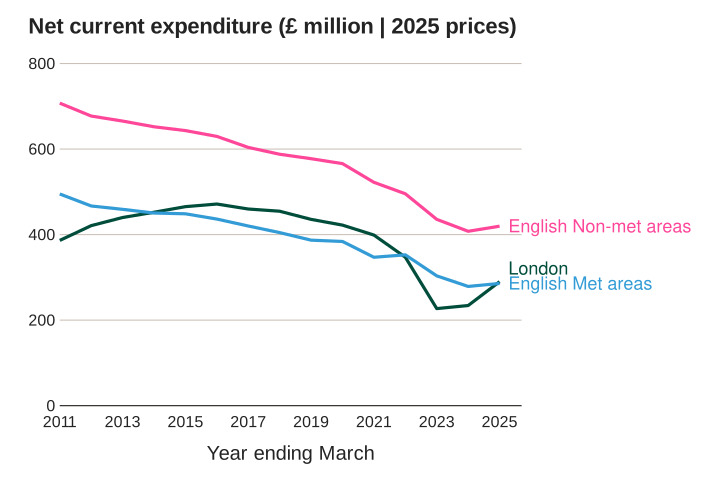
Reimbursement from London Councils to Transport for London (TfL) is calculated from journeys taken in earlier years. This is why the figures for the last two years are showing an uplift because it reflects the recovery from the coronavirus pandemic whereas the years directly preceding it were still partially based on journeys affected by the pandemic.
Further details around the methodology for net current expenditure figures for London can be found in the accompanying background quality report.
Net current expenditure on concessionary bus travel in England (adjusted for inflation) has been decreasing since the year ending March 2011, down 37% since then (Chart 4). This is a comparable change to concessionary bus journeys, which are also down 40% over the same period.
Net current expenditure in metropolitan areas and non-metropolitan areas has steadily declined since the year ending March 2011 (Chart 4), until the latest year when both increased. However, net current expenditure in London increased from the year ending March 2011 to the year ending March 2016, and then started to steadily decline before increasing from the year ending March 2024.
Bus operators are typically reimbursed by TCAs on a ‘no better, no worse off’ basis for concessionary travel, as per statutory requirements. However the ‘no better’ part of this was temporarily suspended through statutory instruments (SIs) from April 2020 to March 2024. This followed the beginning of the coronavirus pandemic, whereby TCAs were allowed (but not required to) reimburse operators up to the pre-pandemic levels.
Due to some TCAs reimbursing above the ‘no worse off’ rate during this period, the level of concessionary reimbursement did not fully reflect the reduced number of concessionary journeys.
The ending of the final SI in March 2024 means reimbursement reverted back to the ‘no better, no worse off’ basis from this point. From April 2024, bus operators will therefore be reimbursed in line with actual journeys, coupled with a lower overall concessionary patronage (in contrast with the higher pre-pandemic levels). This however is likely to be offset by the new DfT guidance and reimbursement calculator introduced to help TCAs determine the appropriate rate of reimbursement. The full effect of these changes shall be evident in future years, from the year beginning April 2024 onwards.
In the year ending March 2025, 87% of net current expenditure was spent on statutory concessionary schemes, which must be provided by TCAs. This proportion has remained broadly stable over the past decade and was unaffected by the coronavirus pandemic, although has decreased slightly in the most recent year from 86% in the year ending March 2024. For each area type, the proportion of net current expenditure spent on statutory concessionary schemes is:
- 93% in London
- 70% in metropolitan areas
- 95% in non-metropolitan areas
Reimbursement to bus operators
The net current expenditure is distributed across various elements of concessionary travel in England, with the majority spent on reimbursing bus operators.
Reimbursement must be calculated by TCAs and is not straightforward. The basic principle is that bus operators should be no better and no worse off from the concessionary scheme.
This legal requirement was temporarily relaxed during the coronavirus pandemic to allow TCAs to continue to reimburse at higher levels than would otherwise be due but this expired in April 2024.
In the year ending March 2025, reimbursement to bus operators accounted for 80% of net current expenditure by TCAs on concessionary travel, or £795 million. This is up 8% compared to the previous year and down 27% since before COVID (year ending March 2020), where reimbursement to bus operators was £1.09 billion although it continues to account for similar proportion (79%) of net current expenditure by TCAs.
By area type, reimbursement as a proportion of net current expenditure in the year ending March 2025 is:
- 64% in London
- 73% in metropolitan areas
- 96% in non-metropolitan areas
Chart 5: Concessionary reimbursement (at 2025 prices) by area status, England, year ending March 2011 to 2025 (BUS08dii)
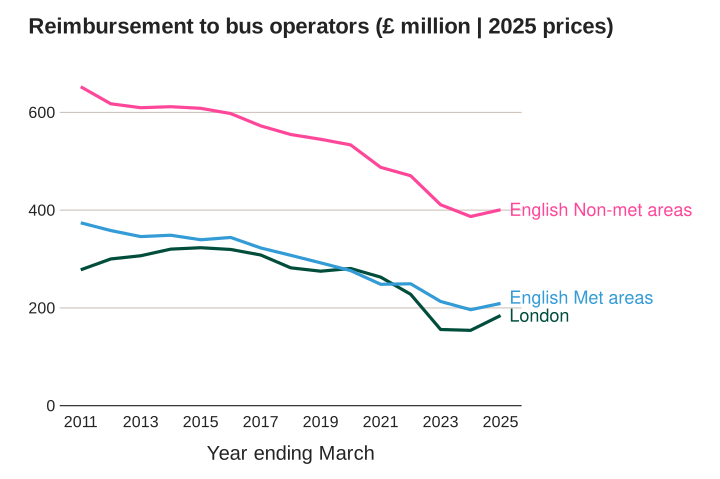
Reimbursement to bus operators in England (adjusted for inflation) has been decreasing since the year ending March 2011, declining by 39% overall, despite a slight increase in the year ending March 2025 (Chart 5). This is a comparable change to concessionary bus journeys, down 40% over the same period.
Reimbursement in metropolitan areas and non-metropolitan areas has steadily declined since the year ending March 2011, until the latest year when it increased (Chart 5). However, reimbursement in London increased from the year ending March 2011 to the year ending March 2015, and then started to steadily decline, before flattening out in the year ending March 2024 and increasing in the year ending March 2025.
Discretionary concessions outside London
Since the year ending March 2011, almost all TCAs outside London have offered some discretionary travel concessions, although the offering can change over time.
Table 1: Top 6 discretionary concessions offered by TCAs, England outside of London, year ending March 2026 (BUS08P02)
| Discretionary concession | Number of TCAs | Proportion of TCAs (%) |
|---|---|---|
| Extensions to the beginning of the statutory time period (9:30am) during weekdays | 65 | 76.5% |
| Companions to disabled people | 56 | 65.9% |
| Extensions to the end of the statutory time period (11:00pm) during weekdays | 56 | 65.9% |
| Allowing the use of discretionary companion passes issued by other TCAs | 41 | 48.2% |
| Flexible Bus Services - Demand Responsive Travel (DRT) (includes S22 and PSV tendered services but not including section 19) | 38 | 44.7% |
| Section 22 fixed route services (not including DRT/flexible bus services) - community transport with fixed routes | 33 | 38.8% |
Some of the concessions offered are very specific to the TCA, such as those for light rail services or ferries.
Young people
Discretionary concessions for young people can be offered by TCAs directly or by bus operators on a commercial basis.
In the year ending March 2026, youth concessions are offered by 28 out of 85 TCAs in England outside London. A youth concession is offered by at least one commercial bus operator in 76 out of 85 TCAs in England outside London.
Definitions
Statutory concessions
In England, there is a statutory concession called the English National Concessionary Travel Scheme (ENCTS). An ENCTS pass allows eligible disabled people and those of state pension age, at a minimum, to travel for free on local bus services anywhere in England, between 9:30am and 11:00pm during weekdays and anytime at weekends and bank holidays. The scheme is administered by Travel Concession Authorities (TCAs).
In London, there is a statutory concession called the Freedom Pass, which covers the whole London Local Transport Network.
Since April 2010, the eligibility age for everyone has been tied to the State Pension age for women. The pensionable age for women reached 65 in 2018 and increased to 66 for both men and women from 2020.
Discretionary concessions
Some TCAs choose to offer residents discretionary concessions over and above the statutory scheme to eligible groups. These can include reduced (or free) fares:
- outside the statutory time period
- for companions of disabled pass holders
- for young people or other targeted groups
- on transport modes other than buses, such as trams or light rail
Data are not available from this survey on:
- concessionary journeys on other transport modes
- reimbursement to operators running concessions on other transport modes
In London, the statutory concession already covers off-peak travel on the whole London Local Transport Network for eligible residents, as well as free bus travel in England. As a discretionary concession, London residents aged 60 plus can obtain a 60 plus Oyster card, which allows free travel on bus, Tube, tram, DLR, London Overground, TfL Rail and most National Rail services within London.
Reimbursement
The underlying principle of reimbursement is set out in domestic regulations, which state that operators should be left no better and no worse off as a result of the existence of concessionary travel schemes. Therefore, the calculation includes:
- concessionary passenger journeys
- revenue forgone - an estimate of the revenue that would have been made in the absence of a scheme
- additional costs incurred due to journeys “generated” by the scheme’s existence, such as operating, capacity and peak vehicle costs
- additional costs incurred by administering the scheme
In March 2021, 2022, and 2023, temporary amendments to statutory instruments (SIs) were put in place in to remove the requirement that a bus operator be ‘no better off’ as a result of providing a concession. This allowed TCAs to continue to reimburse at pre-pandemic levels, should they wish to do so. The most recent amendment to the SI expired in April 2024 leading to the reinstatement of the underlying principle of operators being reimbursed on a ‘no better and no worse off’ basis. As the amendment to the SI was not mandatory some TCAs may have chosen to ignore the change from the outset while other TCAs may have also already reverted back to the ‘no better and no worse off’ principle.
Geography
Metropolitan (met) areas: Greater Manchester, Merseyside, South Yorkshire, Tyne and Wear, West Midlands (county) and West Yorkshire.
Non-metropolitan (non-met) areas: Shire counties and unitary authorities. All areas within England that are not London or a Metropolitan area.
Background notes
There is an accompanying background quality report for these statistics.
About these figures
Statistics in this report are derived from DfT’s annual Concessionary Travel Survey. This survey is issued to each of the Travel Concession Authorities (TCAs) in England.
The overall response rate for the year ending March 2025 was 100%.
Where data were missing from the survey, statistics are determined using:
- information from adjacent years
- information from similar authorities
- TCA websites (where applicable)
- alternative sources
In this release, numbers may not add up to totals and percentages may not add up to 100% due to rounding.
Interpreting trends over time
These statistics were affected by the coronavirus (COVID-19) pandemic and associated restrictions, where travel on all modes decreased. The number of bus journeys decreased as a result of these travel restrictions, including concessionary bus journeys. The expenditure on concessionary and other bus use by local authorities changed to support the provision of services during this time.
Year-on-year changes in the number of concessionary passes should be treated with caution. They can see major changes when TCAs:
- perform manual exercises to clean their records
- change their pass renewal policy
- encourage take up of the scheme
Users and uses of these statistics
Within the Department for Transport, these statistics are used to understand the impact of changes to the concessionary travel scheme and reimbursement guidance, for ministerial briefing and to answer public enquiries.
Other users include TCAs and others with an interest in concessionary travel, such as campaign groups, bus operators and specialist transport press.
Related sources of information
The Department for Transport’s Survey of Public Service Vehicle Operators (PSV Survey) also collects figures for concessionary bus journeys, which are compiled into Annual Bus Statistics.
These include:
- overall bus patronage and trends
- youth concessionary journeys
- older and disabled journeys
- operator finances
Official Statistics
Official Statistics are produced to the high professional standards set by the Code of Practice for Statistics. However, these statistics have not yet been assessed by the Office for Statistics Regulation.
Details of ministers and officials who receive pre-release access to these statistics up to 24 hours before release can be found in the pre-release access list.
Next release
The next Concessionary Travel Statistics are due to be published in late 2026.
Any updates to these plans will be advertised via the DfT statistical publications schedule.
To hear more about DfT statistical publications as they are released, follow us on X at DfTstats.
Instructions for printing and saving
Depending on which browser you use and the type of device you use (such as a mobile or laptop) these instructions may vary.
You will find your print and save options in your browser’s menu. You may also have other options available on your device. Tablets and mobile device instructions will be specific to the make and model of the device.
How to search
Select Ctrl and F on a Windows laptop or Command and F on a Mac.
This will open a search box in the top right-hand corner of the page. Type the word you are looking for in the search bar and press enter.
Your browser will highlight the word, usually in yellow, wherever it appears on the page. Press enter to move to the next place it appears.
Contact details
Bus statistics
Email bus.statistics@dft.gov.uk
Media enquiries 0300 7777 878