Chapter 4: Well-being and loneliness
Updated 9 July 2026
Applies to England

© Crown copyright 2026
This publication is licensed under the terms of the Open Government Licence v3.0 except where otherwise stated. To view this licence, visit nationalarchives.gov.uk/doc/open-government-licence/version/3 or write to the Information Policy Team, The National Archives, Kew, London TW9 4DU, or email: psi@nationalarchives.gov.uk.
Where we have identified any third party copyright information you will need to obtain permission from the copyright holders concerned.
This publication is available at https://www.gov.uk/government/statistics/chapters-for-english-housing-survey-2024-to-2025-headline-findings-on-demographics-and-household-resilience/chapter-4-well-being-and-loneliness
Introduction
This chapter shows the well-being of respondents. It then goes on to discuss loneliness with an emphasis on comparisons to pre-pandemic results, as well as measuring a household’s satisfaction with its accommodation.
For an introduction and summary of main findings in this report as a whole, please see the Introduction and key findings.
Well-being
In the EHS, well-being is measured using the following four questions:
- Overall, how satisfied are you with your life nowadays? Referred to as ‘life satisfaction’.
- Overall, to what extent do you feel the things you do in your life are worthwhile? Referred to as ‘life is worthwhile’.
- Overall, how happy did you feel yesterday? Referred to as ‘happiness’.
- Overall, how anxious did you feel yesterday? Referred to as ‘anxiety’.
For most questions, respondents are asked to give their answers on a scale of 0 to 10 where 0 is ‘not at all’ and 10 is ‘completely’. These questions have been included in the EHS since 2013-14.
These questions are the standard well-being questions developed by the Office for National Statistics (ONS) for the Measuring National Well-being Programme which aims to produce accepted and trusted measures on well-being in the UK. See here for further information: https://www.ons.gov.uk/peoplepopulationandcommunity/wellbeing.
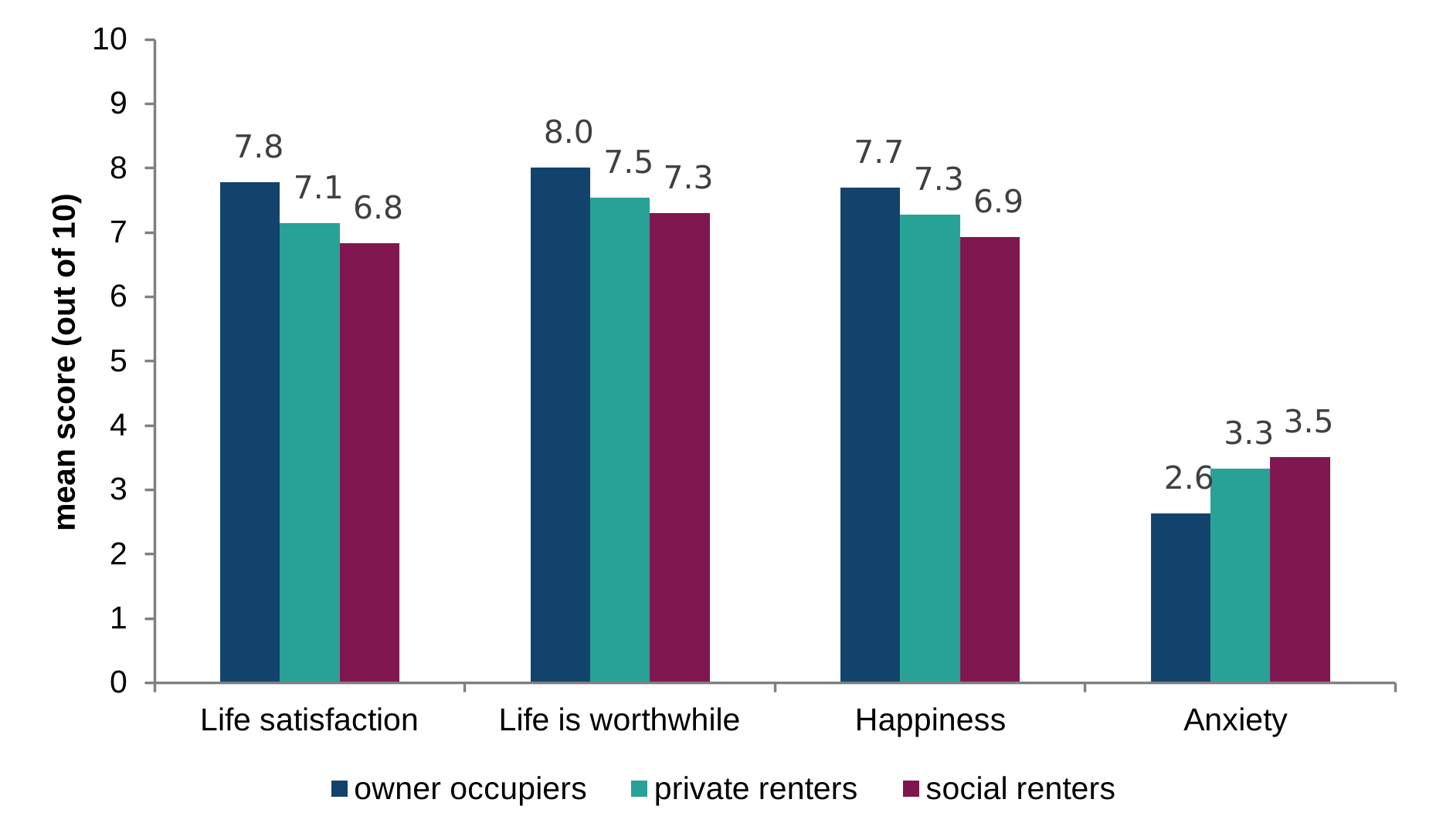
Personal well-being scores varied by tenure. In 2024-25, owner occupiers reported higher scores for life satisfaction (mean of 7.8), thinking life is worthwhile (8.0), happiness (7.7), and lower scores for anxiety (2.6), than the private rented sector (7.1; 7.5; 7.3; 3.3) and social rented sector (6.8; 7.3; 6.9; 3.5), Annex Table 4.1, Figure 4.1.
Among owner occupiers in 2024-25, outright owners reported higher scores than mortgagors for life satisfaction (7.8 compared with 7.7) and happiness (7.8 compared with 7.6), and lower scores for anxiety (2.4 compared with 2.9), Annex Table 4.1.
These findings may suggest there is a relationship between well-being and tenure, though this could also be mediated by related factors, such as income, age and working status, which also tend to correlate with tenure type.
Figure 4.1: Well-being, by tenure, 2024-25
Base: all household reference persons
Notes:
1) underlying data are presented in Annex Table 4.1
Source: English Housing survey, full household sample
When comparing current well-being levels to those last year in 2023-24, well-being levels broadly remained the same. However, compared to pre-pandemic years (2019-20), overall personal well-being scores decreased. In 2024-25, fewer households across all tenures reported their life was satisfactory (7.5 in 2024-25 compared with 7.7 in 2019-20) and worthwhile (7.8 in 2024-25 vs 7.9 in 2019-20), anxiety has risen (2.9 in 2024-25 vs 2.7 in 2019-20) and happiness has fallen (7.5 in 2024-25 vs 7.6 in 2019-20).
Loneliness
Loneliness is not measured on a scale of 0 to 10 but instead by asking respondents how often they feel lonely. Response options range from ‘Often or always’ to ‘Never’. This question was included in the EHS for the first time in 2019-20.
This loneliness question is from the National Indicators of Loneliness and is a standard question used to measure loneliness. See here for further information: https://www.gov.uk/government/statistics/national-measures-of-loneliness.
In 2024-25, owner occupiers reported being less likely to often or always feel lonely (5%) compared to those in the private rented sector (8%). Owner occupiers were also more likely to report never feeling lonely (38%) compared to 28% in the private rented sector. Those in the social rented sector were more likely than other sectors to feel lonely often or always (13%), Annex Table 4.2.
During the last few years, those in the social rented sector have consistently been the most likely to report feeling lonely often or always. The proportions in each sector who report feeling lonely often or always have stayed broadly consistent since 2021-22, Figure 4.2.
Figure 4.2: Often or always feeling lonely, by tenure, 2019-20 to 2024-25

Base: all household reference persons
Notes:
1) underlying data are presented in Annex Table 4.2.
2) The question on loneliness was introduced part way through fieldwork in 2019-20. Loneliness questions are only asked of the HRP. For this reason, only proportions are reported.
Source: English Housing Survey, full household sample
Satisfaction with accommodation
As part of the EHS, households were asked how satisfied they were with their accommodation.
In 2024-25, owner occupiers were more likely to report being satisfied with their accommodation (94%) than private renters (81%). The lowest levels of satisfaction were reported in social renting households (75%).
Since 2019-20, there was a small but significant decrease in satisfaction across all tenures. In the owner occupied sector, this fell from 95% to 94%, in the private rented sector from 83% to 81%, and in the social rented sector from 78% to 75%, Annex Table 4.3.
Underlying Data
For data underlying this report, see the Annex tables. For the charts in this report, see Figures.
Technical notes and glossary
For technical information, please see the technical notes.
For a detailed glossary of terms please see the glossary.