Chapter 3: Housing history and future housing
Updated 9 July 2026
Applies to England

© Crown copyright 2026
This publication is licensed under the terms of the Open Government Licence v3.0 except where otherwise stated. To view this licence, visit nationalarchives.gov.uk/doc/open-government-licence/version/3 or write to the Information Policy Team, The National Archives, Kew, London TW9 4DU, or email: psi@nationalarchives.gov.uk.
Where we have identified any third party copyright information you will need to obtain permission from the copyright holders concerned.
This publication is available at https://www.gov.uk/government/statistics/chapters-for-english-housing-survey-2024-to-2025-headline-findings-on-demographics-and-household-resilience/chapter-3-housing-history-and-future-housing
Introduction
This chapter discusses the demographic and economic characteristics of first time buyers, before outlining the future buying expectations of renters. This is followed by an assessment of length of time in current accommodation and tenure, and then details household moves over the previous 12 months.
For an introduction and summary of main findings in this report as a whole, please see the Introduction and key findings.
First time buyers
As with Chapter 2, which discussed the finances of first time buyers, recent first time buyers are those who bought a home for the first time in the last three years and had not previously owned a property. These figures often fluctuate year on year due to small sample sizes and should be considered indicative only.
In 2024-25, there were around 967,000 recent first time buyers in England. Of these, 14% were in London and the remaining 86% were in the rest of England.
Compared to ten years ago, this is an increase from 564,000 first time buyers in 2014-15 and regional proportions have also changed, with fewer first time buyers purchasing properties in London now. In 2014-15, around one in five (22%) of recent first time buyers lived in London, compared to four in five (78%) in the rest of England, Annex Table 3.2.
Age
In 2024-25, the average (mean) age of all first time buyers in England was 34 years. In London, the average age of first time buyers was 35 while in the rest of England it was 34 years.
The average age of first time buyers overall and in the rest of England (excluding London) (34 in 2024-25) increased compared to the pre-pandemic years in 2019-20 when it was 32. In London, the average age of first time buyers increased from 33 on average ten years ago in 2014-15 to 35 in 2024-25, Annex Table 3.3, Figure 3.1.
Figure 3.1: Mean age of first time buyers, London and the rest of England, 2003-04 to 2024-25

Base: all recent first time buyers (resident for less than three years)
Notes:
1) underlying data are presented in Annex Table 3.3
Sources:
2003-04 to 2007-08: Survey of English Housing
2008-09 onwards: English Housing Survey, full household sample
In 2024-25 the majority of first time buyers were aged between 25 and 34 (58%). The proportion of 35-44 year old first time buyers (28%) increased compared to 2023-24, when it was 21%. There was also an increase in the proportion of first time buyers aged 45 or older compared to 2019-20, rising from 5% to 9%, Annex Table 3.1.
Household type
In 2024-25, 40% of first time buyer households were couples with no dependent children, 29% were one person households and 25% were couples with dependent children. Multi-person households and lone parents with dependent children made up the smallest proportion of first time buyer households, at 4% and 2% respectively, Annex Table 3.1.
The proportion of first time buyer households with a HRP from an ethnic minority group increased when compared to the pre-pandemic period (2019-20), rising from 15% to 23% in 2024-25. Concurrently, first time buyer households with a white HRP decreased from 85% in 2019-20 to 77% in 2024-25. The proportion of first time buyer households consisting of one person also increased over the same period rising to 29% in 2024-25 from 19% in 2019-20.
In terms of income, households in the fourth (second highest) income quintile were most likely to be first time buyers (34%). Those in the highest income quintile were also more likely to be first time buyers than those in the lowest (30% compared to 4% respectively), Annex Table 3.1.
Future buying expectations
In 2024-25, 58% of private renters (2.7 million households) and 23% of social renters (945,000 households) said they expected to buy a property at some point in the future, Annex Table 3.5, Figure 3.2.
Since 2019-20, the proportion of all renters who expected to buy a property has decreased from 45% to 42% in 2024-25. The proportion of social renters expecting to buy decreased from 28% in 2019-20 to 23% in 2024-25 and, in particular, housing association social renters decreased from 29% to 23% over the same time period.
Figure 3.2: Percentage of private and social renters who expect to buy, 2012-13 to 2024-25

Base: all renting households
Notes:
1) underlying data are presented in Annex Table 3.4
Source: English Housing Survey, full household sample
Among private renters who expected to buy in 2024-25, the highest proportion (38%) expected to do so in two to five years. This was higher than the proportion of social renters who expected to buy on the same timeline (31%). Of local authority tenants, 19% expected to buy within two years in 2024-25, an increase compared with 12% in 2023-24.
Length of time in current accommodation and tenure
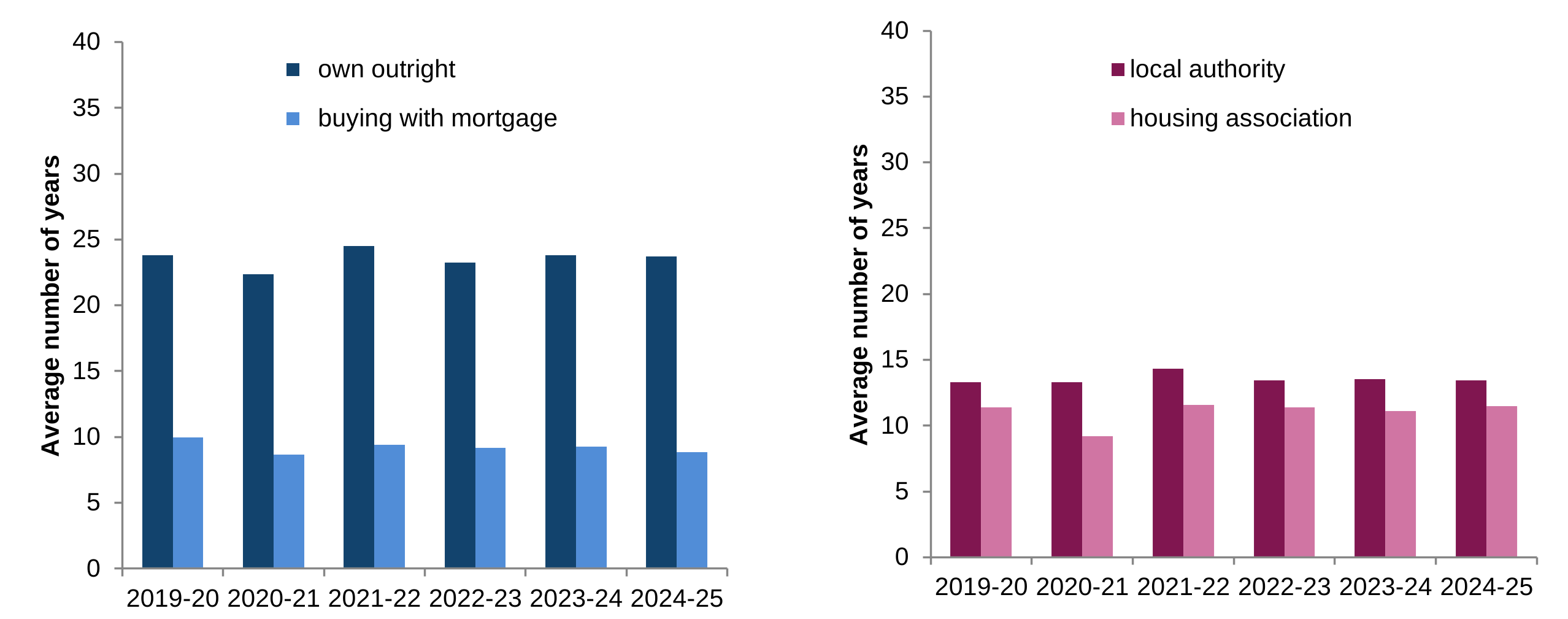
In 2024-25, the average length of time households spent in their current home was 13.9 years. By tenure, owner occupiers lived in their current home for the longest, an average of 17.0 years, social renters an average of 12.2 years and private renters 4.7 years, Annex Table 3.6.
Outright owners lived in their property for an average of 23.7 years, longer than owner occupiers buying with a mortgage (8.9 years). Among social renters, local authority tenants (13.5 years) lived in their homes longer than those in housing association homes (11.5 years). There were no significant differences between 2023-24 and 2024-25 in any of the tenures, Figure 3.3.
Compared to five years ago, mortgagors were in their homes for a shorter amount of time (8.9 years in 2024-25 compared with 10.0 years in 2019-20).
Figure 3.3: Average number of years in current home, owner occupiers and social renters, 2019-20 to 2024-25
Base: all households
Notes:
1) underlying data are presented in Annex Table 3.6
Source: English Housing Survey, full household sample
Household moves
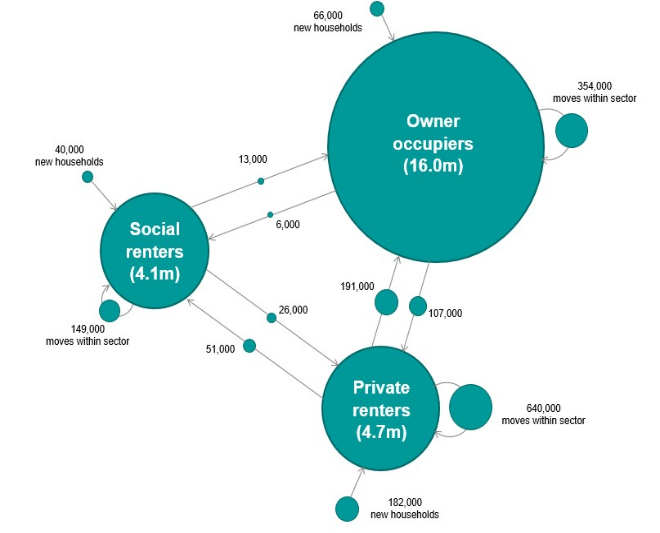
In 2024-25, approximately 1.8 million households moved home in the previous 12 months. Around half of these were moves into or out of private rented dwellings. In total, 640,000 households moved within tenure (from one privately rented home to another) and 182,000 new households moved into the private rented sector, Figure 3.4.
There was less movement in the social rented and owner occupied sectors. In 2024-25, there were 149,000 households that moved from one social rented property to another, and 40,000 new households moved into the sector.
In the owner occupied sector, 354,000 households moved within the tenure and 66,000 new households were created by moving into the sector. There were 191,000 households that moved into the tenure from the private rented sector, Annex Table 3.7.
Figure 3.4: Household moves, by tenure, 2024-25
Base: household reference persons resident less than a year
Notes:
1) underlying data are presented in Annex Tables 1.1 and 3.7
2) a small number of cases with inconsistent responses have been omitted
3) survey cannot identify the number of households which have ended
Source: English Housing Survey, full household sample
Underlying Data
For data underlying this report, see the Annex tables. For the charts in this report, see Figures.
Technical notes and glossary
For technical information, please see the technical notes.
For a detailed glossary of terms please see the glossary.